Introduction
In general, hermaphroditic flowering plants produce more flowers than they have resources to mature into fruits, i.e. the fruit:flower ratio (and the seed:ovule ratio) is low, with outcrossers having lower fruit:flower and seed:ovule ratios than selfers (Willson and Price, Reference Willson and Price1977; Stephenson, Reference Stephenson1979, Reference Stephenson1980, Reference Stephenson1981; Udovic and Aker, Reference Udovic and Aker1981; Bawa and Webb, Reference Bawa and Webb1984; Bookman, Reference Bookman1984; Sutherland and Delph, Reference Sutherland and Delph1984; Wiens, Reference Wiens1984; Sutherland, Reference Sutherland1986, Reference Sutherland1987; Wiens et al., Reference Wiens, Calvin, Wilson, Davern, Frank and Seavey1987; Ganeshaiah and Shaanker, Reference Ganeshaiah and Shaanker1988; Shaanker et al., Reference Shaanker, Ganeshaiah and Bawa1988; Ayre and Whelan, Reference Ayre and Whelan1989; Bawa and Buckley, Reference Bawa, Buckley, Stirton and Zarcchi1989; Burd, Reference Burd1998; Shelton, Reference Shelton2008). The ecological and evolutionary question is why this group of seed plants produces an excess of flowers and ovules, which might on first thought seem to be wasteful. However, various hypotheses (see below), which may not be mutually exclusive, have been proposed to account for this phenomenon (Willson and Rathcke, Reference Willson and Rathcke1974; Janzen, Reference Janzen1977; Willson and Price, Reference Willson and Price1977; Sutherland and Delph, Reference Sutherland and Delph1984; Bawa and Webb, Reference Bawa and Webb1984; Lee, Reference Lee1984; Holtsford, Reference Holtsford1985; Sutherland, Reference Sutherland1986, Reference Sutherland1987; Kozlowski and Stearns, Reference Kozlowski and Stearns1989; Burd, Reference Burd1998, Reference Burd2004; Burd and Callahan, Reference Burd and Callahan2000).
Six of the hypotheses are as follows. (1) Pollinator (pollen) limitation. An increase in amount of pollen received would increase fruit/seed set. (2) Pollinator attraction. A greater number of flowers would increase attractiveness and/or rewards and thus ensure adequate pollination. This ‘attraction’ hypothesis requires that without production of excess flowers, seed set per flower be pollen limited. (3) Bet-hedging. This phenomenon results in long-term maximization of offspring numbers in a randomly varying environment. For example, surplus flowers may allow an increase in fruit/seed production during the occasional (but unpredictable) years of pollinator/resource abundance. The increase in fruit/seed production in a year when resources are not limiting must offset the cost of excess flower production in years (most of them) when pollinators or resources are limiting. To demonstrate bet-hedging, it must be shown that production of excess flowers decreases the variance in, for example, the number of offspring left per generation [Ro (from life table), a measure of fitness], and thus increases the geometric mean of the number of offspring across generations in the long term at a cost of lowering the arithmetic mean in the short term (Philippi, Reference Philippi1993; Seger and Brockmann, Reference Seger and Brockmann1987; Simons, Reference Simons2011; Gremer et al., Reference Gremer, Crone and Lesica2012). (4) Pollen donation (male function, sensu Burd and Callahan, Reference Burd and Callahan2000). Surplus flowers are functionally staminate, and they increase male fitness via increase in pollen (male gamete) production/dispersal, resulting in siring more seeds on other plants. (5) Reproductive assurance (reserve ovary, sensu Ehrlén, Reference Ehrlén1991). Excess flowers, i.e. those that otherwise would not produce seeds, do so when other flowers or fruits are damaged by herbivores, pathogens or weather. The maternal plant compensates for loss of ovaries by increasing the seed:ovule ratio in the remaining (not damaged or eaten) ovaries. Thus, excess flowers ensure seed set when other flowers fail to produce fruit. This hypothesis differs from the one on bet-hedging (Ecological windows, sensu Ehrlén, Reference Ehrlén1991) in that it provides a way for the maternal plant to increase the seed:ovule ratio of the remaining (excess) flowers in a given year (i.e. within a generation), while bet-hedging is concerned with generation to generation continuation of the population in stochastic environments. (6) Selective abortion (selective fruit/seed maturation). The general focus of our review is on this hypothesis as it relates to offspring quality (see below). Several studies on selective abortion have included seed germination, usually along with other early life history traits of the progeny. Our primary aim was to review the literature on the effect of selective abortion on seed germination and post-germination offspring vigour.
Selective abortion refers to the phenomenon in which lower quality genotypes are aborted and higher quality genotypes are retained (matured), thereby increasing offspring quality and thus fitness of the mother plant. Excess flowers would provide a larger pool (‘wider choice’) from which high quality seeds could be selected in all years, provided that the offspring vary in fitness, the variation can be ‘recognized’ by the mother at an early stage of development (at which time investment of resources in the zygote/embryo is low) and the mother aborts the embryos with low fitness expectations in order to invest more resources in embryos with high fitness expectations.
This hypothesis assumes that female reproduction is resource limited. That is, plants abort a portion of their ovules because they do not have the resources to mature all of them. Based on the pollen competition hypothesis (reviewed by Baskin and Baskin, Reference Baskin and Baskin2015), Lee (Reference Lee1984; see also Bawa and Buckley, Reference Bawa, Buckley, Stirton and Zarcchi1989) hypothesized that ovules of fruits that mature a high number of seeds are fertilized by the fastest growing (genetically most fit) microgametophytes (via pollen competition) and that these fruits are more likely to mature and to give rise to more vigorous offspring than fruits that mature a lower number of seeds (no pollen competition) – known as his selective fruit maturation hypothesis.
Methodology – a brief note on determining selective abortion
If seed quality is regulated by selective (non-random) abortion, non-aborted seeds of natural patterns of abortion (self-thinning of flowers/ovules by maternal plant) should be of higher quality than those of non-aborted seeds resulting from random hand-thinning of flowers/ovules, which presumably obscures any discrimination that would otherwise occur (see Burd, Reference Burd2004). Furthermore, offspring from seeds retained (non-aborted) in cases of non-random thinning of flowers should have greater mass, and the seedlings derived from them should exhibit better growth and survival than those retained from seeds of randomly thinned flowers/ovules. Thus, one method used to test for selective abortion is to randomly hand-remove excess flowers on the whole plant or inflorescence (treatment) and compare offspring quality with that of plant or inflorescence from which flowers have not been hand-removed (control, flowers/ovules selectively removed by maternal plant). Random hand-removal of flowers (treatment) should lower the overall quality of the offspring, providing the maternal plant in the control a ‘wider choice’ of high quality zygotes/embryos from which to select than the maternal plant in the treatment. As a result, offspring quality is expected to be higher in the control than in the treatment. Other methodology used to test for selective abortion is included along with the results of the 14 case studies covered in this review, e.g. in the ones on Phaseolus coccineus, Bauhinia ungulata and Cryptantha flava. Note that the majority of studies on seed abortion discussed in this short communication are on legumes (Fabaceae). The linear arrangement of ovules/seeds between the peduncular (basal) and stylar ends of the legume fruit (pod) makes them easy to count.
Results
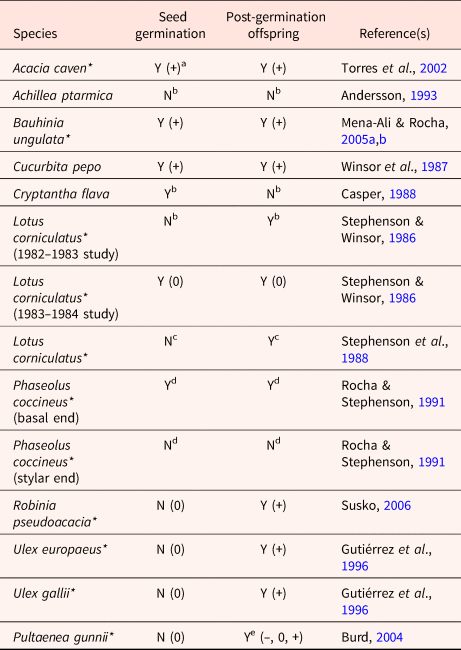
The results of our survey on the effect of selective abortion on seed germination and post-germination performance of offspring are summarized in Table 1. Fruits from self (non-randomly)-thinned inflorescences of Lotus corniculatus (Fabaceae) contained more seeds than those from hand (randomly)-thinned inflorescences. Seeds from the non-randomly selected fruits germinated to higher percentages (and also produced more vigorous offspring) than those from randomly selected fruits, i.e. selective seed abortion via selective fruit abortion (Stephenson and Winsor, Reference Stephenson and Winsor1986). In another study on Lotus corniculatus, germination percentage did not differ between seeds produced by self-thinned and hand-thinned flowers on inflorescences, i.e. abortion was not selective for germination. However, self-thinned (control) inflorescences matured a much higher percentage of the remaining (non-aborted) fruits than did hand-thinned (treatment) inflorescences. Selective abortion also had an effect on offspring growth and biomass: control (self-thinned) > treatment (hand-thinned) (Stephenson et al., Reference Stephenson, Johnson and Winsor1988).
Effect of selective abortion on seed germination and post-germination performance of offspring in 14 case studies on 11 species and 10 genera of angiosperms. Y, positive effect; N, no effect. Species marked with an asterisk belong to the Fabaceae

a –, 0 and + indicate negative, zero and positive influence, respectively, of seed mass on germination and post-germination offspring vigour of a species. b No information on effect of seed size. c Similar-sized seeds from hand-thinned and self-thinned inflorescences were used, i.e. study controlled for seed size effects. d Seed mass was used as a covariate in the analyses, and thus the difference in progeny performance is independent of seed mass. e Seed mass had various effects on post-germination offspring vigour depending on which performance trait was measured (e.g. seedling height or seedling survivorship) and when (e.g. seedling survival at 30 or 90 days), thus –, 0, +.
In Cucurbita pepo (Cucurbitaceae), fruits produced by flowers with high pollen loads on the stigma (pollen competition) were more likely to mature (and to mature more seeds) than those from fruits produced by flowers with low pollen loads on the stigma (no pollen competition). Furthermore, seeds produced by high pollen loads germinated and emerged more rapidly (and the resulting seedlings were more vigorous) than those produced by low pollen loads (Winsor et al., Reference Winsor, Davis and Stephenson1987). The authors concluded that their results support Lee's (Reference Lee1984) hypothesis of selective fruit maturation. Seeds of Cryptantha flava (Boraginaceae) allowed to selectively mature germinated (seedlings emerged) to a significantly higher percentage than those not allowed to selectively mature, i.e. selective abortion had a positive effect on germination (Casper, Reference Casper1988). However, selective abortion did not have much effect on post-emergence growth and survival.
In Phaseolus coccineus (Fabaceae), the three ovules at the stylar end of the ovary are more likely to mature seeds than the three ovules at the basal (peduncular) end (Rocha and Stephenson, Reference Rocha and Stephenson1990, Reference Rocha and Stephenson1991). There was an increase in percentage of mature seeds in basal ovules when stylar ovules were destroyed, which indicates that some viable stylar embryos were aborted. On the other hand, there was no change in percentage of mature seeds in stylar ovules when basal ovules were destroyed, which indicates that no stylar ovules were aborted. Days to seedling emergence in basal seeds in which the probability of seed maturation was increased by destruction of seeds in the stylar position, i.e. slow germinators allowed to mature. Thus, selective abortion had a positive effect on germination rate (speed) in basal end of fruit (Rocha and Stephenson, Reference Rocha and Stephenson1991). Furthermore, destruction of basal ovules did not increase post-germination offspring performance of stylar offspring, whereas destruction of stylar ovules increased post-germination of basal offspring, demonstrating selective abortion for seeds at basal end of the fruit. Andersson (Reference Andersson1993) found no evidence that abortion selectivity affected seed viability (germinability) or number of leaves or capitula of progeny of Achillea ptarmica (Asteraceae).
In Ulex europaeus and U. gallii (Fabaceae), the probability of an ovule producing a mature seed was dependent on its position in the ovary. It was highest for ovules at the stylar end and lowest for those at the peduncular (basal) end. The heaviest seeds more frequently were at the central and stylar positions in the fruit and the lightest ones at the peduncular position. However, seed mass did not have a significant effect on germination, and thus abortion was not selective for germination. On the other hand, seedling mass was dependent on seed mass, being highest for the largest seeds and lowest for the smallest ones. Thus, it seems that, at least indirectly, there was selective abortion for seedling vigour (Gutiérrez et al., Reference Gutiérrez, Menéndez and Obeso1996). Seeds from inflorescences of Acacia caven (Fabaceae) that initiated several fruits (pods) and naturally (non-randomly) self-thinned to one pod germinated to 60%, whereas seeds from inflorescences (randomly) hand-thinned to one pod germinated to only about 30%, i.e. selective maturation of fruits with seeds that germinated to a high percentage. Furthermore, seedlings from self-thinned inflorescences were more vigorous than those that were hand-thinned (Torres et al., Reference Torres, Eynard, Aizen and Galetto2002).
The pattern of seed abortion in fruits of Bauhinia ungulata (Fabaceae) was non-random, with the highest level of abortion and lowest level of seed maturation at the basal (peduncular) end of the fruit and with lowest level of abortion and highest level of fruit maturation at the stylar end of the fruit (Mena-Ali and Rocha, Reference Mena-Ali and Rocha2005a; see also Webb and Bawa, Reference Webb and Bawa1985). In an experiment that tested for selective (non-random) seed abortion on offspring performance, germination percentage was significantly higher in control (no ovules destroyed) and in seeds with peduncular (basal) ovules (high probability of natural abortion) destroyed than in stylar ovules (low probability of abortion) destroyed. That is, germination percentage of control seeds was equal to germination percentage of seeds from fruits in which basal ovules were destroyed but greater than those from fruits in which stylar ovules were destroyed (Mena-Ali and Rocha, Reference Mena-Ali and Rocha2005b). Thus, (1) low quality seeds were selectively (non-randomly) aborted in the control, leaving the high quality seeds to germinate; (2) low quality seeds at the basal end of the fruit were destroyed (by hand), increasing the high quality seed:low quality seed ratio and thus germination percentage; and (3) high quality seeds at the stylar end of the fruit were destroyed (by hand), increasing the low quality:high quality seed ratio and thus decreasing germination percentage. Seed position affected seed size: control > basal > stylar, and seed size had a significant positive effect on days to germination and on some aspects of seedling vigour (e.g. days to produce the first leaf).
The probability of a Robinia pseudoacacia (Fabaceae) seed maturing depended on its position in the fruit, with most seeds maturing at the stylar end and the least at the peduncular (basal) end. The pattern of undeveloped seeds was the reverse of that of seed maturation. Seed mass differed significantly among the four-ovule position-classes, i.e. 1 (basal) < (2 = 3) > 4 (stylar), but there was no effect of seed mass on germination (Susko, Reference Susko2006). Thus, the non-random pattern of seed maturation had no effect on seed germination. On the other hand, seed mass was positively correlated with seedling growth, and thus ovule position influenced post-germination offspring vigour.
Burd (Reference Burd2004) tested the ‘wider choice’ mechanism (which assumes fruit set is not pollen limited) that female fitness in hermaphroditic plants is increased by an excess of flowers, whereupon more ovaries are exposed to selective abortion, thereby increasing offspring quality. Thus, he determined whether there are relationships between production of excess flowers and offspring quality in the shrub Pultaenea gunnii (Fabaceae). Germination percentage of seeds (scarified to break physical dormancy, which synchronizes germination, and may override any differences in germination of intact seeds) was very high regardless of the number of non-fruiting flowers per plant (0 to >200) or number of aborted immature fruits per plant (0 to >50), two measures of excess flowers. On the other hand, there was a significant positive linear relationship between number of aborted flowers and maternal family mean seed mass and a significant negative linear relationship between maternal family mean offspring survivorship (90 days) and number of aborted flowers. However, there was no relationship between maternal family mean seedling height and number of aborted ovules or between maternal family mean seed mass, seedling height or survivorship and number of aborted immature fruits. Furthermore, there was a non-linear relationship between both maximum (i.e. highest value within a maternal family) seed mass and maximum seedling height (30 days) and number of non-fruiting flowers. The curve for both maximum seed mass and maximum seedling height plateaued at about 50 non-fruiting flowers and then remained flat to the maximum number (>200). The results were similar for maximum seedling height vs number of aborted juvenile fruits, with the non-linear curve plateauing at <10 aborted fruits and then remaining flat to the maximum number (>50). Burd (Reference Burd2004) stated that the curve for seed mass vs number of aborted fruits ‘… appears only trivially different from a flat line…’.
Burd (Reference Burd2004; also see Burd, Reference Burd1998) concluded that the non-linear increase in maximum seed mass and maximum seedling height (30 days) within a family in response to excess flower number is consistent with the wider choice model but that his results ‘… suggest that wider choice alone could not account for the evolution of flower display size in this population’. In other words, the number of excess flowers was far greater than that required to maximize offspring fitness.
To sum up, germination and post-germination offspring vigour increased in six and 11 of the 14 case studies, respectively, and did not increase (or decrease) in eight and three, respectively (Table 1). The effects of seed mass on offspring performance were considered in 11 of the 14 case studies; information was not provided on effects of seed mass in the other three case studies. For only three of the 11 case studies did seed mass have a positive effect on germination, and in the other eight it had no effect. For six of the 11 case studies, seed mass had a positive effect on post-germination offspring performance, no effect on four and a variable effect on one (Pultaenea gunnii), depending on the trait and when it was measured.
Concluding remarks
Several studies have demonstrated that maternal plants of various taxa of angiosperms can selectively abort low quality seeds and selectively mature high quality ones, thereby increasing the early life history components of offspring fitness (germination, seedling/juvenile growth). In studies of selective seed abortion, seed mass is more likely to influence the results of post-germination offspring performance than it is to influence germination. Although the selective abortion hypothesis seems to be consistent with the ‘wider choice’ mechanism, it does not appear to provide a full explanation for the large excess of flowers produced by many hermaphroditic plants. It remains to be shown what impact (if any) selective abortion has on global fitness or that it has significant ecological and evolutionary consequences.