Background
An increasing number of studies of cognitive behaviour therapy (CBT) have reported on positive outcomes for people with schizophrenia. Zimmerman et al. (Reference Zimmerman, Favrod, Trieu and Pomini2005) in a meta-analysis of 14 studies of CBT for psychosis conducted between 1990 and 2004 concluded that CBT showed significant benefits in reducing positive symptoms. However, most of the extant studies have focused on participants with chronic schizophrenia (e.g. Kuipers et al. Reference Kuipers, Garety, Fowler, Dunn, Bebbington, Freeman and Hadley1997; Sensky et al. Reference Sensky, Turkington, Kingdon, Scott, Scott, Siddle, O'Carroll and Barnes2000).
Few CBT studies have focused on participants in either the early or acute phase of psychotic illness. Five studies are relevant in this regard (Drury et al. Reference Drury, Birchwood, Cochrane and Macmillan1996; Jackson et al. Reference Jackson, McGorry, Edwards, Hulbert, Henry, Francey, Maude, Cocks, Power, Harrigan and Dudgeon1998, Reference Jackson, McGorry, Edwards, Hulbert, Henry, Harrigan, Dudgeon, Francey, Maude, Cocks, Killackey and Power2005; Lewis et al. Reference Lewis, Tarrier, Haddock, Bentall, Kinderman, Kingdon, Siddle, Drake, Everitt, Leadley, Benn, Grazebrook, Haley, Akhtar, Davies, Palmer, Faragher and Dunn2002; Jolley et al. Reference Jolley, Garety, Craig, Dunn, White and Aitken2003). Drury et al. (Reference Drury, Birchwood, Cochrane and Macmillan1996) included participants in the acute phase of their admission to hospital although two-thirds of their sample had chronic histories and multiple episodes. CBT was superior to an activities control condition at the 9-month follow-up. However, no significant differences between the two conditions existed at the 5-year follow-up (Drury et al. Reference Drury, Birchwood and Cochrane2000).
The large-scale SoCRATES (Study of Cognitive Realignment Therapy in Early Schizophrenia) trial investigated CBT in first- and second-episode participants in the acute treatment phase (Lewis et al. Reference Lewis, Tarrier, Haddock, Bentall, Kinderman, Kingdon, Siddle, Drake, Everitt, Leadley, Benn, Grazebrook, Haley, Akhtar, Davies, Palmer, Faragher and Dunn2002). A total of 315 participants were allocated randomly to one of three groups: CBT, treatment as usual (TAU), and supportive counselling. Participants were drawn from 11 mental health units serving three geographically defined catchment areas. The CBT group only showed significant improvements on hallucinations at 5 weeks after baseline. At the 10-week assessment there were no significant differences between the three study conditions in improvements over time. At the 18-month follow-up, CBT and supportive counselling were superior to TAU on symptom measures (Tarrier et al. Reference Tarrier, Lewis, Haddock, Bentall, Drake, Kinderman, Kingdon, Siddle, Everitt, Leadley, Benn, Grazebrook, Haley, Akhtar, Davies, Palmer and Dunn2004).
A more recent pilot study conducted with early psychosis participants compared CBT (n=12) with TAU (n=9) (Jolley et al. Reference Jolley, Garety, Craig, Dunn, White and Aitken2003). Although both groups improved, there were few group differences and high levels of individual variation. The authors concluded that CBT may be better suited to people whose recovery is incomplete.
Our past work with Cognitively Oriented Psychotherapy for Early Psychosis (COPE) focused exclusively on a first-episode population in the recovery phase. In contrast to the above studies, COPE did not target positive psychotic symptoms. Instead, in the wake of a first episode of psychosis, COPE attempted to improve adjustment, reduce secondary morbidity and improve perceptions of attitudes towards illness. A non-randomized controlled trial (non-RCT) with COPE found some differences favouring COPE over two control conditions (Jackson et al. Reference Jackson, McGorry, Edwards, Hulbert, Henry, Francey, Maude, Cocks, Power, Harrigan and Dudgeon1998), which were mostly lost at the 1-year follow-up (Jackson et al. Reference Jackson, McGorry, Henry, Edwards, Hulbert, Harrigan, Dudgeon, Francey, Maude, Cocks and Power2001). In a controlled trial, COPE was compared with TAU (Jackson et al. Reference Jackson, McGorry, Edwards, Hulbert, Henry, Harrigan, Dudgeon, Francey, Maude, Cocks, Killackey and Power2005), but no significant differences were found between them at the end of treatment.
It might be concluded from these studies that CBT is not an effective treatment for either acute or first-episode psychosis (FEP). However, they have a number of limitations that might contribute to their lack of positive findings. Several studies had small sample sizes with insufficient power to reliably detect significant effects (e.g. Jackson et al. Reference Jackson, McGorry, Edwards, Hulbert, Henry, Francey, Maude, Cocks, Power, Harrigan and Dudgeon1998; Jolley et al. Reference Jolley, Garety, Craig, Dunn, White and Aitken2003). In the large-scale SoCRATES trial, considerable variability in background treatment (e.g. medication, case management, provision of family therapy) across the different mental health units may have occurred. Therefore, the specific effects of CBT may have been masked by the wide variability in improvement due to the different treatment settings. In fact, Tarrier et al. (Reference Tarrier, Lewis, Haddock, Bentall, Drake, Kinderman, Kingdon, Siddle, Everitt, Leadley, Benn, Grazebrook, Haley, Akhtar, Davies, Palmer and Dunn2004) noted significant centre by treatment interactions at the 18-month follow-up. A further limitation is that some studies used only a TAU control condition, which may have failed to control for non-specific factors such as increased therapist contact (Bendall et al. Reference Bendall, Jackson, Killackey, Allott, Johnson, Harrigan, Gleeson and McGorry2006).
A true test of the efficacy of CBT for acute FEP would be a randomized trial conducted within one setting, with adequate sample size and an appropriate manualized control treatment. This would maximize the chances of detecting an effect of CBT if one was present, and would enable replication of the trial. The current study was conducted to address these issues. It involved an RCT of CBT versus Befriending for patients in the acute phase of their first episode of psychosis within a single treatment setting.
The study hypotheses were that: (1) treating FEP patients in the acute phase with CBT would lead to faster reductions in positive and negative symptoms and more rapid improvement in functioning than a Befriending comparison group; (2) improvements in symptoms and functioning effected by CBT would be sustained at the 1-year follow-up compared to those by Befriending; and (3) CBT would lead to fewer hospitalizations and to shorter duration in hospital than Befriending from end-of-treatment to the 1-year follow-up.
Method
Sample
The study was conducted at the Early Psychosis Prevention and Intervention Centre (EPPIC; McGorry et al. Reference McGorry, Edwards, Mihalopoulos, Harrigan and Jackson1996), a subprogram of ORYGEN Youth Health, which serves the north-western metropolitan region of Melbourne, Australia. EPPIC is a comprehensive treatment service for 15–25-year-old people experiencing a first episode of psychosis. It includes a 16-bed in-patient unit, an out-patient case management system, family work, accommodation, prolonged recovery programmes and tailored group programmes (Edwards & McGorry, Reference Edwards and McGorry2002). Medication is administered in line with a low-dose protocol (McGorry et al. Reference McGorry, Killackey, Elkins, Lambert and Lambert2003). Ethics approval to conduct the study was received from the Northwestern Mental Health Behavioural and Psychiatric Research and Ethics Committee.
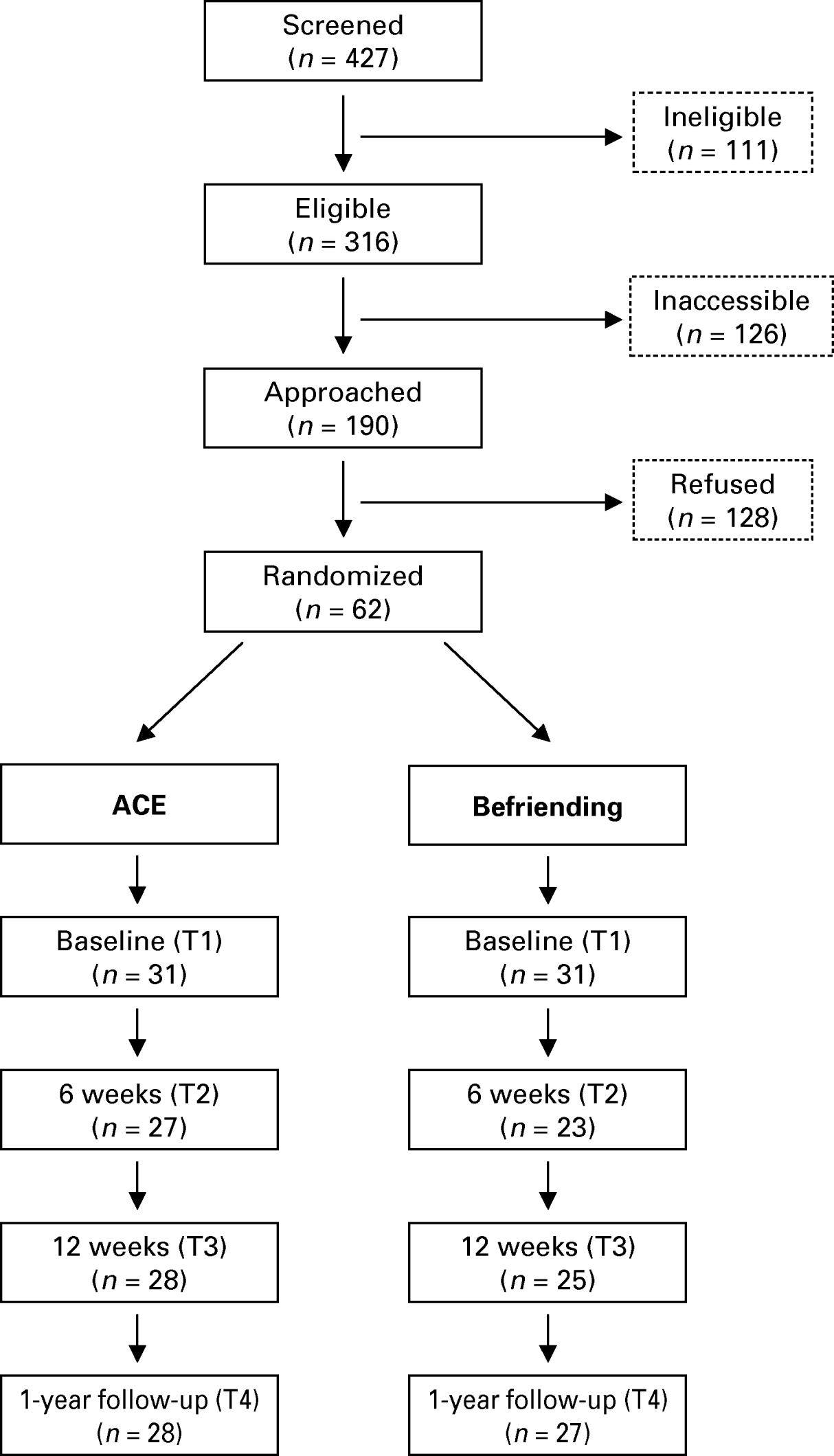
Consecutive patients admitted to EPPIC within 4 weeks of their acceptance to the service were screened for eligibility between August 2001 and September 2003 (n=427). Patients were excluded (before randomization) if any of the following criteria were met: inability to speak English; intellectual disability (IQ <70); psychosis due to a medical condition; change to a non-psychotic diagnosis; left the EPPIC catchment area; treatment from a private psychiatrist/psychologist; participating in a first-episode mania trial; exhibiting violent behaviour; or being incarcerated (n=111). One hundred and twenty-six individuals could not be approached within 4 weeks (e.g. no response to telephone calls/letters, non-attendance at appointments) and were excluded because the trial required therapy commencement within 6 weeks of admission. Therefore, 190 individuals were approached for inclusion in the study, but 128 people refused participation. Basic demographic and diagnostic data were collected for these individuals. Sixty-two individuals gave written informed consent to participate in the study (see Fig. 1).
Recruitment flowchart.

Participants completed a baseline interview with a research assistant (RA) to determine diagnosis, current medication, symptomatology and life functioning. Further assessments were conducted at 6 weeks, 12 weeks and 15 months after baseline (i.e. 1 year after therapy). Participants were paid $AU20 for the 1-year follow-up interview. RAs were blind to treatment conditions and blindness was tested following the therapy intervention.
Measures
The following demographic and illness-related variables were assessed: gender, age, education, marital status, age of onset of illness, duration of untreated psychosis, in-patient hospitalizations, average daily dose of neuroleptics, and receipt of electroconvulsive therapy (ECT). Primary psychotic and any other current or lifetime Axis I diagnoses were made using the Structured Clinical Interview for DSM-IV-TR Axis 1 Disorders – Patient Edition (SCID; First et al. Reference First, Spitzer, Gibbon and Williams2001).
Positive psychotic symptoms were measured using the Psychotic Subscale (Harrigan et al. Reference Harrigan, McGorry and Krstev2003) of the Brief Psychiatric Rating Scale (BPRS; Ventura et al. Reference Ventura, Lukoff, Nuechterlein, Liberman, Green and Shaner1993). The Scale for the Assessment of Negative Symptoms (SANS) was used to assess negative psychotic symptoms (Andreasen, Reference Andreasen1984). Life functioning was measured using the Social and Occupational Functioning Assessment Scale (SOFAS; APA, 1994). Inter-rater reliability was assessed in a subset of participants for positive and negative symptoms (n=10) using a mixed two-way intra-class correlation (McGraw & Wong, Reference McGraw and Wong1996), with uniformly very high results (positive symptoms=0.93; negative symptoms=0.94).
Intervention
Following the baseline assessment, participants were allocated randomly to one of two manualized treatment conditions: a CBT condition called Active Cognitive Therapy for Early Psychosis (‘ACE’; Bendall et al. Reference Bendall, Killackey, Marois and Jackson2005) or a control condition called ‘Befriending’ (Bendall et al. Reference Bendall, Killackey, Jackson and Gleeson2003). Participants were also allocated randomly to one of two clinical psychologists (E.K., S.B.) who delivered both treatments. The therapists received 3 months of training in the treatments and were supervised throughout the trial. Both therapists treated almost identical numbers of participants in both conditions. Randomization was stratified according to affective and non-affective psychotic diagnosis to ensure equal distribution across therapists and treatment conditions. The randomization process was conducted by an independent statistician. Participants could receive a maximum of 20 sessions of therapy over 14 weeks (but no more than 2 weeks past the 12-week assessment) for approximately 45 minutes each session. To maximize engagement and collaboration with the participant, therapy sessions were delivered flexibly across a range of settings (i.e. participant's own home, neutral location, EPPIC). However, the therapist decided on the timing and duration of therapy sessions depending on the presentation and needs of the participant. In addition, all participants received case management, medical assessment and treatment, and other EPPIC services as usual.
ACE
ACE therapy involved an assessment of the presenting psychotic and non-psychotic complaints followed by a formulation of the relationship between these complaints and the participant's life history. Problems were prioritized according to a flowchart that directed the ACE therapy. Any issues of risk were considered a priority. Positive psychotic symptoms, if they were present and distressing, were the next priority, followed by co-morbidities, negative symptoms, issues of identity and relapse prevention. Each area of difficulty was treated from a broadly cognitive-behavioural perspective. Ongoing engagement was essential throughout the therapy process. This involved a flexible approach to the timing, location and content of therapy. For example, therapy might have included going for a bike ride, or being conducted at the participant's home. The therapy was adapted from the work of Kingdon & Turkington (Reference Kingdon and Turkington1994), Chadwick et al. (Reference Chadwick, Birchwood and Trower1996) and Fowler et al. (Reference Fowler, Garety and Kuipers1997). It also drew on other cognitive work conducted at EPPIC that aimed to assist the adaptation of the individual to psychosis (e.g. COPE; Henry et al. Reference Henry, Edwards, Jackson, Hulbert and McGorry2002). A comprehensive description of ACE can be found in the ACE manual (Bendall et al. Reference Bendall, Killackey, Marois and Jackson2005).
Befriending
Befriending aimed to control for time in therapy, participant expectations and positive experiences of therapy. Based on the Befriending therapy used by Sensky et al. (Reference Sensky, Turkington, Kingdon, Scott, Scott, Siddle, O'Carroll and Barnes2000), Befriending consisted of talking about neutral topics that interested the participant, such as music, sport, books, cooking and pets. If the participant found verbal interaction difficult, the participant and therapist engaged in activities such as board games, walking, or playing sport, with a view to using the activity as a tool to engage the participant in further neutral conversation during and after the activity. The therapist's primary goals were to keep the participant engaged for the full duration of therapy and to keep the conversation or activity as close to a neutral ‘pleasant chat’ as possible. When emotionally loaded topics arose, such as symptoms or interpersonal problems, the therapist gently redirected the participant to more neutral topics. Befriending was used in this trial because it was directive; thus, therapists could control the conversation and redirect acutely psychotic participants from unstructured discussion of their psychotic symptoms, which may have been detrimental to them.
Treatment integrity and satisfaction
Treatment adherence was measured using the Cognitive Therapy Rating Scale (CTRS; Young & Beck, Reference Young and Beck1988). Three hundred and fifty-nine therapy sessions were audio-taped and 99 of these (51 ACE and 48 Befriending) were selected randomly and rated by a clinical psychology doctoral student who was blind to treatment allocation. Forty-seven sessions were re-rated by another clinical psychology doctoral student also blind to treatment allocation. The number and length of therapy sessions were recorded. After therapy was completed, a satisfaction questionnaire was given to participants. The scale consisted of five questions, with each response rated on a five-point Likert scale representing different aspects of participant satisfaction.
Power analysis and sample size
The original study protocol contained power calculations based on results from the two most relevant studies (Drury et al. Reference Drury, Birchwood, Cochrane and Macmillan1996; Jackson et al. Reference Jackson, McGorry, Edwards, Hulbert, Henry, Francey, Maude, Cocks, Power, Harrigan and Dudgeon1998). It was noted then that the design of both studies was not completely comparable to the proposed ACE trial (the former identified large treatment effects of 0.95 s.d. for positive symptoms, but contained no results for negative symptoms or for functioning; the latter had effects of around 0.50 s.d. but treatment was not offered until 8 weeks after admission). A conservative medium standardized effect size (0.50) was therefore used in the protocol with an α of 0.05, resulting in a desired sample size of 64 for each treatment condition for achieving 80% power.
The sample size per condition over the 2 years of recruitment ended up being approximately half of that originally sought. In these circumstances, standardized effects would need to be around 0.70 s.d. for power to be maintained at the 80% level. For the conservative medium-sized effect, power now equals 0.49, and therefore the study is under-powered when α is maintained at the 0.05 level.Footnote †
Treatment of missing data and planned data analysis
All 62 participants completed baseline assessments, but subsequent to enrolment in the study, seven participants from Befriending and four from ACE withdrew from treatment for a variety of reasons (details available from the first author). No statistically significant association was found at the 5% level between treatment group and whether or not participants were missing at any time point after the pretreatment period (time 2, χ21=1.85, p=0.20; time 3, χ21=1.17, p=0.28; time 4, χ21=0.16, p=0.69). Data analyses were performed on all 62 participants and follow-up interviews were conducted where possible, regardless of whether they had withdrawn. Two participants in ACE committed suicide after completion of treatment during the follow-up period.
Missing values in each of the outcome measures for any individual at time points subsequent to baseline were assumed to have occurred at random, given observed pretreatment scores. Ten multiply imputed (MI) datasets were generated using the PAN package (Schafer, Reference Schafer, Collins and Sayer2001) in the R statistical software program (2007) to deal with these missing responses.
Investigation of the first and second study hypotheses mirrored the approach in Jackson et al. (Reference Jackson, McGorry, Edwards, Hulbert, Henry, Harrigan, Dudgeon, Francey, Maude, Cocks, Killackey and Power2005). Planned interaction contrasts were specified for the differential treatment of ACE versus Befriending on outcome measures from (a) pretreatment to mid-treatment, (b) pretreatment to end-of-treatment, and (c) end-of-treatment to 1-year follow-up. These contrasts measure the differential treatment effect occurring between each time period that is over and above any main effect treatment differences.
Standardized mean difference effect sizes were calculated for these planned contrasts using the PSY statistical program (Bird et al. Reference Bird, Hadzi-Pavlovic and Isaac2000; Bird, Reference Bird2004). A negative effect size contrast value for both positive and negative symptoms indicates a larger reduction (i.e. improvement) for ACE compared to Befriending from one time point to the next. A positive effect size value for SOFAS indicates a differentially larger increase in social and occupation functioning (i.e. improvement) for ACE.
Separate analyses of the 10 MI datasets provided 10 standardized estimates and standard errors for each planned contrast. These values were then combined using Rubin's (Reference Rubin1987) rules for scalar estimands to obtain a mean standardized effect estimate over all 10 MI datasets. Finally, a 95% confidence interval (CI) was calculated for each mean standardized contrast effect using Rubin's (Reference Rubin1987) Student's t approximation (for a didactic summary of Rubin's rules for combining scalar estimates and standard errors in multiple imputation, see Schafer & Graham, Reference Schafer and Graham2002, pp. 166–166).
The third study hypothesis was investigated using regression models for count data in which treatment group was the single independent variable. The number of hospital admissions between end-of-treatment and follow-up was assessed using a negative binomial regression model, and a zero-inflated negative binomial regression model was used for the total number of days hospitalized during these admissions. Both regression models were fitted using Stata 9.2 (StataCorp, 2005), and 95% CIs were obtained using the same method as that used for the first and second hypotheses.
Results
Demographic, illness and therapy variables
Refusers versus participants
Participants (n=62) and refusers (n=128) were compared on several demographic and illness variables. There was no significant association between the two groups on age, gender or marital status (p⩾0.10 in all instances). There was a significantly smaller proportion of students in the participant group (11.3%) than in the refuser group (25.8%; p=0.03). There was also a significant association between participant status and diagnosis (p=0.002). The participant group contained fewer patients with schizophreniform disorder (40.3%) than expected by chance (refusers=62.7%). There were also significantly more patients with schizo-affective disorder in the participant group (11.3%) than in the refuser group (1.6%).
ACE participants versus Befriending participants
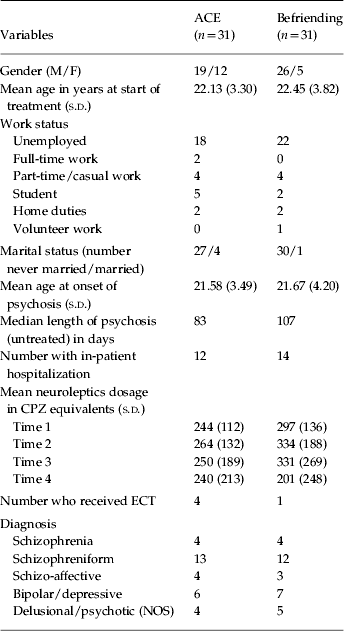
Table 1 shows that the ACE group contained significantly fewer males (n=19; 61.3%) than the Befriending group (n=26; 83.9%; p=0.046), even though the groups were randomized. The ACE group did not significantly differ from Befriending at the 5% level in terms of age (p=0.72), age of onset (p=0.52), martial status (p=0.48), work status (p=0.46), duration of untreated psychosis (p=0.45) and diagnosis at pretreatment (p=0.92). Investigation of possible differences in medication [in chlorpromazine (CPZ) equivalents] over all four time points revealed no significant main effect for treatment group (p=0.25), and no significant difference in medication levels over the four time points according to treatment group (p=0.19).
Frequencies or means (and standard deviations) for demographic and illness-related variables for the participants within the two groups

ACE, Active Cognitive Therapy for Early Psychosis; M, male; F, female; s.d., standard deviation; CPZ, chlorpromazine; ECT, electroconvulsive therapy; NOS, not otherwise specified.
Missing data for neuroleptics dosage at times 2 to 4 were multiply imputed using 10 imputation datasets with the same imputation model that was used for the outcome variables and described in the section headed ‘Treatment of missing data and planned data analysis’.
Regarding delivery of therapy, the mean number of sessions was 9.00 (s.d.=4.93) for ACE and 7.21 (s.d.=5.17) for Befriending, with the difference not being statistically significant (p=0.18). The median time in therapy was 354 minutes for ACE and 174 minutes for Befriending, with this difference being significant (p=0.04).
In terms of treatment integrity, 96/99 therapy sessions were correctly classified to the appropriate therapy. The three incorrect sessions were classified as Befriending when they were in fact ACE. The mean CTRS score was significantly higher (p<0.01) for ACE (mean=38.5, s.d.=13.5) than for Befriending (mean=15.9, s.d.=3.5). Forty-seven sessions were rated to determine inter-rater reliability (24 ACE and 23 Befriending). Inter-rater reliability for the total CTRS was r=0.81 (p<0.01). Regarding treatment satisfaction, Befriending adequately matched ACE in terms of participant expectations and satisfaction (Bendall et al. Reference Bendall, Jackson, Killackey, Allott, Johnson, Harrigan, Gleeson and McGorry2006). Assessment of RA blindness showed that the RAs correctly guessed treatment group membership for 76% of participants (χ21=14.58, p<0.01).
Research hypotheses 1 and 2
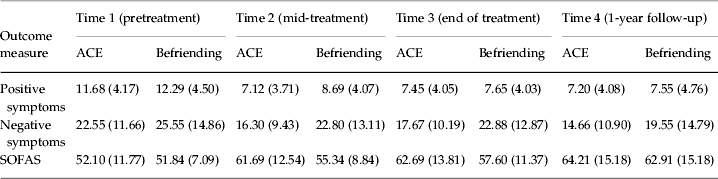
The means and standard deviations of the outcome measures for each time point averaged over the 10 MI datasets are presented in Table 2. A notable trend was for ACE to show better outcome (in terms of lower negative symptoms and higher functioning in particular) at mid-treatment and, to a lesser extent, at end-of-treatment; however, any differences between treatment groups on any outcome measure were lost at follow-up.
Multiply imputed means (and standard deviations) for outcome measures at each time point averaged across 10 imputed datasets for ACE (n=31) and Befriending (n=31) groups

ACE, Active Cognitive Therapy for Early Psychosis; SOFAS, Social and Occupational Functioning Assessment Scale.
Means and standard deviation values at time 1 are equal to the observed sample values because there were no missing cases at pretreatment.
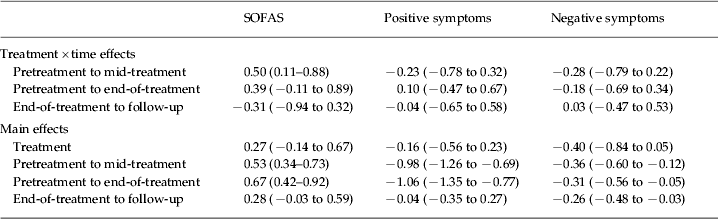
The results for the series of planned interaction contrasts are provided in Table 3, which contains approximate standardized effect sizes with 95% CIs that were used to assess the first two study hypotheses. If ACE resulted in better outcomes over each time period compared to Befriending, then this would be indicated for the treatment×time interaction effects by negative values for both positive and negative symptom measures and by positive values for the SOFAS.
Approximate standardized effect size values for trial outcome measures averaged over analysis of 10 imputed datasets (with 95% confidence intervals in parentheses)

SOFAS, Social and Occupational Functioning Assessment Scale.
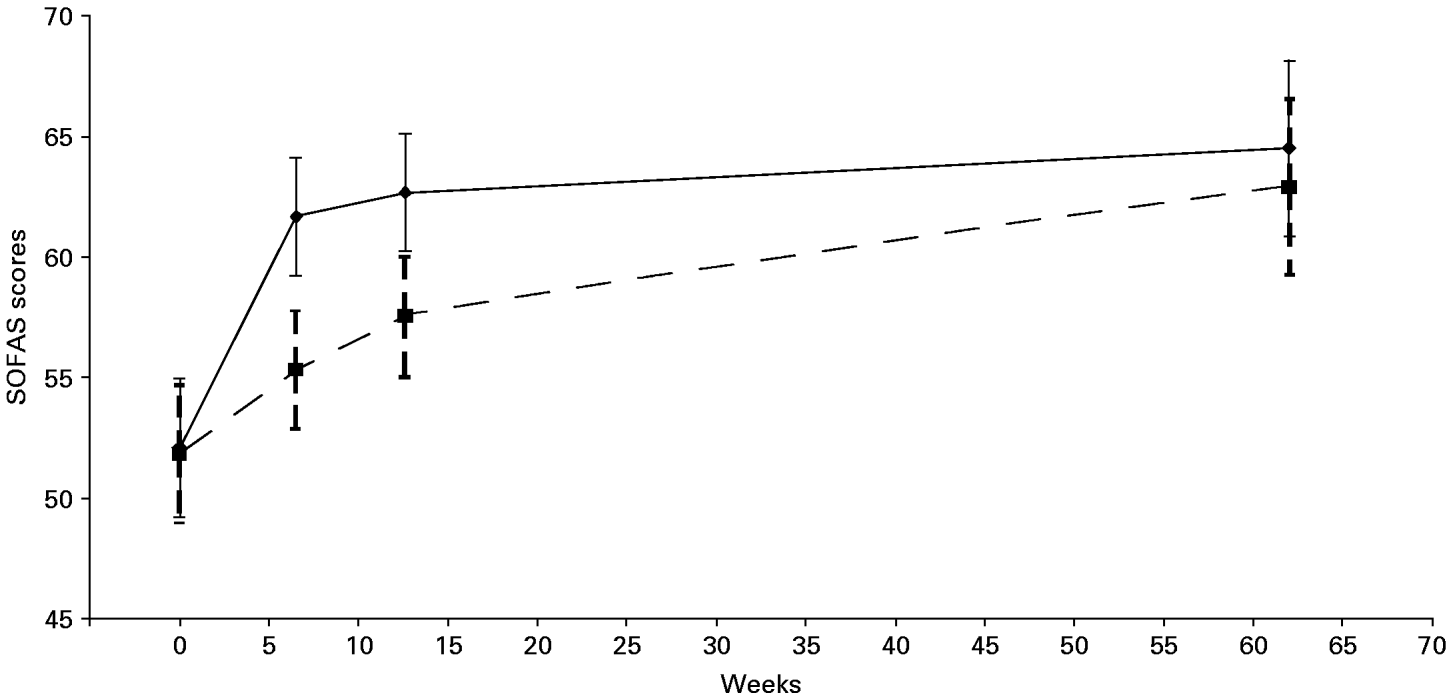
Table 3 shows a moderately large improvement in functioning (0.50; 95% CI 0.11–0.88) in the ACE group between pretreatment and mid-treatment. This effect, however, lessened when comparing ACE and Befriending from pretreatment to end-of-treatment (0.39; 95% CI −0.11 to 0.89). It can only be inferred with 95% confidence that ACE may have provided either trivial detriments (−0.11) in functioning at worst or resulted in a large improvement (0.89) at best over the period of treatment. From end-of-treatment to 1-year follow-up, the point estimate of the interaction effect indicated that Befriending was catching up with ACE in functioning at the 15-month point. These differential changes in functioning (i.e. SOFAS) over the whole study period can be observed in Fig. 2.
Group means for Social and Occupational Functioning Assessment Scale (SOFAS) scores plus 95% confidence intervals at each time point. ––◆––, Active Cognitive Therapy for Early Psychosis (ACE); – –■– –, befriending.

Turning to positive and negative symptoms, the point estimates of the interaction effects at mid-treatment in Table 3 indicated that ACE may have been resulting in a small improvement compared to Befriending (0.23 and 0.28 respectively), but the upper-bound of the respective 95% CIs indicated that effects of equivalent size could just as well be favouring Befriending. Differential effects between the two groups at end-of-treatment were smaller again (0.10 and −0.18 respectively), and they were trivially so for the period from end-of-treatment to follow-up (−0.04 and 0.03 respectively).
For completeness, the main effects for treatment group and for change over time are also shown in Table 3 (although these were not formally part of the research hypotheses). In summary, for treatment effects, there were moderately lower negative symptoms (−0.40; 95% CI −0.84 to 0.05) for ACE compared to Befriending participants. The bounds of the CI for the SOFAS indicated that ACE was at worst trivially different from Befriending (−0.14) and at best substantially better (0.67). The largest improvements over time in both groups for all three outcome measures occurred in the initial period between pretreatment and mid-treatment. In addition, there was further improvement in both negative symptoms and functioning from end-of-treatment to follow-up, but there was very little further change in positive symptoms.
Research hypothesis 3
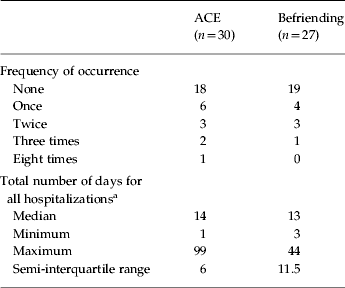
The number and duration of hospitalizations for participants during the follow-up period are summarized in Table 4. The two regression models provided no evidence of significant differences between ACE and Befriending in either the number of admissions or the total number of days hospitalized.
Hospitalization rates and duration of hospitalization from end-of-treatment to 1-year follow-up

ACE, Active Cognitive Therapy for Early Psychosis.
a Excludes zero days for those cases who were not hospitalized.
The negative binomial regression model revealed that the ACE group had an expected increase of 80% in the number of hospital admissions compared to Befriending (95% CI −20 to 305). For the total number of days hospitalized in the follow-up period, the zero-inflated negative binomial model showed that the ACE group had a trivial expected increase of 2.4% (95% CI −50 to 111) in the number of hospitalized days relative to Befriending. The logistic component of the model showed an expected decrease for ACE of 37% (95% CI −75 to 61) in the odds of always having zero hospitalized days compared to Befriending.
Discussion
This study was the first RCT of CBT for patients in the acute phase of their first episode of psychosis conducted within a single treatment setting with standardized background treatment (i.e. prescription of neuroleptics). It conformed to the CONSORT (Consolidated Standards of Reporting Trials) criteria (Moher et al. Reference Moher, Schulz and Altman2001). The main finding of the study was provisional evidence supporting improved functioning to a greater degree for ACE than for Befriending participants at mid-treatment. However, while both groups continued to improve, there was little evidence of meaningful differences in positive and negative symptoms between the treatments by the end of the therapy. At the end of treatment, ACE participants continued to demonstrate moderately better functioning than Befriending participants, as shown in Fig. 2. There were no strong indications that ACE produced differential outcomes over Befriending at the 1-year follow-up on any outcome measure. That is, there was reasonable evidence of the Befriending group catching up over the follow-up period on any differences initially observed at both mid-treatment and at the end of treatment.
ACE, therefore, appeared to be more effective in the earlier phase of treatment. The ability of CBT to accelerate recovery early in the treatment of acute psychosis has been found previously (Lewis et al. Reference Lewis, Tarrier, Haddock, Bentall, Kinderman, Kingdon, Siddle, Drake, Everitt, Leadley, Benn, Grazebrook, Haley, Akhtar, Davies, Palmer, Faragher and Dunn2002), but it was not sustained. Other studies have also shown the beneficial effects of CBT for psychosis to be lost after the treatment had finished (Drury et al. Reference Drury, Birchwood and Cochrane2000; Jackson et al. Reference Jackson, McGorry, Henry, Edwards, Hulbert, Harrigan, Dudgeon, Francey, Maude, Cocks and Power2001). Investigation of why this occurs is important for future research to further develop and improve CBT for FEP. One possibility is that differential treatment effects are difficult to detect because of rapid recovery rates during early psychosis (Hermann-Doig et al. Reference Hermann-Doig, Maude and Edwards2003). In the current study, this effect may have been compounded by participants already receiving a background treatment that included a proactive and diverse range of interventions (Edwards & McGorry, Reference Edwards and McGorry2002). Without a third EPPIC TAU group (i.e. not receiving Befriending or ACE), we were unable to establish to what degree the background treatment contributed to participants' improvement. One study that did include a TAU control group found that both CBT and the supportive counselling control group were superior to TAU at the 18-month follow-up (Tarrier et al. Reference Tarrier, Lewis, Haddock, Bentall, Drake, Kinderman, Kingdon, Siddle, Everitt, Leadley, Benn, Grazebrook, Haley, Akhtar, Davies, Palmer and Dunn2004). This shows the benefits of psychological interventions over and above that of TAU and that such benefits can be maintained after the intervention has ended.
It may be that the relatively few ACE sessions delivered prevented the gains made by mid-treatment from being cemented. On average, the ACE participants received nine sessions and Befriending participants seven sessions over the 14-week therapy trial. It was originally intended that participants would receive two sessions of therapy per week. However, the therapists found that weekly therapy sessions were more appropriate for this patient group due to several factors, including the burden of other EPPIC appointments and the challenging nature of CBT, particularly during the acute stage of psychosis and for participants of a young age. Other trials of CBT for early psychosis have also reported conducting fewer sessions of therapy than originally planned for similar reasons (Tarrier et al. Reference Tarrier, Lewis, Haddock, Bentall, Drake, Kinderman, Kingdon, Siddle, Everitt, Leadley, Benn, Grazebrook, Haley, Akhtar, Davies, Palmer and Dunn2004). If there had been no time restrictions on the therapy, therapists in the current study anecdotally reported that, for some of the participants, the therapy ended prematurely, whereas in normal clinical practice it would have continued for longer. In fact, approximately 25% of CBT and Befriending participants reported that they would have preferred more therapy (Bendall et al. Reference Bendall, Jackson, Killackey, Allott, Johnson, Harrigan, Gleeson and McGorry2006). Both of the participants who committed suicide did so after participating fully in ACE. At the end of therapy, the therapist felt that these two participants would have benefited from further ACE therapy. In both cases, additional case management and medical support was implemented at the end of ACE therapy.
The issue of length of therapy is problematic in a heterogeneous patient group, such as FEP, because patients with complex issues may require more therapy than others. It may be that varying amounts of therapy are needed for different patients with FEP depending on level of risk, co-morbidity, severity of psychotic symptoms, etc. In the current study, 47% of participants had one or more co-morbid disorders at the time of admission (Bendall et al. unpublished observations) and may have needed more therapy than others. ‘Booster sessions’ may also be necessary for maintaining gains made early in therapy (e.g. Tarrier et al. Reference Tarrier, Lewis, Haddock, Bentall, Drake, Kinderman, Kingdon, Siddle, Everitt, Leadley, Benn, Grazebrook, Haley, Akhtar, Davies, Palmer and Dunn2004). Future trials in an acute group may need to have a longer or more flexible time-frame to allow for an appropriate number of sessions. This issue, however, is difficult to address within the constraints of an RCT methodology.
There are several other methodological and logistical issues associated with conducting the current RCT that may have led to the negative results. A striking result was the small proportion of participants recruited relative to the number of admissions to the service during the recruitment period. This is in contrast to the SoCRATES trial (Lewis et al. Reference Lewis, Tarrier, Haddock, Bentall, Kinderman, Kingdon, Siddle, Drake, Everitt, Leadley, Benn, Grazebrook, Haley, Akhtar, Davies, Palmer, Faragher and Dunn2002). The extreme difficulty in recruiting participants in our study was unexpected. Anecdotally, this was due to a combination of participants' acute symptomatology and their self-perceived burden of extra professionals being involved in their care, as all patients meet a large number of professionals at EPPIC within the first 4 weeks of referral. Moreover, in contrast to our study, SoCRATES recruited many participants during their second admission (up to 2 years after their first), which may imply that their participants were more used to the service and had already been through the process of being given their diagnosis. In addition, their participants were in-patients when they were recruited, which may have made it much easier to access patients for recruitment and commencing treatment, compared to many of our participants who were recruited as out-patients. The recruitment issues encountered in our study might be seen as a problem for the widespread provision of CBT in acute FEP. However, we see this more as a by-product of how RCTs must be conducted (e.g. arbitrary time-frames for assessments and therapy, forced number of sessions, multiple assessments, etc.). CBT in normal clinical practice differs from RCTs of CBT, in that CBT would normally be introduced seamlessly into the patient's treatment package, enabling clinicians to have maximum flexibility in conducting CBT with their patients. This is often difficult to achieve in an RCT.
In summary, the current study found provisional evidence that ACE accelerated early recovery in functioning, but these differential effects began to diminish past the mid-treatment point and were largely lost over the follow-up period. CBT is clearly supported for chronic treatment-resistant patients (Pilling et al. Reference Pilling, Bebbington, Kuipers, Garety, Geddes, Orbach and Morgan2002; Zimmerman et al. Reference Zimmerman, Favrod, Trieu and Pomini2005). We believe there is also potential for CBT in FEP, but further research is needed into the optimal number and duration of sessions and the spacing of sessions over time. This may lead to a CBT treatment that produces positive effects that are better sustained over time.
Acknowledgements
We thank Dr Martina Jovev and Marie-Josee Marois for their assiduousness in rating the therapy sessions and Hok Pan Yuen for his administration of the randomization process. This study was funded by an NH&MRC Project grant no. 145 760 awarded to Professor Henry Jackson, Professor Patrick McGorry and Associate Professor Jane Edwards.
Declaration of Interest
None.