INTRODUCTION
The RhD protein, which is the RHD gene product and a major component of the Rh blood group system, carries the strongest blood group immunogen, the D-antigen. This antigen is absent in a significant minority of the human population (RhD-negatives) due to RHD deletion. The origin and persistence of this RhD polymorphism, especially the high frequency of RhD negatives in Caucasian population associated with the spreading of a single haplotype (cde) with a deletion of the whole RHD gene (Wagner and Flegel, Reference Wagner and Flegel2000), is an old evolutionary enigma (Haldane, Reference Haldane1942; Hogben, Reference Hogben1943; Fisher et al. Reference Fisher, Race and Taylor1944; Li, Reference Li1953). Before the advent of modern medicine, the carriers of the rarer allele (e.g. RhD-negative women in the population of RhD-positives or RhD-positive men in the population of RhD-negatives) were at a disadvantage as some of their children (RhD-positive children born to pre-immunized RhD-negative mothers) were at a higher risk of foetal or newborn death or health impairment from haemolytic disease. Therefore, the RhD-polymorphism should be unstable, unless the disadvantage of carriers of the locally less abundant allele is counterbalanced by, for example, higher viability of the heterozygotes (Feldman et al. Reference Feldman, Nabholz and Bodmer1969). Such heterozygote advantage is known to be responsible for polymorphism in haemoglobin genes (and existence of sickle disease) in areas with endemic malaria (Allison, Reference Allison1954). The possible role of the parasites in the origin and persistence of the RhD polymorphism is suggested by pronounced differences in frequency of particular RhD phenotypes in different geographical areas. The frequency of RhD-negative subjects is about 15% in Caucasians, 8% in Africans and 1% in Asians, which corresponds with the allele frequencies of 40%, 28% and 10%, respectively.
An infectious agent which could fulfil such a role is the most common protozoan parasite worldwide Toxoplasma gondii, which infects 20–70% of inhabitants in different developed countries (and as many as 90% in some developing countries). Toxoplasmosis does not occur in the islands where definitive hosts of Toxoplasma (cats) are absent (Dubey et al. Reference Dubey, Rollor, Smith, Kwok and Thulliez1997). Post-natally acquired toxoplasmosis in immunocompetent subjects causes mild disease, acute toxoplasmosis, which turns spontaneously into life-long latent toxoplasmosis. Latent toxoplasmosis is characterized by the presence of dormant stages of the parasite in cysts, mostly in the neural and muscular tissues, and immunity against new Toxoplasma infections (Remington and Krahenbuhl, Reference Remington, Krahenbuhl, Nahmias and O'Reilly1982). Latent toxoplasmosis in humans is considered as clinically asymptomatic (Markell et al. Reference Markell, John and Krotoski1999; Roberts and Janovy, Reference Roberts and Janovy2000). However, infected people have impaired reaction times (Havlicek et al. Reference Havlíček, Gašová, Smith, Zvára and Flegr2001) and about 2·6 times higher risk of traffic accidents (Flegr et al. Reference Flegr, Havlíček, Kodym, Malý and Šmahel2002; Yereli et al. Reference Yereli, Balcioglu and Ozbilgin2006), possibly as a result of manipulation activity of Toxoplasma aimed to increase the chance of transmission from the intermediate to the definitive host (from any bird or mammal species to any feline species (Berdoy et al. Reference Berdoy, Webster and Macdonald2000)). The possible protection of the Rh heterozygotes against Toxoplasma-induced impairment of reaction times could explain the primary spreading of the RHD gene (originated by a duplication of RHCE gene) in the RHD-negative population of our (mostly Toxoplasma-infected) ancestors. Shorter reaction times of Toxoplasma-free, RhD-negative homozygotes could explain secondary spreading of the RHD deletion in regions with low occurrence of cats and therefore low prevalence of toxoplasmosis, like in prehistoric Europe. In the present study, we examined a possible association between the RhD phenotype (or RhD genotype) and toxoplasmosis-associated impairment of psychomotor performance (reaction times) in 4 independent populations.
MATERIALS AND METHODS
Subjects
The 3 studies were carried out on 4 different population samples: 3 groups involving voluntary thrombocyte and blood donors and 1 group of military conscripts. Group 1 (UHKT1) consisted of 69 men and 45 women tested between 1998 and 2000 at the blood transfusion department of the Institute of Haematology and Blood Transfusion, Prague. The mean age of the study participants was 36·4 years (37·5 in men and 34·8 in women). The overall seroprevalence of Toxoplasma infection was 36% (34·8% in men and 37·8% in women) and 27·2% of participants were RhD-negative (33·3% in men and 17·8% in women). Group 2 included 89 men and 37 women tested at the same blood transfusion department between 2004 and 2006 (UHKT 2) and group 3 included 221 men and 92 women tested at the blood transfusion department of the Zbraslav University Hospital in Prague between 2002 and 2006 (Zbraslav). The mean age of participants was 34·1 years (34·8 in men and 32·4 in women). The overall seroprevalence of Toxoplasma infection was 34·4% (34·5% in men and 34·1% in women) and 26·5% of men and 24% of women were RhD-negative. For unknown reasons, the proportion of Toxoplasma-infected subjects in blood donors is usually higher than the prevalence of toxoplasmosis observed in the Czech population (Skallová et al. Reference Skallová, Novotná, Kolbeková, Gašová, Veselý and Flegr2005; Kolbeková et al. Reference Kolbekova, Kourbatova, Novotna, Kodym and Flegr2007). Very high frequency of RhD-negative subjects reflected the higher demand for RhD-negative blood and therefore preferential selection of RhD-negative donors rather than the frequency of the RhD minus allele in the general population. The testing procedure was conducted under standard laboratory conditions between 08:00 and 11:00, either prior to (Zbraslav) or after (UHKT1 and UHKT2) the blood donation session. Group 4 comprised 464 men tested for psychomotor performance during regular psychological examinations of conscripts, who were training to either be drivers, guards or presidential guards. About 80% of the conscripts from the July 2005 draft consented to the use of their test results for the research project purposes and provided 5 ml of blood for serological testing. The mean age of participants was 19·7 years. The overall seroprevalence of Toxoplasma infection was 30·2% and 18·4% of subjects were RhD-negative. The proportion of Toxoplasma-infected subjects and RhD-negative subjects in the population of conscripts corresponded well with frequencies expected in the general population. All study subjects (blood donors and draftees) were screened for health status prior to their enrolment in the study. The recruitment of study subjects and data handling were performed in compliance with Czech legislation in force and all participants voluntarily signed the informed consent form. The Institutional Review Board of the Faculty of Science, Charles University (ethical review board) approved the project.
Psychomotor test
Reaction time was measured by the two computer versions of a simple reaction time test (Smith et al. Reference Smith, Tyrrell, Al-Nakib, Barrow, Higgins, Leekam and Trickett1989). A white square (1×1 cm) appeared in the centre of the black computer display at irregular intervals ranging from 1 to 8 sec; the length of the test was 3 min. The subject had to respond to the square immediately after it appeared on the display by pressing a key on a special keyboard. At the time of testing neither the subjects nor the researcher were aware of the results of the immunological assessment of toxoplasmosis. For the blood donors, the computer measured and recorded reaction times in each trial. The blood donors were tested individually under supervision of an assistant. After the experiment, the mean reaction time for each minute of the test was computed, omitting all outliers, i.e. values more than 2·5 s.d. away from the raw total mean reaction time for the particular subject. The conscripts were tested in groups of 15–20 and instructions about how to perform the test were written on the first (introductory) computer screen. In contrast to the blood donors who were assessed individually, the conscripts were instructed as a group about the importance of responding to visual signals with their maximum possible speed. The conscripts responded by pressing the left button of the computer mouse and the program calculated the mean reaction times from all reaction times achieved during a 1-min simple reaction time test; all other conditions of the test were the same as before. The simple reaction time test was part of a 3-h personality, intelligence and psychomotor performance testing session. As the motivation of some conscripts to achieve fast responses in the simple reaction task was rather low, only 315 subjects whose mean reaction time had been lower than 550 ms and who had had less than 4 premature responses were included in the study. (The data had an approximately Gaussian distribution under the 550 ms cut point.) To follow the method used in previous studies, the raw reaction times were log transformed; however, the results of all analyses were approximately the same when performed with raw data.
Serological tests
Serological tests for toxoplasmosis were carried out in the National Reference Laboratory for Toxoplasmosis of the National Institute of Public Health, Prague. Specific IgG and IgM antibody titres for toxoplasmosis were determined by ELISA (IgG: SEVAC, Prague, IgM: TestLine, Brno), optimized for the detection of acute toxoplasmosis (Pokorný et al. Reference Pokorný, Fruhbauer, Poledňáková, Sýkora, Zástěra and Fialová1989), and complement fixation test (CFT) (SEVAC, Prague). The decrease in CFT titres is more regular and therefore better reflects the length of T. gondii infection (Warren and Sabin, Reference Warren and Sabin1942). CFT titres of antibodies to Toxoplasma in sera were measured at dilutions between 1: 8 and 1: 1024. The subjects with negative results of IgM ELISA (positivity index <0·9) and absorbance in IgG ELISA >0·250, i.e. approximately 10 IU/ml, were considered latent-toxoplasmosis positive.
The RhD blood group type (presence of the RhD antigen on the erythrocyte membrane) was determined in all serum samples using the human monoclonal anti-D reagents (Seraclone®, ImmucorGamma Inc.) in the blood transfusion service laboratories. The complete Rh phenotype was determined using the human monoclonal anti-C, -c, -E and -e reagents (Dynex). The DD-Dd-dd genotype was presumed based on the knowledge of population frequencies of genotypes corresponding to each phenotype (for examples D+C+c-E-e+ phenotype is encoded in 95·5% by DD and in 4·5% by Dd (Daniels, Reference Daniels2002)). The presence of some misclassified subjects in our large experimental set could only add a random noise to the data. Such random noise could increase the probability of false negative results of the study but not of false positive results.
Statistical analysis
The SPSS 12.0 and Statistica 6.0 programs were used independently and in parallel for all statistical testing including General Linear Model test (GLM), Kendall nonparametric test, chi2 test, logistic regression and testing of statistical test assumptions (normality of data and normality of residuals with Shapiro-Wilks tests and residual graphs and homogeneity of variances with Levene's test for homogeneity of variances). To control for the effect of the blood transfusion unit and age in the Kendall regression test, we used residuals computed by GLM with independent factors age and set (hospital) instead of raw data in the analysis. The effects of RhD and toxoplasmosis on reaction time were examined using GLM (study 3) and GLM repeated measures test (studies 1 and 2) with the dependent variables being reaction time in minutes 1, 2 and 3 of the test (continuous variables), and the independent variables RhD (binary variable RhD or categorical factor RhD genotype: DD, Dd, dd), toxoplasmosis (binary variable toxo), age (continuous variable age), blood transfusion unit (binary variable set) and within-subject factor of minute of the test (3-level categorical variable R1). Only the relevant effects and interactions are reported in the text; complete results of GLM are shown in the supplementary information at: http://natur.cuni.cz/flegr/supplement2.pdf.
RESULTS
In the original study (Havlíček et al. Reference Havlíček, Gašová, Smith, Zvára and Flegr2001), the subjects with anamnestic titres of anti-Toxoplasma antibodies (Toxoplasma-infected subjects) had significantly longer reactions, especially in minute 2 of the test, suggesting that they lost concentration earlier or got tired more quickly than Toxoplasma-free subjects. Since the subjects of the original study published in 2001 were thrombocyte donors, they were already tested for the RhD phenotype. In search for possible biological effects of the RhD phenotype, we reanalysed the original data, entering the information on RhD phenotype into the statistical models. The experimental set of voluntary thrombocyte donors (UHKT1) consisted of 69 men and 45 women. Previous studies suggested that males and females could respond differently (often in an opposite way) to toxoplasmosis (Lindová et al. Reference Lindová, Novotná, Havlíček, Jozífková, Skallová, Kolbeková, Hodný, Kodym and Flegr2006, for review see Flegr, Reference Flegr2007). Therefore, we analysed men and women separately.
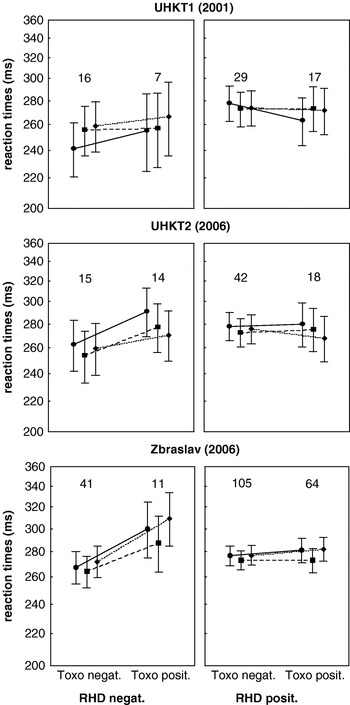
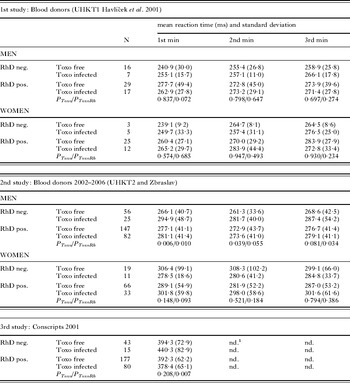
The results show statistically significant interactions between test duration (minutes 1, 2 and 3), RhD phenotype and toxoplasmosis (F 2,128=3·25; P=0·042; η2=0·048), suggesting that the RhD-positive and RhD-negative males were differently influenced by toxoplasmosis in particular minutes of the test (Fig. 1). In the RhD-negative subset, the Toxoplasma-infected males had non-significantly longer reaction times than Toxoplasma-free subjects (1st minute: F 1,20=2·64, P=0·120, η2=0·144; 2nd minute: F 1,20=0·60, P=0·448, η2=0·02; 3rd minute: F 1,20=2·64, P=0·120, η2=0·068), while in RhD-positive subset, any effect of Toxoplasma infection was absent (1st minute: F 1,43=1·67, P=0·203, η2=0·037; 2nd minute: F 1,43=0·01, P=0·913, η2<0·001; 3rd minute: F 1,43=0·26, P=0·610, η2=0·006). The results obtained for females were qualitatively the same (Table 1), the statistical significance of the interaction was lower while the effect size (η2) was higher (F 2,80=3·18; P=0·047; η2=0·074). Due to the low number of subjects, separate analyses of 8 RhD-negative and 37 RhD-positive women provided only non-significant results.
Simple reaction times in 3 populations of men. The y-axis shows mean reaction times (in msec) of Toxoplasma-free (left part of each panel), Toxoplasma-infected (right part of each panel), RhD-negative (left panels) and RhD-positive (right panels) men in minutes 1 (circles), 2 (squares) and 3 (diamonds) of the test; the spreads indicate 95% confidential intervals computed for non-transformed data, figures indicate the numbers of Toxoplasma-free and Toxoplasma-infected men.

Reaction times of Toxoplasma-free and Toxoplasma-infected, RhD-positive and RhD-negative subjects
(The table also shows P values for effect of toxoplasmosis and Toxo-Rh interaction in particular minutes of the test.)

1 not determined.
To reveal possible difference in reaction times between RhD-positive homozygotes and heterozygotes, we repeated the study on a larger scale. We collected new data (UHKT2) in the same blood transfusion facility 4 years after the end of the previous study (89 male and 37 female thrombocyte donors not involved in the previous study) and in the blood transfusion department of the Zbraslav University Hospital (313 blood donors). For technical reasons, at the Institute of Hematology and Blood Transfusion, the performance tests were carried out after the blood donation session (as in the study of Havlíček et al. Reference Havlíček, Gašová, Smith, Zvára and Flegr2001) while the Zbraslav participants were tested prior to the session. Therefore, we also included the blood transfusion facility as one of the independent factors in the analyses. The results for men showed a statistically significant effect of toxoplasmosis (F 1,301=5·61; P=0·019; η2=0·018) and interaction between RhD phenotype and toxoplasmosis (F 1,301=5·71; P=0·017; η2=0·019), suggesting that toxoplasmosis prolonged reaction times, and RhD-negative subjects responded differently (more strongly than RhD-positive) to the infection (Fig. 1). In the RhD-negative subset, the Toxoplasma-infected males had significantly longer reaction times in all 3 mins of the test (1st minute: F 1,76=10·61, P=0·002, η2=0·116; 2nd minute: F 1,76=7·89, P=0·006, η2=0·093; 3rd minute: F 1,76=5·59, P=0·021, η2=0·064) than Toxoplasma-free subjects. In the RhD-positive subset, the effect of Toxoplasma infection was non-significant in any minute of the test (1st minute: F 1,224=0·05, P=0·822, η2=0·019; 2nd minute: F 1,224=0·03, P=0·867, η2<0·001; 3rd minute: F 1,224=0·09, P=0·765, η2=0·014). Except for age, no other main effect was significant. In a separate analysis of the women, these effects were not significant (Table 1).
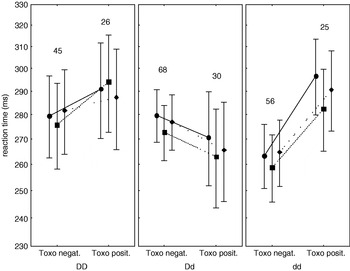
Because of linkage disequilibria, the presumed RhD genotype (heterozygote/homozygote) of subjects can be estimated on the basis of the complete Rh phenotype of each subject and RhD haplotype frequencies in European populations (Daniels, Reference Daniels2002). The complete Rh phenotype data were available for 340 subjects (250 men and 90 women) of groups UHKT2 and Zbraslav. In the subsequent analysis, the presumed RhD genotype (categorical: DD, Dd, dd) instead of the binary variable RhD phenotype was included into the models. The results for 250 men showed no significant main effect but a significant interaction between toxoplasmosis and RhD genotype (F 2,237=3·375; P=0·036; η2=0·028), suggesting that in contrast to both RhD-negative and RhD-positive homozygotes, the heterozygotes were protected against Toxoplasma-induced impairment of reaction times (Fig. 2). The interaction between test duration (minutes 1, 2 and 3), RhD phenotype and toxoplasmosis was not significant (F 4,474=0·37; P=0·827; η2=0·004). The interaction between toxoplasmosis and RhD genotype was not significant for women, which could be due to either the smaller number of experimental subjects or, possibly, confounding effects of fluctuating levels of hormones across the menstrual cycle (Havlicek et al. Reference Havlicek, Roberts and Flegr2005).
Simple reaction times of blood donors (men, UHKT2 and Zbraslav). The y-axis shows mean reaction times (in msec) of Toxoplasma-free (left part of each panel), Toxoplasma-infected (right part of each panel), RhD-positive homozygotes (DD, left panel), RhD-positive heterozygotes (Dd, middle panel) and RhD-negative homozygotes (dd, right panel) in minutes 1 (circles), 2 (squares) and 3 (diamonds) of the test; the spreads indicate 95% confidence intervals computed for non-transformed data, figures indicate the numbers of Toxoplasma-free and Toxoplasma-infected men.

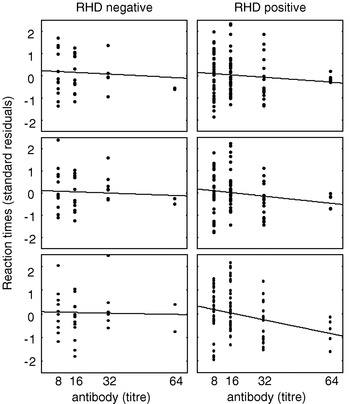
The negative influence of toxoplasmosis on reaction times is known to increase with the duration of Toxoplasma infection (Havlíček et al. Reference Havlíček, Gašová, Smith, Zvára and Flegr2001). Results of previous studies show that the duration of Toxoplasma infection cannot be estimated from the highly fluctuating anti-Toxoplasma antibodies measured with ELISA; however, the estimation can be based on more or less regularly decreasing titres as determined by a complement fixation test (Flegr et al. Reference Flegr, Kodym and Tolarová2000). Fig. 3 shows that there was a negative relation between concentrations of anti-Toxoplasma antibodies and reaction times in RhD-positive men, gradually increasing from minute 1 to minute 3 of the test. This effect was statistically significant for minute 3 of the test (Kendall Tau=−0·161; P=0·018, one-tailed test) as well as for the mean reaction time in all 3 minutes (Kendall Tau=−0·137; P=0·036, one-tailed test). No such effect was observed in RhD-negative men (Fig. 3) and women (not shown). The separate regression for particular genotypes (DD, Dd and dd) provided no significant results. However, the Kendall Tau was around zero for Dd and dd and around −0·15 for DD, suggesting that RhD-positive homozygotes were responsible for the progressive increase in reaction times with duration of the infection in RhD-positive subjects. The data shown in Fig. 3 indicate that the absence of the effect of length of infection in Dd heterozygotes might be explained by their resistance to pathological effects of toxoplasmosis, while in dd homozygotes it possibly results from their immediate response to the infection (rapidly increased reaction times after the infection).
Negative correlation between concentrations of anti-Toxoplasma antibodies and reaction times of blood donors (men, UHKT1, UHKT2 and Zbraslav). The y-axis shows mean reaction times (in standard residuals) in minutes 1, 2 and 3 of the test in RhD-positive men (right panels) and zero correlation among RhD-negative men (left panels). The standard residuals of logarithmic reaction times were GLM with age and hospital (UHKT1, UHKT2 and Zbraslav) as independent variables. The group with the lowest antibody titres measured with CFT (1: 8) includes subjects with the longest duration of Toxoplasma infection.

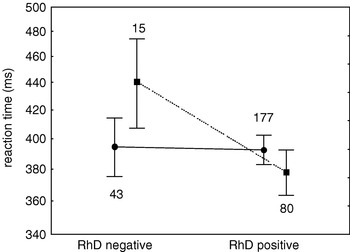
In our third study, we analysed reaction times of 315 male military conscripts. The analysis showed that the RhD-negative subjects had longer reaction times than RhD-positive subjects (Rh main effect: F 1,310=7·85; P=0·005; η2=0·025), and after the infection, the RhD-negative subjects had non-significantly longer (F 1,55=3·76, P=0·057, η2=0·064) and RhD-positive subjects non-significantly shorter (F 1,254=3·42, P=0·065, η2=0·013) reaction times than the corresponding non-infected subjects (Toxo-RhD interaction: F 1,310=7·83; P=0·007; η2=0·024) (Table 1 and Fig. 4).
The GLM analysis of pooled data of all 4 populations of men (dependent variable being reaction time in the 1st minute of the test, independent variables Toxo, RhD, Set, Age) showed a significant effect of Toxo (F 1,850=6·06, P=0·014, η2=0·003) and a highly significant effect of Toxo-RhD interaction (F 1,850=11·53, P=0·001, η2=0·006). The GLM repeated measures test for pooled data of all 3 populations of male blood donors (dependent variables being reaction time in minutes 1, 2 and 3 of the test, independent variables Toxo, RhD, Set, Age) showed a significant effect of Toxo (F 1,366=3·93, P=0·048, η2=0·011) and a Toxo-RhD interaction (F 1,539=5·96, P=0·015, η2=0·016). These effects were non-significant in similar analysis of pooled data of female subjects. The GLM repeated measures test for pooled data of all male and female blood donors (dependent variables being reaction time in minutes 1, 2 and 3 of the test, independent variables Toxo, RhD, Set, Sex and Age) showed a significant effect of Sex-Toxo-RhD (F 1,528=5·11, P<0·024, η2=0·010).
Simple reaction times of blood conscripts. The y-axis shows mean reaction times (in msec) of Toxoplasma-free (circles), Toxoplasma-infected (squares), RhD-negative (left), RhD-positive (right) conscripts in one minute-test; the spreads indicate 95% confidential intervals computed for non-transformed data, figures indicate the numbers of Toxoplasma-free and Toxoplasma-infected men.

DISCUSSION
Observed effects of the RhD phenotype on Toxoplasma-induced deterioration of psychomotor performance could explain not only the origin of the RhD blood group polymorphism, but also the geographical differences in frequency of RhD-minus alleles in human populations. The possible physiological mechanism of the effect of toxoplasmosis on psychomotor performance and the protective role of the RhD protein can only be speculated on at this point. The structure homology data suggest that the RhD protein acts as an ion pump of uncertain specificity and unknown physiological role (Kustu and Inwood, Reference Kustu and Inwood2006; Biver et al. Reference Biver, Scohy, Szpirer, Szpirer, Andre and Marini2006). The molecule could either play a direct role in signal processing or in ontogenetic processes shaping the signal processing machinery. Several independent indices suggest that toxoplasmosis might affect the neurotransmitter levels, most probably that of dopamine, in certain parts of the brain (Stibbs, Reference Stibbs1985; Flegr et al. Reference Flegr, Preiss, Klose, Havlíček, Vitaková and Kodym2003; Novotná et al. Reference Novotná, Hanušová, Klose, Preiss, Havlicek, Roubalová and Flegr2005; Skallová et al. Reference Skallová, Kodym, Frynta and Flegr2006; Hodková et al. Reference Hodková, Kodym and Flegr2007). Dopamine and its agonists and antagonists are known to influence not only reaction times (Courtiere et al. Reference Courtiere, Hardouin, Goujon, Vidal and Hasbroucq2003) but also performance in many attention-related tasks and recognition of new stimuli (Kahkonen et al. Reference Kahkonen, Ahveninen, Pekkonen, Kaakkola, Huttunen, Ilmoniemi and Jaaskelainen2002; Rihet et al. Reference Rihet, Possamai, Micallef-Roll, Blin and Hasbroucq2002; Nieoullon, Reference Nieoullon2002). However, until now, no link has been reported to exist between dopamine (or any other component or function of the neural system) and the RhD phenotype.
Among Toxoplasma-free men in study 1 (UHKT1) and study 2 (UHKT2 and Zbraslav) and Toxoplasma-free women in study 1 (UHKT1), the RhD-negative subjects had faster simple reaction times than RhD-positive subjects. In the study 2 (UHKT2 and Zbraslav) the RhD-negative Toxoplasma-infected women were faster than RhD-negative Toxoplasma-free women (significantly better in the 1st and 2nd minute of the test, data not shown) and in the Toxoplasma-free conscripts the psychomotor performance of RhD-negative and RhD-positive subjects was approximately the same. As far as we know, this effect of Rh factor on psychomotor performance has not been observed or at least reported in the scientific literature. Prevalence of latent toxoplasmosis is approximately 30% worldwide and no psychomotor performance study was probably performed on a Toxoplasma-free subpopulation.
It is possible that the better psychomotor performance of RhD-negative subjects in the Toxoplasma-free population could be the reason for spreading of the ‘d allele’ (deletion) in the European population. In contrast to the situation in Africa and certain (but not all) regions of Asia, the abundance of wild cats (definitive hosts of Toxoplasma gondii) in the European territory was very low before the advent of the domestic cat (Torrey and Yolken, Reference Torrey and Yolken1995). Therefore, the prevalence of latent toxoplasmosis in the prehistoric European population was also probably negligible. Currently, the frequency of RhD-negative subjects in the Caucasian population (with about 30% prevalence of toxoplasmosis) is about 20% while in the African population with a very high prevalence of toxoplasmosis (Roever-Bonnet, Reference Roever-Bonnet1972) it is only 5% (Daniels, Reference Daniels2002). Theoretically, we could expect the decrease of the RhD-minus allele in the European population after the advent of the domestic cat; however, this event was relatively recent and probably coincided with relaxation of many forms of natural selection.
The protective effect of RhD against the Toxoplasma-induced impairment of psychomotor performance could explain not only the differences in frequency of RhD-negative subjects in toxoplasmosis-low and toxoplasmosis-high regions, but also the origin and primary spreading of RHD gene (RHCED duplication) in our African ancestors. A comparison of mean reaction times between infected dd homozygotes and Dd heterozygotes shows that the protective effect of the RhD genotype on Toxoplasma-induced reaction time changes is relatively strong. Reaction times play an important role in interactions with prey and predators as well as in intraspecies combats. In our evolutionary past, the frequency of toxoplasmosis in populations of our ancestors was probably rather high due to consumption of raw or undercooked meat and generally lower hygiene standards. Under such conditions, the RhD heterozygotes with the shortest reaction times were probably favoured by natural and sexual selection, which could only partly be counterbalanced by the selection against RhD-negative women with lower reproductive success. It must be kept in mind that in addition to longer reaction times, the ‘asymptomatic’ latent toxoplasmosis in humans has also been shown to have several other effects, including those on behaviour and personality, length of pregnancy, probability of birth of male offspring and testosterone concentration (Flegr et al. Reference Flegr, Zitková, Kodym and Frynta1996; Kaňková et al. Reference Kaňková and Flegr2007; Kaňková and Flegr, Reference Flegr2007; Flegr et al. Reference Flegr, Lindová and Kodym2008). The protective role of Dd phenotype against these effects of latent toxoplasmosis and probably also of other parasites or even other factors (aging, stress) should be addressed in future studies.
We thank Aleš Kuběna for his help with statistical analysis. This work was supported by grants of the Czech Ministry of Education and Sports (grant 0021620828) and Grant Agency of the Czech Republic (grant 206/07/0360). The study was approved by the IRB Faculty of Science, Charles University and complies with the current laws of the Czech Republic.