Introduction
Recovery Colleges are a global innovation in mental health systems. The concept of ‘recovery education’ – supporting recovery in relation to mental health problems through education – was developed in Boston and Phoenix in the 1990s. In the past decade, a model of Recovery Colleges has emerged, with greater emphasis on co-production and co-learning. The first Recovery College opened in England in 2009, and there are now over 80 in the UK (Anfossi, Reference Anfossi2017). This model has spread internationally, with Recovery Colleges now open or planned in 22 countries, e.g. Australian, Bulgaria, Canada, Hong Kong, Ireland, Italy, Japan, the Netherlands, Norway, Poland and Uganda, among others (Perkins et al., Reference Perkins, Meddings, Williams and Repper2018).
Recovery Colleges involve supporting people living with mental health problems through adult education rather than through treatment (Perkins et al., Reference Perkins, Repper, Rinaldi and Brown2012). The skills needed for living well with mental illness are relevant to anyone, so health professionals, family members and the public as well as service users attend colleges as students. Proportions vary, but, e.g. in the first Italian Recovery College, the student proportions were 63% service users, 19% family, 7% staff and 11% community members (Lucchi et al., Reference Lucchi, Chiaf, Placentino and Scarsato2018). After registration, students attend self-selected courses co-delivered by peer trainers (people with personal experience of mental ill-health and recovery) and non-peer trainers (e.g. clinicians or topic experts). Recovery Colleges typically directly employ a small team of peer and mental health practitioners, with a larger group of peer trainers and practitioner trainers from mental health services and community agencies who are used on a sessional basis. Courses offered may cover understanding different mental health issues and treatment options, rebuilding life with mental health challenges, developing life skills and confidence to either rebuild life outside services or get the most out of services, capacity building and developing the peer workforce, and helping people to provide support for family members and friends who experience mental health challenges. Courses vary from brief, 1 h, introductory sessions to a day per week for a term (10 weeks) (Perkins et al., Reference Perkins, Meddings, Williams and Repper2018). A key feature of Recovery Colleges is the emphasis on co-production, i.e. people with lived experience co-produce all aspects of the college including curriculum development, quality assurance and delivering courses alongside a trainer with professional or topic-specific expertise.
The impact of Recovery Colleges can be stratified into four levels of social reality (Wikgren, Reference Wikgren2005): student, staff, services and societal. The impact on students has been the primary motivation for developing Recovery Colleges, and in separate papers we published a fidelity measure (Toney et al., Reference Toney, Knight, Hamill, Taylor, Henderson, Crowther, Meddings, Barbic, Jennings, Pollock, Bates, Repper and Slade2018a) and a co-produced model of mechanisms of action and outcomes for students (Toney et al., Reference Toney, Elton, Munday, Hamill, Crowther, Meddings, Taylor, Henderson, Jennings, Waring, Pollock, Bates and Slade2018b). Our focus in this study is on the other three levels. The staff level comprises Recovery College staff such as managers, administrators and trainers (including peer and non-peer trainers), and health professionals who attend courses. The services level comprises the mental health and social care system with which the Recovery College is usually, though not always, connected. The societal level is the wider family, community and social environment in which citizenship is enacted and stigma potentially experienced.
Publications about Recovery Colleges make claims for benefits at each level, but the scientific evidence base for Recovery Colleges is developing. Evaluations of experiences and outcomes at the student level have been the main focus, as they are the priority beneficiary group for Recovery Colleges. Research designs primarily comprise uncontrolled cohort studies, case series with pre- and post-test outcome assessment, and expert opinion (Australian Healthcare Associates, 2018). For example, a study of psychiatrists’ views about the impact of Recovery Colleges on students showed general support, with the main concerns being about the relationship with the clinical system and attitudes to medication adherence (Collins et al., Reference Collins, Shakespeare and Firth2018). Although the overall weight of preliminary evidence is strongly positive (Meddings et al., Reference Meddings, McGregor, Roeg and Shepherd2015b; Slade et al., Reference Slade, McDaid, Shepherd, Williams and Repper2017; Australian Healthcare Associates, 2018), no randomised controlled trials have been conducted.
Very little research has addressed staff, services and societal levels. Staff-level evaluations are in general positive but do not use experimental methodologies. For example, a survey of 94 staff students, i.e. mental health workers attending Recovery Colleges as students, found 93% would recommend attendance to colleagues, with 54% self-identifying attitudinal change, 63% a positive impact on personal wellbeing and 88% benefits for practice (Perkins et al., Reference Perkins, Ridler, Hammond, Davies and Hackmann2017). Staff identify benefits from learning about the expertise of lived experience (Sommer et al., Reference Sommer, Gill and Stein-Parbury2018) and increasing their hopefulness about recovery (Newman-Taylor et al., Reference Newman-Taylor, Stone, Valentine, Hooks and Sault2016), resulting in a positive impact on practice (Perkins et al., Reference Perkins, Meddings, Williams and Repper2018). For trainers, self-identified benefits include improved self-esteem and professional growth (Gill, Reference Gill2014), and being inspired and transformed (Perkins et al., Reference Perkins, Meddings, Williams and Repper2018). Staff also self-report benefits in relation to morale, job satisfaction and reduced job-related stress (Sommer et al., Reference Sommer, Gill and Stein-Parbury2018).
At the level of services, the need for mental health system transformation in order to fully support recovery has been identified globally (World Health Organization, 2013; United Nations General Assembly, 2017). Recovery Colleges are proposed as a vehicle supporting this transformation towards recovery-oriented practice and co-production (Perkins et al., Reference Perkins, Meddings, Williams and Repper2018). The evidence base for service-level impact is very limited, although there is a modest evidence of attitudinal shift in staff who are more involved in Recovery Colleges compared with those who are not (Rinaldi and Suleman, Reference Rinaldi and Suleman2012), and staff identify positive impacts on organisational culture, e.g. in greater use of strength-based approaches (Sommer et al., Reference Sommer, Gill and Stein-Parbury2018) and more awareness of in-system stigma (McGregor et al., Reference McGregor, Brophy, Hardy, Hoban, Meddings, Repper, Rinaldi, Roeg, Shepherd, Slade, Smelson, Stergiopoulos and Group2016). Cost savings have been suggested (Slade et al., Reference Slade, McDaid, Shepherd, Williams and Repper2017), including reduced hospital use (Bourne et al., Reference Bourne, Meddings and Whittington2017) and staff sickness (Shepherd and McGregor, Reference Shepherd and McGregor2016).
No evaluative research has been published at the societal level. Candidate pathways of action include course attendance by family members and by non-mental health stakeholders, involvement of community organisations in co-delivering courses, governance arrangements (e.g. some Recovery Colleges are administered by further or higher education colleges or by community organisations), contributing to public mental health awareness (North Essex Research Network, 2014) and addressing community stigma (McGregor et al., Reference McGregor, Brophy, Hardy, Hoban, Meddings, Repper, Rinaldi, Roeg, Shepherd, Slade, Smelson, Stergiopoulos and Group2016).
Existing evaluations of Recovery Colleges do not specify or evaluate the causal mechanisms through which they are expected to operate. This creates challenges for implementation, fidelity and cross-cultural modification. The development of a theory-based change model specifying causal connections between mechanisms of action and outcomes in the related area of peer worker interventions (Gillard et al., Reference Gillard, Gibson, Holley and Lucock2015) has substantially advanced peer worker-related research. The aim of this study was to develop a stratified theory identifying mechanisms of action and outcomes for Recovery Colleges at each of the staff, services and societal levels.
Methods
The research reported here was part of the Recovery Colleges Characterisation and Testing (RECOLLECT) Study (researchintorecovery.com/recollect). Ethics Committee approval was obtained (Nottingham REC 1, 18.1.17, 16/EM/0484). All participants provided informed consent.
Setting
Three Recovery Colleges chosen for geographical and demographic diversity: Leicestershire (opened 2013, 1446 students in 2016/2017, mixed urban/rural catchment), South London and Maudsley (SLAM) (opened 2015, 348 students in 2016/2017, highly urban) and Sussex (opened 2013, 1800 students in 2016/2017, mixed urban/rural). All are open to current/previous secondary mental health service users, staff and carers (family/friends), and Sussex is also open to any community member.
Data collection and analysis
A coding framework was iteratively developed using systematised review, inductive and collaborative analysis of included papers, and semi-structured interviews with stakeholders.
A systematised literature review was conducted. Inclusion criteria: primary focus on Recovery Colleges; online publication 2016 or earlier; electronic version available; English-language. Exclusion criterion: College prospectus, newspaper articles. Sources: existing repository of academic publications (researchintorecovery.com/rcrg); expert consultation (n = 67); conference abstracts (Refocus on Recovery 2010/2012/2014/2017, ENMESH 2011/2013/2015); reference lists and citations of included publications (via Web of Science). Most publications addressed impact only at service user student level, so the sub-set of key papers addressing the other levels were identified by the research team. Inductive thematic analysis on key papers was conducted by one coder, and then refined through discussion with the research team (n = 5) including expert qualitative researchers.
To ensure lived experience informed the analysis, we separately used a collaborative analysis methodology (Cornish et al., Reference Cornish, Gillespie, Zittoun and Flick2013) in a workshop with nine service users and carers to identify candidate mechanisms of action and outcomes at any level (Jennings et al., Reference Jennings, Slade, Bates, Munday and Toney2018). Minutes, flipchart outputs and researcher field notes from the workshop were used to identify themes, which were integrated into the analysis of the key publications to produce a preliminary framework characterising mechanisms of action and outcomes at staff, services and societal levels.
To refine the framework, semi-structured interviews were then conducted with stakeholders from the three study sites, comprising: people directly involved with Recovery Colleges, i.e. managers, peer trainers with lived experience, non-peer trainers with professional or topic-specific expertise, students; community-based and mental health service-based partners; and commissioners. The preliminary framework informed the topic guide. Each interview lasted 30–60 min, and involved open questions about mechanisms and outcomes at the three levels, followed by questions about the validity and comprehensiveness of the preliminary framework. Interviews were recorded, transcribed and coded using NVivo 11 by three researchers using six pre-defined superordinate codes (mechanisms and actions for staff, services and societal levels). Themes were coded at the relevant level (staff, services, societal) independent of the participant's perspective (e.g. student, staff, etc.). After nine transcripts were coded, researchers met to compare and merge coding frameworks. The refined framework was applied to all remaining transcripts, with iterative discussion and further refinement to produce the final coding framework for each level.
Results
Forty-four publications were included (online supplement 1). No publication empirically investigated the research question, and most were non-data-based articles, e.g. descriptions of the process of creating a college. Thirty-eight (86%) were from England, and only two (5%) involved research in more than two colleges (King, Reference King2015, McGregor et al., Reference McGregor, Brophy, Hardy, Hoban, Meddings, Repper, Rinaldi, Roeg, Shepherd, Slade, Smelson, Stergiopoulos and Group2016).
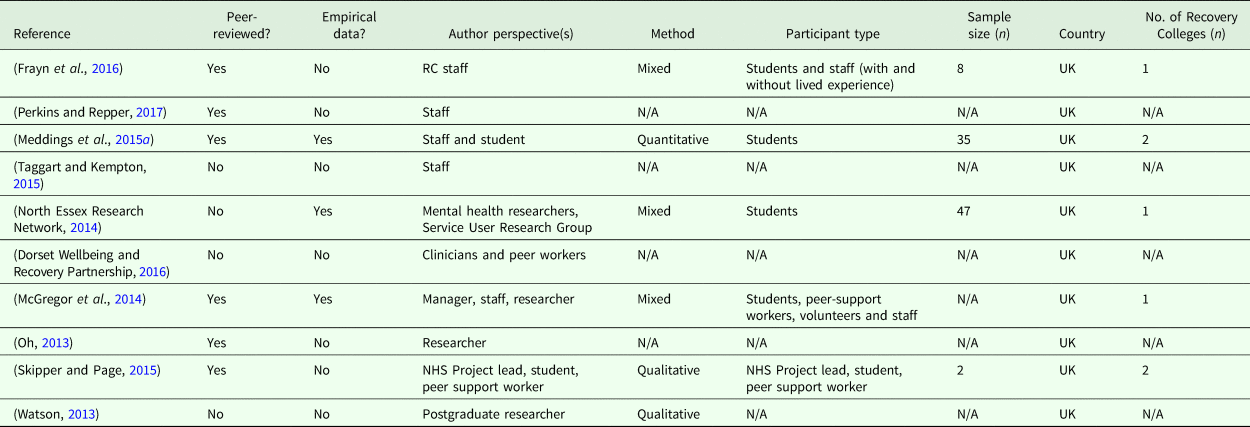
Ten key publications were identified, shown in Table 1.
Key papers included in document analysis (n = 10)

The service user and carer workshop identified mainly student-level mechanisms and outcomes, reflecting their focus. The workshop identified only one societal outcome: reduced stigma in the community and in the family. This proposal and the inductive analysis of key publications were integrated to develop the preliminary framework (shown in online supplement 2), identifying candidate mechanisms (two staff, three services, three societal) and outcomes (five staff, two services, four societal) at each level.
The preliminary framework was refined through interviews (n = 33) with service user students (n = 11), peer trainers (n = 4), clinician trainers (n = 4), Recovery College managers (n = 2), community partner organisations (n = 4), commissioners (n = 4), National Health Service (NHS) (i.e. host organisation) managers (n = 2) and NHS clinicians (n = 2). Service user students primarily described student-level impact, so most coding reported here emerged from non-student participants. The key themes are discussed here, and a more complete description of text for each code is given in online Supplement 3.
Staff level
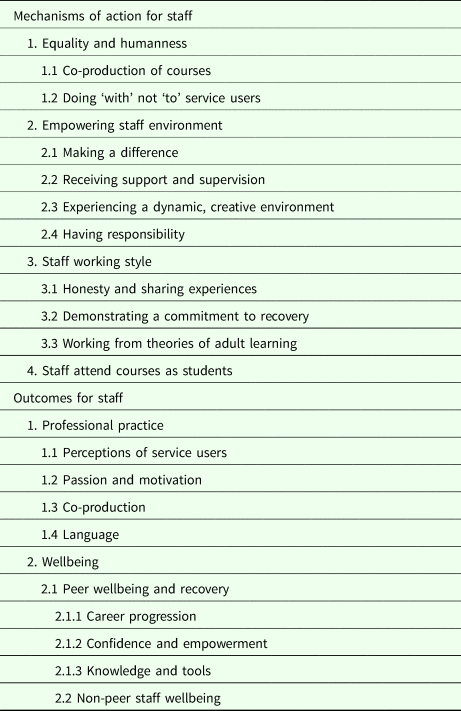
The final coding framework for the staff level is shown in Table 2.
Final coding framework for staff-level mechanisms of action and outcomes
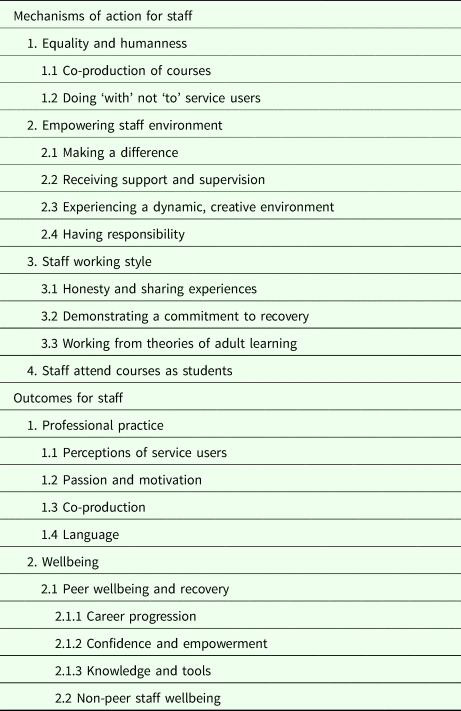
The most frequently proposed mechanism of change for staff was a softening of established roles, which was linked to the environment and to staff–student interactions in attending and delivering courses.
You forget you're a social worker…you're just a person in a room learning about something that is important to you. (Clinician and staff student #1)
…professionals…learn to see service users in a slightly different light (Peer trainer #1)
Resulting changes in professional practice for non-peer staff included new approaches to working with and relating to service users, and a re-engagement with their commitment to the work. Co-production was identified as having a specific impact.
There was the sense…there has to be something better than this for me personally as a clinician… it [Recovery College]…opened up my eyes again. (Non-peer trainer #3)
I will think, everything I do now, let's look at about how we can co-produce this…God, my mindset has absolutely shifted (NHS manager #1)
Some non-peer tutors struggled with the role.
It's sometimes been a challenge when the professional has taken over (NHS manager #1)
A beneficial impact on staff wellbeing was identified by trainers, though the level of responsibility was problematic for some peer trainers.
Without it [working at the Recovery College] I would've been even more sort of fed up and stressed. (Non-peer trainer #3)
Some people [peers] couldn't, sort of, cope with it… (Peer trainer #4)
Services level
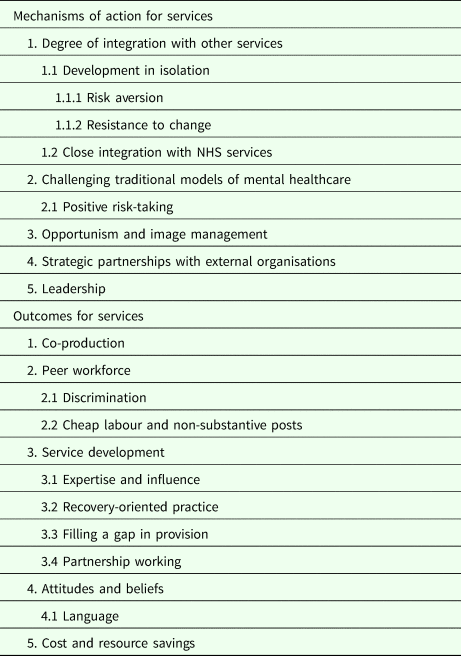
The final coding framework for the mental health and social care services level is shown in Table 3.
Final coding framework for services-level mechanisms of action and outcomes

Many Recovery Colleges develop in a protected and low-visibility space within the host organisation, allowing them to grow un-hindered: ‘I don't think anybody particularly noticed [the college]’ (Non-peer trainer #3). Positive risk-taking encouraged in Recovery Colleges was identified as a specific difference from the risk aversion of the wider organisation, increasing the perceived distance between the college and other services. Differences between the college and wider system were not viewed as a wholly negative, as it allowed the organisation to give a positive impression of hosting a socially desirable recovery initiative.
So that's the challenge to the traditional psychiatric medical model, which is still there in every single team… (NHS manager #1)
There was a near neighbour which already had a college so they would have been very much aware of that, and I think that got good publicity. (Commissioner #3)
The most frequently coded service outcome was increased co-production. Linked to this was the impact on peer workforce development within services, with lowered discriminatory assumptions about the abilities of workers with lived experience and more willingness to make workplace adjustments. The possibility of workforce exploitation was noted, along with concerns about how far Recovery Colleges would spread.
Everything we do is in line with peers…the cultural effect of the Recovery College on this organisation has been a proliferation of co-production. (NHS manager #1)
there would be…resistance at it becoming a dominant way of delivering services…because of the tendency everywhere to fall to the status quo. (Commissioner #2)
Societal level
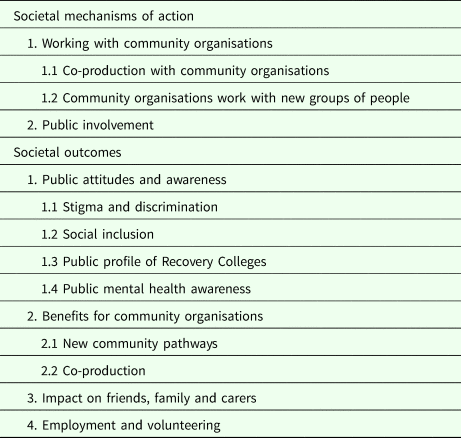
The final coding framework for the societal level is shown in Table 4.
Final coding framework for societal mechanisms of action and outcomes

The most frequently coded mechanism was working with community organisations to co-produce courses. This was nearly always described as positive, though adapting courses to Recovery College requirements was sometimes challenging for the community partner. This enabled community organisations to engage with students they might not otherwise have worked with:
So it's really helpful to be able to do what we do with a different group of people. (Community partner organisation #3)
The most frequently reported impact of Recovery Colleges was on public attitudes, by reducing negative assumptions about people with mental health problems. Increased social inclusion through more friendships and better integration into the community was proposed. Benefits for community organisations from working with Recovery Colleges were also identified, through increased public access to their services and increased co-production in their own work.
It allows people to…be involved a bit more in the community. (Community partner organisation #4)
Because if they [community partner] see how well it [co-production] works…they're more likely to go back and think ‘Oh OK that's how we should do things again’ really. (Recovery College Manager #2)
Discussion
This is the first study to use mixed-methods research to identify candidate mechanisms of action and outcomes for Recovery Colleges at staff, services and societal levels. Inductive document analysis and interviews with a wide range of Recovery College stake holders identified candidate mechanisms of action and outcome at each level.
Change at the staff level
The richest data were elicited for changes in staff. Staff involvement in a Recovery College, including attending and co-running courses, has the potential to impact on staff attitude and behaviour, e.g. towards co-production and shared decision-making (Slade, Reference Slade2017). Specific examples were positive interactions with peer trainers and experiencing co-production. This may be viewed as an approach to reducing in-system stigma, i.e. stigmatising beliefs held by health professionals in relation to people with mental ill-health (Henderson et al., Reference Henderson, Noblett, Parke, Clement, Caffrey, Gale-Grant, Schulze, Druss and Thornicroft2014). Clinicians meeting service users in traditional clinical contexts do not improve attitudes (Thornicroft et al., Reference Thornicroft, Mehta, Clement, Evans-Lacko, Doherty, Rose, Koschorke, Shidhaye, O'Reilly and Henderson2016). It is plausible that the intergroup contacts between staff and service user in a Recovery College context have more prejudice-reducing features: participants have equal status; co-operation around common goals is encouraged; contact is normative, i.e. has institutional support; and meaningful repeated contacts support friendship development (Al Ramiah and Hewstone, Reference Al Ramiah and Hewstone2013).
Peer work is an important global innovation in the mental health system (Puschner, Reference Puschner2018). A change model for peer workers has been developed (Gillard et al., Reference Gillard, Gibson, Holley and Lucock2015), but not yet specifically for peer trainers. Similarly, co-production is a new way of transforming systems, but recent evaluations indicate it is complex to implement (Parker et al., Reference Parker, Dark, Newman, Hanley, McKinlay and Meurk2018). A primary impact of Recovery Colleges on staff arises from seeing these two innovations in practice.
Change at the service level
Recovery Colleges in England have emerged without central commissioning and in the context of economic austerity when many mental health and social care systems are under considerable financial pressure. Two mechanisms emerged as influential at the system level: organisational separation and organisational image.
The separation of Recovery Colleges from its host institution has potential negative impacts, such as low staff awareness about the Recovery College and reduced opportunity to impact on mainstream services (Zabel et al., Reference Zabel, Donegan, Lawrence and French2016). However, participants mainly identified positive benefits from separation, in allowing the creation and sustaining of a different organisational culture, based on educational rather than clinical concepts, and using co-production rather than solely professional views to lead the service. Insufficient separation has been shown to reduce fidelity in other alternative systems, such as consumer-run services (Segal and Hayes, Reference Segal and Hayes2016).
The emergence of organisational image as an influence on uptake may explain the success of Recovery Colleges in opening in England during a period of austerity – Recovery Colleges meet both the goal of having a demonstrable service focused on recovery in alignment with national policy (HM Government, 2011) and the group-level process of social desirability (neighbouring organisations have one so we should have one).
Both these mechanisms can be seen as arising from the Recovery College features of being a discrete new approach which need not disrupt existing service culture. However, it has been argued that viewing recovery as something ‘done’ in one part of an organisation fails to engage with the need for cross-organisation transformation (Slade et al., Reference Slade, Amering, Farkas, Hamilton, O'Hagan, Panther, Perkins, Shepherd, Tse and Whitley2014). Recent challenges to traditional mental health systems (United Nations General Assembly, 2017) indicate that this separation may be a short-term approach to allow Recovery Colleges to flourish, but in longer term, the wider system culture needs to be transformed before colleges can both flourish and be fully integrated.
Change at the societal level
Mechanisms and outcomes at the societal level were least considered, perhaps indicating that the focus of most participants was in-system transformation. All identified mechanisms involved increased interaction between mental health stakeholders and wider community stakeholders, and the most identified beneficial outcome related to stigma. The experience of discrimination by people with mental health problems is widespread (Webber et al., Reference Webber, Corker, Hamilton, Weeks, Pinfold, Rose, Thornicroft and Henderson2014) (Corker et al., Reference Corker, Hamilton, Robinson, Cotney, Pinfold, Rose, Thornicroft and Henderson2016), and anti-stigma initiatives have the potential to impact on service users’ responses to discrimination (Sampogna et al., Reference Sampogna, Bakolis, Robinson, Corker, Pinfold, Thornicroft and Henderson2017). Recovery Colleges and anti-stigma programmes share the aim of increased community participation as a result of reduced discrimination and reduced self-stigma. The extent to which Recovery Colleges can improve community attitudes towards mental ill-health merits further investigation.
The study has several strengths. It is the first study to address the multiple levels at which Recovery Colleges have an impact. It was developed using both primary and secondary data to enhance validity, used a range of stakeholder perspectives, and included consideration both of positive and negative mechanisms and outcomes. A limitation of the study is the challenge of separating impact at different levels. Respondent attributions of change to staff v. change in the system may constitute a category error. Other limitations are the small, albeit diverse, sample who are likely to have self-selected for their positive views, the absence of family perspectives and the potential bias arising from involvement of some authors in Recovery Colleges.
Future research
This study can be extended in three ways. First, it provides a preliminary theory base for the future development of a testable change model at each level. Developing a change model is necessary for formal evaluation of the impact of Recovery Colleges at each level. The next step will involve creating a formal change model showing proposed connections between specific mechanisms and measurable outcomes. It is likely that causal connection will emerge between different levels. For example, improved student outcomes may positively impact on staff hopefulness about recovery, on service culture by raised expectations about shared decision-making, and on societal outcomes through more visible contributions by people with mental health problems in local communities. The resulting change model will then need to be validated by feedback from stakeholders. Our study suggests that, for this specific research question, service user students should not be the main stakeholder group as their focus is on the student level. The final stage will then involve observational or experimental research to test the change model in practice.
Second, we noted the absence of consideration in reviewed publications of potential harms from Recovery Colleges, presumably because as with any health innovation, a very positive message about the content and potential benefit of the intervention is initially needed. Stakeholder interviews highlighted a range of possible negative consequences, such as exploitation of peer workers. This suggests that the field is maturing and some potentially negative consequences are becoming visible. Future Recovery College evaluations should investigate and report (Ioannidis et al., Reference Ioannidis, Evans, Gøtzsche, O'Neill, Altman, Schulz and Moher2004) unwanted effects as well as benefits.
Finally, our identification of candidate mechanisms and outcomes at each level can inform the evaluation of Recovery Colleges. The key outcomes to emerge are staff perceptions about service users, service-level use of co-production and development of a peer workforce, and public attitudes. Each of these outcomes is measurable and can inform a more contextual evaluation in a randomised controlled trial (Moore et al., Reference Moore, Audrey, Barker, Bond, Bonell, Hardeman, Moore, O'Cathain, Tinati, Wight and Baird2014).
Implications
This study has implications for new and existing Recovery Colleges. Investing in Recovery Colleges has the potential not only to benefit mental health service users. A range of outcomes for mental health staff and services and wider society has been identified. The resulting framework can inform commissioning and organisational arrangements.
The level of integration between the college and the host should be actively managed. Aspects to consider include shared v. separate buildings, paperwork, processes and workforce. A protected space enables the college to develop a distinct counter-culture, but closer integration increases the extent to which the Recovery College will influence culture in the host organisation.
If the main focus is on beneficial impacts on the mental health and social care system, then the distinct identity of the Recovery College needs to be actively managed, staff encouraged to view their Recovery College experiences as providing them with experiential resources to be used in the host organisation, and efforts made to invite co-production and peer workforce developments in the host organisation. Similarly, if the focus is on societal change, then courses specifically targeted at family and community members, and active engagement with community agencies are priorities.
The potential benefits of Recovery College beyond mental health service users are coming into focus. This study provides a first theoretical foundation for investigating Recovery Colleges as an approach to organisational and societal transformation.
Author ORCIDs
Claire Henderson http://orcid.org/0000-0002-6998-5659.
Mike Slade http://orcid.org/0000-0001-7020-3434.
Supplementary material
The supplementary material for this article can be found at https://doi.org/10.1017/S204579601800063X.
Data
Data are available from the corresponding author.
Acknowledgements
The authors gratefully acknowledge the contribution of Recovery College students and staff, clinicians and further education college staff who participated in this study.
Financial support
This report is an independent research funded by the National Institute for Health Research (grant number RP-DG-0615-10008) and supported by the NIHR Nottingham Biomedical Research Centre (M.S., grant number BRC-1215-20003). The funders had no role in the conduct of the research, and the views expressed in this publication are those of the author(s) and not necessarily those of the NHS, the National Institute for Health Research or the Department of Health and Social Care.
Conflict of interest
None.
Ethical standards
The authors assert that all procedures contributing to this work comply with the ethical standards of the relevant national and institutional committees on human experimentation and with the Helsinki Declaration of 1975, as revised in 2008.