Individual differences in neurocognitive skills predict symptom presentation in individuals with attention-deficit/hyperactivity disorder (ADHD; Adalio, Owens, McBurnett, Hinshaw, & Pfiffner, Reference Adalio, Owens, McBurnett, Hinshaw and Pfiffner2018), and theoretical models of ADHD regularly implicate neurocognitive dysfunction as a predisposing factor (Barkley, Reference Barkley1997; Castellanos, Sonuga-Barke, Milham, & Tannock, Reference Castellanos, Sonuga-Barke, Milham and Tannock2006; Diamond, Reference Diamond2005). The observed and theoretical comorbidity between ADHD and neurocognitive dysfunction has stimulated investigations into the utility of measures of neurocognitive dysfunction to serve as endophenotypes (i.e., phenotypes that are more proximal to the etiology of a clinical disorder and influenced by common genes that reflect susceptibility for the disorder; Gottesman & Gould, Reference Gottesman and Gould2003) for ADHD. In fact, neurocognitive processes (e.g., working memory, inhibition) are highlighted by the National Institutes of Mental Health Research Domain Criteria Initiative (RDoC) as endophenotypes that may be particularly useful for clarifying the mechanisms that underlie psychiatric disorders (Karalunas, Bierman, & Huang-Pollock, Reference Karalunas, Bierman and Huang-Pollock2016).
The multifaceted nature of both ADHD and neurocognition complicates the study of neurocognitive dysfunction in ADHD, as there may be deficits in some but not all of the neurocognitive functions and patterns that are specific to different ADHD presentations such as inattentive (ADHD-I), hyperactive impulsive (ADHD-HI), and combined (ADHD-C). As a result, studies of the overlap between ADHD and neurocognitive function require a nuanced approach to clarify the specificity of comorbidity among ADHD and neurocognitive dysfunction. Further, different presentations of neurocognitive dysfunction may emerge for the dimensional (i.e., symptom count) versus categorical (i.e., diagnostic) classification of inattention. Although the use of categorical diagnoses is crucial for prioritizing individuals that are most in need of intervention, levels of inattention are variable within the population and it is important to understand how those varying levels relate to other outcomes, such as neurocognitive dysfunction. The utility of symptom counts vs. categorical diagnoses has been demonstrated for dimensional behaviors (Knopik et al., Reference Knopik, Sparrow, Madden, Bucholz, Hudziak, Reich and Todd2005; Levy, Hay, McStephen, Wood, & Waldman, Reference Levy, Hay, McStephen, Wood and Waldman1997) including inattention (Bidwell et al., Reference Bidwell, Willcutt, DeFries and Pennington2007). An exploration of the latent structure of inattention in a general population sample revealed that inattention problems have a dimensional latent structure (Marcus & Barry, Reference Marcus and Barry2011). This is consistent with the dimensional nature of many psychiatric conditions, including ADHD (Bidwell et al., Reference Bidwell, Gray, Weafer, Palmer, de Wit and MacKillop2017). Given the multidimensional and developmental nature of inattention, examining dimensions of behaviors rather than categories may be most useful in determining the etiology of inattention (Nikolas & Burt, Reference Nikolas and Burt2010) and its overlap with neurocognitive functioning. To this end, the current study takes a dimensional perspective to evaluate inattention by using factor analysis to capture the shared variance among symptoms of inattention (rather than diagnostic cutoffs) and examines the genetic overlap between inattention and four aspects of neurocognitive functioning in youth: social cognition, memory, executive function, and complex cognition.
Neurocognitive Dysfunction in ADHD-I and Dimensional Assessment of Inattention
Behaviorally, children with ADHD-I often exhibit inattention, disorganization, and social passivity or social isolation (Hinshaw, Reference Hinshaw2002). The neurocognitive characteristics of children with ADHD-I subtype include slow orientation and responding to stimuli in their surroundings and challenges with memory search and retrieval (Solanto et al., Reference Solanto, Gilbert, Raj, Zhu, Pope-Boyd, Stepak and Newcorn2007). Investigations of the neural mechanisms that underlie inattention in ADHD-I suggest that there are deficits in automatic perceptual processes (e.g., visual orienting to novel stimuli) that are mediated by the posterior attentional system (Posner & Petersen, Reference Posner and Petersen1990) as well as in the mediation of perceptual input processes via the arousal system (Tucker & Williamson, Reference Tucker and Williamson1984). Further, children with ADHD-I recruit attentional alerting and/or orienting processes less efficiently than children with ADHD-C do in the context of inhibitory control tasks (Solanto et al., Reference Solanto, Schulz, Fan, Tang and Newcorn2009). Consequently, in terms of performance on neurocognitive tasks, children with inattention would be expected to present with slower processing speed and slower reaction time, particularly in the context of cognitive load. However, neurocognitive functioning covers a wide range of abilities, which may or may not all be linked with inattention, underscoring the value of assessing the associations between inattention and multiple aspects of neurocognitive function. Further, despite prior evidence that inattention and neurocognitive function are associated, the factors that link these constructs in a pediatric sample remain undetermined. Genetically informed designs can be leveraged to investigate the sources of individual differences (i.e., genetic and environmental) in inattention and neurocognitive functioning and the sources that are common to both.
Genetic Influences on Inattention and Neurocognitive Functioning
There is evidence that individual differences in both clinical and dimensional levels of inattention emerge from a multilocus genetic basis that includes additive genetic effects (i.e., genes acting additively with each other both within and between loci [Hill, Goddard, & Visscher, Reference Hill, Goddard and Visscher2008]), nonadditive genetic effects (i.e., interactions among alleles at the same or different loci [Pingault et al., Reference Pingault, Viding, Galéra, Greven, Zheng, Plomin and Rijsdijk2015]), and nonshared environmental influences (i.e., environments unshared by family members that contribute to familial dissimilarity). Twin studies of both clinical and nonclinical levels of inattention reveal high heritability estimates (McLoughlin, Ronald, Kuntsi, Asherson, & Plomin, Reference McLoughlin, Ronald, Kuntsi, Asherson and Plomin2007; Peng et al., Reference Peng, Grant, Heath, Reiersen, Mulligan and Anokhin2016; Sherman, Iacono, & McGue, Reference Sherman, Iacono and McGue1997; Willcutt, Pennington, & DeFries, Reference Willcutt, Pennington and DeFries2000). For example, attention problems in middle childhood were highly heritable (77% for girls and 83% for boys) based on additive genetic effects (Groot, De Sonneville, Stins, & Boomsma, Reference Groot, De Sonneville, Stins and Boomsma2004). A meta-analysis of twin studies of the genetic and environmental influences on ADHD symptom dimensions of inattention revealed a high broad heritability estimate (71%), with the presence of dominant genetic influences and additive genetic influences ranging from 46–77% depending on the sex,age, and informant (Nikolas & Burt, Reference Nikolas and Burt2010). Heritability may also be estimated by evaluating the additive genome-wide effects of single nucleotide polymorphisms (SNPs). As is consistent with other complex traits (Cheesman et al., Reference Cheesman, Selzam, Ronald, Dale, McAdams, Eley and Plomin2017), the SNP-based heritability (h2SNP) estimates of inattention are lower than twin-based estimates. For example, a recent study of adult self-reported frequency of inattentive symptoms showed a moderate h2SNP of 44% (Bidwell et al., Reference Bidwell, Gray, Weafer, Palmer, de Wit and MacKillop2017).
Twin and family studies also consistently reveal genetic influences on individual differences in aspects of neurocognitive functioning. For example, individual differences in inhibitory control were approximately 50% heritable (Polderman et al., Reference Polderman, de Geus, Hoekstra, Bartels, van Leeuwen, Verhulst and Boomsma2009; Polderman et al., Reference Polderman, Posthuma, De Sonneville, Stins, Verhulst and Boomsma2007) and neural correlates of response inhibition in adolescence are also genetically influenced (Anokhin, Golosheykin, Grant, & Heath, Reference Anokhin, Golosheykin, Grant and Heath2017). Heritability estimates of set-shifting ranged from 50–80% in adolescence and adulthood (Anokhin, Heath, & Ralano, Reference Anokhin, Heath and Ralano2003; Friedman et al., Reference Friedman, Miyake, Young, DeFries, Corley and Hewitt2008). Additive genome-wide effects of SNPs explain modest to moderate variance in aspects of neurocognitive functioning. For example, a prior study that also examined data from the same sample that was used in this study found that common SNPs explained 36% of the variance in general cognitive functioning, 12% in memory, 15% in social cognition, and 46% in reasoning and executive function (Robinson et al., Reference Robinson, Kirby, Ruparel, Yang, McGrath, Anttila and Hakonarson2014). Measures of neurocognitive ability tend to be positively associated both phenotypically and genetically, although not perfectly (Davies et al., Reference Davies, Marioni, Liewald, Hill, Hagenaars, Harris and Deary2016), underscoring the usefulness of evaluating the overlap between inattention and neurocognitive functions separately.
Shared Genetic Effects Among Inattention and Neurocognitive Functioning
Twin and family studies provide evidence that the co-occurrence of inattention and neurocognitive dysfunction is partially attributable to common genetic influences. Common genes link different aspects of neurocognitive functioning and ADHD, including verbal working memory (Bidwell, Willcutt, DeFries, & Pennington, Reference Bidwell, Willcutt, DeFries and Pennington2007; Doyle, Biederman, Seidman, Reske-Nielsen, & Faraone, Reference Doyle, Biederman, Seidman, Reske-Nielsen and Faraone2005), abstract problem solving (Bidwell et al., Reference Bidwell, Willcutt, DeFries and Pennington2007), interference control (Bidwell et al., Reference Bidwell, Willcutt, DeFries and Pennington2007; Doyle et al., Reference Doyle, Biederman, Seidman, Reske-Nielsen and Faraone2005; Slaats-Willemse, Swaab-Barneveld, de Sonneville, van der Meulen, & Buitelaar, Reference Slaats-Willemse, Swaab-Barneveld, de Sonneville, van der Meulen and Buitelaar2003), processing speed (Bidwell et al., Reference Bidwell, Willcutt, DeFries and Pennington2007; Doyle et al., Reference Doyle, Biederman, Seidman, Reske-Nielsen and Faraone2005), verbal learning (Seidman, Biederman, Monuteaux, Weber, & Faraone, Reference Seidman, Biederman, Monuteaux, Weber and Faraone2000), intellectual ability (Faraone et al., Reference Faraone, Biederman, Lehman, Spencer, Norman, Seidman and Tsuang1993; Kuntsi et al., Reference Kuntsi, Eley, Taylor, Hughes, Asherson, Caspi and Moffitt2003), and academic skills (Doyle et al., Reference Doyle, Biederman, Seidman, Reske-Nielsen and Faraone2005; Gayán et al., Reference Gayán, Willcutt, Fisher, Francks, Cardon, Olson and DeFries2005; Willcutt, Pennington, Olson, & DeFries, Reference Willcutt, Pennington, Olson and DeFries2007). However, there is variability in the magnitude of genetic overlap, underscoring the value of evaluating associations between inattention and different aspects of neurocognitive functioning. Molecular genetic investigations have identified specific genes that link ADHD-I/nonclinical inattention symptoms and various aspects of neurocognitive dysfunction (e.g., Luca et al., Reference Luca, Laurin, Misener, Wigg, Anderson, Cate-Carter and Barr2007). For example, a region on chromosome 3q13 is associated with both ADHD inattention symptoms and multiple neurocognitive measures including inhibitory control, set-shifting, planning/organization, verbal learning, working memory, and arithmetic and reading skills (Doyle et al., Reference Doyle, Ferreira, Sklar, Lasky-Su, Petty, Fusillo and Faraone2008). Additionally, there is evidence for an association of the dopamine receptor D1 gene with symptoms of inattention in families that were specifically selected for reading problems (Luca et al., Reference Luca, Laurin, Misener, Wigg, Anderson, Cate-Carter and Barr2007). Importantly, genetic overlap between aspects of neurocognitive functioning and inattention is partial, not complete, and the magnitude of genetic overlap with inattention varies by neurocognitive phenotype. For example, two aspects of cognitive functioning (i.e., reaction time variability and commission errors on the go/no-go and fast tasks) showed moderate (0.64) and low (0.11) genetic overlap with inattention in youth (Kuntsi et al., Reference Kuntsi, Pinto, Price, van der Meere, Frazier-Wood and Asherson2014).
Current Study
Evidence from prior research indicates that inattention and neurocognitive functioning are associated at the phenotypic level and common genetic influences contribute to both inattention and neurocognitive dysfunction. Neurocognitive functioning covers a wide range of abilities, and some of them may or may not be linked with inattention. A systematic examination of the association between inattention and multiple aspects of neurocognitive function is needed but has not been completed to date. To our knowledge, there have been no studies of the genetic overlap between symptoms of inattention and multiple aspects of neurocognitive functioning as measured by the additive effects of SNPs in a pediatric sample. As such, the goals of the current study were to (a) investigate the h2SNP of inattention and aspects of neurocognitive efficiency (memory, social cognition, executive function, and complex cognition) based on additive genome-wide effects; (b) examine if there were shared genetic effects among inattention and each aspect of neurocognitive efficiency; and (c) conduct an exploratory genome-wide association study (GWAS) to identify the genetic regions that are associated with inattention.
Method
Sample
The participants were children and adolescents ages 8 to 21 years that were enrolled in the Philadelphia Neurodevelopmental Cohort (PNC; Satterthwaite et al., Reference Satterthwaite, Connolly, Ruparel, Calkins, Jackson, Elliott and Gur2016), a large-scale, NIMH-funded collaboration between the Center for Applied Genomics at the Children's Hospital of Philadelphia and the Brain Behavior Laboratory at the University of Pennsylvania. Consent/assent was obtained for the children to participate in genomic studies of complex pediatric disorders. The participants completed clinical assessments including a structured neuropsychiatric interview and review of electronic medical records. The participants also completed a comprehensive computerized neurocognitive battery and self- and parent-reports of behaviors (e.g., ADHD symptoms) were obtained. For more complete descriptions of the study, see Calkins et al. (Reference Calkins, Merikangas, Moore, Burstein, Behr, Satterthwaite and Gur2015) and Gur et al. (Reference Gur, Richard, Calkins, Hansen, Loughead, Gur and Bilker2012).
The participants received a severity rating for medical condition based on parent report (for children 17 or younger) or self-report (for participants ages 18 to 21) and electronic medical records, ranging from 1 (none or minor) to 4 (severe). Consistent with other studies of the same sample (e.g., Robinson et al., Reference Robinson, Kirby, Ruparel, Yang, McGrath, Anttila and Hakonarson2014) those with a medical rating of 4 were excluded from the analyses, as physical symptoms may have affected their task performance. Individuals with invalid neurocognitive tests were marked as missing.
Measures
Inattention
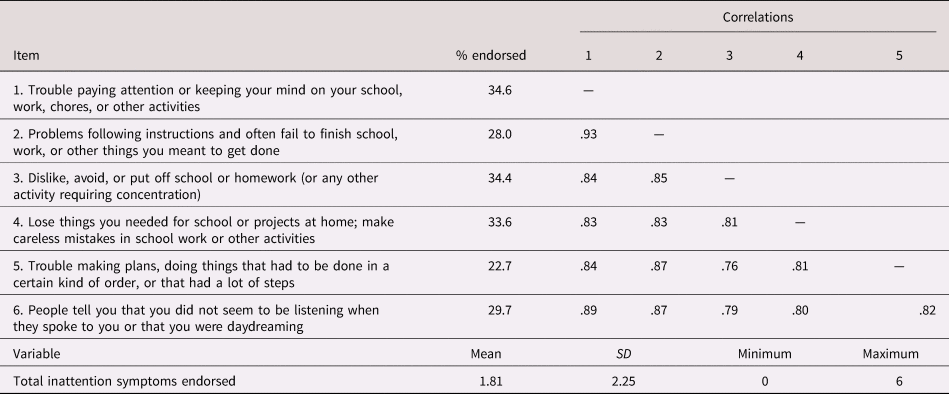
Participants (for participants ages 18+) or their parent (for participants under age 18) reported on six inattention questions that were drawn from the Kiddie Schedule for Affective Disorders and Schizophrenia (shortened) interview (Merikangas, Avenevoli, Costello, Koretz, & Kessler, Reference Merikangas, Avenevoli, Costello, Koretz and Kessler2009). The inattention items (Table 1) assessed the presence of inattentive behaviors across activities that demand attention (e.g., school work, making plans) and across contexts (e.g., “Did you often have trouble paying attention or keeping your mind on school, work, chores, or other activities that you were doing?”). The items were coded as 0 = no (unaffected), 1 = yes (affected). To our knowledge, the reliability and validity of the six-item assessment for inattention has not been tested in the PNC sample, but Cronbach alpha for inattention in the current study was .90.
Descriptive statistics and tetrachoric correlations among inattention symptoms (n = 3,719)

Neurocognitive Functioning
The Penn Computerized Neurocognitive Battery (CNB) was used to conduct 12 tasks that reflect four domains of neurocognitive functioning (Gur et al., Reference Gur, Richard, Calkins, Hansen, Loughead, Gur and Bilker2012; Moore, Reise, Gur, Hakonarson, & Gur, Reference Moore, Reise, Gur, Hakonarson and Gur2015). Each of four neurocognitive domains were assessed with three tasks. Social cognition evaluated emotion identification, emotion intensity differentiation, and age differentiation with the Penn Emotion Identification Test, Penn Emotion Differentiation Test, and the Penn Age Differentiation test, respectively. Memory reflected episodic memory for verbal material, faces, and shapes and was assessed with the Penn Word Memory Test, Penn Facial Memory Test, and the Visual Object Learning Test, respectively. Executive function evaluated abstraction and mental flexibility, vigilance and visual attention, and working memory with the Penn Conditional Exclusion Test, Penn Continuous Performance Test, and the Penn Letter N-Back Test. Complex cognition reflected verbal, nonverbal, and spatial reasoning, assessed with the Penn Verbal Reasoning Test, Penn Matrix Reasoning Test, and the Penn Line Orientation Test. The CNB demonstrates adequate psychometric properties in the PNC sample (Moore et al., Reference Moore, Reise, Gur, Hakonarson and Gur2015), and Cronbach's alphas for the neurocognitive measures in the present study were acceptable (i.e., Memory = .91; Social Cognition = .97; Executive Function = .90; Complex Cognition =.90).
Moore and colleagues (Reference Moore, Reise, Gur, Hakonarson and Gur2015) evaluated the neuropsychological theory that was used to construct the CNB by confirming the factor structure of the tests that compose it within the PNC sample. The authors compared the fit of a correlated traits model and a bifactor model and advise researchers to use the correlated traits model if the investigators use CNB subscale scores. As such, the current study sought to confirm the four-factor correlated model (Moore et al., Reference Moore, Reise, Gur, Hakonarson and Gur2015).
Data Analysis
Derivation of Phenotypes
Exploratory and confirmatory factor analyses were conducted in Mplus Version 8 (Muthén & Muthén, 1998–Reference Muthén and Muthén2017). Missing data were handled with full information maximum likelihood estimation. Model fit was assessed with the confirmatory fit index (CFI) and the root mean square error of approximation (RMSEA), where better fit is indicated by CFI > .90 and RMSEA < .05 (Noar, Reference Noar2003).
Inattention
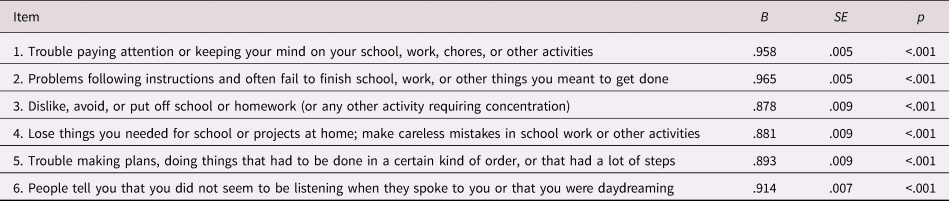
To derive a continuous dimension of inattention problems that captures the shared variance among available inattention symptoms, we conducted a factor analysis of the inattention items. This approach has also been applied using externalizing items within the PNC data (Shanmugan et al., Reference Shanmugan, Wolf, Calkins, Moore, Ruparel, Hopson and Gennatas2016). First, the sample was split into random halves to conduct the exploratory and confirmatory factor analyses (EFA and CFA, respectively). Weighted least-squares mean variance estimation was used for analyzing the binary inattention items. An exploratory factor analysis of data from half of the sample (n = 1,858) revealed a single dimension of inattention with the following model fit statistics: χ2 (9) = 15.281, p = .084; RMSEA = .019. All of the items had high factor loadings, ranging from .876 to .971. The single dimension was confirmed by conducting a CFA of the second half of the sample data (n = 1,861), with model fit statistics, χ2 (9) = 48.107, p < .001; RMSEA = .048, 90% CI [.035, .062]; CFI = .999, and again with the full sample. The inattention items and model results from the full sample CFA are presented in Table 2. The model fit statistics and parameter estimates for the split-half EFA and CFA are presented in Supplemental Table 1. Based on the confirmation of a single factor solution in the CFA, the factor scores from the one factor solution were extracted to be used in the genetic analyses.
Model results (standardized factor loadings, standard errors, and p values) from the full sample confirmatory factor analysis of inattention symptoms (n = 3,719)

Note: Model fit—RMSEA = .036, 90% CI [.027, .046]; CFI = .999; χ2 (9) =52.905, p = <.001.
Neurocognitive Functioning
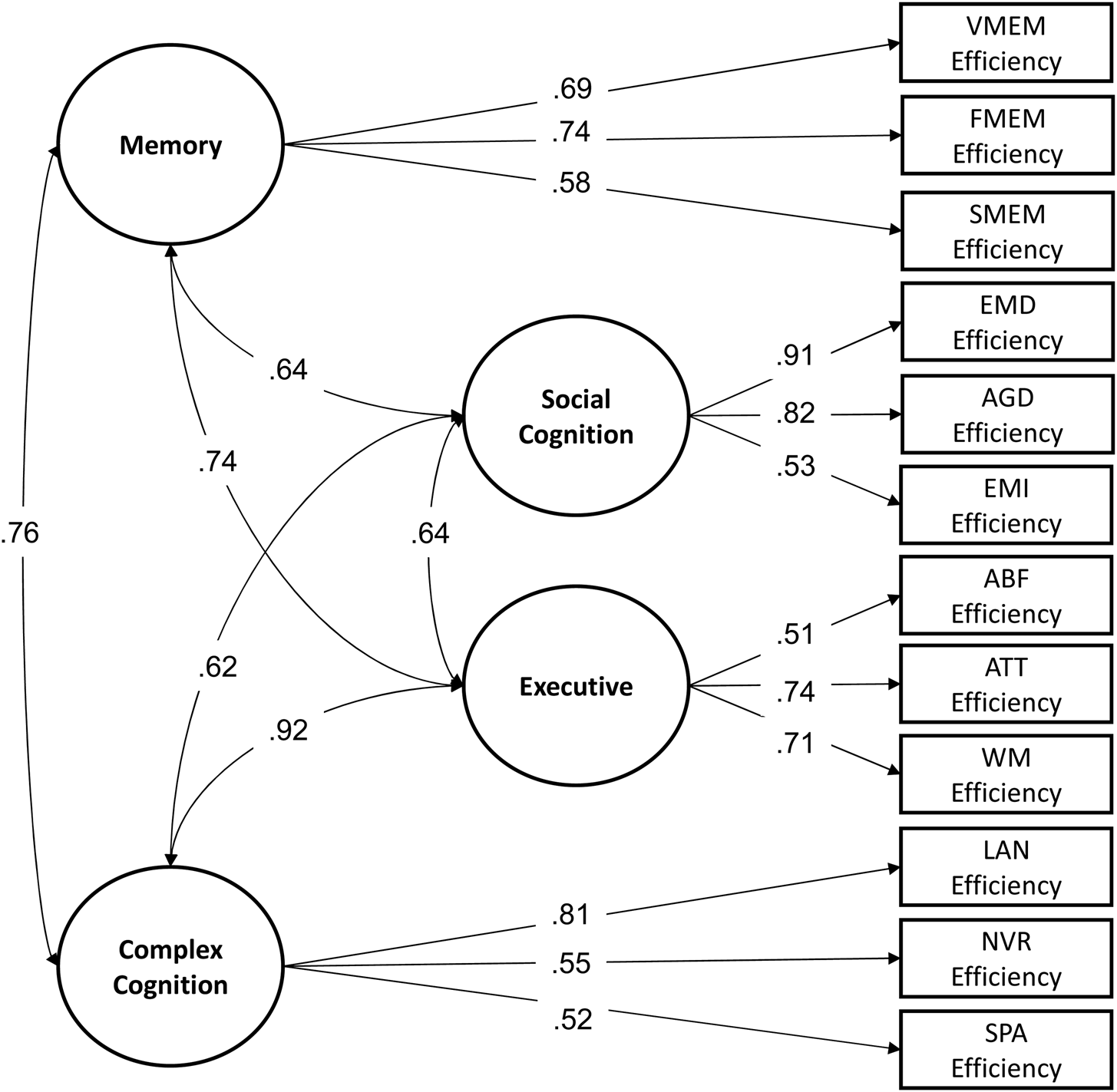
For neurocognitive functioning, a CFA using maximum likelihood estimation was conducted with data that were collected from 3,571 individuals who completed the CNB. Consistent with Moore et al.’s (Reference Moore, Reise, Gur, Hakonarson and Gur2015) approach, raw accuracy and speed data from the CNB were transformed into standard scores (z-scores) by using the sample mean and standard deviation for each measure. Median speed was multiplied by -1, with higher scores indicating faster response times and better performance on both measures. Efficiency scores were calculated to reflect the sum of the standardized scores on speed and accuracy, and they were used as is advised by Moore and colleagues. Further, considering that the focus of our study was to examine inattention, with ADHD hypothesized and shown to impair speed-accuracy tradeoff optimization (Mulder et al., Reference Mulder, Bos, Weusten, van Belle, van Dijk, Simen and Durston2010), we focused on an average of speed and accuracy. The factor structure (see Figure 1) yielded factor loadings that were similar to those reported by Moore et al. (Reference Moore, Reise, Gur, Hakonarson and Gur2015). Support for the correlated four-factor model was also demonstrated by the model fit statistics, χ2 (66) = 16,205.418, p < .001; RMSEA = .097, 90% CI [.093, .101]; CFI = .900.
Confirmatory correlated-traits model of CNB efficiency scores.

Genotyping, Quality Control, and Genetic Imputation
The SNP & Variation Suite (version 8.4.4), PLINK (version 1.9; Purcell et al., Reference Purcell, Neale, Todd-Brown, Thomas, Ferreira, Bender and Sham2007), and R (version 3.1.1) were used for all of the genetic data management. Genomic data were drawn from the Neurodevelopmental Genomics: Trajectories of Complex Phenotypes Study through the National Center for Biotechnology Information's Database for Genotypes and Phenotypes (dbGAP, Study Accession: phs000607.v3.p2). A large sample of youth who had been genotyped previously and data from several Illumina platforms were pooled (Illumina Human610 Quad v1, Human Hap550 v1.1, Human Hap550 v3.0, Human 1M-Duo, Human OmniExpress-12 v1.0). We conducted a principle components analysis within each sample by using the 1000 Genomes Project (1KG) Phase III (Version 5) reference panel (Auton et al., Reference Auton, Brooks, Durbin, Garrison, Kang, Korbel and Abecasis2015) to determine genetic ancestry and perform strand alignment. A total of 4,296 individuals of European ancestry (EA) were identified and selected for imputation by using a pipeline that minimizes effects due to population stratification by screening based on alignment with the 1KG reference samples of Utah residents of northern and western European ancestry. For a detailed outline of this protocol, see Brick, Keller, Knopik, McGeary, & Palmer, Reference Brick, Keller, Knopik, McGeary and Palmer2019. Briefly, each sample was genetically imputed by using the 1KG reference panel and ShapeIT phasing with Minimac3 via the Michigan Imputation Server (https://imputationserver.sph.umich.edu/index.html#!pages/home). Following imputation, markers that were not biallelic, were not autosomal, or had a poor imputation quality score (r 2 < 0.30) were removed. Next, markers that had a call rate < 99%, low minor allele frequency (<1%), or failed the Hardy–Weinberg equilibrium test (p < 0.0001) were removed and samples with < 90% missing data were removed, resulting in a total of 5,360,405 SNPs. A genetic relationship matrix was computed by using the genome-wide complex trait analysis software tool (version 1.25.3) to control for cryptic relatedness (Yang, Lee, Goddard, & Visscher, Reference Yang, Lee, Goddard and Visscher2011). A total of 3,991 unrelated individuals of EA were retained for analysis. See Supplemental Table 2 for a summary of the markers that were removed at each step of the quality control procedure.
SNP-based Univariate and Bivariate Heritability Estimates
Genetic analyses were conducted on the subsample of 3,563 youth of EA (50% female; mean age = 13.7, standard deviation = 3.65) that had available genetic data, valid CNB data, and data on inattention symptoms. Genomic-relatedness-based restricted maximum likelihood, implemented in genome-wide complex trait analysis software (Yang et al., Reference Yang, Lee, Goddard and Visscher2011), was used to estimate the h2SNP of each construct. That is, the phenotypic variance in inattention and each neurocognitive factor was decomposed into the additive effects of genotyped and imputed SNPs. Additionally, we conducted regression analyses to determine whether h2SNP estimates for inattention varied by chromosome and longer chromosomes accounted for more variance in inattention. These analyses were followed with a mixed-linear-model-based association analysis (Yang, Zaitlen, Goddard, Visscher, & Price, Reference Yang, Zaitlen, Goddard, Visscher and Price2014) to identify loci that were significantly associated with inattention. In the mixed linear model based association analyses, false discovery rate (q < 0.05) was used to correct for multiple testing (Benjamini & Hochberg, Reference Benjamini and Hochberg1995). Bivariate genomic-relatedness-based restricted maximum likelihood was used to determine the additive genetic correlation (r G-SNP) between inattention and each of the four neurocognitive factors. The r G-SNP estimate (ranging in value from -1.0 to 1.0) reflects the extent to which the same gene loci influence both outcomes. The two-tailed p values were derived by using the change in log-likelihood when the r G-SNP is fixed to zero, which is distributed as a chi-square statistic. All of the analyses controlled for sex and age.
Results
Prevalence of Inattention Symptoms and Associations With Neurocognitive Functioning
The percentages of endorsement for each inattention question and the correlations among the inattention items are presented in Table 1. The most commonly endorsed (34.6%) item was “Trouble paying attention or keeping your mind on your school, work, chores, or other activities.” Associations among the inattention items were uniformly high, ranging from .76 to .93 (see Table 1). The factor scores between inattention and each aspect of neurocognitive function were negatively associated (r P ranged from -.05 to -.08; Table 3), indicating that, phenotypically, higher levels of inattention were associated with lower neurocognitive efficiency across each domain.
Univariate SNP-heritability (h2SNP), phenotypic correlation (r p), and genetic correlation (r g) estimates for inattention and neurocognitive domains (n = 3,563)

Note: SE = standard error. ***p < .001 **p < .01.
Univariate and Bivariate SNP-Heritability Estimates
The SNP-based heritability estimates and genetic correlations are presented in Table 3. Modest genetic influences were observed for inattention (.20, SE = 0.08), memory (.17, SE = .08), social cognition (.13, SE = .08), executive function (.25, SE = .08), and complex cognition (.24, SE = .08). The examination of the additive genetic effects by chromosome indicated that several chromosomes (chromosomes 1, 3, 4, 8, 10, 13, and 14) significantly contributed to the total additive genetic variance in inattention (see Supplemental Figure 1). Longer chromosomes did not account for more genetic variance (B = <.001; p = .10). The bivariate analyses revealed a moderate positive genetic correlation between inattention and social cognition, (r G-SNP = .67, SE = .37, p < .01) and a negative residual covariance (r E = -.23, SE = 0.06). The genetic correlations between inattention and memory, executive function, and complex cognition were not significant (Table 3).
Exploratory GWAS
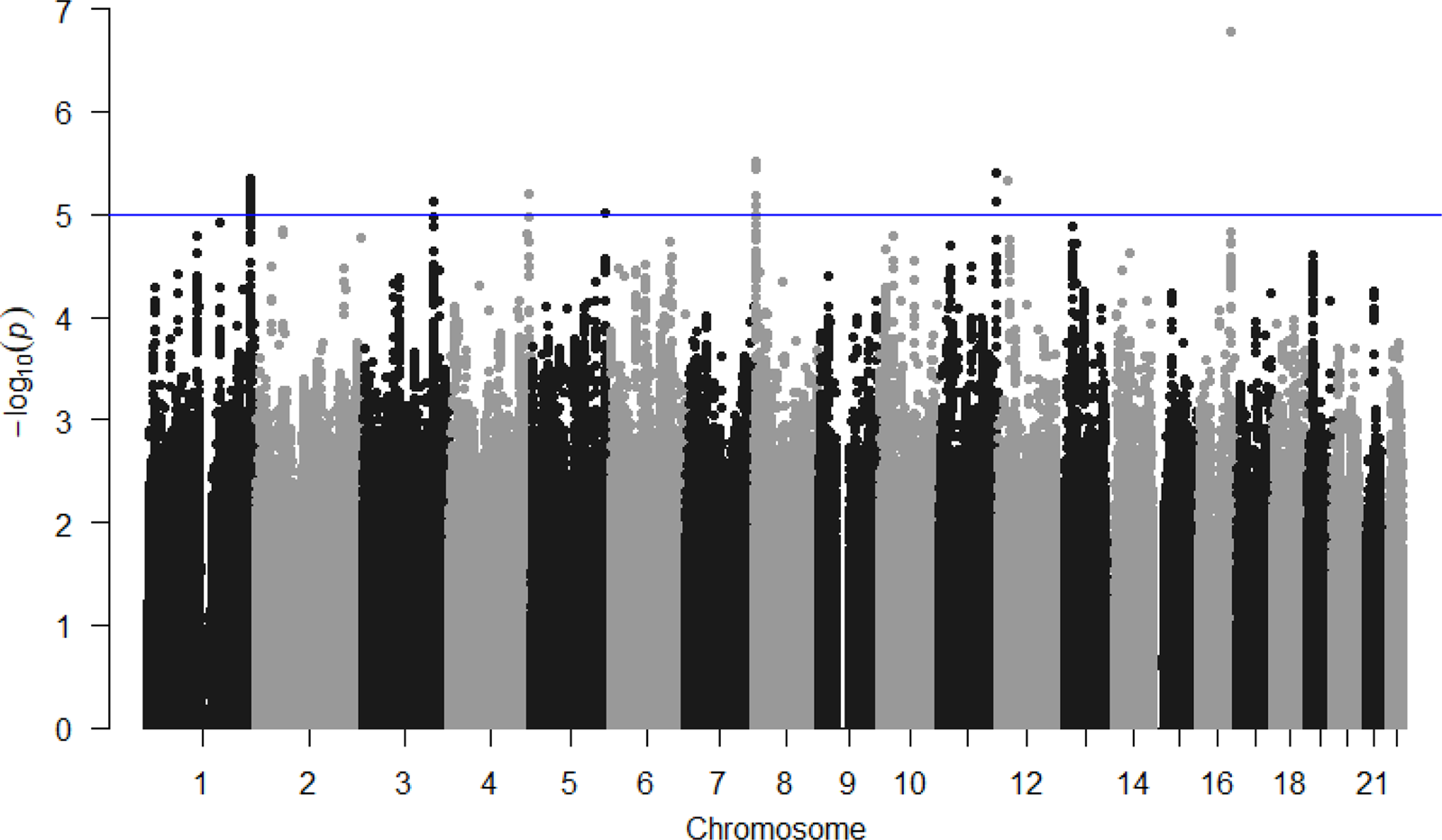
For inattention, no markers were significant at the GWAS level of p < 10–8. One region on chromosome 16 (16:75216240) reached p < 10–6, and 82 markers reached p < 10–5. No markers passed the false discovery rate threshold (Benjamini & Hochberg, Reference Benjamini and Hochberg1995). See Figure 2 for the Manhattan plot of the GWAS p values. The top hits and associated p values are presented in Supplemental Table 3. The GWAS results are available from the authors upon request.
Manhattan plot for inattention by chromosome (n = 3,563).

Discussion
The goal of this study was to use data from a large pediatric sample to conduct a genetically informed study of the associations between inattention and four neurocognitive efficiency factors (memory, social cognition, executive function, and complex cognition) to uncover potentially heterogeneous neurocognitive impairments that are associated with inattention. The findings revealed that inattention and the neurocognitive efficiency variables were each modestly heritable and that there was a moderate, positive genetic correlation between inattention and only one aspect of neurocognitive efficiency, social cognition. The genetic correlations among inattention and neurocognitive efficiency in memory, executive, and complex cognition were not significant.
Consistent with research that has uncovered large gaps between the h2SNP and twin heritability for complex childhood traits such as cognitive abilities and behavior problems (Cheesman et al., Reference Cheesman, Selzam, Ronald, Dale, McAdams, Eley and Plomin2017), the h2SNP of inattention that was observed in this study (i.e., 20%) falls towards the lower end of the estimates that have been reported from twin/family studies (Nikolas & Burt, Reference Nikolas and Burt2010), which may be reflective of broad- rather than narrow-sense effects. The h2SNP estimate obtained herein is also lower than the h2SNP of 44% that was observed for the frequency of inattentive symptoms in a community sample of adults (Bidwell et al., Reference Bidwell, Gray, Weafer, Palmer, de Wit and MacKillop2017). One explanation for the different magnitude of genetic effects is differences in methodology. In the current study, the measure of inattention did not necessarily reflect the clinical levels of inattention that are observed in ADHD diagnoses. Instead, it may have reflected a normative level of inattention that is qualitatively different. Another plausible explanation for the differing magnitudes of genetic influence is the implication of evaluating heritability based on the additive effects of SNPs when nonadditive genetic effects have been observed in twin studies of inattention. If nonadditive genetic effects are important in the etiology of inattention, it is reasonable that these h2SNP estimates would be lower than those that have been observed in twin studies. The difference between the h2SNP estimate for inattention in this study and that of Bidwell et al. (Reference Bidwell, Gray, Weafer, Palmer, de Wit and MacKillop2017) may be due to the developmental course of inattention symptoms over time and the fact that this study evaluated inattention in youth. The symptoms of ADHD (Faraone, Biederman, & Mick, Reference Faraone, Biederman and Mick2006) and inattention decline over age (Biederman, Mick, & Faraone, Reference Biederman, Mick and Faraone2000), so heritability estimates may also follow this pattern and fluctuate with time. Additionally, the inclusion of more items (nine items vs. six included here) and items that capture different aspects of inattention by Bidwell et al. (Reference Bidwell, Gray, Weafer, Palmer, de Wit and MacKillop2017) may contribute to the different magnitudes of h2SNP. For example, the Adult ADHD Self-Report Scale (Kessler et al., Reference Kessler, Adler, Ames, Demler, Faraone, Hiripi and Walters2005) that was used by Bidwell et al. (Reference Bidwell, Gray, Weafer, Palmer, de Wit and MacKillop2017) includes an item that asks explicitly about the frequency that the individual experiences distraction due to an activity or stimulus in their surroundings. The items included in this study obtained information about more concrete activities (e.g., related to school work or task completion), which may be more developmentally appropriate for this age range but, nonetheless, could contribute to the variation in heritability estimates.
Chromosome 1 accounted for the largest amount of the total observed genetic variance in inattention and the results of the mixed-linear-model-based association analysis revealed that 10 of the top 20 top hits were located on chromosome 1. Other molecular genetic studies have implicated chromosome 1 in the genetic architecture of ADHD. For example, a quantitative trait loci linkage scan revealed that there was a common locus at chromosome 1p36 that influenced both parent and teacher reports of ADHD symptoms (Zhou et al., Reference Zhou, Asherson, Sham, Franke, Anney, Buitelaar and Faraone2008). Regions on chromosomes 7, 8, and 11 were also identified in a meta-analysis of GWAS studies of childhood ADHD (Neale et al., Reference Neale, Medland, Ripke, Asherson, Franke, Lesch and Daly2010). Although none of the SNPs reached genome-wide significance, five of the top 10 hits in the present study were on chromosome 8. For inattention specifically, consistent with the present findings, GWAS studies have failed to yield significant genome-wide effects (e.g., Ebejer et al., Reference Ebejer, Duffy, van der Werf, Wright, Montgomery, Gillespie and Medland2013). The strongest effect in the gene-based test was for G-protein coupled receptor 139 on symptoms of inattention (6.40 × 10⁻⁵). Therefore, an ongoing effort is required to identify genes that underlie the heritable component of inattention (Neale et al., Reference Neale, Medland, Ripke, Asherson, Franke, Lesch and Daly2010). Future work could expand on these findings by estimating the heritability of more specific genomic regions such as candidate SNPs based on chromosomal or gene-based regions of interest for inattention. These analyses focused on autosomal variants due to the lack of any prior evidence of sex-specific effects. Therefore, genetic information common across males and females was explored while controlling for sex effects. Future research may consider exploring the role of the X chromosome in inattention and its covariance with neurocognitive efficiency.
The genetic effects that were observed for the four aspects of neurocognitive efficiency are of similar magnitudes to those that were identified in a prior study that used data from the same sample (Robinson et al., Reference Robinson, Kirby, Ruparel, Yang, McGrath, Anttila and Hakonarson2014). However, it is important to note that the measurement of neurocognitive function in this study differed slightly from that in the previous study. Robinson et al. (Reference Robinson, Kirby, Ruparel, Yang, McGrath, Anttila and Hakonarson2014) used principle components analysis to extract three components of neurocognitive functioning (i.e., reasoning and executive function, social cognition, and memory). In contrast, the decision to model the four-factor structure of neurocognitive functioning that was used in the current study was based on a recent theoretically based and psychometrically rigorous investigation into the factor structure of the CNB (Moore et al., Reference Moore, Reise, Gur, Hakonarson and Gur2015). Based on Moore et al. (Reference Moore, Reise, Gur, Hakonarson and Gur2015), we separated the reasoning and executive function component that was derived in Robinson et al. (Reference Robinson, Kirby, Ruparel, Yang, McGrath, Anttila and Hakonarson2014) into two separate factors, executive function and complex cognition. It was important to keep executive function and complex cognition separate in this study, as the primary goal was to evaluate differential patterns of overlap between inattention and aspects of neurocognitive efficiency, and the executive function and complex cognition factors assess different aspects of neurocognitive function.
The positive genetic correlation between inattention and social cognition, though in need of replication, suggests that the same genetic loci influence both inattention and social cognition. In interpreting this finding, it is important to consider two points: (a) the possible consequences of using efficiency scores for the neurocognitive functioning variables; and (b) the levels of inattention that were captured in this study are not necessarily maladaptive or at a clinical categorical threshold. Regarding the first point, it may be the case that a modest amount of inattention facilitates social cognitive efficiency. It is reasonable that, in terms of speed/accuracy, social cognitive processing that is “not too slow” and “just accurate enough” may be more related to inattention than are fast/inaccurate and slow/accurate processing. Additionally, although evidence suggests that individuals with ADHD may demonstrate deficits in emotion perception compared with those without (Bisch et al., Reference Bisch, Kreifelts, Bretscher, Wildgruber, Fallgatter and Ethofer2016), studies of typically functioning individuals show that conditions that promote inattention (i.e., distributed focus) result in better attention to happy faces than to sad faces (Srinivasan & Gupta, Reference Srinivasan and Gupta2010; Srinivasan & Hanif, Reference Srinivasan and Hanif2010). Therefore, the type of emotion that is being identified may interface with level of attention, allowing for the possibility that modest levels of inattention could be adaptive under prescribed situations. Future research that is directed at disentangling different symptomology profiles will shed light on the potential positive influence of moderate levels of inattention. Additionally, future studies could integrate other variables (e.g., personality, psychopathology) to probe mechanistic hypotheses.
Further, there was a negative phenotypic correlation between inattention and social cognition but a positive genetic correlation between the two constructs. It has been shown that a phenotypic correlational structure can be quite different from the underlying genetic and environmental structure (Cloninger, Reference Cloninger1987; Heath & Martin, Reference Heath and Martin1990; Knopik, Heath, Bucholz, Madden, & Waldron, Reference Knopik, Heath, Bucholz, Madden and Waldron2009; Stallings et al., Reference Stallings, Hewitt, Cloninger, Heath and Eaves1996). Because phenotypic correlations reflect both the correlation of additive genetic and environmental effects (i.e., environmental represents any effects that are not additive genetic), differences between phenotypic and genetic correlations must be explained by the relationship between genetic and environmental effects (Sodini et al., Reference Sodini, Kemper, Wray and Trzaskowski2018). Therefore, certain traits have environmental effects that act in the opposite direction to the genetic effects (Hadfield et al., Reference Hadfield, Nutall, Osorio and Owens2007). In this case, the genetic loci that were associated with increases in inattention were also associated with increased social cognitive efficiency as measured here, but environmental factors operated differently across the two traits, influencing the association such that the phenotypic correlation became negative.
Although inattention was associated with all of the aspects of neurocognitive efficiency at the phenotypic level, these associations were not largely explained by common genetic effects. This finding is not consistent with a study of young twins that determined that the association among inattention and two aspects of neurocognitive functioning (reaction time variability and commission errors) was, in part, attributable to common additive genetic effects (Kuntsi et al., Reference Kuntsi, Pinto, Price, van der Meere, Frazier-Wood and Asherson2014). Further, while there is evidence that a region on chromosome 3q13 is associated with both ADHD inattention symptoms and multiple neurocognitive measures (Doyle et al., Reference Doyle, Ferreira, Sklar, Lasky-Su, Petty, Fusillo and Faraone2008), at the level of h2SNP, the additive effects of SNPs did not explain the phenotypic correlations among the constructs. Again, this may be due to the multifaceted nature of neurocognitive functioning and the possibility that there are differential patterns of genetic overlap between inattention and aspects of neurocognitive functioning. For example, there is evidence that shared genetic variability between reading difficulties and ADHD inattention symptoms is largely independent from genes that contribute to individual differences in general cognitive ability (Paloyelis, Rijsdijk, Wood, Asherson, & Kuntsi, Reference Paloyelis, Rijsdijk, Wood, Asherson and Kuntsi2010).
Furthermore, there is evidence that child-specific environmental factors also contribute to the covariation between reading difficulties and inattention symptoms (Paloyelis, et al., Reference Paloyelis, Rijsdijk, Wood, Asherson and Kuntsi2010) and it is possible that common environmental influences rather than genetic effects explain the phenotypic overlap among inattention and neurocognitive efficiency. Prior evidence implicates processing speed and memory search and retrieval impairments in children with ADHD-I (Adalio et al., Reference Adalio, Owens, McBurnett, Hinshaw and Pfiffner2018). Therefore, we would expect children with inattention to perform more poorly on the executive function factor in particular. We observed a phenotypic association that aligned with this hypothesis, but the association was not explained by shared genetic effects. This may be because the genetic link between processing speed and inattention may be most salient for children with the most severe levels of inattention and our sample reflected those with dimensional levels of inattention. Therefore, these results indicate that the symptoms of inattention that are observed in general populations do not necessarily conform to the pattern of overlap between inattention and neurocognitive functioning that is observed in clinical populations. Another possibility is that inattention and neurocognitive efficiency are associated due to common additive genetic effects, but these effects could not be detected due to the relatively low h2SNP estimates for all of the variables. It will be important for future research to continue to explore the genetic and environmental sources of overlap among dimensional measures of inattention and various aspects of neurocognitive functioning, as the patterns of overlap may vary by measurement of both inattention and neurocognitive functioning as well as by the aspect of neurocognitive functioning under question.
The results of this study should be interpreted in light of the following considerations. First, although this study benefited from a large sample size, we were not powered to stratify the analyses by age or sex effects. The inclusion of participants across a relatively wide age range may introduce variation in h2SNP estimates. Investigations of genetic influences on neurocognitive functioning and inattention across development poses challenges due to the interplay between developmental and genetic factors (Anokhin et al., Reference Anokhin, Golosheykin, Grant and Heath2017). The heritability of inattention is relatively stable across adolescence (Anokhin et al., Reference Anokhin, Golosheykin, Grant and Heath2017; Larsson, Lichtenstein, & Larsson, Reference Larsson, Lichtenstein and Larsson2006), whereas the heritability estimate of at least one aspect of neurocognitive functioning, set-shifting, increases across early adolescence (Anokhin, Golosheykin, Grant, & Heath, Reference Anokhin, Golosheykin, Grant and Heath2010). Future studies may consider evaluating whether the univariate h2SNPs and magnitude of genetic overlap among inattention and neurocognitive functions vary with age. Second, there were insufficient items (three) to obtain a reliable measure in this sample, but it would be of interest to determine if a similar pattern of findings emerges for dimensional measures of hyperactivity. Third, although Cronbach's alpha was acceptable in this study, to our knowledge the reliability and validity of the six-item assessment for inattention has not been demonstrated in the PNC sample and future studies are needed to validate this measure against typical assessments. Further, larger samples are needed to estimate several of these effects with sufficient confidence in future studies. Given that the standard errors for the genetic correlations are large, these findings should be considered to be preliminary, and they require replication. Finally, the present study used data only from individuals of European descent, and the extent to which these findings would generalize to other ancestral populations is unknown.
We must also consider potential bias in the results due to the reporting of inattention. The accuracy of youth self-report of ADHD symptoms as an identifier of ADHD is a longstanding debate. However, mounting empirical research suggests that parents and teachers are more accurate raters of ADHD symptoms than youth are, whereas in late adolescence and adulthood, self-reports of ADHD symptoms align with parent and partner ratings (Biederman et al., Reference Biederman, Ball, Mick, Monuteaux, Kaiser, Bristol and Faraone2007). Discrepancies by reporter may be because youth and adults may have different thresholds for considering certain symptoms to be clinically significant (Achenbach et al., Reference Achenbach, McConaughy and Howell1987) or that youth reports reflect an absence of self-awareness that may lead to a false negative report of ADHD by the youth (Biederman et al., Reference Biederman, Ball, Mick, Monuteaux, Kaiser, Bristol and Faraone2007). Consequently, for youth under the age of 18, we used parent reports of their child's inattentive behavior, whereas for children aged 18 years or older we used self-report measures. There is evidence that aggregate ratings by parents and teachers are more accurate than parent report of child behavior alone (Narad et al., Reference Narad, Garner, Peugh, Tamm, Antonini, Kingery and Epstein2015). Therefore, it may be preferable for future studies to obtain both parent and teacher reports of child inattention to capture symptomology across raters and contexts. While the approach that was used in the current study is developmentally sensitive, the use of different reporters of inattention may limit the conclusions that can be drawn across ages.
Conclusion
The present study used a molecular genetic approach to evaluate the overlap among symptoms of inattention and a series of neurocognitive efficiency variables within a pediatric sample. The analyses revealed significant h2SNP for inattention, memory, social cognition, executive function, and complex cognition. Further, these findings provide preliminary evidence for a positive genetic and negative environmental correlation between inattention and social cognition. The observed phenotypic associations between inattention and efficiency in memory, executive function, and complex cognition were not explained by common SNPs that operate across the constructs. These findings underscore the value of assessing normative levels of inattention in genetically informed studies of general population samples as well as the usefulness of exploring the breadth of aspects of neurocognitive functioning, as the patterns of genetic overlap may not be universal across constructs.
Supplementary Material
The supplementary material for this article can be found at https://doi.org/10.1017/S0954579419001573.
Acknowledgments
This work was supported by NIH grant R01DA042742 (Palmer). Dr. Micalizzi was supported by T32DA016184 (Rohsenow). Dr. Brick was supported by T32MH019927 (Spirito). This body of work would not have been possible without the data sharing agreements that were facilitated by the Database for Genotypes and Phenotypes. The data that were used in this study (Philadelphia Neurodevelopmental Cohort) were supported by grants from the National Institute of Mental Health (NIH RC2 grants MH089989 and MH089924).
Author contributions
Drs. Palmer and Knopik share senior authorship.
Conflict of Interest
The authors declare no conflict of interest.