

Introduction
Corn has been utilised as a major feed ingredient in poultry diets due to its high available energy content and low soluble non-starch polysaccharides, which are anti-nutritive factors present in many plant-based feedstuffs (Bedford, Reference Bedford1995; Smits and Annison, Reference Smits and Annison1996; Bach Knudsen, Reference Bach Knudsen1997). Despite these advantages, the nutritional value of corn is variable and dependent on the variety, climate conditions, post-harvest processing and storage which affects starch structure, and lipid/protein/starch matrices (Socorro et al., Reference Socorro, Levy-benshimol and Tovar1989; Herrera-Saldana et al., Reference Herrera-Saldana, Huber and Poore1990; Leeson et al., Reference Leeson, Yersin and Volker1993; Leigh, Reference Leigh1994; Brown, Reference Brown1996; Collins et al., Reference Collins, Moran and Stilborn1998; Cromwell et al., Reference Cromwell, Calvert, Cline, Crenshaw, Crenshaw, Easter, Ewan, Hamilton, Hill, Lewis, Mahan, Miller, Nelssen, Pettigrew, Tribble, Veum and Yen1999; Collins and Moran, Reference Collins and Moran2001). The nutritional value for corn is a function of the content of starch, oil, protein and anti-nutrients, including phytate, enzyme inhibitors and resistant starches. Samples of corn obtained from various locations, seasons or years indicate various metabolisable energy (ME) as well as varied composition (Leeson and Summers, Reference Leeson and Summers1976; Maier, Reference Maier1995; Collins et al., Reference Collins, Moran and Stilborn1998).
Starch contributes, proportionately, around 60% of the apparent metabolisable energy (AME) content of corn-based poultry feeds (Weurding et al., 2001) and relatively small differences in starch digestibility can have a substantial impact on dietary AME content. Cowieson, (Reference Cowieson2005) reported that the nitrogen-corrected AME (AMEn) of corn for broilers may vary by more than 400 kcal/kg. Branched arabinoxylans predominate in the endosperm cell walls; however small amounts of mixed-linked β-glucan and cellulose are present. Xylans and cellulose are abundant in the cell walls of hull fractions. Although corn is considered to be highly digestible by poultry, there is evidence to suggest that some nutrients in corn are not completely digested in the small intestine and resistant starches and protein escape digestion and undergo hindgut fermentation, limiting the energy value (Brown, Reference Brown1996; Weurding et al., Reference Weurding, Veldman, Veen, van der Aar and Verstegen2001a; Slominksi, Reference Slominski2001 Reference Slominskib37; Noy and Sklan, Reference Noy and Sklan1995). Noy and Sklan (Reference Noy and Sklan1995) reported that the ileal digestibility of corn starch rarely exceed 85% in broiler chickens. This has been attributed to the physical barrier created by the aleurone layer, cells that surround the outermost portion of the endosperm, and the starchy endosperm cell walls, which inhibit the animals’ endogenous enzymes in accessing and fully digesting the starch and protein components enclosed within the cells (Theander et al., Reference Theander, Westerlund, Aman and Graham1989; Slominski et al., Reference Slominski, Guenter and Campbell1993; Bedford, Reference Bedford2002). The undigested nutrients limit the energy value of corn, presenting an opportunity for the use of exogenous enzymes in corn-based diets.
Supplementation of exogenous enzymes in poultry diets has been shown to be effective in high soluble NSP wheat-based diets (Bedford and Classen, 1992; Meng et al., 2005; Choct et al., Reference Choct, Hughes and Bedford1999; Gao et al., Reference Gao, Jiang, Zhou and Han2007) however; the success of enzyme inclusion in corn and soybean meal based diets is variable (Bedford and Classen, 1992; Gracia et al., 2003; Meng and Slominski, 2005).
The main mechanism of action of exogenous enzymes in wheat based diets is the hydrolysis of water soluble NSP, reducing the viscosity of the intestinal contents and improving the nutritive value of the diet (Bedford and Schultz, Reference Bedford and Schultz1998; Adeola and Bedford, Reference Adeola and Bedford2004). This is unlikely to be the primary mechanism in corn-based diets as the soluble NSP concentration is less than 1 g/kg (Choct, Reference Choct1997). A so-called ‘ileal brake’ effect has been suggested, mediated by changes in microflora and VFAs in the large intestine (Cowieson and Masey O'Neill, Reference Cowieson and Masey O'Neill2013). Changes in VFAs have been reported in response to enzyme, which correspond with improved performance (Masey O'Neill et al., Reference Masey O'Neill, Singh and Cowieson2014). Response to enzyme supplementation in corn/soy based diets is likely to be influenced by corn quality and the presence of resistant starch in the ingredient affecting overall ME value. Therefore, it is vital to have adequate understanding of nutritional value of raw ingredients and the likely response to exogenous enzyme supplementation.
The objective of the current study was to determine the effects of corn nutrient variation with different corn sources and xylanase inclusion on broiler growth performance, dietary AME, ileal digestible energy, VFA profiles, and the interaction of these two factors. The working hypothesis is that nutrient variation in corn will impact broiler performance, dietary AME, ileal digestible energy and VFA profiles, and xylanase inclusion will improve associated parameters.
Materials and methods
The effect of corn source and xylanase inclusion on broiler performance, dietary AME, ileal digestible energy, VFA profiles, and the interaction of these two factors, was evaluated in a 6 × 2 factorial design yielding a total of 12 treatments for a 41 d trial. The 12 treatments were derived using corn source (six) as the variable, with each corn diet being fed either with or without xylanase. The diets were fed to 2160 male broilers with 10 replicates, each containing 18 birds per replicate. On d of hatch, chicks were randomly allotted to floor pens and dietary treatments based on initial average body weight. Chicks were provided age appropriate supplemental heat and given access to feed and water ad libitum. Chicks were placed in 1.67 m2 rearing pens equipped with tube feeders and nipple drinkers with fresh pine shavings as bedding material. Animal care was provided in accordance with a protocol approved by the Institutional Animal Care and Use Committee (IACUC).
Experimental diets
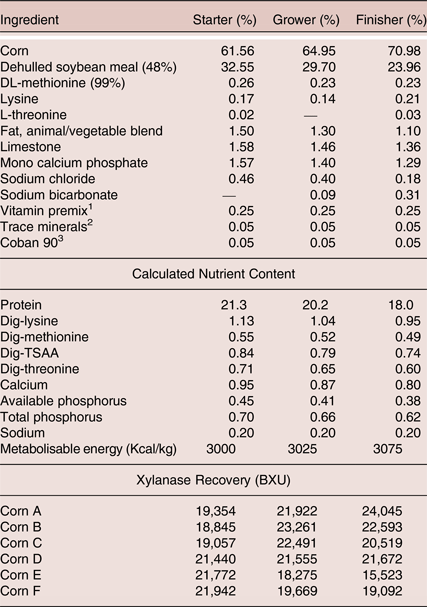
Six corn sources were obtained from different regions (Iowa, Minnesota, Nebraska, North Dakota, South Dakota, Texas – harvested in 2012) in the United States to represent the variability in corn available to feed manufactures. Corn and soy-based diets were formulated using the NRC (1994) value for corn and fed in three dietary phases (Table 1): starter (d 0–18), grower (d 19–31) and finisher (d 32–41). During feed manufacturing, one large premix containing all ingredients, with the exception of corn, was mixed to eliminate nutrient variability among the experimental diets. An equal amount of premix was then mixed with the same amount of each corn source. Therefore, all differences in the diet should have been attributable to the corn. The finished diet for each corn source was then divided into two equal parts and xylanase was added at 100 g/metric ton to one part prior to pelleting. All diets were pelleted at 70 °C with a conditioning time of 10 s; the starter diet was fed as a crumble while the grower and finisher diets were fed as a pellet. Dietary samples of all treatments were collected and analysed to confirm xylanase recovery (Table 1). The xylanase used in the current study was supplied by AB Vista (Marlborough, UK). This xylanase preparation (Econase XT) contained 160,000 units of endo-1,4- β -xylanase activity (EC 3.2.1.8) per gram. One unit of xylanase (BXU) is defined as the amount of enzyme that liberates 1 nmol reducing sugars from birchwood xylan, measured as xylose equivalents, under the conditions of the assay (AB Enzymes, Germany). All broilers and feed were weighed on the d of dietary changes (d 18, 31 and 41) for determination of average body weight (BW) and feed consumption for the calculation of mortality corrected feed conversion ratio (FCR). Starter and finisher diets contained 0.5% titanium dioxide as an indigestible marker for the determination of nutrient utilisation.
Dietary formulation, calculated and analysed nutrient content of diets formulated for male broilers fed diets based on corn from various geographical locations, with and without xylanase inclusion.

1 Vitamin premix added at this rate yields 11,023 IU vitamin A, 3,858 IU vitamin D3, 46 IU vitamin E, 0.0165 mg B12, 5.845 mg riboflavin, 45.93 mg niacin, 20.21 mg d-pantothenic acid, 477.67 mg choline, 1.47 mg menadione, 1.75 mg folic acid, 7.17 mg pyroxidine, 2.94 mg thiamine, 0.55 mg biotin per kg diet. The carrier is ground rice hulls.
2 Trace mineral premix added at this rate yields 149.6 mg manganese, 125.1 mg zinc, 16.5 mg iron, 1.7 mg copper, 1.05 mg iodine, 0.25 mg selenium, a minimum of 6.27 mg calcium, and a maximum of 8.69 mg calcium per kg of diet. The carrier is calcium carbonate and the premix contains less than 1% mineral oil.
3 Active drug ingredient monensin sodium, 90 g/lb (90 g/ton inclusion; Elanco Animal Health, Indianapolis, IN). As an aid in the prevention of coccidiosis caused by Eimeria necarix, E. tenella, E. acervulina, E. brunette, E. mivati, and E. maxima
Corn source
Prior to initiation of the study, proximate and physiochemical analyses were conducted using Near Infrared Reflectance spectroscopy which was carried out using a Foss 6500 NIR spectrophotometer (FOSS NIR Systems, Inc., Laurel, MD) (Table 2). The analyses were conducted at Aunir (Towcester, UK) and the calibrations were based on wet chemistry analyses of 1,000 corn samples, as described by Piotrowski et al. (Reference Piotrowski, Garcia, Flanagan, dos Santos, Philips, Ten Doeschate and Cambt2011).
Nutrient profiles1 taken from three samples of each corn source associated with different geographical locations

1Results are expressed per 100% of dry matter; 2Protein Solubility Index; 3Predicted AME value on an as-is basis using a prediction equation based on NIR values.
Nutrient digestibility
On d 18 and 41, ileal and excreta contents were collected and pooled per replicate pen for the determination of AME and IDE. On d 18 (five birds per replicate) and d 41 (three birds per replicate), birds were euthanised via carbon dioxide asphyxiation, and ileal contents were collected from 4 cm posterior to Meckel's diverticulum to 4 cm anterior the ileal-caecal junction. Excreta contents were collected by placing stainless steel pans in each pen for the collection of clean fresh excreta material. A minimum of eight defaecations were collected per replicate pen. Ileal and excreta collections were homogenized and stored at −20 °C prior to sample analysis. A sub-sample was dried at 100 °C for 24 h for moisture determination. Samples were then ground for gross energy and titanium concentration determination.
Titanium concentration was determined using a modified protocol outline by Short et al. (Reference Short, Gorton, Wiseman and Boorman1996). For this procedure, half a gram of each dried sample was weighed and ashed. Following ashing, each sample was titrated with 10 ml of sulphuric acid (7.4 M) and then boiled at 200 °C for 2 hr until dissolved. Samples were then titrated with 20 ml of 30% hydrogen peroxide, and brought to 100 ml using distilled water. Samples were then analysed for absorption using a Thermo Fisher Scientific Genesys 10S UV-Vis (Model 10S UV-Vis) Spectrophotometer (Thermo Fisher Scientific, Waltham, MA) at 410 nm. Gross energy of feed, ileal and excreta samples were determined using a Parr 6400 bomb calorimeter (Parr Instrument Company, Moline, IL). Nitrogen concentration of each dried sample was determined via combustion method, using an Elementar Vario Max analyser (Elementar Inc., Hanau, Germany). Ileal digestible energy (IDE) was calculated using the following equation (Scott, Neshiem, and Young, Reference Scott, Nesheim and Young1982):
 $${\rm Gross}\, {\rm E}_{\rm f}{\rm \ndash Ileal} \,{\rm E}_{\rm i}\;{\rm where \,Ileal} \;{\rm E}_{\rm i}= {\rm GE}\times \left( {{\rm T}{\rm i}_{{\rm f\- /}}{\rm T}{\rm i}_{\rm i}} \right)$
Ileal energy digestibility coefficients (IEDC) and ileal nitrogen digestibility coefficients (INDC) were calculated using the following equation (Scott, Neshiem, and Young, Reference Scott, Nesheim and Young1982):
 $$\left[ {{\left( {{\rm NT/Ti}} \right)}_{\rm d}{\rm \ndash} {\left( {{\rm NT/Ti}} \right)}_{\rm i}} \right]{\rm /} \left[ {{\left( {{\rm NT/Ti}} \right)}_{\rm d}} \right]$
Whereas NT represents kcal in the sample, Ti represents the %age of titanium, with the subscript ‘i’ representing the ileal contents and subscripts ‘d’ representing the diet.
Volatile Fatty Acid Determination
Volatile fatty acid (VFA) concentration was determined on d 18 (five birds per replicate) and d 41 (three birds per replicate). Ileal, large intestine and caecal contents were collected and pooled per replicate pen. Contents were then homogenised and 2 g of each sample was added to a tube with one ml of 25% weight/volume metaphosphoric acid and distilled water was added to achieve a constant volume of 5 ml. The tube was vortexed and frozen at −20 °C. Samples were thawed, vortexed, and centrifuged at 20,000 × g for 20 min, and using gas-liquid chromatography (GLC) as described by Vanzant and Cochran (1994). The GC was equipped with a flame ionisation detector (FID) and polyethylene glycol column. The column was operated at 100 to 150 °C with a highly purified N2, at 1.8 ml/min, as the gas carrier.
Statistical Analysis
Data were analysed as a 6 × 2 factorial Analysis of Variance (ANOVA) using the General Linear Model (GLM) procedure (SPSS V 18.0). In cases of the presence of significant interactions, data were analysed using a one-way ANOVA. Main effect and treatment means were deemed significant at P ≤ 0.05 and separated using Duncan's Multiple Range Test. The experiment unit used for each parameter was pen.
Results
Broiler Performance
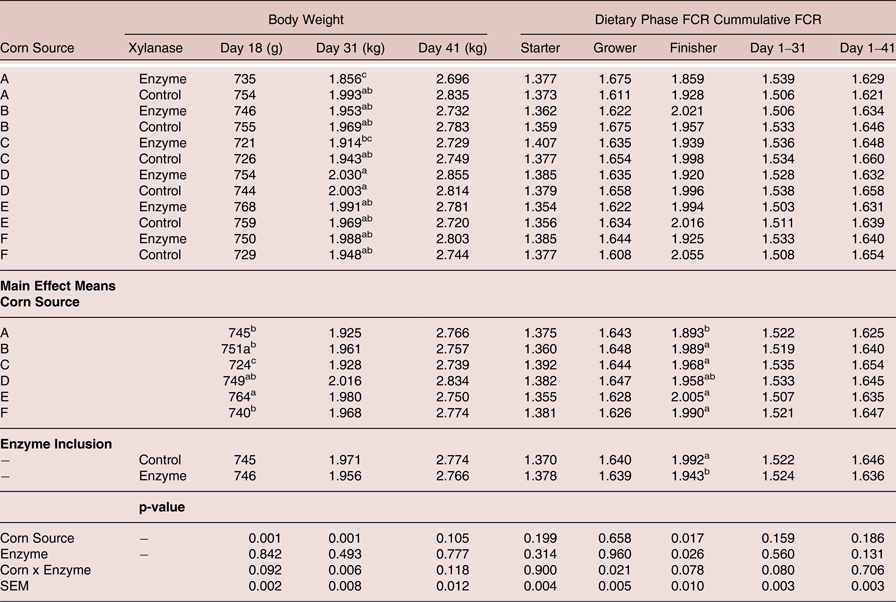
Early body weight differences (P = 0.001) with corn source up to d 18 of age, resulted in a range of 40.1 g between corn sources (Table 3). Broilers fed corn E yielded the highest observed body weight, with corn B and D yielding comparable results. Body weights of broilers fed corn A and F yielded similar results to corn B and D, but did not reach the body weight of broilers fed corn F. Broilers fed corn C yielded significantly lower body weight compared to all other corn sources. No main effect differences were observed between xylanase inclusion and the control-fed broilers. On d 31, corn source did impact body weight, resulting in a range of 91 g (P = 0.001); however, an interaction was observed between corn source and enzyme, with xylanase inclusion negatively impacting broiler body weight when fed corn source A (P = 0.006). At the conclusion of the trial (d 41), no main effect differences were observed regarding corn source or xylanase inclusion.
Body weight, dietary phase FCR and cumulative FCR of male broilers fed corn of varying nutrient profiles, with or without xylanase1 inclusion2.

a−c Main effect and treatment means differ significantly (P ≤ 0.05)
1Econase XT, AB Vista, Marlborough, UK
2 n = 10 replicate pens
Regarding starter and grower dietary phase feed conversion ratio (FCR), no main effect differences were observed with corn source or xylanase inclusion. During the finisher phase, main effect differences were observed for corn source (P = 0.017); broilers fed corn source A yielded the lowest observed FCR, which was significantly reduced from birds fed corn B, C, E and F. Intermediate results were observed with birds fed corn source D. Enzyme inclusion significantly reduced FCR (P = 0.026). The variability associated with the six sources of corn resulted in a range of 11 points in FCR during the finisher phase. No main effect differences were observed in cumulative FCR for corn source and xylanase inclusion.
Nutrient Digestibility
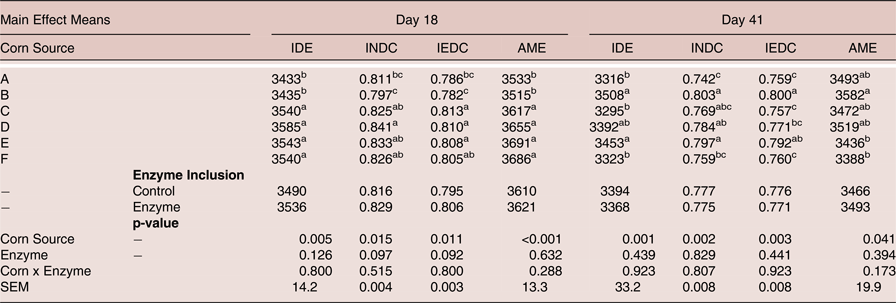
On d 18, corn source influenced nitrogen and energy digestibility on all evaluated parameters, including ileal digestible energy (IDE) (P = 0.005), ileal nitrogen digestibility coefficient (INDC) (P = 0.015), ileal energy digestibility coefficient (IEDC) (P = 0.011), and AME (P = 0.001) (Table 4). Nutrient variability resulted in range of 152 kcal/kg for IDE between corn sources, with birds fed corn source A yielding the lowest value. A significant increase in IDE was observed in birds fed corn sources C, D, E and F compared to corn A and B fed broilers. Variability in corn source resulted in a range of 4.4% for INDC between sources, with corn B yielding the lowest at 79.7% and corn D yielding the highest at 84.1%. A significant decrease in INDC was observed in birds fed corn source A and B compared to broilers fed corn source D. Intermediate results were observed in all other corn sources, including C, E and F. Nutrient variability influenced IEDC, yielding a 3.1% range between the various sources of corn. Birds fed corn source C, D and E yielded the highest values of IEDC with a significant decrease in birds fed corn source A and B; corn F fed broilers yielded intermediate results. The range of AME for the six corn sources was 176 kcal/kg, with a significant decrease observed in birds fed corn source A and B compared to C, D, E and F fed broilers. The digestibility data observed on d 18 corresponded with differences in observed BW as corn source D and E yielded broilers with two of the highest observed body weights. Increases in IEDC and INDC with xylanase inclusion were observed, although neither reached the level of significance (P = 0.097 and 0.092, respectively).
Nutrient utilisation including ileal digestible energy, IDE coefficient, ileal nitrogen digestibility coefficient and AME of male broilers fed sources of corn varying in nutrient profiles, with and without xylanase1 inclusion, on 18 and 41 days of age2.

On d 41, nutrient variability between corn sources resulted in a main effect difference in energy and nitrogen digestibility on all evaluated parameters, including IDE (P = 0.001), INDC (P = 0.002), IEDC (0.003), and AME (P = 0.041). Nutrient variability associated with corn source resulted in a range of 213 kcal/kg for IDE, with birds fed corn source C yielding the lowest value. Broilers fed corn source B and E significantly increased IDE compared to A, C and F corn sources, with corn source D yielding intermediate results. Nitrogen digestibility was influenced by nutrient variability, resulting in a range of 6.1% for INDC. Similarly, broilers fed corn source B and E yielded the highest INDC value, resulting in a significant increase compared to birds fed corn source A and F; intermediate results were observed in birds fed C and D corn. A significant increase in IEDC was observed in birds fed corn source B compared to A, C, D and F fed broilers, with corn source E yielding intermediate results. The nutrient variability resulted in a range of 4.3% for IEDC between corn sources. The range of AME for the six corn sources was 194 kcal/kg, with corn source B fed broilers yielding the highest value. Birds fed corn source B resulted in a significant increase in AME compared to E and F corn fed broilers, with all other sources of corn yielding intermediate results. No main effect differences were observed with xylanase inclusion, and an interaction was not observed between corn source and xylanase inclusion.
Volatile Fatty Acid Determination
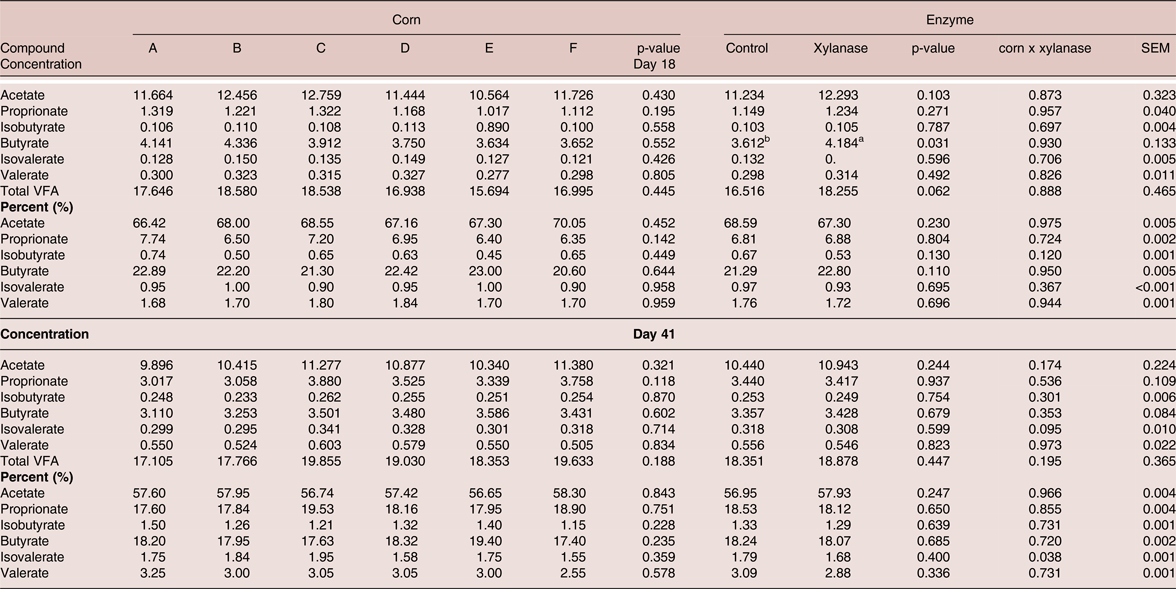
At d 18 the inclusion of xylanase increased the concentration of butyrate in the ceca (Table 5, P = 0.031). The inclusion of xylanase increased total VFA concentration in the ceca; however not at a significant level (P = 0.062). On d 41, an interaction between corn source and xylanase inclusion was observed in isovalerate percentage in the caecal contents (Table 6, p = 0.038). Differences were not observed in the other sections of the intestine that were sampled (data not shown).
VFA compound concentration (mM/g) and fresh caecal contents of male broilers fed sources of corn varying in nutrient profiles, with and without xylanase1 inclusion, on 18 and 41 days of age2.

a,b Main effect and treatment means differ significantly (P ≤ 0.05)
1Econase XT, AB Vista, Marlborough, UK
2 n = 10 replicate pens
Discussion
In this study, various sources of corn were obtained from six different regions in the US to represent the variability of corn available to feed manufactures. Corn source impacted early body weight on d 18. Similar results were observed in a trial conducted by Collins and Moran (Reference Collins and Moran2001) in which corn source impacted feed consumption, body weight gain and feed conversion ratio. The differences in body weight validates that the nutrient profile varies between corn sources. On d 31, corn source did impact body weight; however, an interaction was observed between corn source and xylanase inclusion, suggesting that xylanase benefit may be related to corn nutrient value. Yegani and Korver (Reference Yagani and Korver2013) conducted a study feeding three different sources of corn with the inclusion of xylanase, a xylanase/amylase/protease blend, or a xylanase/ β-glucanase blend. Similar results were observed, with the inclusion of xylanase in only one corn source having negative impacts on performance variables. The same experiment observed bird responses to enzyme supplementation mainly in the grower phase, which correlates to the interaction between corn source and xylanase inclusion on d 31 body weight in the present study. At the conclusion of the trial, FCR was influenced by corn source with values ranging from 1.893 to 2.005. Xylanase inclusion reduced FCR during the finisher phase compared to the diets without xylanase inclusion. Similar results were observed, with improvements in FCR with the inclusion of xylanase, by several previously reporting authors (Gao et al., Reference Gao, Jiang, Zhou and Han2007; Esmailipour et al., Reference Esmaeilipour, Shivazad, Moravej, Aminzadeh, Rezaian and van Krimpen2011; Kalmendal and Tauson, Reference Kalmendal and Tauson2012; Masey O'Neill et al., Reference Masey O'Neill, Mathis, Lumpkins and Bedford2012). This is supportive of the concept of length of time feeding enzymes being impactful on the final outcome (Rosen, Reference Rosen2002).
One of the challenges associated with exogenous enzyme supplementation is that enzyme inclusion may not always lead to enhanced growth performance or nutrient digestibility (Cowieson et al., Reference Cowieson, Singh and Adeola2006). This inconsistency was observed in the current study in which supplementation with xylanase improved FCR; however, this improvement was not reflected with nutrient digestibility. Nutrient digestibility improvements were observed in a study conducted by Cowieson et al. (Reference Cowieson, Singh and Adeola2006), but these improvements were dependent on diet, resulting in a significant diet x enzyme interaction. Similar results were observed by Yegani and Korver (Reference Yagani and Korver2013), in which enzyme inclusion increased IDE in one of the corn sources, however, there were no differences in the other two sources of corn, indicating that enzyme inclusion was dependent on corn source. This is in agreement with Cowieson (Reference Cowieson2010) in that nutritional quality of the diet is probably the most important factor that influences responses to enzyme inclusion; however, in the current study no xylanase x corn source interactions were observed regarding nutrient digestibility. On d 18, differences in corn source were observed in all evaluated parameters including IDE, INDC, IEDC and AME. Similar results were previously reported in which differences were observed between corn sources regarding IDE and AMEn (Gehring et al., Reference Gehring, Bedford, Cowieson and Dozier2012). A main effect difference was observed between corn source regarding d 41 IDE, INDC and IEDC. Gehring et al. (Reference Gehring, Bedford, Cowieson and Dozier2012) reported ileal N digestibility to be positively correlated with IDE in a similar study evaluating the effects of corn source on ileal nutrient digestibility. Nutrient variability between corn source also influenced d 41 AME; similar results were reported; with differences in AMEn associated with corn source (Gehring et al., Reference Gehring, Bedford, Cowieson and Dozier2012).
Xylanase inclusion increased levels of butyrate in the caecum from 3.612 to 4.184 mM/g. Similar results have been observed, with linear increases in levels of acetate and valerate in the ileum and levels of acetate in the caecum as enzyme levels increased in wheat-based diets (Wang et al., Reference Wang, Qiao, Lu and Li2005). The same experiment reported an increase in total VFA content in the ileum and caecum with the inclusion of enzyme; similarly, in the present study an increase in total VFA content was observed in the caecum with xylanase inclusion, but not to a level of significance. On d 41, an interaction between corn source and xylanase inclusion was observed regarding isovalerate percentage in the caecum. These data confirm that exogenous enzyme supplementation does influence VFA contents and percentage, which corresponds with other reporting authors (Wang et al., Reference Wang, Qiao, Lu and Li2005; Choct et al., Reference Choct, Hughes and Bedford1999), although VFA profile was not impacted by corn source. The production of VFAs in the large intestine is impactful not only for its energy content but also for the systemic effects that it's absorption may cause. It is suggested that the absorption of VFAs, such as butyrate, stimulates the release of certain gut hormones which may improve digestibility of nutrients in the proximal digestive tract (Singh et al., Reference Singh, Masey O'Neill, Ghosh, Bedford and Haldar2012, Cowieson and Masey O'Neill Reference Cowieson and Masey O'Neill2013, Masey O'Neill et al., Reference Masey O'Neill, Singh and Cowieson2014). These data confirm that nutrient variability of corn does impact broiler performance, nutrient utilisation and VFA profiles in caecal contents.
The results of this experiment indicate the importance of rapid and accurate evaluation of corn nutrient content to maximise observed growth performance, as multiple growth parameters were impacted and varied depending on corn source. These data also indicate that other factors associated with corn source may in fact influence performance, as increased digestibility data did not always result in improvements in growth performance, especially in older broilers. Digestibility data following the starter phase tended to correlate with the observed body weight related to corn source while nutrient digestibility at the conclusion of the trial tended to be less predictable of the observed growth performance. Additionally, the impact or benefit of xylanase may have been limited or masked due to the varying diet nutrient content with equal corn source inclusion and the lack of AME reduction in the experimental diets. Following the starter phase, energy and nitrogen digestibility were increased by 1.3 and 1.1% with xylanase inclusion but did not reach the level of statistical significance. Caecal butyrate levels were increased with xylanase inclusion, which may indicate an alteration in gastrointestinal microbiota perhaps through the generation and change of oligosaccharides through polysaccharide hydrolysation, as discussed by Masey O'Neill (Reference Masey O'Neill, Mathis, Lumpkins and Bedford2012).
Conclusions
These data confirm that nutrient variability does impact performance and digestibility as body weight, feed conversion ratio, and nutrient utilisation were influenced by corn source throughout the trial. Xylanase inclusion improved FCR in the finisher phase suggesting that the length of time feeding enzymes may be impactful to the final outcome of performance. The results of this study confirm the ability of exogenous enzymes to influence VFA production, as butyrate was increased with xylanase and an interaction was observed between corn source x xylanase in isovalerate percentage in the caecum. The production of VFA's is not only important for energy but also for systemic effects that it's absorption may cause such as the release of certain gut hormones that may improve nutrient digestibility in the proximal digestive tract.