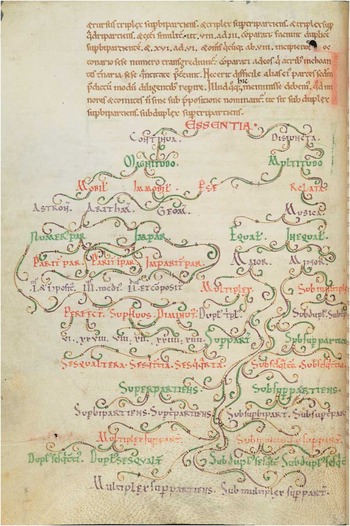


Scholars have often cited and reproduced images from Cambridge University Library MS Ii.3.12, a twelfth-century manuscript from Christ Church, Canterbury containing Boethius’ De institutione arithmetica (DIA) and De institutione musica (DIM), for its fantastical illustrated initials, detailed portraits of Greek music theorists and hundreds of extravagant diagrams that painstakingly illustrate the arithmetical principles and harmonic musical proportions discussed in the text. One of the most ambitious and complex of these diagrams covers almost the entire fol. 22v, yet curiously this diagram, almost exclusively among those in the manuscript, has been largely overlooked by contemporary scholars. Folio 22v, discussed below, rewards further study as an ambitious attempt by its scribe and artist to subject Boethius’ text to a complex schematics, synthesising all information, subject areas and particular vocabulary pertaining to arithmetic and music from DIA I.1–31 into a single visual presentation. This twelfth-century diagram constitutes a map of the domains of the Boethian inquiry and their interrelations, presenting the precepts of DIA I as a unified whole, with lines that establish connections between various areas of the text so as to illustrate how arithmetic and music serve as interrelated branches of the study of mathematics. This diagram served not only as a conceptual and interpretative device for the scribe endeavouring to explicate Boethius’ complex theoretical material, but also as a mnemonic guide that could assist the medieval pedagogue who wished to instruct his students in the mathematics of musica speculativa. Finally, this diagram constitutes a fully developed theoretical exercise in its own right, while also reflecting the role that Boethian philosophy and mathematics played in twelfth-century musical scholarship.
I. HISTORICAL CONTEXT
MS CUL Ii.3.12 serves as a particularly fine example of the meticulously illustrated medieval manuscripts produced by Christ Church, Canterbury during the first third of the twelfth century.Footnote 1 The manuscript is closely related to two other extant copies of DIM that were probably copied in the same Christ Church scriptorium, albeit by different scribes:Footnote 2 Trinity College Cambridge MS R.15.22Footnote 3 and Wellington, Alexander Turnbull Library MS no. 16.Footnote 4 These two manuscripts share strong textual similarities and even identical diagrams with MS CUL Ii.3.12, yet both situate DIM in a different context, bound with Guido of Arezzo’s Micrologus as a precursor to medieval studies of musical theory and practice. MS CUL Ii.3.12 joins together the two surviving Boethian texts on the quadrivial sciences as a single unit so as to position DIM as an outgrowth of the concepts surveyed in DIA,Footnote 5 thereby presenting an introduction to ancient arithmetic as a necessary precursor to an examination of Boethian music theory and practice.Footnote 6
At the time this manuscript was composed, Christ Church was quickly establishing itself as home to one of the most productive scriptoria and vibrant literary communities in Europe. A fire in 1067 had destroyed a significant portion of the pre-Norman library, providing a powerful incentive to collect new manuscripts; the newly appointed Norman archbishop Lanfranc (1070–89) spearheaded the collection and reproduction of both sacred and secular works, amassing one of the most important collections of classical and medieval texts on a wide variety of topics in the liberal arts.Footnote 7 Artists and scribes at Christ Church exchanged exemplars with scriptoria across Norman England, including nearby St Augustine’s of Canterbury, which had direct links to mainland European sources through Mont-Saint-Michel.Footnote 8 The creation of this new library took place during a time when Christ Church was opening up to new foreign influences from France, the Low Countries and North Germany, which had a highly transformative effect on its culture and pedagogical practices.Footnote 9 Under Lanfranc’s guidance, the library was filled with new Latin texts; students were well educated not only in Scripture and Christian doctrine, but also in Priscian’s grammar and the Latin classics.Footnote 10 Pupils were also educated in music, with a combined instruction in both the music of the liturgy and the advanced mathematics of musica speculativa.Footnote 11
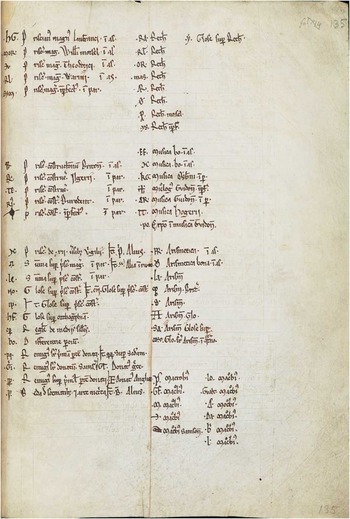
The final five pages of the manuscript (fols. 135r–137r) contain a booklist of the secular and Classical manuscripts held in the Christ Church library during the second half of the twelfth century (see Figure 1).Footnote 12 This booklist, composed later than the rest of the text and written in a different handwriting, contains 223 manuscripts in eleven different fields. Each manuscript is listed prefaced with a sign corresponding to a mark placed in the volume itself: the entry entitled ‘Musica boecii’ is prefaced by the sign ‘EE’, which corresponds to a sign on the first leaf of MS TCC R.15.22.Footnote 13 This list, which may have been used to keep records of book borrowings,Footnote 14 provides us with a glimpse into the intellectual interests of Canterbury and an impression of the types of sources that may have been accessible to the literary community. The author has catalogued each duplicate copy of the text separately, indicating that there may have been a need to collect multiple copies for pedagogical purposes.Footnote 15 He also lists works in the disciplines of grammar, rhetoric, poetry, logic, astronomy, geometry, theology, medicine and law, as well as music theory and arithmetic. There are seven books dealing with music and eight dealing with arithmetic; altogether, there are eight volumes of Boethius, seven of which are copies of just one text, De consolatione philosophiae.Footnote 16 Indeed, Boethius is one of the most highly represented authors in terms of the number of copies of his works.
The booklist on fol. 135r of MS CUL Ii.3.12

The statistics of the booklist are also reflective of contemporary general surveys of extant Boethian manuscripts from medieval Europe. As many as a third of Boethian manuscripts produced between the ninth and fifteenth centuries were copies of De consolatione philosophiae; only about one in five contained versions of DIM and DIA.Footnote 17 Very few copies of the quadrivial texts seem to have been in circulation in the ninth to eleventh centuries,Footnote 18 but the twelfth century shows a dramatic upsurge in production: as many as sixteen copies of DIA and fourteen copies of DIM, compared with only three and two copies respectively in the century before. Indeed, over half of all extant medieval copies of DIA and DIM come from the twelfth century alone, clearly suggesting that this century was witness to a flourishing of Boethian musical and arithmetical scholarship. MS CUL Ii.3.12 was one of the earliest copies produced during this upsurge, demonstrating, perhaps, that Canterbury was at the very vanguard of twelfth-century Boethian musical and arithmetical scholarship—making the rigour of the diagram on fol. 22v all the more necessary as an introduction to new readers, and all the more striking for its complexity and insight.Footnote 19
II. IMAGES AND DIAGRAMS
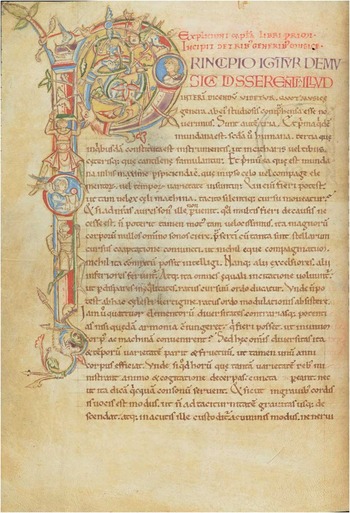
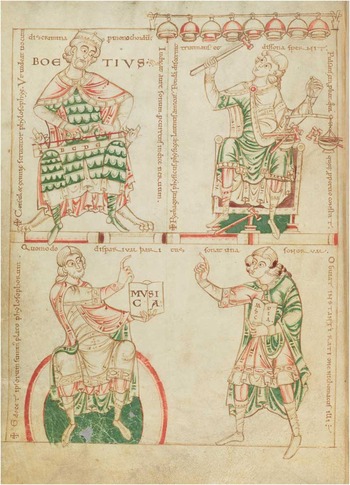
Although some scholars have disparaged the handwriting of MS CUL Ii.3.12 as ‘rather poor’Footnote 20 or ‘mediocre’Footnote 21 for exhibiting little concern for scribal consistency, the exquisite illustrations, charts and diagrams featured in the manuscript inarguably suggest that the illustrators observed the very highest standards of decoration.Footnote 22 Folio 65v features an exquisite Romanesque historiated initial, depicting animal and human forms in a bright palette of blue, green, red and violet (see Figure 2). Sandwiched between the texts of DIA and DIM on fol. 61v is a remarkable full-page illustration of the four most important music theorists relevant to the text: Boethius, Pythagoras, Plato and Nicomachus (see Figure 3).Footnote 23 The latter three theorists are ancient Greek, suggesting a strong continuity between ancient music theory, Boethius and the medieval era.Footnote 24 An image on fol. 125v features what may be the earliest depiction in a manuscript of an English keyboard: a series of fifteen pipes divided into two sets, as well as an organ keyboard labelled according to the a–p system of notation;Footnote 25 if so, this image represents an attempt by the illustrator to connect Boethian theory to contemporary instrumental practice. The amount of coordination that must have been required between the scribe and the illustrator of the historiated initials, author portraits and organ image, as well as the cost of the inks used in the images, suggest that the creators of this manuscript valued it highly.Footnote 26
The historiated initial on fol. 66v of MS CUL Ii.3.12

The portrait of Boethius, Pythagoras, Plato and Nicomachus on fol. 61v of MS CUL Ii.3.12

These illustrations provide a valuable set of clues for understanding how Boethius was received, understood and interpreted in twelfth-century Canterbury. The text itself features only a few minor additions to the text of Boethius, in the forms of glosses, maniculae and marginalia, and therefore the clearest demonstration of interpretative activity can be found in the elaborate graphic presentation. Mary Carruthers proposed that images of this sort in medieval manuscripts constitute ‘pictorial writing’: ‘the visual presentation of a text was considered, at least by the learned, to be part of its meaning, not limited to the illustration of its themes or subjects but necessary to its proper reading, its ability-to-be significant and memorable’.Footnote 27 Diagrams were especially important as interpretative, pedagogical and mnemonic tools: ‘they can serve as fixes for memory storage, and as cues to start the recollective process. The one function is pedagogical, in which the diagram serves as an informational schematic, the other is meditational and compositional.’Footnote 28 These diagrams, however elaborate, should exhibit clarity, brevity and be able to be taken in by a single gaze; thus the graphic arrangements of words and illustrations on the page will help make complex concepts more readily understandable and thus more memorable.Footnote 29 Such diagrams often aided medieval musicians in the memorisation of modal and rhythmic theory useful for musical practice and composition.Footnote 30 The focus in the diagram on fol. 22v, however, is not on musical practice but on the mathematics of speculative musical theory, demonstrating how arithmetical and music theoretical concepts in Boethius’ writings unfold in parallel but are also integrated, while displaying the numerical relationships and proportions that underlie musical intervals, scales and modes and making them easier to conceptualise and grasp than they are in the text itself.
III. THE ARBOR OF FOL. 22V
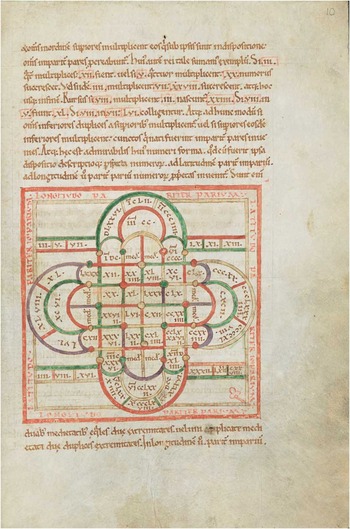
Boethius frequently refers to the presence of explanatory diagrams, indicating that the text was elaborated with images from the very beginning; part of DIA I.11 and the entire DIA I.12 are dedicated to a description of a diagram outlining the relationships between odd times even numbers, which appears in MS CUL Ii.3.12 on fol. 10r (see Figure 4). Diagrams of this complexity are common in medieval manuscripts from a variety of different centuries, locations and scribal practices; often they were transferred between codices just as carefully as the principal text itself.Footnote 31 Nevertheless, the arbor of fol. 22v is unique in its ambition, its comprehensiveness and the extraordinary level of detail it applies in its summary of the first book of DIA; nothing comparable appears even in the closely related manuscripts MS TCC R.15.22 or MS Turnbull no. 16.Footnote 32 (See Figure 5). It is not a marginal gloss by a later reader. Situated just before the opening of the final chapter of Book I, DIA I.32, it was clearly composed by the scribe and illustrator who completed the rest of the manuscript, written in the same hand and with the same colour scheme as the remaining text and images. The large amount of space reserved on the page indicates that the scribe had realised that readers might be confused by the challenging text up to this point, and determined that an elaborate diagram was necessary in order to orient the reader by recapitulating and clarifying the previous material in the book.Footnote 33
The diagram described by Boethius in DIA I.11–12, depicting odd times even numbers, on fol. 10r of MS CUL Ii.3.12

The arbor summarising the various branches of essentia as described in the first book of DIA I, on fol. 22v of MS CUL Ii.3.12

While Boethius does not always progress in a clear order through his argument, the illustrator has attempted to project a unifying logic by charting the logical flow between subdisciplines. The transcription of fol. 22v provided in Appendix I aims to demonstrate the conceptual framework that the creators of the Cambridge manuscript found in DIA, preserving the form and dimensions of the original illustration while reproducing them in translation. As this transcription demonstrates, fol. 22v represents the material of the first book of DIA in the form of a diagrammatic tree, or arbor, in which larger, more general concepts are divided into subsections and are made eventually to focus on specific examples.Footnote 34 By scanning the chart from top to bottom, the reader is able to conceptualise how each subject flows logically into the next. Appendix II shows how the illustrator of the chart has reorganised different sections of the text in order to present the conceptual organisation in a more clearly logical progression than the Boethian text. Examples and specifics in many chapters that appeared to the illustrator to digress from the subjects of interest have been excluded from the chart entirely. Indeed, the analysis invested by the scribe in the complex editing and reorganisation of this chart amounts to a thorough reinterpretation of the entire first book.Footnote 35
Appendix II also reveals how the diagram divides into three regions. Region I, which includes lines 1–5 of the chart, represents all the material of DIA I.1 introduces two types of essences sensible by perception: continuous essence, which is composed of single elements (e.g. a ‘tree or a stone’), and disjoined essence, which is composed of a collection of separate and distinct elements (e.g. ‘a populace, a chorus’).Footnote 36 The numerical qualities of continuous essence are measured by magnitudes, which may be movable or immovable. The study of movable magnitude is subsumed by the field of astronomy, which quantifies and studies the movement of stars in harmonic intervals; the study of immovable magnitude falls within the domain of geometry, which studies the dimensions of fixed shapes such as circles or squares.Footnote 37 The numerical qualities of disjoined essence, on the other hand, are determined by multitudes, which may exist independently on their own (‘per se’), or in proportion to other multitudes (‘relata’). The study of independent multitudes constitutes the field of arithmetic, while the study of proportional multitudes is part of the field of music theory. ‘Numbers’, Boethius explains in DIA I.2, are the ‘principal exemplar in the mind of the creator’ and are thus essential for understanding the natural world.Footnote 38 These four quadrivial fields which complete Region I ‘allow the mind to ascend from the study of things perceived by the senses to the more certain matters of the intellect . . . Through number, the scholar moves from the unity of the divine mind to the multiplicity – and quantitative order – of created things.’Footnote 39
Region II of fol. 22v, which includes the left-hand side of lines 6–10, sets forth the basic principles of arithmetic. In DIA I.3–6, Boethius introduces the distinction between even and odd numbers. Directly following a brief discussion of the nature of unity in DIA I.7 – a passage excluded from the arbor – Boethius explains in DIA I.8 that even numbers are subdivided into three different categories: pariter par (even times even), elaborated in greater detail in DIA I.9; pariter inpar (even times odd), elaborated in DIA I.10; and inpariter par (odd times even), elaborated in DIA I.11–12. Odd numbers are also divided into three different subdivisions, introduced in DIA I.13: prime and incomposite, elaborated in DIA I.14 and I.17; secondary and composite, elaborated in DIA I.15 and I.17; and those numbers in the middle of the two categories, elaborated in DIA I.16–18.Footnote 40 He returns to even numbers in DIA I.19 in order to explain a second way in which they can be subdivided into yet another set of three categories: perfect, superabundant and deficient.Footnote 41 Boethius relates these three types of odd numbers to ‘virtues and vices’ in DIA I.20, noting that perfect numbers occur only ‘rarely’ yet superabundant or deficient numbers appear to be ‘many and infinite’, and ‘arranged randomly and illogically’.Footnote 42
Region III describes the types of proportions that comprise musical theory. Boethius’ proportions are divided into two types, enumerated in DIA I.21–2: equal (a:a, e.g. 10:10) and unequal (a:b). Equal proportions are indivisible by nature, for ‘just as a friend is a friend to a friend, or a neighbor is a neighbor to a neighbor, so is equal said to be equal to equal’.Footnote 43 He explains in DIA I.22 that unequal proportions, on the other hand, are divided into major and minor inequalities, both of which are subdivided into five different types. The five types of major inequalities are: (1) multiplex (a×b:a), elaborated in DIA I.23 and again in I.26–7; (2) superparticular (a+1:a), elaborated in DIA I.24–5; (3) superpartient (a+b:a), elaborated in DIA I.28; (4) multiplex superparticular ((b×a + 1/c):a) elaborated in DIA I.29–30; and (5) multiplex superpartient (b×a+(a-c):a), elaborated in DIA I.31.Footnote 44 The five minor inequalities are the submultiplex, subsuperparticular, and so forth. According to Boethius, through the edifying study of such categories of arithmetic, one can learn better to distinguish good from evil.Footnote 45
Region III is of vital importance, as all Pythagorean proportions that govern the basic building blocks of music – the octave at 1:2, the fifth at 2:3, the fourth at 3:4, and so on – can be identified as one of these types of major or minor inequalities. Boethius writes in Book I:
The logical force of numbers is also prior to music, and this can especially be demonstrated because not only are numbers prior by their nature, since they consist of themselves and are thus prior to those things which must be referred to another in order to be, but also musical modulation itself is denoted by the names of numbers . . . The names diatessaron, diapente and diapason are derived from the names of antecedent numerical terms. The proportion of their sounds is found only in these particular relationships and not in other number relationships . . . [T]he rest of this work will demonstrate [this idea] without any doubt.Footnote 46
Music, for Boethius, emerges from this intricate mathematical world. The quadrivial sciences are interdependent; arithmetic is prior to the remaining three sciences of music, astronomy and geometry and thus the logical place to begin the quadrivial studies: ‘[S]ince, as it is obvious, the force of arithmetic is prior, we may take up the beginning of our exposition’.Footnote 47
The artist has produced a cleaner representation of the logical unfolding of music in Region III than of mathematics in Region II. Region II is the only section of the chart in which the lines cross over each other. The line extended from per se to arithmetica crosses over the line connecting immobilis and geometria; the lines connecting impar to its subdivisions interfere with the lines connecting numerus par to pariter inpar and impariter par. The illustrator of fol. 22v appears to have produced Region II last, cramming its material into the small space left after illustrating Regions I and III. Even though arithmetic is the titular subject of DIA – and, according to Boethius, logically prior to music – the artist who composed this schematic map seems to have devoted his attention first to illustrating the synopsis of music in Region III.
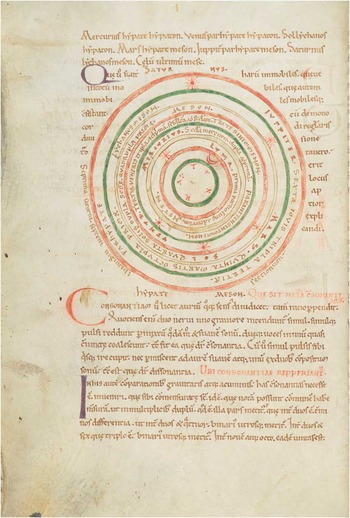
For this artist, it appears, music is of critical importance, as a perceptible demonstration of the qualities of abstract numerical relationships which appear in all fields of the quadrivium. Music theory could also provide a sensory route for students to understand mathematics and the cosmic harmonies: fol. 76v depicts how the proportions classified in fol. 22v can be applied to celestial harmonies, illustrating the orbits of the moon, sun and planets and their corresponding musical intervals (see Figure 6).Footnote 48 Folio 22v thus reveals in detail the necessary frameworks for understanding more abstract applications of music in geometry and astronomy, as well as helping to make perceptible and comprehensible to students the basic components of mathematics and the harmonies of the spheres.
The cosmic harmonies on fol. 76v of MS CUL Ii.3.12

By presenting Book I of DIA as an arbor, the illustrator employs visual aids to explicate the circuitous and confusing subject matter in the same manner as a medieval teacher, who would strive to present concepts by means of a system of organisation that assigns each concept to a logical place, making the overall study coherent and thus easier to commit to memory. And as any teacher knows from planning a syllabus, the work of distilling complex information into a comprehensible set of schematics constitutes a theoretical act: for as Leslie Blasius explains, ‘the organization of diverse topics is no longer a preliminary to theorizing but rather a mode of theorizing in itself’.Footnote 49 Boethius sums it up succinctly in his own description of De Arithmetica, which, he explains, is itself a distillation of Nicomachus’ Arithmetike eisagoge:
I do not restrict myself slavishly to traditions of others, but with a well-formed rule of translation, having wandered a bit freely, I set upon a different path, not the same footsteps. Those things which were discussed in a rather diffuse manner by Nicomachus concerning numbers, I have put together with moderate brevity; those things which demanded a greater care of understanding, but are gone through quickly, I clarified with a small additional explanation and I have even used formulae and diagrams for greater clarity of matters. The careful reader will easily recognize that this involved for us many nights of labor.Footnote 50
Simply put, the medieval scholars have treated Boethius’ text just as Boethius treated Nicomachus, creating a diagram that shows twelfth-century musical theory at its most complex and ambitious. But above all, the diagram is visually stunning, seamlessly integrating word and image to delight the eye while leading the intellect towards a better understanding of the ways in which music and arithmetic are interrelated as branches of the mathematical quadrivium.
Appendix I
Transcription of MS CUL Ii.3.12, fol. 22v

Appendix II
Organisation of Topics from the First Book of DIA, in fol. 22v