

1. Introduction
In a surfactant solution above the critical micelle concentration, isotropic droplets can exhibit autonomous motion by a self-induced Marangoni stress (Herminghaus et al. Reference Herminghaus, Maass, Krüger, Thutupalli, Goehring and Bahr2014; Izri et al. Reference Izri, Van Der Linden, Michelin and Dauchot2014; Toyota et al. Reference Toyota, Sugiyama, Hiroi, Ito and Kitahata2020). This phenomenon has been widely studied to mimic microorganism swimming (Thutupalli, Seemann & Herminghaus Reference Thutupalli, Seemann and Herminghaus2011) and has great potential in many applications, for example targeted cargo delivery (Tu et al. Reference Tu, Peng, André, Men, Srinivas and Wilson2017), detection and collection of metal ions (Ban et al. Reference Ban, Tani, Nakata and Okano2014, Reference Ban, Sugiyama, Nagatsu and Tokuyama2018) and chemotactic maze solving (Jin, Krüger & Maass Reference Jin, Krüger and Maass2017). The Marangoni drop derives its power supply from the surrounding fluid by surfactant micellization and therefore has a long-standing activity. Its swimming dynamics not only determines the cruising efficiency and coverage area of a single drop in a fluid, but also affects the collective behaviour of multiple drops. However, the detailed hydrodynamics and energetics of a self-propelled drop are still not fully understood.
For Marangoni drops, one of the key parameters that determines the self-propulsion is the Péclet number,  $Pe=U_0a/D$, which is the ratio between the convection and diffusion of surfactant around the drop; where
 $U_0$ is the characteristic velocity,
 $a$ is the drop radius and
 $D$ is the diffusivity of surfactant. For a undeformable drop with constant surfactant flux at the surface, Morozov & Michelin (Reference Morozov and Michelin2019b) showed that it has the same critical Péclet number (
 $Pe_{c}=4$) as a diffusiophoretic solid particle (Michelin, Lauga & Bartolo Reference Michelin, Lauga and Bartolo2013). Near the onset of linear instability, the drop undergoes a transcritical bifurcation from stationary to steady translation with the speed proportional to
 $Pe-Pe_{c}$. In addition to
 $Pe$, self-propulsion is also affected by other factors, including the deformability of the drop (Morozov & Michelin Reference Morozov and Michelin2019b), relative strength between phoretic and Marangoni effects (Morozov & Michelin Reference Morozov and Michelin2019a), the nematic field in a drop of liquid crystal (Krüger et al. Reference Krüger, Klös, Bahr and Maass2016) and the adsorption and desorption kinetics of surfactant at the drop surface (Yoshinaga et al. Reference Yoshinaga, Nagai, Sumino and Kitahata2012). In particular, Yoshinaga et al. (Reference Yoshinaga, Nagai, Sumino and Kitahata2012) showed that drop velocity is proportional to
 $\sqrt {Pe-Pe_{c}}$ when the dissolved surfactant is consumed in the bulk fluid at a rate proportional to the surfactant concentration, illustrating the significance of the chemical interaction of drop surface with the surrounding fluid. One goal of this work is to determine the velocity scaling for a self-propelled drop using a simple model for surface reaction.
Beyond the weakly nonlinear regime, the drop can exhibit diverse swimming patterns, and with increasing  $Pe$, shows quasiballistic, unsteady curvilinear and chaotic motions, successively (Krüger et al. Reference Krüger, Klös, Bahr and Maass2016; Suga et al. Reference Suga, Suda, Ichikawa and Kimura2018; Hokmabad et al. Reference Hokmabad, Dey, Jalaal, Mohanty, Almukambetova, Baldwin, Lohse and Maass2021). Similar phenomena have been observed for two-dimensional (2-D) and three-dimensional (3-D) phoretic solid particles (Hu et al. Reference Hu, Lin, Rafai and Misbah2019; Chen et al. Reference Chen, Chong, Liu, Verzicco and Lohse2021). For Marangoni drops, on the other hand, most theoretical and numerical studies have focused on the axisymmetric motion (Yoshinaga et al. Reference Yoshinaga, Nagai, Sumino and Kitahata2012; Morozov & Michelin Reference Morozov and Michelin2019a,Reference Morozov and Michelinb) and lack detailed characterization of trajectory transition for a freely moving drop. Recently, Hokmabad et al. (Reference Hokmabad, Dey, Jalaal, Mohanty, Almukambetova, Baldwin, Lohse and Maass2021) showed that increasing
 $Pe$ enhances the instability modes of high angular modes and causes the drop to oscillate between dipolar and quadrupolar modes as a result of strong interaction with the self-generated chemical field. Suda et al. (Reference Suda, Suda, Ohmura and Ichikawa2021) studied the linear stability of steady translation by analysing the surfactant transport on the drop surface with a specified point source of surfactant. Their model predicts that at high
 $Pe$, the swimming drop transforms from a puller to a pusher-type swimmer which increases its susceptibility to external disturbances and therefore causes the transition from a quasiballistic to a curvilinear trajectory. In their study, the drop motion is imposed by assuming a point source of surfactant attached to the front of the drop surface. This work will investigate the mode transition of a swimming drop due to a spontaneous symmetry-breaking mechanism. Meanwhile, the detailed interaction between different modes in an unsteady drop motion will be studied.
In addition to the advective effect, the swimming dynamics of the drops is also strongly influenced by the chemical reaction at the drop surface. In other advection–reaction systems, such as combustion (Vervisch & Poinsot Reference Vervisch and Poinsot1998), gas dissolution in a porous medium (Andres & Cardoso Reference Andres and Cardoso2011) and electrodeposition (Li et al. Reference Li, Townsend, Archer and Koch2022), the chemical reaction rate has been found to strongly influence the convection process. In terms of a self-propelled particle, Michelin & Lauga (Reference Michelin and Lauga2014) studied the motion of an axisymmetric Janus particle and considered two scenarios of surface kinetics: fixed flux rate and fixed chemical reaction rate. The chemical reaction can be characterized by a dimensionless parameter, the Damköhler number  $Da=k_ca/D$, which is the ratio between reaction and diffusion rates, where
 $k_c$ is the reaction rate of solute at the particle surface. They found that while the advection tends to reduce the particle speed and the strength of the stresslet at large
 $Pe$, swimming motion can be enhanced at intermediate values of
 $Pe$ on a surface of attractive interaction with the solute. At a fixed Péclet number, the speed of the phoretic particle scales as
 $U\sim Da^{-1}$ at
 $Pe=0$ (Michelin & Lauga Reference Michelin and Lauga2014). The influence of chemical reaction rate on the drop motion has not been considered. By combining the conditions of fixed flux rate and fixed reaction rate, this work will use a simplified model to describe the micellization process of surfactant near the drop surface. As will be shown later, the rate of surface reaction can significantly change the self-propulsion of the drop in both linear and nonlinear regimes.
In previous studies, 2-D models have been introduced to study the freely swimming motion of active drops and particles. Compared with the 3-D problems which involves the associated Legendre function and spherical harmonics, the 2-D problems are greatly simplified by using a Fourier series in the angular direction. By solving the interface equation in a 2-D domain, Ohta, Ohkuma & Shitara (Reference Ohta, Ohkuma and Shitara2009) studied the coupled movement and deformation of an incompressible drop in an excitable reaction–diffusion solution and discovered three types of drop states: stationary; straight motion; and circular motion. Nagai et al. (Reference Nagai, Takabatake, Sumino, Kitahata, Ichikawa and Yoshinaga2013) solved the equations for surfactant transport and fluid flow around a 2-D drop providing a point source at the drop surface to create the gradient of surface tension. Their results predict a pitchfork bifurcation from steady translation to circular motion with increasing drop mobility. Recently, Hu et al. (Reference Hu, Lin, Rafai and Misbah2019) have studied the swimming motion of a 2-D phoretic solid particle at different Péclet numbers. Trajectory transitions from linear to meandering and then to chaotic motions are observed with increasing  $Pe$. This study will follow the same methodology as Nagai et al. (Reference Nagai, Takabatake, Sumino, Kitahata, Ichikawa and Yoshinaga2013) and Hu et al. (Reference Hu, Lin, Rafai and Misbah2019) to investigate the influence of both
 $Pe$ and
 $Da$ on the drop motion.
In this work, a 2-D model of an active drop swimming in a surfactant solution is introduced (§ 2) and studied in detail. Weakly nonlinear analysis (§ 3) and direct numerical simulation (§ 4) are performed to investigate the drop's swimming behaviour over a wide range of Péclet and Damköhler numbers. The results provide a deeper understanding of the relation between reaction and transport of surfactant and the self-propulsion of active droplets.
2. Physical model of Marangoni propulsion
Consider an isotropic drop of radius  $a$ in a surfactant solution. The viscosities of the drop and solution are
 $\mu ^i$ and
 $\mu ^o$. The surfactant flux at the interface is governed by first-order reaction kinetics, i.e.
 $D\boldsymbol {n}\boldsymbol {\cdot } \boldsymbol {\nabla } c^*=k_c(c^*+c^*_\infty )$; where
 $c^*$ is the change of surfactant concentration with respect to the far-field concentration
 $c^*_\infty$ (
 $*$ indicates the dimensional variables),
 $D$ is the surfactant diffusivity,
 $\boldsymbol {n}$ is the outward unit normal vector on the drop surface and
 $k_c$ is the consumption rate of surfactant at the drop surface. The surface tension
 $\gamma ^*$ follows a linear relationship with the surfactant concentration
 $d\gamma ^*/dc^*=-\gamma _1$ with
 $\gamma _1>0$. The governing equations are normalized as follows: concentration by
 $A_0a/D$; length by
 $a$; velocity by
 $U_0=A_0M/D$; time by
 $a/U_0$; pressure and stress by
 $\mu ^o U_0/a$; and surface tension by
 $\mu ^o U_0$ – where
 $A_0$ is the characteristic flux rate and
 $M=a\gamma _1/(2\mu ^o+2\mu ^i)$ is the mobility factor for a 2-D circular drop.
In the reference frame attached to the drop centre, the fluid flow is governed by
 \begin{gather} -\boldsymbol{\nabla} p^{o,i}+\beta^{o,i}\nabla^2\boldsymbol{u}^{o,i}=0, \quad \boldsymbol{\nabla}\boldsymbol{\cdot} \boldsymbol{u}^{o,i}=0, \end{gather}
 \begin{gather}{}[\boldsymbol{u}^{o,i}\boldsymbol{\cdot} \boldsymbol{n}]_{r=1} =[(\boldsymbol{u}^o-\boldsymbol{u}^i) \boldsymbol{\cdot} \boldsymbol{t}]_{r=1}=0, \end{gather}
 \begin{gather}{}[(\boldsymbol{\sigma}^o-\boldsymbol{\sigma}^i) \boldsymbol{\cdot} \boldsymbol{n}\boldsymbol{t} +\nabla_s\gamma\boldsymbol{\cdot} \boldsymbol{t}]_{r=1}=0, \end{gather}
 \begin{gather}\boldsymbol{u}^o|_{r\to\infty}={-}\boldsymbol{U}, \end{gather}
where  $\boldsymbol {u}, p$ and
 $\boldsymbol {\sigma }$ are the fluid velocity, pressure and stress (superscripts
 $o$ and
 $i$ represent regions outside and inside the drop),
 $\beta ^o=1$ and
 $\beta ^i=\mu ^i/\mu ^o$ are the viscosity ratios,
 $\gamma$ is surface tension,
 $\boldsymbol {t}$ is the unit tangent vector and
 $\nabla _s=\boldsymbol {\nabla }-\boldsymbol {n}\boldsymbol {n}\boldsymbol {\cdot } \boldsymbol {\nabla }$ is the surface gradient operator. Equation (2.1b) means that the normal velocity vanishes and the tangential velocity is continuous at the drop surface. Equation (2.1c) represents that the discontinuity of the tangential stress across the drop surface is balanced by the Marangoni stress. The drop velocity
 $\boldsymbol {U}$ in (2.1d) is determined by the force-free condition
 $\int _s\boldsymbol {n}\boldsymbol {\cdot } \boldsymbol {\sigma }^o\, {\rm d} s=0$, where
 $S$ is the drop surface.
Outside the drop, the transport and surface reaction of surfactant are governed by
 \begin{gather} \frac{\partial c}{\partial t}+\boldsymbol{u}^o\boldsymbol{\cdot} \boldsymbol{\nabla} c=\frac{1}{Pe}\nabla^2 c, \end{gather}
 \begin{gather}\boldsymbol{n}\boldsymbol{\cdot} \boldsymbol{\nabla} c|_{r=1}=\left[Dac+\frac{k_cc^*_\infty}{A_0}\right]_{r=1}, \quad c|_{r=R}=0, \end{gather}
where  $c$ is the concentration difference. The Péclet number,
 $Pe=U_0a/D=A_0Ma/D^2$, characterizes the ratio between convection and diffusion of surfactant. The Damköhler number,
 $Da=k_ca/D$, characterizes the ratio between reaction and diffusion. Since 2-D diffusion does not have a steady state solution at
 $Pe=0$, the far-field condition is applied at a large distance
 $R=200$ away from the drop. The same condition is used by Hu et al. (Reference Hu, Lin, Rafai and Misbah2019) for 2-D phoretic particle.
The above equations feature a steady isotropic distribution of surfactant around a stationary drop. In a polar coordinate system, the base state concentration difference,  $C$, around a stationary drop is
 \begin{equation} C=\frac{k_cc^*_\infty/A_0}{1+Da\ln R}\ln\frac{r}{R}. \end{equation}
To compare the swimming motion for drops with different reaction rates, the characteristic flux rate is set to  $A_0=k_cc^*_\infty /(1+Da\ln R)$ and all drops have the same base-state surfactant field. It is worth noting that the concentration has been normalized by
 $A_0a/D$ so that the drop surface has a fixed flux rate of surfactant at
 $Da=0$. Here, the Péclet number
 $Pe$ characterizes the total contribution from surfactant consumption rate and Marangoni mobility. One may also normalize the concentration by a fixed value, for instance
 $c^*_\infty$, so that the drop surface becomes non-active at
 $Da=0$. Similarly, the fluid velocity is normalized by
 $U_0'=c^*_\infty M/a$. In this case, a new Péclet number is defined as
 $Pe'=c^*_\infty M/D$ which only includes the contribution of Marangoni mobility. The two Péclet numbers can be easily converted into the other by the relation
 $Pe'=Pe(1+Da\ln R)/Da$. In this work,
 $Pe$ will be mainly used for discussion.
Above a critical Péclet number, the nonlinear coupling between surfactant convection and reaction at the drop surface generates a non-isotropic surface tension which causes the drop motion. Following Nagai et al. (Reference Nagai, Takabatake, Sumino, Kitahata, Ichikawa and Yoshinaga2013), (2.1) and (2.2) are solved by a method of eigenmode superposition to derive the concentration and fluid velocity. The surfactant concentration is expanded into a Fourier series,
 \begin{equation} c=c_0(r)+{Re}\left[\sum_{k=1}^\infty c_k(r)\, {\rm e}^{{\rm i}k\theta}\right], \end{equation}
where  $k$ is the angular mode. The velocity for a 2-D incompressible flow can be written as
 $u_r=({1}/{r})({\partial \varPsi }/{\partial \theta })$ and
 $u_\theta =-{\partial \varPsi }/{\partial r}$, where the stream function
 $\varPsi$ satisfies
 ${\nabla ^2\nabla ^2\varPsi =0}$, and
 $\nabla ^2=({1}/{r})({\partial }/{\partial r})(r({\partial }/{\partial r}))+({1}/{r^2})({\partial ^2}/{\partial \theta ^2})$. For a force-free drop, the stream functions outside and inside the drop can be written as (Nagai et al. Reference Nagai, Takabatake, Sumino, Kitahata, Ichikawa and Yoshinaga2013)
 \begin{equation} \varPsi^o=\textrm{Re}\left[\sum_{k=1}^\infty\frac{r^2-1}{r^k} A_k\, {\rm e}^{{\rm i}k\theta}\right], \quad \varPsi^i=\textrm{Re}\left[\sum_{k=1}^\infty(r^2-1)r^k A_k\, {\rm e}^{{\rm i}k\theta}\right], \end{equation}
where the complex coefficient  $A_k=ic^s_k/2$, and
 $c^s_k=c_k|_{r=1}$ is the concentration coefficient at the drop surface. Since the angular velocity of the drop does not affect the results, a zero angular velocity is enforced in the above equation. In a laboratory frame, the horizontal and vertical velocity components of the drop are
 \begin{equation} U_x=\tfrac{1}{2}\textrm{Re}[c^s_1], \quad U_y={-}\tfrac{1}{2}\textrm{Im}[c^s_1], \end{equation}
where  $\textrm {Re}[\,]$ and
 $\textrm {Im}[\,]$ represent the real and imaginary parts.
The average power consumption of the drop converting the chemical energy of surfactant micellization into the kinetic energy of drop swimming is
 \begin{equation} \langle P\rangle ={-}\left\langle\int_s(\boldsymbol{\sigma}^o-\boldsymbol{\sigma}^i)\boldsymbol{\cdot} \boldsymbol{n} \boldsymbol{\cdot} (\boldsymbol{U}+\boldsymbol{u})\, {\rm d} s\right\rangle, \end{equation}
where  $\langle \rangle$ means the time average. From the continuity condition at the drop surface and the force-free condition, the power consumption of the drop motion is directly related to the surfactant field,
 \begin{equation} \langle P\rangle={-}\frac{2}{Pe}(1+\beta^i)\left\langle\int_s\nabla^2c\, {\rm d} s\right\rangle, \end{equation}
where the diffusion can be decomposed into a surface component which vanishes on a closed surface and two components out of plane, i.e.  $\nabla ^2 c=\nabla _s^2c+\kappa \boldsymbol {n}\boldsymbol {\cdot } \boldsymbol {\nabla } c+\boldsymbol {n}\boldsymbol {n}:\boldsymbol {H}(c)$, where
 $\kappa$ and
 $\boldsymbol {H}(c)$ are the curvature and Hessian matrix (Sario et al. Reference Sario, Nakai, Wang and Chung1977). For a 2-D circular drop, the diffusion term is simply
 $\nabla ^2c=({\partial ^2c}/{\partial r^2})+({\partial c}/{\partial r})$ at
 $r=1$. The above equation proposes an alternative approach to measure the power consumption of a swimming drop simply by using the concentration field. This expression helps reveal the contribution of each Fourier mode in drop swimming.
3. Weakly nonlinear analysis
Above a critical Péclet number, the base state (2.3) becomes unstable, and autonomous drop motion occurs under infinitesimal disturbance. For a weakly deformable drop, the lowest critical Péclet number  $Pe_{kc}$ for an unstable mode corresponds to a dipole mode of
 $k=1$ (Morozov & Michelin Reference Morozov and Michelin2019b). When
 $Pe/Pe_{1c}-1\ll 1$, the drop translates with constant velocity and generates a symmetric surfactant distribution. Here, a weakly nonlinear analysis is conducted to determine the drop motion. As will be numerically confirmed in the next section, the onset of drop motion is supercritical and the small parameter can be written as
 \begin{equation} \varepsilon=\sqrt{Pe_{1c}^{{-}1}-Pe^{{-}1}}. \end{equation}
Assuming the drop moves in the direction of  $\theta =0$, the surfactant concentration can be written as a Fourier series with each mode being a Taylor expansion of
 $\varepsilon$, as follows:
 \begin{align} c&=(C+\varepsilon^2c_{0,2}+\varepsilon^4c_{0,4}+\cdots) +(\varepsilon c_{1,1}+\varepsilon^3c_{1,3}+\cdots)\cos\theta\nonumber\\ &\quad +(\varepsilon^2c_{2,2}+\varepsilon^4c_{2,4}+\cdots)\cos2\theta+\cdots, \end{align}
where  $C$ is the base state concentration in (2.3);
 $c_{k,l}(r)$ is the perturbation of angular mode
 $k$ and of order
 $\varepsilon ^l$;
 $k=0,1$ and 2 represent the isotropic, dipole (source dipole) and quadrupole (stresslet) modes, respectively. The above expansion is similar to the weakly nonlinear perturbation of a parallel flow at high Reynolds numbers (Schmid & Henningson Reference Schmid and Henningson2002).
By substituting (3.2) into (2.2) and collecting the terms of the same orders of  $k$ and
 $l$, one can find the eigenvalue equation for each mode. Up to
 $O(\epsilon^3)$, the perturbation equations for each order are
 \begin{gather} c_{1,1}^{\prime\prime}+\frac{c_{1,1}^{\prime}}{r}-\frac{c_{1,1}}{r^2}+ \frac{Pe_{1c}}{2}\frac{r^2-1}{r^3}c_{1,1}^s=0, \end{gather}
 \begin{gather}c_{0,2}^{\prime\prime}+\frac{c_{0,2}^{\prime}}{r}+\frac{Pe_{1c}}{4} \left(\frac{r^2-1}{r^2}c_{1,1}^{\prime}+\frac{r^2+1}{r^3}c_{1,1}\right) c_{1,1}^s=0, \end{gather}
 \begin{gather}c_{2,2}^{\prime\prime}+\frac{c_{2,2}^{\prime}}{r}-\frac{4c_{2,2}}{r^2} +Pe_{1c}\frac{r^2-1}{r^4}c_{2,2}^s +\frac{Pe_{1c}}{4}\left(\frac{r^2-1}{r^2}c_{1,1}^{\prime}- \frac{r^2+1}{r^3}c_{1,1}\right)c_{1,1}^s=0, \end{gather}
 \begin{align} &c_{1,3}^{\prime\prime}+\frac{c_{1,3}^{\prime}}{r}-\frac{c_{1,3}}{r^2} +\frac{Pe_{1c}}{2}\frac{r^2-1}{r^3}c_{1,3}^s -Pe_{1c}\left(c_{1,1}^{\prime\prime}+\frac{c_{1,1}^{\prime}}{r}- \frac{c_{1,1}}{r^2}\right) \nonumber\\ &\quad +\frac{Pe_{1c}}{2}\left[\left(\frac{r^2-1}{r^2}c_{0,2}^{\prime}+ \frac{r^2-1}{2r^2}c_{2,2}^{\prime} +\frac{r^2+1}{r^3}c_{2,2}\right)c_{1,1}^s\right.\nonumber\\ &\quad +\left.\left(\frac{r^2-1}{r^3}c_{1,1}^{\prime}+\frac{c_{1,1}}{r^4}\right)c_{2,2}^s\right] =0, \end{align}
where the prime means the derivative with respect to  $r$;
 $c_{k,l}^s=c_{k,l}|_{r=1}$ is the concentration coefficient at the drop surface. The boundary conditions are
 $[c_{k,l}^\prime -Dac_{k,l}]_{r=1}=0$ and
 $c_{k,l}|_{r=R}=0$ for all perturbed equations.
The leading-order equation (3.3) solves the eigenmode at  $k=1$ of neutral instability. The solvability condition, i.e. the existence condition for a non-trivial solution, determines the critical Péclet number,
 \begin{equation} Pe_{1c}=\frac{2[Da(R^2-1)+R^2+1]}{(R^2+1)\ln R-R^2+1}. \end{equation}
On a surface of a fixed flux rate ( $Da=0$), (3.7) replicates the result of Hu et al. (Reference Hu, Lin, Rafai and Misbah2019) for a 2-D phoretic solid particle. In two dimensions, the self-propulsion occurs at a vanishing
 $Pe$ as
 $R\to \infty$. This is different from the 3-D drops and particles which have
 $Pe_{1c}=4$ (Michelin et al. Reference Michelin, Lauga and Bartolo2013). In terms of
 $Pe'$, the critical Péclet number
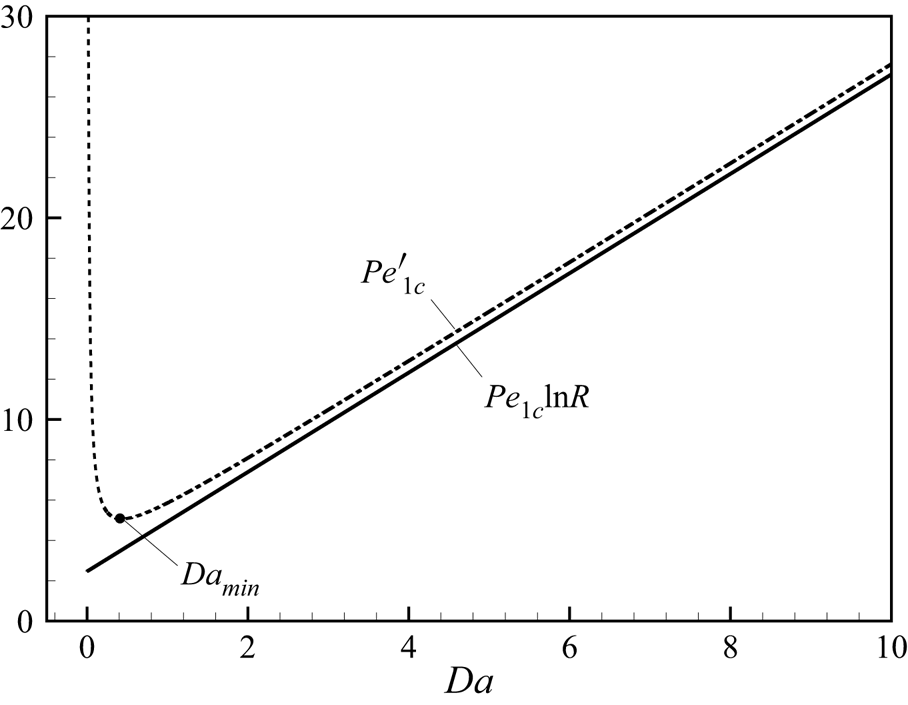
 $Pe'_{1c}=Pe_{1c}(1+Da\ln R)/Da$ approaches infinity on a non-reactive surface as expected. As shown in figure 1,
 $Pe'_{1c}$ reaches the minimum at
 \begin{equation} Da_{min}=\frac{\sqrt{R^2+1}}{\sqrt{(R^2-1)\ln R}}, \end{equation}
showing that the self-propulsion of an active drop is mostly likely to occur at a moderate consumption rate of surfactant. At large  $Da$, both critical Péclet numbers follow a linear relationship with
 $Da$.
The dependence of critical Péclet numbers,  $Pe_{1c}$ and
 $Pe'_{1c}$, on the Damköhler number,
 $R=200$.

To determine the stability of the Fourier modes at  $k\geq 2$, the following eigenvalue equation for neutral stability needs to be solved:
 \begin{equation} c_{k,1}^{\prime\prime}+\frac{c_{k,1}^{\prime}}{r}-\frac{k^2c_{k,1}}{r^2} +\frac{kPe_{kc}}{2}\frac{r^2-1}{r^{k+2}}c_{k,1}^s=0, \end{equation}
where  $c_{k,1}^s=c_{k,1}|_{r=1}$. The corresponding critical Péclet number is
 \begin{equation} Pe_{kc}=4(k-1)(k+Da), \quad\textrm{for } k=2,3,\ldots . \end{equation}
It can be verified that  $Pe_{1c}< Pe_{2c}< Pe_{3c}<\cdots$ at all
 $Da$ for
 $R\gg 1$. At
 $Da=0$,
 $Pe_{kc}=4k(k-1)$ for a Marangoni drop is higher than
 $Pe_{kc}=4(k-1)$ for a phoretic particle, indicating the different contribution of stresslet for droplets and particles to the surrounding fluid. Increasing
 $Da$ increases the critical Péclet numbers of all angular modes.
At  $O(\epsilon^2)$,
 $c_{0,2}$ and
 $c_{2,2}$ can be directly solved by the inhomogeneous equations (3.4) and (3.5). The surface concentrations
 $c_{0,2}^s$ and
 $c_{2,2}^s$ are proportional to the square of
 $c_{1,1}^s$. At
 $O(\epsilon^3)$, the solvability condition of the inhomogeneous equation (3.6) leads to the steady Landau equation for perturbation amplitude,
 \begin{equation} c_{1,1}^s+A_1c_{1,1}^sc_{2,2}^s-A_2(c_{1,1}^s)^3=0, \end{equation}
where  $c_{2,2}^s=A_3Pe_{1c}^2(c_{1,1}^s)^2$ and
 \begin{equation} \left.\begin{array}{c} A_1=\dfrac{4(\ln R)^2-\dfrac{5Da+6}{Da+2}}{32(\ln R-1)}, \quad A_2=\dfrac{(Da+1)^2R^2-4Da^2(\ln R)^3}{32(1+Da\ln R)(\ln R-1)^2},\\ A_3=\dfrac{2(Da+3)\ln R-3Da-7}{(Da+1)[8Pe_{1c}-32(Da+2)]}. \end{array}\right\} \end{equation}
The above equation has three solutions: the trivial solution  $c_{1,1}^s=0$ represents a stationary drop; while the other two solutions
 $c_{1,1}^s=\pm \sqrt {1/(A_2-A_1A_3Pe_{1c}^2)}$ represent steady translation. From (2.6a,b) and (3.1), the leading-order speed of the drop is
 \begin{equation} U=\frac{c_{1,1}^s}{2Pe_{1c}}\sqrt{Pe-Pe_{1c}}, \end{equation}
demonstrating a square-root growth of drop velocity with  $Pe$ near the onset of self-propulsion. Because
 $c_{2,2}^s$ is always negative, the drop swims as a pusher (regardless of the sign of
 $c_{1,1}^s$ due to fore-and-aft symmetry). Different from Suda et al. (Reference Suda, Suda, Ohmura and Ichikawa2021) which uses a point source of surfactant to generate Marangoni stress and predicts a puller-to-pusher transition with increasing
 $Pe$, the drop motion in this work is caused by a symmetry-breaking mechanism. Here, the maximum concentration gradient occurs at the rear of the drop due to convection, while in Suda et al. (Reference Suda, Suda, Ohmura and Ichikawa2021) it occurs at the front side of the drop where the point source is added. Considering the drops at a Péclet number
 $Pe\sim Pe_{1c}$, the velocity scales as
 $U\sim Da^{-1}$ for
 $Da\gg 1$. This result is the same as the scaling for a phoretic particle of specified non-uniform surface activity at
 $Pe=0$ (Michelin & Lauga Reference Michelin and Lauga2014), suggesting the two cases have the same scaling for the concentration perturbation.
4. Numerical simulation
In this section, the full nonlinear dynamics of a swimming drop is numerically studied using the same method of superposition of Fourier modes as the weakly nonlinear stability analysis. This method has been used in Nagai et al. (Reference Nagai, Takabatake, Sumino, Kitahata, Ichikawa and Yoshinaga2013) and Hu et al. (Reference Hu, Lin, Rafai and Misbah2019). The Fourier mode (2.4) is truncated up to the  $K$th term and calculated using the FFTW library (Frigo & Johnson Reference Frigo and Johnson2005). Each mode of the concentration field is solved using a second-order finite difference method and the velocity is directly calculated by the discretized stream function in (2.5a,b). Simulation is performed in a circular domain (
 $R=200$) with a body-fitted polar mesh of a uniform grid in the
 $\theta$ direction and a non-uniform grid in the
 $r$ direction (refined near the drop surface). The drop surface coincides with the constant radial grid at
 $r=1$. The grid number is
 $K=128$ in the
 $\theta$ direction and
 $N=200$ in the
 $r$ direction with the finest grid size being
 ${\rm \Delta} r_{min}=0.01$, and a second-order Runge–Kutta scheme is employed for temporal discretization with
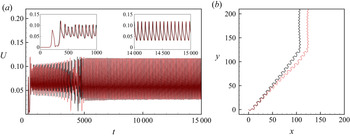
 ${\rm \Delta} t=0.1$. To assess the effect of grid resolution, the time history of drop speed at a relatively high Péclet number (
 $Pe=40$) and
 $Da=0$ under two grid resolutions is compared. In figure 2, the grid size does affect the transient motion of the drop because the problem is deterministic nonlinear and is highly sensitive to small perturbations. Nevertheless, the shape of the trajectory and the drop velocity agree well between two simulations, with the maximum velocity difference less than
 $0.01\,\%$.
( $a$) Time history of the swimming speed and (
 $b$) trajectory of the drop at
 $Pe=40$ and
 $Da=0$ under two simulation conditions. Black solid line:
 $K=128, N=200, {\rm \Delta} r_{min}=0.01$ and
 ${\rm \Delta} t=0.1$. Red dashed line:
 $K=256, N=300, {\rm \Delta} r_{min}=0.005$ and
 ${\rm \Delta} t=0.05$.

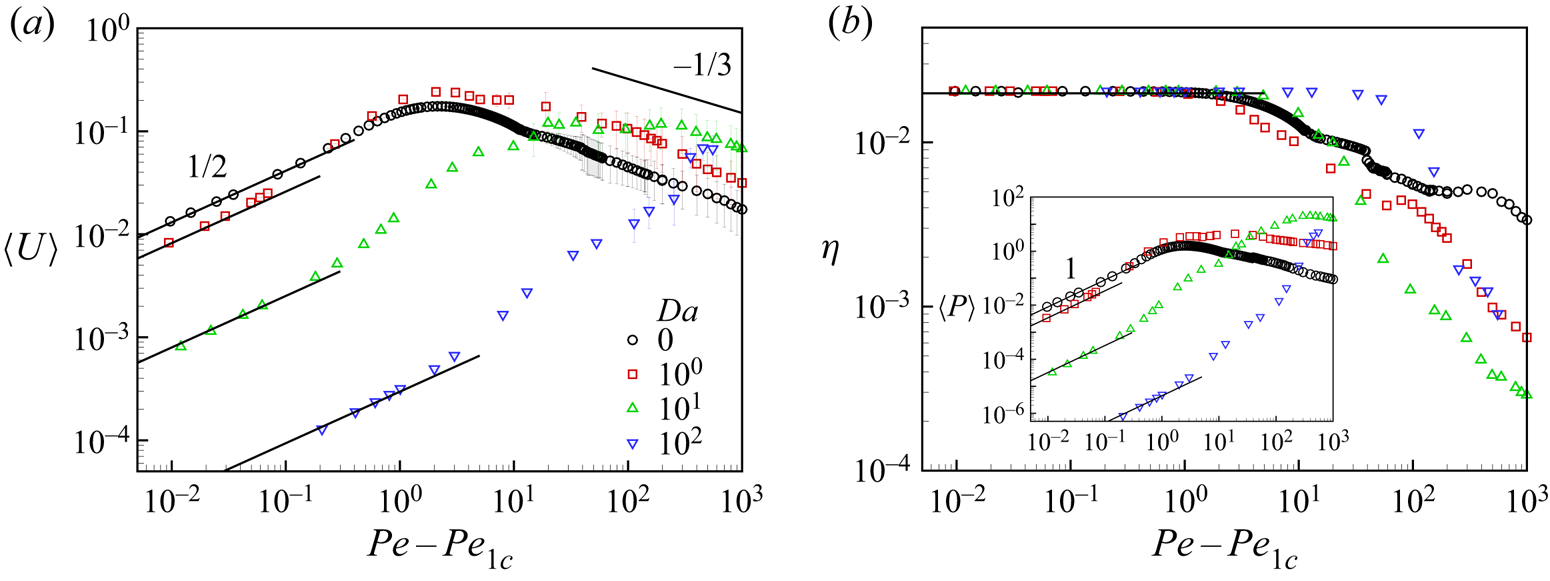
Figure 3( $a$) shows the drop speed as a function of Péclet number. The numerical results match well with the asymptotic solution in (3.13) for
 $Pe/Pe_{1c}-1\ll 1$. The velocity scaling is different from the linear relation for the 3-D drop of constant surface flux of surfactant (Morozov & Michelin Reference Morozov and Michelin2019b), while the same as the one for the 3-D drop of surfactant consumption in the bulk fluid (Yoshinaga et al. Reference Yoshinaga, Nagai, Sumino and Kitahata2012). In Morozov & Michelin (Reference Morozov and Michelin2019b), the concentration perturbation due to drop motion is dissipated in a far-field boundary layer with radius
 $r\sim 1/U$, where
 $U\ll 1$ is the drop velocity. In comparison, the far-field boundary layer is absent for a 2-D drop and a 3-D drop of surfactant reaction in the bulk fluid. The reaction kinetics significantly affects the drop speed without changing its scaling with
 $Pe$ near the supercritical bifurcation.
Dependence of ( $a$) average drop speed
 $U$ and (
 $b$) efficiency
 $\eta$ and (inset) power consumption
 $P$ on the Péclet number. Solid lines are the asymptotic solutions from the weakly nonlinear analysis and the error bars are the standard deviation of drop speed.

Beyond the weakly nonlinear regime, the drop speed first increases with  $Pe$ and later decreases. For self-propelled drops extracting energy from the suspending fluid, the self-propulsion causes two counter effects: advecting the surfactant around the drop, which tends to enhance the non-uniform surfactant distribution at the surface and increases the drop speed; as well as decreasing the thickness of boundary layer, which tends to mix the concentration field and reduces the drop speed. The competition between these two effects leads to a peak velocity at a certain Péclet number. The drop of a small but non-zero Damköhler number (
 $Da\sim 1$) has the highest peak velocity, indicating a nonlinear coupling between the surfactant reaction and generation of Marangoni stresses at the drop surface. At a high enough
 $Pe$, the velocity roughly scales as
 $U\sim Pe^{-1/3}$ for all drops due to the balance between the surfactant diffusion (
 ${\sim}c/\delta ^2$) and convection tangent to the surface (
 ${\sim}PeUc$), where the velocity
 $U$ and boundary layer thickness
 $\delta$ are both linearly proportional to the surfactant concentration
 $c$. This observation is consistent with a phoretic particle (Michelin & Lauga Reference Michelin and Lauga2014).
The energetic properties of the swimming drop are shown in figure 3( $b$). Lighthill (Reference Lighthill1952) defined the hydrodynamic efficiency of swimming as
 $\eta =\langle U\rangle^2/\langle P\rangle$, to represent the ratio between the power consumption of a swimmer under steady dragging, and free-swimming motion at the same speed. Here, the free energy dissipation due to the chemical reaction and surfactant diffusion are neglected and the constant prefactor which represents the drag coefficient is omitted. At relatively small
 $Pe$, all drops have the same constant efficiency
 $\eta =1/8{\rm \pi} (1+\beta ^i)\simeq 0.02$ for
 $\beta ^i=1$. For a microswimmer propelled by purely tangential velocity
 $\boldsymbol {u}_s$, Stone & Samuel (Reference Stone and Samuel1996) showed that the power consumption
 $P^o=\int _{V^o}\boldsymbol {\omega }^2 dV+2\int _s\boldsymbol {u}_s^2\kappa \, \textrm {d} s$, where
 $V^o$ is the region outside the swimmer,
 $\boldsymbol {\omega }$ is vorticity and
 $\kappa$ is the curvature of the surface measured along the direction of the surface flow. In the weakly nonlinear regimes, the self-propulsion of the drop is dominated by the dipole mode so the flow is irrotational outside the drop. The power consumption outside the drop,
 $P^o=8{\rm \pi} U^2$, reaches the lowest limit. Inside the drop, the flow is rotational and the power consumption is
 $P^i=\beta ^i\int _{V^i}\boldsymbol {\omega }^2 \, \textrm {d} V-2\beta ^i\int _s\boldsymbol {u}_s^2\kappa \, \textrm {d} s=8{\rm \pi} \beta ^iU^2$. In terms of the concentration field, the dipole mode has no direct contribution to the power consumption. Instead, the energy dissipation is caused by the leading-order isotropic perturbation of surfactant concentration, i.e. the
 $\varepsilon ^2c_{0,2}$ term in (3.2), showing the significance of hydrodynamic coupling of modes of different angular modes. Increasing
 $Pe$, the efficiency of the drop decreases due to a greater contribution of the higher-order modes. Compared with the drops at large
 $Da$, the drop at
 $Da=1$ has better swimming performance as it has high speed and efficiency, simultaneously, at
 $Pe\sim 20$.
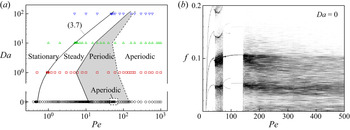
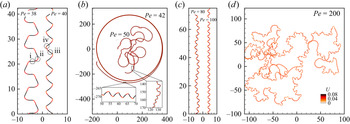
At high Péclet numbers, the drop motion becomes unsteady. Figure 4( $a$) shows the four regimes of the drop states observed in simulations: stationary; persistent steady motion; periodic unsteady motion; and aperiodic unsteady motion. The unsteady trajectories feature different patterns of zigzag curves dependent on
 $Pe$. The critical Péclet numbers for the steady–periodic and periodic–aperiodic transition show non-monotonic dependence on
 $Da$. Interestingly, at
 $Da=0$ there is a small window of aperiodic motion at
 $43\lesssim Pe\lesssim 71$ in the periodic regime. This phenomenon is more obvious in the power spectrum of drop speed. It is worth mentioning that, as shown in figure 2, the drop may first experience a transient movement before reaching the stable state. Here the spectrum is calculated after the drop reaches a stable motion. In figure 4(
 $b$), the frequency remains zero until
 $Pe\sim 11.8$, beyond which the power spectrum shows a primary frequency and a series of weaker harmonics of half and integer multiple frequencies, indicating the onset of a zigzag motion. The primary frequency first increases with
 $Pe$ to
 $f\sim 0.1$ and then suddenly declines at
 $Pe\sim 39$. This corresponds to a transition of the zigzag trajectory from quadrangle to triangle waves (figure 5
 $a$). At a large length scale, the zigzag trajectory may form a closed circle as has been observed for a 2-D phoretic solid particle (Hu et al. Reference Hu, Lin, Rafai and Misbah2019) or circular segments (figure 5
 $b$). Further increasing
 $Pe$, the power spectrum turns into a continuous band whereas the zigzag trajectory is composed of both quadrangle and triangle waves (figure 5
 $b$). In general, the trajectory exhibits quadrangle waves at a low
 $Pe$ and triangle waves at a high
 $Pe$, and transient quadrangle waves may occur before the stable triangle motion (see figure 2). As will be shown shortly, both waves are caused periodic misalignment between the drop swimming direction and angle of the low surfactant area due to the nonlinear interaction. In the intermediate
 $Pe$ regime, the drop motion is in a bistable state and the trajectory is highly sensitive to the surfactant transport around the drop surface. The triangle waves may intermittently transform to quadrangle waves, resulting in the second window of aperiodic motion.
( $a$) The phase diagram of the drop motion at different
 $Pe$ and
 $Da$. (
 $b$) The power spectrum of the drop speed at
 $Da=0$.

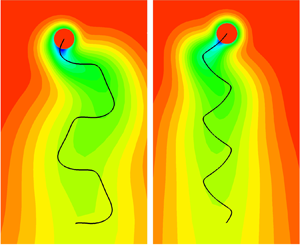
Trajectories of drops at different  $Pe$ and
 $Da=0$, the colour shows the instantaneous drop speed. Circles in (
 $a$) represent the drops at four time instants (i–iv) whose flow fields are shown in figure 7.

At  $72\lesssim Pe\lesssim 141$, the trajectory is a periodic zigzag curve formed by only triangle waves and the main frequency approaches a constant
 $f\sim 0.1$. The secondary frequencies show bifurcations at
 $72\lesssim Pe\lesssim 98$ due to the emergence of interharmonics and their interference with the primary frequency. This corresponds to a zigzag trajectory which slowly sways at a large length scale (see figure 5
 $c$) and indicates that the drop motion is controlled by two coupled processes at different time scales, a fast time scale related to surfactant convection near the drop interface, and the slow scale for the surfactant diffusion far away from the drop. Further increasing
 $Pe$, the secondary frequencies return to regular harmonics at
 $100\lesssim Pe\lesssim 141$. At
 $Pe\gtrsim 142$, the frequency shows a broadband continuous spectrum, representing a highly disordered drop motion (figure 5
 $d$).
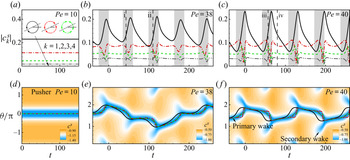
To further understand the swimming dynamics in zigzag trajectories, figure 6 compares the time evolution of surfactant concentration around the drops at  $Da=0$ (fixed flux rate). At
 $Pe=10$, all concentration modes have constant magnitude and align in the same direction. At higher
 $Pe$, they become time dependent, both in magnitude and orientation. Here, the orientation of an odd/even mode is defined by the angle between the axis of symmetry of local diverging/converging flow and the horizontal direction (see the schematic in figure 6
 $a$). In the regime of steady motion, all modes align in the same direction, indicating a pusher-type swimming (see figure 6
 $d$). In the unsteady regime, the drop motion can be categorized in two stages. In the first stage (white areas), the magnitude of the dipole mode
 $|c_1^s|$ decreases while the rest modes remain roughly unchanged, and all modes are in the same direction as the wake region of low surfactant concentration, representing a quasiballistic pusher-type swimming with decreasing velocity (
 $|c_1^s|$ is twice the drop speed). In the second stage (grey areas), the magnitudes of all modes change significantly. The dipole mode becomes more and more misaligned with the other modes and turns the drop into a puller. At time instants (i–iii), the angle between the dipole and quadrupole modes reaches the maximum angle of 75, 80 and 87
 $^\circ$, respectively. In figures 6(
 $e$) and 6(
 $f$), the drop motion generates a secondary wake which eventually merges with the primary wake and changes its drifting direction on the drop surface. Compared with a pusher swimmer, a puller has a much faster response to disturbance (Suda et al. Reference Suda, Suda, Ohmura and Ichikawa2021), thus the drop quickly reorients its swimming direction and returns to a pusher-type translation. At
 $Pe=40$, this effect causes the drop to change swimming direction every half-cycle and results in a zigzag trajectory of triangle waves. This type of drop motion requires relatively strong convection and occurs at high Péclet numbers (
 $72\lesssim Pe\lesssim 141$). In comparison, at
 $Pe=38$ the modes interaction and the convection of surfactant are weaker and require one periodic cycle to reverse the advection direction of the primary wake and leads to a zigzag trajectory composed of quadrangle waves. At
 $43\lesssim Pe\lesssim 71$, the competition and transformation between the two types of swimming motion lead to aperiodic trajectories of circular and irregular patterns.
(a–c) The magnitudes of Fourier coefficients of surfactant concentration for drops at  $Pe=10, 38$ and 40,
 $Da=0$. The inset in (
 $a$) illustrates the angles of odd and even modes. White and grey areas in (
 $b$) and (
 $c$) represent the translation and reorientation stages of the drop swimming. (d–f) Time evolution of surfactant distribution at the drop surface (contour colour) and the opposite direction of hydrodynamic modes (lines). Drops at four time instants (i–iv) are marked in figure 5, the corresponding times are
 $t=43, t=110, t=57$ and 80, respectively.

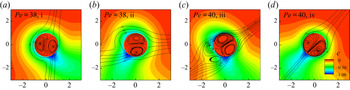
Figure 7 shows the flow fields at the time instants marked in figures 6( $b$) and 6(
 $c$). At
 $Pe=38$, the maximum angles between the dipole and quadrupole modes are less 90 degrees, resulting in a highly asymmetric flow field around the drop in the puller-type swimming motion. In comparison, in figure 7(
 $c$) the drop at
 $Pe=40$ generates a more symmetric puller-type flow and induces strong vortex pairs behind the drop. For the two drops, the ratios between the magnitudes of dipole and quadrupole modes are both around 0.5. This result shows that it is the angle between the concentration modes that determines the two types of zigzag motion. In figure 7(
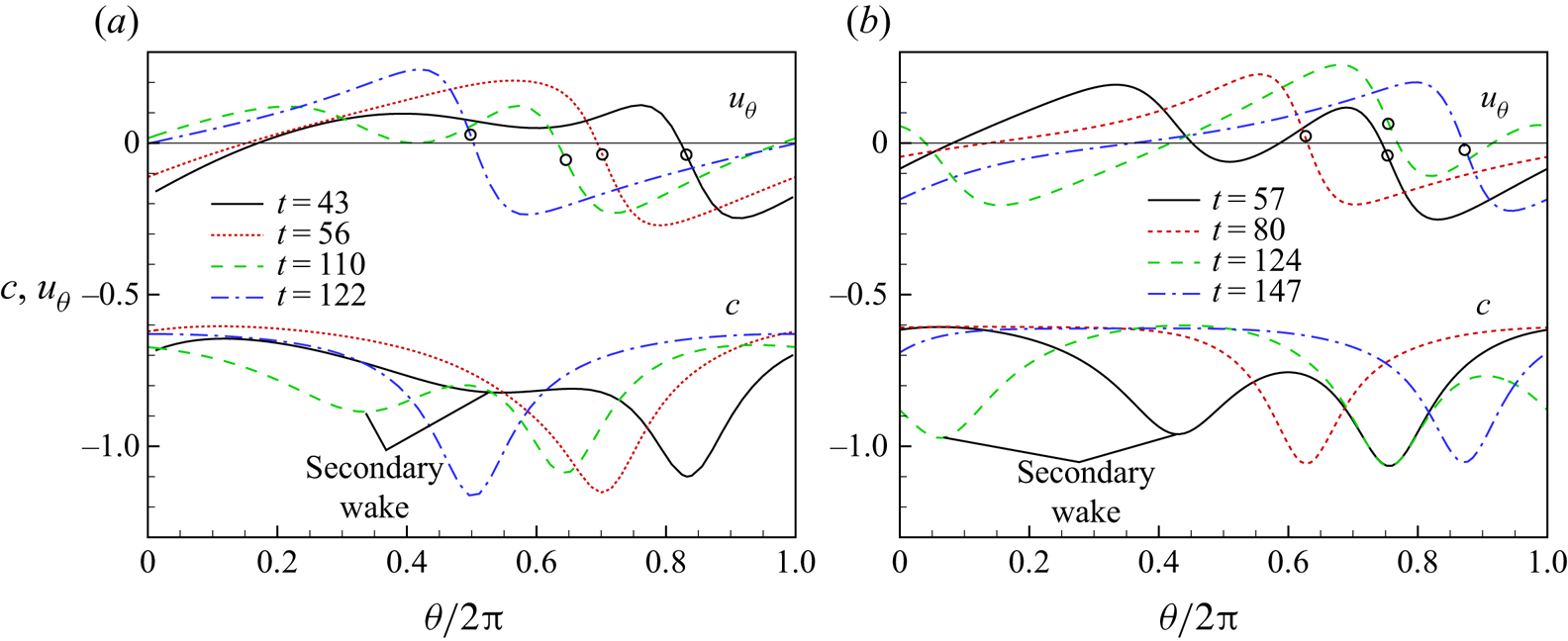
 $d$), when the drop becomes a pusher with the dipole and quadrupole are aligned in the same direction, the streamlines are contracted on the rear side, indicating an unstable pusher swimming mode. To quantify these results, figure 8 shows the typical time evolution of slip velocity and surfactant concentration at the drop surface. At
 $Pe=38$, the secondary minimum of concentration at
 $\theta \simeq {\rm \pi}$ reduces the slip velocity on the drop surface which hinders the advection of surfactant and further decreases the local concentration. The secondary wake is attracted to the primary wake and the two wakes merge together forming a new concentration minimum. At
 $Pe=40$, the process is qualitatively the same, however, the secondary wake is stronger, and in each half-cycle it reverses the direction of slip velocity at the concentration minimum after merging with the primary wake (marked by open cycles). This result shows that the drop motion is directly related to the formation and evolution of the secondary wake.
Distribution of concentration and streamlines around the drops at four time instants marked in figure 5. Movies of the corresponding flow fields and drop trajectories are available in the supplementary movies (https://doi.org/10.1017/jfm.2021.1154).

Typical distribution of surfactant concentration and slip velocity on the surface of a drop at ( $a$)
 $Pe=38$,
 $Da=0$ and (
 $b$)
 $Pe=40$,
 $Da=0$. Circles show the velocity at the point of lowest surfactant concentration.

5. Concluding remarks
To summarize, this work studies the swimming dynamics of a 2-D Marangoni drop in a surfactant solution and its dependence on two parameters: the Péclet number ( $Pe$) and Damköhler number (
 $Da$), which characterize the strength of surfactant convection and chemical reaction, respectively. Depending on the choice of the characteristic velocity, two Péclet numbers can be used to compare the contributions of surfactant reaction and surface mobility on the drop motion. For the onset of self-propulsion, the critical Péclet number
 $Pe_{1c}$, which involves both reaction and mobility, increases linearly with
 $Da$. In comparison,
 $Pe'_{1c}$ which only considers the contribution of mobility, reaches a minimum at a certain
 $Da$. At low
 $Pe$, the drop motion is controlled by supercritical bifurcation and appears as a pusher at far-field. The drop speed and power scale as
 $U\sim \sqrt {Pe-Pe_{1c}}$ and
 $P\sim Pe-Pe_{1c}$, consistent with the scaling for a 3-D drop with a surfactant reaction in the bulk fluid (Yoshinaga et al. Reference Yoshinaga, Nagai, Sumino and Kitahata2012).
Beyond the weakly nonlinear regime, the drop exhibits transition from steady translation to periodic and aperiodic motions with increasing  $Pe$ due to a reinforced coupling between surfactant advection and drop movement. The swimming drop oscillates between pusher and puller due to the interaction between secondary and primary wakes, and moves in zigzag trajectories formed by triangle, quadrangle and mixed waves. These results show that the combined hydrodynamic and chemical interaction between the active drops with the surrounding fluid can generate rich nonlinear swimming dynamics.
In experiments, the drop's self-propulsion is also influenced by the thermal noise and exhibits random fluctuation. Golestanian (Reference Golestanian2009) analysed the three mechanisms which affect the orientation of a phoretic particle: the Brownian motion due to fluctuation of fluid velocity; the rotational diffusion of the drop; and the thermal fluctuation related to the concentration field. The first effect is typically small for a self-propelled drop of  $O(10)$
 $\mathrm {\mu }$m in size and
 $O(10)$
 $\mathrm {\mu }$m s
 $^{-1}$ in speed. The second effect is caused by an asymmetric distribution of surface activity and has a much larger time scale (
 $\sim Pe a/a_m$) than the drop's reorientation time in the unsteady regime (
 $\sim Pe$) due to the nonlinear hydrodynamic interaction between surfactant transport and drop swimming; where
 $a/a_m=10^4 - 10^5$ is the ratio between the particle size and the molecule size of chemical solute. The last effect, which includes the fluctuation in the solvent and the randomness in the surface reaction (Golestanian, Liverpool & Ajdari Reference Golestanian, Liverpool and Ajdari2005), has the same time scale as the drop's reorientation time and should be considered in the model to fully describe the drop motion. It is expected that the thermal fluctuations will mostly affect the drop motion at long time scales and increases the effective diffusion coefficient of the drop in a non-ballistic motion. Future work should also consider the 3-D extension of the current study to better compare with experiments.
Supplementary movies
Supplementary movies are available at https://doi.org/10.1017/jfm.2021.1154.
Declaration of interests
The author reports no conflict of interest.
Funding
Funding by Scientific Research Starting Foundation (grant no. WH220401009) is gratefully acknowledged.