Introduction
Parasitism due to gastrointestinal nematodes is a major constraint to production of goats using pasture in France. Gastrointestinal nematode parasitism of dairy goats induces economic losses especially in goats exhibiting a high level of milk production (Chartier & Hoste, Reference Chartier and Hoste1997). The use of anthelmintics remains the main option for farmers to control nematode infection because of easy implementation as well as a wide range of activity (Hoste et al., Reference Hoste, Chartier, Etter, Goudeau, Soubirac and Lefrileux2000). However, two events strongly suggest that we are turning away from the ‘all chemotherapeutic era’ (Waller, Reference Waller2003). First, ruminant organic farming is developing in European countries and, as a consequence, legislation demands that parasitic infection is controlled without resorting to preventive use of anthelmintics (EU Regulation 1804/99). Second, for conventional farms, the issue of anthelmintic resistance, apparent since the 1980s, is by far one of the greatest concerns in small ruminant industries, and non-chemical control is obviously a necessary alternative to reliance on antiparasitic drugs. Two surveys conducted in the Poitou-Charentes and Midi-Pyrénées areas in France (Chartier et al., Reference Chartier, Pors, Hubert, Rocheteau, Benoit and Bernard1998, Reference Chartier, Soubirac, Pors, Silvestre, Hubert, Couquet and Cabaret2001) reported that almost 100% of investigated farms presented nematodes resistant to benzimidazole compounds. These two events indicate that there is an urgent need to implement non-chemical solutions to the control of parasitism in dairy goats. Several non-chemical alternatives have been studied: alternate grazing schemes with different ruminant species (cattle and sheep or cattle and goats) (Cabaret et al., Reference Cabaret, Bouilhol and Mage2002), use of forages containing condensed tannins (Martínez-Ortíz-de-Montellano et al., Reference Martínez-Ortíz-de-Montellano, Vargas-Magaña, Canul-Ku, Miranda-Soberanis, Capetillo-Leal, Sandoval-Castro, Hoste and Torres-Acosta2010) or biological control using nematophagous fungi (Larsen, Reference Larsen2000; Waller, Reference Waller2003).
The nematode-destroying fungus Duddingtonia flagrans has proved its efficacy in reducing the free-living stages of goat nematodes by trapping the infective larvae in three-dimensional nets before they leave faeces (Chartier & Pors, Reference Chartier and Pors2003; Paraud & Chartier, Reference Paraud and Chartier2003; Waghorn et al., Reference Waghorn, Leathwick, Chen and Skipp2003; Wright et al., Reference Wright, McAnulty, Noonan and Stankiewicz2003; Terrill et al., Reference Terrill, Larsen, Samples, Husted, Miller, Kaplan and Gelaye2004; Paraud et al., Reference Paraud, Hoste, Lefrileux, Pommaret, Paolini, Pors and Chartier2005). The usual efficient dose, necessary to obtain larval number reduction higher than 80%, varied between 105 and 5 × 10⁵ chlamydospores/kg body weight (BW)/day.
However, the fungus is grossly indiscriminate in its parasitic nematode trapping (Nansen et al., Reference Nansen, Grønvold, Henriksen and Wolstrup1988) and a possible negative impact on non-target animals such as beneficial soil nematodes has to be evaluated. Saprophytic soil nematodes are an important and abundant taxonomic component of the grassland fauna, rapidly colonizing fresh dung pats and playing a key role in nutrient recycling (Bardgett et al., Reference Bardgett, Cook, Yeates and Denton1999). The overall ecological balance of the pasture soil-community of organisms could thus be disturbed if the introduction of a large number of the naturally occurring fungus D. flagrans induces long-term reductions of the populations of these beneficial non-target organisms.
The environmental behaviour of D. flagrans in faeces and soil after oral administration of chlamydospores to ruminants has been studied previously. Knox et al. (Reference Knox, Josh and Anderson2002) observed, after deposition of sheep faeces containing D. flagrans chlamydospores, that the fungus was most frequently observed in the top 10 cm layer of soil. Knox et al. (Reference Knox, Josh and Anderson2002) and Faedo et al. (Reference Faedo, Larsen, Dimander, Yeates, Höglund and Waller2002) reported that D. flagrans did not spread in the horizontal plane.
Environmental effects of D. flagrans in faeces after oral administration of chlamydospores were previously studied using two approaches: a global one through comparative rates of degradation of faeces and another, more specific one through the impact on abundance and diversity of non-target soil nematode populations. Only one comprehensive experiment on dung degradation was conducted in Sweden with dung pats derived from cattle fed D. flagrans (Dimander et al., Reference Dimander, Höglund and Waller2003). On the other hand, some investigations on free-living nematodes have been conducted on pasturelands grazed by sheep fed D. flagrans in Australia (Yeates et al., Reference Yeates, Waller and King1997; Knox et al., Reference Knox, Josh and Anderson2002), Denmark (Faedo et al., Reference Faedo, Larsen, Dimander, Yeates, Höglund and Waller2002) and Sweden (Waller et al., Reference Waller, Schwan, Ljungström, Rydzik and Yeates2004) and by cattle fed D. flagrans in Sweden (Yeates et al., Reference Yeates, Dimander, Waller and Höglund2002), and on plot studies with cattle faeces containing D. flagrans chlamydospores in Sweden (Yeates et al., Reference Yeates, Dimander, Waller and Höglund2003). No significant detrimental effect of the presence of the fungus was reported in all these studies. This information is restricted to the routine dose rates of D. flagrans chlamydospores (0.5 × 10⁶–106 chlamydospores/kg BW) and does not include specific goat studies.
Thus, the present 2-year-plot study was carried out with dung derived from goats fed D. flagrans at two different doses (0.5 × 10⁶ chlamydospores/kg BW, and 10 times this dose) and had two main objectives: first, to determine whether or not the presence of the fungus alters the rate of degradation of goat faecal pellets; and second, to examine effects of the presence of the fungus in faeces on the free-living nematode population (size and composition) recovered from soil underneath faecal deposits.
Materials and methods
Animals and administration of chlamydospores
Six Alpine culled dairy goats were purchased from a private farm (Deux-Sèvres, France) using a zero-grazing system. All the animals were free from nematode infection. They were experimentally infected with Trichostrongylus colubriformis (7500 infective larvae per goat) and maintained on a concrete floor in three separated pens of two animals each. They were fed barley grains and lucerne pellets, barley straw and water being offered ad libitum.
Chr. Hansen Biosystems A/S, Denmark, provided chlamydospores of the Troll A isolate of D. flagrans, isolated in Denmark (Grønvold et al., Reference Grønvold, Wolstrup, Larsen, Henriksen and Nansen1993). Chlamydospores were produced on millet seeds and packaged in aluminium bags.
The goats were divided into three groups of two animals receiving 0 (control), 0.5 × 10⁶ (dose 1) or 5 × 10⁶ (dose 2) chlamydospores/kg body weight (BW)/day. The dose rate of 0.5 × 10⁶ chlamydospores/kg BW/day has been shown to be effective for the control of parasitic nematode larvae in goat faeces (Waghorn et al., Reference Waghorn, Leathwick, Chen and Skipp2003; Paraud et al., Reference Paraud, Hoste, Lefrileux, Pommaret, Paolini, Pors and Chartier2005). The dose rate corresponding to ten times the effective dose was arbitrarily chosen to maximize an eventual effect. Chlamydospores were fed daily to goats of the fungus groups for a period of 1 week before each experimental set started, to warrant a regular presence of the chlamydospores in the faeces (Paraud et al., Reference Paraud, Hoste, Lefrileux, Pommaret, Paolini, Pors and Chartier2005). The fungal administration was carried on for the 2 days of faeces collection. Chlamydospores were administered individually in mineral powder (Onix special export fluidized, Onix, St Front sur Nizonne, France) before the distribution of the main diet. The complete consumption of the food with chlamydospores was carefully checked (vacuumed trough).
Experimental pasture plots
Four contiguous grass plots (11 × 7 m) of uniform, flat topography, which had never been grazed by ruminants, were fenced in near proximity to the laboratory. Each plot was dedicated to an experimental set. The vegetation of this old lawn was comprised mainly of dandelion (Taraxacum officinale), clover (Trifolium pratense) and grasses. Prior to each set of faeces deposition, the pasture was mowed to approximately 5 cm high.
Three × two rows per plot were delimited: for each treatment group (two fungus groups and control group), one row was used to evaluate the rate of disintegration of faeces and the other row was used to evaluate the dry matter content of faeces. Each row was separated from another by 1 m. Buffer zones were mowed regularly. The entire plot was protected from disturbance by birds by covering the ground with a wide-mesh nylon net.
Faecal deposition on the plots
Faeces from each treatment group were collected per rectum for 2 days. After thorough mixing, 18 sub-samples, each weighing 100 g, of whole faecal pellets per treatment were prepared: one sub-sample was used to determine the dry matter content of the faeces at the date of deposition; seven were used for the determination of the degradation rate (seven replicates per treatment); and ten were used for the determination of faeces dry matter content at each sampling date and to evaluate the impact on free-living nematodes underneath faeces.
Each sub-sample was put in a square basket (of side length approximately 20 cm, in order to make a single layer of faecal pellets) made of plastic mesh (mesh size: 6 mm, 2 cm edges). The wire mesh allowed soil fauna, such as soil nematodes and earthworms, to colonize pellets while allowing lifting of faeces. Baskets were placed in rows and anchored to the soil with stiff wire to ensure close contact with the soil, each basket being separated from the next by 1 m.
Experimental zones were hand clipped to ensure that grass height did not exceed 5 cm (this decision was made every fortnight when samplings were performed) and clippings were kept on the plot away from baskets.
Faeces containing D. flagrans and control faeces were deposited on plots on 16 May 2003 (set 1), 27 September 2003 (set 2), 8 June 2004 (set 3) and 29 September 2004 (set 4).
Faecal weighing
Seven faecal replicates for each treatment which were placed in the same row were weighed ten times fortnightly after deposition by gently lifting baskets supporting faeces from the ground to a scale and immediately afterwards replacing baskets to their initial positions. At each weighing date, 1 basket out of 10 was withdrawn from the second row and pellets were dried overnight at 110°C to determine the faecal dry matter content. This allowed the expression of all faecal weights on a dry matter basis.
Soil sampling and nematode recovery
Soil samples were collected from underneath the faeces at each weighing date. Four 2-cm-diameter soil cores were taken at a depth of 8 cm at each corner under the faeces baskets that were removed for dry matter content determination. Two more soil samples (negative control) were taken randomly from the sward in order to search for an impact of the presence of faeces on free-living nematode populations.
Three soil samples per treatment (three replicates per treatment and sampling date) and one for the negative control were used to determine the number of free-living nematodes. The remaining samples (one for each treatment and one for the negative control) were used to determine the soil dry matter content by drying soil samples overnight at 110°C.
After weighing, each soil sample was placed on a single layer of disposable tissue placed on a metallic mesh (mesh size: 8 mm). The mesh, supported by spacers (height: 2 cm), was placed in a plastic tray filled with tap water to the height of the mesh and was left for a minimum of 24 h at room temperature. Extracts were then settled overnight in small plastic boxes (eight boxes of 180 ml were used for each sample). Supernatants were removed and final pellets were resuspended in 20 ml of water.
Soil nematodes were counted and allocated to the main feeding groups according to their buccal apparatus using a magnifying glass (magnifying × 40) (Yeates et al., Reference Yeates, Bongers, de Goede, Freckman and Georgevia1993). The Tylenchida group was identified to genus.
Counts were converted to number of nematodes/kg of dry matter of soil and the following indices were calculated to assess biodiversity of soil nematode populations in 1 kg of soil dry matter using the Biodiv statistical package (Baev & Penev, Reference Baev and Penev1993):
● The number of groups identified (S) ranging from 1 to 4.
● The Shannon–Weaver index (H′) described by May (Reference May, Usher and Williamson1974) where H′ = Σp ilog p i, where p i = number of individuals of the feeding group i/total number of worms, and where H′ ranged from 0 (all the nematodes belong to the same community) to the natural logarithm of the total number of groups (S) (each nematode belongs to a different community) in a soil core.
● The ‘evenness’ was measured using the equitability index of Pielou (Reference Pielou1975) (E = H′/S), which ranged from 0 (all soil nematodes belonging to one group) to 1 (all specimens distributed equally among different feeding groups).
Meteorological data
Ten-day average temperature and precipitation values were obtained from a meteorological station situated 10 km away from the experimental area (Météo-France, Niort-Souché station). For comparison, long–term (1971–2000) average precipitation and temperature were obtained from the same meteorological station of Météo-France.
Data analysis
Faecal moisture data were analysed using the non-parametric Mann–Whitney test at level P < 0.05 with treatment or season (sets 1 and 3 were gathered as spring–summer sets and sets 2 and 4 were gathered as autumn–winter sets) as grouping variables. Soil moisture data were analysed using the non-parametric Mann–Whitney test at level P < 0.05 with treatment (the three faeces treatments and the negative control group without faeces) or season as grouping variables. Faecal weight data were analysed in a repeated ANOVA model with factors being treatment and season.
Soil nematode numbers were compared between negative control soil samples and soil cores sampled below control faeces containing no chlamydospores for the whole experiment using the non-parametric Mann–Whitney test at level P < 0.05. Soil nematode numbers were square-root transformed and analysed for the whole experiment in an ANOVA model with treatment and season as factors. Soil nematode indices, H′ and E, were analysed for the whole experiment in an ANOVA model with treatment, season and year as factors.
Statistical analysis was performed using Systat 9.1 for Windows, 1998 (SPSS Inc., Chicago, Illinois, USA).
Finally, multiple correspondence analysis (MCA) was performed to obtain a synthetic description of main features of free-living nematode populations, i.e. global number (N) and diversity indices (H′ and S) in relation to concentration of D. flagrans in faeces (Stat-Itcf computer package, France, 1988). In MCA, each axis corresponded to a linear combination of active variables. The active variables (N, H′, S, year and season) were combined to construct unrelated variables called axes. The D. flagrans concentration variable acted as a supplementary variable not participating in the construction of the factorial planes, in order to get a more relevant location compared to the other variables (Dervin, Reference Dervin1988). Then, all the observed variables were projected on the main factorial planes constructed by axes 1, 2 and 3 and positively related variables were located on the same region of the plane. The individuals (lines) involved in the MCA were all the individual results of free-living nematode determinations (ten measurements per season and per D. flagrans dose rate except for six missing values, i.e. 114 lines). Numerical variables were split into three classes of equal numbers of observations: < 5900 (N1), 5900–9110 (N2), >9110 (N3) for the nematode numbers; < 0.86 (H′1), 0.86–0.97 (H′2), >0.97 (H′3) for the Shannon–Weaver index; < 3.67 (S1), >3.67 (S2) for the number of feeding groups. Other variables included in the analysis were categorical: year (1 or 2), season (spring or autumn) and D. flagrans concentration (0, 0.5 × 10⁶ and 5 × 10⁶ chlamydospores/kg BW).
Results
Abiotic factors
Meteorological data (not shown) indicated unusual values, compared to normal data, with high temperatures and very low rainfall prevailing during the months of August and September 2003 (in August, mean maximum and minimum temperatures recorded were 32.2°C and 18.0°C, respectively, whereas normal maximum and minimum temperatures in August over the 30 past years were 26°C and 13.7°C, respectively; rainfall was 18 mm versus normal rainfall in August, 50.5 mm). During 2004, the very low rainfall in comparison to the normal data persisted throughout almost all the year (for example, in July and in November, recorded rainfall was 34.8 and 53.6 mm, respectively, versus 46.7 mm and 97.1 mm for July and November, respectively, over the past 30 years).
Soil moisture content was significantly different according to the season of deposition (P < 0.001), the soil being moister in autumn–winter than in spring–summer. On the contrary, it was not influenced by the treatment (P = 0.764).
Faecal moisture content was significantly influenced by the season of experiment (P = 0.002). During summer, mean faecal moisture content was 34 and 43% for 2003 and 2004, respectively (with a minimum approaching 0% on July 2004), while during autumn–winter, it averaged 54 and 58% for 2003 and 2004, respectively. On the contrary, treatment did not influence faecal moisture content (P = 0.835).
Faecal disintegration
The period of time between deposition and complete disintegration of the faeces varied significantly between deposition dates. This rate was faster for autumn–winter sets (P < 0.001) than for spring–summer sets: all pellets had vanished after 16 weeks for autumn–winter sets, while during spring–summer faeces remained after 20 weeks (end of the experiment). Treatment did not influence the degradation rate of faeces (P = 0.187).
Soil nematode numbers
Soil sample weights varied between 18 and 23 g of dry matter. Numbers of free-living nematodes were statistically different between negative control soil samples and the soil sampled underneath control faeces containing no chlamydospores (P = 0.027): the number of soil nematodes was higher in soil sampled below faeces (mean ± SE: 9575 ± 820 soil nematodes/kg soil dry matter) than in soil sampled elsewhere in the sward (mean ± SE: 7549 ± 995 soil nematodes/kg soil dry matter).
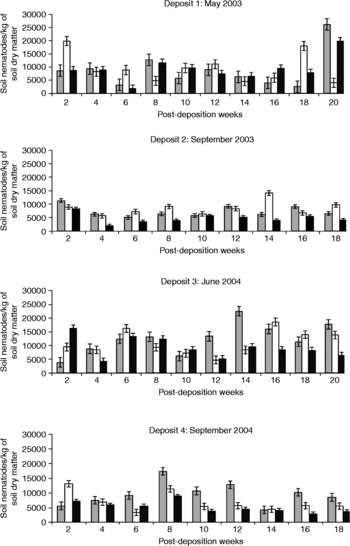
The mean number of free-living nematodes harvested from soil cores underneath the D. flagrans (doses 1 and 2) and control faeces are presented in fig. 1 for each date of the four experimental sets. Season and treatment significantly influenced the number of free-living nematodes recovered (P < 0.001 and P < 0.01, respectively). The number of free-living nematodes was higher in spring–summer than in autumn–winter. The mean number of soil nematodes in soil sampled below the faeces containing the highest chlamydospore concentration was lower than in both soil sampled underneath faeces containing the usual concentration of chlamydospores and soil sampled underneath faeces containing no chlamydospores, especially for autumn–winter depositions.
The mean number of free-living nematodes/kg of soil dry matter ( ± SE) according to weeks after each deposition and to the concentration of chlamydospores given to the goats producing the faeces (grey bars, control, no spores; white bars, dose 1, 0.5 × 10⁶ chlamydospores/kg body weight; black bars, dose 2, 5 × 10⁶ chlamydospores/kg body weight).

Four groups of free-living soil nematodes were identified: bacterial-feeding nematodes, nematodes belonging to the Mononchida group, to the Dorylaimida group or to the Tylenchida group. In the Tylenchida order, 13 taxa were identified: Aphelenchus avenae, Criconematinae, Helicotylenchus sp., Heterodera L2, Paratylenchus sp., Pratylenchoïdes sp., Pratylenchus sp., Rotylenchus sp., Rotylenchulus sp., Tylenchorynchus sp., Tylenchus sp. and Zygotylenchus sp. The most abundant groups were the Tylenchida group and bacterial-feeding, free-living nematodes.
Season significantly influenced the Shannon–Weaver index (P < 0.05), the diversity being higher during autumn–winter. Season significantly influenced the equitability index of Pielou (P < 0.01), the equitability being higher during autumn–winter. No significant difference due to treatment was found among the diversity indices.
Multiple correspondence analyses
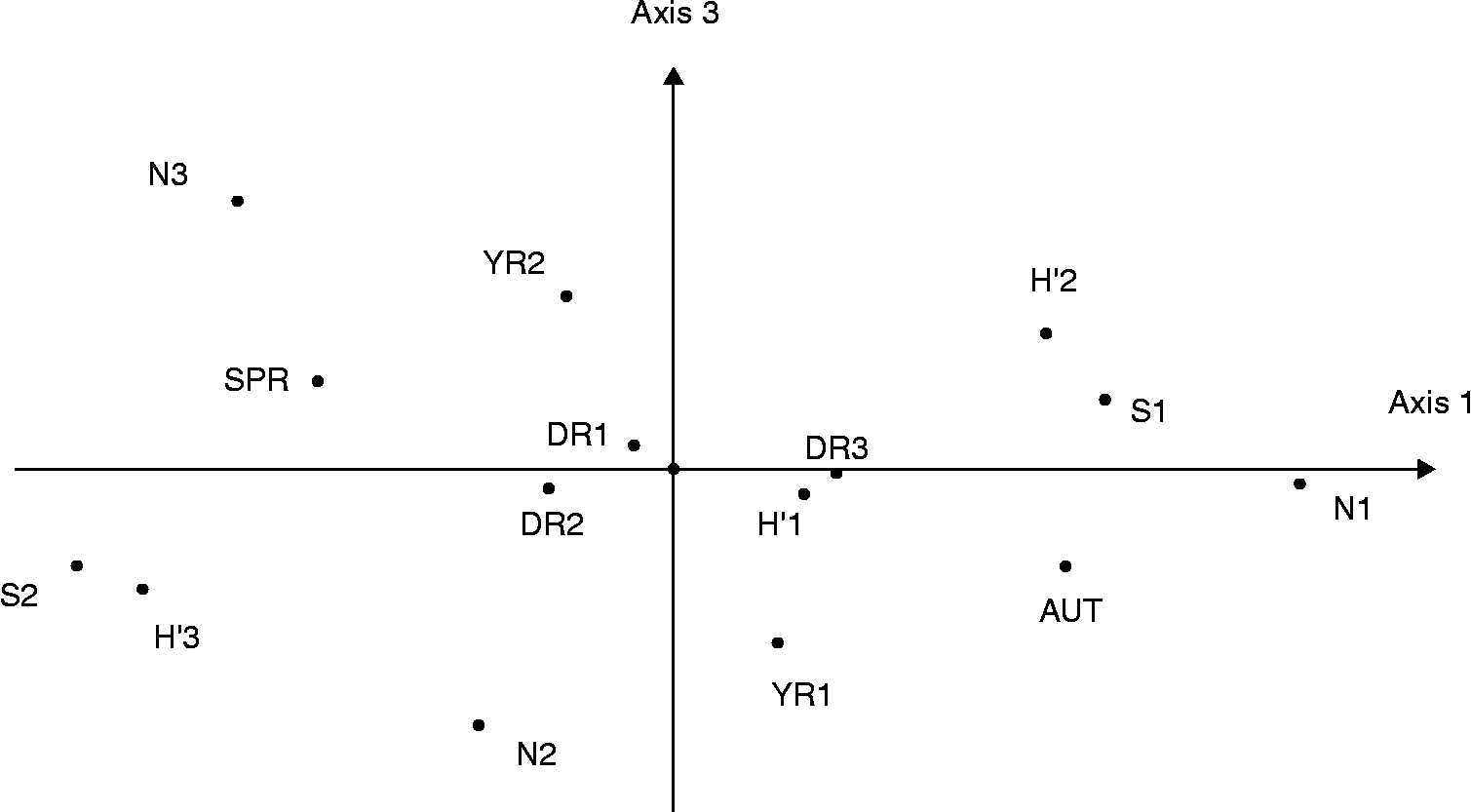
In the multiple correspondence analyses (fig. 2), the principal planes 1–2, 1–3 and 2–3 represented respectively 43, 40 and 39% of the variance (inertia). The plane 1–3 was the most informative with the main contributors being N and S to axis 1 (27.3 and 33.9%, respectively) and N and year (44.9 and 29.4%, respectively) to axis 3. On this plane, the lowest number of free-living nematodes (N1) was associated with autumn-winter sets (AUT) whereas the highest number (N3) was close to spring–summer (SPR) and second year (YR2) sets. The highest values for the nematode population diversity (H′3, S2) were isolated and did not present a noticeable association with other contributing variables; in contrast, H′2 and S1 were relatively close to the lowest number of nematodes (N1), suggesting that a low abundance was associated with a weak diversity.
The number of free-living nematodes and biodiversity indices in relation to the year of deposition, to the season of deposition and to the dose of Duddingtonia flagrans chlamydospores: multiple correspondence analysis. N1, 2, 3: low, medium and high numbers of free-living nematodes; S1, 2: low and high number of feeding groups; H′1, 2, 3: low, medium and high Shannon–Weaver index; YR1, 2: year of deposition; SPR, spring–summer; AUT, autumn–winter; DR1, 2, 3: 0, 0.5 × 10⁶ and 5 × 10⁶ chlamydospores/kg body weight.
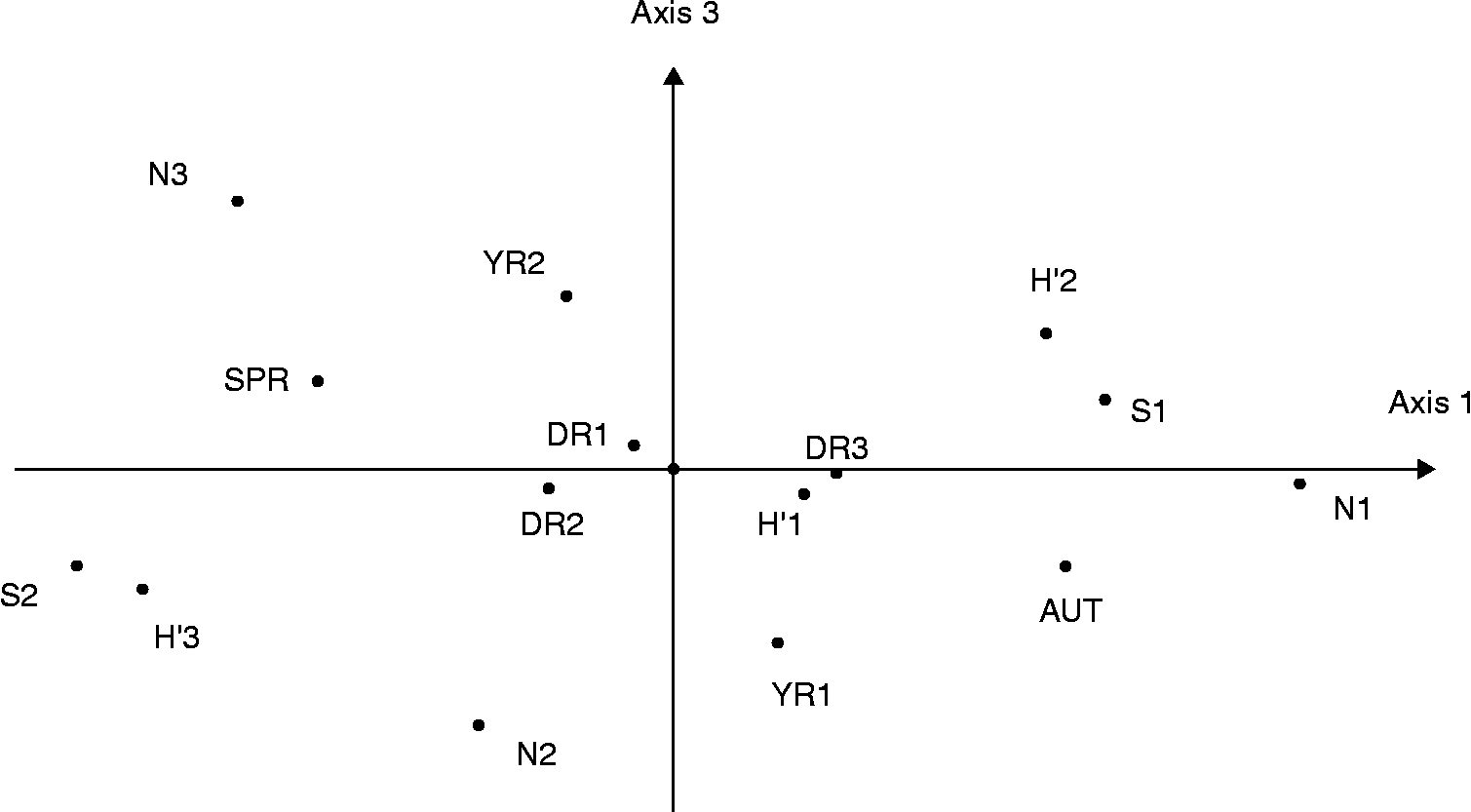
Variables describing the D. flagrans dose rates (DR1, 2, 3) were close to the centre of the plane, suggesting an absence of global relationship with the contributing variables. Thus, concentrations of D. flagrans chlamydospores as used in this analysis (0, 0.5 × 10⁶ or 5 × 10⁶/kg BW) were neither related to the number nor the diversity indices of free-living nematode populations.
Discussion
The efficacy of the administration of D. flagrans in reducing the number of nematode infective larvae has been demonstrated in goats. Under various circumstances (laboratory experiments, plot studies or field trials), several authors have reported reductions of the number of infective larvae higher than 80% in comparison to control faeces when chlamydospores were administered orally to goats at dose rates varying from 1 × 10⁵ to 1 × 10⁶ chlamydospores/kg BW/day (Chartier & Pors, Reference Chartier and Pors2003; Paraud & Chartier, Reference Paraud and Chartier2003; Waghorn et al., Reference Waghorn, Leathwick, Chen and Skipp2003; Wright et al., Reference Wright, McAnulty, Noonan and Stankiewicz2003; Terrill et al., Reference Terrill, Larsen, Samples, Husted, Miller, Kaplan and Gelaye2004; Paraud et al., Reference Paraud, Hoste, Lefrileux, Pommaret, Paolini, Pors and Chartier2005).
The recommended administration scheme is to feed the chlamydospores to goats at the beginning of the grazing season at a minimal dose rate of 0.5 × 10⁶ chlamydospores/kg BW/day (Paraud et al., Reference Paraud, Hoste, Lefrileux, Pommaret, Paolini, Pors and Chartier2005). Potential detrimental effects of the liberation of large numbers of chlamydospores in the pasture environment must be evaluated. Our study is, to our knowledge, the first report of the evaluation of the environmental impact of D. flagrans in goat faeces through the measurement of the degradation of faecal pellets and of the impact on the number and the diversity of non-target, free-living nematodes. Two chlamydospore doses were tested: a dose rate classically used in trials, 0.5 × 10⁶ chlamydospores/kg BW/day, and a much larger one, i.e. ten times this dose, in order to maximize the eventual environmental effects of D. flagrans.
Neither the concentration nor the development of D. flagrans in the faeces were determined. A significant relationship between the daily dose of chlamydospores given to sheep and the number of chlamydospores recovered in faeces has been demonstrated (Ojeda-Robertos et al., Reference Ojeda-Robertos, Torres-Acosta, Ayala-Burgos, Aguilar-Caballero, Cob-Galera and Mendoza-de-Gives2008). Concerning the growth of D. flagrans in faeces, the chlamydospores were distributed to experimentally infected goats so that the developing larvae stimulate the growth of the fungus in the faeces. Such growth has been reported in plot studies using goat faeces: Chartier & Pors (Reference Chartier and Pors2003) reported that, according to the season and the nematode species, the reduction in larval development due to D. flagrans ranged from 50 to 90%. However, the particular meteorological conditions (high temperatures and low rainfall) observed might have impaired the development of both infective larvae and fungus.
The degradation of faeces was not negatively affected by the presence of D. flagrans chlamydospores over a period of 20 weeks, whatever the dose rate. This result is in accordance with the findings of Dimander et al. (Reference Dimander, Höglund and Waller2003) who reported an identical degradation of dung pats from cattle fed D. flagrans chlamydospores at dose rates of 1 × 10⁶ or 0.5 × 10⁶ chlamydospores/kg BW/day over a period of 12 months compared to control. Similarly, Fernández et al. (Reference Fernández, Henningsen, Larsen, Nansen, Grønvold and Søndergaard1999a, Reference Fernández, Larsen, Nansen, Grønvold, Henriksen, Bjørn and Wolstrupb) reported that the weight and the organic matter content of cattle or horse faeces were not affected by the presence of D. flagrans chlamydospores 4 or 8 weeks later.
In contrast, the degradation rate of the pellets varied according to the season. Faeces showed persistence longer than 20 weeks for the spring–summer sets, while during autumn–winter the faeces had completely disappeared after 16 weeks. The 3-year experiment of Dimander et al. (Reference Dimander, Höglund and Waller2003) led to the same conclusions. This can be related to faecal moisture content, which is one of the main factors influencing the decline in faecal mass by the way of dung and soil fauna activity (Lumaret, Reference Lumaret, Roy, Aronson and di Castri1995; Hay et al., Reference Hay, Niezen, Leathwick and Skipp2002; Niezen et al., Reference Niezen, Robertson, Miller and Hay2003).
While measurement of the degradation rate of the pellets could be considered as a global approach, we also tested the effects of the presence of chlamydospores of D. flagrans in goat faeces on the non-target soil nematodes. These inhabitants of soil and faeces could fall prey to D. flagrans as the nematode-trapping activity of this fungus is not specific to parasitic larvae. Furthermore, their population structure is often used as a bioindicator in environmental monitoring (Yeates & King, Reference Yeates and King1997; Bongers & Ferris, Reference Bongers and Ferris1999).
Numbers of soil nematodes varied considerably during the experiment and were within the observed ranges reported in the previous study of Faedo et al. (Reference Faedo, Larsen, Dimander, Yeates, Höglund and Waller2002). Increased numbers of soil nematodes were found under the faeces. Faeces represent an important input of organic matter and thus a plentiful food supply for soil organisms, as already observed by Knox et al. (Reference Knox, Josh and Anderson2002).
Abundance and diversity of free-living nematodes were little affected by the presence of D. flagrans. We expected a reduction of soil nematode population when D. flagrans was given at the dose rate of 5 × 10⁶ chlamydospores/kg BW/day, especially for the autumn–winter sets. However, the multiple correspondence analysis indicated that no global relationship could be seen between dose rates and soil nematode population characteristics.
Previous results of Yeates et al. (Reference Yeates, Waller and King1997, Reference Yeates, Dimander, Waller and Höglund2002, Reference Yeates, Dimander, Waller and Höglund2003, Reference Yeates, Skipp, Chen, Waghorn and Potter2007), Faedo et al. (Reference Faedo, Larsen, Dimander, Yeates, Höglund and Waller2002), Knox et al. (Reference Knox, Josh and Anderson2002) and Waller et al. (Reference Waller, Schwan, Ljungström, Rydzik and Yeates2004) obtained with sheep and cattle faeces containing D. flagrans spores at a concentration of 5 × 10⁵ chlamydospores/kg BW/day under different climates (Australia, Denmark and Sweden) indicated that there was no effect on the free-living nematode populations. Yeates et al. (Reference Yeates, Dimander, Waller and Höglund2002, Reference Yeates, Dimander, Waller and Höglund2003) and Waller et al. (Reference Waller, Schwan, Ljungström, Rydzik and Yeates2004) only reported some transient effects on some nematode genera but overall nematode assemblages were similar below all types of faeces.
This trial demonstrated that D. flagrans had no detrimental environmental effects on nematode populations with regard to disintegration of goat faeces when chlamydospores were administered at the efficient dose rate of 0.5 × 10⁶ chlamydospores/kg BW. On the other hand, a possible detrimental effect of a very high dose of chlamydospores on free-living nematodes (5 × 10⁶ chlamydospores/kg BW) was suggested. Although such detrimental effects were unlikely to occur with the routine dose rates of D. flagrans, the long-term effect of a year-to-year administration of chlamydospores needs to be investigated, and more detailed studies on the soil and dung fauna must be conducted.
Acknowledgements
This experiment was supported by the European project FAIR QLK5-CT-2001-01843: ‘Worm control in organic production systems for small ruminants in Europe: towards the implementation of non-chemical, sustainable approaches’, which is a collaboration between Denmark, Sweden, Spain, UK, The Netherlands and France. C.P. was a grateful recipient of a grant from AFSSA/Région Poitou-Charentes. We also thank Chr. Hansen Ltd for providing Duddingtonia flagrans chlamydospores.