Introduction
Seeds are formed subsequent to pollination, fertilization and accumulation of storage reserves, accompanied by morphological, physiological and functional changes such as maturation drying, finally culminating in the formation of a dehydrated, quiescent and mature seed. When these dehydrated seeds are subjected to imbibition, the germinating seed releases a wide range of organic substances into the environment, which includes (1) low molecular weight carbonyl compounds, such as volatiles (lower alcohols, aldehydes, fatty acids and ketones) and gases (carbon dioxide, ethylene and propylene), that escape into the air space and (2) water-soluble organic substances such as amino acids, sugars and organic acids (Müller et al., Reference Müller, Rumberg and Witt1962; Vancura and Stotzky, Reference Vancura and Stotzky1971) besides proteins (enzymes) and polysaccharides which are advanced glycation end-products (Chan, Reference Chan1987; Grosch, Reference Grosch and Chan1987; Halliwell and Gutteridge, Reference Halliwell, Gutteridge, Halliwell and Gutteridge1999; Knutson et al., Reference Knutson, Handelman and Viteri2000).
Volatile organic compounds (VOCs) are molecules with low molecular weight (300 g mol−1) and high vapour pressure (0.01 kPa at 20°C) that include diverse chemical compounds such as aldehydes, alcohols and ketones (Fincheira et al., Reference Fincheira, Maribel and Andrés2017). One of the earliest reports on volatile compound emission from seeds was made by Hatch and Turner (Reference Hatch and Turner1958) who found that extracts from pea seeds evolved CO2 and ethanol from starch, glucose or fructose by the glycolytic pathway. Bailey et al. (Reference Bailey, Mitchell, Bazinet and Weurman2006) reported that gas samples of flasks with freshly ground cocoa beans contained various volatile compounds in the aroma, such as isovaleraldehyde, isobutyraldehyde, propionaldehyde, methanol, acetaldehyde, methyl acetate, N-butyraldehyde and diacetyl. Bengtson and Bosund (Reference Bengtson and Bosund1964) found the existence of acetaldehyde, ethanol and hexanal in volatiles from frozen unblanched pea seeds, obtained by heating the seeds at 100°C in a water bath for 1 min. Ku et al. (Reference Ku, Chen and Chiou2000) reported that ethylene evolved from seeds from methionine metabolism. Pattee et al. (Reference Pattee, Singleton and Cobb1969) identified pentane, acetaldehyde, methyl formate, octane, 2-butanone, acetone, methanol, ethanol, pentanal and hexanal from a slurry of raw peanut seeds. Many other reports also suggested that oxidation of macromolecules can give rise to small molecular weight carbonyl compounds that escape to the airspace as volatile molecules (Frankel, Reference Frankel1983; Grosch, Reference Grosch and Chan1987; Halliwell and Gutteridge, Reference Halliwell, Gutteridge, Halliwell and Gutteridge1999; Knutson et al., Reference Knutson, Handelman and Viteri2000).
Moore and Stotzky (Reference Moore and Stotzky1974) reported that germinating seeds of bean and cucumber evolved unidentified volatile compounds that reduced spore formation of some fungi. Vancura and Stotzky (Reference Vancura and Stotzky1976) found that most of the oxidizable volatile substances produced by several plant species during the first hours and days of germination were found to be lower alcohols, aldehydes and fatty acids. However, Schenck and Stotzhy (Reference Schenck and Stotzhy1975) reported that volatiles from various germinating seeds served as a sole carbon source for the in vitro growth of numerous bacteria and fungi isolated from soil. Volatile aldehyde compounds emitted by the seeds often stimulate the germination of spores of soil-borne fungi and this may indicate the susceptibility of low vigour seeds to attack by soil-borne fungi (Harman et al., Reference Harman, Nedrow, Clark and Mattick1982). Honing and Rackis (Reference Honing and Rackis1975) reported high emission of volatiles such as acetaldehyde, ethanol, propanol, acetone, pentane, pentanal and hexanal in aqueous slurries of yellow immature seeds of the soybean. They suggested that the contents of volatiles compounds in seeds decreased as the seeds developed and completely ripened.
Gas chromatographic and chemical analyses of the volatiles from various seeds and seedlings showed that all of the seeds liberated ethanol and most of them also released methanol, formaldehyde, acetaldehyde, propionaldehyde, acetone, formic acid, ethylene and propylene, which are expected to be the products of seed metabolism (Stotzky and Schenck, Reference Stotzky and Schenck1976). Zhang et al. (Reference Zhang, Lin, Torii, Sasaki and Esashi1993) investigated seeds of about 47 species and observed that methanol, ethanol, acetaldehyde and acetone were the major compounds produced by many dry seeds. Other than acetaldehyde, ethanol and methanol longer chain aldehydes, such as butanol, pentanol or hexanol, were also frequently observed in the air space of dry seeds (Zhang et al., Reference Zhang, Lin, Torii, Sasaki and Esashi1993, Reference Zhang, Yajima, Umezawa, Nakagawa and Esashi1995a; Trawatha et al., Reference Trawatha, TeKrony and Hildebrand1995; Lee et al., Reference Lee, Taylor, Zhang and Esashi2000a). Among the wide array of volatile aldehydes reported to be emitted from the seeds, the most common volatile compounds are acetaldehyde, ethanol, hexanal, pentane, methanol, ethylene, pentanal and acetone.
Thus, it is amply clear that metabolic chemical activities considered to occur in seeds liberate a slew of VOCs, concomitant with subtle changes in the seed physiology and loss of seed viability. It is hypothesized that the strong correlation that exists between the emission of VOCs and seed deterioration (Mira et al., Reference Mira, González-Benito, Hill and Walters2010) may provide an opportunity to develop a novel and quick method of seed vigour estimation, using gas chromatography (GC) or gas chromatography/mass spectrometry (GC-MS). Many earlier reports have proposed that the presence of ethanol and methanol in the headspace above stored seeds can be used as biomarkers of seed quality (Taylor et al., Reference Taylor, Lee and Zhang1999; Zhang et al., Reference Zhang, Lin, Torii, Sasaki and Esashi1993, Reference Zhang, Maeda, Furihata, Nakamaru and Esashi1994, Reference Zhang, Nakamaru, Tsuda, Nagashima and Esashi1995b; Rutzke et al., Reference Rutzke, Taylor and Obendorf2008). Grotto et al. (Reference Grotto, Santa, Valentini, Paniz, Schmitt, Garcia, Juarez, Rocha and Farina2009), Mira et al. (Reference Mira, González-Benito, Hill and Walters2010), Aldini et al. (Reference Aldini, Yeum, Niki and Russell2010) and Colville et al. (Reference Colville, Bradley, Lloyd, Pritchard, Castle and Kranner2012) suggested that the assessment of hexanol and hydroxy alkenes (4-hydroxynonenal) produced due to lipid peroxidation reactions are common biomarkers of lipid peroxidation.
The goal of this review paper is to gain better insight into the metabolism of emission of VOCs from the seeds under dry and humid conditions and to appraise the possibilities of utilizing the fingerprint of the VOC profile as biomarkers for quick assessment of vigour status of the seeds.
Chemical reactions initiating emission of VOCs
Emission of volatile compounds is a dynamic process that involves chemical reactions, mobility of molecules within drying cells and sorption/desorption processes (Mira et al., Reference Mira, Hill, Gonzalez, Ibanez and Walters2016). Varied chemical reactions such as glycolysis, glycoxidation, auto-oxidation or non-enzymatic oxidation, Strecker degradation of Maillard reactions and others have been identified as source reactions that lead to the production of volatile compounds of varied categories. Breakdown of pectin methyl ester by pectin esterases in mature seeds might lead to methanol formation (Obendorf et al., Reference Obendorf, Koch, Gorecki, Amable and Aveni1990). Enzymatic oxidation of ethanol (Lehninger et al., Reference Lehninger, Nelson and Cox1993; Halliwell and Gutteridge, Reference Halliwell, Gutteridge, Halliwell and Gutteridge1999; Lee et al., Reference Lee, Taylor, Zhang and Esashi2000a), non-enzymatic glycoxidation reactions (Halliwell and Gutteridge, Reference Halliwell, Gutteridge, Halliwell and Gutteridge1999) or auto-oxidation of unsaturated fatty acids (Grosch, Reference Grosch and Chan1987) leads to the production of acetaldehyde. Pentane and ethane are commonly derived from the oxidation of polyunsaturated fatty acids such as linoleic and linoleic acid and reported as products of ageing in plant tissue culture (Rodriguez et al., Reference Rodriguez, Mischel and Shoda1989). Strecker degradation of alanine, valine, isoleucine and leucine, at high temperatures, leads to the formation of acetaldehyde, methylpropanal, 2-methylbutanal and 3-methylbutanal, respectively (Rooney et al., Reference Rooney, Salem and Johnson1967). Glycolysis leads to the production of ethanol and methanol (Lehninger et al., Reference Lehninger, Nelson and Cox1993; Lee et al., Reference Lee, Taylor, Zhang and Esashi2000a). Volatile alkenes and aldehydes are formed as major by-products of lipid peroxidation (Rodriguez et al., Reference Rodriguez, Mischel and Shoda1989; Grotto et al., Reference Grotto, Santa, Valentini, Paniz, Schmitt, Garcia, Juarez, Rocha and Farina2009; Aldini et al., Reference Aldini, Yeum, Niki and Russell2010). Lipid peroxidation mediated by lipoxygenase is a major source of volatile aldehydes emission (Frankel et al., Reference Frankel, Neff and Selke1981). Non-enzymatic oxidation of macromolecules produces a plethora of by-products of linoleic acid, which includes three to six carbon alkanes (e.g. propane, butane and pentane), aldehydes (e.g. propanal, butanal, pentanal and hexanal), ketones (e.g. 2-heptanone), alcohols (e.g. propanol, butanol and pentanol), acids (e.g. pentanoic acid) and esters (e.g. methyl formate) (Frankel, Reference Frankel1983; Grosch, Reference Grosch and Chan1987; Knutson et al., Reference Knutson, Handelman and Viteri2000). Lipid peroxidation also yields unsaturated aldehydes, such as hexanal and hydroxyalkenals (4-hydroxynonenal), which is a common biomarker of lipid peroxidation and oxidative stress (Zhang et al., Reference Zhang, Yajima, Umezawa, Nakagawa and Esashi1995a; Grotto et al., Reference Grotto, Santa, Valentini, Paniz, Schmitt, Garcia, Juarez, Rocha and Farina2009; Aldini et al., Reference Aldini, Yeum, Niki and Russell2010; Mira et al., Reference Mira, González-Benito, Hill and Walters2010; Colville et al., Reference Colville, Bradley, Lloyd, Pritchard, Castle and Kranner2012).
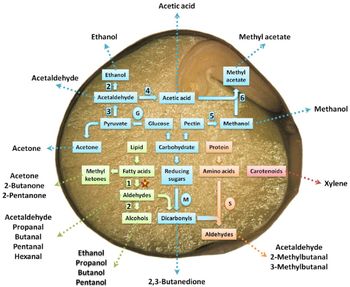
Colville et al. (Reference Colville, Bradley, Lloyd, Pritchard, Castle and Kranner2012) summarized the several processes that may lead to the emission of volatile compounds from seeds. They stated that lipid peroxidation may occur in seeds due to the auto-oxidative process initiated by free radical or lipoxygenase. Lipid peroxidation may give rise to products such as aldehydes that may get converted into alcohols by alcohol dehydrogenase. The aldehydes produced by lipid peroxidation can participate in Maillard reactions (M) with reducing sugars, to give rise to dicarbonyl compounds, e.g. 2,3-butanedione, which may, in turn, take part in Strecker degradation (S) of free amino acids. Under conditions of stress, the likelihood of alcoholic fermentation increases, in which pyruvate formed by glycolysis (G) is, in turn, converted to acetaldehyde by pyruvate decarboxylase which may later be converted into ethanol by alcohol dehydrogenase or be oxidized to acetic acid by aldehyde dehydrogenase. Decarboxylation of pyruvate esterases may form methyl acetate through esterification with acetic acid. Methyl ketones may also be produced due to lipid peroxidation (Fig. 1).
Major processes associated with the emission of VOCs (Colville et al., Reference Colville, Bradley, Lloyd, Pritchard, Castle and Kranner2012, with permission). Star symbol = reactive oxygen species. 1 – lypoxygenase; 2 – alcohol dehydrogenase; 3 – pyruvate decarboxylase; 4 – aldehyde dehydrogenase; 5 – pectine esterase. G – glycolysis; M – Maillard reactions; S – Strecker degradation.

The commonly observed volatiles and the corresponding reactions are summarized in Table 1.
Plethora of volatile compounds emanated by the seeds and the corresponding source reactions

Role of seed moisture content in regulating biochemical events
The moisture content of the seed is a major regulator of biochemical events, and it ultimately decides over the nature and emission kinetics of volatiles produced from seeds (Obroucheva and Antipova, Reference Obroucheva and Antipova1997). Seeds may be exposed to two extreme moisture contents depending on whether the quiescent seed is maintained for safe storage (low moisture regime) or subjected to seed germination (high moisture regime). Walters (Reference Walters1998) and Walters et al. (Reference Walters, Hill and Wheeler2005) envisaged that humid conditions favoured glycolysis, while dry storage condition induced peroxidation reactions. Thus, a shift in biochemical reaction mechanisms occurs in seeds, depending on whether the seeds are exposed to above or below 30% RH.
Mira et al. (Reference Mira, Hill, Gonzalez, Ibanez and Walters2016) reported that the VOC profile of seeds stored under dry conditions was markedly different from humid conditions. The headspace composition of vials containing Eruca vesicaria seeds was found to comprise of over 83% by acetaldehyde and acetone under humid conditions (water content ≤0.100 g g−1). When the same seeds were stored under dry conditions (water content ≤0.048 g g−1), the acetaldehyde had been replaced by butane and pentane. Pentane, hexanal and short-chain ether or peroxide like compounds were consistently detected in dry Lactuca sativa (water content ≤0.042 g g−1) samples. Correspondingly, methanol and ethanol were found to be prevalent in headspace under humid conditions (water content ≤0.099 g g−1) (Fig. 2). In both species, molecules associated with glycolysis (ethanol and methanol) were preferentially produced under humid conditions, and molecules associated with non-enzymatic peroxidation (5–7 carbon alkanes, alcohols and aldehydes) were preferentially produced under dry conditions. The VOCs emitted from the seeds stored in humid conditions reflected fermentation type of reactions with methanol and ethanol being predominant in L. sativa, and acetaldehyde and acetone being predominant in E. vesicaria. Under dry conditions, L. sativa and E. vesicaria seeds emitted higher level of pentane and hexanal indicating peroxidation of polyunsaturated fatty acids. It is conceivable that in aqueous domains witnessed in imbibing seeds, fermentation – type reactions (glycolytic reactions) take place, whereas in dry seeds, there is increasing propensity for triacylglycerol degradation (peroxidative reactions). Thus, it is established that storage of dry seeds will expedite the ‘peroxidative reactions’ as a manifestation of seed deterioration, while the exposure of seeds to high moisture content will facilitate ‘glycolytic reactions’ that correspond to seed germination metabolism.
Volatile emissions by L. sativa, E. vesicaria and C. carvi seeds during storage at 35°C and three moisture treatments: Humid (H, 0.099–0.131 g g–1), Dry (D, 0.042–0.063 g g–1) and Very Dry (VD, 0.030–0.039 g g–1). Bars represent average quantities (in percentage over total quantity) among storage times (<1200 days or when monitoring stopped) of major components: ethanol, methanol, acetaldehyde, hexanal, butane, pentane, acetone and a low carbon ether or peroxide. Values above the bars are the average of total quantity of VOCs emitted (nmol g−1). Total VOCs included all detected compounds except terpenes; bars do not sum to 100% because amounts of individual minor compounds are not shown (Mira et al., Reference Mira, Hill, Gonzalez, Ibanez and Walters2016).

Lipid peroxidation mechanism and emission of VOCs in dry stored seeds
Orthodox seeds which develop on the mother plant reach maximum seed germination and vigour at physiological maturity; from that point of time seeds undergo physiological and biochemical degenerative changes that lead to progressive seed deterioration, loss of seed vigour and, ultimately, to seed death (Helmer et al., Reference Helmer, Delouche and Lienhard1962). Seed deterioration follows a sigmoidal pattern wherein viability remains relatively constant for a period, followed by an abrupt decline in viability, and finally, by a lag period during which a few seeds remain viable (Walters, Reference Walters1998; Walters et al., Reference Walters, Hill and Wheeler2005). The most visible symptoms of seed deterioration are delayed germination, decreased tolerance to sub-optimal environmental conditions, lowered tolerance to adverse storage conditions, reduced germinability and increased number of abnormal seedlings. The rate of seed deterioration is influenced by factors such as initial seed quality, genetic background and seed production conditions; however, seed moisture content and temperature of storage atmosphere are the most significant factors which influence seed deterioration (Ellis and Roberts, Reference Ellis and Roberts1980; Walters et al., Reference Walters, Wheeler and Stanwood2004).
Lipid peroxidation is suggested to play a major role in causing seed deterioration and might occur both in the absence or presence of enzyme catalysis (Walters, Reference Walters1998; McDonald, Reference McDonald1999; Bailly, Reference Bailly2004; Job et al., Reference Job, Rajjou, Lovigny, Belghazi and Job2005; Kranner et al., Reference Kranner, Birtic, Anderson and Pritchard2006). Lipid peroxidation initiated by autoxidation (atmospheric oxygen) or enzymatic oxidation (lipoxygenase) of unsaturated or polyunsaturated fatty acids, such as oleic and linoleic acids, leads to the generation of free radicals (an atom or a molecule with an unpaired electron), mainly hydrogen free radicals (Ho) from a methylene group of the fatty acid, adjacent to double bonds. Once these free radicals are initiated, they continue to propagate other free radicals that ultimately combine, terminating the destructive reactions. In this process, unsaturated fatty acids are converted to free radicals and then to hydroperoxides. The hydroperoxides subsequently follow a variety of reactions leading to the formation of more free radicals and hydroperoxides. The final consequence of this chain reaction is the loss of the membrane structure, leakiness and an inability to complete normal metabolism, ultimately resulting in seed deterioration (Wilson and McDonald, Reference Wilson and McDonald1986).
In the process of lipid peroxidation, a portion of the final products from hydroperoxide decompose into a variety of volatile aldehydes, ketones (Harman et al., Reference Harman, Nedrow, Clark and Mattick1982) and alkenes (Rodriguez et al., Reference Rodriguez, Mischel and Shoda1989; Grotto et al., Reference Grotto, Santa, Valentini, Paniz, Schmitt, Garcia, Juarez, Rocha and Farina2009; Aldini et al., Reference Aldini, Yeum, Niki and Russell2010). Some n-type aldehydes, especially hexanal, a product of oxidation of fatty acids is found to be the most abundant aldehyde in seeds, apart from acetaldehyde (Wilson and McDonald, Reference Wilson and McDonald1986; Hailstones and Smith, Reference Hailstones and Smith1988). The high production of pentane in L. sativa seeds indicates peroxidation of linoleic acid (Frankel, Reference Frankel1983; Knutson et al., Reference Knutson, Handelman and Viteri2000). Pentane production might reflect the fluidity of lipid bodies and, if so, suggests an interesting probe of the non-aqueous environment within seeds and water interactions. Acetaldehyde, the most toxic endogenous volatile (Zhang et al., Reference Zhang, Maeda, Furihata, Nakamaru and Esashi1994) was found to be very abundant in tissues of dry seeds (Donohue-Rolfe et al, Reference Donohue-Rolfe, Keusch, Edson, Thorley-Lawson and Jacewicz1984) and could accelerate seed deterioration by attacking proteins and DNA in dry seeds storage.
Acetaldehyde dehydrogenase (ADH) in dry seeds can transform acetaldehyde to relatively non-poisonous ethanol (Esashi et al., Reference Esashi, Kamataki, Zhang, Ellis, Black, Murdoch and Hong1997), which perhaps is a detoxification path in dry seeds. On the other hand, it is also possible that ethanol accumulated within seeds is converted back to acetaldehyde via ADH (Esashi et al., Reference Esashi, Kamataki, Zhang, Ellis, Black, Murdoch and Hong1997). Therefore, the acetaldehyde content in seeds would also depend upon the interconversion of ethanol and acetaldehyde via ADH. Israel et al. (Reference Israel, Hurwitz, Niemela and Arnon1986) reported that acetaldehyde is transient and can form ethanol by ADH or non-enzymatically react with proteins to form acetaldehyde-protein adducts (APA).
The volatile compounds released from the heating of dry seeds of wheat (Triticum aestivum L.), lettuce (Lactuca sativa L.) and soybean (Glycine max L. Merrill) were suggested to be related to seed viability and vigour (Fielding and Goldsworthy, Reference Fielding and Goldsworthy1982; Hailstones and Smith, Reference Hailstones and Smith1989; Smith and Adamson, Reference Smith and Adamson1989). Grotto et al. (Reference Grotto, Santa, Valentini, Paniz, Schmitt, Garcia, Juarez, Rocha and Farina2009), Mira et al. (Reference Mira, González-Benito, Hill and Walters2010), Aldini et al. (Reference Aldini, Yeum, Niki and Russell2010) and Colville et al. (Reference Colville, Bradley, Lloyd, Pritchard, Castle and Kranner2012) put forth that assessment of hexanal and hydroxyalkenals (4-hydroxynonenal) produced from lipid peroxidation reactions are common biomarkers of seed deterioration. Mira et al. (Reference Mira, Hill, Gonzalez, Ibanez and Walters2016) observed that the VOC profile of certain dry stored seeds was predominantly comprised of low alcohol content and high aldehyde (hexanal) and alkane (pentane) contents. In the headspace of dry stored seeds of C. carvi, and L. sativa molecules such as butane, pentane, hexanal, butanal, acetone and short-chain ether or peroxide, while the E. vesicaria seeds were found to emit acetaldehyde, predominantly.
These studies have envisaged that the emission of VOCs, such as hexanal, pentane, acetaldehyde and ethanol, may be exploited as the biomarkers of assessing the level of deterioration processes that have occurred in the seeds.
Metabolic activity and emission of VOCs in wet germinating seeds
During imbibition and germination of seeds, many metabolic changes associated with respiration and hydrolysis of storage substances result in the release of many metabolic products, among which some are found to be volatile in nature (Juo and Stotzky, Reference Juo and Stotzky1970). Vancura and Stotzky (Reference Vancura and Stotzky1976) studied the emission of volatiles in bean, cabbage, corn, cotton, cucumber, pea, radish, squash, tomato, slash pine, longleaf pine, yellow pine, loblolly pine red alder, etc. and observed that germinating seeds of bean, corn and cotton liberated the largest amounts of oxidizable volatiles during 8 days of incubation. The maximum evolution from bean and cucumber seeds occurred during the 1st day and from corn and cotton seeds during the 2nd day. The liberation of volatile substances from the germinating seeds was attributed to respiration and other associated metabolic activities that occur upon imbibition.
Seed germination is a process which commences once the quiescent dry seed imbibes water in a triphasic manner, corresponding to 67–150% of their weight. Phase I of imbibition is found to be steep. At the end of this phase, water uptake stagnates for a few hours up to a few days, depending on the crop species (Phase II). Eventually, the imbibition once again increases to a high rate (Phase III), when the radicle emerges and continues until the germinating seed possesses 70–90% moisture (Ching, Reference Ching and Kozlowski1972). These stages of water imbibition are closely followed by four phases of respiration. Corresponding to Phase I of imbibition, Phase I of respiration is also steep, favoured by the activation and hydration of existing respiratory enzymes. Increased gas exchange, which starts within few minutes of swelling of the seed, is the first indication that metabolic processes have commenced. During this period, storage reserve substances are beginning to be mobilized. Phase II is the lag phase in respiration, in which O2 uptake is restricted due to complete hydration of all the cells of seeds. In Phase III, increased oxygen uptake and active respiration are resumed due to the formation of new enzymes in the dividing cells that leads to protrusion of the radicle, during which imbibition also increases rapidly. Phase IV of respiration refers to a decline in respiration as the entire seed storage reserves have been exhausted, and the new seedling has begun to photosynthesize.
During these phases of imbibition/respiration, three respiratory pathways become active in the seed, namely (1) the glycolytic or EMP (Embden–Meyerhof–Parnas) pathway, (2) the pentose phosphate pathway, and (3) the Krebs cycle ETC (Electron Transport Chain). All three pathways are concurrently operational in the germinating seeds (Koller et al., Reference Koller, Mayer, Mayber and Klein1962).
As the seeds undergo maturation drying or further deterioration, the cells accumulate damages with respect to DNA and mitochondrial membranes, which leads to a decrease in vigour (Bewley and Black, Reference Bewley and Black1994). The mitochondria in dry seeds are functionally and structurally deficient, due to poor internal differentiation, although they contain sufficient Krebs’ cycle enzymes and terminal oxidases to produce adequate amounts of ATP. Eventually, concurrent with the advancement of seed imbibition, the mitochondrial efficiency increases with time, due to both increased proficiency of existing mitochondria and an increase in their numbers, enabling the completion of seed germination.
During the seed germination process, both the glycolytic and oxidative pentose phosphate pathways resume during Phase I of imbibition, due to activation and hydration of mitochondrial enzymes leading to a very sharp increase in respiration and production of pyruvate, a three-carbon compound (Nicolas and Aldasoro, Reference Nicolas and Aldasoro1979; Botha et al., Reference Botha, Potgeiter and Botha1992). The pyruvate may be further metabolized in the mitochondria through Kreb's cycle ETC, in the presence of O2, to generate NADH and FADH2 which are oxidized in the ETC. During electron transport, a proton gradient is established over the inner mitochondrial membrane, which drives the production of ATP via ATPase.
In Phase II, due to complete hydration of cells and corresponding stagnation of O2 uptake, a partially anaerobic condition engulfs the seed tissues temporarily and the glycolytic pathway becomes very active since mitochondria are non-functional. The deterioration of mitochondrial membranes and reduced mitochondrial activity might cause an imbalance between glycolysis and Kreb's cycle ETC, leading to accumulation of pyruvate (Stewart and Bewley, Reference Stewart and Bewley1980). Accumulation of excess pyruvate leads to temporary diversion to the fermentation pathway, which does not require O2, resulting in the formation of acetaldehyde. Acetaldehyde is converted to ethanol in a reversible reaction by ADH. This oxidation–reduction reaction is mediated by NADH, and the equilibrium greatly favours ethanol formation. Both acetaldehyde and ethanol are volatile and can diffuse out of the seeds into the storage atmosphere. Thus, when mitochondria are not functional due to structural deficiencies or anaerobic conditions, pyruvate is converted into ethanol or lactic acid due to commencement of fermentation pathway (Smith and Rees, Reference Smith and Rees1979; Feireira de Sousa and Sodek, Reference Feireira de Sousa and Sodek2002). Thus, acetaldehyde and ethanol are the two important volatile compounds which are emitted by germinating seeds due to lower mitochondrial activity. It is thus agreeable that low vigour seeds will produce higher levels of acetaldehyde and ethanol during germination compared to the high vigour seeds. The relation between ethanol production and seed deterioration, as evidenced by a decline in germination or seedling growth, has been suggested by Woodstock and Taylorson (Reference Woodstock and Taylorson1981), Kataki and Taylor (Reference Kataki and Taylor2001) and Rutzke et al. (Reference Rutzke, Taylor and Obendorf2008). Reports on the quantity of VOCs emitted by seeds upon commencement of metabolic activity in germinating seeds have been reported to be dependent on mitochondrial activity and amount of storage reserves in seeds.
Mitochondrial activity
Mitochondrial activity commences when seeds are exposed to >75% RH (Zhang et al., Reference Zhang, Yoshiyama, Nagashima, Nakagawa and Esashi1995c), under these conditions high-quality seeds accumulate little ethanol. As the seeds undergo deterioration, peroxidative changes in lipids result in membrane deterioration and subsequent detrimental effect on the ordered system of membrane-associated enzymes of mitochondria takes place.
Many reports endorsed that acetaldehyde and ethanol are two important volatile compounds emitted at elevated concentrations from low vigour seeds compared to high vigour seeds, due to lower mitochondrial activity. Ultimately, a definite negative association has been observed between the quantity of ethanol and acetaldehyde produced during early germination and seed vigour (Woodstock and Taylorson, Reference Woodstock and Taylorson1981; Harman et al., Reference Harman, Nedrow, Clark and Mattick1982). Woodstock and Taylorson (Reference Woodstock and Taylorson1981) found that, after imbibition, aged soybean seeds produced greater quantities of ethanol and acetaldehyde than non-aged seeds. They observed that in low vigour soybean seeds, acetaldehyde and ethanol increased from near trace amounts in dry tissues to maximum levels at 4 h of imbibition. Amable and Obendorf (Reference Amable and Obendorf1986) stated that the enhanced production of ethanol from imbibed aged seeds was attributable to impaired mitochondrial function. Kataki and Taylor (Reference Kataki, Taylor, Ellis, Black, Murdoch and Hong1997) observed that in soybean, ethanol concentration increased with seed ageing, even when germinated under aerobic conditions. Zhang et al. (Reference Zhang, Yoshiyama, Nagashima, Nakagawa and Esashi1995c) also reported that ethanol accumulation in imbibing seeds was high in low vigour seeds compared to high vigour seeds.
Apart from the volumes of acetaldehyde and ethanol released, quickness of release of VOCs from the imbibing seeds is also an indicator of mitochondrial activity and efficiency. Mitochondria are the primary site of deterioration, especially during seed ageing. As ethanol production is most likely initiated or enhanced by the loss of mitochondrial membrane integrity, an ethanol assay has good potential as a test to examine the level of deterioration in seeds (Bewley and Black, Reference Bewley and Black1994). The ethanol levels measured at 40°C after 3.5 h of imbibition of cabbage seeds were negatively correlated (r = −0.92) with the number of normal seedlings observed after 5 d (Kodde et al., Reference Kodde, Buckley, de Groot, Retiere, Víquez Zamora and Groot2012).
Unlike the evolution of ethanol and acetaldehyde, which is negatively correlated with seed vigour, the ‘total volatile organic compounds’ produced by the seeds have been suggested to be directly proportional to seed vigour. Influences of mitochondrial activity, respiratory metabolism and subsequent emission of VOCs from seeds were assessed by subjecting the seeds to optimal and sub-optimal temperatures by Grass and Burris (Reference Grass and Burris1995) and Vanwonterghem et al. (Reference Vanwonterghem, Jensen, Dennis, Hugenholtz, Rabaey and Tyson2014). They suggested that enzyme activity increases with temperature up to an optimum level, but with further temperature increase, enzymes get inactivated and cause weakening of mitochondrial metabolic processes ultimately leading to low ATP production, with the corresponding reduction in the quantity of VOCs emitted (Egigu et al., Reference Egigu, Melak, Kebede and Muthuswamy2014) as well as the change in composition (Motsa et al., Reference Motsa, Slabbert, Bester, Mokwena and Taylor2017). Seethalakshmi and Umarani (unpublished results) observed a very clear trend in the emission of volatiles from unprimed and hydroprimed tomato seeds. They found that the volume of volatiles emitted was very high in hydroprimed seeds during the initial 3 h of imbibition (21–30 s of retention time), which was 2.7 times higher than unprimed seeds. The higher amount of volatile compounds during the early hours of imbibition could be indicative of the higher metabolic activity in hydroprimed, high vigour seeds compared to non-primed, low vigour seeds.
Thus, it has been clearly established that the higher the efficiency of mitochondria (higher seed vigour), the faster will be the emission of VOCs from imbibing seeds. However, the quantity of acetaldehyde and ethanol emitted by dry and imbibing seeds is likely to be indirectly proportional to the efficiency of mitochondria, as well as vigour of seeds.
Storage reserves
Developing seeds accumulate storage reserves such as carbohydrates, lipids and storage proteins. Subsequent to seed imbibition, the seed germination process is triggered and seeds reserves are mobilized by the action of hydrolytic enzymes (Stotzky and Schenck, Reference Stotzky and Schenck1976) so as to provide the essential energy for seedling growth until it becomes photoautotrophic (Yu et al., Reference Yu, Adlofo, John and Bewley2014). Stotzky and Schenck (Reference Stotzky and Schenck1976) indicated that metabolic changes that occur in germinating seeds liberate VOCs, corresponding to the storage reserves present in the seeds. Frankel (Reference Frankel1983), Grosch (Reference Grosch and Chan1987), Halliwell and Gutteridge (Reference Halliwell, Gutteridge, Halliwell and Gutteridge1999) and Knutson et al. (Reference Knutson, Handelman and Viteri2000) found that oxidation of macromolecules, such as carbohydrates, lipids and proteins, may give rise to small molecular weight carbonyl compounds that escape to the airspace as volatile molecules. Therefore, the amount of gaseous and volatile metabolites or VOCs liberated during the imbibition and germination process is expected to be related to the amount of organic substances present in seeds (Vancura and Stotzky, Reference Vancura and Stotzky1976). In general, larger seeds evolved greater quantities than smaller seeds. They appraised that a relation was apparent between the rate of seed germination and the evolution of volatiles. Faster germinating seeds recorded sharper evolution peaks, but the more slowly germinating seeds evolved volatiles over longer periods.
Mira et al. (Reference Mira, Hill, Gonzalez, Ibanez and Walters2016) observed the nature and kinetics of reactions in dry seeds and suggested that the most abundant VOCs arise from degradation of storage reserves. They determined the relative lipid content of L. sativa and C. carvi to be 32 and 10%, respectively. Correspondingly, L. sativa produced higher levels of pentane as an indication of peroxidation of linoleic acid (Frankel, Reference Frankel1983; Knutson et al., Reference Knutson, Handelman and Viteri2000). They proposed that high rates of lipid peroxidation reactions probably reflect the high level of the available substrate in the form of storage reserves in the seed. Motsa et al. (Reference Motsa, Slabbert, Bester, Mokwena and Taylor2017) reported that more volatile fatty acids and volatile phenols were detected in germinating seeds of Cyclopia subternata as compared to C. genestoides. They suggested that the higher number of VOCs detected in C. subternata underscores its higher accumulation of reserves during seed development. This can be expected to affect the timing and speed of germination, leading to earlier germination in C. subternata than in C. genistoides. A germinating embryo of C. subternata may grow and develop better during early successive vegetative growth than C. genistoides, due to an adequate supply of accumulated energy resources that nourish the developing seedling (Motsa et al., Reference Motsa, Slabbert, Bester, Mokwena and Taylor2017).
Thus, we may infer that (1) higher amounts of storage reserves (reflecting higher seed vigour) will result in greater quantities of total VOCs emitted during germination; (2) higher efficiency of mitochondria (higher seed vigour) will result in faster emission of VOCs from imbibing seeds and (3) the quantities of acetaldehyde and ethanol emitted by dry and imbibing seeds are likely to be indirectly proportional to the efficiency of mitochondria, as well as vigour. Estimation of quickness and volume of total VOC emission, as well as total emission of acetaldehyde and ethanol, may serve as tools for assessing the mitochondrial activity of seeds. The higher and quicker production of ‘total VOCs’ may be inferred as an indicator of higher seed vigour, while higher production of acetaldehyde and ethanol can be inferred as an indicator of lower seed vigour.
Thus, it is clear that there is immense potential to harness the total VOCs emitted from imbibed seeds and total acetaldehyde and ethanol evolved from both dry and imbibed seeds as vital biomarkers of seed vigour, irrespective of species.
Fingerprinting of VOCs as biomarkers for quick assessment of seed vigour status
VOCs have been established as major by-products of catabolic reactions that occur in the seeds both in the dry and imbibed states. The evaluation of VOC profile in dry and imbibed seeds will enable the assessment of the level of seed deterioration and the propensity of mitochondria for higher ATP production, respectively. Firstly, VOCs such as hexanal, pentane, acetaldehyde and ethanol emitted in the dry state can be exploited as the biomarkers of the level of seed deterioration processes. Secondly, estimation of acetaldehyde and ethanol emitted after a defined period of imbibition, and quickness of appearance of a 2nd peak of VOCs in imbibing seeds, can be explored as potential tools to evaluate mitochondrial activity and seed vigour status. Therefore, it is concluded that fingerprinting of VOCs emitted by individual crop seed with the help of GC-MS, both in the dry and imbibed states will enable to detect the vigour status of a particular seed lot, accurately and quickly.
Future research should be programmed to characterize the profile and quantity of specific VOCs emitted by the both dry and imbibed seed samples of a particular seed lot at various durations of emission, by experimenting with seeds of different vigour status, in fresh as well as old seed lots. A part of a particular sample should also be submitted for seed germination testing and certain other promising vigour tests such as field emergence, accelerated ageing, radicle emergence, dry matter production, tolerance to temperature and water stress. The specific fingerprint profile and the quantity of the individual VOC biomarker produced should be compared and correlated with the seed germination and vigour test results, so as to arrive at a competent biomarker fingerprint profile specific to the crop species. There seems to be an immense scope to recommend the fingerprint as a ‘universal standard’ for quick assessment of seed vigour.
Methodologies to quantify VOCs emitted by seeds
During the past four decades, many improvements have been in instrumentation and methodology for the assessment of volatile compounds, with the sole objective of achieving higher accuracy of estimation. This is extremely important because volatile production from seeds is low and compounds vary by species, sample preparation, storage moisture and storage duration (Zhang et al., Reference Zhang, Yajima, Umezawa, Nakagawa and Esashi1995a,Reference Zhang, Nakamaru, Tsuda, Nagashima and Esashib; Jorgesen, Reference Jorgesen2000; Lee et al., Reference Lee, Taylor, Zhang and Esashi2000b; Schwember and Bradford, Reference Schwember and Bradford2005).
It is observed that a wide variation exists in the methodology adopted to estimate VOC profiles (Table 2). Collection and detection of volatiles can be affected by several parameters, such as the duration of incubation, sample handling, substrate and their combinations, since they determine the compounds which constitute the complete volatile profile (Rowan, Reference Rowan2011; Morath et al., Reference Morath, Hung and Bennett2012). Hence, it is important to develop a standard methodology for fingerprinting of volatile biomarkers in seeds, so that it can be performed in laboratories across the world and still obtain comparable and reproducible results. The standardized procedure should address such factors as (1) sample size, in terms of the number or weight of seeds; (2) methodology to eliminate oxygen interference, in terms of evacuation of nitrogen flushing; (3) preparation of samples, in terms of dry or imbibed, duration of imbibition; (4) sample heating method, temperature and duration of heating; (5) sample trapping method; (6) volume of sample gas and (7) retention time. The specifications of the GC system and the mass spectrometer, used for assessment of the VOCs, should also be well-specified, so as to assure homogeneity of test results.
Variations in methodologies adopted for analyses of VOCs emitted by different crop seeds

Conclusion
VOCs, being a major by-product of catabolic reactions that occur both in the dry and imbibed seeds, offer great potential for utilizing them as biomarkers for quick and reproducible assessment of the vigour status of crop seeds. In order to utilize the VOC profile for quick assessment of vigour status of seeds, research has to be carried out to develop standard protocols for fingerprinting of standard volatile biomarker(s) along with retention time, with respect to crop species and vigour status of seeds. Most importantly, the identified biomarkers should also be specified, with respect to the particular crop species, in terms of corresponding ‘peaks in specific retention times’. When this task is accomplished, minimum standards for VOC fingerprints can be fixed as a score of acceptable vigour status of seeds, for obtaining high crop productivity. Development of a common standard protocol and minimum standards of volatile biomarkers can be adopted across laboratories to obtain dependable, reproducible and concordant results on seed vigour levels. This VOC fingerprint-based quick test of seed vigour can be incorporated in the regular quality control programmes of the seed industry. Based on the results, seed companies can ensure disbursement of high-quality seed lots for sowing in the ensuing season, thereby assuring higher crop productivity and better remuneration to crop growers.