Introduction
Organisms exhibit greater plasticity during development than in adulthood, so that adaptations can be made to increase survival odds against unfavorable growth conditions. However, the Developmental Origins of Health and Disease hypothesis suggests that this adaptive capacity, while beneficial in the short term, might result in predisposition to chronic diseases in adulthood.Reference Barker 1 For example, exposure of fetuses to maternal undernutrition during gestation results in lifelong changes to organ and endocrine systems, and precipitates both hypertension and impaired glucose tolerance in adulthood.Reference Godfrey and Barker 2 – Reference Barker 6
Although some of the physiological effects of intrauterine stress on the subsequent development of chronic diseases are well described, the mechanisms responsible for these changes are still unclear. One candidate system by which intrauterine reprogramming may be governed through are changes in glucocorticoid (GC) or glucocorticoid receptor (GR) levels.Reference Fowden and Forhead 7 Exposure to inappropriate levels of glucocorticoid (cortisol in human and corticosterone in rodents) during various stages of gestation is correlated with a marked reduction in growthReference Benediktsson, Lindsay, Noble, Seckl and Edwards 8 , Reference Nyirenda, Lindsay, Kenyon, Burchell and Seckl 9 and may contribute to the onset of chronic diseases.Reference Rinaudo and Lamb 10 , Reference Rinaudo and Wang 11 For example, it appears that an individual’s predisposition to cardiovascular disease and diabetes is correlated with exposure to elevated GC levels.Reference Jaddoe and Witteman 12 Importantly, the levels of GR in peripheral tissues may regulate the stress response: postnatal stress in rats causes GR to be upregulated in the hippocampus,Reference Liu, Diorio and Tannenbaum 13 and suboptimal nutrition during gestation is associated with GR upregulation in peripheral tissues.Reference Bertram, Trowern, Copin, Jackson and Whorwood 14
It appears that epigenetics play a significant role in the regulation of GR levels.Reference Turner, Alt and Cao 15 Analysis of rat hippocampus indicates that neonatal stress alters DNA methylation patterns of the GR promoter, which in turn affect GR expression.Reference Weaver, Cervoni and Champagne 16 Moreover, protein restriction during gestation in rats results in decreased DNA methylation at the GR promoter and increased GR mRNA expression in the liver of 4-week-old offspring.Reference Lillycrop, Slater-Jefferies and Hanson 17 Variations in GR expression are noteworthy as they may also be directly involved in the development of metabolic disorders.Reference Whorwood, Donovan, Flanagan, Phillips and Byrne 18
The goal of this study is to address whether or not a suboptimal environment specifically confined to the period of preimplantation embryo development (day 1 to 5 post fertilization) causes differential GR regulation, leading to alterations in adult GC and GR levels. Focusing on preimplantation development has wide clinical relevance, as in vitro culture (IVC) is a procedure routinely used in assisted reproductive technologies (ART), which have resulted in the conception of >5 million children. Although ART children are healthy, there is an associated increase in numerous complications.Reference Feuer, Camarano and Rinaudo 19 Children conceived by IVF have an increased incidence of being born with low birth weights,Reference Schieve, Meikle and Ferre 20 and additional reports suggest unfavorable effects of IVF on growth and metabolism.Reference Ceelen, van Weissenbruch, Vermeiden, van Leeuwen and Delemarre-van de Waal 21 , Reference Ceelen, van Weissenbruch, Vermeiden, van Leeuwen and Delemarre-van de Waal 22 In animal models, mouse embryos conceived by IVF or exposed to IVC exhibit modifications to global gene expression,Reference Giritharan, Talbi and Donjacour 23 – Reference Fernandez-Gonzalez, de Dios Hourcade and Lopez-Vidriero 25 impaired placentation,Reference Delle Piane, Lin and Liu 26 , Reference Bloise, Lin and Liu 27 altered behavior,Reference Ecker, Stein and Xu 28 as well as adult onset of glucose intoleranceReference Donjacour, Liu, Lin, Simbulan and Rinaudo 29 , Reference Feuer, Liu and Donjacour 30 and hypertension.Reference Rexhaj, Paoloni-Giacobino and Rimoldi 31
Previously, global microarray analysis identified a four-fold upregulation of GR in mouse blastocysts conceived by IVF and cultured in suboptimal conditions (IVFWM).Reference Giritharan, Talbi and Donjacour 23 This finding, together with the observation that IVFWM alters postnatal growth trajectory, impairs glucose tolerance, and predisposes a male-specific borderline increase in corticosterone levelsReference Donjacour, Liu, Lin, Simbulan and Rinaudo 29 , Reference Feuer, Liu and Donjacour 30 led us to investigate whether altered GR levels in adult IVF insulin-sensitive tissues could explain the observed phenotype. Specifically, we have evaluated whether IVF as a method of preimplantation embryo stress altered corticosterone and GR levels in the adult mouse offspring. This entailed (1) quantifying GR expression in preimplantation embryos and adult tissues, (2) evaluating DNA methylation status at the GR promoter, (3) measuring changes in corticosterone levels and (4) quantifiying mRNA levels of selected genes downstream of GR. We performed the experiments on both inbred (C57BL/6J) and outbred (CF-1×B6D2F1/J) mouse cohorts to validate that the observations are not an artifact of the mouse strain. Our results indicate that IVF causes GR upregulation in both blastocysts and adult male fat tissue in the IVF mouse offspring.
Materials and methods
Animals
All experiments were approved by the Institutional Animal Care and Use Committee of the University of California San Francisco. Animals were provided with nesting material and housed in cages maintained in a constant 12-h light/dark cycle between 21 and 23°C with free access to standard chow and tap water. Four mouse strains in total were used to generate the inbred and outbred cohorts used in the study. Inbred mice were reared from the C57BL/6J strain (Jackson Laboratories) and outbred mice were generated using female CF-1 (Harlan Laboratories) and male B6D2F1/J (Jackson Laboratories). Embryo transfer experiments required vasectomized CD-1 males (Harlan Laboratories) to prepare pseudopregnant recipient females.
IVF and embryo transfer
IVF was performed as previously described.Reference Donjacour, Liu, Lin, Simbulan and Rinaudo 29 Briefly, 6- to 8-week-old C57BL/6J females were superovulated using an injection series consisting of 5 IU pregnant mare serum gonadotropin followed by 5 IU human chorionic gonadotropin (hCG) 46–48 h later. Approximately 12–14 h post hCG, a male mouse was sacrificed by CO2 asphyxiation. The cauda epididymis of a C57BL/6J male was dissected and several slashes were produced to allow sperm to swim out and capacitate in culture for 1 h. Oocytes were then collected from the ampullae of females and both gametes were co-incubated in culture for 4–6 h in an optimal IVF culture condition utilizing K+ Simplex Optimized Media supplemented with amino acids (Millipore) under 5% O2 to simulate conditions used in fertility clinics (IVFKAA). Fertilized zygotes were quickly washed in fresh medium to minimize debris carryover and then cultured 96 h until the blastocyst stage. Control embryos were obtained by flushing the uterus of a naturally mated, superovulated female mouse at E3.5. For embryo transfers, late-cavitating blastocysts of similar morphology from all three groups were transferred into pseudopregnant CF-1 females and pups were weaned 21 days after birth. Litters were separated according to gender and the animals were reared to adulthood in a pathogen-free, closed barrier system. To study the effect of mouse strain and culture condition on development, the study was repeated on an outbred mouse model (CF-1 females with B6D2F1/J males) with an additional cohort of animals conceived in an older, more suboptimal condition: Whitten’s medium formulation consisting of high glucose and lacking amino acids, under 20% O2 (IVFWM).
Growth and tissue dissections
The inbred (C57BL/6J) mouse cohort was reared 29 weeks into adulthood. Liver and gonadal adipose tissue were the initial insulin-sensitive tissues of interest, which were dissected, weighed and divided into three groups for: snap freezing, fixing in 4% paraformaldehyde and fixing in RNAlater (Life Technologies) to protect cellular RNA. The follow-up outbred cohort (CF-1×B6D2F1) were reared to 40 weeks in order to observe later stage physiology. Muscle was added as a tissue of interest to more comprehensively evaluate the metabolic tissue changes resulting from IVF. Tissues (liver, fat, muscle) were dissected and prepared as described above.
RNA extraction, cDNA preparation and quantitative real-time polymerase chain reaction (RT-PCR)
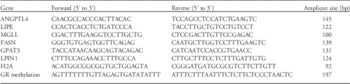
Gene expression analysis was performed in blastocysts and selected peripheral tissues (gonadal fat, liver and skeletal muscle) from adult male and female mice of both inbred and outbred strains. For embryos, 10 blastocysts/experimental group were pooled and constituted one biological replicate. Three separate biological replicates from each method of conception were prepped for RNA extraction using PicoPure RNA Isolation Kit (Applied Biosystems) according to the manufacturer’s protocol. For tissue samples, ~16 mg of tissue was manually homogenized in 1 ml Trizol reagent (Ambion) and prepped for phase separation with the addition of 0.2 ml chloroform (Sigma). Total RNA was collected from the aqueous phases and purified using the RNeasy Mini Kit (Qiagen). Quality and concentration of tissue RNA were analyzed by NanoDrop spectrophotometry (ThermoScientific). Reverse transcription of all RNA samples was accomplished using iScript cDNA synthesis kit and conducted according to the manufacturer’s instructions (Bio-Rad Laboratories). Gene expression was quantified using SYBR Green PCR Supermix and analyzed within the log linear phase of the amplification curve using the comparative threshold cycle method (Bio-Rad Laboratories). GR mRNA expression was analyzed using TaqMan Assay On-Demand Mm0033832_ml primer (Applied Biosystems). For all other genes, primer sequences were designed using PerlPrimer and sequences are listed in Table 1.
Primers used in this study

Western blot analysis
GR protein expression was analyzed in male and female fat tissue from both inbred and outbred groups. Approximately 20 mg tissue were homogenized in a solution of ice cold extraction buffer [50 mM Tris, 250 mM NaCl, 5 mM EDTA, 2 mM Na3VO4, 1 mM NaF, 20 mM Na4P2O7, 0.02% NaN3 and protease inhibitors (Invitrogen)]. Protein concentration was measured using the Pierce BCA Protein Assay Kit (ThermoScientific). Ten micrograms of protein were resolved in 8–16% gradient polyacrylamide gels and transferred onto PVDF Transfer Membranes (Bio-Rad Laboratories). The membrane was blocked in a solution consisting of 5% non fat dried milk prepared in Tris-buffered saline with 0.1% Tween 20 (TBST) for 1 h. The membrane was then incubated overnight on a rocking platform in 4°C under a 2.5% milk-TBST solution containing antibody dilutions of 1:500 GR (Santa Cruz Biotechnologies) and 1:2000 Actin to serve as the loading control (Sigma). The following morning, the membrane was washed three times with TBST and incubated 1 h in a 2.5% milk-TBST solution containing a 1:5000 dilution of horseradish peroxidase-conjugated goat-anti-rabbit IgG (Santa Cruz Biotechnologies). After three more washes with TBST, the signal was detected with Pierce ECL Western Blotting Substrate (ThermoScientific) and imaged by autoradiography. The resulting films were scanned and the integrated density of each band was analyzed using Adobe Photoshop CS6.
Serum collection and corticosterone analysis
Whole blood was collected by cardiac puncture at time of sacrifice (between 10:00–14:00). Serum was separated from plasma by centrifugation and frozen at −20°C. Circulating corticosterone levels were measured in 15 µl duplicate samples using the ELISA-based DetectX Corticosterone Enzyme Immunoassay Kit (Arbor Assays) and a Spectra Max M2 microplate reader (Molecular Devices). Optical density (OD) values were analyzed using the accompanying SoftMax Pro software version 4.7.1 (Molecular Devices). OD intensity was converted to corticosterone concentration using the online tool provided by Arbor Assays (http://www.myassays.com/arbor-assays-detectx-corticosterone-(od).assay).
Methylation analysis of GR promoter by bisulfite sequencing
Methylation status of the GR promoter region was examined in fat samples from three control and three IVFKAA inbred male mice derived from different litters. Genomic DNA isolation was achieved by manual homogenization of tissues and purified using the QIAamp DNA Mini kit (Qiagen) according to the manufacturer’s protocols. DNA concentration was measured by NanoDrop spectrophotometry and ~1 μg of DNA input was bisulfite treated using the MethylEasy Xceed kit (Takara). We focused on a CpG island in the GR promoter region previously reported to be influenced by the environment.Reference Weaver, Cervoni and Champagne 16 A primer pair was designed to flank this region for a second round of PCR using the following thermoycling conditions: 35 cycles at 95°C for 1 min, 54°C annealing for 2 min and 72°C extension for 2 min. The PCR product was purified, ligated using a TOPO TA Cloning Kit (Invitrogen) and plated on LB Agar plates. Positive clones were screened by M13 PCR to confirm correct size of ligated insert and submitted for sequencing (Quintara Biosciences, San Pablo, CA, USA).
Statistical analysis
Values reported are mean±s.d. A Student’s t-test was performed using Prism version 6 software (GraphPad), and P values<0.05 were considered significant.
Results
Blastocysts conceived by IVFKAA exhibit elevated levels of GR compared with controls
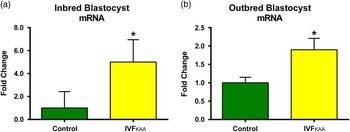
To validate the results gathered from the microarray analysis described in our previous work,Reference Giritharan, Talbi and Donjacour 23 we performed quantitative RT-PCR on IVF and control embryos. Blastocysts conceived in IVFKAA exhibit a two- (outbred mice) to five-fold (inbred mice) increase in GR mRNA (P<0.05, Fig. 1).
IVFKAA blastocysts have significantly higher glucocorticoid receptor expression compared with control embryos. IVF, in vitro fertilization.

Corticosterone levels are not increased in IVF mice
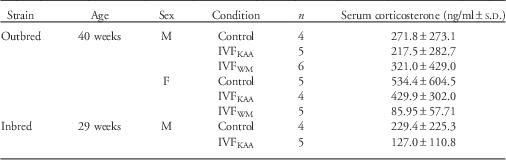
A previous study using non targeted metabolomics analyses revealed a non significant (P=0.057) increase in basal corticosterone levels in 29-week inbred female IVFKAA animals compared with controls.Reference Feuer, Donjacour and Simbulan 32 A targeted analysis showed no differences in resting corticosterone levels between IVF and control mice, including inbred males (control and IVFKAA), outbred males (control and IVFKAA) and outbred females (control, IVFKAA and IVFWM) (Table 2).
Serum corticosterone levels measured in adult in vitro fertilization and control mice

GR expression is upregulated specifically in fat tissue of male mice conceived by IVFKAA
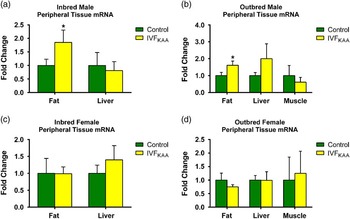
We next evaluated GR expression in periperal tissues from adult IVF and control offspring. In male mice, GR mRNA expression was significantly increased two-fold in fat samples from both inbred (Fig. 2a) and outbred (Fig. 2b) male IVFKAA mice. There was no effect of IVF on GR expression in the liver and muscle from these same animals. In contrast neither, inbred (Fig. 2c) and outbred (Fig. 2d) females showed any changes in GR levels in any tissues examined.
Quantitative real-time polymerase chain reaction of glucocorticoid receptor on peripheral tissues. IVF, in vitro fertilization.

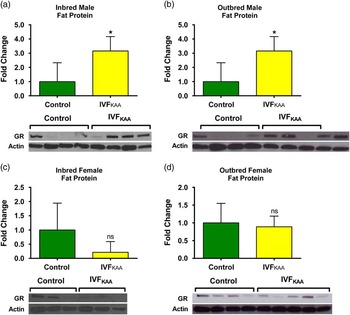
Protein levels examined by Western Blot confirmed the mRNA expression changes and were increased exclusively in both inbred and outbred male fat tissues (Fig. 3a and 3b), and were not affected in females (Fig. 3c and 3d).
Protein analysis of GR in fat tissue. GR, glucocorticoid receptor; IVF, in vitro fertilization.

Downstream targets of GR are upregulated in fat tissue of male mice conceived by IVFKAA
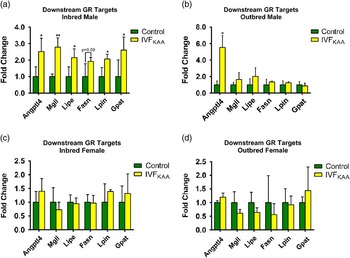
GR activation is associated with the upregulation of several downstream genes in adipose tissue,Reference Yu, Mayba and Lee 33 including genes important for lipolysis (Angptl4, Mgll, Lipe) and triglyceride synthesis (Fasn, Lpin, Gpat). To understand if increased GR expression in adipose tissue has physiological relevance, we tested whether the expression of its downstream targets were affected in our samples. Inbred males conceived by IVFKAA display significant (P<0.05) increases in Angptl4, Mgll, Lipe, Lpin and Gpat, and a borderline increase in Fasn (P=0.09) (Fig. 4a). Only Angptl4 was upregulated in outbred male mice, with the remaining five genes unchanged (Fig. 4b). GR target genes did not show increased expression in female fat (Fig. 4c and 4d).
Quantitative real-time polymerase chain reaction of downstream glucocorticoid receptor targets in fat tissue.

The promoter region of GR in fat tissue is not differentially methylated
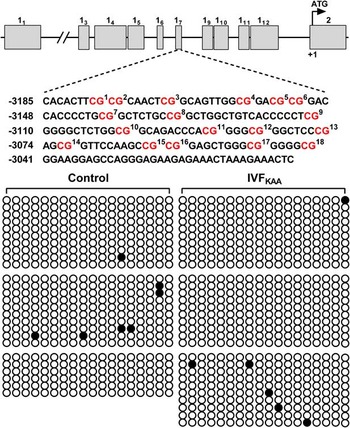
Environmentally induced changes in GR expression have previously been implicated in altered methylation status of GR promoter region.Reference Weaver, Cervoni and Champagne 16 To test if the increased GR expression in IVF offspring is associated with altered of DNA methylation at the GR promoter, we performed bisulfite sequencing in fat tissue from IVFKAA and control males. We did not observe any methylation differences within this particular region of the GR promoter between IVFKAA and control mice (Fig. 5).
Promoter methylation of glucocorticoid receptor in fat tissue of male mice (n=3). IVF, in vitro fertilization.

IVFWM alters GR expression in the blastocyst but not in the peripheral tissues of adult mice
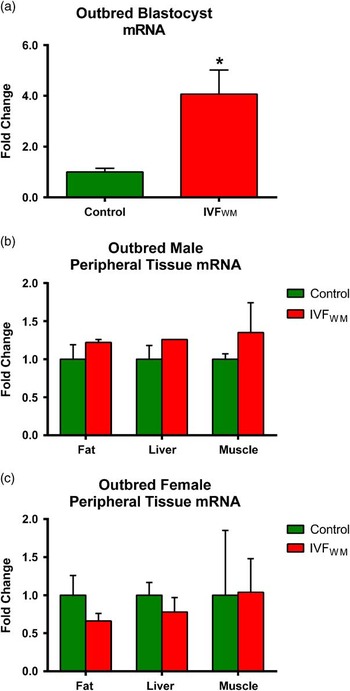
To explore whether exposing a preimplantation embryo to what is usually considered more unfavorable conditions would exacerbate the altered expression of GR, we performed IVF in Whitten medium with 20% oxygen. This medium is known to induce more deleterious effects on embryo gene expression,Reference Rinaudo and Schultz 34 placenta growthReference Delle Piane, Lin and Liu 26 and postnatal onset of glucose intolerance,Reference Donjacour, Liu, Lin, Simbulan and Rinaudo 29 , Reference Feuer, Liu and Donjacour 30 hence we would have predicted a more significant alteration in GR levels, both in embryos and adult tissues. As predicted, IVFWM embryos exhibited an enhanced (four-fold) increase in GR expression compared with controls (Fig. 6a). However, GR expression was not affected in adult offspring in any of the three peripheral tissues (fat, liver and muscle) for either sex (Fig. 6b and 6c). In addition, we did not observe differences in basal corticosterone levels between control and IVFWM in either male or female animals (Table 2).
Effect of suboptimal IVFWM on glucocorticoid receptor mRNA in blastocyst (a) and peripheral tissue of male (b) and female (c) mice in an outbred model. IVF, in vitro fertilization.

Discussion
The aim of this study was to understand whether the altered postnatal growth and metabolism observed in IVF offspringReference Rinaudo, Giritharan, Talbi, Dobson and Schultz 24 , Reference Donjacour, Liu, Lin, Simbulan and Rinaudo 29 was secondary to changes in serum corticosterone and/or GR levels in insulin-sensitive tissues. In fact, glucocorticoids influence a large number of processes, from development, to inflammation and intermediary metabolism, via interaction with the GR. GC enters the cells by diffusion, binds to GR in the cytoplasm and translocate into the nucleus, where it will bind to DNA and exert its genomic functions. Therefore, GR plays a central role in determining glucocorticoidReference Baxter and Rousseau 35 action.
The first important finding of this study was that IVC was associated with an increase in GR mRNA in IVF blastocysts. The exact reason for the increased expression in IVF embryos is unclear, since multiple factors can regulate GR expression. For example, high GC level decrease GR expressionReference Burnstein and Cidlowski 36 while increase in reactive oxygen species (ROS)Reference Makino, Yoshikawa and Okamoto 37 or cAMPReference Dong, Aronsson, Gustafsson and Okret 38 increase GR levels. While we have not measured GC levels in embryo recipient mothers, it is unlikely that the recipients of control and IVF embryos have different GC levels, since they underwent the same embryo transplant procedure. cAMP is known to play a physiological role in blastocoel expansionReference Manejwala and Schultz 39 but it is not known if different levels exist in embryos generated in vivo or in vitro. However, since ROS levels are known to be increased in embryos cultured in vitro,Reference Goto, Noda, Mori and Nakano 40 this could be a likely mechanism of regulation.
The second finding is that preimplantation embryo manipulation was associated with an increase in GR expression in adult tissues that was (1) tissue specific (2) sex specific and (3) condition specific.
Overall, there was a lack of widespread change in GR levels in insulin-sensitive tissues of adult mice; only fat tissue showed changes, both in inbred and outbred mice. Of note neither inbred nor outbred IVF males had different percent body fat than control males at the time of sacrifice.
The reason why GR levels are increased specifically in fat tissue is unclear. This could potentially represent an incidental findings, independent of the culture conditions. However, the fact that the downstream GR genes were also activated in IVF adipose tissue of male mice indicates that the adipose tissue is responding differently at a molecular level. Since the amount of GR present determines the magnitude of the response to the presence of GC,Reference Svec 41 it is possible that the adipose tissue of IVF mice is more sensitive to circulating GC levels. The downstream genes tested and found to be increased in adipose tissue are involved in lipolysis (ANGPTL4, LIPE and MGLL) and triglyceride synthesis (FASN, GPAT and LPIN).
It is possible that the increase in GR levels could lead to glucose intolerance, since adipose tissue has been found to be of importance for maintenance of glucose levels and energy balance in the body.Reference Vegiopoulos and Herzig 42 Overaccumulation of adipose tissue has been linked to the development of metabolic disorders such as insulin resistance and dyslipidemia,Reference Walker 43 which can lead to glucose intolerance. Metabolomic analysis of fat tissue in male IVF mice compared with control males revealed a decrease in glucose, lactate and in metabolites involved in fatty acid metabolism (azelate and 12,13-DiHOME).Reference Feuer, Donjacour and Simbulan 32 These findings are consistent with a dysfunction in triglyceride homeostasis.
The sexually dimorphic effect of IVF repeatedly appears through our experiments as well as in other models of intrauterine stressReference Rinaudo and Wang 11 making our present findings unsurprising. In particular, several metabolites involved in fatty acid metabolism were found to be altered in IVF male mice but not in females.Reference Feuer, Donjacour and Simbulan 32 Further, prenatally stressed female rats had significantly higher corticosterone levels than males during a restraint test, suggesting an inherent sexual dimorphic effect in GC signaling.Reference Weinstock 44
It was surprising to find that only optimal IVF conditions (IVFKAA group) produced changes in GR levels in adult offspring whereas suboptimal conditions (IVFWM group) did not. In fact, Whitten’s medium is known to be more stressful, since it lacks amino acids and contains five times the concentration of glucose found in KSOM. Further we and others have demonstrated that embryo culture in Whitten’s medium impairs blastocyst formation and cell number, reduces the number of viable fetuses, and induces glucose intolerance in adulthood in a more severe fashion than embryo culture in KSOM medium.Reference Delle Piane, Lin and Liu 26 , Reference Negron-Perez, Echevarria, Huffman and Rivera 45 , Reference Donjacour, Liu, Lin, Simbulan and Rinaudo 29 , Reference Feuer, Liu and Donjacour 30 We had therefore predicted that more significant changes in GR levels would have been found in adult tissue of IVFWM offspring. The unexpected finding of normal GR expression in adult tissues indicates that each culture condition has a specific effect on adult physiology, and that likely each preimplantation embryo exposure is unique in its long-term consequences. Therefore, since offspring generated by IVF in Whitten’s medium have evidence of glucose intolerance and no changes in GR expression (among the tissues tested), it is likely that a separate mechanism, GR independent, is at play and responsible to cause the metabolic phenotypes observed.
It is unclear what causes increased GR levels in the fat of male mice. Interestingly, the external environment can influence GR mRNA levels via DNA methylation at the GR promoter. Both in utero protein restriction and increased maternal care in newborn have been shown to decrease DNA methylation at the GR promoter in offspring liver tissue and hippocampus, respectively, leading to an upregulation of GR mRNA.Reference Weaver, Cervoni and Champagne 16 , Reference Lillycrop, Slater-Jefferies and Hanson 17
Since the preimplantation stage is a period of epigenetic reorganization,Reference Reik, Dean and Walter 46 and IVC is frequently associated with DNA methylation changesReference Reik 47 , Reference Doherty, Mann, Tremblay, Bartolomei and Schultz 48 a possible mechanism to explain the elevated GR mRNA in both blastocysts and adipose tissue could have been a decreased in DNA methylation at the GR promoter in both tissues. However, we did not observe DNA methylation differences between IVFKAA and control at the GR promoter in fat tissue and therefore we did not further investigate changes in blastocysts. While the most likely candidate area of the promoter was tested (i.e. the same area of the GR promoter that was found to be differentially methylated by Weaver et al. Reference Weaver, Cervoni and Champagne 16 ) by bisulfite sequencing, it is possible that alternative, unexamined regulatory elements at the GR promoter display changes in DNA methylation. Further, histone changes might be responsible for the differential expression.Reference Feuer, Camarano and Rinaudo 19 We have previously shown that the gene Txnip is upregulated in IVF mouse blastocysts and adipose tissue. While there were no DNA methylation changes at the Txnip promoter, we found increased Histone 4 acetylation, a marker of open chromatin and potentially of increased expression. This points to an area of future investigation of the GR in the fat tissue of IVF male mice.
A third finding was that we did not find differences in basal corticosterone levels in offspring conceived by IVF or by natural conception (Table 2). This finding should be interpreted with caution, since the experiments were performed at time of sacrifice without optimizing time from manipulation to sacrifice. Of note, while the replicate per animals showed a high concordance (indicating reliability of the assay) the standard deviation in each group was very high (100–120% of the mean levels). It is therefore very likely that experiments designed specifically to increase stress and measure glucocorticoids might reveal differences between the two conception groups. In fact, in other models of early life stressors, rodents do not exhibit a difference in resting corticosterone levels but do show differences when subjected to forced-swim or restraint tests.Reference Kember, Dempster and Lee 49 , Reference Lesage, Dufourny and Laborie 50 In our previous study, when we focused on mimimizing the effects of rodent manipulation and measured corticosterone levels in fed (i.e. non stressed) and fasting (i.e. stressed) conditions, we found that males conceived by IVFWM had a blunted response to nutritional stress.Reference Feuer, Liu and Donjacour 30 Future studies need to be designed with this in mind. Interestingly, other models of early life stress events, such as maternal undernutrition, show similarly inconsistent results. A global undernutrition feeding regimen in pregnant rats resulted in elevated corticosterone levels in offspring,Reference Leonhardt, Lesage and Dufourny 51 while a protein restrictive diet with equal total caloric intake did not affect resting corticosterone levels,Reference Langley-Evans, Gardner and Jackson 3 indicating that the corticosterone response to stress is highly complex.
One of the strengths of our study is that the increased GR mRNA and protein in IVF blastocyts and adult male fat tissue were present in both inbred and outbred strains of mice, indicating the biological generalizability of the findings. However, certain limitations merit acknowledgment. We did not examine the levels of releasing hormones (e.g. CRF, ACTH) important in regulating GC levels.Reference Sheppard, Roberts and Blum 52 Future studies should probe changes in the hormones and enzymes involved in this endocrine axis. Of note, we had found decreased CRFR2 mRNA expression in the hypothalamus of IVF offspring.Reference Strata, Giritharan and Sebastiano 53
In summary, our study shows that the glucose intolerance phenotype present in IVF mice is unlikely to be secondary to altered corticosterone levels and widespread changes in GR expression. However, the tissue specificity of altered GR levels in IVF male mice suggests that other metabolic functions involving adipose tissue may be altered in IVF male mice. Further studies should test this potential association, be designed to specifically measure GC hormones and follow outcome in ART children.
Acknowledgment
None.
Financial Support
This work was supported by a National Institute of Child Health and Human Development grant (R01:HD 062803-01A1) and in part by a National Institute of Health training fellowship (5T32DK007418-32, for S.K.F.) and the California Institute for Regenerative Medicine (TB1-01194, for R.K.S.).
Conflicts of Interest
None.
Ethical Standards
The authors assert that all procedures contributing to this work comply with the ethical standards of the relevant national guides on the care and use of laboratory animals and has been approved by the institutional committee (Institutional Animal Care and Use Committee of the University of California San Francisco).