Introduction
Perovskite (CaTiO3) is a common accessory phase in silica-undersaturated igneous rocks, including clinopyroxenites, carbonatites, nephelinites, melilitic rocks, ultramafic lamprophyres and kimberlites (e.g. Chakhmouradian and Mitchell, Reference Chakhmouradian and Mitchell1997, Reference Chakhmouradian and Mitchell2000; Tappe et al., Reference Tappe, Foley, Jenner, Heaman, Kjarsgaard, Romer, Stracke, Joyce and Hoefs2006; Chakhmouradian et al., Reference Chakhmouradian, Reguir, Vadim, Kamenetsky, Sharygin and Golovin2013). Owing to its capacity to concentrate U, Th, rare earth elements (REE), Sr and high-field-strength elements (in particular, Nb and Ta), this mineral has been used widely as a petrogenetic indicator and robust geochronological tool (e.g. Heaman, Reference Heaman1989; Kinny et al., Reference Kinny, Griffin, Heaman, Brakhfogel and Spetsius1997, Hamilton et al., Reference Hamilton, Sobolev, Stern and Pearson2003, Paton et al., Reference Paton, Hergt, Phillips, Woodhead and Shee2007; Donnelly et al., Reference Donnelly, Griffin, Yang, O'Reilly, Li, Parson and Li2012; Chakhmouradian et al., Reference Chakhmouradian, Reguir, Vadim, Kamenetsky, Sharygin and Golovin2013; Heaman et al., Reference Heaman, Pell, Grütter and Creaser2015; Stamm et al., Reference Stamm, Schmidt, Szymanowski, von Quadt, Mohapi and Fourie2018). Since the late 1980s, geochronological studies of perovskite have generally relied on mass-spectrometry techniques, which are capable of providing high-precision results for a small quantity of material (Stamm et al., Reference Stamm, Schmidt, Szymanowski, von Quadt, Mohapi and Fourie2018; Heaman et al., Reference Heaman, Phillips and Pearson2019). Early work utilised isotope-dilution thermal-ionisation mass spectrometry (ID-TIMS) and sensitive high-resolution ion-microprobes (Heaman, Reference Heaman1989; Smith et al., Reference Smith, Allsopp, Gravie, Kramers, Jackson and Clement1989; Ireland et al., Reference Ireland, Compston, Williams and Wendt1990; Kinny et al., Reference Kinny, Griffin, Heaman, Brakhfogel and Spetsius1997). In the past 20 years, a considerable effort has been made to develop in situ perovskite age determination techniques, including laser-ablation inductively-coupled mass spectrometry (LA-ICPMS) (e.g. Cox and Wilton, Reference Cox and Wilton2006; Batumike et al., Reference Batumike, Griffin, Belousova, Pearson, O'Reilly and Shee2008; Reguir et al., Reference Reguir, Camacho, Yang, Chakhmouradian, Kamenetsky and Halden2010) and secondary-ion mass-spectrometry (Li et al., Reference Li, Li, Liu, Wu, Yanga and Mitchell2010; Donnelly et al., Reference Donnelly, Griffin, Yang, O'Reilly, Li, Parson and Li2012). The major advantages of LA-ICPMS are its relatively low cost (both infrastructure and operational), expedience, minimal requirements for sample preparation, and the capability for in situ measurements at a spatial resolution of 20–30 μm. This capability enables a greater level of control over the material being analysed relative to ID-TIMS. The greatest challenges of LA-ICPMS perovskite geochronology are the lack of well-characterised matrix-matched calibration standards and 204Pb–204Hg interference (Reguir et al., Reference Reguir, Camacho, Yang, Chakhmouradian, Kamenetsky and Halden2010). Perovskite from the Ice River alkaline complex (Canada) has been proposed as a calibration standard for U–Pb radiometric age determination (Heaman, Reference Heaman2009). It is also noteworthy here that the overwhelming majority of the available geochronological data on perovskite are for groundmass crystals from kimberlites (Smith et al., Reference Smith, Allsopp, Gravie, Kramers, Jackson and Clement1989; Heaman et al., Reference Heaman, Pell, Grütter and Creaser2015; Donnelly et al., Reference Donnelly, Griffin, Yang, O'Reilly, Li, Parson and Li2012; Stamm et al., Reference Stamm, Schmidt, Szymanowski, von Quadt, Mohapi and Fourie2018; Tappe et al., Reference Tappe, Dongre, Liu and Wu2018, to name a few), whereas publications on other rock types – in particular, alkaline-ultramafic intrusions with carbonatites – are very limited (Srivastava et al., Reference Srivastava, Heaman, Singha and Shihua2005; Cox and Wilton, Reference Cox and Wilton2006; Heaman, Reference Heaman2009; Reguir et al., Reference Reguir, Camacho, Yang, Chakhmouradian, Kamenetsky and Halden2010).
In comparison with perovskite, Ca-Fe-Ti garnets [Ca3(Fe,Ti,Zr,Mg)2(Si,Fe,Al)3O12] are a relatively new U–Pb geochronometer, whose full potential remains yet to be fully explored (Deng et al., Reference Deng, Li, Luo and Wang2017; Salnikova et al., Reference Salnikova, Stifeeva, Nikiforov, Yarmolyuk, Kotov, Anisimova, Sugorakova and Vrublevskii2018, Reference Salnikova, Chakhmouradian, Stifeeva, Reguir, Kotov, Gritsenko and Nikiforov2019; Yang et al., Reference Yang, Wu, Yang, Mitchell, Zhao, Xie, Huang, Ma, Yang and Zhao2018; Stifeeva et al., Reference Stifeeva, Salnikova, Arzamastsev, Kotov and Grozdev2020). The principal advantage of calcic garnets over perovskite is their wider distribution across a spectrum of igneous and contact-metamorphic rocks. In alkaline complexes, calcic garnets are a fairly common accessory or, in some cases, a major mineral in melteigites, ijolites, nephelinites, melilitolites, syenites and, to a lesser extent, carbonatites. These minerals crystallise in a different ${\rm a}_{{\rm Si}{\rm O}_2}\;$ – $f_{{\rm O}_ 2}$
 regime relative to perovskite (Rass and Dubrovinskii, Reference Rass and Dubrovinskii1997) and, thus, can provide valuable complementary information on the timing of alkaline magmatism.
In the present work, we determined the age of perovskite in calcite carbonatites and jacupirangite from the Guli alkaline-ultramafic complex (Polar Siberia, Russia) using ID-TIMS and LA-ICPMS U–Pb techniques, and explored the possibility of using the Ice River perovskite as a calibration standard for age determination using LA-ICPMS. Perovskite is a common accessory phase at Guli, but its geochronology has not been explored to date. In addition, we used ID-TIMS to determine the U–Pb age of andradite from a perovskite-free metasomatic paragenesis at the contact between calcite carbonatite and melilitolite.
Geological Setting
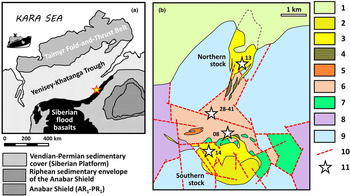
The Guli alkaline-ultramafic complex is part of the Maimecha–Kotuy Alkaline Province, which is one of the world's largest manifestations of intracontinental alkaline magmatism related to the eruption of the Siberian Traps at the Permian–Triassic boundary (Augland et al., Reference Augland, Ryabov, Vernikovsky, Planke, Polozov, Callegaro, Jerram and Svensen2019 and references therein). The complex is located at the northern margin of the Siberian Platform (Fig. 1a), bordered by the Yenisey-Khatanga Trough, which developed synchronously with the trap volcanism and evolved into a marginal basin towards the end of the Triassic (Afanasenkov et al., Reference Afanasenkov, Nikishin, Unger, Bordunov, Lugovaya, Chikishev and Yakovishina2016). The Guli complex has an exposed area of 470 km2 and in its north-northwestern part, is overlain by Mesozoic–Cenozoic sedimentary sequences of the Yenisey-Khatanga Trough (Yegorov, Reference Yegorov1989, Reference Yegorov1991). According to unpublished gravimetric and aeromagnetic data, the northern, buried portion of the complex represents a series of blocks subsided by as much as 4 km towards the Trough; the total area of the Guli pluton may thus reach 1600 km2 (Yegorov, Reference Yegorov1991). The pluton is emplaced into a petrographically diverse volcanic package representing different stages of flood basalt magmatism, including melanephelinites of the Arydzhangsky Suite (251.7 ± 0.4 Ma) to the northeast, stratigraphically higher melanephelinites and trachy-rhyodacites of the Del'kansky Suite (251.1 ± 0.3 Ma) to the southwest, and tholeiitic basaltoids of the Kogotoksky Suite in the east and south (Yegorov, Reference Yegorov1991; Kamo et al., Reference Kamo, Czamanske, Amelin, Fedorenko, Davis and Trofimov2003). Field observations and geophysical data indicate that contacts between the Guli complex and its host volcanics are nearly vertical (Yeliseev and Sheinman, Reference Yeliseev and Sheinmann1961).
(a) Location map of the Guli complex (indicated by a star) with respect to the principal structural elements of the northern Siberian Platform and Taimyr Peninsula. (b) Schematic geological map of the central part of the Guli alkaline-ultramafic complex (simplified after Yegorov, Reference Yegorov1991): (1) Quaternary sediments; (2) dolomite carbonatites; (3) calcite carbonatites (undifferentiated); (4) phoscorites; (5) alkaline syenites; (6) jacupirangite–melteigite series; (7) melilitolites; (8) dunites; (9) melanephelinites; (10) fault zones and (11) sampling locations.

The complex comprises predominantly dunites and melanephelinites, which collectively make up ~90% of the exposed area; the remainder is represented by a wide variety of ultramafic, alkaline and carbonatitic plutonic and hypabyssal rocks (Yegorov, Reference Yegorov1991). On the basis of field evidence, Yegorov (Reference Yegorov1969, Reference Yegorov1991) proposed the following order of their emplacement (oldest to youngest): dunites; magnetite-bearing, perovskite-free clinopyroxenites (koswites); melilitolites (sensu lato); melteigite–shonkinite series rocks; melanephelinites and alkali picrites; jacupirangite–melteigite series rocks (characterised by the abundance of perovskite); ijolites; nepheline and alkali-feldspar syenites (locally silica-oversaturated); phoscorites; carbonatites. Our own field and petrographic observations indicate that at least some of the alkali-feldspar syenites are probably fenitised rafts of basement rocks, rather than intrusive units. This interpretation is supported by their low negative εNd and high initial 87Sr/86Sr values (Kogarko and Zartman, Reference Kogarko and Zartman2007). It is also noteworthy that the dunites are viewed by some researchers as much older rocks unrelated to the Permian–Triassic event (Malitch et al., Reference Malitch, Efimov and Badanina2011).
Carbonatites form two large stocks, crudely oval in plan view and measuring ca. 5 and 3 km2 (Southern and Northern, respectively), and numerous dykes emplaced into the alkali-ultramafic units (Fig. 1b). The exposed part of the Northern stock consists almost exclusively of calcite carbonatites, although phoscorites were reported to occur as dykes south of this intrusion and as xenoliths in the carbonatites (Yegorov, Reference Yegorov1991). The Southern carbonatite intrusion is more complex, consisting of coarse-grained calcitic rocks along its western, northern and north-eastern margins, and dolomite carbonatites in the southern part which is dissected by the Gule River. The two stocks are separated by a large (~4 × 1–2 km) body of jacupirangites, melteigites and subordinate ijolites. Along its northern contact, the Southern stock is bordered by melilitolites and products of their metasomatic reworking. Field relations suggest that the carbonatites postdate all ultramafic and alkaline silicate rocks, with the exception of thin lamprophyre dykes that were observed locally to crosscut the carbonatites (Yegorov, Reference Yegorov1991). The bulk of carbonatite intrusions at Guli are represented by modally simple rocks, composed of 85–95 vol.% carbonate with subordinate magnetite, apatite and phlogopite. However, their endocontact zones adjacent to ultramafic and alkaline wall-rocks or their xenoliths are mineralogically complex and contain a high proportion (locally, up to 60 vol.%) of silicate and oxide phases, including forsterite, diopside, phlogopite, calcic garnets, richterite, magnetite, perovskite, baddeleyite and calzirtite. In particular, the well-exposed contacts of calcite carbonatites with ultramafic rocks in the southern part of the Northern stock and in the western part of the Southern stock contain abundant euhedral perovskite crystals, which are not observed either in the exocontact or further towards the interior of these carbonatite bodies. Along the northern contact of the Southern stock, the wall-rock melilitolites are extensively metasomatised to wollastonite–nepheline–calcite–diopside rocks and glimmerites (Yegorov, Reference Yegorov1969; authors’ unpublished data). The part of this metasomatic aureole proximal to coarse-grained calcite carbonatites (or, possibly, the endocontact facies of the carbonatite itself) is devoid of perovskite, but contains a high proportion of euhedral phlogopite and andradite.
There is a dearth of reliable geochronological data for the Guli complex, particularly taking into consideration its formidable size and compositional diversity. Dalrymple et al. (Reference Dalrymple, Czamanske, Fedorenko, Simonov, Lanphere and Likhachev1995, p. 2079) studied a “poorly located biotite sample … from one of the carbonatite bodies” using 40Ar–39Ar radiometric age determination and obtained a plateau age of 437.7 ± 2.0 Ma, which is clearly in conflict with the much younger age of the surrounding volcanic rocks (~251 Ma). Kogarko and Zartman (Reference Kogarko and Zartman2007) used whole-rock U–Pb isotopic data for a wide spectrum of rocks (from dunites to carbonatites) to construct a 238U–206Pb isochron and arrive at a rough estimate of their emplacement age (250 ± 9 Ma). Kamo et al. (Reference Kamo, Czamanske, Amelin, Fedorenko, Davis and Trofimov2003) studied a baddeleyite sample from an unspecified carbonatite locality and paragenesis, and reported a discordant 206Pb/238U age of 250.2 ± 0.3 Ma. These authors explained the discordance due to excess 207Pb by isotopic disequilibrium caused by magma fractionation. A similar value (250.8 ± 1.2 Ma) was determined for another sample of baddeleyite by Malich et al. (Reference Malich, Khiller, Badanina and Belousova2015). The same authors reported a U–Th–Pb chemical isochron age of 250.1 ± 2.9 Ma for thorianite. No paragenetic or provenance information were given for either of the minerals. Remarkably, there appears to have been no attempt to examine the geochronology of perovskite, which is a common accessory mineral in most of the rock types, with the exception of dunites, magnetite clinopyroxenites, shonkinites and alkali-feldspar syenites. Moreover, the relative timing of perovskite crystallisation can be readily constrained on the basis of its distribution within the rock (see above) and textural relations with other minerals (in particular, titanite, calcic garnets and magnetite).
Analytical methods
Electron-microprobe analysis
For a detailed geochronological study, we selected three samples of perovskite and one sample of andradite. All samples were examined initially using polarising microscopy, back-scattered electron (BSE) imaging and wavelength-dispersive X-ray spectrometry (WDS) to determine the extent of their compositional variation and confirm that they were not affected by alteration. BSE images and WDS data were acquired with a Cameca SX100 electron-microprobe at the University of Manitoba (Winnipeg, Canada) operated at a beam current of 10 nA and an accelerating voltage of 15 kV. For perovskite analyses, a 1 μm beam and the following calibration standards were employed: albite (NaKα), andalusite (AlKα), diopside (CaKα, SiKα), titanite (TiKα), fayalite (FeKα), zircon (ZrLα), synthetic SrTiO3 (SrLα), Ba2NaNb5O15 (NbLα), REE orthophosphates (LaLα, CeLα, PrLβ, NdLβ) and ThO2 (ThMα). Potassium, Ba, Sm, Ta and U were sought, but not detected in any of the samples. The andradite composition was determined using a 10 μm beam and the same standards as above for Na, Al, Ca, Si, Ti, Fe and Nb, plus forsterite (MgKα) and spessartine (MnKα). Fluorine, Zr and REE were also sought, but not detected.
LA-ICPMS
The LA-ICPMS-based U–Pb geochronological study of perovskite was performed using a 213 nm Nd-YAG laser ablation system (UP-213, Merchantek) attached to a ThermoFinnigan Element 2 sector-field ICPMS at the University of Manitoba (Winnipeg, Canada). Laser ablation was performed in situ for two samples from calcite carbonatites (GU-13 and GU-14) using the parameters listed in Table 1. Uranium and Pb concentrations were determined by the LA-ICPMS prior to the U–Th–Pb isotope measurements following the procedure described in Reguir et al. (Reference Reguir, Camacho, Yang, Chakhmouradian, Kamenetsky and Halden2010).
LA-ICPMS operating and data-acquisition parameters.

For the LA-ICPMS U–Pb geochronological study of perovskite, zircon GJ-1 (609 Ma; Jackson et al., Reference Jackson, Pearson, Griffin and Belousova2004) was employed as a primary standard. The quality control was achieved by using the natural Ice River perovskite (Heaman, Reference Heaman2009) as a secondary standard. In order to minimise the number of large particles entering the plasma and to smooth the noisy signals from the relatively low repetition rates, a dual spray chamber, combining the Scott-type and cyclonic-type chambers, was attached to the plasma torch. All analyses were performed using Ni skimmer and sample cones to minimise Pt oxide interferences on Pb. The instrument was tuned using NIST SRM 610 to maintain oxide formation rates at ~0.1% (ThO/Th) and Th/U ratios at ~0.8 to minimise elemental fractionation at the ion source. Each analysis consisted of a 30 s blank measurement prior to laser ablation. The signal intensities were acquired for 30 s in a time-resolved mode for the following isotopes: 202Hg, 204Pb,204Hg, 206Pb, 207Pb, 208Pb, 232Th, 235U and 238U. Although 202Hg and 204Hg were measured, 204Pb corrections were not applied because of high errors associated with this procedure (Reguir et al, Reference Reguir, Camacho, Yang, Chakhmouradian, Kamenetsky and Halden2010).
In order to correct for instrumental drift, two measurements of the GJ-1 primary standard were performed for every 5–10 unknowns. In non-matrix-matched U–Pb age determination, it is critical to match the patterns of elemental fractionation between the primary standard and unknowns. To minimise elemental fractionation at the ablation site, GJ-1 zircon was ablated using a beam focused at 300 μm below the surface, resulting in the ellipse-shaped footprint at the surface (Table 1). To reduce the elemental fractionation further, the repetition rate was set to 2 Hz, resulting in ~18 μm deep ablation pits. The ablation depth was measured by focus differences between the surface and bottom of a laser pit under an optical microscope. With the optimised laser conditions, no signs of time-dependant fractionation between U and Pb in GJ-1 were observed. Perovskite measurements were more straightforward and required fewer adjustments (Table 1) because of its ability to absorb laser energy more efficiently than zircon. Potential elemental fractionation at the ion source, caused by incomplete vaporisation of laser aerosols (e.g. Kuhn and Günther, Reference Kuhn and Günther2003) was assessed by monitoring the Th/U ratios in GJ-1 and perovskite. We observed no evidence of elemental fractionation in our samples or GJ-1 zircon. With the elemental fractionation kept at a minimum at the ablation site and the ion source, the instrument mass-bias can become an important source of errors, especially in non-matrix-matched U–Pb LA-ICPMS perovskite age determination. In this study, the degree of instrument mass-bias was evaluated by analysing the Ice River perovskite (Heaman, Reference Heaman2009) as an unknown simultaneously with the Guli samples using GJ-1 as a primary standard.
ID-TIMS
Geochronological studies of perovskite using ID-TIMS-based U–Pb from carbonatite sample GU-13 and jacupirangite GU-28-41, as well as of andradite from metasomatised melilitolite (GU-08) were undertaken at the Isotope Geology Laboratory of the Institute of Precambrian Geology and Geochronology (IPGG RAS, St. Petersburg, Russia). For this study, visually homogeneous fragments (<0.15 mm) of perovskite and andradite were used. The selected grain fractions were subjected to preliminary ultrasonic cleaning with 1 N HCl (for perovskite) or water (for andradite) followed by acid treatment (6 N HCl or 1 N to 3 N HNO3 at 80°C for 15–30 min) (DeWolf et al., Reference DeWolf, Zeissler, Halliday, Mezger and Essene1996). The samples were then washed in warm water for 20 min, transferred to a pressure vessel for digestion (Krogh, Reference Krogh1973), spiked with a 202Pb–235U tracer, and dissolved in 0.2 ml of 10:1 mixture of 29 N HF and 15 N HNO3 at 180–200°C for 24 hours. Lead and U were separated using a novel single-stage technique, which involves the removal of interfering elements (Ca, Fe, etc.) with 3.1 N HCl + 0.5 N HBr prior to the separation of Pb and U with 6 N HCl and H2O, respectively (Corfu and Andersen, Reference Corfu and Andersen2002). In some cases, U was purified with UTEVA resin (Horwitz et al., Reference Horwitz, Dietz, Chiarizia, Diamondm, Essling and Graczyk1992). The uncertainties of the measured U/Pb ratios, U and Pb concentrations were 0.5%, and the blanks were 10 pg for Pb and 1 pg for U.
Isotopic ratios were measured using a Triton TI multi-collector mass-spectrometer equipped with a Daly detector in digital ion-counting mode. A thermal mass-fractionation correction of 0.1%/amu for Pb and U was derived by replicate analyses of the SRM 981 and SRM 982 NBS standards. The uncertainties of the measured Pb and U concentrations and U/Pb ratios were 0.5%. The errors were calculated by propagating the within-run error for measured isotopic ratios, the uncertainty in fractionation (±0.03% for Pb and U amu), the uncertainty in Pb and U blank concentration (±50%), the uncertainty in spike calibration (±0.5%), ±0.1 absolute uncertainty in Pb blank composition, and external reproducibility of the 91500 zircon standard (Wiedenbeck et al., Reference Wiedenbeck, Hanchar, Peck, Sylvester, Valley, Whitehouse, Kronz, Morishita, Nasdala, Fiebig, Franchi, Girard, Greenwood, Hinton, Kita, Mason, Norman, Ogasawara, Piccoli, Rhede, Satoh, Schulz-Dobrick, Skår, Spicuzza, Terada, Tindle, Togashi, Vennemann, Xie and Zheng2002). Procedural blanks were ~10 pg for Pb and ~1 pg for U. The data were reduced using the PbDAT (Ludwig, Reference Ludwig1991) and ISOPLOT (Ludwig, Reference Ludwig2003) software. Correction for common Pb was applied according to the model of Stacey and Kramers (Reference Stacey and Kramers1975), all errors are reported here as 2σ.
Research material: provenance and compositional variations
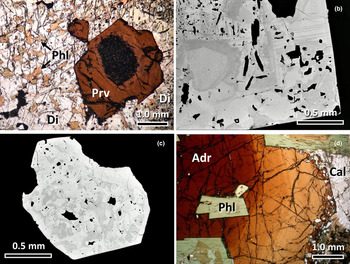
Drill-core sample GU-28-41 (70°54′39″N, 101°14′07″E) is a melanocratic, coarse-grained rock, sampled from a depth of 41 m in the jacupirangite–melteigite intrusion separating the two carbonatite stocks (Fig. 1b). The rock comprises prismatic crystals of diopside locally replaced by phlogopite, and relatively abundant (~4–8 vol.%) euhedral, zoned crystals of perovskite up to 3 mm across (Fig. 2a). Although this sample should be termed clinopyroxenite on the basis of its modal composition (Le Maitre, Reference Le Maitre2002), we will retain the name ‘jacupirangite’ used in the previous literature to distinguish it from perovskite-free rocks of the first intrusive phase (Yegorov, Reference Yegorov1991; Kogarko et al., Reference Kogarko and Zartman2007). According to Yegorov (Reference Yegorov1991), this sample represents Subphase 3 of the third intrusive phase (jacupirangite–melteigite series). Perovskite crystals have a turbid, purplish-brown, inclusion-rich core and a clear brown rim. The core is enriched in Al, Fe, Nb and REE relative to the rim, which shows elevated concentrations of Na and Zr (Fig. 3a–c; Table 2). The ovoid inclusions in perovskite cores contain diopside, phlogopite, apatite, magnetite, pectolite and an unidentified Na-K-bearing silicate material.
(a) Plane-polarised light (PPL) image of perovskite (Prv) associated with diopside (Di) and phlogopite (Phl) in jacupirangite; sample GU-28-41. (b) Back-scattered electron (BSE) image of cubic perovskite crystal from the Northern carbonatite stock, sample GU-13. (c) BSE image of cuboctahedral perovskite crystal from the Southern carbonatite stock, sample GU-14. (d) PPL image of zoned andradite (Adr) at the contact of calcite carbonatite (Cal) with metasomatised melilitolite, sample GU-08.

Compositional variation of perovskite (a–c) and andradite (d) samples studied in the present work. (a–c) Variations in the contents of major and minor elements (wt.% oxides) in zoned perovskite crystals from jacupirangite (GU-28-41: circles) and calcite carbonatites (GU-13: squares, GU-14: diamonds). (d) Variation in the proportion of major end-member components in zoned andradite from the contact of calcite carbonatite with metasomatised melilitolite (GU-08).

Representative WDS compositions (wt.% oxide) and formulae (apfu) of perovskite from Guli.

n.d. = not detected. *Total includes 0.11 wt.% ThO2 (0.001 apfu Th).
Sample GU-13 (Lat. 70°55′19″N, Long. 101°17′00″E) was collected from the southernmost exposure of coarse-grained phlogopite-apatite-magnetite-perovskite-rich calcite carbonatite near the intrusive contact between the Northern stock and its ultramafic wall-rocks. Perovskite in this sample forms lustrous cubic crystals up to 5 mm across. In BSE images, the crystals reveal abundant inclusions of apatite and a complex zoning pattern comprising a small anhedral core and multiple oscillatory growth zones (Fig. 2b) characterised by concomitant variation in Na, Fe and Nb at similar levels of Al, Zr and REE (Fig. 3; Table 2).
Sample GU-14 (70°53′00″N, 101°14′15″E) is a coarse-grained calcite carbonatite collected from near the western contact of the Southern stock with clinopyroxenites. The carbonatite contains cuboctahedral crystals up to 1 cm in size associated with diopside and phlogopite. The crystals exhibit patchy zoning in BSE images (Fig. 2c) arising from higher levels of Fe and Nb in brighter areas (Fig. 3).
Garnet GU-08 (70°53′35″N, 101°15′50″E) was collected from the contact zone between calcite carbonatite of the Southern stock and wollastonite-calcite-nepheline-diopside metasomatic rocks developed at the expense of melilitolites. This sample is essentially a bi-mineralic, coarse-grained aggregate of euhedral green phlogopite and subhedral black andradite crystals up to several cm in size. Platy zoned crystals of phlogopite are enclosed in the garnet or encrust the contact between the metasomatised melilitolite and calcite. Andradite crystals of dodecahedral–trapezohedral habit are invariably euhedral with respect to calcite, but anhedral with respect to the metasomatic endocontact. In plane-polarised light, the andradite exhibits concentric zoning comprising a dark reddish-brown core, sandy- to pale-brown intermediate zone and a dark-brown, poikilitic rim (Fig. 2d). The core has higher concentrations of Mg and Ti, but lower levels of Al and Fe relative to the intermediate zone. The rim is further depleted in Mg and enriched in Fe, but contains lower Al in comparison with the intermediate zone (Fig. 3d; Table 3).
Representative WDS compositions (wt.% oxide) and formulae (apfu) of andradite from Guli.

n.d. = not detected
Data reduction and age determination
LA-ICPMS U–Pb geochronology
The concentrations of U in the perovskite investigated vary from 170 ppm in the samples from carbonatites to 35 ppm in that from jacupirangite. The data reduction for U–Pb age determination of perovskite using LA-ICPMS was performed using the VisualAge DRS procedure (Petrus and Kamber, Reference Petrus and Kamber2012) in the Iolite 3.7 software (Paton et al., Reference Paton, Hellstrom, Paul, Woodhead and Hergt2011). Following the calculation procedure used to determine the U–Pb age of perovskite from the Afrikanda complex, Kola (Reguir et al., Reference Reguir, Camacho, Yang, Chakhmouradian, Kamenetsky and Halden2010), the isotopic composition of common Pb in perovskite from Guli was calculated using the Stacey and Kramers (Reference Stacey and Kramers1975) two-stage growth model for the inferred age of the sample. This technique is conventionally employed in U–Pb isotopic studies of geological materials of various provenance and age (e.g. Frei and Gerdes, Reference Frei and Gerdes2009; Tappe and Simonetti, Reference Tappe and Simonetti2012; Castillo-Oliver et al., Reference Castillo-Oliver, Galí, Melgarejo, Griffin, Belousova, Pearson, Watangua and O'Reilly2016). The common lead corrected 206Pb/238U ratios and ages of each individual perovskite analysis (Table 4) were calculated using Isoplot/Ex 3.75 (Ludwig, Reference Ludwig2012) applying the following decay constants: 9.8485 × 10⁻¹⁰ a–1 for 235U and 1.55125 × 10⁻¹⁰ a–1 for 238U (Steiger and Jäger, Reference Steiger and Jäger1977). The uncertainties in determination of common Pb isotopic compositions were numerically propagated through the error calculations by Isoplot/Ex 3.75 (Ludwig, Reference Ludwig2012). The weighted mean of 30 analyses of perovskite from sample GU-13 yielded a 206Pb/238U age of 250.4 ± 1.1 Ma (Fig. 4a). The age of perovskite from sample GU-14, obtained by taking the weighted mean of 30 analyses, corresponds to 255.3 ± 2.4 Ma (Fig. 4b). Isoplot/Ex 3.75 was also used to construct the Tera–Wasserburg diagram (Tera and Wasserburg, Reference Tera and Wasserburg1972), which yielded 206Pb/238U ages of 249.3 ± 4.7 Ma and 254.6 ± 3.7 Ma for GU-13 and GU-14, respectively. The Tera–Wasserburg diagram was constructed by anchoring the data at a selected 207Pb/206Pb ratio applying the common Pb composition determined using the Stacey and Kramers (Reference Stacey and Kramers1975) model.
LA-ICPMS U–Pb results for perovskite from the Guli carbonatites.

Weighted mean 206Pb/238U age diagrams for perovskite from the (a) Northern carbonatite stock and (b) Southern stock.

The U–Pb data for the Ice River material acquired using the GJ-1 zircon calibration standard and the same procedure as that applied to the Guli perovskite (Table 5) yielded a weighted average age of 357.2 ± 2.4 Ma (Fig. 6). This result is within the analytical uncertainty from the value of 356.5 ± 1 Ma recommended by Heaman (Reference Heaman2009) and is close to the 360–364 Ma range reported by Tappe and Simonetti (Reference Tappe and Simonetti2012).
207Pb/206Pb vs. 238U/206Pb diagrams (Tera and Wasserburg, Reference Tera and Wasserburg1972) for perovskite from the (a) Northern carbonatite stock and (b) Southern stock.

Weighted mean 206Pb/238U age diagrams for perovskite from the Ice River ijolite.

LA-ICPMS U–Pb results for perovskite from Ice River.

ID-TIMS U–Pb geochronology
The U–Pb ID-TIMS data were reduced using the PbDAT (Ludwig, Reference Ludwig1991) and Isoplot (Ludwig, Reference Ludwig2003) software. The results are reported in Table 6, with all uncertainties quoted as 2σ. The common Pb corrections for ID-TIMS analyses were performed using two approaches, the two-stage Pb evolution model of Stacey and Kramers (Reference Stacey and Kramers1975) and three-dimensional linear isochron (Ludwig, Reference Ludwig2003). The latter technique allows the assessment of data concordance and of the assumption of invariant common Pb composition. The concordia-constrained three-dimensional linear isochron age determined for the four perovskite fractions is 253 ± 2 Ma (MSWD = 2.0), which is in excellent agreement with the concordia age obtained using the Stacey and Kramers (Reference Stacey and Kramers1975) model (250 ± 1 Ma for GU-28-41 and 249 ± 2 Ma for GU-13; Fig. 7). The initial common Pb composition, derived from this isochron (206Pb/204Pb = 17.5 ± 4.3 and 207Pb/204Pb = 15.49 ± 0.24) corresponds to the concordia 206Pb/238U ages of 253 ± 2 Ma (MSWD = 0.65) for GU-28-41 and 252 ± 1 Ma (MSWD = 1.3) for GU-13. The andradite sample (GU-08) is characterised by much lower U levels (~4–7 ppm) compared to perovskite, and gave slightly discordant results, with an average 206Pb/238U age of 247 ± 6 Ma (Fig. 7).
U–Pb ID-TIMS isotopic dataa for perovskite and andradite from the Guli complex.

a All measured values are given to the last significant digit (based on the corresponding 2σ).
b Measured isotopic ratios.
c Rho represents correlation coefficients of 207Pb/235U vs. 206Pb/238U ratios.
d Pbc correction made using three-dimensional linear isochrons (Ludwig, Reference Ludwig2003).
U–Pb concordia diagram comparing ID-TIMS data for perovskite from jacupirangite (GU-28-41) and Northern carbonatite stock (GU-13) and andradite from the Southern stock (GU-08).

Discussion and conclusions
The timing of alkaline and carbonatitic magmatism in the Maimecha–Kotuy Province and Taimyr Peninsula and its connection to the Siberian flood basalts at the Permian–Triassic boundary has been addressed at length in previous studies (e.g. Dalrymple et al., Reference Dalrymple, Czamanske, Fedorenko, Simonov, Lanphere and Likhachev1995; Vernikovsky et al., Reference Vernikovsky, Pease, Vernikovskaya, Romanov, Gee and Travin2003; Ivanov, Reference Ivanov, He, Yan, Ryabov, Shevko, Palesskii and Nikolaeva2013; Burgess and Bowring, Reference Burgess and Bowring2015; Reichow et al., Reference Reichow, Saunders, Scott, Millar, Barfod, Pringle, Rogers and Hammond2016). The voluminous geochronological literature on the Siberian basaltic volcanism has not reached a consensus with regard to the duration or spatial extent of this event. High-precision geochronology of zircon from gabbroic intrusions and pyroclastic deposits in the peripheral areas of the Siberian flood basalts (251.35 ± 0.09–251.90 ± 0.06 Ma) indicates that the bulk of basic magma was erupted or emplaced within a narrow time interval (~300 ka) near the end-Permian mass extinction, but the activity continued for another 500 Ka after the event (Burgess and Bowring, Reference Burgess and Bowring2015). The ages of perovskite from melanephelinite flows near the base of the basaltic sequence (252.2–252.3 ± 0.1 Ma) provide a robust constraint on the onset of volcanic activity in the Late Permian (Fig. 8 and references therein). Evidence from differentiated alkaline intrusions in the southern margin of the Taimyr Fold-and-Thrust Belt (i.e. across the Yenisey–Khatanga Trough from Guli) suggests that magmatism extended to at least 250.6 ± 0.2 Ma (Augland et al., Reference Augland, Ryabov, Vernikovsky, Planke, Polozov, Callegaro, Jerram and Svensen2019). The 40Ar–39Ar data for low-Ti tholeiitic flows and their intrusive equivalents from the interior of the Siberian flood basalt province show evidence for a second magmatic pulse some 10 Ma after the extinction, between 242.8 ± 1.3 and 239.1 ± 1.1 Ma (Ivanov et al., Reference Ivanov, He, Yan, Ryabov, Shevko, Palesskii and Nikolaeva2013). Small-volume mantle magmatism extended even further into the Triassic, as indicated by the recently discovered Carnian (234.0–235.2 Ma) diopside-sanidine-phlogopite lamproites at Norilsk (Ivanov et al., Reference Ivanov, Demonterova, Savatenkov, Perepelov, Ryabov and Shevko2018).
Summary of geochronological data (from the literature and this work) for the Siberian flood basalts (black: lavas; green: intrusive rocks; blue: lamproites), Maimecha–Kotuy alkaline plutons (lilac: published data; purple: this work) and felsic intrusions (red). HP: Hoffman Peninsula (Reichow et al., Reference Reichow, Saunders, Scott, Millar, Barfod, Pringle, Rogers and Hammond2016); MK: Maimecha–Kotuy (Burgess and Bowring, Reference Burgess and Bowring2015); CP, ATS and NL: central Putorana, Angara–Taseevskaya syncline and Noril'sk lamproite, respectively (Ivanov et al., Reference Ivanov, He, Yan, Ryabov, Shevko, Palesskii and Nikolaeva2013, Reference Ivanov, Demonterova, Savatenkov, Perepelov, Ryabov and Shevko2018); N1: Noril'sk intrusion (Renne, Reference Renne1995); DS and AS: Delkansky and Arydzhangsky Suites (Kamo et al., Reference Kamo, Czamanske, Amelin, Fedorenko, Davis and Trofimov2003); GS, SS, T, N2, E, PND and D: Gudchikhinsky suite, Syverminsky suite, Talnakh intrusion, Noril'sk vein, Ergalakhsky intrusion, Post-Norilsk dolerite dyke and Daldykansky intrusion (Dalrymple et al., Reference Dalrymple, Czamanske, Fedorenko, Simonov, Lanphere and Likhachev1995); GUMC, GUSS, GUNS and GUJA: Guli melilitolite–carbonatite contact, Southern stock, Northern stock and jacupirangite (this work); GM and AD: Guli melilitolite and Avansky dyke (Dalrymple et al., Reference Dalrymple, Czamanske, Fedorenko, Simonov, Lanphere and Likhachev1995); KU: Kugda (Anosova et al., Reference Anosova, Kostitsyn and Kogarko2019); OD: Odikhincha (Salnikova et al., Reference Salnikova, Chakhmouradian, Stifeeva, Reguir, Kotov, Gritsenko and Nikiforov2019); GU1, GU2, GU3: Guli (Malich et al., Reference Malich, Khiller, Badanina and Belousova2015; Kogarko and Zartman, Reference Kogarko and Zartman2007; Kamo et al., Reference Kamo, Czamanske, Amelin, Fedorenko, Davis and Trofimov2003, respectively); BG: Bolgokhtokh granodiorite stock (Kamo et al., Reference Kamo, Czamanske, Amelin, Fedorenko, Davis and Trofimov2003); RI, MI, UR: Uboinaya River, Morzhov Island, Rastorguev Island (Vernikovsky et al., Reference Vernikovsky, Pease, Vernikovskaya, Romanov, Gee and Travin2003); DI and DU: Dikarabigai and Dumtalei intrusions (Augland et al., Reference Augland, Ryabov, Vernikovsky, Planke, Polozov, Callegaro, Jerram and Svensen2019).

The previously published geochronological data for Guli are predominantly limited to carbonatites. Baddeleyite from unknown sampling sites (most likely at the southern contact of the Northern stock) yielded essentially identical ID-TIMS and LA-ICPMS ages: 250.2 ± 0.3 and 250.8 ± 1.2 Ma, respectively (Kamo et al., Reference Kamo, Czamanske, Amelin, Fedorenko, Davis and Trofimov2003; Malich et al., Reference Malich, Khiller, Badanina and Belousova2015). These values are in excellent agreement with our LA-ICPMS data for perovskite from the Northern stock (250.4 ± 1.1 Ma), and are within error from the ID-TIMS results (249 ± 2 Ma) and U–Th–Pb chemical isochron age of thorianite (250.1 ± 2.9 Ma: Malich et al., Reference Malich, Khiller, Badanina and Belousova2015). Thus, the emplacement of the Northern carbonatite stock is well-constrained and occurred in the waning stage of the first magmatic pulse (Augland et al., Reference Augland, Ryabov, Vernikovsky, Planke, Polozov, Callegaro, Jerram and Svensen2019). Interestingly, jacupirangites that border the Northern stock from the south (Fig. 1b) are coeval within the analytical uncertainty (250 ± 1 Ma, ID-TIMS).
The LA-ICPMS results for perovskite from the Southern carbonatite stock imply a somewhat older age: its weighted mean 206Pb/238U date is 255.3 ± 2.4 Ma and ‘Tera–Wasserburg’ value 254.6 ± 3.7 Ma (Figs 4, 5). Unfortunately, our attempt to constrain further the age of the Southern stock using andradite from its metasomatised contact with melilitolites (GU-08) gave inconclusive results (247 ± 6 Ma, Fig. 6). Our results are in conflict with the younger U–Pb ages of volcanic rocks outside the Guli complex (Kamo et al., Reference Kamo, Czamanske, Amelin, Fedorenko, Davis and Trofimov2003). Notably, however, contacts between the age-dated Arydzhangsky and Del'kansky Suites and the intrusion are not exposed. Outside these volcanic units, intrusive contacts between the Guli dunites and basaltoids have been characterised as metasomatic (e.g. Yegorov, Reference Yegorov1991, p. 30). However, this interpretation is inconsistent with the much older age of dunites reported by Malich et al. (Reference Malitch, Efimov and Badanina2011), who interpreted these rocks as ophiolite-type blocks of Ediacaran age juxtaposed by alkaline–ultramafic magmas.
The ~255 Ma age determined in the present work is not the only indication of pre-Siberian flood basalt magmatism in this part of Siberia. Combined U–Pb data for perovskite from olivinites and phoscorites of the Kugda alkaline–ultramafic complex, situated some 80 km ESE of Guli, gave a value of 257 ± 6 Ma (Anosova et al., Reference Anosova, Kostitsyn and Kogarko2019), although more precise age determinations for this and other intrusions in the Maimecha–Kotuy province are clearly desirable to provide robust constraints on the timing of this type of magmatism. Some mafic intrusions in the Angara–Taseevskaya depression (SW part of the Siberian flood basalt province) have been dated using U–Pb and 40Ar–39Ar techniques to 254.2 ± 2.3– 255.8 ± 4.7/5.3 Ma (Paton et al., Reference Paton, Ivanov, Fiorentini, McNaughton, Mudrovska, Reznitskii and Demonterova2010; Ivanov et al., Reference Ivanov, He, Yan, Ryabov, Shevko, Palesskii and Nikolaeva2013). The extent of this hypothetical earlier pulse of mantle activity is difficult to constrain because its manifestations were obviously obliterated by voluminous flood volcanism at ~252 Ma. It is important to note, however, that in other large igneous provinces, alkaline and carbonatitic magmatism was recurrent and overlapping with the emplacement of tholeiitic rocks. For example, Cretaceous basaltic volcanism in the Paraná Basin of South America (133–135 Ma: Pinto et al., Reference Pinto, Hartmann, Santos, McNaughton and Wildner2011; Almeida et al., Reference Almeida, Janasi, Heaman, Shaulis, Hollanda and Renne2018) was preceded, accompanied and followed by the emplacement of alkaline–ultramafic intrusions, many of which contain carbonatites (Eby and Mariano Reference Eby and Mariano1992; Gomes et al., Reference Gomes, Comin-Chiaramonti, Velázquez, Orué, Comin-Chiaramonti and Gomes1996; Antonini et al., Reference Antonini, Gasparon, Comin-Chiaramonti and Gomes2005; Speziale et al., Reference Speziale, Castorina, Censi, de Barros Gomes, Soares Marques and Comin-Chiaramonti2020). The oldest of these rocks predate the basalts by at least 6 Ma, whereas the youngest postdate them by some 15 Ma (Gomes et al., Reference Gomes, Comin-Chiaramonti and Velázquez2013 and references therein). Hence, it is conceivable that the Siberian flood basalts, representing the world's largest igneous province, could also be preceded by small-volume mantle-derived magmas. The co-existence of carbonatites of different ages should also not be surprising, given the evidence of recurrent igneous activity at many structurally complex plutons, including carbonatite complexes (Guarino et al., Reference Guarino, Wu, Lustrino, Melluso, Brotzu, Gomes, Ruberti, Tassinari and Svisero2013, Reference Guarino, Wu, Melluso, de Barros Gomes, Tassinari, Ruberti and Brilli2017; Poletti et al., Reference Poletti, Cottle, Hagen-Peter and Lackey2016).
Good agreement between the LA-ICPMS and ID-TIMS data for perovskite from the Northern carbonatite stock demonstrates that LA-ICPMS can be used reliably for in situ U–Pb age determination of compositionally heterogeneous perovskite (Figs. 2a–c, 3a–c). The main limitations of this type of analysis include a high proportion of common lead in this mineral (207Pb/206Pb = 0.85 ± 0.02) and the lack of a robust matrix-matched standard. Considering matrix effects, we initially explored the possibility of using the Ice River perovskite as a calibration standard. However, several test runs showed that this material is not a reliable calibration standard at the analytical settings employed in the present work. The recommended age value of 356.5 ± 1.0 Ma (Heaman, Reference Heaman2009) was determined for a single perovskite grain from the Ice River ijolite. A more recent study by Tappe and Simonetti (Reference Tappe and Simonetti2012), based on multiple, smaller grains from ijolite and melteigite reported an appreciably older value of 361.7 ± 1.0 Ma, and explained the discrepancy with Heaman's (Reference Heaman2009) data by the presence of apatite inclusions in his material. These uncertainties compelled us to use zircon GJ-1 for calibration, even though it is not matrix-matched with respect to perovskite. The benefit of using zircon as a U–Pb standard is that it eliminates the need to correct calibration data for common Pb, which is an important potential source of errors with matrix-matched standards rich in common Pb. In this study, we demonstrate that LA-ICPMS analytical protocols can be modified by adjusting the laser focus, repetition rate and spray chamber configuration to effectively minimise any matrix effects. The use of a secondary, matrix-matched standard (e.g. Ice River perovskite) will further improve results by helping control the instrument mass bias. The Ice River perovskite cannot be recommended as a calibration standard until the discrepancies between the original study by Heaman (Reference Heaman2009) and that of Tappe and Simonetti (Reference Tappe and Simonetti2012) have been addressed. In our opinion, it is important to examine multiple grains of perovskite from the Ice River ijolite to verify its isotopic homogeneity, because it is not unusual for alkaline rocks to contain more than one generation of perovskite representing distinct and temporally disconnected evolutionary processes (Chakhmouradian and Mitchell, Reference Chakhmouradian and Mitchell2001; Zurevinski et al., Reference Zurevinski, Heaman and Creaser2011; Ranger et al., Reference Ranger, Heaman, Pearson, Muntener and Zhuk2018; Tappe et al., Reference Tappe, Dongre, Liu and Wu2018).
Acknowledgements
This work was supported by the Natural Sciences and Engineering Research Council of Canada (Discovery Grant to ARC). We are grateful to Marina Sevastyanova, Mikhail Martyshkin and Ivan Kalmykov (Polyarnaya Exploration Company) for their hospitality while in Khatanga, as well as their generous help with fieldwork logistics. Larry M. Heaman is thanked for donating the Ice River perovskite. The manuscript has benefited from constructive reviews by Sebastian Tappe and an anonymous reviewer.