Introduction
“Schoolies Festivals” in Australia are events that provide young people with an opportunity to celebrate the end of their secondary school lives. Such celebrations have become an established part of the school culture in Australia, with thousands of young students converging at beach side locations to celebrate the end of their secondary school education.Reference Salom, Watts, Kinner and Young1 Current research on “Schoolies Festivals” focuses on high-risk adolescent behaviours such as binge drinking, smoking, and taking illicit substances.Reference Wallace and Bahr2
The purpose of this project was to identify what young people consider important to stay safe and healthy when they are celebrating the end of their secondary school lives. The study was undertaken at a “Schoolies Festival” in South Australia in 2008. The aim of this pilot study was to identify the health and safety issues of young people, including associated risks, in order to develop subsequent health messages tailored to meet their needs when attending celebratory events such as the “Schoolies Festivals.”
Background
Events such as the “Schoolies Festival” are a common phenomenon in today’s society, with current healthcare strategies concentrating on health promotion messages and the provision of health care services on-site to care for presenting casualties. Current literature suggests that young people tend to seek support from their peers to resolve health issues, and they may not seek medical attention.Reference Hutton3 However, research has been limited as to what young people perceive may affect their health at mass-gatherings.Reference Arbon4,Reference Hutton, Roderick and Munt5 Understanding the health issues at these events from a young person’s perspective can assist in developing preventative strategies, and in understanding what factors may prompt young people to seek health care in a mass-gathering setting. Most importantly, this research aims to provide support for the development of more effective strategies for the prevention and mitigation of illness or injury for young persons in these settings, and thus, reduce the demand for on-site first aid care.
Even though most people attending mass-gatherings are well, these events may produce a “higher incidence of injury or illness than in the general population”.Reference Arbon6 These higher rates of illness and injury at mass-gathering events can be due to: (1) the type and duration of the event; (2) the mood of the crowd; (3) the number of people attending the event; (4) crowd density; (5) the average age of the crowd; and (6) the level of alcohol and drug use.Reference Milsten, Maguire, Bissell and Seaman7,Reference Arbon8
Australian “Schoolies Festivals” were started in the 1970s by a private entrepreneur in Queensland, but have since become an established part of the Australian culture and a “rite of passage” for students to celebrate the end of their secondary schooling.Reference Winchester, McGuirk, Everett and Teather9 The event is characterized in the popular culture as “risky,” involving excessive alcohol consumption and high-risk behaviors, coupled with a party atmosphere.Reference Wallace and Bahr2,Reference Winchester, McGuirk, Everett and Teather9 With these concerns in mind, the study was designed to investigate what the participants at this event perceived impacted their health and safety at the event.
Setting
The “Schoolies Festival” is an end-of-year celebration held over three days in a small seaside community of approximately 11,500 permanent residents, located one hour from the South Australian capital of Adelaide. The event is held within a bounded, dry zone (in which the sale and consumption of alcohol are banned) monitored by volunteers whose role is to provide pastoral support to the participants. Although the event is held in a controlled environment, participants travel long distances to the event, and camp out, or reside in rented cabins or other rental accommodations, within the surrounding community.
Methods
Data Collection
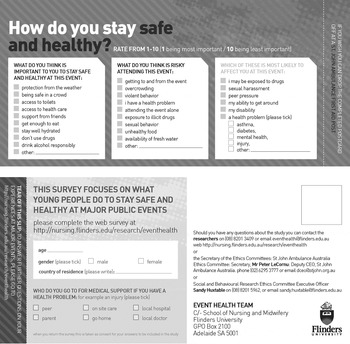
Data were collected at a “Schoolies Festival” in Adelaide in 2008 using a postcard containing a short survey (Figure 1). This method was used to attract the attention of the young persons at the event, and to provide an efficient way of collecting data in a “moving crowd” environment. Such postcards have been used previously as a means of enhancing survey response rates in medical research.Reference Pirotta, Gunn, Farish and Karabatsos10–Reference Hill, Fahrney, Wheeless and Carson13 However, there is minimal literature documenting the use of postcards as a primary method of data collection.Reference Bergk, Gasse, Schnell and Haefeli12,Reference Hill, Fahrney, Wheeless and Carson13
The front (A) and back (B) sides of the postcard survey

The postcard survey gathered baseline data on participants’ demographics as well as their concerns regarding health and safety, risks, and behavioral influences. The three lead questions were:
What do you think is important to stay safe and healthy at this event?
What do you think is risky attending this event?
Which of these is most likely to affect you at this event?
Within the three lead questions were sub-categories of items that were determined from key issues within the nursing literature, the Australian Institute for Health and Welfare (AIHW), and Mission Australia reports on youth health.14,15 These items focused on what young people might consider important to their safety and health while attending a mass-gathering event.Reference Hutton, Roderick and Munt5 Participants were asked to rate the importance of each item on a scale of 1–9, with one being the most important, and nine being the least important.
The reverse side of the postcard requested demographic information including age and gender. An additional question asking participants where they would seek medical support at this event concluded the survey.
Three hundred postcards were distributed to festival attendees in an area 250 meters outside the bounded “Schoolies Festival” environment. The majority of young people approached were identifiable as event attendees by the clothing they were wearing, i.e., tee-shirts or jersey tops emblazoned with school logos and nicknames. All postcards were distributed and collected by the researchers within the controlled event site during the event. Data collection was confined to the Friday afternoon and early Saturday morning of the event when the attendees were likely to be suffering the least from the effects of alcohol, and not be overly tired from the celebrations.
Human research ethics approval was obtained from the Flinders University Social Behavioural Research Ethics Committee.
Data Analysis
Each sub-category item of the first two questions was ranked and then grouped as follows: Rating scores of 1–3 were categorized as “Important”; rating scores of 4–6 were categorized as “Neutral”; and rating scores of 7–9 were categorized as “Not Important.” The rating scores of the six items in the third question were categorized as follows: 1–2 = “Important”; 3–4 = “Neutral”; and 5–6 = “Not Important.”
The data were processed using SPPS 17.0 (IBM, Chicago, USA) to obtain a descriptive analysis of data.
Results
A total of 220 postcards were returned, yielding a response rate of 73%. Of the 220 returned postcards, 165 (75%) respondents answered all four questions completely. Cards with incomplete answers to the four questions were not included in the analysis.
Demographics of Respondents
The average age of the participants was 17.7 years. One hundred forty-five of the participants were 16–18 years of age; 11 were 19–21 years of age; and two participants were 22–25 years old. Gender distribution of participants was fairly equal with 47% (n = 78) being male, and 50% (n=83) of respondents being female. Four individuals (2.4%) did not identify themselves as either male or female, but were included in the analysis as they answered the four questions completely.
Safety and Health (Question #1)
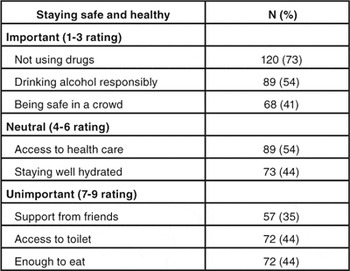
In response to the lead question “What do you think is important to stay safe and healthy at this event?,” 120 of the 165 respondents (73%) indicated that “not using drugs” was important to staying safe and healthy; 89 of the respondents (54%) indicated “drinking alcohol responsibly” was important; and 68 (41%) considered “being safe in a crowd” to be important (Table 1). Both “access to health care” and “staying well hydrated” were rated as neutral factors by 89 (54%) and 73 (44%) of the respondents, respectively. Items that the participants considered to be relatively unimportant to staying safe and healthy were: “support from friends” (n = 57, 35%); “access to toilets” (n = 72, 44%); and “getting enough to eat” (n = 72, 44%).
Responses to Question #1 on staying safe and healthy

Risks (Question #2)
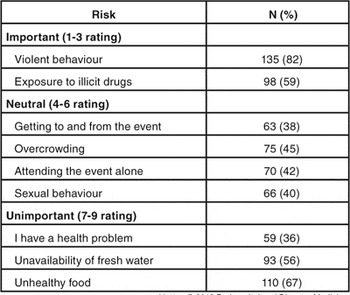
To the second lead question “What do you think is risky attending this event?,” 135 (82%) of the respondents identified “violent behavior,” and 98 (59%) identified “exposure to illicit drugs” as important risky behaviours (Table 2). Behavioral risks that the respondents rated as neutral were: “getting to and from the event” (n = 63, 38%);”overcrowding” (n = 75, 45%); “attending the event alone” (n = 70, 42%); and “sexual behaviour” (n = 66, 40%). The items rated unimportant by respondents were;
Responses to Question #2 concerning risks

“I have a health problem” (n = 59, 36%); “unavailability of fresh water” (n = 93, 56%); and “unhealthy food” (n= 110, 67%).
Items Likely to Affect You at the “Schoolies Festival” (Question #3)
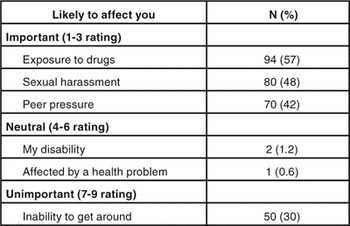
In response to the third question: “Which of these [items] is most likely to affect you at this event?,” 94 (57%) of the respondents stated that being “exposed to drugs” was most likely to affect them at while at the event (Table 3). Also considered to be important were “sexual harassment” (n = 80, 48%) and “peer pressure” (n = 70, 42%). The “inability to get around” was rated as non-important by 50 (30%) of the participants. A neutral rating was given to “my disability” and being “affected by a ‘health problem” by two (1.2%) and one (0.6%) of the respondents, respectively.
Responses to Question #3 concerning items likely to affect you at the “Schoolies Festival”

Access to Health Care (Question #4)
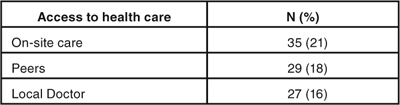
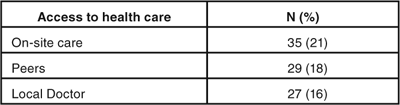
To the question “Who do you go to for medical support if you have a health problem?,” 35 (21%) of the participants indicated that they would seek on-site health care at the event; 29 (18%) indicated that they would seek medical support from their peers; and 27 (16%) responded that they would seek care from a local doctor (Table 4).
Responses to Question #4 concerning access to health care
Discussion
The aim of this project was to identify what young people believe is important in order to remain safe and healthy when they attend an event celebrating the end of their secondary school year. The impetus behind identifying young people’s concerns was to prioritize and develop health messages relevant to the young person at mass-gathering events, specifically the “Schoolies” event. The long-term aim of the study was to increase the preparedness of young persons attending mass-gathering events, and to mitigate illness and injury at these events.
Results from the descriptive analysis indicate that attendees considered not using drugs to be the most significant health and safety factor. These findings are in keeping with the 2009 Mission Australia report indicating that young people have concerns about the effect of drugs.15 However, the participants in that study were considerably younger (11–14 years) than the average age of students attending a “Schoolies Festival,” as well as the participants in the current study. The Mission Australia report also found that 27.6% of males were concerned with drinking responsibly, compared with 19% of females.15 Similar results from the current study confirm that young people attending such festivals are concerned about drinking responsibly. In the Mission Australia report, older respondents (15–18 years of age) were concerned about their mental health. However, no effort was made to identify mental health concerns in this study.
The findings of young people’s concerns about violent behavior at mass-gathering events are interesting as this phenomenon has not been reported widely and warrants further investigation. Given the limitations of the postcard survey, it was not possible to ascertain what type of violence concerned the participants in this study. Zinkiewicz, et al. found that individuals who participated in high levels of drinking at “Schoolie Festivals” were likely to be involved in interpersonal conflict.16 These authors also found that males engaged in riskier behaviors than did females, and that females were more concerned for their sexual safety with increased drinking rather than general violent behavior.
The exposure to illicit drugs was revealed to be a dominant concern for the participants in this study. Within contemporary literature, the exposure to illicit drugs has not necessarily been viewed as a risk to young people, but rather has been considered an expected activity at such an event.Reference Salom, Watts, Kinner and Young1,Reference Wallace and Bahr2,Reference Arbon8,Reference Zinkiewicz, Davey and Curd16,Reference Smith and Rosenthal17
Overall, the use of, and exposure to, drugs were predominant concerns regarding health and safety, risks, and influences at the “Schoolies Festival.” While drugs are a predominant concern, the participants’ concerns regarding sexual harassment and peer pressure are aligned with their identification of violent behaviour as a risk, and as likely to affect their health and safety at the event. Findings of peer pressure and sexual harassment provide insight into the concerns young people may have at this event.
Currently, the Adelaide “Schoolies Festival” is set up to support young people to celebrate safely through the use of dry zones, ticketed entry, bounded environment, and “chill-out rooms.” In addition, 500 volunteers are present at the event to assist the young people in remaining safe and healthy. With these strategies in place, one could argue that young people who attend this event in Adelaide are well supported. Further research into the role of these support strategies may be beneficial to the perception of the health, safety, and risks of young people at these events. In addition, the findings from this study are only representative of the dry zone in which the event took place, and not from the area in which the young people resided.
The findings from this study have implications within the wider context of mass-gathering celebrations and young people’s health, and the amounts of money spent on advertisements that target the health, safety, and risks of the young person at such events. A common perspective of health promotion is to provide pertinent health information, and that the provision of information is sufficient. However, findings from this study indicate that young people are able to identify the risks to their health and safety at a “Schoolies Festival,” and that providing more health information is not necessary. Funds currently being used for further promotion of health information would be well spent within a public health framework aimed at supporting young people to celebrate safely at mass-gathering events.
According to Blackie, Gregg and Freeth, preventative health actions are more likely to be undertaken if young people believe they are susceptible to a particular threat.Reference Blackie, Gregg and Freeth18 Applying health information in a specific context is relevant to mass-gathering research, as each mass-gathering event is unique; the “Schoolies Festival” is an example of that uniqueness. The development of health messages specific to a mass-gathering event provides the opportunity to investigate whether or not health messages given in a specific context are useful to young people. Abrams asserts that health messages in a specific context do have an immediate positive result in young people, although they may not be adopted long-term.Reference Abrams19 The response to health messages in a specific mass-gathering context remains an area worthy of further investigation.
As data on young people attending mass-gatherings are limited, this pilot study is part of developing an understanding of the ways of accessing the opinions of young people in order to improve preparedness and mitigation for mass-gathering events. This research is an initial step in providing young people with an opportunity to articulate what is significant to them, and/or what being safe and healthy means to them.
Conclusion
Even though the young people attending mass-gathering celebrations, such as the “Schoolies Festival,” generally are healthy, they have valid concerns about drinking responsibly, exposure to illicit drugs, and sexual harassment. Events such as the “Schoolies Festivals” are represented as rites of passages for young persons, and it is expected that such events will be celebrated with alcohol, drugs, and promiscuity, despite concerns about the risk of these activities to their health and safety. Thus, while young people are aware of the health and safety risks they may face at celebratory events, they still will attend the event even knowing that these risks are present. By understanding the overall context of an event, specific health messages and supportive environments can be developed that match the mass-gathering context with the health concerns of young people. Young people have legitimate concerns regarding their health when they attend mass-gatherings events. Consequently, they may be responsive to health messages or health promotion strategies that are tailored to their specific concerns. Such information can inform managers of mass-gathering events in their preparedness endeavors.
Abbreviations:
None