





LEARNING OBJECTIVES
After reading this article you will be able to:
-
• understand the epidemiology, health burdens and health outcomes associated with adult ADHD
-
• understand major sources of inequity in the recognition, diagnosis and treatment of adult ADHD
-
• understand the major public mental health concerns relating to the assessment, treatment and organisation of services for adults with ADHD.
In May 2023, the BBC (a British public service broadcaster) featured the subject of inappropriate attention-deficit hyperactivity disorder (ADHD) diagnosis in private mental health clinics in England in its televised flagship Panorama programme. Undercover reporter Rory Carson, posing as a patient, was assessed in three different private mental health clinics and diagnosed with ADHD in all three. The assessment processes, as observed by the viewing public, were questionable. Following a more thorough assessment in a National Health Service (NHS) clinic, the diagnosis of ADHD was dismissed. By then, however, Mr. Carson had been able to access stimulant medications, which are controlled substances, and had spent significant sums of money to access diagnosis and treatment (BBC 2023).
The challenges with ADHD diagnosis and treatment in the UK are not confined to private healthcare, although private healthcare providers have become important stakeholders in ADHD care. The quest for private assessments, diagnoses and treatments has arisen from severe challenges in accessing publicly funded ADHD-related healthcare, with waiting lists of up to 8 years or more for adults in some places (NHS England 2025a). In 2022, the UK’s parliament and government were publicly petitioned to commission a review into the management of ADHD assessments by the NHS. The petition’s goals were to reduce significant waiting lists and provide resources for new patients. The matter was debated in parliament and the government responded positively to the petition (UK Parliament 2022). Some of these governmental actions are described later in this article.
What is ADHD and how is it diagnosed?
ADHD is a chronic neurodevelopmental disorder, characterised by hyperactivity, impulsivity and/or inattention. Inattention may manifest as difficulties with sustaining attention, organisation and completing tasks, as well as distractibility and forgetfulness. Hyperactivity and impulsivity may present as restlessness, excessive activity or talking, difficulties waiting or taking turns, and interrupting others. Diagnosis requires a persistent pattern of symptoms that affects functioning, with evidence of symptoms beginning in childhood and occurring across more than one setting. Other possible explanations for the symptoms also need to be considered and possibly excluded.
There are specific criteria for making the diagnosis, as determined in DSM-5 (American Psychiatric Association [APA] 2013), the principal professional manual used for diagnosing mental disorders in North America. ICD-11 (World Health Organization [WHO] 2023a) is more commonly used for diagnosis in the rest of the world. The DSM classification is also more commonly used in ADHD research and provides operational diagnostic criteria that facilitate clinical assessment and research. The National Institute for Health and Care Excellence (NICE) used the DSM-5 classification in its guideline on management of ADHD (NICE 2018).
A key difference is that ICD-11 does not offer an operational definition to guide the determination of a diagnostic cut-off for ADHD, for example by specifying a minimum number of symptoms for diagnosis (e.g. 5 or 6 out of 9 symptoms in adults). Hence, it is less commonly used in questionnaires and consequently less utilised for research.
Childhood versus adult ADHD
ADHD was historically been regarded as a disorder of childhood and it remains more commonly diagnosed in children and males (APA 2013). Longitudinal studies suggest that approximately 60–80% of children diagnosed with ADHD continue to meet diagnostic criteria during adolescence, indicating substantial persistence through this developmental period (Faraone Reference Faraone, Biederman and Mick2006, cited in Faraone Reference Faraone, Banaschewski and Coghill2021). Although persistence declines with age, ADHD remains evident in a significant proportion of individuals, with approximately 15–30% of those diagnosed in childhood continuing to meet full diagnostic criteria in adulthood (Faraone Reference Faraone, Biederman and Mick2006, cited in Faraone Reference Faraone, Banaschewski and Coghill2021; Agnew-Blais Reference Agnew-Blais, Polanczyk and Danese2016). Furthermore, many adults who no longer meet the full diagnostic threshold continue to experience residual symptoms and functional impairment, suggesting that the long-term impact of ADHD extends beyond syndromal persistence alone (Caye Reference Caye, Spadini and Karam2016). These findings support the view of ADHD as a lifespan condition that frequently persists from childhood into adolescence and, for a substantial minority, into adult life.
Factors associated with persistence into adulthood include greater severity of ADHD symptoms in childhood (OR = 2.33, 95% CI 1.6–3.39; P < 0.001), treatment for childhood ADHD (OR = 2.09, 95% CI 1.04–4.18; P = 0.037), and the presence of comorbid conduct disorder (OR = 1.85, 95% CI 1.06–3.24; P = 0.030) and/or major depressive disorder (OR = 1.8, 95% CI 1.1–2.95; P = 0.019) (Caye Reference Caye, Spadini and Karam2016).
Epidemiology of ADHD in adults
DSM-5 reports a global prevalence of adult ADHD at approximately 2.5% (APA 2013), a figure also reflected in the World Federation of ADHD International Consensus Statement (Faraone Reference Faraone, Banaschewski and Coghill2021). More recently, an umbrella review by Ayanoa et al (Reference Ayanoa, Tsegay and Gizachew2023), which synthesised five systematic reviews and meta-analyses comprising 57 primary studies and more than 21 million participants, reported a global pooled prevalence (PP) of 3.10% (95% CI 2.60–3.60%). Among ADHD presentations, the inattentive type was most prevalent (PP = 3.0%, 95% CI 2.0–4.0%), followed by the hyperactive-impulsive type (PP = 2.95%, 95% CI 1.8–4.0%) and the combined type (PP = 2.44%, 95% CI 1.5–3.5%).
In England, data from the Adult Psychiatric Morbidity Survey 2023/2024 showed that 1.8% of adults had been diagnosed with ADHD by a professional; 5.8% of adults thought that they had ADHD (Ridout Reference Ridout, O’Shea, Morris, Morris, Hill and Brugha2025), suggesting that demand for assessment may continue to increase.
Adult ADHD is at least as common as several well-recognised mental health conditions, including generalised anxiety disorder (2.9%), post-traumatic stress disorder (3.5%) and obsessive–compulsive disorder (1.2%), although less common than major depressive disorder (7%) (APA 2013). Its prevalence also exceeds that of conditions such as schizophrenia (0.3–0.7%) and bipolar disorder (0.6%), which often benefit from dedicated, specially funded services. Despite this, service provision for ADHD remains disproportionate to its prevalence and potential severity. These figures also highlight the need for all healthcare professionals, not just mental health specialists, to recognise ADHD and develop the skills required to deliver care, including in primary care settings, where most mental disorders are managed.
Why does ADHD matter?
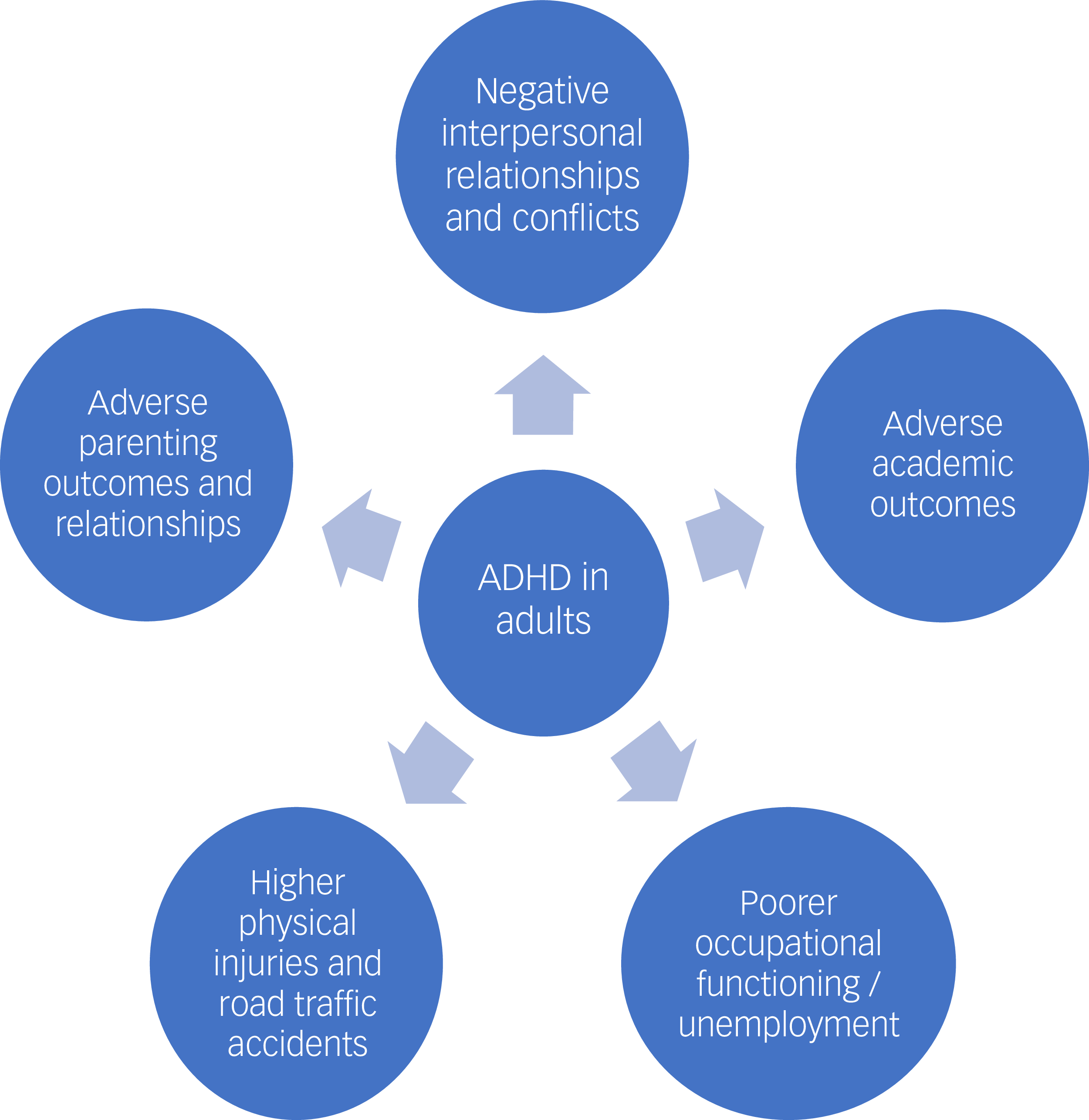
ADHD is associated with a broad range of adverse functional outcomes (Fig. 1) that extend beyond its core symptoms of inattention, hyperactivity and impulsivity (APA 2013). Adults with ADHD are more likely to experience difficulties across multiple domains of life, including education, employment, interpersonal relationships and family functioning. They are also at increased risk of being perceived as lazy, irresponsible or uncooperative, which may contribute to stigma and social disadvantage (APA 2013).
Functional consequences of attention-deficit hyperactivity disorder (ADHD) in adults (adapted from American Psychiatric Association 2013).

Effective treatment can mitigate many of the adverse outcomes associated with ADHD. In a large population-based study, Li et al (Reference Li, Coghill and Sjölander2025) found that medicating ADHD was consistently linked to lower risks of self-harm, unintentional injury, road traffic accidents and criminality across age groups and sexes.Footnote a Specifically, medication use was associated with lower rates of self-harm (incidence rate ratio IRR = 0.77–0.85), unintentional injury (IRR = 0.87–0.93), road traffic accidents (IRR = 0.71–0.87) and criminal behaviour (IRR = 0.73–0.75). Although the magnitude of these associations diminished over time as prescribing rates increased, the findings suggest that ADHD treatment may confer important benefits that extend beyond symptom reduction and improve broader public health outcomes.
Comorbidity of ADHD in adults
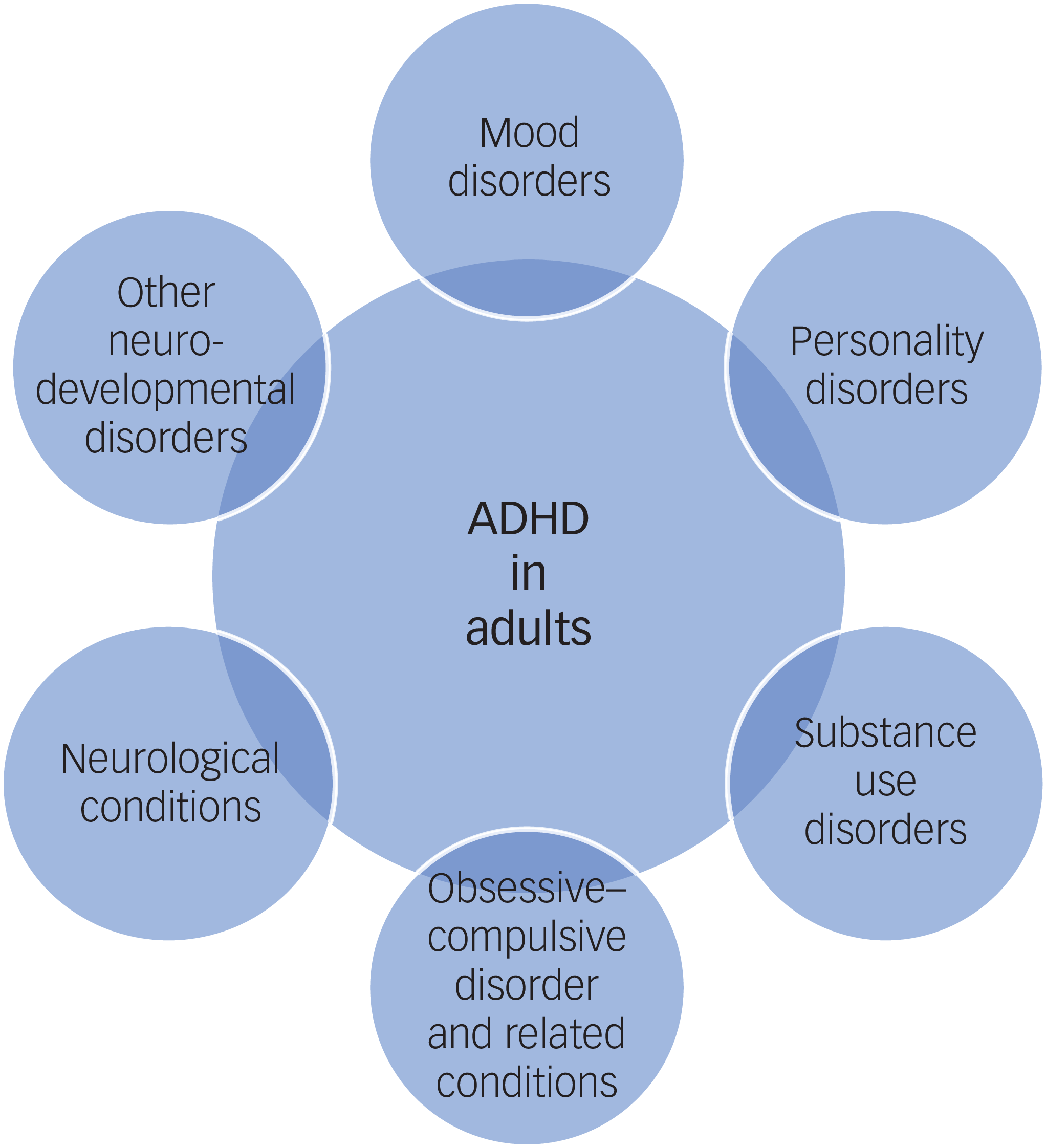
ADHD commonly co-occurs with other psychiatric disorders in adulthood (Fig. 2), including anxiety disorders, depressive disorders, bipolar disorder and substance use disorders (APA 2013). Recognition of psychiatric comorbidity is important because co-existing conditions may complicate diagnosis, influence treatment and contribute to poorer functional outcomes.
Common psychiatric comorbidities in attention-deficit hyperactivity disorder (ADHD) (adapted from American Psychiatric Association 2013).

There is ongoing debate regarding the relationship between ADHD and borderline personality disorder. This is of particular relevance to practising psychiatrists because the two conditions frequently co-exist and share overlapping clinical features, and the presence of one may influence the treatment outcomes of the other (Moukhtarian Reference Moukhtarian, Mintah and Moran2018). Emotion dysregulation, although not a diagnostic criterion for ADHD, is increasingly recognised as a clinically important feature that contributes substantially to psychosocial impairment and may overlap with symptoms observed in borderline personality disorder (Moukhtarian Reference Moukhtarian, Mintah and Moran2018). A review of clinic-based studies (Shaw Reference Shaw, Stringaris and Nigg2014) reported that emotion dysregulation is present in 34−70% of adults with ADHD.
Adults with ADHD are also at increased risk of suicidal behaviour, underscoring the importance of timely recognition and effective treatment of the disorder (Austgulen Reference Austgulen, Skram and Haavik2023). The risks associated with untreated ADHD therefore extend beyond symptom burden and may have significant consequences for both individuals and society.
Associated healthcare costs
The costs and consequences of untreated ADHD are substantial, amounting to billions of dollars globally each year (Faraone Reference Faraone, Banaschewski and Coghill2021). Using medical claims data from approximately 5 million patients in Germany between 2012 and 2017, Libutzki et al (Reference Libutzki, May and Gleitz2020) found that direct healthcare costs for adults with ADHD reached up to €4000 per patient in the year of diagnosis. Costs were already elevated in the years preceding diagnosis and generally declined over the subsequent 4 years, suggesting a potential benefit of recognition and treatment.
Similarly, Du Rietz et al (Reference Du Rietz, Jangmo and Kuja-Halkola2020, cited in Faraone Reference Faraone, Banaschewski and Coghill2021) analysed Swedish national register data from over 445 000 young adults and found that annual healthcare costs (at 2017 prices) were lowest among those without ADHD (€304), intermediate among those whose childhood ADHD had remitted and highest among those with persistent ADHD (€1060). Healthcare costs were also higher among females than males. As emergency care, primary care and over-the-counter expenses were not included, these estimates may underestimate the true economic burden of ADHD.
Inequity in life expectancy
People with ADHD are increasingly recognised as a vulnerable group with reduced life expectancy. Evidence from several high-income countries suggests that ADHD is associated with excess mortality compared with the general population.
Excess mortality
Using UK primary care data from approximately 30 000 adults with ADHD and matched controls, O’Nions et al (Reference O’Nions, El Baou and John2025) estimated a reduction in life expectancy of 6.78 years (95% CI 4.50–9.11) for males and 8.64 years (95% CI 6.55–10.91) for females. The study drew on data from 792 general practices serving approximately 9.5 million people. Although socioeconomic status and race/ethnicity were not adjusted for, the findings provide one of the strongest contemporary estimates of reduced life expectancy among adults with ADHD.
Similar findings have been reported internationally. In a systematic review and meta-analysis of neurodevelopmental disorders, Catalá-López et al (Reference Catalá-López, Hutton and Page2022) identified eight ADHD studies, involving 396 488 participants, and found that ADHD was associated with a twofold increase in all-cause mortality (RR = 2.13, 95% CI 1.13–4.02). Mortality from natural causes was not significantly increased (RR = 1.62, 95% CI 0.89–2.96), whereas mortality from unnatural causes, including injury and suicide, was substantially increased (RR = 2.81, 95% CI 1.73–4.55). The authors also reported a more than fourfold increase in mortality risk by midlife. Mortality appeared higher among females (RR = 2.84, 95% CI 1.02–7.89) than males (RR = 2.43, 95% CI 1.01–5.83). The included studies were drawn from the USA, Denmark, Finland, Sweden and Taiwan, although heterogeneity across studies was considerable.
Suicide risk
Suicide appears to be an important contributor to this excess mortality. In a Danish prospective cohort study of 1.92 million individuals, including 32 061 people with ADHD, Dalsgaard et al (Reference Dalsgaard, Østergaard and Leckman2015, cited in Faraone Reference Faraone, Banaschewski and Coghill2021) reported a 5.85-fold increased risk of suicide compared with 2.21 in those without ADHD, even after adjustment for comorbid depression and substance misuse. A meta-analysis by Septier et al (Reference Septier, Stordeur and Zhang2019, cited in Faraone Reference Faraone, Banaschewski and Coghill2021) similarly found elevated risks of suicidal ideation (OR = 3.53, 95% CI 2.94–4.25), suicide attempts (OR = 2.37, 95% CI 1.64–3.43) and completed suicide (OR = 6.69, 95% CI 3.24–17.39). Austgulen et al’s systematic review (Reference Austgulen, Skram and Haavik2023) identified ADHD symptom severity and persistence, female gender, family history of ADHD, childhood and parental factors, and impaired social functioning as risk factors for suicidal behaviours. Importantly, elevated risk persisted after adjustment for psychiatric comorbidity.
It is worth clarifying that the evidence of association between ADHD and completed suicide is less clear compared with the evidence of association with suicide attempts. Registry studies show that taking ADHD medication is associated with lower rates of suicide attempts (Zhang Reference Zhang, Zhu and Sjölander2025).
Summary
Taken together, the literature on life expectancy in ADHD is relatively recent but warrants urgent policy attention. The available evidence suggests that adults with ADHD are at increased risk of premature mortality compared with the general population. The excess mortality appears to be largely attributable to unnatural causes, particularly injury and suicide, and to have been observed across various high-income countries. Although the evidence remains limited, females may be at particularly high risk.
Inequity in diagnosis and treatment: impact of sex/gender
In this section, sex and/or gender are considered in general terms of how self-describing females or women experience the diagnosis and treatment of adult ADHD.
Females are more likely to present with inattentive symptoms and less likely to exhibit disruptive behaviours that prompt referral for assessment. They are also more likely to present with internalising symptoms such as anxiety, depression, emotional distress and low self-esteem, all of which may obscure the underlying diagnosis of ADHD (Hinshaw Reference Hinshaw, Nguyen and O’Grady2022).
Historically, ADHD has been considered more common in males and consequently females have been at greater risk of under-recognition and underdiagnosis. Hinshaw et al (Reference Hinshaw, Nguyen and O’Grady2022) noted that males remain more likely to be diagnosed with ADHD in adulthood, although this gap appears to be narrowing.
Changing epidemiology
Recent studies suggest that the epidemiology of diagnosed adult ADHD may be changing. In the UK, McKechnie et al (Reference McKechnie, O’Nions and Dunsmuir2023) reported substantial increases in ADHD diagnoses and prescribing for females in primary care between 2000 and 2018. Similar trends have been observed elsewhere. Hu et al (Reference Hu, Desai and Au2025) found increasing rates of incident adult ADHD diagnoses among females in British Columbia, Canada, between 2013 and 2023, and Westman et al (Reference Westman, Prami and Kallio2025) reported increasing rates of ADHD diagnosis across age groups in Finland, with particularly marked increases among females. Martin et al (Reference Martin, Langley and Cooper2024), using population healthcare records from Wales, found that sex differences in ADHD diagnosis varied according to age at diagnosis. The highest male:female ratio was observed among those diagnosed before the age of 12 years (4.8:1), whereas the lowest ratio was observed among those diagnosed after the age of 18 years (1.9:1). Collectively, these findings suggest that females are increasingly being recognised and diagnosed with ADHD in adulthood.
Diagnostic and treatment delays
Despite these trends, evidence suggests that females continue to experience delays in diagnosis and treatment. In a Swedish population register study involving approximately 85 000 individuals with ADHD, Skoglund et al (Reference Skoglund, Sundström Poromaa and Leksell2024) found that females were diagnosed and treated approximately 4 years later than males (95% CI 3.74–4.11). Thus, although the gap in rates of diagnosis may be narrowing, females continue to experience delays in gaining access to diagnosis and treatment.
The consequences of missed or delayed diagnosis may be considerable. In a systematic review of qualitative studies, Attoe & Climie (Reference Attoe and Climie2023) found that females with ADHD commonly reported low self-esteem, anxiety, stress and difficulties in interpersonal relationships prior to diagnosis. Receiving a diagnosis was frequently associated with relief, improved self-understanding and reduced self-criticism. However, the available evidence remains limited by relatively small sample sizes and a predominance of studies conducted in high-income countries.
Summary
Overall, the available evidence suggests differences in how adult females may experience ADHD, including more complex clinical presentations and greater psychiatric and emotional comorbidity. These factors may contribute to delayed recognition and treatment. Herein lies a gap where greater awareness among clinicians, alongside ongoing refinement of diagnostic frameworks and clinical guidance, may help reduce inequities in access to timely assessment and treatment.
Inequity in diagnosis and treatment: impact of race/ethnicity
Riccioni et al (Reference Riccioni, Radua and Ashaye2024) conducted a systematic review and meta-analysis of race and ethnicity reporting in double-blind randomised controlled trials (RCTs) of ADHD medications. Among 310 RCTs, over 30% did not report race or ethnicity in a published or unpublished report. Reporting improved over four decades and was most common in studies from the USA. In US studies (all age groups), Asian participants were underrepresented (2.2%), whereas White participants were overrepresented (74.3%) relative to national population estimates; in US adult studies, Asians remained the least represented group (2.9%), whereas White participants accounted for 82.6% of samples.
Diagnosis
Asian, Black and Hispanic youths are thought to be underdiagnosed relative to White youths, despite similar symptom levels. Shi et al (Reference Shi, Hunter Guevara and Dykhoff2021) examined data on 238 011 insured children in the USA and found that ADHD was diagnosed significantly less often in Asian (3.2%), Black (6.0%) and Hispanic (9.1%) children than in White children (78.8%) (P < 0.001).
Chung et al (Reference Chung, Jiang and Paksarian2019) examined adult ADHD prevalence and incidence across seven racial and ethnic groups in the USA. Among more than five million adults aged 25–34 years, prevalence increased across all groups over the 10-year study period. White adults consistently had the highest prevalence rates, whereas Asian American adults had the lowest. White race was associated with significantly greater odds of receiving an ADHD diagnosis (e.g. Asian versus White patients: OR = 0.248, 95% CI 0.240–0.257; P < 0.001). However, participants were drawn from a single healthcare organisation in Northern California, limiting generalisability.
Shalaby et al (Reference Shalaby, Sengupta and Williams2024) analysed 41 million anonymised electronic health records from a US insurance database. Aside from the hyperactive subtype, ADHD diagnoses were significantly less common in Black than in White individuals. Diagnosis rates declined after adolescence in the Black population, whereas White individuals showed disproportionately higher rates of diagnosis between 18 and 40 years of age. The study did not adjust for socioeconomic or insurance status, both of which may influence access to diagnosis. These findings are consistent with underrecognition of ADHD in some Black and minority ethnic populations rather than over-diagnosis among White populations. They may also reflect implicit biases that contribute to service-seeking behaviours being misinterpreted as stimulant-seeking behaviours.
Treatment
Following diagnosis, disparities in treatment persist, at least in the USA. Black, Hispanic and Asian children in the USA are less likely than White children to receive ADHD-specific care, including medication and mental health visits (Yang Reference Yang, Flores and Carson2022). Similarly, Shi et al (Reference Shi, Hunter Guevara and Dykhoff2021) found lower odds of treatment among Asian (OR = 0.54, 95% CI 0.42–0.70), Hispanic (OR = 0.57, 95% CI 0.48–0.67) and Black children (OR = 0.79, 95% CI 0.64–0.98). Medication patterns also differ, with Black and Asian children receiving fewer ADHD medications, while Black and Hispanic children show higher rates of treatment discontinuation (Yang Reference Yang, Flores and Carson2022; Cummings Reference Cummings, Ji and Allen2017). Although ethnic differences are less pronounced for psychosocial interventions, Black and Hispanic adolescents remain less likely to receive psychosocial therapy (Adams et al Reference Adams, Riley and Quinn2024). In educational settings, behavioural symptoms in Black children are more likely to result in disciplinary action, whereas White children with similar presentations are more often referred for therapeutic or behavioural interventions (Skiba Reference Skiba, Michael and Nardo2002).
However, these findings remain contested. Cénat et al (Reference Cénat, Blais-Rochette and Morse2021) reported a pooled ADHD prevalence of 14.54% (95% CI 10.64%–19.56%) among Black individuals in the USA. The authors suggested that this may reflect the inclusion of studies involving youths from lower socioeconomic backgrounds. Only two studies included adults, precluding conclusions regarding adult populations. In a subsequent meta-analysis, Cénat et al (Reference Cénat, Kokou-Kpolou and Blais-Rochette2024) found no significant difference in ADHD prevalence between Black and White youths, suggesting that prevalence may be more similar than previously thought.
Summary
Although the evidence remains mixed, racial and ethnic disparities appear to exist in childhood ADHD diagnosis, treatment access and treatment patterns. These differences may extend into adolescence and young adulthood. Evidence regarding disparities in adult ADHD remains limited. Taken together, the findings suggest that Black, Asian and Hispanic adults may be less likely to have ADHD recognised during childhood or early adulthood, increasing their vulnerability to adverse outcomes. Further efforts are needed to improve recognition and access to care in these populations.
Public interest in adult ADHD
Public concern regarding adult ADHD has increased substantially in recent years. In England, an independent taskforce was established by NHS England to work with stakeholders and incorporate extensive public and patient engagement in identifying potential solutions to challenges in ADHD care pathways and treatment. NHS England (2024) identified several areas requiring urgent attention, including increasing demand for ADHD assessments, limited understanding of unmet need, growth of the independent sector, variation in diagnostic and treatment pathways, inequities in access to care, and the need for coordinated support across health, social care, education and justice services.
In response to these concerns, the independent ADHD Taskforce made several recommendations in Part 1 of its report (NHS England 2025a). These included urgently addressing NHS waiting times and prioritising support for people on waiting lists. The report recognised that reliance on specialist or tertiary diagnostic services alone is unlikely to be sustainable and proposed a stepped-care model, with expansion of diagnosis and treatment into primary care. It further highlighted the need for a cross-government, multi-agency approach to ADHD, supported by improved data collection and digital infrastructure.
Importantly, the report also addressed concerns regarding both under- and overdiagnosis of ADHD. It noted that rates of ADHD recognition and treatment in England and other parts of the UK remain substantially lower than in several European countries, including Norway, Denmark and Spain (NHS England 2025a). The report further highlighted evidence of under-recognition and undertreatment of clinically significant ADHD, alongside marked inequalities in access to care, particularly among minority groups.
These findings suggest that demand for ADHD services is unlikely to decline and that existing clinical pathways may require substantial reconfiguration. The rising demand for ADHD assessment observed in England appears to mirror trends across other Western countries and likely reflects a combination of factors, including greater public and professional awareness of adult ADHD, improved recognition of ADHD in females, changes in diagnostic practice, the impact of the COVID-19 pandemic and the requirement for formal diagnosis to access educational support and reasonable adjustments (NHS England 2025a).
Services for adults with ADHD across the world
Adult ADHD services have developed unevenly across countries, reflecting differences in healthcare systems, professional training, medication regulation and historical attitudes to the diagnosis.
Transition to adult services
Adolescents with ADHD form the largest group of patients requiring transition from child and adolescent mental health services (CAMHS) to adult mental health services. However, they remain at risk of falling through gaps in service provision. A systematic review by Price et al (Reference Price, Janssens and Woodley2019) found that the experiences of young people transitioning between services were predominantly negative. These challenges arise largely in healthcare systems where child and adult services are separately commissioned and organised.
Despite growing recognition of ADHD in adults, service provision remains variable. The UK NICE guideline on ADHD (NICE 2018) recommends that adults requiring assessment should be referred to a mental health specialist with training in the diagnosis and treatment of the disorder. Responsibility for ongoing care is placed with healthcare professionals possessing appropriate expertise in ADHD management. This specialist-led model presents challenges when applied to a relatively common condition, particularly in health systems already facing workforce and capacity constraints.
The impact of this can be seen in attitudes to service provision. In a survey of psychiatrists in South Australia, Cao et al (Reference Cao, Deakin and Gill2024) found that some clinicians did not feel adequately equipped, trained or resourced to treat adults with ADHD. Such concerns may contribute to variations in service availability and access to care.
Care pathways and prescribing practices
Care pathways differ internationally. In the Republic of Ireland, the Health Service Executive has developed a National Clinical Programme for ADHD in Adults, whereby referrals from general practitioners are initially assessed within general adult mental health services before onward referral to regional specialist ADHD teams where indicated (Health Service Executive 2021). In contrast, Canadian guidelines permit assessment and management within primary care settings by appropriately trained clinicians and do not restrict key elements of diagnosis or treatment to specialist services alone (Canadian ADHD Resource Alliance 2020). This potentially allows more timely access to care if expertise exists outside specialist services.
Differences are also evident in medication availability and prescribing practices. In Japan, strict controls on amphetamines have resulted in greater reliance on methylphenidate and atomoxetine (Sasaki Reference Sasaki, Tsujii and Sasaki2021). France historically restricted stimulant prescribing because of concerns regarding misuse, with methylphenidate being the only approved stimulant for treatment of ADHD in children since July 1995 (Frances et al Reference Frances, Hoizey and Millart2004). For an extended period in Saudi Arabia, methylphenidate and atomoxetine were the only ADHD-specific medications available (Saudi ADHD Society 2016).
These international differences highlight the absence of a single model for adult ADHD care. These differences extend beyond service organisation and service models to medication availability. Consistent with this, ADHD-specific medications are not currently included in the WHO’s essential medicines list (WHO 2023b).
Recommendations from the ADHD Taskforce for clinical services in England
Asherson et al (Reference Asherson, Leaver and Adamou2022) noted that restricting ADHD care largely to specialist and secondary services is difficult to reconcile with the prevalence and long-term course of the condition. In its Part 2 report, the independent ADHD Taskforce proposed a series of recommendations for the future organisation of ADHD services in England (NHS England 2025b). Broadly, these focused on three areas: increasing service capacity, strengthening regulation and quality assurance, and improving workforce capability.
Service capacity
To address service capacity, the Taskforce called on integrated care boards (ICBs), commissioners and service providers to urgently reduce waiting times and evaluate service performance through ongoing audits and quality improvement processes. It recommended that triage should not rely solely on screening questionnaires, but should be informed by clinical judgement and overseen by appropriately experienced clinicians.
A central recommendation was the adoption of a stepped-care model, with greater involvement of primary care in the assessment and management of ADHD. The report proposed that general practices be supported and incentivised to undertake aspects of ADHD care, alongside more integrated support across health, social care, education and other agencies. It also endorsed task-sharing and task-shifting as potential approaches to expanding workforce capacity and capability.
The stepped-care model appears to be the most practical of the five service models proposed by Smith et al (Reference Smith, Mukherjee and Müller-Sedgwick2024) for the UK. However, Bhattacharya (Reference Bhattacharya2024) argued that implementation may be hindered by the absence of clear definitions of ADHD severity within current diagnostic systems, making it difficult to determine which patients are most appropriately managed at different levels of care.
Regulation and quality assurance
The Taskforce also recommended greater regulation and accountability across ADHD commissioning and service provision, supported by the development of quality standards. It called for waiting-time expectations comparable to those applied to chronic physical health conditions and highlighted the need for greater clarity regarding workforce roles. Specifically, it recommended that NICE clarify what constitutes an ‘appropriately qualified healthcare professional’ for the assessment and management of ADHD (NICE 2018: para. 1.3.1) and specify the competencies required for these roles.
Improving workforce capability
Finally, the report recommended the development of core competencies and training curricula across professional groups, including psychiatrists, paediatricians, psychologists and specialist mental health nurses. It further advocated government-supported training initiatives to expand the workforce capable of assessing and treating ADHD.
Conclusion
There are multiple aspects of adult ADHD that are of importance to the public and should also be of concern to psychiatrists. Although ADHD is a neurodevelopmental disorder, its implications extend well beyond childhood and beyond its core symptoms of inattention, hyperactivity and impulsivity. Adult ADHD is associated with a wide range of psychiatric comorbidities, functional impairments, economic costs and adverse health outcomes.
The evidence reviewed in this article suggests that ADHD is not only common, but that it may also be associated with reduced life expectancy. It further highlights important inequities in diagnosis, treatment and access to care. Females remain at risk of delayed diagnosis, while disparities related to race and ethnicity continue to raise concerns regarding equitable access to assessment and treatment.
At the same time, increasing public awareness and demand for services are placing pressure on healthcare systems that were not originally designed to meet current levels of need. Across countries, service models have developed in different ways and there remains no single approach to organising adult ADHD care. However, a recurring theme is the need to move beyond reliance on a small number of specialist services towards broader workforce development, greater collaboration across sectors and improved access to evidence-based assessment and treatment.
For psychiatrists, the challenge is no longer whether adults with ADHD require care, but how best to organise services so that care is timely, equitable and sustainable. The recommendations of the NHS England ADHD Taskforce provide one potential framework for addressing these challenges. Whether such approaches translate into improved outcomes for patients, services and wider society remains an important area for future evaluation.
MCQs
Select the single best option for each question stem
-
1 Which of the following best explains why adult ADHD is considered an important public mental health issue?
-
a It is associated only with difficulties in attention
-
b It is a rare disorder requiring highly specialised services
-
c It is associated with substantial functional impairment, psychiatric comorbidity and healthcare burden
-
d It occurs only in people with childhood behavioural problems
-
e Its effects are largely confined to educational settings.
-
-
2 Which of the following best reflects the relationship between ADHD and health outcomes in adulthood?
-
a ADHD affects quality of life but has little impact on wider health outcomes
-
b ADHD is associated with a range of adverse health, social and functional outcomes
-
c ADHD primarily affects occupational functioning but not physical health
-
d ADHD is associated with reduced healthcare utilisation
-
e ADHD has no association with mortality.
-
-
3 Which of the following best describes an important inequity identified in females with ADHD?
-
a Females are typically diagnosed earlier than males
-
b Females are less likely to experience psychiatric comorbidity
-
c Females often experience delays in diagnosis despite increasing recognition of ADHD
-
d Females are more likely to present with hyperactive symptoms than inattentive symptoms
-
e Gender differences in ADHD diagnosis are no longer observed.
-
-
4 Which of the following best describes concerns regarding race and ethnicity in ADHD care?
-
a Differences may occur at multiple stages, including recognition, diagnosis and treatment
-
b Racial and ethnic disparities are confined to childhood ADHD
-
c Racial and ethnic disparities are confined to pharmacological treatment
-
d Evidence regarding disparities is restricted to Europe
-
e There are no reported concerns regarding equity of access to ADHD care.
-
-
5 Which of the following service principles is most consistent with recent recommendations for adult ADHD services in England?
-
a ADHD assessment and treatment should be restricted to specialist tertiary services
-
b Primary care should have no role in ADHD management
-
c Service provision should involve coordinated working across agencies and levels of care
-
d Pharmacological treatment should be prioritised over all other interventions
-
e ADHD services should focus only on patients with severe symptoms.
-
MCQ answers
-
1 c
-
2 b
-
3 c
-
4 a
-
5 c
Data availability
Data availability is not applicable to this article as no new data were created or analysed in this study.
Acknowledgements
We thank the libraries of the Royal College of Psychiatrists (UK), Western University (London, Ontario), Teesside University (UK) and the Byron Memorial branch of the London Public Library (Ontario) for their support. We thank Dr Carol McDaniel, who commented on our draft of this article. We want to specially thank our patient, M.S., who commented on drafts of this article, and we thank patients of City Clinic & Wellness Center, London, Ontario, who inspired this work.
Author contributions
All authors made substantial contributions to the conception or design of the work, including the acquisition, analysis and interpretation of relevant data; all authors were involved in drafting the work and revising it; all authors gave final approval of the version to be published; and all authors agree to be accountable for all aspects of this work.
Funding
This research received no specific grant from any funding agency, commercial or not-for-profit sectors.
Declaration of interest
I.U. is a member of the BJPsych Advances editorial board and did not take part in the review or decision-making process of this article.

 Open access


eLetters
No eLetters have been published for this article.