Kawasaki disease is an acute febrile vasculitis that predominantly affects children under 5 years of age.Reference Kawasaki, Kosaki, Okawa, Shigematsu and Yanagawa1, Reference McCrindle, Rowley and Newburger2 In particular, Kawasaki disease in infants younger than 6 months often has incomplete presentation with transient or subtle signs and symptoms, and these infants have a high risk for developing coronary artery lesions.Reference McCrindle, Rowley and Newburger2 Although most important long-term sequelae of Kawasaki disease are confined to the coronary arteries, multiple other organs are inflamed during the acute state and cause various clinical symptoms.Reference McCrindle, Rowley and Newburger2 A wide range of other clinical features that are not included in the diagnostic criteria such as extreme irritability exceeding that observed in other febrile illnesses, aseptic meningitis, transient unilateral peripheral facial nerve palsy, uveitis, urethritis, arthralgia, arthritis, abdominal pain, hepatitis, heart failure, and gallbladder hydrops have been widely recognised as being correlated with Kawasaki disease.Reference McCrindle, Rowley and Newburger2–Reference Maurer, Unsinn, Waltner-Romen, Geiger and Gassner6 However, there is less number of works related to splenomegaly in Kawasaki disease in the literature, outside of one outdated studyReference Ohshio, Furukawa, Fujiwara and Hamashima7 and one study that described an adult Kawasaki disease patient case with splenomegaly.Reference Cunha, Pherez, Alexiadis, Gagos and Strollo8 Moreover, the adult Kawasaki disease study did not describe the clinical importance of splenomegaly in Kawasaki disease.Reference Cunha, Pherez, Alexiadis, Gagos and Strollo8 The purpose of this study was to summarise the clinical features of Kawasaki disease with gallbladder hydrops and splenomegaly among patients who underwent abdominal ultrasonography and to investigate the relationship of gallbladder hydrops or splenomegaly with coronary artery lesions development.
Subjects and methods
Selection of patients
We retrospectively reviewed the records of patients who were discharged from Samsung Changwon Hospital with a diagnosis of Kawasaki disease between March 2011 and February 2017. The patients who were referred for only echocardiography after treatment of Kawasaki disease at another hospital were excluded because we could not verify the laboratory results. Patients who did not follow-up after discharge for any cause were also excluded. According to the 2017 American Heart Association guidelines for the diagnosis of Kawasaki disease, classic or complete Kawasaki disease was diagnosed in the presence of fever for at least 5 days – the day of fever onset is taken to be the first day of fever – together with at least four of the five following principal clinical features that include erythema and cracking of lips, strawberry tongue, and/or erythema of oral and pharyngeal mucosa; bilateral bulbar conjunctival injection without exudate; maculopapular, diffuse erythroderma, or erythema multiforme-like rash; erythema and oedema of the hands and feet in the acute phase and/or periungual desquamation in the subacute phase; and cervical lymphadenopathy >1.5 cm in diameter, usually unilateral. In addition, an exclusion of alternative diagnoses must be verified.Reference McCrindle, Rowley and Newburger2 Even if a patient did not perfectly meet the clinical criteria, incomplete Kawasaki disease is often diagnosed in any infant or child with prolonged unexplained fever, fewer than four of the principal clinical findings, and compatible laboratory or echocardiographic findings.Reference McCrindle, Rowley and Newburger2 To date, there is no definite diagnostic laboratory test for Kawasaki disease, therefore, the diagnosis of incomplete Kawasaki disease should be made only when other infectious diseases mimicking Kawasaki disease are ruled out. To rule out the possibility of patients with other infectious diseases being included in the study population, we excluded the patients with proven infections, such as Epstein Barr virus, adenovirus, and measles.Reference McCrindle, Rowley and Newburger2 According to the guidelines, an echocardiogram is considered positive if any of the three following conditions are met: z-score of left anterior descending coronary artery or right coronary artery ⩾2.5; coronary artery aneurysm is observed; or ⩾3 other suggestive features exist, including decreased left ventricular function, mitral regurgitation, pericardial effusion, or z-score in the left anterior descending coronary artery or right coronary artery of 2–2.5.Reference McCrindle, Rowley and Newburger2
Study subjects and statistical analyses
Patient clinical characteristics and past history, laboratory results, results of ultrasonography, response to intravenous immunoglobulin, length of hospital stay, and development of coronary artery lesions were reviewed and compared according to the type of Kawasaki disease, whether complete Kawasaki disease versus incomplete Kawasaki disease, presence of gallbladder hydrops, and presence of splenomegaly between groups using an independent Student’s t-test or Pearson’s χ2-test. All statistical analyses were performed with IBM SPSS v. 21.0 software (IBM Inc., Chicago, IL, USA). All p-values <0.05 were considered statistically significant, and all parameters are expressed as mean ± SD. The spleen was measured in the longitudinal coronal view by experienced radiologist. The maximal distance between the most supero-medial and infero-lateral points are taken as the spleen length.Reference DeSanctis, Connoly and Bramson9 There are only less studies for normal spleen size in the infant and young children. We defined splenomegaly when the mean spleen length of those were 6.0 cm at 3 months, 6.5 cm at 6 months, 7.0 cm at 12 months, 8.0 cm at 2 years, 9.0 cm at 4 years, 9.5 cm at 6 years, 10.0 cm at 8 years, 11.0 cm at 10 years, 11.5 cm at 12 years, and 12.0 cm at 15 years or older for girls, and 13.0 cm at 15 years or older for boys by an earlier report.Reference Rosenberg, Markowitz, Kolberg, Park, Hubbard and Bellah10 Approval of this retrospective study was obtained from the Institutional Review Board of our institution (2017-11-013).
Results
Patients characteristics
From March 2011 to February 2017, a total of 417 children were diagnosed with Kawasaki disease. Because of echocardiographic follow-up loss, 21 patients were excluded, leaving a total of 396 patients during this 6-year period. Of these, 77 (23.4%) underwent abdominal ultrasonography during the treatment period and were enrolled for further analysis. The patients included 46 males and 31 females, and their average age was 35.8 ± 26.1 months. A total of 28 patients (male:female = 13:15) belonged to the complete Kawasaki disease group, and 49 patients (male:female = 32:17) belonged to the incomplete Kawasaki disease group.
Performance of ultrasonography
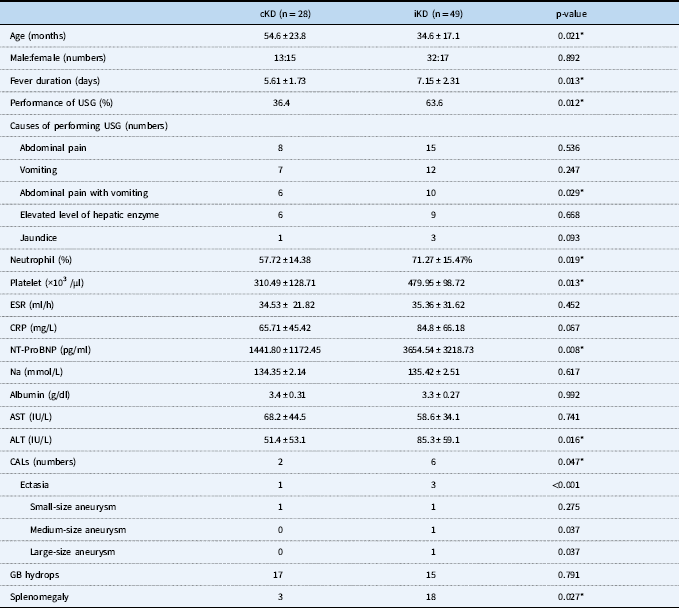
Table 1 shows that the causes for performing ultrasonography were dependent on various situations. There was no report related to suspicious splenomegaly during physical examination. The levels (IU/L) of aspartate aminotransferase and alanine aminotransferase of patients with ultrasonography were 76.2 ± 34.6 and 68.7 ± 31.9, respectively, and those of patients without ultrasonography were 69.4 ± 34.7 and 67.6 ± 23.7. This result was not shown at the table. The timing of ultrasonography was acute phase of Kawasaki disease – 4.5 ± 1.3 days after fever onset – and the follow-up ultrasonography was performed in 68 among 77 cases (88.3%) in the subacute or convalescent phase of Kawasaki disease – 11.3 ± 3.2 days after fever onset. The hepatic enzyme and bilirubin cut-off levels as to whether to perform ultrasonography were not determined in our hospital’s policy and were decided according to clinical practice.
Clinical characteristics of complete and incomplete Kawasaki disease.

AST = aspartate aminotransferase; ALT = alanine aminotransferase; CALs = coronary artery lesions; cKD = complete Kawasaki disease; CRP = C-reactive protein; ESR = erythrocyte sedimentation rate; GB hydrops = gallbladder hydrops; iKD = incomplete Kawasaki disease; NT-ProBNP: N-terminal fragment of prohormone brain-type natriuretic peptide; USG = ultrasonography; WBC = white blood cell. Data are shown as mean ± SD. *p-value <0.05 was statistically significant
Ultrasonography findings
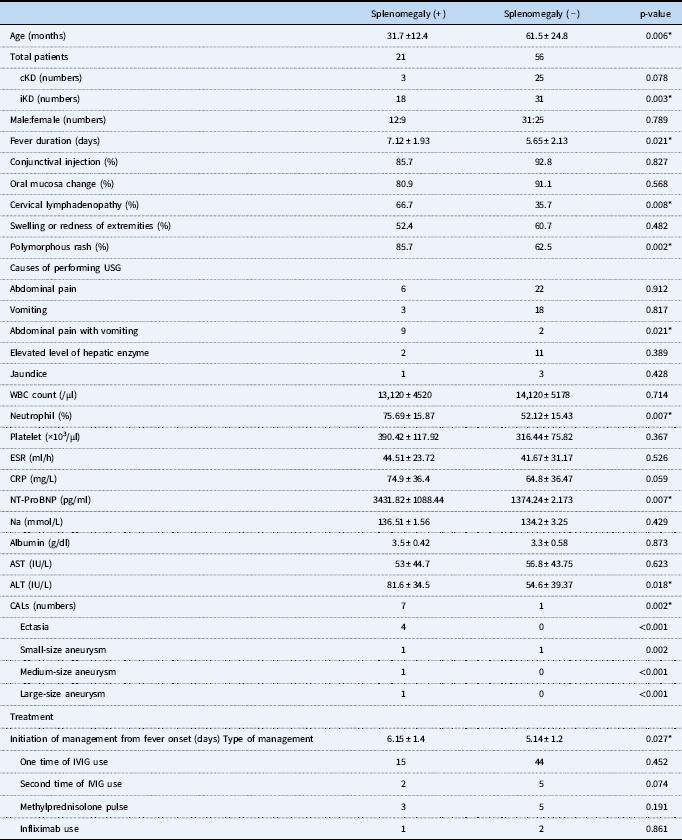
Gallbladder hydrops was detected in 32 patients, and acute acalculous cholecystitis was not found, and no patients had sonographic evidence of pancreatic pathology or intra/extrahepatic biliary tree dilatations. Splenomegaly was detected in 21 patients, where complete Kawasaki disease/incomplete Kawasaki disease = 3:18. The mean spleen length was 98.3 ± 22.7 mm. Gallbladder hydrops and splenomegaly were not detected at the same time in any patient. Tables 1 and 2 show the clinical and laboratory findings according to the type of Kawasaki disease and presence of splenomegaly, respectively.
Clinical characteristics of Kawasaki disease patients with splenomegaly.

iKD = incomplete Kawasaki disease; cKD = complete Kawasaki disease; USG = ultrasonography; WBC = white blood cell; ESR = erythrocyte sedimentation rate; CRP = C-reactive protein; ProBNP: prohormone brain-type natriuretic peptide; AST = aspartate aminotransferase; ALT = alanine aminotransferase; CALs = coronary artery lesions; IVIG = intravenous immunoglobulin; cKD = complete Kawasaki disease; CRP = C-reactive protein; ESR = erythrocyte sedimentation rate; iKD = incomplete Kawasaki disease; ProBNP: prohormone brain-type natriuretic peptide; USG = ultrasonography; WBC = white blood cell. Data are shown as mean ± SD. *p-value <0.05 was statistically significant
Association between splenomegaly and coronary artery lesions
Although there was no difference between the two groups in regard to detection of gallbladder hydrops, however, the development of coronary artery lesions and detection of splenomegaly were greater in the incomplete Kawasaki disease group (Table 1). When we analysed subjects with identified gallbladder hydrops, there was no statistical difference in the clinical or laboratory findings or development of coronary artery lesions except younger age, more frequent cervical lymphadenopathy, and higher neutrophil percentage in the gallbladder hydrops group. However, there were several statistical differences in patients with splenomegaly. They mostly belonged to incomplete Kawasaki disease group, had longer fever duration, more frequent cervical lymphadenopathy and polymorphous rash, higher neutrophil percentage, higher N-terminal fragment of pro-brain natriuretic peptide and alanine aminotransferase, and higher incidence of coronary artery lesions than patients without splenomegaly (n = 7/21 versus 1/56, respectively, p = 0.002, Table 2). When ultrasonography was performed, splenomegaly was most commonly detected in patients complaining of abdominal pain with vomiting (Table 2). Also, we compared our cohort of patients with splenomegaly to all patients with Kawasaki disease instead of just the subset of patients with negative ultrasonography in spite of the many differences in numbers. Similarly, there was no statistical difference in the clinical or laboratory findings except that the subjects with splenomegaly belonged more to the incomplete Kawasaki disease group than all patients with Kawasaki disease including patients with negative ultrasonography (n = 18/21 versus 126/375, respectively, p = 0.017). This result was not shown in the table. We found that the presence of splenomegaly was an important predictor of incomplete Kawasaki disease (n = 18/21 versus 31/56, respectively, p = 0.003, Table 2) and also it was a possible predictor of coronary artery lesions.
Treatment
The initiation time of management from fever onset was described in Table 1. The patients with splenomegaly had been treated later than those without splenomegaly. Because we studied the patients who treated before submission of American Heart Association guideline 2017, there was management with methylprednisolone pulse therapy, which is no more a recommended option now.
Discussion
The main finding of this study is that gallbladder hydrops is not a possible predictive factor of coronary artery lesions, but splenomegaly is a possible predictive factor, particularly in incomplete Kawasaki disease patients. According to the authors, whether the presence of sonographic splenomegaly in Kawasaki disease patients has an influence on disease outcome, especially in coronary artery lesions, is an area of interest that has never been explored. When ultrasonography was performed in Kawasaki disease patients, splenomegaly was most commonly detected in patients complaining of abdominal pain with vomiting, and patients with splenomegaly were more frequently in the incomplete Kawasaki disease group and had longer fever duration and higher incidence of coronary artery lesions than patients without splenomegaly.
Kawasaki disease is an acute, febrile, multi-systemic vasculitis of unknown aetiology, affecting mainly children <5 years of age.Reference Kawasaki, Kosaki, Okawa, Shigematsu and Yanagawa1, Reference McCrindle, Rowley and Newburger2 Despite a decrease in the number of children in the population because of the low birth rate in South Korea, the incidence of Kawasaki disease in children <5 years of age has shown a marked increase and was estimated to have increased to 134.4 per 100,000 children <5 years of age in 2011 in South Korea.Reference Kim, Han and Park11 The aetiology of Kawasaki disease is still not clear, and the reason for this increase has not been completely identified. Although Kawasaki disease is known to be self-limiting, coronary artery lesions such as coronary artery aneurysm or ectasia can develop in 15–25% of untreated Kawasaki disease patients. These complications can lead to myocardial infarction, ischaemic heart disease, or sudden death.Reference McCrindle, Rowley and Newburger2, Reference Kato, Sugimura and Akagi12, Reference Parsa, Khaheshi, Paydary and Haybar13 To reduce these sequelae, an accurate and timely diagnosis of Kawasaki disease is critical because specific diagnostic tests or pathognomonic clinical features are absent, and clinical diagnostic criteria for Kawasaki disease might not all present on any given day, and not all patients with Kawasaki disease present with all the specific clinical features.Reference McCrindle, Rowley and Newburger2, Reference Maurer, Unsinn, Waltner-Romen, Geiger and Gassner6, Reference Yun, Yang and Park14 In addition to the diagnostic criteria, a broad range of non-specific clinical features such as extreme irritability exceeding that observed in other febrile illnesses, aseptic meningitis, transient unilateral peripheral facial nerve palsy, uveitis, urethritis, arthralgia, arthritis, seizure, parotitis, severe lethargy, semi-coma, cough, rhinorrhoea, and heart failure have also been widely recognised.Reference McCrindle, Rowley and Newburger2, Reference Chen, Huang and Tiao5, Reference Yun, Yang and Park14 The common gastrointestinal findings include hepatitis, diarrhoea, vomiting, abdominal pain, and gallbladder hydrops, with pancreatitis and jaundice presenting less commonly.Reference McCrindle, Rowley and Newburger2 Non-specific gastrointestinal complaints can be seen in one-third of patients.Reference Maurer, Unsinn, Waltner-Romen, Geiger and Gassner6, Reference Chung, Rayder, Meyers and Long15 Abdominal complaints are frequently encountered in the early acute stage of the disease; among them, the only well-known abdominal ultrasonographic finding in Kawasaki disease is gallbladder hydrops.Reference Maurer, Unsinn, Waltner-Romen, Geiger and Gassner6, Reference Magilavy, Speert, Silver and Sullivan16 The association between Kawasaki disease and gallbladder hydrops was reported as early as the late 1970s and early 1980s in the form of isolated case reports with an incidence rate of 5–14%.Reference Suddleson, Reid, Woolley and Takahashi3, Reference Suddleson, Reid, Woolley and Takahashi17 In our study, 41.6% (32/77) of Kawasaki disease patients who underwent abdominal ultrasonography had gallbladder hydrops. However, previous research has pointed out the relatively self-limiting nature and laboratory features of gallbladder hydrops in Kawasaki disease.Reference Suddleson, Reid, Woolley and Takahashi3 Recently, a report found that sonographic gallbladder abnormalities are associated with higher C-reactive protein, aspartate aminotransferase, neutrophil, and intravenous immunoglobulin resistance in Kawasaki disease and can be used as a predictor of intravenous immunoglobulin resistance in patients with Kawasaki disease.Reference Chen, Huang and Tiao5 However, in this study, when we analysed subjects with gallbladder hydrops, there was no statistical difference in the clinical or laboratory findings or development of coronary artery lesions except younger age, more frequent cervical lymphadenopathy, and higher neutrophil percentage in the gallbladder hydrops group than those without it. Similarly, we want to investigate whether splenomegaly is a possible predictive factor of coronary artery lesions in Kawasaki disease.
In particular, as we showed the follow-up of ultrasonography before and after acute phase and when ultrasonography was repeated, there were no splenomegaly, no complaints of abdominal pain or vomiting, and no abnormal findings of the level of hepatic enzyme or bilirubin. We thought there is evidence that splenomegaly is an acute symptom of Kawasaki disease. Although this study showed a significant difference according to the presence of splenomegaly between the complete and incomplete Kawasaki disease groups, however, it is unclear whether the treatment method and diagnostic timing of Kawasaki disease have an association with the development of splenomegaly. It could be suggested that the severe inflammatory response which is evident by longer fever duration, more frequent cervical lymphadenopathy and polymorphous rash, higher neutrophil percentage, higher N-terminal fragment of pro-brain natriuretic peptide and alanine aminotransferase due to delayed diagnosis in the younger patients with incomplete Kawasaki disease affect splenomegaly. Also, according to the literature, changes in spleen size coincided with clinical course,Reference Ohshio, Furukawa, Fujiwara and Hamashima7 but the mechanism of splenomegaly in Kawasaki disease was not described.Reference Ohshio, Furukawa, Fujiwara and Hamashima7, Reference Cunha, Pherez, Alexiadis, Gagos and Strollo8 We thus hypothesised that the development of splenomegaly in Kawasaki disease is related to hemophagocytic lymphohistiocytosis, a rare systemic inflammatory disorder characterised by uncontrolled generalised histiocytic proliferation resulting in hemophagocytosis, macrophage activation, and up-regulation of inflammatory cytokines, which can complicate the course of Kawasaki disease.Reference Kim, Kim, Cho, Hong, Sohn, Yoo, Chung and Ryu18, Reference Doğan, Karaaslan, Özer, Gümüşer and Yılmaz19 Diagnostic criteria for hemophagocytic lymphohistiocytosis include prolonged fever, splenomegaly, cytopenia in two or more cell lines, hypertriglyceridemia or hypofibrinogenemia, and hemophagocytosis in bone marrow, spleen, lymph nodes, or other organs.Reference Kim, Kim, Cho, Hong, Sohn, Yoo, Chung and Ryu18, Reference Doğan, Karaaslan, Özer, Gümüşer and Yılmaz19 Secondary hemophagocytic lymphohistiocytosis has been associated with Kawasaki disease.Reference Kim, Kim, Cho, Hong, Sohn, Yoo, Chung and Ryu18, Reference Doğan, Karaaslan, Özer, Gümüşer and Yılmaz19 In most of the reported cases, hemophagocytic lymphohistiocytosis develops long after treatment or during a recurrent course of Kawasaki disease,Reference Palazzi, McClain and Kaplan20 however, one report showed it developed during the acute phase of incomplete Kawasaki disease.Reference Doğan, Karaaslan, Özer, Gümüşer and Yılmaz19 There are no definite mechanisms by which Kawasaki disease develops into or triggers. However, like hemophagocytic lymphohistiocytosis, although the accurate pathophysiology is still inconclusive, there are similar findings to Kawasaki disease such as increased immune mediators like interleukin-6, interleukin-8, interleukin-10, tumour necrosis factor-α, macrophage colony-stimulating factor, and interleukin-1β and inflammatory mediators such as C-reactive protein and matrix metalloproteinase and increased level of T-cell receptor β-chain.Reference McCrindle, Rowley and Newburger2, Reference Kim, Kim, Cho, Hong, Sohn, Yoo, Chung and Ryu18, Reference Titze, Janka, Schneider, Prall, Haffner and Classen21–Reference Brogan, Shah, Clarke, Dillon and Klein23 Therefore, both diseases cause hypercytokinaemia and thereby have large overlaps in clinical symptoms.Reference Kim, Kim, Cho, Hong, Sohn, Yoo, Chung and Ryu18–Reference Palazzi, McClain and Kaplan20 When there are atypical findings for Kawasaki disease, such as hepatosplenomegaly, hyperferritinaemia, and hypertriglyceridaemia, clinicians should be suspicious of possible hemophagocytic lymphohistiocytosis in Kawasaki disease patients.Reference Kim, Kim, Cho, Hong, Sohn, Yoo, Chung and Ryu18 According to our results, we reasoned that Kawasaki disease patients with splenomegaly might experience a mild form of hemophagocytic lymphohistiocytosis during the acute phase of Kawasaki disease, although we did not present enough concrete evidence supporting our hypothesis such as hyperferritinaemia or hypertriglyceridaemia in our study group. This hypothesis will be evident by future prospective multi-centre collaborative study.
Limitations
There were several limitations to this study. This study had a retrospective design and the work was the result of one centre’s experience; therefore, the number of patients was low. These results do not reflect nationwide incidence and do not generalise the relationship with coronary artery lesions and splenomegaly in Kawasaki disease. Not all Kawasaki disease patients underwent ultrasonography; only selected patients with abdominal pain and/or vomiting, elevated hepatic enzymes, or mild jaundice underwent ultrasonography. This selection bias of the subjects also may lead to a different outcome. The prevalence of splenomegaly and coronary artery lesions in patients with Kawasaki disease without the aforementioned symptoms should be analysed as well by further prospective study. Moreover, to identify splenomegaly as a predictive factor of coronary artery lesions, multivariate analysis in larger cohort is really needed, because many factors such as age, the type of Kawasaki disease, and the duration of fever can interfere with the association between splenomegaly and coronary artery lesions. Since this study is a retrospective study, we could only assess associations between variables and not determine causality based on this study. Therefore, we could not determine the presence of splenomegaly as the predictive factor for coronary artery lesions. We could not perform specific laboratory tests such as measurement of interleukin-6, -8, and -10 levels. Among the patients, there were no confirmed cases of hemophagocytic lymphohistiocytosis during or after treatment for Kawasaki disease. Also, it will be interesting to investigate the features of the immune response in patients with splenomegaly in the future prospective study. Nevertheless, it would be worthwhile to first reveal the relationship of splenomegaly and coronary artery lesions in Kawasaki disease patients.
Conclusion
Gallbladder hydrops in Kawasaki disease patients is not related to the development of coronary artery lesions. However, to the best of our knowledge, the association between the presence of sonographic splenomegaly and the development of coronary artery lesions in Kawasaki disease has never been reported. Kawasaki disease patients with splenomegaly belonged mainly to the incomplete type, and they correlated to the development of coronary artery lesions. Splenomegaly may be a possible predictive factor of coronary artery lesions in Kawasaki disease.
Acknowledgements
None.
Financial support
This work not supported by any grant.
Conflicts of interest
None.