INTRODUCTION
Institutional theory has become a dominant lens in the theoretical framing of research into the diffusion of management innovations (Strang & Meyer, Reference Strang and Meyer1993; Djelic, Reference Djelic1998; Strang & Soule, Reference Strang and Soule1998; Campbell, Reference Campbell2004; Djelic & Sahlin-Andersson, Reference Djelic and Sahlin-Andersson2006; Ansari, Fiss, & Zajac, Reference Ansari, Fiss and Zajac2010). Institutional studies of innovation are often focused on organizational fields, analysing change at a local or industry level, usually within the boundaries of a single nation. Yet, institutional processes are not bounded by nation states and often travel beyond their boundaries such that, today, most spheres of activity are enmeshed in transnational dynamics and influences (Djelic & Quack, Reference Djelic and Quack2003; see also Drori, Meyer, & Hwang, Reference Drori, Meyer and Hwang2006). Horizons of action and meaning are increasingly global as interdependencies increase and cultural waves break internationally (Djelic & Quack, Reference Djelic and Quack2003; Kostova, Roth, & Dacin, Reference Kostova, Roth and Dacin2008; Drori, Höllerer, & Walgenbach, Reference Drori, Höllerer and Walgenbach2014; Logue, Reference Logue2014).
Ideas travel. As they travel they are translated. Empirically, we examine the translation of the German organizational form of Mittelstand over the period 2002–2012, specifically in the Australian context, as part of a search for solutions for a declining manufacturing sector. Squeezed between a high-value currency as a result of its ‘safe haven’ status and the pressure on input costs that this creates, as well as labour market pressures from a resources boom in minerals destined primarily for China, Australian manufacturing searches for new solutions. One mooted possibility is the Mittelstand, described in the Financial Times as ‘a model that everyone wants’ (Bryant, Reference Bryant2012), widely seen as having enabled Germany not only to withstand much of the global financial crisis’ (GFC) aftermath, but also to position it for sustainable growth. Can this widely admired model be copied by other nations (it has garnered attention in the United Kingdom, United States, Australia, China and elsewhere), given the specificity of its values and embeddedness? Consideration of this empirical case of transnational theorization and translation of the Mittelstand from Bavaria to Geelong is the topic of this paper. Thus, we ask two related research questions: what do conceptual stage models of translation reveal about how a fully institutionalized local organizational model, such as the Mittelstand, might translate to a completely different local context? What happens when the value orientations of globally theorized models are developed into localized templates?
The paper is structured as follows. First, we examine studies that provide insights into processes of theorization and translation, and the transnational translation of forms of economic and industrial models. Second, we explore the crisis facing Australian manufacturing, and describe the German organizational model of the Mittelstand, which has been seen as a key element of the Germany economy, ripe for emulation. We describe the historical development of the Mittelstand organization from its emergence and dominance in Bavaria, and its structures, strategies and underlying management philosophies and values (as opposed to a generic label for all small and medium enterprises in Germany). Third, we present an empirical example of how this very German, embedded, values-based model is currently being theorized and translated as a solution in a very different part of the world – Australia. Although the Mittelstand is globally and positively discussed after the GFC, attention to the core philosophy and value structures underlying the success of the Mittelstand is often absent, particularly in the Australian context. We conclude by speculating on the future organizational developments of the Australian manufacturing industry, and institutional understandings of the translation or attempted transposition of cross-national models of industrial organization.
THEORETICAL FRAMING
Institutional translation
When institutionalists consider transnational dimensions, they often cite or rely on complementary work by economic sociologists that focuses on comparisons between different national systems. Bendix (Reference Bendix1956), drawing on Weber (Reference Weber1978), initiated this as a modern tradition that has been continued more recently by authors such as Hamilton and Biggart (Reference Hamilton and Biggart1988), Guillen (Reference Guillen1994) and Djelic (Reference Djelic1998). The political and social processes inherent in the development of economic systems, organizational models, and management ideologies and the consequent political and social values represented are explored in this nationally comparative work. From this tradition it is evident that adoption of any economic system or organizational model implies the more or less successful translation of different social and cultural values. In such transnational settings, the spread and adoption of models thus often relies more strongly on cognitive and cultural processes insufficiently explained by traditional structural network imagery relied upon in earlier institutional studies of diffusion (Strang & Meyer, Reference Strang and Meyer1993). Strang and Meyer (Reference Strang and Meyer1993) refer to these cognitive and cultural processes as theorization. Theorization implies some abstraction of observed qualities of any phenomena in question, providing a process that literally can ‘abstract’ practice. It involves the typification of a ‘problem’ and a ‘solution’ – disembedding a practice or a model, enabling it to diffuse to very different contexts. Yet, a volume of work on translation and glocalization (Drori, Höllerer, & Walgenbach, Reference Drori, Höllerer and Walgenbach2014) refutes the clean diffusion and adoption of such typified models or practices, arguing that models or practices cannot be transported ‘wholesale’ from one cultural context to another:
… Instead, they have to pass through a powerful filter of local, cultural and structural constraints to also gain legitimacy in their new local context and can, thus, only spread if they resonate with this context… a new fit has to be accomplished, a new adjusted theorization with standardised vocabularies that are aligned with the values and beliefs has to be developed and so translated. (Meyer, Reference Meyer2014: 81; see also Czarniawska & Joerges, Reference Czarniawska and Joerges1996; Sahlin-Andersson, Reference Sahlin-Andersson1996; Benford & Snow, Reference Benford and Snow2000; Campbell, Reference Campbell2004; Czarniawska & Sevon, Reference Czarniawska and Sevon2005; Meyer & Höllerer, Reference Meyer and Höllerer2010)
Although theorization is one part of the diffusion process, often in de-contextualizing organizational models and practices, translation is the process of re-contextualizing these models and practices into new settings. One needs to consider both the theorization and translation of organizational models or practices to understand the sensemaking that occurs in the diffusion of management innovations, especially in transnational fields.
Theorization and translation: Settings of transnational diffusion
Theorization involves simplifying and distilling ‘the properties of new practices and explaining the outcomes they produce’ (Greenwood, Suddaby, & Hinings, Reference Greenwood, Suddaby and Hinings2002: 60). As stated by Strang and Meyer (Reference Strang and Meyer1993: 495), new ideas have to be ‘compellingly presented as more appropriate than existing practices’ if they are to be picked up. Studying how a specifically national form of organization, such as the German Mittelstand, has been theorized as something that can, potentially, be translated to other nations and contexts (such as Australia) draws attention to empirical studies of theorization in the institutional literature. There are various studies in organizational institutionalism that directly refer to and apply the notion of theorization (Greenwood, Suddaby, & Hinings, Reference Greenwood, Suddaby and Hinings2002; Rao, Monin, & Durand, Reference Rao, Monin and Durand2003; Munir & Phillips, Reference Munir and Phillips2005; Suddaby & Greenwood, Reference Suddaby and Greenwood2005; Lounsbury & Crumley, Reference Lounsbury and Crumley2007). For example, Tolbert and Zucker (Reference Tolbert and Zucker1996) describe the role of theorization in an abstracted three-stage model of institutionalization in organizational change; Birkinshaw, Hamel, and Mol (Reference Birkinshaw, Hamel and Mol2008) also describe theorization as a stage in the creation and distribution of management innovations. Focusing on field-level change, Suddaby and Greenwood (Reference Suddaby and Greenwood2005) demonstrate the role of theorization in the legitimation of new organizational practices in professional business services; Rao, Monin, and Durand (Reference Rao, Monin and Durand2003) also describe the role of theorization in the emergence and diffusion of new practices and identities of chefs in the field of French cuisine. Rao, Monin, and Durand (Reference Rao, Monin and Durand2003), referring to Strang and Meyer (Reference Strang and Meyer1993), describe how theorization increases the zones of acceptance by creating perceptions of similarity among potential adopters and by doing so increases rates of adoption.
In contrast to those applying a theorization lens to understand diffusion of models and practices, a significant volume of work focuses on how theorized models need to be translated in order to spread (e.g., see Czarniawska & Joerges, Reference Czarniawska and Joerges1996; Sahlin-Andersson, Reference Sahlin-Andersson1996). Ideas never arrive in a new arena without being added to or interpreted in some way that makes a difference. This perspective within the broad institutional tradition of diffusion is often associated with Scandinavian scholars such as Czarniawska and Sevón (Reference Czarniawska and Joerges1996, Reference Czarniawska and Sevon2005) and Sahlin-Andersson and Engwall (Reference Sahlin-Andersson and Engwall2002), who highlight ‘the peculiarities of the context on the diffusion path and patterns of appropriation’ (Djelic, Reference Djelic2008: 548). Indeed, in ‘using a metaphor of travel, these scholars stress the transfer of ideas is highly interactive, with diverse means of transportation carrying ideas from one setting to another’ (Powell, Gammal, & Simard, Reference Powell, Gammal and Simard2005: 237).
Building on these understandings of theorization and translation, and at a transnational level, is recent work in institutional and organizational studies that encapsulates these processes within the concept of ‘glocalization’: ‘a complex process that fuses the global and the local, and interlaces worldwide similarity with cross-national variation’ (Drori, Höllerer, & Walgenbach, Reference Drori, Höllerer and Walgenbach2014: 3). In attempting to articulate the mechanisms that underlay these processes of globalization and localization, they suggest four phases of glocalization that provides a bridge between theorization and translation. The stages in this process model are useful for understanding transnational diffusion (Drori, Höllerer, & Walgenbac, Reference Drori, Höllerer and Walgenbach2014: 10):
a. abstraction through theorization (creating a typified problem–solution through de-contextualization);
b. based on such abstraction, construction of equivalency across boundaries on a more macro level;
c. adoption and enactment of the ‘globally’ theorized idea or model through translation, adaption and re-contextualization (i.e., modifying to fit local context);
d. rebound of the locally adapted and enacted ideas and models onto theorized templates.
In attending to the interaction between the global and the local, Lounsbury (Reference Lounsbury2007: 301) in a study of the US mutual fund industry argues for a:
[D]eeper analysis of how such broader symbolic meaning systems systematically structure localized practices and identities, as well as how such ground-level translations and performances… contribute to the editing and reformulation of broader cultural ideas and discourse in more interactive and discursive ways.
The process is echoed in other institutional work that also suggests accounting for bottom-up theorizing of change (Höllerer, Reference Höllerer2013). Recent work by Meyer (Reference Meyer2014) suggests that local ‘accounts’, framed by broader symbolic meaning systems, are central discursive micro re-contextualization devices that both manufacture local consent for a global model and also minimize local dissent in development and enactment of local models.
Origins of organizational models and implications for cross-national diffusion
According to the study by Drori, Höllerer, and Walgenbach (Reference Drori, Höllerer and Walgenbach2014: 17), when ideas and models are translated ‘across regions, sectors, fields, or organizations, two prerequisites have to be met’. First, equivalency has to be constructed across the respective locations or sectors. Second, the translated model must be edited to fit with the local adoptive and enacting locale. Any such translation requires institutional underpinnings that, successfully innovated, enhance economic performance. As the Mittelstand is an organizational model with inherent values concerning vision, mission and governance, it is evident that these values will be bundled up in its practices and components, playing a central role in its successful functioning, comprising what Bendix (Reference Bendix1956) referred to as an industrial ‘ideology’. Bendix’s (Reference Bendix1956) classic study, titled Work and authority in industry, directed early scholarly attention to the role of managers’ ideologies, ideas and world views in shaping organizational and societal change. Drawing heavily on the work of Weber to describe the development of managerial ideologies and practices in England, Russia and the United States, he focused on how the problem of industrial organization was constituted in each national setting. One model, above all, was pre-eminent for much of the 20th century – that of the United States.
In the post-war era, the US or ‘American’ model travelled to Europe where it was met not without resistance: nationally influential commentators, such as Servan-Schreiber (Reference Servan-Schreiber1967), saw the American model of industrial organization as a form of cultural and business imperialism. As Djelic describes it, in France, in particular, these American ideas seemed to threaten ‘a certain idea of French “civilisation”’ (Djelic, Reference Djelic1998: 49). The core component of the American model, defined against the command economies that emerged in the East of Europe after the Second World War (Judt, Reference Judt2005), comprised free markets, albeit overshadowed by US corporations that were giant bureaucracies. Reflective of the struggles represented in the Federalist papers that gave birth to the American constitution, ‘freedom’ is a constitutive ideological element of American social and economic space, inherent in the American model of corporate capitalism and industrial organization. Freedom is understood largely in terms of an absence of regulation, especially from the state (Bauman, Reference Bauman1988). Closely related values are respect for competition, efficiency and the free play of market forces, all emanating from an ideological framework that believes, variously, in the invisible hand of the market, natural selection or even divine election (Djelic, Reference Djelic1998).
American organizational know-how did not easily or immediately translate to Europe, despite the geo-political balance of power that pertained after the Second World War when Europe and Japan were in ruins and bankrupt. For one thing, European firms were on the average much smaller, weaker in the global market and more fragmented than the behemoths of US corporate capitalism. In addition, industrial activity in France, Germany and Italy was organized differently, often in smaller, family-owned enterprises with a greater role for the local and federal state. Traditionally, the firm had an important social function, meaning that its management was fairly conservative with a main priority being the survival of the firm (and protection of family control).
Value orientations and convictions always underpin particular models and their preferred ways of organizing, whether the American idea of sacrosanct freedoms or the French idea of a distinct national cultural difference. When firms globalize, the values and the practices implicit in their models necessarily struggle with the values represented in those sites that they penetrate. Actors involved in the institutionalization of value processes, including the state, professional associations, trade unions, business schools and education systems, productivity commissions and planning boards, as well as representatives of the broader business and industrial community, shape theorization and translation. Djelic’s (Reference Djelic1998) study provides a detailed account of how individuals from these groups, using the complex and powerful web of social relations, aid and resist large-scale processes of cross-national diffusion. Djelic (Reference Djelic1998) notes that the existence or availability of foreign models does not necessarily lead to their adoption. Elites need to be familiar with the model in question be convinced of its superiority; there also needs to be an initial sense of crisis to exist if alternative models are to even be considered (Djelic, Reference Djelic1998).
In addition to the spread of the American model, scholars have also examined East Asian business models, again inspired in large part by work that draws from the taproot of Bendix (Reference Bendix1956). Hamilton and Biggart (Reference Hamilton and Biggart1988) describe a combination of economic, cultural and authority relations that shape the growth of common forms of organization across South Korea, Japan and Taiwan. In examining how these industrial arrangements emerged, Hamilton and Biggart (Reference Hamilton and Biggart1988) demonstrated the role that market, cultural and structural explanations play in addressing organizational models and practices in each of these countries. For example, this quote illustrates the complexity of the different national models of organizing, with cultural, market and structural influences: ‘South Korean firms draw their managerial culture from the same source, the state, and from state-promoted management policies; they do not have the local character of the corporate culture of Japanese firms. Instead, they have developed an ideology of administration, an updated counterpart to the traditional Confucian ideology of the scholar-official. For this reason, American business ideology has had an important effect in South Korea, far more than in either Japan or Taiwan’ (Hamilton & Biggart, Reference Hamilton and Biggart1988: 82).
As they see it, analyses that attend only to political explanations that stress state policies or economic accounts focused on entrepreneurial action do not capture what is specific to East Asian industrialization. They indicate that ‘generalized expressions of beliefs in the relative importance of such social factors as belongingness, loyalty, and submission to hierarchical authority’ (Hamilton & Biggart, Reference Hamilton and Biggart1988: 53) play an important role, in addition to political and economic factors. Their work has been influential: Guillen (Reference Guillen1994) focusing on models of management and their diffusion to different nations also draws on their work as well as that of Bendix (Reference Bendix1956). He considers how models of management (such as scientific management, human relations and structural analysis) have been taken up in the United States, Germany, Spain and the United Kingdom. Guillen described how ‘managers use new organizational models to address the ideological and technical problems that appear whenever changes in the scale and complexity of the firm, the international competitive environment, or working-class unrest challenge current practices’ (1994: 1). These studies of transnational development and diffusion of industrial organization and management demonstrate the importance of examining the historical, political and social construction of seemingly rational economic models and ways of organizing, and the historical role of business and its relationship with society (Blasco & Zølner, Reference Blasco and Zølner2010). In more recent times, one model that has been perceived as superior by elite opinion makers is that of the Mittelstand, so the heightened process of translation into Germany in the post-war era is now a two-way traffic: it is Germany that provides the economic and organizational models for emulation and translation today.
METHOD AND DATA
Research context: Australian manufacturing in crisis
Australian manufacturers currently face claims of diminished levels of productivity in a context of a high exchange rate and competition for skilled labour from other sectors of the Australian economy (such as mining). Competition occurs in an open global economy characterized by disappearing boundaries between manufacturing and services, with manufacturers now involved in production, research, design and service provision (Australian Business Foundation (ABF), 2011). It was in this context that perceptions of a continued decline of manufacturing industry led the then Prime Minister to establish a Manufacturing TaskForce in 2011. In August 2012, the non-government members of the Taskforce provided a report reviewing the conditions of the sector, its importance to the Australian economy, and policy responses required for its future growth and stability. The report noted that more than 100,000 jobs had been lost since the start of the GFC and that ‘many workers, their families and communities are facing tough times and many family-owned businesses and factories that have been here for several generations are under pressure and some have closed’ (Report of Non-Government Members of Prime Minister’s Manufacturing Taskforce, 2012: 1). The sector itself is declining as a proportion of gross domestic product, the share of which apportioned to manufacturing has fallen from 29% in 1960 to 8.6% in 2011 (James, Reference James2012). It is also perceived by the report as being not attractive to a younger workforce that now associates the manufacturing industry with an imagery of job instability and dirty work, exemplified by high-profile job losses from large manufacturing firms such as Holden, Rio Tinto, Pacific Brands and Alcoa.
As the Australian manufacturing industry struggles, commentators write of the lack of mid-sized manufacturing firms in Australia, especially ones that are global and highly innovative (Marceau, Reference Marceau1997). Solutions are sought in overseas models that might be emulated. Business Review Weekly proposed that the ‘Mittelstand is the solution to Australia’s manufacturing ills. In fact it is the only solution. We have a handful of such businesses but we need hundreds and we must find ways to nurture them’ (Tipler, Reference Tipler2012).
The workings and history of the Mittelstand model
The Mittelstand refers historically to petit bourgeois involvement in business: for instance, the ‘independent Mittelstand of peasant proprietors, artisans, small businessmen and shopkeepers has long, and rightly, been seen as crucial to an understanding of National Socialist success’ according to a study by Blackbourn (Reference Blackbourn2003: 409). Its roots go much deeper than National Socialism, however. The Mittelstand emerges from the formative 19th-century grounds for cultural, social and moral ideas embedded in Germany’s Social Market Economy (Berghoff, Reference Berghoff2006). Glossner (Reference Glossner2010), Fioretos (Reference Fioretos2011) and Paster (Reference Paster2012) separately but collectively argue that the Mittelstand is an outcome of Germany’s quest to find an economic system that was best suited to achieving broad economic goals such as structural reform, growth and social equality. The Institute for Mittelstand Research (IfM) in Bonn defines contemporary Mittelstand as ‘small- and medium-sized enterprises’ (SMEs), based on number of employees and/or annual turnover. In Germany that means enterprises up to 500 employees and turnover to 50 million euros. The definition of Mittelstand is somewhat flexible, however: a firm with a workforce of over a 1,000 can be considered part of the Mittelstand if it is owned and run by a family and if its business culture has retained aspects of the original economic and cultural arrangements, such as family control and management, lean management structures, strong family values, a patriarchal culture and an emphasis on continuity. In this paper, we focus on the Mittelstand as an organizational model, rather than as a generic label that is sometimes used to describe all SMEs. The petit bourgeois form has evolved over time but family ownership remains central.
Mittelstand organizations have distinct guiding values and philosophy that prioritize long-term decision making, conservative forecasting, employee loyalty and respect, as well as deep embeddedness, networking and cooperation with other Mittelstand. They draw much of their strength from Germany’s technical and vocational education system, enshrined in Germany’s post-Second World War constitution and social market economy. The most famous and successful firms in this category, such as Miele and Beckhoff, are known globally, however, many are unknown business-to-business models, colloquially described as Germany’s ‘hidden champions’ (Simon, Reference Simon1996). Many Mittelstand firms are focused on top-end global niche markets, having invested heavily over many decades in highly trained employees and advanced technologies. Although mostly family-owned and based in broadly dispersed provincial towns, they hold market shares of up to 90% in global market niches (Venohr & Meyer, Reference Venohr and Meyer2007). They also have strong links to regionally based university research and education, which characterize regional embeddedness in local communities. Mittelstand companies seek to secure high levels of customer satisfaction rather than short-term profit maximization and focus on the long-term viability of the business and its role as a familial and communal asset. For example, firms such as Roeckl, located outside Munich, have been producing handmade leather gloves since 1839, focusing on craftsmanship, while maintaining an increasing international reputation over six generations, such that they are now the world leaders in glove making for many professional and Olympic sports.
Several studies have attempted to distil the characteristics of the Mittelstand organizational model (Simon, Reference Simon1996; Berghof, Reference Berghoff2006; Venohr & Meyer, Reference Venohr and Meyer2007). Summarizing the salient features, these are that the family firm form ensures generational continuity, which assists the development of focused, long-term strategies. Typically, successful Mittelstand strive for world market leadership in their markets and segments, using strategies that are deep rather than wide: deep in their value chain, not wide in their coverage of different markets with different needs. They keep close to their customers, in particular top customers, being highly innovative in products, services and technological adoptions. Innovation activities are globally oriented and continuous. They have very strong corporate cultures associated with excellent employee identification and motivation, in part sustained by highly focused selection procedures for employment as well as a high degree of independence ensured through using self-financing rather than raising external capital. The IfM nominates the following qualitative factors as especially important: the identity between ownership and personal responsibility for the enterprises’ activities, the centrality of ownership and personal liability for the success or failure of the enterprise, and the personal relationship between employer and employee. As Bergoff describes: ‘their raison d’être is not maximizing short-term profits but securing the company’s existence for the next generations’ (2006: 272). Even in times of crisis (such as the GFC), Mittelstand firms ‘are reluctant to shed workers, as they value the loyalty and the skills of their staffs and take their social corporate responsibility very seriously’ (Berghoff, Reference Berghoff2006: 272). In return, this results in high levels of employee loyalty, further embedding the Mittelstand in regional communities.
Mittelstand serve as an organizational manifestation of attitudes and values found not only in laws such as Mitbestimmung (codetermination) but also in the German constitution (Sandrock and du Plessis, 2012). Tracing back to events after the Treaty of Westphalia at the close of the Thirty Years War of Religion in 1648, strong threads relating to the need to protect human dignity can be found in moves away from the influence of the princes/Holy Roman Empire to the rise of thousands of hometown constitutions through to Bismark’s 1871 founding of German welfare state (the first forms of worker employment insurance). Those hometown constitutions (Walker, 1971/Reference Walker1998) sought independence from the princes and their ilk, and championed the need to resolve their issues within the town’s walls (Walker, 1971/Reference Walker1998). They knew of the perverse outcomes of such moves and in the vast majority of cases those provisions were incorporated into their constitutions. Many guilds, merchants, education institutions were within these towns, so the practices of ‘in-house’ dispute resolution and recognition of constitutional values for mutual benefit had their origins here. These hometowns were the same origins of many of the most successful Mittelstand organizations. More broadly, in the constitution, attention is given to class collaboration in economic outcomes, including ample prior notice of decisions that are likely to have an impact on the maintenance of dignity (Eberle, Reference Eberle2002, Reference Eberle2008).
The most influential values for the institution of the Mittelstand come not from inherited practices reflected in the constitution, but so much as from legislation, shaped and reinforced by deep roots in social and economic practices both before and following two world wars. In this regard, the values inherent in codetermination (Mitbestimmung) play a central role. Codetermination ‘ranks among the foundation pillars of the German economic order’ and is widely seen as ‘the trademark of a socially regulated, tamed, “Renish capitalism”’ (Silvia, Reference Silvia2013: 51). Scholars have traced codetermination’s roots back to a mixture of influences: 19th-century republicanism, employer paternalism, accommodations after the First World War, socialist planning, syndicalism and Catholic social teaching (Silvia, Reference Silvia2013). Post-war codetermination practices consist of two distinct components: employee representation on supervisory boards and works councils. More broadly, the term captures the relationship between German business and labour, as although the two parties regularly engage in serious conflict, they share an acceptance of each other as legitimate partners, and a commitment to the rule of law (Silvia, Reference Silvia2013: 51).
Interest in the Mittelstand goes global: The theorization of a global model
Interest in the Mittelstand has expanded beyond academic circles globally and publically since the GFC, including recent special reports in the Financial Times and The Economist (2012). Figure 1 demonstrates the increasing attention (via citations) of Mittelstand globally, that have been published in English during the past decade.
Factiva results for search on all articles referencing ‘Mittelstand’ globally, published in English 2002–2012 (n=5,709)

A recent special series in the Financial Times presented the Mittelstand as a ‘model that everyone wants’ (Bryant, Reference Bryant2012), as Germany’s ‘miraculous machine’ (Atkins, Reference Atkins2012) and as something that ‘China industry groups’ are confronting (Marsh, Reference Marsh2012). The success of the Mittelstand is compared favourably with manufacturing in the United States, United Kingdom, China and Australia. Importantly, in considering how or if this model can be translated into other nations, Bryant (Reference Bryant2012) notes, in recognition of its deep embeddedness, instilling Mittelstand values elsewhere ‘may turn out to be the biggest challenge of all’. Nonetheless, global attention to the Mittelstand has seen some nation, such as China, particularly in times of global or national crisis, recruiting German engineers in attempts to emulate the German model. Recent articles in The Economist (20 October 2012), also headline ‘Why doesn’t France have a Mittelstand?’ and ‘The mighty middle: medium-sized firms are the unsung heroes of America’s economy’, referring to the many characteristics that America’s successful mid-sized firms are said to share with the Mittelstand. After finding elements of the Mittelstand in the United States, some commentators have wondered whether it might be a potential export to Australia.
Data source and analysis
Theorization and translation can be observed through discourse in a field, its rhetoric and the narratives espoused by a variety of actors (Greenwood, Suddaby, & Hinings, Reference Greenwood, Suddaby and Hinings2002; Rao, Monin, & Durand, Reference Rao, Monin and Durand2003; Munir & Phillips, Reference Munir and Phillips2005; Suddaby & Greenwood, Reference Suddaby and Greenwood2005; Svejenova, Mazza, & Planellas, Reference Svejenova, Mazza and Planellas2007; Nigam & Occasio, Reference Nigam and Occasio2010). Sources include media reports, newspaper articles, industry publications and interviews with leaders in the field. We explore such data in our contemporaneous empirical setting of Mittelstand and the current discussions of the German model in Australia. Australia provides a rich empirical setting in which to begin to examine processes of translation and the role of theorization in a distinct national context. As Zilber has argued ‘societal-level artifacts (e.g. newspaper articles) and field-level artifacts (e.g. industry reports), like any cultural product, reflect and construct generally shared cultural meanings as well as more level-specific ones. For this reason, they are suitable for exploring translation processes’ (2006: 287). Drawing on Zilber (Reference Zilber2006), we first explore key recent industry publications on the manufacturing sector in Australia to understand the nature of the much-vaunted crisis of manufacturing and the organizational solutions being proposed (both in structure, strategies, processes and values), theorized and translated. Three such publications have been produced:
1. Report of the Prime Minister’s Manufacturing Taskforce (2012) (PM).
2. Manufacturing Futures (2011) by the NSW Business Chamber and the ABF.
3. Victorian manufacturing: meeting the challenges (2011) (VIC).
Reay and Hinings note that ‘such [field level] documents represent the end result of internal negotiations designed to portray a particular point of view’ (2005: 361), providing a rich source of information about key actors’ view and understanding of the changes occurring. These publications draw on contributions by industry, government, universities, local councils, unions, associations and researchers. Other reports on these issues were either published before the extent of the manufacturing crisis was apparent, focused on singular issues or areas, and/or did not widely canvas the views of all stakeholders. The contributions and data used in the selected reports draw upon submissions from all types of actors in this field as well as results from multiple sector roundtables, workshops and public forums. Theoretical and empirical interests shaped our choice to use a qualitative methodology, drawing upon insights from a grounded theory approach by employing content analysis, to examine 445 pages of field-level materials.
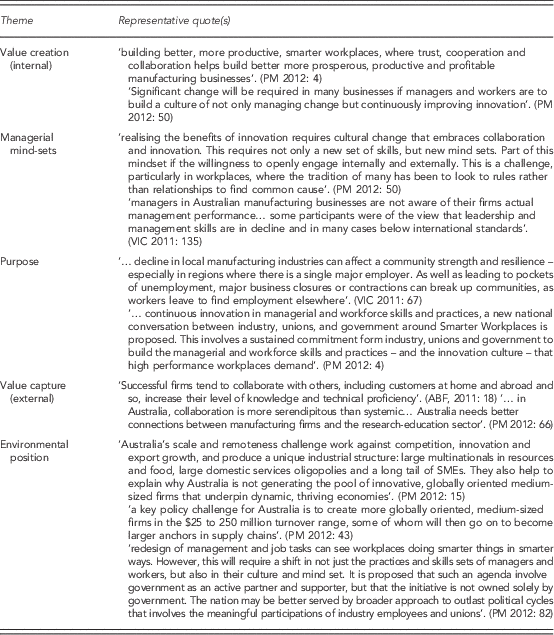
The analysis began by identifying relevant concepts in the data and grouping them into categories, that is, an open coding approach (Van Maanen, 1979) to examine how actors conceptualized the current and future models of manufacturing in Australia – in both structural and value terms. We then grouped these codes into higher order themes, seeking relationships between and among these codes (Gioia, Price, Hamilton, & Thomas, Reference Gioia, Price, Hamilton and Thomas2010), drawing upon insights from Gioia et al.’s (Reference Gioia, Price, Hamilton and Thomas2010) grounded theory approach. Similar to the study by Gioia et al. (Reference Gioia, Price, Hamilton and Thomas2010), we coded using NVIVO software, keeping track of emerging categories, enabling the collapsing categories into fewer themes and supported by relevant samples of text. The coding resulted in the development of 10 codes, which we then grouped into five overarching themes. Figure 2 illustrates the structuring and ordering of the data from the initial codes to researcher-induced higher order themes (Gioia et al., Reference Gioia, Price, Hamilton and Thomas2010), not in a dynamic or causal representation but as an illustration of the methodological process underpinning the findings. See Table 1 for representative quotes for coding themes.
Structure of data analysis for industry reports
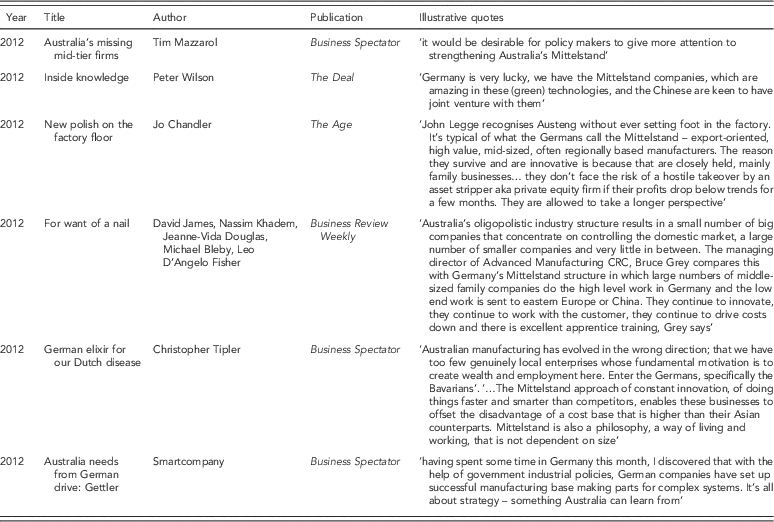
Second, we explored media coverage of Mittelstand in Australia, using media archives drawn from Factiva (news database), similar to other studies that have used such news archives to measure legitimation and the rationalization of new practices, myths and social constructions (Baum & Powell, Reference Baum and Powell1995; Zilber, Reference Zilber2006). We then restricted our search to the past decade (2002–2012), limiting our search only to news articles published in Australia that cited Mittelstand (n=36). Although we recognize that this volume of articles may not initially be compelling, as a mechanism, the role of the media (especially top-tier media outlets) and local ‘accounts’ (Meyer, Reference Meyer2014) have been demonstrated to be influential in many other studies of theorization (e.g., see Davis, Diekmann, & Tinsley, Reference Davis, Diekmann and Tinsley1994; Rao, Monin, & Durand, Reference Rao, Monin and Durand2003). Most were published in 2012, reflecting international newspapers, such as the Financial Times’ lauding of the Mittelstand as the backbone of the German economy, as something that held the European Union together financially in the face of multiple bailouts of other European nations. Table 2 presents illustrative quotes from the most recent articles.
Representative data for coding themes
These newspaper articles provided a supplementary data source on which we also conducted content analysis, and opportunity to triangulate how this model was being theorized and translated in Australia, compared with field-level reports.
RESULTS
The first thing that is evident from the data analysis is that there is an element of the ‘garbage can’ model (Cohen, March, & Olsen, Reference Cohen, March and Olsen1972) to the current espousal of the Mittelstand, as it was not so long ago that The Australian Financial Review wrote a story on the economic woes of Germany, arguing for the need for fundamental reforms of taxation, the welfare system, hiring and firing and other labour market laws, and the laws governing bankruptcy (Taylor, Reference Taylor2003), which positioned the Mittelstand model as a problem. The article reported the resistance to change in the German political landscape and how political parties at the time did not want to suggest ‘rethinking their deeply held belief in the social market economic system that had served them so well since they rebuilt their nation after World War II’ (Taylor, Reference Taylor2003). The article interviewed several experts and reported that:
the social market economy is taught in German schools as a way of stopping extremism from ever happening again. The Germans always look at the impact on individual works; there is a strong distaste for anything that looks like corporate greed… after the horror of World War II, Germans wanted protection and normality… they no longer trusted the market to deliver them political and economic stability, so they put in place a system designed to deliver stability their whole life long, even if the market should fail… and when Germany was a manufacturing-based economy, that system served it well. But now everything has changed the economy is more service based, the industries less location-specific. We need flexibility, we need to be more competitive to keep up, but all of the vested interest groups which have been built up around the old Germany social economy system in place and so, until now, nothing has changed.
A decade later the tune has changed – the Mittelstand and the German Way are now held up as a global success and the envy of many nations around the world. Part of this global theorization, Mazzarol (Reference Mazorol2012) describes the Mittelstand as an organizational model characterized by high levels of innovation and private ownership, high investment in R&D and a location in smaller or regional towns where they have close networks and ties amongst employees, suppliers, R&D and customers. Interestingly, Mazzarol (Reference Mazorol2012) also describes the culture and management style of these Mittelstand as bottom-up, where company leadership has a hands-on approach, deep knowledge of their products, and a culture of investing in the skills and development of the local community (Table 2).
Sample of recent news articles on Mittelstand in relation to Australia
The desired characteristics and future of the Australian manufacturing sector very closely reflects the current and well-known characteristics of the Mittelstand. Several members of the Prime Minister’s Taskforce had written previously about the success of this model and the need for something similar to be developed in Australia: it is evident that this thinking informs not only this report but also the other industry reports considered. For example, we can note the significance afforded to developing longer time horizons, engaging employees and developing trust and knowledge sharing in the workplace (across hierarchical levels) (Riege & Zulpo, Reference Riege and Zulpo2007), focusing on customers and investing in R&D and fostering a shared commitment within the firm. The call for Australia to develop a tier of mid-sized firms that are globally competitive and deliver high-quality niche products seeks to develop something similar to the Mittelstand. The other data source, news articles published in Australia, more explicitly theorize the Mittelstand as a solution to the current crisis in Australian manufacturing.
In Business Review Weekly and in The Age, there are echoes of the Mittelstand proposed as solutions for Australian manufacturing industry. James (Reference James2012), in Business Review Weekly, writes of 10 practical steps, straight out of Mittelstand best practice, which could help make the manufacturing sector viable and sustainable, whereas Chandler (Reference Chandler2012), in The Age, reports on Geelong manufacturer Austeng – a family-owned manufacturing firm, with regional networks, high-quality products, operating in a niche market, proud of the company’s stability and family culture in the factory, which did not lay off long-term workers during the GFC. What is important, according to the article, is the company’s CEO mind-set: ‘we’re not into growth’, whilst still being innovative, dynamic and export oriented. The reason they can survive, the article notes, is that they are allowed to take a longer perspective ‘and not face hostile takeovers from private-equity firms looking for a quick return’. Firms such as Austeng are described in the article as the Victorian Mittelstand, ‘critical to the future of manufacturing and the maintenance of a productive skills base’ and, it is suggested, ‘providing better access to finance on fair terms would be the single best way to support them’ (Chandler, Reference Chandler2012). In the same article, the managing director of a government-funded research centre for the manufacturing sector also suggests Australian manufacturing firms need to think globally, as do the Mittelstand. He described how Mittelstand do the high-level work in Germany and send low-end work to China or Eastern Europe – enabling them to innovate continually, work with the customer and drive down costs. He also notes the excellent apprentice training in German as a success factor of the Mittelstand, as well as the importance of cooperation between managers, employees and unions. Tipler (Reference Tipler2012), a management consultant writing in Business Spectator, refers to the Mittelstand as a ‘German elixir for our Dutch disease’, and that the ‘strategies of Bavaria’s “Mittelstand” companies show a path back to health’.
DISCUSSION
That the German example of the Mittelstand is being considered as an organizational and management solution for Australian manufacturing industry is a contemporary case of theorization and translation. The transnational and contemporaneous nature of this empirical illustration (as compared with detailed historical studies such as Djelic, Reference Djelic1998, who identifies the actual individuals involved in the transnational diffusion of models), makes the four phases of glocalization as outlined by Drori, Höllerer, and Walgenbach (Reference Drori, Höllerer and Walgenbach2014) (theorization and de-contextulization of a global model; construction of equivalency; adoption and enactment through translation and re-contextualization; and rebounding of local onto global templates) a useful framework with which to parse current discourse and speculate as to the successful diffusion and institutionalization of this German model into the Australian context.
De-contextualization (abstraction through theorization)
In feature articles on the Mittelstand published in the Financial Times in 2012, those suggesting the applicability of translating this model to other national contexts included the UK Chancellor of the Exchequer, Directors of the World Bank as well as owners of Mittelstand. In Australia, those doing the theorizing of this model come from a variety of quarters, with commentators ranging from consultants, to educators, to heads of manufacturing research centres, to manufacturers, united in discussing the promise of the Mittelstand model. Recent and major industry reports provide consensual collations of the submissions, views and opinions of many actors in the field in support of the theorization, mobilizing consent through their accounts of what the problem–solution was in the field (Meyer, Reference Meyer2014). A pervasive sense of manufacturing crisis creates the opportunity for alternative models to be considered, and government support and resources to be forthcoming. Alternative ways of organizing become more feasible at times of crisis, as observed in Djelic’s (Reference Djelic1998) study of the export of American model of capitalism to Europe post-Second World War.
Construction of equivalency
In the public discourse analysed, the Australian manufacturing sector, specifically SMEs, is considered by many to be equivalent to the German manufacturing sector, with similar attributes such as skilled labour, and needing to be globally competitive, especially in the face of lower labour costs from China. Thus, Australia, it is argued, needs to build or create a cohort of SMEs or middle-tier firms similar to those in Germany (i.e., the Mittelstand) to overcome the current oligopolistic structure of the industry plus the long tail of poor performing smaller enterprises. Somewhat missing in the construction of equivalency is a broader consideration that the Mittelstand model, to be adopted, would require adoption by not only existing manufacturers, but also trade unions, local communities, national and local education systems, the state and employees. The Mittelstand model is an embedded model (within value chains and knowledge networks) with support systems essential to its operation, specifically the apprenticeship system and R&D, involving closer connections between company research and university researchers. Although some of the characteristics of the sector and the issues it is facing are equivalent to Germany, the other actors involved in the working of this model are quite different. There culturally deep roots that embed and sustain this model in its native land that are not found in Australia.
Re-contextualization (adoption and enactment through translation)
The Mittelstand model of organization has both tangible and intangible aspects – the intangible being the values and philosophy underpinning the model, which, many argue, is its core strength. It seems that as the model is theorized in Australia, the tangible aspects of the business model are the focus, such as niche markets, high-end technology and R&D, and the production of business-to-business products. The intangible aspects receive limited attention. The model’s deeply held value orientations arguably come into conflict with many of the existing models of organization and management in the manufacturing sector.
For example, in the recent report from the Prime Minister’s Taskforce in Manufacturing, there is a focus on long-term thinking, increasing collaboration in workplaces and building stronger relationships with universities and researchers. In the German context, such elements are manifestations of values cultivated over many years and through many generations. This is especially evident, for example, in the strong collaborative relationships for which the Mittelstand are known can be seen in the notion of codetermination (Mitbestimmung). Considering the Mittelstand as a socially embedded organizational manifestation of a specific German value system, beyond seeing it merely as a successful model for SMEs with a certain turnover and number of employees, the likelihood of its translation from Bavaria, Germany to Geelong, Australia, is seemingly both implausible and unlikely, requiring deep and broad processes of translation by many actors. The collective commitment in the Mittelstand to pursuing ‘mutual interests’ (Walker, 1971/Reference Walker1998) necessarily but challengingly broadens the focus of stakeholders well beyond those served routinely by neo-economic liberal market analysis. For instance, in a system of codetermination it would be highly unusual to inform employees of job losses overnight and escort them off the premises with security guards, as occurs in some manufacturing workplaces in Australia (Jarvis & Logue, Reference Jarvis and Logue2012). Australian approaches to business generally (and not merely SMEs), in common with the vast majority of most Anglo-US practices, do not share the foundational values embedded in German law (Mazarol, Reference Mazorol2012). The German approach shifts the focus well beyond shareholders and ‘maximizing shareholder value’, the ideology that has framed the dominant stakeholder role since the late 1970s in Anglo-US business circles with a considerable and growing literature linking the roots of the ongoing GFC/Global Recession with the centrality of this Anglo-US ideology (see Locke, Reference Locke1996; Avery, 2010; Locke & Spender, Reference Locke and Spender2011; Jones, Reference Jones2012; Stout, 2012)Footnote 1.
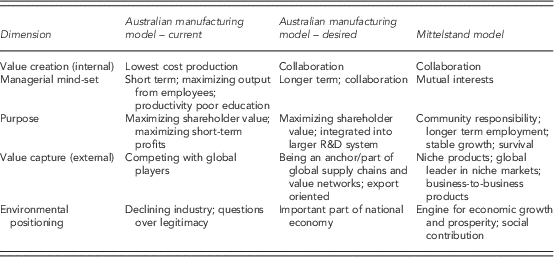
Theoretically, we contribute to understandings of glocalization, and the translation diffusion of management innovations through our empirical testing and evidence of support for the models outlined by Drori, Höllerer, and Walgenbach (Reference Drori, Höllerer and Walgenbach2014) and Meyer (Reference Meyer2014). In our case we see that the local theorization of globally theorized templates is necessary to mobilize consent. Local experts provide accounts and mobilize other experts in field-level studies that produce reports that suggest field-wide support and consensus for such global models, and also construct equivalency. Such accounts ‘work’ as they ‘explain and justify by linking to a shared frame’ (Meyer, Reference Meyer2014: 84); in our setting that the manufacturing sector in Australia was important, that it needed a new organizational model, and that the Mittelstand was a viable model to adopt. Its translation and re-contextualization is ongoing, and faces significant challenges in translating such historical value orientations into a very different national and industrial setting. Our data are limited in that it does not provide details of the finer grained processes of translation (e.g., ethnographically or by specific interviews) that are occurring (or may in the future) in the manufacturing sector of this foreign model. We do show, however, that the value orientations inherent in such models, often neglected by organizational theorists’ focus on diffusion as a clean 1/0 coded adoption, present a more realistic and richer account of the likelihood of institutionalization of organizational models from one context to another, and indeed opportunity to trace movement towards other models or ideal types. Our analysis of the Mittelstand model, as presented in Table 3 and Figure 2, also demonstrates the importance of considering organizational models beyond just formal and informal structures. We suggest that organizational models need to be considered in terms of the way they create and capture value, underlying purpose, managerial mind-set and environmental positioning.
Matrix comparing models of organizing
CONCLUSION
Understanding the process of how a fully institutionalized local organizational model, such as the Mittelstand, may be usable in a completely different local context is aided by applying a four-stage process of glocalization (Drori, Höllerer, & Walgenbach, Reference Drori, Höllerer and Walgenbach2014). By considering the four stages, a very localized model can be seen to be globally theorized (as the Mittelstand was done in international media, business and policy experts), then locally theorized, contributing to local translation and development of a localized model. However, through these phases, in considering both theorization and translation, we see the challenges in how the value orientations of globally theorized models are developed into localized templates.
Translation from German practice to what Australian commentators value appears narrow, with the hard aspects of the model, such as a focus on niche products, customer markets and university linkages more readily transported, than the ‘softer’ values-based elements, such as long-term vision, collaboration with employees and a sense of purpose focused on the continuance of the business as the primary concern. Such a focus differs enormously from that of an ideology oriented to maximizing shareholder value. Under the latter very short, mainly quarterly horizons predominate; under the former longer term horizons for all decision making are inscribed in practice. Tellingly, Australian business management frequently views questions of productivity gains in terms of cost reduction rather than creativity and innovation (Gittens, Reference Gittens2012).
The Mittelstand represents far more than an economic or even manufacturing model. The success of the Mittelstand reaches beyond questions of technical mimesis or translation. The Mittelstand represents a uniquely German story accommodating societal well-being with economic prosperity. In Germany’s Mittelstand (and beyond), human dignity is manifest in business, that is, human dignity serves to ensure that business not only serves society but also that human well-being is an always-embedded governing principle (Glasman, Reference Glasman1996). Theorizing the Mittelstand as a vehicle for economic success raises moral questions of ‘mutual interests’, in which constitutional governance and governmentality at all levels of organization are explicitly, and publicly bound.
The contemporary nature of recent consideration of Mittelstand in Australia provides an opportunity to explore initial theorizations of this management model, compared with other historical studies relying on immense archives (e.g., Guillen, Reference Guillen1994; Djelic, Reference Djelic1998). Such consideration offers an opportunity too rarely developed – that organization theory might shape policy and practice and not just theory. The empirical setting of recent policy debates in Australia demonstrate that organization theorists need to study not only established institutional fields on which there are large data sets and historic data but also need to use theoretical insights to contribute to nascent fields, collaborations and theorizations in order to be engaged as policy scientists in contemporary political, social and economic developments.
Acknowledgements
We would like to thank two anonymous reviewers and the managing editor for their constructive comments. We also thank Alfred Kieser and Markus Höllerer for discussions and feedback on earlier versions of this manuscript. We thank Alexandra Pitsis for her exemplary research assistance. Any errors remain our own.