NOMENCLATURE
- ADD
Aviation Development Directorate
- CA
comprehensive analysis
- CAD
computer-aided design
- CFD
computational fluid dynamics
- CSD
computational structural dynamics
- CD&A-TA
concept design and assessment tech area
- DL
disk loading,
 ${W \mathord{\left/ {\vphantom {W {A_{{{\rm disk}}} }}} \right. \kern-\nulldelimiterspace} {A_{{{\rm disk}}} }}$
, lb/sq. ft
- FEA
finite element analysis
- GUI
graphical user interface
- IML
inner mold line
- INCOSE
International Council on Systems Engineering
-
${L \mathord{\left/ {\vphantom {L {D_{{\rm e}} }}} \right. \kern-\nulldelimiterspace} {D_{{\rm e}} }}$
lift-to-equivalent drag ratio, measure of aerodynamic cruise efficiency
- M
aircraft figure of merit,
${{P_{{{\rm ideal}}} } \mathord{\left/ {\vphantom {{P_{{{\rm ideal}}} } {P_{{{\rm req}}} }}} \right. \kern-\nulldelimiterspace} {P_{{{\rm req}}} }}$
- MBSE
model-based systems engineering
- MDO
multidisciplinary design optimisation
- OML
outer mold line
- QFD
quality function deployment
- SE
systems engineering
- sfc
engine-specific fuel consumption, lb/hp h
- SysML
systems modelling language
- UML
unified modelling language
-
$P_{{{\rm ratio}}} $
ratio of actual take-off power available to rated engine power
- AIDEN
An Integrated Design Environment for NDARC (IDE for using NDARC)
- ALPINE
Automatic Layout with a Python Integrated NDARC Environment (Rapid CAD generator for use with NDARC)
- BRL CAD
Ballistic Research Lab Computer Aided Design (geometry engine for vulnerability analysis)
- CAMRAD
rotorcraft comprehensive analysis software
- Helios
CFD/CSD software
- IXGEN
Intelligent Cross-Section Generator (Geometry and meshing tool for rotor cross-section analysis)
- NDARC
NASA Design and Analysis of Rotorcraft (CD&A-TA’s aircraft system analysis and sizing software)
- NPSS
NASA Propulsion Simulation Software
- OpenMDAO
Python framework for integrating multiple analysis codes into multidisciplinary optimisation problems
- OpenVSP
open source aircraft geometry engine for conceptual design
- PSU-WopWop
rotorcraft noise prediction software
- RCAS
Rotorcraft Comprehensive Analysis Software
- SIMPLI-FLYD
handling qualities analysis tool for conceptual design
- SPIRITS
electro-optical and inferred signature analysis software
- TrueRotorcraft
rotorcraft cost estimation software
- X-patch
radar signature analysis software


1.0 INTRODUCTION
Aircraft design is traditionally divided into three phases: conceptual, preliminary and detail design( Reference Torenbeek 1 ). Each phase is characterised by varying levels of understanding consistent with critical decisions that must be made at the end of each phase.
The goal of conceptual design is the definition of an aircraft configuration which meets system level requirements, subject to constraints on economic and technology considerations. The assessment of the design is often done using semi-empirical analytic methods. These methods often combine simplified physical models with correction factors based on previously built aircraft and are, therefore, best at predicting future aircraft of similar architecture and technology. Uncertainty in the predicted performance, economics and risk must be small enough to have high probability that requirements will be met, as well as enable clear distinction between competing configuration approaches. Conceptual design establishes the basic configuration layout and the overall bounds in which further design work will occur.
Preliminary design takes the resulting configuration, selected in conceptual design, and seeks to allocate and optimise the performance of the individual elements that make up the overall air vehicle system. Higher fidelity analytic methods are typically applied during this phase of design, supplemented by component and sub-scale vehicle testing to confirm analytic predictions. Uncertainty in performance and risk must be further reduced to the point at which firm guarantees can be made on vehicle performance, cost and schedule. Preliminary design is complete when the overall configuration is ‘frozen’ and engineering work shifts to producing the drawings and information necessary to manufacture the aircraft as part of the detail design phase. The detail design phase, which leads to aircraft realisation, typically involves large teams of engineers and is beyond the scope of design activities under consideration in this paper.
Traditional conceptual design methods( Reference Torenbeek 1 – Reference Tishchenko, Nekrasov and Radin 8 ) applied by industry and government advanced design offices have been heavily reliant on empirical and semi-empirical methods adjusted based on historical data. Advances in computer capability and rotorcraft analysis software present an opportunity for these offices to re-think their approach to conceptual design to include analysis and model fidelity now typical of preliminary design. Proper application of higher-fidelity analyses and automated design space search and optimisation techniques, during the conceptual design phase of aircraft development, can improve the resulting aircraft design carried forward into the later stages of development. The goal in the application of these improved tools and methods should be to reduce uncertainty in the predicted performance, cost and risk by enabling better informed system-wide trade-offs. The result is a baseline design carried forward into preliminary design that is technically more mature in its description and projected capabilities than one realised using traditional methods.
The U.S. Army’s Aviation and Missile Research, Development and Engineering Center, Aviation Development Directorate, Concept Design and Assessment Technical Area (ADD CD&A-TA) has been actively conducting research into developing the methods necessary to enable an advanced design activity which may take advantage of higher-fidelity analyses, by blending and improving upon traditional conceptual design and preliminary design processes to improve future rotorcraft development programs. The experience gained from these activities has helped to refine the vision of how rotorcraft design tools must continue to evolve in the future to support advanced concept design. This article outlines a vision of how rotorcraft conceptual design should evolve in general and provides some specific examples of how this vision is being implemented using tools available to CD&A-TA.
2.0 PRESENT AND FUTURE CHALLENGES FOR ADVANCED DESIGN
Previously, McMasters and Cummings(
Reference McMasters and Cummings
9
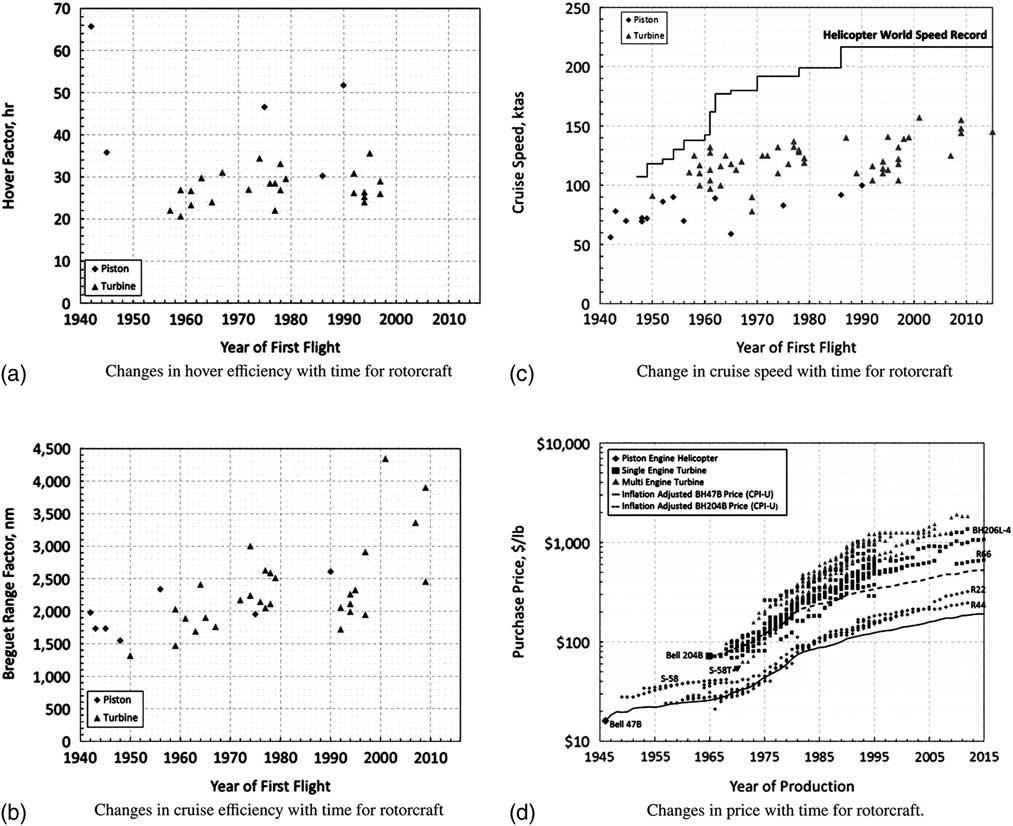
) have highlighted the difficulty over time in continuing to make a sustained rate of progress in traditional measures of aircraft performance as aircraft technology has matured. Figure 1 updates the growth in capability of helicopters for a number of system performance metrics identified by Carlson(
Reference Carlson
10
) that impact payload, range and speed. Hover factor,
 $$75.86P_{{{\rm ratio}}} {M \!\mathord{\left/ {\vphantom {M {\left( {{\rm sfc}\sqrt {{\rm DL}} } \right)}}} \right.} \!{\left( {{\rm sfc}\sqrt {{\rm DL}} } \right)}}$$
, captures the efficiency of a particular vehicle at converting energy into hovering time. Breguet Range Factor,
 $${{325.8L/D_{{\rm e}} } \mathord{\left/ {\vphantom {{325.8L\,/\,D_{{\rm e}} } {({\rm sfc})}}} \right. \kern-\nulldelimiterspace} {({\rm sfc})}}$$
, is the term in the Breguet range equation related to aerodynamic and engine efficiency. Aircraft of equal range factor, regardless of overall vehicle take-off gross weight (size), will fly the same distance for an equal consumption of fuel mass divided by the take-off gross weight. Increases in the value of the Breguet Range Factor, due either to engine or aerodynamic efficiency improvements, are an improvement in aircraft cruise efficiency. These metrics are often considered by advanced design offices when assessing various configurations and design trade-offs. Eight decades of research, design and development have led to progress in speed and fuel economy, resulting in helicopters that fly farther and faster than the initial offerings of the 1940s. Consistent with the findings of McMasters and Cummings, the rate of progress in areas such as speed has slowed with time. Additionally, customers have become more sophisticated in their requirements, demanding not only continued performance improvement in traditional payload, range and speed metrics but also an improvement in more diverse attributes such as noise and environmental emissions(
Reference Russell and Basset
11
), and mission systems. Unfortunately, as Fig. 1(d) also shows, the price of more capable helicopters has grown faster than general inflation. If the rotorcraft industry is to grow or even sustain its current markets, this trend in price growth with more capable helicopters cannot continue indefinitely.
Historic trends in rotorcraft performance, showing slowing increases in capability with ever-increasing cost.

Pursuing novel configurations, which might offer hope of breaking away from the historic trend of evolutionary improvements shown above and better address some of the newer requirements, typically comes with a higher level of development risk. In a business environment where the cost of new aircraft development has rapidly escalated, there is a waning tolerance for accepting the level of development risk which remains when classic methods of conceptual design are applied to novel configurations. This leads to a desire to drive to lower levels of uncertainty in the conceptual design phase. However, uncertainty associated with many of the classic conceptual design methods, such as scaling trends for weight prediction, while reasonably estimated for evolutionary designs, begin to breakdown as the design departs further from historic practice (becomes more ‘novel’). Novel configurations may also introduce new interactions between components that are not well modelled, resulting in system performance which differs greatly from what would be expected in a more conventional design. Further, the design problem itself is better understood for the evolution of existing configurations, and aircraft designers are able to use this understanding to define optimisation formulations for these configurations which include design variables most impactful to the desired measure of merit. Understanding what matters for a novel configuration and should be included in an optimisation formulation is less clear. When uncertainty is considered in the evaluation of vehicle performance, either explicitly in the design process or implicitly by the application of ‘engineering conservatism’ to empirical factors in the analyses, the potential advantages of novel configurations can be nullified by the larger uncertainty associated with them when limited to using traditional conceptual design methods. Many( Reference McMasters and Cummings 9 , Reference Kroo 12 , Reference Kolonay 13 ) have suggested that exploiting the capabilities in advanced computational tools may provide a way forward for reducing the uncertainty and risk inherent in novel configurations early enough in the design/decision process to enable their pursuit. Improved design methodology, therefore, becomes a key enabling technology to bring novel configurations to maturity and potentially find new and better ways to address the emerging requirements.
Classic conceptual design methods have the advantage of requiring only a relatively simple description of the air vehicle in terms such as overall dimensions, power installed and general placement of major components. This level of description is consistent with the basic understanding of the requirements and design that is typical of conceptual design. This can be contrasted with higher fidelity analysis methods used in preliminary and detail design which require suitably high-fidelity descriptions of the aircraft to include geometry, system architecture and component layout. Unfortunately, this information is often not immediately available during conceptual design, though some( Reference Roth, Livingston, Blair and Kolonay 14 ) have proposed estimating this detail by analogy or parametrisation of common design building blocks such as wings, fuselages, engines and rotors based on existing aircraft. Lack of the necessary description detail, or inappropriate approximation by parametrisation or analogy, can lead to spurious results when higher fidelity analysis is considered in the context of predicting the actual behaviour and performance that will result in the final design.
Ultimately, it is a more accurate prediction of the design performance and cost for a wide range of configurations at the end of the development process that is desired. This should not be confused with a related, but different, goal of accurate analytic results from a vehicle conceptual representation. To improve traditional conceptual design methods, it is, therefore, necessary to address the interrelated challenges of analysis and design description fidelity. As noted above, this problem is made more difficult when applying traditional conceptual design methods to a novel configuration, since it is still desirable to reduce the uncertainty in the predicted performance and project the impact of technology and program risk to the same level of certainty as for a traditional configuration. Using current state-of-the-art design processes and methods, decision makers may be left with the undesirable choice between pursuing novel designs, with greater uncertainty, which could potentially meet or exceed requirements at an improved cost, or taking an evolutionary path, with greater certainty, but with smaller potential improvement in performance. As requirements for aircraft designs become more strenuous and include factors not previously considered in the configuration selection process, the demand for consideration of novel configurations will only increase. To remain effective in the future, therefore, rotorcraft advanced design offices must improve their design methods and capabilities to address these challenges and opportunities.
2.1 Advanced design challenges
Uncertainty in analysis hinders the ability to distinguish between multiple alternatives the most cost-effective or acceptable risk path to improve the performance or meet new requirements
• Novel configurations are penalised when using traditional conceptual design methods simply because they are novel.
• Level of vehicle description necessary for the use of higher fidelity analyses not consistent with traditional descriptions used in the conceptual design.
• Advanced design approaches must be timely to execute, and appropriate for the size and skill mix of advanced design groups, which represent a subset of the entire engineering workforce involved in the complete aircraft development process.
3.0 APPROACHES TO DESIGN
A number of groups and individuals have identified the need for improved methods to address these challenges. While each approach is unique, it can be helpful to examine these proposed approaches in the context of three general themes: Systems Engineering, Multidisciplinary Design Optimisation and Design Thinking.
3.1 Systems engineering
The International Council on Systems Engineering (INCOSE) defines Systems Engineering as
An interdisciplinary approach and means to enable the realisation of successful systems. [Systems Engineering is focused] on defining customer needs and required functionality early in the development cycle, document requirements, then proceeding with design synthesis and system validation. Systems Engineering considers both the business and the technical needs of all customers with the goal of providing a quality product that meets the user needs. http://www.incose.org/AboutSE/WhatIsSE/.
In the United States, DoD Directive 5000.01 mandates the application of a Systems Engineering (SE) approach in the management of acquisition programs to optimise system performance and minimise cost.
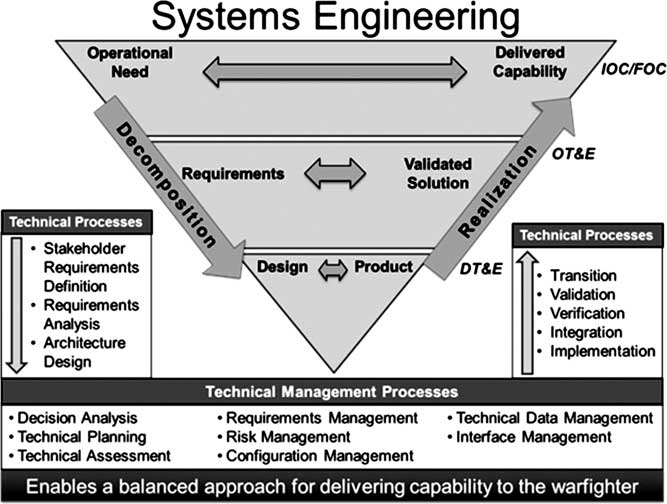
The classic SE process is a documentation driven activity which proceeds from systems requirements definition and analysis through architecture design to implementation, integration, verification, validation and transition( Reference Kossiakoff, Sweet, Seymour and Biemer 15 ) (see Fig. 2). Techniques such as the Quality Function Deployment (QFD) house of quality, Pugh matrix, functional decomposition and N-squared diagrams provide formalised means to decompose and document various aspects of the vehicle system design. While providing a format and structure to visualise and document design choices, these techniques alone do not provide physical insight into the implications of design choices.
Systems Engineering Processes (source: Defence Acquisition Guidebook).

Integrated Process/Product Design/Development as developed and evolved at Georgia Tech( Reference Schrage and Mavris 16 , Reference Schrage and McCandless 17 ) uses the Systems Engineering methods in decomposing the requirements and designing an end-item. These methods are embedded in an integrated computer environment and emphasise the need for formalised requirements’ decomposition and trade-off analysis early in the development process of a new design. Arruda et al.( Reference Arruda, Gavrilovski, Ahn, Chae, Spero and Mavris 18 ) specifically looked at the information challenge facing decision makers in selecting requirements, vehicle configurations and technologies for advanced concepts, and developed a software toolbox that aids in applying the SE processes. This approach, as implemented, has a need to encapsulate the vehicle design problem in a surrogate model, which necessitates upfront decisions regarding the dimensions of the design space and associated ranges of selected design parameters. Care must be exercised to ultimately check any resulting design selected from the surrogate model against the results obtained from a multidisciplinary analysis of the design. Additionally, in order to execute the SE process, these tools often encode utility function weights based on subject matter expert qualitative judgments. The resulting output of this process can be dominated by those empirically selected values, which may have a high degree of uncertainty. In practice, the connection between these utility function weights and design outcomes, paradoxically, may also be obscured by the overall complexity of the SE technique applied.
Recognising some of the weaknesses in the classic Systems Engineering methods, the International Council on Systems Engineering (INCOSE) outlined a vision of the evolution of the discipline towards a method it termed Model-Based Systems Engineering (MBSE)( 19 ). This is described as a move away from the document-centric approach of classic SE towards a model-centric approach. INCOSE identified the following key characteristics of MBSE:
• Domain-specific modelling languages and visualisation that enable the system engineer to focus on modelling of the user domain.
• Modelling standards based on a firm mathematical foundation that supports high fidelity simulations and real-world representations.
• Extensive reuse of model libraries, taxonomies and design patterns.
• Standards that support integration and management across a distributed model repository.
• Highly reliable and secure data exchange via published interfaces.
Many generic MBSE tools rely on variations of the Systems Modelling Language (SysML) or Unified Modelling Language (UML) to describe these system models. The generic nature of these modelling techniques makes it difficult to describe aircraft designs in terms suitable for the application of traditional physics-based analysis methods necessary for the evaluation of the designs. The syntax and abstract nature of these modelling languages also can negatively impact the ability of aircraft designers to develop the necessary understanding regarding the relationship of various design choices and requirements with system performance.
SE processes provide an organised framework by which design offices can document and address the challenges faced in developing the next generation of rotorcraft( Reference Price, Raghunathan and Curran 20 ). However, the quality of the output from these processes is entirely dependent on the quality of the data available to the process. MBSE attempts to address data integrity by an increased focus on the model(s) from which data are derived but does not directly address the challenge, outlined above, of developing physics-based models of suitable fidelity. Modern aircraft are by their nature complex multidisciplinary objects. The techniques of SE and MBSE, while helping to organise and categorise the designer’s understanding of the vehicle, may not improve his ability to actually understand and address that complexity through design. Designers and decision makers must exercise care to pay attention to not only the process itself but also the underlying data and modelling uncertainty to ensure conclusions drawn from exercising these processes of SE and MBSE are valid.
3.2 Multidisciplinary design optimisation
Multidisciplinary design optimisation (MDO) is the application of numerical optimisation techniques to system representations where multiple engineering disciplines are involved and interrelated analytically. Typically, each of these disciplines has some specific analysis algorithm or technique that is used to provide design information needed to determine the overall system performance and cost. A number of different approaches and procedures have been proposed to systematically solve a design problem posed in this manner( Reference Martins and Lambe 21 ). Much of the work in the MDO community has been focused on developing a variety of efficient ways to solve the integrated design problem. This includes the development of various decomposition approaches to optimisation, as well as algorithms to efficiently solve optimisation problems through improved search procedures, cheaper calculation of gradients or more robust surrogate modelling. A key aspect of MDO is, therefore, developing the framework for interconnecting these analyses in a flexible manner( Reference Martins and Lambe 21 – Reference Martins, Marriage and Tedford 23 ).
MDO attempts to leverage existing discipline-specific algorithms and interconnect them in ways that allow for design and analysis of the entire system problem. MDO assumes that there exist emergent behaviours of the system that cannot be adequately captured in isolation and that the combined behaviour should be modelled and optimised. Examples of this are seen in both wing and rotor( Reference Ortun, Bailly, Mercier des Rochettes and Delrieux 24 ) aerodynamic and structural optimisation. A related theme in MDO has been to increase the fidelity of the various analyses as computational capability has increased.
While MDO provides a software paradigm and algorithmic means to approach solving the higher-fidelity aircraft design problem, it too alone is not sufficient to address the challenges previously highlighted. In particular, MDO requires well-formed optimisation problems, the generation of which can be problematic for a variety of reasons. The designer must distil the complex requirements space into a numerical merit function which can be evaluated, and upon which the entire result of MDO depends. Many MDO approaches also implicitly assume a unification of the design process and analytical knowledge needed for design in ways that are not consistent with how many large engineering organisations are structured( Reference Belie 25 ). Even if the design problem can be well posed for MDO, institutional barriers may make it difficult or impossible to actually integrate the analysis process to the degree necessary for MDO algorithms to be applied. Additionally, one of the reasons early stages of design can have such a profound impact on the overall cost, schedule and risk of a development program is the fact that the designer still retains tremendous freedom to modify the design. MDO struggles with problems that include a large number of degrees of freedom, since the computational cost of many methods increases geometrically with problem size. Despite these limitations, it provides an important way forward for increasing fidelity in advanced design since it can provide a common framework for multiple discipline experts to interact in the design problem. Collectively working on MDO approaches also may help to breakdown some of the historical institutional segregation that has developed over time.
3.3 Design Thinking
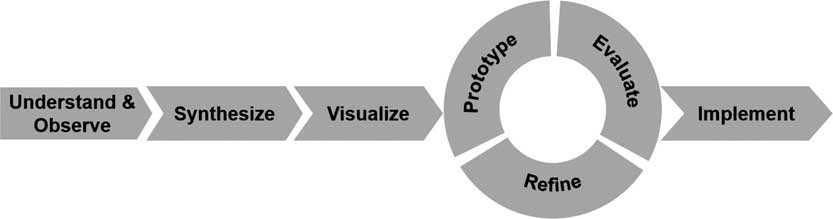
Design Thinking is the term used by David Kelly of Ideo( Reference Tischler 26 ) and others to describe the process for developing new ideas that have been applied to the development of a wide range of products and innovations. Figure 3 outlines this process, as described by Ideo. The concepts of understand and observe, synthesise, visualise, prototype–evaluate–refine, and implement that form the core of this process should be familiar to aircraft designers, and have similarity to the SE technical processes of requirements decomposition, architecture design, verification & validation and transition. Design Thinking, in contrast to the other two approaches described, views design primarily as a creative activity. Keys to making this activity effective include the use of diverse teams, focused effort and willingness to explore novel ideas. Many elements of this process can be observed in the case studies on aerospace engineering examined by Vincenti( Reference Vincenti 27 ). Design Thinking also emphasises the iterative process of prototyping, evaluating and refinement. The practical value and essence of this process is seen in many historical aircraft developments where the ability to do ‘cut-and-try’ activity, rapidly in a relatively low-cost manner, leads to rapid advancement of designs and technology.
Ideo Design Thinking process.

Sikorksy’s VS-300 helicopter development provides one such example of this process at work. Sikorsky went through a number of tail designs in search of an approach to achieving controlled hover, beginning with a single blade anti-torque rotor then proceeded through several multi-rotor configurations to the final two-bladed anti-torque rotor configuration. The prototype–evaluate–refine process allowed him to gain valuable in-flight experience and knowledge necessary to create a successful helicopter. As aircraft became more complex, and the associated support organisations larger, the ability to complete this physical design iteration efficiently was degraded to the point where it is now seen as a primary non-recurring cost driver that should be reduced or eliminated. One opportunity high-fidelity physics-based computational models present is the ability to reinvigorate this iterative process in advanced aircraft design using virtual prototyping in place of physical prototyping.
4.0 ADVANCED DESIGN VISION
In the future, rotorcraft advanced design must leverage the ideas and concepts from the three viewpoints on design discussed above to meet the challenging goal of reducing uncertainty and risk earlier in the design process, while also increasing the breadth of vehicle capabilities considered. The re-imagined advanced design activity must use these tools and approaches to address the challenge of vehicle costs rising faster than inflation, adequately consider novel configurations, reduce uncertainty by improving overall analysis and model fidelity in synchronisation, and rapidly execute the prototype–evaluate–refine process in a virtual manner. Vehicle level performance analysis and design codes, such as NASA Design and Analysis of Rotorcraft (NDARC)( Reference Johnson 5 ), will remain the primary tool of advanced design offices because of their ability to model the integrated aircraft performance using information generally available to early design efforts. These tools will, however, be increasingly supplemented by higher fidelity analysis tools which can aid in the reduction of uncertainty associated with exploration of design spaces not well validated by existing aircraft designs. While the results of these analysis tools cannot be blindly accepted as infallible, and should be carefully validated against experimental data, they can provide a physical basis for extrapolation that is less uncertain than direct extrapolation of the semi-empirical methods used in codes like NDARC.
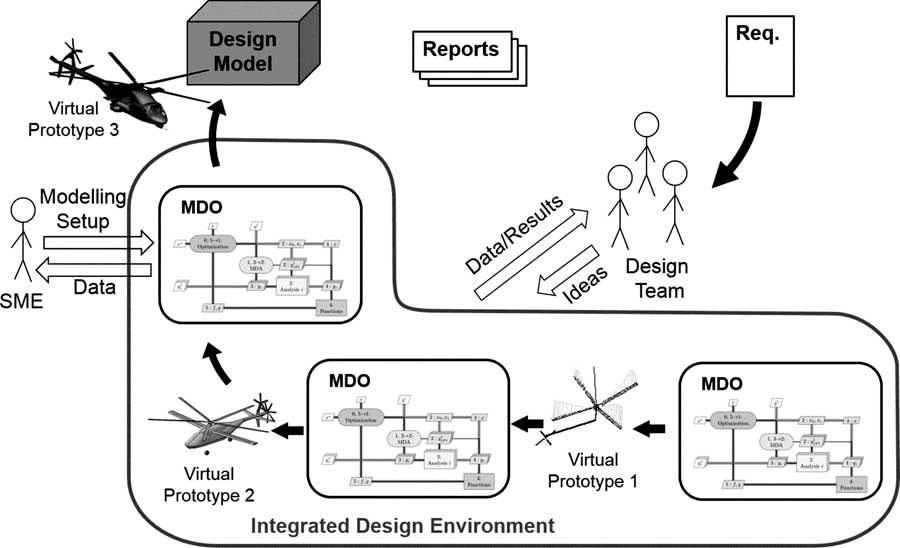
Figure 4 depicts a vision of a re-imagined advanced design process, highlighting some of the important aspects of that process that leverage ideas from SE, MDO and Design Thinking.
Re-imagined advanced design characteristics
• Integrated Design Environment (IDE): The IDE is intended to provide a flexible framework in which design teams and other subject matter experts can interact to rapidly move through the prototype−evaluate−refine stages for a variety of configurations.
• Virtual Prototyping: The models developed as successive virtual prototypes can be carried forward to aid in transfer of knowledge and design intent to later stages of design activity as is envisioned in MBSE.
• Multidisciplinary Design Optimisation: MDO processes will be tailored at each iteration of the virtual prototype to match analysis fidelity with model fidelity and maturing of understanding of the vehicle design regardless of configuration.
• SE Documentation: The framework must also support tracking of requirements and their relationship to the virtual prototypes to ensure continued use of SE best practices.
An overview of a re-imagined advanced design process.

4.1 Uncertainty
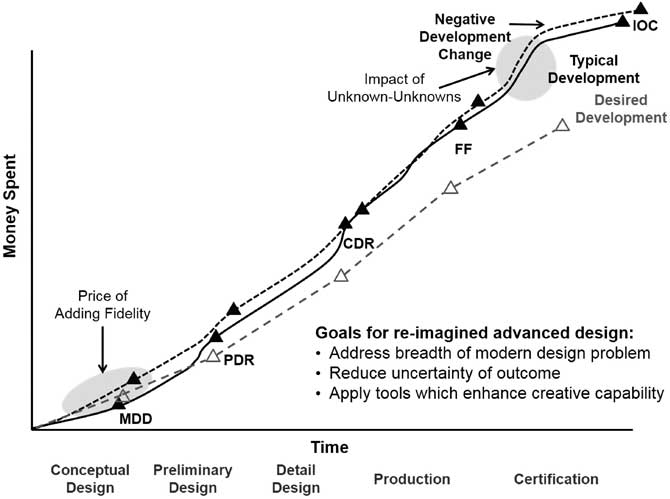
A driving consideration in a re-imagined advanced design process is the desire to reduce uncertainty more quickly as the design proceeds, with the implication that such an outcome will positively impact the development timeline and non-recurring development cost of advanced aircraft as illustrated by the notional dash trend line in Fig. 5, which represents a program that executes to plan from start-to-finish. In a perfect scenario, this re-imagined advanced design capability would result in a small increase in the development cost early that would be more than offset by cost saving from smoother running detail design, assembly and test phases with little or no surprises late in the aircraft development. Unfortunately, running higher fidelity analyses earlier does not automatically guarantee a reduction in the uncertainty of the predicted performance of the final design. In particular, the nature of the ‘unknown–unknowns’ in aircraft development suggests that while an overall reduction in cost and schedule is possible, it cannot be guaranteed just by improving advanced design activities. This is illustrated in Fig. 5 by the dotted line which shows an increase in cost during the advanced design phases relative to current practice, and a slight reduction in detail design, assembly and test costs, but a failure to anticipate the impact of ‘unknown–unknowns’, ultimately resulting in a slight non-recurring cost increase over a notional baseline program executed using today’s tools. While this potential downside to pursuing additional fidelity early in the program is real, and arguably the likely outcome of an ad hoc approach to pursuing more fidelity early in the design process, the difference in cost between the dash line upside postulate and the dash-dot downside postulate is large enough to warrant further exploration of improved advanced design methods. In an effort to properly manage uncertainty, each proposed modification to a re-imagined advanced design activity must consider both the uncertainty it directly attempts to address with a higher fidelity analysis and potential uncertainty that analysis adds through additional design assumptions and process complexity.
A notional baseline development cost profile compared to two possible outcomes of change in non-recurring costs and timeline for development of a new aircraft as impacted by improvements in the advanced design process.

Several sources of error and uncertainty that can impact the design include analysis error, model description error and specification error. Analysis error is the error and uncertainty most directly affected by the introduction of higher fidelity analyses in the advanced design process. Such analyses when properly verified and validated should reduce performance prediction uncertainty and provide a better physical basis for extrapolating performance, as is often necessary for novel configurations. However, the introduction of higher fidelity analysis typically requires a corresponding increase in the fidelity of the description of the aircraft model.
During the early stages of design, the design is not yet mature in its definition, and providing the necessary description to support the higher fidelity analysis can introduce errors in predicting the ultimate outcome based on an incorrect model description. These errors may take two forms, first an inconsistency between the representation used in two different models (e.g. mid-plane chord distribution used in a lifting-line analysis not matched to chord distribution implied in a CFD mesh), or second, an insufficient design error, where the necessary information has not yet been specified and therefore must be inferred (e.g. using NACA0018 airfoil cross-section to generate a wing mesh for CFD analysis as an initial guess for the performance of an advanced wing). The first error source is addressed as part of the tool integration and data management development. The second error source is more difficult to address since this can only be done by actually developing a suitable design description. The difficulty that immediately arises is that such a description, while a natural outcome of the complete design and development activity, may not be something that can be readily discovered or known otherwise. Simply moving more detailed design activities earlier in the development process can be expected to actually increase cost and schedule since the net effect is to increase the uncertainty of the requirements used to develop this design description and increase concurrent engineering activities. A derived requirement for any advanced design capability that intends to include higher fidelity analysis is the need then to provide a means for addressing this challenge.
A final source of uncertainty that must be addressed is specification error. This error arises because either the user requirement is not fully understood, or the conditions and assumptions that stand behind that requirement are no longer correct at some future point in the aircraft’s life-cycle. Many of the practices of Systems Engineering provide a means to carefully document and decompose the user requirement and may help mitigate against this type of uncertainty. These processes typically involve trade-off analysis of some form, and the most accurate data available to describe the trades should be considered during that analysis. The use of high-fidelity multidisciplinary analysis and simulation to predict vehicle performance and provide evidence to support the trade-off analysis can and should become a more frequent part of these SE processes.
Design Thinking also can play a role in addressing specification uncertainty. Advanced design groups should recognise that an additional source of specification error is related to the human aspects of design that Design Thinking attempts to address. Brainstorming and the use of diverse teams in the design process are hallmarks of Design Thinking that should become as common in advanced design groups as QFD and Pugh matrices. High-fidelity analysis and simulation can also serve as a virtual prototype to support the prototype–evaluate–refine process.
Ultimately no process, tool or technique will be able to guarantee the elimination of all uncertainty in aircraft design, development and use. However, opportunity exists to improve on the current state of practice and proactively address uncertainty during early aircraft design activities. Further, by properly understanding the nature of the uncertainties present, aircraft designers can draw upon a broadened toolbox of techniques and analyses to address these uncertainties. Advanced design groups can also better fulfil their responsibility to communicate the risks of various design approaches to all stakeholders in an aircraft development program so that informed choices can be made.
Re-imagined advanced design characteristics:
• Uncertainty Tracking: Decisions to increase fidelity are driven by characterisation of uncertainty in the predicted performance of aircraft concepts.
• Risk Aware Decision Making: Uncertainty quantification enables design and requirement choices to be made with the understanding of the relative risk remaining in each course of action.
5.0 CD&A-TA DEVELOPMENT ROADMAP
Developing the enhanced capability desirable in the early stages of design to address future aircraft design challenges and uncertainty will take time and practice. Best practices must be developed to guide designers in the approaches they take to address the increased breadth of assessment while also reducing uncertainty and continuing to look at novel configurations. Over the past few years, the U.S Army CD&A-TA team has work to enable a re-imagined advanced design capability through a number of software tool development projects and design exercises. The approach is one potential means to address the challenges and characteristics identified above and lessons learned have resulted in continued refinement of the roadmap.
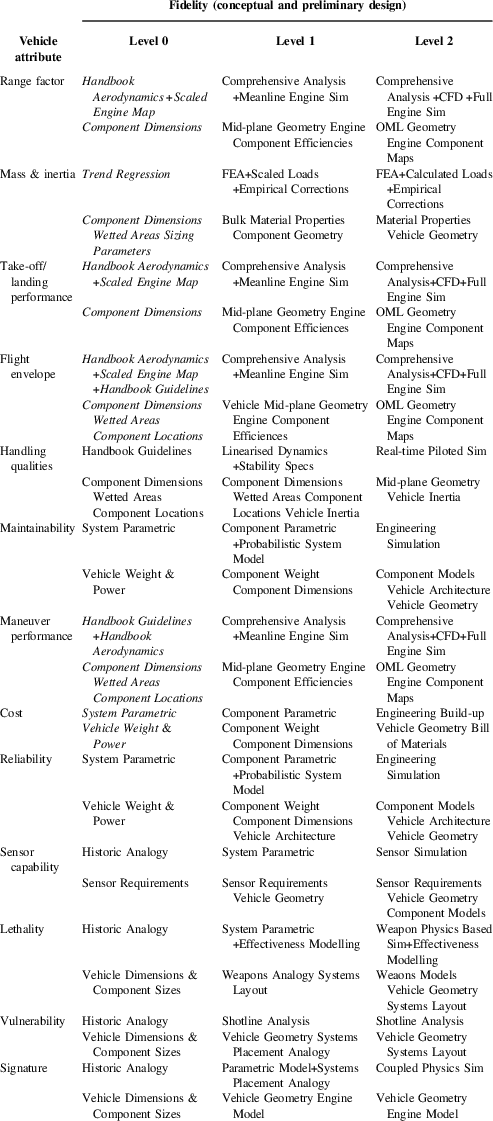
A list of vehicle capabilities desirable for consideration and assessment early in the aircraft development process by CD&A-TA is given in Table 1. For each capability, a series of assessment fidelity levels are defined both in terms of the analysis fidelity and associated model description fidelity to go with that analysis. In general, Level 0 fidelity is characterised by semi-empirical and analogy-based analysis methods which require a simple description of the vehicle. Level 1 analysis begins to introduce more physics-based analysis in the process and/or move parametric analyses from the system level to the component level, with explicit modelling of the component interactions in the system. Fidelity of the model description must increase to support these more in-depth analyses. The level of description required begins to resemble that seen in later stages of design, but many of the details present in CAD, FEA and CFD models at later stages are not yet mature and maybe left-out, simplified or chosen by historic analogy, thereby limiting the degree to which uncertainty can be reduced. Level 2 goes further in introducing physics-based modelling and requires a similar increase in the supporting fidelity of the model which represents the aircraft. In practical terms, the level of refinement required to support Level 2 modelling over the entire vehicle requires a degree of engineering effort that is beyond that scope of early design activities.
Summary of necessary analysis capability (upper row) and level of model description (lower row) required to achieve varying levels of fidelity for a variety of aircraft attributes. Algorithms and model descriptions contained in NDARC are in italics for reference

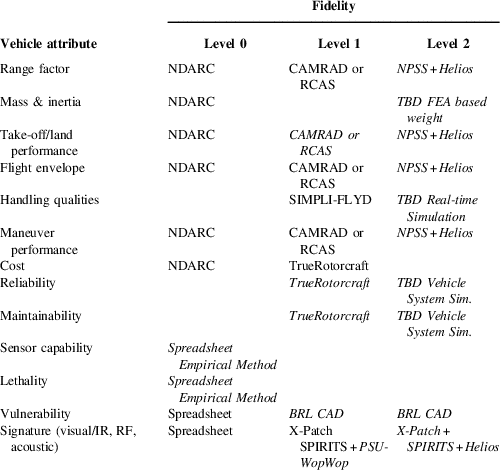
For a particular capability or configuration, however, it may be desirable to examine some aspects of a design with Level 2 tools and models to address an uncertainty that may be a driving factor in decision making. Table 2 correlates analysis software tools used by CD&A-TA to levels of analysis fidelity and vehicle attributes. In some case, the same tool and model can be used to make assessments of multiple attributes.
A summary of software tools CD&A-TA uses to address the various vehicle attributes of interest. Planned tool usage identified in italics

Table 2 does not provide a complete picture of the necessary tool development required by CD&A-TA to achieve the desired advanced design end-state. To facilitate the use of these tools in an advanced design process, additional work is required to develop a framework for integrating these analysis tools along with the creation of other software utilities which aid in the vehicle model creation and management. We have previously( Reference Johnson and Sinsay 28 ) identified that the movement and management of design information is an important enabler for the successful use of these tools. This leads to a need for common representations of the vehicle design model and associated interpreters to ensure consistency of information across multiple analysis tools. Vehicle geometry plays a critical role as one common view of the vehicle design, and initial work should be focused on developing a parametric, higher fidelity geometry capability to integrate with the vehicle performance and analysis code. This integration will likely form a core capability necessary for all design activities, from which other analysis tools can be incorporated, as necessary, to address uncertainty reduction and provide additional assessment of required capabilities not directly addressed in the core tools.
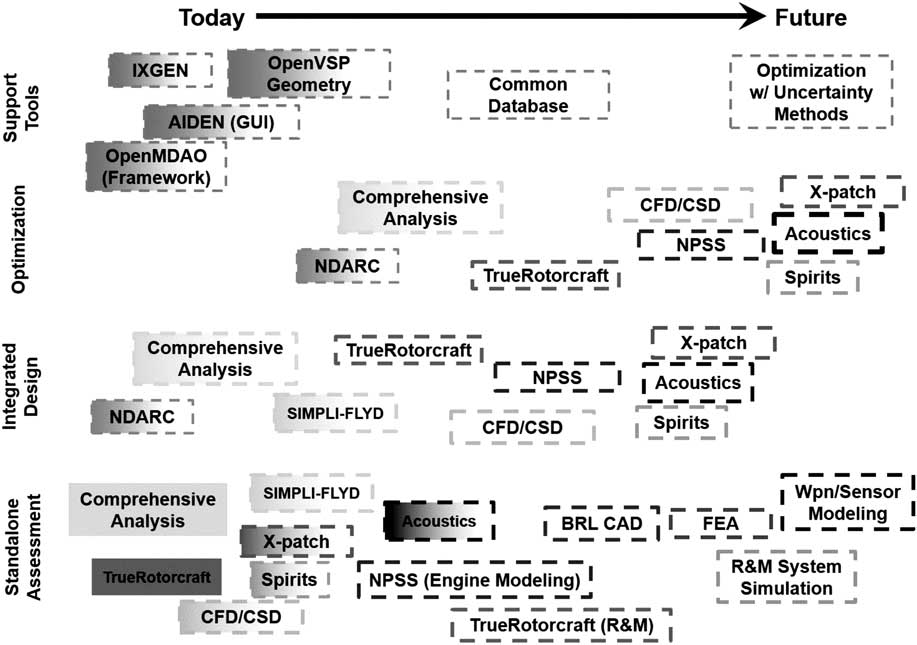
Figure 6 shows a progression for tool development and integration that is being pursued by CD&A-TA to try and enable our re-imagined advanced design process and actualise the vision described above. Consideration of new attributes can be expected to begin as a separate assessment activity not tightly integrated with the overall design process. As insight is gained into the necessary model fidelity and use of appropriate analysis tools to perform this assessment, work can then proceed to more tightly integrate consideration of the attribute into the overall design process. Flexibility should always be maintained in this integration; ultimately leaving it to the designer to select the tools used to tailor the design process to a given problem.
ADD CD&A-TA’s evolution of advanced design to include tools that increase the breadth of the attributes that can be considered and integrate the consideration of these attributes into a holistic design process within an integrated framework.

5.1 Near-term activities
Initial integration activities are focused on bringing together the core sizing and geometry tools already in use in advanced design into a framework like those developed for MDO. This framework provides the requisite standards-based environment to integrate multiple tools in a consistent manner and naturally leads to the development of a common data model for sharing information between the analysis codes consistent with MBSE principles. The framework should provide a flexible and scalable approach to integrating the various analysis tools, allowing aircraft designers the ability to tailor the process easily and quickly to meet their assessment needs in support of rapid prototyping, evaluation and design refinement.
In parallel with these initial integration activities, work may proceed in the development of the additional tools needed to reduce uncertainty with higher fidelity and increase the breadth of attributes assessed. In developing these tools and methods, care should be taken to document and track sources of uncertainty, and whenever possible attempts made to validate and verify processes and analyses using existing aircraft data. Also, the time required for executing these processes and necessary engineering expertise should be considered and documented. Assessments must be made in a timely fashion, consistent with the rapid pace of typical advanced design activities. Part of this timeliness is related to the overall structure of the organisation and the responsiveness of various discipline experts to the advanced design office. Advanced design offices should develop, document and retain sufficient expertise and knowledge to exercise these domain-specific higher fidelity tools, supported by additional subject matter expertise from the various engineering disciplines for problem setup and final design validation.
A vital part of the integration work is the development of a user interface that increases productivity by simplifying and automating commonly completed design tasks, while preserving the flexibility necessary to allow for customisation of the design process to a particular design activity. The user interface must also help with data and model management and data interpretation. As additional high-fidelity tools and optimisation techniques become incorporated into this advanced design process, the need to distil information into knowledge becomes increasingly more important. The ability to quickly generate appropriate knowledge to inform the design process is a characteristic that will distinguish effective advanced design activities from ineffective activities. The user interface should also include consideration of the System Engineering process and the need to generate information on the design to support organisations in the use of Systems Engineering.
5.2 Long-term activities
Returning again to Fig. 6, later development activity is focused on the development and application of automatic design and optimisation algorithms in the integrated environment. These capabilities provide a means to address the insufficient design description issue described above, as well as improve the designer’s ability to search complex design spaces where a designer’s intuition-based experience may break down. A portion of the rationale for pursuing higher-fidelity analysis and design earlier in the design process is the fact that changes at the system level can be less disruptive to the design activity, and therefore more freedom exists to make large changes to the design. Designers, therefore, need a means to actually explore these complex multidisciplinary interactions as part of the design and optimisation process using MDO approaches. A challenge with current optimisation algorithms is that the number of potential design variables far exceeds the number that can practically be optimised. The use of high-performance computing can help alleviate some of the limitations associated with computational cost, but additional work is required to develop efficient algorithms for system level design. These algorithms should include both calculus-based optimisation and heuristic design approaches. Optimisation algorithms and design best practices must also be developed that deal with the variety of potential design variables and merit functions to include stochastic results that may come from the inclusion of mission effectiveness or similar analysis tools. In developing these capabilities, it must also be recognised that the fundamental goal is not necessarily to find the perfect vehicle design for a given set of requirements, but rather to efficiently search the potential design space and enhance the designer’s knowledge of that space in order to enable appropriate selection of a configuration and associated description. This selection may then be further analysed, refined and developed at later stages of the design process.
In addition to optimisation of nominal performance, uncertainty and robustness of designs to perturbations in the underlying assumptions should be addressed. This will help reduce the impact of specification uncertainty. By exercising these tools and processes on a series of design activities, verification of the suitability of these processes and designer best practices may be developed and documented. These verification activities will also highlight deficiencies in the toolset and may provide a basis for further validation of the design process if the design activity proceeds to the actualisation of an aircraft. An important consideration in this design activity is careful documentation of the design best practices. In particular, these best practices should help guide designers in the selection of analysis tools and areas of design to concentrate on to meet different design objectives.
6.0 DEVELOPMENT STATUS
CD&A-TA work to date has now produced initial versions of many of the tools necessary to form the core capability described above. Work continues on beginning the process of integrating and exercising these tools in the design activity. Lessons learned from these initial activities are being used to refine the tools and initiate the second phase of activity which will demonstrate more multidisciplinary analysis and design capability, including the more extensive use of optimisation techniques in CD&A-TA’s design practice. A brief summary of some of the most notable efforts is provided below.
6.1 Analysis tools
Accurate cost estimation tools are a prerequisite for making progress in being able to design next-generation aircraft that delivers enhanced capability in an economic fashion. We have developed the TrueRotorcraft cost estimation tool in co-operation with PRICE Systems and US industry-academia-government Vertical Lift Consortium( Reference Scott, Sinsay, Dinning and McMichael 29 ). TrueRotorcraft extends the historical Level 0 system cost analysis of NDARC to provide Level 1 cost analysis capability. Costs are estimated at a component level corresponding to the 3rd and the 4th level of the MIL-STD 881C work breakdown structure. The cost estimating relationships used in TrueRotorcraft are based on historical data and require inputs about the air vehicle design that are consistent with the component information available in typical NDARC models. This tool provides a foundation for further integration of cost into the future advanced design process and will allow for various optimisation and trade-off activities to more fully consider cost metrics. Going forward, we intend to extend this style of methodology to estimate reliability and maintainability at the component level.
Scott et al.( Reference Scott, Sinsay, Dinning and McMichael 29 ) also describe on-going work to include mission effectiveness analysis in our design process. This analysis required the development of tools to bridge from NDARC output to various signature inputs necessary to model the susceptibility of aircraft in the mission effectiveness tool. This toolset included the use of existing radar cross-section and infrared signature analysis tools, but required the development of a means to quickly move from NDARC-specified geometry to suitable computational meshes. These meshes were generated from 3D CAD geometry and provided lessons that can be applied to our geometry tool development described below. Additional spreadsheet models were also developed to fill-in additional susceptibility and vulnerability data not provided by these commercial tools.
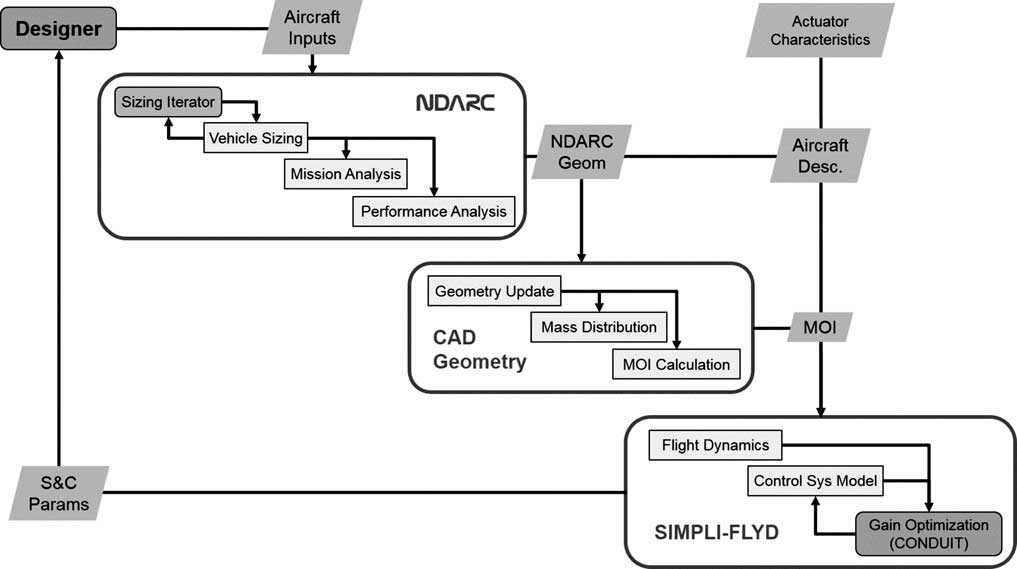
Figure 7 illustrates how the introduction of an initial handling qualities assessment tool, (SIMPLI-FLYD)( Reference Lawrence, Tobias, Berger, Tischler, Theodore and Elmore 30 ) in the design process, introduces need for additional tools and methods to enable the connection of the vehicle description available from the vehicle analysis and design code (NDARC) to the input required by the handling qualities tool (SIMPLI-FLYD). Some of the information necessary for making a handling qualities assessment in SIMPLI-FLYD must come from sources other than NDARC since there is no need for that information in the legacy NDARC vehicle sizing process. These data include vehicle moments of inertia and control system actuator dynamics. Such data may either be derived from supplemental analysis and design tools, as is the case with moments of inertia from a CAD model of the aircraft, or based on historic analogy or parametrics as was done for the actuator dynamics. It, therefore, becomes important to understand how uncertainty from these various additional sources of information propagates through the analysis and design process since they will contribute to the overall uncertainty of the advanced design process output.
A sample integration of a handling qualities assessment tool SIMPLI-FLYD with NDARC to increase the breadth of capability that can be assessed during advanced design. In order to execute SIMPLI-FLYD, additional information not available from NDARC must be supplied either by a CAD model that can be derived from NDARC output or by analogy to existing aircraft.

The mix of tools clearly highlights the various forms of uncertainty that can impact the design process. It also shows the need for a flexible framework which can accommodate these tools working together on an integrated problem and allow for easy update or replacement of one piece of the architecture to reduce uncertainty in a particular dimension. Further work to track uncertainty and quantify its impact on the overall system performance is warranted as our design tools and framework mature.
6.2 Tool integration and optimisation
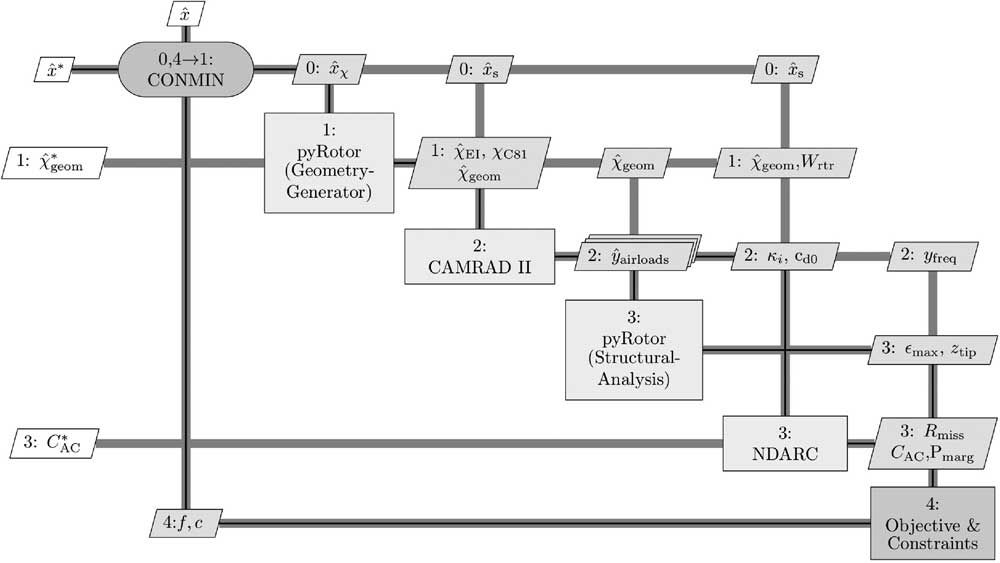
As an example of the use of higher-fidelity analysis in advanced design, previous work( Reference Sinsay and Alonso 31 ) outlined initial activities to develop capability using the NASA developed OpenMDAO( Reference Moore, Naylor and Gray 22 ) software framework to integrate NDARC with comprehensive analysis to optimise and improve a lift-offset rotor design. The goal of this work was to overcome uncertainties related to rotor performance and weight for a lift-offset rotor, where the semi-empirical methods in NDARC may be inadequate. The design process shown in Fig. 8 that was developed for this activity also highlights an example of where additional support tools are needed to help update aircraft models and incorporate the desired analysis fully into the design process. In this instance, pyRotor is a tool which generates additional rotor design information to include beam stiffness and airfoil characteristics necessary to execute comprehensive analysis but not necessary for NDARC. Gradient-based optimisation of the rotor system was applied to this design as a demonstration of how MDO can function for this type of problem. Even for this relatively simple problem, with few design variables, the computational time and cost was seen to be an issue that demanded further investigation and careful consideration of the optimisation approach used.
Extended design structure matrix summarising example integration of NDARC with higher-fidelity comprehensive analysis to enhance rotor design capability.

pyRotor used a simplified representation of the blade cross-sections to generate the desired structural and aerodynamic properties. In some instances, this level of fidelity may be sufficient, but in general, a better estimate is desired. Work continues on the development of an Intelligent Cross-Section Generator (IXGEN)( Reference Rohl, Dorman, Sutton, Kumar and Cesnik 32 ). IXGEN will provide a level of model description fidelity that is more appropriate for use with comprehensive analysis as it allows for modelling of the cross-section inner mold line (IML) geometry and material properties to generate section stiffness for use in finite beam models. pyRotor and IXGEN provide an example of an area where care must be exercised to match the model fidelity and analysis fidelity with the nature of the design problem. The level of uncertainty in the prediction achieved using IXGEN coupled with a comprehensive analysis code can vary based on choice in how the modelling is approached. While it is possible to model the rotor IML and material layup in IXGEN to a very high degree of detail and achieve a corresponding reduction in model uncertainty, this detail may not be readily available during early stages of design. However, the use of a bulk laminate property with a simplified IML geometry in IXGEN may still be more accurate and useful than the simple handbook estimates of bending stiffness found using pyRotor.
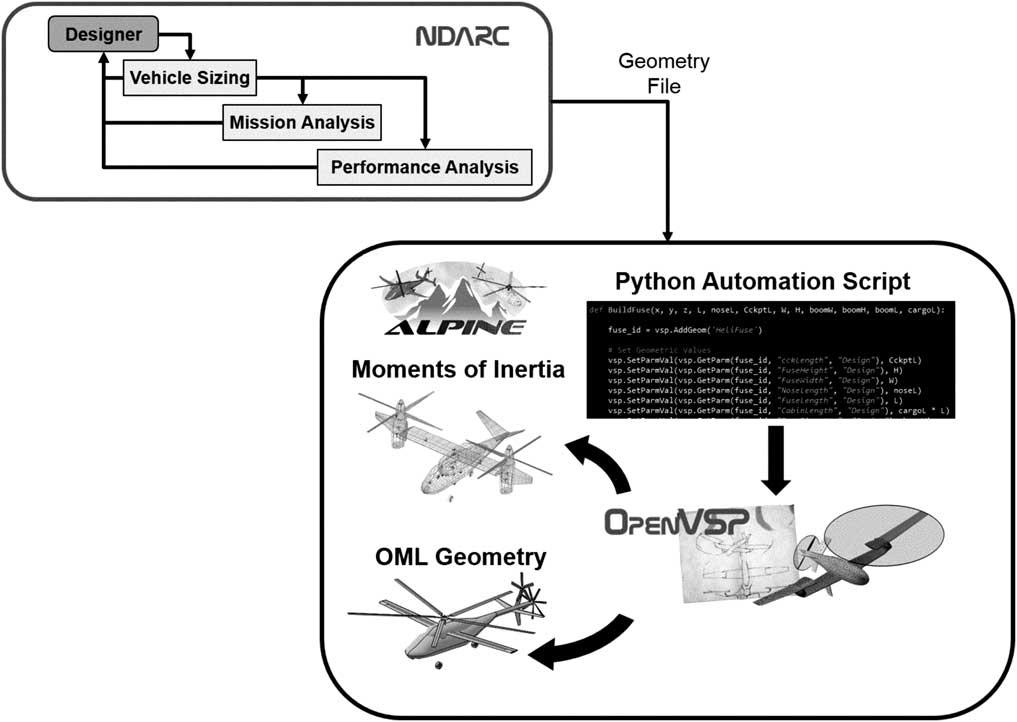
The geometry description available in NDARC is simplified to include only the overall dimensions of major components and their relative locations. Such a model lacks sufficient detail to support rendering a vehicle layout and for many of the necessary geometry-derived inputs to support desired higher-fidelity analysis capabilities. Legacy capability( Reference Sinsay and Nuñez 33 ) is based in the use of a parametric CAD solid modelling that required significant human-in-the-loop interaction to update and extract desired data. To support tool integration and optimisation, the use of a parametric CAD model that can be executed quickly and with more automation has been implemented. Automated Layout with a Python Integrated NDARC Environment (ALPINE) (Fig. 9) is being developed on top of the OpenVSP( Reference Gloudemans and McDonald 34 ) geometry tool specifically for use in this type of advanced design, multidisciplinary analysis environment. ALPINE provides layout, geometry and moment of inertia information that can be used by NDARC and downstream analysis tools. ALPINE is based on a collection of component models that can be assembled to form a complete aircraft. These component models can encode additional details about the aircraft description not directly available from NDARC and if selected based on historic analogy to existing aircraft may provide a suitable higher fidelity model representation. An example of this is the fuselage which is described in NDARC as just a reference length, width and height. The selection of an appropriate ALPINE fuselage component adds the additional detail necessary to loft a fuselage that might be most appropriate for a cargo or attack rotorcraft. By matching the correct ALPINE component, for a given aircraft configuration, with the NDARC output, models of higher-fidelity than available directly from NDARC can be obtained.
ALPINE provides a python-based interface to link NDARC geometry output with parameteric CAD modelling using OpenVSP.

6.3 User interface
An Integrated Design Environment for NDARC (AIDEN)( Reference Sinsay, Hadka and Lego 35 ) has been developed in collaboration with Penn State University–Applied Research Lab to provide a graphical user interface (GUI) for the design process. This GUI initially improves user productivity with our core design code NDARC by improving model management and setup. It also includes tools to aid in processing of output data from NDARC and a flexible framework that will allow for incorporation and access to other tools in the design process. AIDEN is designed to execute across common desktop operating systems and could eventually provide a front-end capability for external computational activities performed on high-performance computing platforms. Used in conjunction with OpenMDAO, it is also intended to provide an environment where designers can set up and manage MDO instances.
7.0 CONCLUSION
Continuing pressure to develop more capable advanced aircraft designs in an environment with decreasing cost and risk tolerance requires continued improvement to aircraft advanced design methods and tools. The U.S. Army Aviation Development Directorate’s on-going science and technology activity is working with partners to develop this re-imagined rotorcraft advanced design capability for the U.S. Army that includes the key characteristics of
• Integrated Design Environment (IDE)
• Virtual Prototyping
• Multidisciplinary Design Optimisation
• SE Documentation
• Uncertainty Tracking
• Risk Aware Decision Making
Initial results show promise and have provided insights into how this development should proceed. Work to-date illustrates how the decision to address one item of uncertainty in the design can have multiple impacts on the overall design process as additional design information becomes needed the in-turn adds other elements to the design process. Further work is required to more fully integrate the various pieces developed into an integrated design environment and demonstrate the use of that environment on typical advanced design problems.
The key to the successful integration of this capability in advanced design offices is a flexible and user friendly software environment that allows aircraft-advanced designers the freedom to integrate the right tools and methods for the problem at hand; to reduce uncertainty and gain knowledge and insight that can potentially result in better starting points for the follow-on design and realisation activities. Optimisation and other automated design methods aid the designer in identifying the most promising concepts and configurations in the design space. These automated search procedures also improve the odds that the designs analysed represent good comparison points that maximise the potential capability of individual concepts for a given set of requirements. Model management and data visualisation capabilities help the designer focus on the aircraft design aspects of the problem, not computer science issues.
Advances in computational capability have enabled better physics-based, higher fidelity analysis tools to be leveraged in the early design stages to potentially reduce uncertainty in predicted performance and examine novel aircraft configurations. Developments in model-based systems engineering, multidisciplinary design and optimisation can also be leveraged to improve on traditional design practice. In the future, advanced design will involve the more frequent application of these tools and methods in a flexible manner as dictated by the design activity. Enhancements in computer speed and capability can be leveraged by designers to execute a virtual prototype–evaluate–refine process of sufficient fidelity to enable better performing and most robust design choices in the early stages of design. Software development activities are needed to allow advanced design offices to employ SE, MDO and Design Thinking concepts and techniques effortlessly in the execution of their overarching mission to improve prediction of capability and cost of next-generation aircraft. Such capability will allow advanced design offices the ability to provide decision makers with a clear understanding of the risk and uncertainty associated with these designs and hopefully lead to less costly development activities, helping to reduce the incremental cost of capability in future rotorcraft.
ACKNOWLEDGEMENTS
The ideas and concepts presented in this paper represent the outcome of hours of insightful and challenging conversations on how to accomplish the mission to designing next-generation aircraft for the US Army. I am grateful to the whole team: John Berry, Mark Calvert, Josh Elmore, Ernie Keen, Andrew Gallaher, Wayne Johnson, Alex Moodie, Gerardo Nuñez, Travis Perry, Robert Scott, Mike Scully, Chris Silva, Dana Taylor and Robbie Vocke for their individual contributions to that conversation and efforts in developing many of the tools highlighted in this paper.