In this article, I report on an inquiry into ways in which ecological thinking informs the everyday practice of a selection of teachers. My use of the term ‘ecological’ is informed by Bateson's (Reference Bateson1972, Reference Bateson1979) ‘ecological epistemology’, in which he draws attention away from an objective focus upon entities to an examination of the subject's relationship to the object. In doing so, he contributes to what O'Sullivan (Reference O'Sullivan1999) calls a reconstructive postmodern vision. This focus on ways of thinking through relationships ensures the ecological has a place in all areas of education. It is not the domain of one sole discipline. In this respect, I am drawn to Thomas Berry's observation — repeated in his foreword to O'Sullivan's (Reference O'Sullivan1999) treatise on transformative learning.
Every profession and occupation of humans must establish itself within the integral functioning of the planet. The earth is the primary teacher in economics, in medicine, in law, in religion. Earth is the primary educator. Ecology is not a part of economics. Economics is an extension of ecology. (O'Sullivan, Reference O'Sullivan1999, p. xiv)
Berry's assertion becomes a prompt to action in the work of social ecology theorist Murray Bookchin. Bookchin applies Bateson's insight to position social ecology as an approach ‘concerned with the most intimate relations between human beings and the organic world around them’ (Bookchin, Reference Bookchin2002, para. 5). Our prioritisation of this relationship obliges us, he argues, ‘to seek changes not only in the objective realm of economic relations but also in the subjective realm of cultural, ethical, aesthetic, personal, and psychological areas of inquiry’ (Bookchin, Reference Bookchin2002, para. 5). Implicit within this is education.
Context
For almost 20 years I have worked as an educator in a university-based Social Ecology department. Here, considerable attention has been paid to the construction of ecological understanding and, in association, the ‘learning ecology’ of both students and teachers (Hill, Wilson, & Watson, Reference Hill, Wilson, Watson, O'Sullivan and Taylor2004; Wright & Hill, Reference Wright, Hill, Wright, Camden-Pratt and Hill2011). This was central to our process. We argued that it is one thing to observe ‘an ecology’, and it is another to understand one's self as part of it. Capra (Reference Capra1966), who has made a significant contribution to applying this thinking to education, draws on Maturana and Varela (Reference Maturana and Varela1992) to describe this as ‘bringing forth our world’. With this in mind, our university students were invited to pursue this understanding through real-world practice, self-reflection and creative, academic writing.
As an illustration of the context for this study, I quote ‘Anne’, a primary school teacher and a recent graduate of our Social Ecology program.
Before [I did the Master of Education: Social Ecology course] I didn't have [an integrated] understanding. . . . Ecology was a separate thing . . . I see everything in [connected] terms now. I see it in our relationship with the world, how our relationship with each other impacts upon the world around us. . . . I look at the ecology of the classroom, because you see a shift when someone is away. . . . The class . . . I see it as a body, an organism made of many bodies. . . . And I see the staff like that also. . . . So yes . . . my understanding has changed totally (Personal communication, July 24, 2012).
Anne's response demonstrates personal and social insight as well as insight into her work as an educator. She notes benefits to her work and benefits to her life outside of her work and she identifies this in relation to ‘the world’. I am excited by her analysis and keen to understand how insights of this kind can permeate education more fully. This is more than a response to an environmental problem. It is a response to ‘our’ circumstance: a social-ecological point in time, in which we are all participants (Wright, Camden-Pratt, & Hill, Reference Wright, Camden-Pratt and Hill2011).
I argue therefore that ecological epistemologies can offer a considerable amount to the practice of education. The influence of Bateson's thinking (Reference Bateson1972, Reference Bateson1979; Harries-Jones, Reference Harries Jones1995) can be seen in constructivist approaches to learning, most particularly in radical constructivism (von Glasersfeld, Reference von Glasersfeld1996), where it is argued that the construction of understanding (or learning) is an individual experience built around reflection upon systems of relationship. Maturana and Varela (Reference Maturana and Varela1992) extend this through theories of systemic self-organision and autopoiesis. Autopoiesis (or self-making) draws on the biology of cognition to argue a process-based understanding of experience, from the perspective of the participant. Varela, Thompson, and Rosch (Reference Varela, Thompson and Rosch1991) and Varela (Reference Varela1999) extend this through further work on ‘enaction’, which identifies embodied experience as a generator of emergent knowledge. Such knowledge, Varela argues, creates consequences for which responsibility must be taken. Capra (Reference Capra1996) captures such thinking in his discussion of the way in which we bring forth our world. Sterling (Reference Sterling2003) argues this as the basis of a paradigm shift in education and an emerging ecological worldview.
In his work with the Centre for Eco-literacy (Stone & Barlow, Reference Stone and Barlow2005), Capra calls for education systems that learn from and reflect the workings of self-organising systems. He notes: ‘at all scales of nature, we find living systems nesting within other living systems – networks within networks’ (Reference Capra1996, p. 24). These living systems include schools. An ecological worldview draws attention to interrelationships within a system. It does so from the perspective of those within that system, rather than that of detached ‘objective’ experts. Bowers (Reference Bowers, Smith and Williams1999, Reference Bowers2011) describes this as ‘ecological intelligence’: the intelligence of the systems — including human systems of thought and action — that sustain the organisation of life. He argues that the transition from individual to ecological intelligence should be a major focus in education.
The challenge will be for education professors, as well as their colleagues in other departments, to recognise how the patterns of thinking they now equate with progress and enlightenment contribute to the ecological crisis, and to make the radical shift in consciousness that is required. (Bowers, Reference Bowers, Smith and Williams1999, p. 170)
In predicating ‘the local’ as central within such learning, Bowers emphasises local communities, local histories and local environmental practices. He argues the importance of examining the local in terms of its sustainability. This can be known better, Bowers suggests, through greater awareness of place-based culture, tradition and ‘elder knowledge’. This calls up the values and experience of traditional and indigenous communities and challenges the assumptions and practices of colonial cultures. Immersive experience in nature-based learning is a vehicle for such learning (Sobel, Reference Sobel1996). Sobel argues ‘we teach too abstractly, too early’ (p. 5). Grunewald (Reference Grunewald2003) also seeks to build a critical consciousness of the ways in which place permeates schooling. He challenges educators to recognise and utilise place-based pedagogies. In doing so, he cites Wendell Berry:
Properly speaking, global thinking is not possible. Those who have ‘thought globally’ [and among them have been imperial governments and multinational corporations] have done so by means of simplifications too extreme and oppressive to merit the name of thought. . . . Unless one is willing to be destructive on a very large scale, one cannot do something except locally, in a small place. (as cited in Grunewald, Reference Grunewald2003, pp. 633–634)
These issues of systems thinking, criticality, the perspective of the participant, reflection, responsibility, ‘the local’, nature-based and place-based learning, indigenous perspectives, and imaginative and emotional engagement in the construction of relationship are core elements in an ecological understanding of education. Much literature suggests that these can be linked and interwoven very effectively (Judson, Reference Judson2010; O'Sullivan & Taylor, Reference O'Sullivan and Taylor2004; Saylan & Blumstein, Reference Saylan and Blumstein2011; Stone & Barlow, Reference Stone and Barlow2005; Smith & Williams, Reference Smith and Williams1999). Each of these elements has contributed to the design of the research project discussed here and its examination of teachers’ ecological understanding.
The Project
In this project interviews were conducted with teachers in one school in Canada, one in the United States, and three in Australia. All schools were chosen deliberately (all names of schools and teachers used here are pseudonyms). I discuss the factors influencing the choice of the North American schools first.
Both Maple School and Oak School were founded under the influence of a significant holistic education theorist. The website of Maple School says the school is dedicated to holistic teaching and has developed its holistic approach based on John P. Miller's The Holistic Curriculum (Reference Miller1996). The web site of Oak School says the school was founded in 1995 by Ron Miller (no relation), an author and publisher in holistic education, and that Miller sought to develop Oak as a model of holistic education. Both authors make links between the holistic and the ecological. R. Miller (Reference Miller2011) argues that holism is also known as ‘green’, ‘ecological’, or ‘integral’ thinking. He applies the term ‘holistic education’ to ‘cultivating the whole person and helping individuals live more consciously within their communities and natural ecosystems’ and says a ‘holistic ecological education . . . (seeks) to cultivate a direct, active, experiential relationship with the processes of life’ (Miller, R., Reference Miller2005, para. 3). In establishing the ‘wholeness’ that holistic educators value, J.P. Miller (Reference Miller1996) points to the wholeness of the planet and the ecological interdependence that marks its functioning. He compares the ‘predatory conscience’ of mechanistic models of education to the ‘ecological conscience’ of holistic education. These schools were chosen, therefore, for their theoretical foundations and the modelling of practice that emerges from this. They were chosen also because of subsequent research that has discussed practices in both schools (Miller, J.P., Reference Harries Jones2010; deSouza Rocha, Reference DeSouza Rocha2003).
Of the three Australian schools, two were founded under the influence of one key individual. Teacher and educational theorist Garry Richardson (Reference Richardson1985) led the 1978 foundation of Wollemi. He later withdrew from involvement with the school and passed away in 2005 (current staff sometimes talk of themselves as ‘second-generation’ or ‘third-generation’ Wollemi, thus suggesting some distance from this original influence). The driving influence behind the 2006 establishment of Bloodwood was a successful author of young adult fiction and an experienced teacher of English. He continues to play a leadership role and the school operates on land he owns. The third school, Casuarina, was founded in 1969 and owes its genesis to a group of local parents and teacher educators, none of whom are named on the school website. All three schools identify their philosophical underpinnings in their published material. Casuarina in terms of ‘child-centred’ and ‘democratic’ education; Wollemi as ‘human centred’, ‘human scale’, ‘sustainable’, ‘secular’, ‘integrated’ and ‘independent’. Bloodwood claims ‘take care; take risks’ as its credo.
All three Australian schools, like Oak, could be described as independent, non-systemic schools. None are governed by a centralised philosophical or regulatory system. They are not part of a government school system or a religious or philosophically based school system. Thus none of these schools rely upon regulated systems of zoning or religious affiliation to attract students. They attract students because parents discern other qualities. Importantly, these are qualities that the individual school, rather than the external systems that govern the school, is recognised for. This is not to suggest that systemic schools cannot have individuality and be recognised for specific qualities and attract students accordingly. Rather, it is to suggest that unless independent, non-systemic schools find resonance in the community, they cannot continue to exist. Parents will not enrol their children in a school that they do not identify as advancing what they see as the interests of their children (especially when those schools charge significant tuition fees). For this reason it is in the interest of such schools to ground themselves politically, philosophically and practically in issues of community concern.
Maple is a slightly different sort of school. It exists as — and is formally identified as — an ‘alternative’ school within the school board of the district it is located in. It is required to work with a provincial curriculum but, as an alternative school, is allowed to approach that curriculum through its own methodologies. Unlike the other schools mentioned, Maple students do not pay fees, beyond those required of all provincial school students. Applicants are offered places through a ballot system and staff are appointed by a district school board, after expressing an interest in the school.
Interestingly, all five schools also represent a cross-section of physical settings. Casuarina is situated on a main road in a prosperous inner suburb of a major city, Wollemi on the bush-suburban fringe of a major city, and Bloodwood on a large forested rural holding, accessed by a series of unsealed roads, more than an hour's drive from a major city. Maple shares premises with a government school, in an ethnically diverse suburb close to the centre of a major city. Oak stands on the rural-industrial fringe of a provincial city. In their published materials, each of these schools — although Bloodwood more than the others — construct their appeal as sites for learning around the site they inhabit. All position themselves in the context of community, nature and place.
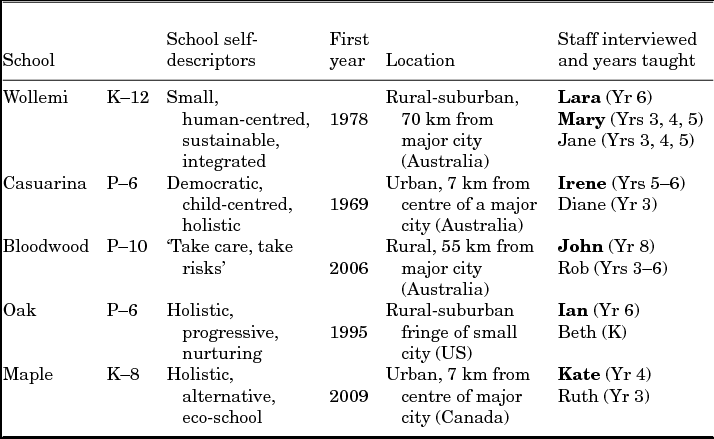
The decision to invite staff from these schools to participate in the research was determined therefore by assumptions arising from practical and philosophical considerations. These were deemed appropriate to test a notion that the combination of an independent, non-systemic school management system and a prevailing community discourse around social-ecological issues would produce staff well prepared to discuss the relationship between ecological understanding and classroom practice. Table 1 provides profiles of the participating teachers.
Interviewee Profiles

Note: K = Kindergarten; P = Preschool; Experienced staff marked in bold.
The Inquiry
In all schools requests were made, via the school principal or school coordinator, to interview one long-standing staff member and one recent appointee. The long-standing staff member was seen to represent authority, experience and a history of involvement with the school: a current leader. The recent addition was seen to represent less experience as a teacher, more recent completion of teacher training and an investment in the future of the school: a potential leader. The aim was to gain insight into how differently skilled teachers’ ecological understanding permeates their educational practice. In all schools the invitation was made available to the whole staff group by the principal or coordinator and staff self-selected. In one school, three staff volunteered and all were interviewed. Ethics approval was obtained through appropriate authorities in Australia, Canada and the United States, and most interviews were conducted face to face in school classrooms outside of teaching hours. One interview was conducted, following negotiation, in a private home.
The interviews were designed to gain insight into the lived experience of individual teachers and the meaning they make from that experience (Seidman, Reference Seidman2006). There was an interview structure, with seven key questions and room allowed for clarification through improvisation between questions. As an inquiry into understanding, the aim was to stimulate thinking in relation to key concepts and draw out responses through story (Reason & Hawkins, Reference Reason, Hawkins and Reason1994). Interviews commenced with an invitation to respond to a critique of school education made many years ago by Gregory Bateson:
The pattern which connects: Why do schools teach almost nothing of the pattern which connects? . . . What's wrong with them? What pattern connects the crab to the lobster and the orchid to the primrose and all four of them to me? And me to you? And all six of us to the amoeba in one direction and to the back-ward schizophrenic in another? (Bateson, Reference Bateson1979, p. 8)
This was followed by a series of questions that asked interviewees to expand on their thinking through reference to their practice in their school, characteristics of their school that facilitated such practice, and their thoughts on the responsibilities of schools and teachers in relation to ‘ecological understanding’. No terminologies were defined. How each individual understood terms used and how that understanding informed that individual's practice were therefore critical issues. Interview data was analysed systematically. The interview questions provided the structure around which the analysis was built, but additional issues also emerged, leading to new themes (O'Toole & Beckett Reference O'Toole and Beckett2010).
Findings
Taken in their entirety, the responses to the questions display genuine curiosity about and interest in engaging with ecological ways of thinking. Within that entirety, some teachers demonstrated greater affinity with the ecological and a greater capacity to articulate that affinity than others. These were generally the more experienced teachers, the exceptions being Ruth, who while a new teacher, is a mature women who has raised a family and worked in a variety of settings, and Beth. While a new teacher at Oak, Beth had worked for two years in a mainstream school before seeking further training. John and Mary, among the more experienced teachers, and Diane and Rob, among the new teachers, seemed less assured in this discussion. Kate and Ian were the interviewees who entered into the subject matter most immediately.
When introduced to the Bateson quote, Kate raised one deep and abiding concern: ‘Yes, but how do you present that to kids?’ She continued:
To me it's an existential need. I see in the future we need to create a more sustainable way of being but how do you teach this way? . . . I think we are trying to figure out how we are connected while we are teaching curriculum that is not connected.
The response of Ian resembled that of Kate:
There is a structure in place that does not honour the ecological principle . . . [nonetheless] . . . this way of teaching is extraordinarily important, but it is difficult to do cause once you start doing it, it [challenges] what we thought we were and that can be scary for a lot of people. But when you dive into it your whole pattern of understanding is changed . . .
Both Kate and Ian attributed significance to the challenge Bateson presents. Importantly, they also identified difficulties in responding. Both argue these difficulties arise because of the understanding that an ecological analysis entails, and the conflict this represents with the assumptions that inform contemporary schooling and, by extension, the social and political agenda that constructs that schooling.
While interviewees responded to my questions, they did more than this. Collectively, and without consultation, they fashioned a set of priorities. When I reviewed the interview transcripts, four overriding issues emerged (all of which could also be seen as subsets of the question asked by Kate: ‘How do you present that to kids?’). These issues were not solicited through direct questioning. They emerged through indirect references. They reflect my sense that ecological understanding is of great importance and that education systems must have both a structural and a curricular relationship to it. The four emergent issues were:
• What does the concept of ‘connection’ mean in the context of schooling?
• How well are teachers prepared to work with the issue of ecological understanding?
• Is the development of ecological understanding a responsibility of school education?
• How can teachers (and schools) set up educational experiences that may allow ecological understanding to arise?
Connection
Bateson's phrase ‘the pattern which connects’ is deliberately broad. The quote was used as an initial provocation. Most interviewees were able to respond to the provocation and most were keen to position themselves in relation to this ‘pattern’ perception. It reminded Ian of another insight he valued, one offered by US environmentalist John Muir: ‘Muir talked about how when we look at something, say a stone, we look at how it connects to everything else in the universe.’ Irene said it reminded her of an E.M. Foster quote: ‘Only connect’. Lara, said ‘it triggers for me’ the reasons why ‘we chose this school for our children’ and why she is so excited to be working in it. Jane responded similarly. Others used the quote to discuss their teaching. Beth said, ‘I use the idea of connection and relationship a lot in my teaching, or I try to at least.’ Diane described a whole of school discussion activity that invites participation from all students in her school. John was cautious. He understood the question but quavered at its implications: ‘I see it in kids’ faces now when I mention climate change, they just go “Oh no . . . not again”.’ Irene lacked such caution, arguing that a sense of connection is crucial to our wellbeing. ‘We need to acknowledge the bigger picture and the interconnections between all the layers and all the systems.’
Some teachers were keen to expand on ‘connection’ as a method of teaching and learning. Lara emphasised the importance of relationship in education. In doing so, she extended the bounds of relationship beyond the classroom to include ‘the environment, animate and inanimate’. In the process, she critiqued the individually focused psychological approach to learning that was emphasised in teacher training, particularly its classroom management focus as she experienced it 15 years previously.
Teacher Preparation
Lara was not the only teacher to refer to her training. Rob, a first year teacher at Bloodwood, did also, but without the perspective available to Lara. He said: ‘Ecological literacy, which is what it seems this is about . . . we had about a week or two [on it] in the whole [teacher training] course . . . I feel I’m not trained in finding connections. . . . I’m not confident in doing it.’ It is of note that Rob constructs such a powerful link between his confidence as a teacher and his training.
Jane, a teacher of 3 years experience in two different alternative schools, also identified limits in her training. She expressed this most forcefully in her critique of the sites she was sent to for her practicum: ‘Like [the schools] where I did my prac [practicum] made me . . . wonder why they don't teach anything about the patterns that connect.’ She continued: ‘connections are what give me joy in the classroom. So it's very important for me to [seek out and] . . . work in an environment where I’m judged first and foremost on those.’
Of all the teachers spoken with, only Ruth, a first year teacher at Maple, lauded her training for its recognition of the importance of ‘connection’. She said: ‘I thought . . . [my training] would be mainstream but it was very much into these kinds of ideas . . . what I loved about the program was it gave me hope because they realise we need to be infusing these things into the education system, ‘cause people are coming out . . . without compassion and without connection to the Earth and that is probably why we are at such a critical point in this world.’
Irene, like Ruth, was sent to do her practicum at the school in which she now works. She said her teacher training ‘threw me in the deep end’. But, she concluded: ‘I think, really, you’ve got to learn on your feet . . . I don't think any university can prepare you adequately.’
In their responses, two teachers spoke of the importance of further studies, beyond their teacher training, that enabled them to work with an ecological understanding. Beth said she ‘went back to [university] because she felt [her previously learned approach to teaching] wasn't right for me’. Her Masters in Education for Sustainability led her to employment at Oak. Ian spoke of a Masters in Transpersonal Psychology that has helped him to recognise how to work with the limitations encountered in school education. He said that while working in traditional and alternative schools he is always trying ‘to help (students) see their capabilities. And to tell them that school isn't all there is.’
School Responsibility for Ecological Understanding
Responses to the question ‘Is ecological understanding a responsibility of school education?’ were mixed. They ranged from immediate affirmation to equivocation. Mary said it is something latent within students that schools can bring it to the surface: ‘We are part . . . we are interconnected. . . . And I think children do innately understand that anyway . . . I think it's got something to do with that essence of being respectful towards one another, respectful of everything around us, which is central to our teaching.’
Rob responded differently: ‘Yes, it is important and it should be a responsibility of school but . . . if it's about how things connect and if kids aren't learning anything at home then that's a problem.’ By contrast, Ruth argued ‘a school has as much responsibility as parents to be teaching these kinds of values’. Lara rang a note of caution: ‘Yes, but it is what teachers need to be taught as well. You can't just tell teachers you must teach eco-consciousness . . . cause a lot of teachers do not know what that is.’ Ian agreed: ‘. . . the difficult thing is . . . it's like trying to teach meditation if you haven't meditated before’. As Lara and Ian suggest, without ecological understanding, arrived at through experience and reflection, it is practically impossible for teachers to communicate such learning. Issues of capacity therefore precede issues of responsibility. Responsibility is a consequence of learning and needs to be assumed before any system can require it.
Teacher's Approaches to Ecological Understanding
Given the difficulties suggested above, it is interesting that when asked how they worked with the ecological themes of connectedness and relationships, few interviewees had problems responding. Opportunities to teach in this way were reported, in some instances, as set up through an agreed school vision, and in others, as an individual initiative. Overall, it appeared that a school agenda around ecological understanding is of great benefit to teachers trying to initiate learning of this kind. Not only does it allow group action and collective responsibility, but it supports those staff struggling to understand, articulate and implement appropriate practice.
Kate, for example, spoke of her involvement in the establishment of Maple: ‘I think we . . . created this school because we want a more connected life. It seems to me that the families who have come together at this school are looking for that. They are seeking something deeper and richer for their kids to experience and for them to experience as well . . . in community, together.’
Ruth, also a teacher at Maple, spoke of it as a challenge: ‘Well, I am still figuring out how to do [it] . . . but I know, at this school, story telling is a huge part . . . It engages children and captures their imagination and stays with them longer than dry teaching.’
Others spoke of specific ways of working: John of his experiments in using bicycles to teach physics and design and technology and to create absorbed and rewarding learning. Diane and Irene both mentioned group work, with a community welfare outcome. Ruth spoke of the outdoors as an integrated learning tool: ‘We try to teach about connections to nature and how nature relates to us . . . the cycles of life and the cycles of nature.’ Lara spoke of ‘teachable moments’ she found in the opportunity to bring the outside-in: ‘We were learning about making things move and it started snowing so [we took] . . . the kids outside to experience the snow and to play in the snow and to watch the steam rising off the roof of the building and . . . kind of romp, ‘cause many of them, they . . . haven't seen snow . . . so [it's great] to step out of what you were doing to engage with something not directly related to . . . the classroom.’
Two stories warrant quoting at length:
Ian: ‘One thing recently, we did a hike to the top of Mt Mansfield, which is . . . over 4000 ft. We did . . . a pretty rugged trail. We got about halfway up and the wind was just howling but . . . the sky was clear, you could see all the way to Montreal, gorgeous, and the kids . . . stayed positive, they urged each other on. Some . . . ended up getting to the top, some didn't but they got about four-fifths of the way up and they felt OK about [the decision to turn] around . . . they understood themselves and it made sense. . . . It made it such a wonderful trip. . . . The kids were so excited about being up in the mountain . . . the sense of freedom . . . and challenging themselves. . . . And I think part of it was the class felt very connected to one another, they were willing to take risks because of that, willing to challenge themselves because of that, but also they love being outside, they love being in nature . . . they were out there all day, they were so involved with that landscape.’
Kate introduced a stronger social agenda:
OK, we have just finished celebrating the day of the dead. We wrote biographies of someone who had passed, one of our ancestors, and this gave the kids a chance to reflect on something that is not the here and now . . . and this time of the year [Halloween] becomes a broader event than just dressing up and running around. . . . It becomes something deeper that connects them . . . helps them be in a state of reverence for their family, and . . . it sort of enlivens the whole family system. And then we relate that across curriculum to the organ systems, so they are studying the body. . . . And I find that is a step in a right direction. Just to connect to ourselves as beings . . . not just consumers . . . noticing characteristics in our family and honoring them.
Then Kate offered a bigger comment: ‘Coming up with ideas about relationships, socially, environmentally, with the self . . . which is the philosophy that we started off with [at this school] . . . is a process of discovery, especially in the city. To find ways to actually connect . . . so we are doing it authentically and it's not just another synthesis of [theories about] what we should be connecting with, [is a challenge]. We’re actually trying to root it in the natural rhythms . . . around us, of our place. . . . We [the Grade 4 class] do go out as much as possible, which is a struggle cause as you get into the higher grades there is more curriculum to cover, so there is a balance to maintain. We have to work really hard and efficiently here so that we can get out of [the classroom and] bring . . . [the outside] in.’
Discussion
Maturana spoke of the dynamics of engaged learning of this kind:
Becoming aware of one's awareness and understanding one's understanding gives rise to a feeling of responsibility for what one is doing, for what one is creating through one's own operations of distinction. This kind of insight has something inevitable: once this has been understood, one cannot pretend any longer to be unaware of one's understanding if one is aware of it and also aware of this awareness. Even those who deny this kind of awareness are ineluctably of it: for acting hypocritically and lying implies asserting something that contradicts one's own insights . . . it is not understanding that entails responsibility but the knowledge of knowledge. (as cited in Poerksen, Reference Poerksen2004, p. 52)
The articulate vision of practitioners, arising from absorbing practice, contributes to theory that is transferable beyond its site of implementation. This responsibility can be incidental or approached deliberately. Several of the teachers interviewed appeared to have a more coherent sense of purpose in their description of their practice than others. Several are employed in schools that focus — or use the opportunity to focus — that vision more systematically than others. All contribute nonetheless to the construction of an emerging field of practice: something that is a response to ecological challenges that are being presented with increasing urgency.
Recognition of the complexities associated with teaching and learning contributes to an ecological understanding. The most significant issue here is the relationship of the educator to those complexities. For example, Ian spoke at length about the architecture of Oak; the way light enters his classroom at particular phases of the day. He spoke of the wetlands area within view of his classroom and how its presence contributes to his class. He spoke also of self-awareness: the need for a knowing relationship between his own state of being and classroom learning. He made a direct link between his patience and his sleep the previous night (or lack thereof), and his teaching, and said that this was something he brought to the attention of his students.
Few of the other teachers offered the same sort of personal reflection (though opportunities for it were available). Most restricted their conversation to professional observations. Three did, however, in different ways, emphasise how important strong educational foundations are to the development of this sort of learning. This is exemplified in a comment made by Kate: ‘So to do all this, what I consider enriched learning, we need to make sure that the kids are learning their basics and actually doing really well . . . And, just for me, I need to be up to a high standard so that I can say this really does work and be able to defend it to anybody.’
The Patterns Which Connect
The practice of individual teachers cannot be considered apart from the circumstances within which those teachers work. Here, patterns can be discerned that are worthy of note. They revolve around such variables as the formative influences behind the establishment of each school and ongoing developments within each school. Central also is the approach of state or provincial education systems: requirements put in place by government policy. Individual differences — personal values, interests, motivations and training — are also considerations.
Formative Influences
Casuarina commenced operations in 1969, and Wollemi commenced in 1978. Both are long-standing independent schools. Both were established in the context of a critique of schooling heavily influenced by the libertarianism of A.S. Neil and Ivan Illich. The early days of Wollemi were influenced also by critical analyses of Steiner education (Richardson, Reference Richardson1985). The discourse that contributed to the foundation of these schools is different to that which contributed to the more recent foundation of Maple (2009) and Oak (1995), both of which were imagined through the frame of holistic education, which is built around a core of ecological thinking. Neither of these schools has yet proven long-term viability. Bloodwood, by comparison, brings greater complexity. Although a new school, established in 2006, it is less easy to analyse in these terms. Bloodwood makes little reference to ecological issues in its website. It does, however, draw attention to its site: ‘what is probably the world's biggest school campus: more than 1100 acres . . . a lovely setting of native forests, European trees and gardens’. The founder and principal of the school attaches value to this, arguing: ‘one of the first things a school should pay attention to is the physical environment, whether it's in the city or the country, that beauty is important and we should value it and we should surround young people around it so they grow up in that atmosphere of beauty’. The site is imagined therefore as a backdrop for learning, engaged directly to a greater or lesser extent, by individual staff. Only at Maple, on the most starkly urban of all five schools sites, have staff gone beyond a respectful, utilitarian approach to physical setting. Maple has developed formal relationships with regional park management authorities to allow students to systematically care for and nurture areas of natural vegetation in local parks. It is perhaps the absence of a direct link to the richness of the natural world that requires staff to think in the most creative ways about relationship to it.
The philosophical base that informs the establishment of an institution necessarily influences thinking in that institution. And while this must change over time — for example, Casuarina now identifies strongly with the ‘democratic education’ movement and Wollemi is questioning the appropriateness of ‘human-centred education’ as its principal descriptor — historical influences remain. Importantly, philosophy influences staffing, in that new appointees are more often than not selected for their capacity to work with an operating vision. When the vision is clearly articulated in ecological terms, it is likely that staff able to work with such a perspective are attracted to and appointed to such institutions. This goes some way towards explaining why staff interviewed at Maple and Oak — founded as they were on holistic principles — appeared more able to articulate their approach to schooling through an ecological perspective than their counterparts at Casuarina, Wollemi and Bloodwood. This was not the case in all circumstances and this brings attention to another pattern worthy of mention. Lara and Irene, the most experienced of the teachers interviewed, at Wollemi and Casuarina respectively, both spoke confidently and coherently through an ecological perspective. I am drawn to attribute this to the ways in which their experience as educators, combined with their involvement in issues of social concern, gave them the liberty to think deeply about the relationship between ecological understanding and education. The point of comparison is with recent graduate Rob, who argued: ‘I feel I’m not trained in finding connections . . . I’m not confident in doing it.’
Political Context
Necessarily, teachers’ understanding of and approach to ecological understanding is influenced by the approach of state or provincial education administrative systems. Here it is noteworthy that Maple is an ‘alternative’ school within a provincial school system. It shares premises with a government primary school, as it does administrative staff and to a limited extent, executive staff. While staff are paid and managed through government systems, Maple staff have considerable freedom in the design and organisation of their teaching.
Typically, Australian and US state school systems do not nurture educational experiments of this kind, in this way. All Australian and US schools visited for this project charge tuition fees far in excess of those required in government schools. Despite being independent and non-systemic, all are still required to align their teaching with state school requirements. Irene argues that these have become ‘unbelievably arduous’ and hamper what teachers are able to do. She argues that in the Australian state in which she works, such requirements have contributed to the decline in numbers of alternative schools between the 1970s and the present; it is not that the alternative is no longer attractive, rather that the organisation of the alternative is governed much more rigidly than in the past. These requirements have also, she argues, contributed to her school, Casuarina, moving towards a more mainstream style of education. The contrast is with the Canadian facilitation of opportunities to inquire into alternative systems. Kate, a teacher of 20 years experience before joining the core group responsible for the theoretical design and practical establishment of Maple, appreciates this, but notes also the downside:
. . . so [Maple, as an idea is] lovely and wonderful, but when you start [working in it] . . . it's tough and people get discouraged ’cause, like in any experience not everybody is happy . . . and people think, if I was at another, simpler school and I could still teach in this extra lively way I would be an outstanding teacher . . . but here I am just another among people who are working to fulfill this holistic agenda . . . so it can be discouraging cause it is above and beyond the call [answered by most teachers].
Given ecological change that is foreshadowed (Intergovernmental Panel on Climate Change, 2013), the acquisition and transferability of ecological understanding is an issue of consequence. How, therefore, can education enable ecological understanding? While this issue was not raised directly in interviews it did arise on several occasions. Ian said: ‘It has to start with ourselves.’ Rob spoke of the power of the physical environment: ‘by virtue of being amongst the woods . . . the natural environment has a subtle effect upon you . . . upon me certainly’. Beth spoke of an incidental learning: ‘We look at each child and how each connects to themselves and how they connect to other kids in the classroom and then how we as a classroom connect to the whole school. . . . Those conversations about connections and relationship happen a lot more here than at other schools that I have worked in.’
When invited to tell a story that exemplified Maple, Kate spoke of an event developed to celebrate Earth Day. The event took place on a lakeside beach, within walking distance of the school. Kate said:
We made a huge turtle and one of the parents, who is a storyteller, told a story of Skywoman, who fell down to earth with seeds in her hand, onto the back of the turtle, which is North America. And a great tree grows from that . . . [then] the kids came group by group through a passageway in the sand . . . the older ones brought the younger ones through, and they put little gifts onto the turtle . . . it was a really simple thing. And we got into a circle and did a bunch of songs. . . . And when . . . most of the younger ones left the older ones stayed behind and laid out on the beach and I took them through a guided visualisation based on native ways of being in connection . . . then we just walked back . . . [Later] I asked the kids . . . if they thought this should be a [school] tradition . . . and they all said ‘yes’. So we went on to asking ‘What is culture?’ . . . For me, [Maple is about] creating an impression in the kids when they are young, so that they will recognise [cultural connection] wherever they go. . . . And it seems like we had it that day.
Place, the local, experiential encounters with nature, ritual, myth, indigenous knowledge, leadership, relationships and cultural consciousness are all present in this story: a story of meaning built collectively, through participation. As a story, it is reminiscent of Capra's call for us to bring forth our world.
Conclusion
Theorists discussed earlier argue that ecological understanding assumes we are part of a self-renewing, ecologically sustainable system: that we need to recognise ourselves as powerful, reflective participants in that system. Schools have a role in the development of reflective awareness of this kind. When we are facing a future overshadowed by significant ecological problems, ecological understanding should be a major issue for school students, educators and education systems.
This small study of teachers in alternative and independent non-systemic schools suggests that individual teachers have varying degrees of preparedness to teach in this area: some are strong, coherent and effective, many are not. In addition, it suggests that even in independent, autonomous schools that are designed to respond to the concerns of their community, only in some of the more recently established schools do ecological principles directly inform the construction of pedagogy. And while individual teachers may find personal avenues to such learning and teaching, the study suggests that recent teacher graduates often feel insufficiently informed and, as a consequence, insufficiently prepared to bring this sort of learning to their students. This contributes to the ways in which this understanding is insufficiently integrated into the practice of schools.
In all schools, systems, provinces and countries there are lessons to be learned from practice elsewhere. Some models of practice in teacher education, school administration and pedagogy in North America, particularly Canada, may assist Australian educators to work towards the learning that is required. That learning is constantly emerging, rather than understood in advance. The risks involved in developing, then applying such learning need to be confronted. This is part of the challenge facing all of us participants in this unfolding process of dealing with our uncertain ecological future. There are a number of steps that may assist us to respond.
Teacher educators and education systems must be encouraged to reflect upon the ways in which their programs acknowledge and prepare future educators for the ecological understanding that will be increasingly significant in all our lives. Discourse around the facilitation of ecological understanding must be encouraged through academic and professional journals: through education associations and education communities. Opportunities for further study in the area of ecological understanding must be encouraged in the tertiary sector via postgraduate programs. Other organisations that work with ecological ways of thinking must be encouraged to articulate their experience for the benefit of those seeking to appreciate how such learning can be transferred.
This issue is not and has never been one of schooling alone. It is a deeply personal issue, intimately connected with the futures we wish for. This makes it deeply, and unavoidably, political. And while it has been argued that the vociferous nature of the defence of vested interests reflects desperation in the face of insurmountable evidence (McKibben, Reference McKibben2010), this cannot be an excuse for inaction. For this reason educators need to position learning of this kind within a political frame. They need to assert that if this sort of learning is to be taken seriously it needs to be addressed in policy. Necessarily, this challenges individual as well as organisational systems of learning, language and communication. It requires leadership. ‘Understanding’ is a deeply ingrained form of awareness. Changing understanding changes how individuals in society appreciate the world they construct day by day. As such, it changes relationships within society and beyond. It is the relationships ‘beyond’ that will determine the consequences of the challenge that an historical failure of ecological understanding has already constructed.
Acknowledgments
In addition to teachers and schools referred to directly (through pseudonym) I would like to express appreciation to staff in the Environmental School Project, Maple Ridge, BC, Canada; Ballarat and Queen's Anglican Grammar School, and Wendouree Primary School both in Victoria, Australia.
The project was undertaken with the assistance of a Faculty Research program grant in the Understanding Canada-Canadian Studies Program offered through Foreign Affairs and International Trade, Canada (DFAIT). This program has since, regrettably, been concluded.
Author Biography
David is Senior Lecturer and Director of Higher Degree Research in the School of Education at the University of Western Sydney. He works with undergraduate and postgraduate students in programs in Social Ecology and Transformative Learning. He also works with research students and has overseen the completion of 16 research degrees, mostly in learning through and about embodied experience. David's work traverses embodied learning, arts-based practices, constructivism and system theory, imaginative education and ecological understanding. He recently edited the book Social Ecology: Applying Ecological Understanding to Our Lives and Our Future with Catherine Camden-Pratt and Stuart Hill.