The Government believes that fixed-term Parliaments will have a positive impact on our country’s political system; providing stability, discouraging short-termism, and preventing the manipulation of election dates for political advantage. (HM Government 2011: Introduction)
CONSTITUTIONAL RULES POWERFULLY SHAPE THE NATURE and patterns of government terminations. Some constitutions enable governments to call early elections discretionarily, while others constrain such powers and make early elections a rare event and a costly political move (Schleiter and Morgan-Jones Reference Schleiter and Morgan-Jones2009). Yet how constitutional changes are likely to affect government durations and the nature of terminations is often poorly understood in specific real-world cases of reform. Constitutional rules regarding cabinet terminations tend to be fairly stable, and the UK’s Fixed-term Parliaments Act of 2011 provides a rare opportunity to study the likely effects of changes to such rules. In September 2011 the Fixed-term Parliaments Act became law in the UK. It is designed to restrict parliamentary dissolution to situations of crisis or government defeat. The Act was a part of the coalition agreement between the Conservative and Liberal Democratic parties when they came to power in 2010 and is seen as a significant political reform (Hazell, 2010; HM Government 2011; Youngs and Thomas-Symonds 2013). The main aim of the Act is to constrain the prime minister’s power to dissolve parliament discretionarily, thereby restricting the political opportunism inherent in such dissolutions. Historically, UK prime ministers have used the dissolution power in order to time elections to opportune moments, to keep the opposition guessing and to pre-empt anticipated electoral risks (Smith Reference Smith2003). The potential significance of this Act becomes apparent in light of the fact that almost 60 per cent of the UK’s general elections in the post-war period (10 out of 17) were early and opportunistically timed by the prime minister. The Fixed-term Parliaments Act aims to remove these opportunistic elections from parliamentary politics. It mandates a ‘fixed’ five-year parliamentary term, under the assumption that opportunistic elections will be substituted by regular elections that take place at fixed intervals. The corollary aims of the Fixed-term Parliaments Act are a better synchronization of the parliamentary and governmental terms and improved parliamentary and governmental planning, which will result in ‘a more long-term policy-making approach and lead to a more stable and predictable political cycle’ (HM Government 2011: paragraph 2).
Among scholars and practitioners in the UK, expectations for the Act diverge. On the one hand, it is anticipated that fixing the parliamentary term will provide the benefits of certainty and stability, but may also force unpopular or ineffective governments to carry on to the end of their term (Hazell Reference Hazell2010; Roy and Alcantara Reference Roy and Alcantara2012; Youngs and Thomas-Symonds Reference Youngs and Thomas-Symonds2013). On the other hand, scholars have noted that the Act can be subverted by the government and may therefore have little effect on the prime minister’s power to time elections, leaving parliamentary and government life largely unaffected (Dunleavy Reference Dunleavy2012).
This article examines both the main and corollary aims of the Fixed-term Parliaments Act. Exploring the anticipated effects of the Act poses special inferential challenges common to all predictions. The Fixed-term Parliaments Act is a recent development and its full effect will only be apparent after a number of election cycles. To analyse its likely effects in a systematic and evidence-based manner, the article employs two distinct and complementary inferential strategies. First, it draws on comparative evidence using an original data set on European cabinets from 1945 to the present. A number of European countries have operated with fixed-term parliaments for many years. Others – like the UK up to 2011 – have given prime ministers discretion to dissolve the assembly. A comparison of the patterns of parliamentary dissolution, government termination and duration across these two groups of countries speaks to the divergent expectations in the UK debate about the Act and grounds the analysis empirically in patterns that have in fact been realized in other European countries. Second, this article juxtaposes the comparative patterns with a historical analysis of the strategic considerations that have motivated UK government terminations to date and then conducts a counterfactual analysis of the manner in which the Act is likely to alter these calculations. This part of the analysis sheds light on the mechanisms and motivations that have shaped cabinet terminations in the UK and how they are likely to be transformed by the Act. The conclusions that emerge from these two distinct types of analysis suggest that the Act is likely to affect parliaments and governments significantly. Some of these impacts are widely expected in the UK debate, but others are entirely unanticipated: the removal of opportunistic elections from the prime minister’s political repertoire is not only likely to replace some early elections with regular elections at fixed intervals, it may also adversely affect the stability of governments and negatively impact the synchronization of parliamentary and governmental terms.
The structure of the article is as follows. The next section outlines a comparative approach to evaluating the Fixed-term Parliaments Act, drawing on the wider comparative literature on cabinet terminations and early election calling. The following section presents the comparative findings. Next, a historical analysis examines the strategic decisions that have motivated UK politicians to terminate cabinets in different ways. Then a counterfactual analysis of the Fixed-term Parliaments Act’s likely effects in altering those strategies is developed, which relates the conclusions from this analysis to our comparative findings. The last section provides some conclusions.
A COMPARATIVE APPROACH TO EVALUATING THE FIXED-TERM PARLIAMENTS ACT
The Fixed-term Parliaments Act of 2011 is designed to alter the manner in which UK parliaments and cabinets terminate (Hazell Reference Hazell2010). Up to 2011, parliament was dissolved by the monarch on the advice of the prime minister, who could make his or her choice independently of parliament and even the cabinet (Hazell Reference Hazell2010). Moreover, while the monarch was not bound to accept such requests, in practice denying a prime minister’s request for dissolution was politically difficult because it ran the risk of questioning the political neutrality of the Crown (Birch 2013: 36–7; Laski 1951: 72; Heasman Reference Heasman1960: 99–100). Prime ministers made use of parliamentary dissolution in two very different circumstances: when they had lost the confidence of parliament or when they calculated that they were more likely to secure a parliamentary majority in early elections (Jennings Reference Jennings1959: 428). Moreover, they were able to invoke the threat of dissolution as a means to discipline their own backbenchers in situations of policy conflict. Thus in 1993 John Major threatened to dissolve parliament if Conservative rebels rejected the Maastricht Treaty’s social chapter, in order to manage backbench dissent within his own party (Baker et al. Reference Baker, Gamble and Ludlam1994).
By constraining the discretion to dissolve parliaments, the Act aims to remove opportunistic election calling from the prime minister’s political repertoire. Under the Act, early elections can be triggered in two ways: if parliament votes for an early election by a two-thirds majority, or if it passes a no-confidence vote in the government with a simple majority and fails to invest a new government within 14 days.Footnote 1 Since this safety valve for dissolutions in response to political crises or gridlock exists, the phrase ‘fixed-term parliaments’ is a misnomer (Hazell Reference Hazell2010; Youngs and Thomas-Symonds Reference Youngs and Thomas-Symonds2013). It is more appropriate to conceive of the Fixed-term Parliaments Act as constraining discretionary dissolution rather than completely fixing the parliamentary term.
Scholars and practitioners in the UK hold diverse views about the potential effects of the Act. Many argue that the Fixed-term Parliaments Act significantly reduces the prime minister’s power to call early elections, or to use the threat of doing so as a bargaining strategy (Hazell Reference Hazell2010; House of Commons PCRC 2013: Evidence 13). This is expected to reduce opportunistic election calling and to stabilize the parliamentary and governmental terms. From this perspective, the Act is also thought to give rise to more ‘lame duck’ governments, which are unable to make progress with their policies, but continue in office because they cannot call early elections (Youngs and Thomas-Symonds Reference Youngs and Thomas-Symonds2013: 541). Others, however, believe that the provisions of the Act can be easily subverted by incumbent governments, which may manipulate the no-confidence procedure to achieve dissolution. In this view the Act will have little effect on the prime minister’s power to call elections opportunistically (Dunleavy Reference Dunleavy2012). Other aspects of government life, too, are thought to remain unaffected. For instance, Peter Riddell suggests that ‘[s]peculation over leadership changes, speculation over reshuffles – it is all the same as ever’ (House of Commons PCRC 2013: Evidence 7, Q. 235). This article evaluates these contrasting expectations using comparative and counterfactual analysis.
Two bodies of scholarly work are relevant to evaluating the Fixed-term Parliaments Act in comparative perspective – the literature on cabinet survival and work on early election calling (see, for example, Diermeier and Stevenson Reference Diermeier and Stevenson1999; Lupia and Strøm Reference Lupia and Strøm1995; Schleiter and Morgan-Jones Reference Schleiter and Morgan-Jones2009; Strøm and Swindle Reference Strøm and Swindle2002; Warwick Reference Warwick1994). Those two literatures make clear that elections in parliamentary democracies can best be analysed as a mode of government termination. Early elections, like other government terminations, such as the collapse of coalitions, or a change of prime minister that occurs without intervening elections, are the result of strategic choices by politicians (Lupia and Strøm Reference Lupia and Strøm1995). With changing circumstances throughout the life of a government, governing parties and the parliamentary opposition weigh the value of the current cabinet against the opportunities attendant on choosing a new prime minister, changing the constellation of parties in government or calling early elections (Diermeier and Stevenson Reference Diermeier and Stevenson1999; Lupia and Strøm Reference Lupia and Strøm1995; Schleiter and Morgan-Jones Reference Schleiter and Morgan-Jones2009). As a result, cabinets work under a series of competing risks that may lead to their early termination. Opportunistic election calling is only one way of terminating a cabinet early. This is the path of termination that the Fixed-term Parliaments Act restricts. However, the removal of the power to call early elections discretionarily also affects the ability of politicians to bargain about other risks of early cabinet termination. Understanding better how the Act might affect cabinet terminations therefore requires a conceptualization of the different competing risks under which governments work.
The Competing Risks of Early Government Termination
Building on previous work, this article distinguishes three competing political risks of early government terminations: opportunistic elections, failure elections and failure replacements (Schleiter and Issar Reference Schleiter and Issar2014a, Reference Schleiter and Issarb). Of those paths to early termination, only one – opportunistic election calling – is driven by the government’s aim to maximize its chances of winning a full new term in office (Kayser Reference Kayser2005; Schleiter and Issar 2014b). Opportunistic elections are called by incumbents in order to realize electoral gains and are timed to capitalize on the government’s public opinion support, to exploit the opposition’s weakness and/or manage electoral risks. This contrasts with failure elections, which result from crises, legislative defeats of the government, no-confidence votes, popular opposition or scandals (Schleiter and Issar Reference Schleiter and Issar2014a, Reference Schleiter and Issarb). The Fixed-term Parliaments Act aims to rule out opportunistic elections and envisages failure as the only path to early parliamentary elections. Not all early government terminations result in elections, though. Often government failure results in non-electoral replacements – changes in the governing parties or of the prime minister that do not trigger parliamentary dissolution. Since these terminations occur in response to the same triggers that cause failure elections, we refer to them as failure replacements. These three types of political terminations are distinct from government changes that occur for non-political, technical reasons such as the illness or death of a prime minister. On occasion, politicians cite non-political reasons even though failure is the true cause of the termination. In such ambiguous cases, we categorize terminations as technical only when there is no evidence of underlying government failure. In this sense, these technical terminations are a residual category, and since they are not the result of political choices we exclude them from further consideration. The remainder of our discussion focuses on the three political paths to early termination – opportunistic election timing, failure elections and replacements.
A brief note is in order on the distinction between opportunistic and failure elections. Most cases are unambiguous. For example, an opposition-triggered election brought about by a government’s defeat in a vote of no-confidence is a clear case of a failure election. Similarly, opportunistic elections are clearly identified when the incumbent calls for early elections in order to capitalize on public support and to realize electoral gains, as was the case when Margaret Thatcher scheduled the 1983 elections in the wake of her victory in the Falklands war. However, there are some elections that have features of government failure and incumbent opportunism. For instance, the October 1974 election called by British Prime Minister Harold Wilson had aspects of both. Wilson had formed a minority Labour government in the aftermath of the February elections in the same year. His government’s position was precarious and by October it had been defeated in parliament 17 times (Norton Reference Norton1980: 491, see also Heath Reference Heath1998: 523). Nonetheless, Labour could also point to steady progress over its brief period in office. The government had successfully resolved a miners’ strike and ended the state of emergency that had been imposed by its predecessor. When Labour opened up an eight-point lead in the polls, Wilson decided to schedule an election for 10 October 1974, capitalizing on this support and exploiting the blow that the February 1974 defeat had dealt to the Conservative opposition and its leader, Edward Heath. In the event, Wilson won the election and secured a narrow majority of just three seats. In cases like this, there is evidence of significant opportunism in addition to aspects of failure. We classify such potentially ambiguous cases as opportunistic when government failure is not imminent and the termination would not have occurred at the time it did in the absence of opportunistic motivations.
The distinction between failure and opportunistic elections is critical to an analysis of the Fixed-term Parliaments Act; fixed-term constitutional rules restrict opportunistic election calling by the incumbent but are designed to allow failure elections (for instance, after a vote of no-confidence). Thus, the distinction between failure and opportunistic elections is fundamental to fixed-term constitutional rules.
When governments do not terminate early as a result of any of these risks, they last to the end of the inter-election term and conclude with regular elections. The distinction between early and regular elections is in principle simple to draw – parliaments that end in regular elections run for their full constitutional term. In practice, however, this distinction is complicated by the fact that regular elections are frequently not held on the very last day of a government’s term. Often, regular elections are scheduled with some flexibility – to coincide with a particular weekday, to avoid public holidays, and so on. We treat those elections that are held within 60 days (approximately two months) of the expiry of a parliament’s term as regular elections and those that are held before this threshold as early.
The aim of the Fixed-term Parliaments Act, of course, is to ensure that more governments end in regular elections. But our conceptualization of the competing risks of early government termination makes it easy to see that the Fixed-term Parliaments Act may not only have the effect of converting opportunistic elections into regular elections, it may also affect political bargaining about the other termination paths. As the next section explains, restricting the power of prime ministers to dissolve parliament discretionarily affects not only early election calling but also the ability of the prime minister to manage failure terminations.
Constitutional Rules and the Competing Risks of Early Government Termination
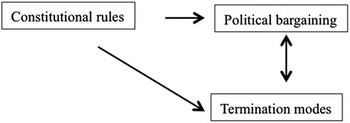
The literature on government terminations demonstrates that constitutional rules are a key factor in shaping the vulnerability of cabinets to the competing risks of early elections and non-electoral replacement (Diermeier and Stevenson Reference Diermeier and Stevenson1999; Lupia and Strøm Reference Lupia and Strøm1995; Schleiter and Morgan-Jones Reference Schleiter and Morgan-Jones2009). Constitutional rules – such as the Fixed-term Parliaments Act – affect the distribution of termination modes in two ways, illustrated in Figure 1. First, they directly determine how easy it is to bring about a particular type of termination. The Fixed-term Parliaments Act, for instance, is an example of a wider group of constitutional rules that aim to preclude opportunistic elections. Second, constitutional powers affect government terminations indirectly by shaping the nature of political bargaining.
The Twin Effects of Constitutional Rules on Government Termination Modes

For instance, in the UK, the prime minister’s power to call elections discretionarily has been an important tool for political bargaining. Often the threat of early elections has been employed strategically to achieve key political aims, enforce party discipline and advance the government’s policy agenda. The Fixed-term Parliaments Act, like other constitutions that constrain dissolution, removes this key bargaining tool from the repertoire available to the prime minister. Through these twin mechanisms, constitutions that constrain the dissolution power produce distinct patterns of government terminations: They directly circumscribe the ability of governments to call early elections and indirectly affect political bargaining by weakening prime ministers vis-à-vis their cabinet and backbenchers, restricting their ability to manage risks. Government terminations in these countries should therefore differ markedly from the patterns that can be observed when prime ministers have discretion to dissolve.
The next section probes that expectation by comparing cabinet terminations in countries that give the prime minister discretion to dissolve parliament (including the UK before 2011) with European countries that have fixed-term parliaments. The latter countries are referred to as operating under constrained dissolution.
COMPARATIVE FINDINGS: CONSTITUTIONAL CONTEXT AND CABINET TERMINATIONS
The comparison draws on an original data set consisting of 586 cabinets from 26 East and West European countries. A government termination is counted with every general election, change in the governing parties or change of prime minister (Müller and Strøm Reference Müller and Strøm2000: 12). The cabinets span the post-war period, or, for the newly democratic countries, the post-democratization period, until June 2013. Of these cabinets, 96 are associated with constitutions that give the prime minister discretion to call early elections, representing the following countries: the UK (up to 2011), Spain, Sweden (1970–4), Ireland and Denmark. A further 191 cabinets fall under constitutions that constrain the power of dissolution, representing Belgium, Bulgaria, the Czech Republic, Estonia, Finland (after 1991), Germany, Latvia, Lithuania, Romania, Poland, Slovakia, Slovenia and the UK (since 2011). Constrained dissolution is the constitutional context to which the UK has shifted with the adoption of the Fixed-term Parliaments Act. Our comparison focuses only on cabinets that operate under these two sets of constitutions because they speak directly to the rules under which the UK has operated prior to 2011 and since then. Cabinets in countries in which the power of parliamentary dissolution rests with the government collectively, a simple parliamentary majority or the president, are excluded from the analysis because these cases do not speak directly to the changes that the Fixed Term Parliaments Act has introduced.
Several caveats are in order in evaluating the effects of the Fixed-term Parliaments Act in comparative context: other European countries that operate with fixed-term parliaments have party systems, electoral systems and constitutional frameworks that differ from the UK’s. Many of these countries are also new democracies (for example, the Eastern European countries). While their experience is instructive, it must be extended to the UK with caution. For instance, the UK’s party system and electoral cleavages give rise to a comparatively low effective number of parties (currently 2.6), as opposed to 4.6 for other European countries with fixed-term parliaments. Relatedly, the UK has typically had single-party governments, while other fixed-term countries usually work with coalitions. With these caveats in mind, this section probes the potential effects of constraining dissolution (fixing the parliamentary term) on the duration of parliaments, cabinet terminations and the synchronization of governmental and parliamentary terms.
Constitutional Rules and Mode of Government Termination
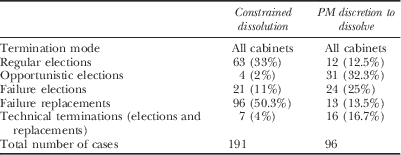
Table 1 shows the differences in government termination patterns by constitutional rule. The table contrasts the frequency of different types of termination under constitutions that constrain dissolution with constitutions that give the prime minister discretion to call early elections. As is consistent with the expectations outlined above, the table suggests that the two types of constitutional rule correlate with distinct patterns of government termination. Turning first to electoral terminations, the data make clear that European cabinets which operate under constrained dissolution end more often in regular elections (33 per cent) and far less frequently in opportunistic early elections (2 per cent) than those that operate under prime ministerial discretion to dissolve (12.5 per cent regular elections, 32.3 per cent opportunistic elections). Clearly, prime ministers who have discretion to dissolve exercise this power frequently. Opportunistic and failure elections jointly account for 57.3 per cent of all government terminations under such constitutions. Thus, early elections (whether discretionary or not) are an important aspect of political bargaining in those constitutional contexts.
Termination Modes by Constitutional Rule
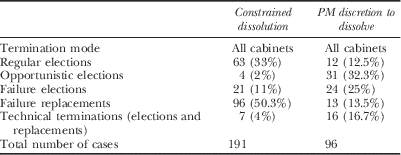
Source: Original data set compiled by the authors. The table omits current cabinets that have not yet terminated at the time of writing.
Given the expectations about the Act in the UK debate, though, an unexpected feature of the comparative evidence is that only a minority of all governments under constrained dissolution (33 per cent) terminate in regular elections. In fact, the modal termination type under these constitutions is not a regular election but a failure replacement (50.3 per cent). This pattern is not driven by the relatively large number of new democracies that have fixed-term parliaments (although the new democracies have a slightly higher frequency of failure replacements: 55.2 per cent of all government terminations, compared with 42.7 per cent in older democracies). Neither is it driven by coalition status. Among the cabinets that operate under constrained dissolution, termination modes do not differ significantly for single-party and coalition governments: the share of coalition governments ending in failure replacements is 50 per cent, 12 per cent end in failure elections and 2 per cent opportunistic elections, while single-party governments had 52 per cent failure replacements, 7 per cent failure elections and no opportunistic elections. These differences in the pattern of government terminations for coalitions and single-party governments are not statistically significant (a chi-square test of the difference of termination modes by coalition status is not significant; p=0.691). This is not surprising. Constitutions that seek to rule out opportunistic election calling equally restrict the freedom of manoeuvre of single-party and coalition governments. Constraining a prime minister’s power to dissolve the assembly, then, appears to change bargaining about these different modes of government termination fundamentally and in ways that are not fully appreciated in the UK debate about the Fixed-term Parliaments Act. The next section underscores this point with an analysis of the impact of the two constitutional types on the duration of parliaments and governments.
Constitutional Rules and the Duration of Parliaments and Governments
The distinction between the duration of parliamentary and governmental terms is crucial in analysing the effects of fixed-term parliaments because constraining dissolution affects governments and parliaments in different ways. It renders parliaments more stable by making it more difficult to call early elections of all types, converting some early elections into regular elections, but as Table 1 suggests, it also appears to make governments more susceptible to failure.
As anticipated, parliaments complete a greater proportion of their term (0.83) under constrained dissolution than when the prime minister has discretion to dissolve parliament (0.73). The difference is statistically significant (ANOVA p=0.008), though substantively it is not very large. The reason for this is that opportunistic elections, which account for the vast majority of early elections under prime ministerial dissolution, are typically timed towards the end of the parliamentary term.
The evidence regarding cabinet duration, though, reveals a potential consequence of constrained dissolution that is entirely unanticipated in the UK debate about the Fixed-term Parliaments Act: the average duration of cabinets under constrained dissolution is shorter (579 days, or 0.40 of the full inter-election term) than that of cabinets under prime ministerial discretion to call early elections (890 days, or 0.55 of the maximum inter-election term). This difference is only partially accounted for by the fact that the new East European democracies operating under constrained dissolution initially had less stable governments, resulting in an average duration of 0.36 as opposed to 0.46 of the parliamentary term for the older democracies in that category. It is also not accounted for by the coalition status of governments: in fact, single-party governments under constrained dissolution last on average less long (0.29 of the parliamentary term) than coalitions (0.42, ANOVA p=0.056). Closer inspection suggests that the reasons for the remaining difference are twofold. First, under constrained dissolution, governments end more often in failure replacements (the modal termination type under fixed-term parliaments). Second, failure replacements tend to occur in the first three quarters of the parliamentary term because politicians are more likely to form a new cabinet if they have sufficient time to make progress with their policies before the next regular elections have to be held. Opportunistic elections (the modal form of termination under prime ministerial discretion to dissolve), in contrast, are timed close to the end of the parliamentary term because governments aim to minimize the proportion of the current term that they sacrifice for the privilege of holding the next election in favourable circumstances. This difference in the timing of the modal termination types accounts for the shorter average lifespan of governments under constrained dissolution.
The comparative evidence, then, suggests that the Fixed-term Parliaments Act is likely to affect parliaments and governments differently. It can be expected to improve the duration of parliaments marginally, but it should not be expected to increase the average duration of governments and may quite possibly have the reverse effect, resulting in less stable governments and more replacements.
HISTORICAL ANALYSIS: POLITICAL STRATEGY AND TERMINATION MODES IN THE UK
To shed light on the motivations that inform the choices of politicians and generate the patterns in the comparative data, this section now turns to the political calculus and bargaining implicit in the historical patterns of cabinet terminations in the UK since 1945.Footnote 2 The following section builds on this analysis by exploring a series of counterfactual scenarios to examine how the Fixed-term Parliaments Act is likely to change the strategic calculations of politicians, and it integrates the conclusions with the comparative evidence to evaluate the divergent expectations of the Act.
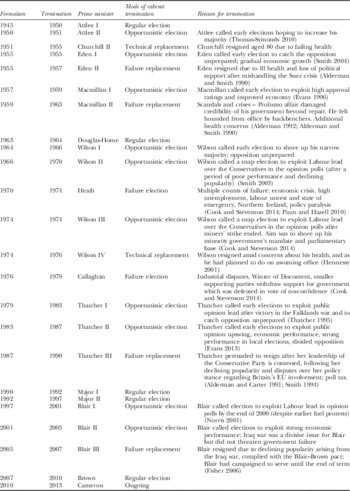
Table 2 presents all post-war cabinet terminations in the UK, categorized according to the typology that was outlined above.Footnote 3 Of the 23 cabinets in the UK since 1945, ten (44 per cent) have terminated in opportunistic elections, two (9 per cent) in failure elections, four (17 per cent) in failure replacements, two (9 per cent) in technical replacements and five (22 per cent) in regular elections.Footnote 4 Almost 60 per cent of all elections (10 out of 17) in the post-war period were opportunistically timed by the prime minister.
UK Government Terminations since 1945

Opportunistic elections, then, have been the modal election type and the dominant path of cabinet termination in the UK. The strategic calculations that motivate these elections are well illustrated by Margaret Thatcher’s decision to call an early election in June 1983, a year before the end of the parliamentary term. The timing of the election reflected two considerations. First, it aimed to capitalize on the British victory in the Falklands war and the disarray of the opposition; second, it was calculated to pre-empt the adverse effects of an anticipated increase in inflation over the coming months and the uncertainties inherent in an upcoming by-election in Cardiff (Thatcher Reference Thatcher1995: 288–9). The strategy proved successful. In a landslide victory the Conservatives secured 61.1 per cent of the parliamentary seats and another term in government. The Fixed-term Parliaments Act aims to rule out this path to government termination and to convert opportunistic elections into regular elections by requiring popular governments to run to full term.
As Table 2 makes clear, failure elections – caused by an erosion of the governing party’s majority or discipline, the collapse of a coalition, a loss of parliamentary support, a loss of public support, industrial unrest, major policy failure or scandal – have been rare in the UK, with only two examples since 1945 (Heath in 1974, Callaghan in 1979). The termination of the Conservative government under Edward Heath in February 1974 illustrates the strategic situations that trigger such elections. Heath called the election against the background of a deepening economic crisis and open conflict with the unions. The government’s credibility rested on its success in managing the economy and making its pay-restraint policy work. Yet, by early 1974, policy failure was evident on both counts and Heath was confronted with the prospect of a miners’ strike that spelled doom for his economy policy. If the government attempted to face down the miners, a prolonged strike was certain to undo its efforts to stabilize the economy. If it gave in to the miners, it would have to abandon its policy of pay restraint, with equally detrimental effects for economic stabilization. Heath’s government was effectively facing defeat in the confrontation with the unions. Unable to make progress with his key political aims, the prime minister used his discretion to call early elections (Heath Reference Heath1998: 509–11). Under the Fixed-term Parliaments Act, failure is the only envisaged route to early election. However, by constraining government discretion, the Act makes calling even those elections more difficult. Governments can no longer call a failure election when they judge that they have been defeated (as in Heath’s case), but must actually be ousted by a no-confidence vote or gather a cross-partisan, two-thirds majority for parliamentary dissolution.
Failure replacements have been similarly uncommon in the UK, as Table 2 shows. There are two ways in which government change can occur without an intervening election – either the prime minister is replaced, or there is a change of governing parties. Since single-party governments have historically dominated in the UK, all post-war replacements have taken the form of a change of prime minister (which terminated the cabinets of Macmillan in 1963, Thatcher in 1990 and Blair in 2007), while changes in the governing parties have occurred through elections. Margaret Thatcher’s removal from power is suggestive of the strategic calculations that motivate replacements. Throughout 1990, Thatcher’s popularity – and that of her government – waned considerably (Alderman and Carter Reference Alderman and Carter1991: 126–7). By late 1990 the economy was in recession. The introduction of the deeply unpopular community charge (widely referred to as the ‘poll tax’) had provoked widespread opposition, non-payment and riots. Labour had opened up a lead in most opinion polls in mid-1989 and held it. Conservative ministers contemplated abolition of the poll tax but knew that this would not be possible while Thatcher was still prime minister. These disagreements were compounded by differences within the cabinet over Thatcher’s perceived intransigence in her approach to the European Economic Community, which culminated with the resignation of the deputy prime minister, Sir Geoffrey Howe. The internal divides over policy, electoral concerns and discontent within the party about Thatcher’s abrasive leadership style contributed to a leadership challenge by Michael Heseltine in November 1990. After the first round of the leadership ballot ended inconclusively, some ministers in her cabinet persuaded Thatcher to resign. The Fixed-term Parliaments Act affects failure replacements not by directly regulating this mode of termination (as is the case with early elections), but by changing the bargaining tools of the prime minister and weakening his or her ability to manage exogenous risks to the government and internal tensions with the cabinet and governing parties. This argument is developed in greater detail below.
COUNTERFACTUAL ANALYSIS: STRATEGIC IMPLICATIONS OF THE FIXED-TERM PARLIAMENTS ACT
This section examines through a series of counterfactual scenarios how the Act is likely to alter the strategic choice of politicians in managing government terminations. Such scenarios allow us to explore the effects that would obtain if a ‘hypothesized causal factor is supposed to have been absent’ (Fearon Reference Fearon1991: 169). In evaluating the Fixed-term Parliaments Act, the counterfactual scenario is one in which the prime minister does not have the discretion to time elections opportunistically. The counterfactual question, then, is: What would have happened in different types of situations that actually occurred in the past, had the prime minister not had the discretion to dissolve? Focusing on each termination type in turn, this section relates its findings to the comparative patterns identified above and brings both types of evidence to bear in evaluating the different expectations in the UK debate about the implications of the Act.
The Act fundamentally alters the strategic considerations involved in opportunistic election calling. Opportunistic elections are called and timed to maximize the incumbent government’s chances of electoral victory. Under the Act it is possible for governments to engineer their own defeat in order to achieve early elections. But the Act reduces their ability to precipitate an early election directly and makes it less likely that such an election would yield a partisan advantage. Consider, for instance, Thatcher’s 1983 decision to time the general election early for partisan advantage. Counterfactual analysis reveals that the Fixed-term Parliaments Act would fundamentally alter the options available to a prime minister in Thatcher’s position. Since it is improbable that a cross-partisan two-thirds majority could be achieved for a plan to call an election for the incumbent’s advantage, the government would have to instruct its MPs to pass a motion of no confidence in their own cabinet. A defeat, however, is not sufficient to bring about an election. The Act provides for a 14-day period to form an alternative government in the event that a government suffers defeat in a no-confidence vote. This gives rise to a constitutional expectation that an attempt to form a replacement government should be made. In addition, European experience suggests that manipulated dissolution manoeuvres are open to judicial challenge (for example, Germany in 2005; see Youngs and Thomas-Symonds Reference Youngs and Thomas-Symonds2013). Both the prospect of judicial involvement and the expectation that replacement governments should be explored reduce the incumbent cabinet’s ability to precipitate early elections directly. Even if dissolution is achieved, the Act makes it less likely that governments would be able to derive electoral advantage from it. As Smith (Reference Smith2003) has shown, voters react adversely to evidence of opportunism in early election calling. Under the Act, a government would have to be not only opportunistic but also transparently manipulative in its subversion of the constitution’s intent, which would probably incur a significant electoral penalty, reducing any advantage that might have been gained from early elections. In sum, this counterfactual scenario suggests that the Act will fundamentally alter the strategic considerations of the government. While early elections timed for incumbent advantage are not entirely ruled out, they should be much less likely under the Act. This conclusion coincides precisely with the patterns that were observed in the comparative evidence – under constrained dissolution opportunistic elections account for just 2 per cent of all government terminations, compared with 32.3 per cent under prime ministerial discretion to dissolve. Both the comparative evidence and the counterfactual analysis, then, support the widespread expectation in the UK policy community that opportunistic early elections will substantially decline under the Act. The suggestion that opportunities to manipulate the no-confidence procedure could negate the overall effect of the Act are, in our view, not well founded.
The corollary expectation that the Act will convert opportunistic elections into regular elections rests on the implicit assumption that governments face no significant risks of terminating for other reasons in the intervening period. This assumption, a counterfactual analysis reveals, is mistaken. As noted above, governments manage risks (as well as grasping opportunities) when they call opportunistic elections. For instance, as mentioned above, Thatcher pre-empted the anticipated risks of a future rise in inflation and a Cardiff by-election by calling the election in June 1983 (Thatcher Reference Thatcher1995: 288–9). Governments that do not have that option are less able to manage their termination risks. Consider the following counterfactual scenario. For James Callaghan’s government, the risk of parliamentary defeat rose sharply with the lapse of the Lib–Lab pact in July 1978. When the pact lapsed, the Liberal Party declared that it would seek a general election as soon as possible and would therefore support any no-confidence motions. Imagine that Callaghan had called an election in September 1978, as he was widely expected to do. He would have pre-empted the risk of parliamentary defeat and of potential labour disputes during the winter, which he and others clearly perceived, and Labour would most likely have performed significantly better than it did in 1979 (Callaghan Reference Callaghan2006: 514–18). Under the Fixed-term Parliaments Act Callaghan would not have had that option. In the event, his choice to postpone the election allowed these risks to transform themselves into manifest problems that triggered defeat. Only when governments face risks that do not have the potential to trigger defeat can the Act reliably transform opportunistic elections into regular elections. For those that face significant challenges, the Act constrains the prime minister’s options of managing those risks, raising the government’s vulnerability to failure. Thus, the Act can be expected to raise the share of regular elections to a degree, but this rise will almost certainly not be proportional to the reduction of opportunistically timed elections. This conclusion is consistent with the comparative evidence: fixing the parliamentary term raises the frequency of regular election terminations (from 12.5 per cent to 33 per cent), but not as much as it reduces opportunistic elections (from 32.3 per cent to 2 per cent). The expectation that the Act will convert opportunistic elections into regular ones, therefore, only finds partial support in the available evidence.
The Fixed-term Parliaments Act can also be expected to change the strategic considerations that lead to failure elections. This type of early election has received little attention in the UK debate. Only Youngs and Thomas-Symonds (Reference Youngs and Thomas-Symonds2013) give detailed consideration to the question and suggest that the Act may make it more difficult to call such elections, forcing ‘lame duck’ governments to complete their full term. A counterfactual analysis lends support to that conclusion. Consider Edward Heath’s decision to call elections once his government had been cornered by the miners in 1974. Under the Act, this option would not have been available to him. Early elections would either have required a successful no-confidence vote (which was unlikely since Heath commanded a parliamentary majority at the time) or a cross-partisan two-thirds majority to achieve dissolution. In the absence of cross-partisan agreement on the desirability of elections, Heath would have had to carry on. This counterfactual scenario illustrates that the Act makes calling a failure election appreciably more difficult, which is likely to make them rarer still. Indeed, this is precisely what the comparative evidence suggests. Constraining dissolution correlates with a reduced frequency of failure elections among government terminations (just 11 per cent compared with 25 per cent under prime ministerial discretion to dissolve).
Interestingly, failure replacements have received no attention at all in the UK debate about the likely consequences of the Fixed-term Parliaments Act. But this mode of termination, too, is likely to be affected because the Act weakens the bargaining tools available to prime ministers. This alters the strategic choices available to the political actors in a manner that raises the risk of failure replacements by three mechanisms: First, as noted above, the Fixed-term Parliaments Act substantially reduces the prime minister’s power to manage the government’s risk of termination from exogenous influences (such as rising inflation, industrial unrest or parliamentary defeat) by timing the election to opportune circumstances. Second, the Act reduces the prime minister’s power to manage tensions within the government itself. Thus, ‘one of the consequences of having a fixed-term Parliament [is] that the Prime Minister loses that bargaining power, the ability to be able to threaten a recalcitrant minority coalition partner with the consequences of an early election’ (House of Commons PCRC 2013: Evidence 13, Q. 277). For the same reason, the Act reduces the ability of the prime minister to discipline his or her own recalcitrant backbenchers. Both backbenchers and coalition partners may therefore become more assertive in the future. In both of these ways, the Act makes governments more vulnerable to failure. Third, the Act establishes a constitutional expectation that the formation of a replacement government be explored before failure elections are called and also makes it more difficult to call failure elections. This is likely to channel bargaining over government failures into replacements. As Table 2 makes clear, replacements have been rare events in the UK since 1945. They should be expected to become more common in future. The comparative evidence suggests that this is an area in which the Act’s effects may turn out to be as pronounced as the effects on opportunistic election calling: failure replacements are the modal type of government termination under constrained dissolution – accounting for half (50.3 per cent) of all cabinet terminations. Both the counterfactuals and the comparative evidence, then, point to a potential consequence of the Act that has so far been unanticipated in the UK debate – an appreciable increase in the share of governments that suffer failure replacements.
What are the likely consequences of these projected shifts in termination patterns? As the comparative evidence suggests, failure replacements reduce the average duration of governments. Moreover, if more governments terminate without intervening elections, the synchronization of governmental and parliamentary terms is reduced. Before 2011, most governments in the UK ended in elections (whether early or not). As a result there was a high degree of synchronization between parliamentary and governmental terms. A rise in failure replacements in the UK would detract from that. In principle, a rise in failure replacements can seriously disrupt governmental and parliamentary planning and generate political and economic uncertainty. Clearly, though, that disruption is greatest when the replacement leads to a change of government parties; it is significantly less severe when only the prime minister is replaced and the governing party remains in power. The predominance of single-party governments in the UK makes an increased frequency in the changes of prime minister a more likely outcome than all-out changes of governing parties. From the point of view of planning governmental and parliamentary business, these replacements are easier to manage. As long as single-party governments remain common, then, the most disruptive implications of an increase in failure replacements are likely to be mitigated.
CONCLUSION
Constitutional rules powerfully shape patterns of government termination, duration and parliamentary dissolution. But often their effects in specific instances of reform are not well understood. This article has analysed the likely effects of the Fixed-term Parliaments Act (2011) in the UK and probed the divergent expectations of practitioners and scholars. Exploring anticipated effects poses non-trivial inferential challenges simply because direct evidence of the legislation’s effects has yet to emerge. This article addresses these challenges by combining evidence from two distinct and complementary approaches – comparative and counterfactual analysis – to draw inferences about the Act. While the comparative analysis of European cabinets under fixed- and variable-term parliaments speaks to the large-N correlations between constitutional rules and patterns of government termination, the counterfactual analysis addresses complementary questions about the causal processes that might drive termination patterns. To the extent that the results of both analyses converge, one can have greater confidence in conclusions about the probable consequences of the Act.
The evidence from both analyses indicates that the Act’s central goal is likely to be met: opportunistic elections can be expected to decline substantially and should cease to be the modal type of government termination in the UK. But the widespread expectation that the Act will convert opportunistic elections into regular ones finds only partial support in the evidence. While regular elections should increase to a degree, stabilizing the term of parliaments, that rise will almost certainly not be proportional to the reduction of opportunistically timed elections. This article explains why this is the case – showing that early and regular elections are just two of the four different paths to government termination between which politicians choose strategically. It shows that the other two paths to government termination – failure elections and failure replacements – are equally affected by the Act. By changing the choices open to political actors and the bargaining tools of the prime minister, the Act is likely to make failure elections rarer still, but has the potential to cause an appreciable increase in the share of governments that suffer failure replacements – a consequence that has to date been entirely unanticipated in the UK debate. While the Act is therefore likely to render parliaments more durable, it will in all probability reduce the stability of governments, and their average durations. As a result, the Act’s corollary aims of achieving more stable governments and a better synchronization of the governmental and parliamentary term are unlikely to be met.
ACKNOWLEDGEMENTS
We thank the editors of Government and Opposition and the anonymous referees for comments on an earlier version of the paper. Petra Schleiter gratefully acknowledges the support for this research by the British Academy (Grant Reference Number CTRYFG0) and the John Fell Oxford University Press Research Fund (Project Reference 121/476).