INTRODUCTION
Cotton (Gossypium hirsutum L.) is a self-pollinated species and elite cultivars are assumed to be genetically homogeneous. However, evidence from selection experiments within fairly homogeneous genetic pools suggests that the genome is more flexible and plastic than previously assumed (Fasoula & Boerma Reference Fasoula and Boerma2005). McClintock (Reference McClintock1984) pointed out that the genome is dynamic and can modify itself in response to environmental stress, whereas Rasmusson & Phillips (Reference Rasmusson and Phillips1997) noted that elite gene pools have inherent mechanisms to provide a continuing source of new genetic variability thanks to genome plasticity. Genetic variation, depicted by microsatellite and/or Restriction fragment length polymorphism (RFLP) molecular analysis, has been reported within sunflower (Helianthus annuus L.) and maize (Zea mays L.) inbred lines (Zhang et al. Reference Zhang, Gentzbittel, Vear and Nicolas1995; Gethi et al. Reference Gethi, Labate, Lamkey, Smith and Kresovich2002, respectively) and rice (Oryza sativa L.) cultivars (Olufowote et al. Reference Olufowote, Xu, Chen, Park, Beachell, Dilday, Goto and McCouch1997). Besides genome plasticity, natural crossing may exist in cotton thanks to the presence of insects that transfer the heavy and sticky pollen from plant to plant (Xanthopoulos & Kechagia Reference Xanthopoulos and Kechagia2000). Consequently, elite cotton cultivars may be, to some extent, heterogeneous, carrying hereditary variation attributable to latent heterozygosity, cross-pollination, mutation or a combination of these. Fasoulas (Reference Fasoulas2000) reported exploitable genetic variation within a cultivar for seedcotton yield and resistance to Verticillium wilt (Verticillium dahliae), but there are no other studies known on the presence of genetic variation and the feasibility of single-plant selection within elite cotton cultivars. On the other hand, such studies under ultra-low density conditions, which allow maximum phenotypic expression and hence accentuate limited genetic variation, revealed significant intra-cultivar variability in various species. Significant variation within bread wheat (Triticum aestivum L.) cultivars was reported for grain yield (Fasoula Reference Fasoula1990; Tokatlidis et al. Reference Tokatlidis, Tsialtas, Xynias, Tamoutsidis and Irakli2004), as well as for grain protein content, carbon isotope discrimination and ash content (Tokatlidis et al. Reference Tokatlidis, Tsialtas, Xynias, Tamoutsidis and Irakli2004). Traka-Mavrona et al. (Reference Traka-Mavrona, Georgakis, Koutsika-Sotiriou and Pritsa2000) succeeded in improving pod number and yield in a snap bean (Phaseolus vulgaris L.) cultivar. Tokatlidis (Reference Tokatlidis2000) found significant differentiation for five agronomic traits among sublines derived from two maize inbred lines, with variation being transmitted to single-crosses. Fasoula & Boerma (Reference Fasoula and Boerma2005) discovered significant variation within three soybean (Glycine max (L) Merr.) cultivars for seed protein, oil and fatty acid composition.
The aim of the present work was to investigate variation within three elite cotton cultivars for seedcotton yield, fibre quality properties (length, uniformity, strength and micronaire) and physiological traits (leaf carbon isotope discrimination, ash content and K concentration). Single-plant selection at the ultra-low density of 1·2 plants/m2 was performed for two consecutive generations and progeny evaluation was performed for the aforementioned traits under the same ultra-low density. Ultra-low density, assumed to approach total absence of competition by maximizing phenotypic expression and differentiation and allowing high selection intensities (Fasoula & Fasoula Reference Fasoula and Fasoula1997, Reference Fasoula and Fasoula2002), optimizes the expression of selection differential (S) and heritability (h 2), parameters that, according to the formula R=ih 2S (Falconer Reference Falconer1989), affect response to selection (R).
MATERIALS AND METHODS
Source material and experimental treatment
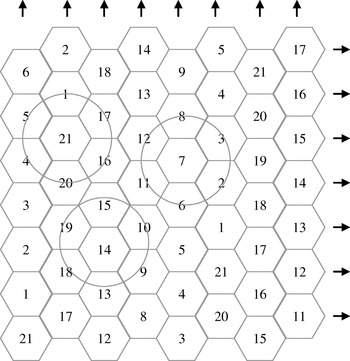
Three commercial cotton cultivars (cvs Christina, Flora and Corona), widely cultivated in northern Greece, were used. These cultivars were released in Greece in 1997, 1998 and 1992, respectively. Honeycomb experimentation (Fasoulas & Fasoula Reference Fasoulas and Fasoula1995) was conducted at three sites, representing the regions of Greece where cotton is widely cultivated, at the ultra-low density of 1·2 plants/m2. Honeycomb designs ensure effective soil-heterogeneity control to compare different entries by allocating each entry systematically and uniformly on the entire area. Hence, objective single-plant selection within a given entry is attained, because plants of this entry are always surrounded by plants of all the other entries (Fig. 1). Site 1 was Alexandroupolis, a northern location of Greece (40° 51′ N, 23° 17′ E, 9 m asl, a sandy clay loam soil with pH 7·3, organic matter 15·1 g/kg, N-NO3 41·8 mg/kg, P-Olsen 52 mg/kg, and K 437 mg/kg). In this particular region, honeycomb selection was applied for two generations on the basis of single-plant seedcotton yields by the moving-circle procedure (Fasoulas & Fasoula Reference Fasoulas and Fasoula1995). By this technique a particular plant is selected when, being in the centre of a circle, the size of which is defined by the selection intensity, it outyields all the surrounding plants included in the circle. Alternatively, the yield of each plant is expressed as proportion of the mean yield of the surrounding plants, and those with the highest relative value are selected. This latter technique was used in the present work.
Entries' arrangement according to the R-21 honeycomb design for progeny evaluation. Codes 7, 14 and 21 belong to the check cvs Christina, Flora and Corona, respectively. Entries were coded in such a way that the six plants surrounding each plant of a given check always belonged to the six lines derived from this particular cultivar (e.g. codes 2, 3, 6, 8, 11 and 12 represent plants from lines derived from cv. Christina).

Sites 2 and 3, where progeny evaluation was performed, were Thessaloniki (40° 32′ N, 22° 59′ E, 6 m asl, a clay loam soil with pH 7·6, organic matter 25·8 g/kg, N-NO3 17·9 mg/kg, P-Olsen 25 mg/kg and K 109 mg/kg) and Larissa (39° 35′ N, 22° 36′ E, 51 m asl, a clay loam soil with pH 7·9, organic matter 23·4 g/kg, N-NO3 15 mg/kg, P-Olsen 41 mg/kg and K 455 mg/kg), respectively. Honeycomb experimentation was applied under growing conditions that were as optimal as possible: two or three seeds were sown in each hill and thinned to a single plant per hill when seedlings reached the 2-true leaf stage; trials were regularly irrigated to avoid drought stress; soil fertilization was applied at planting stage at 100 kg/ha N, 50 kg/ha P2O5 and 75 kg/ha K2O; insecticide was used to suppress soil and plant insect development; complete weed control was obtained by tilling and hand weeding; to control final plant growth, 400 ml/ha mepiquat chloride (5 g/kg SL, soluble concentrate) was applied when plants were 0·6 m high and 600 ml/ha when plants were 1·0 m high. Plants were individually hand-harvested from mid-September to early November; small and immature bolls that would not be harvested by commercial spindle pickers were excluded. Bolls of selected plants were ginned on a laboratory gin, seeds were delinted with H2SO4 (900 g/kg), and covered with fungicide (carboxin 170 mg/g – pendachloronitrobenzene 170 mg/g and 5 ml/kg) after immature seed had been removed using a ‘blower’ device.
Single-plant selection to form first generation's lines
On 17 April 2004 an R-3 honeycomb experiment was established at Site 1. It included 550 plants of each cultivar, with plants being 1·0 m apart. Self-pollination was achieved by hand-pollination, and six plants per cultivar were selected. The selected plants were those that had the highest relative seedcotton yields compared to the mean yield of 61 surrounding plants (i.e. 0·016 selection pressure). Seed of each selected plant constituted a separate line, and 18 first generation lines resulted.
Progeny evaluation and selection to form second generation's lines
During the 2005 growing season, the 18 first generation lines, as well as the original cultivars as controls (seed from the same batch used in the previous season), were sown in mid-April in an R-21 honeycomb experiment at the three locations. Each entry was represented by 60 plants in each location and plants were spaced 1·0 m apart. Entries were coded in such a way that the six plants surrounding each plant of a given control cultivar always belonged to the six lines derived from this particular cultivar (Fig. 1). This entry arrangement ensured the most comparable conditions between cultivars and their respective lines. At Site 1, 10 selfed (i.e. hand-pollinated) plants that had the highest relative yields concerning the mean yield of 43 surrounding plants (i.e. 0·023 selection pressure) were selected from each first generation line. Mixed ginned seed of the selected plants within each first generation line formed the respective second generation line.
To estimate physiological traits, the uppermost fully expanded leaf of each plant was collected (in mid-August) to comprise three samples of each entry (each sample collected after the entire experimental area was divided in three different replications). Leaf samples were dried at 75°C for 48 h and ground to fine powder using a microhammer cutter (Glen Creston Ltd Stanmore, Middlesex, UK). Determination of carbon isotope discrimination (Δ, a measure of the 13C/12C ratio in plant tissues compared to the air) was conducted at the Scottish Crop Research Institute on an isotope mass spectrometer (CF-IRMS, Europa Tracer Mass, Crewe, UK) coupled to an elemental analyser (Roboprep) for online sample preparation. Carbon isotope ratio δ13C (‰) in samples was calculated as:

where the universally accepted standard was PDB (Peedee belemnite) limestone. Carbon isotope discrimination (Δ) was calculated as:

where δa and δp are δ13C of the air and leaf sample, respectively; δa is c. −8 ‰ (Farquhar & Lloyd Reference Farquhar, Lloyd, Ehleringer, Hall and Farquhar1993). Ash was determined after burning of leaf samples (0·5–1 g) in a muffle furnace at 500°C for at least 4 h and by weighing the residue. In the same leaf samples, K concentration was measured after dry combustion on a flame photometer.
Fibre quality traits (length, uniformity, strength and micronaire) were estimated in three samples per entry via high volume instrumentation. These samples, collected only from Site 1 by classifying the entire experiment as three replications, had been put in an air-conditioned area (22°C temperature and 65% relative humidity) the previous day, to avoid fibre breakage.
Progeny evaluation of second generation's lines
In the third growing season (2006), the aforementioned experiment was repeated for the second generation lines in the same experimental fields. All practices were similar to those used during the previous growing season.
Data analysis
Mean seedcotton yields were compared by z-test for independent samples and different standard deviations. For all the other traits, comparison of means was conducted by ANOVA, after applying Bartlett's test for homogeneity.
RESULTS
In the initial R-3 experiment (Site 1), the seedcotton yields of the three cultivars did not differ significantly. Mean yield per plant of cv. Christina was 437 g with a 150 g standard deviation (CV=0·34). The respective values for cv. Flora were 418 and 120 g (CV=0·29) and for cv. Corona 412 and 141 g (CV=0·34).
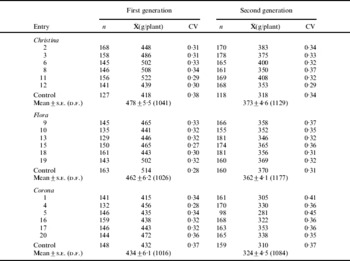
Mean seedcotton yield of the first and second generation lines, as well as of the respective check cultivars across the three locations, are given in Table 1. Even though entries ranked differently and significant differences between overall mean yields of locations were observed, data presented were averaged across the three locations, because genotype×environment interaction was not the primary issue of the present paper. Site 3 gave significantly lower yields and considerably higher CV values than Site 1 and Site 2 in the first and especially in the second generation. This was attributed partly to Verticillium wilt in the soil.
Mean yield per plant ( ), and mean coefficient of variation (CV) of first and second generation lines across three locations (n=total number of harvested plants)

The data shown in Table 1 depict significant differences within cultivars for seedcotton yield per plant. Mean seedcotton yields of the first generation lines derived from cv. Christina ranged from 439 to 522 g (CV values ranging from 0·29 to 0·34), while their original cultivar yielded 418 g (CV=0·38). Compared to the appropriate check cultivar, four out of the six lines were up to 25% superior (e.g. line 11). The average yield of first generation lines was also significantly higher by 16%. Compared with the check cultivar, the six second generation lines were 10 (line 8) to 28% (line 11) significantly higher yielding, with their average yield being by 19% significantly higher. In contrast compared with cv. Flora, average yield of the respective six first generation lines was significantly lower (by 11%), with five of them giving significantly lower yield up to 14% (line 10). In the second generation, the average line yield did not differ significantly from that of cv. Flora, and only line 13 yielded significantly lower (by 6·5%). Except for line 15 in the first generation and line 18 in the second generation, generally higher CVs were observed compared to the check cultivar. In cv. Corona, the first generation line 20 was significantly superior by 9·3% over the control. Lines 20 and 17 were significantly superior in the second generation (by 9 and 14%, respectively). Average yield of lines was slightly higher in comparison with yield of cv. Corona in both generations, with superiority increasing from 2·5% in the first generation to 3·9% in the second generation. In the first generation lines tended to exhibit lower CV values than the control.
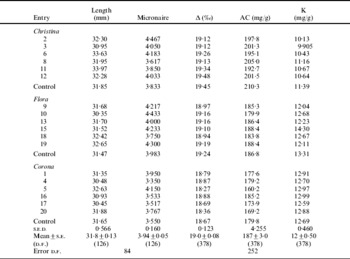
Analysis of variance for fibre quality properties and physiological traits depicted significant differences between genotypes, excepted for fibre uniformity and strength. Fibre length was affected by the year, whereas significant genotype×year interaction was found for micronaire. Physiological traits were significantly affected by the main factors (year, location and genotype) and their interactions. In Table 2, mean values are given for those traits shown to be significant in the analysis of variance. Significant differences between entries of each cultivar were found for almost all these traits, except for K concentration in cv. Corona. Even in the case of ash content in cv. Flora, for which no line differed significantly from the control, line 19 had a significantly higher value than line 10.
Mean entry values for fibre quality and physiological traits with significant mean square: fibre length and micronaire across two years in a single location, and Δ, ash content (AC) and K across two years and three locations

DISCUSSION
The above results depict significant intra-cultivar variability for single-plant seedcotton yield, because the three cultivars responded to selection for this particular trait. The way they responded to selection demonstrates the type and the extent of their variability. Cultivars Christina and Corona both responded positively, but cv. Christina responded to the greatest possibly reflecting greater variability. As compared to the respective control cultivar, the tendency for lower line CV values is a sign of narrowing genetic variation within these cultivars. Experience of similar studies in maize (Tokatlidis Reference Tokatlidis2000) and bread wheat (Tokatlidis et al. Reference Tokatlidis, Xynias, Tsialtas and Papadopoulos2006) has led to the conclusion that response to selection of cv. Corona was somewhat more expected. Perhaps cv. Christina consists of a mixture of lines (i.e. multiline cultivar) and in a personal communication from a representative of the company that stocks this cultivar, such a possibility was not excluded. This multiline hypothesis reflects wide genetic variation and renders the highly positive response to selection reasonable. Nevertheless, it was obvious that selection within both cultivars could exploit existing variability. Average yields of the checks were lower in the second compared with the first generation (by 24 and 28% for cvs Christina and Corona, respectively), clearly showing that environmental conditions were less favourable for the second generation lines. However, average line superiority over controls increased in the second generation (i.e. 16 v. 19% for cv. Christina, and 2·5 v. 3·9% for cv. Corona), giving the impression of further response to selection.
The data from cv. Flora were promising for exploitable variation. Cross-pollination within cultivar that preserves heterozygosity could explain the availability of genetic variation for selection, since strict self-pollination would have reduced exploitable heterogeneity. The average first and second generation line CV being higher (c. 11%) than that of the control is indicative of this. Although cotton is a self-pollinated species, natural crossing may range from zero to almost 0·5 (Xanthopoulos & Kechagia Reference Xanthopoulos and Kechagia2000) . Advanced by self-pollination, the second generation lines considerably decreased the gap between average line and original cultivar performance (i.e. −11 v. −3·2% lower yield in the first and the second generations). More specifically, inferiority of line 15 decreased from 10 to 1·4% and that of line 18 decreased from 14 to 3·8%. This opens the possibility that continuous selection within cv. Flora may lead to new lines capable of out-yielding the cultivar.
Fibre quality properties are affected by the environment, although to a lesser degree than yield (Campbell & Jones Reference Campbell and Jones2005), whereas Δ, ash and K have a high heritability (Condon & Richards Reference Condon and Richards1992; Tsialtas et al. Reference Tsialtas, Kassioumi and Veresoglou2002). In the present study, single-plant seedcotton yield was the selection criterion, whereas fibre quality and physiological traits were used to support the within-cultivar variation. Significant intra-cultivar variation for Δ and ash content was also reported in a bread wheat cultivar (Tokatlidis et al. Reference Tokatlidis, Tsialtas, Xynias, Tamoutsidis and Irakli2004). Leaf Δ is widely used as an indirect assessment of plant water economy because it is negatively related to water use efficiency (the ratio of dry biomass produced per kg water consumed) in C3 species (Farquhar et al. Reference Farquhar, Ehleringer and Hubick1989). In cotton, Δ was found to be related with yield (seed- and lint-cotton yield), and thus was proposed as an indirect selection criterion for upgrading cotton productivity (Saranga et al. Reference Saranga, Flash and Yakir1998; Leidi et al. Reference Leidi, López, Gorham and Gutiérrez1999). Potassium, playing a key role in gas exchange characteristics and water economy, is related to productivity and Δ in cotton (Bednarz et al. Reference Bednarz, Oosterhuis and Evans1998). However, a more detailed study on the relationships between seedcotton yield, quality and physiological traits (Δ, ash content and K) is needed.
The significant differentiation within the three cultivars for seedcotton yield, fibre length and micronaire, Δ, ash and K are indicative of genetic intra-cultivar variation. Hence, this variation deserves particular consideration as regards the conservation of breeder's seed purity. Gethi et al. (Reference Gethi, Labate, Lamkey, Smith and Kresovich2002) argued that breeders should take into account the within maize inbred lines genetic variation, especially when sampling materials released earlier. Fasoula & Fasoula (Reference Fasoula and Fasoula2000) stated that continuous selection after the release of cultivars is imposed by the need to eliminate deleterious mutations and exploit any positive source of existing and newly derived variation, either genetic or epigenetic. Epigenetic changes, caused by habitat, represent heritable changes (Riggs & Porter Reference Riggs, Porter, Russo, Martienssen and Riggs1996). In a recent study (Tokatlidis et al. Reference Tokatlidis, Xynias, Tsialtas and Papadopoulos2006), it was speculated that a new approach accentuating limited genetic variation might be necessary for bread wheat cultivar conservation and honeycomb selection fulfils such a prerequisite. Results of the present study are supportive of this approach for cotton cultivars as well. Selection for single-plant yield in the absence of competition, that maximizes single-plant or entry differentiation and hence facilitates the selection of those representing the superior genotypes (Fasoula & Fasoula Reference Fasoula and Fasoula1997; Janick Reference Janick, Coors and Pandey1999), seems an effective procedure to treat elite cotton cultivars. In this way any existing and newly developed variation could be beneficially exploited, in order to either avoid gradual degeneration or even upgrading the cultivar. Honeycomb selection at the density of 0·74 plants/m2 within the elite cotton cv. Sindos 80 led to cv. Macedonia, which under experimental conditions across 32 environments exhibited 10% greater seedcotton yield than cv. Sindos 80. Additionally, two cotton lines were identified with tolerance to Verticillium wilt, while the original cv. Sindos 80 was susceptible (Fasoulas Reference Fasoulas2000). In wheat divergent single-plant selection at the density of 1·2 plants/m2 within the cv. Siete Cerros produced lines with 8% higher and 9% lower yield than Siete Cerros (Fasoula Reference Fasoula1990). In maize, honeycomb selection at 0·74 plants/m2 revealed significant variation within inbred lines for grain yield and other ear traits, that was transmissible to their hybrids (Tokatlidis Reference Tokatlidis2000). Fasoula & Boerma (Reference Fasoula and Boerma2005) succeeded in obtaining significant differentiation for seed protein, oil and fatty acid composition within three soybean cultivars via honeycomb selection at 1·4 plants/m2. The researchers also reported significant variation within these cultivars for seed weight and maturity (Fasoula & Boerma Reference Fasoula and Boerma2007). Selection within the bread wheat cv. Nestos for two generations at 1·2 plants/m2 confirmed improvement of grain yield per unit area under the typical dense stand, as well as of stability across densities (Tokatlidis et al. Reference Tokatlidis, Xynias, Tsialtas and Papadopoulos2006). Honeycomb selection has been found to allow maximum expression of genetic potential by reducing any plant-to-plant interference for environmental resources. Plants selected under the honeycomb system exhibit less density dependence, enabling them to give maximum yield per unit area under a wider range of densities (Fasoula & Fasoula Reference Fasoula and Fasoula2000, Reference Fasoula and Fasoula2002; Tokatlidis et al. Reference Tokatlidis, Koutsika-Sotiriou and Fasoulas2001, Reference Tokatlidis, Xynias, Tsialtas and Papadopoulos2006). The impact is beneficial for stability since yield loss on account of any missing plants is better compensated by the plants surrounding the unoccupied hills in the field. Furthermore, cultivars could be grown under lower densities than usual and in cotton this might be beneficial for fibre quality as well. Lower densities in cotton result in more desirable fibre qualities (Dong et al. Reference Dong, Zhang, Tang, Li and Li2005; Bednarz et al. Reference Bednarz, Nichols and Brown2006). The final message of the present study is that honeycomb selection under ultra-low density that approximates absence of competition could be an effective tool to treat breeder's seed of elite cotton cultivars. Batzios et al. (Reference Batzios, Roupakias, Kechagia and Galanopoulou-Sendouca2001) applied honeycomb pedigree, as well as conventional pedigree selection in two cotton populations, and the results supported honeycomb selection as being more effective in identifying lines with high yielding ability and good fibre quality.
In conclusion, results of the current study provide evidence of significant variation within elite cotton cultivars and this is likely due to latent and/or newly developed variation. Single-plant selection under ultra-low density, that facilitates identification of even limited genetic variation because it maximizes phenotypic differentiation, is proposed as an effective procedure to exploit the variation. Honeycomb experimentation and selection invented for such conditions could be effectively utilized in breeder's seed treatment so that gradual cultivar degeneration is avoided and beneficial variation is exploited.
The project was co-funded by the European Social Fund & National Resources – EPEAEK II – PYTHAGORAS II. We are grateful to Professor N. Barbayiannis at the Laboratory of Soil Science, School of Agriculture, Aristotle University of Thessaloniki, for ash content and K determinations, to the Union of Agricultural Cooperatives of Rodopi for the analysis of the qualitative traits, to the branch of the United Textiles in Alexandroupolis for letting us gin the samples in their plant, as well as to Bios Agrosystems for the use of the ‘blower’ device and seed treatment.