

We appreciate the author’s thoughtful review of our book, Democracies in Peril. The author raises concerns about whether democracies in less developed countries (LDCs) are struggling to raise revenue post-liberalization, particularly in comparison to authoritarian regimes. Their critique has two main points: (1) developing countries have not experienced a significant revenue shock after liberalization; and (2) LDC democracies are successfully implementing and increasing domestic taxes to offset their revenue losses. The critique focuses on our choice of data: we used the World Bank’s World Development Indicators (WDI) rather than the more detailed International Center for Tax and Development (ICTD) dataset.Footnote 1 We appreciate these valuable insights and welcome the opportunity to revisit our research question using updated data, clarify our choice of WDI, reassess whether liberalizing democracies in LDCs continue to face fiscal challenges, and propose implications for future research.
THE REVENUE SHOCK PERSISTS
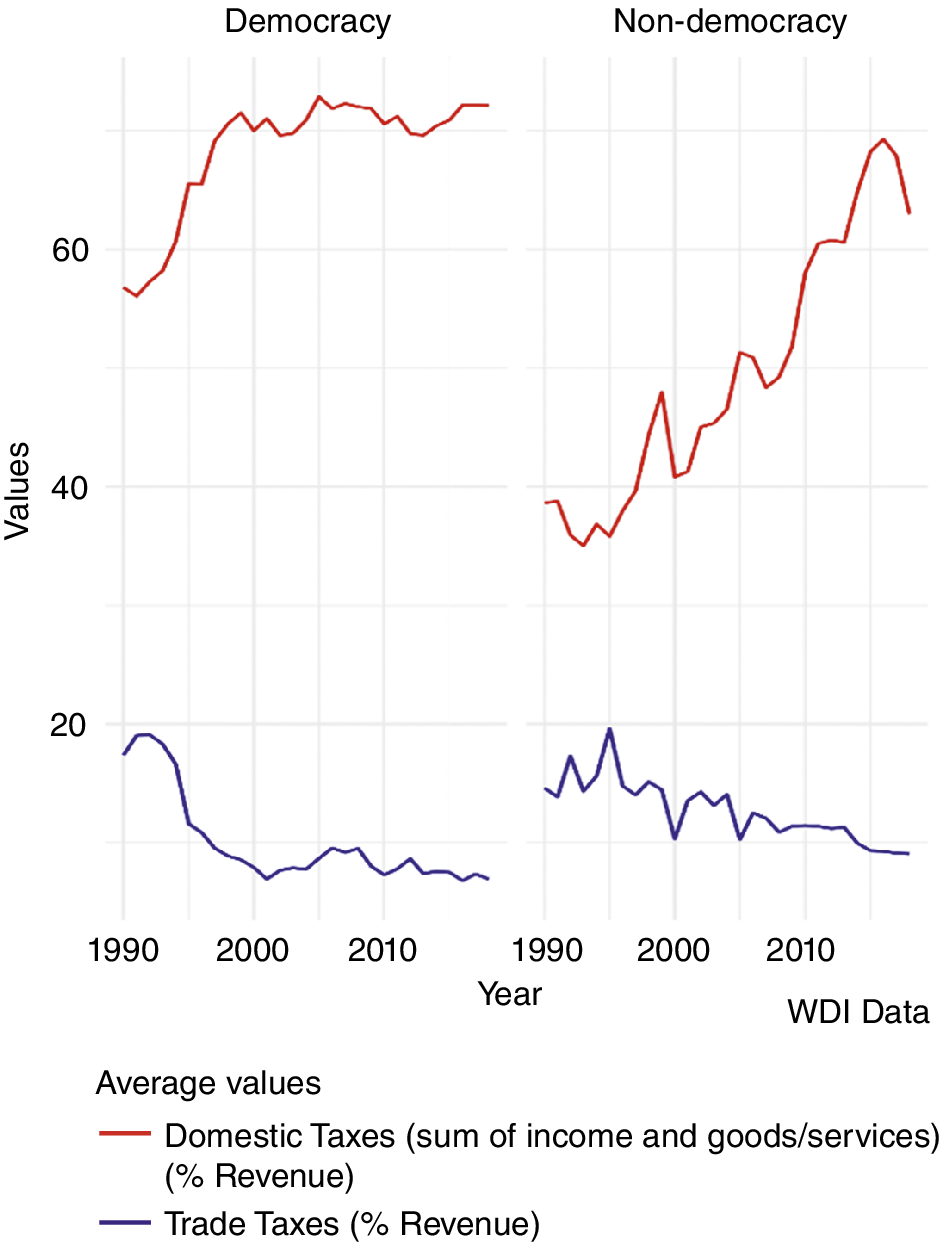
Is there a revenue shock? We replotted tax-revenue trends in LDCs using the most recent data published by the WDI.Footnote 2 Following the author’s advice, we recalculated domestic tax revenue as the summation of goods and services tax revenue and income tax revenue; we then plotted this against trade tax revenue as a percentage of total revenue. We chose to focus on post-1990 data so that we could be more confident that declines in trade tax revenue correspond to trade liberalization. Before the 1990s, factors including dependence on a limited number of trade partners, reliance on a small range of goods for revenue, efforts to promote domestic industries, and reduced consumer access to imported goods contributed to a volatile environment for trade tax revenues in LDCs even before the effects of trade liberalization were felt. To provide clear trends across democracies and non-democracies, we also chose to plot data for countries that did not switch regime types.Footnote 3 These trends held steady when resource-rich countries were excluded (see online appendix figure A.1). We confirmed this because these nations may depend less on domestic tax revenues and reform, as the author rightly argues.
As shown in figure 1, trade tax revenues (as a percentage of total government revenue) have been declining for both democracies and non-democracies since 1990. After trade liberalization began in the late 1980s and 1990s for most LDCs, non-democracies experienced growth in their domestic tax revenues. In democracies, however, tax revenues began stagnating around the early 2000s as taxes on income and goods and services became the primary source of government income following trade liberalization. Domestic tax revenues initially began at higher levels in democracies, which is expected because democracies face greater demands for redistribution and public goods spending. ICTD data reflect a similar trend, as shown in online appendix figures A.2 and A.3.
Tax Revenue Trends in a Sample of Stable Democracies and Non-Democracies, 1990–2018 (WDI Data)

Beyond the trends unveiled in figure 1 and online appendix figures A.1–A.3, key international and domestic actors placed significant focus on the revenue shock in developing countries, underscoring its seriousness. An examination of the history of trade liberalization in LDCs reveals that the International Monetary Fund (IMF) and World Bank (WB) have had pivotal roles in both facilitating and addressing this issue. Since the 1980s, these institutions have actively promoted trade liberalization, often using structural adjustment programs to integrate developing countries into the global economy. As a result of this process, managing the revenue shock has become a key focus for both domestic LDC policy makers and international organizations, and it has remained a priority to this day.
More specifically, economic crisis in many LDCs led the IMF and the WB to provide financial assistance through conditional lending programs. In exchange, the IMF required major reforms, including tariff reductions, removal of trade barriers, and liberalization of import regimes. Although this approach successfully promoted trade liberalization, it also led to a major negative consequence: that is, the significant loss of tariff revenues—a critical source of income for LDCs.
Our book explores in detail how the shift from easy-to-collect taxes (e.g., tariffs) to harder-to-collect taxes triggered a revenue shock for developing countries, particularly democracies. This rapid transition faced public resistance in democratic LDCs because households were reluctant to accept higher taxes—especially in countries where confidence in the government’s effective use of funds was low due to the poor state of public goods (e.g., roads, infrastructure, health, welfare, and education). Additionally, weak tax-administration systems in LDCs made compliance and enforcement more difficult in democracies where tax evasion often carries less-severe consequences than in non-democracies. This led to a vicious cycle of poor public goods, low tax revenue, and a continued undersupply of effective public services.
In response, both international institutions (i.e., the IMF and the WB) quickly shifted their focus to helping developing countries transition from trade taxes to domestic revenue sources, such as the value-added tax (VAT); broaden the base of domestic taxes; and improve tax administration. As highlighted in our book, both the IMF and the WB provide substantial resources for technical assistance, training, and policy guidance to support the implementation and enforcement of domestic taxes in LDCs. The IMF and the WB remain actively engaged in assisting these countries to replace revenue lost from trade liberalization. Simply stated, powerful international organizations are deeply engaged in helping LDCs overcome the revenue shock caused by trade liberalization.
PRIORITIZING WDI DATA TO ESTIMATE THE REVENUE SHOCK
The author makes valid points regarding the value and validity of the ICTD database. As mentioned previously, the ICTD has more-granular, disaggregated tax data, great coverage, and the inclusion of informal and subnational revenues. This allows for a nuanced account of revenue in countries with decentralized systems, enabling researchers to account for country-specific deviations from global norms (e.g., informal taxes and subnational tax systems).
Our choice of WDI data is based on two factors. First, it is the gold standard for macroeconomic and fiscal analyses for researchers who need consistent, comparable revenue data across numerous countries. Scholars and policy makers consider the WDI’s standardization best for those who prioritize globally consistent comparable data. Its strict standardized methodology across all countries, focus on national-level aggregates, and exclusion of informal and subnational revenues make it easier to use in cross-country comparisons. We accept this as a necessary tradeoff. It also is crucial that international organizations that are offering tax assistance and technical advice to LDCs are making decisions based on WDI data.
Second, and more important for our research, the trade tax revenue variable in WDI is a more precise measurement of the revenue loss associated with trade liberalization. ICTD data focus on reporting only import taxes, export taxes, and “other” taxes on international trade. The WB, however, includes these variables, as well as the profits of export and import monopolies, exchange profits, and exchange taxes in its trade tax revenue variable.
Including this latter group of easy-to-collect taxes on export and import monopolies, exchange profits, and exchange taxes is critical to calculations of trade tax revenue because it provides alternative and indirect forms of revenue that are closely linked to trade and trade liberalization in LDCs. Many LDC governments rely on these sources of income from trade-related activities—in addition to traditional trade taxes such as tariffs—and they are impacted deeply by liberalization. The reasoning is that profits from state-owned export and import monopolies are linked directly to protectionism; this is because they arise from the government’s control over the pricing and quantity of goods traded internationally, and they serve as an important source of revenue for government. Exchange profits come from the management of foreign-currency transactions by central banks and government entities, especially in the more-closed economies in which currency exchange is controlled or manipulated. Many of these profits are connected to trade because businesses and individuals need foreign currency to engage in international transactions (e.g., imports and exports). Third, exchange taxes are explicit levies on currency conversions used for international trade.
All of these revenue sources that are not captured by ICTD data tend to fall with trade liberalization because liberalization involves the reduction or removal of government controls and restrictions on trade, capital flows, and market access, and also aims to promote freer markets and greater competition. For example, allowing private firms to compete leads to lower export prices and a decline in a government’s revenue from its former monopoly. Under trade liberalization, governments often move toward a market-based exchange rate, reducing their ability to manipulate currency values for profit. Finally, governments often reduce currency controls and taxes on currency transactions with liberalization, leading to a decline in revenues from exchange taxes. Simply stated, in addition to the reduction in tariff revenue, trade liberalization results in revenue loss from monopoly profits, exchange profits, and exchange taxes.
We did not discuss these nuances of the WDI tax revenue data and our data choice in sufficient detail in the book, and we appreciate the opportunity to do so. Instead, we used the ICTD data only as a robustness check in the appendix of our book. It is not surprising that we find that income-tax revenue and goods and services tax revenue variables in WDI and ICTD are correlated highly (r=0.8 and 0.9, respectively)—but with one exception: trade tax revenue has a lower level of correlation (r=0.6). Thus, we did not expect to find the same exact results using both datasets. However, it is important to note that the ICTD data reveal the same pattern as mentioned in the book and in this article’s online appendix figures A.2 and A.3.
ARE DEMOCRACIES DOING WORSE THAN NON-DEMOCRACIES?
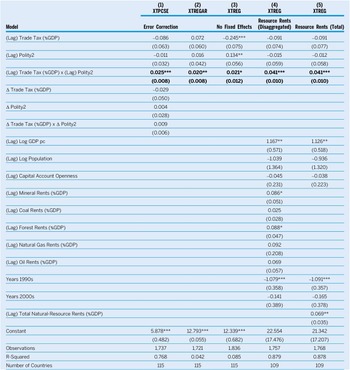
When we update our data with more recent years, the trend persists: democracies continue to struggle with revenue generation post-liberalization, non-democracies less so. Table 1 incorporates the various constructive empirical critiques presented by the author. To summarize, in direct response to the author’s queries, we did the following: began the analysis in the 1980s and included all available data to dateFootnote 4; calculated domestic tax revenue as the sum of income-tax revenue and goods-tax revenue; presented models without any controls; included a model with Stata’s xtregar command; included controls for natural-resource rents and population; and ran models without fixed effects. The findings for our key variable—the interaction of regime type and trade tax revenues—held across all of these models.
Determinants of Domestic Tax Revenue (Percentage of GDP)

Notes: Standard errors are in parentheses; ***p<0.01, **p<0.05, *p<0.10.
In addition to the positive sign and statistical significance of the interaction term of liberalization–democracy, marginal effects were critical to fully explore our argument. In fact, p-values for interaction terms held little meaning unless the marginal effects were calculated. The author of the critique, however, did not assess the marginal plots in the regressions for the interaction of trade tax revenues—that is, the proxy for trade liberalization—and regime type. In figure A.4 in the online appendix for this article, we present the marginal effects for the statistical estimation of model/column 5 from table 1. The plot also includes a histogram for illustrative purposes. Marginal plots are crucial for understanding these interaction effects because they indicate how the effects of lower trade tax revenue on total domestic revenues change depending on regime type. Our key question is how the impact of declining trade revenues might be different for democracies and non-democracies. The visualization illustrates whether the effect of trade liberalization on domestic revenues strengthens, weakens, or reverses based on different values of polity.
In non-democracies, online appendix figure A.4 reveals a negative and statistically significant correlation between trade tax revenue and domestic revenue, which indicates that as trade tax revenue declines, domestic tax revenue increases. This suggests that these countries successfully implemented domestic tax reforms following the onset of trade liberalization.
In democracies, as expected, we found the opposite: a positive (and statistically significant) correlation between trade tax revenue and domestic revenue, which suggests that as trade tax revenue declines, domestic tax revenue also decreases (see online appendix figure A.4). In substantive terms, the model that includes natural-resource rents suggests that a 1% decline in trade taxes (as a percentage of GDP) results in an approximate 0.04% decrease in domestic tax revenue. Although the author rightly notes that this is a relatively small coefficient, the ongoing revenue losses in fiscally constrained LDCs present a significant challenge for democracies, directly affecting the lives of citizens in these countries. Declining tax revenues prevent the government from investing in public goods that are essential for reducing poverty, supporting economic growth, and improving quality of life. It is interesting that the positive and statistically significant coefficient for natural-resource rents (minerals in particular) suggests that the author is correct in critiquing the WDI domestic tax variable for including these rents. Nevertheless, our main findings still hold.
Table 1 indicates that LDC democracies have been slow to establish alternative revenue streams, such as the VAT and personal or corporate income taxes. In other words, the loss of trade tax revenue is not being offset, which is leading to an overall decline in both trade and domestic tax revenues. Shifting from trade taxes—which are less visible to the public—to domestic taxes such as income taxes often faces strong political resistance in democracies. Households and businesses resist paying higher direct taxes, especially if they lack confidence in the government’s ability to spend the money wisely. This results in lower tax compliance, which reduces domestic tax revenues, and—ultimately—diminishes the supply of essential public goods.
A statistically insignificant effect is also revealing and negative news for countries attempting to raise domestic revenue mobilization post-liberalization. In these cases, despite the decrease in trade tax revenue, domestic tax systems (e.g., the VAT and income taxes) have not been established or enforced properly to make up for the shortfall. In essence, a country did not transition successfully from reliance on trade taxes to domestic taxes.
Simply stated, LDC democracies unfortunately are still in peril. It is not surprising that in 2018, the WB and its partners allocated more than USD $90 million to support domestic revenue mobilization in more than 85 countries through its Global Tax Program (World Bank 2018). In 2015, the IMF and the WB launched a joint initiative to further assist countries in strengthening their tax systems. The goal was to raise tax-to-GDP ratios by at least 2% to 4% in many low-income countries without harming economic growth or fairness. Domestic revenue generation also has been elevated to a Sustainable Development Goal (SDG), underscoring its seriousness.
RECENT EXAMPLES OF REVENUE SHOCKS IN LDCS
Recent cases of tax reforms or attempted tax reforms in democracies since the publication of Democracies in Peril further demonstrate how these revenue challenges persist post-liberalization. In Costa Rica, for example, debt has reached almost 70% of GDP in recent years as “the quality of public services is deteriorating” (The Economist 2021). Despite its recent Organization for Economic Co-operation and Development (OECD) status, Costa Rica’s revenue levels often are significantly lower than its peers in Latin America and the OECD (Organization for Economic Co-operation and Development 2017, 2023). Economists and international financial institutions have called for Costa Rica to crack down on tax evasion, broaden the tax base, and raise taxes (Organization for Economic Co-operation and Development 2017; The Economist 2021). Yet, despite the desperate need for revenue, tax reforms in the 2010s and in 2020 have faced massive protests and stalled in the Costa Rican Congress (Civicus Global Alliance 2020; Organization for Economic Co-operation and Development 2017).
Recent cases of tax reforms or attempted tax reforms in democracies since the publication of Democracies in Peril further demonstrate how these revenue challenges persist post-liberalization.
Sri Lanka is another example of a liberalizing democratic LDC that is facing a continuing budget crisis due to insufficient domestic-tax reform. Recently, the crisis was instigated by President Gotabaya Rajapaksa’s tax cuts that resulted in “public revenue losses of about 800 billion rupees” (Jayasinghe Reference Jayasinghe2021). Sri Lanka enacted tax reforms in 2023 and immediately faced public backlash. A recent IMF report on Sri Lanka indicates that “tax-collection efforts have fallen short of levels that the IMF would like to see. Without more revenue gains, the government’s ability to provide essential public services will further erode” (Francis Reference Francis2023). As a result, and according to WDI, Sri Lanka’s domestic-tax revenues have been declining consistently from 13% of GDP in 1990 to less than 6% of GDP in 2022.
Recent research further highlights the struggle for developing-country democracies to collect taxes. Rao (Reference Rao2016), for example, wrote of a “tyranny of the status quo” in India, where tax reforms are “slow and often ineffective.” Rashid, Warsame, and Khan (Reference Rashid, Warsame and Khan2021) found a negative association between democracy and tax revenues in the Global South, pointing to “various groups increasing rent-seeking activities from the state.”Footnote 5 This mechanism mirrors the arguments that we made in Democracies in Peril.
In contrast, non-democracies such as Uzbekistan and Côte d’Ivoire recently have clamped down on opposition to tax reforms and implemented them more effectively than their democratic counterparts. For example, in 2021, Uzbekistan received USD $60 million of WB support for a project to reform tax administration (World Bank 2021). The World Bank Country Manager for Uzbekistan recently commended the country’s tax progress and applauded the government for prioritizing tax reforms and creating a more efficient tax-administration system.
Opposition to the tax changes in Uzbekistan was effectively neutralized. Protests by small businesses in 2021 resulted in criminal charges for those participating in “unsanctioned rallies” (Association for Human Rights in Central Asia 2020). Consequently, Uzbekistan has experienced steady progress toward implementing tax reforms and experienced corresponding revenue growth (see data from WDI and Orbitax 2024).
Côte d’Ivoire is another example of a non-democracy experiencing successful tax reforms, such as the 2024 reforms to taxes on wages and pensions (Wilu Reference Wilu2024). Côte d’Ivoire was praised by the IMF for its efforts and results: “Côte d’Ivoire’s tax revenue has been increasing in recent years, supported by the authorities’ efforts, particularly on tax administration and digitalization” (Gulilat, Gicquel, and Gruss Reference Gulilat, Gicquel and Gruss2022). According to WDI data, Ivory Coast’s domestic tax revenue increased from 5% of GDP in the early 2000s to 9% of GDP in 2022.
IMPLICATIONS AND DIRECTIONS FOR FUTURE RESEARCH
Our analysis supports the two conclusions of our book: (1) developing countries have faced a substantial revenue shock following liberalization; and (2) democracies in LDCs continue to struggle to offset these potential revenue losses through increased domestic taxation. To make matters worse, new revenue challenges have emerged and intensified in recent years.Footnote 6
Our analysis supports the two conclusions of our book: (1) developing countries have faced a substantial revenue shock following liberalization; and (2) democracies in LDCs continue to struggle to offset these potential revenue losses through increased domestic taxation.
First, the COVID-19 pandemic destroyed government coffers. For example, in democratic Colombia in 2021, President Iván Duque attempted to raise taxes to balance the budget “to pay for emergency food handouts and other social programs put in place since the start of the pandemic” (Otis Reference Otis2021). However, he was met with extensive protests and subsequently withdrew the bill (British Broadcasting Corporation 2021).Footnote 7 Non-democratic countries (e.g., Cambodia) similarly are facing new revenue challenges post-pandemic (Hernando Reference Hernando2024). Before the pandemic, Cambodia was described as “on a roll when it came to tax collection” with its “strong tax collection…attributable to robust reforms that broadened the tax base, modernized the tax system, and improved the audit and enforcement capabilities of tax officials” (Hernando Reference Hernando2024). However, although Cambodia has faced public resistance to tax reforms since the pandemic (Reed and Foster Reference Reed and Foster2023) and some reversal in policies (Hutt Reference Hutt2023), the regime continues to maintain momentum on tax reform and collection (Vanyuth Reference Vanyuth2024a).Footnote 8
Second, the race to the bottom in corporate tax rates and revenues persists (Mansfield and Rudra Reference Mansfield and Rudra2021). This challenge often is framed as tax base erosion and profit shifting (BEPS) (Hanappi, Jakubik, and Ruta Reference Hanappi, Jakubik and Ruta2023). BEPS essentially means that multinational corporations are moving their profits (i.e., taxable income) to low or no-tax locations. BEPS is associated with USD $200 billion in tax revenue losses globally, with low- and middle-income countries bearing the brunt of that loss. The OECD and G20’s Project BEPS seeks to reduce this tax avoidance and evasion by multinational firms with a 15-point agenda of international rules and participants around the world. Unfortunately, adoption has been limited and profit shifting has prevailed: an average of 35% of global profits are shifted to tax havens each year (Teles Reference Teles2023). Revenue lost due to profit shifting increased from 2015 to 2019 (Teles Reference Teles2023).
Third, tax collection is complicated further by digitization. Although the advance of the digital economy has led to economic growth and employment opportunities, it also has enhanced the potential of firms and other actors to avoid or reduce their tax liability, further squeezing government coffers and the already small number of taxpayers (Organization for Economic Co-operation and Development 2017). Digital taxes are associated with tax challenges because firms—not physically located in the place where sales occur—currently are not paying property, employment, or environmental taxes (Organization for Economic Co-operation and Development 2017). Rules and procedures for how to tax value created from digital products, services, and data also are difficult to write and enforce. Antiquated international tax rules cannot address the complexity of a digital economy and the scale at which companies can sell in a jurisdiction without a physical presence (Organization for Economic Co-operation and Development 2017). Finally, as discussed in our book, international organizations are calling for the adoption of the VAT to make up for lost trade tax revenue. However, the digital economy creates challenges for VAT collection, although it still is preferred to a customs duty on digitally traded products (Hanappi, Jakubik, and Ruta Reference Hanappi, Jakubik and Ruta2023). Economists and international organizations are debating how LDCs can effectively tax digital goods and services from suppliers abroad (Organization for Economic Co-operation and Development 2017).
In light of ongoing global revenue challenges from multiple dimensions, future research should explore the political and economic conditions that enable democracies to effectively increase revenue. One possibility is that democracies must invest in broad-based public goods to end the low-confidence/low-tax vicious cycle. However, such an investment involves money and, unfortunately, it is well known that developing countries face constraints in borrowing on the international market (Wibbels Reference Wibbels2006). Moreover, post-pandemic, the borrowing and lending sources may be even more limited. To date, tax havens have been found to be a “larger hit as a percentage of GDP” than the foreign development assistance received (Shaxson Reference Shaxson2019). Which incentives might lead democracies in LDCs to prioritize public goods that enhance citizen confidence in government, thereby increasing their willingness to pay taxes?
In light of ongoing global revenue challenges from multiple dimensions, future research should explore the political and economic conditions that enable democracies to effectively increase revenue.
One research approach is to examine the political opportunities surrounding international initiatives for tax assistance and global tax cooperation. How much does it help that revenue generation is now an SDG and more multilateral and bilateral partners are financing projects that support tax reform (Michielse and Thuronyi Reference Michielse and Thuronyi2010; Seelkopf and Bastiaens Reference Seelkopf and Bastiaens2020)? International debates (e.g., among the G20) on global tax issues give momentum to the issues (Mascagni, Moore, and McCluskey Reference Mascagni, Moore and McCluskey2014). Current initiatives also include the OECD’s Global Forum on Transparency and Exchange of Information for Tax Purposes, the European Union’s Common Consolidated Corporate Tax Base, and the Global Corporate Minimum Tax Deal. If these initiatives are not more successful, we are concerned that—following recent pushes against globalization—democracies may start turning inward and adding a fiscal rationale to the cultural and economic narratives for closing economies around the world.
SUPPLEMENTARY MATERIAL
To view supplementary material for this article, please visit http://doi.org/10.1017/S1049096525000332.
ACKNOWLEDGMENTS
We thank Hashem Krayem for his research assistance and Dennis Quinn and Irfan Nooruddin for their feedback. Any errors are our own.
DATA AVAILABILITY STATEMENT
Research documentation and data that support the findings of this study are openly available at the PS: Political Science & Politics Harvard Dataverse at https://doi.org/10.7910/DVN/HKP2PT.
CONFLICTS OF INTEREST
The authors declare that there are no ethical issues or conflicts of interest in this research.