

1. INTRODUCTION
Child mortality in Sub-Saharan Africa (SSA) is the highest in the world and exhibits low rates of decline.Footnote 1 Understanding better the factors driving these persisting high levels of child mortality is therefore a clue. While the role of women’s poor education [for a review, see Hobcraft (Reference Hobcraft1993)], as well as the role of adolescent childbearing [Bledsoe and Cohen (Reference Bledsoe and Cohen1993)], has been widely studied, the role of single motherhood at first birth has received relatively little attention. In this paper, we aim at filling this gap and for the context of Senegal, we investigate how children’s well-being, captured by the survival rate during infancy, varies with their mother’s marital status when she gave birth for the first time.
Premarital births are not rare in SSA. According to Demographic and Health Survey data from 25 countries, an average of one in five mothers in SSA gave birth before marriage [Garenne and Zwang (Reference Garenne and Zwang2006)]. This average has steadily increased over the last decades [Garenne (Reference Garenne2008)], whereas in most countries, total fecundity has been decreasing. In Senegal, over the period 2010–2011, we estimate that one in seven women gave birth before their first marriage. This proportion is 2 percentage points higher compared to the one observed in 1992. This upward trend is closely linked to rising age at first marriage in contexts where policies aiming at improving the use of modern contraceptive methods, notably for the youth, have been more or less successful. It also reflects the deep changes that affect family structures and organization in the subcontinent, driven notably by rapid urbanization and increased education [Van de Walle and Meekers (Reference Van de Walle and Meekers1994), Gage and Meekers (Reference Gage and Meekers1994), Calves (Reference Calves1996), Thiriat (Reference Thiriat1999), Locoh (Reference Locoh2003)].
These patterns are, however, often at odds with social acceptance of premarital sex that varies between groups depending on norms and local contexts. In Senegal, procreation is considered socially acceptable within marital unions [Adjamagbo et al. (Reference Adjamagbo, Philippe and Valérie2004), Dial (Reference Dial2008)], and therefore, premarital sexual relationships are strongly disapproved, even condemned, for women [Adjamagbo and Koné (Reference Adjamagbo and Koné2013)].Footnote 2 Where women’s premarital sexuality is stigmatized and where the choice of suitable spouse falls onto the elders of the family more than on the bride-to-be herself, the arrival of a premarital pregnancy can turn into a real tragedy for family members, especially for the future mother [Adjamagbo et al. (Reference Adjamagbo, Guillaume, Bakass, Bajos, Ferrand, Rossier, Texeira, Baya, Soubeiga, Sawadogo, Chaker, Gyapong, Beikro, Osei, Koné, Gourbin, Moreau, MayHew and Collumbien2014)], raising much concern in public spaces and in public health circles [Faye et al. (Reference Faye, Speizer, Fotso, Corroon and Koumtingue2013)].Footnote 3
In Senegal, concerns are relative to women’s health following abortion, attempted secretly given the restrictions imposed by the abortion law,Footnote 4 and to children’s health. Negligence due to stigma could be one cause, and lack of resources during the child’s first years of life could be another one. Indeed, following a premarital birth, a delay in marriage has been observed in different contexts in SSA [Calvès (Reference Calvès1999), Johnson-Hanks (Reference Johnson-Hanks2005)] as well as in rural Senegal [Adjamagbo et al. (Reference Adjamagbo, Philippe and Valérie2004)]. No or delayed marriage implies for the child born out of wedlock to grow up, while her mother has a potentially reduced access to economic resources, in particular from the (absent) child’s father. Besides, if a premarital birth challenges the marriage initially planned by parents, whoever the mother marries (including the child’s father), the couple may not receive the same support from her family as the couple would have received if her partner was the one chosen by her family. Therefore, one might also worry that all children, not only the one born outside marriage, of a mother who had a premarital birth may be at a higher risk of vulnerability.
In this paper, our objective is twofold. First, we examine whether children born before their mother’s first marriage have a different mortality rate at two year old compared to other first-born children within marriage. Second, we investigate the extent to which having an eldest sibling born outside marriage affects the mortality rate of children born second and within marriage. Combining data from Senegal Demographic and Health Survey (SDHS thereafter) collected in 2010/2011 and in 2015, we find that mortality is higher for first-born boys whose mother was single at the time of their birth. We also find that mortality at 2 is lower for children born later if their elder sister was born out of wedlock. Additional tests suggest however that this last result is driven by children born to mothers belonging to older cohorts.
Several threats might challenge the interpretation of these results. First, information on abortion and date of abortion is missing in these surveys (only the date of last pregnancy termination, for whatever reasons, is available). This could be an issue if within the group of second-born children whose mother never had a premarital birth, those whose mother had a premarital pregnancy she could terminate differ from those whose mothers never had a premarital pregnancy. Yet, if the former are more vulnerable than the later, notably because abortions damage women’s health, then our estimates of the average effect of having an elder sibling born while the mother was single are biased toward zero. Besides, apart from abortion attempts, mothers giving birth to a child while being single could be a selected group of mothers. However, our results are robust to including different sets of controls. Finally, and most importantly, conditional on the absence of in-utero sex selection, which is likely in our setting, and of sex-biased misreporting, there is no reason these issues drive the observed gender-differentiated effects.
Our finding relative to first-born children suggests that strategies to mitigate the negative consequences of the stigma associated with a premarital birth exist but vary with the gender of the child born premarital in Senegal. In addition, persisting negative effects appear to have decreased over time. Overall, our findings indicate that social programs targeting single mothers, especially when they gave birth to a boy, would help avoiding dramatic events such as the death of a child.
This work contributes to the empirical literature on the link between mothers’ singlehood at (first) birth and children’s well-being in developing countries [Meekers (Reference Meekers1994), Emina (Reference Emina2011), Clark and Hamplová (Reference Clark and Hamplová2013), Ntoimo and Odimegwu (Reference Ntoimo and Odimegwu2014)], extending existing results by looking at second-born children and accounting for the sex of the child born premarital, which is likely exogenous in our context.Footnote 5 It also contributes to the larger literature investigating linkages between children’s living arrangements or family structure and children’s well-being in developing countries: Wagner and Rieger (Reference Wagner and Rieger2015), Gibson and Mace (Reference Gibson and Mace2007), and Omariba and Boyle (Reference Omariba and Boyle2007) have notably analyzed the role of polygyny status, Delprato et al. (Reference Delprato, Akyeampong and Dunne2017), Sekhri and Debnath (Reference Sekhri and Debnath2014), and Guilbert (Reference Guilbert2013) the role of early marriage, Beck et al. (Reference Beck, De Vreyer, Lambert, Marazyan and Safir2015), Coppoletta et al. (Reference Coppoletta, De Vreyer, Lambert and Safir2012), Marazyan (Reference Marazyan2011), and Castle (Reference Castle1995) the role of child fostering, among others.
The remainder of the paper is organized as follows. Section 2 presents the data and some summary statistics. Section 3 presents the empirical models associated with the questions we raise. Sections 4 and 5, respectively, present and discuss the results. Section 6 concludes.
2. THE SDHS 2010 AND 2015
We use the most recent SDHS data, collected in 2010/2011 and in 2015 in the country, both representative at the national level. Interested in analyzing the well-being of first- and second- born children, we restrict the sample to children whose mother is 25 year and older each year of interview. Indeed, at 25 year old, 92% of mothers have at least two ever-born children. We test the robustness of our main results to reducing the sample to children whose mothers is aged 30 or more in Section 4 (at 30, 98% of mothers have at least two ever-born children). We exclude sibships when the child born first was born as a twin.Footnote 6
We define premarital births as all births that occurred up to one month before a woman’s first marriage. In our sample, 12% of mothers gave birth to their first child while not being married.Footnote 7
2.1. Premarital Births: Mother and Household Level Correlates
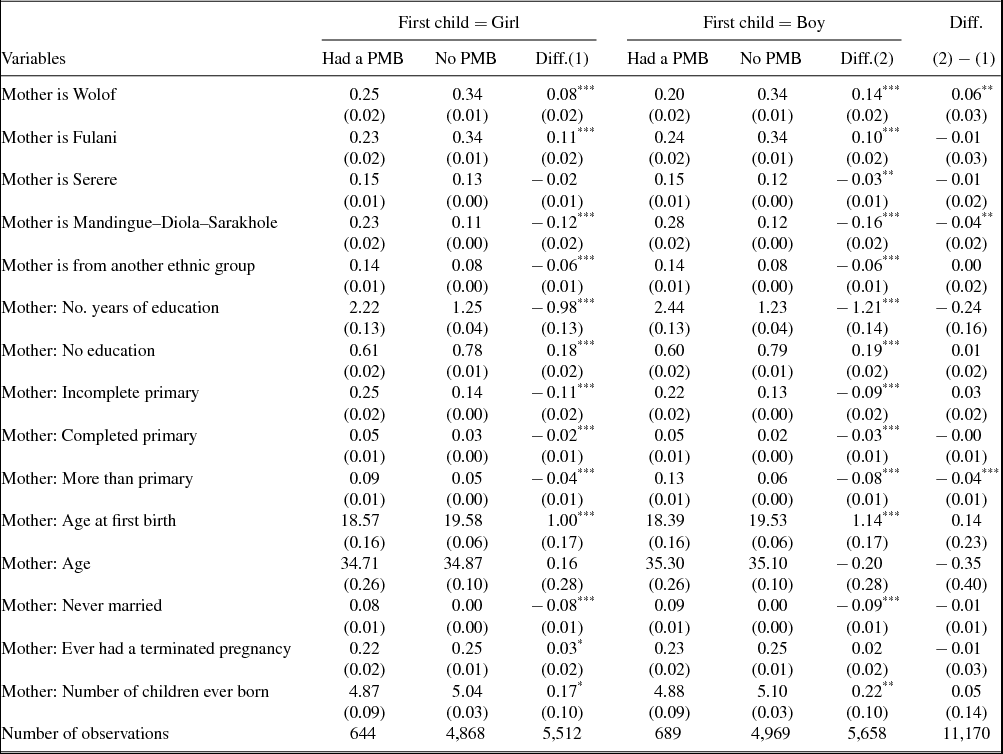
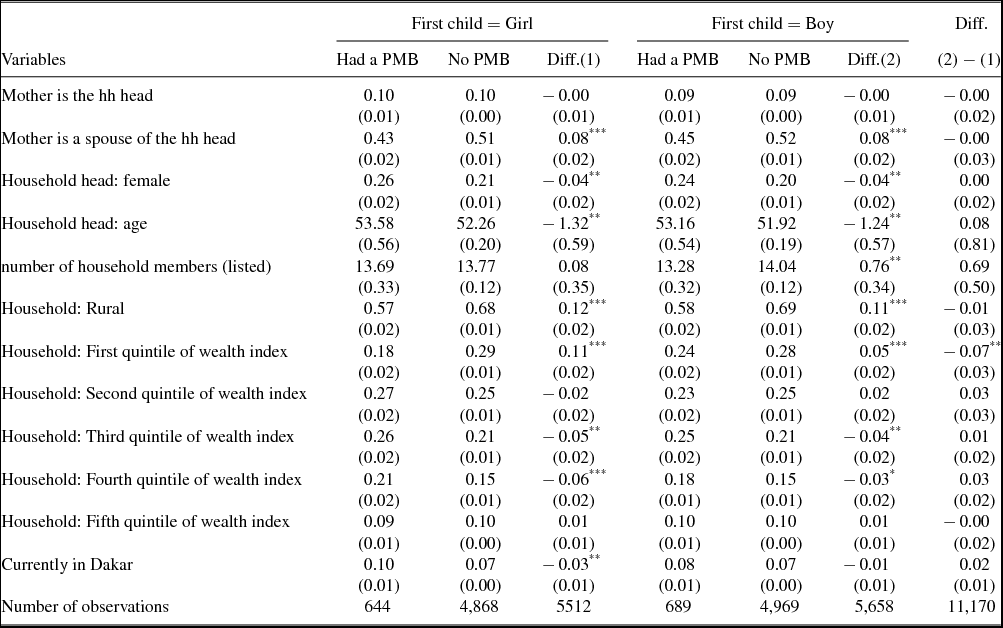
We expect mothers who ever had a premarital birth to differ in many dimensions from other mothers: in their ability to avoid a premarital pregnancy while having sexual relationships, in their ability to cope with the economic consequences of having a premarital pregnancy, in the extent to which the norm stigmatizing premarital births is enforced for them, and so on. Yet, the SDHS data provide only few baseline information that is information on mothers before they ever gave birth. Most information is contemporary, and thus potentially explained by the fact that the mother had a premarital birth and/or by the survival status of children. For these variables, the interpretation of differences between subgroups of mothers should therefore be taken with caution. We describe in Tables A.1 and A.2 in the appendix characteristics of mothers and of their household, respectively. We first describe characteristics predetermined at first birth, and then those potentially endogenous.
Mothers differ significantly in terms of ethnic group. Mothers who ever gave birth to a child before being married are more likely to be Mandingue, Diola, or Sarakhole than Wolof or Fulani. This could reflect ethnic differences relative to the norm stigmatizing premarital sexual activity. This is worth to comment further. According to Murdoch’s Ethnographic Atlas, premarital sex is prohibited (although weakly censored) among the Wolof and permitted among the Diola, the Fulani, and the Serere. However, given the younger age at which Fulani women marry, control over Fulani women’s sexual activity is likely important.Footnote 8 For our purpose, these differences along ethnic groups are important to account for as these ethnic groups are also located in different areas across the country. Yet, access to health facilities, key for children’s health outcomes, is likely to vary between geographic areas. Besides, mothers who ever had a premarital birth were younger when they first gave birth. This is also key since teenage births are important determinants of children’s mortality and morbidity [WHO (2014)].
At the day of the interview, women with premarital birth appear to be more educated. This is all the more true as they gave birth first to a boy. Yet, the difference appears for the highest level of education (having more than primary education). They have fewer children ever born. They are also more likely to live in a urban area, to belong to a household headed by a female (but not by themselves), and, in this household, to not be the spouse of the household head. Finally, they are less likely to belong to poorest households, even more if they gave birth first to a girl.Footnote 9
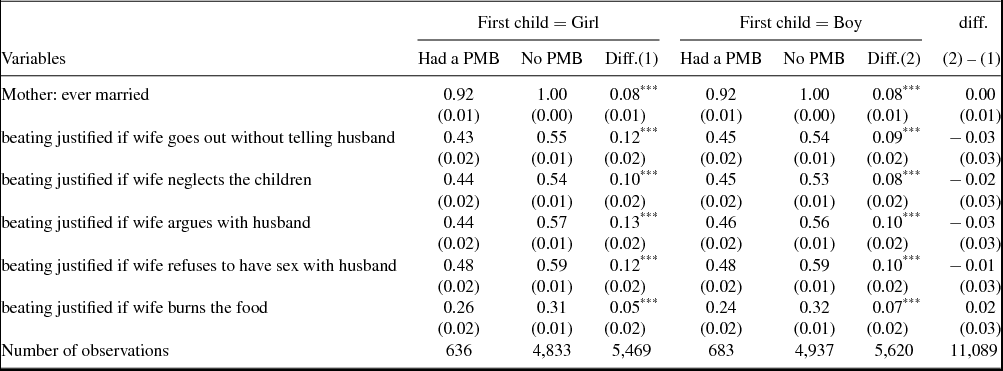
These findings could suggest that mothers who were single at first birth are somehow positively selected (in a context where premarital sexual activity for women is stigmatized, women with more resources can afford—economically and socially—to give birth while not being married). Alternatively, and contrary to expectations, they show that giving birth before being married is not associated with a posteriori negative consequence on mothers’ economic trajectory. Further evidence in favor of a positive selection is provided in Table A.3 in the appendix. It describes mothers’ opinion relative to domestic violence (the information is available for all ever-married mothers). When they had a premarital birth, mothers are less likely to consider beating, for any reason, as justified. For a subsample of births,Footnote 10 the survey provides information on the extent to which births were desired, as declared at the date of the interview by the mother.Footnote 11 We report in Table A.4 in the appendix this information for first births depending on whether the birth was premarital or not. Premarital births, and premarital male births in particular, are less likely to be reported as desired. The question being asked retrospectively, one may wonder whether the observed gender gap among premarital births is actually driven by the difficulty faced by women as the caretaker of children born out of wedlock depending on the gender of the child, with the birth of a boy creating more complications. Yet, surprisingly in a context where premarital sex is expected to be stigmatized, the proportion is not zero. This could support the hypothesis that a share of mothers giving birth before marriage are positively selected.
In what follows, we investigate the correlates of being born from a single mother or from a married mother.
2.2. Premarital Births: Correlates at First-Born Children’s Level
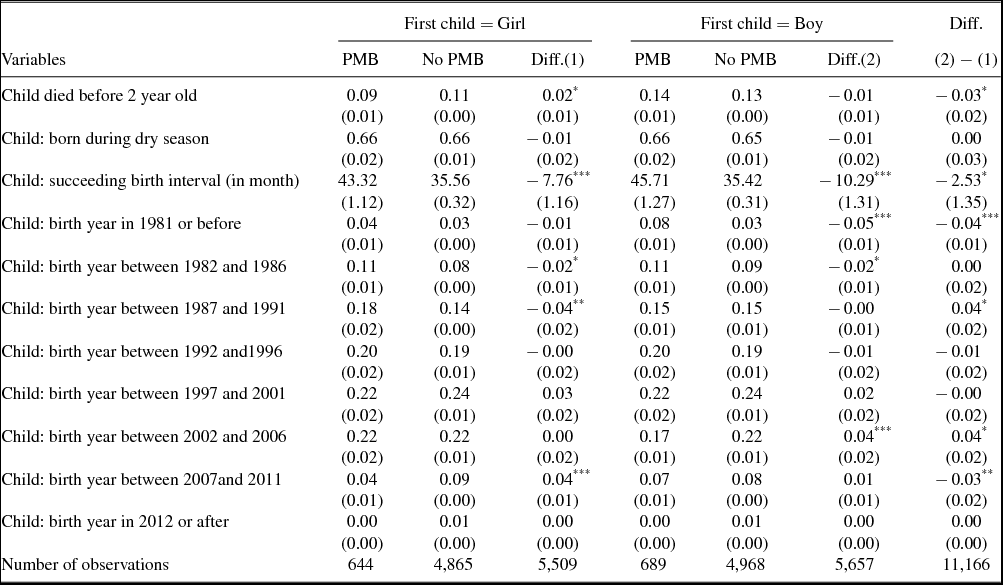
Whether first-born children, born to a single or a married mother, face a different mortality risk is described in Table 1. Boys and girls have different mortality rates at birth [Mahy (Reference Mahy2003)]. Therefore, information is provided distinguishing boys and girls to not confound the effect of premarital birth status with the one of sex.
First-born children characteristics

Note: The table compares characteristics of first-born children across sex and premarital birth status (PMB stands for premarital birth). Standard errors are in parentheses and significance levels are denoted as follows: *p<0.10, **p<0.05, ***p <0.01. The significance levels for coefficients in columns diff.(1) and diff.(2) are reported for t-tests. The significance levels for coefficients in column diff. (1)− (2) are reported for the test of equality between diff.(1) and diff.(2).
We find that girls born to single mothers have a significantly lower probability to be deceased at 2 year old compared to other girls. We find the opposite for boys (although not significant). The double difference is significant. This indicates that girls have a higher survival rate at 2 year old than boys, and this is even more true if girls were born before their mother’s first marriage. This finding calls for few remarks: (1) In-utero sex selection being unlikely in Senegal, the above patterns should not be driven by women who can afford having a child while being single and who select having daughters.Footnote 12 But, if women giving birth before being married are positively selected, i.e., their socioeconomic characteristics allow them to provide better care to their children, this could explain the lower mortality risk found for daughters born before their mother’s marriage. Yet, one would have expected to observe the same pattern for boys. (2) If stigma associated with a premarital birth is on average manageable, explaining why we observe premarital births in Senegal, our results may indicate that actually stigma is managed differently depending on the gender of the child.
Other interesting patterns relate to birth intervals to next-youngest sibling. We find that around 35 months separate a first-born child and her next-youngest sibling when the first child was born from a married mother. The interval is similar whether the first child is a girl or a boy. This indicates that preference for son, if it exists, does not affect second-birth timing. The interval increases when the first child was born from a mother not already married. This is expected if stigma (on the marriage market) follows a premarital birthFootnote 13 or if women having a premarital birth are positively selected (they would have married later and had longer birth intervals in any case). This interval is found to be even higher when a boy was born before the mother’s first marriage (almost 46 months). Since longer succeeding birth intervals are expected to decrease children’s mortality risk [Winikoff (Reference Winikoff1983)], these difference should again be considered when analyzing children’s mortality. That being said, a child’s mortality could also affect the timing of others births, e.g., succeeding birth interval could be endogenous in a model explaining mortality.
All in all, the finding relative to boys born before their mother’s first marriage is worrisome: for what reasons boys born to single mothers do not benefit, as girls seem to, from having a mother with relatively better characteristics, and from longer succeeding birth interval?
2.3. Premarital Births: Correlates at Second-Born Children’s Level
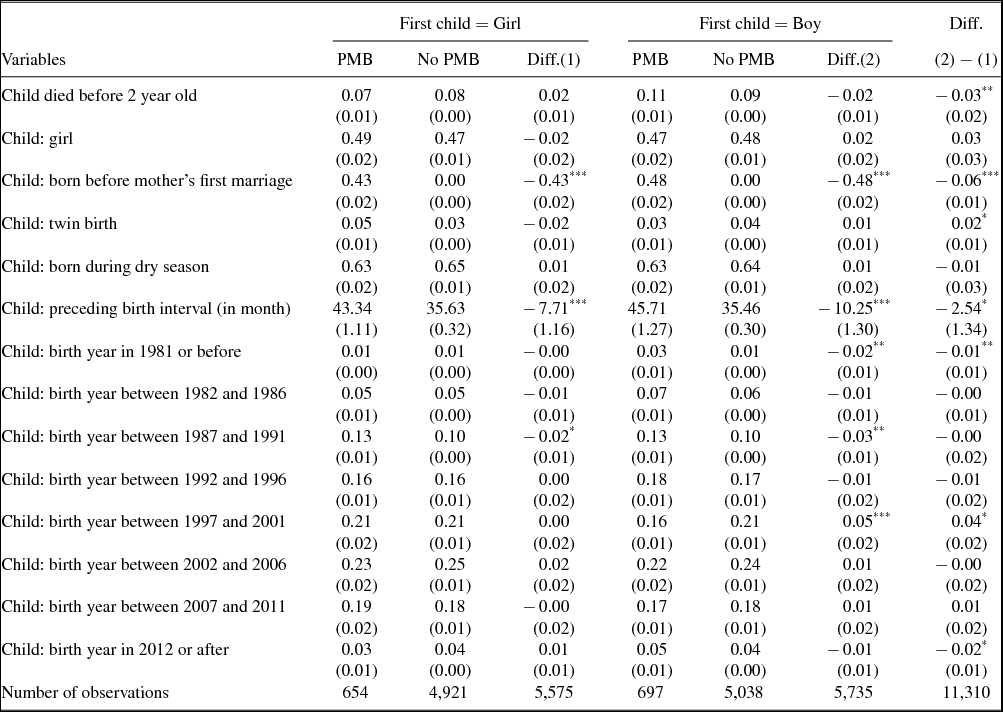
In this section, we investigate the extent to which the differentiated patterns observed at the level of first-born children persist at the level of second-born children. In Table 2, we describe characteristics of second-born children to provide preliminary insights on this question.
Second-born children characteristics

Note: The table compares characteristics of second-born children across two characteristics of first-born children: their sex and their premarital birth status (PMB stands for premarital birth). Standard errors are in parentheses and significance levels are denoted as follows: *p<0.10, **p<0.05, ***p<0.01. The significance levels for coefficients in columns diff.(1) and diff.(2) are reported for t-tests. The significance levels for coefficients in column diff. (1) − (2) are reported for the test of equality between diff.(1) and diff.(2).
An important result is that second-born children whose elder sibling is a boy born before the mother’s first marriage have the highest mortality rate. In contrast, second-born children whose elder sibling is a girl born before the mother’s first marriage have the lowest mortality rate. The double difference is significant. In other words, if mothers who start their fertile life as single are positively selected, neither the boy born out-of-wedlock, nor the boy’s next-younger sibling, seems to benefit from this positive selection. Alternatively, stigma associated with a premarital birth is manageable, but to a lesser extent for boys and for their next-younger sibling.
Our subgroups of second-born children actually differ in other dimensions that could explain part of the differences in their mortality rates. In particular, the data reveal that close to half of second-born children are also born from a single mother. This proportion actually varies with the gender of the first child born before the mother’s first marriage (43% when a girl was born and 48% when a boy was born). These last statistics also work in favor of a stronger stigma following the birth of a boy out of wedlock and that would make the marriage of one’s mother less likely to happen rapidly.
So far, these data invite us to compare mortality rates of first-born children depending on their premarital birth status and on their gender as well as mortality rates of second-born children depending on the premarital birth status of their elder sibling, as well as their own, and on the elder sibling’s gender.
3. THE EMPIRICAL MODELS
In this section, we present the empirical models used to go beyond descriptive analysis and to answer the two following questions: (1) do children born first to a mother who was single at that date have a different mortality rate than other first-born children? (2) Does having an eldest sibling born out of wedlock affect the mortality rate of second-born children?
3.1. On the Consequences of Being Born to a Single Mother
On the sample of first-born children (among ever-born), we estimate the following model:
 $$\begin{eqnarray}
\text{Mort}_{i,m}&=& \alpha _0 + \beta _1 \text{Girl}_{i,m} + \beta _2 \text{PMB}_{i,m} + \beta _3 \text{Girl}_{i,m}*\text{PMB}_{i,m} \nonumber\\
&&+\,\beta _4 X1_{i,m} + \varepsilon _{i,m},
\end{eqnarray}$$
where Mort i, m is a dummy that equals one if the child died before reaching 2 year old and zero otherwise; PMB is a dummy that equals one if the child was born before his mother’s first marriage and zero otherwise; Girl i, m is a dummy to indicate whether the child is a girl and zero otherwise. Girl i, m *PMB i, m is the interaction term that captures the specific effect of being born out-of-wedlock for girls. X1 i, m is a vector of child and mother level characteristics, predetermined at the birth of the child, to ease their interpretation (they are not affected by potential reverse causality). It includes information on the child’s year of birth,Footnote 14 and season of birth (dry versus rainy). It also includes measures relative to the mother’s characteristics: her age at first birth and, importantly, her ethnic group.Footnote 15 ε i, m is the error term.
Conditional on all variables included, the coefficient on Girl i, m *PMB i, m is identified if a child’s premarital birth status is independent from her gender that is if parents do not practice in-utero sex selection. This condition is likely to hold in our context.
We estimate two additional specifications of equation (1) that include characteristics potentially affected by the child’s premarital birth and/or survival status. In these specifications, coefficients should therefore be interpreted with caution. In a second specification, we control for mother’s education (whether she has no education, whether she has incomplete primary education, the reference category being whether the mother has more than primary education). In a third one, we control for birth interval with the next-youngest sibling.Footnote 16
3.2. On the Consequences of Being the Youngest Sibling of a Child Born Premarital
To evaluate whether any stigma affecting a premarital birth affects also later-born children, we estimate the following model on second-born children (among ever-born):
 $$\begin{eqnarray}
\text{Mort}_{i,m}&=& \alpha ^{\prime }_0 + \beta _1^{\prime } \text{SibGirl}_{i,m} + \beta _2^{\prime } \text{SibPMB}_{i,m} + \beta _3^{\prime } \text{SibGirl}_{i,m}*\text{SibPMB}_{i,m} \nonumber\\
&&+\, \beta _4^{\prime } X1_{i,m} + \varepsilon ^{\prime }_{i,m},
\end{eqnarray}$$
where SibPMB i, m is a dummy that equals one if the child’s elder sibling was born before their mother’s first marriage and zero otherwise, and SibGirl i, m is a dummy that equals one if the child’s elder sibling is a girl and zero otherwise. SibGirl i, m *SibPMB i, m is the interaction between the two later defined dummies. X1 i, m is a vector of child and mother level characteristics similar to the one included in equation (1). It also includes a dummy to indicate whether the child was born as a twin.Footnote 17
SibGirl i, m *SibPMB i, m measures whether the second-born children’s mortality varies with the premarital birth status of their first-born sibling in a different way given the gender of the first-born sibling. Conditional on all variables included, it is identified on the same condition as the one stated above: that parents do not practice in-utero sex selection.
In a second specification, we control for a measure of birth interval with the older sibling and for a dummy indicating whether the second-born child was him/herself born before the mother’s first marriage or not. In a third specification, we control additionally for mother’s education. All these characteristics are potentially affected by the premarital birth status of the first-born child. Therefore, they can be understood as different channels through which a premarital birth may affect the mortality of later-born children.
All above-mentioned models are estimated in ordinary least squares with standard errors clustered at the mother level.
3.3. On the Choice of the Outcome
Mortality rate comparison before 2 year old is justified to overcome the fact that in SDHS we do not know whether dead children where residing with their mother or with someone else at the time of their death. In Senegal, children are used to being fostered out starting from age 2 [Coppoletta et al. (Reference Coppoletta, De Vreyer, Lambert and Safir2012)]. Since both probabilities to be fostered out and born before the mother’s union could be positively correlated,Footnote 18 looking at mortality rate differences at higher ages raises the risk of confounding the effect of being born before the marriage of one’s mother and of having been fostered out. This risk is minimized by examining, for first-born children, the mortality before 2 year old. A priori the issue raised being of less importance for second-born children, mortality at 5 year old is also investigated for them.Footnote 19
4. RESULTS
4.1. Main Results
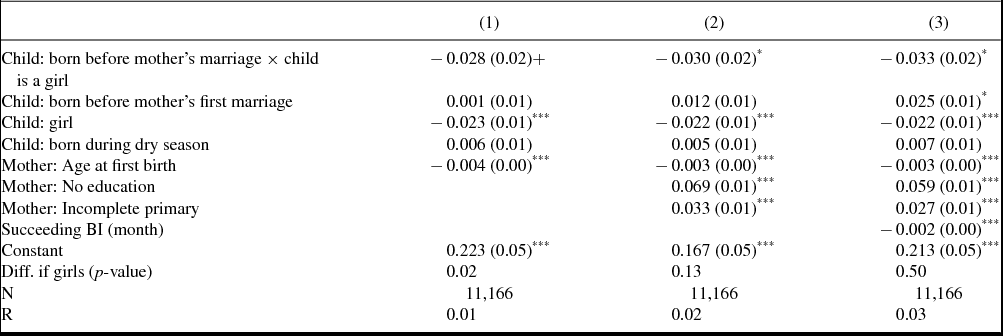
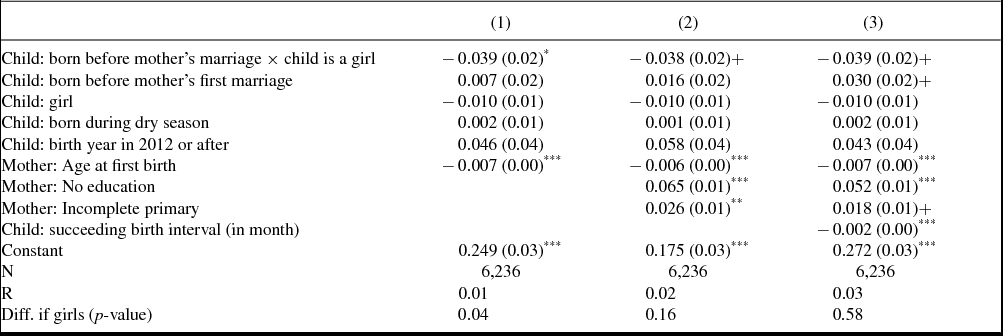
Estimation results of equation (1), and of its various specifications, are presented in Table 3. We first comment results from the first specification, and then results from the second and the third ones. The two later including potentially endogenous characteristics, the interpretation of the estimated effects, call for caution.
First-born children’s mortality at 2 year old: Linear probability model

Note: Ethnic group, year of interview and categories of birth year are controlled for (coefficients not shown).
Diff if girls indicates the p-value of the test testing the equality of the coefficient on being born before a mother’s marriage and of the coefficient on being born after, for girls.
Standard errors are clustered at the mother level. Significance levels are denoted as follows: + p<0.15, *p<0.10, **p <0.05, ***p<0.01.
In the first specification, the double difference (or the interaction term) is significant at 15% level. Boys and girls do not have the same mortality at 2, with girls having a higher probability to survive. This gender gap is slightly higher among children born to a single mother. The widening of the gap is driven by girls: If they were born before their mother’s first union, their survival probability is even higher. These findings confirm those obtained looking at descriptive statistics. They raise the question of why boys born to a single mother do not benefit, as girls, from any positive selection of their mothers. Note the negative effect of age at first birth on mortality.
In the second specification, which controls for mother’s education, point estimates of the three coefficients of interest remain relatively similar. The interaction term becomes significant at 10% level. Low education, itself, has a positive effect on mortality. In the third specification, which controls for succeeding birth interval, the point estimate of the coefficient capturing the effect of being a boy born to a single mother increases in size and becomes significant at 10% level. A downward bias is corrected by introducing succeeding birth interval since we saw in descriptive statistics that succeeding birth interval is the longest for boys born to a single mother and since longer birth intervals have on average a significant negative effect on mortality. In addition, the size of the coefficient on the interaction term (as well as on the gender dummy) remains quite similar, which is reassuring regarding our identification hypothesis. However, since reverse causality could be at play, the interpretation of the coefficient sizes in this last model is challengeable.Footnote 20
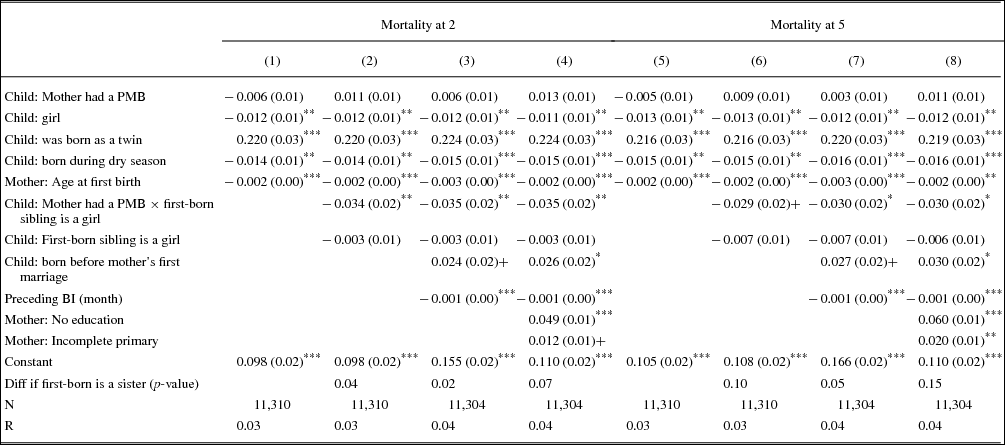
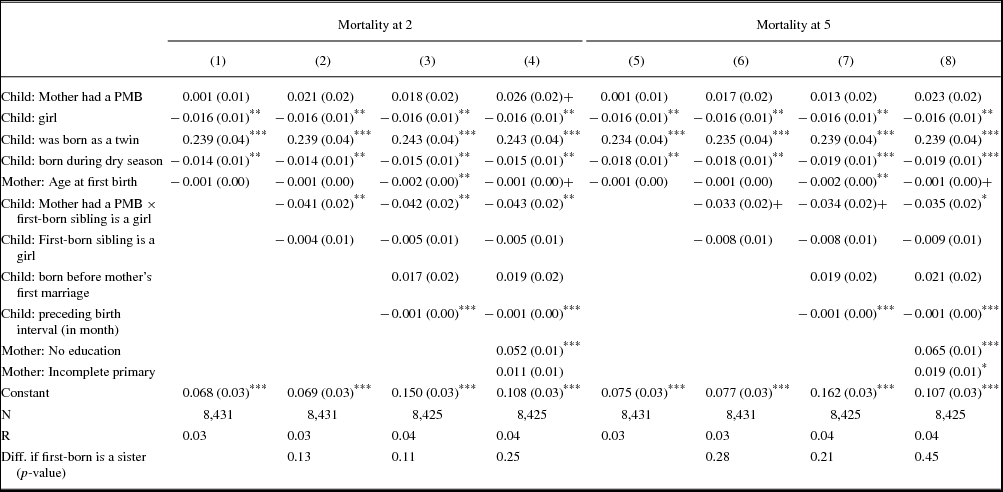
Estimation results of equation (2), and of its various specifications, are presented in Table 4. The average effect of being the later-born sibling of a child born from a single mother is also presented (specifications 1 and 5). Mortality at age 2 is examined in specifications 1–4 and mortality at age 5 in specifications 5–8.
Second-born children’s mortality: Linear probability model

Note: PMB stands for premarital birth.
Ethnic group, year of interview and categories of birth year are controlled for (coefficients not shown).
Diff if first-born is a sister (p-value) indicates the p-value of the test testing the equality of the coefficient on having an elder sister born before a mother’s marriage and of the coefficient on having an elder sister born after.
Standard errors are clustered at the mother level. Significance levels are denoted as follows: + p <0.15, *p<0.10, **p<0.05, ***p<0.01.
Analyzing mortality at age 2, being the second-born sibling of a child born before the mother’s first marriage has on average no effect on children’s mortality. However, being the second-born sibling of a girl born to a single mother decreases the mortality rate relative to being the second-born sibling of a girl born to a married mother (column 2). The premarital status at the birth of an elder brother does not have any effect. The double difference is significant at 5% level. These point estimates are similar across specifications, which is, again, reassuring regarding our identification hypothesis. These observations apply when analyzing mortality at age 5. It is interesting to note that the observed effect is not driven by second-born children who are also born out of wedlock, as we control for this in specifications 3 and 4 (7 and 8). Children born second to a mother still single at the time of their birth have a higher risk of dying before reaching 2 year old.
4.2. Robustness Analysis
We perform two robustness analysis. First, to evaluate the role of premarital birth status and of gender on first-born children’s mortality at 2 year old, we estimate the following alternative model:
 $$\begin{eqnarray}
\text{Mort}_{i,m}= \alpha _0 + \gamma _1 \text{PreMarBirth}_{i,m} + \gamma _2 X1_{i,m} + \mu _{m}+ \varepsilon _{i,m},
\end{eqnarray}$$
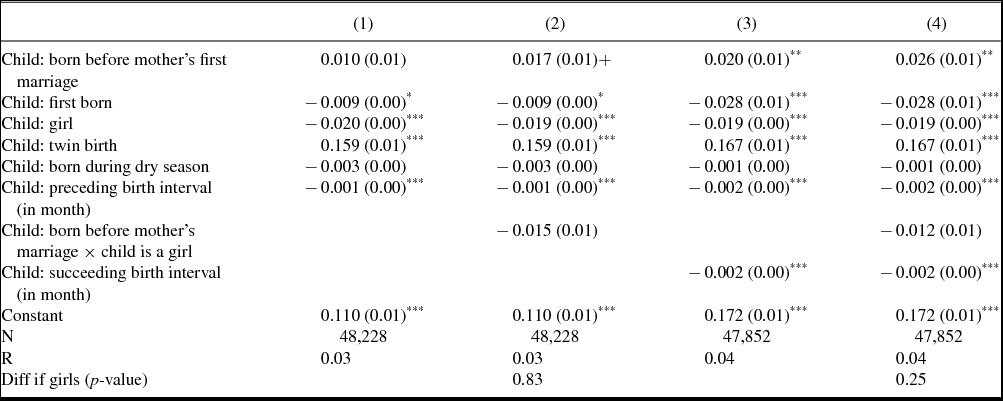
where μ m indicates mother fixed effects. PreMarBirth i, m is a dummy indicating whether the child was born before the mother’s first marriage and zero otherwise, and X1 i, m is a vector of child level characteristics, similar to the one included in equation (2). All characteristics can be considered as predetermined at child’s birth. Given the challenges linked with its interpretation, a measure of succeeding birth interval is introduced only in a second specification. The model is estimated on all children ever born, whatever the mother’s age. The coefficient of interest γ1 is identified on the subsample of children whose mother ever married and had at least one child born while being single and another one born while being married. Last-born children are excluded to maintain sample size comparable across specifications controlling and not controlling for succeeding birth interval. Note that the coefficient on the dummy indicating whether the child is born first is identified, while we control for whether the child is born to a single mother, as we have children born out of wedlock of birth rank 2 (and more). Adding fixed effects to our model allows us to control for mother’s fixed and unobserved characteristics. Doing so, we reduce any bias driven by the potential positive selection of mothers. Results are presented in Table A.7 in the appendix.
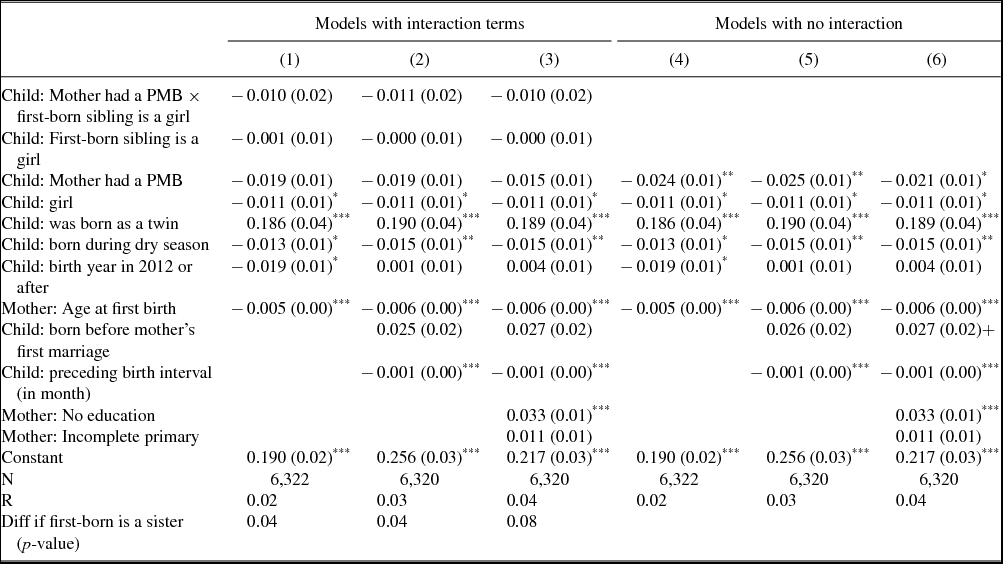
According to specification (1), a child’s mortality is not affected by his premarital status at birth. We observe a significant effect when succeeding birth interval is accounted for [specification (3)]. The first result was likely downward biased. We do not find a gender-differentiated effect [specifications (2) and (4)]. However, the estimated difference in mortality rates between boys depending on their premarital birth status in specification (4) (2.6) is very similar to the one obtained when estimating equation (1) (2.5) [specification(3) in Table 3].
For second-born children, we re-estimate the mortality equation [equation (2)] reducing the sample to children whose mother is 30 year old or more (each year of interview).Footnote 21 Results are presented in the appendix in Table A.8. When analyzing mortality at age 2, coefficients on the interaction term is still negative and significant (and still relatively constant across specifications). Point estimates are higher than those obtained in Table 4.
5. HETEROGENEITY AND DISCUSSION
5.1. Heterogeneity
We investigate whether the patterns found hold for more recent cohort of mothers. To do so, we re-estimate equations (1) and (2) on the subsample of mothers aged 25–35 year old (each year of interview).Footnote 22 Note that the number of first-born children born before their mother’s first marriage, of a given sex, experiencing a death could be below 30 (similarly for the number of second-born children with a sibling of a given sex born before marriage). Therefore, interaction terms should be interpreted with caution.Footnote 23 For first-born children, results are shown in Table A.9, for second-born children, in Table A.10.
As regards first-born children, the effect of premarital birth status on a child’s mortality appears still to be gender differentiated (the coefficient on the interaction term has increased in size) but its significance has reduced. As regards second-born children, the only effect we observe is that having a first-born sibling (whatever his sex) born before the mother’s marriage decreases second-born children’s mortality. The effect is no longer differentiated along the sex of the first-born child (coefficient of the interaction term has significantly decreased). Positive selection could drive the result found. Therefore, the benefit of being the next-youngest sibling of a girl born to a single mother relative to a girl born to a married mother seems to be driven by children of older cohorts of mothers.
5.2. Discussion
5.2.1. Measure quality
Information on abortion and date of abortion is absent in these surveys (only the date of last pregnancy termination is available). This could be an issue if within the group of second-born children whose mother never had a premarital birth, those whose mother had a premarital pregnancy she could terminate differ from those whose mother never had a premarital pregnancy. Yet, if the former are more vulnerable than the later, notably because abortions damage women’s health, then our estimates of the average effect of having an elder sibling born while the mother was single are biased toward zero.
5.2.2. Channels of effect?
Our results relative to first-born children could be interpreted in two major ways. First, one might argue that boys have an innate survival rate during infancy even more lower if they were born from a single mother: The mother’s stress due to her singlehood status could transmit to the child through in utero channels Reynolds et al. (Reference Reynolds, Labad, Buss, Ghaemmaghami and Räikkönen2013), Wadhwa et al. (Reference Wadhwa, Entringer, Buss and Lu2011) more when the child is a boy, than when the child is a girl, due to boys’ higher physiological vulnerability. To evaluate the extent to which this channel can be at work, we present in Table A.11 in the appendix children’s weight at birth (in gram) and height at birth (in centimeter) as reported by mothers for the last six births. Although available on a small number of observations, the patterns reported in the table confirm that first-born boys born premarital have a lower weight at birth than girls born in the same conditions and boys born within marriage. However, the differences observed between subgroups of children are not significant. In addition, this hypothesis hardly explains the persistence of an effect up through second-born children.
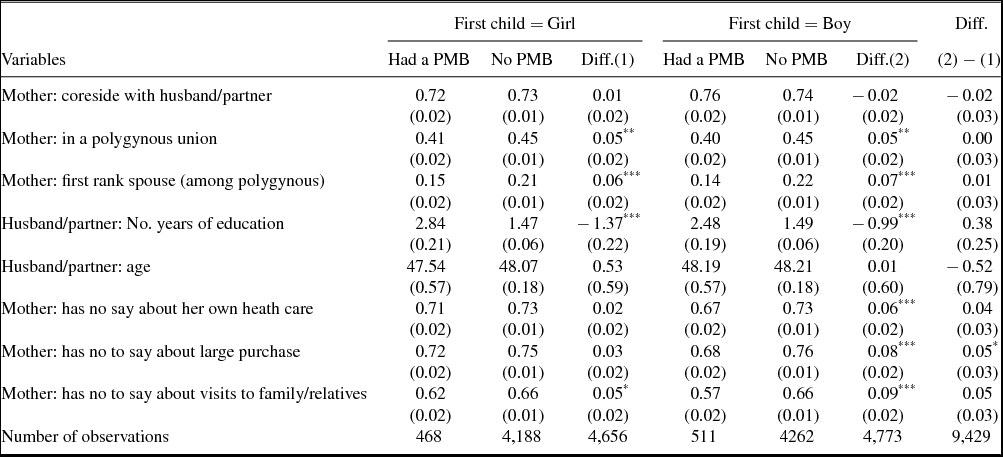
Second, one might suspect that mothers face different difficulty and marginalization depending on the sex of the child born premarital. This would materialize both in the support the woman receives while raising her child while single and in the marriage she contracts following the birth. The marriage that follows the birth of a boy may systematically differ from the marriage that follows the birth of a girl: The characteristics of the husband could be at stake, as well as the characteristics of support provided by parents to the couple. Our result suggest these characteristics are relatively better when a girl was born to a nonmarried mother. Unfortunately, with data in hand, we cannot test formally for such a channel of effect.Footnote 24
6. CONCLUSION
This paper investigates the extent to which being born to a single mother in a context where premarital sexual relationships are more common but still socially disapproved, affects a child’ survival probability. We expand the analysis by looking at heterogenous effect along the sex of the child and by examining whether a lasting effect exists through the survival probability of second-born children. We find that the mortality rate is higher for first-born boys but not for first-born daughters, whose mother was single at the time of their birth, and lower for second-born children whose sister, but not brother, was born out of wedlock. The latter effect is actually driven by children from older cohorts of women. These results are robust to a set of robustness checks and are unlikely to be driven solely by a selection effect, in-utero sex selection being uncommon in Senegal.
Therefore, strategies to mitigate the negative consequences of the stigma associated with a premarital birth seem to exist but to vary with the gender of the child born premarital in Senegal. Persisting negative effects appear also to have decreased over time. Overall, our findings indicate that social programs targeting single mothers, especially when they gave birth to a boy, would help avoiding dramatic events such as the death of a child.
With the data in hand, we cannot without ambiguity disentangle between different potential channels through which boys born to a single mother are at a higher risk of death. We provide some evidence that this effect is not due to an innate survival rate during infancy that is even more lower for boys when they were born to a single mother. Marriage quality does not seem to differ also between groups of mother depending on the gender of the first-born child and on their marital status at birth. A channel left for future analysis is whether the support provided by the family decreases when the couple formed by the daughter is somehow forced, notably following the birth of a boy.
APPENDIX A
A.1. Baseline
Mothers characteristics

A.2. Main Results
Household characteristics of mothers

A.3. Robustness Analysis
Mothers characteristics

A.4. Discussion
First-born children characteristics: desired pregnancy

First-born boys: succeeding birth interval

First-born girls: succeeding birth interval

(All mothers) Children’s mortality at 2 year old (last born child is excluded): Linear probability model with mother fixed effects

(Mother 30+) Second-born children’s mortality: Linear probability model

(Mother 25–35) First-born children’s mortality at 2 year old: Linear probability model

(Mother 25–35) Second-born children’s mortality at 2 year old: Linear probability model

First-born children characteristics: Weight and height at birth

Ever-married mothers characteristics

Currently married mothers characteristics