I. Introduction
OVER the past twenty years, political scientists and economists have expressed growing interest in the long-run impact of colonial institutions on contemporary outcomes. One line of research focuses on the effects of colonial-era institutions on developmental outcomes like access to health care, sanitation, and education.Footnote 1 Another line of investigation examines outcomes that highlight colonialism's especially pernicious long-run effects, such as ethnic conflict and social strife.Footnote 2 This article builds on the latter research: I examine the historical assignment of villages in the Dutch East Indies to an institution that pitted ethnic groups against one another and seek to identify variation in contemporary levels of out-group intolerance.
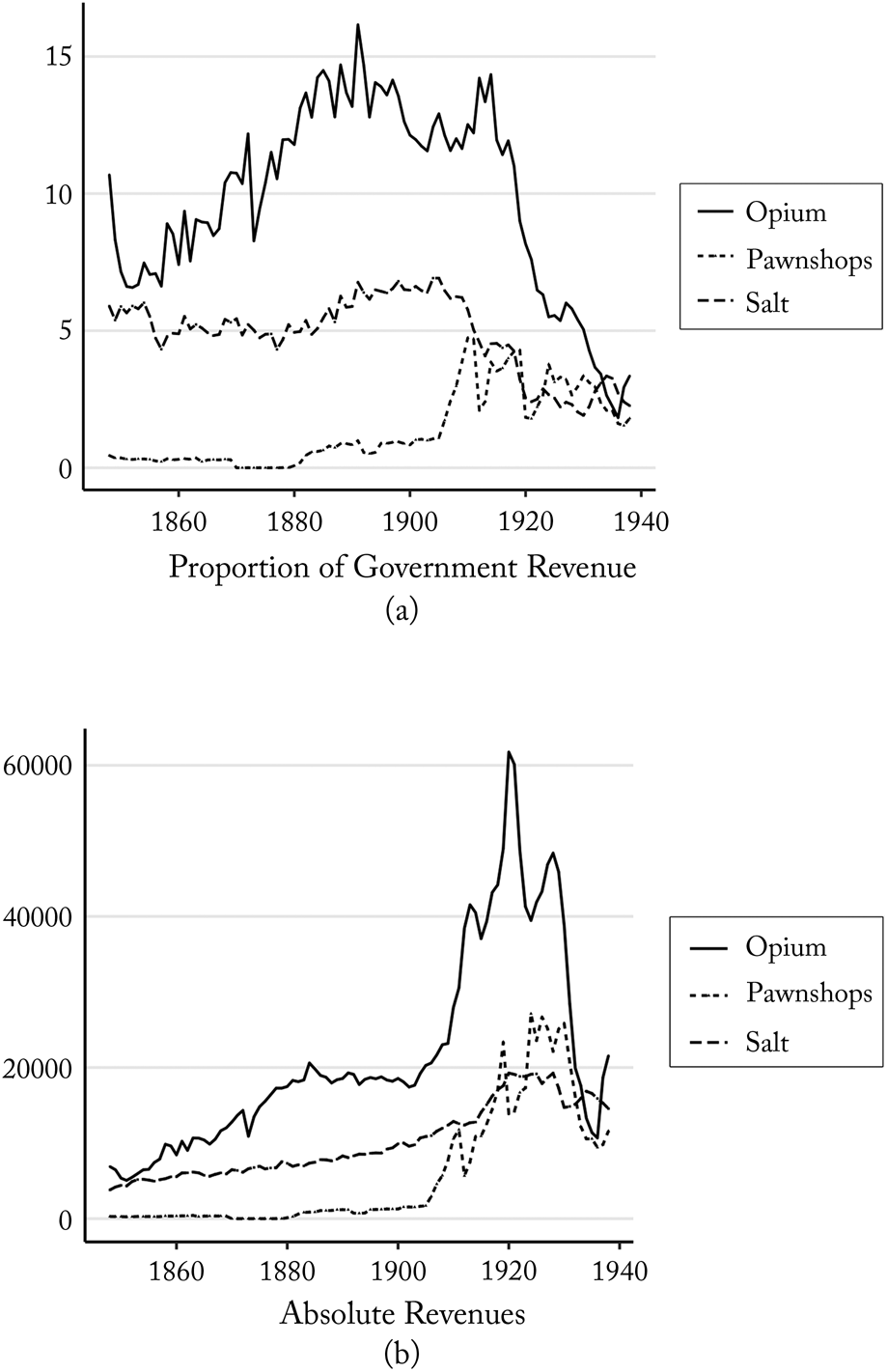
I investigate the long-run effects of the opium concession system—a nineteenth-century arrangement through which the Dutch would lease to the highest bidder the monopolistic right to sell opium in a predetermined area. The winners of these auctions were invariably ethnic Chinese.Footnote 3 The opium concession leaseholders were granted the exclusive right to establish stores throughout their territory through which they would sell opium to the population of Java, the political and economic center of the archipelago.Footnote 4 The scale of the opium concession system was massive. In 1891, revenues from opium concession leases amounted to 16.2 percent of the total Dutch revenue from their colonies.Footnote 5 The addictive properties of opium combined with the poverty of Javans meant that many in the indigenous population fell into destitution at the hands of ethnic Chinese vendors. The structure of the opium concession system therefore placed Javans in a position of economic servitude vis-à-vis the ethnic Chinese. Importantly for the purposes of this article, the legality of the opium concession system varied discretely along a series of borders; the import and sale of opium were outlawed in four distinct pockets across Java.
Leveraging this discontinuous jump in exposure, I implement a geographical regression discontinuity design to recover the causal effect of the opium concession system on contemporary levels of out-group intolerance on Java. I combine geolocated contemporary individual-level survey data with historical data that identify variation in the areas where the import and sale of opium were banned. I then compare rates of out-group intolerance among villagers in the areas near the borders where the opium concession system was operative to areas where it was outlawed. The critical assumption behind this research design is that all factors other than treatment assignment vary smoothly at the opium concession system boundaries. For the plausibility of this assumption, it is important to note that the boundaries of the opium concession system were not key political borders either before or after the colonial era.
I find that the introduction of the opium concession system had a durable effect in increasing contemporary levels of out-group intolerance. Today, when comparing respondents in villages where the opium concession system was introduced with respondents in nearby unexposed villages, the former are substantially more intolerant of out-group members. Specifically, they are more likely to state that they would be upset if a member of another religion (1) tried to build a place of worship nearby, (2) lived in their village, (3) lived in their neighborhood, or (4) rented a room in their house. These results are robust to a series of alternative specifications, including wider and narrower bandwidths, covariate adjustments, and the inclusion of provincial fixed effects.
Turning to the mechanisms of persistence, I show that the effect of the opium concession system on contemporary levels of out-group intolerance operates through two hypothesized channels. First, I provide evidence of intergenerational socialization leading to attitudinal persistence. I demonstrate that the effects of the opium concession system on contemporary levels of out-group intolerance are highest among Java's ethnic Sundanese. The introduction of the concession system was most traumatic for this group, as existing accounts suggest that the Sundanese did not consume opium before the system was introduced. This finding thus builds on the recent work of Avidit Acharya, Matthew Blackwell, and Maya Sen, who find that counties in the American South with larger populations of enslaved people during the nineteenth century report higher levels of contemporary racism—a finding the authors attribute to the intergenerational persistence of attitudes.Footnote 6
Second, I show that economic stratification is a self-reinforcing phenomenon that sustains out-group intolerance. In other words, when colonial regimes offered economic supremacy to one ethnicity over another, they put in motion a self-reinforcing economic institution that enriched one group and impoverished the other—conditions that heightened levels of ethnic strife. Foundational to this theory is a claim about the relationship between economic inequality and intolerance: when economic inequality is high and cleaves along ascriptive lines, I expect levels of out-group intolerance to be high. I find two pieces of suggestive evidence that support this theory. Relying on newly digitized data from the 1930 Dutch East Indies census, I find that districts exposed to the opium concession system experienced higher levels of ethnic inequality thirty-six years after the system's abolition in 1894. And analyzing contemporary data, I find that the long-term effect of the opium concession system on out-group intolerance is largest in areas where income inequality is high.
I also leverage the boundaries of the salt concession system on Java to conduct a placebo test. Similar to the opium concession system, this institution relied on the presence of a population of ethnic Chinese to purchase concession leases to sell salt to the indigenous population. But the catchments where salt concessions were legal were not coterminous with the boundaries of the opium concession system, allowing an opportunity to evaluate whether the main effects are driven by a generic privileging of the ethnic Chinese or by features unique to the opium concession system. I observe no differences in contemporary levels of intolerance between respondents who reside in villages historically subjected to the salt concession system and those residing in villages not subjected to the system. I interpret this as suggestive evidence that the opium concession system held a unique causal significance for the emergence of out-group intolerance above and beyond the generic economic privileging of the ethnic Chinese in the Dutch East Indies.
This article makes at least two contributions. First and foremost, it speaks to a growing literature in comparative politics on the origins of ethnic strife. Recent prominent accounts have focused on rationalist explanations, often emphasizing how political entrepreneurs strategically heighten the salience of latent ethnic cleavages to mobilize supporters for political gain.Footnote 7 Indonesia is no stranger to these dynamics. For example, it is widely thought that the recent surge in Islamist mobilization was brought about by elites opportunistically marshaling deep-seated grievances.Footnote 8 This article builds on those findings by examining the historical conditions that structure antagonisms between competing groups and make such appeals persuasive to begin with.
Second, my article adds fresh empirical evidence to the burgeoning literature on the long-term effect of colonial rule on contemporary outcomes. Specifically, I present an argument that calls attention to the predominantly pernicious long-run effects of the transformations produced by the colonial project. My argument therefore builds most directly on the work of Nathan Nunn and Leonard Wantchekon, who find that African communities whose ancestors were frequently raided during the slave trade report lower levels of trust today.Footnote 9 This article also responds to the growing demand in the legacies literature to directly investigate the “mechanisms of reproduction” by which a critical juncture leads to long-term effects and how those effects persist over time.Footnote 10 In doing so, my article embraces evidence that there are at least two causal mechanisms driving the observed effects.
In the next section, I review the colonial legacies literature and more concretely situate the contribution of this article by emphasizing the consequences of divide-and-rule strategies. Section III then turns to a description of the opium concession system itself. Section IV presents the empirical data and strategy. Section V presents the main results, along with additional tests verifying the robustness of the main findings. Section VI includes a series of additional tests probing possible mechanisms and finds suggestive evidence that the results are driven by persistent economic inequality initiated by the opium concession system. Concluding remarks and avenues for future research are presented in section VII.
II. Theory: Colonial Ethnic Stratification and Contemporary Conflict
A rich literature in political science and economics has demonstrated the historical origins of many contemporary political and economic outcomes. These studies focus on Africa, Asia, and Latin America in particular, and often adopt vast timescales, occasionally tracing contemporary variation to precolonial origins.Footnote 11 Yet this research agenda has long drawn on spatial variation in colonial institutions to explain divergent political and economic outcomes.Footnote 12 For example, in an article focusing on political outcomes, Marie Lechler and Lachlan McNamee show how histories of direct versus indirect colonial rule in Namibia shape individual preferences for democracy today.Footnote 13
I build on this research agenda by tracing how spatial variation in an important colonial institution affects contemporary levels of out-group intolerance. In doing so, I contribute to a subset of the so-called legacies literature, which has focused more specifically on the ways in which the durable effects of various colonial institutions can heighten the salience of ethnic cleavages and, in some cases, increase the probability of ethnic conflict. Looking at colonial Mexico, for instance, Alberto Diaz-Cayeros shows how the introduction of the encomienda, an institution in which whole communities were “entrusted” to the colonists, led indigenous communities to erect barriers that have led to the long-run consequences of heightening the political salience of their ethnic indigeneity.Footnote 14 In another case, also from Latin America, Jenny Guardado shows that when the Spanish crown auctioned off colonial governorships, those regions with greater extractive potential fetched “higher prices and worse buyers,” and in the long run, this contributed to the regions’ contemporary underdevelopment.Footnote 15 The adverse selection of governors also eroded institutional trust in these regions and thus elevated the likelihood of political conflict today.
There is also considerable evidence outside the Latin American context that historical institutions—colonial or otherwise—continue to shape group relations in plural societies. Nunn and Wantchekon, for example, find that the legacy of the African slave trade explains variation in contemporary mistrust among African ethnicities: communities whose ancestors were frequently raided during the slave trade report lower levels of trust today.Footnote 16 In a similar vein, Acharya, Blackwell, and Sen have written a book and a series of articles on their findings that individuals who live in counties in the American South that had a high proportion of slaves in the early nineteenth century report higher levels of racial prejudice today.Footnote 17 But historic institutional antecedents to contemporary group relations do not necessarily exert deleterious effects. Saumitra Jha, who studies Muslim-Hindu violence in contemporary India, finds that medieval port cities—despite being more ethnically mixed—reported five times fewer Muslim-Hindu riots than similarly positioned neighbors.Footnote 18 Jha attributes this finding to the nature of the economic relationship between Muslims and Hindus in these port cities: as Muslims were better positioned to engage in trade on the Indian Ocean, local institutions emerged to support interethnic economic exchange.
In this article, I am specifically interested in the consequences of an institution that overtly and explicitly stratified local ethnic groups in a colonial context. This strategy, sometimes called “divide and rule,”Footnote 19 took different shapes, but it was nearly ubiquitous across colonial Africa and Asia. In both India and Kenya, for instance, the British adopted segregationist policies that required individuals of specific ethnicities to reside in predetermined catchments—a policy that reverberates to this day and remains a source of tension.Footnote 20 In other cases, such as that of the Dutch in Indonesia, colonial rulers elevated certain ethnic groups over others by enlisting their service as administrators with the express intent of shielding Europeans from the anger of the indigenous population. Robert Bates shows how the privileging of certain regions—and thus ethnicities—by colonial powers in Africa is associated with contemporary levels of uneven modernization across ethnic groups, a dynamic that fuels resentment on the part of the comparatively marginalized.Footnote 21
Why did this sort of ethnic stratification lead to a heightened probability of conflict? This expectation builds on the foundational work of Donald Horowitz, who describes societies where opportunity for social mobility cleaves along ascriptive differences like those in which ethnic groups are “ranked” as opposed to “unranked.”Footnote 22 Specifically, he writes, “The distinction rests upon the coincidence or noncoincidence of social class with ethnic origins. Where the two coincide, it is possible to speak of ranked ethnic groups.” Horowitz conceptualizes ranked systems in a deterministic sense as those in which “mobility opportunities are restricted by group identity,” as in the case of the Hutus and Tutsis in Burundi.Footnote 23 It is understandable that in these contexts, tensions spill over into outright conflict, as members of subordinate groups find their ambitions for a better life systematically thwarted owing to purely ascriptive traits.
More recent scholarship has loosened Horowitz's conceptualization, instead considering group-based inequality as a more informative measure. Some work suggests that systems in which certain groups are less likely to experience political or economic mobility, that is, countries with high group-based inequality, are more likely to experience group conflict.Footnote 24 It is worth emphasizing that the institution examined here—the opium concession system—segmented ethnic groups in the Dutch East Indies without ranking them in the sense proposed by Horowitz: there were social elites in both indigenous and ethnic Chinese communities. And yet, the segmented position of the ethnic Chinese vis-à-vis the indigenous population was an elevated one, offering up the possibility that this institution may have generated the same grievances observed elsewhere in the literature.
It seems plausible that stratifying institutions may have had an impact on ethnic relations during their operation, but the legacies literature has long shown a theoretical interest in the difficulty of identifying the precise mechanisms by which historical causes sustain contemporary effects.Footnote 25 Here, I take up and build on two mechanisms of persistence through which a colonial institution of ethnic stratification might continue to shape ethnic grievances today.
First, it may be that in this case, the opium concession system shapes contemporary ethnic relations through a mechanism of intergenerational socialization. A traumatic institution in which one group wielded coercive authority over another is liable to provoke ethnic animosity, which may in turn be intergenerationally transmitted as individuals are socialized to adopt similar grievances. Nunn and Wantchekon provide one such example, suggesting that the norms of mistrust that emerged among frequently raided African communities have been self-reinforcing over time. The slave trade pitted neighbors against one another, as “households near ports” were able to profit by “tricking unsuspecting strangers and then selling them to merchants.”Footnote 26 It seems likely that as a survival tactic, members of these communities became more suspicious. These norms persisted as generation after generation was socialized to mistrust neighbors. In another example, Noam Lupu and Leonid Peisakhin look at the violent deportation of Crimean Tatars during World War II and find that descendants of families subjected to particularly acute forms of state-sponsored violence identify more strongly with their ethnic identity today—a finding the authors attribute to intergenerational socialization.Footnote 27
Second, it may be that the colonial-era economic privileging of ethnic groups has perpetuated the economic stratification of these groups today, and that this stratification in turn motivates out-group intolerance. The mechanism of reproduction here is thus twofold. On the one hand, the prevailing institutional arrangement is sustained by conventional accounts of path dependence in which economic power, and the accumulation of capital in particular, builds upon itself.Footnote 28 On the other hand, this mechanism differs from conventional accounts of path dependence insofar as those groups who are comparatively disadvantaged respond with hostility—rather than acquiescence—to the prevailing institutional arrangement, a response manifested in part by animosity toward the groups who are thought to benefit.
The plausibility of this claim derives from two specific tendencies. First, individuals are inclined to marry coethnics. Among the respondents interviewed in the survey I analyze in this article, for example, 92 percent report having parents who were coethnics. And wealth is typically passed down through generations. Again, among the respondents over the age of fifty interviewed in the survey mentioned above, 86 percent intend to leave their inheritance to their children. Taken together, this means that levels of ethnic inequality centuries ago are plausibly the source of variation in contemporary ethnic inequality. Second, in areas where economic inequality is persistently high and cleaves along ethnic group lines, I expect levels of out-group intolerance to be high. This proposition, that tolerance is negatively correlated with economic inequality, has found modest empirical support in other research.Footnote 29 One study, for instance, finds cross-national evidence that heightened levels of economic inequality occurring along “horizontal cleavages” between ethnic groups is positively associated with spikes in conflict.Footnote 30
III. Background and Empirical Context
The Ethnic Chinese on Java
Ethnic Chinese have lived on Java since at least the fifteenth century—predating the arrival of the Dutch in the early sixteenth.Footnote 31 Most lived in urban centers on the island's northern coast, working as merchants and middlemen.Footnote 32 Local princes held considerable sway over the activities of the ethnic Chinese for the first two centuries of their presence on Java, often limiting their sphere of influence and restricting their movements, and thus ensuring minimal friction with the indigenous population.Footnote 33 This arrangement meant that the ethnic Chinese were able to profit while existing amicably with the indigenous population, who retained administrative and political control over the island. For example, Peter Carey writes that before the Dutch arrived, “in court circles at least, a very different relationship seems to have prevailed between the two communities. This was one based not on mutual suspicion, but on a marked degree of reciprocity, common interest, and inter-communal cooperation.”Footnote 34
The arrival of the Dutch East India Company (Vereenigde Oost-Indische Compagnie, hereafter voc) in the early sixteenth century significantly changed the dynamic between the ethnic Chinese and Java's indigenous population. At the time, and still today, the indigenous population comprised several distinct ethnic groups, including the Javanese, Madurese, Sundanese, and Betawi. By the late seventeenth century, the voc had transformed itself from a commercial enterprise into one with territorial and administrative ambitions. To organize governance on the island, the voc empowered the ethnic Chinese to exploit the indigenous population for economic gain, yielding profits that ultimately flowed upward to the Dutch rulers. This policy dates to the beginning of the Dutch influence on Java.Footnote 35
The voc went bankrupt in 1800 and the Netherlands fell to the French Empire in 1806, meaning that the administration of Java was handed over to Napoleonic France. The French held control until 1811, at which point the British invaded and seized power.Footnote 36 That year, the interim British governor general remarked, “Dutch policy seems to have been to give every encouragement to the ethnic Chinese. They were the agents of the Dutch. They have almost an uncontrolled command of the Javanese market.”Footnote 37 In particular, the voc had adopted the practice of leasing revenue concessions to the ethnic Chinese, including monopolies over the operation of pawnshops, as well as the sale of salt, opium, and manpower.Footnote 38 From the perspective of the colonial regime, these tax-farm systems were desirable because they minimized administrative costs by outsourcing extraction to the ethnic Chinese and their agents. When the Dutch returned in 1816, this time led by colonial representatives of the metropole government, the tax-farm system was further entrenched and institutionalized. Eventually, it became an important source of revenue for the colonial government.Footnote 39 Figure 1 shows the importance of these tax farms for the financial viability of the Dutch East Indies between 1848 and 1938.
Tax Farm Revenues, Dutch East Indies, 1848–1938
Source: “Government Revenue in the Netherlands East Indies 1821–1940,” Center for Global Economic History.

The Opium Concession System on Java
The opium concession system was the largest tax farm in the Dutch East Indies, with analogs across Southeast Asia in British Malaya and French Indonesia.Footnote 40 Under this system, merchants would bid for the exclusive rights to sell opium within a predetermined territory. Although it was not a de jure requirement, those participating in these auctions were exclusively and invariably ethnic Chinese. But during its operation, the opium concession system was outlawed in certain regions across Java, based on perceptions of the system's viability. In areas where demand was perceived to be low, the authorities “reinforced the local disinclination with an official ban.” This local disinclination was closely correlated with characteristics of the population in these areas. Elsewhere, as James Rush writes, the Dutch “attributed this disinclination to religious values, especially to the stricter observance of Islam in these areas.” The opium concession system was banned in large pockets across Banten and West Java, and also in smaller pockets of Central and East Java.Footnote 41
Opium concession leases were typically purchased by a partnership of ethnic Chinese merchants (kongsi) for periods ranging from one to three years. Leaseholders would receive contracted quantities of raw opium—mostly imported from India—from the Dutch administrators. The leaseholders were responsible for processing and refining the opium into a consumable form known as candu. They also had to establish and maintain a system of stores and opium dens throughout their territory. The Javans, who constituted the majority of opium smokers, would purchase the opium in small amounts. Rush estimates that the average Javan peasant earned twenty-five cents a day, and that the “commonest daily expenditure” on opium was five cents.Footnote 42
The position of opium concession leaseholder also conferred legal authority on the ethnic Chinese. The monopolistic scheme meant that the impoverished Javans frequently turned to a black market to acquire opium-soaked strips of tobacco. To root out this practice, the Dutch granted the opium concessioner and his spies (mata-mata) the right to search Javan homes within his leasehold without warrant. Rush writes, “mata-mata often searched both the bodies and the homes of suspects and victims with little regard for their privacy or modesty.”Footnote 43
By the end of the nineteenth century, public opinion had shifted away from supporting the opium concession system. A growing chorus criticized the system's exploitative structure, arguing that it incentivized the ethnic Chinese to push opium onto an indigenous population who might not otherwise have been interested. Examining the rise of the opium prohibition movement in mainland Southeast Asia, Diana Kim identifies colonial bureaucrats as key actors and writes that the commercialization of opium for economic profit created more problems than it was worth.Footnote 44 But unlike its colonial peers in French Indochina and British Malaya, the Dutch East Indies was unwilling to abandon the sale of opium entirely. Instead, in the final decade of the nineteenth century, the opium regime system (opium regie) was proposed as a solution to the exploitative structure of the opium concession system. The Dutch colonial government seized the monopolistic rights to sell opium from the ethnic Chinese, and the Dutch themselves began handling the production and sale of opium through their own stores, which restricted consumption by metering individuals’ purchases. Importantly, the opium regime system legalized the sale of opium throughout the entire archipelago, even previously forbidden areas.
Opium and Resentment on Java
Through what specific channels did the opium concession system lead to out-group intolerance and resentment? First and foremost, the economic elevation of the ethnic Chinese embittered the indigenous population. Carey writes that “such attitudes [of animosity] towards the Chinese communities in Central Java have only crystallized over the past 150 years, precisely the time of the greatest foreign economic impact on the interior of the island.”Footnote 45 The anti-Chinese resentment, coupled with a generalized anger toward Europeans, boiled over into the Java War (1826–1830). The conflict exploded with the massacre of ethnic Chinese concession leaseholders in Central Java.Footnote 46 Throughout the war, which was mainly fought between the indigenous population of Java and the Dutch, resentment led to pogroms that specifically targeted the ethnic Chinese.Footnote 47
But the stigmatized and degenerative nature of the product sold—opium—holds important clues to understanding the link between the sale of the drug and the widespread resentment toward the sellers. Opium's addictive properties, combined with the poverty of the indigenous population, plunged many Javans into destitution. Carey writes, “even the slightest predilection for the drug exhausted the scarce savings of a Javanese peasant and made his economic position still more precarious. The road to social degradation and crime was ever present.”Footnote 48 Impoverished Javan peasants turned to small loans to finance their addiction—liabilities almost always held by the ethnic Chinese, whose opium the Javans then purchased. Javans unable to pay their debts would find themselves financially enslaved to wealthy ethnic Chinese concessioners. As Rush describes, “There were numerous variations, but the result was nearly always the same: unable fully to pay off one loan before needing another one, peasants found themselves committing a steady flow of rice upward through the Chinese patronage constellation.”Footnote 49 This tendency led many Javans to deeply resent the ethnic Chinese, who owned the rights to distribute the substance on which they would often exhaust their meager resources.
Anecdotal evidence from Indonesia supports the notion that even after the abolition of the opium concession system, the indigenous population continued to resent the ethnic Chinese. At the start of the twentieth century, in response to the economic hegemony of the ethnic Chinese, a cooperative of weavers formed Sarekat Islam (a socio-political organization) to support Indonesian traders. By 1919, the group's membership had swelled to two million, united by a shared “dislike of the Chinese,” and its actions frequently led to violence.Footnote 50 In addition to Sarekat Islam's activities, the ethnic Chinese were increasingly attacked by the impoverished indigenous population, with economic inequality frequently cited as the proximate cause.Footnote 51 Writing about the anti-Chinese pogroms of the late nineteenth and early twentieth centuries, Sartono Kartodirdjo notes that “the Chinese became an outlet for the frustrations of the masses” and that their economic prosperity was resented.Footnote 52
IV. Empirical Strategy and Data
Identifying the Causal Effect
The central task of this article is to identify the long-run consequences of the opium concession system on contemporary ethnic animosity on Java. The main obstacle to a straightforward analysis of this proposition is that the areas where the opium concession system was legal are likely different from the areas where it was outlawed along a host of observable and unobservable factors. If these differences are correlated with levels of out-group intolerance—the main outcome of interest—then causal estimates are likely to be biased. To work around this difficulty, I adopt a regression discontinuity framework. The opium system boundary cleaved along a series of district (afdeeling) boundaries that were drawn by the Dutch colonial regime in the early nineteenth century and that cut crudely across the Javan countryside with little concern for the villages on the borders’ margins. I leverage the observation that exposure to the opium concession system was a deterministic function of villages’ distance from these borders, and that within a narrow bandwidth around the boundaries, the underlying features of villages in which the system was operative were likely to be statistically indistinguishable from those in which it was not. In other words, I argue that, for the purposes of statistical inferences, the only meaningful difference between villages narrowly on one side of the border and those narrowly on the other is their historical exposure to the independent variable of this study: the opium concession system.
To further bolster the plausibility of this smoothness assumption, I also conduct a series of balance tests to confirm that the properties of villages on either side of the boundaries appear to be statistically indistinguishable. First, recall that the Dutch outlawed the opium concession system in places they perceived to be more religious. It is therefore crucial to evaluate whether—at least within narrow bandwidths around the borders—there were indeed salient religious differences. To this end, I draw on a geolocated database of mosques that includes their construction dates, assuming that mosque density is a reasonable proxy for piety.Footnote 53 Thus, I compare the number of mosques that were built prior to 1809 on either side of the opium concession system's boundaries. The results of this test, presented in Figure B1 (e) of the supplementary material, suggest that across a range of bandwidths, the pretreatment distribution of mosques on either side of the boundaries is statistically indistinguishable.
Second, I also rely on time-invariant features of the villages’ geography: (1) average terrain ruggedness, (2) average temperature, (3) average rainfall, and (4) soil quality. The results of these balance tests are presented in section B of the supplementary material. Specifically, I conduct difference-in-means tests across the areas where the opium concession system was legal compared with areas where it was outlawed, across a range of bandwidths. The results of these tests reveal that at very narrow bandwidth selections (for example, fewer than 3,000 meters), there are statistically significant differences in the temperature, average rainfall, and soil quality in the villages on both sides of the opium concession system boundaries. These differences are driven by an underlying imbalance in altitude—Java's central areas are more mountainous than its coast, meaning that villages within the opium concession system are at higher altitudes. But these differences quickly dissipate as the bandwidth expands. Nonetheless, in the supplementary material, I demonstrate that the main results are robust to the inclusion of these variables as controls (see Figure C3 in the supplementary material).
I also conduct a posttreatment demographic balance test on the distribution of adherents of Islam on both sides of the boundaries. After the 1965 massacre of suspected communists in Indonesia, in which ethnic Chinese were often targeted, many Chinese adopted Javan names to obscure their identity.Footnote 54 Fearful that census documents might be used to identify them in future pogroms, ethnic Chinese typically claim to be Javan on forms and surveys. In the survey analyzed in this article, for example, less than 1 percent of respondents claim to be ethnic Chinese. To work around this, I look at the distribution of religion—a close correlate of ethnicity—to examine the possibility of sorting around the opium concession system boundaries. The results, presented in section B of the supplementary material, appear to rule out the possibility of such sorting.
Addressing Threats to Identification
Before turning to the estimation strategy and main results, I consider three possible objections to my identification strategy. To be clear, I cannot definitively rule out these possibilities as I do not possess the requisite data; there is no systematic and disaggregated documentation of extent of out-group intolerance in the Dutch East Indies prior to the introduction of the opium concession system. Instead, in this section I argue that these objections ought to bias the observed effect in the opposite direction of the hypothesis outlined here. In other words, I argue that the assignment mechanism generates a least likely case for the emergence of the proposed relationship.
The first concern stems from the assignment mechanism. Namely, since the opium concession system was outlawed in places that were more religious, this imbalance might be correlated with posttreatment levels of ethnic and religious intolerance. In principle, this concern should be assuaged by the test results presented in Figure B1(e) of the supplementary material. However, skeptics might be concerned that religious piety could be negatively correlated with out-group intolerance. But in fact, the correlational relationship between piety and intolerance is typically positive. Among the respondents interviewed in the survey analyzed in this article, for example, praying at least five times a day is associated with a 1.5 percent increase in the likelihood of respondents offering an intolerant response to the question, “Would you be upset if a member of another religion built a place of worship nearby?” If one expects latent levels of intolerance toward ethnic Chinese to persist over time, places where the opium concession system was banned ought to exhibit higher, rather than lower, levels of out-group intolerance.
The second concern is spillover owing to mobility. Individuals in areas where the opium concession system was outlawed might still have been able to purchase opium, either by traveling to neighboring areas or by obtaining it on the black market. In the case of traveling to nearby areas, at least three features of life in nineteenth-century Java make this concern unlikely. First, during the Dutch-imposed cultivation system (cultuurstelsel), Javan peasants were required to work on communal concessions in their villages for at least sixty days a year—making frequent foot travel to nearby villages difficult. Second, under the cultivation system, traveling from one's home village required a permit from the village head (kepala lurah), and these permits were rarely granted because the authorities feared defections in the labor force. Third, even travel to nearby villages was prohibitively expensive for most Javan peasants. During the nineteenth century, the Dutch leased the rights to private merchants to exact tolls on public footpaths, which deterred intervillage travel. Carey estimates that in 1804, the tolls incurred along a ten-kilometer stretch of Javan footpaths totaled ninety-eight cents—roughly four times the daily income of a Javan peasant.Footnote 55 Surprisingly, according to the 2014 Indonesian Family Life Survey data, mobility in Indonesia remains low: about 85 percent of respondents in the sample still reside in the location where they were born.
In contrast, a black market certainly existed in areas where opium was banned. Known as the patungan trade, it differed in important ways from the trade conducted in regions where the concession system operated. Javan middlemen, rather than ethnic Chinese, sold black-market opium in the restricted areas. Since it was Javan vendors to whom the opium users became indebted, the character of animosity in these regions was therefore within rather than across ethnicities.Footnote 56
The third concern is that the legality of the opium concession system was decided on a district-level basis—a third-tier administrative boundary beneath the regency level. As such, the observed effects might be driven by systematic differences in governance across districts where the opium concession system was banned versus where it was legal. Importantly, however, governance in the Dutch East Indies occurred at the regency level—through which the opium concession system boundaries cut. Moreover, the contours of districts and regencies were redrawn during the twentieth century. This administrative reshuffling meant that the borders of the opium concession system are not coterminous with politically relevant contemporary administrative boundaries—a feature that should increase confidence in the results, as the borders on which the colonial regime relied have no contemporary significance.Footnote 57
Estimation
Implementing a regression discontinuity involves selecting a bandwidth around the borders, within which observations are kept in the estimation sample. Researchers skeptical of current research practices may be concerned by the arbitrary nature of this decision. Scholars have offered several techniques for selecting the optimal bandwidth.Footnote 58 In this article, I adopt a different approach to maximize transparency. For specific point estimates, I present the results according to four different bandwidths—2,500, 5,000, 7,500, and 10,000 meters.
Turning to the estimation strategy, I follow convention in implementing a local linear regression.Footnote 59 Specifically, I use ordinary least squares regression to estimate the following:
 $${\eqalign{Y_{ic} &= \alpha + \beta _1\cdot Opium_{ic} + \beta _2\cdot Distance_c \cr& + \beta _3\cdot Opium_{ic}\cdot Distance_c, + {\epsilon}_c }}$$
where Y ic is a stand-in for the outcomes of interest—whether individual i in village c offered an intolerant response. Opium ic is a dummy variable that takes a 1 if observation i in village c is located in an area where the opium concession system was legal, and a 0 otherwise. Distance c is the distance of village c from the boundary of the opium concession system. β 1is the parameter in which I am interested, and the one that carries a causal interpretation. It is the effect of a respondent living in an area where the opium concession system was legal—as opposed to an area where it was outlawed—on the likelihood of respondents offering an intolerant response. The unit of analysis is the individual. Since the forcing variable—distance from the opium concession system border—is calculated at the village level, I adopt the conservative approach of clustering standard errors at that level.
Data
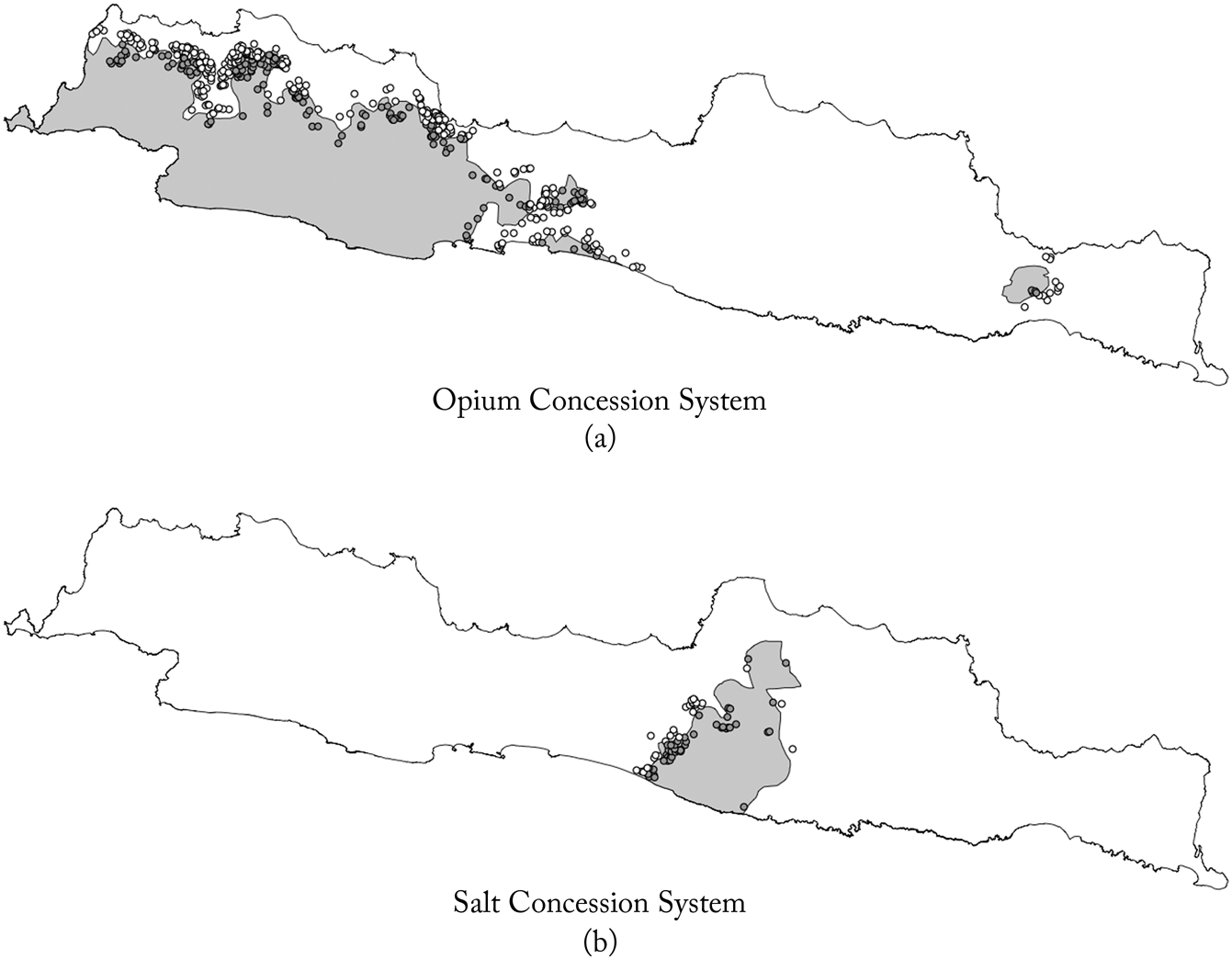
I collect data on the areas where the opium concession system operated from three archival sources and one secondary source. The main source is a map held in the archives of Leiden University and that is available online.Footnote 60 Commissioned by the Dutch East Indies government in 1882, the map outlines the extent of both the opium and salt concession systems (see section A.1 of the supplementary material). Using a high-resolution digitization of this map, I overlay the image onto a map of Java and trace the borders. Doing so creates the shape file for the boundaries from which I estimate whether or not villages land inside the opium concession system. I present the results in Figure 2(a). The map for the salt concession system, produced through a parallel process, is shown in Figure 2(b).
Extent of Opium and Salt Concession Systems on Javaa
a Author's reconstruction. Shaded areas represent the areas where the opium and salt concession systems were outlawed between 1809 and 1894. The borders of the opium concession system (a) and salt concession system (b) are drawn from Kaart van den Indischen Archipel: Aangevende de Bestaanden Toestand met Betrekking tot de Gouvernementsmonopolien van Opium en Zout 1882. The dots indicate villages sampled in the IFLS survey within 10,000 meters of the systems’ boundaries. White dots represent sampled villages where the systems were operative; grey dots indicate villages where the systems were outlawed.

To corroborate the validity of the map and confirm that the boundaries remained stable over time, I draw on three additional sources. All substantiate the validity of the map. The first is The Historical Atlas of Indonesia, which contains an independently sourced map of the extent of the opium concession system.Footnote 61 The second source of data is the yearly colonial reports, known as Koloniaal Verslagen, which have been digitized and are housed at the Dutch parliamentary archives.Footnote 62 Each colonial report includes a series of appendices that summarize regionally disaggregated revenues from the various revenue concessions, including the opium system. These data allow me to corroborate the absence of revenue generated from the restricted areas. The third source is the original text of a piece of legislation passed by the Dutch parliament in 1907. This legislation, Administratieve Voorschriften Vor de Opiumregie, initiated the opium regime system. Its text includes special treatment and discussion of the forbidden (verboden) areas, offering another opportunity to confirm the regions where the import and sale of opium were outlawed.
The central source of outcome data upon which I draw is the fifth wave of the Indonesian Family Life Survey (ifls), a panel survey conducted by the rand Corporation in 2014.Footnote 63 I include only those respondents from Java and the nearby island of Madura (N = 32,420). The ifls survey includes a battery of questions measuring trust. Specifically, it asks whether a respondent would be upset if a member of another religion (1) tried to build a place of worship nearby, (2) lived in their village, (3) lived in their neighborhood, or (4) rented a room in their house. Responses are dichotomized such that an affirmative response (intolerant) is coded as 1 and a negative response (tolerant) as 0. This strategy is adopted to maximize interpretability. The coefficients on the regressions represent percentage-point changes in the likelihood of respondents offering an intolerant response.
ifls also provides the coordinates of each sampled enumeration area—in this case, a village. Using this information, I calculate the distance of each village from the borders of the opium concession system. One consequence of this strategy is that the relevant explanatory variable—proximity to the boundary of the opium concession system—is calculated at the village level, meaning that entire clusters of respondents are estimated to live the same distance from the boundary. The level of imprecision resulting from this process is likely small. Villages are the lowest administrative unit in Indonesia, often covering only one or two square kilometers, so it is reasonable to assume that surveyed villagers live within a few hundred meters of the coordinates recorded by ifls.
Importantly, the questions ask about religious, rather than ethnic, intolerance. But in Indonesia, religion and ethnicity are often coterminous with the ascriptive differences that constitute the socially constructed categories of “Chinese” and “indigenous.”Footnote 64 Census data from 2000, for example, reveal that 95.6 percent of Javans adhere to Islam and only 4.6 percent of Chinese report being Muslim. Thus, there is good reason to expect that the proposed outcomes capture anti-Chinese sentiment.
V. Results
Main Results
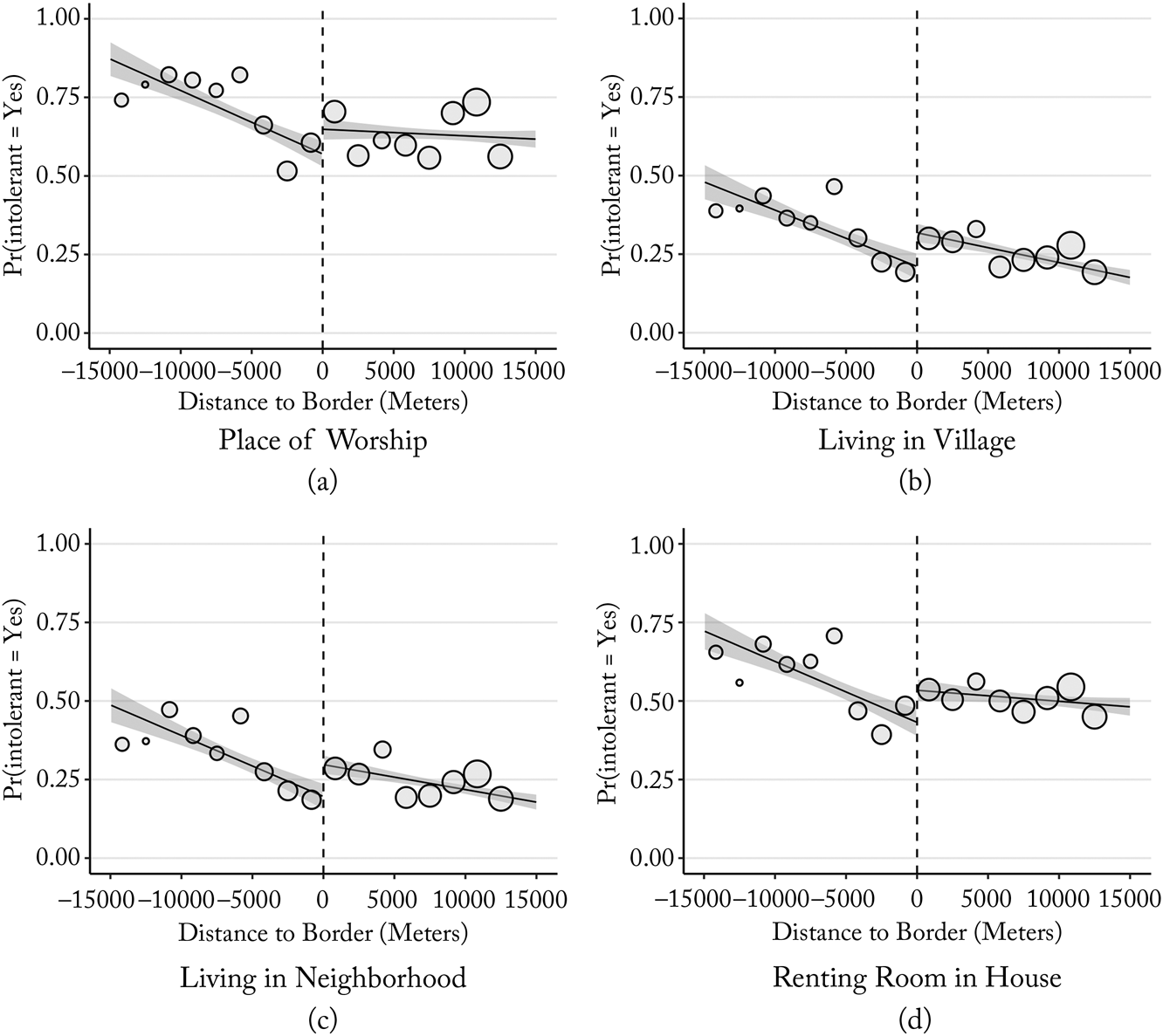
The results are presented in Figure 3, with 95-percent confidence intervals plotted. I report the results from the same tests with covariate adjustments and provincial fixed effects in section C.1 of the supplementary material. The results are substantively identical. My preferred presentation is graphical, with average outcome values plotted in bins every 1,500 meters. I include a simple linear regression line in Figure 3, although it is worth emphasizing that the results are robust to the specifications used in the coefficient plots, including first and second polynomials. This visual analysis reveals that the introduction of the opium concession system is positive and significant on all four measures of contemporary intolerance: more than a hundred years after its abolition, residents of villages that were narrowly exposed to the opium concession system are systematically more intolerant of out-groups when compared with residents of villages that were not narrowly exposed.
Effect of the Opium Concession System on Intolerancea
a Linear regression, with binned averages every 1,500 meters. The outcomes are drawn from a battery of questions that asked respondents if they would be upset if a member of another religion (1) tried to build a place of worship nearby, (2) lived in their village, (3) lived in their neighborhood, or (4) rented a room in their house.

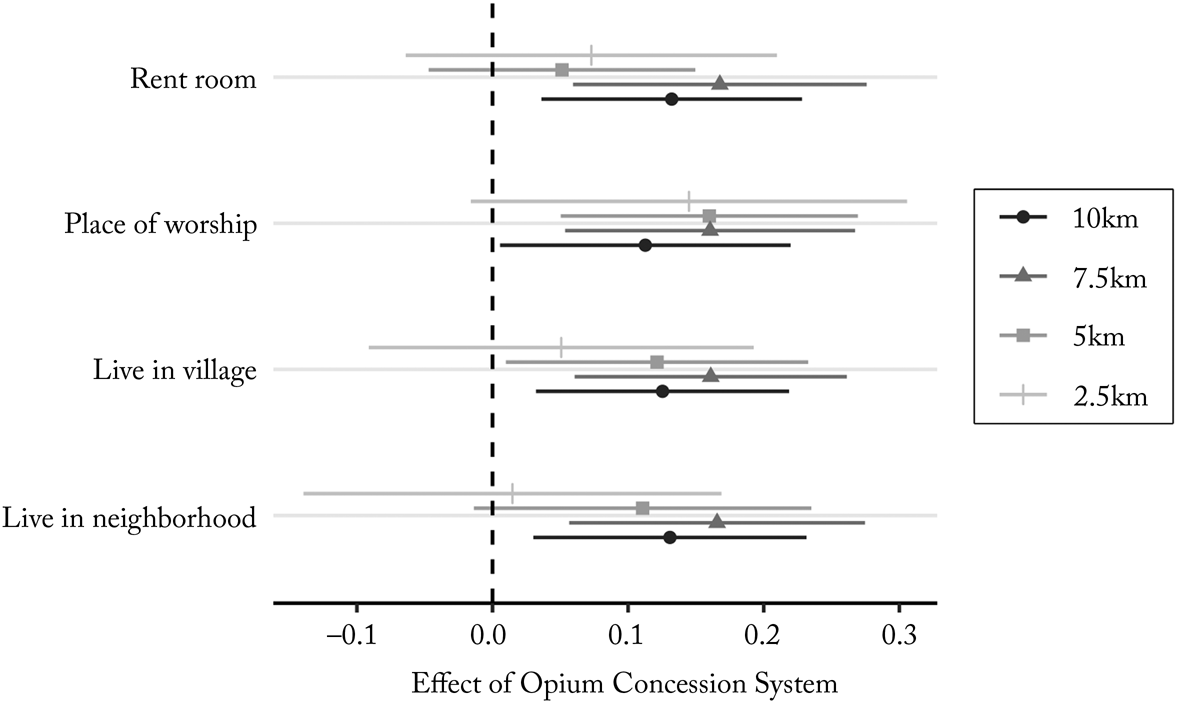
For a more precise comparison and discussion of the magnitude and significance of the effects, I also plot the estimates of the local average treatment effects, obtained from the beta coefficients of the local linear regression specification, according to different bandwidths. These estimates are presented in Figure 4. As discussed, the estimated effects are substantively large. The analysis in which the estimation sample is restricted to villages within 7,500 meters of the borders yields the most precise estimates. The introduction of the opium concession system led to a 15.9 percentage–point increase (p = 0.009) in the proportion of respondents saying they would protest if a member of another religion tried to build a place of worship nearby. This represents a 30.5 percent increase over the observed rates in nearby counterfactual villages where the opium concession system was banned.
Effect of the Opium Concession System on Intolerance, Multiple Bandwidthsa
a Beta coefficients from OLS local linear regression with 90 percent confidence intervals. Bandwidths range from 2,500 to 10,000 meters, at intervals of 2,500 meters. Robust standard errors clustered at the village level.

Across the other three outcomes, the results of the main tests suggest an increase in the proportion of respondents expressing intolerant opinions of others. Specifically, when I restrict the sample to villages within 7,500 meters of the borders, I find that respondents in villages where the opium concession system was operative are significantly more likely to state that they would be upset if a member of another religion lived in their village, lived in their neighborhood, or rented a room in their house. Looking at an indexed outcome measuring extreme intolerance—that is, agreeing with all four hypotheticals—I find that individuals in villages where the opium concession system was operative were fourteen percentage points more likely to offer such views (p < 0.01).
These results are robust to a larger bandwidth—villages within 10,000 meters of the borders. The results of those tests obtain similar point estimates and standard errors. It is worth mentioning that not all the results hold at a narrower bandwidth (villages within 5,000 meters of the borders). For villages within the 5,000 meter bandwidth, the opium concession system appeared to increase the proportion of respondents who stated that they would protest if a member of another religion tried to build a place of worship nearby or tried to live in their village. The results from the other tests at this bandwidth do not yield statistically significant results, which suggests that the effect of the opium concession system on these outcomes should be interpreted cautiously.
For villages in the most restrictive samples (fewer than 2,500 meters), the opium concession system appears to have had no effect on contemporary levels of out-group intolerance. This finding merits two caveats. First, the procedure implemented in the construction of the boundary involved a degree of imprecision, possibly diluting the true effect of the opium concession system. Second, the sample size in this restrictive sample is small, which should cast doubt on the precision of the estimates. The restrictive sample has 759 individual observations and 136 village-level clusters.
Placebo Test Results
I also conduct a series of placebo tests to validate my preferred interpretation that the observed separation in contemporary levels of out-group intolerance can be attributed to the historical assignment of villages to the opium concession system. Skeptical readers might wonder if the observed attitudinal separation could result from the distribution of the ethnic Chinese population; the villages close to the boundaries where the opium system was operative may have been the places where ethnic Chinese already resided. And it may be that these villages today report higher levels of out-group intolerance through the generic economic privileging of ethnic Chinese rather than through the opium concession system specifically.
To evaluate this possibility, I conduct an additional placebo test leveraging the salt concession system. As discussed above, in addition to the opium concession system, the colonial Dutch government leased other tax farms to buyers who were predominantly ethnic Chinese. The most prominent of these lesser tax farms was the salt concession system, introduced during the Dutch East Indies Trading Company era but abolished in 1813 during the British interregnum.Footnote 65 The Dutch reimposed the salt concession system in 1829 and it operated until 1882, when it was permanently abolished and turned into an outright government monopoly. Before its abolition, the salt concession system brought in more than seven million guilders—approximately US $72 million in contemporary value. The salt concession system operated much like the opium concession system. Ethnic Chinese tax farmers bid for the monopolistic rights to sell contracted quantities of salt within a predetermined catchment for a specified period. Most of the salt was produced on the island of Madura. Salt was commonly used for household culinary purposes, but it also held particular importance for small-scale fishermen, who used it as a preservative. Sellers were often accused of price gouging the indigenous population.Footnote 66
Like the opium concession system, the legality of the salt concession system varied discretely along a series of borders. It also relied on the presence of a population of ethnic Chinese to sell the product to the indigenous population. But importantly for my research design, the boundaries of the salt concession system were not coterminous with those of the opium concession system (see Figure 2). This fact enables an important test of the mechanism. Since the salt concession system imitated one key property of the opium system (the economic privileging of the ethnic Chinese over the indigenous population) but did not possess another characteristic of the opium system (the trade in an addictive and stigmatized substance), an evaluation of the long-term attitudinal consequences of the salt concession system helps validate the finding that the main results of this study can indeed be attributed to the uniquely traumatic aspects of the opium concession system.
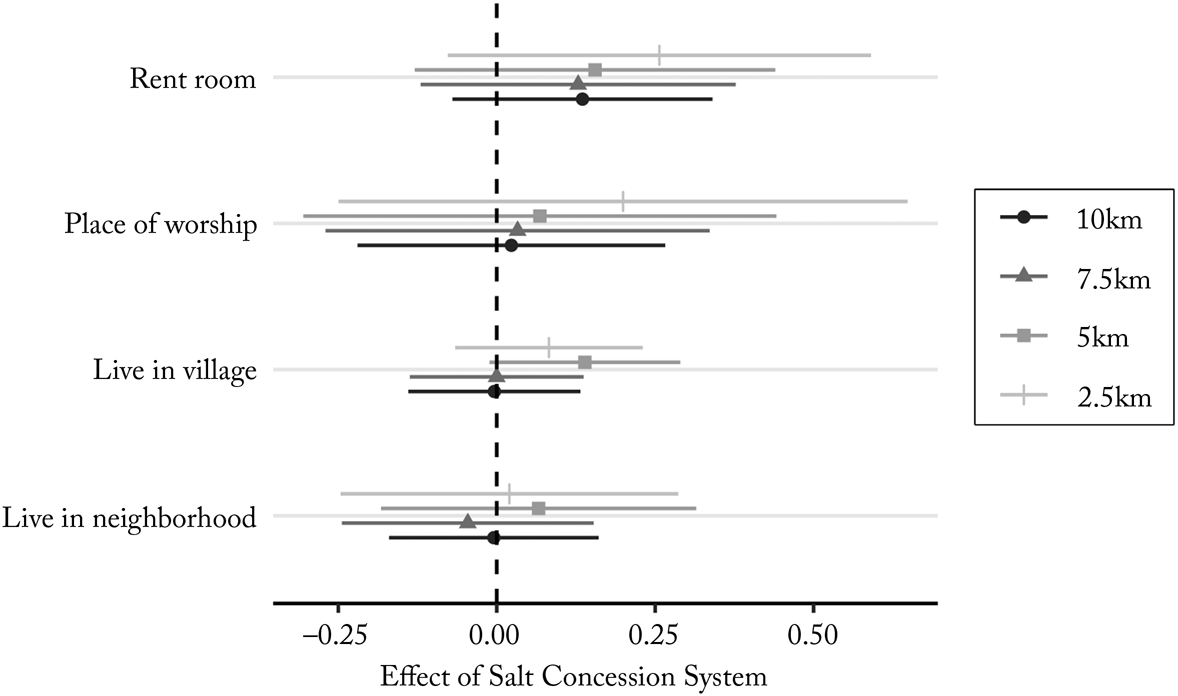
Figure 5 presents the results estimating the long-run consequences of the salt concession system on contemporary levels of out-group intolerance. Looking at the same outcomes as those presented in the main results, I also restrict the analysis to villages that were within 10,000 meters of the boundaries. When I compare contemporary levels of intolerance among respondents living in villages historically subjected to the salt concession system to those in villages not subjected to the system, I observe no substantive attitudinal separation across the two groups. These null effects are robust to four different bandwidth selections—2,500, 5,000, 7,500, and 10,000 meters. The results do not rule out the notion that the persistence of group-based inequality was an important mechanism of reproduction for the main results. As figures 1 and 2 show, the scale of the salt concession system, both fiscal and geographical, was smaller than that of the opium concession system, and so this trade may have enriched the ethnic Chinese to a lesser degree. Yet the results do suggest that the opium concession system held unique significance for the emergence of out-group intolerance—above and beyond the generic economic privileging of the ethnic Chinese.
Effect of Salt Concession System on Intolerancea
a Beta coefficients from OLS local linear regression with 90 percent confidence intervals. Bandwidths range from 2,500 to 10,000 meters, at intervals of 2,500 meters. Robust standard errors clustered at the village level.

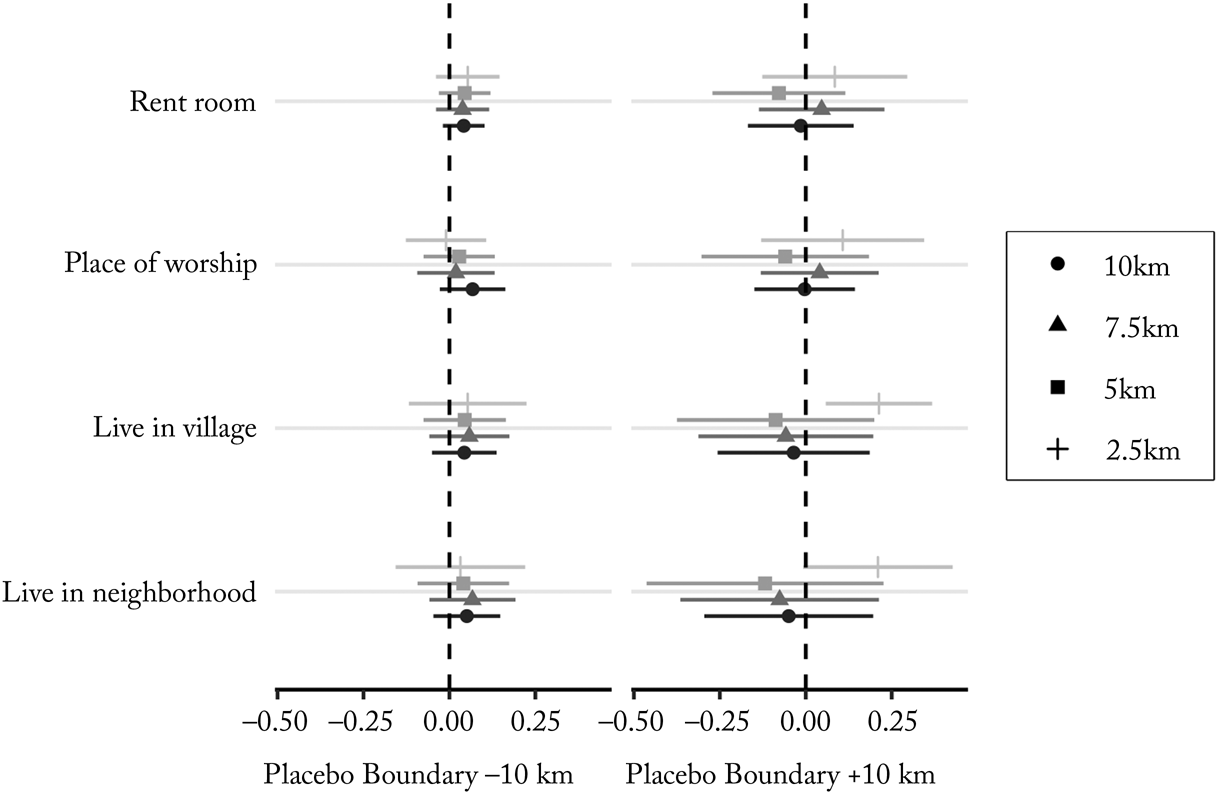
I conduct another placebo test to further validate that the main results are attributable to differences across villages around the sharp boundaries of the opium concession system. To do so, I arbitrarily draw a new boundary for the opium concession system and examine whether the effects are still present. Specifically, on either side of the original boundary of the opium concession system, I draw new borders that are 10,000 meters away. This creates two placebo boundaries: one in which I added 10,000 meters to the forcing variable (for example, distance to the original boundary), and another in which I subtracted 10,000 meters from the forcing variable. I then created a new treatment variable to reflect villages’ placement with respect to the new placebo boundary. Using these new placebo variables, I conducted the same tests from the main analysis.
The results are presented in Figure 6. Using the placebo borders, the results show that for all but two outcomes, no statistically significant differences in levels of out-group intolerance emerge on either side of the boundaries. The two exceptions emerge in the narrowest bandwidth (less than 2,500 meters) around the placebo boundary, 10,000 meters below the actual boundary. In these cases, it appears that the placebo opium concession system had the effect of decreasing out-group intolerance. These results are likely due to chance alone, given that there were thirty-two placebo tests in all.
Effect of the Opium Concession System on Intolerance, Placebo Testa
a Beta coefficients from OLS local linear regression with 90 percent confidence intervals. Bandwidths range from 2,500 to 10,000 meters, at intervals of 2,500 meters. Robust standard errors clustered at the village level.

VI. Investigating the Mechanisms
The results of my study suggest that nearly 125 years after the abolition of the opium concession system, respondents now living in areas where the system operated during the nineteenth century report higher levels of intolerance toward out-group members. The persistence of this effect over time is puzzling. Although the design of this study cannot definitively isolate the mechanisms that drive the results, my preferred interpretation is twofold. First, I hypothesize that intolerance toward the ethnic Chinese is passed down through generations, as individuals are socialized to harbor grievances initialized during the operation of the opium concession system. Second, I hypothesize that economic ethnic stratification is an intergenerationally self-reinforcing phenomenon, which in turn motivates out-group intolerance.
I conduct several tests to probe the plausibility of these two mechanisms. First, as discussed, it might be that intolerance toward the ethnic Chinese is passed down through generations, as children of certain groups are socialized to harbor grievances. At the time when the opium concession system operated, Javan resentment toward the ethnic Chinese is plausible, as opium addiction further impoverished their already marginalized communities. The opium concession system might have motivated Javan communities to socialize children to hold a grudge against the Chinese in a cycle that perpetuates to the present day. One observable implication of this possibility is that were this mechanism at work, the effects would be most pronounced among the ethnic groups most traumatized by the opium concession system during its operation—and thus most likely to socialize their children to bear grievances.
I conduct another test to probe the plausibility of this mechanism. The Dutch believed the ethnic Sundanese to be more pious than the ethnic Javanese, and more likely to have abstained from opium consumption before the introduction of the concession system.Footnote 67 In a bid to maintain peace, the Dutch attempted to reinforce this disinclination by placing an official ban on opium in the Sundanese-populated regions of West Java. And yet, particularly along its borders, the opium concession system included areas populated by ethnic Sundanese. The introduction of the opium concession system in ethnic Sundanese communities may therefore have been more traumatic than it was in ethnic Javanese communities, thus motivating these communities to adopt intolerant views of the ethnic Chinese, and in turn, to be more likely to socialize their children to adopt such grievances. To be clear, there is little direct evidence that the ethnic Sundanese were more aggrieved than the ethnic Javanese upon the introduction of the opium concession system. But consistent with this theoretical expectation, consider that when the opium concession system was repealed and opium was made universally available through the regie system, it was the Sundanese chiefs who raised the most vocal protests.Footnote 68
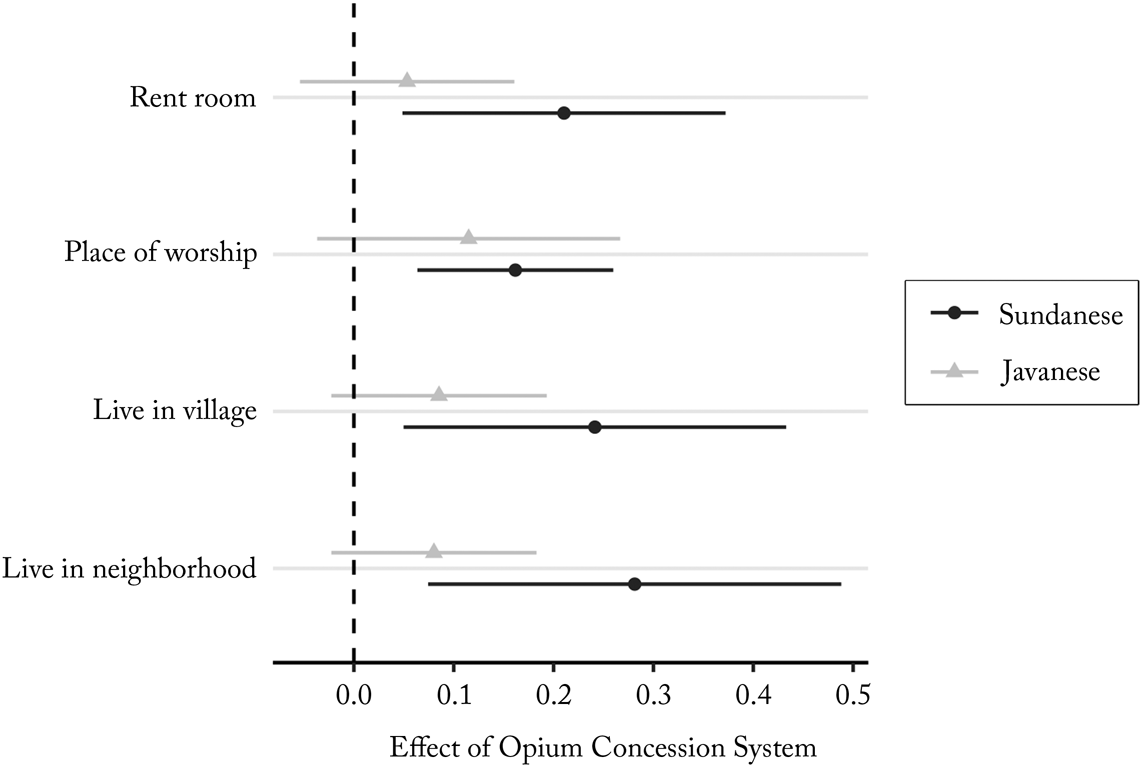
Leveraging this possibility, I probe for heterogeneous effects by examining differential effects among two different respondent ethnicities: the Javanese and the Sundanese. Figure 7 shows the effect of the opium concession system on contemporary levels of intolerance, subsetting among the Javanese and the Sundanese. I run the same local linear regression used for the analysis of the main results, and I include all observations within 10,000 meters of the opium concession system boundary.
Effect of the Opium Concession System on Intolerance, by Ethnicitya
a Beta coefficients from OLS local linear regression with 90 percent confidence intervals. Conventional standard errors clustered at the village level.

For all four outcomes, I find that the main results are largely driven by a heightened sensitivity to the legacy of the opium concession system on the part of the Sundanese. Again, these results should be interpreted cautiously, since the differences in point estimates are not always statistically significant. But the results are broadly consistent with the expectations of the mechanism that intolerant attitudes persist across generations.
Next, I examine the persistence of the economic-stratification mechanism. Existing qualitative and descriptive accounts have emphasized how levels of group-based inequality, both real and perceived, have influenced the degree of out-group intolerance in colonial and postcolonial Indonesia. Siddarth Chandra, looking at the Dutch East Indies between 1908 and 1916, shows that the places where the wage gap was largest between ethnic Chinese and indigenous workers performing the same jobs were also the places with the highest membership in Darul Islam—an Islam-based nationalist organization that leveraged anti-Chinese rhetoric.Footnote 69 More recently, the perceived economic supremacy of the ethnic Chinese has often been cited as a proximate cause for pogroms. After the 1998 fall of Suharto, for example, majority-group members in Jakarta turned on the ethnic Chinese minority in a series of pogroms that left more than one thousand dead. Sarah Turner writes that “tensions in the country were fueled by continued resentment of the government and of the perceived wealth of the Chinese population.”Footnote 70
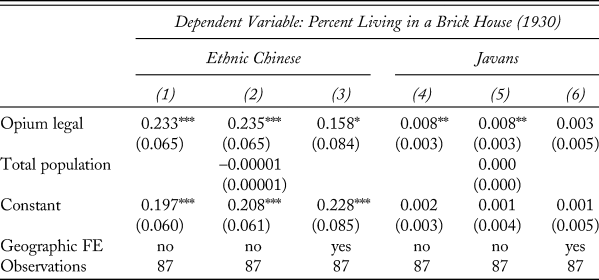
So, it seems likely that the opium concession system, in creating economic inequalities between the ethnic Chinese and indigenous populations, might motivate continued resentment. One observable implication of this possibility is that ethnic inequality is indeed higher in the areas where the opium concession system was operative. But it is hard to obtain credible data to test this expectation, since Indonesia no longer collects income data by ethnicity. To work around this problem, I obtained and digitized data from the 1930 census—the last one to credibly measure ethnic stratification. The 1930 census did not directly collect information on income, but it classified individuals by the type of structure in which they resided (“brick house,” “solid roof hut,” “non-solid roof hut,” or “other”). I use the proportion of individuals residing in a brick house as a proxy for wealth.
The 1930 census aggregated information at the district level. For each district, I indicate whether the opium concession system was legal during the years 1809 to 1894. I then conduct a simple ols regression to probe the mechanism's plausibility. I also conduct the same test with available controls and regency-level fixed effects. While the results, presented in Table 1, are purely correlational, they suggest that nearly thirty-five years after the opium concession system ended, ethnic Chinese were significantly wealthier in areas where the system had operated, as compared to districts where it was outlawed. Ethnic Chinese living in areas where the opium concession system was operative were 23.3 percentage points more likely to live in a brick house (p < 0.001), as compared to those living in districts where it was outlawed. This result is robust to the inclusion of available controls and regency fixed effects.
Relationship between the Opium Concession System and Wealth (1930)

*p < 0.01; **p < 0.05; ***p < 0.01; beta coefficients from OLS regression; district-level population controls included; conventional standard errors clustered at the district level.
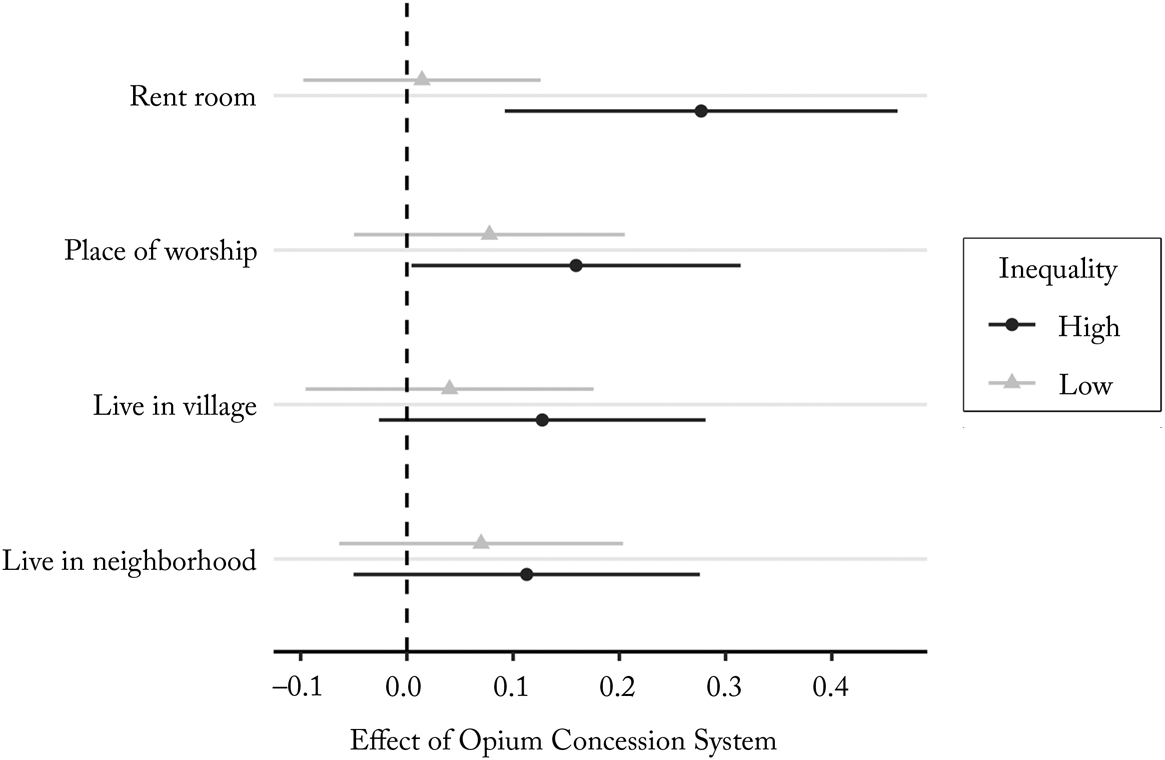
Another observable implication of the income-inequality mechanism would be that the effect of the opium concession system on out-group intolerance is more pronounced in areas where economic inequality is persistently high. I draw on household income data from the ifls survey to create a village-level measure of inequality by calculating the Gini coefficient.Footnote 71 I then cleave the sample at the median Gini coefficient and create two subsets: respondents in villages with high levels of economic inequality and respondents in villages with low levels of economic inequality. These analyses are confounded by posttreatment bias, but it is my belief, conditional on this shortcoming, that these analyses still convey important information. Figure 8 shows the effect of the opium concession system on contemporary intolerance, subset to villages with high and low levels of inequality. The results of these tests are partially consistent with the income-inequality mechanism. For two of the four outcomes, I find that the effect of the opium concession system on contemporary intolerance is largely driven by respondents who live in villages with high levels of inequality.
Effect of the Opium Concession System on Intolerance, by Local Levels of Inequalitya
a Beta coefficients from OLS local linear regression with 90 percent confidence intervals. Conventional standard errors clustered at the village level.

VII. Conclusion
The findings presented in this article suggest that the opium concession system had a persistent effect in increasing levels of out-group intolerance in contemporary Indonesia nearly 125 years after the system's abolition. The evidence supporting this case hinges on a comparison between respondents in villages where the opium concession system was introduced and respondents in nearby unexposed villages, showing that the former respondents are substantially more intolerant of out-group members. A series of additional tests bolsters the interpretation that these differences can indeed be attributed to the opium concession system. These tests indicate that villages on either side of the opium concession boundaries look statistically indistinguishable along a variety of pretreatment and time-invariant features. Of course, the opium concession system was not randomly assigned. But qualitative historical evidence suggests that the selection mechanism for drawing the boundaries of the opium concession system should have the effect of biasing away from the observed effects. Still, it is worth emphasizing that the inferences offered in this article should be interpreted cautiously in the absence of geographically disaggregated measures of out-group intolerance prior to the introduction of the opium concession system.
What might explain the persistence of the observed effects? I have argued that there are two interlocking mechanisms of reproduction through which contemporary residents of villages that were exposed to the opium concession system more than a century ago report greater intolerance toward out-groups. First, I have proposed that the effects can at least partially be attributed to intergenerational attitudinal persistence: in a cycle that dates from the opium concession system, children are socialized to adopt grievances against the ethnic Chinese. Second, I have also shown that the opium concession system instigated a self-reinforcing economic institution that enriched the ethnic Chinese on Java at the expense of the indigenous population. And I argue that this economic inequality persists to this day, creating an imbalance that partly drives the observed effects.
My results contribute to several important scholarly debates. Most immediately, this work joins a growing number of studies that seek to understand the consequences of colonial opium monopolies on governance in Southeast Asia—both in the short run and in the long term.Footnote 72 As Kim documents in Empires of Vice, all the major colonies in Southeast Asia derived significant incomes from such institutions. And all these monopolies relied on the presence of an ethnic Chinese population to both import and sell opium, suggesting that the Indonesia-specific effects reported here may offer insights into the origins of the resentment toward the ethnic Chinese witnessed in many Southeast Asian countries. But importantly, the scale of indigenous consumption varied widely across these contexts. Particularly large numbers of the general population in the Dutch East Indies and British Malaya consumed opium—suggesting an important scope condition in which the results obtain in contexts where sufficiently large numbers of the population became addicted.Footnote 73
This research also offers an empirical contribution to the growing literature on the deleterious long-term effects of colonial institutions. I have focused on the effects of a collaborationist institution that had parallels across contexts: colonizing Europeans often sought to insulate themselves from the anger of the indigenous populations by enlisting certain groups to assist them in tasks of governance. As Christopher Goscha describes in Going Indochinese, for instance, the French relied on the ethnic Annamese to staff government posts across French Indochina—inspiring the resentment of the Cambodians and Laotians.Footnote 74 An especially pernicious variant of these collaborations involved revenue collection, in which the extraction of rents from indigenous populations was subcontracted to wealthy individuals of certain groups. To recoup upfront investments, leaseholders in these arrangements evidently engaged in unusually extractive behavior, with deleterious present-day consequences, as documented by Diaz-Cayeros and Guardado in the Latin American context.Footnote 75 This article adds to these accounts by examining two such institutions in the Dutch East Indies. Future work should examine the consequences of analogous colonial institutions as explanations for contemporary social strife.
My findings can probably be generalized to other contexts and other analogous institutions, but the results point to important theoretical scope conditions. It seems likely that the mechanism of intergenerational attitudinal persistence is at work across the postcolonial world, as has been shown in a wide-ranging interdisciplinary literature on collective trauma.Footnote 76 But it is worth underscoring the scope conditions upon which other findings presented here are contingent. Although many colonial regimes initiated institutions that privileged certain ethnicities over others, the results showing the persistence of economic stratification are likely circumscribed by contexts where postcolonial regimes did not expropriate resources from the comparatively advantaged groups that were favored under colonialism. While these sorts of intervening remedial policies may generate new grievances, they may also serve to reconcile the intergroup animosity that is evidently still at work in the Indonesian context. In this respect, the argument articulated here is perhaps less likely to emerge in contexts where postcolonial redistribution schemes have sought to remedy the imbalances initiated during colonial divide-and-rule policies.
Supplementary Material
Supplementary material for this article can be found at https://doi.org/10.1017/S0043887122000041.
Data
Replication files for this article can be found at https://doi.org/10.7910/DVN/D6IBFJ.
Acknowledgments
For comments on earlier drafts, I would like to thank Thad Dunning, Otto Kienitz, Joel Kuipers, Joel Middleton, Neil O'Brian, Bhumi Purohit, Catlan Reardon, Jim Rush, Vincent Tanutama, and Jason Wittenberg, as well as seminar participants at the Center on the Politics of Development at the University of California, Berkeley, the Berkeley/Stanford Political Economy Seminar, Berkeley's Research Workshop in Quantitative Modeling, and the Midwest Political Science Association.