INTRODUCTION
Unlike many vertebrate species, very few invertebrates are known for their group behaviour, excluding social insects. Among these invertebrates, the squids are known to form large aggregations. However, in contrast to the number of studies conducted for analysing fish schooling behaviour (Pitcher & Parrish, Reference Pitcher and Parrish1993), squid school studies are scarce considering their equal importance to the world fisheries and their ecological niche in marine environments.
Cephalopods possess a well-developed nervous system. Their brain weight relative to body weight is intermediate between that of the fish–reptile group and the bird–mammal group (Packard, Reference Packard1972). This advanced neural feature is reflected in their cognitive abilities such as short- and long-term memories (Messenger, Reference Messenger1973) and visual imprinting (Darmaillacq et al., Reference Darmaillacq, Chichery and Dickel2006). These abilities might also be the contributing factors to their social features such as schooling behaviour.
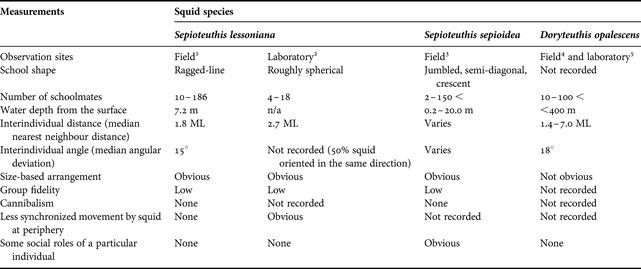
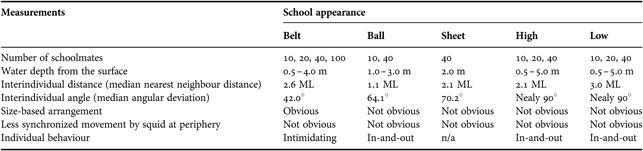
Moynihan & Rodaniche (Reference Moynihan and Rodaniche1982) in natural environment observed schools (from 2 to more than 150 squid) of the Caribbean reef squid Sepioteuthis sepioidea (Blainville, 1823) at the San Blas Islands along the Caribbean coast of eastern Panama (Table 1). They observed S. sepioidea forming schools with semi-diagonal (successive order of body size from large to small) and crescent (large individuals at both ends and small individuals at the center) appearances upon encountering potential predators (Moynihan & Rodaniche, Reference Moynihan and Rodaniche1982). In these schools, squid arranged themselves laterally by facing in the same direction and sometimes contained individuals continuously watching for predators as scouts or sentinels (Moynihan & Rodaniche, Reference Moynihan and Rodaniche1982).
Difference of characteristics for schooling behaviour among some squid species. n/a, not applicable; ML, dorsal mantle length.

1Adamo & Weichelt (Reference Adamo and Weichelt1999), 2Boal & Gonzalez (Reference Boal and Gonzalez1998), 3Moynihan & Rodaniche (Reference Moynihan and Rodaniche1982), 4Hunt et al. (Reference Hunt, Zeidberg, Hamner and Robison2000), 5Hurley (Reference Hurley1978).
Other studies also showed similar Sepioteuthis schooling behaviours (Table 1). Boal & Gonzalez (Reference Boal and Gonzalez1998) observed a size-based arrangement of captive oval squid S. lessoniana (Férussac, 1831 in Lesson 1830–1831) without complex social behaviour. Adamo & Weichelt (Reference Adamo and Weichelt1999) observed a natural population of S. lessoniana (10 to 186 squid) at Casuarina Beach on Lizard Island, Australia, and reported a ragged-line and size-based arrangement for S. lessoniana, visually similar to that reported for S. sepioidea schools. Schools of the California market squid, Doryteuthis opalescens (Berry, 1911), which numbers were similar to those of Sepioteuthis spp. (tens or hundreds: Hunt et al., Reference Hunt, Zeidberg, Hamner and Robison2000) consisted only of similar-sized schoolmates (Hurley, Reference Hurley1978). These past reports function as foundations; however, they are not enough to clarify the complex dynamics of squid schools and their appearances. Our knowledge about squid schooling behaviour in nature is still very limited.
We feel that in order to elucidate the social aspects of squid school in nature, more extensive observation of school appearance and schoolmate dynamics is necessary. In this study, we traced patterns of school dynamics for S. lessoniana in its natural environment. In addition, we defined several types of squid school appearance and discussed their morphological traits and possible social functions.
MATERIALS AND METHODS
Schooling behaviours of Sepioteuthis lessoniana were observed in the field between July and August of 2005–2011. Observations were conducted in the coastal waters of Okinawa Island, located in the Ryukyu Archipelago, Japan. The specific locations are as follows: Cape Maeda, 26°26′N 127°46′E, 1- to 30-m depth (Figure 1A); Cape Zanpa, 26°25′N 127°42′E, 1- to 3-m depth (Figure 1B); and Sunabe beach, 26°19′N 127°44′E, 1- to 5-m depth (Figure 1C). At Cape Maeda, the edge of the coral reef is close to the shoreline (less than 50 m), and observations were conducted mainly at the edge of the reef. At Cape Zanpa and Sunabe beach, the reef edge is far from the shore (100 m and 1000 m, respectively), and observations were conducted near the shore within the coral reef. At all locations, 2 to 5 observers separately snorkelled and searched for a school of S. lessoniana. Once a S. lessoniana school was found, all observers joined to watch an identical school, then, it was followed and video recorded using one or more of the following equipment: Canon IXY Digital 610, SONY DCR-TRV900, Canon PowerShot A650 IS and Canon EOS Kiss X3 cameras. The recording was usually started immediately after a school was found; however, at some occasions, recording was started several minutes after spotting a school to allow the squid to acclimate. Recordings were made from some distance (~5 to 10 m). At all occasions, S. lessoniana did not swim away and would often move closely under and between the observers. This indicated that they had been acclimated to our presence. The recording was continued until the squid voluntarily moved out of the field of vision. Each observation lasted for 1 to 2 hours between 0800 and 1700. In this study, 16 recordings were analysed (1 to 7 recordings per day; recording duration, 10 to 903 seconds), which were recorded on: 2 July 2005; 20 July 2008; 25, 27 and 28 August 2010; and 18 August 2011 (SCHOOL 1 through to 16).
A simplified map of the observation sites for the schools of the oval squid Sepioteuthis lessoniana: (A) Cape Maeda; (B) Cape Zanpa; (C) Sunabe beach. The numbers show the depth (m) from the water surface. The cross indicates bearing. The bold line indicates the boundary of the mainland. Other lines show the landscape of the sea bottom. The slashed area indicates the observational area. Scale bars: (A & C) 50 m; (B) 200 m.

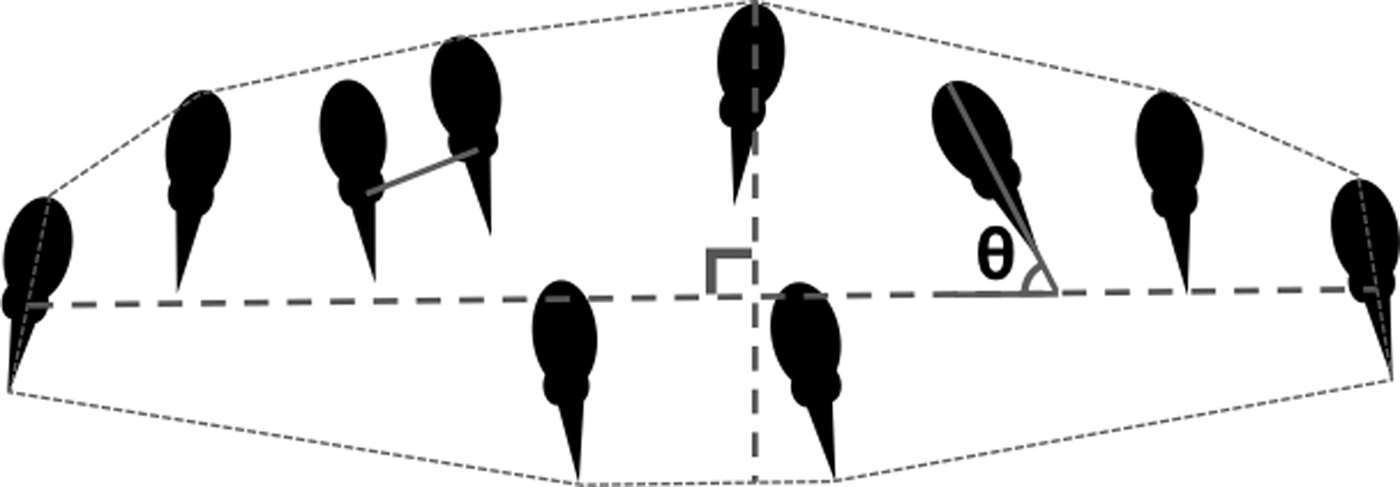
For each recording, the numbers of schoolmates were counted and the changing process of school appearance with time was traced. The school appearance was categorized on the basis of geometrical traits. The trait of the school appearance was evaluated by calculating the nearest neighbour distance (NND), angular deviation (AD) and shape deviation (SD) from the video still frames by using a video imaging software (ImageJ 1.45, Figure 2). NND was the distance of 2 points between the eyes of the 2 closest squid (Sugimoto & Ikeda, Reference Sugimoto and Ikeda2012). AD was calculated by setting a base line. This line was the horizontal line connecting 2 points between the eyes of 2 squid that were situated at the most peripheral position of both the sides when schoolmates oriented toward the longitudinal direction. AD was the angle between the base line and a schoolmate. Since squid could move backward and forward, AD was less than 90°. NND and AD were measured for 10 squid that were evenly distributed in whole school per video frame. Each value was averaged across 10 schoolmates; next, the median and quartile for these distances and angles were calculated from 5 video frames for each school appearance in 1 recording. The video frame that contained more than 10 clearly visible schoolmates was selected as the analysis frame.
Definition of the nearest neighbour distance (NND), angular deviation (AD) and shape deviation (SD) for the schools of the oval squid Sepioteuthis lessoniana: NND (solid line) was measured as the distance between the midpoint of the eyes of randomly selected squid and their own closest neighbour; AD (θ) was defined as the angle between the base line (dashed horizontal line) and squid; SD was defined as the difference between the length of the base line and the perpendicular line (dashed vertical line) that was drawn between 2 farthest cross-points of the polygon (dotted line). For the details of each measurement, please refer to the text.

For SD, a polygon was drawn to connect the tip of the arm and the mantle (opposite side of the head) of peripheral schoolmates, and a perpendicular line was drawn to the base line between 2 farthest cross-points of the polygon and the perpendicular line. SD was the difference between the length of a base line and the perpendicular line. The median and quartile for this length were calculated from 5 video frames in the same way as NND and AD. Dorsal mantle length (ML) for S. lessoniana in a school and the water depth from the surface at which they formed the school were visually estimated. Since the accurate length of the field could not be estimated easily, NND and SD were normalized to ML.
For statistical analysis, NND, AD and SD were compared among different schools and school appearances by using the Kruskal–Wallis test, followed by the Scheffé test and Mann–Whitney U-test with Ekuseru–Toukei 2006 (Social Survey Research Information Co., Ltd.).
RESULTS
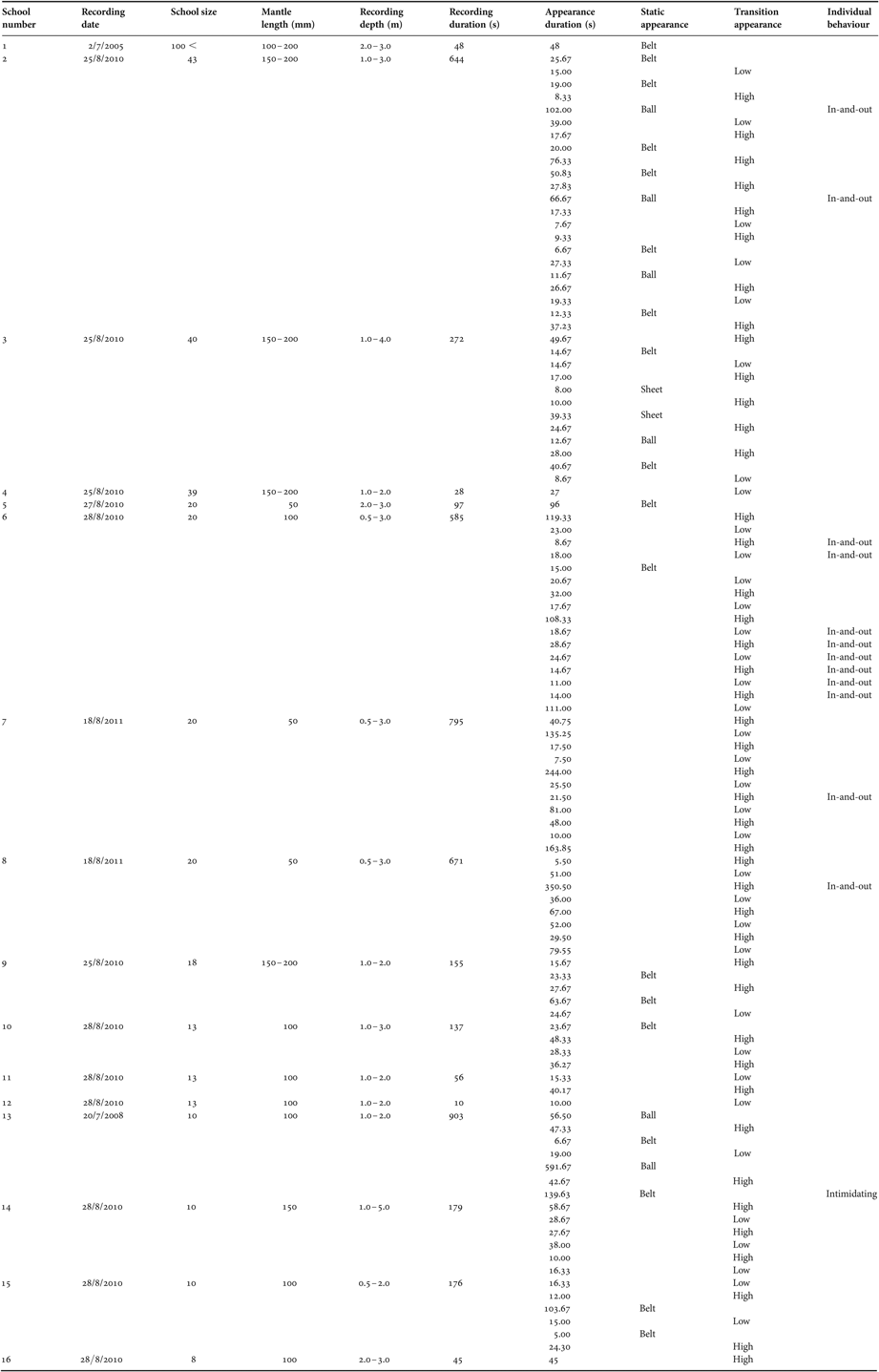
In all, 16 schools of S. lessoniana were observed, containing 8 to more than 100 squid of sizes ranging from 50 to 200 mm ML (Table 2). Squid schools were divided into 4 categories as containing ~100 squid, ~40 squid, ~20 squid and ~10 squid. SCHOOLS 1 through to 4 contained different sizes of squid (100 to 200 mm ML for SCHOOL 1; 150 to 200 mm ML for SCHOOLS 2, 3 and 4). SCHOOLS 5 through to 16 mainly contained squid of the same size (50, 100, or 150 mm ML). All these schools were found at a depth of 1.0 to 3.0 m on an average in clear water.
Details of oval squid Sepioteuthis lessoniana schools observed in coastal water of Okinawa Island, Ryukyu Archipelago, Japan.

Further, the schools were divided into 5 school appearance types: static appearances (belt, ball and sheet shape) and transitional appearances (high and low density). If a school retained a specific appearance for more than 5 seconds with hovering of schoolmates, it was judged as static and the others as transitional appearance. Many observed schools often changed their appearances within the time of recording. The frequency of these appearances was as follows: belt-shaped appearance by 9 schools; ball-shaped appearance by 3 schools; sheet-shaped appearance by 1 school; high-density transition by 12 schools; and low-density transition by 13 schools (Table 2). These appearances were quantitatively defined by calculating NND, AD and SD, and selecting SCHOOL 1 as schools containing ~100 squid, SCHOOL 3 as schools containing ~40 squid, SCHOOL 6 as schools containing ~20 squid and SCHOOL 13 as schools containing ~10 squid. During this study, no cannibalism and gender or group fidelity were observed or recorded among schoolmates because of the difficulty of accurately identifying individual schoolmates within a school.
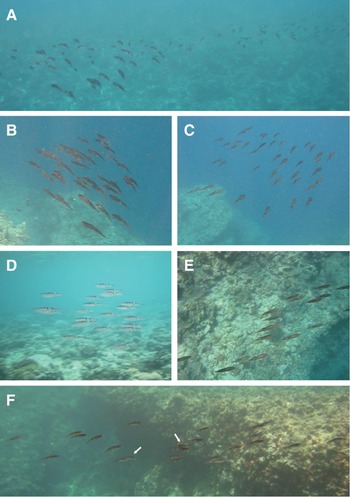
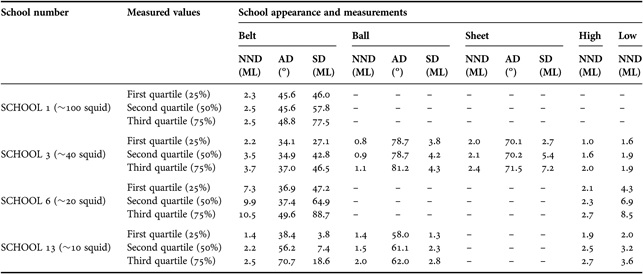
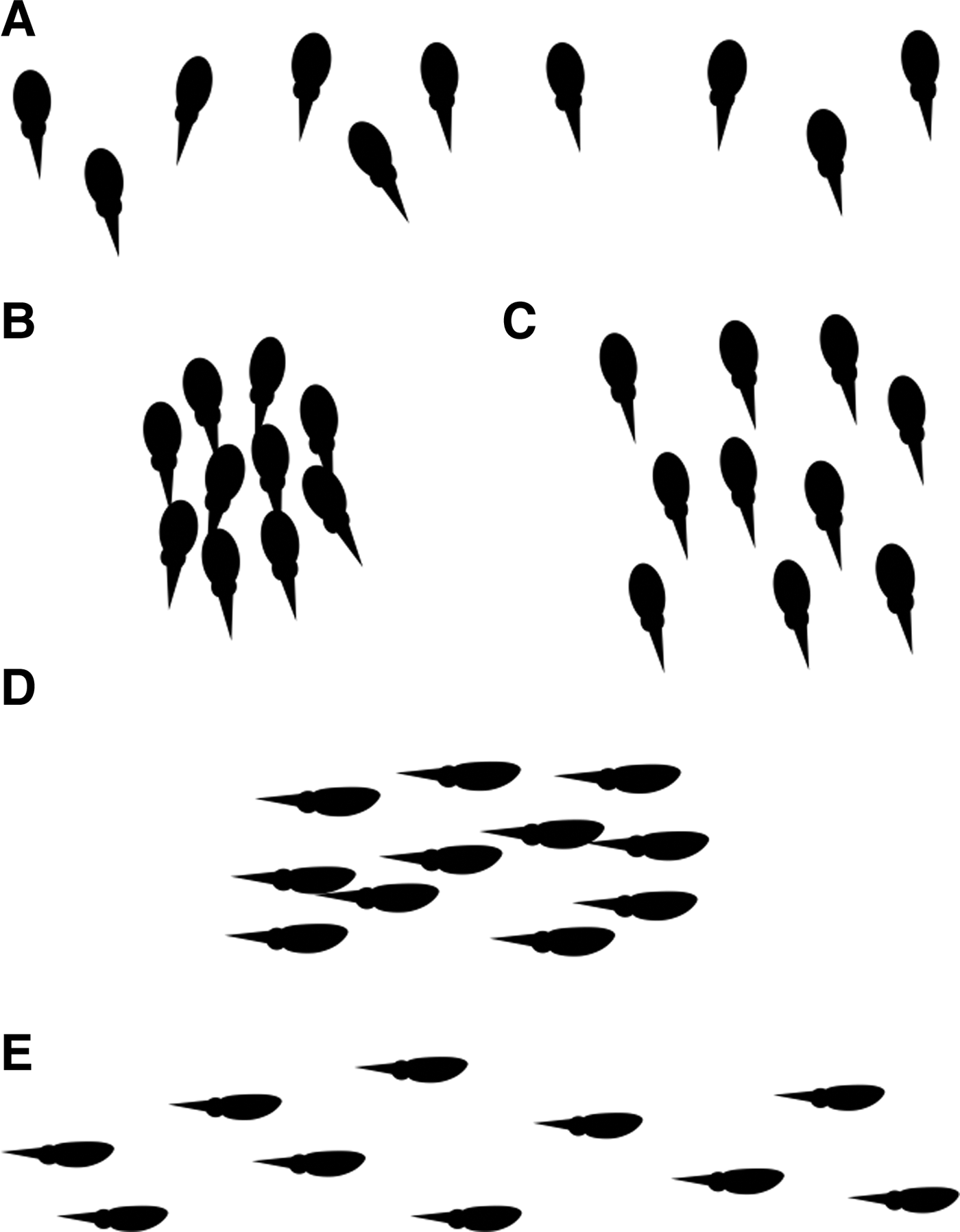
The belt-shaped appearance of S. lessoniana was used by schools of all sizes (Figures 3A & 4A; Table 3). This appearance was formed at the depth of 0.5 to 4.0 m. The schools continuously maintained this appearance for 5.0 to 139.6 seconds (first quartile, 14.8 seconds; second quartile, 23.5 seconds; and third quartile, 50.1 seconds). In this appearance, schoolmates hovered and aligned themselves laterally and horizontally into a rectangular arrangement while maintaining a parallel orientation with neighbouring individuals. Interindividual distances between schoolmates were highly varied (see NND below). In the schools with ~100 squid, schoolmates arranged themselves according to their body sizes: larger squid were positioned at the front end of the school (i.e. closer to human observers), while smaller squid were scattered across the entire school (Figure 3A). The NND ranged between 1.3 and 11.1 ML (Table 4). AD ranged between 30.9 and 78.4°. The SD ranged between 0.9 and 129.9 ML. In the schools with ~20 squid, NND and SD were significantly larger than those of the schools with ~10 squid (both P < 0.05, Scheffé test). The AD did not show a significant relationship with school size. School size and NND were inversely proportional to each other. However, the relationship seemed insignificant.
Photographs of the schools of the oval squid Sepioteuthis lessoniana: (A) belt-shaped appearance (SCHOOL 1); (B) ball-shaped appearance (SCHOOL 3); (C) sheet-shaped appearance (SCHOOL 3); (D) high-density transition (SCHOOL 8); (E) low-density transition (SCHOOL 3); (F) two individuals (arrow) facing in opposite directions (SCHOOL 1). Note that some larger schoolmates are positioned at the front end of the school in the belt-shaped appearance (see the lower left of (A)). All photographs were taken at Cape Maeda.

Difference among the school appearances in oval squid Sepioteuthis lessoniana observed in coastal water of Okinawa Island, Ryukyu Archipelago, Japan. n/a, not applicable; ML, dorsal mantle length.

Details of measurements for the school appearances in oval squid Sepioteuthis lessoniana observed in coastal water of Okinawa Island, Ryukyu Archipelago, Japan. Nearest neighbour distance (NND), angular deviation (AD) and shape deviation (SD).

The ball-shaped appearance of S. lessoniana was used by the schools with ~40 and ~10 squid (Figures 3B & 4B; Table 3). It was formed at the depth of 1.0 to 3.0 m. The schools continuously maintained this appearance for 11.7 to 591.7 seconds (first quartile, 23.6 seconds; second quartile, 61.6 seconds; and third quartile, 93.2 seconds). In this appearance, schoolmates hovered parallel to each other and were densely packed into a spherical arrangement. The NND ranged from 0.8 to 2.5 ML (Table 4). The AD ranged from 47.9 to 83.8°. The SD ranged 0.5 to 5.7 ML. Although these values were not significantly different between the schools with ~40 and ~10 squid, NND of the former was smaller than that of the latter.
The sheet-shaped appearance of S. lessoniana was used by the schools with ~40 squid (Figures 3C & 4C; Table 3). It was formed at the depth of 2.0 m. The schools continuously maintained this appearance for 8.0 to 39.3 seconds (first quartile, 15.8 seconds; second quartile, 23.7 seconds; and third quartile, 31.5 seconds). In this appearance, schoolmates hovered parallel to each other and positioned themselves in a horizontal plane with a square arrangement. The schoolmates were evenly distributed, with a similar interindividual distance. The NND ranged from 1.3 to 2.9 ML (Table 4). The AD ranged from 60.7 to 80.9°. The SD ranged from 2.7 to 13.6 ML.
Schematic drawings of the school appearance in the oval squid Sepioteuthis lessoniana: (A) belt-shaped appearance; (B) ball-shaped appearance; (C) sheet-shaped appearance; (D) high-density transition; (E) low-density transition.

SCHOOL 3 with schools of ~40 squid showed all appearance types: the belt-shaped, ball-shaped and sheet-shaped. The NND, AD and SD of this school type showed significant differences between the belt-shaped and ball-shaped appearances. The NND of the belt-shaped appearance was larger than that of the ball-shaped appearance (P < 0.01, Scheffé test; Table 4). The AD of the belt-shaped appearance was smaller than that of the ball-shaped appearance (P < 0.01, Scheffé test). The SD of the belt-shaped appearance was larger than that of the ball-shaped appearance (P < 0.05, Scheffé test). The NND, AD and SD of the sheet-shaped appearance were intermediate between those of the belt-shaped and ball-shaped appearances.
SCHOOL 13 with schools of ~10 squid showed both belt-shaped and ball-shaped appearances. The NND and SD of the belt-shaped appearance were larger than those of the ball-shaped appearance, although insignificant (Table 4). The AD of the belt-shaped appearance was smaller than that of the ball-shaped appearance, although insignificant.
The high- and low-density transitional appearances of S. lessoniana were used by the schools with ~10, ~20 and ~40 squid (Figures 3D, E & 4D, E; Table 3). These appearances were formed at a depth of 0.5 to 5.0 m. The duration of these transitional appearances ranged from 5.5 to 350.5 seconds (first quartile, 17.2 seconds; second quartile, 28.0 seconds; and third quartile, 47.7 seconds) and 7.5 to 135.3 seconds (first quartile, 15.2 seconds; second quartile, 20.7 seconds; and third quartile, 32.3 seconds). The high-density transition occurred when schoolmates moved simultaneously as a cluster. On the other hand, the low-density transition was observed in 2 cases where schoolmates began to move away from individuals located at the school's periphery or simultaneously moved into a belt-shaped arrangement. Since schoolmates aligned themselves laterally and longitudinally, the school's appearance became elongated. In both the high- and low-density transition, interindividual distances varied over time, changing school geometry. In contrast, interindividual angle was maintained at nearly zero (i.e. completely parallel) among schoolmates since they maintained the same directional movement.
We evaluated these 2 transitional appearances by using NND alone. When schoolmates used both high- and low-density transitions, schools with ~40 and ~20 squid were often separated into two groups, which smoothly merged together within a few seconds to several minutes. The NND of the high-density transition ranged from 1.0 to 2.8 ML (Table 4). The NND of the low-density transition ranged from 1.5 to 9.1 ML. In the low-density transition, the NND of the schools with ~40 squid was significantly smaller than that of the schools with ~20 squid (P < 0.05, Scheffé test). In the schools with ~20 squid, the NND of high-density transition was significantly smaller than that of low-density transition (P < 0.01, the Mann–Whitney U-test).
The NND of the belt-shaped appearance for the schools with ~10, ~20 and ~40 squid was larger than that of the high- and low-density transitions, and that of high-density transition was smaller than that of low-density transition, although insignificant (Table 4). The NND of the ball-shaped appearance of the schools with ~40 and ~10 squid was smaller than that of the high- and low-density transitions, particularly showing a significant difference between the ball-shaped appearance and low-density transition (P < 0.05, Scheffé test). Furthermore, the NND of the sheet-shaped appearance of the schools with ~40 squid was larger than that of the high- and low-density transitions, and that of the high-density transition was smaller than that of the low-density transition, although insignificant.
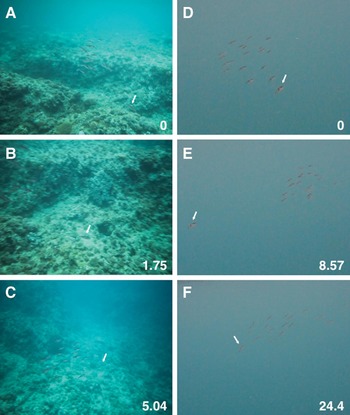
Several interactions were observed among the schoolmates of S. lessoniana. In SCHOOL 7, a larger individual suddenly moved out of the school and moved in the opposite direction from the school. Immediately, the schoolmates turned around and followed this larger squid (Figure 5A–C). On the same day, in SCHOOL 8, a larger squid dashed out of a school, but the schoolmates did not follow this individual. Instead, 43 seconds later, the larger squid rejoined the school. In another instance, a large squid (ML ~200 mm) moved near the school but did not join this school, and none of the schoolmates responded to the movement of this squid. This type of in-and-out behaviour was observed during the high-density transition in both SCHOOLS 7 and 8.
In-and-out behaviour by a larger squid was also noted in SCHOOL 2. The larger individual left the school and then returned to it after 21 to 72 seconds. This particular squid repeated this process 4 times over a period of 10 minutes. In SCHOOL 6, a larger squid left the school and rejoined it after 14 to 35 seconds (Figure 5D–F). This squid repeatedly joined and left the school 3 times over a period of 10 minutes. The in-and-out behaviour in SCHOOLS 2 and 6 was observed during the ball-shaped and transitional appearances, respectively. These in-and-out behaviours in SCHOOLS 2 and 6 differed from those in SCHOOLS 7 and 8 in terms of relative location of the larger squid to the other schoolmates. The larger squid in SCHOOLS 2 and 6 always maintained the same distance from the other schoolmates and never moved away from the school. In the case of SCHOOLS 7 and 8, however, the larger squid moved away from the school.
Photographs of in-and-out behaviour and following behaviour in a school of the oval squid Sepioteuthis lessoniana: (A) a larger squid dashes out of the school; (B) the schoolmates follow the larger squid; (C) the larger squid rejoins the school; (D) a larger squid moves to the periphery of the school; (E) the larger squid moves out of the school; (F) the larger squid rejoins the school. Arrows indicate the larger squid. Numbers show time-lapse in seconds. A–C, SCHOOL 8; D–F, SCHOOL 6. All photographs were taken at Cape Maeda.

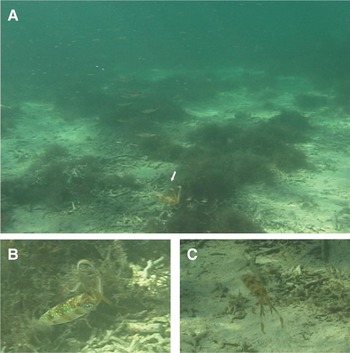
In SCHOOL 13, a larger squid was located at one end of the belt-shaped school closest to the human observer. This squid exhibited distinct body pattern with conspicuous striped coloration, with its arms held upward or downward (Figure 6A–C). The remaining schoolmates did not show such a distinct body pattern and oriented themselves parallel to each other. During all the other school appearances observed, S. lessoniana consistently exhibited a clear counter-shading pattern with darker dorsal side and lighter ventral side. No other body patterns or body postures were observed during both static and transitional appearances. In addition, 1 or 2 schoolmates sometimes moved facing in opposite directions from all the other schoolmates, while maintaining the same moving direction and speed.
Photographs of intimidating behaviour by a large oval squid Sepioteuthis lessoniana individual in a school: (A) a larger squid moves to the periphery of a school with a belt-shaped appearance and lifts its arms; (B) enlargement of the squid in (A); (C) same squid in (A), with its arms down. All photographs were of SCHOOL 13 at Cape Zanpa.

DISCUSSION
In this study, we described and defined 5 types of school appearances (3 static appearances: belt shape, ball shape and sheet shape; and 2 transitional appearances: high and low density) of Sepioteuthis lessoniana in the field. Of these appearances, the belt-shaped appearance has been reported by following researchers during their field study of Sepioteuthis (see Table 1). The semi-diagonal and crescent appearance (Moynihan & Rodaniche, Reference Moynihan and Rodaniche1982), the picket line appearance (Hanlon & Messenger, Reference Hanlon and Messenger1996) for S. sepioidea, and the ragged-line appearance (Adamo & Weichelt, Reference Adamo and Weichelt1999) for S. lessoniana can be categorized together with the belt-shaped appearance described. Adamo & Weichelt (Reference Adamo and Weichelt1999) quantitatively defined belt-shaped appearance among S. lessoniana schoolmates by using the interindividual distance (1.8 ML) and deviation of angle (15°) method, and these values are also similar to our result (2.6 ML and 12.5°, respectively; see Table 3). Besides geometric similarity, in a belt-shaped appearance, school size (~10 to ~100 squid) and body-size based arrangement are concomitant with those reported by the pioneer studies. The Sepioteuthis sepioidea school usually includes 20 to 40 squid (Hanlon & Messenger, Reference Hanlon and Messenger1996) and shows marked size-based arrangement in the belt-shaped appearance (Moynihan & Rodaniche, Reference Moynihan and Rodaniche1982; Hanlon & Messenger, Reference Hanlon and Messenger1996). In this study, however, the size-based arrangement was not obvious in the belt-shaped appearance of the schools with ~20 and ~40 squid (half of all records) and was observed only in the schools with ~100 squid. This difference may be caused by the difference in the amplitude of schoolmate body-size variation. The body size variation of S. lessoniana schoolmates in the schools with ~10 to ~40 squid was smaller than that of the schools with ~100 squid. A wide size-range of schoolmates in S. sepioidea has been reported previously (Moynihan & Rodaniche, Reference Moynihan and Rodaniche1982; Hanlon & Messenger, Reference Hanlon and Messenger1996). That is, in a belt-shaped appearance of Sepioteuthis school, the larger the size variation of schoolmates, more is the size-based arrangement.
Unlike belt-shaped appearance, which has been reported in the past studies, the ball shape and sheet shape as static appearances have not yet been reported (see Tables 1 & 3). Ball-shaped and sheet-shaped appearances are similar to those of a rough assemblage of relaxed S. sepioidea in the field (Moynihan & Rodaniche, Reference Moynihan and Rodaniche1982) and/or of S. lessoniana in a laboratory tank (Boal & Gonzalez, Reference Boal and Gonzalez1998). However, the deviation angle between schoolmates differs. Almost all schoolmates in this study faced the same direction unlike the previous studies (just half of the schoolmates faced the same direction; Boal & Gonzalez, Reference Boal and Gonzalez1998).
To our knowledge, we are the first to define transitional appearances in terms of schoolmate density (high and low). The school appearance while moving was described as the tight appearance against approaching predators in S. sepioidea (Hanlon & Messenger, Reference Hanlon and Messenger1996). Moreover, Adamo & Weichelt (Reference Adamo and Weichelt1999) reported that the interindividual distance in a S. lessoniana school decreased while jetting away. These descriptions are similar to the high-density transition of S. lessoniana since the schoolmates are densely packed and facing the same direction. A school of S. lessoniana might be constantly expanding (fission) and contracting (fusion) according to various environmental necessities. This trait of static and transitional appearances of S. lessoniana is also similar to the schooling behaviour of S. sepioidea (Moynihan & Rodaniche, Reference Moynihan and Rodaniche1982).
School appearances described in this study can also be found in other animals. Fish, birds and dolphins show similar group appearances in their three-dimensionally manoeuvrable living environments (Table 5). The belt-shaped appearance is reported in birds and dolphins. Birds use a line flight formation (e.g. front or V formation), which they use during their long migration (Heppner, Reference Heppner1974; Hainsworth, Reference Hainsworth1987). This appearance in bird flocks possesses two major functions: reducing energetic costs of flight through aerodynamic advantages and facilitating visual contact with neighbouring birds for communication (Heppner, Reference Heppner1974; Cutts & Speakman, Reference Cutts and Speakman1994). Dolphins also use a line formation (e.g. a front formation; Pryor & Norris, Reference Pryor and Norris1991) by 20–30 individuals maintaining an equal interindividual distance (Pryor & Norris, Reference Pryor and Norris1991). Dolphins' school arrangement may also be related to the above-mentioned 2 functions found in birds. Although the shape is similar, the belt-shaped appearance of S. lessoniana schools also has a unique characteristic. Unlike birds and dolphins, S. lessoniana can hover in mid-water. Hence, hydrodynamic advantages are an unlikely reason for this and other static appearances, despite the difference in the buoyancy and density effect between air and water. Instead, visual contact might be used for communication between school members, since squid possess a highly developed and laterally positioned lens and can change their body patterns. These physical attributes may suggest that squid have visual communication with members of the school.
Difference of characteristics related to grouping behaviour among animals. n/a, not applicable.

1Pitcher & Parrish (Reference Pitcher and Parrish1993), 2Hanlon & Messenger (Reference Hanlon and Messenger1996), 3Nagy et al. (Reference Nagy, Ákos, Biro and Vicsek2010), 4Pryor & Norris (Reference Pryor and Norris1991), 5McComb et al. (Reference McComb, Moss, Durant, Baker and Sayialel2001).
The ball-shaped appearance and the high- and low-density transitions are similar to the group appearance of fish, birds and dolphins. The school appearances of squid are similar to ball, cruise and hourglass manoeuvres in fish (Pitcher & Wyche, Reference Pitcher, Wyche, Noakes, Linquist, Helfman and Ward1983); globular, extended and column formations in birds (Heppner, Reference Heppner1974); and tight group, team and line formations in dolphins (Pryor & Norris, Reference Pryor and Norris1991). In fish, the ball manoeuvre is employed when stationary and at the highest density when fish are introduced in a new environment (Pitcher & Wyche, Reference Pitcher, Wyche, Noakes, Linquist, Helfman and Ward1983). In the ball-shaped appearance observed, S. lessoniana also aggregate with the highest density compared to other appearances. The dense pack of schoolmates may have some anti-predator functions in terms of the morphological feature (Pitcher & Parrish, Reference Pitcher and Parrish1993). In fish, birds and dolphins, several group appearances during movement might have appropriate functions for defence or migration. The same might be true for squid. The switch between the high- and low-density transition and in-and-out behaviour in these appearances might enhance some functions related to defence and/or navigation.
In addition to its appearance, for a squid, the size variation among schoolmates and the number of schoolmates relates directly to the functions of a school. In SCHOOL 8, when a school of ~20 small squid (ML ~50 mm) encountered a large squid (ML ~200 mm), they did not form a single school. Forming a school with similar-sized schoolmates has been reported in natural populations of Doryteuthis opalescens (Hurley, Reference Hurley1978). This is also common in fish schools (Pitcher & Parrish, Reference Pitcher and Parrish1993). From the principle of the oddity effect of groups (i.e. predators may preferentially target the least common phenotype in a group), evolutionary pressure for grouping with similar individuals is produced (Krause & Ruxton, Reference Krause and Ruxton2002). The feature of forming a school with similar-sized schoolmates was particularly common in the smaller S. lessoniana observed in this study. Smaller S. lessoniana (ML less than ~100 mm) form a small school (schools of ~10 and ~20 squid) and exhibit narrow size-variation among schoolmates. In contrast, larger S. lessoniana (ML more than ~100 mm) tend to form a large school (schools of ~40 and ~100 squid) with various-sized schoolmates. In a school with ~100 squid, the size-range of the schoolmates is wider than that in a school with ~40 squid. Adamo & Weichelt (Reference Adamo and Weichelt1999) reported that S. lessoniana of 25 to 160 mm ML formed a school of less than 186 squid that showed a size-based arrangement. In this study, 75% of the observed schools had ~10 or ~20 schoolmates (12 schools out of all schools observed). This suggests that a school with ~10 or ~20 squid is the smallest natural unit of a S. lessoniana school. These units are then integrated to create a larger squid school. Hence, schools with ~40 and ~100 squid contain squid of different body sizes. In fact, schoolmates in schools with ~100 squid had the widest body-size variations (ML ~100 to 200 mm) and thus showed the size-based arrangement. During this study, we observed and analysed very interesting facts regarding the schooling behaviour of S. lessoniana. However, there are many more questions that need to be answered in our future investigation.
ACKNOWLEDGEMENTS
We thank members of the Ikeda laboratory for their assistance with field observations. We also acknowledge H. Shirakawa and H. Aniya for assistance in drawing the map of the observation sites. This study was partially supported by a Grant-in-Aid for Scientific Research (C), Project No. 18580188, MEXT; a Research Fellowship for Young Scientists, Project No. 23·4156, JSPS; and University of Minnesota Grant-in-Aid and Imagine Grant for which we are very grateful.