The year 2007 can be considered as a milestone in the regional economic integration roadmap of the Association of Southeast Asian Nations (ASEAN),Footnote 1 with the signing of the Charter of the Association of Southeast Asian Nations (ASEAN Charter)Footnote 2 and the Cebu Declaration on the Acceleration of the Establishment of an ASEAN Community by 2015,Footnote 3 which adopted the ASEAN Economic Community Blueprint (AEC Blueprint) that aimed to transform ASEAN into “a single market and production base”, “a highly competitive economic region”, “a region of equitable economic development”, and “a region fully integrated into the global economy”.Footnote 4 Further, the goal of regional integration demands a rationalized, rules-based framework for economic co-operation which is consistent with multilateral rules.Footnote 5
The ASEAN Regional Guidelines on Competition PolicyFootnote 6 is a pioneering attempt to achieve the goal of transforming ASEAN into a highly competitive economic region and the introduction of nationwide competition policy and law in all ASEAN members by 2015. Unveiled by the ASEAN Economic Ministers on 24 August 2010, the ASEAN Regional Guidelines on Competition Policy is a non-binding document covering generally all key issues relating to competition law and policy, as well as providing specific suggestions tailored to the different economic situations of the respective ASEAN countries.
This article provides a comparative study of the regional harmonization of competition law and policy among the European Union (EU), the North American Free Trade Agreement (NAFTA),Footnote 7 the Southern Cone Common Market (MERCOSUR), the Andean Community (CAN), and ASEAN, and it focuses on ASEAN's approach. After a short introduction, the article first examines the need for the international harmonization of competition law and policy (Section I), and then makes a comparative study of the regional harmonization of competition law and policy in the EU, NAFTA, MERCOSUR, and CAN (Section II). In Section III, the development and content of the ASEAN Regional Guidelines on Competition Policy will be analyzed. In contrast to the “hard law” approach of the EU, NAFTA, MERCOSUR, and CAN, ASEAN has opted for a “soft law” approach, and the Guidelines only serve as a reference guide for ASEAN Member States in their efforts to create a fair competition policy. Section IV provides an analysis of the rationale for the divergence of ASEAN's approach as compared to those of other regions. Unlike other regions, ASEAN has been constrained by (1) the traditional “ASEAN Way”; (2) the diversity in economic conditions and competition regimes among its members; and (3) the lack of a supranational body to enforce common competition rules, or, at least, a mechanism for dispute resolution, which is considered, from the experiences of other regional competition policy arrangements (as examined in Section II), to be an essential element for common competition rules to be effective. The author concludes that although ASEAN has taken a very modest step in the harmonization of competition law and policy in the region, this step is appropriate for the time being, taking into account the current constraints that ASEAN faces.
I. The Need for International Harmonization of Competition Law and Policy
Before further discussion, it is useful to distinguish competition “policy” in general from competition “law”. Competition lawFootnote 8 comprises rules and regulations to foster the competitive environment in an economy.Footnote 9 Competition policy spans the much broader set of measures and instruments that may be pursued by governments to promote and protect competition. It consists of competition laws and policies achieving the same aimsFootnote 10 (e.g. deregulation, efforts to privatize state-owned enterprises, foreign direct investment, and other policies insofar as they are intended to promote competition). Thus, competition law can be said to be a subset of competition policy.Footnote 11
There has been an ever-expanding literature on the subject. Broadly speaking, proposals for an international approach to competition issues stem from the internationalization or globalization of the world economy: “the globalization of markets has led inevitably to proposals for the globalization of antitrust.”Footnote 12 In the context of growing international trade, there are at least four perceived problems which have prompted the development of international competition law.
A. Anti-Competitive Practices Outside the Control of Any Single State
The evolution of international markets creates the situation of anti-competitive activity falling outside the control of any single nation.Footnote 13 Broadly speaking, there are two types of policy failure to control cross-border anti-competitive conducts. First, national competition laws are normally not able to reach conduct which affects the national economy but which is committed in other countries. For instance, the problem in dealing with international cartels is that the evidence needed to prove the existence of an international cartel is located abroad, or usually scattered around the world. Ironically, the country which is in the best position to collect the relevant evidence has the least incentive to do so. Second, national competition laws do not normally consider injury or costs imposed by the conduct of producers in their jurisdiction on the residents of other countries. Countries typically take a more lenient view of actions by their citizens which harm residents of other countries;Footnote 14 thus, for instance, many countries exempt export cartels from national competition laws. These shortcomings of national competition approaches can be explained by the fact that “[n]ational competition laws are passed by national legislatures, concerned only with the welfare of residents living within the jurisdiction and are confined to conduct within the jurisdiction (with the exception of the extraterritorial application of some laws)”.Footnote 15 Thus, “without more effective cooperation among national competition authorities, consumers around the world will increasingly pay higher prices”.Footnote 16
In fact, more and more countries have attempted to deal with cross-border anti-competitive practices by exercising extra-territorial jurisdiction under the so-called “effect doctrine”. However, there are certain problems with this approach;Footnote 17 therefore, various countries have entered positive comity agreements to address these sorts of issues.Footnote 18 Positive comity operates whereby one state may request another to investigate anti-competitive behaviour within that other state's boundaries which is affecting firms located in the requesting state. However, each country retains the right to initiate or reinstitute its own enforcement activities if it is not satisfied with the speed or quality of the investigation.Footnote 19
Beside international cartels, which are already a challenge for competition enforcement, there may also be structural anti-trust problems of global monopoly and oligopoly, and “it may not be long before we see the development of worldwide oligopolies, in which pricing and output decisions by each firm are made with conscious reference to the conduct of its few remaining competitors, even without explicit inter-firm agreements”.Footnote 20
B. Enforcement Conflicts Between National Competition Authorities
It has been widely accepted that competition law enforcement is not simply a domestic affair any more. Some mechanisms, notably the use of extra-territoriality, may create substantial conflicts between the interests and laws of different countries. As noted by Campbell and Rowley, “[a]s commercial activity becomes increasingly global and competition regimes proliferate, the divergence in such laws is likely to produce considerable conflict between jurisdictions, compliance burdens for business, and chilling effects on economically beneficial conduct”.Footnote 21 The interference by the European Community (EC) in the merger between Boeing and McDonnell Douglas (MDD), which had been cleared by the US authorities, is a famous case which illustrates the possible enforcement conflicts between national competition authorities where only a last-minute compromise prevented a serious conflict from erupting.Footnote 22 What was interesting about the case was that the EU was concerned that some of Boeing's long-term sole-sourcing contractual arrangements with airlines risked permanently excluding Airbus if they were not challenged. Thus, the concern was not that the merger would result in higher prices for aircraft buyers. The issue was to protect the interests of the only EU competitor of Boeing-MDD. The EU refused to approve the merger unless Boeing agreed not to enforce the sole-sourcing contracts, which in the end Boeing accepted. As such, the case illustrates that the interests of different jurisdictions can diverge considerably in merger cases and suggests there may be value to the adoption of rules to foster transparency, e.g. the harmonization of notification procedures.Footnote 23
C. Unnecessary Compliance Costs
The United Nations Conference on Trade and Development (UNCTAD) observed that cross-border mergers have been growing rapidly and accounted for a higher proportion of total mergers in many jurisdictions.Footnote 24 This boom in mergers, acquisitions, joint ventures, and other business transactions, coupled with the proliferation of merger control laws, has greatly increased the number of transactions being reviewed by the competition authorities of several different jurisdictions. Therefore, it is not uncommon for a significant acquisition to trigger notification requirements in a dozen jurisdictions, and business groups and lawyers often argue that this proliferation of jurisdictions with merger control procedures and the differences between them have raised transaction costs and produced frictions among merging parties and reviewing agencies.Footnote 25 For instance, Tarullo argued that “[i]t is certainly conceivable that successive reviews of the same merger by eight or ten different national authorities could delay or even defeat a merger that is substantively unobjectionable”.Footnote 26 There are two somewhat overlapping sets of interests: while competition authorities want effective leverage over mergers that may have cross-border effects, firms want to minimize the number of agencies they are accountable to. In fact, as noted by Sokol, “the push for cooperation provisions in Preferential Trade Agreements (PTAs) comes from international business, particularly in the areas of merger control and cartel investigation … International business wants increased agency cooperation to streamline and harmonize procedures and operational matters for mergers.”Footnote 27
D. Market Access
A report by the Organisation for Economic Co-operation and Development (OECD) reveals that the liberalization of trade and investment stimulates healthy competition; yet there is an increasing recognition that the benefits of international trade liberalization may be negated by domestic measures inimical to an open, competitive market environment.Footnote 28 Such barriers may take the form of private anti-competitive behaviour, abuse of monopoly and dominant supplier power, or inappropriate governmental regulatory frameworks.Footnote 29 The effectiveness of anti-trust law enforcement, which seeks to eliminate private barriers, is therefore of great significance to the world trading system.Footnote 30 In other words, “achieving unconditional free trade requires the adoption of common antitrust disciplines”.Footnote 31
The most often-cited example regarding the tension between market access and private competition-restrictive behaviour is the Japan-Measures Affecting Consumer Photographic Film and Paper caseFootnote 32 (Kodak-Fuji), which found its way into the World Trade Organization (WTO) dispute resolution mechanism. Kodak-Fuji revolved around exclusive and selective vertical arrangements between upstream and downstream sellers.Footnote 33 The US accused Japanese keiretsu groups of using the control of the wholesale sector to exclude foreign goods.Footnote 34 As noted by Hoekman and Mavroidis:
The Kodak-Fuji case confirmed that government measures including actions directly or indirectly linked to competition policy that foster anti-competitive behavior and exclude rivals, can in principle be challenged at the WTO. However, it also illustrated that the “non-violation” process is an inherently limited instrument through which to attack the (non-)application of national competition laws.Footnote 35
Another well-known example of this tension is the application of anti-dumping measures in international trade. There have been numerous calls for replacing an anti-dumping regime with an anti-trust regime to ensure effective remedies against genuine cases of anti-dumping predation.Footnote 36 It is widely agreed among competition experts that anti-dumping measures promote competitor welfare rather than consumer welfare (e.g. domestic cartels often use anti-dumping measures to shield themselves from foreign competitors). In contrast, anti-trust measures apply a more economically rigorous analysis to claims of predation as compared to anti-dumping measures.Footnote 37 Some regional trade agreements such as the 1957 Treaty Establishing the European Economic Community (EEC Treaty),Footnote 38 and the Australia-New Zealand Closer Economic Relations Trade Agreement (ANZCERTA)Footnote 39 have phased out the application of anti-dumping remedies as the imposition of anti-dumping actions in intra-bloc trade is against the principle of internal liberalization, which is behind the formation of a preferential trade agreement. Also, its allowance constitutes an important loophole in the integration process. Therefore, they should be eliminated along with tariffs and any other form of non-tariff barriers.Footnote 40
II. Regional Harmonization of Competition Law and Policy: a Comparative Study
At the regional level, several regional trade arrangements have developed competition law and policies on an area-wide basis. The first multinational agreement of any kind relating to competition law was the EEC Treaty,Footnote 41 principally Articles 85−92.Footnote 42 Four other regional trading agreements have incorporated some agreement relating to competition law. These are the 1983 Closer Economic Relations Agreement between Australia and New Zealand (ANZCERTA);Footnote 43 NAFTA, which was signed in 1992 between the US, Canada, and Mexico;Footnote 44 the Andean Subregional Integration Agreement (Cartagena Agreement),Footnote 45 establishing the 1991 Andean Common Market (CAN); and the Treaty Establishing a Common Market between the Argentine Republic, the Federal Republic of Brazil, the Republic of Paraguay, and the Eastern Republic of Uruguay (Treaty of Asunción),Footnote 46 which created the Southern Cone Common Market (MERCOSUR). Thus, more than fifty regional trading partners are now involved in regional competition law agreements. Below is a brief review of the current regional regimes of competition law and policy: the EU, CAN, NAFTA, and MERCOSUR. Of course, in this comparative study, one should not forget the diversity in the extent of integration among these regions. However, “[t]he diversity of the institutional arrangements being considered does not mean that comparisons cannot be made but any comparison needs to take full account of differing contexts”.Footnote 47
A. The EU
The European Union (EU)Footnote 48 is an economic and political union of twenty-seven Member States. Committed to regional integration, the EU was established by the Treaty on European Union (TEU), which was signed in Maastricht on 7 February 1992,Footnote 49 upon the foundations of the European Community. The EU operates through a hybrid system of supranationalism and intergovernmentalism: in certain areas, decisions are taken by independent supranational institutions, while in others they are made through negotiation between Member States. So far, “the EU is perhaps the most ‘legalized’ international institution in existence”.Footnote 50
Competition policy is one of the most fundamental policies underlying the European Community because of its relationship with the original overarching goals of the Community to create a European common market in which distinct national markets give way to the “Single Market”.Footnote 51 The EU has been developing its competition rules for over fifty years. It represents a mature competition system as well as the most comprehensive effort at economic, monetary, and, perhaps, political integration amongst any regional organization in the world.Footnote 52 The EU has supranational competition rules which are linked by the treaty establishing the European Economic CommunityFootnote 53 to the fundamental objective of establishing a common market. Competition rules in the EU are notable for the doctrines of direct effect and supremacy, i.e. European law can create direct effects on national law, and European law is supreme to national law and creates an obligation for national courts to enforce EU law over conflicting national law.Footnote 54 The Treaty of Lisbon amending the Treaty on European Union and the treaty establishing the European Community, which came into force on 1 December 2009, rewrote the EU's internal rules and introduced institutional changes designed to streamline decision-making.Footnote 55 The Treaty on the Functioning of the European Union (TFEU)Footnote 56 expanded the Commission's power and increased the Parliament's involvement in the legislative process. According to Article 3 of TFEU, the Union has exclusive competence in the establishment of the competition rules necessary for the functioning of the internal market.Footnote 57 At the same time, however, its Member States still have separate and distinct national competition laws and national competition authorities which may differ substantially from one another.Footnote 58
One noteworthy feature of the EU's competition law and policy is the underlying objective of regional integration and the unity of the EU market.Footnote 59 The European Court of Justice (ECJ) once stated that the Article in the Treaty Establishing the European Community (EC Treaty)Footnote 60 ensuring that competition is unhindered is “a fundamental provision … essential for the accomplishment of the tasks entrusted to the Community and, in particular, for the functioning of the internal market”.Footnote 61 Thus, the rationale behind the European competition policy is to allow firms to compete on a level playing field in all EU Member States.Footnote 62
The EU provides the most far-reaching example of where enforcement of international competition rules has been assigned to several supranational institutions. The primary institution is the European Commission, specifically, the Directorate-General for Competition (DG Competition). As the competition regulator for the single market, the Commission is responsible for competition issues, approving mergers, breaking up cartels, working for economic liberalization, and preventing state aid. Nonetheless, it should be noted that certain EC competition laws and rules can be applied by national courts and national competition authorities.Footnote 63 The European Commission has also issued various notices and guidelines on competition issues, which, although not legally binding, strongly indicate the Commission's position on a variety of important issues and help ensure that all jurisdictions will adopt the same approach in the enforcement of competition rules.
The Commission may initiate investigation under Articles 101 or 102 of the TFEUFootnote 64 following an application made by an undertaking, an individual, or, to a limited extent, a Member State. The Commission may also open a case on its own initiative where information has been submitted to it by, for instance, a private citizen or an undertaking.Footnote 65 The Commission enjoys extensive powers to investigate alleged infringements of EU competition rules (including requesting information from relevant parties; calling parties to oral interviews; and conducting unannounced investigations at corporate premises, as well as private premises and homes, etc.).Footnote 66 Any authority that initiates a case under Articles 101 or 102 of the TFEU must report that case to the European Competition Network (ECN), which is the network that links together the Commission and the national competition authorities. Further, national competition authorities are obliged to submit their enforcement decisions to the Commission thirty days before their adoption.
Beside the European Commission, the General Court (CFI) and the European Court of Justice (ECJ) also deal with competition rules by way of appeals. Following a decision of the DG Competition, parties may appeal the decision to the General Court of first instance. This court may decide upon the case by annulling the decision, ordering a fresh investigation, or upholding the Commission's decision. Further appeal, either by the parties or the Commission, is made to the ECJ of final instance, which may quash the decision of the General Court.Footnote 67 The latter court may also be requested for a preliminary ruling in competition matters submitted by the courts in the Member States.Footnote 68
Recently, the EC radically reformed its enforcement regulations and adopted the new Council Regulation (EC) No. 1/2003 of 16 December 2002 on the implementation of the rules on competition laid down in Articles 81 and 82 of the Treaty,Footnote 69 which took effect in May 2004. The most radical and interesting provision is found in Article 3,Footnote 70 which provides that national courts applying national competition rules to conduct affecting trade between Member States must also apply Articles 81 and 82 of the EC Treaty.Footnote 71 In other words, national competition rules must be applied in tandem with Community rules. The significance of this new provision is that, now, EU competition law is not only uniform at the EU level, but also at national level (i.e. national competition laws must, in most cases, only prohibit what EU law prohibits, and cannot permit what EU law does not).Footnote 72
B. NAFTA
The North American Free Trade Agreement (NAFTA), effective as of 1 January 1994, is signed by the United States, Mexico, and Canada.Footnote 73 NAFTA was the first Latin American regional trade agreement to include a competition policy chapter.Footnote 74 The reason for having competition policy provisions in the agreement echoes the reasoning of the EU: to prevent governmental trade barriers from being replaced by private trade restraints.Footnote 75 NAFTA provides, at most, a bare framework for the development of co-operative or collective competition policies. First, NAFTA requires its parties not only to have competition rules, but also to ensure that such rules are enforced.Footnote 76 Second, the parties oblige themselves to consult each other and co-operate in the enforcement by assisting the other parties where needed. However, unlike the case of the EU, NAFTA specifies no uniform competition rules.Footnote 77 This means that NAFTA parties can prohibit any practices they wish in their competition laws.
Regarding enforcement, in contrast to the case of the EU, NAFTA does not rely on supranational institutions for enforcement. The reason is quite straightforward: NAFTA was not intended to aspire to the same level of economic or potential political integration as the EU does. NAFTA is merely a free-trade area, not a customs union or a common market. NAFTA lacks the institutions of the EU, as well as the political and security objectives of the EU.Footnote 78 Instead of relying on a supranational body, NAFTA's general consultation and co-operation requirements call on the parties to consult one another on the effectiveness of their national competition laws and to co-operate in the enforcement of those laws via mutual legal assistance, notification, consultation, and the exchange of information.Footnote 79 Although no attempt was made in NAFTA to move towards harmonization of competition regimes, the potential gains from co-operation in this area are recognized. Parties have agreed to apply the positive comity principle in the enforcement of anti-trust law and have engaged in a process of discussing the interface between trade and competition policy.Footnote 80
What is noteworthy about the competition policy chapter in NAFTA is that although there is a binding dispute settlement process involving multilateral panels, the competition provisions of Article 1501 are expressly excluded from the dispute settlement procedures.Footnote 81 The exclusion of competition policy from NAFTA's dispute resolution procedures has ironically resulted in disputes on competition policy being taken to the WTO. The oft-cited case is Mexico-Measures Affecting Telecommunications Services. Footnote 82 Regarding this case, one author has commented that:
The great irony here is that the U.S. did not act under NAFTA, which does have explicit competition rules, but did act under the dispute settlement procedures of the WTO, which does not have explicit competition rules … One conclusion is that something is seriously wrong with the competition rules of NAFTA when the Parties have to resolve their competition-related issues by the dispute procedures of the WTO.Footnote 83
This situation is in contrast to the EU, where the EC Treaty provides that the Commission is the final arbiter of competition policy within the EU.Footnote 84 The result of NAFTA's lack of supranational or regional, as distinct from national, competition policy and lack of supranational institutions is that “competition disputes are settled by informal cooperation between the Parties, or in rare instances, by resort to the dispute resolution procedures of the WTO, or not settled at all”.Footnote 85
C. MERCOSUR
The Southern Cone Common Market (MERCOSUR) is a customs union established in 1991 by the Treaty of AsunciónFootnote 86 between Argentina, Brazil, Paraguay, and Uruguay. Venezuela, Bolivia, Chile, Colombia, Ecuador, and Peru became members subsequently. The Treaty of Asunción had envisioned no central institutions in its initial stages, but was amended in December 1994 through the Protocol of Ouro Preto to include a variety of institutional provisions, including dispute settlement.Footnote 87 The Protocol of Ouro Preto established an institutional structure for MERCOSUR, which was inspired by the EU. MERCOSUR functions on the basis of a fully intergovernmental structure. The institutions of MERCOSUR consist of a Common Market Council (ministers), a Common Market Group (ambassadors), a Commercial Commission, and a large number of Technical Committees, Working Groups, and Ad Hoc Groups, which all deal with specific areas of policy such as industry, competition, the environment, co-operation, agriculture, and customs. These entities consist of representatives (diplomats and other civil servants) of member countries and make decisions on the basis of consensus.Footnote 88 All these institutions are still at an intergovernmental level of development, but MERCOSUR is making an effort in institutionalization.Footnote 89
MERCOSUR members have initiated a process to harmonize national competition laws and “create a mechanism for coordinated action to prevent anticompetitive practices from affecting intra-area trade”.Footnote 90 The Protocol for the Defense of Competition within MERCOSUR (Fortaleza Protocol) was adopted in December 1996, which was a step forward in setting up the Customs Union.Footnote 91 The Protocol created the first anti-trust policy instrument in MERCOSUR legislation and it sets the rules that must be followed when analyzing a case with effects in more than one country of the bloc. Continuing the process of development of competition law, MERCOSUR members signed in December 2002 the Agreement for the Regulation of the Protocol of Competition Policy (MERCOSUR Regulation).Footnote 92 Its basic content rests on co-operation between the competition authorities of each country under the co-ordination of the domestic enforcement agencies. More recently, in 2004, the members of the bloc strengthened their commitments through the Understanding about Cooperation Between the National Agencies (Decision No. 04/04).Footnote 93 It envisages a positive comity clause and the strengthening of technical co-operation between the members of the bloc.Footnote 94
The goals of competition policy stated in the Fortaleza Protocol are similar to those of the TFEU,Footnote 95 i.e. to abolish the obstacles hindering the enlargement of the regional market.Footnote 96 The Fortaleza Protocol establishes a prohibition on concerted practicesFootnote 97 that restrict or distort competition, and affect trade between Member States, and gives MERCOSUR institutions the power to enforce these rules. However, implementation remains the responsibility of national competition agencies. The reach of common competition policy disciplines is conditional upon a trade effects test, and there are ongoing efforts to ensure that national anti-trust regimes are similar.
Regarding enforcement, Article 3 declares that the regulation of acts carried out within a country and whose impact is limited to the same country falls within the exclusive competence of its competition authority.Footnote 98 Yet, according to Article 8, the Protocol is enforced by the MERCOSUR Trade Commission (TC), which has adjudicative functions, and by the Committee for the Defense of Competition (CDC), which is in charge of the investigation and evaluation of cases with extra-territorial effects.Footnote 99 Proceedings are initiated before the competition authority of each country at an interested party's request. After a preliminary determination of whether the practice has MERCOSUR implications, the competition agency may submit the case to the CDC for a second determination. The Committee shall review the preliminary assessment work made by the national authority in these cases and has the power, after consultation with the Trade Commission, to apply sanctions or any other appropriate measures to the infringing party based on guidelines to be implemented by the national authorities. However, this does not represent a move towards supranational authority, as MERCOSUR institutions operate by consensus and a national authority can veto a Committee decision. The monitoring of these measures and the enforcement of the sanctions are the responsibilities of the national competition authorities.Footnote 100 Thus, as commented by Azevedo, “the Fortaleza Protocol does not create supranational institutions, and the effectiveness of the regional disciplines would rely on the enforcement power of the national agencies”.Footnote 101
To conclude, having common rules implemented by intergovernmental bodies is one of the major characteristics of MERCOSUR and also one of its major limitations. As pointed out by Azevedo and Tineo, there are two problems: first,
given the fact that the national agencies, the Committee and the Trade Commission are independent in their judgments at each stage, and that one can overrule the other at the following stage, the process of defining the MERCOSUR dimension of each case may be cumbersome under this system … [a]t each stage the agency may apply a different criterion to define the relevant market.Footnote 102
Second, “both the preliminary and the Committee analyses may lead to inconsistent results, especially when these bodies base their decisions on considerations other than technical ones”.Footnote 103
D. The Andean Community
The Andean Community (CAN) is a customs union founded in 1969 by the Cartagena AgreementFootnote 104 and currently comprises four countries that straddle the Andes: Bolivia, Colombia, Ecuador, and Peru.Footnote 105 Andean Community Commission Decision 608 on “Rules for the protection and promotion of competition in the Andean Community” regulates free competition in the Andean subregion.Footnote 106 It prohibits and sanctions behaviour in restraint of free competition that affects the subregion, whether exercised within the territory of one or more Member Countries, or of a country outside the CAN, the real effects of which are felt in one or more Member Countries. Practices originating in or affecting a single Member Country, or other unforeseen situations, are excluded from the effects of this Decision and will be governed by the respective Member Country's national legislation.
The CAN institutions also have supranational powers, as the General Secretariat is assigned the responsibility to investigate alleged anti-competitive infringements, and its subsequent orders have direct legal effect in Member Countries. The General Secretariat can start an investigation on its own initiative or at the request of qualified national authorities in the area of free competition, Member Country national integration bodies, natural or artificial persons under public or private law, consumers’ organizations, or other entities, if there is evidence of behaviour that could unduly restrain market competition. National competition authorities shall participate with the General Secretariat in the investigations. The first phase of the investigation is carried out jointly with qualified Member Country authorities in the area of free competition. Hearings may be held, agreements executed, and precautionary measures established. Once the investigation is concluded and the General Secretariat has prepared its report, it will be made available to the parties in order to hear their arguments, as well as to the members of the Andean Committee on the Defense of Free Competition, which is made up of one high-level representative from each Member Country, in order to receive their recommendations. The General Secretariat, in its final decision, should go on record with its opinion about the recommendation that has been made. Corrective measures and sanctions may be imposed as a result. Responsibility for their execution lies with the governments of the Member Countries where the enterprises that are the object of the measure have their main place of business in the subregion, or where the effects of the practices denounced under national law are felt.Footnote 107
E. Conclusion
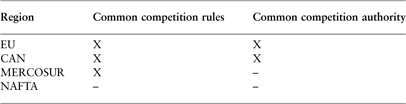
Of the current regional trading arrangements, the EU and the CAN have achieved the highest level of regional harmonization of competition policy with common competition rules and a common competition authority. MERCOSUR has common competition rules but no common authority, and NAFTA provides, at most, a bare framework for the development of co-operative or collective competition policies (see Table 1).
Regional harmonization of competition law and policy in comparison
Most importantly, the review of the current regional trading arrangements has revealed one valuable lesson: common competition policy and rules will become ineffective without the existence of a supranational body to enforce them, or at least the existence of a mandatory dispute resolution mechanism for competition-related provisions.Footnote 108 However, setting up these institutions is by no means an easy task.Footnote 109 For instance, the experience of MERCOSUR has led Oliveira to believe that one should not have common regional rules during the initial stages. Such rules should only be in place after: (1) MERCOSUR becomes a common market with supranational authority; (2) national competition policies and laws are enacted and harmonized; and (3) the delimitation of national jurisdictions with respect to regional jurisdiction is clearly defined.Footnote 110 Similarly, after a review of competition policy chapters in major preferential trade agreements, Sokol also found that “the number of agreements that have dispute settlement, particularly for ‘pure’ antitrust related provisions, is non-existent … In effect, the lack of dispute settlement has created soft law within the guise of a hard law agreement”,Footnote 111 in other words, “[s]ymbolism may be the appropriate explanation for the power of PTA competition policy chapters”.Footnote 112 Such a lesson will be valuable to ASEAN on their road of regional competition policy harmonization.
III. The ASEAN Approach
A. The Development of the ASEAN Regional Guidelines on Competition Policy
The rationale behind the harmonization of competition law and policy in ASEAN is similar to that of most regional trade areas, namely to promote regional economic integration. As Thanadsillapakul puts it:
While investment liberalization within ASEAN can help encourage the free entry of firms and to enhance the contestability of the ASEAN market, it is not enough: competition laws are needed to ensure that the former statutory obstacles to contestability are not replaced by anti-competitive business practices, thus negating the benefits that might arise from liberalization.Footnote 113
Moreover, harmonization of competition law and policy within ASEAN is expected to avoid enforcement conflicts among competition authoritiesFootnote 114 and to provide for more foreign investment and consumer welfare in the region.Footnote 115
In response to the endorsement of the recommendation on the establishment of the ASEAN Experts Group on Competition (AEGC) at the Thirty-Ninth ASEAN Economic Ministers Meeting in August 2007, the AEGC was established,Footnote 116 and its first meeting was held in Singapore in 2008. This is an official body comprising representatives from the competition authorities and agencies responsible for competition policy in the Member States.Footnote 117 Recently, in an effort to help lagging countries catch up with more developed nations in the region, the AEGC has launched two new publications: the ASEAN Regional Guidelines on Competition Policy Footnote 118 and the Handbook on Competition Policy and Law in ASEAN for Business.Footnote 119
The Regional Guidelines are based on country experiences and international best practices “with the view to creating a fair competition environment in ASEAN. It seeks to enhance and expedite the development of national competition policy within each ASEAN Member State.”Footnote 120 In contrast to the approaches of the EU, NAFTA, CAN, and MERCOSUR, the ASEAN Regional Guidelines is not intended to be a full or binding statement on competition policy.Footnote 121 They only serve as a general framework guide for the Members by setting out different policy and institutional options for Members to create a fair competition policy. In other words, ASEAN has chosen a “soft law” approach instead of a “hard law” one.Footnote 122 Further, the Guidelines will be a “living” reference as the AEGC will update them within the next five years to reflect any changes and developments in ASEAN and in international best practices.Footnote 123
B. Highlights of the Substantive Provisions of the ASEAN Regional Guidelines on Competition Policy
1. Trade is the overriding principle
Article 2.2.4 states that “competition policy complements trade policy”, and that “effective competition policy can also increase investor confidence and prevent the benefits of trade from being lost through anti-competitive practices”.Footnote 124 This approach is consistent with those of the EU and NAFTA.Footnote 125 Moreover, Article 10.1.1 emphasized again that
the overarching or long term objectives of a cooperative competition policy arrangement for the Members are the promotion of market integration in the lead up to the establishment of a common market in 2015, and the promotion of economic efficiency and growth at a regional level.Footnote 126
2. Goals of competition policy
The Guidelines emphasized the three main goals of competition policy, including economic efficiency, economic growth and development, and consumer welfare.Footnote 127 Further, the Guidelines pointed out that competition policy is beneficial to developing countries. Due to the worldwide deregulation, privatization, and liberalization of markets, developing countries need a competition policy in order to monitor and control the growing role of the private sector in the economy, and to ensure that public monopolies are not simply replaced by private monopolies.Footnote 128
3. Adoption of nationwide competition law and policy
The Guidelines call for clear and effective legislation in all MembersFootnote 129 and suggest a framework of competition policy with three standard heads of prohibition, namely prohibitions of anti-competitive agreements,Footnote 130 abuse of a dominant position,Footnote 131 and anti-competitive mergers.Footnote 132 The Guidelines have gone as far as to explicitly define, categorize, and give examples for each particular type of anti-competitive practice. Further, similar to the EU's and MERCOSUR's approaches, the Guidelines propose a “rule of reason” analysis (except for hard-core restrictions, which may be treated as per se illegal). Members could consider applying administrative, civil, and criminal sanctions to anti-competitive practices.Footnote 133
It is also suggested that competition policy should be an instrument of general application, and apply to all economic sectors and businesses engaged in commercial economic activities, including state-owned enterprises.Footnote 134 However, Members may exempt the government, statutory bodies, or any person acting on their behalf insofar as the government activities are connected with the exercise of sovereign power.Footnote 135
4. Balancing national competition policy with other policies and special attention to the needs of small and medium-sized enterprises (SMEs)
Members may have exemptions or exclusions aimed at specific industries or activities, and the key rationale for such exemptions or exclusions includes strategic and national interest, security, and public, economic, and/or social considerations.Footnote 136 The Guidelines also recognize the potential need of Members to grant exemptions from national competition policy to certain industries which are highly regulated (e.g. banking, insurance, energy, etc.), where such industries are subject to sectoral regulations.Footnote 137 Members may also exempt small and medium-sized enterprises (SMEs) from the application of competition law, in order to enhance their competitiveness in the market and to improve their market opportunities when competing against large companies.Footnote 138
5. Building an independent competition regulatory body
The Guidelines suggest that the Member State's competition regulatory body should be equipped with the necessary resources and legal powers to carry out their responsibilities,Footnote 139 and that Members grant the competition regulatory body as much administrative independence as necessary and as possible, in order to avoid political influence.Footnote 140
To ensure the independence of the competition regulatory body, Members may appoint independent commission members to be in charge of the competition regulatory body with a fixed term of reasonable duration without the possibility of being dismissed. Also, the determination of the budget of the competition regulatory body should be free from political considerations. One method is to separate the competition regulatory body's budget from that of other governmental functions and make it transparent to the public.Footnote 141
6. Non-discrimination, due process, and transparency
The Guidelines require that businesses engaged in the same line or similar lines of activity should be subject to the same set of legal principles and standards to ensure fairness, equality, transparency, consistency, and non-discriminatory treatment under the law,Footnote 142 and that the confidentiality of commercially sensitive information and details of an individual's private affairs should be protected.Footnote 143
The Guidelines particularly emphasize the importance of due process and devote a whole chapter to this issue (Chapter 7).Footnote 144 What is noteworthy is the suggestion that Members should recognize the role of the judiciary in the enforcement of competition law, including both direct access to the judicial authority and the review of administrative decisions.Footnote 145
7. Technical assistance and capacity building
The Guidelines suggest some issues that Members could consider in technical assistance and capacity-building programmes, including: (1) improving the capacity to advocate the benefits of competition policy before government officers and the general public, and to foster a culture of competition; (2) building technical (legal and economic) skills necessary for the establishment and implementation of national competition policy; (3) developing a sound institutional framework and due process for the competition regulatory body; and (4) improving the competition regulatory body's capacity to educate the public about the objectives and scope of competition policy.Footnote 146
8. Regional co-operation
The Guidelines require Members to endeavour to develop a regional platform, or understanding, or arrangement, or otherwise build on the AEGC to facilitate co-operation between competition regulatory bodies.Footnote 147 Such a regional platform will allow competition regulatory bodies to exchange their experiences, identify best practices, and endeavour to implement co-operative competition policy and competition regulatory body arrangements that provide for harmonization.Footnote 148 In the framework of this platform, working groups may be created to discuss general or specific issues related to the establishment and enforcement of competition policy.Footnote 149 However, the regional platform shall not exercise any rule-making function, and no voting rules should be in place within the working groups, as the co-operation is based on consensus-building.Footnote 150 Even when the platform reaches consensus on recommendations or “best practices”, each competition regulatory body may decide whether and how to implement the recommendations through unilateral, bilateral, or multilateral arrangements, where appropriate.Footnote 151
IV. The Rationale for ASEAN'S Approach
As mentioned in Section III, in contrast to the approaches of other trade regions, ASEAN has not adopted a binding agreement on competition law and policy; instead, it has chosen the so-called “soft law” approach. This approach can be explained by the fact that ASEAN is still constrained by several factors, including the traditional “ASEAN Way”, the diversity in its member countries’ economic conditions and competition regimes, and the current level of ASEAN's regional economic integration.
A. The “ASEAN Way”
The preference for “soft” arrangements in harmonizing competition policy within ASEAN exemplifies ASEAN's traditional mode of dispute resolution, often termed as the “ASEAN Way”, which includes decision-making by consensus, non-interference in each state's domestic affairs, and recourse to informal, non-binding agreements. This “ASEAN Way” is “in contrast to the formal legalism of most Western international institutions”.Footnote 152 The ASEAN Way has been placed on a formal footing in Article 2(2) of the ASEAN Charter, which provides that the principles of ASEAN co-operation include “reliance on peaceful settlement of disputes”, “non-interference in the internal affairs of ASEAN Member States”, and “enhanced consultations on matters seriously affecting the common interest of ASEAN”.Footnote 153
The ASEAN Way is based in history and culture, as explained by the former ASEAN Secretary-General Ong Keng Yong: “ASEAN founding fathers wanted ASEAN to be an organization with minimal legal institutionalization because to them, ASEAN was first and foremost a diplomatic instrument for confidence-building in a time when member countries’ common concern was containing communist China.”Footnote 154
Thus, ASEAN countries have relied to a large extent on the personal approach, in contrast to the Western way of dependence on structures and their functions,Footnote 155 and this “ASEAN Way” has constrained the pace of institution-building and decision-making in the region.Footnote 156 In this context, it is not surprising that ASEAN countries have preferred a non-binding set of regional guidelines on competition policy to a binding agreement.
It is noteworthy, however, that there have recently been various calls for replacing the traditional “ASEAN Way” with a more legalized system. One important reason for legalization within ASEAN is economic integration and the desire to attract foreign investment.Footnote 157 Legalization has become even more urgent since ASEAN is aiming at building “a single market” and “the currently weak legalization in the ASEAN is perhaps an unusual basis for a regional integration project”.Footnote 158 Another reason for replacing the traditional “ASEAN Way” with a legalized approach comes from the need for market regulation. H.E. Rodolfo C. Severino, Jr., a former ASEAN Secretary-General, has pointed out that the financial crisis in 1997 had convinced East Asian countries that they must move away from a “relationship-based” way of doing business and creating wealth to one that is more “rules-based” and market driven.Footnote 159 This is once again true in the context of the current global economic crisis where there have been calls for better regulation of the market.Footnote 160
In fact, a new trend of legalization has recently emerged in ASEAN and “ASEAN has evolved from a loose organization based on the ASEAN Way to a more legalistic framework based on rules and a dispute settlement mechanism”.Footnote 161 This development has continued with the new ASEAN CharterFootnote 162 and has also been reflected in the AEC Blueprint which states that “[i]n establishing the AEC, ASEAN shall act in accordance to the principles of an open, outward-looking, inclusive, and market-driven economy consistent with multilateral rules as well as adherence to rules-based systems for effective compliance and implementation of economic commitments”.Footnote 163 Obviously, ASEAN countries will have to make more effort in order for this aspiration to be realized in the future. Over time, as ASEAN moves toward further legalization, the “ASEAN Way” will no longer be a constraint in adopting a binding agreement on competition policy in the region.
B. The Diversity in Economic Conditions and Competition Regimes among ASEAN Countries
The ASEAN countries have widely diversified levels of economic conditions. Singapore is regarded as a developed economy, with Indonesia, Malaysia, and Thailand somewhere in the middle, and Cambodia, Laos, Myanmar, and Vietnam (CLMV) being less developed economies. Such diversity in economic conditions makes a “hard law” approach less desirable because “hard” law is less flexible than “soft” law in reacting to different circumstances and levels of development, and an international binding set of rules might impose standards that do not fit within the particular context of the individual country's legal and economic traditions.Footnote 164 This is extremely important in the area of competition law and policy, which are often regarded as part of the broader economic development policy of each state. As Wood has explained, the reason why individual nations have, thus far, insisted on autonomy over their competition law policy rests on the complex interrelationship between competition law and other national economic goals.Footnote 165
In fact, the scope of competition policy has always been a political decision and no country considers competition as a national goal for its own sake. Rather, competition policy tends to be regarded as simply part of a more general industrial policy regime.Footnote 166 Through a combination of administrative discretion and an ability to carve out explicit exceptions to competition laws, nations have, to a greater or lesser degree, subordinated free-market principles to other elements of national self-interest.Footnote 167 Thus, Singapore provides their liner shipping industry with a block exemption from the prohibition on anti-competitive agreements on the grounds that the block exemption brings about substantial benefits for local shippers and the Singapore economy. Similarly, Vietnam's competition law is applicable, in theory, to all sectors and industries, but in practice Vietnamese competition authorities may take a more lenient view of state-owned enterprises (SOEs) since it is a “socialist market economy” in which SOEs are expected to play a leading role. In this context, it will be hard to convince all ASEAN countries to enter a binding agreement on competition policy that might prevent them from implementing their own industrial policies.
Thanadsillapakul has argued that of the three options for the regional harmonization of competition law based on competition rules,Footnote 168 the harmonized law model is the most feasible for ASEAN because of the diversity of the economic structures, economic history, legal systems, societal goals, and cultures, as well as differences in national socioeconomic infrastructure in the Member States.Footnote 169 Further, in such a harmonization process, “ASEAN may need to tolerate some national differences to continue to exist until the individual economies are more evenly developed”.Footnote 170 Commentators have already pointed out that while the competition rules of most countries governing cartels and merger reviews have seen substantial convergence, a certain degree of divergence persists among the laws of many jurisdictions with regards to the unilateral conduct of firms with a market-dominant position.Footnote 171 Many of these differences reflect differences in economic circumstances, cultural values, and legal traditions, and should not be expected to be abandoned for the sake of convergence alone.Footnote 172 In other words, harmonization of national competition law rules is neither politically feasible nor necessarily desirable.Footnote 173
Another reason why a “soft law” approach is more desirable is that a binding commitment on competition law and policy may be too costly for participating parties.Footnote 174 The outstanding feature of competition law is that it involves not only legal science but economics. Thus, substantive rules of competition law and policy need to keep changing to adapt to changes in economic theories. Heyer has explained that competition law and policy operate within a world of uncertainty, since they rely heavily on economic theories and “even economic theory does not have all the answers and probably never will”.Footnote 175 For instance, in the past, the US had condemned vertical agreements according to the per se rule, but subsequently, when more empirical evidence showed that most vertical agreements are efficient, such agreements have become subject to a rule of reason scrutiny. Therefore, Tarullo has argued that “because competition policy should and does change with new market conditions and new economics learning, it would be unwise to specify antitrust rules too precisely”.Footnote 176 Similarly, Melamed opined that:
It would be a serious mistake to cast in concrete broad notions about international antitrust policy that may well be shown to be wrong, impractical, or outdated in a few years. Instead, we should endeavor to make progress on case-specific cooperation and to resist the temptation to codify principles that may well be either too vague to be useful or, if precise, unsuited to the disparate interests involved and unlikely to pass the test of time and experience.Footnote 177
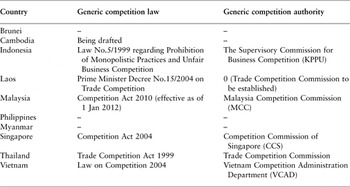
Further, so far, only six ASEAN countries have had effective economy-wide competition laws and policies (Indonesia, Malaysia, Laos, Singapore, Vietnam, and Thailand), with five countries having a generic competition authority (see Table 2). Of these six countries, even though their competition laws are similar in broad principles, there are still differences in terms of approaches and styles.Footnote 178 For example, while Singapore excludes all vertical agreementsFootnote 179 from its competition law on the ground that most vertical agreements are pro-competitive and efficient, other ASEAN countries, such as Thailand, Malaysia, Laos, and Indonesia subject these agreements to competition law scrutiny on the ground that certain vertical agreements may be anti-competitive and thus harmful. The objectives of competition law also vary among ASEAN Member Countries from promoting economic efficiency and consumer welfare (which is the case for most ASEAN jurisdictions), to promoting “fair competition” (in Laos, Indonesia, and Thailand), and the “protection of State's interests and public interest” (in Vietnam). Excessive pricingFootnote 180 is condemned in Vietnam, Thailand, and Malaysia, but not in Indonesia, Singapore, and Laos. Also, Thailand, Singapore, Malaysia, and Vietnam do not prohibit a firm from becoming dominant in the market but only prohibits the abuse of a dominant position, but Indonesia and Laos prohibit firms from conducting activities that could lead to them controlling the market. As Wood puts it, “[i]f one jurisdiction bans something and another thinks it represents good hard competition, agreement will be difficult”.Footnote 181 Nevertheless, these factors should not unduly constrain the development of a common ASEAN competition policy since the regional integration experience has demonstrated that “international agreements on antitrust are feasible, even between countries with initially quite different domestic antitrust policies (or no such policies at all)”,Footnote 182 with the EU as the most obvious example.Footnote 183 Yet it is still a real challenge for ASEAN countries to reach agreement on a common set of substantive rules.
The current competition regimes in ASEAN countries

source: McEwin and Anandarajah, supra note 178.
Interestingly, ASEAN is not the only example of diversified legal regimes. Divergence of competition law exists even among developed countries, especially the rules on unilateral conduct of firms with a dominant market position. The oft-cited example is the difference in the approaches of the US and the EU, the two most influential competition jurisdictions in the world.Footnote 184 On this divergence, Fox has explained that “[t]he laws of the industrialized countries have already converged to the extent that convergence is congenial to all involved. The margin that remains reflects significant contextual differences. The divergences that do remain are predictably the most resistant to harmonization.”Footnote 185
C. ASEAN's Current Integration Level
The lesson learnt from the review of other regional harmonization regimes (in Section II) is that a binding set of common competition law and policy will not be effective without a supranational body to enforce them, or at least a mechanism for dispute resolution.Footnote 186 The difficulty with anti-trust rules is that they are drafted in broad terms, and thus leave a great deal of discretionary power to the enforcing authorities.Footnote 187 As mentioned above, competition law and policy rely on vigorous economic analysis, the inevitable result of which is that the same set of facts may result in different (or even conflicting) decisions in different countries, because of the difference in the market conditions, analytical tools, and methods used by the respective competition authorities in these countries. This leads to different views on the impact of a conduct/transaction on the market (e.g. a merger may be considered harmless to one market but harmful to another). Thus, there will still be divergent interpretations of the commonly agreed rules, unless the case-law is harmonized through appeals lodged before a centralized anti-trust court.Footnote 188
In the context of ASEAN, since ASEAN is not yet a supranational organization, there is no regional institution, or court, or any other mechanism to enforce or resolve potential disputes related to common competition rules. As affirmed by the ASEAN Charter, ASEAN is an intergovernmental (rather than supranational) organization, founded on the principles of equal sovereignty of all Member States, and non-interference in Members’ internal affairs.Footnote 189 As Ewing-Chow has commented, “[w]hile the ASEAN Charter does take the important step of conferring legal personality to ASEAN, it does not sufficiently address the legally important elements of rule making, monitoring and enforcement for ASEAN”.Footnote 190 Although the ASEAN Charter envisages a committee of Permanent Representatives based in Jakarta, which will be appointed to ASEAN with the rank of Ambassador, such a committee will not be the primary decision-making body. Instead, the ASEAN Summit will continue to be the main forum for decision-making and decisions at all levels will continue to be made by consultation and consensus.Footnote 191 In other words, at present, ASEAN is still, at best, only a free-trade area, and not a custom union,Footnote 192 and “[w]hile the aims for the ASEAN Community and the Charter are now in place, there is as yet no clear and agreed road map for bringing the ASEAN members together in a regional constitution”.Footnote 193
In such a context where no supranational body or dispute resolution mechanism is established in the region, adopting a binding agreement on competition policy will be unfeasible. Even if ASEAN countries can agree on a common set of rules, the interpretation and application of these rules may still vary among the countries. Thus, ASEAN's “soft law” approach can be regarded as an appropriate step, taking into account the current stage of ASEAN integration. Of course, as ASEAN moves towards further integration, we can expect an expanded number of binding undertakings.Footnote 194 As the level of integration grows, the binding character of liberalizing agreements becomes more important, and as the levels of legal obligation and the precision of the rules increase, delegation of rule interpretation and dispute adjudication is often observed.Footnote 195 Yet, until then, the current “soft law” approach taken by ASEAN towards the harmonization of competition law and policy is more desirable.
V. Conclusion
The ASEAN Regional Guidelines on Competition Policy is a pioneering attempt to achieve the stated goal of transforming ASEAN into a highly competitive economic region, and the introduction of nationwide competition policy and law in all ASEAN members by 2015.Footnote 196 The Guidelines address all key issues relating to competition law and policy and provide specific suggestions tailored to the different economic situations of the respective ASEAN countries. Yet, in contrast to the “hard law” approaches of the EU, NAFTA, MERCOSUR, and CAN, ASEAN has opted for a “soft law” approach, with the Guidelines serving only as a reference guide for ASEAN countries in their efforts to create a fair competition policy. Although this step taken by ASEAN seems very modest as compared to the extent of harmonization of competition policy achieved in other trade blocs, especially the EU, ASEAN's approach in this area can be explained by the fact that, unlike other regions, ASEAN is constrained by the traditional “ASEAN Way”, which includes decision-making by consensus, non-interference in each state's domestic affairs, and recourse to informal, non-binding agreements. Further, ASEAN is constrained by the diversity in economic conditions and competition regimes among its members, which makes a regional agreement on competition law and policy difficult and costly. Last but not least, at present ASEAN is still at a low level of integration with neither a supranational body nor a compulsory dispute resolution mechanism, which are considered, from the experiences of other regional arrangements, to be essential elements for the effectiveness of binding arrangements on competition law and policy.
Despite their non-binding characteristics, the ASEAN Regional Guidelines on Competition Policy should still be warmly welcomed because they assist the development of competition policy in the region. First, they will help increase ASEAN members’ awareness of the importance of having proper competition law and policy to achieve economic growth and development, and will help promote their domestic reforms,Footnote 197 which is extremely important for those countries which have not yet introduced a nationwide competition law and policy. Second, it helps stimulate the development of best practices and enhances co-operation in this field within the region. It is hoped that through this networking and co-operation process, ASEAN countries will develop a common understanding of competition law and policy and solve cross-border competition problems that arise in the region efficiently. Over time, when ASEAN countries can overcome the current constraints and develop common ground for competition law and policy, we can expect more legalization in this area in the future.