In art historical scholarship, the concept of “living painting” (ἔμψυχος γραφὴ) in the work of Michael Psellos has drawn attention to the implications of artistic representation as a form of indwelling or divine inspiration. At times, the term's usage has been signalled as unique to Psellos’ thinking about the icon. However, the goal of the present article is to survey a wide range of sources that use empsychos and related words to conceptualize strategies of representation. By looking at this and other terms’ handling by writers thinking about visual art, liturgy, theology, literature, and performance, the aim is to give readers a better sense of the variety and cohesion of this line of thought. The article by no means presents a comprehensive survey, but instead each section presents a microhistory of these terms in artistic, liturgical, and literary theory in the Middle Byzantine world. These three threads nuance our understanding of terms such as empsychos, typos, and entheos, by engaging their ancient and late-antique precedents in order to contextualize how learned authors, such as Psellos, would have understood the usage of these terms within secular and religious milieus, both Pagan and Christian. This article deliberately brings together an eclectic range of textual and visual evidence in order to show the consistency, continuation, and cohesion of this thinking. Moreover, the conclusion demonstrates how these ideas come together in art to produce layered and complex images of the way in which divine and artistic representation intertwine.
Looking at the shared intellectual history of inspiration and indwelling in theories of representation, one can observe that, since the ancient world, the arts were seen as the by-products of acts of divine possession in their making and reception. Going back to Plato's Ion, we can observe a longstanding trajectory by which terms related to the inhabitation of the divine in earthly matter defined the production of artistic works, with the Muses being one example of this divine intervention. This inspiration moved the hand of the poet, the voice of the performer, and the brush of the painter. Nevertheless, the acts of seeing, spectating, and reading equally partook in this process, as audiences gave voice to texts, imagined the stories depicted, and invested themselves in worship.
Throughout the sources that I have surveyed from antiquity to the Middle Byzantine period, a plurality of interrelated terms exist that articulate the process of artistic representation as an event occurring within a medium, whether that medium be a reader, reciter, manuscript, or body. Terms such as ἔνθɛος (divinely-inspired), ἔμψυχος (ensouled), ἔμπνους (breathing), ἔνυλος (material), ἔνσαρκος (incarnate), or ἔνοικος (indwelling) articulate the crucial terms of inspiration, life, and incarnation through the utilization of the prefix ἐν-/ἐμ- from the preposition ἐν (in). Here, the prefix does double-duty, suggesting both that an exterior condition or entity such as breath (ἔμ-πνους) or God (ἔν-θɛος) dwells within a person or thing, and also the inverse, whereby a certain condition or entity, particularly the divinity, takes on material form such as flesh (ἔν-σαρκος) or matter (ἔν-υλος). By suggesting an indwelling rather than a transformation, these terms allow for the divine quality to co-exist as one with the material quality and to thus retain a dual nature, being simultaneously fully-material and fully-spirited. Not only does this rhetoric figure prominently in the justifications of John of Damascus and Theodore the Studite for the icon,Footnote 1 but this logic permeated throughout the various arts. In modern Orthodoxy, the intersection of divine inspiration and artistic production appears in the thinking of key theologians, such as Pavel Florensky and Paul Evdokimov.Footnote 2 While these ideas stretch back to ancient philosophy, they found prominence in their applicability to Christological doctrine. Therefore, they were an apt language to describe Christian forms of representation.
Art: painting, perception, and ensoulment
The concept of empsychos graphe is given its most eloquent articulation in Michael Psellos’ Ekphrasis on the Crucifixion, a careful description of the act of viewing an icon of the Crucifixion, which appears at the end of a longer narrative on the Crucifixion itself. Addressing modern spectators of the Crucifixion, Psellos’ text compels the audience to become witnesses to events being depicted in visual art and literature.
Focusing on Psellos’ Ekphrasis, a variety of scholars have contributed to the articulation of empsychos graphe, perhaps most notably Hans Belting, Robin Cormack, Charles Barber, Bissera Pentcheva, Glenn Peers, and Paroma Chatterjee.Footnote 3 The key trope inherent in Psellos’ ekphrasis, however, is that while representation is extolled for its vividness and clarity, these qualities affirm that art and rhetoric can only represent, but they cannot offer a real presence or life. As Psellos writes in a critical section of the text:
While this living painting (ἔμψυχος… γραφή) exists as a result of component parts combined most felicitously, the entire living form seems to be beyond this, so that life exists in the image from two sources, from art (τέχνην) which makes a likeness and from grace (χάριν) which does not liken to anything else. Is this then a comparison of images and shadows? Yet I would not compare this painting to any other painting, neither those set up by past hands or that represented the archetype accurately, nor those from our own time or from a little before that had made some innovations in form. I declare this picture to be like my Christ in times past… Thus, it seems to me that Christ hangs in the delineated and coloured likeness. And I would not dispute that there is oversight that is beyond the painter's hand and that this overseeing mind had returned that painting to its prototype.Footnote 4
Here, the language of empsychos graphe carries out crucial semantic work in shattering the myth of “living painting” as being a specific type of painting, a claim to mimetic naturalism, or a notion of true presence. While this passage was read by Hans Belting to suggest that Psellos is speaking about a new style of painting, we see here that Psellos is precisely stating that this is not an image regulated by the flows of stylistic difference, but circumvents style, artistry, and skill.Footnote 5 Psellos is reaffirming here the limits and bounds of representation.
Charles Barber and Bissera Pentcheva represent two important camps regarding our understanding of the term. For Barber, the term suggests a system of representation outside the skill of the artist, whereby the image is motivated through grace in its production and reception; whereas, for Pentcheva, the term suggests the sensual effects of the metal-relief icon and the specificity of its (material) medium as enabling those aesthetic qualities. My contribution in this article comes by virtue of shifting the focus onto the concept's operation, not simply the term's meaning or the objects it could speculatively describe, as is found in Barber and Pentcheva's approaches, respectively. In other words, I am interested in how empsychos graphe works as a mechanism through which artistic representation is made possible. The gamut of terms around ensoulment and indwelling found in the primary sources outline two fundamental tenets: first, that the act of representation is an event akin to a performance or miracle; secondly, that representation always requires an earthly medium in which the divine might be represented.
To think through these problems in a deeper historical context, the questions explored in Psellos’ Ekphrasis are best articulated in Plato's Ion dialogue. There, artists are described as being the medium for representing the divine logos through the event of their inspiration and performance; performance here encompasses both the act of composition and reception. As Plato has Socrates state in the Ion:
For, as I was saying just now, this is not an art in you, whereby you speak well on Homer, but a divine power, which moves you like that in the stone which Euripides named a magnet, but most people call “Heraclea stone.” For this stone not only attracts iron rings, but also imparts to them a power whereby they in turn are able to do the very same thing as the stone, and attract other rings; so that sometimes quite a long chain of bits of iron and rings is formed, suspended one from another; and they all depend for this power upon that one stone. In the same manner, the Muse also inspires (ἐνθέους μὲν ποιɛῖ αὐτή) men herself, and then by means of these inspired persons (ἐνθέων) the inspiration spreads to others (ἐνθουσιαζόντων), and holds them in a connected chain. For all the good epic poets utter all those fine poems not from art (οὐκ ἐκ τέχνης), but as inspired (ἔνθɛοι ὄντɛς) and possessed (κατɛχόμɛνοι), and the good lyric poets likewise… For the poets tell us, I believe, that the songs they bring to us are the sweets they cull from honey-dripping founts in certain gardens and glades of the Muses – like the bees, and winging the air as they do. And what they tell us is true. For a poet is a light and winged and sacred thing, and is unable ever to indict until he has been inspired and put out of his senses, and his mind is no longer in him: every man, whilst he retains possession of that, is powerless to indict a verse or chant an oracle… For not by art do they utter these things, but by divine influence (θɛίᾳ δυνάμɛι); since, if they had fully learnt by art to speak on one type of theme, they would know how to speak on all. And for this reason God takes away the mind of these men and uses them as his ministers, just as he does soothsayers and godly seers, in order that we who hear them may know that it is not they who utter these words of great price, when they are out of their wits, but that it is God Himself who speaks and addresses us through them… For God, as it seems to me, intended him to be a sign to us that we should not waver or doubt that these fine poems are not human or the work of men, but divine and the work of gods; and that the poets are merely the interpreters of the gods, as each is possessed by one of the heavenly powers.Footnote 6
In Plato's metaphor, rhapsodes who travelled, reciting the works of Homer, were merely a link in a long chain of divine inspiration/possession that came down from the gods, through the Muses, onto the poets, and continuously down through lineages of reciters and listeners. As such, the transmission of information occurred through the distribution of textual corpuses and through human apparatuses, such as readers. To articulate this process, Plato uses a series of words that metaphorically articulate the inspiration and possession of bodies (ἔνθɛοι ὄντɛς καὶ κατɛχόμɛνοι) and their own proliferation and dissemination (ἐνθουσιαζόντων) through networks of transmission.
In Psellos’ Ekphrasis, the artist (like the rhapsode) is utterly struck out of his senses and possessed by the logos in order to undertake the act of representation of the divine scene. Crucially, the Ion clarifies that the rhapsode's recitation of epic poetry and even the poet's composition of said work is not an act of art or skill (τέχνη), but instead a result of being divinely-inspired and possessed (ἔνθɛοι ὄντɛς καὶ κατɛχόμɛνοι).Footnote 7 The parallels with Psellos’ Ekphrasis on the Crucifixion are striking. At this point, it is worth noting that the three primary manuscripts of the Ion dialogue (modern sigla T, W, and F) date to around 950, the second-half of the eleventh century, and between 1280 and 1340 respectively, all with known or assumed origins in major scriptoria in Constantinople.Footnote 8 As Consul of Philosophers, Michael Psellos would surely have been intimately familiar with the text of the Ion.Footnote 9
While it would be imprudent to assert a direct connection, it seems that Psellos’ theorization of empsychos graphe is closely informed by Plato's notion that art is a product of divine-possession, betraying a grasp of the Ion’s consequences and implications. However, as I shall show, the model of inspiration set forth by the Ion cannot be reduced merely to Psellos’ erudition. Nevertheless, what the text of the Ion offers us is a way of further articulating the operation of Psellos’ empsychos graphe (and related terms) in a way that productively extends the concept past a theory of the icon specifically, but spans painting, sculpture, rhetoric, and performance (i.e. as in the liturgy or in the recitation of texts). Thus, we might come to understand the function of empsychosis as being a broader mechanism of representation that includes not only visual art, but also performance and recitation from literature to the liturgy.
While gazing upon the icon of the Crucifixion, Psellos reflects upon the image's creation, wishing to focus upon concerns beyond historical style or artistic quality. Psellos observes in particular: “Although this suffering brings Him [Christ] in due course to death, the power that moves the hand of the artist (τὴν τοῦ ζωγράφου κινήσασα χɛῖρα) also animates the body that has breathed its last”.Footnote 10
This power (δύναμις) that animates the object is the grace (χάρις) of God, a function often associated with the Holy Spirit. The operation of divine charis lies outside the skill of artist's hand and, as Psellos points out later in the discourse, its actions may be witnessed even in images produced by the most unskilled artists. Moreover, it is charis that likewise dwells in the icon so as to enact it as an empsychos graphe for its users.
Like the magnetized chains of divine inspiration in the Ion, charis is the critical term in Psellos’ thinking used to characterize the operation of divine inspiration. In the painting itself, charis is both responsible for its generation by the artist and its manifestation to the viewer. As Psellos writes early on in the Ekphrasis, “God inspires (ἐμπνɛῖ) with His grace not only creatures who possess reason but also images that lack life (ἀψύχοις ἰνδάλμασιν).”Footnote 11 Psellos, in the excerpt cited at the beginning of this section, also refers to form as being endowed with the grace of the Holy Spirit, but, as pointed out by Barber, this presence is not inherent in matter. Instead, it emerges from the engagement of the viewer with the image, that “overseeing mind” (ἐπιστατοῦντος νοὸς) which connects the painting with the prototype. As such, the image emerges through the concerted mental disposition of the viewer toward the image through the functions of the visualizing faculties of the imagination.Footnote 12
Bissera Pentcheva, however, sees the action of charis as emerging from the sensual varieties of the image's materials, which literally make the image appear as an animate person. Focusing upon Psellos’ observations on the movement and variations of the image, she suggests that Psellos here is referring to a metal-relief icon that would have literally changed its form and appearance according to the movements and conditions of ambient light. While Pentcheva tries to distance herself from the Neoplatonic understanding of Psellos’ work, one can cut across this debate in order to demonstrate that both Barber and Pentcheva's perspectives engage with the same aspects of Psellos’ understanding of the icon.
In both these interpretations of Psellos, the icon is an event that becomes manifest only as the viewer contemplates it, moved either by the dynamics of the imagination or the lighting conditions and practices of the space. The icon always operates as a potentiality for representation, but it is only through its actualization that it can be said to be an image. Whether that source of activation is Barber's overseeing-mind or Pentcheva's flickering-flame becomes less important if one views this problem as being one regarding the mechanics of representation: that is to say, if one is interested more in the fact that empsychosis is a perceptual process motivated by divine inspiration both in the creation and reception of the icon, just as it was for the inspiration of Homer and the possession of the rhapsode in the Ion.
An important aspect, however, that must be addressed regarding Pentcheva's argument is that this perspective at times allows metaphor to translate into material realities, rather than using metaphor to articulate the conceptual mechanics of representation. Compare Michael Psellos’ text on the Crucifixion icon to the inter-relations of these various terms, for example, in the sixteenth anathema from the iconoclastic Council of 754:
If anyone ventures to set up profitless figures of all the saints in soulless, speechless images (ἐν ɛἰκόσιν ἀψύχοις καὶ ἀναύδοις) made of material colours (ἐξ ὑλικῶν χρωμάτων) – for this is a vain invention and the discovery of diabolical craft – and does not, on the contrary, reproduce their virtues in himself as actually living images (ἐμψύχος ɛἰκόνας), with the aid of what has been recorded about them in books, in order to be stimulated to zeal like theirs, as our inspirited fathers (οἱ ἔνθɛοι) have said, let him be anathema.Footnote 13
Although it is a pro-iconoclastic text from the mid-eighth century, this source does offer us a useful comparison for the terms discussed in this article. Here, the iconoclastic decree argues that the force of ensoulment should lie within the user who takes to the type of the image delineated in the texts of the divinely-inspired (ἔνθɛοι) Evangelists and Church Fathers, rather than diluting this process through an image or, even worse, letting it end with a misguided animistic belief in the image itself. In the sixteenth anathema, one may witness that the debate over the empsychos image is not medium specific, nor is it limited to the eleventh-century, as Hans Belting believed when he read the term iconographically, nor has the term ever been limited to the icon alone, but through various forms of religious and secular representation.
Liturgy: performance, typology, and indwelling
A similar language of empsychosis is pervasive in texts regarding how representation works in liturgical practices as well. In the late eleventh-century, liturgical commentary of the Protheoria,Footnote 14 its authors Nicholas and Theodore of Andida, write, following a reference to the Last Supper:
Therefore, in this way, the blessed ones continue to make remembrance of that man [Jesus], just as both the body remembers through the Divine Symbols and suitably performs what is due, intelligible and living (ἔννουν καὶ ἔμψυχος), by the leavening thrown into the mixture [of the Eucharistic bread], and according to the fulfilling essence being of the divinity.Footnote 15
Here, the justification against unleavened bread (coming in the wake of the Great Schism and the debates with the Latin Church over the azymes controversy) is articulated through the same language of indwelling deployed for divine inspiration. Unleavened bread had been associated by the Greeks with the Latin heresies, and especially with the Monophysite liturgy of the Armenians, and thus often associated with the single-nature heresy.Footnote 16 The unleavened bread (ἄζυμα) was understood as being lifeless and was described as soulless (ἄψυχος), whereas the leavened bread was properly living and ensouled (ἔμψυχος). Thus, the latter was capable of manifesting the wholly divine and wholly human nature of Christ according to orthodox Chalcedonian Christology.
In a related liturgical commentary in verse from the twelfth- or thirteenth-centuries, derived from the Protheoria and formerly attributed to Michael Psellos, the anonymous author writes, at the moment of the consecration of the Eucharistic gifts, that through the action of the Prayer of the Anaphora and the epiclesis, “the things that were concealed before, now have been revealed through the in-dwelling (διὰ τῆς ἐνδημήσɛως) of the God-man Logos.”Footnote 17 The prayer of the epiclesis in the Divine Liturgy precisely calls for the descent and visitation of the Holy Spirit upon the bread and wine so as to transform them into the veritable body and blood of Christ. Hence, contemporaneous writings on the liturgy acknowledge, support, and deploy these terms in order to construct a liturgical model of representation, whereby the divinely intelligible forms became perceptible to humanity through their indwelling in the material world.
Unlike the Incarnation itself, however, the manifestation of typoi through images, rhetoric, or liturgical performance do not simply occur through pure, unadulterated indwelling of divine presence or transformation, except of course for the Eucharist. In art and rhetoric, there is not a full transformation of earthly matter into that of the archetypes they seek to represent, but they still become perceptible through the manifestation of those prototypes as “completed” (τɛλɛυταῖος) or “fulfilled” (πλήρης) typoi, such as when the reader recites the divinely-inspired Gospels from a lectionary or a painter depicts the image of Christ through earthly colours. Nevertheless, those qualities were revealed by the icon through the material form's “relative participation” in the divine, as Theodore the Studite describes it.
As the liturgical poem states, in another instance, after the Creed, the “angel crying, ‘Let us stand well, and with fear,” represents (ɛἰκονίζɛι) the Divine Resurrection, [as the angel] proclaims the Anastasis through the deacon.”Footnote 18 The intermediary action of the deacon as an instrument distinguishes this process from actual presence. Images, rhetoric, and performance can represent typologies that direct their audiences toward the divine archetypes, even if they cannot represent them. Hence, the priest leading the Divine Liturgy, for example, is described as a “typos similar to” (ἰσότυπος) Christ: that is to say, his function and performance take to the image of Christ as a likeable type, but not an actual image of Christ.Footnote 19
In order to properly conduct the Divine Liturgy and undertake the Eucharistic rite to its completion, the author delineates the following process:
In this outline, one can observe the process whereby the officiant must first become wholly human (i.e. primed for the task), and then fulfil the discourse of the liturgy in accordance with its written text. This is later echoed in the poem in which a parallel is structured through the metaphor of a house, whereby first “it is necessary to harmoniously lay down the foundation” (τὸν θɛμέλιον ποιɛῖν ἐναρμοζόντος), then a house for God must be built upon that foundation, after which all earthly things must be set aside, and then finally the Holy Gifts and the liturgy may be undertaken to completion.Footnote 21 Hence, the body of the celebrant is not to be avoided or purged, but rather nurtured as the medium through which the divine becomes temporarily perceptible.
The importance of this language of inspiration, representation, and possession in liturgical texts draws our attention prominently to the intertwined aspects of performance, recitation, reading, and writing around the literary arts. As a performance and re-enactment of both liturgical and Biblical texts, the Divine Liturgy has made us aware of the importance that an underlying mechanism for divine inspiration and possession plays in thinking about the act of reading and its oral recitation. Notably, however, these ideas were by no means limited in the Middle Byzantine world to religious texts or recitations. In fact, this approach to thinking about textual performance as a form of spiritual possession has been associated with acts of both reading and writing since the ancient world. This emphasis of the body as being a medium is critical in literary performance and recitation practices from antiquity through to Byzantium, and thus merits further attention in the subsequent section.
Literature: writing, reading, and divine inspiration
Perhaps one of the most eloquent contemplations on these matters comes from Jesper Svenbro's textual anthropology of reading in antiquity where he considers in depth the manner in which writing, reading, and recitation operated as forms of spiritual possession. Focusing on the Ancient Greek world, Svenbro articulates a model of recitation that engages with the process as an almost violent practice of bodily possession, whereby the agency of the reader's soul (ψυχή) is suspended and the text temporarily takes hold of them as an inspirited instrument (ὄργανον ἔμψυκον).Footnote 22 Reading was, in the Ancient Greek world, as in the Byzantine world, primarily an oral and aural act on the part of the reader and their audience. The body of the reader served as an apparatus or medium. I define medium throughout here as being any intermediary site – whether it be performance, painting, text, speech, or so forth – through whose operation the divine is made manifest.
This theorization of recitation resonates with the supernatural description of reading and listening captured by Michael Psellos in his learned encomium for the Monk Ioannes Kroustoulas, who recited the saints’ Lives at Hagia Soros in the Chalkoprateia neighbourhood of Constantinople.Footnote 23 There, Psellos writes:
Such was the charm dripping from his lips, so harmonious was his voice, in such a way he enchanted (κατέθɛλγɛ) his listeners and cast a spell (κατɛκήλɛι) on those willing, that, even if someone… were to receive the tribulations of Odysseus, even such tribulation would fill his entire heart with joy.Footnote 24
Even drawing parallels with the recitation of and listening to Homeric epic, Psellos alludes to a notion of recitation that takes hold of the listener by enchanting and casting a spell over them. Here, it is the willing and consenting listener who gives himself up to be possessed and enchanted by the reader's words, just as the divine took hold of the reader in Plato's Ion. Reading, in other words, is a process of inspiration in which the listener, reader, text, and divine are all caught in a chain of divine possession and inspiration.
These aspects are aptly emphasized by Psellos’ characterization of Kroustoulas as being an “instrument of the Spirit” (πνɛυματικὸν ὄργανον), resonating with Svenbro's observations upon these processes in the ancient world, and furthermore suggesting once again Psellos’ intimate familiarity with the lessons of Plato's Ion. Elsewhere, Michael Psellos even speaks to a letter's hold over its reader, writing, “in what way did it not attract the reader, like a magnet does to iron?”Footnote 25 Extolling the pleasures of receiving a letter and reciting its words, Psellos addresses the reader's possession by the text in what must be an allusion to the Ion's metaphor of the magnet, where divine inspiration moves the rhapsode like “the stone which Euripides named a magnet,” as quoted above.
Similar notions of reading as divine possession are repeatedly articulated in Middle Byzantine texts.Footnote 26 For example, in the Life of Nikephoros of Miletos from around 1000,Footnote 27 Ioannes Sikeliotes spectacularly describes the act of witnessing the holy figure read, stating: “If you heard him read (as those who had heard him attest), you would say that he was snatched away (ἁρπάζɛσθαι); with his soul suspended from the words, and he journeyed towards heaven.”Footnote 28 The act of reading is one akin to “abduction” or “rape” (ἁρπάζɛσθαι), a forceful possession of a person's body. Additionally, earlier, Gregory of Nazianzus even described his reading of Basil the Great as being a transformative experience that caused him to be “transformed and brought into harmony, and to become another from another, being changed by a divine alteration.”Footnote 29 Reading, for Gregory, is a divine transformation (θɛίαν ἀλλοίωσιν), and one that happens precisely through the harmony and rhythm (ῥυθμίζομαι) of reading, understood both melodically and intellectually.
The use of the term entheos across these sources is of particular interest. Usually translated as “divinely-inspired,” the term could be literally rendered (albeit awkwardly) as “engodded” or “possessed” in order to emphasize that this act of inspiration operates through a form of divine in-dwelling. In the second century, Maximus of Tyre even describes Homer's prudent qualities, beginning with his “submission to his inspired nature” (φύσɛι τɛ κɛχρημένος ἐνθɛωτάτῃ).Footnote 30 In Aristotle's Rhetoric, the term appears when Aristotle recounts the appropriate expressions to be used for an emotional or enthused orator. There, he notes that much of this style shares in that of poetry, “for poetry is possessed” (ἔνθɛον γὰρ ἡ ποίησις), meaning that poetry emerges from an inspired and frenzied form of speech. Both these instances demonstrate entheos as being a creative and artistic force. This is akin to our understanding of “inspiration,” but this modern notion lacks the frenzied force alluded to in Aristotle's comparison between an impassioned speaker and poetic tropes.
In its ancient usage, the inspiration described by entheos does not easily translate, given that entheos does not merely connote a sense of possession or inspiriting, but has this clear denotation associated with religious rites and divine frenzy. The followers of Bacchus are described in Sophocles’ Antigone as being “possessed women” (ἐνθέους γυναῖκας),Footnote 31 and the warmongering warrior in Aeschylus’ Seven Against Thebes is the one “possessed by Ares, who raves for battle like a frantic woman” (ἔνθɛος δ’ Ἄρɛι βακχᾶι πρὸς ἀλκήν, θυιὰς ὥς).Footnote 32 Here, the use of the verb βακχᾶι denotes the warrior's rage as being literally a Bacchic frenzy, emphasized by the comparison to a “frantic woman” (θυιὰς), namely a maenad, one of Bacchus’ female followers. Moreover, in Euripides’ Hippolytus, the chorus asks, “Are you possessed, girl?” (σὺ γὰρ ἔνθɛος, ὦ κούρα),Footnote 33 then proceeding to speculate upon the various gods under whose influence she might be. Once again, the term denotes a literal loss of human control and possession by a divine power.Footnote 34
This language was particularly important for the Church Fathers to articulate orthodox Christological doctrines and distinguish them from their heretical adversaries. In his First Letter to Kledonios, Gregory of Nazianzus positions himself against Apollinarius by emphasizing the place of the Theotokos as the site in which (ἐν αὐτῇ) Christ was formed, lest the Theotokos be understood as merely a channel through which (διὰ σωλῆνος) Christ passed unchanged.Footnote 35 Through the juxtaposition of the prepositions διὰ (through) and ἐν (in), Gregory carefully distinguishes between orthodox and heretical Christologies. The use of these constructions in the key texts on pre-iconoclastic Christology and post-iconoclastic image theory articulates the representation of the icon as a process of containment or indwelling, whereby the image occurs as an actualization of the prototype within an earthly and material substrate.
The term entheos similarly came to the foreground around the Christological debates and Apollinarius’ use of the word to claim that there was nothing inherently divine in Christ's own nature, but rather that he was merely an “inspired man,” an anthropos entheos, claims refuted by Gregory of Nyssa's Antirrheticus against Apollinarius.Footnote 36 Although the term entheos continues to be used in this text to describe the divinely-inspired scriptures, the problem of its applicability to Christ is what is fundamentally at stake in this article: namely, that entheos presupposes a material, earthly medium in which God indwells and that he possesses, but it does not allow for the union of divine and human natures requisite for the incarnation – in other words, to be divinely inspired is not the same as the divinity becoming incarnate. Thus, entheos is a specifically human and material experience of the divine. It is overpowering in its ability to take control of a person and strike them out of themselves, but it does not divinize or transform the person that it inhabits.
As we have seen, in ancient literature entheos explicitly indicates a frenzied possession intertwined with religious performances. However, in this context, connections are also drawn to artistry and rhetoric, particularly regarding actions that exceed human craftsmanship, skill, and art, just as empsychos graphe operated for Psellos. In Aeschylus’ Eumenides, praising the oracular oratory of Apollo and his oracles, he writes that “Zeus made his mind possessed with the art” (τέχνης δέ νιν Zɛὺς ἔνθɛον κτίσας φρένα).Footnote 37 Here, the divinely-inspired art (τέχνης) is an indication of prophetic abilities, as in Agamemnon where Aeschylus’ chorus asks Cassandra, “Were you already overcome by the divinely-inspired art?” (ἤδη τέχναισιν ἐνθέοις ἡιρημένη;).Footnote 38 These uses of the term endure well into late-antiquity given that the application of entheos to describe the Psalms, together with both the Old and New Testaments more generally, speaks to the term's associations not only with divinely-inspired texts, but also those that are prophetic in nature.Footnote 39
As such, the term in Byzantium is often used to describe sacred texts as well, their material embodiments, and holy figures, such as the Evangelists or Church Fathers.Footnote 40 This language was crucial to the understanding of early Christian asceticism, whereby the Holy Spirit dwells or indwells in the soul of the ascetic. In the Pseudo-Macarian writings, emerging around the Messalian controversy of the fourth to fifth centuries, the language of “dwelling” (οἰκέω) and “indwelling” (ἐνοικέω) is used in Greek, together with ‘mar in Syriac, to denote both the indwelling of the Spirit as well as of sin.Footnote 41 Columba Stewart has articulated the careful nuances of these metaphors, particularly how the “indwelling sin” (ἡ ἐνοικοῦσα ἁμαρτία) is metaphorically described as dwelling in the home of the spirit like a thief.Footnote 42 Not all early Christian writers were comfortable with the understanding of sin as partaking of the same dynamic of indwelling given the language's positive associations with the fulfillment and completion of the ascetic soul.Footnote 43 Thus, following Biblical precedent, many of them emphasized instead the action of the indwelling of the Spirit in the soul, including Clement of Alexandria, Cyril of Alexandria, Basil the Great, Gregory of Nyssa, Evagrius, and Mark the Monk.Footnote 44
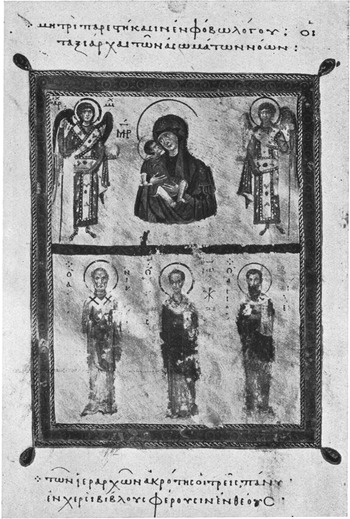
Focusing upon word-image relations in material culture, one can observe that the entheos often appears in conjunction with miniatures and epigrams associated with Biblical texts, as in the epigram surrounding one of the opening miniatures in the eleventh-century Berlin Psalter (Berlin, Berlin University's Christian Museum, 3807, fol. 2v; now at the State Hermitage Museum in Moscow) [Fig. 1].Footnote 45 In the top register of this miniature, the Virgin and Child are depicted flanked by the archangels Michael and Gabriel. Below them, in the bottom register, Saints Nicholas, John Chrysostom, and Basil are depicted bearing their sacred codices. Immediately below this scene, the inscription reads: “The foremost of the prelates, all three of them, holding the inspired books in their hands (τῶν ἱɛραρχῶν ἀκρότης οἱ τρɛῖς πάνυ: ἐν χɛρσὶ βίβλους φέρουσιν ἐνθέος).”Footnote 46 In this opening image, the artist plays with the chains of divine-inspiration that motivate religious writing: from God, through incarnation in the Theotokos, on to the Evangelists and theologians, their scribes, and so on. In the divine space of the top register, the Christ-child looks to His mother, and loosely drops his right hand bearing a scroll, which directs one's eye down to the field of the Church Fathers below.
Berlin, Berlin University's Christian Museum, 3807, fol. 2v.

In particular, John Chrysostom stands in the centre directly beneath Christ. As is typical, John Chrysostom's name is heavily abbreviated using the Chi-Rho ligature for the Chryso- (Χρυσο-) of his epithet “John, the golden-mouthed” (Ἰωάννης ὁ Χρυσόστομος) that praised his rhetorical skill. Heightened in this particular context, there is a playful intervisuality that connects the Chi-Rho of Χρυσόστομος with the Chi-Rho monograph of Christ (Χριστός). Graphically, Christ is manifested here as dwelling within the name of the divinely-inspired Chrysostom who is directly below His image. This play is heightened by the word order of the inscription's last line, where the act of bearing the inspired books “in their hands” (ἐν χɛρσὶ) is paralleled by the “in-spiration” (ἐνθέος) of the books themselves through the epanalypsis of the line, “ἐν χɛρσὶ βίβλους φέρουσιν ἐνθέος,” poetically stressing the “in” (ἐν) at the beginning and end. This rhetorical device literalizes the notion of indwelling suggested by the term ἔνθɛος through the metaphor of carrying a book in one's hand, while likewise demonstrating the long chain of divine-inspiration that occurs through the action of the Logos's indwelling within the Virgin's flesh, on into the Evangelists and Holy Fathers, then into their books, and eventually their present readers and listeners.
These chains of inspiration, however, operate in the literature beyond mere metaphor, demonstrating a profound concern with the bodily indwelling of texts in bodies for their transmission. Take, for example, another use of the term ἔνθɛος, evidenced in an eleventh-century Gospel book in Paris (Paris, Bibliothèque nationale de France, gr. 219), which bears an opening inscription parallel to that of Michael the Monk's Gospel in Istanbul (Istanbul, Ecumenical Patriarchate, Cod. 3).Footnote 47 Here, the term appears as part of a longer poem written in large, gold uncials within a decorated border. Although absent in the Istanbul version, the Paris Gospel uses ἔνθɛος to describe Gospel text itself. The relevant lines read,
Here, the engodded logos (ἐνθέων λόγων) is paired with the imagery of an endlessly flowing fountain, whose streams satiate humanity's thirst, analogous to the blood of the Eucharistic wine.Footnote 49 The inspiration chain is articulated through a process of bodily ingestion, literalizing the operation of the term engodded as being a physical insertion of the divinity within human flesh.
The play with indwelling evidenced here appears repeatedly in the Akathistos Hymn, attributed to Romanos the Melodist. The Akathistos is replete with metaphors of indwelling, inspiration, and containment to describe the Incarnation. Most pertinently, the verse, “Hail, womb of the divinely-inspired incarnation (Χαῖρɛ, γαστὴρ ἐνθέου σαρκώσɛως).”Footnote 50 This line resonates with the hymn's characterization of the Theotokos as the “ensouled temple” (ἔμψυχον ναόν) or the “container of the uncontainable God” (θɛοῦ ἀχωρήτου χώρα).Footnote 51 Similar metaphors are found throughout the hymnography and homiletics of the eighth and ninth centuries, wherein the Theotokos’ body is repeatedly likened to a container, such as the temple, tabernacle, ark, and gate.Footnote 52 This language emerges around the period of iconoclasm and immediately afterwards, during which not only does the cult of the Theotokos coalesce, but she also serves as a metaphor and justification for the icon's representation of Christ in material form.Footnote 53 These lines connect the womb and the temple to the incarnational topography of the Virgin's flesh and through their diction liken such sites to the bodies of the holy persons who bear forth the logos through their divinely-inspired writings or through the recitation of the latter's texts.
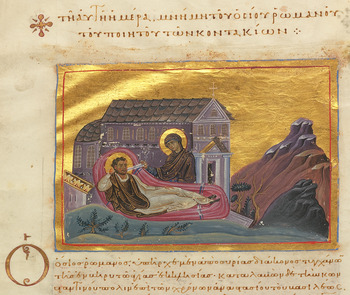
Compare these interconnected metaphors and diction to a miniature from the ‘Menologion’ of Basil II (976–1025), depicting Romanos the Melodist receiving the inspiration for his hymn on the Birth of Christ. In this image, the Theotokos literally inserts words into the composer's mouth by giving him a scroll to eat (Vatican City, Biblioteca Apostolica Vaticana, gr. 1613, p. 78) [Fig. 2]. This follows in a tradition whereby Romanos was believed to have been fed the words to his hymns by the Virgin, as is attested by an epigram on the silver revetment of an icon of the Theotokos Kyriotissa.Footnote 54 The preserved poem reads:
Vatican City, Biblioteca Apostolica Vaticana, gr. 1613, p. 78.

In this example, the body of Romanos becomes a vessel and container for the Logos, just as that of the Theotokos before him. Similar to the Paris Gospel's opening poem, scenes are attested where audiences literally drink from the streams that flow from the writings of the Church Fathers and this iconography often appears along with the canon tables of the Four Gospels.Footnote 56 These examples demonstrate literalized forms of ingestion as being metaphors for divine-inspiration.
In revetment of the Theotokos Kyriotissa, it is her icon that enables the profuse flow of drinkable wisdom, which shall conversely inspire further deeds and divinely-inspired works. As Bissera Pentcheva has argued, these visual and textual metaphors of ingestion and pregnancy resonate with representations of the Evangelists and Church Fathers in manuscripts and icons, as well as with liturgical spaces and their architecture, where the logos is continually born through the Divine Liturgy.Footnote 57 These examples demonstrate a critical fact, which is that the act of being entheos is ultimately temporal and temporary. To be etheos, to be empsychos, or to fulfil/complete a typos are all events whereby the divine partakes in a human actor, text, or work of art, but the grace of being endowed is neither permanent nor does it inherently divinize the medium that has been possessed.
Conclusion
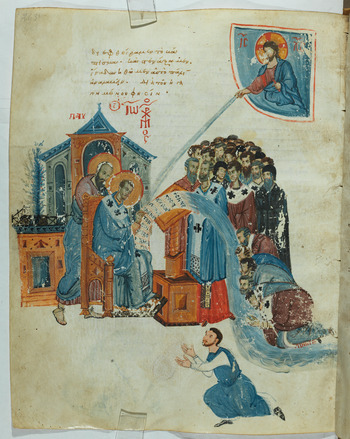
The self-conscious visualization of the processes at work in this article are wonderfully visualized in a twelfth-century manuscript of John Chrysostom's homilies on the Pauline epistles (Milan, Biblioteca Ambrosiana, A 172 sup., fol. 263v) [Fig. 3]. The illumination opens the first homily on Ephesians, featuring John Chrysostom in the style of an Evangelist author-portrait with Paul speaking to him from behind his seat.Footnote 58 The dual inspiration of John, both from Christ and Paul, is articulated through the two inspirations on the writer. The figure of Christ in the heavenly sphere gestures down toward John and the ray of light shining from his hand animates the hand of John as he writes the opening words of the homily. Similar to the charis that moves the hand of the artist in Psellos’ ekphrasis, here the artist has visualized this process as John's hand is moved by Christ's light. Over his slanted writing desk, the scroll trails off, transforming into streams of water from which the huddled congregation drinks. As such, the scene carefully structures the divine-inspiration of John Chrysostom from Paul and Christ, while it is the grace of God that rouses his hand to write the text. The fact that it is being written on a scroll is notable because they are used by the priests for the recitation of prayers in the liturgy. Thus, the scroll stresses the homily as being a cue for speech that is to be made manifest through its recitation in the liturgy before that congregation that is huddled around his desk and drinking those sonic words.
Milan, Biblioteca Ambrosiana, A 172 sup., fol. 263v.

John Chrysostom was known for preaching his homilies from the ambo so as to be better understood, rather than from the synthronon, as was customary, a fact that was noted by Socrates Scholasticus in his Ecclesiastical History.Footnote 59 Sozomen's Ecclesiastical History likewise notes that he placed himself in the midst of the people, who eagerly crowded around him pressing against one another.Footnote 60 Hence, we can imagine the huddled masses in the image, bumping up against his desk as a reference to this very action. Paul the Silentiary, for instance, describes the manner in which the people clustered around the ambo and the solea as if they were waves crashing upon an isthmus in a sea, particularly as the priest passed on his return from the ambo holding the Gospel book in hand. As the crowds try to kiss and touch the manuscript, Paul writes that “the countless waves of the surging people break around.”Footnote 61 As such, the flowing waters of John's divinely-inspired homily spill onto the multitudes, just as those multitudes crash back onto them as waves.
The artist in the Ambrosiana miniature cleverly slanted John's writing desk so that it carries an added resonance with liturgical recitation, rather than the act of writing itself. In the late-antique world, and perhaps up until the ninth-century, scribes customarily wrote either on a wooden tablet held on their laps or on their knees. This is attested by colophons that make reference to the work's production, stating “the reed wrote me, right hand and knee” (κάλαμος μ᾽ ἔγραψɛ, δɛξιὰ χɛὶρ καὶ γόνυ),Footnote 62 and is also a common visual motif in Evangelist portraits who carry the blank or in-progress folios on their knees, while the text being copied stands upon the lectern. The lectern upon which John is writing resembles the wooden stands from which the Evangelists read, often bearing this coiling, spiraling woodwork on its shaft. Keeping in mind that reading (even by an Evangelist in his study) would have been an oral act, such lecterns seem to index an oral recitation.Footnote 63 John Chrysostom's lectern also bears this notable spiral woodwork on its stand, suggesting a popular motif for this type of contemporary church furnishing used for the recitation of texts. As such, one can surmise that here the artist is capturing the doubled act of writing and reciting in one image: the text that John is writing on one side of the lectern is also orally flowing from his desk in waves for his listeners to consume on the other side. In this manner, the miniature not only plays with these intricate understandings of inspiration, writing, and recitation, but also with John's personal history as a famed orator and his association with the trope of the “Fount of Wisdom.”Footnote 64 The liturgical homily is depicted as spreadable media through its proliferation via textual transmission and constant re-performance, bearing the neat chains and layered complexities of inspiration and possession that have been surveyed herein.Footnote 65
* * *
The goal of this article has been to show the prevalence of this logic of indwelling across various media of representation. Rather than considering empsychos graphe as being either a term unique to the icon or to the writings of Michael Psellos, there is a clearly attested and longstanding importance given to this and related ideas across art and rhetoric. Beyond the specificity of a single term or concept, however, this article cautions us to understand that this complex of ideas posits artistic representation as being a by-product of divine indwelling, appearing in various formulations across ancient, late-antique, and Byzantine texts. What is at stake in contemplating the manifestations of this representational logic is that the arts – in their various forms – are premised upon the notion that a material, earthly medium is always necessary in order to provide a site in which the manifestation of forms is possible. Whether this be the mind of the poet, the voice of the rhapsode, the hand of the painter, or the imagination of the audience. Each one of these links are part of a longer chain of representation, and each one of them is led back to the prototype being represented through this process.