Introduction
Major depressive disorder (MDD) is one of the most common conditions worldwide and is associated with high risk of mortality and morbidity. Lifetime depression prevalence ranges from 3% in Japan to 17% in the USA, while the majority of countries fall within the range of 8–12% (Andrade et al. Reference Andrade, Caraveo-anduaga, Berglund, Bijl, Graaf, Vollebergh, Dragomirecka, Kohn, Keller, Kessler and Kawakami2003; Kessler et al. Reference Kessler, Berglund, Demler, Jin, Merikangas and Walters2005). MDD has severe economic consequences for individuals and society arising out of increased healthcare utilisation, caregiver burden and labour force productivity losses (Cuijpers et al. Reference Cuijpers, Beekman and Reynolds2012; Lepine & Briley, Reference Lepine and Briley2011). Furthermore, MDD is a major cause of disease burden throughout the world and is one of the priority conditions examined under the Research Agenda for Health Economic Evaluation (RAHEE) project implemented by the World Health Organization (WHO) (Tordrup & Bertollini, Reference Tordrup and Bertollini2014; Tordrup et al. Reference Tordrup, Attwill, Crosby and Bertollini2015). The objective of the RAHEE project is to identify health economic research priorities based on availability of economic evidence for selected conditions. The present review arose as part of this project.
There is ample evidence for the therapeutic effectiveness of several forms of therapy in treating MDD. For instance, several systematic reviews have examined the effects of pharmacotherapy and psychotherapy and have demonstrated that both therapeutic options are effective in treating depressive disorders in both the short and the long term (Cuijpers et al. Reference Cuijpers, van Straten, Andersson and van Oppen2008a , Reference Cuijpers, Van Straten, Van Oppen and Andersson b , Reference Cuijpers, van Straten, van Oppen and Andersson2010; Cuijpers et al. Reference Cuijpers, Dekker, Hollon and Andersson2009; Karyotaki et al. Reference Karyotaki, Smit, Henningsen, Huibers, Robays, de Beurs and Cuijpers2016). Moreover, research has shown that other treatment alternatives, such as transcranial magnetic stimulation (rTMS), can be effective in treating the symptoms of MDD (Lee et al. Reference Lee, Blumberger, Fitzgerald, Daskalakis and Levinson2012). Considering the rising health care costs associated with the treatment of MDD, it is important to further examine the cost-effectiveness of common treatment options, however only a few systematic reviews have touched upon this.
Grochtdreis et al. (Reference Grochtdreis, Brettschneider, Wegener, Watzke, Riedel-Heller, Harter and Konig2015) performed a systematic review of studies examining the cost-effectiveness of collaborative care compared with usual care in patients with depression. The authors found studies were inconsistent in their quality and results, and conclusions were ambiguous depending on willingness to pay. Incremental cost per Quality Adjusted Life Year (QALY) ranged from dominance to US$ 874 562 Purchasing Power Parity (PPP) (Grochtdreis et al. Reference Grochtdreis, Brettschneider, Wegener, Watzke, Riedel-Heller, Harter and Konig2015). Furthermore, Rabheru (Reference Rabheru2012) searched for cost-effectiveness evidence of maintenance electroconvulsive therapy (M-ECT) in patients who had responded to ECT but found no trials reporting cost-effectiveness in a maintenance setting since 1997. In the same year, Lee et al. (Reference Lee, Blumberger, Fitzgerald, Daskalakis and Levinson2012) published a review on the clinical and cost-effectiveness evidence of transcranial magnetic stimulation (TMS) in the treatment of resistant MDD. The authors examined four studies, which were in disagreement on the cost-effectiveness of TMS v. ECT. To the best of our knowledge, there are no recent (carried out in the past 10 years) systematic reviews on the cost-effectiveness of psychotherapy or the combination of pharmacotherapy and psychotherapy in patients with MDD.
Given the limited evidence on the cost-effectiveness of treatments for major depression in existing reviews, the present systematic review of randomised controlled trials (RCTs) seeks to provide a comprehensive overview of the cost-effectiveness of the most common treatment options for MDD. We aimed to identify evidence gaps, as well as highlight the methodological challenges inherent in synthesising the available evidence.
Methods
Search strategy
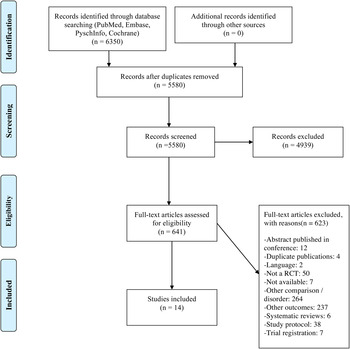
We screened an existing database that was developed to identify all RCTs on cost-effectiveness outcomes in the treatment of common mental disorders (depression and anxiety disorders). This database has been used in a recently submitted paper, reporting a global return on investment analysis on mental health for depression and anxiety disorders (Chisholm et al. Reference Chisholm, Sweeny, Sheehan, Rasmussen, Smit, Cuijpers and Saxena2016). We built the database employing a systematic literature search in PubMed, PsychINFO, Embase and Cochrane library from database inception to December 2014. In these searches, various terms covering economic evaluation and common mental disorders were used in different combinations, using both index and free terms. A full search string for PubMed is provided in Appendix A. In total, 6347 references are included in the database and were examined for eligibility in the present review (2203 from PubMed, 321 from PsychINFO, 2046 from Embase and 1777 from the Cochrane library). In addition to this database, we conducted a separate search in PubMed for verification purposes. Resulting titles and abstracts were screened for eligibility and full texts were retrieved and examined for inclusion. Flow chart 1 shows the study selection process.
Inclusion criteria
Participants: individuals with moderate or severe MDD (as defined in individual studies). No age or country restriction was applied.
Intervention: treatment options for MDD – psychotherapy, pharmacotherapy, combined psychotherapy with pharmacotherapy, physical treatments (ECT and transcranial magnetic stimulation).
Comparison: Control comparison conditions (treatment as usual (TAU) or pill placebo); or active comparison conditions (common treatment options for MDD, as described above).
Outcomes: We included full economic evaluations reporting outcomes on cost-benefit, cost-effectiveness and cost-utility. We also considered cost-minimisation studies of interventions with identical effectiveness (a special case of cost-effectiveness), and cost-consequence studies where one intervention was less costly and more effective (equivalent to a dominant intervention in a cost-effectiveness study).
Study design: RCTs
Exclusion criteria
Studies were excluded if they did not integrate cost- and effectiveness analyses, e.g. cost-consequence or cost-minimisation studies, except as specified above. Moreover, we excluded collaborative care interventions since this topic has already been covered by a recent systematic review (Grochtdreis et al. Reference Grochtdreis, Brettschneider, Wegener, Watzke, Riedel-Heller, Harter and Konig2015). Modelling studies were excluded due to methodological differences compared with RCT-based economic evaluations. Further, studies were excluded if the language was not English. Finally, we did not search for unpublished data because it was out of the scope of the present systematic review.
Quality assessment of economic evaluations
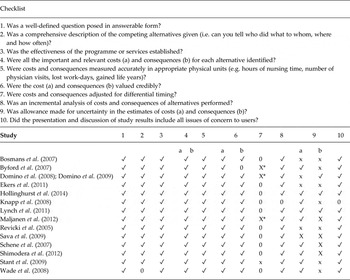
We assessed the methodological quality of the economic evaluations based on the Drummond 10-item checklist (Drummond, Reference Drummond2005). For each of the 10 items, studies were scored as ‘yes’, ‘no’, ‘cannot tell’ or ‘not applicable’, the latter being used for items that were not applicable to certain studies. One author (C.B.) completed the checklist and another reviewed it (E.K.). Disagreement was resolved through discussion.
Risk of bias assessment
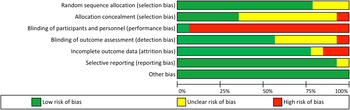
Furthermore, we assessed the validity of the included studies according to the Cochrane Collaboration's Risk of bias assessment tool (Higgins & Altman, Reference Higgins, Altman, Higgins and Green2011; Higgins & Green, Reference Higgins and Green2011). This tool examines the following domains of possible bias: (a) selection bias: systematic differences between groups in baseline characteristics due to inadequate random sequence generation or allocation concealment, (b) performance bias: systematic differences between the groups in the treatment provided due to the absence of blinding of participants and personnel, (c) detection bias: systematic differences between the groups in how outcomes were assessed and determined due to the absence of blinding of outcome assessors, (d) attrition bias: systematic differences between groups in study dropout (incomplete outcome data), (e) reporting bias: systematic differences between reported and unreported results (selective reporting), (f) other bias: bias due to other issues (Higgins and Altman, Reference Higgins, Altman, Higgins and Green2011; Higgins & Green, Reference Higgins and Green2011).
Data extraction and management
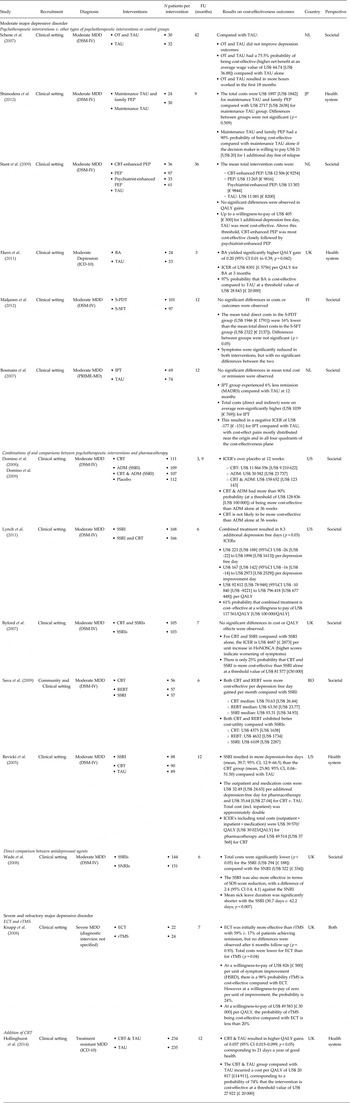
Two authors (E.K. and D.T.) extracted independently the following data: authors’ names, study setting, major depression diagnosis status, type and duration of the therapy, type of control groups and economic perspective and outcomes. This information is summarised in Table 1. Data from the included studies are combined narratively and are presented in the following section. This narrative description presents the main characteristics of the economic evidence. All costs were inflated to 2014 US$ PPP using OECD and World Bank country specific Consumer Price Index statistics and currency conversion rates (OECD, 2016a , b ; WB, 2015). 2014 US$ PPP values are given throughout the paper, with original currencies and values in [brackets].
Study characteristics

ADM, antidepressant medication; BA, behavioural activation; CI, confidence intervals; DSM, diagnostic and statistical manual of mental disorders; ECT, electroconvulsive therapy; FI, Finland; FU, follow up; HoNOSCA, health of the Nation Outcome Scale for children and adolescents; ICD, international classification of diseases; ICER, incremental cost effectiveness ratio; IPT, interpersonal psychotherapy; MADRS, Montgomery Asberg Depression Scale; MDD, major depressive disorder; n, number; OT, occupational therapy; PEP, psychoeducation programmme; PRIME-MD, PRIMary care evaluation of mental disorders; QALY, quality adjusted life years; REBT, rationale emotive behavioral therapy; RO, Romania; rTMS, repetitive transcranial magnetic stimulation; S-PDT, short-term psychodynamic therapy; S-SFT, short-term solution-focused therapy; s.d., standard deviation; SNRIs, serotonin norepinephrine reuptake inhibitors; SDS, Sheehan disability scale; SSRIs, selective serotonin reuptake inhibitors; TAU, treatment as usual WEB, psychiatric services through webcam.
Results – data synthesis
Study characteristics
Across the 14 included RCTs (Fig. 1), outpatients were recruited mainly through clinical samples (n = 12), while two studies recruited participants through both community and clinical referrals. The included studies were conducted in six different countries: Finland (n = 1), Romania (n = 1), the Netherlands (n = 3), Japan (n = 1), the UK (n = 5) and the USA (n = 3). Time horizons for economic outcomes were 2–36 months. The included RCTs examined eight types of psychotherapeutic interventions: behavioural activation (BA; n = 1 study), cognitive behavioural therapy (CBT; n = 7 studies), interpersonal psychotherapy (IPT; n = 1 study), occupational therapy (OT; n = 1 study), psychodynamic psychotherapy (PDT; n = 1 study), psychoeducation (PEP; n = 2 studies), rational emotive behavioural therapy (REBT; n = 1 study) and solution focused therapy (SFT; n = 1 study), while the included pharmacotherapeutic trials examined mostly antidepressants from the cluster of selective serotonin reuptake inhibitors (SSRIs). Finally, one trial examined the effects of TMS compared with ECT. Studies targeting absolute efficacy used TAU or pill placebo as control comparison condition (n = 8 studies). Table 1 presents a summary of study characteristics.
PRISMA Flow chart of the studies selection process.

Quality assessment of economic evaluations
The overall methodological quality of the economic evaluations was relatively good, but varied among studies. The mean relative value of the methodological quality criteria fulfilled was 9.7 out of 12 (see Table 2). The minimum relative value of criteria fulfilled was 8 (Knapp et al. Reference Knapp, Romeo, Mogg, Eranti, Pluck, Purvis, Brown, Howard, Philpot, Rothwell, Edwards and McLoughlin2008) and the maximum value of criteria met was 11 (Domino et al. Reference Domino, Burns, Silva, Kratochvil, Vitiello, Reinecke, Mario and March2008; Lynch et al. Reference Lynch, Dickerson, Garber, Clarke, Weersing, Beardslee, Brent, Gladstone and DeBar2011; Maljanen et al. Reference Maljanen, Paltta, Harkanen, Virtala, Lindfors, Laaksonen Maarit and Knekt2012; Hollinghurst et al. Reference Hollinghurst, Carroll, Abel, Campbell, Garland, Jerrom, Kessler, Kuyken, Morrison, Ridgway, Thomas, Turner, Williams, Peters, Lewis and Wiles2014). All studies included a well-defined research question, reported on the effectiveness of the programme or service concerned, identified all relevant costs and consequences for each alternative, measured costs and consequences accurately, and valued the cost credibly. All studies except for one (in brackets) included a comprehensive description of the competing alternatives (Wade et al. Reference Wade, Fernandez, Francois, Hansen, Danchenko and Despiegel2008), valued the consequences credibly (Byford et al. Reference Byford, Barrett, Roberts, Wilkinson, Dubicka, Kelvin, White, Ford, Breen and Goodyer2007), performed an incremental analysis of costs and consequences of alternatives (Knapp et al. Reference Knapp, Romeo, Mogg, Eranti, Pluck, Purvis, Brown, Howard, Philpot, Rothwell, Edwards and McLoughlin2008), and included a presentation and discussion of study results that covered all issues of concern to users (Knapp et al. Reference Knapp, Romeo, Mogg, Eranti, Pluck, Purvis, Brown, Howard, Philpot, Rothwell, Edwards and McLoughlin2008). Only three studies reported on adjusting cost and consequences for differential timing (Byford et al. Reference Byford, Barrett, Roberts, Wilkinson, Dubicka, Kelvin, White, Ford, Breen and Goodyer2007; Domino et al. Reference Domino, Burns, Silva, Kratochvil, Vitiello, Reinecke, Mario and March2008; Maljanen et al. Reference Maljanen, Paltta, Harkanen, Virtala, Lindfors, Laaksonen Maarit and Knekt2012). Five studies did not make allowances for uncertainty in the estimation of costs (Revicki et al. Reference Revicki, Siddique, Frank, Chung, Green, Krupnick, Prasad and Miranda2005; Bosmans et al. Reference Bosmans, Schaik, Heymans, Marwijk, Hout and Bruijne2007; Domino et al. Reference Domino, Burns, Silva, Kratochvil, Vitiello, Reinecke, Mario and March2008; Sava et al. Reference Sava, Yates, Lupu, Szentagotai and David2009; Ekers et al. Reference Ekers, Godfrey, Gilbody, Parrott, Richards, Hammond and Hayes2011). Only three studies allowed for uncertainty in the estimation of consequences (Domino et al. Reference Domino, Burns, Silva, Kratochvil, Vitiello, Reinecke, Mario and March2008; Lynch et al. Reference Lynch, Dickerson, Garber, Clarke, Weersing, Beardslee, Brent, Gladstone and DeBar2011; Hollinghurst et al. Reference Hollinghurst, Carroll, Abel, Campbell, Garland, Jerrom, Kessler, Kuyken, Morrison, Ridgway, Thomas, Turner, Williams, Peters, Lewis and Wiles2014).
Quality assessment with the 10-item Drummond checklist

Note: yes ✓, no X, explanation is given why costs and consequences are not discounted X*, cannot tell 0.
Risk-of-bias assessment
With regard to risk-of-bias assessment, the majority of the included trials reported an adequate random sequence generation (11/14). The allocation was concealed in 6 out of the 14 included RCTs while the remainder reported inadequate information to permit judgement. Blinding of personnel and participants was possible in only one of the included studies and incomplete outcome data were adequately addressed by 11 included RCTs. Finally the vast majority of the included trials were rated as free from selective outcome reporting bias (13/14) and other sources of bias (14/14) (Fig. 2.)
Risk of bias assessment.

Moderate major depressive disorder
Psychotherapeutic interventions v. other types of psychotherapeutic interventions or control groups
One study examined the cost-effectiveness of psychotherapeutic interventions targeting work related outcomes (e.g. productivity losses). Schene et al. (Reference Schene, Koeter, Kikkert, Swinkels and McCrone2007) found that adding OT to TAU did not improve depression outcomes, but did result in a significant reduction of workdays lost over 18 months. Net benefit was calculated as the ‘value of work’ (hourly wages multiplied by time) minus costs of the intervention. Mean net benefit was higher in the OT group with a 76% chance of being cost-effective (higher net benefit) over usual care at a median wage value of US$ 44.74 [US$ 36,88] per hour.
Two studies assessed psychoeducation targeting prevention of MDD relapse/recurrence. A Japanese study comparing family psychoeducation maintenance treatment with usual care reported significantly more relapse-free days in the maintenance treatment group. The intervention was considered cost-effective with a probability of almost 100% at a willingness-to-pay (WTP) of US$ 31 [US$ 30] per depression-free day. No cost-utility results were reported (Shimodera et al. Reference Shimodera, Furukawa, Mino, Shimazu, Nishida and Inoue2012). In contrast, an individual psychoeducation prevention program (PEP) reported by Stant et al. (Reference Stant, TenVergert, Kluiter, Conradi, Smit and Ormel2009) in the Netherlands was more expensive and less effective in terms of depression-free days compared with TAU. If supplemented with psychiatric consultation or CBT, outcomes with PEP were slightly better than TAU, but neither combination was cost-effective. Follow-up duration was shorter in the Japanese study (9 months) than in the Dutch study (36 months).
Ekers et al. (Reference Ekers, Godfrey, Gilbody, Parrott, Richards, Hammond and Hayes2011) conducted a relatively small study (n = 47 participants) to examine the cost-effectiveness of BA delivered by non-specialist mental health nurses compared with TAU. The authors found a significant difference between groups in QALY's of 0.20 (95% CI, 0.01–0.39; p = 0.042) in favour of BA and an incremental cost-utility ratio (ICUR) of US$ 8301/QALY [£5756/QALY].
Two types of short-term psychotherapy were compared in a Finnish context (PDT and SFT). No significant differences in costs or effects were observed though PDT trended towards lower costs and greater improvements. No cost/QALY was reported (Maljanen et al. Reference Maljanen, Paltta, Harkanen, Virtala, Lindfors, Laaksonen Maarit and Knekt2012).
Management of MDD in elderly (55+) people identified through primary care screening was assessed by one study. IPT did not result in significant clinical change compared with TAU over 12 months but did incur non-significantly higher total costs. Uncertainty around the cost-effectiveness estimate suggested that the intervention was unlikely to be cost-effective (Bosmans et al. Reference Bosmans, Schaik, Heymans, Marwijk, Hout and Bruijne2007).
Combinations of and comparisons between psychotherapeutic interventions and pharmacotherapy
Eight trials showed conflicting results for the comparison of combination therapy (psychotherapy with pharmacotherapy) with monotherapy (either pharmacotherapy or psychotherapy alone). Domino et al. (Reference Domino, Burns, Silva, Kratochvil, Vitiello, Reinecke, Mario and March2008) compared CBT with fluoxetine (an SSRI) and a combination of both in a sample of American adolescents with MDD. Compared with pill placebo at 12 weeks, fluoxetine alone was more cost-effective (US$ 30 582/QALY [US$ 23 737/QALY]) than fluoxetine with CBT (US$ 158 652/QALY [US$ 123 143/QALY]). Furthermore, addition of CBT to fluoxetine was not cost-effective compared with fluoxetine alone (US$ 591 121/QALY [US$ 458 818/QALY]) at 12 weeks. Results from the same trial indicated that the combination of fluoxetine plus CBT became more cost-effective than fluoxetine alone over a longer follow-up of 36 weeks (>90% probability at a threshold of US$ 128 836 [US$ 100 000]). The authors concluded combination therapy is both clinically effective and cost-effective (Domino et al. Reference Domino, Foster, Vitiello, Kratochvil, Burns, Silva, Reinecke and March2009).
Byford et al. (Reference Byford, Barrett, Roberts, Wilkinson, Dubicka, Kelvin, White, Ford, Breen and Goodyer2007) studied whether CBT in addition to SSRI treatment was cost-effective in UK adolescents attending outpatient mental health clinics, who had not responded to an initial brief intervention. Compared with TAU, at 28 weeks there was no significant difference in costs or clinical outcomes though there was a trend towards higher costs and worse clinical outcomes for combination therapy. Lynch et al. (Reference Lynch, Dickerson, Garber, Clarke, Weersing, Beardslee, Brent, Gladstone and DeBar2011) studied CBT as an add-on to medication switch in young people with SSRI-resistant depression. Addition of CBT to medication switch was associated with higher costs but also higher gains in depression-free days at 24 weeks compared with medication switch alone (Incremental Cost Effectiveness Ratio – ICER of US$ 221 [US$ 188] per depression-free day or US$ 92 812/QALY [US$ 78 948/QALY]).
Sava et al. (Reference Sava, Yates, Lupu, Szentagotai and David2009) examined CBT, REBT and fluoxetine individually and followed patients for 6 months after completion of the intervention. The authors did not find significant differences between treatment groups in depression severity, depression- free days or QALYs. Due to lower costs, the psychotherapeutic interventions were more cost-effective than fluoxetine at US$ 4375/QALY [US$ 1638/QALY] and US$ 4632/QALY [US$ 1734/QALY] for CBT and REBT, respectively, against US$ 6109/QALY [US$ 2287/QALY] for fluoxetine (before v. after treatment).
Among low-income ethnic minority women with major depression in Washington DC, Revicki et al. (Reference Revicki, Siddique, Frank, Chung, Green, Krupnick, Prasad and Miranda2005) compared either pharmacotherapy (paroxetine potentially followed by bupropion) or CBT with ‘community’ referral, consisting of education about depression and its treatment along with referral to usual providers of mental health care services in the community. At 12-month follow-up, pharmacotherapy was slightly more cost-effective than CBT (US$ 39 570/QALY [US$ 30 023/QALY] v. US$ 49 514 [US$ 37 568/QALY]) compared with community referral.
Direct comparison between antidepressant agents
Only one study examined differences between various antidepressant medications. Wade et al. (Reference Wade, Fernandez, Francois, Hansen, Danchenko and Despiegel2008) examined the cost-effectiveness of escitalopram compared with duloxetine in treating patients with MDD. The authors found that treatment with duloxetine was associated with higher cost, higher mean sick leave and higher depression scores over the 24-week study period (Wade et al. Reference Wade, Fernandez, Francois, Hansen, Danchenko and Despiegel2008).
Severe and refractory major depressive disorder
ECT and repetitive TMS (rTMS)
A small study of people with severe depressive episodes (n = 46) compared rTMS with ECT. In the 6 months after treatment, total costs for ECT (treatment, services and informal care) were lower than for rTMS, and ECT was more effective (McLoughlin et al. Reference McLoughlin, Mogg, Eranti, Pluck, Purvis, Edwards, Landau, Brown, Rabe-Heskith, Howard, Philpot, Rothwell, Romeo and Knapp2007; Knapp et al. Reference Knapp, Romeo, Mogg, Eranti, Pluck, Purvis, Brown, Howard, Philpot, Rothwell, Edwards and McLoughlin2008).
Combined CBT plus TAU
A UK study compared addition of CBT to TAU with TAU alone in primary care patients who did not respond to medication for at least 6 weeks. Over 12 months, the costs of health and social care, out-of-pocket expenses and productivity losses did not differ between groups. However, CBT incurred an additional expense of US$ 1270 [GBP £910] per patient and resulted in improved outcomes within ICUR of US$ 20 817/QALY [GBP £14 911/QALY] (Hollinghurst et al. Reference Hollinghurst, Carroll, Abel, Campbell, Garland, Jerrom, Kessler, Kuyken, Morrison, Ridgway, Thomas, Turner, Williams, Peters, Lewis and Wiles2014).
Discussion
Main results
The present systematic review presents a comprehensive overview of health economic evidence for the various treatment modalities for major depression. Several economic evaluations of clinical trials have been conducted in the area of major depression, covering pharmacotherapeutic treatments as well as different types of psychotherapeutic interventions, with some studies comparing both. Only one study evaluated the cost-effectiveness of ECT and transcranial magnetic stimulation.
For moderate MDD, family psychoeducation was considered cost-effective compared with TAU (Shimodera et al. Reference Shimodera, Furukawa, Mino, Shimazu, Nishida and Inoue2012). In contrast, Stant et al. (Reference Stant, TenVergert, Kluiter, Conradi, Smit and Ormel2009) found that individual psychoeducation was outperformed by TAU in clinical effectiveness and cost-effectiveness. The difference in the results of psychoeducation could be attributed to differences in treatment format (family v. individual) or to differences in follow-up duration (9 v. 36 months). Two studies examined CBT alone, but using different methodological approaches. Using a pre-post analysis, Sava et al. (Reference Sava, Yates, Lupu, Szentagotai and David2009) found CBT and REBT were more cost-effective than fluoxetine on account of their relative input prices. In contrast, Revicki et al. (Reference Revicki, Siddique, Frank, Chung, Green, Krupnick, Prasad and Miranda2005) found CBT was less cost-effective than pharmacotherapy, compared with community referral. However it is clear that both study design, population and setting (Romania v. USA) are likely to play a major role in these differences between findings.
A relatively broad literature examined the effects of monotherapy with SSRIs and CBT, or the combination of both in patients with moderate MDD. Domino et al. reported the combination of CBT with SSRIs was clinically effective and cost-effective compared with monotherapy, but only in the longer term (Domino et al. Reference Domino, Burns, Silva, Kratochvil, Vitiello, Reinecke, Mario and March2008, Reference Domino, Foster, Vitiello, Kratochvil, Burns, Silva, Reinecke and March2009). Lynch et al. (Reference Lynch, Dickerson, Garber, Clarke, Weersing, Beardslee, Brent, Gladstone and DeBar2011) showed higher clinical gains as well as higher costs in favour of combined treatment compared with monotherapy with SSRIs. Finally, Byford et al. (Reference Byford, Barrett, Roberts, Wilkinson, Dubicka, Kelvin, White, Ford, Breen and Goodyer2007) found no significant differences between combined treatment and monotherapy in cost or clinical effectiveness. It should be noted that the interventions, although similar, had differences. In Lynch et al. (Reference Lynch, Dickerson, Garber, Clarke, Weersing, Beardslee, Brent, Gladstone and DeBar2011) trial CBT was added to medication switch, while in Byford et al. (Reference Byford, Barrett, Roberts, Wilkinson, Dubicka, Kelvin, White, Ford, Breen and Goodyer2007) trial patients received CBT and started receiving SSRIs at the same time. Thus, results should be interpreted with caution due to limited comparability between the examined trials. Concerning direct comparison between antidepressants, one study found escitalopram dominated duloxetine (Wade et al. Reference Wade, Fernandez, Francois, Hansen, Danchenko and Despiegel2008).
Importantly, for several interventions (behavioural activation, occupational therapy, short-term psychological therapies, IPT) only results from a single study were identified (Bosmans et al. Reference Bosmans, Schaik, Heymans, Marwijk, Hout and Bruijne2007; Schene et al. Reference Schene, Koeter, Kikkert, Swinkels and McCrone2007; Maljanen et al. Reference Maljanen, Paltta, Harkanen, Virtala, Lindfors, Laaksonen Maarit and Knekt2012) limiting the generalisability of conclusions. With regard to severe and refractory MDD, only two clinical studies of different interventions were identified (Knapp et al. Reference Knapp, Romeo, Mogg, Eranti, Pluck, Purvis, Brown, Howard, Philpot, Rothwell, Edwards and McLoughlin2008; Hollinghurst et al. Reference Hollinghurst, Carroll, Abel, Campbell, Garland, Jerrom, Kessler, Kuyken, Morrison, Ridgway, Thomas, Turner, Williams, Peters, Lewis and Wiles2014), and consequently no generalisations can be made.
Quality of economic evaluations
The overall methodological quality of the included economic evaluations was relatively high. The majority of studies described the methods in a transparent way, reducing possible biases related to methodology of economic outcomes assessment. However, the results of the trial-based economic evaluations rely heavily on the methodology of the RCTs. Thus, we examined the included RCTs for a spectrum of possible sources of bias related to the methodology. The results of the risk-of- bias assessment indicated that the included studies presented overall low risk of bias in most of the items examined except for blinding of personnel and participants, since this type of blinding is inherently difficult or impossible following exposure to active psychotherapeutic interventions. Therefore, the conclusions of the present systematic review should be interpreted with caution due to high risk of performance bias.
Strengths and limitations
One of the strengths of the present review is the systematic method employed to reduce the risk of bias and to provide reliable findings and conclusions. Moreover, this paper examined the validity of the included studies and presents a detailed quality appraisal. However, the work also has several limitations. A formal meta-analysis could not be conducted due to the high diversity in outcomes across the included studies. Moreover, this heterogeneity of results limited the comparability of the findings and our ability to draw robust conclusions regarding relative cost-effectiveness of interventions. Finally, it should be noted that the cost effectiveness of a particular intervention might differ substantially between countries due to variations in usual care, differences in the way new treatments are introduced, and in costs of inputs such as the salaries of health professionals between countries. Thus, the present findings should be interpreted with caution, and clinicians and policy makers should take into account any national or regional evidence in order to draw conclusions about the cost effectiveness of an intervention for major depression.
Evidence gaps and future research
Little is known about the economics of occupational therapy, short-term psychological therapies, behavioural activation, PDT, REBT and IPT for the treatment of moderate MDD and/or prevention of progression to more severe disease. Additionally, little empirical evidence is available on the cost-effectiveness of treatment options for severe MDD. There are gaps in knowledge regarding which medication is likely to be most cost-effective and for which patient groups, and which psychological therapy is to be preferred. There is also relatively little information on the long-term impact of treatments. No published evidence was identified regarding the cost-effectiveness of self-help programmes delivered through the Internet by therapists or healthcare workers other than qualified psychotherapists. Similar trials are ongoing in this area, such as Internet-delivered treatment for individuals with depressive symptoms (Warmerdam et al. Reference Warmerdam, Smit, Straten, Riper and Cuijpers2010), which may provide a cost-effective approach to limiting disease progression with early intervention.
The present review, and earlier draft stages, formed part of the WHO Research Agenda for Health Economic Evaluation project, where priorities for economic research in mental health and nine other subject areas were discussed by a panel of experts (Tordrup et al. Reference Tordrup, Attwill, Crosby and Bertollini2015). Suggested research priorities for MDD, based on the limitations of the available evidence, include: economic primary studies of rarely evaluated interventions (e.g. self-help interventions); long-term head-to-head comparisons of well studied treatments (e.g. CBT, CBT in combination with SSRIs) against usual care, using routinely available real-world data; analysis of the disease course to enable prediction of progression, thereby ensuring treatments are targeted at those unlikely to recover naturally; and elucidation of genetic components to treatment response. Importantly, when considering interventions that are supported by extensive evidence and are known to work in treating depression, the next step should be to target patients most likely to respond.
Conclusions
In conclusion, there is some economic evidence underpinning many of the interventions routinely used to treat major depressive disorder. Wide variability was observed in study outcomes, probably attributable to differences in population, interventions or follow-up periods. Significant economic evidence gaps remain in the area of major depressive disorder.
Supplementary Material
The supplementary material for this article can be found at http://dx.doi.org/10.1017/S2045796016000421.
Acknowledgements
None.
Financial Support
David Tordrup and Roberto Bertollini are implementing the Research Agenda for Health Economic Evaluation (RAHEE) project, which is funded by the European Commission Consumers, Health, Agriculture and Food Executive Agency, contribution agreement 2011 53 02.
Conflict of interest
The authors have no financial conflicts of interest to declare.
Ethical Standards
The authors assert that all procedures contributing to this work comply with the ethical standards of the relevant national and institutional committees on human experimentation and with the Helsinki Declaration of 1975, as revised in 2008.
Availability of Data and Materials
Data supporting the present findings are publicly available. For further details, the reader is encouraged to contact the corresponding authors.