Forty thousand infants are born with CHD in the United States each year. The most complex conditions, which require surgical intervention during the first weeks of life, account for 46% of deaths from all congenital malformations. Reference Zimmerman, Smith and Sable1 However, advances in medical and surgical treatments have dramatically increased survival through infancy and beyond childhood, posing long-term coping challenges on their parents and affecting their quality of life. Reference Ernst, Marino and Cassedy2,Reference Golfenshtein, Deatrick, Lisanti and Medoff-Cooper3
The neonatal period in which the cardiac surgeries are being performed, and which is followed by long hospitalisations at the cardiac ICU, has been described as particularly distressing period for both the infant and the family, Reference Golfenshtein, Hanlon, Deatrick and Medoff-Cooper4,Reference Lisanti, Golfenshtein and Medoff-Cooper5 and has been linked to a decreased quality of life. Reference Goldbeck and Melches6 Parental quality of life reflects their physical, emotional, and social well-being and functioning, and is recognised as an essential construct for their overall health and wellness. Reference Pinto, Fumincelli, Mazzo, Caldeira and Martins7 As parental quality of life is multidimensional, and influenced by personal, environmental, and physical factors related to disease and functioning, it is often compromised for parents of infants with complex CHD. 8 Infants with complex conditions are more likely to be discharged and maintained on multiple medications per day, experience multiple re-hospitalisations, demonstrate feeding difficulties, and are at risk for profound growth failure. Reference Wei, Roscigno, Hanson and Swanson9,Reference Medoff-Cooper, Irving and Hanlon10 Mothers have described their infants as especially fussy, irritable, and difficult to sooth during the post-surgery period and after hospital discharge. Reference Marino and Lipshitz11,Reference Jackson, Frydenberg, Liang, Higgins and Murphy12 Together with the multiple caretaking demands necessary to maintain their infant’s physiologic stability, these we often described as overwhelming Reference Golfenshtein, Deatrick, Lisanti and Medoff-Cooper3 and were linked to maternal feelings of inadequacy, fatigue, resentment, and hopelessness. Indeed, neuropsychological and cognitive research supports the maternal impressions with regard to their infants' irritability and particularly in infants with the more complex conditions. Reference Marino and Lipshitz11 Although not fully understood, the aetiology of infant irritability is often attributed to the complex surgical interventions resulting in blood flow and brain oxygenation obstructions, exposure to noxious stimuli during the CICU stay, post-operative complications, and growth failure, which may create permanent alterations in neuronal and synaptic organisation. Reference Costello, Gellatly, Daniel, Justo and Weir13,Reference Anderson, Marino and Irving14 These neurological changes may further contribute to negative emotionality and a difficult infant behavioural style, which are considered to be the core of the difficult temperament paradigm. Reference Thomas and Chess15
The popular temperament frameworks conceptualise temperament as the individual core differences in reactivity and self-regulation. Reference Thomas and Chess15,Reference Rothbart, Ziaie and Eisenberg16 According to these, early temperament is unfolded by infant emotional regulation efforts or self-regulating/soothing behaviours. These temperament characteristics are primarily reflected in the infant’s mood, irritability, or soothability, but also include the infant’s adaptability to new situations, degree of persistence, and regularity (rhythmicity) of bodily functions. Studies have previously found that the temperament characteristics of adaptability, persistence, and regularity were associated with parental role aspects and parental stress. Reference Lisanti, Golfenshtein and Medoff-Cooper5,Reference Torowicz, Irving, Hanlon, Sumpter and Medoff-Cooper17 Little is known about how the behavioural style or temperament in the early months after discharge relates to parental quality of life. The purpose of this study was to explore the associations between early infant temperament characteristics and parental quality of life in parents of infants with complex CHD.
Materials and methods
This descriptive, cross-sectional study utilised previously collected data of a randomised clinical trial (Trial Registration: NCT01941667) that was conducted from 2012 to 2017 at three large children’s hospitals in the Northeastern region of the United States. The study was approved by the institutional review boards. The trial aimed to test a telehealth programme supporting parents of infants with complex CHD post-surgery over 4 months. The main study included 219 parent–infant dyads. Infants included had undergone cardiac surgery in the first three weeks of life, were at least 37 weeks gestation and 2500 g at birth, and had a Risk Adjustment in Congenital Heart Surgery Category of 2 or greater. The main study excluded parents who were less than 18 years of age, did not speak or read English, infants with genetic disorders and other syndromes (except DiGeorge syndrome), or infants with cardiomyopathy and/or those awaiting heart transplant. Infants who suffered a significant neurologic insult post-operatively and/or were not discharged home within 2.5 months of life were withdrawn from the study. Data collected over the study included demographics, infant temperament, and parental psychosocial information. Sample for the current study included patients with complete data on infant temperament and parental quality of life four months post-surgical hospital discharge. We included patients from both intervention and control groups, as groups did not significantly differ on any of the current study’s variables of interest. Temperament and quality of life data were available for 90 parents and their infants at 4 months post-discharge.
Study variables and measures
Infant Temperament: The independent variable was assessed at 4 months post-discharge via the Early Infant Temperament Questionnaire. Reference Medoff-Cooper, Carey and McDevitt18 The self-report questionnaire for parents contains 76 items for assessing infant temperament characteristics in 1- to 4-month-old infants. The nine categories include Activity, Approach/Withdrawing behaviours, Adaptability, Intensity, Mood, Persistence, Distractibility, Regularity in bodily functions, and Sensory threshold. Means for the nine categories are calculated separately by subscale and by infant’s age (1–2 months, 3–4 months). Infants can be further classified into three clusters: Easy Infants (regular in bodily function, approaching in new situations, adaptable, low in intensity, and positive in mood); Slow to Warm Up infants (withdraw in new situations, but generally positive in mood and low in intensity); Challenging Infants (irregular in bodily functions, less adaptable, high intensity, negative in mood, and less distractible or more difficult to soothe). The questionnaire has been validated in normative samples of infants ageing between 1 and 4 months (α = 0.67–0.89).
Parental Quality of Life: The dependent variable was measured at 4 months post-discharge using the Ulm Quality of Life Inventory, specifically designed to assess quality of life in parents of chronically ill children. Reference Goldbeck and Melches6,Reference Goldbeck and Storck19 The Ulm Quality of Life Inventory is a 29-item self-reporting questionnaire which assesses parent well-being and functioning for each item on a five-point Likert-like scale. The total score is calculated by adding the raw scores of all 29 items and is linearly transformed to a 0 to 100 scale. Higher score reflects the higher quality of life. Cronbach’s α for the total scale is 0.91.
Covariates considered for analysis
Clinical indicators: Illness severity has previously been shown to affect parental quality of life Reference Ernst, Marino and Cassedy2 ; therefore, the following illness severity measures were considered as potential confounders: cardiac physiology (single or two ventricle), Risk Adjustment in Congenital Heart Surgery score (low or high risk Reference Al-Radi, Harrell and Caldarone20 ), hospital length of stay in days, number of hospital readmissions post-discharge, number of unscheduled cardiologist visits post-discharge, number of medications at discharge, and WHO weight-for-age z-scores 21 at 4 months.
Demographic Characteristics: Socio-economic and other demographic characteristics can potentially influence quality of life in families of ill children Reference Klassen, Anthony, Khan, Sung and Klaassen22 ; therefore, we considered the following information to be included in the multivariable models: parental age, sex, race, ethnicity, education level, insurance type, household income, number of children in house. Parental Dyadic Adjustment : Partner’s support and cohesion have been demonstrated to moderate the effect of illness related adversities on parental well-being in paediatric populations. Reference Santos, Crespo, Canavarro and Kazak23 Therefore, we considered this as a potential confounder in our analyses. Parental dyadic adjustment was assessed via the Dyadic Adjustment Scale, Reference Spanier24 a 32 self-report questionnaire assessing couple’s relational aspects, and rating respondents' answers on a Likert-like scale. Items are summed to a total score, with higher score representing higher adjustment.
Analysis
Descriptive statistics were used to characterise demographic and clinical measures of parents and infants. Comparisons of demographic characteristics and parental quality of life at 4 months post-discharge between parents with and without temperament data were performed to identify differences between subsamples. No significant differences were found between the subsamples, demonstrating no sampling bias. To examine the associations between the nine subscales of infant temperament and parental quality of life (Total Score) at four months, we performed multivariable linear regression modelling, separately for each subscale. Reference Cohen, Cohen, West and Aiken25 Covariate selection was performed based on the covariate list described above. Covariates significant at 0.2 significance level in the bivariate models were further examined in multivariable models via the backwards deletion process at the 0.1 significance level. Final covariates included in the multivariable models were parental dyadic adjustment, insurance type, infant’s number of medications, and number of unscheduled cardiologist visits post-discharge. We interpreted the models based on the context of both clinical meaningfulness and statistical significance (0.05 level). All analyses were performed via STATA Version 16™.
Results
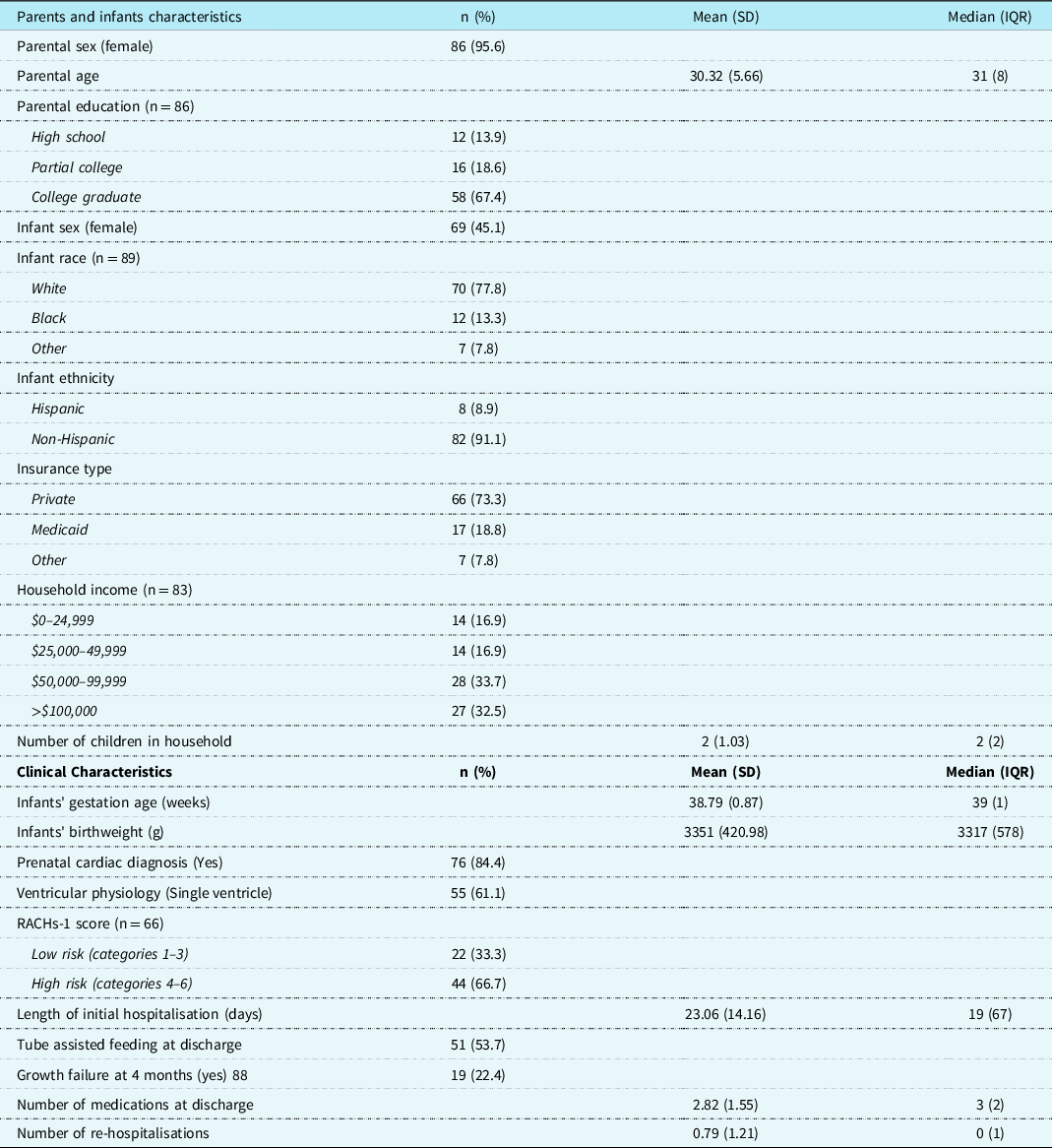
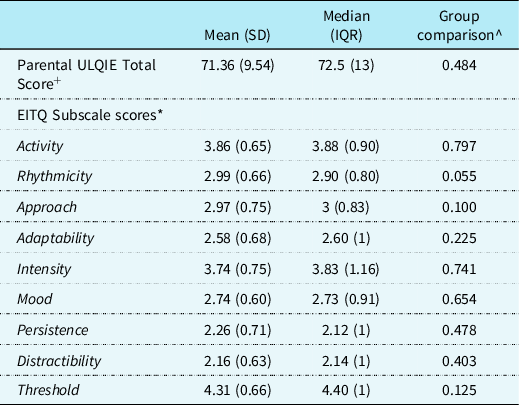
Ninety parent–infant dyads were included in this analysis. Most were mothers (96%), with a mean age of 30 ± 5.66 years. Most mothers were non-Hispanic (91%), white (78%), and had college education (67%). More demographic and SES characteristics are presented in Table 1. Most infants were diagnosed with their cardiac defect prenatally (84%), 61% had one ventricle physiology, and 67% had high mortality risk score. Post-surgery, the median length of stay at the hospital was 19 days (IQR = 67), and about half of the infants (54%) were discharged home with a feeding tube and with three or more medications (IQR = 2). At 4 months, 19 infants (22%) were failing to thrive with WAZ scores of <2. Infants' clinical indicators are further presented in Table 1. Table 2 depicts infant temperament and parental quality of life information at four months post-discharge and presents group comparisons for this information by cardiac physiology. Infant temperament mean scores on all nine subscales of the Early Infant Temperament questionnaire fall within one standard deviation of normative sample distributions (healthy infants at 3–4 months of age). Parental quality of life in the current sample was normally distributed with a mean score of 71 ± 9.54 for the total score. No significant differences were demonstrated between infants with single- and bi-ventricle physiology and their parents.
Demographic and clinical characteristics of parents and infants (n = 90)

Note. SD = Standard Deviation; IQR = Interquartile Range; RACHS-1 = Risk Adjustment in Congenital Heart Surgery.
Infant temperament and parental quality of life descriptives and group comparisons by ventricular physiology at four months of age (n = 90)

Note. *Early Infant Temperament Questionnaire (EITQ); + ULQIE = Ulm Quality of Life Inventory; ^Group comparisons via t-tests for continues parameters, significant at the 0.05 level.
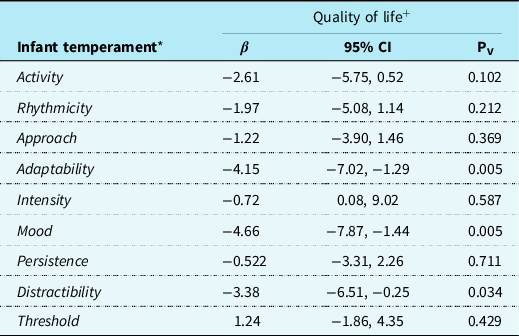
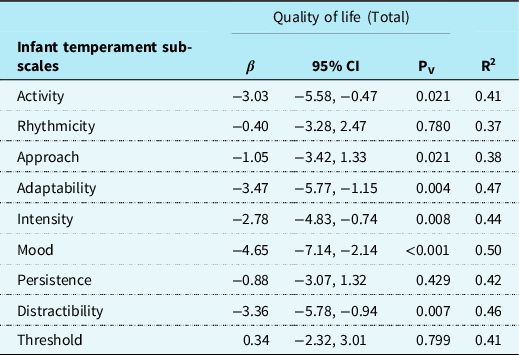
Tables 3 and 4 present results from regression models in which parental quality of life was regressed over infant temperament subscales. Univariable model results (Table 3) show that the Early Infant Temperament Questionnaire subscales of Adaptability (β = −4.15, p = 0.005), Mood (β = −4.66, p = 0.005), and Distractibility (β = −3.38, p = 0.034) were negatively and significantly associated with parental quality of life total score. Multivariable regression results (Table 4) demonstrate negative significant associations between most infant temperament subscales and parental quality of life. Higher scores on the Activity (β = −3.03, p = 0.021), Approach (β = −1.05, p = 0.021), Adaptability (β = −3.47, p = 0.004), Intensity (β = −2.78, p = 0.008), Mood (β = −4.65, p < 0.001), and Distractibility (β = −3.36, p = 0.007 were all significantly associated with lower parental quality of life scores, adjusting for parental dyadic adjustment, insurance type, number of medications, and number of unscheduled cardiologist visits. R for these models ranged between 0.38 and 0.50.
Univariable models for parental quality of life regressed on infant temperament (n = 90)

Note: *Early Infant Temperament Questionnaire (EITQ); + ULQIE = Ulm Quality of Life Inventory; CI = Confidence intervals; PV = p-value at the 0.05 significance level.
Multivariable models* for parental quality of life regressed on infant temperament (n = 84)

Note: *Models were adjusted for insurance type, number of medications, number of unscheduled cardiologist visits, and Dyadic Adjustment; CI = Confidence intervals; PV = p-value at the 0.05 significance level.
Discussion
The current study aimed to examine the associations between early infant temperament characteristics and parental quality of life over the critical care period at home after the infant’s cardiac surgery. Our a priori assumptions were that infants with complex CHD at the post-surgery period would be more difficult to parent, due to their irritability, negative mood, lower adaptability, and difficulty to soothe (all characteristics of an immature regulatory system). However, our findings indicate that in this cohort of infants, the temperament characteristics, on average, resembled those of the general population in which only about 10% of infants demonstrate immature self-regulatory behaviours as defined by Rothbart Reference Rothbart, Ziaie and Eisenberg16 and align with Thomas and Chess' Reference Thomas and Chess15 definition of an infant’s difficult temperament. Contrary to our previous findings, demonstrating more difficult temperaments in infants with single ventricle physiology, Reference Torowicz, Irving, Hanlon, Sumpter and Medoff-Cooper17 in the current study we did not find differences in temperament characteristics between the two physiology groups. One explanation may be that the infants with biventricular physiology in this sample were more complicated (RACHS-1 score of 2 or greater) compared with our previous cohorts. Our main findings further indicate that the difficult temperament characteristics are negatively associated with parental quality of life in our sample. Parents who reported their infants to be more active, slower to adapt and hesitant towards new situations, more intense in their responses to caregiving and less distracted by external stimuli, and more negative in mood had lower quality of life. These findings align with the assumptions of general parenting psychosocial and developmental frameworks which account for the child’s temperament as a stress evoking factor in the parent-child system, Reference Crnic and Coburn26,Reference Abidin27 potentially affecting the quality of the parent-child relationship, and other parenting aspects which interfere with the daily living and parental well-being. Our previous study demonstrated that high parenting stress, parental post-traumatic stress, lower partner’s support, and lower social support predicted parental decreased quality of life in the CHD population. These factors accounted for more than two-thirds of the construct.
Stress and coping research emphasises the role of an individual’s subjective cognitive appraisals in shaping the coping and adjustment process to adversities. In the healthcare arena, parental perceptions with regard to the child’s illness/health condition may play an important role on their stress levels, their self-competence in caretaking of their sick child and familial functioning, and consequently affect their adaptation to the illness. Similarly, parental perceptions of their infant’s characteristics may increase their stress levels, and vice versa, researchers found that high parental stress significantly increased the infant’s risk of being perceived as difficult. Reference Mäntymaa, Puura, Luoma, Salmelin and Tamminen28 As the challenges to parent and infant with complex CHD are often attributed to the infant’s difficult temperament, rather to the illness as causing these behavioural changes, it is important to recognise these parental perceptions in order to help families build a positive relationship with their infant and improve their quality of life. Healthcare providers have an important role in identifying and shaping parental illness perceptions, in order to aid parents in their coping process with the illness.
This study has several limitations. The secondary nature of this analysis limited our sample size and our ability to potentially include additional variables, such as parental illness perceptions. Our available data were also collected over the sensitive post-operative period in which many infants were within the intra-mortality risk zone. Future studies should follow patients beyond this period and learn how families adjust once the infants are stabilised. Future research can also qualitatively explore parental perceptions with regard to the connection between infant temperaments, the illness characteristics, and the illness adaptation process.
Conclusions
This study examined the associations between infant temperament and quality of life of parents of infants with complex CHD, over the early months of infants' life. Findings show that the perception of infant’s difficult behavioural style or temperament characteristics appears to be associated with poorer quality of life in parents of infants with complex CHD post-cardiac surgery. Findings can be used in the screening process of families at potential risk of increased stress and poor illness adaptation and in the design of interventions to target parental mental health in this vulnerable patient population.
Acknowledgements
None.
Financial support
This work was supported by the National Institutes of Health R01 NR002093.
Conflicts of interest
None.
Ethical standards
The authors assert that all procedures contributing to this work comply with the ethical standards of the relevant national guidelines on human experimentation (USA) and with the Helsinki Declaration of 1975, as revised in 2008, and have been approved by the institutional committees of the University of Pennsylvania, The Children’s Hospital of Philadelphia, Cincinnati Children’s Hospital, and the Lurie Children’s Hospital of Chicago.