Between 1998 and 2008 laws affecting public service broadcasters (PSBs) were revised in Austria, Portugal, Italy, Spain, Slovenia, the United Kingdom and Finland. Such reforms usually aim to give the PSB concerned greater independence from politics.Footnote 1 To this end, they propose new legislative provisions concerning appointments, funding and accountability. Unfortunately, we know little about the effects of such legislative provisions on the independence of PSBs. In part, this is because previous work on the politics of public broadcasting has either been country-specificFootnote 2 or has not upset the null hypothesis.Footnote 3 Given the dominant market position of most PSBs in Europe,Footnote 4 this lack of knowledge is regrettable.
In part, however, we lack knowledge because the effect of de jure measures designed to increase independence is uncertain. Scholarly literature on the independence of other bodies operating at arm’s length (outside government control), such as central banks,Footnote 5 constitutional courtsFootnote 6 and regulatory agencies,Footnote 7 has used indicators of de jure independence and has sidestepped the issue of whether such de jure independence guarantees de facto political independence. Analyses distinguishing between de facto and de jure independence, carried out by economists rather than political scientists, have found that the two items are only weakly correlated.Footnote 8
Public service broadcasting is an important area in which to distinguish the effects of de jure independence. Most proposed explanatory factors concern features of the wider society that are often assumed to be decisive. If this is so, de jure independence is either superfluous (because de facto independence is guaranteed by features of the wider society), or has no effect (because de facto independence is made impossible by features of the wider society).This article attempts to assess the impact of grants of de jure independence on de facto independence using a sample of thirty-six PSBs drawn from across the world. I have used measures for de jure and de facto independence which I describe and cross-validate with other more direct (but less widely available) measures. My finding – that de jure independence explains a high degree of de facto independence when the size of the market for news is taken into account – shows that the prospects for designing independent PSBs are good.
De Facto Political Independence
By ‘de facto political independence’, I mean the degree to which PSB employees take day-to-day decisions about their output or the output of their subordinates, without receiving and acting on the basis of instructions, threats or other inducement from politicians, or the anticipation thereof; or considering whether the interests of those politicians would be harmed by particular choices about output. I do not consider independence from powerful economic groups within society, nor do I wish to include political involvement in setting the types of programming and strategic goals of the broadcaster, activities which are more common and less normatively troubling.
The definition applies whether inducements or threats come from politicians in government or those in opposition. Coppedge and Reinicke use ‘partiality in and greater availability of government-controlled media’ as an indicator of the lack of ‘alternative sources of information’,Footnote 9 thus impairing voters’ ability to choose between electoral alternatives. Yet interference by elected politicians in general also impairs voters’ ability to choose between alternatives, since it is one of the means by which cartel parties protect themselves against political insurgents not currently represented in the legislature.Footnote 10 Thus, political independence in general is desirable. It is also desired: the proposed 2007 reform of Rai (the Italian PSB) sought specifically to grant it autonomy ‘from the parties’, not just from the government.Footnote 11
Ideal measurement of this concept would rely on surveys of PSB journalists and the considerations influencing their work, yet such surveys are rare. Therefore, I use a proxy measure of independence based on executive turnover. In doing so, I follow Cukierman and Cukierman and Webb, who developed two proxies for de facto independence: the rate of turnover of chief executives (TOR), and the political vulnerability index (VUL).Footnote 12 TOR is equal to the reciprocal of the average tenure of the chief executive in years. VUL is the percentage of government changes followed within six months by a change in the chief executive.
The logic behind the use of TOR is as follows. Where chief executives are in office for a short period of time, they lack knowledge of the broadcaster, and consequently lack the capacity to defend it. By contrast, where the chief executive has been in office longer than one legislative term – and perhaps longer than many legislators – then she will know more about the broadcaster, and be better able to defend it.
The logic behind the use of VUL is as follows. If, following a new government, there is a change in the chief executive, then either the chief executive reached the end of her term, or left early. If she reached the end of her term, it may be that the terms of chief executives are designed so as to coincide with changes in government (the case in Spain before 2006). If this is the case, then one may assume that the chief executive is, in some sense, the expression of a government choice. If the terms do not coincide by design, then the fact that they did so may create this impression in any case. If, by contrast, the chief executive left early, she was either constrained to resign, or did so of her own accord. If she was constrained to resign, this may represent the introduction of some new constraint connected to the government. If she left of her own accord, this may reflect a belief that the government should have a ‘clean slate’ to influence the forthcoming selection of a chief executive.
Since the use of multiple imperfect proxies can reduce the error present in each single proxy, I operationalize independence, I, as the average between TOR and VUL. Since higher values of TOR and VUL indicate lower independence, the formula for independence is:

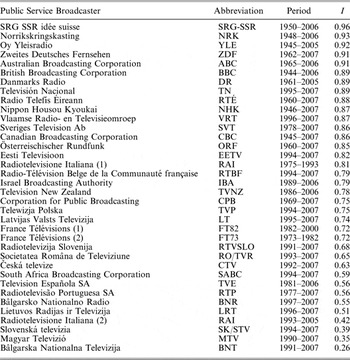
where higher values of I indicate greater de facto independence. Table 1 shows values of I for the thirty-six PSBs included in my sample.Footnote 13 These values need to be treated sensitively. The range of values is limited, and the discrimination at higher levels of I seems limited. The Swiss broadcaster SRG-SSR has a higher value of I than the British Broadcasting Corporation (BBC), but this reflects the fact that BBC directors-general who have retired have done so after seven or ten years whilst SRG-SSR directors have done so after twenty years. This difference, though it affects TOR, does not reflect differences in de facto independence. Additionally, there seems to be no readily identifiable cut-off point above and below which one can talk of ‘independent’ and ‘not independent’ broadcasters respectively.
Ranking of Broadcasters according to Perceived Independence (I)

Note: I is a proxy measure of independence.
The proxy nevertheless agrees with more direct measurements. Polls conducted in Denmark, Britain, Canada, France and Italy show that broadcasters with higher scores were more likely to be perceived as independent by the public: 42 per cent and 38 per cent of respondents believed that the BBC and Danmarks Radio respectively were independent of the government;Footnote 14 a slightly lower percentage (35 per cent) believed CBC was independent of the Canadian government;Footnote 15 22 per cent of respondents thought that the French media in general was independent of political interests;Footnote 16 in a subsequent question, France Télévisions was neither substantially more trusted, nor substantially less trusted, suggesting that if a question had been asked about its independence, France Télévisions would not score substantially better. Finally, older internal polling for Rai showed that only 4.1 per cent of respondents believed Rai to be ‘outside of politics’, which I take to be equivalent to ‘politically independent’.Footnote 17 These responses correspond with the broadcasters’ ranking and relative distance shown in Table 1.
Four Potential Explanatory Factors
The potential explanatory factors identified below are, with the exception of de jure independence, all derived from previous work on the politics of the media. Not all, however, are mutually compatible, or enjoy the same logical standing. Foreshadowing the descriptions below, explanation in terms of the partisanship of the bureaucracy works by altering politicians’ perceptions of the appropriateness of interfering; it therefore falls within a ‘logic of appropriateness’ model.Footnote 18 Explanations in terms of the polarization of the party system and the size of the market for news function by altering PSB journalists’ attitude to their work and, a fortiori, politicians’ perceptions of journalistic output at the PSB. When politicians’ perceptions are positive (or at least not negative), their motives for interfering are reduced (or, more dryly, the net utility derived from interference relative to the status quo ante decreases). Finally, explanations, in terms of de jure independence, work by partially constraining politicians’ attempts to sanction the broadcaster, given adverse views of PSB output. Where attempts to interfere are severely constrained, the politician cannot interfere, no matter how pressing the motive. These three explanations fall within a (constrained) consequentialist logic.
Since de jure independence acts as a constraint after other factors have provided politicians with motives to interfere, one might think that its influence should always be felt. However, legal provisions are never entirely clear or entirely self-enforcing. Where other factors, such as the size of the market for news and party system polarization, furnish politicians with motives to interfere, their interpretation of de jure provisions may be determined more by their motives than by disinterested interpretation of the relevant text. That non-institutional background factors in society have usually been held to be determining in this way is strongly suggested by the way in which typologies of media systems and descriptions of public broadcasters have tended to use geographic and social labels, rather than institutionalist ones, to describe different media systems. This tendency would be more lamentable if further comparative work had perpetuated it; unfortunately, much ostensibly comparative work is primarily based on the experiences of either Britain or the United States.
Bureaucratic Partisanship
The one factor which has been cited in a comparative work on PSB is the partisanship of the bureaucracy. ‘Since a public national broadcasting corporation exists in the same normative framework and in the same political arena as the government bureaucracy, it is likely to have some features in common with it.’ Etzioni-Halevy hypothesizes: ‘countries that have party-politicised bureaucracies are also more likely to have party-politicised public broadcasting corporations as compared with other countries where the bureaucracies have become largely non-partisan.’Footnote 19 Suppose that, subsequent to the establishment of a public broadcaster, politicians engage in a search for appropriate models to guide their behaviour towards the broadcaster, using an availability heuristic.Footnote 20 Given that PSBs in certain respects resemble government departments more than they do corporations, politicians may use the same model that they use to govern their relationships with bureaucrats in their subsequent relationship with broadcasters. Where the model of politician–bureaucrat relations involves party-politicization, politicians will be used to giving partisan orders to bureaucrats, and will subsequently give such orders to broadcasters (and will expect them to be carried out). Where, by contrast, the model of politician–bureaucrat relations involves ‘professionalized’ bureaucracy, politicians will be used to having bureaucrats disallow certain orders as incompatible with basic norms of professional conduct, and will thus not make partisan requests of broadcasters, and/or will accept broadcasters rebuffing such requests.
To operationalize the partisanship of the bureaucracy, I use data from the International Institute of Management Development, which includes in its survey of business executives a question on whether ‘public service … is [or is not] independent from political interference’.Footnote 21 Scores range from 1 to 6; higher scores indicate greater independence.
Size Of The Market For News
The size of the market for news differs widely between European countries. In Sweden and Switzerland, almost 400 newspapers are printed for every 1,000 people. In Spain and Italy, the figure is closer to 100.Footnote 22 These relative differences are stable across time and correlated with past growth in literacy.Footnote 23 They also have important consequences for the perception of journalism in a country. A smaller market for news means that newspaper publishers facing fixed costs will struggle to break even or profit from sales and advertising revenue alone.Footnote 24 Consequently, publishers who remain in business will either not have to care about profit or take subventions from other interested groups.Footnote 25 Examples of the former case include newspapers owned by political parties or large industrial groups (the so-called editori impuri in the Italian case). These publishers or groups will seek favourable coverage in exchange for their subventions, either by pressuring existing journalists or by recruiting on the basis of ideological affiliation. As Giovanni Bechelloni writes of the Italian case, ‘[p]olitical–ideological militancy became, from the twenties and thirties onward, a winning card for entry into the profession. This condition … has meant that the body of Italian journalists has been, in large part, made up of successive cohorts of individuals selected on the basis of their political militancy’.Footnote 26 Such conditions make it difficult for the idea of objective or impartial journalism to flourish.Footnote 27 Journalists are more likely to adopt an idea of journalism as a politically engaged activity.Footnote 28 Patterson and Donsbach found that 74 per cent of Italian journalists rated ‘championing values and ideas’ as very or quite important in their work, compared to 45 per cent in higher-circulation Britain and 36 per cent in Sweden with still higher circulation.Footnote 29
This has consequences for the type of journalism practised by the PSB. The more partial the journalists for hire – partial in the sense that they champion certain values and ideas which are not widely held across society but instead held by particular identifiable groups within society – the more partial the resulting stock of journalists within the PSB, other things being equal. The more partial the stock of journalists within the PSB, the more likely politicians are to see the output of the PSB as a biased activity and, as such, potentially damaging to them and worthy of sanctioning. Conversely, the larger the market for news and the better established the idea of objective or impartial journalism, the more likely it is that PSB journalists will be committed to such ideals, and the more likely politicians are to see the output of the PSB as an attempt to report the facts. Facing negative coverage from today’s facts, they may believe that tomorrow’s facts will lead to better coverage; or, they may believe that sanctioning in response to such negative coverage will be ineffective if journalists are strongly committed to the idea of reporting the facts.
These developments are, of course, mediated by the strategies and the agency of the executives of the broadcaster. Broadcasters may be better at hiring impartial journalists; or may constrain journalists by adopting certain procedural rules governing their journalism. In its most extreme form, they may require journalists to read out news supplied by other companies. Thus, the BBC, Sweden’s Radiotjänst, and Denmark’s Statsradiofonien all began by broadcasting the news they were supplied with by the press agencies. Agency influence persisted: as late as 1936 the Ullswater Committee on Broadcasting was able to state: ‘The BBC … is dependent for the bulk of its news on four commercial agencies’;Footnote 30 and in Denmark, Radioavisen’s news was supplied by the press agencies until the 1960s. Consequently, the mould for public broadcast journalism was set early by press agencies specializing in a terse, factual style. Yet these news agencies are themselves a product of a large market for news: whilst the BBC in 1936 could count on four news agencies to supply them with material, EIAR, Rai’s predecessor in Italy, could only count on one agency, Agenzia Stefani, which supplied only ‘insufficient and stale’ dispatches.Footnote 31
To operationalize the size of the market for news, I have used the natural log of daily newspaper circulation per 1,000 population for each country in 1975. That year is used since reliable data are available for it, and later data would in certain cases be later than the early years of the broadcaster (thus implying reverse causation), and because there is some comparable data for countries which did not exist in 1975.Footnote 32 Newspaper circulation is used because newspapers are the medium which concentrates most on news instead of entertainment generally, because markets in radio and television have for much of the period been state monopolies or otherwise restricted markets, and because newspapers have had a historical role in setting norms for journalism, both in general and through operating as recruitment pools for companies in other media. Because newspaper circulation in Communist countries was artificially inflated, I also use a dichotomous control variable to account for this inflation.Footnote 33
Party System Polarization
Party system polarization has been cited both as a correlate of certain media systems and as a specific explanation of low levels of independence in PSBs. As Mancini and Hallin write, ‘the notion of politically neutral journalism is less plausible where a wide range of competing world views contend’.Footnote 34 Their view is echoed by PSB journalists and managers. Ruggero Orlando, Rai’s London correspondent in the1950s, wrote:
Whereas in Britain, the existing agreement of ‘90% of the people on 90% of the issues’ (Sir Winston Churchill’s figures) leaves ample scope to ‘non-controversial’ political broadcasts, the disagreement between government and pro-Communist opposition runs deep to the foundations of the national constitution which makes it very difficult, and often impossible, to plead absolute impartiality.Footnote 35
The sentiment is not restricted to Italy. Oliver Whitley, chief assistant to the BBC Director-General, claimed that ‘the nation divided always has the BBC on the rack’.Footnote 36
The intuitive idea is that politicians react badly to claims repeated on radio or television that are far from their own preferred positions; they assume that anyone who repeats what they see as such a mistaken claim – a claim which involves what they see as fundamentally incorrect views on the constitutional settlement or nature of democracy – cannot merely be presenting views impartially, but must thereby be endorsing them. Journalism which repeats such claims can defend itself when such claims are rare, as they are in party systems with limited polarization; but journalists cannot so defend themselves when they report claims made by politicians in polarized party systems, where claims made are by definition far apart. Consequently, politicians react by interfering in broadcasting to avoid such objectionable claims being made in the future. This may happen even when the broadcaster repeats the views of extreme positions in a scrupulously fair fashion. At one point, the PSB may be attacked from the left; at another, from the right. Politicians react in this way – runs the argument – not because they are concerned about medium- or long-run balance, but because they believe that some in the broadcasting staff hold deeply mistaken views which make a mockery of impartiality.
Outside of Britain and Italy, this idea seems less applicable. Mancini and Hallin claim that political journalism in Spain is similar to that in Italy because ‘Spain and Portugal … had a form of polarized pluralism … during brief periods of democracy early in the twentieth century’,Footnote 37 but it is unclear why polarized views ninety years ago should affect independence now. Adopting the polarization of the party system as an explanation also means grouping Italy with other countries frequently described as polarized, such as Finland, where, despite a tendency towards self-censorship,Footnote 38 the broadcaster is relatively independent, according to the measures presented in Table 1.
To operationalize polarization, I have used the unweighted range of party left–right scores for each country for parties reported by Huber and Inglehart.Footnote 39 Huber and Inglehart’s measures are used in preference to other data, since they track party position, rather than policy stands: to the extent that polarization is thought to affect independence, it is through the broadcasting of extreme politicians’ statements, rather than politicians’ extreme policy proposals.
De Jure Independence
Perhaps because it has sometimes been used as a proxy for de facto independence, the idea of de jure independence has often been unclear. De jure independence must refer to legal provisions, but which ones? It may seem tautological to suggest that one should include those legal provisions which are thought to have a bearing on actual, de facto independence, but this should draw attention to the fact that every empirical link between de jure and de facto independence itself depends on a theory of which legal provisions are thought to influence independence.Footnote 40
Potential links between legal provisions and de facto independence are numerous. Provisions might involve moral suasion: the presence of a commitment to independence might shame politicians and/or journalists into living up to such a provision. Alternatively, provisions might create (dis)incentives for independent behaviour – say, if licence fee settlements were decided by viewers’ panels. The most common links, however, are the extent of sanctioning methods and the possibilities for selecting executives.
Sanctioning
Assume that PSB executives’ utility is a function of their own income, autonomy and reputation, and the success (commercial or otherwise) of the broadcaster. Politicians can act so as to reduce (increase) these goods contingent on the broadcasters’ actions, thereby sanctioning (rewarding) PSB executives, who will come to anticipate sanctioning and avoid the kind of programming that leads to sanctions, thereby reducing independence. Where sanctioning mechanisms are heavily constrained by law, this effect will be negligible, and the broadcaster will consequently enjoy a high degree of de facto independence.
Appointments
Whilst sanctions operate through changing executives’ actions despite their preferences, appointments may reduce independence by changing the preferences of those at the top of the broadcaster. Where few (political) actors are involved in appointments, the closer the match between the ideal point of the appointing individual and that of the appointed person; conversely, where multiple (political) actors need to agree on appointments, the match between any appointing actor and the appointed person will be looser. Where appointments last for a long time, the greater is the potential that the appointed person’s preferences will diverge from those of the appointing agent over time, thus increasing the possibility for independence. Conversely, the more frequent and more easily revoked these appointments are, the stronger this effect.Footnote 41
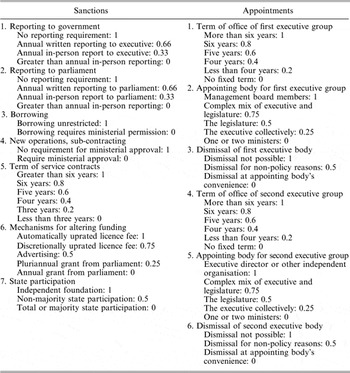
Table 2 presents thirteen indicators used to construct an index of de jure independence using these two links. These indicators are heavily reliant on prior work done by Gilardi and by Elgie and McMenamin.Footnote 42 Items in the first column refer to sanctions; items in the second column refer to appointments. Each is based on legal provisions commonly found in the laws establishing PSBs.
Thirteen Indicators of De Jure Independence

The first two indicators – reporting to government and reporting to parliament – are already used in the literature. Where an agency must report to a political body frequently, the psychological costs of appearing before intense committee pressure and/or questioning and media intrusion can operate as sanctions where members of the committee wish to sanction. Therefore, the more often legislation allows for such reports, the greater the opportunity for politicians to sanction the broadcaster.
‘Borrowing’ is another term used in Gilardi. The idea is this: due to the capital-intensive nature of broadcasting, broadcasters occasionally require large capital expenditure which cannot be met by current revenue streams, but must be borrowed. Failure to invest will result in competitive disadvantage. Where borrowing requires ministerial permission, the minister can threaten to withhold permission either to punish the broadcaster for prior behaviour, or to blackmail the broadcaster and so influence future behaviour. In either event, where legislation requires the broadcaster to seek ministerial permission to borrow, the greater the opportunity for the relevant minister(s) to sanction the broadcaster.
‘New Operations’ is not, to my knowledge, found in other indexes. Due to the high-technology nature of broadcasting, new operational techniques may become necessary, or old operational techniques obsolete; broadcasters may therefore need to adopt new techniques or jettison old ones in order to avoid competitive disadvantage. As with borrowing, where new operations require ministerial permission, the minister can threaten to withhold permission either to punish or blackmail the broadcaster for prior behaviour, thereby influencing its future behaviour.
‘Contract term’ is specific to public service broadcasting. Some public broadcasters are established in perpetuity, as is their qualification as a public service broadcaster. Other public broadcasters are established as companies for a limited time; or their public service concession is time-limited; or, increasingly, agreements regulating the public service concession are set for a limited number of years.Footnote 43 Where such contract terms are limited, the broadcaster is more likely to face periodic intrusion into its operations, and the threat of sanctioning.
Funding is obviously of key importance. Where the funding mechanism guarantees a secure revenue stream, the de jure independence of the broadcaster will be high, as politicians cannot intervene arbitrarily to reduce company revenue. Where the funding mechanism guarantees a secure revenue stream but future increments are subject to political discretion, the broadcaster will be less secure; where the funding mechanism generates a short-term income stream only, and where continuation of that income stream is subject to political discretion, the opportunities to sanction will be numerous. Finally, state participation in the ownership of a company may generate opportunities for sanctioning, where, if the broadcaster is structured as a normal public company with share ownership, the requirement that certain resolutions be approved at annual general meetings may give the share-holding minister power over the broadcaster. (In recognition of this possibility, some laws – i.e., the Portuguese law on radio and television restructuring – explicitly forbid the minister this power.)
The second group of indicators, ‘Appointments’, is largely drawn from Elgie and McMenamin, comprising three indicators (‘Tenure’, ‘Appointing Body’, and ‘Dismissal’) for the first and second executive bodies. An example of a first, or upper executive body, is the former Board of Governors of the BBC or the Fernsehrat of ZDF; an example of a second executive body is the post of Director-General, Intendant, or, more rarely, a multiple-member executive board.Footnote 44
Broadcasters were first assigned scores for each indicator on the basis of the appropriate legislative text.Footnote 45 The two groups of indicators – ‘Appointments’ and ‘Sanctions’ – were then averaged, and the average of the two groups taken as the overall value for the broadcaster’s de jure independence. Alternative specifications of the index of de jure independence do not change the results appreciably. Gran and Patterson argue that the de facto independence of agencies depends not on the mean value of legislative guarantees of independence, but on the minimum, since politicians will attack the ‘weakest link’.Footnote 46 Yet countries which score highly on Appointments also score highly on Sanctions; the correlation between the two terms is 0.91. The specification also matches expert attempts to insulate PSBs from political pressure: the score for one model law on public broadcasting would be the second-highest in the sample, beaten only by Switzerland.Footnote 47
Methodology
The universe of public service broadcasters operating at national level in consolidated democracies consists of approximately fifty cases. From these, I have drawn an availability sample of the thirty-six PSBs listed in Table 1, periodicized according to the duration of the legislative text. The sample is an availability sample in that broadcasters were excluded if they lacked information on legislative standing and/or turnover. Values for the partisanship of the bureaucracy were imputed in five cases using the mean.Footnote 48
This sampling is likely to underestimate the number of low independence broadcasters, since a number of the excluded PSBs have low values of I: numerous government changes in Turkey have been followed by a change in the director-general of TRT, and the average tenure of directors-general of ERT in Greece during the 1980s was eight months.Footnote 49 Nevertheless, such omitted cases seem to be in line with theoretical expectations: both Turkey and Greece have extremely low newspaper circulation per population.
Periodicization of the broadcasters according to legislative standing may seem artificial, given the historical continuity present in the development of the market for news. Given the theoretical interest in identifying the effect of de jure independence, however, periodicization does seem necessary; as for the remaining variables which vary less over time, one can only note that:
one faces continuous problems of ‘aggregation’ of the temporal units … [if] for one aspect of the research the temporal unit of reference is the legislative period, those properties/variables which can be evaluated only at the temporal level of the regime will have to be considered as constant for each legislative period internal to the regime.Footnote 50
The shortest period under consideration is the nine years of France Télévisions under Loi no. 696/1974; the longest is the BBC (1944–2006).
I have used multivariate ordinary least squares (OLS) linear regression to estimate the relative effects of the four potential explanatory factors listed above. The use of a dependent variable bounded between zero and one means that checks for heteroscedasticity are necessary. Therefore, I have reported statistics for the Breusch–Pagan test alongside each model.
Results
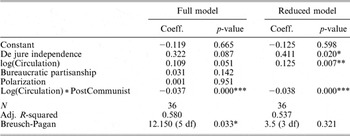
Table 3 shows the results of the regression analysis. The first column of data shows the full model, with all four main explanatory variables and one interaction term included. With an n of 36, this model has too high a ratio of variables to observations. It also faces problems of heteroscedasticity. It is, however, clear from the model that the partisanship of the bureaucracy and the degree of polarization add little to the model, and can safely be removed. The second column shows the reduced model, with all three terms significant at the 0.05 level. All coefficients are in the predicted direction; the value of Cook’s distance is less than 0.25 for all cases, and problems of heteroscedasticity faced by the previous model disappear. The resulting model explains over half of the variance in PSB independence.Footnote 51
Regression Analysis with Full and Reduced Models

*, **, *** indicates significance at the 95%, 99%, and 99.9% level, respectively.
If the model is broadly correct – and if the unexplained variance is not the result of some other systematic factor – then the prospects for designing independent public service broadcasters are relatively good. Assuming average press circulation, an increase from no legal protection to full legal protection would result in an increase from negligible to almost total de facto independence. Of course, these values are never observed in real life, as every PSB law grants the broadcaster some protection. Within the range of observed values, however, the difference between the minimum de jure score of 0.15 and the maximum of 0.82, is, nevertheless, still large. We can understand the substantive significance of these coefficients better if we apply them to a real-world example of PSB reform. In Spain, the Zapatero government, following a report by a committee of sages, drafted a new law on RTVE establishing a single-tier board of twelve members (nominated by the parliament for a non-renewable six-year term), one of whom would be the president of the new corporation. The reformed legal position scores much higher than the previous law of 1980 (0.8 compared with 0.5). The likely effect of the law on RTVE’s independence will be positive: from an independence score of 0.49, the mean predicted independence score would rise to 0.78 (standard deviation of 0.068), fulfilling the intent behind the legislation of liberating RTVE from excessive governmental control.Footnote 52
Conclusion
Given the magnitude of the effects of de jure independence noted above, the potential for designing independent PSBs seems great. If, as I claimed at the beginning, PSB independence is both desired and desirable, then this conclusion should be heartening: within the limits of what can be explained by existing theories, an important determinant of independence – legislative provisions – is easily tractable. Questions of institutional design, however, are rarely simple. Designers often have a multiplicity of goals in mind; there is no guarantee that PSB independence is compatible with other desirable characteristics of the broadcaster. Additionally, asking about the capacity of institutional design to resist politicians’ current desires to interfere in the PSB begs the question of whether these institutions are, as Riker memorably put it, ‘congealed preferences’,Footnote 53 and, if so, just how congealed? If institutional designs intended to preserve independence could easily be rewritten, their worth is greatly diminished. Fortunately, the de jure independence granted by PSB reforms seems only to increase: reforms of the French, Italian and Spanish laws on PSB have all granted greater de jure independence to the broadcaster. Thus, de jure PSB independence tends to congeal upwards, a positive finding if PSB independence is indeed valued as I have suggested.