INTRODUCTION
Recent improvements in radiocarbon (14C) dating methods and Bayesian models have led to significant refinements to the cultural chronologies of many regions of South America, even the short-lived Inca empire (e.g., Rick et al. Reference Rick, Mesia, Contreras, Kembel, Rick, Sayre and Wolf2009; Marsh Reference Marsh2012; Koons and Alex Reference Koons and Alex2014; Korpisaari et al. Reference Korpisaari, Oinonen and Chacama2014; Marsh et al. Reference Marsh, Kidd, Ogburn and Durán2017, Reference Marsh, Roddick, Bruno, Smith, Janusek and Hastorf2019). Improving chronologies has required researchers to identify problematic dates that suffer from issues such as old wood, inadequate pretreatment, and unclear artifact associations. This paper continues that endeavor with a critical evaluation of the discrepancies between 14C and luminescence dates.
In the late 1970s, thermoluminescence (TL) dating was a boon to archaeologists, since it provided cultural chronologies at lower costs. Many projects in South America turned to TL for its main advantage over 14C: it can directly date decorated pottery styles. However, the reliability of luminescence dating has not been adequately evaluated with comparisons between laboratories or methods such as optically stimulated luminescence (OSL) and 14C. The first major effort to compare luminescence laboratories showed there was a higher-than-expected 18% standard deviation for sediment samples (Murray et al. Reference Murray, Buylaert and Thiel2015). Despite potential issues, there is a consensus among Chilean archaeologists that TL dates are reliable for building cultural chronologies (e.g., Falabella et al. Reference Falabella, Cornejo, Sanhueza and Correa2015). In contrast, most luminescence dates in Argentina have produced unexpected results (e.g., Angiorama Reference Angiorama1998; Bárcena Reference Bárcena1998; Stenborg Reference Stenborg2001). With no clear reason for this, inconsistent luminescence dates are often discarded and not mentioned beyond theses and conference presentations, which has hindered a broader assessment of the method.
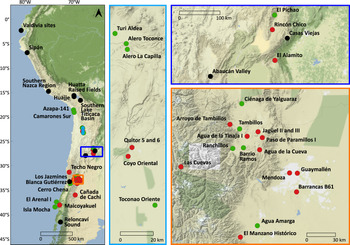
This paper’s goal is to assess the reliability of luminescence ages in the southern Andes by comparing them to 14C and historic dates. We address the problem with three approaches: (1) a compilation of individual paired 14C–TL and historic–TL dates from Argentina and Chile, since nearly all paired dates in South America are from these two countries (Figure 1); (2) comparisons of two Bayesian models of four sets of 14C and TL dates; and (3) a pilot study in Mendoza of 6 sherds dated by 4 methods each: TL, OSL, infrared stimulated luminescence (IRSL), and 14C (see Table 1). Comparisons suggest that luminescence ages do not meet temporal expectations from 14C dates or historic documents. Although issues remain with 14C dates, especially ones run decades ago, the method is continuously updated with inter-laboratory tests and compares well to independent dating methods such as historic documents and crucially, dendrochronology. This is not the case for luminescence dating, which produces inconsistent results in the southern Andes. Hence, we recommend using 14C rather than luminescence dates for building archaeological chronologies.
Map of archaeological sites with luminescence dates in western South America. Summary results of paired-dates tests are indicated by color: if more than half the pairs at a site pass the chi-square test, dots are green, otherwise they are red (Tables 2–4). Black dots indicate sites mentioned in the text but not included in the paired-date tables. The inset map for northern Chile has a light blue border, for northwestern Argentina, dark blue, and for northern Mendoza, orange. The dot labelled Mendoza includes the sites Mendoza plaza, Mendoza town hall, and San Francisco. Las Cuevas includes Las Cuevas 2 and Paramillos de Las Cuevas. Azapa-141 also indicates the location of the Azapa Valley. Made in QGIS 3.18 with a Stamen base map (http://maps.stamen.com/). (Please see electronic version for color figures.)

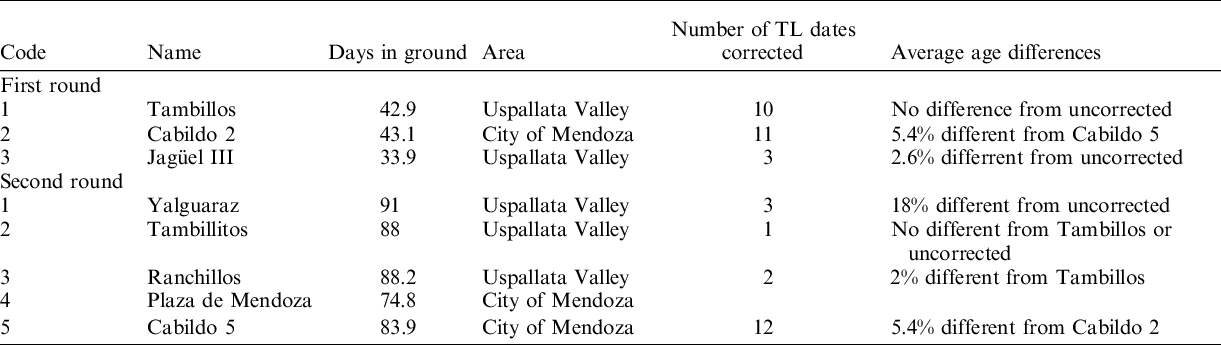
Dosimeters used in Bárcena’s (Reference Bárcena1998: 197–198) TL dates from northern Mendoza. The second round of dosimeters incorporates corrections from a travel dosimeter included during travel by bus or car from Mendoza to Santiago. The dose readings from the dosimeters are not published, so this table compares date corrections made with different dosimeters as a general approximation of their impact on TL dates from northern Mendoza.

BACKGROUND
Early Success with TL Dating of Archaeological Ceramics
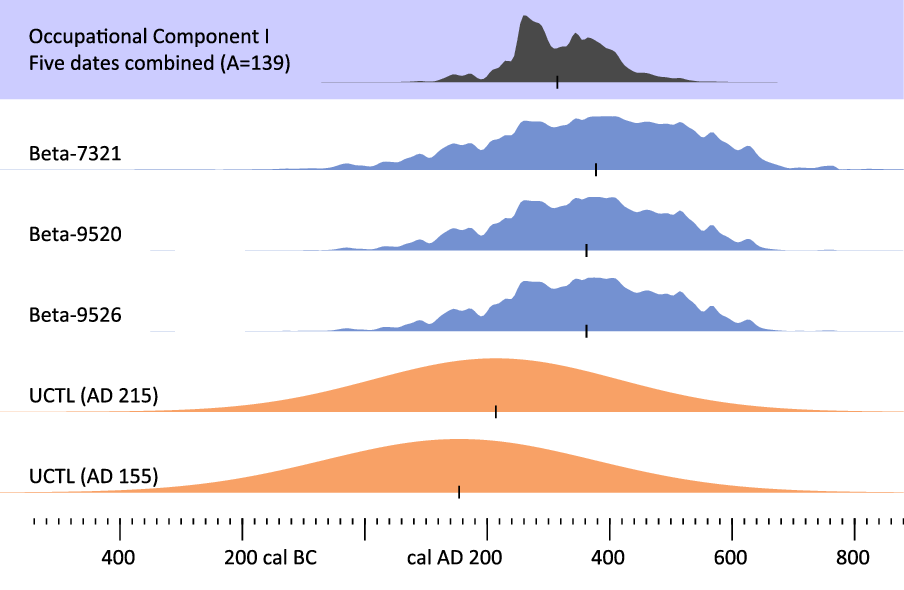
Beginning in the late 1970s, the laboratory at the Pontificia Universidad Católica de Chile (UCTL) made promising headway with TL dates that agreed with ceramic sequences in northern Chile (Brito et al. Reference Brito, Deza, Román and Concha1979; Román and Deza Reference Román and Deza1985; Berenguer et al. Reference Berenguer, Deza, Román and Llagostera1986; Muñoz Ovalle and Chacama Rodríguez Reference Muñoz Ovalle and Chacama Rodriguez1988; Schiappacasse et al. Reference Schiappacasse, Román, Muñoz, Deza and Focacci1991). Initial efforts mentioned 14C dates, but these were often generalized comparisons to dates associated with similar ceramic styles from other sites. Early on, it was acknowledged that TL dates tended to underestimate 14C dates, in both Chile and Ecuador (Stothert Reference Stothert1988; Schiappacasse et al. Reference Schiappacasse, Román, Muñoz, Deza and Focacci1991). However, minor differences did not significantly impact low-resolution regional chronologies or ceramic sequences. This made it common to ignore inconsistencies, which were not even apparent because of large error ranges. For example, at the site Turi Aldea in northern Chile, there are 3 14C and 2 TL dates from a single occupation layer (Castro et al. Reference Castro, Aldunate, Berenguer, Cornejo, Sinclaire and Varela1994; Sinclaire Reference Sinclaire2004). The TL dates’ medians are 145–225 years older, but the error ranges of 120–215 years make them statistically indistinguishable (Figure 2; Table 2).
14C and TL dates from occupational component I at the site Turi Aldea in northern Chile. Because of their large error ranges, these dates pass individual and group chi-square tests. They can be statistically combined with a high agreement index (A=139). 14C probability ranges are in blue; TL in orange. Medians indicated as vertical lines at the base of each distribution. UCTL lab codes were not published.

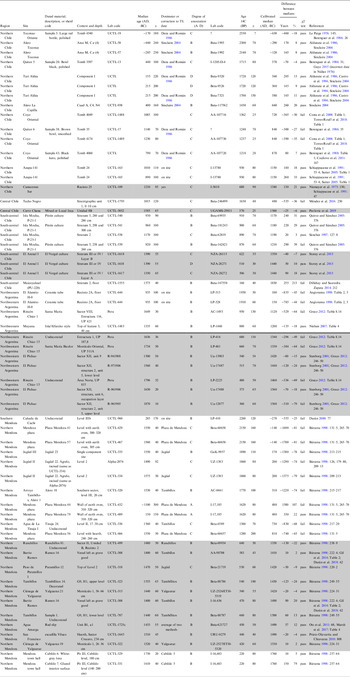
Paired TL and 14C dates from Argentina and Chile. The 22 Inca-period pairs are shaded. Positive differences between medians indicate luminescence dates underestimate the paired 14C dates. Many 14C dates are available in recent compilations (Campbell and Quiroz Reference Campbell and Quiroz2015; Gayo et al. Reference Gayo, Latorre and Santoro2015; Gil et al. Reference Gil, Giardina, Neme and Ugan2014). 14C dates were run on charcoal except the three from Arenal I, which were run on chicken bones.

In Ecuador, phases for the Valdivia culture were defined with TL dates that had large error ranges of ±245–578 years, even though the sherds had excellent characteristics for TL dating (Marcos and Michczyński Reference Marcos and Michczyński1996; Galli et al. Reference Galli, Sibilia and Martini2020: 190). Phasing based on TL and 14C dates tends to agree, but for a few ceramic phases, TL dates consistently underestimate age (Martini and Sibilia Reference Martini and Sibilia2001: 243; Galli et al. Reference Galli, Sibilia and Martini2020: Figure 5). Comparisons have only been made between regional ceramic phases, rather than more rigorous tests of paired dates from the same depositional event. Recently, calibrated 14C dates on pottery residues suggest that early pottery in Ecuador is much older than the TL-based chronology (Tabarev et al. Reference Tabarev, Kanomata, Marcos, Popov and Lazin2016; Kanomata et al. Reference Kanomata, Marcos, Popov, Lazin and Tabarev2019), a significant finding for some of the oldest pottery in the Western Hemisphere.
The accumulation of TL dates led researchers to build cultural and ceramic sequences with both TL and 14C dates, despite some inconsistencies. In part, the paucity of dates motivated them to use as many as possible. It was also more legitimate to question 14C dates in the 1980s, prior to methodological refinements, extensive inter-laboratory comparisons, and refined calibration curves (Bayliss Reference Bayliss2009), in addition to potential problems with old wood and sample–artifact associations. A significant factor in the popularity of TL dates in both Chile and Ecuador was price: they were 75% cheaper than 14C dates (Berenguer et al. Reference Berenguer, Roman, Deza and Llagostera1988: 343; Marcos and Michczyński Reference Marcos and Michczyński1996: 102). Generally, TL dates fit stratigraphic sequences, which built trust in the method. This may partly explain why recent efforts tend to be less careful about using on-site dosimetry and reporting contextual details.
Dates in Chile have the additional advantage of comparability: all dates have been estimated with the same procedures at the same laboratory. UCTL measures the equivalent dose with three methods: plateau, additive with superlinearity correction, and pre-dose (Supplementary Material 1; Brito et al. Reference Brito, Deza, Román and Concha1979; Concha et al. Reference Concha, Román, Brito and Deza1980; Román et al. Reference Román, Deza and Brito1983; Román and Deza Reference Román and Deza1985; Deza and Román Reference Deza and Román1986; Román and Deza Reference Román and Deza1998). UCTL reported that for younger sherds, they prefer the pre-dose method since the luminescence signal is weaker and there is a greater chance of uncertainty; for older sherds, they prefer the plateau method (Bárcena Reference Bárcena1998: 365). The laboratory’s procedures have not changed for decades. They are considered reliable and are used at other luminescence laboratories (for updates to luminescence methods, see Roberts et al. Reference Roberts, Jacobs, Li, Jankowski, Cunningham and Rosenfeld2015).
Elsewhere in the Andes, results are mixed. Some TL dates match high-precision 14C dates such as the exemplary Bayesian chronology of the Sipán tomb complex, even though problematic dates are discarded (Aimi et al. Reference Aimi, Alva, Chero, Martini and Maspero2016; see also Roque et al. Reference Roque, Guibert, Vartanian, Vieillevigne and Bechtel2004). Near Lake Titicaca, TL ages on ceramics from raised fields seem unreliable and have unwieldy error ranges of 90–660 years (Erickson Reference Erickson1988: 194; Janusek and Kolata Reference Janusek and Kolata2004: 410). At the lakeshore site Huajje, TL dates were corrected for feldspar fading and mostly matched temporal expectations (Schultze Reference Schultze2008: 391–397). In the southern Lake Titicaca Basin, TL dates from Qeya-style museum pieces in France underestimate the style’s expected date range, based on Bayesian models of 14C dates and stratigraphy (Marsh et al. Reference Marsh, Roddick, Bruno, Smith, Janusek and Hastorf2019; A. Roddick, personal communication 2021). In the southern Nazca region in Peru, a large OSL study (Vaughn et al. Reference Vaughn, Eerkens, Lipo, Sakai and Schreiber2014) had a number of unexpected results compared to both ceramic seriation and Bayesian models of 14C dates (Unkel et al. Reference Unkel, Markus, Hermann, Johny, Bernd and Volker2012). Since so many factors affect archaeological dates, it is challenging to identify the cause of disagreement between methods, especially when dates do match in some cases. To begin to do this, the next section assesses individual paired dates.
Approach 1: Individual Paired Dates
To evaluate associated 14C and TL samples that archaeologists expect to be the same age, we have adapted Waterbolk’s (Reference Waterbolk1971) categories for more or less certainty of the depositional association between dated samples. Date pairs with higher grades are more reliable data points for testing dating methods.
-
A. Very high probability. For example, a 14C date on organic residue from a pot and a luminescence date from the same vessel, or when a production stamp or seal indicates the production date of the vessel.
-
B. High probability. For example, both samples are from a single depositional event such as a hearth or occupational floor. Samples are spatially close to one another and the context is small and carefully excavated. This includes tombs that were not looted or reused (otherwise tombs are C).
-
C. Probability. For example, the two samples are from the same architectural structure or occupational layer. Contexts are larger and excavations less controlled.
-
D. Reasonable possibility. For example, the samples are from the same occupational layer but different sectors of a site, or from a site with only one period of occupation. These pairs are of little relevance to testing the dating methods and not generally included here.
Since 14C and luminescence date different events, we should expect a lag between them. Luminescence dates a pot’s firing, which should be earlier than its use or deposition, which is dated by 14C dates. Heirloom vessels in graves may have been fired generations prior to the death of the associated individual (e.g., Fitzpatrick et al. Reference Fitzpatrick, Kaye, Feathers, Pavia and Marsaglia2009), but in most cases, the lag is likely no more than a few decades so the dates’ probability ranges should overlap. This overlap can be evaluated with a chi-square test (Ward and Wilson Reference Ward and Wilson1978) implemented with the Combine command in OxCal 4.4 (Bronk Ramsey Reference Bronk Ramsey2009a). Here, we use this approach to compare normal TL probability distributions, irregular 14C calibrations, and uniform distributions for historic ranges. If a date pair passes the test, “we have no statistical evidence to doubt the consistency of the two determinations” (Ward and Wilson Reference Ward and Wilson1978: 30). Radiocarbon dates are calibrated with SHCal20 (Hogg et al. Reference Hogg, Heaton, Hua, Palmer, Turney, Southon, Bayliss, Blackwell, Boswijk, Ramsey, Pearson, Petchey, Reimer, Reimer and Wacker2020), the most appropriate curve for the southern Andes (Marsh et al. Reference Marsh, Bruno, Fritz, Baker, Capriles and Hastorf2018); calibrated medians and probability ranges are rounded by 10 years. Modeled results are presented in italics. We compare medians in years and percentages (Tables 2–4), for example, the 14C date Beta-69935 from Chile is ∼780 years old (calibrated) and its pair UCTL-540 is 240 years younger, a difference that is 31% of its 14C age. This follows the convention in luminescence dating of reporting errors as a percentage of the age, for example, Alpha-2076 from Mendoza was reported as AD 1490±20%. When available, UCTL uses on-site CaSO4:Dy dosimeters to correct TL ages (Deza and Román Reference Deza and Román1986). In this region, most dosimetry corrections are small, reflecting the generally low external dose (Table 1).
Comparisons of 28 historic-period TL dates on floor tiles, bricks, and sherds with known production dates from northern Mendoza, as in Table 2.

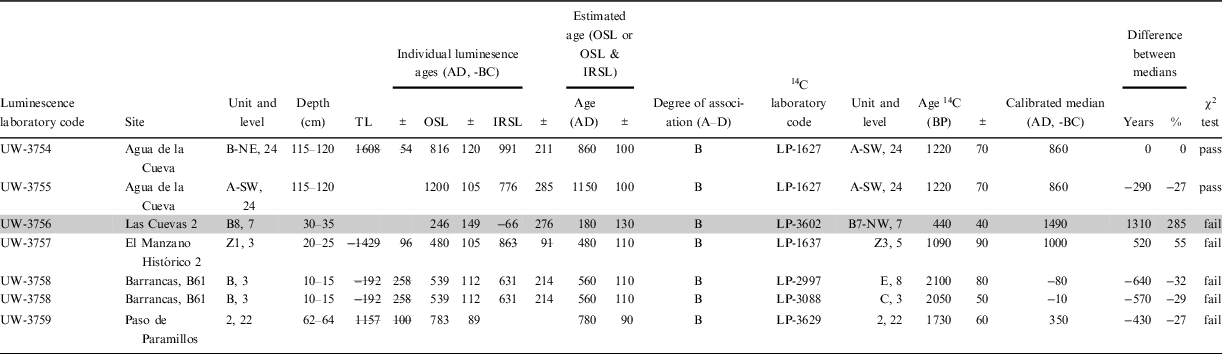
Paired dates from the pilot study in Mendoza. Crossed-out dates were not used by the laboratory to estimate the age. Valid OSL and IRSL dates were combined following Ward and Wilson (Reference Ward and Wilson1978) to arrive at estimated sherd ages. Inca-period pair is shaded.

Date Pairs from Chile and Argentina
Despite the fact that the UCTL laboratory has run over three thousand TL dates, surprisingly few are paired with 14C or historic dates. We identified 59 luminescence-14C date pairs and 28 TL dates on items with known historic production ages from Chile and Argentina (Tables 2 and 3).
Chile
In northern Chile, there are 15 date pairs from 9 sites, which were mostly processed in the 1980s. Most have poor 14C–TL sample associations (C and D), since they are from looted cemeteries, early excavations, or museum collections. There are only four paired dates in Berenguer et al.’s (Reference Berenguer, Deza, Román and Llagostera1986, Reference Berenguer, Roman, Deza and Llagostera1988) original set of TL dates that established the method’s credibility. Most of these early dates had dosimetry corrections but still have large error ranges, allowing 12 of 15 dates to pass the chi-square test. A large body of unpaired 14C dates from the same sites tend to be later than TL dates (Torres-Rouff and Hubbe Reference Torres-Rouff and Hubbe2013; Pestle et al. Reference Pestle, Torres-Rouff, Pimentel and Hubbe2021).
In central and south-central Chile, we identified 10 pairs from 6 sites. Seven pairs pass the chi-square test, but they have low association grades. Some TL dates are earlier than expected, for example at the site Blanca Gutiérrez. While not paired, 8 TL dates from this site are centuries earlier than 6 14C dates (Pavlovic et al. Reference Pavlovic, Troncoso, Massone and Sánchez2000: 179; Soto Reference Soto2018: 53). Similarly, at the cemetery Los Jazmines, 14C dates from graves with Inca-period ceramics are earlier than TL dates run on the same ceramic styles at other sites (Cornejo Reference Cornejo2014; Cortés Reference Cortés2017; Puerto Mundt and Marsh Reference Puerto Mundt and Marsh2021). In south-central Chile, there is a high-grade pair from an occupation surface at Maicoyakuel. The TL date is much older than the 14C date (Dillehay and Saavedra Zapata Reference Dillehay and Saavedra Zapata2014), similar to many historic-period TL dates. At El Arenal I, paired dates associated with pre-Hispanic chicken bones have lower association grades but in fact pass the chi-square test (Storey et al. Reference Storey, Quiroz, Beavan and Matisoo-Smith2013), similar to others from around the Inca period. Farther south, a study around the Reloncaví Sound reports the only luminescence dates in Chile not run at UCTL, but these dates were not paired (Itaci and Flores Reference Itaci and Flores2010).
Northwestern Argentina
In Northwestern Argentina, we identified 11 paired dates from 5 sites. They all had grade-B associations and four passed chi-square tests. These dates include a preliminary study aimed at comparing 14C dates and TL ages run by a Peruvian laboratory (Greco Reference Greco2012). TL dates underestimate paired 14C dates, which could have been due to difficulties in the laboratory (Greco, personal communication 2019). At El Alamito, results were similar, despite corrections with an on-site dosimeter (Angiorama Reference Angiorama1998). A study in the Abaucán Valley included 68 sherds, mostly from the surface, but none had paired 14C dates (De La Fuente et al. Reference De La Fuente, Rasmussen, Ferguson and Glascock2010). This study used results from petrography, magnetic susceptibility, and soil samples to improve results, which were processed at the Missouri University Reactor Research Center, USA. The 17 Inca-style sherd dates are later than expected, with most medians falling between AD 1600 and 1700, during the historic period. It is not impossible that Inca-style ceramics were produced after the fall of the Inca empire, but such late dates have not been documented anywhere else and are likely underestimates. The dates are notably later than 14C-based estimates that the Inca empire was in the area roughly AD 1400–1550 (Greco Reference Greco2012; Marsh et al. Reference Marsh, Kidd, Ogburn and Durán2017).
At the site of El Pichao in the Tucumán province, 4 Inca-period contexts were also underestimated, in this case by OSL and TL dates run in Denmark (Stenborg Reference Stenborg2001). This is the trend in the large set of 42 luminescence ages, though most have acceptable probability ranges. Eight luminescence dates (19%) were discarded with differences of multiple centuries or more. TL and feldspar dates had larger error ranges, so OSL on quartz was preferred (Cornell and Johansson Reference Cornell and Johansson1993). The site of Casas Viejas in the Tafí Valley is known for its large carved monoliths placed atop a mound; 14C dates from the mound’s base strongly agree with medians of AD 90–130 (González and Lagilgia Reference González and Lagiglia1973; Oliszewski Reference Oliszewski2017). Excavation details are too imprecise to treat these as paired dates but one TL date does agree, with a median of AD 120, while another seems to underestimate the context’s age with a median of AD 370 (Núñez Regueiro and García Azcárate Reference Núñez Regueiro and García Azcárate1996). Overall, dates from northwestern Argentina have been processed at different laboratories that have all taken different types of error into consideration, but nearly all ages underestimate paired 14C dates.
Mendoza
Luminescence dating has been used extensively in Mendoza, including a significant study by Bárcena (Reference Bárcena1998) that included a number of paired dates. This study used both on-site and travel dosimeters (Table 1), resulting in minor age corrections of 10–45 years (-3–8.3%), and at one Inca-period site, 60–90 years (15–20%). Bárcena worked closely with UCTL, which refined dates based on dosimeters as well as other sherds from the same sites. The study included 10 TL dates on sherds with known historic production ages (AD 1632–1930). Eight were produced at identified locations in Europe (Schávelzon Reference Schávelzon2001). These are grade-A date pairs with known production ages that confidently date the firing. Despite this, only 3 of 10 sherds pass the chi-square test and age is overestimated in six sherds (Table 3). This can happen when vessels are fired at very high temperatures such as stoneware, though this is not the case for these sherds. In contrast, age was underestimated in one sherd from a large colonial vessel that was probably made locally. The inscribed date, 19 April 1632, could indicate the vessel’s production or perhaps another date the potters deemed important. The trend of overestimating historic ages continues in a set of seven floor tiles and bricks from Mendoza’s historic town hall. Four are from the same level, but the TL ages do not agree; all seven fail a chi-square test against the building’s historically documented construction and use, AD 1749–1861. These deposits are sealed below the rubble of a significant AD 1861 earthquake, which is a clear and well-dated stratigraphic boundary. The adjacent plaza fountain was in use AD 1810–1858 (Bárcena Reference Bárcena1998: 314), but all 12 TL dates estimate ages that are 60–300 years earlier (a 3–16% difference). None of these 24 date pairs pass the chi-square test; however, two colonial sherds from the same excavation do.
For the 11 paired dates older than AD 900, all but one fail the chi-square test. In one case, a single sherd was TL-dated in two different laboratories as UCTL-334 and Alpha-2076. The second date was run by Alpha Analytic, a now-defunct laboratory from Florida, USA, which reported good signal stability and a stable plateau for this sample (Bárcena Reference Bárcena1998: 180). The two luminescence ages overlap, but both underestimate the paired 14C date by more than a millennium. In stark contrast, 10 Inca-period date pairs all pass the chi-square test, as well as 3 historic sherds. TL dates gravitate toward this temporal range: sherds that should be older or younger often have Inca-period TL dates, for example, 8 of the 11 sherds from contexts that are older than AD 900 (Bárcena Reference Bárcena1998: 215, 221, Figure 20). This unexpected pattern was not repeated in our pilot study nor at sites in northwestern Argentina, where luminescence ages from Inca-period sherds underestimate paired 14C dates. There are a number of other studies with unpaired TL dates in the provinces of Mendoza and San Juan (Durán and Novellino Reference Durán and Novellino2003; Cahiza et al. Reference Cahiza, Llorca and Aguilar2008; Gil et al. Reference Gil, Neme, Hernández, Novellino, Giardina, Salgán, Tucker and Albarrán2008; Prieto Olavarría and Chiavazza Reference Prieto Olavarría and Chiavazza2010; Bárcena and Ots Reference Bárcena and Ots2012; Guráieb et al. Reference Guráieb, Carro and Rambla2015; Chiavazza Reference Chiavazza2016). Some dates agree with expectations based on nearby 14C dates or stratigraphic sequences, but many others do not, echoing the trend in paired dates.
Overall, the compilation of paired dates suggests luminescence ages are inconsistent, but each individual case may have factors that might explain mismatched dates. With such a variety of sites, environmental conditions, and laboratory procedures, it is difficult to isolate sources of error for individual date pairs. Hence the next section compares sets of dates with Bayesian models.
Approach 2: Bayesian Models of 14C and TL Dates
We compared 14C-only and TL-only Bayesian models for 3 ceramic styles in northern Chile and the Inca occupation of Mendoza. Since we cannot assess all factors in individual date pairs, we turn to larger samples that should be less sensitive to case-specific problems. If both methods are accurate, independent Bayesian models for each method should show overlap in Kernel Density Estimates (KDE) and starting and ending boundaries (Bronk Ramsey Reference Bronk Ramsey2017).
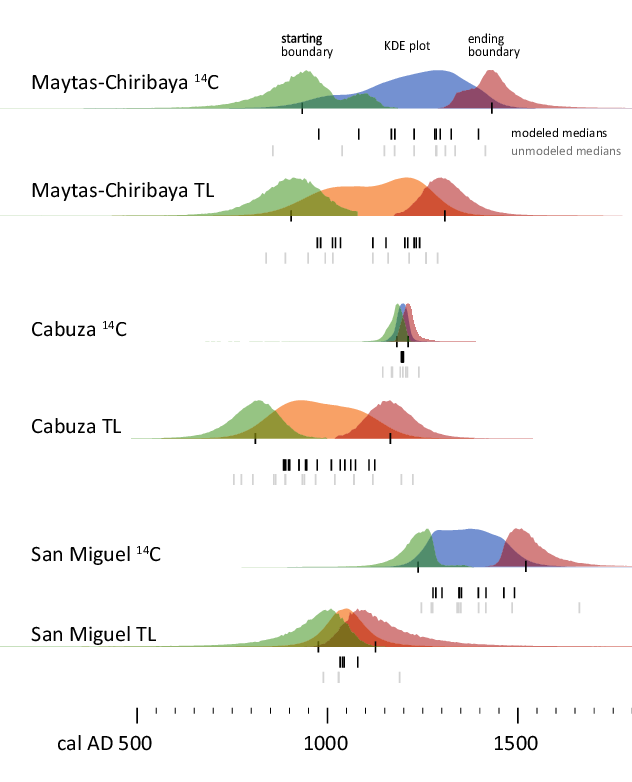
We modeled temporal ranges for 3 ceramic styles with dates from cemeteries in the Azapa Valley in northern Chile, where there are 66 14C and 60 TL dates (Muñoz Ovalle Reference Muñoz Ovalle2019). The lack of agreement between the dates has led to long-running debates on the ceramic sequence (see Korpisaari et al. Reference Korpisaari, Oinonen and Chacama2014: 411–4). The models for Maytas-Chiribaya, Cabuza, and San Miguel ceramics all had acceptable agreement indices (Supplementary Material 2). For the Cabuza models, 3 outliers were removed from the 14C model and 2 from the TL model, following Korpisaari et al. (Reference Korpisaari, Oinonen and Chacama2014).
For Maytas-Chiribaya ceramics, the TL and 14C models agree: the phase boundaries overlap and the KDE trends are similar (Figure 3). In contrast, the models for both the Cabuza and San Miguel ceramics strongly disagree. The TL dates are internally coherent but fall centuries earlier than the 14C dates associated with the same ceramic styles. The TL dates significantly overestimate the radiocarbon dates, the opposite trend seen in individual date pairs. It is unclear why the two dating methods agree for Maytas-Chiribaya ceramics but not for Cabuza ceramics, since microscopic and chemical analysis of the 2 styles show they have very similar paste compositions, firing patterns, and were likely made with local temper and water (Ogalde Reference Ogalde2019: 143–144, 175–176). The reporting and use of dosimetry corrections is inconsistent, a trend seen elsewhere in Chile, but this probably would not have had a major effect on the results (Korpisaari et al. Reference Korpisaari, Oinonen and Chacama2014: 422; Puerto Mundt and Marsh Reference Puerto Mundt and Marsh2021). Most dates were run on individual sherds, which could have been out of primary context since many of these cemeteries have been looted. It is also possible that some of these are heirloom vessels, which would explain the older TL dates. However, individual outliers should not affect Bayesian trends. The 14C models agree with the interpretation that all three styles emerged from the post-Tiwanaku diaspora and should fall after Tiwanaku’s collapse ∼AD 950–1000. This is supported by a large set of 14C dates from textiles and human bones (Cassman Reference Cassman1997; Sutter Reference Sutter2000). Hence, future research may find it productive to proceed without the TL dates.
Bayesian models of 14C and TL dates for 3 ceramic styles from the Azapa Valley, Chile. Green and red curves indicate starting and ending boundaries, respectively. Kernel density estimates (KDE) are indicated in between the boundaries, in blue for 14C dates and orange for TL dates. Vertical lines below the curves indicate modeled and unmodeled medians.

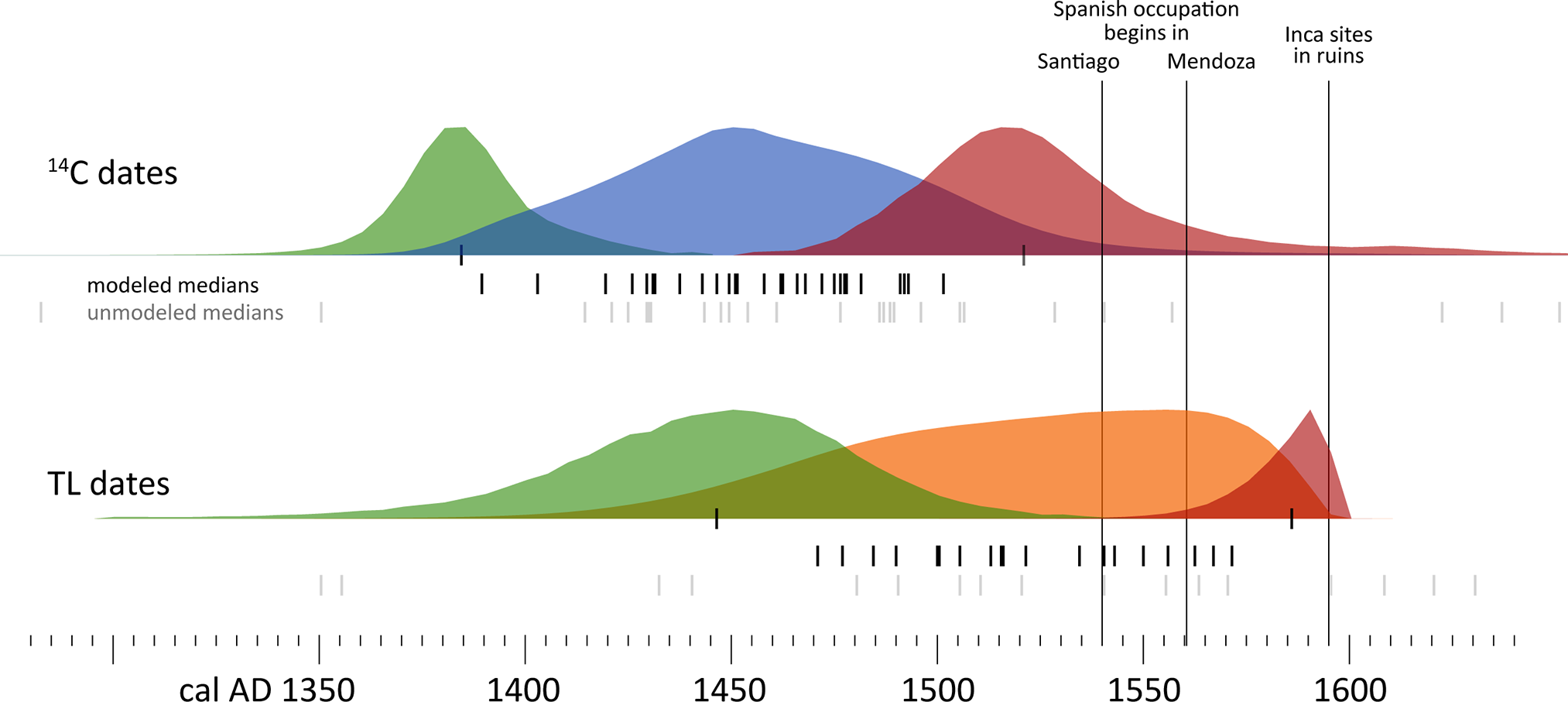
The apparent reliability of Inca-period TL dates led Marsh et al. (Reference Marsh, Kidd, Ogburn and Durán2017: 126) to include them in a Bayesian model of the Inca occupation of Mendoza. This model required complex outlier models that discarded 10 (19%) of 54 dates. Here we compare two single-phase models, one for each dating method (Figure 4; Supplementary Material 2). The 14C model has 31 dates, including eight dates not included in the previous model (Bárcena Reference Bárcena2010; Morgan et al. Reference Morgan, Neme, Sugrañes, Salgan, Gil, Otaola, Giardina and Llano2017; Terraza et al. Reference Terraza, Bárcena and Aguilar2019; Durán et al. Reference Durán, Zárate, Yebra, Frigolé, Gasco, Castro, Winocur, Barberena, Cortegoso, Marsh, Lucero, Andreoni and Zonana2021). Two dates (6%) had low agreement indices (A=22 and 33), which follows the general expectation that a set of dates will have around 5% outliers (Bronk Ramsey Reference Bronk Ramsey2009b). The agreement indices are above 60 and hence acceptable (Amodel=84, Aoverall=76). The Bayesian algorithm converged on a precise starting boundary, cal AD 1380 (1350–1430, 95% probability), despite dispersed medians and large error ranges. This agrees with estimates for the earliest evidence of the Inca empire in northwestern Argentina; a model of 14C dates has the same boundary medians, cal AD 1380 and 1520 (Greco Reference Greco2012: 408–411). The ending boundaries are coherent with the sequence of historically documented events: the first Spanish expedition into northwestern Argentina in AD 1536 (Vitry Reference Vitry2007), the initial Spanish occupation of Santiago in AD 1540, the founding of Mendoza in AD 1561, and two travelers’ reports that the Inca sites were in ruins by AD 1595 (Parisii Reference Parisii1994: 55).
Bayesian models for the Inca occupation of northern Mendoza, as in Figure 3.

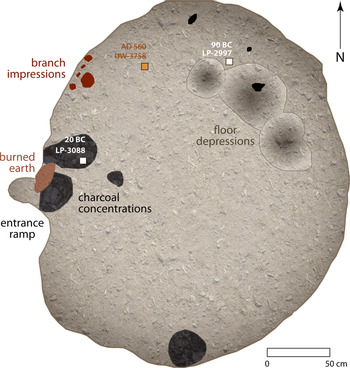
Early pit house from Barrancas, site B61, northern Mendoza, indicating the location, calibrated median, and lab code for each date. 14C samples marked as white squares and the sherd dated by OSRL and IRSL marked as an orange square. Based on original drawing by Diego Estrella.

In contrast, the TL-only model would not converge unless constrained by an ending date of AD 1595. We included two additional dates not included in the previous model (Bárcena et al. Reference Bárcena, Terraza and Iniesta2015). The model’s agreement indices are just below the acceptable threshold (Amodel=58, Aoverall=48). Four of the 21 dates (19%) have low agreement indices (A=28–42), more than expected. Compared to the 14C model, the two boundaries do not overlap and the TL starting boundary is later and much less precise. The KDE suggests continued Inca occupation until AD 1595, which disagrees with historically documented events. The TL model underestimates the dates of Inca occupation, even though overlapping error ranges allow individual date pairs to pass chi-square tests. Hence, we suggest that the updated 14C-only model is our current best estimate of the timing of the Inca occupation in Mendoza.
Approach 3: A Pilot Study of Paired 14C, TL, OSL, and IRSL Dates in Mendoza
The final approach was a pilot study with a set of six sherds from Mendoza paired with 14C dates, all run at the same laboratory in Argentina. The luminescence dates were run at the University of Washington by James Feathers, who used three methods for each sherd: TL, OSL, and IRSL. All sherds were undecorated (Table 4; for methods and photos see Supplementary Materials 3 and 4). These sites were excavated in 5-cm levels, so they have grade-B associations between dated pairs.
One limitation is the lack of on-site dosimeter corrections. Studies in the region show low external rates (Bárcena Reference Bárcena1998; Schmidt et al. Reference Schmidt, Tsukamoto, Salomon, Frechen and Hetzel2012), so we use dates that assume a low dose of 0.5% K, 6 ppm Th, and 2 ppm U, as suggested by the laboratory (Supplementary Material 3). Most likely, on-site dosimeters would result in minor adjustments to the dates, as they did in Bárcena’s (Reference Bárcena1998) study (Table 1). TL dating showed anomalous fading in all sherds, and despite fading corrections, only one sherd produced useful data with a high error of ∼30% (UW-3759). This is a notable result, since anomalous fading may not have been fully considered at UCTL (Román et al. Reference Román, Deza and Brito1983: 10). Hence, for the pilot study, only OSL and IRSL ages are considered.
Barrancas, B61. In the southern Andes, ceramics were first adopted in multiple regions around ~150 cal BC (Marsh Reference Marsh2017). This includes Barrancas, a lowland area with the region’s earliest cemetery (Novellino et al. Reference Novellino, Barchetta Aporta, D’Addona, Estrella, Bernal, Devincenzi, Cortegoso and Durán2013) and pit house at the site B61, which has two very similar 14C dates (LP-2997 and LP-3088; Marsh Reference Marsh2017). The first sample is from a hearth adjacent to the ramp entrance; the second is from a carbon concentration on the other side of the same house (Figure 5). The luminescence-dated sherd is from the same depth (10–15 cm) on the house’s original floor. All three samples are from the better-preserved northern half of the structure, which included details such as the impressions left by branches used to build wattle-and-daub walls.
Structures like this are rarely maintained for more than a generation, so floor refuse is often deposited within a few decades and covered by roof fall, reducing the possibility of mixing with earlier or later material. The sherd from the house floor returned a luminescence date of AD 560±100 (UW-3758). This is many centuries later than the date suggested by the two paired 14C dates, which have a combined median of 50 cal BC. While unlikely, we cannot rule out the possibility that the sherd washed into the pit from a later occupation. It is also possible that differential radioactivity above and below the floor surface affected the age.
El Manzano Histórico. At this site, a similar pit house was found below a modern road. Carbon and artifact concentrations were dense within the house. A 14C date from the floor returned a median of AD 1000 (LP-1637; Cambria Reference Cambria2010; Marsh et al. Reference Marsh, Frigolé and Moyano2014), which is consistent with expectations for the associated Agrelo pottery. An undecorated sherd from a different part of the house was submitted for luminescence dating (UW-3757). Unlike other sherds in the pilot study, the recovered dose was higher than the administrated dose, which may explain the overestimated OSL age, AD 480±100. Only OSL was used, since the TL and IRSL signals suffered from anomalous fading. A high b-value hinted that the age may be underestimated, but in fact, the OSL age is centuries older than the 14C date and all other regional 14C dates associated with this ceramic style (García Reference García2004).
Paso de Paramillos I. This rock shelter is near a mountain pass west of Mendoza (Bárcena Reference Bárcena1998: 220–2). The deposition of the site is cleanly divided into two layers. The lower one has sparse bits of carbon and very few, small lithic flakes. The upper layer has a distinct soil texture and color and includes a much higher density of artifacts and some ceramics. The sherd dated by luminescence (UW-3759) was found lying flat on the stratigraphic boundary between the two layers. The IRSL signal was too weak to obtain an age, but OSL dated the sherd to AD 780±90. It was found within a few centimeters of a dated carbon concentration (LP-3629), which has a median of AD 350, consistent with regional expectations for early highland pottery. The luminescence age underestimates the 14C date by multiple centuries. While there was no sign of stratigraphic disturbance near the sherd, rodent activity could have moved this sherd. A 14C–TL date pair from the site’s upper layer site did pass the chi-square test, though the association between samples is less certain (Bárcena Reference Bárcena1998: 222; Table 2).
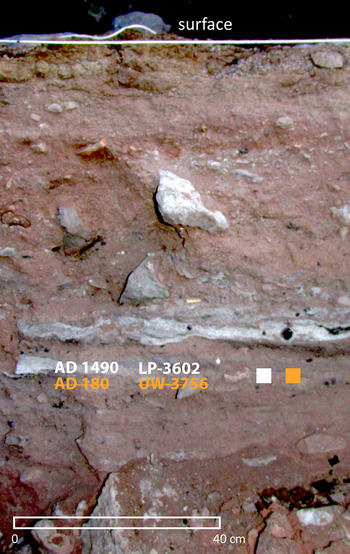
Las Cuevas 2. This is a high-mountain rock shelter in the Cuevas River Valley (3160 m.a.s.l.). The area has lush summer pastures and is located along the natural pass between Mendoza and Santiago (Gasco et al. Reference Gasco, Llano, Durán, Winocur, Zonana and Paiva2021). Excavation material suggested an occupation from around AD 1300 to Spanish contact. The paired samples are from a depth of 30–35 cm in a stratum with carbon and ash lenses and a clayey matrix (Figure 6). The samples were found immediately below field stones that were part of an informal wall. The radiocarbon date has a median of AD 1490 (LP-3602), consistent with diagnostic Inca-period ceramics from this level and the other Inca 14C dates from northern Mendoza. In contrast, the luminescence age of AD 180 (UW-3756) is much older, and there is little agreement between the individual TL, OSL, and IRSL ages. While highly unlikely, it is not impossible that the sherd was made more than a thousand years before it was deposited in this site’s layers of refuse.
West profile of unit B7, Las Cuevas 2. The white square indicates the approximate depth of the 14C sample with its calibrated median and laboratory code; the orange square indicates the same for the sherd dated with luminescence. It is crossed out because it does not match expectations based on diagnostic decorated ceramics or stratigraphy.

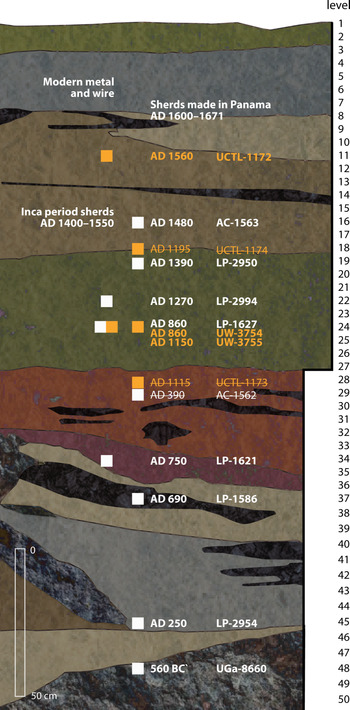
Agua de la Cueva. This site has the most complete sequence of human occupation in the province. Occupation began in the Late Pleistocene (García Reference García2003), but its intensity was much higher over the last two thousand years (Durán and García Reference Durán and García1989; Castro and Yebra Reference Castro and Yebra2018). With one exception (AD-1562, level 29), the nine 14C dates follow the stratigraphic sequence, consistent with the generally undistributed and horizontal deposition of strata (Figure 7; Durán et al. Reference Durán, Gasco, Paiva, Zonana and Barberena2020). The most recent luminescence date (UCTL-1172, level 11) fits stratigraphic expectations, similar to other Inca-period TL dates. Three other luminescence ages (UCTL-1173, UCTL-1173, and UW-3755) underestimate the date of the strata where they were found, which fits the overall trend for individual paired dates. One age (UW-3754, level 24) agrees very well with the 14C date from the same level; both have medians of AD 860. Another luminescence date from the same level (UW-3755) barely passes the chi-square test, but its median is 3 centuries younger. This difference between the luminescence ages is difficult to explain because the sherds’ depositional histories should be very similar. This part of the sequence has few pits or burning events that might affect luminescence ages.
East profile of unit B, Agua de la Cueva (North) with dates, as in Figure 6. UW-3755’s median is three centuries too young, but it does barely pass a chi-square test (Table 4). Squares shifted to the left are from unit A, which is adjacent to unit B. Dates recalibrated from Cortegoso et al. (Reference Cortegoso, Durán and Gasco2014), Durán et al. (Reference Durán, Gasco, Paiva, Zonana and Barberena2020), and Gil et al. (Reference Gil, Giardina, Neme and Ugan2014). Profile redrawn from Castro and Yebra (Reference Castro and Yebra2018: Figure 4), based on original drawings by Víctor Durán and Gustavo Lucero.

The pilot study of ceramics in Mendoza shows that luminescence ages are inconsistently older and younger than paired 14C dates. One possibility is that there was a residual signal left in the sherds that resulted in partial bleaching, but on the other hand, they had good plateaus. Another possibility is that energy levels vitrified the quartz, but regional firing practices make it is quite unlikely that vessels were heated above 1000°C. The dose rate calculations could clearly be improved with local corrections using on-site dosimeters. This may have a minor effect, like Bárcena’s (Reference Bárcena1998) dosimeter corrections (Table 1), or be significantly higher, since luminescence sensitivity is unstable in the Andes. In this case, the dates may be accurate, but with error ranges that are far too large to be useful in constructing archaeological chronologies. It is also possible that post-depositional processes moved samples out of primary position; hence, these are not grade-A date pairs. Overall, the pilot study’s inconsistent results echo those of the other two approaches.
Discussion: Disagreement between 14C, Historic, and Luminescence Ages
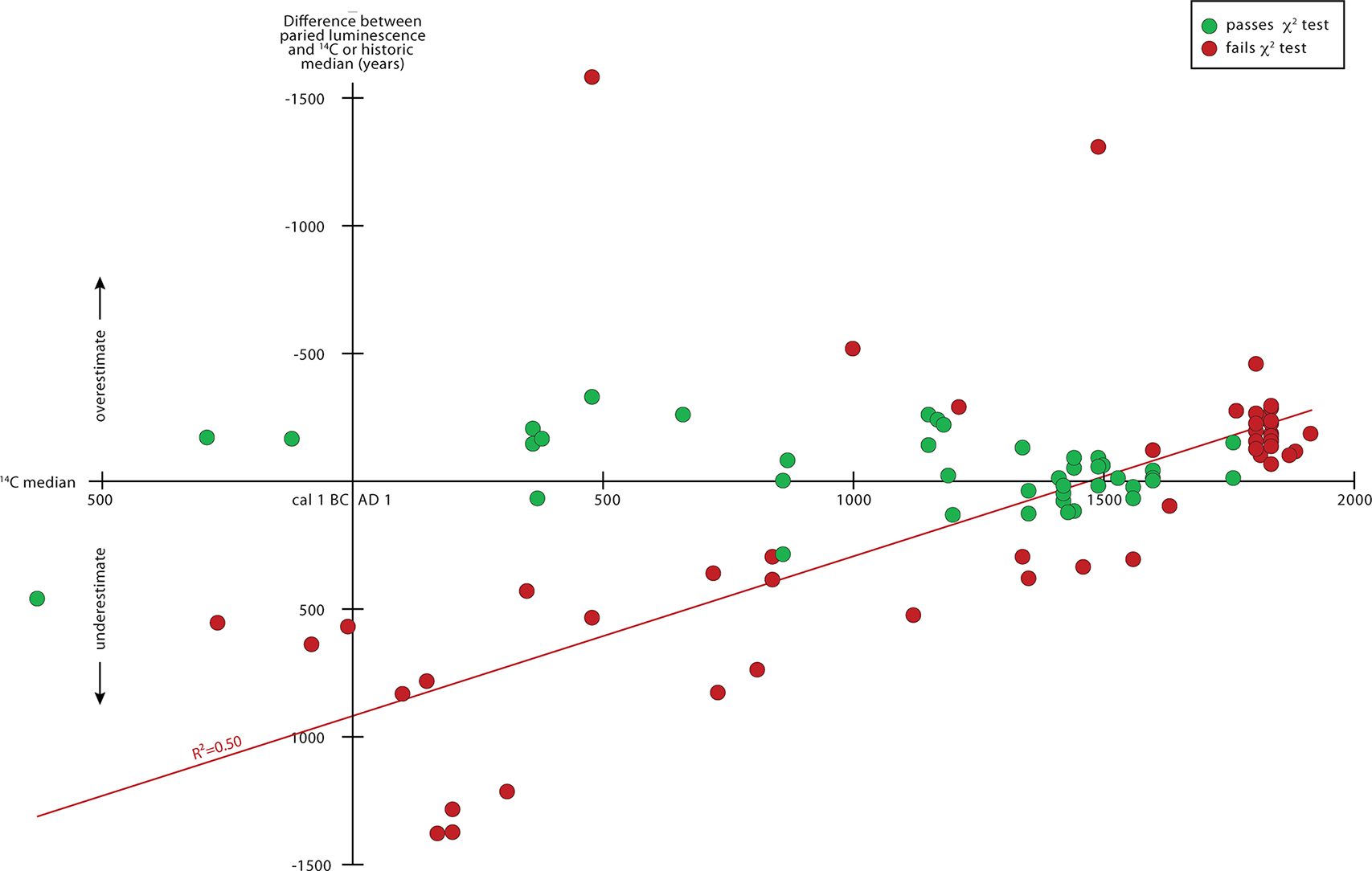
We took three approaches to comparing dating methods, which all show that luminescence dates are inconsistent. Of the 94 paired dates from the literature and the pilot study, 56% fail the chi-square test, with a median difference between paired dates of 300 years or 27% (Figure 8; Tables 2–4). For date pairs that passed the test, agreement was not strong, with a median difference of 90 years or 12%. For date pairs that failed the test, differences increase with age, marking a clear trend line (r2=0.50). This trend line crosses the horizontal axis at AD 1500, which may reflect the fact that some laboratories use this date as an a priori reference point for sherd age, since it is usually clear whether sherds are pre- or post-Hispanic. This may help explain why most Inca-period dates pass individual chi-square tests. Method choice may also help explain this; for example, UCTL prefers pre-dose for younger sherds and plateau for older sherds (Bárcena Reference Bárcena1998: 365). The Mendoza pilot study identified anomalous fading in all sherds, which may be another confounding factor for some TL dates.

Dates that failed the test showed different tendencies for three age ranges. First, older luminescence dates underestimate 14C dates, a tendency identified in the 1980s (Stothert Reference Stothert1988; Schiappacasse et al. Reference Schiappacasse, Román, Muñoz, Deza and Focacci1991). Second, during the Inca period, 78% of pairs pass the chi-square test. Third, in the historic period, dates overestimate the true age. In Mendoza, 25 of 28 TL dates on European-fired sherds, floor tiles, and bricks fail the chi-square test; all but one overestimate the expected dates based on historic records. Sediment dates from northern Mendoza have also reported this trend. In a stratum with three consistent 14C dates, with medians of AD 1760–1850, the associated OSL age was some three centuries older (Schmidt et al. Reference Schmidt, Tsukamoto, Salomon, Frechen and Hetzel2012: 71). In sediments from Chile, refined p-IRIR methods also overestimated the age of two historic events (Brill and Cisternas Reference Brill and Cisternas2020: 9).
UCTL ran 83% of the luminescence dates compared here, but laboratories in Denmark, Peru, and the United States have had no more success despite using updated methods. It is possible that this trend reflects unclear geological variability in northern Mendoza, where 60% of the date pairs come from. However, within this region and others, there is no apparent spatial trend in chi-square results (Figure 1). Furthermore, date pairs with higher association grades are no more reliable: 8 of 11 grade-A pairs failed chi-square tests.
Luminescence Challenges in the Andes
Some of the disagreement between 14C and luminescence ages seems to be related to the young age of the Andes. These sediments have low and unstable luminescence sensitivity and strong regional variation, in contrast to those in Brazil (Sawakuchi et al. Reference Sawakuchi, Jain, Mineli, Nogueira, Bertassoli, Häggi, Sawakuchi, Pupim, Grohmann, Chiessi, Zabel, Mulitza, Mazoca and Cunha2018: 158; del Río et al. Reference del Río, Sawakuchi and González2019). Younger sediments may also show significant variability between grains and dose rate can change over time (Preusser et al. Reference Preusser, Chithambo, Götte, Martini, Ramseyer, Sendezera, Susino and Wintle2009; Degering and Degering Reference Degering and Degering2020). Areas with higher erosion may be more susceptible to this, but this needs to be assessed in each region. In Peru, an age offset between OSL and IRSL ages was attributed to unstable OSL signal components (Steffen et al. Reference Steffen, Preusser and Schlunegger2009). In Chile, feldspar IRSL has proven more reliable than OSL (del Río et al. Reference del Río, Sawakuchi and González2019), and quartz OSL underestimated control ages (Brill and Cisternas Reference Brill and Cisternas2020), perhaps because it saturates earlier than feldspar and has low sensitivity. In Argentina, quartz OSL is more often used (Espizua Reference Espizua1999; Robinson et al. Reference Robinson, Spencer, Strecker, Richter and Alonso2005; Moreiras et al. Reference Moreiras, Hermanns and Fauqué2015). In northwestern Argentina, Spencer and Robinson (Reference Spencer and Robinson2008) used post-IR-blue stimulated luminescence to help improve on OSL ages with poor accuracy and precision. In northern Mendoza, Schmidt et al. (Reference Schmidt, Tsukamoto, Salomon, Frechen and Hetzel2012) used IR-OSL stimulation to remove the feldspar OSL signal from quartz aliquots.
Not all of these adjustments may be relevant to quartz or feldspar temper in archaeological ceramics, since firing should reset TL signals, sensitize quartz, and de-sensitize feldspar. Ceramics are less complex than sediments in terms of partial bleaching or mixing. Since they usually have more clay, they tend to have a higher content of radionuclides, which may make them less sensitive to external dose rates. Some researchers prefer OSL for ceramics because single-aliquot methods are more precise (Roberts et al. Reference Roberts, Jacobs, Li, Jankowski, Cunningham and Rosenfeld2015: 46; Ideker et al. Reference Ideker, Finley, Rittenour and Nelson2017). Others prefer single- and multi-aliquot TL (Galli et al. Reference Galli, Sibilia and Martini2020: 190). The depositional history of each sherd is essential but is often missing from published luminescent ages. Initially, sherds could only be reliably dated from deep homogenous layers (Aitken Reference Aitken1990: 153), but with updated methods, it is increasingly common to date sherds from the surface, complex burial contexts, and museum collections (Dunnell and Feathers Reference Dunnell and Feathers1995; Hood and Schwenninger Reference Hood and Schwenninger2015; Hood and Highcock Reference Hood and Highcock2019). Collection procedures and adequate contextual information are often lacking, which is likely a contributing factor in some of the inconsistencies identified here. For any study, myriad issues must be addressed to produce reliable luminescence ages.
CONCLUSION AND IMPLICATIONS FOR FUTURE RESEARCH
This paper took three approaches to evaluate luminescence ages’ reliability: individual paired dates, Bayesian models of sets of dates, and a pilot study with four methods per sherd: TL, OSL, IRSL, and closely associated 14C samples. These approaches all show that luminescence ages are inconsistent, but there have been some encouraging results such as the Maytas-Chiribaya ceramics in the Azapa Valley. Some TL dates appear to be useful for low-resolution chronologies or relative markers (Berenguer et al. Reference Berenguer, Roman, Deza and Llagostera1988; Bárcena Reference Bárcena1998; Schultze et al. Reference Schultze, Stanish, Scott, Rehren, Kuehner and Feathers2009). However, they seem to be no more reliable or precise than well-documented stratigraphic sequences, which is a much simpler approach. Even sherds fired in European kilns with grade-A associations fail chi-square tests more often than not, which casts a long shadow over the luminescence ages that do seem to be accurate.
This result has significant implications for Chilean cultural and ceramic chronologies, which depend heavily on TL dates, though some are based on 14C dates (e.g., Sierralta et al. Reference Sierralta, Delgado, Kelly and Rebolledo2019). For unpaired TL dates, we cannot say if they (1) place ceramics accurately in time such as the Maytas-Chiribaya style and 44% of individual paired dates, (2) overestimate ages by multiple centuries such as the Cabuza and San Miguel styles, or (3) underestimate age such as 56% of individual paired dates. The general tendency to underestimate 14C dates runs counter to the expectation that luminescence ages of a vessel’s firing should be older than 14C dates associated with its deposition. Coincidences with 14C dates may be masked by large error ranges, which seems to be the case for early dates from northern Chile and Inca period dates in Mendoza. For the Inca dates, individual paired dates pass chi-square tests, but Bayesian models show that TL dates underestimate the age of the Inca occupation. In other parts of the Andes, results are also mixed, probably for similar reasons.
The reasons for the lack of agreement between methods remain unclear, but it is clear that young Andean sediments present a challenge to luminescence dating. We encourage continued work to produce reliable and reproducible ages of both sediments and ceramics in the Andes, as has been done in other regions with older and more stable sediments such as Australia, Brazil, and Uruguay (Roberts et al. Reference Roberts, Jacobs, Li, Jankowski, Cunningham and Rosenfeld2015; Feathers and Nami Reference Feathers and Nami2018; Sawakuchi et al. Reference Sawakuchi, Jain, Mineli, Nogueira, Bertassoli, Häggi, Sawakuchi, Pupim, Grohmann, Chiessi, Zabel, Mulitza, Mazoca and Cunha2018). In these efforts, comparisons between multiple methods and laboratories will be essential. The gold standard may be with pairing luminescence ages with radiocarbon dates of lipids extracted from the same sherd (Casanova et al. Reference Casanova, Knowles, Bayliss, Dunne, Barański, Denaire, Lefranc, di Lernia, Roffet-Salque, Smyth, Barclay, Gillard, Claßen, Coles, Ilett, Jeunesse, Krueger, Marciniak, Minnitt, Rotunno, van de Velde, van Wijk, Cotton, Daykin and Evershed2020). Despite continuing challenges, reliable luminescence ages would be a boon to South American archaeology. At the moment, however, our message to archaeologists working in the Andes is that luminescence dates are not reliable enough for constructing or revising cultural chronologies.
ACKNOWLEDGMENTS
This paper has been enriched through comments, discussions, and citations generously provided by Roberto Campbell, Christina Torres-Rouff, César Méndez, Fernanda Falabella, Carola Flores, Catriel Greco, Andrew Millard, Juan Pablo Ogalde, Omar Reyes, Simón Sierralta, and Vanina Terraza. Susanne Lindauer provided detailed comments on an earlier draft. We thank James Feathers for running the samples in the pilot study, offering guidance throughout the process, and making constructive criticisms of an earlier draft. The pilot luminescence study was funded by the Argentine government through the Agencia Nacional de Promoción de la Investigación, el Desarrollo Tecnológico y la Innovación (PICT 2015-2184). Excavations at Barrancas were partially funded by the outreach program Mauricio López from the Universidad Nacional de Cuyo, Mendoza. Excavations of the site Paso de Paramillos I were part of a 2017 field school in Uspallata, Mendoza, organized by the Institute for Field Research, Los Angeles. Excavations of the sites Las Cuevas and Agua de la Cueva were funded by the Argentine government’s Agencia (PICT-2014-0940, PICTO-2016-0056), an extension project from the Education Ministry (Res. 3408/15), and the Universidad Nacional de Cuyo (SIIP 06/G797-2019-2021). Thank you to all those who participated in the field work. We are grateful to all of these people. Any errors in fact or interpretation are ours.
SUPPLEMENTARY MATERIALS
The following are available in the online Supplementary Materials for this article: (1) English translation of Román and Deza (Reference Román and Deza1998), which briefly describes UCTL methods; (2) OxCal code for Bayesian models of dates from the Azapa Valley, Chile, and the Inca occupation of northern Mendoza; (3) laboratory report from the pilot study, prepared by James Feathers; and (4) photos of the sherds and sherd profiles (40× magnification) from the pilot study.
Supplementary material
To view supplementary material for this article, please visit https://doi.org/10.1017/RDC.2021.82