Introduction
Ageism is defined as: “a process of systematic stereotyping and discrimination against people because they are old” (Butler, Reference Butler and Maddox1995, p. 35) and is a widespread human phenomenon. It is more pronounced among men and more prevalent among younger people (e.g. Rupp et al., Reference Rupp, Vodanovich and Crede2005), but is evident in both genders and all age groups, including the elderly (Levy and Banaji, Reference Levy, Banaji and Nelson2004). When people age they move from a social group of younger adults to a group of older adults. Ageism can then develop into a form of what we term “self-ageism”, that is, negative perceptions about people of one's own age (Bodner, Reference Bodner2009). Secure attachment style, which is a positive form of relating to oneself and to others, was found to mitigate prejudice perceptions toward distinctive social groups (e.g. anti-Semitism; see Mikulincer and Shaver, Reference Mikulincer and Shaver2001). However, the contribution of secure attachment to the understanding of self-ageism has not been studied yet.
Previous studies have reported on inverse relations between some components of quality of life (QoL) among elderly people and negative stereotypes about old age (Hausdorff et al., Reference Hausdorff, Levy and Wei1999). Other studies have shown that attachment styles are also associated with several measures of QoL (Mikulincer and Shaver, Reference Mikulincer and Shaver2009). Nevertheless, none of these studies focused on the relations between ageism, QoL, and attachment styles in late life. The current study is the first to explore the multilateral connection between secure and insecure attachment styles and ageism among the elderly, and the first to examine how attachment styles and QoL are related in late life. In addition, this study will try to explore how attachment and QoL explain the phenomenon of ageism among elderly people.
Attachment style in old age
Old age is usually accompanied by many difficulties and losses (Cuddy and Fiske, Reference Cuddy, Fiske and Nelson2004). The intensified vulnerability of older adults to chronic and incapacitating diseases increases their dependency on caregiving behaviors. It was found that 75% of older mothers indicate their daughters among the three most important people in their lives, and as the person with whom they are most likely to speak when worried and ask for help (Fingerman, Reference Fingerman1996; Reference Fingerman2001). In an innovative study, Steele et al. (Reference Steele, Phibbs and Woods2004) found different attachment patterns (e.g. different levels of proximity seeking, contact maintaining, and overall responsiveness) of mothers with various degrees of dementia during a reunion episode following a 45- to 60–minute separation from their daughters. In short, attachment becomes a central issue in old age, and chronic illnesses in older adults lead the elder to search for proximity to an attachment figure.
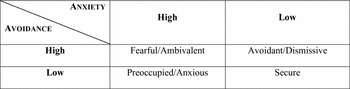
The ability to create and maintain secure attachment (Bowlby, Reference Bowlby1973) may buffer against physical and psychological losses in late life: physical deterioration, cognitive and social decline, loss of self-esteem, death of the spouse, other family members or friends. Secure attachment is built on the sense that when an individual becomes distressed, he/she can approach a significant other who can provide support (Bowlby, Reference Bowlby1973). Secure and non-secure attachment reflect internal working models of the self and others that are based on two dimensions (Brennan et al., Reference Brennan, Clark, Shaver, Simpson and Rholes1998): (i) attachment-related avoidance which reflects preference for interpersonal distance, discomfort with emotional closeness and with dependence on relationship partners, extreme self-reliance, and low emotionality; (ii) attachment-related anxiety caused by intense worries about partner availability and responsiveness, a strong desire for closeness and safety, and worries about one's value to a partner. As shown in Figure 1, these dimensions form four styles (Bartholomew and Horowitz, Reference Bartholomew and Horowitz1991).
Dimensions of the four attachment styles (Bartholomew and Horowitz, Reference Bartholomew and Horowitz1991).

People who score low on both dimensions are defined as “secure”, whereas people who score high on both dimensions are termed “fearful” or “ambivalent”. Those who score high only on avoidance are described as “dismissive” or “avoidant”, and those who score high only on anxiety are referred to as “preoccupied” or “anxious”. Many studies demonstrated that secure children, adolescents and young adults who score higher on measures of actively seeking support are more likely to be empathic to others, and have more positive expectations from others’ supportiveness. A secure base is positively correlated with measures of well-being and good mental health, and negatively with psychopathology and negative affectivity (for a review see Mikulincer and Shaver, Reference Mikulincer and Shaver2009).
Bowlby argued that attachment plays a vital role “in the life of man from cradle to the grave” (Bowlby, Reference Bowlby1979). He also claimed (1979) that although the attachment system is being formed by early interactions with primary caregivers during childhood, it can also be influenced over the entire life span and be activated by actual and psychological losses which evoke a search for protection, support, and guidance. As mentioned before, these losses are particularly evident in late life. Yet, most research on attachment has been focused on earlier periods in life; with relatively little effort directed to the effects of attachment styles on the elderly (see review by Bradley and Cafferty, Reference Bradley and Cafferty2001). These previous studies were directed mainly at how attachment styles are associated with reactive attempts by elderly people to combat stressful life events such as chronic illnesses, bereavements and losses, or physical and psychological deterioration which cause them to become dependent on carers (Bradley and Cafferty, Reference Bradley and Cafferty2001). However, previous studies did not examine the relations between attachment style and what we phrase as “self-ageism” among elderly people, which is one of the aims of the present study.
Quality of Life (QoL) and ageism in old age
The historical origins of the term “quality of life” are rooted in the concepts of “life satisfaction” and “well-being” (Lawton, Reference Lawton, Birren, Lubben, Rowe and Deutchman1991). This term has been adopted by researchers and clinicians to refer to a vast array of domains, including states of psychological distress or well-being, self-esteem and sense of mastery, pain and discomfort, ability to function cognitively, socially, sexually and emotionally, perceived health and the ability to perform daily activities, including self-maintenance and self-care (Stewart and King, Reference Stewart, King, Abeles, Gift and Ory1994).
QoL measures have been widely explored in young adults. However, they have often been neglected in elderly people (Walters et al., Reference Walters, Munro and Brazier2001). Nevertheless, several late life aspects which resemble the above-mentioned domains of QoL were studied with reference to negative and positive perceptions towards old people's own aging (Levy et al., Reference Levy, Hausdorff, Hencke and Wei2000; Reference Levy, Slade and Gill2006; Levy and Myers, Reference Levy and Myers2004). It was demonstrated that negative and positive perceptions toward own aging were related to decreases in motivation, sense of self-efficacy and cognitive performance (Levy, Reference Levy1996). An examination of aged community-dwelling persons revealed that negative age stereotypes were associated with a decline in screened hearing, after a 36-month period (Levy et al., Reference Levy, Slade and Gill2006). Exposure of older individuals to negative aging stereotypes resulted in heightened cardiovascular responses and elevated skin conductance compared to exposure to positive aging stereotypes (Levy et al., Reference Levy, Hausdorff, Hencke and Wei2000). A 20-year follow-up of adults who participated in the Ohio Longitudinal Study of Aging and Retirement (OLSAR) indicated that individuals who practiced more preventive health behaviors had less negative self-perceptions of aging (Levy and Myers, Reference Levy and Myers2004). Stability and walking speed among elderly people were correlated with holding less negative stereotypes about old age (Hausdorff et al., Reference Hausdorff, Levy and Wei1999). An examination of 66,000 people aged over 50 years who participated in the OLSAR community-based survey demonstrated that individuals with more negative self-perceptions of aging lived on average less than those with positive perceptions (Levy et al., Reference Levy, Slade, Kunkel and Kasl2002). It thus appears that QoL and negative perceptions about people of one's own age (self-ageism) are negatively related in older adults.
The present study
The relations between the three concepts of attachment styles, ageism and QoL were not explored multilaterally in any of the abovementioned studies. In line with the current literature, we formulated three hypotheses: (1) secure elderly adults will express less ageism than insecure elderly adults; (2) secure elderly adults will report better QoL than insecure elderly adults; and (3) a negative correlation will be found between QoL and ageism measures.
Methods
Participants and procedure
The participants included 94 elderly people living in urban and rural communities (52.2% female and 47.8% male, mean age 73.20 ± 5.45 years, range 64–85) who were approached by research assistants while participating in day center activities. Most (90%) agreed to participate, signed an informed consent form, and filled in the questionnaires anonymously (incompletion = 10%). Most of the participants had a high school (44.8%) or college/university (54%) education and the remaining (1.2%) had an elementary school education. The self-reported socioeconomic status of the participants was: 70.5% medium-high, 24.4% high and 5.1% low. The majority (75.8%) reported being married or living as couples, the rest as living alone (24.2%), i.e. bachelors, divorcees or widows/widowers. The ethical review committee of Bar Ilan University at Ramat Gan approved the study protocol.
Measures
Demographic information
The demographic questionnaire included questions regarding the participants’ gender, age, socioeconomic status, dwelling situation, formal education and marital status.
The experiences in close relationships scale (ECR)
This 36-item scale (Brennan, et al. Reference Brennan, Clark, Shaver, Simpson and Rholes1998) is recommended in the literature as the best measurement for attachment to people (Mikulincer and Shaver, Reference Mikulincer and Shaver2009). It contains two subscales: attachment anxiety and avoidance in adults. The participants rated the extent to which each item describes their experiences in close relationships on a 7-point scale ranging from “not at all” (1) to “very much” (7). Eighteen items tap attachment anxiety, and 18 tap attachment avoidance. The inventory allows classification into the four attachment styles (Bartholomew and Horowitz, Reference Bartholomew and Horowitz1991). The scales’ reliability and validity have been demonstrated in both English and Hebrew (Brennan et al., Reference Brennan, Clark, Shaver, Simpson and Rholes1998; Mikulincer and Shaver, Reference Mikulincer and Shaver2009). In the current study, Cronbach's α for the anxiety and avoidance scales were high (0.80 and 0.88, respectively), and the correlation between anxiety and avoidance scores was low (r = 0.10, ns).
Fraboni scale of ageism (FSA)
This scale was developed by Fraboni et al., (Reference Fraboni, Saltstone and Hughes1990) for assessing ageism. Due to the scale's multidimensional structure, it is in common use in social studies of attitudes (e.g. Kalaver, Reference Kalavar2001; Rupp et al., Reference Rupp, Vodanovich and Crede2005). Contrary to previous studies that used this inventory for studying ageism among younger adults (Fraboni et al., Reference Fraboni, Saltstone and Hughes1990; Rupp et al., Reference Rupp, Vodanovich and Crede2005; Bodner and Lazar, Reference Bodner and Lazar2008), the current study applied the FSA to elderly people. Therefore, a principal components factor analysis with varimax orthogonal rotation was carried out on the responses of the research participants to the FSA items, after recoding all reverse items. The analysis yielded four factors that explained 51.08% of the variance. It differed from previous investigations which indicated three factors (Fraboni et al., Reference Fraboni, Saltstone and Hughes1990; Rupp et al., Reference Rupp, Vodanovich and Crede2005; Bodner and Lazar, Reference Bodner and Lazar2008). Nineteen items loaded cleanly with a loading of 0.40 and higher on one factor, and less than 0.40 on the other factors. Three items were omitted due to low loadings. Items which associated with the first factor (six items) represent the tendency to avoid direct or indirect contact with elderly people (“It is best that old people live where they won't bother anyone”). This factor was labeled separation (α = 0.73). Items which associated with the second factor (five items) represent negative affects towards elderly people's expected utility to society (“I don't like it when old people try to make conversation with me”). This factor was labeled affective (α = 0.68). Items which associated with the third factor (four items) represent a variety of negative attitudes toward the elderly. This factor was labeled stereotypes (α = 0.60) (“Old people complain more than other people”). The fourth factor (four items) was labeled intergeneration (α = 0.52) (“Old people should find friends their own age”). The FSA thus yielded four separate scores for each participant's expressed ageism based on the means of responses ranging from 1 (less ageist attitudes) to 6 (more ageist attitudes) for each factor.
SF-36 health status scale
The 36-item short-form questionnaire (Ware and Sherbourne, Reference Ware and Sherbourne1992) is commonly used in older community-dwelling people with limited morbidity (Haywood et al., Reference Haywood, Garratt and Fitzpartick2005). Participants are asked to score their evaluations on eight health scales referring to the present and to the past four weeks: (1) physical functioning; (2) role-physical; (3) bodily pain; (4) general health; (5) vitality; (6) role-emotional; (7) mental health; (8) social functioning. The higher the scores the better the perceived QoL (e.g. a high score on bodily pain means less bodily pain). Cronbach's α reliability coefficients are over 0.80 for each of the scales, and there is evidence for good construct validity (Lewin-Epstein et al., Reference Lewin-Epstein, Sagiv-Shifter, Shabtai and Shmueli1998).
Results
Differences in ageism between attachment styles
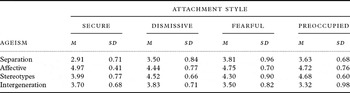
A two-way multivariate analysis of covariance (MANCOVA) was conducted to test the first hypothesis. The attachment styles and gender were the independent variables, and the four ageism measures served as dependent variables. Age was regarded as a covariate variable because the participants’ ages spanned a range of 20 years. MANCOVA yielded a main effect for the attachment style on separation, F(3,72) = 4.25, p<.01, η 2 = 0.15. Further pairwise comparison analyses indicated that secure participants expressed less separation (M = 2.91, SD = 0.71) than fearful participants (M = 3.81, SD = 0.95), but not less than preoccupied and dismissive participants, who expressed moderate ageism on separation (M = 3.63, SD = 0.68; M = 3.50, SD = 0.84, respectively). Gender differences on separation were significant, F(1,72) = 5.16, p<0.05, η 2 = 0.08. Men scored higher on separation (M = 3.71, SD = 0.93) than women (M = 3.20, SD = 0.74).
No significant differences were found between secure and insecure participants in the other three factors. However, it should be mentioned that all participants expressed relatively high levels of ageism in these factors (means 3.9–4.7 on a 6-level scale). Our findings thus partially support the first hypothesis that secure elderly adults will express less ageism than insecure elderly adults. The results of the analysis are presented in Table 1.
Means and standard deviations of ageism for the attachment styles

Differences in QoL scales between attachment styles
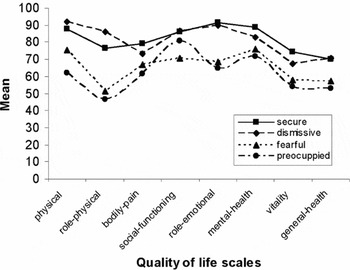
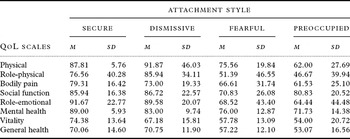
A two-way MANCOVA was conducted to test the second hypothesis that secure elderly adults will report better QoL than insecure elderly adults. The attachment styles and gender were the independent variables, the eight QoL scales served as dependent variables, and age was held as a covariate. MANCOVA yielded a main effect for the attachment style variable with reference to seven of the eight scales: physical, F(3,56) = 3.10, p<0.05, η 2 = 0.14, role-physical, F(3,56) = 4.94, p<0.01, η 2 = 0.21, general health, F(3,56) = 5.89, p<.001, η 2 = 0.25, vitality F(3,56) = 5.90, p<0.001, η 2 = 0.24, role-emotional, F(3,56) = 3.22, p<0.05, η 2 = 0.16, mental health, F(3,56) = 7.08, p<0.001, η 2 = 0.28, and social function, F(3,56) = 3.58, p<0.05, η 2 = 0.16. Means are presented in Figure 2 and Table 2. Further pairwise comparison analyses indicated the same trend for secure attachment: the QoL scores of secure and dismissive participants were significantly higher (p<0.05) than those of fearful and preoccupied participants. Similar but insignificant differences appeared on the bodily pain scale, with means on the lower pole of the scale (more bodily pain). No significant differences in the QoL scales were found between genders, F(8,49) = 1.17, p>0.05, η 2 = 0.15. The interactions of attachment style and gender were also insignificant, F(24,153) = 0.94, p>0.05, η 2 = 0.12. These findings support the second hypothesis.
QoL profiles of the four attachment styles.

Means and standard deviations of QoL for the attachment styles

Explanatory analyses of ageism
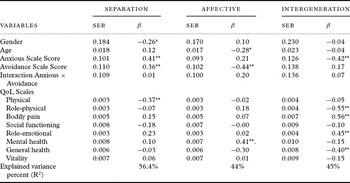
A series of regression analyses were conducted in order to examine the third hypothesis that negative correlation will be found between QoL and ageism measures. The participants’ demographic variables (gender and age), attachment subscales (avoidance and anxious scores separately and the avoidance × anxious interaction), and eight QoL scales served as explanatory variables in four multiple regression analyses. The ageism factor (separation, affective, stereotypes, and intergeneration) was the dependent variable in each separate regression analysis. Table 3 summarizes the results of the three regression analyses. The explained variance for the fourth factor, stereotypes, did not reach significance.
Multiple regression analyses results for explaining ageism

Note: The table is a summary of separate sets of regression analyses.
*p<0.05, **p<0.01, ***p<0.001.
The two attachment scores (avoidance and anxious), the gender and the physical scale contributed significantly to the explained variance on separation. The β coefficients for gender and for the physical scale were negative, indicating that women express less ageism on separation than men, and that the better the physical score, the lower the separation score. The β coefficients for the two attachment scores were positive, indicating that the higher the scores on avoidance attachment and/or anxious attachment, the higher the score on separation. The remaining explanatory variables did not reach significance. The avoidance score, the age and the mental health scale contributed significantly to the explained variance on affective. The β coefficients for avoidance attachment and age were negative, indicating that the higher the scores on avoidance attachment and age, the lower the score on affective.
The anxious attachment score and several QoL scales contributed significantly to the explained variance on intergenerational. The β coefficients for anxious attachment, the role-physical scale and the general health scale were negative, indicating that the higher the scores on anxious attachment, the role-physical scale and the general health scale, the lower the score on intergenerational. The positive β coefficients for the bodily pain scale and for the role-emotional scale indicate that the higher the scores on the bodily pain and role-emotional scales, the higher the score on intergenerational. These finding generally support the third hypothesis.
In conclusion, the MANCOVA analyses showed that attachment styles can explain the variance in agist attitudes and QoL perceptions, so that elderly people with secure attachment style express less ageism (less separation) and report of a better QoL than elderly people with fearful style. These findings were validated and confirmed by multiple regression analyses, which demonstrated that insecure attachment (higher scores on the anxiety and avoidance scales) generally predicts more ageism (e.g. higher scores on the separation factor), and that better QoL (e.g. higher scores on the physical and mental health) also predicts less ageism (e.g. lower scores on the separation and affective factors). Finally, age and gender also contributed to the explained variance of ageism, so that older adults and males predicted more ageism (i.e. higher scores on the affective factor).
Discussion
The present study provides the first evidence of a relation between secure and insecure attachment, ageism, and QoL in elderly people. The study demonstrates the relevance of the attachment theory and QoL for understanding the attitudes of the elderly toward people of their own age. The findings of this study support our three hypotheses. In line with the first two hypotheses, secure elders demonstrated less self-ageism and better QoL than insecure (fearful) elders. Moreover, high scores on the insecure attachment measures (i.e. the anxious and the avoidance subscales), as well as low scores on the QoL scales, predicted more self-ageism. Finally, attachment styles were found to mediate the perception of QoL in the direction of the third hypothesis; that is, secure participants received higher QoL scores.
Two previous reports support our findings that secure elders were characterized by less ageism and better QoL than insecure (fearful) elders: (a) Bodner (Reference Bodner2009) described younger and older adults as having an identical intergroup bias, that is, ascribing themselves to the young age group and therefore valuing young adults and devaluing old adults; and (b) Mikulincer and Shaver (Reference Mikulincer and Shaver2001) demonstrated the mitigating effect that priming of secure base schema has on prejudice against distinctive social groups (e.g. anti-Semitism). Based on these two studies it is possible to assume that the ability to relate positively to oneself and to others, an ability which securely attached individuals have, mitigated the elders’ negative evaluative reactions toward their own age peers (self-ageism).
The regression analyses revealed that the anxious and avoidant subscales were consistently related to three factors of ageism. A high score on the anxious and avoidance subscale predicted a tendency to separate oneself from people of one's own age (high score on separation), and to prefer the company of younger adults (low score on intergeneration). Fear of abandonment may explain the preference for the supportive company of younger adults, who unlike older adults are not socially associated with incompetence (Cuddy and Fiske, Reference Cuddy, Fiske and Nelson2004). It is also possible that elders separate themselves from their age peers, who are prone to ageism, in order to avoid social rejection. Furthermore, a high score on the avoidant subscale predicted a high score on the affective factor. This is compatible with previous findings that describe people with high scores on the avoidant subscale as more emotionally reserved and inhibited (Mikulincer and Shaver, Reference Mikulincer and Shaver2009). These explanations should be studied carefully in future studies. In conclusion, the current findings provide preliminary evidence for the moderating role of attachment styles in the formation of ageist attitudes.
The study also supports the notion that attachment styles mediate the perception of QoL in elderly people. In the present study, secure and dismissive participants reported better QoL on seven scales, compared with preoccupied and fearful participants. This is in agreement with several findings that demonstrated that secure adults perceived stressful events more optimistically than insecure adults, had better mental health, lower levels of negative affects, and better social relations (Mikulincer and Shaver, Reference Mikulincer and Shaver2009). The relatively high QoL scores of dismissive participants may reflect a tendency for “compulsive self-reliance” (Bowlby, Reference Bowlby1973), which generally results in suppression of negative feelings, overshadowing of stressful occurrences, and limited self-disclosure (Mikulincer and Shaver, Reference Mikulincer and Shaver2009).
The relations between QoL and ageism in elderly adults generally supported the third hypothesis. High scores on the physical, role-physical, and general health scales predicted low scores in separation and intergeneration. Thus, in line with the third hypothesis, when elderly people are in good physical health, which enables them to function properly, they may become less focused on age limitations, tend to be more tolerant toward others and demonstrate less ageism. However, contrary to the hypothesis, high scores on the bodily pain, role-emotional and mental health scales contributed to higher scores in affective and intergeneration, i.e. less pain and better emotional and mental condition predicted an increase in ageist attitudes. Thus, it is possible that a “young spirit” in elders leads to derogation of their age-group as reflected in ageist attitudes. These interpretations should be examined in future studies.
Men scored higher than women on the separation factor. This is compatible with previous findings (Fraboni et al., Reference Fraboni, Saltstone and Hughes1990; Kalavar, Reference Kalavar2001; Rupp et al., Reference Rupp, Vodanovich and Crede2005). Age was negatively correlated with ageism (i.e. the affective factor). This is in accordance with earlier findings that ageism decreases with age (Kalaver, Reference Kalavar2001; Rupp et al., Reference Rupp, Vodanovich and Crede2005). Nevertheless, the present study demonstrates that self-ageism is more dominant among older individuals who suffer from insecure attachment, and who report a lower QoL. In line with these findings, future studies can focus on the specific impact of attachment styles on particular aspects of ageism, such as intergenerational relations. Future studies can also explore whether a dismissive attachment style, which was found in this study to be also associated with higher QoL, may have protective functions for the elderly (e.g. reflect their ability to preserve their independence in performing the activities of daily living), which are less relevant for younger individuals.
The current study suffers from limited generalizability because it has relied on a convenience sampling method, with a small sample of community-dwelling participants from medium-high socioeconomic backgrounds. It is thus recommended that future studies in this area would use alternative sampling methods (e.g. stratified sampling) and approach other populations of elderly people from multiple socioeconomic backgrounds (e.g. in assisted living residences). Also, because of the lack of inventories for the assessment of self-ageism, we used the Fraboni et al. (Reference Fraboni, Saltstone and Hughes1990), which was initially constructed for younger adults. It is recommended that future studies should focus on developing other multidimensional ageism inventories that would be applicable for both younger and older adults, and allow comparisons between various age groups (e.g. younger, middle-aged, and older adults).
Several conclusions can be drawn from the results of this study. Based on evidence that meaningful life events create changes in attachments styles among older adults (e.g. Zhang and Labouvie-Vief, Reference Zhang and Labouvie-Vief2004), the current study adds support to the idea that strengthening the secure base of community-dwelling elderly people may also improve their QoL and encourage their social ties with older and younger adults. It may also be worthwhile to broaden this inquiry to elderly people living in aged residential care facilities, who have to adjust to living in a social environment which is mainly composed of other elderly adults. In such an environment, ageist perceptions can be even more devastating to one's QoL than in a community-dwelling setting. In sum, the results of this study suggest that considering the attachment style of elderly adults may assist psychogeriatricians in designing appropriate support interventions that may improve the quality of their final years.
Conflict of interest
None.
Description of authors’ roles
E. Bodner planned the study and decided on the relevant questionnaires. S. Cohen-Fridel analyzed the data. Both authors cooperated through all the stages of the study (data collection and writing, editing and commenting on every section of the paper).