Introduction
Archaeological research on violence and war rarely addresses questions of army size and military organisation, in part due to the nature of the evidence available to archaeologists.
It is generally assumed that “clan-related feuds with personal motivation” occurred during the Neolithic and Bronze Age, whereas major conflicts are associated with the Late Bronze Age and Iron Age (Peter-Röcher Reference Peter-Röcher2007: 187–90). When Early Bronze Age social complexity in many parts of Europe is examined, however, the question of military organisation inevitably arises. Multiple lines of evidence imply some kind of inherent permanent or institutional potential for violence, for reasons of external and internal security. These include settlement patterns, the development of specialised weapons and the accumulation of extreme wealth (represented in particular by weaponry in hoards). This is highlighted by a newly discovered Late Bronze Age battlefield in the Tollense Valley in Mecklenburg-West Pomerania, Germany. The excavators have tentatively estimated that between 2000 and 6000 warriors were involved in the battle in approximately 1300 BC (Terberger et al. Reference Terberger, Dombrowsky, Dräger, Jantzen, Krüger, Lidke, Link and Peter-Röcher2014). Mediterranean documents provide additional information concerning troop strength and conflicts in the central European Middle and Late Iron Ages. Mediterranean eyewitnesses of such clashes were shocked by the large numbers and strength of the “Barbarians” (Polybius (Historiae 2.18.2; Labuske Reference Labuske and Herrmann1988); Livy (Ab urbe condita 38.17.6; Johne & Labuske Reference Johne, Labuske and Herrmann1988)). Even if we assume that the ancient sources were exaggerated and calculate only 10–50 per cent of the actual troop numbers, the army that took part in the Cimbrian War (105–101 BC) would still have numbered between 40000 and 200000 warriors (Diodorus Siculus (Bibliotheca historica 37.1.5; Perl Reference Perl and Herrmann1988)). Given that the central European Late Bronze and Iron Age economic systems and population sizes remained largely unchanged, the possibility remains that armies containing significant numbers of professional warriors existed as far back as the Early Bronze Age.
Naturally, without supportive written evidence, problems with archaeological interpretation arise. New analyses of extant assemblages from Early Bronze Age central German axe hoards (an important feature of the indigenous Únětice Culture), however, have provided an archaeological approach that strongly suggests the existence of well-organised armies with standard weaponry and hierarchical chains of command (Meller Reference Meller, Nicklisch, Orschiedt, Alt, Meller and Schefzik2015). This new interpretation offers an alternative explanation to the proposition that hoards served as gifts to the gods (cf. Hänsel Reference Hänsel, Hänsel and Hänsel1997). New excavations carried out at the monumental ‘princely grave’ Bornhöck, near Dieskau in Saalekreis District (Meller & Schunke Reference Meller, Schunke, Meller, Hahn, Jung and Risch2016), and in-depth examination of the structure of Únětice society have also contributed to this other interpretation (e.g. Schwarz Reference Schwarz, Meller, Risch and Pernicka2014; Knoll & Meller Reference Knoll, Meller, Meller, Hahn, Jung and Risch2016).
The Únětice Culture in central Germany and its socio-political interpretation
The pottery, in particular, of the Early Bronze Age Únětice Culture can be traced back stylistically to Late Neolithic Corded Ware and Bell Beaker Cultures. From approximately 2600 BC onwards, these cultures, coming from the east or west respectively, converged in central Germany (Schwarz 2015). Grave goods and evidence for violence indicate the presence of archers and battle-axe warriors in these communities. Burials containing such evidence of violence (e.g. skeletal trauma from arrow and axe wounds) suggest that it was used both in ambushes and in ritual single combats (Meyer et al. Reference Meyer, Brandt, Haak, Ganslmeier, Meller and Alt2009; Meller et al. Reference Meller, Nicklisch, Orschiedt, Alt, Meller and Schefzik2015). Numerous male graves with weapons, along with the erection of commemorative statue menhirs, demonstrate the ideal, lived by some of the men, of the lone warrior, rooted in an ‘heroic’ way of life (Vandkilde 2006; Schwarz 2015: 699–703).
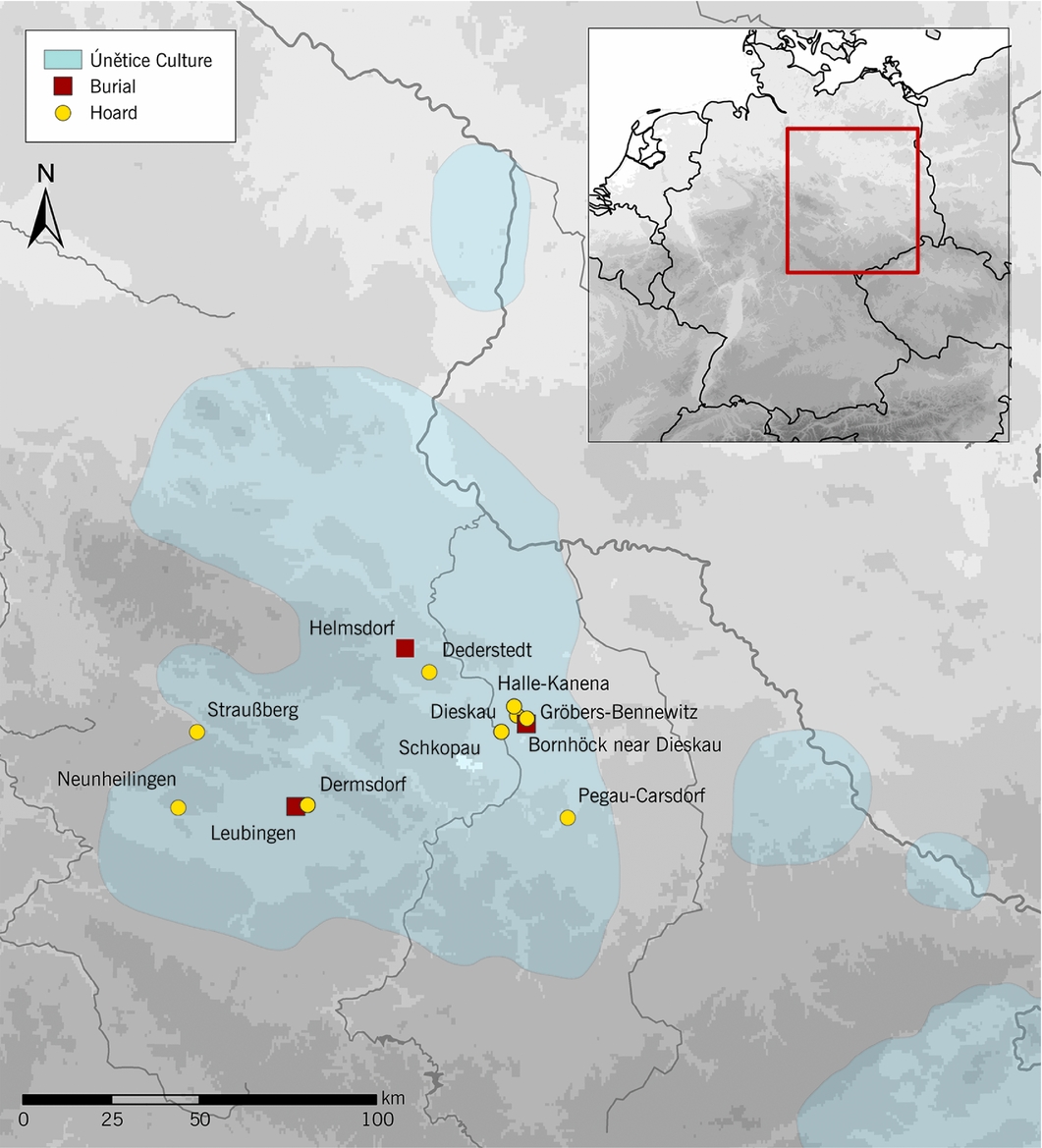
From these Neolithic predecessors, the Únětice Culture developed from approximately 2200 BC in central Germany, Silesia, Greater Poland, Bohemia, Moravia, Lower Austria and western Slovakia (Figure 1; cf. Zich Reference Zich1996). Such a long-lived and homogeneous cultural region had not existed in the area between the Harz Mountains, Oder River and Danube knee since the Early Neolithic Linear Pottery Culture. At first glance, the Únětice Culture appears to have been relatively peaceful, experiencing little internal or external conflict over several centuries. This can be shown quite clearly using central Germany as an example. Numerous villages were found along rivers and waterways, with associated fields on consistently fertile ground behind the settlements (Evers Reference Evers2012). Despite intensive investigation, fortified settlements, manors or hilltop settlements that existed in many prehistoric periods have not yet been discovered in central Germany (Ettel & Schmidt Reference Ettel and Schmidt2011). Neither has it been possible to identify a hierarchical structure in settlement patterns.
Distribution map of the Early Bronze Age Únětice Culture (c. 2200–1600 BC) in central Germany and the sites mentioned here. Map by A. Swieder; base map (GTOPO30) courtesy of the USGS, public domain; rivers and lakes (WISE) courtesy of the EEA, licence CC-BY 4.0.

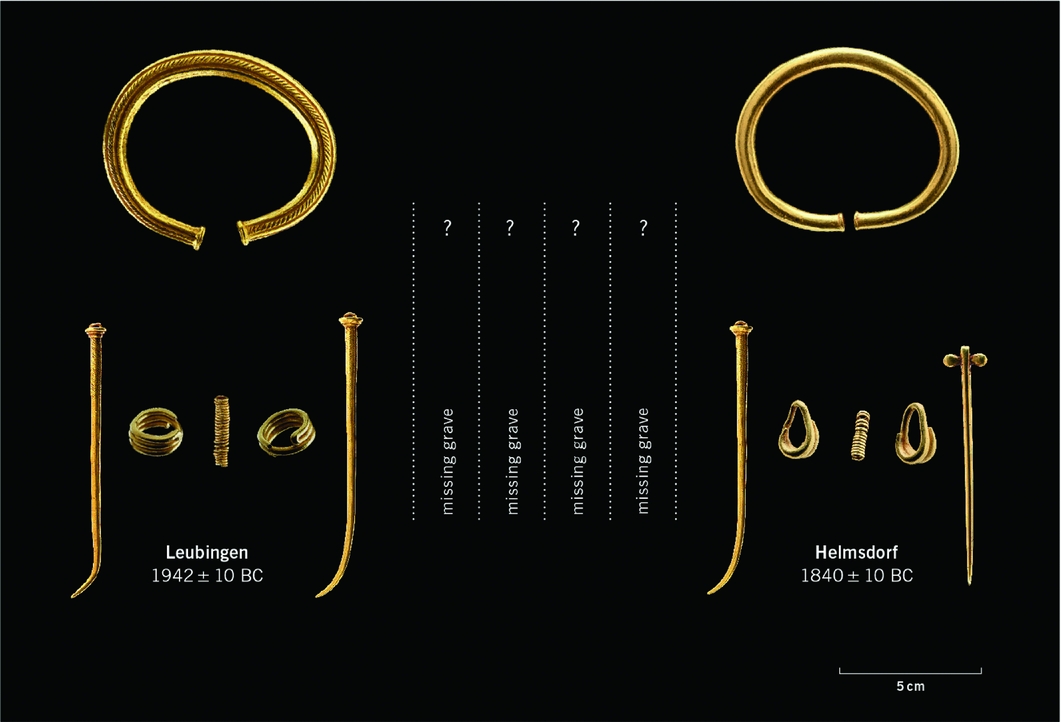
A closer inspection of the numerous graves, however, provides a completely different picture. Burial structures and grave goods reflect a strictly hierarchical society from as early as 2000 BC (Figure 2; Schwarz Reference Schwarz, Meller, Risch and Pernicka2014; Knoll & Meller Reference Knoll, Meller, Meller, Hahn, Jung and Risch2016). At the top of the social pyramid were the distinctive, so-called ‘princely graves’, such as those found at Leubingen and Helmsdorf. In contrast to the usual crouched burials, the ‘princes’ were buried in a supine position. Their elevated status was demonstrated by a standardised ensemble of gold jewellery consisting of hair-rings, pins and a bracelet, for at least a century between the Leubingen and Helmsdorf burials (Figure 3; Meller 2014: 628–40). Their roles as commanders, rulers and warriors followed an earlier pattern evidenced by unusually large numbers of daggers, halberds and axes in the graves (Hansen Reference Hansen, Meller and Bertemes2010: 83–85). This high-status group was followed by a second tier of individuals whose graves did not always contain weapons and who were characterised by far less gold (represented by gold hair-rings, a distinctive feature known since the Bell Beaker Culture) (Meller 2014: 616–28). The third tier included only a few burials containing axes and daggers, while the fourth tier consisted of graves characterised by bronze goods, often in the form of one or two pins. The two bottom tiers contained burials with ceramic vessels only, or completely unfurnished graves (Schwarz Reference Schwarz, Meller, Risch and Pernicka2014: 719–25).
Model of social organisation within the Únětice Culture of central Germany, based on an analysis of grave inventories (after Schwarz Reference Schwarz, Meller, Risch and Pernicka2014: 718, fig. 1a). Graphic design by R. Schwarz and B. Janzen.

Gold jewellery, including a bracelet, lock-rings and eyelet pins (such as that found in the dendrochronologically dated graves at Leubingen and Helmsdorf) were the distinctive hallmark of the ‘princes’ for at least 100 years. Photographs by J. Lipták, graphic design by B. Janzen.

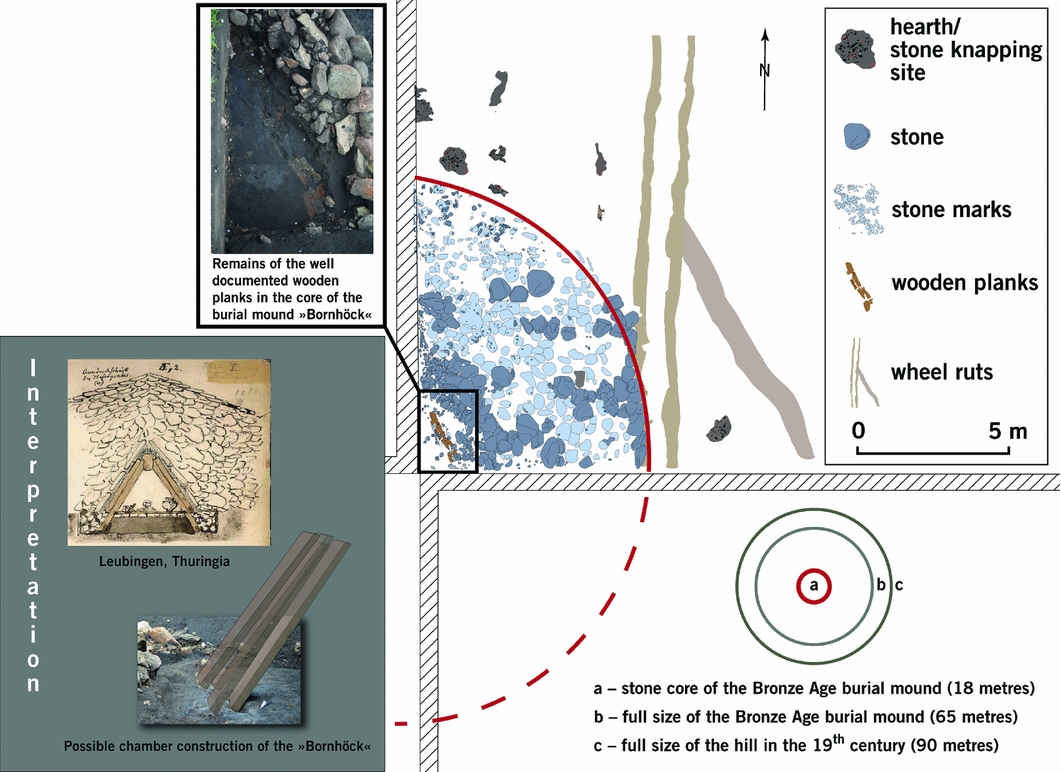
Excavations at the recently discovered burial mound Bornhöck, near Dieskau in Saalekreis District, have provided the first indications of an additional, higher-level political and social stratum. The burial mound measured nearly 20m in height and almost 90m in diameter in the mid nineteenth century, although it was later removed by farmers between c. 1865 and 1874. The diameter of the mound in the Early Bronze Age would have measured approximately 65m, and was enlarged in later periods. As with the graves at Leubingen and Helmsdorf, the mound would originally have had an approximately 18m-diameter stone core, consisting of erratic (glacially transported) boulders surrounding a tent-like chamber constructed of oak boards (Figure 4). The stone core and chamber was severely disturbed and robbed-out. The mound was erected in the nineteenth century BC, or shortly after (Meller & Schunke Reference Meller, Schunke, Meller, Hahn, Jung and Risch2016).
Excavation plan of the core of the large burial mound Bornhöck near Dieskau. It shows the remains of the tent-like burial chamber, the stone packing and the wheel ruts made by the carts used to transport the construction materials. Graphic design by J. Filipp.

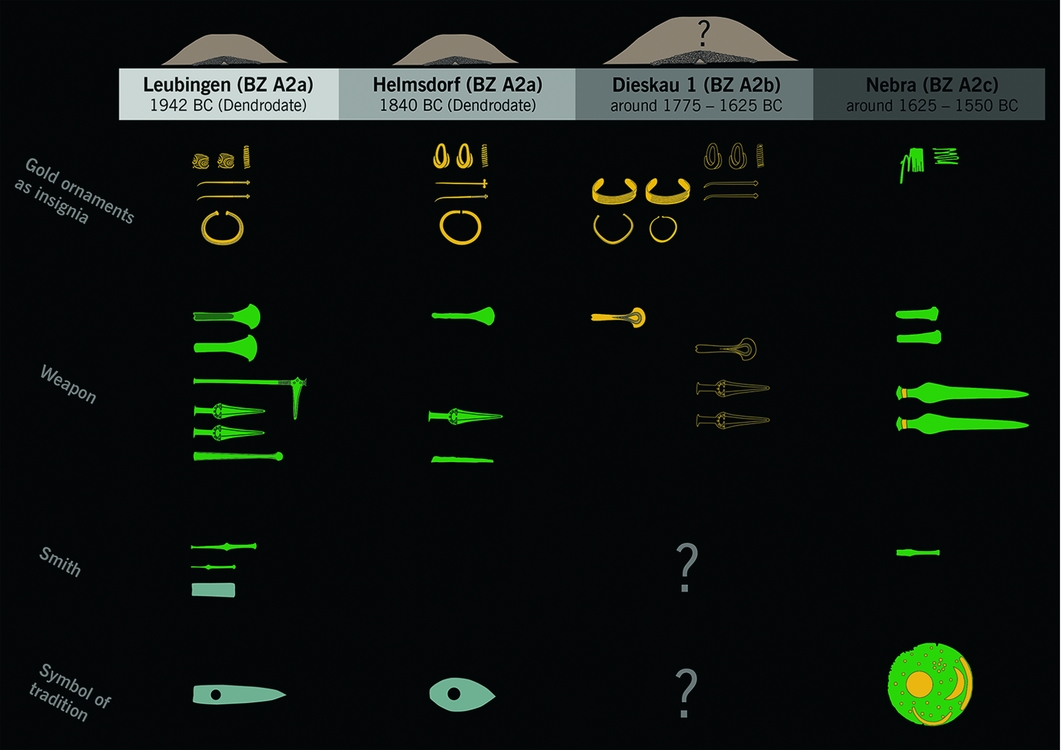
The Dieskau 1 assemblage of gold finds (a flanged axe, two bracelets, an arm ring and an ingot torque), which was previously interpreted as a hoard, possibly originated from this large burial mound (Figure 5). A further eight artefacts from the Dieskau assemblage appear to have been lost (Filipp & Freudenreich Reference Filipp, Freudenreich, Meller, Risch and Pernicka2014). The gold finds had been discovered during construction work only 2.7km north of the burial mound Bornhöck in the same year (1874) as its removal by farmers had been completed. Moreover, the character of the Dieskau assemblage is more suggestive of a grave assemblage, rather than of a hoard. The gold axe is reminiscent of a group of unique gold weapons, which were placed in exceptional graves and hoards from the third millennium BC onwards. This mainly occurred in Egypt, the Near East and south-eastern Europe. The only comparable central European find known to date is the gold dagger from Inowrocław in Poland (Primas Reference Primas1988).
Reconstruction of the possible set of gold ornaments placed in the burial mound Bornhöck, based on the gold find from Dieskau 1. Five of the thirteen gold objects found originally have survived (arm rings, axe). The remaining eight objects were hypothetically reconstructed based on analogies from the ‘princely graves’ at Leubingen and Helmsdorf, and are shown only in outline. Graphic design by J. Filipp.

The micro-region around Dieskau has yielded the largest quantity of Early Bronze Age metal finds anywhere in Europe, comprising more than 150kg of bronze and approximately 650g of gold (cf. Filipp & Freudenreich 2016)—and potentially more than 1kg of gold, if the lost Dieskau artefacts are included. The hoards date to the period between 1950 and 1650 BC (Meller Reference Risch, Meller, Meller, Bertemes, Bork and Risch2013: 518–19; Filipp & Freudenreich Reference Filipp, Freudenreich, Meller, Risch and Pernicka2014: 756–57).
Both the Bornhöck mound and the hoards imply that this location was a centre of power over a period of several centuries, starting with the construction of the burial mound around the nineteenth century BC, and lasting until the period between 1600 and 1550 BC. Such a power structure would have had no comparisons in central European prehistory in terms of its longevity and size (Meller Reference Risch, Meller, Meller, Bertemes, Bork and Risch2013: 520–23). This provides a clearer definition of the central German Early Bronze Age power structure, with the Leubingen and Helmsdorf ‘princes’ belonging to the second tier of the ruling class, and the leaders of the Dieskau region forming the tip of the power pyramid (Figure 2).
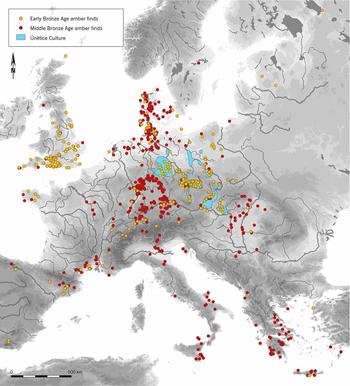
Recent studies on the circulation of raw materials suggest that the Únětice ‘princes’ did not primarily derive their wealth from salt exploitation or central German copper, as has often been assumed (e.g. Montelius Reference Montelius1900: 77–78; Jahn Reference Jahn1950: 86). Rather, it was their location—north of the Central German Uplands, between the Elbe and Oder Rivers—that facilitated control over the exchange of goods between the north and the south. The distribution of Baltic amber shows that this control operated very smoothly (cf. Stahl Reference Stahl2006, for example). Before the collapse of Únětice rule, amber was contained within the territory of the Únětice Culture and that of its trading partners in the Alpine region. After the system broke down, however, amber suddenly began to arrive in western Germany and in areas as distant as Italy and Mycenaean Greece (Figure 6). In Bohemia, the same process occurred but slightly earlier. The classic phase of the Únětice Culture in Bohemia (c. 2050/2000–1800/1750 BC) was characterised by an extraordinary increase in amber, which disappeared abruptly when the phase ended. Subsequently, amber mainly occurred in the northern Carpathian Basin in the Mad'arovce-Větěrov cultural complex (Ernée Reference Ernée, Meller, Bertemes, Bork and Risch2013). The absence of amber in the former Únětice region after 1600 BC is particularly worth noting. The development of the Nordic Bronze Age, which was reliant on the largely unlimited supply of copper from the south via Central Europe, also occurred after the collapse of the Únětice Culture around 1600 BC (e.g. Vandkilde Reference Vandkilde1996, Reference Vandkilde2014; Risch & Meller Reference Risch, Meller, Meller, Bertemes, Bork and Risch2013: 606–607, Reference Meller, Nicklisch, Orschiedt, Alt, Meller and Schefzik2015: 252–53). These factors clearly show that the regions once peripheral to the Únětice Culture benefitted from the decline of the central power.
Distribution map of Early Bronze Age (c. 2200–1600 BC) and Middle Bronze Age (c. 1600–1300 BC) European amber finds against the background of the Únětice Culture (2200–1600 BC) distribution area. Map by A. Swieder; base map (GTOPO30) courtesy of the USGS, public domain; rivers and lakes (WISE) courtesy of the EEA, licence CC-BY 4.0.

The lack of fortified or hilltop settlements in central Germany is another indication of the power (and probably also the potential for violence) that the Únětice, and particularly its elites, exhibited. The existence of a stable social order is further supported by the constant supply of raw materials from the same sources from the eighteenth century BC onwards—for example, gold from Cornwall in Great Britain, or copper from Mitterberg in Austria (Pernicka Reference Pernicka, Meller and Bertemes2010; Ehser et al. Reference Ehser, Borg and Pernicka2011; Lockhoff & Pernicka Reference Lockhoff, Pernicka, Meller, Risch and Pernicka2014). Moreover, the standardised production of metal objects (axes, rings and the like) indicates the existence of specialised established workshops. This is reiterated by the homogeneous composition of axes found in hoards (see below). Above all, what the Únětice rulers required to protect their unrivalled position of power (besides a consistent ideology) was a well-organised and professional army that could keep the peace both internally and externally, purely by virtue of its existence.
Únětice social structure as reflected in its graves and hoards
Considering the Early Bronze Age graves as a whole, it becomes obvious that, compared to previous periods, the presentation of men as warriors played a very minor role in Únětice society; axes, halberds and daggers are rarely, if ever, found in graves. The large number of Únětice Culture hoards suggests that the exclusion of weapons from a grave was not necessarily a reflection of the deceased's role in life. Initially consisting of mainly jewellery, dress accessories and rings, to which axes and other weapons were later added, these hoards can be classed as equipment hoards (Meller Reference Risch, Meller, Meller, Bertemes, Bork and Risch2013: 516–17, tab. 2). These central German hoards, which largely date from between 1950 and 1650 BC, contained a total of 1174 axes, 36 halberds, 20 daggers and 11 double axes (Meller Reference Risch, Meller, Meller, Bertemes, Bork and Risch2013: 516–19). In contrast, graves from the same period have only yielded 10 axes, 3 halberds and 27 daggers. The warriors’ weapons were, therefore, preferentially placed in hoards, rather than graves. This chiefly applies to the axe-bearing warriors, as very few axes are found in graves. The situation differs for daggers, which are more frequently found in graves than hoards, and sometimes in larger quantities. The two ‘princely graves’ from Leubingen and Helmsdorf, however, present the clearest picture. Alongside a halberd, the Leubingen grave contained axes in duplicate and daggers in triplicate (see Figure 5). Daggers and halberds thus appear to represent a different social stratum than the more numerous axes. Besides, Early Bronze Age axes were not exclusively weapons. They were also tools used, for example, in woodworking (cf. Kienlin Reference Kienlin2008: 293–312). Daggers could also serve as both weapons and tools, but halberds—contrary to previous thinking—were probably used exclusively as weapons (O'Flaherty Reference O'Flaherty2007; Dolfini Reference Dolfini2011; Horn Reference Horn2014: 174–222; Lull et al. Reference Lull, Micó, Rihuete-Herrada, Escanilla and Risch2017). Given the limited size of their shaft holes, double axes were probably status symbols, rather than weapons. While the axe-bearers were not buried with their weapons, both the ‘princes’ and dagger-bearers were represented as warriors, even after death. During the Late Neolithic period (i.e. the Corded Ware and Bell Beaker Cultures), this privilege had been open to every warrior, regardless of rank. Towards the end of the Únětice Culture, which coincided with the discontinuation of ‘princely graves’, the custom of depositing hoards appears to also have applied to the people at the very pinnacle of society, as shown by the outstanding discovery of the Sky Disc and its associated finds from Nebra in Burgenlandkreis District (1600 BC; Meller Reference Meller, Meller and Bertemes2010). The ostentatious reflection of wealth and power appears, therefore, to have shifted from funerary rites to the deposition of metal hoards over the 400-year development of the Únětice political organisation. While most Early Bronze Age hoards in Central Europe were undoubtedly associated with sacrificial offerings, the gradual change in the expression of power and status challenges the conventional interpretation of the deposition of weapons purely as votive offerings to the gods. This interpretation is ultimately based on the ancient tradition of Mediterranean and also (allegedly) central European rituals of sacrifice (cf. Hänsel Reference Hänsel, Hänsel and Hänsel1997). The merit of the analogy, however, should not present a barrier to the purely archaeological study and interpretation that this article presents.
The concept that hoarded weapons legitimately represent actual ‘soldiers’ and ‘military units’ is most strongly supported by the recent discovery of an Early Bronze Age hoard and an unusually large (44 × 11m) longhouse at Dermsdorf in Sömmerda District. The hoard consisted of 98 axes and two possible dagger or halberd blanks found in a ceramic vessel near the ridge post of the longhouse (Behrendt et al. Reference Behrendt, Küßner, Mecking, Gluhak, Greiff, Kraus and Prange2015). The length of the building and modern ethnographic examples suggests that it could easily have accommodated 98–100 people. The obvious conclusion is that the hoard may have been a deposition of axe blades that had belonged to ‘soldiers’ garrisoned in what could be called a ‘men's house’. Furthermore, it is probably no coincidence that the building was located within sight of the Leubingen ‘princely grave’ (Meller Reference Risch, Meller, Meller, Bertemes, Bork and Risch2013: 520–21; Schwarz Reference Schwarz, Meller, Risch and Pernicka2014: 727–28). It can be assumed that the ‘prince’ of Leubingen was buried at the centre of his territory, which would also have included the nearby ‘men's house’ and its armed inhabitants. The northern part of the Thuringian Basin, which controlled the important long-distance trade route on the Porta Thuringica, can still be seen from here. Besides Dermsdorf, other ‘men's houses’ associated with the ‘prince’ must have been visible from the Leubingen burial mound.
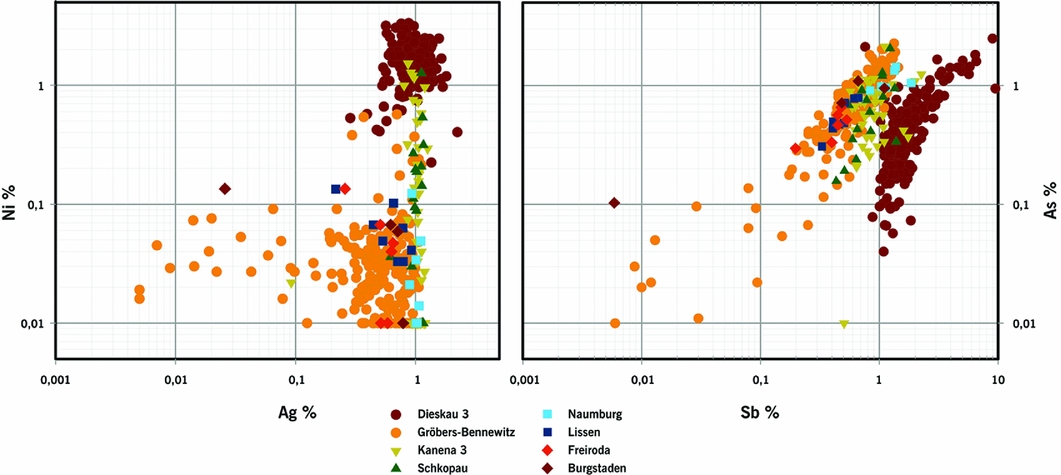
Furthermore, many axes from this and other hoards display obvious traces of use (cf. Kienlin Reference Kienlin2008; Behrendt et al. Reference Behrendt, Küßner, Mecking, Gluhak, Greiff, Kraus and Prange2015: 98). They were, therefore, not made specifically for deposition; rather, their handles were removed at the end of their use-life, before the axes were permanently deposited. The group of ‘soldiers’ had possibly been issued the weapons by the ‘prince’, and had then sacrificed them in front of their ritual building when he died. His successor may have issued new axes, thereby symbolically securing their loyalty. Metal analyses provide another argument in support of the centralised equipping of ‘soldiers’ with axes. These showed that the axes from the individual hoards comprised very similar materials (Figure 7; E. Pernicka pers. comm; cf. Rassmann Reference Rassmann, Meller and Bertemes2010: 813–15). It can therefore be assumed that the axes from each hoard were made by a single workshop. The batch then stayed together—as did their carriers—until they were deposited years later. If this theory indeed represents a real scenario, the Early Bronze Age hoards (at least those from central Germany) could be seen as a direct reflection of the social and military organisation of Únětice society.
Trace element diagrams (Ag/Ni, Sb/As) of Early Bronze Age hoards in central Germany. The large axe hoards from Dieskau 3 and Gröbers-Bennewitz 1 differ significantly with regard to their composition. Diagrams after E. Pernicka (unpublished); graphic design by B. Janzen.

Did hoards represent ‘military units’?
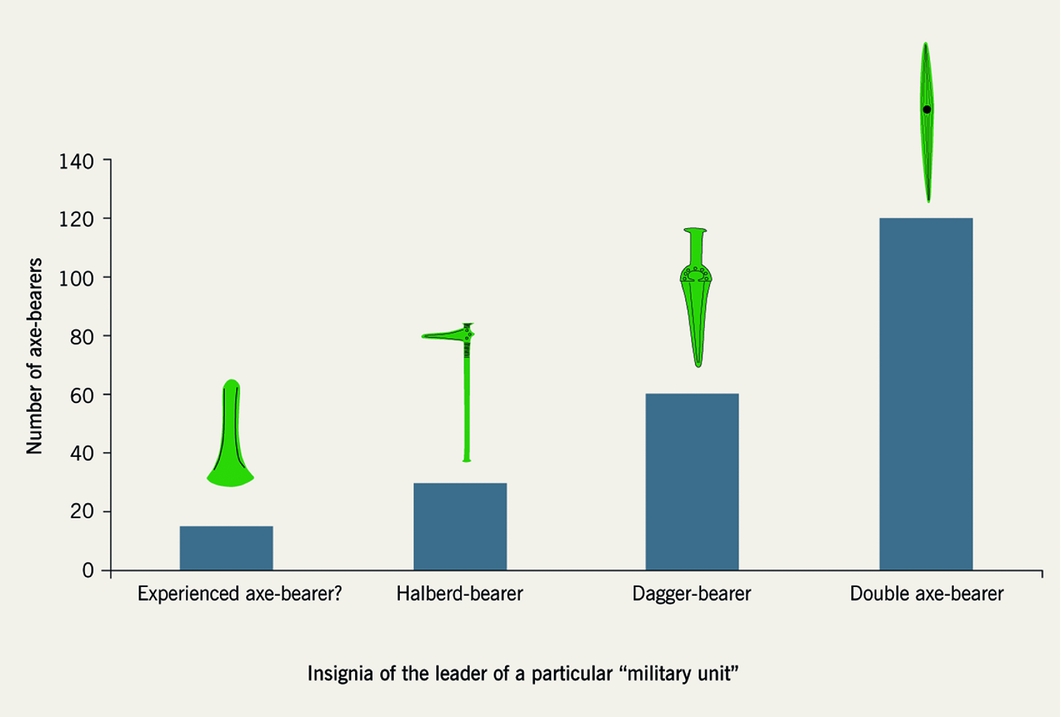
As the spatial link that ties hoards to either graves or settlements often remains unknown, the only aspect that can be studied is their quantitative and qualitative composition. If the number of weapons in the hoards reflects actual ‘military units’, the first step must be to compare their quantities. It should be noted that many hoards were accidentally uncovered by ploughing in the nineteenth and early twentieth centuries; in some cases, therefore, the quantity of artefacts may differ from the number originally deposited. That most hoards were placed in vessels, however, ensures their completeness, to a certain extent. Initial quantification shows that the known hoards yielded 1174 axes, 36 halberds, 20 daggers and 11 double axes. Immediately, this pattern does not appear coincidental, but may actually reflect a military command structure, and thus deliberate organisation. There would have been a halberd-bearer for every 30 (32.6) axe-bearers, a dagger-bearer for every 60 (58.7) axe-bearers and a double-axe-bearer for every 120 (117.4) axe-bearers. The relevance of this ratio is supported by two possible dagger or halberd blanks found at Dermsdorf, whose bearers would, therefore, have commanded approximately 90 men. This roughly corresponds with the hoard's 98 axes. If the weapons from graves are included, only the dagger-bearers experience a significant shift in that they now correspond to only 30, rather than 60, axe-bearers (Meller Reference Meller, Nicklisch, Orschiedt, Alt, Meller and Schefzik2015).
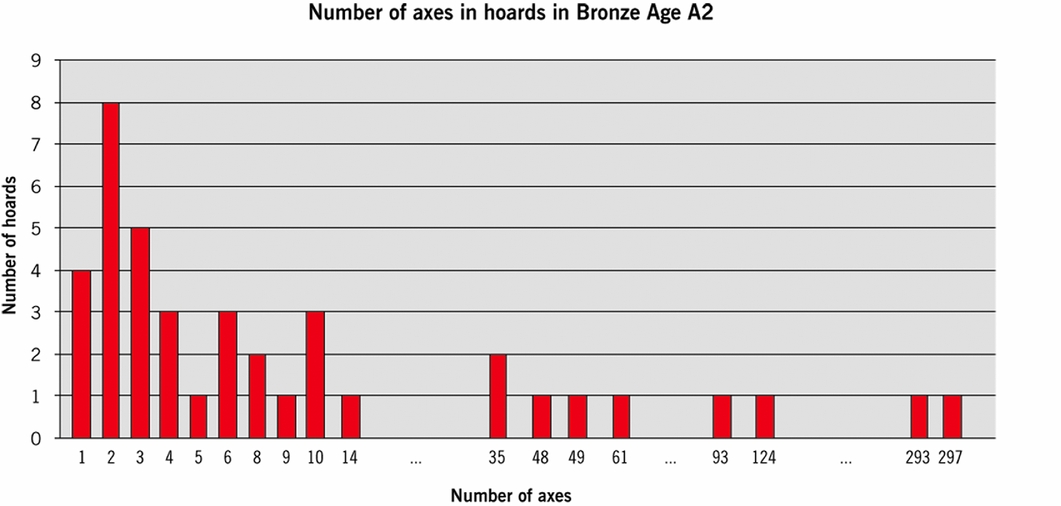
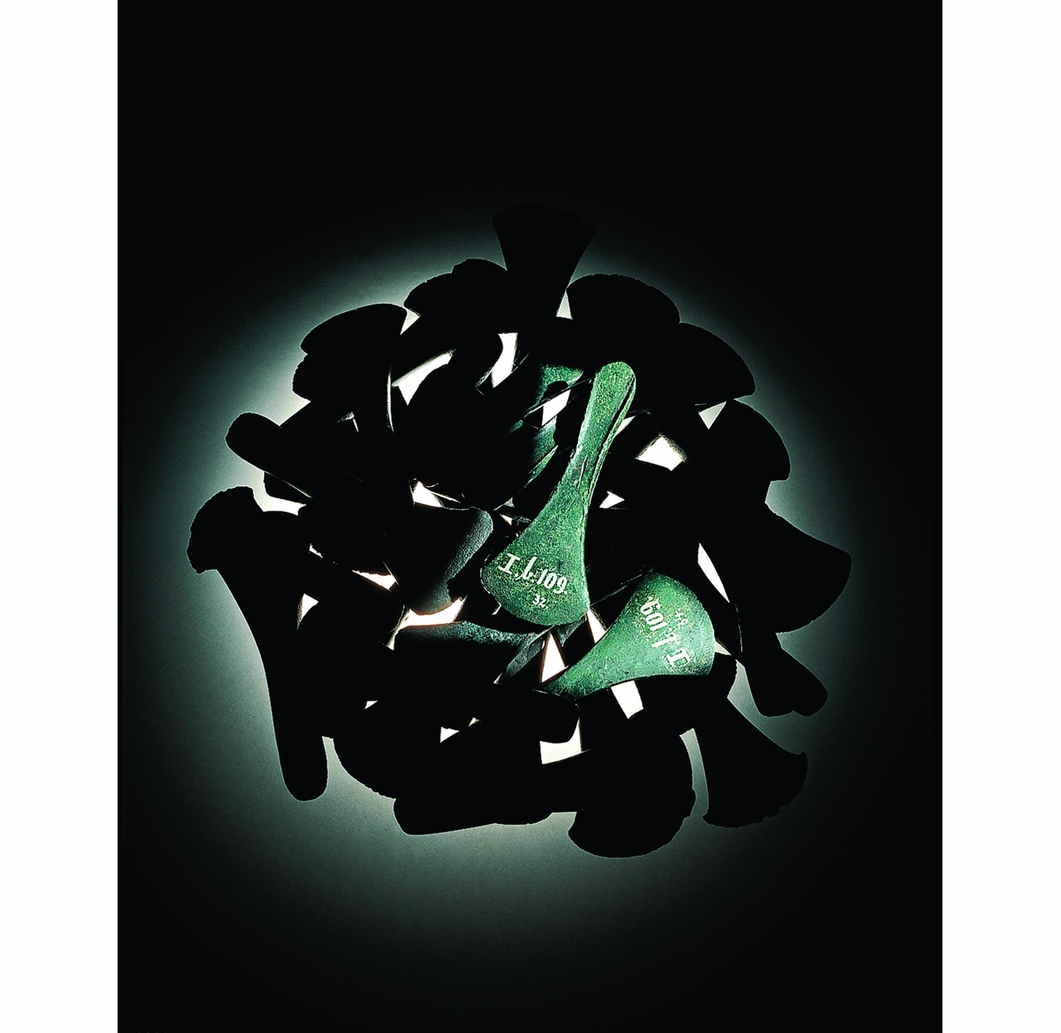
Interestingly, the same numerical relationships reoccur in the axe hoards. It therefore makes sense to concentrate on the quantity of axes in each individual hoard. The distribution, particularly of hoards with larger quantities (>10) of axes, does not appear to be coincidental (Figure 8). With 297 and 293 axes respectively, the large hoards from Gröbers-Bennewitz 1 (Figure 9) and Dieskau 3 (both in Saalekreis District) were roughly three times the size of the Dermsdorf hoard. They may therefore represent three ‘men's houses’. That both hoards were found near Dieskau again supports the overall picture of a powerful region. The hoards from Schkopau in Saalekreis District (124 axes), Neunheilingen in Unstrut-Hainich District (61 axes), Olbersdorf in Görlitz District (49 axes), Halle-Kanena (48 axes), Straußberg in Kyffhäuser District (35 axes), Pegau-Carsdorf in Leipzig District (35 axes), and Dederstedt in Mansfeld-Südharz District (14 axes) represent a fraction of one such possible longhouse. This is shown by the rounded axe ratios of 15:30:45:60:90:120:300. Perhaps the number five was the common denominator here too, as it would become in the Late Bronze Age (Sommerfeld Reference Sommerfeld1994). More importantly, however, the numerical relationships may reflect systems of military order, as known from military history since antiquity. The smallest unit visible in the hoards comprised 10 or 15 axes or ‘soldiers’. The unit of 30 ‘soldiers’ would then have been led by a halberd-bearer, and the unit of 60 ‘soldiers’ would have been under the command of a dagger-bearer. Finally, the largest combat unit of 120 individuals would have been led by a double axe-bearer (Figure 10). The ‘princes’, who would have held the highest rank, however, had a combination of weapons in their graves (excluding double axes). The Dieskau ‘prince’, with his gold weapons, apparently held a still higher position, possibly in a sacred sphere.
Graph of all Early Bronze Age (phase Bz A2) hoards containing axes in central Germany (for dataset, see Meller Reference Risch, Meller, Meller, Bertemes, Bork and Risch2013: 516–17, tab. 2). Unlike hoards with few axes, which often include other objects, the rarer pure axe hoards contain larger numbers of artefacts, ranging from 30, 45, 60, 90 or 120–300 axes. This pattern might reflect a military system where the smallest unit consisted of 15 axes or men. Graphic design by N. Seeländer and B. Janzen.

Hoard from Gröbers-Bennewitz 1, Saale District. With 297 bronze flanged axes weighing a total of 70kg, the assemblage is the largest axe hoard found in central Germany to date. Photograph by J. Lipták.

Diagram of the possible military organisation of the Únětice Culture in central Germany. While small units of 15 axe-bearers were probably led by a more experienced axe-bearer, the larger units would have been commanded by halberd-, dagger- or double-axe-bearers. Graphic design by B. Parsche and B. Janzen.

The military organisation is, therefore, postulated to have been based on the following units, starting with the smallest: 1 (10 or 15 axes/‘soldiers’):2:4:6 or 8. For comparison, the imperial Roman army was organised according to the following ratio: 1 (century):2 (maniple):6 (cohort):60 (legion) (Junkelmann Reference Junkelmann1991: 92–94). The Prussian army, after its reorganisation of 1713–1717, was structured in a ratio of 1 (platoon):4 (company):20 (battalion):40 (regiment) (Groehler Reference Groehler2001: 73–74). ‘Small’ hoards (with nine axes or fewer) do not contradict this interpretation, but could represent sacrificial offerings made by individual ‘soldiers’ or smaller ‘military units’. The largest axe hoards from the Dieskau region also correspond well with the ratio of troop sizes, in that they are roughly three times the size of the largest combat unit proposed above. The troop strengths within the individual units, however, exhibited great variety. For instance, the number of men in each unit of the Roman army fluctuated significantly (Junkelmann Reference Junkelmann1991: 92–93). The same can still be said of the organisation of modern German armed forces; the composition even of the smallest unit, a squad or team, can vary between two and six persons.
Conclusions
The deposition of weapons in hoards and the strictly hierarchical structure both suggest that a dramatic social change took place after 2000 BC. In the Late Neolithic period, it was mainly the individual ‘heroes’ of the Bell Beaker and Corded Ware Cultures who engaged in combat, and who sometimes had stone stelae erected in their honour. In the Early Bronze Age, however, we can envisage well-organised axe-bearing infantrymen, who may have protected themselves with shields and body armour made of organic materials. The extent to which spears might also have been used is very difficult to gauge; spearheads may have been made of organic material, which would not have survived. A single bronze spearhead was, however, recovered from one of the earliest Únětice Culture hoards, at Kyhna, Nordsachsen District. The technology, if not the artefact itself, was imported from the Mediterranean (Genz Reference Genz2004).
If the theories outlined above are indeed correct, it perhaps evidences professional soldiers in the central German Early Bronze Age, as opposed to the ‘heroic’ combatants of the Late Neolithic. These soldiers would have been part of systematic armies serving their ‘princes’. It cannot, of course, be ascertained whether they would represent a standing army supported by surplus resources, or were only mobilised when required. In any case, the ‘princes’ appear to have had a general agreement that prevented the outbreak of internal wars (to gain control of neighbouring territories, for example) for several centuries; there is no evidence of such conflicts. This cohesion may have been rooted in kinship relations, in an elective monarchy (perhaps based on alternating the seat of power between various regions), or even in an institution that presided over the individuals buried at Leubingen and Helmsdorf. The notion of standing armies is, therefore, more probable; the ‘princes’ must have had a permanent military “coercive apparatus” (after Weber 2005 [Reference Weber and Ulfig1922]: 24–25) at their disposal to secure and maintain peace throughout such a vast area. In exchange for their peaceful existence and for the lasting protection of their individual households, the unfortified settlements on the riverbanks would surely have paid substantial tributes to the ruling class. These funds were used to finance not only the rulers’ luxurious lifestyles, but also their military power base. It was not until the collapse of the Únětice Culture around 1600 BC that a system of local rule developed once again. This may have given more freedom to the individual territories, but it came at the cost of reduced protection.
Acknowledgements
I would like to express my gratitude to my colleague Torsten Schunke for conducting the excavations at the Bornhöck, and to all the students of the yearly campaigns. Finally, I would like to thank Roberto Risch for his comments on the text.