Introduction
Various studies have been carried out to investigate the effects of high atomic elements on increasing the absorbed dose by various experimental methods or using different simulation codes.Reference Khoshgard, Hashemi, Arbabi, Rasaee and Soleimani 1 , Reference Kakade and Sharma 2 Important elements with high atomic numbers such as gold nanoparticles have a significant effect on increasing dose and are used to treat cancer. One of the most important problems in treating cancer is that along with cancer cells, healthy cells are also destroyed. In chemotherapy, the drug reaches the entire body, while the target is only cancer cells. Radiation therapy can limit the area of radiation, but in any case the radiation also damages some healthy cells. In surgery, the removal of a tumour sometimes requires sacrificing part of the healthy tissue around the tumour. In the case of brain tumours for example, the destruction of these tissues can lead to the loss of some of the functions in an individual. In addition, surgery may leave some cancerous cells. Therefore, in many surgery cases, chemotherapy or radiation therapy is used as complementary procedures. This causes severe side effects for the patient, which is partly due to the loss of healthy cells behind. Therefore, in recent years, seeking a method that will only target cancer cells has been at the forefront of cancer research procedures.
Gold is an element that rarely chemically reacts with other materials. Therefore, it does not cause allergic or immune responses in the body and is non-toxic. Gold nanoparticles can enter the cell and show the position of the cancerous cell, and then a laser beam can be used to attack the cancer cell. This laser beam causes warming and boiling of the water inside the cell and creates bubbles. Bubbles then expand, rupture and damage the cancer cell. Sometimes these nanoparticles and the companion weapons such as laser beams prevent cancer cells from dividing. Gold is the best choice for treating cancer since it adapts to the biological environment of the human body. Due to their small size, nanoparticles provide a significant surface area, which increases the chemical activity and higher absorption rates in the same mass of the same material.
To investigate the effect of gold nanoparticles on the increase in absorbed dose, dose enhancement factor (DEF) in increasing the dose induced by these elements was obtained using a Monte Carlo simulation method and experimenting in several phantoms. In a study in 2005, Cho made the DEF value for 140 KVp X-ray sources and 4 MV photon beam at various concentrations of gold nanoparticles by Monte Carlo simulation method. He estimated the DEF for X-ray and photonic beam to be 30% and 2%, respectively.Reference Podgorsak 3 , Reference Roeske, Nuñez, Hoggarth, Labay and Weichselbaum 4 In a study, Roeske obtained DEF for all elements with an atomic number between 25 and 90 using normal sources in radiation therapy and brachytherapy. The obtained results showed that DEF factor significantly increases in orthovoltage energies with increasing atomic number and concentration of nanoparticles.Reference Roeske, Nuñez, Hoggarth, Labay and Weichselbaum 4 In 2009, for the first time, GEANT4 code was used by Zhang et al. to illustrate the effect of gold nanoparticles on increasing absorption dose. They used an Ir92 source of irradiation in a water phantom.Reference Zhang, Gao and Buchholz 5 In recent years, many studies have been conducted on the effect of gold nanoparticles on the increase in the absorbed dose using MCNP code.Reference Alkhatib, Watanabe and Broadhurst 6 – Reference Mahdavi, Khadem-Abolfazli, Mahdavi and Ataei 10
Today, cancer is one of the health sector’s concerns in modern societies. The goal of radiotherapy is to bring the maximum dose to the cancerous tissue while healthy tissue receives the lowest dose. The maximum dose of these cells causes them to be destroyed in the face of X rays. This method of increasing doses is used to treat cancer. The application of gold nanoparticles in medical science has created new possibilities for diagnosis, tumour imaging and cancer in humans. These particles have been specifically considered due to their wide range of size, low toxicity, adhesion and stability. Gold nanoparticles, due to their unique performance, are a highly sensitive device for manipulating cancer molecules.
In this study, the effect of gold nanoparticles on the increase in the absorbed dose in the MAGIC-f gel, which was exposed to Siemens Primos X-ray radiation with 6MV X-ray, was investigated. At first, the dose curves were plotted at different depths with experimental data, and then the experimental results were compared with the results of the EGS-nrc simulation code, and then DEF was calculated. The final purpose of this study is the use of gold nanoparticles for the increase in absorbed dose by increasing the concentration of gold nanoparticles.
Materials and Methods
Preparing the MAGIC-f gel
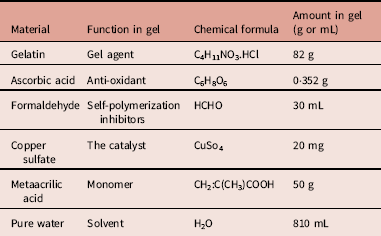
Table 1 shows the ingredients in the gel and the amount of each one in it.Reference Uusi–Simola, Heikkinen and Kotiluoto 11 After preparing the gel, half of the nanoparticle was added to it according to the desired concentration and it was put in contact with a magnet and thus, a homogeneous solution was prepared. Then, the gel containing nanoparticles was also poured into vials and, they were completely sealed using Parafilm and special covers, in a way that they could completely resist the air penetration. All solutions were then stored for 10 days at a temperature of 10°C in the laboratory fridge.
The amount and type of the material used for preparing the Magic-f Gel

Calculating the amount of gold nanoparticles injected into the gel
In this study, nanoparticles were used as a solution with a diameter of 100 nm and a mass of
 $2{\times}10^{{11}} \,{{{\rm Nanoparticle}} \over {{\rm cm}^{{\rm 3}} }}$
. The available gold nanoparticles were used with concentrations 0·17, 3 and 6 mg/mL, respectively. In this study, an optimum concentration of 0·1 mg/ml was considered for using gold nanoparticles in polymer gels. Therefore, for the sample, the required amount of nanoparticles was calculated at a concentration of C = 0·17 mg/mL and the rest of the concentrations were calculated. First, the concentration of C = 0·17 mL/mg was converted to mM:
 $\begin{array}{*{20}{rcl}}{\rm{C}}& = &{0 \cdot 17\,{\rm{mg}}/{\rm{mL}} \times 1000\,{\rm{mL}}/{\rm{L}} \times 1\,196 \cdot 97\,{\rm{mol}}/{\rm{g}}} \\ {}&{}&{ \times 1000\,{\rm{mmol}}/{\rm{mol}}} \\ {}& = &{\left( 1 \right)\,170\,196 \cdot 97\,{\rm{mmol}}/{\rm{lit}} = 0 \cdot 8631\,{\rm{mmol}}/{\rm{lit}}\left( {{\rm{mM}}} \right)}\end{array}$
Then the required volume of gold nanoparticles for vials and concentrations of 0·1 mM was calculated according to the following equation:
 ${\rm C1V1=C2V2}$
where C1 is 0·8631 mM, C2 is the optimal concentration of 0·1 mM, V2 is the amount of gel dosimeter created and V1 is the volume of the nanoparticle at a concentration of 0·17 mg/mL.Reference Stewart 12
Gel radiation
Radiation of gels was performed 24 hours after their construction by linear accelerator Siemens Primos. Vials in a cubic phantom containing water with a dimension of 30 × 30 × 30 cm3 were placed so that the vials distance from the walls was 5 cm; in other words, the irradiation was done in the isocenter of 100 cm and at a 5 cm depth [Source to Surface Distance (SSD) = 95 cm]. All vials were similar at this depth, and the X-ray irradiation was 6 MV X-ray with the field size of 20 × 20 cm and a 90° Gantry angle. Monitor units were calculated and contained vials at doses of 2, 4 and 6 Gy. For each absorbed dose, three vials containing gold nanoparticles were present at concentrations of 0·17, 3 and 6 mM, respectively as well as vials without nanoparticles. Irradiation process was performed in which one of the samples was labeled as an example with a zero dose or control dose. All other specimens were placed in the phantom, at the front of the accelerator, in the first stage of radiation, of up to 2 Gy. At this stage, all specimens had a 2 Gy absorbed dose. One sample was labeled as 2 Gy. In this way, following the same trend, samples were prepared and labeled with absorbed doses in the range of 2–6 Gy. Each time the tubes were stopped, radiation was stopped, and the other tubes were rotated in the water phantom to ensure the uniformity of the absorbed dose in the tube.
Samples read-out with Optical Computer Tomography System (OCT)
For gel read-out, the optimum time is 24 hours after the radiation, because the monomers in the gel should be completely converted to polymers after radiation. First, the light source, the charge couple device and the computer were turned on and the system was used after 10 minutes (warm up time of the camera). The gel vial was installed on the motor in the corresponding position, and then the room light was turned off. After turning on the step motor, the first projection was taken through the capture card software. Then, the first rotation was taken under a 1° angle. After 1 second, following the next spin, the next projection was also achieved. This process took 360 stages to complete 360°. After about 6 minutes, a full scan of a sample was prepared. Then, it was rebuilt and processed by the image processing code written in MATLAB.
EGS-nrc simulation method
In this study, software packages BEAM-nrc and DOSXYZnrc were used for simulating the Siemens Primos linear accelerator. The simulation method used in this study consists of three steps: 1. Simulation of the Siemens Primos Linear Accelerator System with 6 MV as a source. 2. Simulation of water cubic phantom in dimensions 30 × 30 × 30 cm3. Simulation of the Magic-f gel vial with and without a nanoparticle of gold.
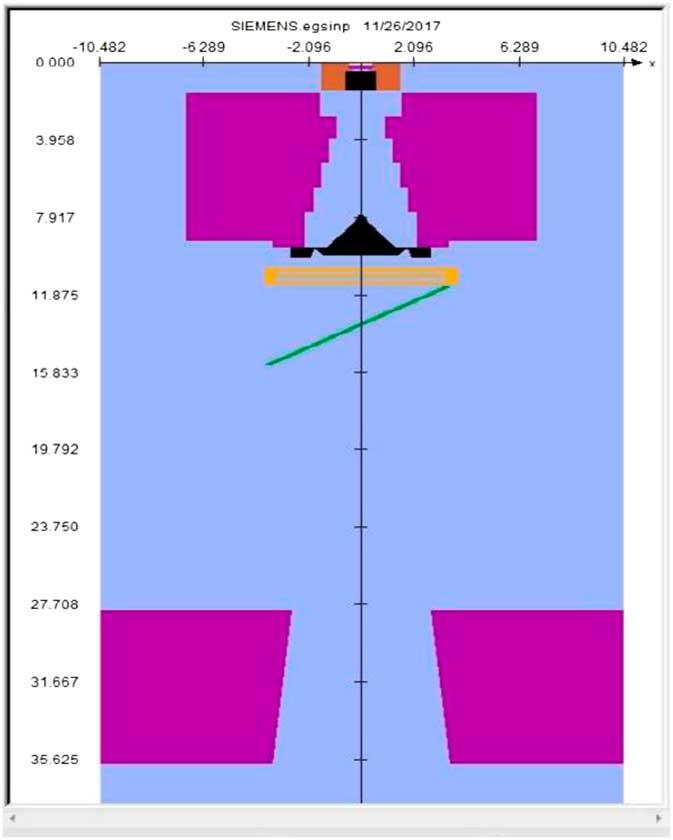
The Siemens Primos linear accelerator components are FLATFILT, CHAMBER, MIRROR, JAWS and SLABS. According to the characteristics and distances related to these components, simulation of the 6 MV accelerator head was performed using the BEAMnrc file. At this point, by saving the simulation file, a phase space file was created. Figure 1 illustrates the simulation of the Siemens Primos linear accelerator system.
Simulation of Siemens Primos linear accelerator head.

The DOSXYZ file was used to simulate gel and phantom vials. This file is used for dosimetry. After selecting and opening this file, three parts will be found:
1. The first part is related to phantom definition. The phantom used in this study is non-CT. Phantom and vials of gel are entered in this section. The phantom is made of perpex and contains water, and the gel vial is made of the pet.
2. The second part is related to the parameters of the source. The source is the phase space file, which was previously created in the BEAMnrc file in the accelerator definition.
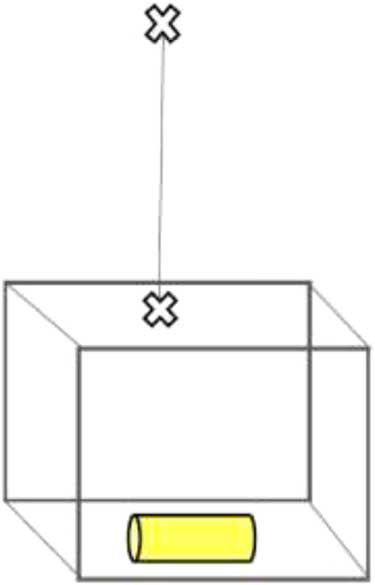
3. The third part of this file is related to the simulation parameters, which includes the number of histories, the run time of the program and the frequency use of the phase space file. By completing these three sections and saving them, the program will be performed. After completion, dosexyznrc folder is opened. This folder contains several files. The main output is 3D dose, which is the same 3D dose matrix, where egsinp is the same input file, and egslst is the required output and contains the relevant information. The information in this file is copied to a text file and sent to the Excel environment. Then, the percentage depth dose (PDD) curve is plotted according to the distance. The phantom used in this section was a cubic phantom measuring 30 × 30 × 30 cm. A vial of cylindrical gel with a height of 9 cm and a diameter of 3 cm, containing the MAGIC-f gel, was horizontally centered. The type and amount of the material used to prepare the Magic-f Gel are shown in Table 1. The source distance from the phantom surface (SSD) was 90 cm. Figure 2 illustrates the simulation of a cubic phantom and a cylindrical gel.
Simulation of cubic water phantom and vial of Magic-f gel.

Results
Results from OCT readings
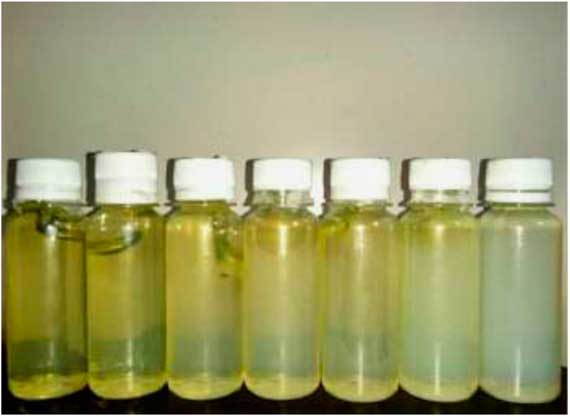
Radiation causes a change in the gel colour. This property is used to read the dose using the OCT technique. The amount of opacity is directly related to the amount of radiation. Figure 3 shows the samples before and after irradiation.
Gel vials samples before and after irradiation.

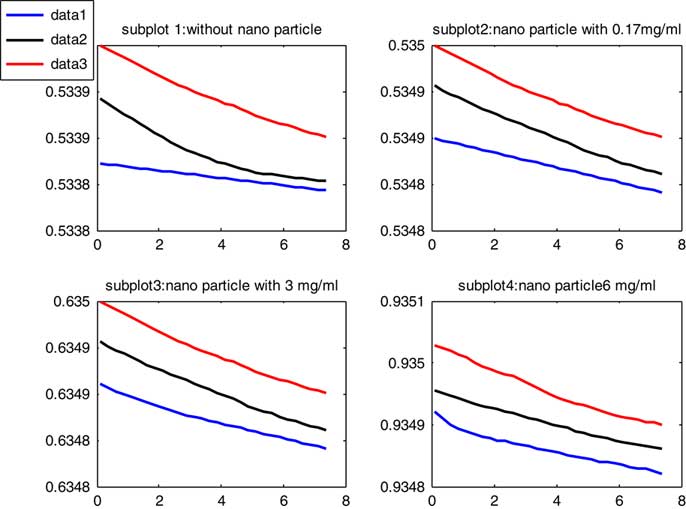
After processing the data in MATLAB software and obtaining cross-sectional images that are 0·25 cm in length at different depths of the gel, the amount of light attenuation at various depths of the gel was estimated using the inverse radon program. Then from the light attenuation, the calibration curve was plotted. Using this calibration curve, a plot of the dose at a different depth (PDD) for a gel without nanoparticle and with nanoparticle was constructed using the MATLAB software (Figure 4).
Dose diagram in terms of distance with the Optical Computer Tomography System (OCT) technique.

Results from EGS-nrc Monte Carlo simulation Method
To validate linear accelerator with EGS-nrc code
For validation, the PDD should be in accordance with the experimental data. For experimental data, the water phantom was used for dosimetry and the results were read out by thermoluminescent dosimeter.
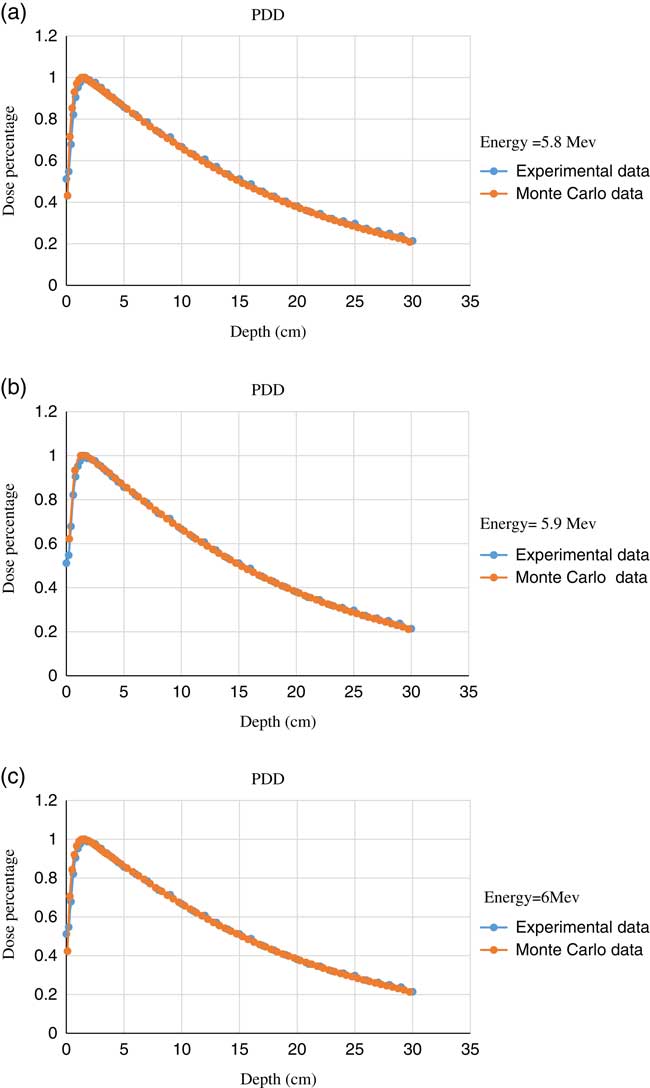
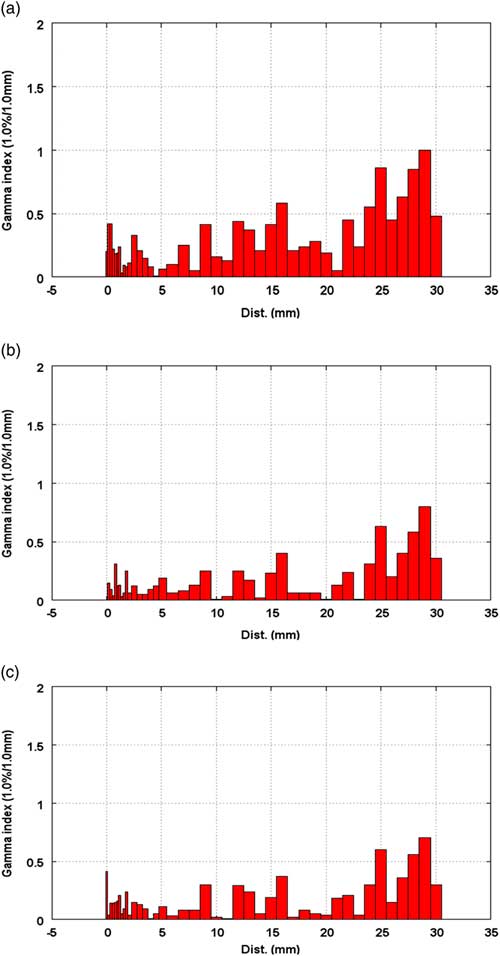
In the real accelerator, energy is present in MV, but during simulation, it is found in MeV. These two parameters, namely MV and MeV are completely different. In this accelerator, there is a beam of electrons that accelerates under the difference of the 6 MV potential. Eventually, a spectrum of electrons is generated that has different energies. Due to the uncertainty in the energy spectrum of the electrons, the electrons around the energy of 6 MV have a Gaussian distribution function with full width at half maximum (FWHM) = 0·35. A number of electrons have less than 6 MV energy, but in the present paper, the 6 MV energy is used, which is slightly different from reality. For this reason, for the PDD curve, the energy of less than 6 MV (here, 5·5 MV) is maintained with a step of 0·1–6·5 energy. In addition, for each energy, the PDD curve is plotted. The resulting PDD curve was coincided with a diagram from the experimental data of adaptation to determine on which energy the two diagrams coincide. The PDD diagram for three energies of 8·5, 9·5 and 6 MV is shown in Figures 5a, 5b and 5c. The gamma index method has become the gold standard for the comparison between measured and calculated absorbed dose distributions. This result can be used to test the statistical significance of measured deviations in clinical radiotherapy quality control. To have more acceptable calculations, the gamma index should be less than 1, and the lower the quantity, the more accurate the results. In Figures 6a, 6b and 6c, the gamma index diagram is shown for energies of 5·8, 5·9 and 6 MV, respectively.
The percentage depth dose in different energies for cubic water phantom.

Gamma index for different energies.

Regarding the diagrams in Figure 5, it can be seen that, among these three diagrams, graph c is more consistent with experimental data than other graphs, which can even be compared with the gamma index shown in Figure 6. By calculating the gamma average from the graphs of Figure 6a, 6b and 6c, this quantity was estimated to be 0·65, 0·47 and 0·3, respectively. The gamma index of the graph 6c is lower than the other two graphs, which indicates that the 6 MV energy for the accelerator is confirmed in the simulation.
PDD curves for gel and gold nano gel
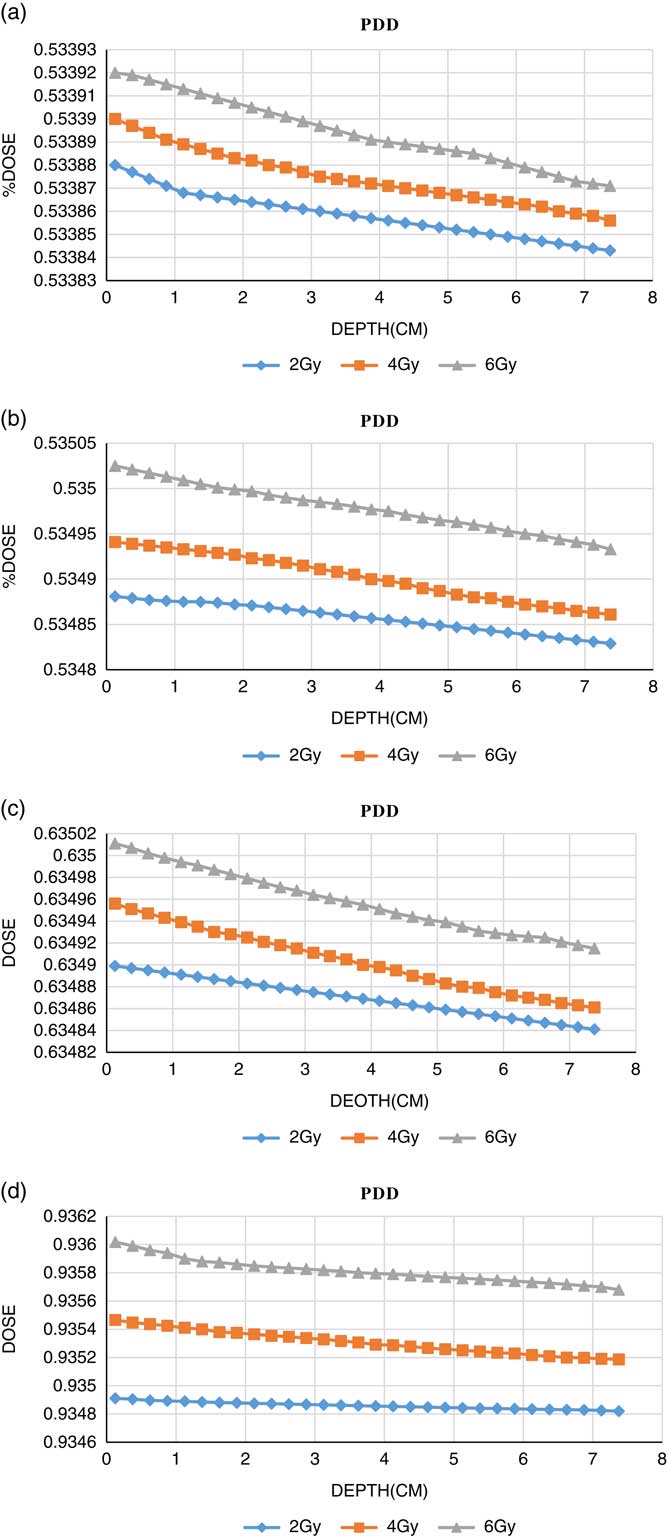
After the accelerator geometry, water phantom and gel vial were simulated, EGSHOME was selected from the EGS-nrc folder. Figure 7 shows the PDD graphs resulting from the simulation of non-nanoparticle gels and gold nanoparticle gels.
The percentage depth dose (PDD) graph of the simulation (a): without the nanoparticle (b): with a nanoparticle at a concentration of 0·17 mM (c): with a nanoparticle at a concentration of 3 mM (d): with a nanoparticle at a concentration of 6 mM.

The percentage error between calculation and experimental data is also calculated by the following equation:Reference Mesbahi, Allahverdi and Gheraati 13
 ${\rm{error}}\% = \displaystyle\frac{{{\rm{calculation\,data}} - {\rm{experimental\,data}}}}{{{\rm{experimental\,data}}}}$
The average error percentage between the simulation and the experimental data in the PDD diagram of the MAGIC-f gel and GN-MAGIC-f at concentrations of 0·17, 3 and 6 mM were 1·002%, 1·08%, 1·19 and 2·003%, respectively.
Calculation of DEF
The DEF is used to check the dose increase in the presence of absorbent materials in the tumor. This quantity is defined as the ratio of a dose at a point inside the tumor in the presence of high-atomized nanoparticles to a dose at the same point without the presence of a substance with a high atomic number.Reference Esteve, Corde and Elleaume 14 The DEF quantity in gel is equal to the ratio of GN-MAGIC-f gel dose response to MAGIC-f gel dose response:Reference Corde, Joubert and Adam 15 – Reference Iwamoto, Cochran, Winter, Holburt, Higashida and Norman 17
 ${\rm{DEF}} = \displaystyle\frac{{\mu \left( {GN - MAGIC - {\rm{f}}} \right) - \mu \left( {{\rm{MAGIC}} - {\rm{f}}} \right)}}{{\mu \left( {{\rm{MAGIC}} - {\rm{f}}} \right)}}$
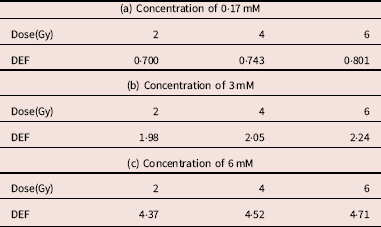
where μ(GN-MAGIC-f) is the gel response in the presence of nanoparticles and (MAGIC-f) is the gel response in the absence of nanoparticles. DEF values for concentrations of 0·17, 3 and 6 mM are shown in Table 2.
Dose enhancement factor (DEF) value for different doses and concentrations

The gold nanoparticles increased at concentrations 0·17, 3 and 6 mM, resulting in an increase in DEF equal to 18%, 39% and 53%, respectively.
Discussion and Conclusion
The analysis of the graphs in Figures 4 and 5 shows that there is a good agreement between simulation and experiment. In addition, both the experimental graphs of Figure 4 and simulation diagrams confirm an increase in the absorbed dose by adding the gold nanoparticle.
Figures 4a and 5a refer to samples without nanoparticles. Given the graphs, it can be seen that more dose increases the dose level only slightly. The next graphs are related to different concentrations of nanoparticles, in which an increase in the concentration of nanoparticles results in higher doses. The higher the concentration of nanoparticles of gold, the higher the dose. This property of nanoparticles can be used to treat cancer. Given the increasing dose and the use of gold nanoparticles, the absorbed dose can be increased. Also, a combination of methods that only increase the dose for cancer cells through energy, such as intensity modulated radiation therapy (IMRT) and using gold nanoparticles can also be used to increase the absorbed dose.
In one study, the dose increase for nanoparticles with a diameter of 50 nm was calculated as 12%.Reference Iwamoto, Cochran, Winter, Holburt, Higashida and Norman 17 In another study, this factor was estimated at 44% in 18 MV.Reference Roeske, Nuñez, Hoggarth, Labay and Weichselbaum 4 In their study, Mahdavi et al. calculated the dose increase for concentrations of 0·1, 0·2 and 0·4, to be, 2%, 4% and 10%, respectively.Reference Mahdavi, Khadem-Abolfazli, Mahdavi and Ataei 10 In this study, the same factor was estimated to be 18%, 39% and 53% for nanoparticles with a diameter of 100 nm at concentrations of 0·17, 3 and 6 mM, respectively.
An increase in the dose in this study could be due to increasing the concentration and size of gold nanoparticles. In this study, various concentrations of gold nanoparticles were investigated. However, due to time and cost, nanoparticles were not studied in different sizes.
In general, within the low energy range, given the increase in the effective atomic number, the photoelectric absorption potential increases. In this study, 6 MeV photons were used for radiation. However, at this level of energy, the dominant interaction of the Compton phenomenon should be considered. It should also be taken into account that the photons produced by the linear accelerator have a spectrum of energy. In other words, in the spectrum of photons produced, there are also low-energy photons, which will certainly play a significant role in the rate of DEF. The cause of the effect of increasing dose is usually discussed with low-energy photons and photoelectric phenomena. However, we should pay attention to the fact that at an energy level of 6 MV, the dominant interaction is between photons and the Compton scattering matter, which bears no relation to the atomic number of the target material. The probability of Compton dispersion depends on the physical density of the target material. Now, using the nanoparticles, the effective density of the radiant volume is increased and the probability of the Compton scattering is also increased. Following such an increase in the cross-sectional area, the probability of producing secondary electrons increases as well, which ultimately increases the absorbed dose. In addition to the photoelectric phenomenon and Compton’s scattering, the pair production phenomenon can also result in more beam absorption. At high energies, the pair production phenomenon is proportional to Z2eff. As the radiation of the material impacts the material, the energy of the photon is converted into the electron and positron energy. Also, depending on the energy of the radiating photon, the distance is between the several microns to several millimeters, and in its kinematic range, it can also influence the DEF. Therefore, it can be deduced that the DEF in the dose level of the mega-voltage energy resulting from the set of photoelectric interactions, Compton scattering, pair production, and in general, all of the secondary electrons, including photocell, Electron-Compton and even electron auger is created following the above interactions. The DEF of gold nanoparticles is also indicative of the fact that Compton scattering plays a significant role in increasing the absorbed dose. In other words, although the effectiveness of the photoelectric phenomenon in the DEF is undeniable, based on the reasons explained in the mega-voltage energy level (that photoelectric phenomenon is less likely), and even in the presence of nanoparticles that do not have high atomic numbers, a significant amount of dose increase factor can be obtained.
Acknowledgements
This work was supported by University of Mazandaran.
Conflict of interest
There are no conflicts of interest by authors.