Implications
Disease prevention is an important means for economic and environmental improvement on dairy farms as it leads to higher milk yield and to therapy reduction. High amounts of antibiotics are used to control mastitis. Disease prevention and udder health management can be improved by extension programs. The objectives of those programs are to detect animal health risks, to develop improvement strategies and to verify effects of those implemented preventive measures. This study aims to evaluate management factors and extension effects on udder health, particularly in organic dairy farms. The results shall lead to a better effectiveness of such extension programs.
Introduction
Poor udder health is a common problem in conventional and organic dairy herds with incidences of infected udder quarters reported between 23% (Hamilton et al., Reference Hamilton, Emanuelson, Forslund, Hansson and Ekman2006) and 61.5% (Busato et al., Reference Busato, Trachsel, Schällibaum and Blum2000). Both consumers’ expectations and economic necessities require innovative strategies to improve udder health at the herd level. Organic farming regulation requires specific procedures to assure the health status of livestock. These procedures are: (i) animal breeding and choice of suitable animals, (ii) herd-based prevention and management, (iii) complementary therapy and lastly, resorting to (iv) chemical synthetic veterinary medicine (EC, 1999).
Surveys in a number of European countries show variable udder health in organic dairy herds (Busato et al., Reference Busato, Trachsel, Schällibaum and Blum2000; Fehlings and Deneke, Reference Fehlings and Deneke2000) and compared to conventional systems, organic farms are not consistently better or worse, although there is a tendency for better udder health in organic herds compared to conventional herds in northern European countries (Hamilton et al., Reference Hamilton, Emanuelson, Forslund, Hansson and Ekman2006; Vaarst et al., Reference Vaarst, Bennedsgaard, Klaas, Nissen, Thamsborg and Ostergaard2006; Fall et al., Reference Fall, Emanuelson, Martinsson and Jonsson2008). A study in Switzerland found no significant differences in the incidence of mastitis between conventional and organic herds (Roesch et al., Reference Roesch, Doherr and Blum2006).
In recent decades, the local and systemic administration of antibiotics has been the most common approach to control mastitis in both conventional and organic dairy herds (except in the USA, where according to the regulations, animals treated with antimicrobial drugs lose their status as organic animals). However, given the principles of organic agriculture, the consumer’s concern about antibiotic residues in food and the potential for pollution of the environment by residuals, interest in preventative management strategies and alternative treatments increased lately (Hertzberg et al., Reference Hertzberg, Walkenhorst and Klocke2003).
In order to develop successful preventive strategies and extension concepts, it is important to identify factors that affect udder health under organic farming conditions. Langford et al. (Reference Langford, Rutherford, Jack, Sherwood, Lawrence and Haskell2008) found management and disease treatment differences between organic and conventional farms in the UK. In general, the quality of management and milking technology plays an important role in udder health control (Østeras and Lund, Reference Østeras and Lund1988; Chassagne et al., Reference Chassagne, Barnouin and Le Guenic2005; Svensson et al., Reference Svensson, Nyman, Persson Waller and Emanuelson2006). Straw yard housing was associated with reduced udder health (Peeler et al., Reference Peeler, Green, Fitzpatrick, Morgan and Green2000; Barnouin et al., Reference Barnouin, Bord, Bazin and Chassagne2005) whereas all measures improving barn and cubicle hygiene had a positive impact on udder health (Barkema et al., Reference Barkema, Schukken, Lam, Beiboer, Benedictus and Brand1998; Koster et al., Reference Koster, Tenhagen and Heuwieser2006; O’Reilly et al., Reference O’Reilly, Green, Peeler, Fitzpatrick and Green2006). Other investigations found no correlation between housing conditions and udder health (Haltia et al., Reference Haltia, Honkanen-Buzalski, Spiridonova, Olkonen and Myllys2006; Hamilton et al., Reference Hamilton, Emanuelson, Forslund, Hansson and Ekman2006).
Quality and quantity of roughage, concentrates and minerals in the dairy cows’ rations can influence udder health (Barkema et al., Reference Barkema, Schukken, Lam, Beiboer, Benedictus and Brand1998; Nyman et al., Reference Nyman, Ekman, Emanuelson, Gustafsson, Holtenius, Waller and Sandgren2007). Feeding of the young stock influences their udder health as primiparous cows (Svensson et al., Reference Svensson, Nyman, Persson Waller and Emanuelson2006). It is still controversial whether giving infected milk to calves plays a role in the development of subsequent persistent infections in these heifers after parturition (Barto et al., Reference Barto, Bush and Adams1982). Herds where calves were fed with milk bearing high somatic cell counts (SCC) had a higher risk of high bulk milk somatic cell counts (BMSCC) (Barkema et al., Reference Barkema, Schukken, Lam, Beiboer, Benedictus and Brand1998).
This cross-sectional study was performed to investigate (i) the influence of management factors on udder health in organic dairy farms under Swiss milk production conditions (small herd sizes, mostly family farms) and (ii) the effects of extension on management practices and udder health. All involved farms participated in the Swiss organic dairy farm network ‘pro-Q’ (Ivemeyer et al., Reference Ivemeyer, Raillard, Heil and Klocke2007). Management improvements were investigated in terms of udder health development. The results should provide the basis for specific herd health improvement concepts for organic dairy farms.
Material and methods
Project framework and herd selection
The first part of the study investigated the impact of management factors on udder health. A total of 77 farms out of the Swiss organic dairy farm network ‘pro-Q’ were included in this study. As inclusion criterion, milk recording data and cow somatic cell count (CSCC) data from the year before project start (11 months) had to be available. Joining the ‘pro-Q’ network was the farmer’s decision. All those farms had joined the ‘pro-Q’ network between April 2004 and December 2005 and had received advice and guidance for at least 1 year after. At project entrance of each farm, milking management was recorded by standardized observation and duration of milking procedures was recorded using Noldus Pocket-Observer 2.1 software (Noldus Information Technology, Wageningen, The Netherlands). Milking technology and housing were surveyed and measured and a questionnaire on feeding and general farm issues was filled in. Milking technology was assessed by the same expert on all farms. All management factors were assessed by four researchers of the ‘pro-Q’ team. They were trained by the project manager and they all used the same recording methods. Basic udder health was assessed by analyzing retrospective CSCC of the whole year before project start in order to exclude seasonal effects. Clinical udder investigations were performed, accompanied by milk samples from all lactating udder quarters. The quarter milk samples of the entire lactating herd were taken before milking. Analysis of bacteriology, using standard bacteriological culture methods and cell count measurement (SCC) with flow cytometry (FOSSOMATIC; Foss Electric, Hilleröd, Denmark) were carried out on all samples. All milk samples were analyzed by a certified commercial veterinary laboratory in Switzerland.
After 1 year, the assessment of the management factors and the quarter milk samples were repeated. In the 12 months between the two investigations, 4 to 6 regular advisory meetings were held between the farmers, their veterinarians and one member of the project team. Management weak points were discussed and optimization concepts, including the long-term goal of reducing antibiotic input, were carried out. A follow-up meeting was conducted after 1 year to evaluate the progress in herd health management and udder health. The first aim of the extension program was the prevention of mastitis through improvement of management practices. Antibiotics were used for therapies as needed where appropriate, but were not used preventatively. A thorough description of the approach within the ‘pro-Q’ project can be found in Ivemeyer et al. (Reference Ivemeyer, Raillard, Heil and Klocke2007).
In the second part of the study the extension effect on management practices and on udder health was evaluated. Sixty-four farms out of 77 initial farms were examined again after one year (83%). The other 13 were excluded because of incomplete datasets due to the lack of compliance by farmers or due to them leaving the program (17%).
Analysis of udder health variables
The theoretical bulk milk somatic cell count (TBMSCC) of each farm throughout 1 year was used to assess the status of udder health. It was calculated using the monthly milk recording data of the breeding company: all CSCCs were multiplied by individual milk yields on sample days. These values were added up for 1 year and this sum was divided by the whole herd milk yield of the same year. In order to identify management factors influencing udder health significantly the variables recorded at the initial investigation were correlated with the TBMSCC over the year before the start of the project (TBMSCC_0).
Laboratory analyses were used to group the quarter secretion of all cows, according to the DVG/IDF (Deutsche Veterinärmedizinische Gesellschaft/International Dairy Federation) mastitis definition (Hamann and Fehlings, Reference Hamann and Fehlings2002), into the following categories (a) normal secretion (NORMAL; quarter somatic cell count (QSCC) <100 000/ml), (b) non-specific SCC increase (NON-SPECIFIC; QSCC exceeded 100 000/ml, but were culturally negative) and (c) mastitis quarters (MASTITIS; QSCC ⩾ 100 000 and culturally positive).
Analysis of management factors
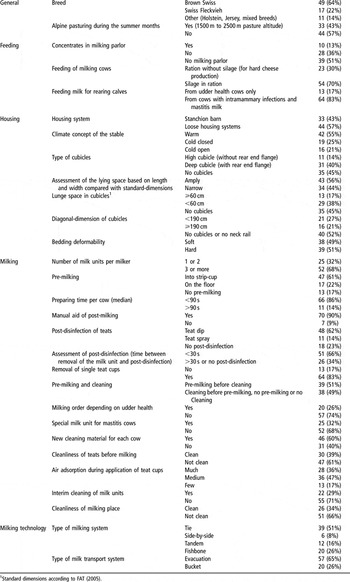
The selection of 29 management factors was based on investigations performed by Goodger (Reference Goodger1996), but those not relevant for small farms under Swiss conditions were excluded from this study. Five areas of management were examined: general aspects (breed, alpine pasturing), housing, feeding, milking management and milking technology. Variables of numerical character were divided into two categories. If there was no biologically relevant threshold available to do so, the median was used as delimiter. The categories of management factors and the frequencies of their assessment are shown in Table 1.
Included 29 management factors and frequency of farms (n = 77) related to the variable level

1Standard dimensions according to FAT (2005).
For the assessment of the lying space the Swiss standard-dimensions were used as reference values (FAT, 2005). For on-farm measured dimensions, acceptable width and length of the lying space were related to breed-based cow size (e.g. Jersey cows require smaller lying space dimensions). The lunge space was measured from shoulder flange to wall or, in head-to-head design, to the dividing construction rail. The diagonal dimension of the cubicles was measured from neck rail to rear end.
The preparation time per cow during milking was measured from first touch of the cow until applying the milk unit. Post-milking was defined as the time of manual support during machine milking at the end of the milking procedure.
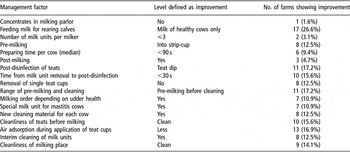
In order to evaluate the effects of the extension program for each farm the number of management factor improvements between start of the project and end of the first project year was counted. The definitions of improvements of the 17 changed management factors are listed in Table 4 (under the section ‘Results’). The other twelve factors, for example breed or housing system, remained stable in the farms and were not included in the analysis of management development.
Statistical analysis
For the univariable statistical analysis, one-way ANOVA procedures were performed. Tukey–Kramer post hoc comparison was added for identification of differences between the respective levels of the variables. Distribution of data had been evaluated graphically by normal-qq-plots. For multivariable modeling all variables with P < 0.20 in the univariable ANOVA were included in an initial linear model with stepwise backward elimination of not significantly associated factors with the dependent variable (threshold for elimination: P = 0.05). Model diagnostics were done by a graphical evaluation of the residual distribution and the residual-by-predicted-values plot. Multicollinearity was checked up by testing for interaction between the factors.
In order to calculate the association between management changes and TBMSCC development (TBMSCC_1-0; difference between TBMSCC of project year (TBMSCC_1) and TBMSCC_0) the former were categorized into five groups (0, 1, 2, 3 and ⩾4 management changes per farm) and the TBMSCC_1-0 of those groups were compared using ANOVA. The correlation between TBMSCC_0 and TBMSCC_1-0 was tested by performing linear regression. In all analyses levels of significance were α = 0.05. All statistical analyses were carried out using JMP 5.0.1.2 (SAS Institute Inc., Cary, USA).
Results
Descriptive statistics of herds and farms
The mean herd size of farms in the survey was 20 cows (range: 8 to 65 cows). Most of them (n = 49, 63.6%) were herds of Swiss Brown cattle breed, 17 (22.1%) were herds of Swiss Fleckvieh, five were Holstein Friesian herds, two were Jersey herds and four herds were of mixed breeds. About 92.2% of the herds (n = 71) were certified organic farms, the other six (7.8%) practiced integrated productions (which is a certified conventional farming standard in Switzerland, including some ecological requirements). More characterizations of the investigated farms can be found in Table 1.
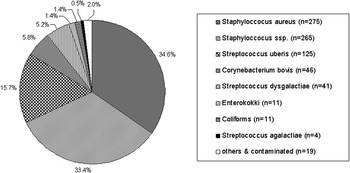
The mean TBMSCC_0 for all farms was 176 460 cells/ml (95% CI: 159 040 to 193 880 cells/ml; normal distribution). Of the 5528 quarters analyzed at the beginning of the project, 71% were NORMAL, 12% showed a NON-SPECIFIC QSCC increase and 14% were diagnosed as MASTITIS quarters. In 141 quarters (3%), measurement of QSCC was not possible; so they could not be classified. The microbial distribution of these 794 MASTITIS quarters is shown in Figure 1. Staphylococcus aureus (35%) and Staphylococcus ssp. (33%) were the most frequent pathogens followed by Streptococcus uberis (16%).
Distribution of basic bacteriological profile of all MASTITIS quarters in the 77 investigated farms at the time of beginning of the project (n = 794 quarters).

Multivariable analysis of impact of management factors on udder health
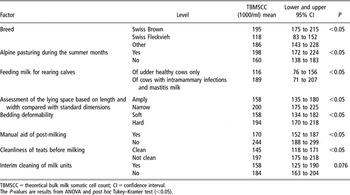
In univariable analysis, seven factors had a significant effect (P < 0.05) and one factor had a tendential effect (P < 0.20) on the TBMSCC_0 (Table 2). These eight factors were included in a multivariable regression model.
Significant and tendency effects of management factors on udder health in univariable analysis with theoretical bulk milk somatic cell count mean and confidence interval

TBMSCC = theoretical bulk milk somatic cell count; CI = confidence interval.
The P-values are results from ANOVA and post hoc Tukey–Kramer test (<0.05).
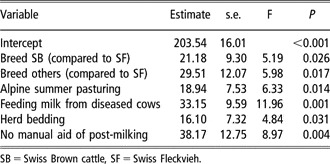
After backward elimination and stepwise regression procedures the remaining factors ‘breed’, ‘alpine pasturing’, ‘calf feeding method’, ‘bedding deformability’ and ‘post-milking’ showed significant effects (P < 0.05) on the TBMSCC (Table 3). The whole model had a P-value of < 0.001 with an R 2 of 0.406 and an adjusted R 2 of 0.354. The model was valid according to the model diagnostics.
Management factors with significant effects on theoretical bulk milk somatic cell count (TBMSCC_0) in multivariable linear regression model (whole model: R 2 adj. = 0.354, F-ratio = 7.96, P < 0.001)

SB = Swiss Brown cattle, SF = Swiss Fleckvieh.
Development of udder health and management factors affected by the extension program
In 17 out of 29 different management factors, an improvement was recorded on at least one of the 64 farms at the end of the first project year (Table 4). In seven farms there was no improvement of any factor (zero improvements) while 17 farms improved one factor, 16 farms improved two factors, 13 farms improved three factors and 11 farms improved four or more factors. The maximum number of management improvements per farm was seven. There was no statistical difference in TBMSCC_1-0, as a measure for udder health assessment between these categories (ANOVA, P = 0.904).
Improved management factors within the first project year, definition of improvement and number of farms that realized the improvement (farms n = 64)

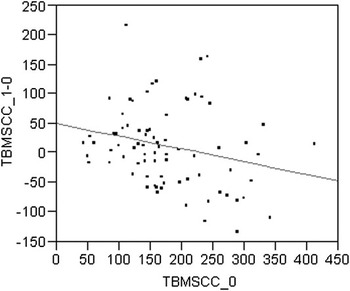
Overall, TBMSCC_1-0 showed no significant development over the year with a slight TBMSCC increase of 11 885 cells/ml (95% CI: −3324 to 27 094 cells/ml). Anyway, 34 (44%) of the 77 farms showed a decline in TBMSCC. Figure 2 shows the TBMSCC_1-0 relative to TBMSCC_0, with negative values representing farms showing improvements. Linear regression indicated an association between TBMSCC_0 and TBMSCC_1-0 (TBMSCC_1-0 = 50 122–0.217 TBMSCC_0, R 2 = 0.062, adjusted R 2 = 0.049, P = 0.030). In farms with higher TBMSCC_0, improvement of udder health was more likely than in farms that initially showed fewer udder health problems.
Regression function of udder health development (measured as difference between theoretical bulk milk somatic cell count (TBMSCC) in the year before project start and the project year – TBMSCC_1-0) in dependence of TBMSCC in the year before project start (TBMSCC_0) in 1000/ml (n = 77 farms, P = 0.030).

Discussion
Study design
The presented study was performed to evaluate which management factors influence udder health as a basis for extension concepts for organic dairy farmers. It differed from others in the pre-selection of interested farms via the ‘pro-Q’ network, since most comparable studies worked with stratified random samples of farms (Busato et al., Reference Busato, Trachsel, Schällibaum and Blum2000; Green et al., Reference Green, Leach, Breen, Green and Bradley2007). This pre-selection of motivated farmers inhibited a randomized choice, but it was welcome to have such a group of farms, since in extension programs farmers’ motivation is needed to get any improvement effects (Ivemeyer et al., Reference Ivemeyer, Maeschli, Walkenhorst, Klocke, Heil, Oser and Notz2008).
The theoretical bulk milk somatic cell count calculated from milk yield and CSCC based on 1-year milk recording data was chosen to describe the udder health for a number of reasons. A 12-months overview offers independence to seasonal variations, without the lengthy time span of 36 months used by Barnouin et al. (Reference Barnouin, Chassagne, Bazin and Boichard2004). Furthermore, in contrast to the (absolute) BMSCC of delivered milk, the TBMSCC is not biased by discarded milk. In contrast to a recent intervention study (Green et al., Reference Green, Leach, Breen, Green and Bradley2007), this study investigates udder health on the basis of all kinds of mastitis including sub-clinical infections and not primarily on clinical mastitis.
Comparison of the results of the present study with those reported previously
The proportion of 29% quarters with SCC higher than 100 000/ml agrees with the spectrum of udder health status described in literature for organic dairy herds in Switzerland. A screening of 152 Swiss organic farms primarily based on the California Mastitis Test (CMT) came to a similar result (Busato et al., Reference Busato, Trachsel, Schällibaum and Blum2000). In that study, out of a total of 9775 quarters, 2918 (30%) showed an elevated SCC, defined by a positive CMT. There is no comparable study published which investigates TBMSCC on organic farms.
Analysis of potential risk factors in this study showed influences of management practices on udder health. The link between Brown Swiss cattle and udder health problems compared to Swiss Fleckvieh is not in agreement with another study in Switzerland (Busato et al., Reference Busato, Trachsel, Schällibaum and Blum2000). Alpine pasturing is a specific issue of mountainous regions; approximately 15% of all Swiss dairy cows are fed on pastures between 1500 to 2500 m above sea level for 2 to 5 months during the summer. Often, cows from a number of different herds are gathered on the same alpine pasture, which leads to social stress in the newly socialized herd and to a higher risk of cross infection. Also the change of milking personnel, milking technology, climate and feedstuff could result in a higher infection risk, particularly for high-performance breeds. All these factors could lead to a high SCC both in initial quarter and cow composite milk (Lamarche et al., Reference Lamarche, Martin, Hauwuy, Coulon and Poutrel2000; Walkenhorst et al., Reference Walkenhorst, Spranger, Klocke and Schaeren2005). However, Swiss Brown herds may be more likely to be exposed to the risk factor ‘alpine summer pasturing’. Although there is no statistical correlation between ‘alpine summer pasturing’ and ‘breed’ (χ 2 test, P = 0.159), 76% of the Swiss brown herds spent their summers on alpine pastures.
Feeding of milk from infected cows to pre-weaning calves is correlated with a higher TBMSCC in the herds. An explanation for the correlation between waste milk feeding and high TBMSCC could be a higher rate of heifers with infected quarters. Another possible explanation is that farms with poorer udder health use to feed more infected milk to their calves in order to avoid discarding of milk. Although there are no investigations demonstrating a correlation between feeding milk pathogens and later infections after the first birth, some studies show indirectly that this calf feeding practice can result in a higher mastitis risk of primiparous cows (Barto et al., Reference Barto, Bush and Adams1982; Roberson et al., Reference Roberson, Fox, Hancock, Gay and Besser1994 and Reference Roberson, Fox, Hancock, Gay and Besser1998; Barkema et al., Reference Barkema, Schukken, Lam, Beiboer, Benedictus and Brand1998). Further investigations are necessary to study this correlation in order to find causal relationships.
Ample lying space (larger than the Swiss standard dimensions) was associated with a lower TBMSCC in the study farms. Housing conditions are a common issue of different studies, whereas the lying space has not been considered as an impact factor on udder health before. An adequate laying space has been recognized in recent reviews as a crucial aspect of cow comfort to avoid injuries and to increase welfare and thus performance of dairy cows (Cermak, Reference Cermak1988; Cook et al., Reference Cook, Bennett and Nordlund2005), yet this may be compromised since many dairy breeds have increased in size during the last decades. The deformability of the bedding also had a positive impact on udder health. A high deformability is normally associated with deep litter cubicles that are dry and often have a high hygienic standard. Barkema et al. (Reference Barkema, Schukken, Lam, Beiboer, Benedictus and Brand1998) identified a low BMSCC in herds where the thickness of bedding in cubicles of lactating cows was more than 1 cm. The bedding in the deep litter cubicles of most investigated barns in this study was in excess of 10 cm.
This study reveals some further aspects of milking routine influencing udder health. Manually supported machine post-milking is a very common practice by milkers in Switzerland due to the small size of many herds. This was determined to have a positive impact on udder health, possibly due to less residual milk that could act as a substrate for new and existing infections in the udder. On the other hand the importance of this factor is still questionable, because only seven farms (9%) did not conduct any manual aid of post-milking. In agreement with other investigations, teat cleanliness can be an indicator of hygiene in the cows’ environment and good cubicle and barn hygiene were found to be correlated with good udder health (Bartlett et al., Reference Bartlett, Miller, Lance and Heider1992; O’Reilly et al., Reference O’Reilly, Green, Peeler, Fitzpatrick and Green2006; Breen et al., Reference Breen, Green and Bradley2009).
In other studies, aspects of milking technology such as less frequent technology check, automatic cluster removal, high milking vacuum and cleanliness of milking parlor have been reported to have a negative influence on udder health (Østeras and Lund, Reference Østeras and Lund1988; Barkema et al., Reference Barkema, Schukken, Lam, Beiboer, Benedictus and Brand1998), whereas in general, the factors of milking technology and feeding of lactating cows in the presented investigation show no significant association to udder health. It is important to know that under Swiss conditions the milking technology is of a high standard because the milking equipment has to be tested annually. On the other hand, feeding parameters might show no effects on udder health because most of the investigated herds were fed by a roughage-based ration with a small amount of different components. This consequently led to a low feeding variability between the farms.
Effects of the extension program
Extension-based effects on udder health over the first year under advice were limited in the presented project. One reason could be that improvement of sub-clinical mastitis is often combined with the dry-period of the cow. Hence, herd-level extension effects on udder health may become obvious after a longer time than 1 year. A recent study showed a remarkable effect of reduced clinical mastitis following an intervention program on farms with a high incidence of mastitis, compared to increased mastitis incidences on control farms (Green et al., Reference Green, Leach, Breen, Green and Bradley2007). The design of the present study does not include control farms and the main focus of the investigation is sub-clinical, rather than clinical mastitis. As our results show, an improvement of udder health is more easily achieved in herds with compromised udder status. This result is quite weak in this study (according to the low R 2-value), but it is getting stronger when a 2-year development is analyzed (Ivemeyer et al., Reference Ivemeyer, Maeschli, Walkenhorst, Klocke, Heil, Oser and Notz2008). Indeed two-thirds of the herds showed a TBMSCC lower than 200 000/ml prior to the project, which is moderate by international standards, so, this may be a reason for the slight changes in udder health during one extension year on all farms. In the first year, only management factors that can be classed as short term or dynamic changes can be altered. The long-term management factors often take longer than 1 year to implement (e.g. breed or alpine summer pasturing) or are associated with high investment (e.g. rebuilding of the stable). They are unlikely to be altered in 1 year by an extension service based on animal health support. Furthermore, effects of extension may need more than 1 year because the confidence between the farmer and the advisor is developing slowly and often depends on positive results (Ivemeyer et al., Reference Ivemeyer, Maeschli, Walkenhorst, Klocke, Heil, Oser and Notz2008).
Conclusions
A set of management factors associated with reduced udder health in Swiss organic dairy herds can be identified. The management factors with significant influence on udder health are in agreement with comparable previous studies. The results support the extension concept but there may be further relevant factors for advising in individual farm situations that cannot be determined as significant on all farms. Not all identified risk factors were changed in the first year of extension. Udder health improvement was achieved only on some of the farms within 1 year, especially on those with poorer basic udder health status.
Acknowledgements
The authors gratefully acknowledge the European Community financial participation under the Sixth Framework Program for Research, Technological Development and Demonstration Activities, for the Integrated Project QUALITY LOW INPUT FOOD, FP6-FOOD-CT-2003- 506358 and the Coop Naturaplan Fonds for financial support of the pro-Q project.