In times of disaster, public servants respond at the front line, set up evacuation shelters, and work to provide for residents’ needs. They face multiple burdens as they engage in demanding and stressful disaster-response work while simultaneously attending to their own needs. On March 11, 2011, the Great East Japan Earthquake and tsunami struck the northeastern coast of Japan, leaving 18,452 dead or missing, 1 with an additional 3472 people dead owing to secondary effects of the disaster. 2 In support activities after the disaster, the exhaustion of local public servants was a major concern among professionals dispatched to the devastated area to support them and the affected residents.Reference Inoue, Inoue and Kobayashi 3 , 4
Our previous studies on the mental health of public servants 2 months and 7 months after the Great East Japan Earthquake revealed that distressing work conditions in the aftermath, characterized by overwork and a stressful disaster-related job and working environment, increased the risk of mental distress when controlling for disaster damage.Reference Fukasawa, Suzuki and Obara 5 , Reference Suzuki, Fukasawa and Obara 6 Sakuma et alReference Sakuma, Takahashi and Ueda 7 investigated the long-term mental health of public servants after the earthquake and found strong relationships between disaster damage and mental health after 14 months when controlling for workplace factors at the time of the survey. In addition, Kuwahara et alReference Kuwahara, Takahashi and Matsui 8 reported long-lasting effects of disaster experiences and disaster-related work experiences on mental health after 16 months.
Studies of disaster responders other than public servants, such as recovery workers,Reference Ehring, Razik and Emmelkamp 9 public health workers,Reference Fullerton, McKibben and Reissman 10 and hospital medical workers,Reference Sakuma, Takahashi and Ueda 7 have also indicated that not only disaster damage but also work-related factors such as stressful work experiences, high work demand, lack of communication, and lack of rest increased the risk of poor mental health even long after the event. In addition, a series of studies of workers and volunteers responding to the terrorist attacks on September 11, 2001Reference Bills, Levy and Sharma 11 , Reference Neria, DiGrande and Adams 12 and studies of the clean-up workers responding to the Chernobyl nuclear power plant accidentReference Bromet, Havenaar and Guey 13 - Reference Rahu, Rahu and Tekkel 15 suggested that adverse effects on mental health status could last for several years. Although we cannot infer the mental health status of public servants directly from these studies’ findings because of major differences in the nature of these disasters, the study populations, and occupational activities, it is possible that adverse effects in the aftermath of a disaster remain long term, especially among those responding to a massive disaster. Further studies are needed to reveal these effects and derive some suggestions to establish the most effective countermeasures to protect and facilitate their mental health.
In this study, we examined whether the effects of disaster damage and stressful work conditions soon after the earthquake had persisted over the long term, using longitudinal data collected in health surveys of public servants 2, 7, and 16 months after the disaster. In addition, we examined the extent of replacement of those participants who were identified as experiencing mental distress between these surveys to reveal the proportion of those who had persistent mental distress during this period.
Methods
Survey
Web-based self-administered health surveys were conducted by the Prefectural Labor Welfare Division of Miyagi Prefecture for all its public servants 2 months (May 2011), 7 months (October 2011), and 16 months (July 2012) after the Great East Japan Earthquake. Japan consists of 49 administrative districts called prefectures and Miyagi Prefecture is the prefecture nearest the epicenter and is located on the Pacific side of Japan’s Tohoku region, in northeast Honshu. It has a population of ~2,324,000. 16 The prefecture was heavily damaged during the earthquake, with more than 10,000 reported dead or missing. 1
Study Population
The first survey involved 4334 (82.8%) of the total 5233 public servants in the prefecture at the time of the survey, the second survey involved 4413 (83.2%) of 5305 public servants, and the third survey involved 4662 (88.2%) of 5287 public servants. In this study, we analyzed data obtained from 3174 individuals who participated in all 3 surveys, which represented 60.0% of all public servants at the time of the third survey and 73.2% of all public servants who participated in the first survey. These surveys covered all departments in the prefecture, such as the department dealing with human resources, civil engineering, revenue, and health and welfare, though did not include police officers, firefighters, teachers, or hospital workers, as they are administered under different personnel systems.
Study Variables
Mental Health
Mental distress was assessed using the K6, a 6-item self-administered standardized screening instrument of non-specific psychological distress over the past 30 days.Reference Kessler, Andrews and Colpe 17 , Reference Furukawa, Kawakami and Saitoh 18 Items are rated on a 5-point Likert scale from 0 (none) to 4 (all the time), with a summary score ranging from 0 to 24. Cut-off scores of 13Reference Kessler 19 or 5Reference Sakurai, Nishi and Kondo 20 have been recommended for identifying individuals with mental distress and used often in previous studies. However, we did not use them because the purpose of our analysis was not to screen mental disorders or predict their prevalence, but rather to explore risk factors for mental distress among public servants engaged in disaster response in order to highlight potential countermeasures. Specifically, we aimed to ascertain the characteristics of 10% of the most distressed workers in an organization at the time of the third survey, conducted 16 months after the earthquake, and chose K6≥10 as the cut-off score which corresponded to the 10% of the respondents in the third survey. To reveal the risk factors for mental distress, we used the K6 score in the third survey. To reveal the extent of replacement of people identified as having mental distress in a successive survey, we used the K6 score in all 3 surveys.
Damage Caused by the Great East Japan Earthquake
Variables concerning disaster damage were obtained mainly in the first survey and were supplemented with information obtained from the second and third surveys. We asked about degree of housing damage as listed in the official report (none, minimal, partial collapse, half collapse, massive collapse, or total collapse of the home) and presence or absence of dead or missing family members. Furthermore, in the first survey (2 months after the earthquake), we asked whether the participant was living or had lived someplace other than one’s own home, such as a shelter (no; previously yes; or currently yes). In the third survey, we asked whether there was a change of residence due to the disaster (yes or no).
Work-Related Variables
Variables for stressful work conditions soon after the earthquake obtained in the first survey included whether participants were engaged in work at a morgue (yes or no), whether they were handling residents’ complaints (yes or no), and about their worksite (inland area or coastal area). Variables representing overwork included working >100 hours of overtime per month (yes or no) and taking 1 day off per week (yes or no). We also asked about the level of workplace communication with bosses, colleagues, and subordinates (good, reasonable, or poor).
As variables for the current work conditions 16 months after the earthquake, we utilized information obtained in the third survey. We used overtime working hours during the previous month, whether participants had sufficient rest (enough, reasonable, neither, less, or little), and the level of workplace communication (good, reasonable, neither, or poor). As to overtime working hours, we used hours as a categorical variable divided into 4 groups (<20 hours, 20-40 hours, 40-80 hours, and ≥80 hours).
Demographic Characteristics
We utilized sex and age data obtained in the first survey, with age used as a categorical variable divided into 4 groups (18-29, 30-39, 40-49, and 50-64 years old).
Statistical Analysis
The study population comprised individuals who participated in all 3 surveys, the data of which were matched by the personnel identification code of the prefecture. First, we confirmed the representativeness of this population among participants in the first survey by comparing those who had participated in all 3 surveys (n=3174) with those who did not participate in the second or third survey (n=1160). We used the χ 2 test to compare demographic characteristics, earthquake damage, working conditions soon after the earthquake, and mental health status 2 months after the earthquake, using data obtained in the first survey.
Second, to reveal the risk factors of mental distress at 16 months after the earthquake, we examined relationships between mental distress and each factor (ie, demographic characteristics, earthquake damage, and working conditions) using the χ 2 test. Then, to explore the effects of earthquake damage and working conditions soon after the earthquake on mental distress, we calculated adjusted odds ratios (ORs) and 95% confidence intervals (CIs) using logistic regression analysis. In Model 1, we explored the effects of earthquake damage by controlling for demographic characteristics. Next, we added variables concerning working conditions soon after the earthquake (Model 2), and then adjusted for working conditions at 16 months after the earthquake (Model 3).
Finally, we presented the proportion of participants who scored K6≥10 in each survey and the proportion of participants who were replaced in a subsequent survey. We also calculated the proportion of participants who scored K6≥10 consistently throughout all 3 surveys.
All statistical analysis was performed using Stata 13.0 for Windows (StataCorp LP, College Station, TX). Statistical significance was set at 0.05 and all tests were two-tailed.
Results
Effects of Earthquake Damage and Working Conditions Soon After the Earthquake on Mental Health 16 Months After the Earthquake
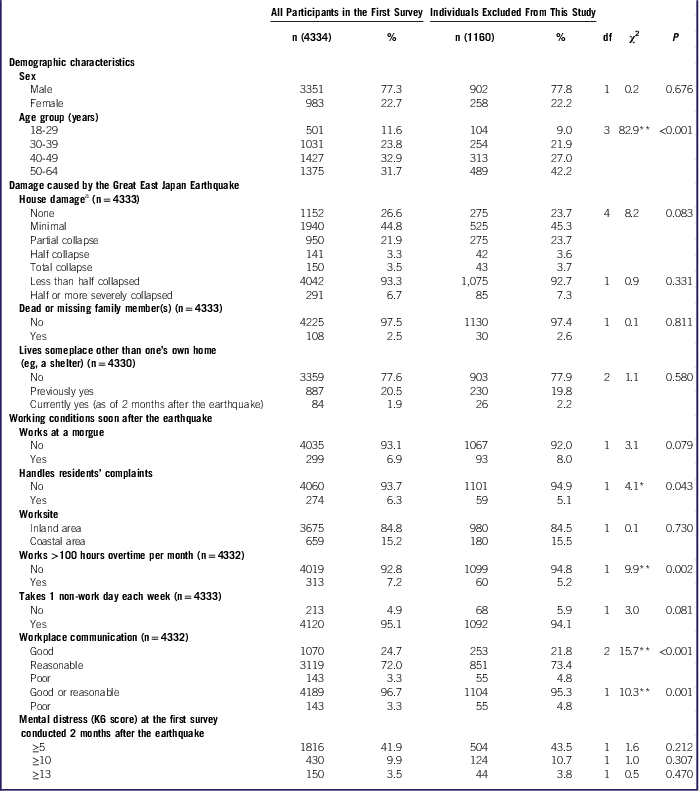
When we compared the study population (ie, participants in all 3 surveys) with excluded individuals, we found significant differences in age, proportion of individuals handling residents’ complaints, working >100 hours of overtime per month, and level of workplace communication (Table 1).
Demographic Characteristics, Earthquake Damage, Working Conditions Soon After the Earthquake, and Mental Distress of Individuals Excluded From the Study Population Compared With All Participants in the First Survey (n=4334).

a Information on house damage obtained in the first survey, which differed from data used in the other analysis in this study, which was revised based on information obtained in the second survey.
*P<0.05, **P<0.01.
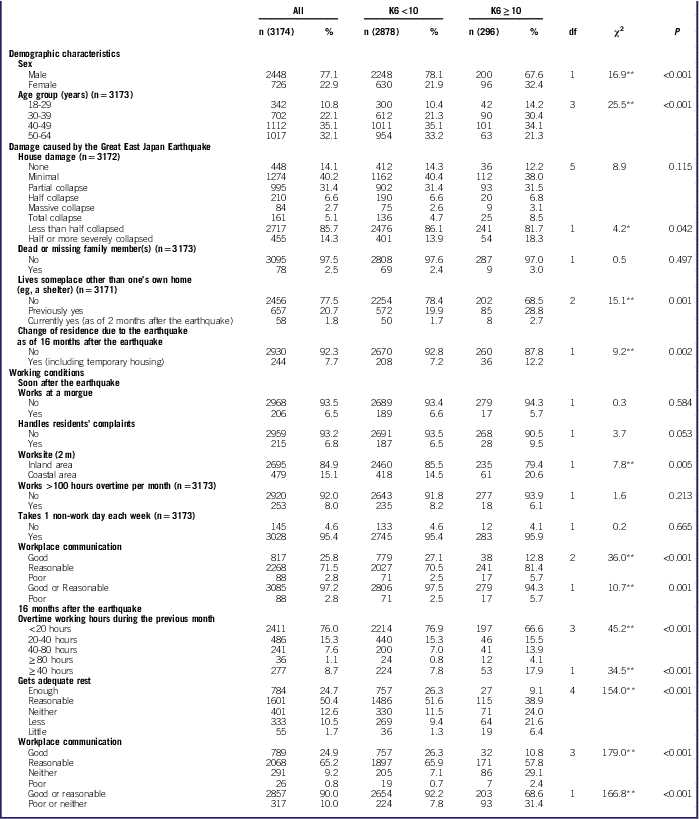
Our analyses revealed statistically significant correlations between demographic characteristics and mental health (Table 2). Women and younger people were more likely to have mental distress. In terms of disaster damage, we found that severe housing damage, experience of living someplace other than one’s own home, and change of residence were significantly related with mental distress. As for working conditions soon after the earthquake, working in a coastal area and poor workplace communication were related, but not job type (eg, working at a morgue or handling residents’ complaints) or overwork (eg, >100 hours of overtime and taking <1 day off per week). As for current working conditions, working ≥40 hours of overtime in the past month, inadequate rest, and poor workplace communication were significantly related with mental distress.
Relationships Between Mental Distress 16 Months After the Earthquake and Demographic Characteristics, Earthquake Damage, and Work-Related Variables Soon After and 16 Months After The Earthquake (n=3174).

*P<0.05, **P<0.01.
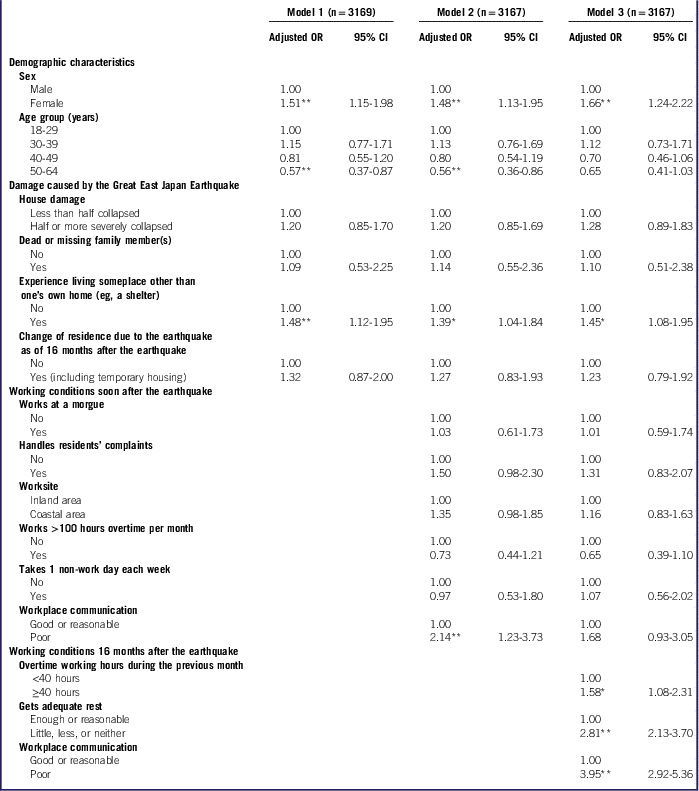
When exploring the effects of earthquake damage and working conditions soon after the earthquake on mental distress 16 months later, we calculated adjusted ORs and 95% CIs of variables using logistic regression analysis (Table 3). In Model 1, living someplace other than one’s own home increased the risk of mental distress (OR: 1.48; 95% CI: 1.12-1.95). In Model 2, living someplace other than one’s own home remained as a significant risk factor (OR: 1.39; 95% CI: 1.04-1.84), and among added variables concerning working conditions soon after the earthquake, poor workplace communication increased the risk of mental distress (OR: 2.14; 95% CI: 1.23-3.73). In Model 3, living someplace other than one’s own home remained as a significant risk factor (OR: 1.45; 95% CI: 1.08-1.95), but workplace communication soon after the earthquake did not. All 3 added variables concerning current working conditions were significantly and strongly related with mental distress.
Adjusted Odds Ratios (ORs) and 95% Confidence Intervals (CIs) for Damage Caused by the Great East Japan Earthquake and Working Conditions Soon After the Earthquake on Mental Distress 16 Months After the Earthquake, Controlling for Demographic Characteristics and Working Conditions 16 Months After the Earthquake, Using Logistic Regression Analysis.

*P<0.05, **P<0.01.
To analyze the effect of living someplace other than one’s own home on mental health by multivariate analysis, we combined the answers “previously yes” and “currently yes” (as of 2 months after the earthquake) because the number of participants in the study population who answered “currently yes” (n=58, 1.8%) was too small to permit a separate examination of these two conditions. When excluding these 58 participants, results of logistic regression analysis were almost the same (OR: 1.43; 95% CI: 1.06-1.94 in Model 3).
Proportion of Participants with Persistent Mental Distress
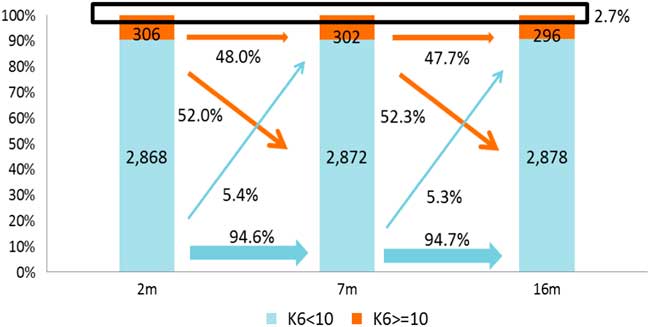
The number of participants who scored above the cutoff of K6≥10 was 306 (9.6%) in the first survey and 302 (9.5%) in the second survey. Among those who scored K6≥10 in the first survey, 48.0% scored K6≥10 in the second survey, and 47.7% of those who scored K6≥10 in the second survey scored K6≥10 in the third survey. Among those who scored K6≥10 in the first survey, 37.3% scored K6≥10 in the third survey. The proportion of participants who scored K6≥10 in all 3 surveys was 2.7% (Figure 1).
Proportion of People Who Scored K6≥10 in Each Survey, Conducted 2 Months, 7 Months, and 16 Months After the Great East Japan Earthquake, and the Proportion of Individuals Who Scored K6≥10 in Subsequent Surveys.

Discussion
Living someplace other than one’s own home in the aftermath of the earthquake increased the risk of mental distress even 16 months later. Working conditions soon after the earthquake were not associated with mental distress at 16 months when controlling for current working conditions. Although the proportion of participants who scored K6≥10 was almost consistent across the surveys conducted 2, 7, and 16 months after the earthquake, almost half continued to score above the cutoff in a subsequent survey and only a few did so in all 3 surveys.
With respect to the experience of living someplace other than one’s own home, although we could not explore length of stay in shelters or elsewhere, 58 (1.8%) participants were living someplace other than their own home 2 months after the earthquake, which is substantially fewer than those who had done so previously (n=657). Thus, most participants did not experience evacuee life for long but it was the only factor of disaster experience whose effects remained 16 months later. It is reasonable to assume that participants experienced stressful conditions while staying in a shelter or relative’s home from, for example, a lack of privacy. The experience of living someplace other than one’s own home seems to reflect the severity of stresses experienced in the aftermath of the earthquake.
On the other hand, our observation that none of the variables concerning disaster damage except for the experience of living someplace other than one’s own home affected mental health 16 months after the earthquake is not consistent with the findings of previous studies. In their examination of the mental health of municipal workers in Miyagi Prefecture 14 months after the Great East Japan Earthquake, Sakuma et alReference Sakuma, Takahashi and Ueda 7 reported that having dead or missing family member(s) and displacement from prior housing to temporary housing or elsewhere were strongly related with mental distress after controlling for workplace factors at the time of the survey. However, they administered their survey among local municipal workers in a coastal area, which included many more participants who experienced severe disaster damage compared with our study population. Their proportion of participants with mental distress was also much higher. Thus, the persistent effect of disaster damage in a population is thought to depend on the severity of damage suffered by that population.
Selection of the outcome variable might also explain why we did not find an association between the independent variables for disaster damage except for life as an evacuee and mental health. For example, Kuwahara et alReference Kuwahara, Takahashi and Matsui 8 examined the mental health of local public servants in Miyagi Prefecture and reported that disaster experience was related to post-traumatic stress symptoms 16 months after the Great East Japan Earthquake. Among recent studies into the long-term effects of disaster damage on mental health, although some studies revealed that people with higher disaster exposure were more likely to have depression,Reference Sakuma, Takahashi and Ueda 7 , Reference Fullerton, McKibben and Reissman 10 , Reference Cénat and Derivois 21 other studies reported that earthquake experiences or consequences were related to post-traumatic stress symptoms/disorder but not to depression.Reference Ehring, Razik and Emmelkamp 9 , Reference Gigantesco, Mirante and Granchelli 22 Other studies have suggested that, although disaster exposure and traumatic events are predictive of the development of post-traumatic stress disorder, life stressors are more predictive when it comes to depression.Reference Sakuma, Takahashi and Ueda 7 , Reference Tracy, Norris and Galea 23 Our use of the K6 score as an outcome measure, a scale that assesses non-specific psychological distress and consists mainly of items related to depression or anxiety-related symptoms, might partly explain why we did not find a relationship between objective disaster damage (eg, severity of housing damage or death or missing of family members) and mental distress, but only evacuee life, which is likely related to several life stressors.
In this study, we did not observe any effects related to work conditions soon after the disaster. Previous studies have reported inconsistent results for work-related stressors on mental health. Our previous study revealed the significant effect of securing 1 non-work day per week soon after the earthquake on mental health 7 months after the earthquake.Reference Suzuki, Fukasawa and Obara 6 Kuwahara et alReference Kuwahara, Takahashi and Matsui 8 reported that experience of compassion fatigue at work and subsequent busyness affected post-traumatic stress symptoms among local public servants 16 months after the earthquake. Ehring et alReference Ehring, Razik and Emmelkamp 9 reported that work-related stress had significant effects on post-traumatic stress symptoms, anxiety, and somatic symptoms, but not on depression among recovery workers 24 months after the earthquake. Fullerton et alReference Fullerton, McKibben and Reissman 10 reported that work demand during or in the aftermath of a hurricane had significant effects on alcohol and tobacco use but not on post-traumatic stress symptoms or depression among public health workers 9 months after a hurricane. Considering the diverse results of these studies and their assessment of various work-related factors and psychiatric symptoms, we cannot discuss the effects of specific work-related stressors on specific symptoms. More research is needed into the effects of work conditions during and after a disaster. On the other hand, among the factors of work conditions, our study revealed that the effects of current work conditions were much stronger than that of stressful work conditions soon after the disaster. Therefore, we should first focus on current work conditions, keeping in mind the potential for the long-lasting effects of stressful work conditions in the aftermath of a disaster.
To identify individuals with high mental distress, we considered those with a K6 score in the upper 10%, which resulted in our use of 9/10 as a cutoff. Although, to our knowledge, no other study has selected 10% of the population using the K6, some reports have calculated the proportion of people who scored K6≥10. A community survey conducted in Japan during non-disaster times reported that the proportion of people scoring K6≥10 was 8.2%.Reference Kawakami 24 According to data from the Comprehensive Survey of Living Conditions, among people aged 15-65 years in Miyagi Prefecture, the proportion scoring K6≥10 was 12.3% in 2010 and 12.8% in 2007. 25 A survey of local government staff conducted during non-disaster times reported a proportion of 8.2% of subjects scoring K6≥9.Reference Suzuki, Sasaki and Motohashi 26 Given these previously reported proportions, the K6 score in our study is comparable despite being obtained after a massive disaster. These statistics seem to reflect the resilience of our study population of public servants in that protective factors such as secure employmentReference Cénat and Derivois 21 , Reference Norris and Galea 27 , Reference Kukihara, Yamawaki and Uchiyama 28 or relatively high socio-economic statusReference Kukihara, Yamawaki and Uchiyama 28 might overcome deterioration of mental health.
As for the replacement of participants identified as having mental distress between surveys, although the proportion who scored K6≥10 was almost consistent throughout the surveys, about half of them were replaced in a subsequent survey and few people consistently scored K6≥10 in all 3 surveys. Despite the absence of pre-disaster data for comparison, that so few participants consistently scored K6≥10 is in line with existing knowledge that most people have psychological resilience; that is, most people experience negative symptoms for a short time and then quickly return to pre-disaster levels of functioning.Reference Norris, Tracy and Galea 29 , Reference Pietrzak, Tracy and Galea 30
This study has some limitations. The response rate of the first survey was 82.8% and there was no information about those who did not participate. In addition, we included 73.2% of participants in the first survey, and there were some differences between the study population and excluded individuals. Although we found no significant differences in disaster damage and the proportion of participants scoring at or above the K6 cut-off point 2 months after the earthquake, it should be kept in mind when interpreting the results that more individuals were derived as study participants from a younger section of the population and had good communication, engaged in handling residents’ complaints, and worked 100 hours overtime per month soon after the earthquake compared with all first-survey participants. Furthermore, we limited disaster-related variables to house damage, dead or missing family member(s), experience of living someplace other than one’s own home, and change of residence. Cerdá et alReference Cerdá, Bordelois and Galea 31 found that acute disaster-related traumatic events or stressors such as death of a family member or close friend or loss or damage to one’s own house matter most for short-term mental health, rather than for the longitudinal course of mental health, and that as time passes, ongoing post-disaster daily stressors begin to influence mental health. To examine the long-term effects of a disaster, it would have been better to ask about changes in life and stressors, not just change of residence and also, for example, serious financial problems, stressful legal problems, or lost/decreased social support due to the disaster. Nevertheless, whereas most studies conducted after a disaster have been cross sectional, we were able to utilize longitudinal data obtained at 2, 7, and 16 months after the earthquake. We were able to gain information on disaster damage and work conditions soon after the disaster from the first survey conducted 2 months after the earthquake, which should decrease recall bias. In addition, we were able to reveal the extent of replacement of high-risk participants between surveys identified with the K6, a frequently used questionnaire, which should provide useful information in future disaster response.
Conclusions
Although the effect of experiencing evacuee life on mental health remained for more than 1 year, the effects of stressful work conditions soon after the earthquake did not. Focusing on improving present work conditions as a usual occupational health activity (eg, restricting excessive overtime work or ensuring adequate rest, or paying careful attention to workplace communication) while keeping in mind the long-lasting effects of disaster damage seems to be instrumental in managing employees’ mental health after a disaster. Although the proportion of participants identified by the self-administered questionnaire K6 was consistent for 3 time surveys repeated over 16 months, the membership changed to a large extent over several months. Most prefectural public servants responding to the massive disaster were resilient.
Acknowledgments
The authors thank Rumiko Sasaki, Toshinori Ushibukuro, and Mitsunori Sato from the Division of Human Resources and Welfare of the Miyagi Prefectural Government and Dr Yuiko Kimura and Yumiko Moriya from Miyagi Prefectural Government Health Clinic. The authors also acknowledge the dedicated coordination efforts of Akemi Toubai from Miyagi Mental Health and Welfare Center.
Funding
This work was supported by Health and Labor Science Research Grants for Research on Psychiatric and Neurological Diseases and Mental Health (grant number 23201501) from the Ministry of Health, Labour and Welfare, Japan.
Conflicts of Interest
None.
Author’s Contribution
M.F. analyzed and interpreted the data and drafted the manuscript. A.O. and Y.S. planned and managed the survey. Y.S. and Y.K. revised the draft for important intellectual content. All the authors read and approved the final manuscript.
Ethical Considerations
All procedures followed were in accordance with the ethical standards of the responsible committee on human experimentation and with the Helsinki Declaration and its later amendments. This study involved secondary analysis of existing data. The study protocol was reviewed and approved by the Ethics Committee of the National Center of Neurology and Psychiatry, Japan.