INTRODUCTION
The yield of yams (Dioscorea spp.) is influenced by a range of agronomic, physiological and environmental factors, whose interactions are not well understood. High variability within yam plantings has hampered progress to characterize yield determinants in the crop and is largely a product of the mode of vegetative propagation (Okoli, Reference Okoli1980; Onwueme and Haverkort, Reference Onwueme and Haverkort1991). Despite a long growing season (7–12 months depending on species and climate) the size of the initial planting piece (tuber sett) is highly influential on final yield (Enyi, Reference Enyi1972a; Ferguson, Reference Ferguson1977; Nwoke et al., Reference Nwoke, Njoku and Okonkwo1977). In addition to the sett size, large variability among plants results from differences in sprouting time and vigour, both influenced by the sett's dormancy status and which part of the mother tuber is used (whole tubers or top, middle or tail sections) (Okoli, Reference Okoli1980). Virus and nematode loads undoubtedly add to variability in most plantings. In addition, staking, mounding and mulching practices are known to influence yield, but the extent of influence has varied among reported studies and depends on genotype and environmental conditions (Enyi, Reference Enyi1972b; Maduakor et al., Reference Maduakor, Lal and Opara-Nadi1984; Okigbo, Reference Okigbo1977). In many traditional yam-growing communities, the cultivation of yam is highly ritualized, attempting to optimize these agronomic influences and to appease the supernatural forces held responsible for further unexplained variability (Malinowski, Reference Malinowski1922; Tedder and Tedder, Reference Tedder and Tedder1974; Weightman, Reference Weightman1989).
Among traditional growers, much emphasis is placed on the selection of land for yam gardens (Tedder and Tedder, Reference Tedder and Tedder1974). Yams are regarded as being demanding of soil fertility and are almost invariably placed first in a crop rotation following fallow. Yields obtained by farmers (estimated at 11–15 t ha−1 in Papua New Guinea by Bourke and Vlassak, Reference Bourke and Vlassak2004) are considerably less than the yield potential of above 80 t ha−1, (e.g. Vander Zaag et al., Reference Vander Zaag, Fox, Kwakye and Obigbesan1980), and farmers report that shortened fallows have been associated with progressive yield decline (O'Sullivan, Ernest and Holzknecht, unpublished surveys in Papua New Guinea). Yet reported responses to fertilizers have been erratic and usually of low magnitude, compared with the effects of sett size or staking (Chapman, Reference Chapman1965; Enyi, Reference Enyi1972b; Obigbesan, Reference Obigbesan1981). Oyolu (Reference Oyolu, Miege and Lyonga1982) appealed for more information on method and timing of fertilizer application in relation to crop development. Indeed, among the published studies of fertilizer responses, method of application and dimensions of plots are frequently not mentioned. Timing has been addressed to a limited extent, and delaying N applications until after crop establishment has been shown to increase the likelihood of a positive yield response (Chapman, Reference Chapman1965; Sobulo, Reference Sobulo1972b). Nwinyi and Enwezor (Reference Nwinyi and Enwezor1985) compared four fertilizer placement options for D. rotundata after crop establishment and found that broadcast fertilizer usually yielded as much or more than banded side-dressings requiring soil disturbance, while requiring much less labour. However, soil and climate factors affecting leaching and volatilization may have affected the ranking of treatments at different locations.
In a series of recent field experiments attempting to quantify soil fertility constraints to yam yield in Vanuatu, Melteras (Reference Melteras2005) failed to find significant yield responses at most sites, despite nutrient omission pot trials and soil chemical analyses identifying the nutrients applied at each site as being moderately to severely deficient (Melteras et al., Reference Melteras, O'Sullivan, Asher and Lebot2004). Foliar nutrient concentrations in the crops also indicated that test nutrients were deficient in most cases, based on critical nutrient ranges defined in solution culture (critical concentration data are not yet published; indicative adequate and deficient concentrations are available in O'Sullivan and Jenner (Reference O'Sullivan and Jenner2006) for D. alata and O'Sullivan and Ernest (Reference O'Sullivan and Ernest2007) for D. esculenta). High variability among plants contributed to the results but did not fully account for them. Issues identified as requiring further investigation were the limited information on optimum placement and timing of fertilizers for yams, and the adequacy of the 2 m treatment separation used in these trials.
The current experiment was undertaken to examine yam root development in relation to development of the crop, with a particular interest in the horizontal distance reached by roots from the planting position, indicating the minimum distance needed to separate experimental fertilizer applications, and the location of fine roots with respect to fertilizer placement options. While D. alata is the dominant yam species grown in Vanuatu, D. esculenta was used in this study due to the high risk of anthracnose infection (Colletotrichum gloeosporioides) curtailing D. alata development at this site. Further investigations of root distribution were undertaken subsequently using D. alata at an anthracnose-free site and are reported in the subsequent paper in this volume (O'Sullivan, Reference O'Sullivan2008).
MATERIALS AND METHODS
The experiment was conducted at the Vanuatu Agricultural Research and Training Centre at Valeteruru, Espiritu Santo, Vanuatu: 15°25′S, 167°6′E, 20 m asl, mean air temperature 25.2°C, humidity 85% and annual rainfall 2947 mm with a relatively dry season (less than 200 mm rain per month) between June and September. The site used was a brown volcanic soil (Eutrandept by USDA soil taxonomy) developed on a raised coral platform, typical of cropping soils in Vanuatu. The site had been cleared from forest six years earlier and had been cropped three times (with yam, sweet potato and cassava) without fertilization, but immediately prior to the experiment had been fallowed under the herbaceous legume Glycine wightii for two years. No fertilizer was applied to the experiment.
Two replicate blocks of 50 plants were established at 2 m × 2 m spacing, separated by a single (2 m) guard row. Whole tubers of Dioscorea esculenta (all of a single unnamed cultivar grown at one site), weighing 450–550 g fresh weight, were sprouted in a pit lined with banana leaves and covered with soil (a traditional Tongan practice known as tanu) for five weeks before selecting planting material of uniform sprout development, which was randomized within blocks. The heat generated in the tanu incubation is believed to aid wound healing and provide some control of fungal and nematode pests, as well as synchronizing the breaking of dormancy. No chemical pest control was used. The field was mechanically tilled, setts placed on the loose soil and soil mounded up to 50 cm height over each sett. Wide spacing and large mounds were intended to facilitate excavation with minimum disturbance to adjacent plants. Each plant was supported with a single stake approximately 2 m high.
Planting was on 1 October 2003. Beginning at 11 weeks after planting (WAP) (5 weeks after vine emergence) and continuing each month to 55 WAP, five plants were excavated from each block. The normal growing season for D. esculenta in this area is 9–10 months, hence observations continued beyond the normal harvest stage, through the dormancy period, in order to define optimum harvest conditions and impacts of earlier or later harvest.
For each plant, vines were cut first from the crown of the plant and fresh weight recorded immediately in the field. The roots were then excavated manually starting from the crown and working to the end of each root. The branching pattern and depth of the root extremities were noted, but not quantified for each root. For the purpose of the following discussion, the adventitious roots arising directly from the crown of the sett are referred to as primary roots, to distinguish them from the total root system, which included branches from the primary roots and, later in the season, adventitious roots arising from developing tubers. Once excavated, the length of each primary root from the crown to its furtherest extremity was measured in the field. The number of primary roots and tubers, and the fresh weight of tubers, were recorded. Roots, mother tubers (setts) and new tubers were washed, tuber samples sliced, and all fractions oven-dried at 65°C for 48 h before recording dry weight. To reduce the volume to be dried, weighed sub-samples were taken of vines and tubers, and the total dry weight calculated from the sample dry weight percentage.
Plants were harvested in groups of five adjacent plants in each block, to minimize disturbance and spacing effects on remaining plants. From 23 WAP, root entanglement required some roots to be broken in order to trace others. Hence root length measurements were limited to 20 roots per plant, while the total number of primary roots and the total weight of roots recovered were recorded.
Data were analysed using the general linear means protocol (glm) in SAS (version 8).
RESULTS
Plants grew vigorously from emergence and showed no symptoms of stress. At four months Cyclone Ivy knocked down the vines and their stakes, but the plants continued to grow vigorously on the ground. From about nine months, leaves turned yellow as vines entered senescence.
Root development
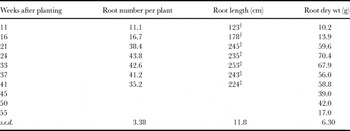
At 11 WAP the plants had developed more than 10 primary roots and root numbers increased to 24 WAP (Table 1). Thereafter, the number of roots remained stable. After 41 weeks, the number of roots could not be recorded with accuracy as they had become senescent and broke easily.
Mean number and length of primary roots, and weight of all roots recovered, measured at sequential destructive harvests of D. esculenta at Valeteruru. Data are means of 10 plants; s.e.d. gives the standard error for the difference between two means. From 45 WAP, root number and length were not recorded due to frequent breakage of the senescent roots.

† Mean of all roots present.
‡ Mean of 20 roots per plant.
In the first harvest at 11 WAP, primary roots were confined to the top 7–10 cm of the soil and their short branches also extended horizontally, not penetrating more than a few centimetres deeper. Furthermore, roots did not extensively explore the planting mound at this stage, but radiated horizontally from the crown of the sett. They had already achieved an average length of 123 cm (Table 1). Despite the 2 m × 2 m spacing, roots were already overlapping with those of adjacent plants. The average length increased to 21 WAP but not significantly thereafter. After reaching a maximum distance, the roots went deeper in the soil. Hence, at 24 WAP, the extremities of roots penetrated to about 30 cm depth. With the number of primary roots increasing steadily to about 24 WAP, the amount of roots found within the mound also increased; however, many of these roots belonged to neighbouring plants. From 33 WAP, fibrous roots growing from the developing tubers increased the root density below the mound. By 45 WAP, roots were becoming senescent and root lengths could not be recorded, but the broken pieces were recorded in dry weight.
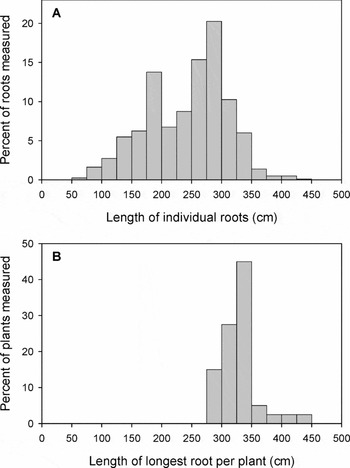
In terms of individual roots, the longest root was recorded at five months (21 WAP) with a length of 436 cm. Taking root length data from 21 WAP to 37 WAP when average root lengths were stable and maximized, it was observed that the highest frequency of root lengths was between 250 and 300 cm (Figure 1A), and that all plants possessed at least one root exceeding 275 cm, 85% of plants exceeded 300 cm in root reach and 12.5% exceeded 350 cm (Figure 1B). The minor peak in root lengths just under 2 m may be an artifact, recording roots damaged during previous harvests of adjacent plants. Thus longer root categories may be slightly underestimated.
Frequency distribution of root lengths grouped in 25 cm length ranges, (A) for all 800 primary roots measured from 21 WAP to 37 WAP, and (B) for the maximum root length of each of the 40 plants harvested over the same period.

The average root dry weight per plant at each harvest is presented in Figure 2. There was a slow increase over the first four months, then a rapid increase to 24 WAP when the root dry weight peaked. Roots accounted for around 16% of new season biomass at the earliest harvest, declining to around 10% during the vegetative phase before tuber initiation and to less than 1% at maximum tuber production. From 41 WAP, the weight of recovered roots declined as the plants entered senescence.
Dry weight of plant parts at sequential harvests of D. esculenta grown at Valateruru. Data are means of 10 plants. Error bars show standard errors of means.

Vegetative growth
At planting, the tuber sett dry weights were approx. 150 g. By the first harvest at 11 WAP, they had lost 65–85% of the initial dry weight. Relatively little further weight loss occurred (less than 10%) over the next three months, suggesting the remaining material was not remobilizable. After five months the setts rotted away (Table 1).
Dry weight development of vines was relatively slow to 11 WAP then more rapid to 33 WAP. The slight inflection in the curve at 16–21 WAP may have been due to cyclone damage. After 33 WAP vine weight decreased significantly as the plants entered the senescent stage. Yellowing of leaves became evident between 33 and 37 WAP. By 45 WAP, many leaves were shed and vine dry weight was less than half its maximum. Vines were completely dead by 50 WAP and their weight was not recorded.
Tuber production
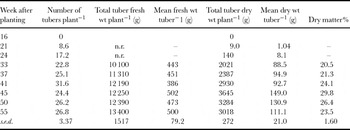
Tubers were first observed at 21 WAP. The number of tubers increased significantly over the following months reaching a maximum around 27 tubers per plant between 37 and 41 WAP. Tuber dry weight production was slow in the first four weeks following initiation, then increased rapidly from 24 WAP to 33 weeks when vine growth had ceased. However, tuber growth continued throughout the senescence of the vines, adding 40% of the final dry weight during this period, largely due to increased dry matter content (Table 2). The data suggest that harvesting before full senescence of the vines risks losing significant potential yield, although this may not be apparent on the basis of fresh tuber weight. After 45 WAP dry matter content declined, probably due to tuber respiration during dormancy.
The tuber number, fresh and dry weight, and dry matter percentage measured at sequential harvests during tuber development and dormancy of D. esculenta at Valeteruru. Data are means of 10 plants; s.e.d. gives the standard error for the difference between two means.

n.r. = not recorded.
The tuber yield per plant recorded in this experiment was very high, due to the wide plant spacing. The fresh tuber yield of 13 kg plant−1 was equivalent to 32 t ha−1, assuming a uniform spacing of 1 plant per 4 m2, without considering edge effects of plants adjacent to previously harvested areas. The effect of plant spacing on D. esculenta yields has not been extensively studied. While Enyi (Reference Enyi1972a) and Ferguson (Reference Ferguson1977) reported maximum net yields of yams at plant densities of 1–3 per m2, Rodriguez-Montero et al. (2001) found that D. alata yield was dependent on seed rate (weight of setts per unit area) rather than plant population. At a rate of 1.25 t setts ha−1, our yield was somewhat higher than those they obtained; however, our plant population was below the range studied. The capacity of D. esculenta to produce large numbers of tubers may increase its ability to maintain yield at lower plant densities.
At the optimum harvest time of 45 weeks, tubers accounted for 87% of total dry matter, comparable with that reported for intensively managed D. rotundata by Irizarry and Rivera (Reference Irizarry and Rivera1985) (84% of total not including roots) and considerably exceeding the 50–67% recorded for D. esculenta by Enyi (Reference Enyi1972a;Reference Enyib), possibly due to the longer period of tuber bulking afforded by the absence of a distinct dry season in the present study. However, such a measure of harvest index is highly dependent on the extent of vine senescence at the time of harvest. As a measure of the tubers' proportion of total biomass produced, the maximum weight of roots and vines should be included. On this basis, the harvest index in this study was 71%.
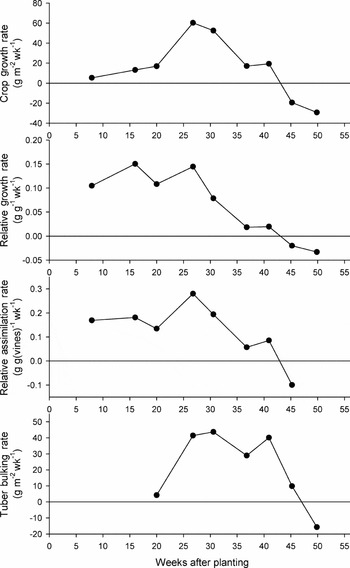
Growth analysis parameters for D. esculenta grown at Valeteruru. Plant spacing was 4 m2 plant−1. Data are moving averages across two sampling intervals.

Growth analysis
Figure 3 depicts the estimation of various growth parameters throughout the measurement period. Sett weight was not included in the weight increment data, but was included in the denominator for relative growth rate calculation. Crop growth rate, as a reflection of the photosynthetic capacity, followed a similar pattern to vine dry weight, but declined more steeply in the vine senescence period, as declining photosynthetic efficiency of the senescing leaves added to loss of leaf biomass. Relative growth rate was fairly steady, around 0.13 g g−1 wk−1, during the initial vegetative stage, but declined during tuber bulking due to the effect of the unproductive tuber mass in the denominator. Tuber bulking rate, however, remained high after vine growth had ceased, declining rapidly only in the last stages of vine senescence.
In this study leaf blades were not separated from vines and petioles, and leaf area was not estimated, hence net assimilation rate (NAR) is given as g g (vines)−1 wk−1. These data can be interpreted on the basis that leaf blades account for around 40% of vine weight in early growth, increasing to around 60% at peak vine development, and declining due to abscission during the senescence phase (Maduakor et al., Reference Maduakor, Lal and Opara-Nadi1984; Okezie et al., 1984; Sobulo, Reference Sobulo1972a). Thus NAR in this study approximated 0.4 g g (leaf blade)−1 wk−1 throughout vine development, equivalent to approximately 0.16 g dm−2 wk−1 on a leaf area basis and similar to rates reported by Sobulo (Reference Sobulo1972a) for D. rotundata and Chapman (Reference Chapman1965) for D. alata. Njoku et al. (Reference Njoku, Nwoke, Okonkwo and Oyolu1984) and Okezie et al. (Reference Okezie, Okonkwo and Nweke1986) reported higher values for D. rotundata.
DISCUSSION
In an attempt to characterize the agronomic determinants of yield, a number of growth analysis studies have been conducted with yams (D. rotundata: Irizarry and Rivera, Reference Irizarry and Rivera1985; Njoku et al., Reference Njoku, Nwoke, Okonkwo and Oyolu1984; Nwoke and Okonkwo, Reference Nwoke and Okonkwo1978; Subolu, Reference Sobulo1972a; D. alata: Chapman, Reference Chapman1965; Irizarry et al., Reference Irizarry, Goenaga and Chardon1995; Okoli, Reference Okoli1980; D. esculenta: Enyi, Reference Enyi1972a;Reference Enyib). In general three phases are observed: early and rapid development of the root system and stem during the period of dependence on the planting sett, followed by a period of vine growth and leaf area acquisition, and finally tuber development. Chapman (Reference Chapman1965) identified a correlation between leaf area duration and tuber yield. Enyi (Reference Enyi1972a) emphasized the relationship between tuber number of D. esculenta and leaf area at the time of tuber initiation, and the high correlation between final tuber yield and leaf area duration over the period from tuber initiation to harvest. However, the role of nutrient capture remains poorly understood (Onwueme and Haverkort, Reference Onwueme and Haverkort1991). The literature suggests that yams respond little if at all to fertilizers on soils where other crops show substantial gains. In contrast, sett size has large and consistent impact on yields, despite it influencing vegetative growth only in the first 7–10 weeks (Nwoke and Okonkwo, Reference Nwoke and Okonkwo1978), during which only around 2–5% of the final biomass is produced (Enyi, Reference Enyi1972a; Njoku et al., Reference Njoku, Nwoke, Okonkwo and Oyolu1984; Sobulo, Reference Sobulo1972a). Yet fertilization has been observed to promote earlier tuber initiation and to delay vine senescence (Enyi Reference Enyi1972b; Sobulo Reference Sobulo1972c; authors' unpublished observations), both parameters increasing leaf area duration for tuber bulking.
Thus the evidence to date on nutrient requirements and fertilizer responses of yams has been inconsistent and contradictory. Considering the root distribution revealed in the current study, we speculate that inadequate treatment separation may have reduced observed responses in many fertilizer studies.
While several authors describe the yam root system as developing horizontally in the upper layers of the soil (Oyolu, Reference Oyolu, Miege and Lyonga1982), little quantitative information is available on root distribution. Njoku et al. (Reference Njoku, Nwoke, Okonkwo and Oyolu1984) excavated roots of D. rotundata, finding up to 20 primary roots per plant lying around 10 cm below the surface and extending up to 2.5 m. Budelman (Reference Budelman1990) depicted the root system of D. alata in a sandy loam as extending approximately 2 m radially from the crown, with secondary branches descending to a depth of around 30 cm. For D. esculenta, Enyi (Reference Enyi1972a and Reference Enyi1972b) recorded weight of roots recovered within the ridge in the area of the sample but did not attempt to trace the extent of roots of individual plants. Maduakor et al. (Reference Maduakor, Lal and Opara-Nadi1984) estimated root length density and root weight density of D. rotundata from root cores but did not report the depth profile obtained.
The root lengths recorded in this study exceed those previously reported. A focus on the planting ridge or mound for retrieval of roots (Enyi, Reference Enyi1972a) should be questioned, but may be appropriate as a representative sample within uniform plantings. With respect to fertilizer placement, our observations suggest that spot placement of fertilizers in the planting hole, or banding in the planting furrow, may not provide efficient access for the target plant. However, given its convenience and the accessibility to surrounding plants, it may be an effective method for pre-planting applications. Side dressing into a groove around the planting mound after crop establishment (a commonly used method) risks damage to primary roots, which radiate from the crown and are very close to the surface at the base of mounds. Such damage may be responsible for apparent negative fertilizer effects we have observed in some trials. Broadcasting or placement along the interrow may be preferable to the formation of furrows or forking in around mounds. Nwinyi and Enwezor (Reference Nwinyi and Enwezor1985) found broadcasting usually yielded as well or better than banding into a groove formed within ridges, but surface application in the interrow furrow did not perform as well at most locations. This was attributed to leaching losses on sandy soils with high rainfall. They further found that groove placement as a ring around the vine almost invariably yielded less than that as a band along the ridge, which could be explained by greater root damage in the ring placement. Further experiments on comparison of fertilizer placement in yam fields are needed in order to evaluate placement efficiency for particular soil types. Such experiments should include a separate control with the same soil disturbance but no fertilizer application, for each post-planting application method.
Regarding the design of fertilizer field trials, it is evident that the yam roots are capable of traversing a single guard row at 1 m spacing and reaching fertilizers placed 2–4 m away. The use of unplanted alleys or trenches (Irizarry and Rivera, Reference Irizarry and Rivera1985, Irizarry et al., Reference Irizarry, Goenaga and Chardon1995) complicates the interpretation with respect to effective plant density and remains untested as an effective root barrier. The need for wide guard rows and large plot sizes, in which a central datum area may be regarded as having uniform fertilizer exposure, would limit randomized trials to very few treatments in most Pacific region contexts, where garden sizes are traditionally small (less than 1000 m2) and availability of uniform planting material is very limited. One option would involve installing plastic root barriers around the plots. However, this would be costly and only practical where mechanical digging equipment is available. An attractive alternative may be the use of non-randomized treatment arrangements, in which the treatments form a continuous gradient within a block and yields are analysed by correlation, such as the method reported by Vander Zaag et al. (Reference Vander Zaag, Fox, Kwakye and Obigbesan1980). A P rate experiment of this type conducted by the authors, at the same location as the current study, obtained a significant response, while several randomized experiments failed to do so (Melteras, Reference Melteras2005). The yield increase obtained was 55%, and the highest response recorded at 240 kg P ha−1. Both the magnitude of this response and the rate required to saturate it are exceptionally high in the literature on yam fertilization, suggesting that appropriate trial design is critical in revealing the nutritional requirements of yam.
Reported observations on D. alata and D. rotundata (reviewed above), and now on D. esculenta, indicate that all have similar rooting patterns. Soil type appears to have no profound effect on root distribution, within the range of soils typical of yam production, which are generally light textured, allowing free drainage and unimpeded tuber formation. A subsequent paper in this volume (O'Sullivan, Reference O'Sullivan2008) describes further characterization of root distribution in D. alata. That study, utilizing a root tracer, addressed the problems inherent in the current experiment, of atypically low plant density, and incomplete recovery of very fine roots. The conclusions of the current study are upheld and extended, and we believe they have profound implications for future fertilizer studies with yams.
Acknowledgements
This work was funded by the Australian Centre for International Agricultural Research (ACIAR) under project SMCN/1998/28. M.-V. Melteras was supported by an AusAID postgraduate scholarship.