Introduction
The demographic changes in our society will lead to a growing number of older individuals on the one hand, and to a decreasing number of individuals in younger age on the other. In particular, the number of persons aged 80 years and over will increase constantly as part of continuous increase in life expectancy. By the year 2050, increase from the current 4 million to about 10 million very old people is expected (Statistisches Bundesamt, 2009). The continuously increasing population of very old people represents a major challenge for our society as well as healthcare system (Riedel-Heller et al., Reference Riedel-Heller, Busse and Angermeyer2006).
The demographic and social developments that can be expected in next decades will lead to significant increase in medical treatment and healthcare needs in the elderly population. Compared with the needs of younger people, the needs of older people are often more complex because of multi-morbidity, physical function impairment, and social problems. Thus, the planning and provision of healthcare services should include more than the isolated assessment of diagnoses and symptoms. Undetected and unmet needs of older patients can lead to underuse or misuse of treatments and inadequate or inappropriate provision of healthcare services, and are therefore the main focus of health services research. To avoid underuse or misuse of healthcare services and treatments, there is a rising need to supply standardized assessment of needs. The assessment of needs should be comprehensive, multidimensional, and systematic to ensure that the individual's actual existing needs correspond well to the offered treatments and healthcare services.
The Camberwell Assessment of Need for the Elderly (CANE; Orrell and Hancock, Reference Orrell and Hancock2004) is an instrument for the comprehensive, person-centered assessment of needs in the elderly population, and was derived from the original Camberwell Assessment of Need (CAN; Phelan et al., Reference Phelan1995), which is used internationally (Bauerle et al., Reference Bauerle2013). The CANE can be used within a multidisciplinary team and takes into account the perspectives of patients, carers and health care professionals. The advantage of CANE over other needs assessment instruments is that it can be used not only for clinical but also for research and evaluation purposes. Furthermore, the CANE can be applied in a variety of settings such as private homes, nursing homes, acute care hospitals, and day clinics. The CANE is available in 16 languages and within the CANE network there are many collaborating researchers and clinicians in over 32 different countries in Europe, Asia, and America (http://www.ucl.ac.uk/cane). The feasibility, reliability and validity of the CANE was investigated and proved in many studies (Reynolds et al., Reference Reynolds2000; Orrell and Hancock, Reference Orrell and Hancock2004; van der Roest et al., Reference van der Roest, Meiland, van Hout, Jonker and Droes2008; Fernandes et al., Reference Fernandes2009). However, the German version of the CANE (Dech and Machleidt, Reference Dech, Machleidt, Orrell and Hancock2004) has been barely used and could not yet be established in the field of health services research. Moreover, data on psychometric quality of the instrument and comprehensive studies on the validity of the German version of the CANE are pending.
Against this background, the purpose of this study was to evaluate needs in a sample of individuals using the current German version of the CANE and to identify common met and unmet needs. In order to assess the reliability and validity of the instrument, a further aim of this study was to compare CANE with other instruments and outcomes, and also compare patients’ and relatives’ perspectives.
Method
Sample
The sample consisted of older primary care patients and their relatives (if available). All patients were recruited via general practitioner (GP) practices in the city of Leipzig, Germany. Only regular patients who had at least one contact with the GP within the last 12 months (including home visits) were included in the study sample. Exclusion criteria were (1) severe illness, probably fatal, within three months according to the GP, (2) moderate to severe dementia as indicated by the GP, (3) insufficient ability to speak and read German, insufficient ability to consent, and (4) poorly known patients to the GP because of accidental consultation. The entire study protocol was approved by the local ethics committees, and all participants gave written informed consent. The sample consisted of 158 patients (n = 158) and their relatives (n = 44).
Instruments
As part of a standardized questionnaire, the German version of the CANE was used as provided by Dech and Machleidt (Reference Dech, Machleidt, Orrell and Hancock2004) and as described by Fink (Reference Fink2011). The CANE consists of 24 domains of needs in four care categories, including environmental needs (accommodation, looking after home, food, caring for someone else, money/budgeting, benefits), physical needs (self-care, eyesight/hearing/communication, mobility/falls, continence, physical health, drugs), psychological needs (memory, psychotic symptoms, psychological distress, deliberate self-harm, inadvertent self-harm, behavior, alcohol), and social needs (daytime activities, information, abuse/neglect, company, intimate relationships) (Reynolds et al., Reference Reynolds2000; Orrell and Hancock, Reference Orrell and Hancock2004; van der Ploeg et al., Reference van der Ploeg, Bax, Boorsma, Nijpels and van Hout2013). The CANE assessments were completed by the patients and by their relatives if available.
In addition to the CANE, the health-related quality of life of participants was assessed using the visual analogue scale of the EQ-5D questionnaire (visual analogue scale (VAS) of EQ-5D; Moock, Reference Moock2008). The participants were asked to rate their current state of health on the VAS EQ-5D, which ranged from 0 (worst imaginable state of health) to 100 (best imaginable state of health). The Mini-Mental State Examination (MMSE; Folstein et al., Reference Folstein, Folstein and Mchugh1975) was used to screen for cognitive impairment and dementia. Depressive symptoms were assessed via the 15-item German version of the Geriatric Depression Scale (GDS; Gauggel and Birkner, Reference Gauggel and Birkner1999). The participants’ capacity to perform (instrumental) activities of daily living (IADL/ADL) was assessed by 24 items (Schneekloth and Potthoff, Reference Schneekloth and Potthoff1993). The 24 items cover responsibility for one's own body care, mobility, ability to buy food and prepare meals, medication, keep the home clean, use public transport, use telephone, visit people, orientate oneself outside, and to handle finances. Participants with difficulties in at least one of the 24 ADL/IADL were classified as impaired. Furthermore, the five-item German version of the ENRICHD Social Support Inventory (ESSI; Kendel et al., Reference Kendel2011) to assess perceived emotional and social support was used.
The socio-demographic variables of age, education/occupation, gender, care level, and marital status were assessed via the standardized questionnaire. Medication, healthcare utilization, and use of health services (mean GP visits within last six months, nursing service, domestic help, support from friends or family, and care level) were also recorded.
Statistical analyses
All statistical analyses were performed using SPSS version 20 for Windows. Descriptive statistics, including mean number of needs, met and unmet needs identified by patients and relatives were calculated. Correlation (Spearman's ρ) and Cramer's V (φ c; inter-correlation of two discrete variables and used with variables having two or more levels) were calculated to analyze the level of agreement between ratings of patients and relatives in CANE. Cramer's V varies from 0 (corresponding to no association between the variables) to 1 (complete association). In order to determine aspects of construct validity in terms of convergent and discriminant validity (positive or negative correlations between items where one would expect such correlations or a lack of such correlation, respectively) of the CANE, associations between the total score of unmet needs and other related or unrelated instruments or scores (MMSE, VAS EQ-5D, GDS, ADL/IADL, ESSI, medication, and healthcare utilization) on a group level were analyzed via correlations (Pearson's or Spearman's ρ, as appropriate). Analyses of variance (ANOVA) were conducted to investigate factors that were significantly associated with having one or more (≥1) unmet needs. It was assumed that a higher level of unmet needs was associated with lower scores in MMSE, VAS EQ-5D, and ESSI. On the other hand, a higher level of unmet needs was assumed to be associated with higher scores in GDS, ADL/IADL, and a higher mean medication intake and healthcare utilization (number of GP visits within last six months and nursing care level). If not otherwise stated, the significance level was set to α = 0.05 for all computations.
Results
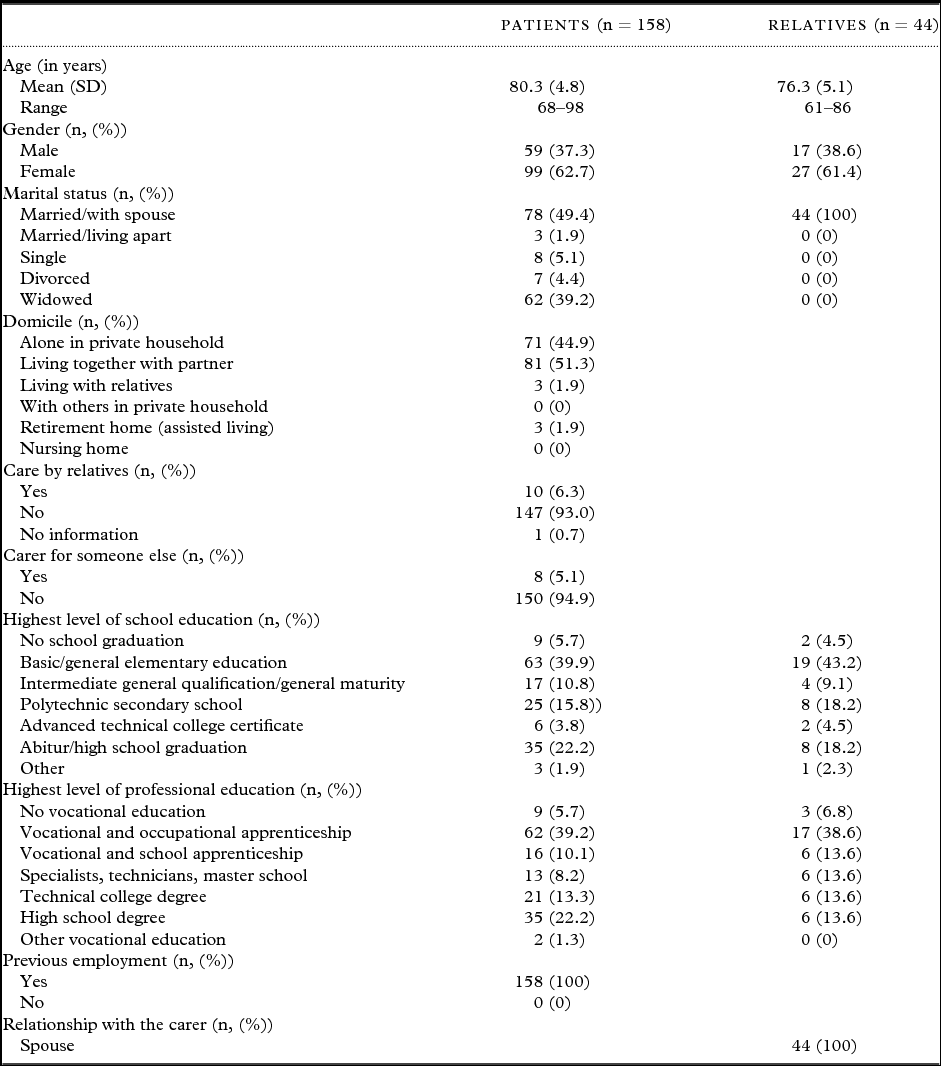
The sample characteristics of the patients (n = 158) and their relatives (n = 44) are displayed in Table 1. Mean age of the patients was 80.3 years ranging from 68 to 98 years. Relatives were on average 76.3 years old ranging from 61 to 86 years. Most of the patients and relatives were females. Altogether, most of the patients were married and living together in a private household with their partner.
Socio-demographic characteristics of the sample of patients and relatives

Notes. SD = Standard deviation.
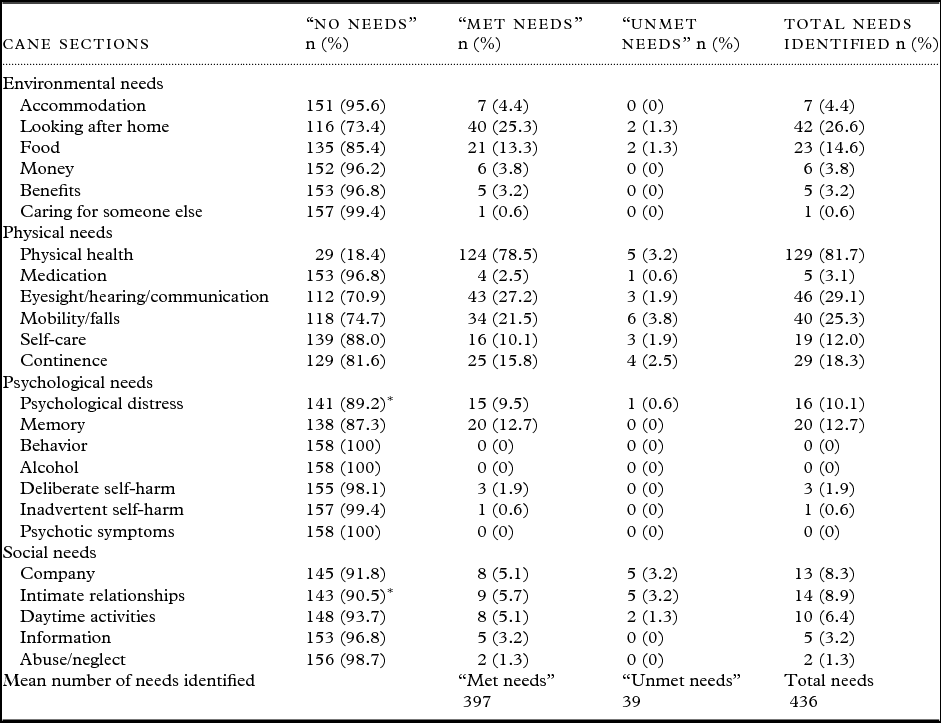
The met and unmet needs of the patients identified via CANE are summarized in Table 2. It illustrates that most of the patients’ unmet needs were reported in the sections of mobility, continence, physical health, company, intimate relationships, looking after home, food, self-care, daytime activities, and eyesight/hearing/communication. As shown in Figure 1, the most commonly met and unmet needs were reported in the care category of physical needs, including the sections of physical health, eyesight/hearing/communication, mobility/falls, and continence, as well as in the care category of environmental needs, including looking after home and food. Furthermore, the sections of intimate relationships and company representing social needs appeared to be relevant sections of patients’ unmet needs.
Met and unmet needs of patients (n = 158)
Notes. *No information: n = 1.
Most frequently reported met and unmet needs of patients (n = 158).
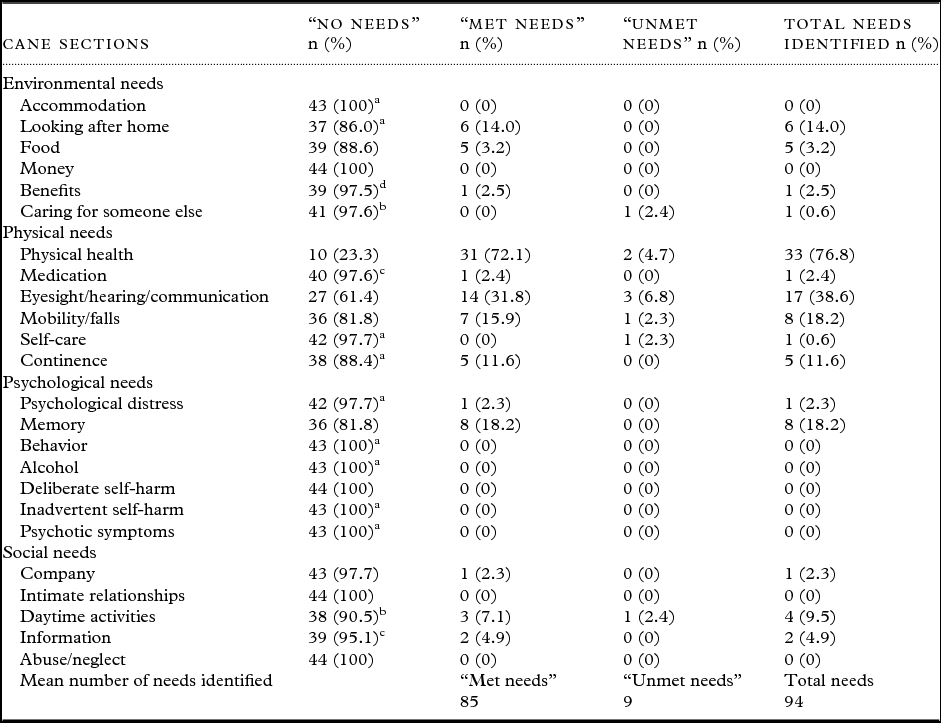
Table 3 provides an overview of met and unmet needs of the patients from the relatives’ point of view. In contrast to the patients, the relatives reported less total unmet needs. Mostly, unmet needs were identified in the sections of self-care, caring for someone else, daytime activities, eyesight/hearing/communication, mobility, and physical health representing physical and environmental needs. As can be seen in Figures 1 and 2, the most frequently met and unmet needs from the patient's and relative's perspectives were reported in the care category of physical needs in the sections of physical health and eyesight/hearing/communication.
Met and unmet needs identified by relatives (n = 44)
Notes. aNo information: n = 1; bno information: n = 2; cno information: n = 3; dno information: n = 4.
Most frequently met and unmet needs identified by relatives (n = 44).
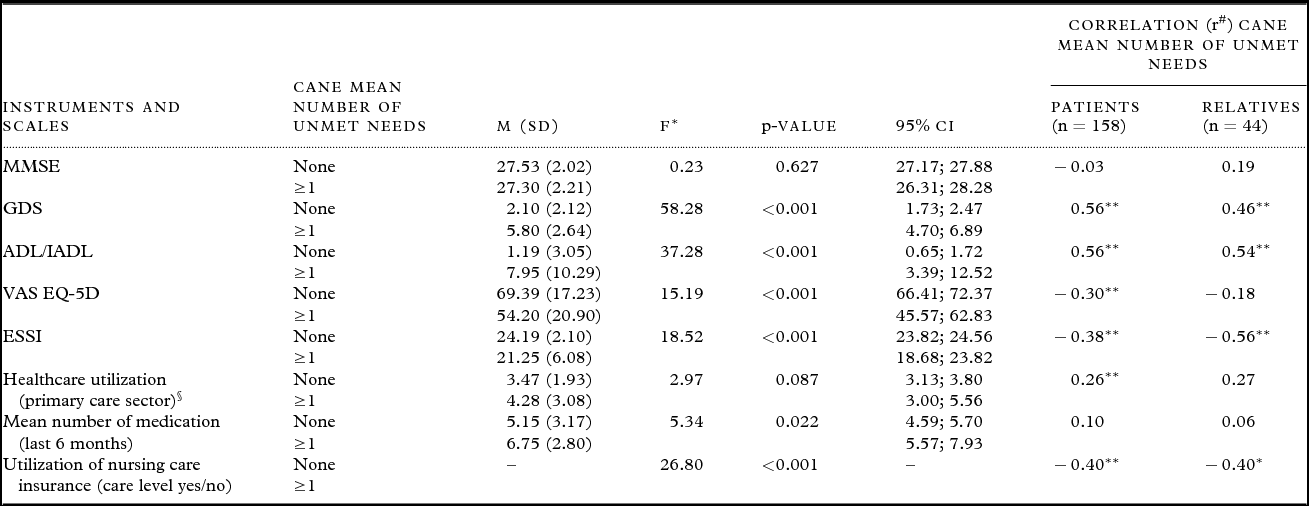
Reflecting the level of agreement between patients and relatives, the correlation (Spearman ρ) between patients’ and relatives’ ratings in the CANE was r = 0.43 and Cramer's V, φ c = 0.56. Furthermore, Table 4 summarizes the associations between CANE and other construct-related or construct-unrelated instruments or scores. Comparisons on a group level via ANOVA revealed that several factors were significantly associated with having one or more unmet needs. Significant differences were observed between the CANE mean number of unmet needs (none/≥1) and mean scores in GDS, ADL/IADL, VAS EQ-5D, ESSI, medication, and utilization of nursing care insurance (care level). Higher scores in GDS (reflecting more depressive symptoms), ADL/IADL (reflecting impaired ADL), and higher mean number of medication were significantly associated with a higher number of unmet needs. On the other hand, higher scores in VAS EQ-5D (reflecting higher health-related quality of life), ESSI (reflecting higher social and emotional support), and utilization of nursing care insurance were significantly associated with lower mean number of or no unmet needs. This pattern was also found in the correlation analyses, which included the correlations between the CANE mean number of unmet needs from the patient's and the relative's perspectives and other construct-related or construct-unrelated instruments or scores (Table 4, last column). Weak to moderate negative significant correlations were observed between the CANE unmet needs, VAS EQ-5D, ESSI, and utilization of nursing care insurance (care level). This means that a higher number of unmet needs as identified by CANE was significantly associated with lower scores in VAS EQ-5D and ESSI reflecting lower health-related quality of live and perceived emotional and social support as well as no utilization of nursing care insurance (care level). On the other hand, weak to moderate positive correlations were observed between the CANE unmet needs and GDS, ADL/IADL, and healthcare utilization (number of GP visits), reflecting that a higher number of unmet needs are accompanied by higher scores in GDS (more depressive symptoms), ADL/IADL (more impaired ADL), and more GP visits. A poor, negative non-significant correlation between MMSE and the CANE unmet needs became evident, indicating a weak association between the two instruments and/or constructs in this study sample. Moreover, no significant correlation was found between the CANE unmet needs and medication intake.
Associations between CANE (patients’ perspective) and other related or unrelated instruments or scores in the patient sample (n = 158)
Notes. *F = test statistic, comparison between groups is based on ANOVA.
#Correlation (Pearson's or Spearman's ρ, as appropriate) between CANE number (sum) of unmet needs and instrument.
**Significant on the p < 0.001 level; *significant on the p < 0.05 level (two-tailed).
§Mean number of GP visits in the last 6 months.
M = mean; SD = standard deviation; MMSE = Mini-Mental State Examination; GDS = Geriatric Depression Scale; IADL/ADL = (instrumental) Activities of Daily Living; VAS EQ-5D = the visual analogue scale of the EQ-5D questionnaire; ESSI = ENRICHD Social Support Inventory.
Discussion
The aim of the present study was to evaluate met and unmet needs in a sample of elderly primary care patients by using the currently available German version of the CANE, and to assess the psychometric properties of the instrument. To our knowledge, this is one of the first studies in Germany to explore the most common met and unmet needs of the oldest-old community-dwelling primary care patients by using the German version of the CANE. This study found that very old primary care patients have one or more unmet needs that mostly refer to physical needs (mobility/falls, physical health, continence) and social needs (company and intimate relationships). The comparison of needs among patients and relatives revealed that the most common met and unmet needs were similar, including physical needs such as physical health and eyesight/hearing/communication whereas the relatives tended to report less total unmet needs compared with that of the patients. Needs in the sections of physical ability, senses, and continence were also the most common unmet needs found by Iliffe et al. (Reference Iliffe, Lenihan, Orrell, Walters, Drennan and Tai2004) and Walters et al. (Reference Walters, Iliffe, Tai and Orrell2000). Previous studies show that the priority and the number of needs may differ depending on the sample type and the setting (Orrell and Hancock, Reference Orrell and Hancock2004). Dementia patients, for example, were found to report a different pattern of the most frequent unmet needs, especially in the sections of daytime activities, memory, company, and psychological distress (Hancock et al., Reference Hancock, Woods, Challis and Orrell2006; van der Roest et al., Reference van der Roest, Meiland, van Hout, Jonker and Droes2008). Moreover, and as one would expect, older individuals with no diagnosis of dementia were found to report less needs in total and less unmet needs in comparison with dementia patients (van der Ploeg et al., Reference van der Ploeg, Bax, Boorsma, Nijpels and van Hout2013). The sample of this study mostly consisted of cognitively healthy individuals due to the exclusion of patients having a diagnosis of dementia at baseline. This could explain the finding that the patients in this sample reported a relatively low total number of unmet needs. Other studies point out that environmental setting and living situation play a central role. So, the needs of older people in residential care and nursing and hospital settings may substantially differ from the needs of older people in other living situations and health conditions (Fahy and Livingston, Reference Fahy and Livingston2001; Field et al., Reference Field, Walker, Orrell, Orrell and Hancock2004). Altogether, the data of this study suggest that very old primary care patients without dementia who live in private households either alone or with their partner report comparatively less unmet needs than older institutionalized individuals with severe physical or mental illness; the CANE is sensitive enough to identify unmet needs in different samples and settings.
In this sample, the levels of agreement between patients’ and relatives’ ratings in CANE were moderate to low. One reason for this could be the small sample size of relatives and limited distribution of test data. Similar to another study, κ coefficients could mostly not be calculated due to insufficiently spread data (Miranda-Castillo et al., Reference Miranda-Castillo, Woods and Orrell2013). Contrary to this study, previous studies mostly assessed highly selected samples, such as dementia patients or patients with depression or other mental disorders, which could contribute to differences in agreement level (Orrell and Hancock, Reference Orrell and Hancock2004; Fernandes et al., Reference Fernandes2009; Houtjes et al., Reference Houtjes, van Meijel, Deeg and Beekman2011). At the same time, the CANE questions asked are often personally sensitive and the answers may be distorted in the patient's or relative's desire to appear socially acceptable, especially in the situation of face-to-face interview in this study, and in specific sensitive topics such as alcohol consumption and circumstances that were already discussed (Crome and Phillipson, Reference Crome and Phillipson2000). Further studies should therefore also assess the acceptance of CANE within personally conducted interviews. In agreement with another German study (Dech and Machleidt, Reference Dech, Machleidt, Orrell and Hancock2004), the interviewer staff in this study criticized the answering format of the first question and suggested to ask for “needs” instead of “no needs.” It can therefore be assumed that, because of the difficulties identified, the German version of the CANE would be substantially benefited from a methodical revision. Another explanation for the lack of agreement between different raters could be that some sections in the CANE, especially sections referring to social support and social networks (intimate relationships, company or daytime activities), are judged as highly subjective by the patients and their relatives, resulting in diverging answers. Thus, the observed differences in reported met and unmet needs (patient's vs. relative's perspectives) may reflect different perceptions of needs (Crome and Phillipson, Reference Crome and Phillipson2000). Beside identified methodical and practical issues of the CANE, the overall low number of reported unmet needs in this study might reflect good health condition and healthcare situation of the study sample as being older regular primary care patients living at home with no dementia. It is questionable, however, as to what extent the results of this study are transferable to the general elderly population. The results indicate a need for further studies considering different groups of patients and in different healthcare settings.
In agreement with previous studies (Field et al., Reference Field, Walker, Orrell, Orrell and Hancock2004; Hoe et al., Reference Hoe, Orrell, Lambert, Prettyman, Orrell and Hancock2004; Fernandes et al., Reference Fernandes2009), patients with higher scores in GDS indicating more depressive symptoms reported significantly more unmet needs than patients with lower scores in GDS. Furthermore, and consistent with previous findings (Field et al., Reference Field, Walker, Orrell, Orrell and Hancock2004), limitation of activity level (impaired ADL) also predicted high levels of unmet needs. In contrast to other studies (Field et al., Reference Field, Walker, Orrell, Orrell and Hancock2004; Hoe et al., Reference Hoe, Orrell, Lambert, Prettyman, Orrell and Hancock2004; van der Ploeg et al., Reference van der Ploeg, Bax, Boorsma, Nijpels and van Hout2013), no association was found between the level of cognitive functioning measured by the MMSE and the CANE mean number of unmet needs in this sample. The most plausible reason for this is the exclusion of patients with severe cognitive impairment and dementia from the study sample at baseline. Consequently, the sample consisted mostly of cognitively healthy individuals and did not allow the comparison of unmet needs in patients with and without cognitive impairment and dementia. Furthermore, the results confirm the hypotheses that a higher level of unmet needs is associated with lower levels of health-related quality of life as well as lower levels of perceived emotional and social support. These results are also reflected in the high number of reported unmet needs in the CANE sections of company and intimate relationships. This finding is particularly important in the light of current research emphasizing that loneliness and isolation in old age are substantially associated with several negative outcomes such as poor health, maladaptive behavior, depressive symptoms, mortality, morbidity, and an increased likelihood of institutionalization (Landi et al., Reference Landi2004; Valtorta and Hanratty, Reference Valtorta and Hanratty2012). Finally, ANOVA showed that having one or more unmet needs was accompanied by a higher mean number of medications. This is not surprising, since the most unmet needs were reported in the care category of physical needs that probably include a higher level of medication intake due to multimorbidity and impaired physical health. Altogether, the findings of this study could be interpreted as a reasonable evidence for the construct validity of the CANE.
This study has several strengths. As one of the first studies in Germany, this study provides insights into the met and unmet needs of community-dwelling primary care patients in old age as reported by themselves and by their relatives via the CANE, and also into how these needs are related to other factors, instruments, and scores. Moreover, this study provides evidence for the psychometric quality of the CANE. In terms of limitations, the study sample may not necessarily reflect the distribution of cognitive impairment in the general elderly population due to the exclusion of cognitively impaired and dementia patients at baseline. Furthermore, complete data from relative's assessment were not available for every patient thereby limiting the power of the analysis.
In the future, our healthcare system will be challenged by the demographic changes in our society and the rising spectrum of health needs, especially in the elderly population (Dech and Machleidt, Reference Dech, Machleidt, Orrell and Hancock2004). The fact that the majority of the elderly patients visit their GP on regular basis (Linden et al., Reference Linden, Gilberg, Horgas and Steinhagen-Thiessen1996) and our findings highlight the important role of the primary care sector regarding to the detection of unmet needs and the appropriate provision of healthcare and other social services in the elderly population (Smith and Orrell, Reference Smith and Orrell2007). In Germany, further development and establishment of the German version of the CANE should be among the aims of health services research. So far, first efforts to develop and apply the German version of the CANE have been made only as an unpublished dissertation at the Charité – Universitätsmedizin Berlin, and in an Austrian study assessing patients having dementia (n = 45) and their families. Until now, these first beginnings have not pursued any further (Dech and Machleidt, Reference Dech, Machleidt, Orrell and Hancock2004; Kaiser et al., Reference Kaiser, Unger, Marquart, Weiss, Freidl and Wancata2010; Fink, Reference Fink2011). In addition to the lack of publication and psychometric review of the instrument, economic or time restrictions could be one more plausible reason that the German version of the CANE has not been established till now. With a total length of 26 CANE sections of needs (including two sections for caregivers), the application of the CANE may represent a logistical and time-consuming challenge for routine use in clinical practice, especially in the primary care sector. In the United Kingdom, first efforts to develop a short instrument for rapid and economical detection of particularly relevant needs of elderly people based on the original version of the CANE have been already made. The British results show that certain categories of need, such as vision and hearing, physical health, mobility, continence, cognition, and psychological stress, were most frequently identified as unmet in the elderly population (Walters et al., Reference Walters, Iliffe, Tai and Orrell2000; Iliffe et al., Reference Iliffe, Lenihan, Orrell, Walters, Drennan and Tai2004). As a result of the first efforts being made in the United Kingdom, the development of a short form of the German version of the CANE on the basis of the most frequently identified unmet needs in the elderly population could be the goal of further research. Furthermore, the original version of the CANE was developed in the United Kingdom almost ten years ago. Differences between the British and the German healthcare systems as well as qualitatively and quantitatively altered supply requirements and healthcare needs due to demographic changes lead to the conclusion that a formal and content-related verification and adaptation of the currently available German version of the instrument is required. Therefore, a revision of the content validity of the CANE domains of needs according to the current state of evidence-based research and the transferability of the instrument to the German healthcare system seem desirable. Altogether, further development and application of CANE in the future should be aimed in order to assess the needs of elderly patients. The systematic application of CANE and the multidimensional assessment of needs could help determining the need for care, preventing further disability and attaining maximum quality of life in the elderly population.
Conflict of interest
None.
Description of authors’ roles
J. Stein, M. Luppa, and S. G. Riedel-Heller formulated the research questions. M. Luppa, H.-H. König, and S. G. Riedel-Heller assisted with writing the paper. J. Stein was responsible for carrying out the statistical analyses, and wrote the paper.
Acknowledgments
This study was funded by the German Federal Ministry of Education and Research (grant number: 01GY1155A) and the junior research grant from the Medical Faculty of the University of Leipzig (project number: 971000-066), and is published in affiliation with the German Research Foundation (Deutsche Forschungsgemeinschaft) (STE 2235/1-1). We would like to thank Prof. Martin Orrell for his valuable advice and support.