


Since September 2001, survey researchers have questioned citizens of the Islamic world about how they view Americans, U.S. policy, and American values and culture. The depths of anti-Americanism revealed by these surveys—especially within the Arab world—have been the subject of much discussion (Abdallah Reference Abdallah2003; Fuller Reference Fuller2002; Gentzkow and Shapiro Reference Gentzkow and Shapiro2004). The consequences of this anti-American sentiment are seen as delegitimizing American values, increasing sympathy for America's enemies, and weakening America's influence in foreign affairs (Keohane and Katzenstein Reference Katzenstein, Keohane, Katzenstein and Keohane2007; Naím Reference Naím2003; Shore Reference Shore2005). Less noticed, however, is that in many countries, Muslims actually tend to view the United States quite favorably. Even within the Arab world, there is a considerable amount of cross-national variation in levels of anti-Americanism. Why, then, do some Muslims harbor such intense dislike for America, whereas others are more neutral or even supportive of the United States as a global actor?
Anti-Americanism has been defined as “any hostile act or expression that becomes part and parcel of an undifferentiated attack on the foreign policy, society, culture and values of the United States” (Rubinstein and Smith Reference Rubinstein and Smith1988, 36) and more broadly as “a psychological tendency to hold negative views of the United States and of American society in general” (Katzenstein and Keohane Reference Keohane, Katzenstein, Katzenstein and Keohane2007, 12). Commentators have argued at length over why Muslims in particular might adopt such a stance, with most explanations settling into one of two categories. The first is that Muslims who dislike the United States do so on the basis of core differences over societal norms and values. Paz (Reference Paz2003, 53), for example, writes that Islamists—those who advocate the formal integration of Muslim social and religious precepts into government—view conflict with the United States as a “war of cultures” and that “the nature of Islamist anti-Americanism is cultural rather than military or political.” Many other scholars, however, regard this view as a “myth” (Esposito and Mogahed Reference Esposito and Mogahed2008, 140). Instead, they contend that Muslims dislike the United States not for who Americans are, but rather for what Americans do (e.g.,Abdallah Reference Abdallah2003; Cole Reference Cole2006; Shore Reference Shore2005; Tessler Reference Tessler2003). As described by Makdisi (Reference Makdisi2002, 538), “Anti-Americanism is a recent phenomenon fueled by American foreign policy, not an epochal confrontation of civilizations.”
Despite their disagreement over the root causes of anti-Americanism, both theories share a presumption that individuals form their opinions about the United States primarily as a direct reaction to what the United States is or does. Although this may be true in part, it neglects the important intermediary role played by political elites in determining what information about the United States individuals hear, how they interpret this information, and how they incorporate it into their political perspective (Zaller Reference Zaller1992). Like people everywhere, Muslims are open to persuasion on the issue of anti-Americanism and susceptible to elite influence through the mass media (Lynch Reference Lynch, Katzenstein and Keohane2007; Nisbet and Myers Reference Nisbet and Myers2011).
In this article, we propose a theory of anti-Americanism that transcends the conventional “what America does” versus “who America is” debate. We trace the source of Muslim anti-Americanism to the intensity of domestic political competition between a country's Islamist and secular-national factions. Leaders on both sides of this dominant cleavage in the Muslim world can credibly claim opposition to the United States. When the struggle for political control between these two groups escalates, elites of both types have incentives to ramp up anti-American appeals to boost mass support. More generally, when opposing politicians share similar stances on salient issues, heated competition can lead to more extreme rhetoric as politicians attempt to ideologically “outbid” their opponents. As elites' anti-American pronouncements increase, larger numbers of Muslims hear, consider, and are led to adopt anti-American attitudes. In contrast, where conflict is minimal, individuals are less exposed to anti-American messages and subsequently report lower levels of anti-Americanism. This is not to say that American actions or the United States' unique position in global political affairs is irrelevant to explaining anti-Americanism. Rather, it is that domestic elites find in the behavior of America and Americans justifications for anti-American claims.
This logic explains why—seemingly paradoxically— although religious Muslims are more anti-American than their secular compatriots, anti-American attitudes are most prevalent in more secular countries where the political division between religious and nonreligious individuals is the greatest. Because the split between religious and secular-nationalist “types” in a society changes slowly over time, our theory also accounts for why Muslim countries tend to return to a steady-state level of anti-American sentiment even after political shocks to public opinion, as well as why far greater variation exists across Muslim communities than within Muslim communities over time.
Scholars have termed domestic sources of anti-American attitudes instrumental anti-Americanism, reflecting the efforts of a Muslim political elite that “instigates and manipulates hostility toward the United States in order to mobilize domestic support” (Rubinstein and Smith Reference Rubinstein and Smith1988, 41). Our theory offers an explanation for the conditions under which such instrumental anti-Americanism is more or less likely to be found; applying a multilevel statistical model to public opinion survey data from nearly thirteen thousand Muslim respondents in 21 countries, we are the first to systematically test for—and find empirical evidence of—instrumental anti-Americanism at work.
Increasing scholarly understanding of the roots of anti-American sentiment in the Muslim world has important and far-reaching political implications. One and a half billion Muslims make up one-fifth of the total world population, and favorable attitudes toward the United States are rarer in the Muslim world than anywhere else (Kohut and Stokes Reference Kohut and Stokes2006). Many of the world's most intractable conflicts involve Muslim-majority countries, and the ability of the United States to exercise “soft power” to influence the trajectories and outcomes of these disputes is of considerable importance.Footnote 1 One would be hard pressed to think of a time when Muslim attitudes toward the United States carried greater political import. As Arab citizenries across the Middle East engage in both peaceful and more violent protest against dictators—some of whom enjoyed close ties to the United States—a reassessment of U.S.-Arab and U.S.-Muslim relations is underway, with the potential to critically reshape America's ability to promote its values and interests in the region.
SOURCES OF MUSLIM OPPOSITION TO THE UNITED STATES
The grievances that motivate many Muslims to express anti-American sentiments have been linked both to specific actions taken by the United States in foreign political and economic affairs and to America's growing global cultural influence since the end of World War II (Rubinstein and Smith Reference Rubinstein and Smith1988).Footnote 2 The question that contemporary scholars continue to debate is which among this “amalgam of discontents” (Kohut and Stokes Reference Kohut and Stokes2006, 23) matters most for explaining anti-American attitudes. We briefly review the two sets of long-term factors generally seen as providing the basis for Muslim anti-Americanism.
U.S. Policy and the Foreign Backlash
Several key U.S. foreign policy developments in the second half of the 20th century have provided fodder for the spread of anti-American sentiment in the Islamic world. The first relate to America's involvement in the internal political and economic affairs of countries with large Muslim populations. During the Cold War, America propped up dictators seen as friendly to the United States and worked to topple regimes with leanings toward the Soviet Union. American “overidentification” with unpopular local dictators like the Shah of Iran or Sadat in Egypt was one factor contributing to mass anti-American sentiment (Parker Reference Parker1988, 53).
American government agencies, such as USAID, also intervened in the economic planning of several developing Muslim countries (Thornton Reference Thornton1988, 10). Because aid was disbursed conditionally, a perception emerged that the United States used foreign assistance to “enslave” a country politically. For example, American involvement in Pakistani political and economic life is widely deplored, and secular elites tend to describe their ill feelings toward the United States in terms of “capitalist or imperialist exploitation” (Kizilbash Reference Kizilbash1988, 59, 63). Muslim leftists, such as Egyptian economist Samir Amin, argue that American economic intervention in the Middle East is part of a global imperialist strategy on the part of the United States.
Another key U.S. foreign policy development in the post–World War II era is American support for the state of Israel. There is widespread anger on the part of many Muslims toward the United States for its political support of Israel, which is invariably seen as coming at the expense of Palestinian interests. The fate of Jerusalem—the third most holy city in Islam and the location of important Muslim holy sites—is also of importance to Muslims around the world. Describing the Arab world, Hammond (Reference Hammond2007, 57) writes that “views of the United States today are first and foremost conditioned by American policy vis-à-vis the Israel-Palestinian conflict and the degree to which the United States is seen backing Israel to the detriment of the Palestinians.”
Islamism and Cultural Anti-Americanism
One of the most important political developments to emerge in the Muslim world over the last four decades has been the growth of support for what many term “Islamism”—the idea that both society and politics should be infused with a greater religious sensibility. This has been coupled with the rise of the mosque movement. According to Mahmood (Reference Mahmood2004, 44–47), this movement “emerged in response to the perception that religious knowledge, as a means for organizing daily life, had become increasingly marginalized under modern structures of secular governance . . .. Piety activists [sought] to imbue each of the various spheres of contemporary life with a regulative sensibility that takes its cue from the Islamic theological corpus rather than from modern secular ethics.”
Within the Muslim world, many of the strongest proponents of anti-American attitudes are found in Islamist political circles (Faath and Mattes Reference Faath, Mattes and Faath2006). Fuller (Reference Fuller2002, 54–55) comments that “most in the Muslim world feel themselves besieged by the West . . .. Islamist movements today provide a key source of identity to peoples intent on strengthening their social cohesion against Western cultural assault.” Some Islamist activists believe that the United States represents a primary threat to Muslim society and is to blame for a variety of domestic and international political problems (Ajami Reference Ajami2003). Others see the United States as the “neo-Mongol power lurking behind the apostate governments that they seek to topple” (Doran Reference Doran2002, 183). In Arab countries, Islamists promote the idea of a “global Western conspiracy against the Arabs and the Arab and Muslim world,” which “provides the Islamists with their main justification and motive for developing the image of the ‘American enemy’” (Paz Reference Paz2003, 53).
EXPLAINING ANTI-AMERICANISM
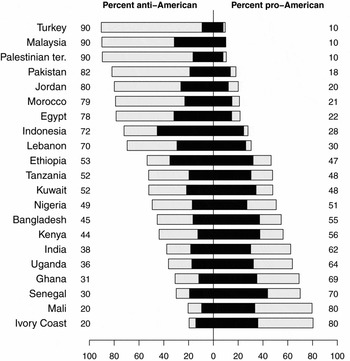
The unpopularity of certain U.S. policies and negative reaction to the spread of American culture are both important reasons why Muslims around the world might hold anti-American attitudes. Nevertheless, many Muslims are not anti-American. In 2007, the Pew Global Attitudes Project (GAP), a cross-national opinion poll sponsored and directed by the nonpartisan Pew Research Center, asked respondents in 21 countries with significant Muslim populations if they had “a very favorable, somewhat favorable, somewhat unfavorable, or very unfavorable opinion of the United States.” Large proportions of Muslims around the world told researchers that they in fact had a favorable view of the United States (Figure 1).Footnote 3 To explain anti-Americanism, it is not enough to demonstrate that potential grievances exist: A valid theory must also account for the observed variation in anti-American sentiment not only across Muslim individuals but even more strikingly across Muslim countries.
Distribution of Favorable and Unfavorable Opinions toward America among Muslims in 21 Pew GAP Study Countries in 2007 (Question 16A)

We propose that Muslim attitudes toward America, like most political attitudes, are shaped by the messages and arguments to which individuals are exposed by political elites and the mass media. In countries where elites are the most outspoken in their opposition to the United States, anti-American sentiment will be greatest. We argue, moreover, that local political factors offer one explanation for why elites in some countries may be more aggressive in promoting anti-American attitudes. Where there is more intense political competition between Islamist and secular-nationalist groups, domestic elites have much stronger incentives to exploit grievances against the United States for political gain.
Unlike existing theories, we describe a specific mechanism through which domestic political factors influence elite messages about the United States and consequently shape public opinion. Our theory also explains a notable empirical regularity: Levels of opposition to the United States in Muslim countries are extremely consistent from year to year (Pew Global Attitudes Project 2009). Most variation, instead, is found across countries in their long-term, baseline levels of anti-Americanism. As observed by Schatz (Reference Schatz2008, 9), “attitudes about the United States do not change in lock-step with U.S. policies. Rather, they become sedimented in domestic cultures, institutions, and contexts.” Even the increase in Muslim anti-Americanism following the 2003 U.S. invasion of Iraq was, as described by Chiozza (Reference Chiozza, Katzenstein and Keohane2007, 125), “a momentary reaction to the exceptional circumstances of the Iraq War rather than a structural shift in the popular perceptions of the United States.” By 2004, Muslim perceptions of the United States had returned to prewar, 2002 levels, and have remained mostly steady since that time.
Elite-led Opinion Formation
As a phenomenon of public opinion, anti-Americanism does not emerge solely as a response to U.S. actions and values, but is also shaped by the way local political leaders describe and discuss the United States. As Zaller (Reference Zaller1992) describes, the opinions people express are a combination of their own personal experiences and the balance and intensity of the elite attitudes to which they are exposed and are predisposed to accept. Individuals who identify with particular opinion leaders will tend to align their viewpoints with those elites.Footnote 4 For those without strong political attachments, what matters is the prevalence of different arguments in their social or mass media environment. Following Zaller's “one-message” model, the more insistently that elites promote anti-Americanism, the more that individuals tend to adopt anti-American attitudes. In countries where elites project a positive stance toward the United States, individuals should be relatively more pro-American as well.
Domestic elites, communicating through local mass media, are a primary source of political news and opinion about the United States. A secondary stream of information is provided by transnational satellite news networks such as Al Jazeera, Al Arabiya, and CNN, which each have their own editorial slant. Exposure to Al Jazeera is especially significant because of the channel's perceived anti-American stance (e.g., Ajami Reference Ajami2001). Survey evidence indicates that watching Al Jazeera is associated with more negative attitudes toward the United States (Gentzkow and Shapiro Reference Gentzkow and Shapiro2004; Nisbet and Myers Reference Nisbet and Myers2011). At the country level, however, Muslim anti-Americanism has remained fairly stable over time (Pew Global Attitudes Project 2009), even as Al Jazeera has expanded its reach. This finding suggests that the influence of transnational news networks on anti-Americanism can only be one part of a broader explanation.
If our argument about domestic, elite-led opinion formation is correct, then the crucial question becomes why political debate in certain countries is more or less saturated with anti-American messages—and from which segments of elite leadership to which sets of followers. To understand how anti-American attitudes enter into mass opinion, we describe (1) the dominant political cleavages in Muslim society, which affect how individuals choose to align with competing elites; (2) the positions held by elites in each competing bloc; and (3) how the intensity of political competition between opposing groups affects the strength with which political elites advance anti-American claims.
The Religious–Secular Cleavage
In large parts of the Islamic world, the substance of political debate surrounds a secular–religious issue cleavage akin to the left–right ideological dimension that describes policy preferences in most Western democracies. Debate concerning the nature of the governing regime and the role of the state in society is central to the secular–religious divide. Roy (Reference Roy1994, 23) writes that, despite the protests of some political actors, “any political action amounts to the automatic creation of a secular space or a return to traditional segmentation” where a more traditional space refers to one with a greater religious sensibility. Hunter (Reference Hunter and Guazzone1995, 327) argues that Muslim-majority countries are characterized by a “rift between the more Westernized and the more traditional segments” in both social and political affairs.
The modern historical basis for this cleavage dates to the mid-19th century (Owen Reference Owen2010). Hunter (Reference Hunter1998, 75–76) explains that as European powers increasingly gained in economic and political prominence relative to the Muslim world, Muslim–Western relations that had previously been characterized as a competition between “equals” evolved into “that between the dominating and the dominated.” Within Muslim societies, a debate arose as to whether stricter adherence to religious principles was the “culprit” or the “solution” for this change. From the 1920s through the 1970s, proponents of the former argument dominated positions of political power, as “most Muslim societies underwent a process of state-directed secularization and cultural and political nationalization” (Hunter Reference Hunter1998, 85). Since then, however, Islamism has emerged as the primary ideological rival to secular nationalism—though the pace at which secular nationalism has given way to Islamism varies considerably across states.
A range of explanations for the rise of Islamism have been proposed. Some argue that secular nationalism failed to successfully incorporate dissatisfied social groups and classes (Sutton and Vertigans Reference Sutton and Vertigans2005). In the Arab states, increasing support for Islamism has also been associated with the Arab defeat in the 1967 Arab-Israeli War (e.g., Ajami Reference Ajami1992); according to Hammond (Reference Hammond2007), Islamists and secular nationalists continue to “argue vociferously” about how best to respond to that defeat. Murphy (Reference Murphy2002) argues that, for Muslim individuals, identification with Islam counteracts feelings of inferiority toward the West, providing a renewed sense of cultural dignity. Others such as Wickham (Reference Wickham2002, 6) see the growth of Islamism as due more to the successful “mobilizing efforts of opposition [Islamic] elites” than as a “natural result of accumulated grievances.” Whatever the exact cause, Browers (Reference Browers2009, 1) observes that even when secular nationalists and Islamists confront a common opponent in the form of corrupt, authoritarian regimes, they have still shown themselves to be “each other's worst enemy.”
The Value of Anti-American Rhetoric
Although contemporary anti-Americanism is primarily associated with Islamism, in fact proponents of both Islamism and secular-nationalism publicly criticize the United States. For secular leaders, who historically positioned themselves as anticolonial and anti-imperialist, anti-American attitudes reflect a perception of America as encroaching on the independence and sovereignty of countries in the Muslim world. Reetz (Reference Reetz and Faath2006, 186) writes of Pakistan that “left-leaning anti-American arguments play a central role in the public debate, especially in the largely independent print media.” In the Arab world, Hammond (Reference Hammond2007, 205) describes both camps as “virulently anti-American.” In Indonesia, Bowen (Reference Bowen, Katzenstein and Keohane2007, 245) finds anti-American sentiments in the pronouncements of both Islamists and non-Islamists, the latter tending to focus on what they see as America's neo-imperialist economic ambitions. In Egypt, both secularists and the Muslim Brotherhood have orchestrated anti-American demonstrations. (Mitchell Reference Mitchell, Ross and Ross2004, 98).
Because of the political, economic, and cultural hegemony of the United States, large segments of Muslim society are receptive to anti-American rhetoric—from whichever side it comes. Opinion surveys indicate that most Muslims believe Americans are not religious enough and that the religious beliefs that they do hold drive the United States to make bad decisions in the world (Kohut and Stokes Reference Kohut and Stokes2006, 93). Although many individuals across the Muslim world enjoy American movies, television, and music, they also view globalization and the spreading influence of American culture as potential threats to local beliefs (Esposito and Mogahed Reference Esposito and Mogahed2008; Faath and Mattes Reference Faath, Mattes and Faath2006; Hammond Reference Hammond2007; Kohut and Stokes Reference Kohut and Stokes2006).
Against this backdrop, anti-American appeals can represent a successful instrumental strategy for political elites seeking to gain popular support. During the Cold War, the association between anti-Americanism and communism gave anti-American rhetoric a certain strength, but at the same time placed limits on its ability to appeal broadly. More recently, anti-Americanism has become what Krastev (Reference Krastev2004, 6) describes as an “all-purpose ideology”—compelling yet vague enough to be harnessed by any number of political groups for “cynically designed political strategies” seeking to mobilize supporters for political gain.Footnote 5 Similarly, Schatz (Reference Schatz2008, 12–13) views anti-Americanism as a “symbolic resource” used by political activists to link their “on-the-ground . . . goals to larger-scale (even global) imperatives,” thereby legitimizing and enhancing the significance of their political movements.
The Intensity of Elite Competition
Despite its potential appeal, not all Muslim political leaders pursue anti-American claims or do so with equal force. Many have little to gain by doing so. In Muslim communities where religious leaders already monopolize local political control, competition for “converts” is no longer as fierce. The battle for local supremacy has already been won by those who are more religious, leaving neither side with strong incentives to invoke grievances against the United States to recruit supporters.
Where competition is more intense, both Islamists and secularists will seek to lay claim to anti-Americanism, because it remains an issue with which both sides possess a credible association. From a historical perspective, secularists associated with left-leaning political movements positioned themselves in opposition to the United States as part of the political environment of the Cold War. Since the end of the Cold War, Islamists have also sought to leverage anti-American sentiment for political ends—and have enjoyed great political success with these efforts. Although Islamists may currently enjoy an advantage over secular factions on the issue of anti-Americanism (as our empirical results indicate), neither side can afford to abandon this highly salient, all-purpose issue altogether.
There are clear parallels to the logic of issue ownership. Political entrepreneurs engage in a type of ideological “outbidding” to avoid the costs of ceding a tough stance on the United States to their opponents. In the American context, scholars of election campaigns have argued that candidates should focus voter attention on issue areas that play to their strengths or highlight a weak area for a political opponent (Petrocik Reference Petrocik1996; Spiliotes and Vavreck Reference Spiliotes and Vavreck2002). In many cases, however, politicians intentionally trespass on issues associated with an opponent (e.g., Damore Reference Damore2004; Reference Damore2005). As explained by Pfau and Kenski (Reference Pfau and Kenski1990), elites seek to neutralize potential vulnerabilities and will engage on an issue to prevent opponents from positioning themselves in a way that may pose a future political threat.
Our argument also parallels research on the political economy of religion. Scholars of religious “markets” suggest that, when religious groups become dominant in a local setting, religious adherence declines. For example, U.S. cities with higher rates of religious diversity have elevated levels of adherence, increased Sunday school attendance, a larger number of children in Catholic school, and more priestly ordinations (e.g., Finke and Stark Reference Finke and Stark1988; Stark and McCann Reference Stark and McCann1993). Gill (Reference Gill1998) argues that in Latin American countries where the Catholic Church faced competition from Protestantism, the Church—seeking to maximize membership and financial resources—had an incentive to support democracy to avoid losing poor parishioners with more democratic preferences. We believe that the logic of the “lazy monopolist” applies to competition for support within the Islamic world as well.
Implications for Observed Levels of Anti-Americanism
If anti-Americanism is a manifestation of elite opinion leadership, then anti-American attitudes should be most widespread in countries where elites from across the political spectrum have incentives to promote grievances against the United States. We expect that intense competition between political elites along Islamist–secular lines provides these incentives.
One factor contributing to the intensity of elite competition along secular–religious lines is the baseline level of religiosity in a country's Muslim population. The effect of this variable on anti-Americanism at the country level should be non-monotonic: In highly religious and highly secular contexts, there is a less balanced—and hence, less competitive—political environment, so levels of anti-Americanism should be relatively low. In the contemporary Muslim world, however, we do not observe countries with entirely secular populations. As a result, the empirical predictions we yield refer only to the second half of an inverted U-curve, suggesting that as religiosity becomes more widespread, elite competition diminishes, so levels of anti-Americanism are expected to fall.
At the country level, we also predict that the size of a country's Muslim population as a share of the total population will be associated with greater anti-Americanism. The reasons are consistent with our theory, but we are primarily concerned that this variable might confound an empirical relationship between competitiveness and levels of anti-Americanism. Where Muslims dominate domestic politics, the stakes of secular–Islamist competition increase, and messages voiced by Muslim leaders become more prevalent in political discourse. Conversely, countries with fewer Muslims are less anti-American overall (that is, including the non-Muslim population), which may affect the opinions of Muslims in those countries.
The theory is associated with additional predictions about individual-level differences in average levels of anti-Americanism within countries. If a country's Islamist leaders are especially anti-American in their rhetoric, then their religiously observant followers will receive and internalize those considerations, reporting stronger anti-American views. To the extent that secular-nationalist elites follow suit in expressing anti-American sentiments, their followers will echo such attitudes. Because Islamist political activists have emerged as some of the most vocal opponents of the United States, we expect the pious followers of Islamist political elites to demonstrate greater anti-Americanism. Likewise, we expect that individuals who follow international news more closely will report stronger anti-American attitudes, because popular outlets such as Al Jazeera contain content that amplifies criticism of the United States. Those who prefer to focus on domestic news may not be exposed to this additional influence. Taken together, the most anti-American individuals, on average, should be those who are both highly religious and highly attuned to international affairs.
Finally, if the underlying mechanism that we have proposed as linking elite behavior to mass attitudes is correct, then we should find that depictions of the United States in the domestic mass media will be predominantly negative in highly competitive countries, but neutral or even positive in less competitive countries.
MULTILEVEL STATISTICAL ANALYSIS OF MUSLIM PUBLIC OPINION
We begin our analysis by considering the determinants of anti-Americanism at both the national and individual level using public opinion survey data collected by the Pew Global Attitudes Project (2007). The 2007 GAP study interviewed nearly 13,000 Muslim respondents in 21 countries, spanning a geographically, economically, and culturally diverse range (Figure 1). Although individual attitudes are not the only way in which anti-Americanism can be expressed, we consider responses to the GAP study to provide the most cross-nationally consistent source of information about perceptions of America at a single point in time.Footnote 6 Country-level sample sizes range from 34 in Kenya to 1,930 in Pakistan.
Measurement
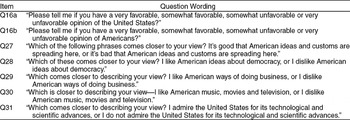
Anti-Americanism describes a wide range of antagonisms and grievances directed at the United States, its government, policies, culture, and even individual citizens. For this reason, isolating the concept in survey-based research may be difficult (Katzenstein and Keohane Reference Keohane, Katzenstein, Katzenstein and Keohane2007). In addition, as in most surveys, we expect a large amount of measurement error in responses to any single question about the United States. Averaging across a series of related items can significantly improve the reliability of survey-based measures, while allowing for a more complete operationalization of the notion of anti-Americanism (Ansolabehere, Rodden, and Snyder Reference Ansolabehere, Rodden and Snyder2008). The Pew GAP study contains a battery of seven questions that we use to create an anti-Americanism scale. These items elicit individuals' opinions of the United States, Americans, and the spread of American customs, ideas about democracy, ways of doing business, cultural products, and technological and scientific advances (Table 1). We rescale each item to range from 0, indicating complete favorability of the United States, to 1, indicating the maximum level of anti-American sentiment, and average across responses. This is our dependent variable. Country-level means vary from 0.23 in Ivory Coast to 0.84 in Turkey.Footnote 7
Survey Items Used to Create the Anti-Americanism Scale

Source: Pew Global Attitudes Project (2007).
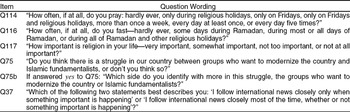
At the individual level, we employ two distinct measures of respondents' secular–Islamist political predispositions. The first is based on individuals' self-reported level of religiosity, which classifies respondents according to the religious–secular issue dimension that is dominant in the Muslim world. The GAP survey asks three questions pertaining to Muslims' level of religious commitment: their frequency of prayer, fasting, and the importance of religion in their life (Table 2). Responses to these questions demonstrate consistent patterns: Of the 87% of Muslims who say that religion is very important, 91% fast at least through Ramadan, and 68% pray five times a day. Praying five times a day is a particularly good standard by which to judge an individual's level of religiosity because, although the mid-day, afternoon, sunset, and evening prayers tend to take place when most individuals are awake, the dawn, or fajr, prayer occurs when most individuals are asleep.Footnote 8 Willingness to rise for the dawn prayer demonstrates a high level of religious commitment. We therefore create a dichotomous variable for piety, considering individuals who answer yes to all three questions to be the most highly religious.Footnote 9
Survey Items Used to Measure Religiosity (Q114, Q116, and Q117), the Perceived Intensity of Secular–Islamist Conflict (Q75), Identification with Either Group (Q75b), and Media Exposure (Q37)

Source: Pew Global Attitudes Project (2007).
The second measure of individuals' political allegiances uses responses to a GAP item asking respondents whether they identify more closely with “groups who want to modernize the country or Islamic fundamentalists.” Although this question would appear to produce an apt measure, it is only asked of respondents who first report awareness of a “struggle in our country between groups who want to modernize the country and Islamic fundamentalists” (Table 2). Because this subgroup does not comprise a representative sample, our inferences from this variable, although informative, are less generalizable than those from the variable measuring piety.
To assess individuals' media exposure, we examine responses to a survey question asking whether respondents follow international news closely “only when something important is happening” or “most of the time, whether or not something important is happening.” In most countries, the proportion who indicate following international news closely most of the time is between 40% and 60%.
At the country level, we require a measure of the intensity of conflict between Islamist and secular factions. This conceptual variable is difficult to operationalize in a cross-nationally consistent manner, because many countries in our sample do not have traditionally consolidated democratic institutions. For example, we cannot measure political competition as the ratio of Islamist to secular politicians in parliament or their associated vote margins. Even where elections are held, they may not reflect the balance of political power between secular and Islamist organizations, because political elites may not be seeking office, per se, as an end goal. Indeed, Islamist activists frequently see their objectives as being much wider ranging than political representation through existing institutions; their goals often focus on a broader Islamization of society.
We overcome this challenge in two ways, both of which take further advantage of questions included in the Pew GAP survey. In 17 of the 21 study countries, Muslim respondents were asked if they perceived a “struggle” between modernizing forces and Islamic fundamentalists (as described earlier). We assume that such perceptions represent an accurate assessment of the actual level of struggle between the two groups. Our first country-level measure of competitiveness is therefore the proportion of Muslims in each country who respond affirmatively to this question. Second, we create a country-level measure of religiosity as the proportion of a country's Muslim respondents who are highly religious, as defined at the individual level. Values of this variable range from 36% in Turkey to 90% in Kuwait.
We obtained a measure of the share of each country's population that is Muslim from the Pew Research Center (2009) Report on the Size and Distribution of the World's Muslim Population which is a study conducted independently from the Pew GAP survey. Muslim population shares range from 7% in Kenya to 99% in Morocco.
A Hierarchical Model of Anti-Americanism
To test both the individual- and country-level implications of our theory, we model responses to the dependent variable—attitude toward the United States—using a Bayesian hierarchical model containing individual-level and country-level components (Gelman and Hill Reference Gelman and Hill2007). The structure of the survey data places individual respondents within countries. The hierarchical model simultaneously estimates the effects of individual-level predictors of anti-American sentiment within each study country, as well as country-level determinants of the level of anti-Americanism across countries. Hierarchical models are particularly well suited for capturing such “causal heterogeneity” (Western Reference Western1998). We prefer the hierarchical specification to alternative approaches for modeling multilevel data (e.g., the two-stage method described by Lewis and Linzer [Reference Lewis and Linzer2005]) because it represents a single, coherent model of the hypothesized data-generating process and has the practical advantage of being able to “borrow strength” from information contained in countries with large samples to improve within-country estimates for countries with small samples. The Bayesian specification of the model also enables us to retain in our analysis all countries and individuals for whom some (but not all) of the variables of interest are unobserved, by imputing missing observations as part of the estimation process (Jackman Reference Jackman2000).Footnote 10
In the individual-level model, we estimate the effects of religiosity, x 1, and media attentiveness, x 2, on anti-Americanism, y. Larger values of the dependent variable indicate stronger anti-American sentiment. Religiosity is coded x 1i = 1 if respondent i prays five times daily, fasts on most or all religious holidays, and states that religion is very important; otherwise, x 1i = 0. In a secondary specification, we let x 1 represent identification with Islamists (x 1i = 1) versus modernizers (x 1i = 0). Media awareness is coded x 2i = 1 if respondent i follows international news closely most of the time; otherwise x 2i = 0. We also examine a series of other demographic and attitudinal factors, xk, to help rule out threats to inference due to confounding. The coefficient notation βkj[i] indicates the effects of xk on y for individuals i living in country j = 1 . . . J, so that

For each covariate, we model the βkj as random effects that vary by country, assuming a normal distribution with estimated mean μk and standard deviation νk.Footnote 11 Our expectation is that estimates of both β1j > 0 and β2j > 0. The εi is a normally distributed random error term with mean zero and standard deviation σ.
The overall level of anti-Americanism in country j is captured by the term β0j. We model cross-national variation in this parameter as a linear function of the intensity of reformer–Islamist competition, z 1j; the share of each country's population that is Muslim, z 2j; and a set of variables, z 3j, that we use to test alternative hypotheses about the “direct” effects of U.S. policy or culture on levels of anti-Americanism:

The country-level error term ϵj is assumed to be normally distributed with mean zero and standard deviation ν0. Positive γ coefficients indicate variables that increase a country's overall level of opposition to the United States.
The final step is to select prior distributions for the unknown parameters. We use noninformative priors in every instance. We place uniform prior distributions over the σ and νk parameters, and vague normal priors on the γ coefficients and μ parameters. We model z 1 as beta distributed because it is missing for a subset of countries. Other prior distributions for the x variables are specified as needed to account for missing values.Footnote 12
Data Analysis and Model Results
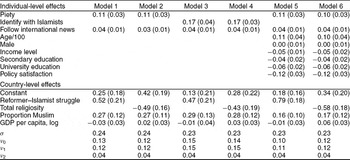
We begin by estimating two models with religiosity and media awareness as individual-level predictors of anti-Americanism; Model 1 uses level of perceived struggle as the country-level measure of competitiveness, and Model 2 uses the overall level of religiosity (Table 3). We also investigate the country-level effect of wealth as a possible confounding variable, because political competition may intensify either as a direct result of increasing wealth or indirectly through the effect of economic development on lower levels of religiosity (Inglehart and Welzel Reference Inglehart and Welzel2005).Footnote 13 Because wealthier countries enjoy a higher economic standard of life, but are also more directly exposed to American cultural exports and receive less U.S. foreign aid, the effect of wealth on anti-Americanism may be either positive or negative (Chiozza Reference Chiozza, Katzenstein and Keohane2007).
Hierarchical Linear Model Coefficient Estimates and Posterior Standard Deviations

Notes: The dependent variable is an individual's level of anti-Americanism on a 0–1 scale. Positive coefficients indicate variables that have an increasing effect on levels of anti-Americanism. Dataset includes 12,831 respondents in 21 countries. Coefficients on the individual-level variables are the average effects uk across countries.
The model results indicate that religious Muslims are consistently more anti-American than their less observant compatriots within a given country. The typical individual-level effect of piety is to increase the strength of anti-American attitudes by 0.11 points on the 0–1 scale. As predicted, this effect is greater than zero in 20 of the 21 study countries.Footnote 14 Muslims who regularly follow international news also tend to be more anti-American. In an average country, we estimate that anti-Americanism is 0.04 points higher among the highly media aware—a smaller but still nonzero effect. This effect is greater than zero in 18 of the 21 study countries.Footnote 15 The combined effect of religiosity and high media attentiveness, by adding  , is approximately 0.15 points in a typical country. In substantive terms, this individual-level effect is nearly one-quarter of the total range of anti-Americanism observed across countries (0.23 to 0.84). When we measure Muslims' political predispositions by their allegiance with Islamists or modernizers, the estimated individual-level effect on anti-Americanism is even larger—fully 0.17 points in a typical country (Models 3 and 4). Again, however, this finding is based on the subset of respondents who believed there to be a “struggle” in their country between fundamentalists and modernizers.
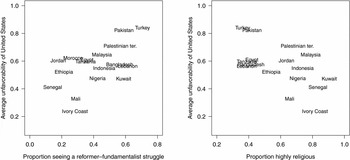
At the country level, the effect of secular–Islamist conflict on levels of anti-Americanism is even more pronounced. Anti-Americanism is much more widespread in countries with higher perceived levels of struggle between secular and Islamist elites, as well as in countries with lower overall levels of religiosity among the Muslim population (Figure 2). Recall that as countries converge on 100% religious types, there is less intense secular–Islamist competition. In Model 1, we estimate that an increase of just 10% in the proportion perceiving a reformer–Islamist struggle is associated with an additional 0.05 points of anti-Americanism at the country level. Across the entire range of this variable, our model predicts a difference of 0.3 points on the 0–1 anti-Americanism scale. The magnitude of the effect of overall levels of religiosity on anti-Americanism (Model 2) is substantively just as large. These results are consistent with our assertion that anti-Americanism in the Muslim world has an instrumental basis and is closely related to countries' domestic politics. They also provide an explanation for the low levels of anti-Americanism observed among Muslims in Ethiopia and West Africa and are robust to alternative explanations discussed later.
Average Level of Muslim Anti-Americanism Compared to Two Measures of the Intensity of Secular–Islamist Political Competition: Proportion of Muslims Seeing a Struggle between Groups Who Want to Modernize the Country and Islamic Fundamentalists (left); and Proportion of Muslims Who Report a High Level of Religious Piety (right)

The models further indicate that anti-Americanism is more widespread among Muslims in countries where Muslims comprise a larger share of the population. Where Muslims represent a smaller proportion of the population, anti-Americanism is lower, on average. The relationship between competitiveness and levels of anti-Americanism does not seem to be a spurious association due to some countries having larger shares of Muslims than others. The estimated effect of this variable is of similar size to that of competitiveness across its observed range–approximately 0.25 points on the anti-Americanism scale. Finally, a country's level of per capita GDP does not confound either of these two predicted effects. There is no consistently positive or negative estimated effect of wealth on countries' level of anti-Americanism.
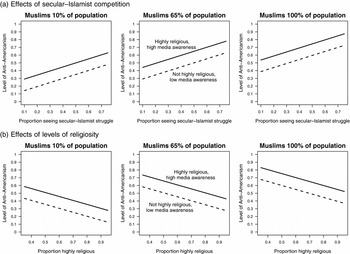
To more fully interpret the results of Models 1 and 2, we compare the predicted level of anti-Americanism for nonreligious, low-media-aware individuals to that of highly-religious, high-media-aware individuals in different types of countries. We vary the percentage of Muslims in a country who see a reformer–Islamist struggle from 10% to 75%, which is slightly greater than the observed range in our study. We then consider hypothetical countries in which the Muslim population share is near its minimum (10%), mean (65%), and maximum (100%). Because logged per capita GDP has a relatively small effect, we hold it fixed at its mean value, approximately $1,000. In the first group, x 1 = 0 and x 2 = 0, so at each combination of the country-level covariates, the expected level of anti-Americanism is  In the second group, x 1 = 1 and x 2 = 1, so the expected level of anti-Americanism is
 where
 and
 are the estimated means of the random effects β1j and β2j. Anti-American attitudes are most prevalent where reformers and Islamists are most engaged in struggle, and in countries that are predominantly Muslim (Figure 3a). Recalculating the model predictions using a country's level of religiosity as the measure of competitiveness (Model 2) produces the same result (Figure 3b).
Predicted Levels of Anti-Americanism by National Context: Percentage of a Country's Population that is Muslim and (a) Level of Conflict between Secular and Islamist Elites or (b) Proportion Highly Religious

As the perceived level of competition between secular and Islamist groups increases, so does the prevalence of unfavorable attitudes toward the United States. From left to right, the combined effects of reformer–Islamist struggle and Muslim population share can explain variation of 60% of the entire possible range of anti-Americanism (0–1). Adding in the individual-level effects, as shown, raises this to 75%. Because high overall levels of religiosity are associated with less intense secular–Islamist competition, Figure 3b illustrates exactly how more religious countries are less anti-American even though more religious individuals are more anti-American.
We now consider a series of individual-level demographic and attitudinal factors that might also explain anti-American attitudes and could confound the estimated effects of religiosity and media attentiveness. Indeed, there are many predictors of anti-Americanism at the individual level that matter in addition to the ones identified by our theory (e.g., Chiozza Reference Chiozza2009; Gentzkow and Shapiro Reference Gentzkow and Shapiro2004; Nisbet and Myers Reference Nisbet and Myers2011)—and it is probable that the effects of these variables vary by country. We therefore enter into Models 1 and 2 measures of respondents' age, gender, income, education level, and policy satisfaction.Footnote 16 The results appear in Table 3 as Model 5 and Model 6. We find that in most countries, age is associated with greater anti-Americanism and that greater wealth, education, and satisfaction with politics are all associated with lesser anti-Americanism. Yet none of these effects diminish the estimated effects of religiosity or media awareness.Footnote 17
To what extent is it possible that a country's level of reformer–Islamist struggle is caused by aggregate levels of anti-Americanism and not vice versa? Most scholars point to the long-term historical origins of the split within the Muslim world over optimal regime type. Owen (Reference Owen2010, 238), for example, describes the struggle between promoters of Islamism and secularism as having a “deep structural cause” with its origins in the late 19th and early 20th centuries. If a country's level of conflict on this dimension has a long-term historical basis, reverse causality is unlikely. This suggests that anti-Americanism has been epiphenomenal to ideological polarization on the “mosque”-state dimension.
Testing Alternative Explanations
The theoretical argument and empirical findings thus far focus on how the domestic political environment serves as a primary driver of anti-American sentiment in the Muslim world. This section considers alternative contextual explanations for anti-Americanism and describes the results of a series of empirical tests that operationalize these alternative hypotheses.
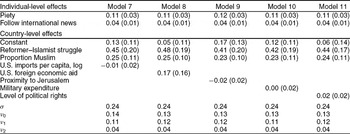
Does Muslim anti-Americanism vary with greater U.S. cultural and economic presence in a country? On the one hand, higher levels of cultural and economic interaction could increase feelings of connectedness and fellowship between the two societies (Chiozza Reference Chiozza2009); on the other hand, American business practices and cultural products might be seen as invasive or exploitative. We thus enter into the model a measure of the direct exposure of Muslims in each country to the United States, calculated as the (logged) per capita dollar value of a country's imports of goods from the United States in 2007 (Table 4).Footnote 18 In our sample, wealthier countries import greater amounts of merchandise from the United States, and this variable is highly correlated with levels of per capita GDP. As with wealth in Model 1, we find no consistent effect of U.S. imports on overall levels of anti-Americanism (Model 7). Nor does this variable confound the effects of secular–Muslim conflict or Muslim population share.Footnote 19
Tests of Alternative Country-Level Hypotheses and Robustness Checks for Model 1 in Table 3

Notes: Positive coefficients indicate variables that have an increasing effect on levels of anti-Americanism, on a 0–1 scale. The survey sample contains 12,831 respondents in 21 countries.
A second possible factor that might increase or decrease anti-Americanism is the amount of U.S. foreign economic aid received by a country. Poorer countries, such as those in sub-Saharan Africa, receive significantly larger amounts of U.S. assistance, making citizens of those countries potentially more appreciative—or, at least, more sympathetic—toward the United States, leading to more favorable attitudes. However, Muslims might also see foreign aid from the United States as an affront to a country's sovereignty. We test the effects of this variable in Model 8.Footnote 20 After domestic sources of anti-Americanism have been accounted for, levels of U.S. foreign aid have no significant effect on opposition to the United States. The estimated effects of domestic competition and Muslim population share are robust in this model specification.
Commitment to a just resolution of the Arab-Israeli conflict remains important to many Muslims, particularly given the religious and cultural importance of Jerusalem within the Islamic faith. The involvement of the United States as a mediator in this conflict might be expected to increase anti-American sentiments. Because the conflict may be more salient for citizens of frontline states like Jordan, Syria, and Egypt, a country's geographic distance to Jerusalem might serve as a proxy for concern about this issue. Yet distance to Jerusalem is not a significant predictor of anti-American sentiment (Model 9).Footnote 21 This variable also serves as a control for the existence of an “Arab” or “Middle Eastern” effect because many consider the Levant to be the geographic center of the Middle East.
We last consider the possible effects of militarism and degree of democracy on levels of anti-Americanism. Muslims living in highly militarized societies may be more aware of geostrategic considerations while simultaneously viewing their countries in more direct competition with the United States for regional or global influence. Yet we find no relationship between countries' domestic military expenditures and levels of anti-Americanism (Model 10).Footnote 22 Similarly, it is possible that Muslims living in a country with a democratic political culture more similar to that of the United States might have more affinity for America in general. Countries' levels of political rights, however, are not associated with levels of Muslim anti-Americanism (Model 11).Footnote 23 In addition, in both Models 10 and 11, the estimated country-level effect of secular–Islamist competition on anti-Americanism does not change.Footnote 24
COMPARATIVE CASE STUDY EVIDENCE
We now turn to comparative case studies and media content analysis of news reports and editorials about the United States in three predominantly Muslim countries: Turkey, Morocco, and Senegal. To establish that the causal mechanism we have described is consistent with the experiences of these countries, we assess both (1) the nature and intensity of secular–Islamist political competition in each country and (2) the public portrayal of the United States by local leaders and other political elites. In choosing these three countries for in-depth analysis, we follow the guidance of King, Keohane, and Verba (Reference King, Keohane and Verba1994, 140) that “the best ‘intentional’ design selects observations to ensure variation in the explanatory variable . . . without regard to the values of the dependent variable.” Turkey and Senegal are among the most dissimilar countries in the Muslim world with respect to their level of contestation between secular and Islamist political groups: Turkey is highly competitive along that dimension, whereas Senegal is not (Figure 2). In the 2007 GAP study, 71% of Turkish Muslims perceived a struggle between modernizers and Islamic fundamentalists, whereas only 36% were highly religiously observant. In Senegal, by contrast, only 14% of Muslims observed a reformer–fundamentalist struggle, and 83% were highly religious. Morocco is an intermediate case. The population of all three countries is nearly entirely Muslim.
We expect that depictions of the United States in the Turkish press will be overwhelmingly negative, whereas the United States will receive more balanced treatment in the Moroccan press and relatively positive treatment in the Senegalese mass media. Preliminarily, we observe that, in line with this expectation, levels of anti-American sentiment are extremely high in Turkey and quite low in Senegal, with Morocco falling in between (Figure 1). We do not deny that mass opinion about the United States affects elite opinion and is affected by it in return. That said, if our analysis did not find elite opinion patterns in the manner we have described, we would count this as evidence against our theory.
Senegal
The vast majority of Senegalese are highly religious, identifying with one of a handful of Islamic Sufi brotherhoods that dominate Senegalese associational life (Clark Reference Clark1999).Footnote 25 In recent years, an Islamist movement has emerged that calls for the adoption of Islamic law in Senegal (Loimeier Reference Loimeier and Westerlund1996), but its influence has remained fairly limited.
Like many African countries that gained independence in the 1950s and 1960s, Senegal inherited a secular state structure after its period of colonial rule by France. The governing apparatus in the newly independent Senegalese state came to be dominated by a narrow elite of Francophone technocrats and intellectuals. Nominally Muslim but secular in outlook and orientation, this elite was bound together by what O'Brien (Reference O'Brien2003, 53) calls the powerful “secularizing” influence of French language, culture, and education. A university education in French became a prerequisite for employment in the state bureaucracy, even though less than 20% of the population spoke French with any degree of fluency and less than 1% used French exclusively.
The system of political compromise that emerged in Senegal brought together the secular Francophone elite with the leaders of the Sufi brotherhoods. Recognizing the need for an intermediary between the state and the masses, the secular elite worked closely with these Islamic leaders (e.g., Haynes Reference Haynes1996; Villalón Reference Villalón1995), frequently demonstrating their acquiescence and, in some cases, submission (Dieye Reference Dieye2009). The leaders of the Sufi orders, by allowing the secular elite to run the state, created a system of coexistence for the religious brotherhoods that obviated the need for political competition within the set of Sufi groups. Yet tension still exists between the secular elite and the Sufi Brotherhoods. Forms of “symbolic confrontation” (O'Brien Reference O'Brien2003) over issues like family law and the inclusion of religious instruction in education continue to demonstrate the relevance of the secular–religious conflict in Senegalese daily life. Despite this conflict, the citizens of Senegal are overwhelmingly pious Muslims living in a country whose political system is dominated by a narrow, secular bureaucratic elite.
Internationally, Senegal has cultivated and currently enjoys a very strong relationship with the United States. Over the past decade, numerous American politicians and dignitaries have visited Senegal and have been received favorably. There is little to be gained in the context of Senegalese politics by criticizing the United States; as such, Muslims in Senegal are among the most pro-American in the world.
Turkey
Mainstream anti-Americanism in Turkey first emerged during the Cold War, but was largely confined to the Turkish left, who strongly opposed the nature and extent of U.S. involvement in Turkish political affairs. In the 1960s and 1970s, the Turkish right aligned itself with the United States against international communism (Criss Reference Criss2002). With the decline of Cold War bipolarity, however, the salience of the religious–secular issue dimension intensified in Turkey, starting in the 1980s and continuing through the 2000s (Taspinar Reference Taspinar2005).
According to Hale (Reference Hale and Beeley2002, 178), the political poles in contemporary Turkey are Kemalist secularism and political Islamism, and this cleavage has superseded the traditional left–right socioeconomic divide. Using public opinion data from the World Values Survey, Kalaycioglu (Reference Kalaycioglu1999) found that in the 1990s individuals' religiosity corresponded closely with party preferences, whereas social class and economic satisfaction mattered little. The intensity of the religious–secular cleavage in Turkey is reflected not only in Turkey's formal party organizations but also in the substance of highly prominent national debates about the role of religion in Turkish public and political life—for example, concerning policies prohibiting women from attending schools or universities while wearing the Islamic headscarf.
Anti-Americanism in Turkey is embraced by nearly all segments of Turkish society, and both secular nationalists and Islamists engage in stridently anti-American rhetoric (Guney Reference Guney2008; Taspinar Reference Taspinar2005). Pollock (Reference Pollock2005) describes anti-Americanism in Turkey as a “combination of old leftism and new Islamism” where “just about every politician and media outlet (secular and religious) preaches an extreme combination of America- and Jew-hatred that . . . voluntarily goes far further than anything found in most of the Arab world.” Islamists, such as the elite associated with the Justice and Development Party, have been relentlessly and publicly negative in their portrayal of the United States (Cagaptay Reference Cagaptay2008). Likewise, anti-imperialist rhetoric is a main theme of secular nationalists, who argue that Turkey is under a “lethal threat” from both the United States and religious Muslims (Akyol Reference Akyol2008). Secularist rallies, some of which draw millions of supporters, frequently feature demonstrators carrying anti-American placards (Somer Reference Somer2007; Zaman Reference Zaman2007). Secular nationalist intellectuals also argue that American policies in the Middle East are part of a “neo-colonial” effort to establish hegemony in the region: For example, a U.S. bombing in Iraq triggered a major earthquake in Turkey in 2003, the United States is keeping Turkey out of Iraq to ensure Turkey is not able to exploit Iraq's oil resources, and Osama bin Laden and Saddam Hussein were both on the American payroll (Cagaptay Reference Cagaptay2004).Footnote 26 Pollock (Reference Pollock2005) similarly relates that the Islamist newspaper Yeni Şafak, and the mainstream secular paper Hürriyet, are both rife with conspiracy theories, including how U.S. forces in Iraq have been harvesting the organs of dead Iraqis for sale in the United States and how secret American nuclear testing was actually responsible for the Southeast Asian tsunami.
Morocco
Religious and secular political organizations exist simultaneously in contemporary Morocco. The dominant religiously oriented groups include both militant and moderate Islamist groups as well as a broad-based Sufi movement that mirrors the “vocabulary and structures” of Morocco's monarchy (Zeghal Reference Zeghal2008, xix). Secular Moroccans—many of whom graduated from a parallel Francophone educational system and are associated with left-leaning political organizations—are influential but fewer in number than Moroccans with a more religious worldview (Zeghal Reference Zeghal2008, 61;80).
The relative balance between secular and religious trends has led scholars to argue that there exists a “Muslim consensus” in Morocco in which Islam “animates the nation's spiritual life and anchors its social existence” (Entelis Reference Entelis1989, 11–12). At least three significant political groups exist within this consensus: moderate Islamists, radical Islamists, and individuals associated with local Sufi movements (Zeghal Reference Zeghal2008, xix). Supporters of a moderate interpretation of Islam enjoy a near majority, as evidenced by public opinion polling (Sater Reference Sater2010, 1). Radical Islamists disagree with their more moderate counterparts primarily on tactical political matters. Islamist activists of both types have been sharply critical of Western-influenced elites who are believed to be “steering the country toward secular values and Westernization that distance it from Arab and Islamic roots” (Shahin Reference Shahin and Ruedy1994, 169).Footnote 27
In Morocco, there exists a complex—and some argue uniquely Moroccan—relationship between religion and political authority.Footnote 28 Morocco's king, who claims to be descended from the prophet Mohammed, is the “commander of the faithful,” and although state institutions have a secular quality, the monarchy itself remains a key religious institution in the country (Munson Reference Munson1993, 121). Thus, although the Moroccan state may be viewed as not sufficiently religious by the Islamist right, supporters of the monarchy associate the king with religious authority.
Although the majority of Moroccans have converged in their support of religion in one form or another, there nonetheless exists a politically influential secular-minded minority of the Moroccan political elite. In addition, there appears to be significant social distance between religious and secular types in Moroccan society. Secular forces have historically identified with leftist political organizations that have roots in the Arab socialist tradition (Zeghal Reference Zeghal2008, 63). Moroccan socialist parties have typically drawn support from organized laborers, urban migrants, bureaucrats, and university students (Waterbury Reference Waterbury1970, 196–7), though are increasingly losing ground to Islamist political organizations on university campuses and in urban areas (Boukhars Reference Boukhars2011, 92). Yet despite a decline in popularity of the secular left, elites associated with this perspective continue to enjoy considerable influence both in media and government.
How do these political cleavages relate to the intensity of anti-American sentiment? According to one journalist, anti-Americanism in Morocco is espoused by everyone “from Islamist traditionalists to urban sophisticates” (Charney Reference Charney2005). This trend is evidenced by both large anti-U.S. protests organized by Islamic activists and by strong anti-American sentiment expressed by secular elites. In this context, “Moroccans echo their media's sentiments about the United States,” suggesting elites have a particularly important role to play in influencing public opinion (Charney Reference Charney2005). The existence of a broad, religious Muslim consensus with a politically significant secularist presence in Morocco should—according to our theory—translate into lower levels of anti-American than observed in Turkey but higher levels than seen in Senegal.
Comparative Media Content Analysis
We examined the balance between positive and negative portrayals of the United States in two leading national newspapers in each study country over a period of two to five months in advance of the 2007 GAP survey. This interval was long enough to produce samples containing approximately 50 to 100 articles from each of the six sources.Footnote 29 We chose the newspapers based on the size of their circulation and the condition that they be domestically produced. Each one was major enough to offer fully searchable online archives for the period under study. In Turkey, we examined Zaman, a moderate-conservative Islamist daily that is generally sympathetic to the policies of the AKP, and its primary competitor, the Kemalist-secularist Hürriyet. In Morocco, we searched Aujourd'hui le Maroc and Le Matin du Sahara et du Maghreb; both widely circulated Francophone dailies. In Senegal, we examined issues of the government-owned Le Soleil and the independent Sud Quotidien, the two largest Francophone dailies in 2007 (Banks, Muller, and Overstreet Reference Banks, Muller and Overstreet2007).
For articles discussing the role of the United States in either international or domestic political or economic affairs, we recorded whether the tone of the article was predominantly positive, negative, or neutral. These articles included both straight news items and editorials. The most common positive mentions of the United States referred to American-backed development programs, trade, or the role of the United States in international diplomacy. Negative mentions tended to focus on objections surrounding the wars in Iraq and Afghanistan or other criticisms of U.S. foreign policy. We coded as neutral those cases in which America was referenced in neither a critical nor laudatory manner (for example, announcements of meetings between Senegalese leaders and U.S. officials).Footnote 30
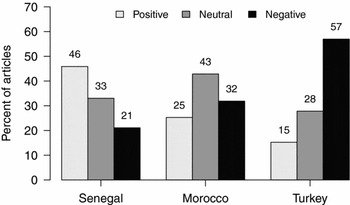
We tabulated the percentage of news articles in each country describing the United States in a positive, negative, or neutral manner (Figure 4). In Turkey, where secular–Islamist competition is most intense, more than half of the articles referenced the United States in an unfavorable manner. The tone of articles in the moderate Hürriyet (61% negative) was more critical than those in Zaman (52%). The opposite was the case in Senegal, where nearly half of the articles portrayed the United States in a favorable light. The content of Le Soleil, which we might expect to be more closely attuned to elite attitudes, was far more positive toward the United States (54%) than the independent Sud Quotidien (34%). Although this difference in tone should affect mass attitudes—after all, nearly one-third of Senegalese Muslims do hold an unfavorable opinion of the United States—it also matches our expectation that Senegalese political elites are not predominantly anti-American in their public pronouncements. Finally, we found a balanced set of perspectives toward the United States in the major Moroccan press, with a tilt in the anti-American direction. Morocco is situated between Senegal and Turkey, with little difference in tone between Le Matin and Aujourd'hui le Maroc. Consistent with our expectations, in countries with low secular–Islamist competition, people are exposed to one type of media environment, and in places with high competition people are exposed to a very different type of media environment. Although our media analysis does not address the issue of causal direction, a different pattern of evidence might have falsified our theory.
Balance in the Tone of Media Mentions (Positive versus Negative) of the United States in Political and Economic Affairs in Senegal, Morocco, and Turkey

CONCLUSION
Negative perceptions of the United States are widespread in the Islamic world, but they are not universal. We have argued that levels of Muslim opposition to the United States are associated with the degree of domestic political competition in a given country between secular and religious groups. As competition intensifies, it becomes increasingly advantageous for elites to foment anti-American sentiment for their own political gain. The outcome of this elite-led process is what we contend survey researchers are detecting, at least in part, when they ask individual Muslims their opinion of the United States.
The intensity of political competition along religious–secular lines—the key explanatory variable that we propose—explains a substantively large amount of the cross-country variation in anti-American sentiment across the Islamic world. A media content analysis of the balance of pro- and anti-American messages in three Muslim countries with varying levels of competition provides further evidence in support of the country-level mechanism we describe. At the individual level, we find consistent and robust effects of religiosity and media attentiveness on Muslim anti-Americanism across a wide range of countries.
Explaining why many Muslims dislike America can provide insight into the utility of the policy options available to the United States in mitigating American unpopularity abroad. Previous scholarly work has suggested that, to the extent anti-Americanism is based on attributes of America and Americans, it will be less likely to moderate over time, because these concerns are based on deep-seated attitudes—in contrast to concerns about American policies that may be more mutable (Thornton Reference Thornton1988, 13). As the Muslim reaction to the events of 2003 makes clear, the actions of the United States in the Islamic world do affect perceptions of and support for the United States as a global actor, even if only for a short time. At the very least, the United States—through its position in the world system and interventionism overseas—provides a generalized environment of grievance that allows for political mobilization against America to take place.
Yet it is unclear how far a more balanced approach to American foreign policy making would go toward eradicating anti-Americanism in the Islamic world. Our results indicate that to the extent Muslim anti-Americanism is a domestic phenomenon, a certain degree of pessimism is warranted toward the potential of American actions to lessen negative perceptions of the United States in the Islamic world. Foreign elites continue to have their own motivations for promoting negative views about the United States, which are related to incentives surrounding local political mobilization. A core assumption made by advocates of an enhanced public diplomacy campaign is that anti-Americanism stems from poor “strategic communication” on the part of the United States (Nisbet and Shanahan Reference Nisbet and Shanahan2008). The results of this study suggest that Muslim publics are highly responsive to messages from domestic elites and that any American-led effort to offer a counter-narrative would have to compete with local media environments that may be firmly oriented toward the instrumental advancement of anti-American attitudes.
 for all parameters.




Comments
No Comments have been published for this article.