INTRODUCTION
For the Panamic Province of the tropical eastern Pacific Ocean (Baja California, Mexico to northern Peru), several monographs have characterized the molluscan fauna. Hertlein & Strong (Reference Hertlein and Strong1955) recorded the presence of 211 species of gastropods, bivalves and scaphopods, based on collections from the ‘Askoy’ cruise in 1941 (Hertlein & Strong, Reference Hertlein and Strong1955) in Panama, Colombia and Ecuador. Subsequently, Olsson (Reference Olsson1961) presented a thorough work on the neritic bivalves species found from Panama to Peru, including several locations on the Colombian coast. This work was followed by Olsson (Reference Olsson1971), who documented gastropods and bivalves found in the Gulf of Panama. Based in part on these previous publications, Keen (Reference Keen1971) presented the first inventory of the tropical eastern Pacific molluscs, including 3325 species of monoplacophorans, aplacophorans, polyplacophorans, scaphopods, cephalopods, bivalves and gastropods. Due to intensive sampling, the Gulf of California is the best documented area within the Panamic Province. Hendrickx et al. (Reference Hendrickx, Brusca, Cordero and Ramírez2007) listed 2194 marine mollusc species dwelling in these bottoms, of which 565 were bivalves.
The most recent and specific contribution related to Pacific mollusc taxonomy and distribution was made by Coan & Valentich-Scott (Reference Coan and Valentich-Scott2012), recording 890 bivalve species distributed from the central Pacific coast of Baja California, Mexico, including the Gulf of California, to northern Peru. A considerable number of these species are presumed to inhabit in the Colombian Pacific waters, taking into account that their geographical distribution areas range from the Gulf of California to Peru. However, for most of the species presented in the aforementioned publications, there are no documented records of their presence in Colombian waters.
According to Miloslavich et al. (Reference Miloslavich, Klein, Díaz, Hernández, Bigatti, Campos, Artigas, Castillo, Penchaszadeh, Neill, Carranza, Retana, Díaz de Astarlo, Lewis, Yorio, Piriz, Rodríguez, Yoneshigue-Valentin, Gamboa and Martín2011), in the Pacific coastal waters of Costa Rica, Panama, Colombia and Ecuador, 875 species of molluscs are known. These authors pointed out that even for relatively well known groups such as molluscs, echinoderms and fish, the inventories are by no means complete, and further discoveries should be expected.
In the Colombian Pacific Díaz et al. (Reference Díaz, Cantera and Puyana1998) recorded 883 species of molluscs, but estimated the presence of about 1813 mollusc species. The latter number could be much closer to what might be found in the area, taking into account the low sampling effort and that the actual data are mostly representative of species from shallow coastal environments, such as mangroves, rocky shores, sandy beaches and coral and rocky reefs (e.g. Malpelo and Gorgona Islands). Modest emphasis was given to the shelf, upper slope and the deep-water soft bottom fauna.
Thus, the purpose of this paper is to present the first inventory of the bivalve mollusc species collected on the continental shelf and upper slope surveys carried out by the Invemar projects in Colombia. The data presented herein will contribute to the knowledge about the regional fauna and their geographical and bathymetric distributions.
MATERIALS AND METHODS
Study area
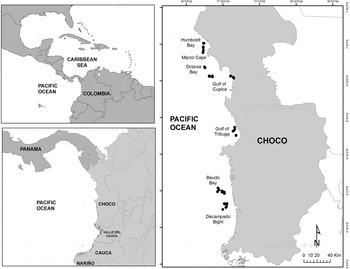
The Colombian Pacific Ocean has nearly 1300 km of shoreline and is a component of the Panama Basin. The Colombian Pacific Basin is located between 01°30′N to 7°10′N and between 77°40′W to 82°00′W (Murcia & Giraldo, Reference Murcia and Giraldo2007). The basin is bounded on the north by the Gulf of Panama; the coast of Colombia, composed of the departments of Choco, Valle del Cauca, Cauca and Nariño, in the east; the Ecuadorian coast and the submarine Carnegie Ridge, to the south; and the Pacific Ocean, territorial waters of Panama (30 km) and the Cocos Ridge to the west (Murcia & Giraldo, Reference Murcia and Giraldo2007). Longitudinally these boundaries include the coastline to the outer limits of the exclusive economic zone which includes Malpelo Island (644 km from continental coast), with 339,500 km2 among estuarine, coastal and ocean waters, with depths up to 4000 m (Martínez et al., Reference Martínez, Giraldo and Rodríguez-Rubio2007). The most important geomorphological features are Gorgona and Malpelo Islands (Murcia & Giraldo, Reference Murcia and Giraldo2007). Our study includes the area off Choco Department, the largest in shoreline on the Pacific side of the country (Figure 1). The Panama Basin is dominated almost exclusively by biogenic sediments seasonally controlled by primary productivity, except for northern and eastern margins consisting mainly of terrigenous sediments (Betancur & Martínez, Reference Betancur and Martínez2003). The dominant ocean waves, like the wind and current in the Colombian Pacific Basin, come from the south-west (Murcia & Giraldo, Reference Murcia and Giraldo2007).
Geographical position of the sampling sites in the Invemar expedition carried out in the north of the Colombian Pacific Ocean.

Collection and processing of specimens
A collection campaign was carried out on the Colombian Navy RV ARC ‘Malpelo’ in the framework of the project Invemar-Macrofauna III (Biodiversity baseline study of the northern Colombian Pacific coastal and shelf areas) from 6–13 October 2002. Sampling was performed in several locations along the continental shelf and the upper slope of the northern coast of the Colombian Pacific (Figure 1). A total of 39 demersal trawls were performed with an epibenthic trawl net (3 knots by 10 minutes) at depths of 70, 150, 300 and 500 m. In this methodology the opening of the net in each trawl was unknown, making it semi-quantitative sampling, however all collected species and specimens were quantified. All collected specimens were preserved dry or in 70% ethanol.
The sediments were characterized using a nested set of sieves (or gradation tests) according to the methodology of Folk (Reference Folk1974). The results of samples indicate the following mud/sand proportions: Station P3E20 was composed of mud 60% and sand 40%; Stations P1E22, P3E17, P14E9 and P15E7, 70/30%; Stations P1E21, P3E18, P14E10, P14E11 and P15E6, 75/25%; Stations P1E23 and P15E5, 80/20%; and Station P1E24, 90/10% (Pérez & Posada, Reference Pérez and Posada2004). Other oceanographic parameters were unfortunately not sampled.
Specimens were identified using the most current taxonomic literature available on the region such as Dall (Reference Dall1908), Strong & Hertlein (Reference Strong and Hertlein1940), Grau (Reference Grau1959), Rost (Reference Rost1955), Soot-Ryen (Reference Soot-Ryen1955), Olsson (Reference Olsson1961), Keen (Reference Keen1971), Coan et al. (Reference Coan, Valentich-Scott and Bernard2000) and Coan & Valentich-Scott (Reference Coan and Valentich-Scott2012), among others. The taxonomic arrangement of the species follows the criteria of Coan & Valentich-Scott (Reference Coan and Valentich-Scott2012). In the systematic account the species considered as new records for the area are highlighted (*). Specimens were deposited in the mollusc collection of the Museo de Historia Natural Marina de Colombia (MHNMC) in Santa Marta.
We have included data for both live collected and dead collected specimens and clearly demarcate them as ‘specimens’ and ‘valves’. We do present ‘maximum collection depth’ from either live or dead material, but this is not to indicate that the species is currently living at this depth. Instead it allows us to compare our distributions with the monographs by Keen (Reference Keen1971) and Coan & Valentich-Scott (Reference Coan and Valentich-Scott2012), who made no distinction between living or dead specimens in their bathymetric reporting.
RESULTS
A total of 38 species, represented by live collected specimens and dead valves, were identified. We herein provide a taxonomic list of the species, geographical locality and depth range.
SYSTEMATICS
Class BIVALVIA Linnaeus, 1758
Family NUCULIDAE Gray, 1824
Genus Ennucula Iredale, 1931
Ennucula taeniolata (Dall, Reference Dall1908)
(Figure 2A, B)
Keen (Reference Keen1971): 26, figure 15; Coan & Valentich-Scott (Reference Coan and Valentich-Scott2012): 39, plate 11.
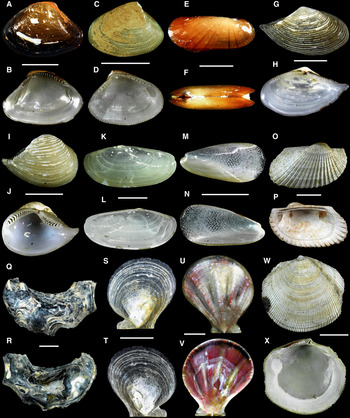
Exterior and interior views of Ennucula taeniolata (A, B); Nucula iphigenia (C, D); Solemya pervernicosa (E, F); Saccella fastigata (G, H); Saccella hindsii (I, J); Orthoyoldia panamensis (K, L); Amygdalum pallidulum (M, N); Anadara concinna (O, P); Undulostrea megodon (Q, R); Delectopecten zacae (S, T); Pseudamussium fasciculatum (U, V); and Lucinisca fenestrata (W, X). Scale bars: A–D, G–H, M–X = 1 cm; E–F, I–L = 0.5 mm.

MATERIAL EXAMINED
4 specimens and a valve INV MOL9665 (P14E12a), 474–475 m.
GEOGRAPHICAL DISTRIBUTION
Mexico (Gulf of California) (Coan & Valentich-Scott, Reference Coan and Valentich-Scott2012). In Colombia* collected off Baudo Bay.
DEPTH RANGE
474 to 1275 m (herein; Coan & Valentich-Scott, Reference Coan and Valentich-Scott2012).
REMARKS
This is a major range extension and represents the southern record for the species as well as the shallowest record.
Genus Nucula Lamarck, 1799
Nucula iphigenia Dall, Reference Dall1896
(Figure 2C, D)
Olsson (Reference Olsson1961): 55; Keen (Reference Keen1971): 26, figure 6; Coan & Valentich-Scott (Reference Coan and Valentich-Scott2012): 45, plate 13.
MATERIAL EXAMINED
1 specimen INV MOL9664 (P15E7a), 300 m.
GEOGRAPHICAL DISTRIBUTION
Panama to Peru (Coan & Valentich-Scott, Reference Coan and Valentich-Scott2012). In Colombia* collected off Decampado Bight.
DEPTH RANGE
300 to 474 m (herein; Keen, Reference Keen1971).
REMARKS
Previously only known from the type locality in the Gulf of Panama and one sample off Tumbes Peru. This specimen represents the shallowest record for the species.
Family SOLEMYIDAE Gray, 1840
Genus Solemya Lamarck, 1818
Solemya pervernicosa Kuroda, Reference Kuroda1948
(Figure 2E, F)
Coan & Valentich-Scott (Reference Coan and Valentich-Scott2012): 55, plate 17.
MATERIAL EXAMINED
1 specimen INV MOL9714 (P15E5a), 65–67 m.
GEOGRAPHICAL DISTRIBUTION
USA (Alaska) to Peru; Sakhalin Island to Japan (Coan & Valentich-Scott, Reference Coan and Valentich-Scott2012). In Colombia* collected off Decampado Bight.
DEPTH RANGE
40 to 1510 m (Coan & Valentich-Scott, Reference Coan and Valentich-Scott2012).
Family NUCULANIDAE Adams & Adams, 1858
Genus Saccella Woodring, 1925
Saccella fastigata (Keen, Reference Keen1958)
(Figure 2G, H)
Olsson (Reference Olsson1961): 62, plate 2, figures 2, 2a; plate 3, figure 9; Keen (Reference Keen1971): 29, figure 24; Coan & Valentich-Scott (Reference Coan and Valentich-Scott2012): 76, plate 24.
MATERIAL EXAMINED
5 specimens INV MOL9676 (P14E9a), 70 m; 2 specimens INV MOL9677 (P15E51), 65–67 m; 2 specimens INV MOL9678 (P1E21b), 70 m; 2 valves INV MOL9679 (P3E17b) 76–78 m; 3 valves INV MOL9680 (P14E10b), 115–116 m; 1 valve INV MOL9752 (P15E6a), 119–128 m; 2 valves INV MOL9753 (P15E6b), 115–127 m.
GEOGRAPHICAL DISTRIBUTION
Mexico to Peru (Coan & Valentich-Scott, Reference Coan and Valentich-Scott2012). In Colombia* collected off Humboldt Bay, Baudo Bay, Gulf of Cupica and Decampado Bight.
DEPTH RANGE
9 to 128 m (Coan & Valentich-Scott, Reference Coan and Valentich-Scott2012; herein).
REMARKS
The Colombian records, albeit with dead collected specimens, represent a new maximum collection depth for this species.
Saccella hindsii (Hanley, Reference Hanley1861)
(Figure 2I, J)
Olsson (Reference Olsson1961): 65–66; Keen (Reference Keen1971): 29, 31, figure 25; Coan & Valentich-Scott (Reference Coan and Valentich-Scott2012): 76, 78, plate 25.
MATERIAL EXAMINED
1 specimen INV MOL9715 (P3E17a), 74–80 m; 2 valves INV MOL9716 (P3E17a), 74–80 m; 1 specimen and 7 valves INV MOL9717 (P14E9b), 70–72 m; 1 specimen and 4 valves INV MOL9718 (P7E13b), 76 m; 1 specimen and 1 valve INV MOL9719 (P15E5b), 70–71 m.
GEOGRAPHICAL DISTRIBUTION
Mexico to Panama (Coan & Valentich-Scott, Reference Coan and Valentich-Scott2012). In Colombia* collected off Gulf of Tibuga, Gulf of Cupica, Decampado Bight and Baudo Bay.
DEPTH RANGE
16 to 100 m (Coan & Valentich-Scott, Reference Coan and Valentich-Scott2012).
Family YOLDIIDAE Dall, Reference Dall1908
Genus Orthoyoldia Verrill & Bush, 1897
Orthoyoldia panamensis (Dall, Reference Dall1908)
(Figure 2K, L)
Keen (Reference Keen1971): 35, figure 59; Coan & Valentich-Scott (Reference Coan and Valentich-Scott2012): 98–99, plate 32.
MATERIAL EXAMINED
3 specimens INV MOL9657 (P14E12a), 474–475 m; 1 specimen INV MOL9658 (P3E18b), 143–145 m; 1 specimen INV MOL9659 (P14E10a), 120–121 m.
GEOGRAPHICAL DISTRIBUTION
Mexico to Peru (Coan & Valentich-Scott, Reference Coan and Valentich-Scott2012). In Colombia* collected off Gulf of Cupica and Baudo Bay.
DEPTH RANGE
64 to 864 m (Coan & Valentich-Scott, Reference Coan and Valentich-Scott2012).
Family MYTILIDAE Rafinesque, 1815
Genus Amygdalum Megerle von Mühlfeld, 1811
Amygdalum pallidulum (Dall, Reference Dall1916)
(Figure 2M, N)
Keen (Reference Keen1971): 74, figure 154; Coan et al. (Reference Coan, Valentich-Scott and Bernard2000): 188, plate 31 as Amygdalum politum (Verrill & Smith in Verrill, Reference Verrill and Smith1880); Coan & Valentich-Scott (Reference Coan and Valentich-Scott2012): 142–144, plate 46.
MATERIAL EXAMINED
1 specimen INV MOL9652 (P15E5b), 70–71 m; 1 specimen INV MOL9653 (P1E21b), 70 m; 1 specimen INV MOL9654 (P3E18b), 143–145 m; 1 specimen INV MOL9655 (P14E9a), 70 m.
GEOGRAPHICAL DISTRIBUTION
USA (California) to Gorgona Island, Cauca, Colombia (Coan & Valentich-Scott, Reference Coan and Valentich-Scott2012). Also collected in Colombia off Humboldt Bay, Gulf of Cupica, Decampado Bight and Baudo Bay.
DEPTH RANGE
40 to 400 m (Coan & Valentich-Scott, Reference Coan and Valentich-Scott2012).
Family ARCIDAE Lamarck, 1809
Genus Anadara Gray, 1847
Anadara concinna (Sowerby, Reference Sowerby1833)
(Figure 2O, P)
Olsson (Reference Olsson1961): 98, plate 8, figures 1–1a; Keen (Reference Keen1971): 42, 44, figure 78; Ríos-Jara et al. (Reference Ríos-Jara, López-Uriarte and Galván-Villa2008): 129; Coan & Valentich-Scott (Reference Coan and Valentich-Scott2012): 173, plate 55.
MATERIAL EXAMINED
2 valves INV MOL9742 (P15E6a), 119–128 m; 2 valves INV MOL9743 (P15E6b), 115–127 m.
GEOGRAPHICAL DISTRIBUTION
Mexico to Ecuador (Coan & Valentich-Scott, Reference Coan and Valentich-Scott2012). In Colombia* collected off Decampado Bight.
DEPTH RANGE
6 to 150 m (Coan & Valentich-Scott, Reference Coan and Valentich-Scott2012).
Family OSTREIDAE Rafinesque, 1815
Genus Undulostrea Harry, 1985
Undulostrea megodon (Hanley, Reference Hanley1846)
(Figure 2Q, R)
Keen (Reference Keen1971): 84, figure 173; Coan & Valentich-Scott (Reference Coan and Valentich-Scott2012): 238, plate 76.
MATERIAL EXAMINED
1 valve INV MOL9744 (P15E6a), 119–128 m.
GEOGRAPHICAL DISTRIBUTION
Mexico to Peru, and Galapagos Islands, Ecuador (Coan & Valentich-Scott, Reference Coan and Valentich-Scott2012). In Colombia* collected off Decampado Bight.
DEPTH RANGE
Intertidal to 128 m (Coan & Valentich-Scott, Reference Coan and Valentich-Scott2012; herein).
REMARKS
While we have not collected live specimens in Colombia, this dead collected specimen represents a new maximum collection depth for the species.
Family PECTINIDAE Rafinesque, 1815
Genus Delectopecten Stewart, 1930
Delectopecten zacae (Hertlein, Reference Hertlein1935)
(Figure 2S, T)
Keen (Reference Keen1971): 91, figure 194; Paredes & Cardozo (Reference Paredes and Cardozo2008): 13–14, figure 6; Coan & Valentich-Scott (Reference Coan and Valentich-Scott2012): 278, plate 91.
MATERIAL EXAMINED
1 specimen INV MOL9681 (P1mE24b), 492–500 m; 10 valves INV MOL9682 (P1mE24b), 492–500 m; 2 specimens INV MOL9683 (P3E20b), 489–491 m. 34 valves INV MOL9684 (P3E20b) 489–491 m; 618 valves INV MOL9685 (P3E20a), 482–490 m; 24 specimens INV MOL9686 (P3E20a), 482–490 m; 9 specimens INV MOL9687 (P15E7a), 300 m; 5 specimens INV MOL9688 (P1E23b), 329–339 m.
GEOGRAPHICAL DISTRIBUTION
Mexico to Peru, Galapagos Islands, Ecuador (Coan & Valentich-Scott, Reference Coan and Valentich-Scott2012). In Colombia* collected off Gulf of Cupica, Octavia Bay, Marzo Cape and Decampado Bight.
DEPTH RANGE
10 to 1840 m (Keen, Reference Keen1971).
Genus Pseudamussium Mörch, 1853
Pseudamussium fasciculatum (Hinds, Reference Hinds and Hinds1845)
(Figure 2U, V)
Olsson (Reference Olsson1961): 167–168, plate 20, figures 2–2b; Keen (Reference Keen1971): 93–94, figure 204; Coan & Valentich-Scott (Reference Coan and Valentich-Scott2012): 294, plate 97.
MATERIAL EXAMINED
17 valves INV MOL9656 (P14E11a1), 272–295 m.
GEOGRAPHICAL DISTRIBUTION
Mexico to Peru (Coan & Valentich-Scott, Reference Coan and Valentich-Scott2012). In Colombia* collected off Baudo Bay.
DEPTH RANGE
31 to 333 m (Grau, Reference Grau1959).
Family LUCINIDAE Fleming, 1828
Genus Lucinisca Dall (1901)
Lucinisca fenestrata (Hinds, Reference Hinds and Hinds1845)
(Figure 2W, X)
Keen (Reference Keen1971): 121, figure 273; Ríos-Jara et al. (Reference Ríos-Jara, López-Uriarte and Galván-Villa2008): 130; Coan & Valentich-Scott (Reference Coan and Valentich-Scott2012): 348, plate 112.
MATERIAL EXAMINED
5 valves INV MOL9745 (P15E6a), 119–128 m; 4 valves INV MOL9746 (P15E6b), 115–127 m.
GEOGRAPHICAL DISTRIBUTION
Mexico to Ecuador (Coan & Valentich-Scott, Reference Coan and Valentich-Scott2012). In Colombia* collected off Decampado Bight.
DEPTH RANGE
13 to 128 m (Coan & Valentich-Scott, Reference Coan and Valentich-Scott2012; herein).
REMARKS
The presence of 9 dead valves at two stations suggests that this small, non-commercial species is living in Colombia. This represents a new maximum collection depth for the species.
Genus Neophysema Taylor & Glover, Reference Taylor and Glover2005
Neophysema aphanes Taylor & Glover, Reference Taylor and Glover2005
(Figure 3A, B)
Taylor & Glover (Reference Taylor and Glover2005): 334, figures 49A–H–50A; Ríos-Jara et al. (Reference Ríos-Jara, López-Uriarte and Galván-Villa2008): 130; Coan & Valentich-Scott (Reference Coan and Valentich-Scott2012): 353, plate 114.
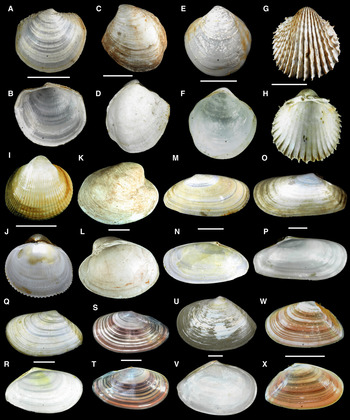
Exterior and interior views of Neophysema aphanes (A, B); Channelaxinus oliveri (C, D); Thyasira cf. flexuousa (E, F); Trachycardium belcheri (G, H); Microcardium panamense (I, J); ‘Pliocardia’ donacia (K, L); Macoma panamensis (M, N); Macoma cf. siliqua (O, P); Psammotreta pura (Q, R); Tellina nicoyana (S, T); Tellina lyrica (U, V); and Tellina carpenteri (W, X). Scale bars: A–B, E–F = 0.5 mm; C–D, G–X = 1 cm.

MATERIAL EXAMINED
6 valves INV MOL9730 (P3E18b), 143–145 m; 1 valve INV MOL9731 (P14E9a), 70 m; 3 valves INV MOL9732 (P3E17a), 74–80 m; 2 specimens and 4 valves INV MOL9733 (P14E9b), 70–72 m; 2 valves INV MOL9734 (P3E17b), 76–78 m; 1 valve INV MOL9735 (P14E10a), 120–121 m; 4 valves INV MOL9736 (P14E10b), 115–116 m; 2 valves INV MOL9737 (P15E5b), 70–71 m; 1 valve INV MOL9738 (P1E21b), 70 m; 1 specimen and 1 valve INV MOL9739 (P7E13b), 76 m.
GEOGRAPHICAL DISTRIBUTION
Mexico, Gorgona Island—Cauca Colombia, Galapagos Islands—Ecuador (Coan & Valentich-Scott, Reference Coan and Valentich-Scott2012). Herein new distribution in Colombia off Humboldt Bay, Gulf of Cupica, Gulf of Tibuga, Decampado Bight and Baudo Bight.
DEPTH RANGE
4 to 250 m (Coan & Valentich-Scott, Reference Coan and Valentich-Scott2012).
Family THYASIRIDAE Dall, Reference Dall1900 (1895)
Genus Channelaxinus Valentich-Scott & Coan in Coan & Valentich, Reference Coan and Valentich-Scott2012
Channelaxinus oliveri Valentich-Scott & Coan in Coan & Valentich, Reference Coan and Valentich-Scott2012
(Figure 3C, D)
Coan & Valentich-Scott (Reference Coan and Valentich-Scott2012): 369, plate 119.
MATERIAL EXAMINED
1 valve INV MOL9725 (P14E11a1), 272–295 m.
GEOGRAPHICAL DISTRIBUTION
Mexico to Costa Rica (Coan & Valentich-Scott, Reference Coan and Valentich-Scott2012). In Colombia* collected off Baudo Bay.
DEPTH RANGE
9 to 295 m (Coan & Valentich-Scott, Reference Coan and Valentich-Scott2012; herein).
REMARKS
While only one dead valve of this species was collected, this record represents the southernmost and deepest records for this recently described species. Channelaxinus oliveri is very thin, fragile, and small. It is unlikely that it would be transported long distances after death.
Genus Thyasira Lamarck, 1818
Thyasira cf. flexuosa (Montagu, Reference Montagu1803)
(Figure 3E, F)
Ríos-Jara et al. (Reference Ríos-Jara, López-Uriarte and Galván-Villa2008): 130; Coan & Valentich-Scott (Reference Coan and Valentich-Scott2012): 371, plate 120.
MATERIAL EXAMINED
1 specimen INV MOL9723 (P15E5b), 70–71 m; 2 specimens INV MOL9724 (P3E18b), 143–145 m.
GEOGRAPHICAL DISTRIBUTION
Circumboreal and Panantartic, USA, Mexico, El Salvador, North Africa, Florida, Japan (Coan & Valentich-Scott, Reference Coan and Valentich-Scott2012). In Colombia* collected off Gulf of Cupica and Decampado Bight.
DEPTH RANGE
20 to 3000 m (Coan & Valentich-Scott, Reference Coan and Valentich-Scott2012).
REMARKS
A strong note of caution was given by Coan & Valentich-Scott (Reference Coan and Valentich-Scott2012) on this species. Thyasira flexuosa exhibits an extremely variable shell shape. Efforts to define the species based on shell shape alone have led to much confusion on delimiting the species morphologically, as well as its distribution globally. Thus, we have chosen to qualify the species with the cf. (compared to) designation.
Family CARDIIDAE Lamarck, 1809
Genus Trachycardium Mörch, 1853
Trachycardium belcheri (Broderip & Sowerby, Reference Broderip and Sowerby1829)
(Figure 3G, H)
Olsson (Reference Olsson1961): 246, plate 37, figure 2; Keen (Reference Keen1971): 155, figure 365; Cruz (Reference Cruz1996): 66; Ríos-Jara et al. (Reference Ríos-Jara, López-Uriarte and Galván-Villa2008): 130; Coan & Valentich-Scott (Reference Coan and Valentich-Scott2012): 415, plate 136.
MATERIAL EXAMINED
1 valve INV MOL9650 (P1E22a), 148–150 m; 1 valve INV MOL9651 (P1E22b), 163–168 m.
GEOGRAPHICAL DISTRIBUTION
Mexico to Peru (Coan & Valentich-Scott, Reference Coan and Valentich-Scott2012). In Colombia* collected off Humboldt Bay.
DEPTH RANGE
14 to 200 m (Coan & Valentich-Scott, Reference Coan and Valentich-Scott2012).
Genus Microcardium Thiele, 1934
Microcardium panamense (Dall, Reference Dall1908)
(Figure 3I, J)
Olsson (Reference Olsson1961): 254, plate 39, figure 4; Keen (Reference Keen1971): 158, figure 375; Coan & Valentich-Scott (Reference Coan and Valentich-Scott2012): 425, plate 141.
MATERIAL EXAMINED
8 valves INV MOL9643 (P1E22b), 163–168 m; 70 valves INV MOL9644 (P14E11a1), 272–295 m; 9 valves INV MOL9645 (P1E22a), 148–150 m; 50 valves INV MOL9646 (P3E18a), 146–152 m; 64 valves INV MOL9647 (P3E18b), 143–145 m; 2 specimens INV MOL9648 (P1E22a), 148–150 m; 18 specimens INV MOL9649 (P3E18a), 146–152 m; 1 specimen INV MOL9754 (P15E6a), 119–128 m; 9 valves INV MOL9755 (P15E6a), 119–128 m; 1 valve INV MOL9756 (P15E6b), 115–127 m.
GEOGRAPHICAL DISTRIBUTION
Mexico to Peru (Coan & Valentich-Scott, Reference Coan and Valentich-Scott2012). In Colombia* collected off Humboldt Bay, Gulf of Cupica, Baudo Bay and Decampado Bight.
DEPTH RANGE
68 to 333 m (Keen, Reference Keen1971; Coan & Valentich-Scott, Reference Coan and Valentich-Scott2012).
Family VESICOMYIDAE Dall & Simpson, 1901
Genus Pliocardia Woodring, 1925
‘Pliocardia’ donacia (Dall, Reference Dall1908)
(Figure 3K, L)
Keen (Reference Keen1971): 116, figure 260 as Vesicomya donacia; Coan & Valentich-Scott (Reference Coan and Valentich-Scott2012): 538, plate 178.
MATERIAL EXAMINED
3 valves INV MOL9741 (P14E11a1), 272–295 m.
GEOGRAPHICAL DISTRIBUTION
Panama (Coan & Valentich-Scott, Reference Coan and Valentich-Scott2012). In Colombia*, collected off Baudo Bay.
DEPTH RANGE
272 m to 2325 m (herein; Coan & Valentich-Scott, Reference Coan and Valentich-Scott2012).
REMARKS
This species was previously only known from the holotype, which is represented by a single, dead collected, left valve. The shell is thin and fragile and likely not transported long distances. The new records greatly extend the known bathymetric range, as well as providing the first opportunity to observe the right valve of the species. There are many generic uncertainties within the family Vesicomyidae, thus we follow Coan & Valentich-Scott (Reference Coan and Valentich-Scott2012) in the tentative placement of this species into the genus Pliocardia.
Family TELLINIDAE Blainville, 1814
Genus Macoma Leach, 1819
Macoma panamensis Dall, Reference Dall1900
(Figure 3M, N)
Coan & Valentich-Scott (Reference Coan and Valentich-Scott2012): 607, plate 186.
MATERIAL EXAMINED
6 valves INV MOL9720 (P1E22a), 148–150 m; 6 valves INV MOL9721 (P1E22b), 163–168 m.
GEOGRAPHICAL DISTRIBUTION
Mexico to Panama (Coan & Valentich-Scott (Reference Coan and Valentich-Scott2012). In Colombia*, collected off Humboldt Bay.
DEPTH RANGE
22 to 168 m (Coan & Valentich-Scott, Reference Coan and Valentich-Scott2012; herein).
REMARKS
The presence of 12 dead valves at two stations suggests that this small, non-commercial species is living in Colombia. This represents a new maximum collection depth for the species.
Macoma cf. siliqua (Adams, Reference Adams1852)
(Figure 3O, P)
Olsson (Reference Olsson1961): 415–416, plate 74, figures 9, 9a; Keen (Reference Keen1971): 229, figure 566; Ríos-Jara et al. (Reference Ríos-Jara, López-Uriarte and Galván-Villa2008): 131; Coan & Valentich-Scott (Reference Coan and Valentich-Scott2012): 607, plate 187.
MATERIAL EXAMINED
6 valves INV MOL9691 (P3E18b), 143–145 m; 7 valves INV MOL9692 (P3E18a), 146–152 m; 1 valve INV MOL9693 (P7E13b), 76 m; 3 valves INV MOL9694 (P15E5b), 70–71 m; 1 valve INV MOL9757 (P15E6a), 119–128 m; 9 valves INV MOL9758 (P15E6b), 115–127 m.
GEOGRAPHICAL DISTRIBUTION
Mexico to Ecuador (Coan & Valentich-Scott, Reference Coan and Valentich-Scott2012). In Colombia* collected off Gulf of Cupica, Gulf of Tibuga and Decampado Bight.
DEPTH RANGE
18 to 152 m (Coan & Valentich-Scott, Reference Coan and Valentich-Scott2012; herein).
REMARKS
We were unable to definitively identify these specimens to species level, but this species closest to Macoma siliqua. The presence of 28 dead valves at six stations suggests that this small, non-commercial species is living in Colombia. This represents a new maximum collection depth for the species.
Genus Psammotreta Dall, Reference Dall1900
Psammotreta pura (Gould, Reference Gould1853)
(Figure 3Q, R)
Keen (Reference Keen1971): 231, figure 571; Coan & Valentich-Scott (Reference Coan and Valentich-Scott2012): 614–615, plate 189.
MATERIAL EXAMINED
8 valves INV MOL9722 (P1E22a), 148–150 m.
GEOGRAPHICAL DISTRIBUTION
Mexico to Peru (Coan & Valentich-Scott, Reference Coan and Valentich-Scott2012). In Colombia* collected off Humboldt Bay.
DEPTH RANGE
Intertidal to 150 m (Coan & Valentich-Scott, Reference Coan and Valentich-Scott2012; herein).
REMARKS
While only collected at one station, the presence of 8 dead valves suggests that this thin, non-commercial species is living in Colombia. These valves represent a new maximum collection depth for the species.
Genus Tellina Linnaeus, 1758
Tellina nicoyana Hertlein & Strong, Reference Hertlein and Strong1949
(Figure 3S, T)
Olsson (Reference Olsson1961): 409; Keen (Reference Keen1971): 219, figure 536; Cruz (Reference Cruz1996): 67; Ramírez et al. (Reference Ramírez, Paredes and Arenas2003): 268; Coan & Valentich-Scott (Reference Coan and Valentich-Scott2010): 57, figure 1F–H; Coan & Valentich-Scott (Reference Coan and Valentich-Scott2012): 639, 641, plate 196.
MATERIAL EXAMINED
22 valves INV MOL9666 (P15E5a), 65–67 m; 12 valves INV MOL9667 (P7E13b), 76 m; 10 valves INV MOL9668 (P14E9b), 70–72 m; 14 valves INV MOL9669 (P14E9a), 70 m; 4 valves INV MOL9670 (P15E5b), 70–71 m; 2 specimens INV MOL9671 (P15E5b) 70–71 m; 1 specimen INV MOL9672 (P3E17a), 74–80 m; 7 specimens INV MOL9673 (P14E9a), 70 m; 8 specimens INV MOL9674 (P14E9b), 70–72 m; 51 specimens INV MOL9675 (P15E5a), 65–67 m.
GEOGRAPHICAL DISTRIBUTION
Costa Rica to Peru (Coan & Valentich-Scott, Reference Coan and Valentich-Scott2012). In Colombia* collected off Gulf of Tibuga, Gulf of Cupica, Decampado Bight and Baudo Bay.
DEPTH RANGE
55 to 200 m (Coan & Valentich-Scott, Reference Coan and Valentich-Scott2012; Cruz, Reference Cruz1996).
Tellina lyrica Pilsbry & Lowe, Reference Pilsbry and Lowe1932
(Figure 3U, V)
Olsson Reference Olsson1961: 384–385, plate 70, figures 6, 6a; Keen (Reference Keen1971): 219, figure 539; Coan & Valentich-Scott (Reference Coan and Valentich-Scott2012): 642, plate 197.
MATERIAL EXAMINED
1 specimen INV MOL9660 (P15E5a), 65–67 m; 1 valve INV MOL9661 (P15E5a), 65–67 m; 1 valve INV MOL9662 (P14E9a), 70 m; 1 valve INV MOL9663 (P1E22a), 148–150 m; 2 valves INV MOL9759 (P15E6a), 119–128 m; 1 valve INV MOL9760 (P15E6b), 115–127 m.
GEOGRAPHICAL DISTRIBUTION
Mexico to Peru (Coan & Valentich-Scott, Reference Coan and Valentich-Scott2012). In Colombia* collected off Humboldt Bay, Decampado Bight and Baudo Bay.
DEPTH RANGE
15 to 150 m (Coan & Valentich-Scott, Reference Coan and Valentich-Scott2012; herein).
REMARKS
A single dead valve of this species was collected at 150 m, but living specimens were not collected deeper than 67 m. While the valve collected at the deepest station could have been transported from shallower depths, it is unlikely for such a thin, fragile species. This represents a new maximum collection depth for the species.
Tellina carpenteri Dall, Reference Dall1900
(Figure 3W, X)
Keen (Reference Keen1971): 211, figure 509; Coan & Valentich-Scott (Reference Coan and Valentich-Scott2012): 649, plate 199.
MATERIAL EXAMINED
1 specimen INV MOL9726 (P1E21b), 70 m; 2 valves INV MOL9727 (P14E10a), 120–121 m; 3 valves INV MOL9728 (P1E22b), 163–168 m; 2 valves INV MOL9729 (P1E22a), 148–150 m.
GEOGRAPHICAL DISTRIBUTION
USA (Alaska) to Panama (Coan & Valentich-Scott, Reference Coan and Valentich-Scott2012). In Colombia* collected off Humboldt Bay and Baudo Bay.
DEPTH RANGE
Intertidal zone to 823 m (Coan et al., Reference Coan, Valentich-Scott and Bernard2000).
Tellina pristiphora Dall, Reference Dall1900
(Figure 4A, B)
Olsson (Reference Olsson1961): 380–381, plate 69, figure 11; Keen (Reference Keen1971): 223, figure 546; Ríos-Jara et al. (Reference Ríos-Jara, López-Uriarte and Galván-Villa2008): 131; Coan & Valentich-Scott (Reference Coan and Valentich-Scott2012): 655, plate 201.
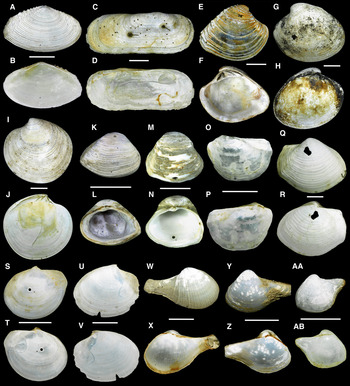
Exterior and interior views of Tellina pristiphora (A, B); Solecurtus guaymasensis (C, D); Lirophora kellettii (E, F); Callocardia catharia (G, H); Cyclinella jadisi (I, J); Caryocorbula nasuta (K, L); Varicorbula obesa (M, N); Pandora radiata (O, P); Pseudocyathodonta draperi (Q, R); Periploma lagartillum (S, T); Periploma teevani (U, V); Cardiomya planetica (W, X); Cuspidaria parapodema (Y, Z); and Krylovina lynnae (AA, AB). Scale bars: A–J, Q–V = 1 cm; K–P, W–AB = 0.5 mm.

MATERIAL EXAMINED
9 valves INV MOL9695 (P1E22a), 148–150 m; 14 valves INV MOL9696 (P1E22b), 163–168 m; 2 valves INV MOL9761 (P15E6a), 119–128 m.
GEOGRAPHICAL DISTRIBUTION
Mexico to Peru (Olsson, Reference Olsson1961; Keen, Reference Keen1971; Coan & Valentich-Scott, Reference Coan and Valentich-Scott2012). In Colombia* collected off Humboldt Bay and Decampado Bight.
DEPTH RANGE
22 to 333 m (Keen, Reference Keen1971; Coan & Valentich-Scott, Reference Coan and Valentich-Scott2012).
Family SOLECURTIDAE d'Orbigny, 1846
Genus Solecurtus Blainville, 1824
Solecurtus guaymasensis (Lowe, Reference Lowe1935)
(Figure 4C, D)
Olsson (Reference Olsson1961): 354, plate 63, figure 8; Keen (Reference Keen1971): 244, figure 614; Coan et al. (Reference Coan, Valentich-Scott and Bernard2000): 439–440, plate 92; Coan & Valentich-Scott (Reference Coan and Valentich-Scott2012): 729, plate 224.
MATERIAL EXAMINED
5 valves INV MOL9689 (P1E22a), 148–150 m; 8 valves INV MOL9690 (P1E22b), 163–168 m.
GEOGRAPHICAL DISTRIBUTION
Mexico to Ecuador (La Plata and Galapagos Islands) (Coan & Valentich-Scott, Reference Coan and Valentich-Scott2012). In Colombia* collected off Humboldt Bay.
DEPTH RANGE
7 to 168 m (Coan & Valentich-Scott, Reference Coan and Valentich-Scott2012; herein).
REMARKS
While only collected at one station, the presence of 8 dead valves suggests that this fragile, non-commercial species is living in Colombia. These valves represent a new maximum collection depth for the species.
Family VENERIDAE Rafinesque, 1815
Genus Lirophora Conrad, 1863
Lirophora kellettii (Hinds, Reference Hinds and Hinds1845)
(Figure 4E, F)
Keen (Reference Keen1971): 190, figure 459; Ríos-Jara et al. (Reference Ríos-Jara, López-Uriarte and Galván-Villa2008): 130; Coan & Valentich-Scott (Reference Coan and Valentich-Scott2012): 781, plate 242.
MATERIAL EXAMINED
1 valve INV MOL9747 (P15E6b), 115–127 m.
GEOGRAPHICAL DISTRIBUTION
Mexico to Peru (Coan & Valentich-Scott, Reference Coan and Valentich-Scott2012). In Colombia* collected off Decampado Bight.
DEPTH RANGE
27 to 127 m (Coan & Valentich-Scott, Reference Coan and Valentich-Scott2012; herein).
REMARKS
This single dead valve represents a new maximum collection depth for the species.
Genus Callocardia Adams, 1864
Callocardia catharia Dall, Reference Dall1902
(Figure 4G, H)
Keen (Reference Keen1971): 176, figure 421; Coan & Valentich-Scott (Reference Coan and Valentich-Scott2012): 794, plate 244.
MATERIAL EXAMINED
2 valves INV MOL9748 (P15E6a), 119–128 m.
GEOGRAPHICAL DISTRIBUTION
Mexico to Peru, Galapagos Islands, Ecuador (Coan & Valentich-Scott, Reference Coan and Valentich-Scott2012). In Colombia* collected off Decampado Bight.
DEPTH RANGE
13 to 128 m (Keen, Reference Keen1971; herein).
REMARKS
These two dead valves represent a new maximum collection depth for the species.
Genus Cyclinella Dall, Reference Dall1902
Cyclinella jadisi Olsson, Reference Olsson1961
(Figure 4I, J)
Keen (Reference Keen1971): 180, figure 429; Coan & Valentich-Scott (Reference Coan and Valentich-Scott2012): 822, plate 256.
MATERIAL EXAMINED
1 valve INV MOL9749 (P1E22b), 163–168 m.
GEOGRAPHICAL DISTRIBUTION
Mexico to Ecuador (Coan & Valentich-Scott, Reference Coan and Valentich-Scott2012). In Colombia* collected off Humboldt Bay.
DEPTH RANGE
Intertidal to 168 m (Coan, 2001; herein).
REMARKS
This single dead valve represents a new maximum collection depth for the species.
Family CORBULIDAE Lamarck, 1818
Genus Caryocorbula Gardner, 1926
Caryocorbula nasuta (Sowerby, Reference Sowerby1833)
(Figure 4K, L)
Olsson (Reference Olsson1961): 429–430, plate 75, figures 3–3e; Keen (Reference Keen1971): 266, figure 677; Coan (Reference Coan2002): 53–58, figures 2–7, 40; Ríos-Jara et al. (Reference Ríos-Jara, López-Uriarte and Galván-Villa2008): 131; Coan & Valentich-Scott (Reference Coan and Valentich-Scott2012): 873–874, plate 273.
MATERIAL EXAMINED
6 specimens INV MOL9700 (P1E21b), 70 m; 20 specimens INV MOL9701 (P15E5b), 70–71 m; 15 specimens INV MOL9702 (P14E9b), 70–72 m.
GEOGRAPHICAL DISTRIBUTION
Mexico to Peru, Galapagos Islands, Ecuador (Coan & Valentich-Scott, Reference Coan and Valentich-Scott2012). Previously known to Colombia in Del Gallo Island (Nariño) (Olsson, Reference Olsson1961). Also collected off Humboldt Bay, Decampado Bight and Baudo Bay.
DEPTH RANGE
Intertidal to 229 m (Coan & Valentich-Scott, Reference Coan and Valentich-Scott2012).
Genus Varicorbula Grant & Gale, 1931
Varicorbula obesa (Hinds, Reference Hinds1843)
(Figure 4M, N)
Keen (Reference Keen1971): 266, figure 679; Coan (Reference Coan2002): 76–78, figures 24–25, 50; Coan & Valentich-Scott (Reference Coan and Valentich-Scott2012): 883, plate 227.
MATERIAL EXAMINED
1 specimen INV MOL9697 (P3E18a), 146–152 m; 3 specimens INV MOL9698 (P7E13b), 76 m; 2 valves INV MOL9699 (P14E9a), 70 m.
GEOGRAPHICAL DISTRIBUTION
Mexico to Colombia (Gulf of Cupica) (Coan & Valentich-Scott, Reference Coan and Valentich-Scott2012). Also collected in Gulf of Cupica, Gulf of Tibuga and Baudo Bay.
DEPTH RANGE
14 to 205 m (Coan & Valentich-Scott, Reference Coan and Valentich-Scott2012).
Family PANDORIDAE Rafinesque, 1815
Genus Pandora Bruguière, 1797
Pandora radiata (Sowerby, 1835)
(Figure 4O, P)
Coan & Valentich-Scott (Reference Coan and Valentich-Scott2012): 969, plate 306.
MATERIAL EXAMINED
1 valve INV MOL9750 (P3E18b), 143–145 m; 1 valve INV MOL9751 (P14E10b), 115–116 m.
GEOGRAPHICAL DISTRIBUTION
USA (California) to Peru. In Colombia*, collected off Gulf of Cupica and Baudo Bay.
DEPTH RANGE
20 to 170 m (Coan & Valentich-Scott, Reference Coan and Valentich-Scott2012).
Family THRACIIDAE Stoliczka, 1870 (1839)
Genus Pseudocyathodonta Coan, Reference Coan1990
Pseudocyathodonta draperi (Coan, Reference Coan1990)
(Figure 4Q, R)
Coan (Reference Coan1990): 43, figures 42–42a; Coan & Valentich-Scott (Reference Coan and Valentich-Scott2012): 986, plate 311.
MATERIAL EXAMINED
1 valve INV MOL9740 (P7E13b), 76 m.
GEOGRAPHICAL DISTRIBUTION
Mexico and Panama (Coan & Valentich-Scott, Reference Coan and Valentich-Scott2012). In Colombia*, collected off Gulf of Tibuga.
DEPTH RANGE
55 to 76 m (Coan & Valentich-Scott, Reference Coan and Valentich-Scott2012; herein).
REMARKS
This is a very rare species (see Coan, Reference Coan1990, for reported records), and it has never before been collected south of Veraguas, Panama.
Family PERIPLOMATIDAE Dall, 1895
Genus Periploma Schumacher, 1817
Periploma lagartillum Olsson, Reference Olsson1961
(Figure 4S, T)
Olsson (Reference Olsson1961): 463–464, plate 82, figures 5–5b; Keen (Reference Keen1971): 293, figure 751; Coan & Valentich-Scott (Reference Coan and Valentich-Scott2012): 997, plate 315.
MATERIAL EXAMINED
2 valves INV MOL9704 (P7E13b), 76 m; 2 valves INV MOL9705 (P14E9a), 70 m; 1 specimen INV MOL9706 (P3E18a), 146–152 m.
GEOGRAPHICAL DISTRIBUTION
Mexico to Panama (Coan & Valentich-Scott, Reference Coan and Valentich-Scott2012). In Colombia* collected off Gulf of Cupica, Baudo Bay and Gulf of Tibuga.
DEPTH RANGE
In beach drift (Coan & Valentich-Scott, Reference Coan and Valentich-Scott2012), in Colombia 70 to 152 m.
REMARKS
In Colombia 5 specimens of this fragile species were collected from three stations, indicating that the species likely lives in the region. The type specimens and all subsequently collected specimens were dead collected in beach drift. This record represents a significant increase in the maximum collection depth for the species.
Periploma teevani Hertlein & Strong, Reference Hertlein and Strong1946
(Figure 4U, V)
Olsson (Reference Olsson1961): 463, plate 83, figure 9; Keen (Reference Keen1971): 293, figure 755; Coan & Valentich-Scott (Reference Coan and Valentich-Scott2012): 999, plate 316.
MATERIAL EXAMINED
1 valve INV MOL9703 (P15E5a), 65–67 m.
GEOGRAPHICAL DISTRIBUTION
Mexico to El Salvador (Coan & Valentich-Scott, Reference Coan and Valentich-Scott2012). In Colombia* collected off Decampado Bight.
DEPTH RANGE
55 to 90 m (Coan & Valentich-Scott, Reference Coan and Valentich-Scott2012).
Family CUSPIDARIIDAE Dall, 1886
Genus Cardiomya Adams, 1864
Cardiomya planetica (Dall, Reference Dall1908)
(Figure 4W, X)
Keen (Reference Keen1971): 300, figure 783; Coan et al. (Reference Coan, Valentich-Scott and Bernard2000): 556, plate 120; Zamorano et al. (Reference Zamorano, Hendrickx and Toledano-Granados2007a): 314, figure 3F; Coan & Valentich-Scott (Reference Coan and Valentich-Scott2012): 1008, plate 319.
MATERIAL EXAMINED
2 specimens INV MOL9711 (P15E5b), 70–71 m; 1 specimen INV MOL9712 (P3E17a), 74–80 m; 1 specimen INV MOL9713 (P1E21b), 70 m.
GEOGRAPHICAL DISTRIBUTION
USA (Alaska) to Panama, Galapagos Islands, Ecuador, Japan (Coan & Valentich-Scott, Reference Coan and Valentich-Scott2012). Peru (Paredes & Cardozo, Reference Paredes and Cardozo2003). In Colombia* collected off Humboldt Bay, Gulf of Cupica and Decampado Bight.
DEPTH RANGE
25 to 3000 m (Coan et al., Reference Coan, Valentich-Scott and Bernard2000).
Genus Cuspidaria Nardo, 1840
Cuspidaria parapodema Bernard, Reference Bernard1969
(Figure 4Y, Z)
Keen (Reference Keen1971): 300, figure 774; Coan et al. (Reference Coan, Valentich-Scott and Bernard2000): 550, plate 118; Coan & Valentich-Scott (Reference Coan and Valentich-Scott2012): 1011, plate 320.
MATERIAL EXAMINED
1 specimen INV MOL9709 (P3E18a), 146–152 m; 1 specimen INV MOL9710 (P1mE24b), 492–500 m.
GEOGRAPHICAL DISTRIBUTION
USA (California) to Costa Rica (Coan & Valentich-Scott, Reference Coan and Valentich-Scott2012). In Colombia* collected off Gulf of Cupica and Octavia Bay.
DEPTH RANGE
39 to 500 m (Coan & Valentich-Scott, Reference Coan and Valentich-Scott2012; herein).
Genus Krylovina Valentich-Scott in Coan & Valentich-Scott, Reference Coan and Valentich-Scott2012
Krylovina lynnae Valentich-Scott & Coan in Coan & Valentich, Reference Coan and Valentich-Scott2012
(Figure 4AA, AB)
Coan & Valentich-Scott (Reference Coan and Valentich-Scott2012): 1013, plate 320.
MATERIAL EXAMINED
1 specimen INV MOL9707 (P3E18a), 146–152 m; 6 specimens INV MOL9708 (P3E18b), 143–145 m.
GEOGRAPHICAL DISTRIBUTION
Panama (Coan & Valentich-Scott, Reference Coan and Valentich-Scott2012). In Colombia* collected off Gulf of Cupica.
DEPTH RANGE
84 to 152 m (Coan & Valentich-Scott, Reference Coan and Valentich-Scott2012; herein).
REMARKS
This represents the first record of this genus and species, since their original description in 2012, and extends the maximum collection depth for the species.
DISCUSSION
In the past two decades, many new records and descriptions of new species of marine bivalves have been added in the Panamic Province of the tropical eastern Pacific Ocean (e.g. Landa-Jaime & Arciniegas-Flores, Reference Landa-Jaime and Arciniegas-Flores1998; Paredes & Cardozo, Reference Paredes and Cardozo2003, Reference Paredes and Cardozo2008; Coan & Valentich-Scott, Reference Coan and Valentich-Scott2010; Valentich-Scott & Coan, Reference Valentich-Scott and Coan2010; Valentich-Scott & Skoglund, Reference Valentich-Scott and Skoglund2010; Valentich-Scott & Garfinkle, Reference Valentich-Scott and Garfinkle2011). These recent publications highlight the large gaps in our understanding of bivalve diversity, abundance and geographical and bathymetric distributions in the region. Significant efforts have also been made to describe bivalve species abundance and composition patterns in the Panamic Province and their relationship to environmental parameters (e.g. Zamorano et al., Reference Zamorano, Hendrickx and Toledano-Granados2007b; Ríos-Jara et al., Reference Ríos-Jara, López-Uriarte and Galván-Villa2008). The information presented in this paper is part of the first national effort to study the fauna inhabiting the shelf and slope soft bottoms of the northern Pacific coast of Colombia, a heretofore poorly sampled and reported region of the Panamic Province.
Coan & Valentich-Scott (Reference Coan and Valentich-Scott2012) reported 890 bivalve species in the Panamic Province from intertidal depths to the abyssal plain. Of these, 49 species were specifically reported from Colombian waters. An early dredging expedition by Hertlein & Strong (Reference Hertlein and Strong1955) yielded 26 bivalve species from four Colombian offshore localities. Olsson (Reference Olsson1961) reported 105 bivalve species from mostly intertidal habitats along the Pacific Colombian shores. We have herein verified and illustrated an additional 34 bivalve species in the Colombian Pacific.
In this taxonomic contribution we have included records of dead shells (valves) as evidence that the species inhabits the Colombian Pacific benthos. Many records herein extend the known distributional and depth collection ranges for each species. Dead shell records have proven to be useful in estimating the composition of the living community. Death assemblages of bivalve shells cannot provide temporal information and can be subject to postmortem transport, but they do provide exceedingly useful data. Kidwell (Reference Kidwell2013) stated ‘these dead individuals are the direct empirical evidence of the former existence of populations on some spatial scale and within some past time frame’, and thus they should not be discounted when reporting species distributions within a region.
Historically, there has been intense benthic fisheries exploitation in the Colombian Pacific by industrial and artisanal fleets, mainly of shrimp caught from shallow to deep water (70–250 m) using bottom trawls (Rodríguez et al., Reference Rodríguez, Rueda, Viaña, García, Rico, García and Girón2012). These fisheries have shown environmental impacts on the benthic biodiversity and associated seafloor habitats. These impacts are a result of excessive fishing effort, poor trawl choices and lack of appropriate management measures based on ecosystem resource assessments (Rodríguez et al., Reference Rodríguez, Rueda, Viaña, García, Rico, García and Girón2012). This intensive trawling could transport dead bivalves within our sample area, and also dislodge and kill living bivalves, possibly lowering living bivalve populations and diversity.
During sampling operations, a large amount of terrestrial plant material was observed (sticks and sunken leaves). Observations like these have previously been documented for deep waters (e.g. Wolff, Reference Wolff1979; Gracia & Ardila, Reference Gracia and Ardila2010). In this plant material a diversity of associated fauna was found, including molluscs and other organisms (e.g. Xylopagurus hermit crabs). Given the presence of a large number of rivers that flow into the Colombian Pacific, it is expected that rivers deposit a great amount of plant material. This type of substratum is important to consider in future collections as source of a diverse fauna of wood-boring organisms and other fauna that also live externally attached on it. The wood associated and boring bivalves (e.g. superfamilies Pholadoidea and Mytiloidea) were not included in this study. It is very likely that additional sampling of this substratum will increase the number of bivalve species known in the region.
In conclusion, we have provided many new geographical and bathymetric records for the marine bivalve fauna in the Colombian Pacific and the Panamic Province. We suggest that efforts to understand the diversity of the Colombian malacofauna on the Pacific coast should be expanded, including additional benthic sampling techniques (grab, box corer, etc.) and recording additional environmental information at each sampling station.
ACKNOWLEDGEMENTS
The study was supported by Invemar and Departamento Administrativo de Ciencia, Tecnología e Innovación–Colciencias (code project number 2105-09-11248). We thank the Captain and all the crew of RV ARC ‘Malpelo’ who participated in the survey; N. Santodomingo, J. Reyes, N. Cruz and G. Borrero who also participated in this project and kindly assisted in the collection of the biological material; N. Rangel for producing the study area map; M. Martelo for technical support in the MHNMC; Eugene V. Coan, Eduardo Ríos-Jara and José Salgado-Barragán who gave helpful comments on a draft of this manuscript; and finally thanks to anonymous referees for greatly improving this manuscript. This is the contribution No. 1138 of Invemar.