




No CrossRef data available.
Article contents
Pain management and related factors in advanced cancer patients who initiated opioid therapy in an outpatient setting
Published online by Cambridge University Press: 13 April 2006
Abstract
Objective: The aim of this study was to clarify the state of pain management in Japanese patients with advanced cancer who initiated opioid therapy in an outpatient setting.
Methods: Interview surveys using questionnaires were conducted and medical records were reviewed. Pain relief was defined as >33% decrease in worst pain intensity score, and significance of early pain relief was investigated in terms of changing self-efficacy for activities of daily living (ADL). Factors related to early pain relief were also investigated.
Results: The study was conducted between June and December 2003, on 20 patients (13 women, 7 men; mean age, 59 years). Compared to score at initiation of opioid administration (Numerical Rating Scale, 8.3 ± 1.3), pain relief was generally insufficient at 2 weeks (early pain relief ratio was only 42%). Patients with sufficient pain relief at 2 weeks displayed significant improvements in numerous ADL functions and symptom-coping efficacy (p = 0.037), confirming the importance of early pain relief. Early pain relief was associated with high frequency of hospital visits before opioid administration and absence of sudden excavation within the first 2 weeks.
Significance of results: Result of this study indicated insufficient pain relief at an outpatients setting with advanced cancer patients. In the meantime, patients had who their pain decrease after 2 weeks also had improved ADL and self-efficacy at the same time. These findings suggest that to achieve early pain relief in an outpatient setting, clinical staff must assess pain earlier and inform patients of possible breakthrough pain following opioid administration and available treatments for such occurrences.
Information
- Type
- ORIGINAL ARTICLES
- Information
- Copyright
- © 2005 Cambridge University Press
INTRODUCTION
About 75%–90% of cancer patients experience cancer pain, and uncontrollable pain can affect patients physically, psychologically, and socially and reduce activities of daily living (ADL) and quality of life (QOL) (Ferrell, 1995; Miaskowski & Dibble, 1995; Bennet & Marie, 2002).
For the past 20 years, under the guidelines of the World Health Organization (WHO), specialists in various countries have attempted to establish measures to relieve cancer pain. In Japan, hospice and palliative care units were legally recognized in 1990, and in 2002, national health insurance began covering pain relief care provided by palliative care teams in hospital settings. Specialist care is thus beginning to be provided to cancer patients, predominantly to inpatients.
With regard to cancer pain relief in outpatient settings, an American study on patients with cancer pain demonstrated that proper pain relief was not achieved in 42% of patients, due to factors such as discrepancies in perceived pain severity between patients and doctors, race, old age, being female, and low self-efficacy (Cleeland et al., 1994; Oliver et al., 2001; Rhodes et al., 2001). In Japan, a few studies have examined cancer pain relief. These show that pain reportedly affects ADL in outpatients with advanced lung cancer (Tanaka et al., 2002) and that outpatients on opioid therapy do not regularly take their medications due to concerns about addiction, tolerance, and adverse reactions (Kondo & Shibuya, 2002). Among inpatients and outpatients with terminal cancer in hospices, high self-efficacy has been associated with better psychological adaptation regardless of physical conditions such as pain (Hirai et al., 2002). However, none have closely analyzed pain relief from the start of opioid administration.
When assessing relief of cancer pain, medical specialists must subjectively ascertain severity of pain and degree of relief (Anderson & Cleeland, 2003). Severity of pain has been assessed in terms of worst and average pain intensity scores using pain scales such as the Visual Analog Scale and Numerical Rating Scale (NRS).
The present study defined pain relief as a >33% decrease in worst pain intensity score (Farrar et al., 2000, 2001). Because opioid analgesics can only be prescribed for 2 weeks in Japan, early pain relief was defined as pain relief achieved within 2 weeks of starting opioid administration.
This study was conducted at a university hospital that includes a department dedicated to supporting home care of outpatients and strives to improve cancer pain management. The objectives of this study were to (1) ascertain the current state of pain management in patients with cancer pain who initiated opioid therapy in an outpatient setting; (2) assess early pain relief and analyze changes in ADL, self-efficacy, and degree of satisfaction with pain relief and discuss the significance of early pain relief; and (3) identify factors related to early pain relief.
METHODS
Subjects
Subjects comprised patients with cancer pain who initiated opioid therapy (agents requiring a narcotic prescription) in an outpatient setting at a university hospital in Tokyo and who satisfied the following inclusion criteria: ≥18 years old, but ≤80 years old; able to understand Japanese; using opioids for treatment of cancer pain with no previous history of opioid use; assessed as capable of participating in the present study by their attending physicians; and provision of written informed consent.
The study was conducted from June to December 2003, including 8 weeks of follow-up. Patients who were enrolled in November were only followed for 4 weeks. Patients who were admitted to the hospital during the study period were followed in the same manner.
Measurements
Patient Characteristics
Age, sex, primary tumor, distal and bone metastases, Karnofsky Performance Scale (KPS) score, symptoms other than pain, past medical treatments, frequency of recent hospital visits, and outcomes were assessed.
Severity of Pain
Pain severity was assessed using the Japanese Brief Pain Inventory (BPI-J) in terms of 24-h worst and average pain intensity scores. Seven ADL functions used in BPI-J and two more ADL functions (“habits of excretion” and “amount and number of meals”) were assessed. Severity of pain and degree of ADL impairment were assessed using the NRS with a scale of 0 to 10. A higher score indicates more severe pain and greater ADL impairment. The reliability and validity of the BPI-J in Japanese patients with cancer pain have been documented (Uki et al., 1998). Location and characteristics of pain were also evaluated.
Pain Relief Medication and Care
Use of analgesics before starting opioid therapy, type and quantity of opioids prescribed, combined use of nonsteroidal anti-inflammatory analgesics and adjuvant analgesic drugs, adverse reactions caused by opioids, use of the initial assessment sheet, oral and written explanations of how to use opioids for patients, and details of continuous therapy were ascertained.
Self-Efficacy
Self-efficacy was assessed using the “Self-efficacy scale for patients with advanced cancer” (Hirai et al., 2001). This scale comprises three subscales: “symptom-coping efficacy” (SCE), “ADL efficacy” (ADE), and “affect-regulation efficacy” (ARE). These subscales include a total of 18 items. Scores were calculated for each subscale (range: 0–100), with higher scores indicating better efficacy. Reliability and validity have been verified.
A preliminary test was conducted on 2 inpatients with cancer pain. The questionnaire was modified based on those results, then used in the present study.
Data Collection
Patients were contacted by one of the investigators after being referred by physicians and nurses from each department, and written informed consent was obtained.
Data were collected by conducting interviews, reviewing medical charts, and from health care professionals. Data were collected on a total of seven occasions: start of opioid administration (0 weeks after start of administration); 3 days after start of administration; and 1, 2, 4, 6, and 8 weeks after start of administration. Severity and type of pain and adverse reactions were assessed at all occasions; changes in prescriptions were assessed at 0, 2, 4, 6, and 8 weeks; and ADL, self-efficacy, satisfaction with pain relief, and opinions on analgesics and pain were assessed at 0, 2, and 8 weeks. At 3 days and at 1 week after start of administration, patients were contacted over the telephone, but if they happened to be at the hospital on that day, then one of the investigators met them in person.
Ethical Considerations
The present study was approved by the Ethical Review Board of Keio University School of Medicine. Study objectives were explained orally, and written consent was obtained from each patient. Interviews were conducted in private rooms to protect privacy.
Analysis Methods
Within 8 weeks of start of administration, 3 patients died, and some patients became very ill or were transferred to another hospital. By the end of the study, 11 patients remained. As a result, except for changes in severity of pain, data obtained at 0 and 2 weeks after start of administration were used.
Current State of Pain Management
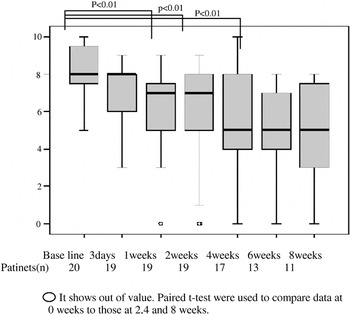
Descriptive statistics were used to analyze each item. Shifts in worst pain intensity scores were expressed using box and whisker plots, and paired t tests were used to compare data at 0 weeks to those at 2, 4, and 8 weeks after start of administration. Furthermore, the ratio of patients in whom pain relief was achieved was calculated at each time point.
Paired t tests were used to compare ADL and self-efficacy between 0 and 2 weeks after start of administration, and Wilcoxon rank sum tests were used to analyze degree of satisfaction with pain relief.
Comparison of Early Pain Relief and Changes in ADL, Self-Efficacy, and Satisfaction with Pain Relief
Unpaired t tests were used to assess changes in ADL, self-efficacy, and degree of satisfaction with pain relief between 0 and 2 weeks after start of opioid administration, with respect to presence of early pain relief.
Factors Related to Early Pain Relief after Start of Opioid Administration
Nominal or continuous explanatory variables were converted into binary values, and effects on early pain relief were analyzed using Fisher's exact test and the Cochran–Armitage trend test.
Analyses were conducted using SPSS v. 11.5 for Windows and SAS System for Windows v. 8.2. All tests were two-tailed, and probability values less than 0.05 (bilateral) were considered statistically significant.
RESULTS
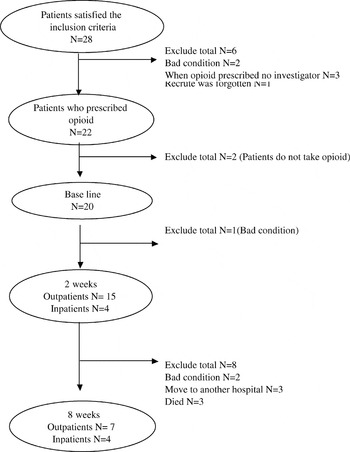
Data Collection (Fig. 1)
During the study period, 28 patients satisfied the inclusion criteria. Of these, 22 participated in the study. However, 2 patients did not take the prescribed opioid due to concerns about adverse reactions and protests from their families. As a result, 20 patients served as subjects. Data were collected from 19 patients at 2 weeks after start of administration (95%), and from 11 patients at 8 weeks (55%).

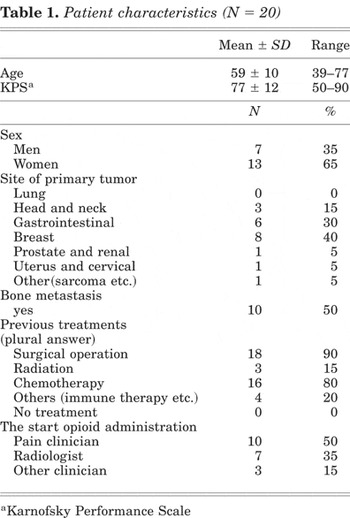
Patient Characteristics (Table 1)
Mean (±SD) subject age was 59 ± 10 years, and the subject group included 13 women (65%) and 7 men (35%). The most common cancer was breast cancer (n = 8, 40%). Bone metastasis was seen in 10 patients (50%). Prior to start of opioid administration, 18 patients (90%) had undergone surgery and 16 patients (80%) had undergone chemotherapy.
Patient characteristics (N = 20)

Pain Management
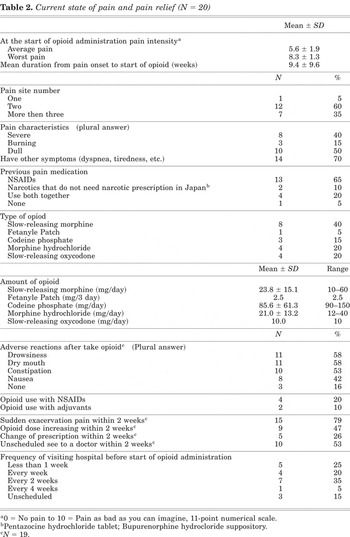
Current State of Pain and Pain Relief (Table 2)
At the start of opioid administration, worst and average pain intensity scores were 8.3 ± 1.3 and 5.6 ± 1.9 points, respectively. Number of painful areas was >2 in 19 patients (95%). Mean duration from pain onset to start of opioid administration was 9.4 ± 9.6 weeks.
Current state of pain and pain relief (N = 20)

Of the various opioids, slow-releasing morphine sulfate was most often prescribed (n = 8, 40%). Adverse reactions at 2 weeks after start of administration comprised drowsiness in 11 patients (58%), dry mouth in 11 patients (58%), constipation in 10 patients (53%), and nausea in 8 patients (42%). Although adverse reactions caused some patients to take another type of opioid or transiently stop taking the opioid, no patients discontinued administration of the prescribed opioid altogether. Furthermore, 4 patients (20%) also took anti-inflammatory analgesics, and 2 patients (10%) also took adjuvant analgesic drugs.
Pain Relief (Figs. 2 and 3)
Figure 2 shows shifts in worst pain intensity scores. Compared to the start of opioid administration, significant decreases were observed at 2, 4, and 8 weeks after start of administration (p < 0.01).

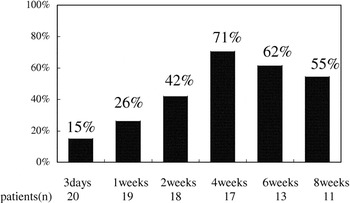
Figure 3 shows shifts in ratio of patients in whom pain relief was achieved. Pain relief was achieved in 8 patients (42%) at 2 weeks after start of administration, 12 patients (71%) at 4 weeks, and 6 patients (65%) at 8 weeks.

Shifts in ADL, Self-Efficacy, and Satisfaction for Pain Relief (Table 3)
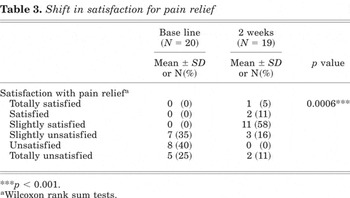
Subjects displayed significant improvement in sleep at 2 weeks after start of administration (p < 0.01), but no marked changes in other ADL functions were identified. Furthermore, no significant changes in self-efficacy were noted.
Shift in satisfaction for pain relief

Changes in ADL, Self-Efficacy, and Satisfaction for Pain Relief between Patients with and without Early Pain Relief (Table 4)
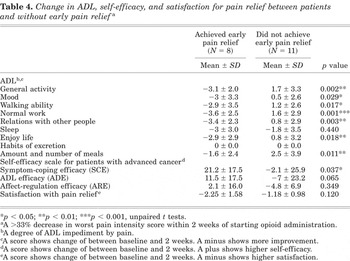
Patients who achieved early pain relief displayed significant improvements in the following ADL functions: “general activity,” “normal work,” “relations with other people,” “enjoyment of life,” “amount and number of meals” (p < 0.01 for each), “mood,” and “walking ability” (p < 0.05 each). Significant improvements in “sleep” were observed for both groups of patients, with no significant intergroup differences.
Change in ADL, self-efficacy, and satisfaction for pain relief between patients and without early pain reliefa

Patients who achieved early pain relief exhibited significant increases in “symptom-coping efficacy” (SCE) (p < 0.05) and a tendency toward increased ADE. No marked differences in ARE were found between patients with and without early pain relief. Although degree of satisfaction with pain relief tended to be higher for patients who achieved early pain relief, no significant intergroup differences were identified.
Factors Related to Early Pain Relief after Start of Opioid Administration (Table 5)
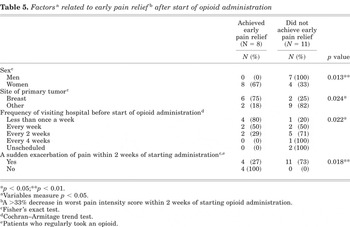
Table 5 shows four explanatory variables that exhibited significant correlations with early pain relief: being female (p = 0.013), breast cancer (p = 0.024), high frequency of visits before start of administration (p = 0.022), and absence of sudden exacerbation of pain within 2 weeks of starting administration (p = 0.018).
Factorsa related to early pain reliefb after start of opioid administration

DISCUSSION
Data Collection and Patient Characteristics
Subjects in the present study displayed advanced cancer complicated by distal metastases, and data obtained at 8 weeks after start of administration was poor (55%) due to reasons such as poor health and death. Of the 20 subjects, 65% were women and 40% had breast cancer, and most patients were seeing an anesthesiologist or radiologist. The reasons for these could have been that (1) incidence of bone metastasis is high in breast cancer (Bruera & Sweeney, 2003), (2) patients with painful bone metastasis are often referred to an anesthesiology or radiology department, and (3) opioids are often administered to inpatients in other departments.
State of Pain Management
According to the guidelines established by the National Comprehensive Cancer Network (Mickle, 2002), an NRS of 7–10 requires reassessment, including opioid dose adjustment after 24 h. Worst pain intensity score at the start of opioid administration for patients in the present study was equivalent to this level, confirming that pain relief was urgent.
Subjects displayed significant decreases in worst pain intensity score at 2 weeks after start of administration, but severity of ADL impairment at start of administration was greater in the present study than in a past study of patients on opioid therapy (Mickle, 2002). The WHO proposes that the initial goal of pain relief is to allow cancer patients to sleep (Zech et al., 1995). Furthermore, no significant increases in self-efficacy were achieved, clarifying that pain relief was insufficient at 2 weeks after start of administration.
Degree of satisfaction with pain relief was significantly improved 2 weeks after start of administration, suggesting that because pain severity was marked at the start of administration, even slight improvements were satisfactory, or that many patients thought that pain became tolerable (Ward & Gordon, 1996). In any case, about 30% of patients were dissatisfied, and pain relief needs to be achieved in a greater proportion of patients.
Significance of Early Pain Relief
Patients who achieved early pain relief displayed significant improvements in ADL functions such as normal work, relations with other people, mood, and walking ability (p < 0.05), supporting the results of a past study on patients with cancer pain accompanied by metastasis (Cleeland et al., 1994). Furthermore, significant improvements were achieved in overall ADL, enjoyment of life, and meals (p < 0.01), confirming that early pain relief markedly improves ADL. Patients who achieved early pain relief also displayed significantly increased SCE (p < 0.05) and a tendency toward increased ADE. Because early pain relief improved ADL and SCE, a decrease of >33% in worst pain intensity scores was found to serve as an indicator for pain relief.
Factors Related to Early Pain Relief after Start of Opioid Administration
In the present study, most female patients had breast cancer and were seeing a radiologist. However, few of these patients received radiotherapy, and no correlation was found between early pain relief and radiotherapy. Due to the above-mentioned subject biases in the present study, drawing conclusions about the relationship between gender and early pain relief is difficult. Regarding frequency of hospital visits prior to start of opioid administration, patients who made more visits facilitated communication with medical specialists and gathering of information, and if pain occurred or exacerbated, administration of treatment, including opioid therapy, was easier. In addition, early pain relief correlated with absence of sudden pain exacerbation within 2 weeks of starting administration.
Limitations and Future Issues
Subjects of the present study were outpatients treated at a university hospital in an urban/metropolitan area, and only 20 patients were enrolled. Most of these patients, in whom opioid therapy was initiated in an outpatient setting, were seeing an anesthesiologist or radiologist, and many had breast cancer. Furthermore, due to poor health and deaths, the number of subjects at 8 weeks after start of administration had declined by more than 50%, complicating statistical analyses. In the future, larger subject populations need to be studied, and patients who do not take prescribed opioids or discontinue taking prescribed opioids after the start of administration need to be followed.
The present study did identify several techniques to achieve early pain relief, and these techniques should be investigated to verify their effectiveness.
ACKNOWLEDGMENTS
We thank the patients who agreed to participate in the present study and the following individuals for their valuable advice: Professors Junzo Takeda at the Department of Anesthesiology, Keio University Hospital and the staff of the nursing and outpatient departments.
References
REFERENCES
Anderson, K.O. &
Cleeland, C.S.
(2003).
The assessment of cancer pain. In
Cancer Pain Assessment and Management,
Bruera, E.D. &
Portenoy, R.K. (eds.), pp.
51–66.
New York:
Cambridge University Press.
Bennet, P. &
Marie, B.S.
(2002).
The epidemiology of pain. In
Core Curriculum for Pain Management Nursing,
Marie, B.S. (ed.) pp.
45–53.
Philadelphia:
W.B. Saunders Company.
Bruera, E.D. &
Sweeney, C.
(2003).
Bone pain. In
Cancer Pain Assessment and Management,
Bruera, E.D. &
Portenoy, R.K. (eds.), pp.
413–428.
New York:
Cambridge University Press.
Cleeland, C.S.,
Gonin, R.,
Hatfield, A.K.,
et al.
(1994).
Pain and its treatment in outpatients with metastatic cancer.
New England Journal of Medicine,
330,
592–596.Google Scholar
Farrar, J.,
Portenoy, R.,
Berlin, J.,
et al.
(2000).
Defining the clinically important difference in pain outcome
measures.
Pain,
88,
287–294.Google Scholar
Farrar, J.,
Young, J.P., Jr.,
LaMoreaux, L.,
et al.
(2001).
Clinical importance of changes in chronic pain intensity measured on
an 11-point numerical pain rating scale.
Pain,
94,
149–158.Google Scholar
Ferrell, B.R.
(1995).
The impact of pain on quality of life. A decade of research.
Nursing Clinics of North America,
30,
609–624.Google Scholar
Hirai, K.,
Suzuki, Y.,
Tshunetou, A.,
et al.
(2001).
Self-efficacy scale for terminal cancer.
Journal of Psychosomatic Medicine,
41,
19–27.
(English abstract only).Google Scholar
Hirai, K.,
Suzuki, Y.,
Tsunetou, A.,
et al.
(2002).
A longitudinal study of a relationship between self-efficacy and
psychological adjustment in terminal cancer.
Journal of Psychosomatic Medicine,
42,
111–118.
(English abstract only).Google Scholar
Kondo, Y. &
Shibuya, M.
(2002).
Concerns about morphine and medication behavior in cancer
outpatients with pain.
Japanese Society of Cancer Nursing,
16,
5–16.
(English abstract only).Google Scholar
Miaskowski, C. &
Dibble, S.L.
(1995).
The problem of pain in outpatients with breast cancer.
Oncology Nursing Forum,
22,
791–797.Google Scholar
Mickle, J.
(2002).
Cancer pain management. In
Core Curriculum for Pain Management Nursing,
Marie, B.S. (ed.), pp.
349–366.
Philadelphia:
W.B. Saunders Company.
Oliver, J.W.,
Kravitz, R.L.,
Kaplan, S.H.,
et al.
(2001).
Individualized patient education and coaching to improve pain
control among cancer outpatients.
Journal of Clinical Oncology,
19,
2206–2212.Google Scholar
Rhodes, D.J.,
Koshy, R.C.,
Waterfield, W.C.,
et al.
(2001).
Feasibility of quantitative pain assessment in outpatient oncology
practice.
Journal of Clinical Oncology,
19,
501–508.Google Scholar
Tanaka, K.,
Akechi, T.,
Okuyama, T.,
et al.
(2002).
Impact of dyspnea, pain, and fatigue on daily life activities in
ambulatory patients with advanced lung cancer.
Journal of Pain and Symptom Management,
23,
417–423.Google Scholar
Uki, J.,
Mendoza, T.,
Cleeland, C.S.,
et al.
(1998).
A brief cancer pain assessment tool in Japanese: The utility of the
Japanese Brief Pain Inventory-BPI-J.
Journal of Pain and Symptom Management,
16,
364–373.Google Scholar
Ward, S.E. &
Gordon, D.B.
(1996).
Patient satisfaction and pain severity as outcomes in pain
management: A longitudinal view of one setting's experience.
Journal of Pain and Symptom Management,
11,
242–251.Google Scholar
Zech, D.F.,
Grond, S.,
Lynch, J.,
et al.
(1995).
Validation of World Health Organization Guidelines for cancer pain
relief: A 10-year prospective study.
Pain,
63,
65–76.Google Scholar
Patient characteristics (N = 20)
Current state of pain and pain relief (N = 20)
Shift in satisfaction for pain relief
Change in ADL, self-efficacy, and satisfaction for pain relief between patients and without early pain reliefa
Factorsa related to early pain reliefb after start of opioid administration
 You have
Access
- 6
- Cited by