Word-knowledge development is linguistically demanding as it incorporates multiple abilities, including the ability to establish links among the sound of a word, its meaning and graphic form, the ability to embed words into sentential and discourse structures, and the ability to apply words to the real world. Although adult Chinese as a heritage language (CHL) learners may have acquired initial oral vocabulary knowledge through home language input (Xiao, Reference Xiao2006), they still encounter the challenge to enhance their print vocabulary knowledge and reading ability. Because Chinese is a phonologically opaque writing system, it is unclear whether previously acquired oral vocabulary knowledge through extended exposure to spoken Chinese could support word-learning ability among Chinese heritage language learners. This study, therefore, aimed to uncover whether early exposure to spoken Chinese gives CHL learners advantages in the development of word-level subskills compared with non-CHL learners, and to what extent and how earlier exposure to spoken Chinese affects word-knowledge development in Chinese in collegiate CHL learners.
CONCEPTUAL FRAMEWORK
Word-Knowledge Development in Chinese as a Heritage Language
Valdés (Reference Valdés, Kagan and Rifkin2000) refers to heritage language (HL) learners in the United States as individuals raised in homes where a language other than English is spoken and who are to some degree bilingual in English and the HL. For HL children, bilingual vocabulary gap results from the time they are immersed in each language environment (Thordardottir, Reference Thordardottir2011). It has been demonstrated that the amount of language input strongly influences the growth of language knowledge among both monolingual and bilingual children (e.g., Hoff, Reference Hoff2003; Pearson, Reference Pearson2007) and oral language exposure is closely related to oral vocabulary knowledge (e.g., De Houwer, Reference De Houwer, Fletcher and MacWhinney1995; Vermeer, Reference Vermeer2001). Home language input is particularly important for HL learners to develop preliteracy requisites, for example, oral vocabulary knowledge and phonological awareness. Oral vocabulary provides the foundation for phonological sensitivity, which is the key language ability to support reading development (Snow, Burns, & Griffin, Reference Snow, Burns and Griffin1998). A question may be raised about to what extent oral vocabulary that develops through home language input could support further Chinese print skills including print vocabulary knowledge, meaning inference, and reading comprehension. Ke (Reference Ke1998) investigated the effect of home language background on the success in learning Chinese characters and compared character learning between 85 CHL learners and 60 non-CHL learners. The results revealed that home language background was a not significant variable affecting character recognition and production. The study indicated that Chinese home language background had no significant effect on learning Chinese characters. Additionally, Xiao (Reference Xiao2006) examined multiple language skills including oral language skills (listening and speaking), grammar, reading comprehension, print vocabulary knowledge, and vocabulary production between CHL learners and non-CHL learners. The findings showed that home language exposure explained CHL learners’ advantages in oral language proficiency and grammar. CHL learners, however, did not outperform their non-CHL counterparts on print literacy skills including reading comprehension, print vocabulary, and vocabulary production. It is suggested that CHL learners’ oral exposure to home language does not entail the development of print literacy skills on the condition that learners do not have sufficient print experience.
Therefore, it is plausible that home language exposure helps CHL learners to develop oral language proficiency, oral vocabulary knowledge, and associated metalinguistic awareness (including phonological awareness and morphological awareness); however, limited print experience does not necessarily lead to their success in print literacy skills including print vocabulary knowledge and reading ability.
Morphological Awareness and Lexical Inference in Word-Knowledge Development
Word-knowledge development necessitates a series of word-learning abilities including intentional word learning, incidental word learning, and information retrieval (Koda, Reference Koda2005). It is noteworthy that intraword awareness, especially morphological awareness, plays a facilitative role in word learning because the awareness of morphological structures provides insight into the analysis of a word’s internal properties so that a link can be established between newly encoded word information and preexisting word knowledge (Koda, Reference Koda2005). Morphological awareness was conceptualized as “the awareness of morphemic structures of words and the ability to reflect on and manipulate that structure” (Carlisle, Reference Carlisle and Feldman1995, p. 194) and it could contribute to the construction of semantic blocks and word meanings by extracting and incorporating core semantic cues. Morphological sensitivity and segmental information manipulation are fundamental to word-knowledge expansion and incorporation because it connects new and stored information and reduces the possibilities generated by context-based reasoning (Koda, Reference Koda2005).
Incidental word learning, accrued as a by-product of reading and language exposure, facilitates word-knowledge incorporation and expansion because it involves context-based word learning (Horst, Reference Horst2005; Hulstijn, Reference Hulstijin and Robinson2001; Schmitt, Reference Schmitt2010). Local (word-level) meanings and global (text-level) understandings are reciprocal due to the fact that text-word information conveys more than dictionary meaning and form, and context-appropriate meanings are constructed in specific textual information (Adam, Reference Adams1994). Through the module of incidental learning, learners could fill the semantic gap through inferencing and comprehending specific textual information. Contextual lexical inferencing ability is crucial in incidental vocabulary learning given that lexical inference improves contextualized word learning by activating intraword information, contextual clues, and background knowledge (Koda, Reference Koda2005; Sternberg, Reference Sternberg, McKeown and Curtis1987; Wesche & Paribakht, Reference Wesche and Paribakht2010). Lexical inferencing ability was defined as “making informed guesses as to the meaning of a word, in light of all available linguistic cues in combination with the learner’s general knowledge of the world, her awareness of context and her relevant linguistic knowledge” (Haastrup, Reference Haastrup1991, p. 40). Lexical inference could help learners achieve the expansion of context-based knowledge and develop in-depth understandings of lexical items.
On the one hand, lexical inference helps learners develop contextualized word knowledge. On the other hand, preexisting vocabulary knowledge could facilitate lexical inferencing ability. Huckin and Bloch (Reference Huckin, Bloch, Huckin, Haynes and Coady1993) state that a lexical inferencing model includes a knowledge module component and a metalinguistic strategic component. The knowledge module component contains vocabulary knowledge, morphology, syntax module, and so forth, and the metalinguistic strategic component includes cognitive abilities learners use to identify and construct word meaning. Nassaji (Reference Nassaji2004) found that L2 learners with stronger depth of vocabulary knowledge used more strategies in lexical inferencing than the learners with weaker depth of vocabulary knowledge did. Also, the students with greater depth of vocabulary knowledge made more effective and successful lexical inferencing attempts than the students with lesser depth of vocabulary knowledge did. Overall, it showed that depth of vocabulary knowledge made a significant contribution to lexical inferencing ability. Recently, Prior, Goldina, Shany, Geva, and Katzir (Reference Prior, Goldina, Shany, Geva and Katzir2014) conducted a study to explore the predictive roles of L2 vocabulary knowledge and word reading skills in L2 lexical inferencing among 53 immigrant high school students in Israel. The results showed that L2 Hebrew vocabulary knowledge predicted L2 reading comprehension, which in turn was strongly related to lexical inferencing ability in L2 Hebrew. This study affirmed the significant roles of decoding skills and vocabulary knowledge in lexical inferencing ability. Based on the current literature, preexisting vocabulary knowledge has also been found to play a critical role in facilitating successful lexical inference (Nassaji, Reference Nassaji2004; Prior et al., Reference Prior, Goldina, Shany, Geva and Katzir2014; Wesche & Paribakht, Reference Wesche and Paribakht2010).
The Role of Morphological Awareness in Lexical Inferencing Ability
Skilled readers would be able to derive meanings of new words and learn the new words by using their knowledge of prefixes, roots, and other partial word information (Anglin, Reference Anglin1993; Nagy, Reference Nagy1998; Nagy & Anderson, Reference Nagy and Anderson1984). Anglin (Reference Anglin1993) studied English-speaking children’s vocabulary development from the perspective of morphological analysis and found that accumulation of root words and derived words could enhance children’s ability to derive meanings of new words by segmenting and extracting sublexical morphemic cues in the words. Similarly, Carlisle (Reference Carlisle2000) investigated the relationship between morphological awareness and reading ability among elementary-age students. The results indicated that children’s awareness of morphological structures and meanings of derived words was significantly related to their ability to infer morphologically complex words. Numerous recent studies have also found that skill in morphological analysis leads to successful and accurate lexical inference among L1 students (Brusnighan & Folk, Reference Brusnighan and Folk2012; McCutchen & Logan, Reference McCutchen and Logan2011, Zhang, Reference Zhang2015). Brusnighan and Folk (Reference Brusnighan and Folk2012) explored English-speaking college students’ ability to infer meanings of novel compound words. By monitoring readers’ eye movements, they found that skilled readers could automatically decompose novel compound words to infer the meaning of unknown words. In addition, Zhang (Reference Zhang2015) probed the role of morphological awareness in reading vocabulary knowledge among elementary-age students and the findings revealed that morphological awareness had a significant effect on lexical inferencing ability.
With regard to L2 lexical inferencing ability, Zhang and Koda (Reference Zhang and Koda2012) tested the direct and indirect contributions of morphological awareness to vocabulary and reading through the mediation of lexical inferencing ability among English as a Foreign Language learners and found that morphological awareness predicted lexical inferencing ability, which in turn, contributed to vocabulary and reading. Hamada (Reference Hamada2014) recently examined the role of morphological and contextual cues in L2 lexical inference by comparing college-level English as a Second Language learners from four different proficiency levels. It was found that beginning-level students mainly relied upon morphological cues in meaning inference due to their reading proficiency. This study suggests that morphological analysis is critical for beginning L2 learners to infer the meaning of unfamiliar words. Moreover, it is vital for learners to be familiar with a wide range of morphologically complex words inclusive of semantically transparent and semantically opaque ones.
To summarize, intraword awareness, morphological awareness in particular, highlights the analysis of words’ internal structures to identify the possible link between graphemes and morphemes (Anglin, Reference Anglin1993; Carlisle, Reference Carlisle2000). This capability could help to establish associative links, for example, happy, happily, and happiness, to achieve the expansion of the grapheme-morpheme connections of specific words. Meanwhile, intraword awareness could be conducive to the inference of unknown words in reading because word-internal structures may provide clues for successful inference, for example, affixes -un and -like in the word unladylike. It is worth mentioning that incidental word learning could consolidate the understanding of dictionary-based core semantic information and contextual information, which ultimately contributes to the development of content-specific knowledge.
Morphological Awareness and Its Role in CHL Reading
Morphological awareness has been highlighted as a core component skill in HL and bilingual reading development (Koda, Lü, & Zhang, Reference Koda, Lü, Zhang, He and Xiao2008a; Koda, Zhang, & Yang, Reference Koda, Zhang, Yang, He and Xiao2008b; Pasquarella, Chen, Lam, & Yang, Reference Pasquarella, Chen, Lam, Luo and Ramirez2011; Saiegh-Haddad & Geva, Reference Saiegh-Haddad and Geva2008; Wang, Cheng, & Chen, Reference Wang, Cheng and Chen2006; Wang, Ko, & Choi, Reference Wang, Ko and Choi2009). The underlying mechanism including structural and functional understandings of morphemic cues make morphological awareness a universal and sharable metalinguistic ability across languages (e.g., Deacon, Wade-Woolley, & Kirby, Reference Deacon, Wade-Woolley and Kirby2007; Pasquarella et al., Reference Pasquarella, Chen, Lam, Luo and Ramirez2011; Ramirez, Chen, Geva, & Kiefer, Reference Ramirez, Chen, Geva and Kiefer2010). Therefore, in HL and bilingual reading development, learners who grow up speaking two languages would be able to capitalize on bilingual resources to compensate for underdeveloped reading skills in another language.
Koda et al. (Reference Koda, Lü, Zhang, He and Xiao2008a) explored the development of morphological awareness among young Chinese heritage learners by probing the effect of print language input in weekend heritage schools on the formation of morphological awareness. They focused on young learners’ ability to understand and segment radical information in multiple-unit characters. Their findings demonstrated that CHL learners did not have sufficient exposure to Chinese print language given that they had limited resources and time allocated to their learning. Despite quantitative restrictions, the print input did provide solid foundations for CHL learners to develop the understanding of segmental properties of Chinese characters. Concerning the contribution of morphological awareness to reading and literacy development, Pasquarella et al. (Reference Pasquarella, Chen, Lam, Luo and Ramirez2011) investigated bilingual morphological awareness and the transferability of morphological awareness in elementary-age CHL students who were exposed to Chinese language at home and in CHL programs. The results indicated that the CHL students already developed initial morphological awareness in both Chinese and English because they had various degrees of exposure to the two languages. Most importantly, the study indicated that cross-linguistic morphological awareness in CHL learners could facilitate the development of vocabulary and reading comprehension in both languages. Similarly, Wang and her colleagues (Reference Wang, Cheng and Chen2006, Reference Wang, Ko and Choi2009) examined the role of morphological awareness in biliteracy acquisition among CHL students and found that morphological awareness was a significant core subskill contributing to the development of reading ability (word reading and reading comprehension) among Chinese heritage students.
In all, the current literature has shown that morphological awareness is a key factor associating language capacities and reading skills in young HL students. However, we are not clear whether early heritage backgrounds would give collegiate students advantages in reading development and how emerging morphological awareness can be exploited in reading acquisition among collegiate CHL learners.
Oral Vocabulary and the Formation of Morphological Awareness
Morphological awareness initially can be shaped through oral language input. Berko (Reference Berko1958) argues that morphological awareness starts to develop once children have exposure to spoken communication. For example, English-speaking children develop the understanding of plural allomorphs, past tenses, possessives, and other forms before formal schooling. Children expand their morphological sensitivity to grapho-morphological awareness through extended exposure to literacy at school. Kuo and Anderson (Reference Kuo and Anderson2006) argue that there are multilayered and interconnected relationships between morphological awareness and orthography or phonology. Learners, therefore, could develop morphological awareness through input from both phonological and graphic representations.
McBride-Chang and her colleagues (Reference McBride-Chang, Wagner, Muse, Chow and Shu2005, Reference McBride-Chang, Tardif, Cho, Shu, Fletcher, Stokes, Wong and Leung2008) investigated the relationship between morphological awareness and oral vocabulary knowledge. McBride-Chang, Wagner, Muse, Chow, and Shu (Reference McBride-Chang, Wagner, Muse, Chow and Shu2005) explored the relationship between morphological awareness and vocabulary acquisition in 220 L1 English children. They administered multiple assessments of reading subskills (phonological awareness, word identification, word repetition, morphological awareness, and oral vocabulary knowledge) to the participating children. The results indicated that two measures of morphological awareness, morpheme identification and morphological structure awareness, were significantly related to children’s oral vocabulary knowledge. In addition, McBride-Chang et al. (Reference McBride-Chang, Tardif, Cho, Shu, Fletcher, Stokes, Wong and Leung2008) investigated the connection between morphological awareness and oral vocabulary knowledge in Mandarin, Cantonese, and Korean. They measured compound structure awareness among 660 preschooled L1 students at two time points within a one-year period. The findings showed that morphological awareness at time 1 significantly contributed to oral vocabulary at time 1. Interestingly, oral vocabulary at time 1, in turn, significantly predicted morphological awareness at time 2. The study suggests that there seems to be interconnected relationship between oral vocabulary knowledge and morphological awareness among the three groups of learners.
With regard to the L2 or bilingual population, Kieffer & Lesaux (Reference Kieffer and Lesaux2012) examined the development of morphological awareness and vocabulary knowledge in young English language learners (ELLs) through a latent growth model. They emphasized the concurrent and longitudinal relationships between morphological awareness and oral vocabulary knowledge among Spanish-speaking ELLs. The study demonstrated that ELLs developed both oral vocabulary knowledge and morphological awareness across time. More critically, the findings showed that there was a significant and positive relationship between the rates of growth in the two skills. Additionally, Pasquarella et al. (Reference Pasquarella, Chen, Lam, Luo and Ramirez2011) found that there was a cross-linguistic bidirectional relationship between morphological awareness and oral vocabulary knowledge. They examined the cross-language transfer of morphological awareness in English-Chinese bilingual children and the results showed that there was a reciprocal relationship between English compound awareness and Chinese oral vocabulary knowledge.
To date, there have been few empirical studies focusing on the connection between morphological awareness and oral vocabulary knowledge in L2 learners, especially L2 Chinese learners. Heritage learners have different degrees of oral language exposure and they may have acquired some oral vocabulary knowledge through spoken communication like L1 speakers. Meanwhile, they are developing their print vocabulary knowledge through print input and literacy instruction. Previous CHL studies have emphasized language and literacy experiences in the formation of morphological awareness among young learners. It is vital to investigate how oral vocabulary knowledge is associated with morphological awareness among collegiate CHL learners. Insomuch as there is a research gap in CHL word-knowledge development, the objectives of this study are (a) to examine whether there are differences in word-level subskills, including oral vocabulary knowledge, print vocabulary knowledge, morphological awareness, and lexical inferencing ability between CHL learners and non-CHL learners and (b) to explore whether enhanced linguistic or metalinguistic resources (oral vocabulary, print vocabulary, and morphological awareness) contribute to lexical inferencing ability in CHL learners.
THE CURRENT STUDY
Based on the conceptual framework and research objectives presented in the preceding text, two research questions were posed.
RQ1: Are there any differences in word-level subskills (oral vocabulary knowledge, print vocabulary knowledge, morphological awareness, and lexical inferencing ability) between CHL learners and non-CHL learners? If so, in which word-level subskills do they differ?
RQ2: Are there any differences between the two participant groups in the extent and manner that oral vocabulary knowledge, print vocabulary knowledge, morphological awareness, and lexical inferencing ability are related?
METHOD
Participants
Participants were 62 college-level intermediate Chinese learners including 37 CHL learners and 25 non-CHL learners (mean age = 20.4 years). The participants enrolled in college-level foreign language classes in two different American universities (one on the East Coast and one on the West Coast), and they all completed two-year classroom learning in their universities. The university on the West Coast used the textbook Integrated Chinese and the university on the East Coast used Chinese Link as their textbook. The learning objectives and thematic foci are similar in the two textbook series. Both textbooks aim to help students develop a broad range of oral and written communication skills and building awareness of Chinese culture. By the end of the fourth semester (intermediate level), the students are expected to build their foundational language knowledge inclusive of Chinese character/word knowledge, grammar knowledge (e.g., aspects, complements, and passive structures), and oral communication skills in topic-familiar situations.
The participating students completed a brief background questionnaire about their prior language experiences. The participants were asked about whether they identify themselves as Chinese and whether they speak or use Chinese (including regional varieties) at home. In addition, questions also emphasized the intensity of early language use at home with their family members. For example, the students were asked “what language(s) did you use before 1st grade and after 1st grade when talking to your parents?” and the responses were normed based on a 1-to-5 Likert scale (English only, mostly Chinese, half Chinese/half English, mostly Chinese, and Chinese only). All the participating CHL students indicated that they used Chinese dominantly when communicating with their parents at home. The critical contrast between the two participant groups lies in the presence/absence of extended exposure to spoken Chinese at home prior to formal collegiate instruction in Chinese.
Measures and Instruments
Oral Vocabulary Knowledge.
All vocabulary test items (including oral vocabulary knowledge and print vocabulary knowledge) were selected from HSKFootnote 1 level 1 to level 6. According to the classification of word recognition ability (Koda, Reference Koda, Li, Graffiney and Packard2002), the measurement of oral vocabulary knowledge aimed to identify meanings from orally presented words. In this task, the test administrator read aloud a word in Chinese and the participants were asked to circle the most appropriate English meaning of the word in print. There were 30 items in the oral vocabulary task. The reliability of this measure was α = .882.
Print Vocabulary Knowledge.
Similarly, based on the classification of word meaning recognition (Koda, Reference Koda, Li, Graffiney and Packard2002), the measurement of print vocabulary knowledge aimed to assess learners’ ability to identify meanings from visually presented words. Five word items were randomly selected from each level in HSK. Both word-meaning knowledge and character knowledge were measured in this task. Therefore, 15 items asked the participants to choose meanings in English for given characters (word-meaning) and 15 items asked the participants to choose Chinese characters for given English meanings (character knowledge). The reliability of this measure was α = .818
Morphological Awareness.
Morphological awareness measures aimed to capture learners’ ability to manipulate Chinese-specific morphological structures. Because the measures are printed tasks, several attempts were made to reduce the confounding effect from print vocabulary. First, characters and morphemes used in the morphological awareness measures were selected from those that had been explicitly taught to intermediate-level learners, and therefore, they were assumed to be within their print and oral vocabulary knowledge (HSK level 1 and level 2 words). Second, the participants were asked to make judgments about the semantic relationship between words and their subcomponent morphemes rather than extracting meanings from the whole words. Finally, only semantically and structurally transparent words were selected so that morphological segmentation and discrimination would contribute to the inference of morphologically complex words. To finalize task items, 46 L1 Chinese college students were asked to rate the semantic transparency and the structural transparency (based on a 1-to-5 scale) of 97 target disyllabic compound words from HSK level 1 and level 2. Lexical items with relatively high semantic transparency (>3.00) and high structural transparency (>3.00) were included in the morphological awareness tasks.
There were two tasks in this measurement: morpheme recognition and morpheme discrimination. The morpheme recognition task was used to measure learners’ ability to segment disyllabic words and make semantic associations between a disyllabic word and its subcomponent morpheme. The task tapped into learners’ segmentation ability of morphological structures and asked them to judge whether the segmental morpheme is useful for understanding the whole compound. For example, the participants were shown one disyllabic and compound-like word 高兴 (“tall” + “prosper” → “happy”) and one of its segmental morphemes “高,” and asked to indicate whether the meaning of “高” is related to the meaning of “高兴.” In this case, the segmental meaning of “高 tall” is hardly related to the meaning of the compound word “高兴 happy.”Footnote 2 There were 20 items in the morpheme recognition task. The reliability of this task was α = .716.
For the morpheme discrimination task, three disyllabic words were presented, for example, 拿手 “good at,” 左手 “left hand,” 举手 and “raise hand,” three of which share one morpheme 手 “hand.” One word—in this case, 拿手 “good at”— does not imply the meaning of the common morpheme—in this case, “hand.” The participants were instructed to circle the word whose morpheme conveys a different meaning. There were 20 items in this measure. The reliability was α = .791. The scoring of the two tasks was based on a dichotomous rating (correct vs. incorrect) and each correct response was worth one point.
Lexical Inferencing Ability.
This task required the participants to infer meanings of unknown disyllabic words. Each disyllabic word was composed of two elementary-level characters taken from HSK level 1 and level 2. However, as compound words, they are presumably unknown to learners of Chinese as they are beyond the highest level (level 6) of the HSK test. A pilot test was administered to 14 intermediate L2 Chinese learners before the current study, and they were asked to indicate whether they had known any of the 20 initially selected disyllabic compound words and whether they had understood the meanings of component characters within each disyllabic word. According to their responses on a checklist, they did not have problems identifying the meanings of basic-level characters. Four words were apparently known to them without inferencing through morphological or contextual cues, so 16 disyllabic words were finalized for this study. In the task, each disyllabic compound word was presented in a short sentence. The participants were expected to use both word-internal (morphological information) and word-external clues (contextual information) to infer the meaning of the word. For instance, 我很喜欢吃日料 “I like eating ____ very much” was presented to the participants along with four multiple-choice options, for example, (a) Japanese food (morphology+, context+; correct)Footnote 3; (b) Chinese cuisine (morphology-, context+); (c) Daily material (morphology+, context-); (d) Korean tissues (morphology-, context-). In this example, the subcomponent morphemes 日 and 料 have multiple morphemic meanings. 日 can refer to Japan or day and 料 can refer to cuisine or material. By incorporating both morphological cues (possible morphemic meanings) and contextual information (something that people like eating), learners were supposed to choose “Japanese food” as the correct response. The reliability of this measure was α = .856.
RESULTS
To answer the research questions, a series of multivariate analyses including MANOVA (multivariate analysis of variance) test, multigroup correlational analysis, and hierarchical multiple regression analysis were conducted. Results are presented as in the sections that follow.
Differences in Word-Level Subskills
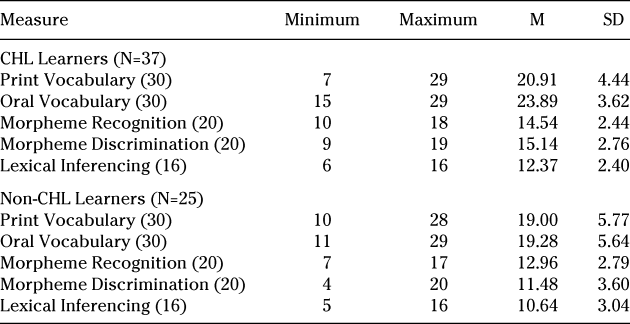
Descriptive statistics of word-level subskills in CHL learners and non-CHL learnersFootnote 4 are provided in Table 1. A relatively wide spread was found in print vocabulary and oral vocabulary among non-CHL learners. Overall, there was adequate variability across six different tasks in both CHL learners and non-CHL learners.
Descriptive statistics of word-level subskills in CHL learners and non-CHL learners

NB: Numbers in the parentheses represent the maximum score of each task.
To answer the first research question, a MANOVA test was conducted to determine the performance of the subskills between CHL learners and non-CHL learners. Before running the test, statistical assumptions were checked to evaluate the robustness of the MANOVA test. Kolmogorov-Smirnov Test of Normality showed that normality was well met in non-CHL learners, but normal distribution was somehow violated in CHL learners. Given that MANOVA results would be robust under some violations of normality, no data transformation was performed (Osborne, Reference Osborne2013). Levene’s Test of Equality of Error Variances identified a mild violation of equal variance in oral vocabulary measures (p = .043). Overall, the Levene’s Test showed that the observed error variances of the dependent variables were equal across groups. Box’s Test of Equality of Covariance Matrices indicated the observed covariance matrices of the dependent variables were equal across groups (p = .813). Assuming equal covariance and variance, a robust statistic, Wilks’ Lambda, was used in data interpretation. A slight violation of collinearity of oral vocabulary and print vocabulary was found in non-CHL learners. In general, linearity of variables was well met based on a plot of residuals versus predicted values. Additionally, multicollinearity of variables was checked by variance inflation factors (VIFs). All VIFs were low ranging from 1.67 to 2.75, which indicated that multicollinearity was also well met.
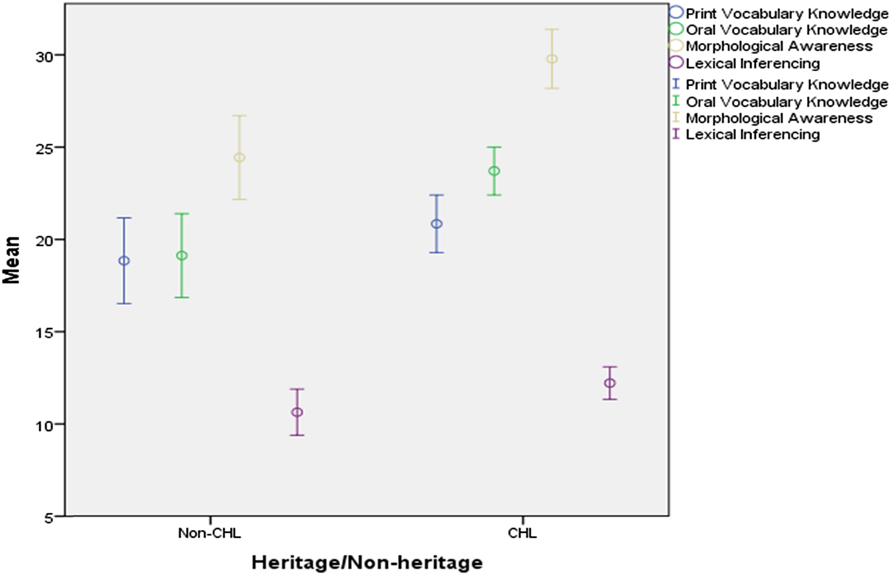
The multivariate analysis showed that there was a statistically significant difference in the word-level subskills between the two groups of learners: F (1, 60) = 8.25, p < .0005; Wilks’ Λ = .63, partial η2 = .367 (refer to a simple error bar chart in Figure 1). Detailed analyses indicated that CHL learners outperformed non-CHL learners on oral vocabulary knowledge: F (1, 60) = 15.827, p < .0005; Wilks’ Λ = 0.63, partial η2 = .197, morphological awarenessFootnote 5: F (1, 60) =16.487, p < .0005, Wilks’ Λ = 0.63, partial η2 = .216 and lexical inferencing ability: F (1, 60) = 5.204, p = .034, Wilks’ Λ = 0.63, partial η2 = .073. Nonetheless, there was no significant difference in print vocabulary knowledge between the two groups: F (1, 60) = 2.928, p = .134; Wilks’ Λ = 0.63, partial η2 = .037.
Error bar chart of word-level subskills.

Contributions of Morphological Awareness and Vocabulary Knowledge to Lexical Inference
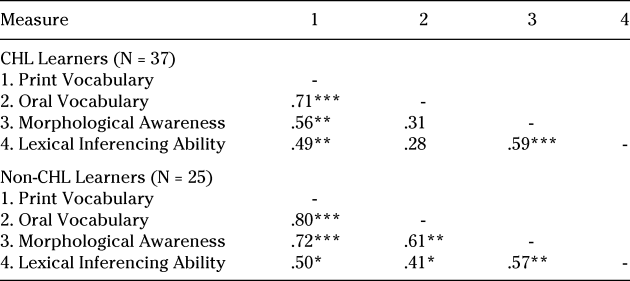
Correlation and regression analyses were used to address the second research question. Table 2 shows the bivariate correlations among the word-level subskills in the two groups of learners. In the group of CHL learners, print vocabulary was significantly correlated with all other subskills whereas oral vocabulary was not significantly correlated with morphological awareness and lexical inferencing ability (r = .31, p > .05; r = .28, p > .05). In the group of non-CHL learners, all the measures were significantly intercorrelated. In addition to moderate to high correlations among print vocabulary knowledge, morphological awareness, and lexical inferencing ability (r .72, p < .001; r = .50, p < .05), significant correlational coefficients were found among oral vocabulary knowledge, morphological awareness, and lexical inferencing ability (r = .61, p < .01; r = .41, p < .05).
Bivariate correlations of word-level subskills in CHL learners and non-CHL learners

* p < .05; ** p < .01; *** p < .001.
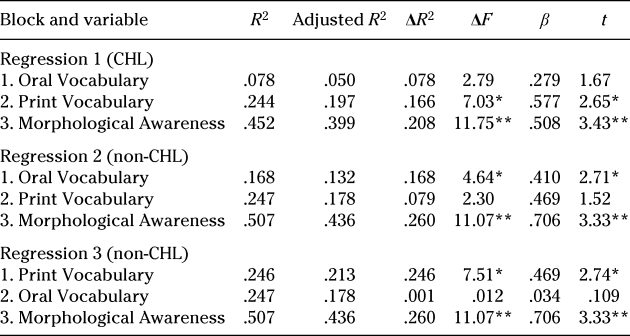
Hierarchical multiple regressions were used to explore the relative contributions of oral and print vocabulary knowledge to lexical inferencing ability among CHL and non-CHL learners by incorporating the effect of morphological awareness. Three comparative multiple regressions (Table 3) were run to determine the individual and collective effects of oral vocabulary knowledge, print vocabulary knowledge, and morphological awareness on lexical inferencing ability. In the CHL group, results revealed that oral vocabulary knowledge did not contribute to lexical inferencing ability and that print vocabulary knowledge was a strong predictor of lexical inferencing ability given that 16.6% additional variance in lexical inferencing ability was explained by print vocabulary knowledge when oral vocabulary knowledge was adjusted for. In the non-CHL group, results found that little or no additional variance was predicted by oral vocabulary knowledge or print vocabulary knowledge when the proportion explained by the other vocabulary knowledge was controlled for and that both oral vocabulary knowledge and print vocabulary knowledge significantly contributed to lexical inferencing ability when entered in the first block of the regression analyses. A follow-up within-group t-test analysis pinpointed that there was no significant difference between oral vocabulary and print vocabulary knowledge in the non-CHL group; t(24) = .389, p = .70 while oral vocabulary knowledge was significantly better than print vocabulary knowledge in the CHL group; t(36) = 5.54, p < .0001, which suggests that non-CHL learners develop oral vocabulary knowledge and print vocabulary knowledge concomitantly in similar manners. The results indicated that oral vocabulary knowledge and print vocabulary knowledge were not separable constructs in non-CHL learners, which collectively predicted lexical inferencing ability. Critically, in both groups, morphological awareness had a significant effect on lexical inferencing ability given that 20.8% and 26% additional variance was accounted for by morphological awareness in the two participant groups.
Hierarchical multiple regressions predicting lexical inferencing ability in CHL learners and non-CHL learners

* p < .05; ** p < .01.
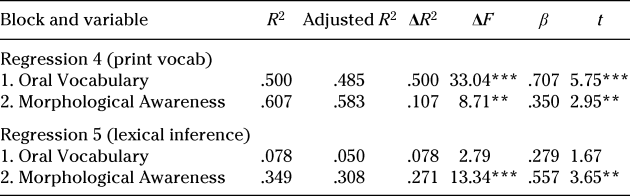
For the reason that oral vocabulary knowledge did contribute to lexical inferencing ability among the non-CHL group but the greater oral vocabulary knowledge did not seem to provide additional contribution to lexical inference among the CHL group, it was important to scrutinize whether oral vocabulary knowledge, as an indicator of early exposure to spoken Chinese, plays a different role in word-knowledge development (print vocabulary knowledge and lexical inferencing ability) among CHL learners. Two separate multiple regressions were conducted to explore the role of oral vocabulary knowledge in print vocabulary knowledge and lexical inferencing ability. The regression analysis predicting print vocabulary knowledge (Table 4) revealed that 50% of total variance in print vocabulary knowledge was explained by oral vocabulary knowledge in CHL learners. Additionally, morphological awareness yielded 10.7% additional variance of print vocabulary knowledge.
Hierarchical multiple regressions predicting print vocabulary knowledge and lexical inferencing ability in CHL learners

** p < .01; *** p < .001.
The regression analysis (Table 4) on lexical inferencing ability indicated that oral vocabulary had no effect on lexical inference among CHL learners (β = .279, p = .105). Morphological awareness, nevertheless, had a significant effect on lexical inference given that 27.1% additional variance of lexical inferencing ability was predicted by morphological awareness. In brief, oral vocabulary knowledge did not contribute to lexical inferencing ability; however, morphological awareness predicted lexical inferencing ability above and beyond oral vocabulary knowledge among CHL learners.
DISCUSSION AND CONCLUSION
Word-Knowledge Outcomes between CHL Learners and Non-CHL Learners
The first research question was posed to address the differences in word-level subskills between CHL learners and non-CHL learners. As mentioned previously, the MANOVA test demonstrated that CHL learners outperformed non-CHL learners on oral vocabulary knowledge, morphological awareness, and lexical inference. As predicted, early exposure to spoken Chinese appears to contribute to general linguistic sophistication among CHL learners. The analysis also showed that there was no statistical difference between the two groups in print vocabulary knowledge. In the present study, the participating CHL learners had extended exposure to spoken Chinese at home during their childhood but limited, if any, print exposure either at home or in school. Ke (Reference Ke1998) found that home language background in Chinese had no effect on learning Chinese characters. He explained that because CHL learners started to have intensive print literacy training in foreign language classrooms, CHL learners and non-CHL learners developed their print vocabulary knowledge at the same time in similar manners in the classroom setting. Other studies also found that there was no significant difference in character recognition/production (Ke, Reference Ke1998; Xiao Reference Xiao2006) and print vocabulary (Xiao, Reference Xiao2006) between adult CHL learners and non-CHL learners. Moreover, prior psycholinguistic studies provided empirical evidence that oral language exposure did not predict learners’ development of L2 word decoding skill (Geva & Siegel, Reference Geva and Siegel2000). The results are consistent with these findings, suggesting that the acquisition of print knowledge is less affected by childhood oral language exposure.
In sum, the present study suggests that CHL learners have stronger oral comprehension capacity, but their meaning extraction skills from printed words (indexed by print vocabulary knowledge) are not different from their non-CHL counterparts at the same instructional level.
The Effects of Vocabulary Knowledge and Morphological Awareness on Lexical Inferencing Ability in CHL and Non-CHL Learners
The second research question was posed to probe the interconnected relationships among multiple word-level subskills in the two groups. The correlational analysis (Table 2) demonstrated that there were different correlational patterns between the two groups. The results found that there were low correlations between oral vocabulary knowledge and other literacy measures in CHL learners whereas moderate to high correlations were found among all measures in non-CHL learners. These results corroborated the findings in the MANOVA test, affirming that oral vocabulary was not related to print word-knowledge development in CHL learners.
The hierarchical multiple regressions (Table 3) showed that oral vocabulary and print vocabulary contributed to lexical inference jointly in the non-CHL group; however, only print vocabulary knowledge was strongly predictive of lexical inference in the CHL group. Furthermore, the additional regression analyses on the data from the CHL group revealed that oral vocabulary knowledge contributed to print vocabulary knowledge but did not contribute to lexical inferencing ability. Additionally, morphological awareness explained a unique proportion of variance in lexical inferencing ability among CHL learners. Several implications can be drawn from these findings. First, oral vocabulary knowledge appears to play different roles in reading development between the two groups. In non-CHL learners, print vocabulary knowledge and oral vocabulary knowledge are more closely related than in CHL learners, and the measures used in this study did not sufficiently distinguish the two constructs in non-CHL leaners. The two forms of vocabulary knowledge jointly predicted lexical inference. In CHL learners, however, print vocabulary and oral vocabulary are more distinct constructs. Oral vocabulary knowledge was found to form the basis for print vocabulary knowledge, however, its contribution to lexical inference seemed to be insufficient. The second implication centers on the effect of morphological awareness on lexical inference similarly in the two groups. The current study found that morphological awareness strengthened the effects of both oral vocabulary knowledge and print vocabulary knowledge on lexical inference in the two groups of learners. Prior reading studies demonstrated that both vocabulary knowledge and morphological awareness contributed to lexical inference separately (e.g., Anglin, Reference Anglin1993; Prior et al. Reference Prior, Goldina, Shany, Geva and Katzir2014; Zhang & Koda, Reference Zhang and Koda2012). To further disentangle the complex relationships among vocabulary knowledge, morphological awareness, and lexical inferencing ability, the present study found the unique role of morphological awareness in the way vocabulary knowledge relates to lexical inference.
To summarize, oral language exposure seems to provide CHL learners a solid linguistic foundation because oral vocabulary knowledge as an indicator of oral language capacity had a significant impact on print vocabulary knowledge in the CHL group. However, as noted previously, oral vocabulary knowledge alone did not contribute to lexical inferencing ability. One of the universal requisites for reading acquisition is to make links between the spoken language and its writing systems (Perfetti, Reference Perfetti2003). Oral vocabulary knowledge cannot be accessed during reading unless the sound and meaning of spoken words are linked to their graphic forms in memory (Ehri, Reference Ehri2014; Share, Reference Share2008). The current study indicated that oral vocabulary knowledge and emerging morphological awareness enhanced the development of print vocabulary knowledge, and that print vocabulary knowledge and morphological awareness jointly supported lexical inferencing ability in CHL learners.
All in all, this exploratory study shed light on the differences of word-level subskills and tested the relationships of the subskills in CHL learners and non-CHL learners. The study found that print vocabulary knowledge contributed to lexical inferencing ability in CHL learners while print vocabulary knowledge and oral vocabulary knowledge jointly contributed to lexical inferencing ability in non-CHL learners. In addition, it suggests that oral vocabulary knowledge does not necessarily enhance lexical inferencing ability among CHL learners, nonetheless, it provides a strong linguistic foundation and serves as an additional resource that is facilitative in the formation of morphological awareness and in the development of print vocabulary knowledge and lexical inferencing ability.
IMPLICATIONS AND LIMITATIONS
The present study focused on the development of word knowledge in CHL learners and found possible different developmental sequences in CHL learners and non-CHL learners. Several implications could be provided in relation to instruction in the CHL classroom.
To begin with, there are different instructional needs between CHL learners and non-CHL learners. The study suggests that CHL learners with home language background have strong oral language ability and have the need to foster their print skills. Thus, it is vital to highlight the development of print skills in the CHL classroom. Teachers are expected to provide learners with intensive literacy training. For example, for those CHL students with a relatively wide range of oral vocabulary knowledge because of early language experiences, instructors should try to help students establish the link between their oral language repertoire and print knowledge. Instructors could first emphasize character decoding and character production of familiar spoken words in the classroom. When students have some character knowledge and decoding skills, teachers could use their emerging linguistic resources (character and vocabulary knowledge) to foster their advanced print processing skills, for example, meaning inference and reading comprehension. The retrieval of local lexical information facilitates the construction of global text information. Learners, therefore, could be instructed to use their preexisting character knowledge to infer morphologically complex words. Once they learn to derive morphologically complex words, they could use that skill to achieve text comprehension (e.g., extraction of main ideas, identification of specific textual information, and comparison of different viewpoints).
Moreover, the study highlights the significant role of morphological awareness in lexical inferencing ability. To recapitulate, morphological awareness was found to boost the effect of oral vocabulary knowledge on print vocabulary knowledge and lexical inferencing ability among CHL learners. As discussed previously, oral vocabulary by itself is insufficient for the development of lexical inferencing ability. Morphological awareness, however, appears to contribute to both print vocabulary knowledge and lexical inferencing ability. Hence, it is believed that morphological awareness instruction could support CHL learners to further develop their print literacy skills (lexical inference in particular). Instruction in morphological awareness has been found to enhance various facets of literacy skills, for example, word reading, vocabulary, and text comprehension (Carlisle, Reference Carlisle2010). For instance, 球 (ball) is the head for many basic Chinese compound words, for example, 足球 foot + ball (soccer), 篮球 basket + ball (basketball), and 网球 web + ball (tennis). If learners are instructed to segment a compound word and extract the morphological cue 球 (ball), their understanding of partial word knowledge would be strengthened. More critically, learners would be able to memorize relevant compound words with similar morphemic cues more efficiently.
In addition to the implications for learning and instruction, the results from the present study have raised some questions for future studies. First, the cross-sectionality of this study narrows our scope in generalizing the developmental trajectory of reading and vocabulary in CHL learners. As mentioned earlier, prior studies have found that there is a bidirectional and reciprocal relationship between morphological awareness and vocabulary knowledge in monolingual children (McBride-Chang et al., Reference McBride-Chang, Tardif, Cho, Shu, Fletcher, Stokes, Wong and Leung2008) and bilingual children (Pasquarella et al., Reference Pasquarella, Chen, Lam, Luo and Ramirez2011). To expand our understanding of the causal relationship, future studies could emphasize both concomitant and longitudinal relationships among morphological awareness, print vocabulary knowledge, and lexical inferencing ability in adult CHL learners so that a causal sequence of CHL print development could be identified. Second, print experience was not controlled for among the CHL group in the present study and learners may have different print input in afterschool or weekend HL programs. Future studies could incorporate learners with different oral and print experience at home and weekend HL schools to explore the effects of language exposure in different situations on later print literacy development. Finally, this study only focused on lexical inferencing ability as a predictor of word-learning ability. Future studies could capture a more integrated view of higher-level inferencing and comprehension skills, so both local and global text meaning construction could be included as predictors of comprehension skills.