India is a culturally diverse country occupying approximately 2.4 percent of the world's land area, but supporting 17.5 percent of the global population (Reference Freeze13). With a population of 1.17 billion people, it is the world's second most populous country after China (20). The majority of the people live in small villages where agriculture and associated activities predominate. Based on a 2001 census, approximately 72 percent of the population lives in 638,000 villages across the country (20).
The healthcare system in India consists of both government-financed public hospitals and private institutions. In 2002, there were 15,393 hospitals in India with approximately two-thirds being public (23). However, because of chronic under-funding, most public healthcare facilities are only able to offer basic care. Therefore, the better funded private sector provides approximately 60 percent of all comprehensive outpatient care in India and up to 40 percent of all inpatient care (Reference Pandeya22;23). To gain access to private hospitals, patients must have health insurance or they must pay out of pocket. Unfortunately, only approximately 11 percent of the population has any form of health insurance, and this is often inadequate (23). Patients with sufficient private insurance have better access to modern health care, but only 1 percent of the Indian population fall into this category. Since so few patients have adequate health insurance, personal funds have to be used to obtain treatment. In one report, it was estimated that out of pocket payments for medical care accounted for 98.4 percent of total healthcare expenditures (23).
Given the lack of adequate health insurance, only approximately 50 million Indians (i.e., 4.2 percent of the population) are able to afford modern medicines, which are available at comparable costs to the United States and Europe (Reference Pandeya22;23). To increase patient access to new and vital drugs, the Indian government has created an essential drugs list. When drugs are added to this list, the government imposes price controls to ensure that these vital agents become affordable to the population. Under a new policy originally proposed in 2006, the government revealed its intention to increase the number of essential drugs for price control from 79 to 354, which would bring almost a third of the pharmaceutical industry under such control (Reference Pandeya22;23). Given their high cost, cancer drugs are likely to be affected by this policy (Reference Fojo and Grandy11). This would no doubt create tension between foreign drug firms who want to sell their products at an adequate margin to ensure a profit and the government's desire to increase patient access to new agents. To address this impasse, new drug pricing strategies need to be found that will ensure the commercial viability of innovative therapies while making such agents affordable to the extended Indian population.
One approach that may facilitate the identification of an optimal list price would be through the application of pharmacoeconomic (PE) modeling techniques. The basic premise of PE evaluations is to compare the costs and consequences of a new drug to determine if it offers the best value for money relative to the standard of care (1;Reference Fojo and Grandy11). Such analyses are usually undertaken after the unit cost of the drug has been set following regulatory approval. However, PE may have an additional and perhaps more valuable role in estimating or negotiating the price of the drug based on societal value thresholds. PE has been used in this capacity for the evaluation of numerous biologics, including novel oncologic agents assessed by Institute of Clinical Excellence (NICE) for the United Kingdom (UK) (Reference Church4). This approach can also be used to estimate a more affordable price of a drug for the Indian healthcare setting.
Quality-adjusted life-years, or QALYs, are a way of measuring the impact of disease. They include both the quality and the quantity of life lived and are used to quantify the relative benefit of two competing medical interventions. One of the major challenges against the use of PE modeling for estimating drug cost is in setting the value threshold for a given country. As an illustration, NICE of the UK has established a threshold for drug coverage at £30,000 per QALY gained (Reference Drummond and Mason8). In many other jurisdictions, a US$50,000 cost per QALY threshold has been used (Reference Laupacis, Feeny, Detsky and Tugwell17); which was based on a 1982 valuation (Reference Hillner and Smith15). A problem in using such thresholds is that the wealth of the individual country is not taken into consideration. To address this, the World Health Organization (WHO) has proposed to use multiples of a country's per capita gross domestic product (GDP) to establish thresholds for economic value (Reference Hillner and Smith15;Reference Murray, Evans, Acharya and Baltussen19;Reference Sarin26). Products less than or equal to the per capita GDP would be considered very cost-effective, one to three times would be cost-effective and more than three times would be cost-ineffective (Reference Hillner and Smith15). For a country like India (i.e., per capita GDP = $US3,100) (2), the three times threshold for cost-effectiveness of new anticancer therapies would be approximately US$9,300 per QALY gained. In contrast, the threshold for economic value for a higher income country such as Norway would be US$150,000 per QALY gained. Therefore, the list price for a drug sold in India would be substantially less than the list price in Norway, and these price figures would be proportional to their respective national per-capita GDP.
The use of thresholds based on per capita GDP in combination with PE modeling to establish a value-based price for a drug is an interesting approach, because it could set the foundation for improving global patient access. Wealthier nations would then be expected to pay more for drugs and these higher revenues would subsequently subsidize access for the developing world. To illustrate the application of this drug pricing strategy, decision analyses modeling was used in the current study to estimate the price per dose of a hypothetical new cancer drug that would provide an overall survival benefit of 3 months over the standard of care. Clinical data for the case study are based on a combination of bevacizumab plus chemotherapy in a first-line treatment setting of metastatic colorectal cancer (mCRC) (Reference Chase3). Bevacizumab was chosen because it has a high acquisition cost and its economic value has been questioned in recent PE studies (Reference Shiroiwa, Fukuda and Tsutani28;Reference Tappenden, Jones, Paisley and Carroll29).
METHODS
Economic Model
mCRC was chosen for this analysis because the sequential use of specific chemotherapy regimens is well established. In patients with mCRC, randomized trials have demonstrated that irinotecan (FOLFIRI) or oxaliplatin (FOLFOX) in combination with infusional 5-fluorouracul (5-FU) and leucovorin are highly active and superior to the previous standard of 5-FU/leucovorin alone (Reference Douillard, Cunningham and Roth5;Reference Goldberg, Sargent and Morton14). Data from a large randomized trial also verified that sequential schedules of FOLFOX and FOLFIRI (or the reverse order) are equally effective and have thus emerged as the first- and second-line standard of care for patients with mCRC (Reference Tournigand, Andre and Achille32). Clinical practice guidelines also recommend the addition of an anti-vascular endothelial growth factor (VEGF) such as bevacizumab at some point during chemotherapy for mCRC (Reference Engstrom9). FOLFOX, FOLFIRI, and bevacizumab are all available in India, but access is limited by a patient's ability to pay.
A decision model for the sequential treatment of mCRC with FOLFOX (± an anti-VEGF) followed by FOLFIRI upon disease progression was developed with the DATA software (Treeage Software Inc.) (Supplementary Figure 1, which can be viewed online at www.journals.cambridge.org/thc2011003). The analytic timeframe was from the first cycle of FOLFOX chemotherapy until death, and an Indian healthcare system perspective (both public and private) was taken. The primary outcome for measuring successful initial therapy was clinical benefit, defined as either complete tumor response (CR), partial response (PR), or stable disease (SD) based on the Response Evaluation Criteria in Solid Tumors [RECIST]) (Reference Therasse, Arbuck and Eisenhauer30). Three clinical oncologists, each with experience in treating colorectal cancer, evaluated the face and content validity of the model.
The model began at the decision node (square) where the first-line treatment choice would be either FOLFOX + “the new drug” or FOLFOX alone (Supplementary Figure 1). During the first two cycles of chemotherapy, patients would be assessed for intolerable toxicity. For those patients with severe toxicity, first-line therapy would be discontinued in its entirety and second-line FOLFIRI would be offered until disease progression. Upon progression, all patients would receive best supportive care until death. In contrast, patients who did not experience severe toxicity from first-line FOLFOX (± “the new drug”) would continue receiving treatment until disease progression. They would then be offered second-line FOLFIRI alone and the new drug would be discontinued. Upon progression, all patients would receive best supportive care until death (Supplementary Figure 1).
Clinical Data
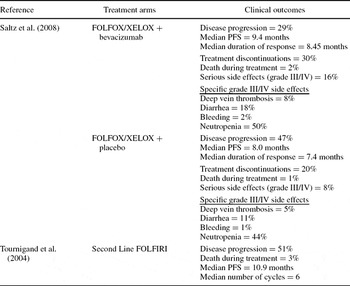
The clinical data required to populate the model consisted of early treatment discontinuations because of toxicity, achievement of clinical benefit, duration of clinical benefit, risk of cancer-related death during active treatment, and number of chemotherapy cycles administered. These data were obtained through a literature search of randomized trials evaluating FOLFOX (± bevacizumab) in the first-line setting and second-line FOLFIRI in the treatment of mCRC. Two randomized trials were identified that provided the required data for the decision model (Table 1) (Reference Saltz, Clarke and Diaz-Rubio25;Reference Tournigand, Andre and Achille32).
Published Randomized Trials Providing Clinical Data to Populate the Economic Model

Note. PFS, progression-free survival; OS, overall survival; FOLFOX, oxaliplatin in combination with infusional 5-fluorouracul; FOLFIRI, irinotecan in combination with infusional 5-fluorouracul.
Estimation of Treatment Costs
The duration of investigation ran from the start of first and second-line sequential chemotherapy therapy until death. Costs for anticancer drugs, materials, patient monitoring and other related hospital resources (e.g., laboratory and diagnostic tests) were obtained from two private and two public institutions. The costs collected in the study were in Indian Rupees and then converted to US$ per the currency conversion prevailing in 2010 (conversion factor 1 US$ = 45 Indian Rupees).
Patient Preferences for Alternative Health States
The health-related quality of life values measured in the analysis were patient preferences for alternative health outcomes, as depicted in the decision analysis model. In the current study, quality-adjusted progression-free periods were measured as “healthy months equivalent” for the time spent in each outcome of the decision model using the Time Trade-Off (TTO) technique (Reference Gafni12;Reference Torrance31). The scores in months were then converted to utility measures between 0 and 1, where 0 represented death and 1 was a state of perfect health or optimal quality of life.
Intuitively, the ideal population for measuring health state utilities and treatment preferences should be cancer patients with the disease in question who are in a position to receive the new treatment. However, it has been recommended in the Canadian Guidelines for Economic Evaluations and by the Panel on Cost-Effectiveness in Health and Medicine of the United States that treatment preferences be measured from members of the general public who are potential candidates of the new medical intervention (1;Reference Russell, Gold, Siegel, Daniels and Weinstein24). As a compromise in this study, a patient surrogate group was used that would provide insight from both the perspective of the patient and members of the general public because the latter sample often has difficulty in understanding utility questionnaires. Therefore, a patient surrogate sample consisting of twenty-four oncology nurses provided utility values for the model. With a sample of twenty-four respondents, healthy month equivalence was measured with a precision of ± 1.0 month, with a 95 percent probability. Such a sample has been successfully used by our group in several economic evaluations of cancer drugs (Reference Dranitsaris, Cottrell, Spirovski and Hopkins6;Reference Dranitsaris, Vincent and Crowther7;Reference Leung, Tanock, Oza, Puodziunas and Dranitsaris18). There is also evidence in the oncology literature suggesting that nurses are suitable patient surrogates for objective outcomes and that utility estimates derived from such a sample do not substantially alter the findings of cost-utility studies (Reference Leung, Tanock, Oza, Puodziunas and Dranitsaris18;Reference Ortega, Dranitsaris, Sturgeon, Sutherland and Oza21).
After informed consent was obtained, each participant was interviewed for 30 to 45 minutes by trained local field investigators. Respondents were presented with information on FOLFOX, bevacizumab, and FOLFIRI consisting of the methods of administration, efficacy, and the side effects reported in the literature (Reference Saltz, Clarke and Diaz-Rubio25;Reference Tournigand, Andre and Achille32). Bevacizumab was not identified by name but simply referred to as the “new drug.” The interview was then continued with a description of the sixteen health states, and the length of time a patient would live in each health state (Supplementary Figure 1). The respondents were then asked how many months of “optimal health” they considered being equivalent to the time spent in each of the less than optimal health states described in the model. These measures were then used to weigh each branch of the model by the quality of life experienced by a patient living through that time period.
Cost-Utility Analysis
The clinical, economic, and respondent preference data were then combined into a cost-utility analysis of the “new drug” for the first-line treatment of mCRC. The base-case analysis assumed that the addition of the “new drug” to standard chemotherapy would provide a survival benefit of 3 months. The primary objective of the analysis was to estimate an appropriate price per dose for the “new drug” by using the target benchmark cost of US$9,300 per QALY gained, which is three times the Indian per capita GDP. Indirect costs were not included because there were no data available on the association between bevacizumab usage and indirect cost avoidance. Future costs and benefits were not discounted because of the short time periods involved. However, the stability of the baseline results was evaluated by a comprehensive sensitivity analysis. This consisted of substituting the 95 percent confidence intervals (CI) for the health-state utilities as well as variations in the overall survival benefit, costs of care, and the target threshold for economic value in India. Individual analyses were conducted from both the public and private healthcare perspective.
RESULTS
Clinical outcomes data and costs used to populate the model are presented in Tables 1 and 2. The economic data revealed that expenses for chemotherapy, side-effect management, and best supportive care are considerably lower in the public than the private system in India. This may be a reflection of the modest level of care offered to patients in public hospitals and of the ability of the private sector to mark up the cost of goods and health services.
Hospital Costs for the Treatment of Metastatic Colorectal Cancer in India

Note. FOLFOX, oxaliplatin in combination with infusional 5-fluorouracul; FOLFIRI, irinotecan in combination with infusional 5-fluorouracul.
aOxaliplatin in combination with infusional 5-fluorouracul. Cost per cycle includes resources for drug administration and routine patient monitoring. In the hospitals that provided data for this study, patients are admitted for two days to receive the chemotherapy.
bIrinotecan in combination with infusional 5-fluorouracul.
cPatients would be admitted for 3 days for the management of side effects and for reassessment.
dAfter failing two lines of chemotherapy, patients would receive best supportive care on an outpatient basis until death.
The second component required for the cost-utility analysis was health state utilities for the time period spent in each of the 16 health states (Supplementary Figure 1). Utilities for each outcome were estimated from a sample of twenty-four oncology nurses. There were thirteen respondents from private hospitals and the remainder were from public institutions. The sample had an average of 5.4 years of direct oncology experience (range, 3–15 years) and all had experience in the treatment of colorectal cancer patients. In addition, 22 of 24 (91.7 percent) respondents had direct clinical experience in the administration and follow-up care associated with FOLFOX (mean years = 4.8) and FOLFIRI (mean years = 3.2) chemotherapy. However, only 9 of 24 (37.5 percent) had experience with the newer targeted therapies such as bevacizumab and cetuximab.
The health state utilities from the oncology nurses are presented in Supplementary Table 1, which can be viewed online at www.journals.cambridge.org/thc2011003. The results suggested that patient utilities were influenced by the severity of drug toxicity, the likelihood of achieving a response to chemotherapy and the risk of rapid cancer death. The health states with the lowest utilities (i.e., branches 4 and 12 of the model, Supplementary Figure 1) were those where first-line therapy had to be stopped because of severe toxicity, the patient then had an early progression during second-line treatment followed by a rapid cancer death. It was also interesting to note that, in all of the related scenarios, comparative branches that included treatment with the “new drug” tended to have lower health state utilities (Supplementary Table 1). This is likely related to the additional side effects that would occur with the addition of an anti-VEGF agent like bevacizumab to chemotherapy (Table 1).
Cost Utility Analysis for the Public and Private Healthcare Systems
The outcomes data from the clinical trial, the estimated costs associated with each treatment and the health state utility estimates were combined into the cost-utility analysis. The price per dose of the “new drug” was then varied until the incremental cost-effectiveness ratio reached a threshold of US$9,300 per QALY gained. Using this approach from the public healthcare system perspective, the base-case analysis suggested that a price of US$98.00 would be considered cost-effective for India according to the WHO criteria (Reference Hillner and Smith15;Reference Murray, Evans, Acharya and Baltussen19;Reference Sarin26).
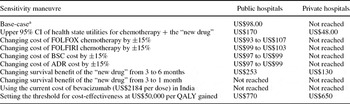
A series of one-way sensitivity analyses were then conducted using the upper 95 percent CI for the health state utilities, variations in treatment costs, overall survival benefit, and the targeted cost per QALY threshold. When the costs of therapy were varied by ± 15 percent, the results were relatively stable (Table 3). The two biggest factors to impact the base-case findings were the health state utilities associated with the new drug and the overall survival gain. The monthly drug price rose to US$170 when the upper 95 percent CI of the health state utilities for the new drug were applied to the model. Similarly, increasing the overall survival benefit from 3 to 6 months allowed the monthly drug price to increase to $U.S.253 while retaining the same value. These findings indicate that the two most important factors driving the cost-effectiveness of any new cancer drug is its ability to significantly improve quality and quantity of life.
Sensitivity Analysis on the Unit Price per Dose for the “New Drug”

Note. CI, confidence interval; FOLFOX, oxaliplatin in combination with infusional 5-fluorouracul; FOLFIRI, irinotecan in combination with infusional 5-fluorouracul; BSC, best supportive care; ADR, adverse drug reaction costs; QALY, quality-adjusted life-year.
aFor a target threshold of US$9,300 per QALY when the new drug is added to FOLFOX chemotherapy.
While bevacizumab is available in India, its purchase price is approximately US$2184 per dose for an average mCRC patient, which is similar to the price charged in the United States and Europe. As a result, only patients with adequate insurance and or sufficient personal resources would have access to this drug. A sensitivity analysis was conducted where the current price of bevacizumab was applied to the model. The results revealed that the incremental cost per QALY gained would be greater than US$200,000. When a US$50,000 cost per QALY threshold was used instead of the WHO criteria, the price per dose of the new drug rose to US$770.00. In summary, the sensitivity analyses suggested that a price of approximately US$98.00 for a new drug that would prolong patient survival by 3 months would be considered cost-effective in India.
A similar series of analysis was conducted with cost data collected from private hospitals. Unlike the results from the public system, we were unable to find a price per dose for the new drug that would result in a US$9,300 cost per QALY gained (Table 3). Under most of the sensitivity scenarios evaluated, a price for the “new drug” could also not be found (Table 3). The only exception was when the upper 95 percent CI of health state utilities for chemotherapy + the “new drug” were used. This allowed the price of the drug to be US$48.00. The main reason behind these results was the fact that the addition of an effective new drug would increase the total number of chemotherapy cycles administered. This would drive up the costs and overcome any incremental benefit in quality of life and overall survival. However, the intent of the WHO criteria for cost-effectiveness is its application towards publicly funded healthcare systems. The criteria seem to provide a reasonable threshold for estimating the cost-effectiveness of a new drug in a developing country like India.
DISCUSSION
In this study, decision analysis was used to estimate the price of a hypothetical new drug that provides a 3-month survival benefit when added to chemotherapy in the first-line treatment of mCRC. The primary analysis was conducted from the Indian public healthcare system perspective using the WHO criteria for cost-effectiveness. In the base-case analysis and in most of the scenarios evaluated, a price per dose of approximately US$98.00 was suggested by the data as being cost-effective. The price of the drug could increase to US$253 per month if the survival benefit were to approach 6 months. However, in the treatment of solid tumor patients with metastatic disease, a 6-month survival gain is rarely achieved. Most new cancer drugs approved for use over the past 3 years have not been able to improve survival beyond 3 months (Reference Escudier, Eisen and Stadler10;Reference Jonker, O'Callaghan and Karapetis16;Reference Saltz, Clarke and Diaz-Rubio25;Reference Van Cutsem, Peeters and Siena33).
The findings of this study suggest that the WHO criteria for cost-effectiveness can be applied to a developing country like India for estimating an appropriate price which may be more affordable to the public healthcare system. Reducing drug acquisition prices to these levels would improve patient access. However, central to the pricing debate is the matter of commercial viability based on the manufacturer's cost of goods and operational overhead expense. It is unclear whether manufacturers would realize greater short-term benefit from a scenario where the drug is sold at a high price to a few people (as with bevacizumab in India), versus a case where the drug is sold at a lower cost but to a much larger group of people. In India, only 50 million people of a population of 1.17 billion are able to afford modern medicines (Reference Pandeya22;23). Could a reasonable level of profit be achieved if a drug were to become more affordable to the remaining 1.165 billion?
An exercise to identify a price point where revenue between the two scenarios reaches equivalence is a worthy analysis to undertake. However, if the status quo is maintained, then one of two possible outcomes may materialize. The Indian government may issue a compulsory license, which would enable local production of the patented drug. This is possible under the Trade Related Intellectual Property Rights agreement of the World Trade Organization and has already occurred with some HIV drugs (Reference Shashikant27). Alternatively, the government may mandate price controls by adding a new cancer agent to the Essential Drugs List (Reference Pandeya22;23). Either way, total revenues for the product would be compromised.
One of the challenges faced by the pharmaceutical industry in making a drug available at a lower price in less-developed countries is the phenomenon known as parallel trade. In this situation, the drug is imported to a wealthier nation by an intermediary for the intention of profit making. Cooperation between the global pharmaceutical industry and the government of the developing nation will be needed to make a lower price policy viable. A strict and enforceable system would have to be developed that would reduce the likelihood of parallel trade. One approach could be through a centralized single source drug distribution process along with a preauthorized list of prescribers. Notwithstanding, the PE modeling approach presented in this paper along with the WHO criteria for cost-effectiveness can be a useful tool in identifying an optimal drug price for all of the key stakeholders. The proposed methodology will also focus negotiations on cost-effectiveness and value based pricing as opposed to intellectual property litigation and mandated price controls.
There are several limitations in the application of this technique. Our modeling exercise was theoretical. For the proposed methodology to be viable, complete data from randomized trials on a drug by drug basis is required. One of the limitations of using the per capita GDP for value based pricing is that it represents a national average and does not consider income dispersion. For our modeling strategy to be applied, a new drug must demonstrate either an improvement in QOL over the standard of care or a survival of sufficient magnitude to identify a final price point for cost-effectiveness. However, many of the newer oncology drugs have not been able to demonstrate such benefits (Reference Escudier, Eisen and Stadler10;Reference Jonker, O'Callaghan and Karapetis16;Reference Saltz, Clarke and Diaz-Rubio25;Reference Van Cutsem, Peeters and Siena33). Lastly, indirect costs such as time off work secondary may be relevant in this setting, but were not considered in this analysis.
CONCLUSIONS
Modern cancer medicines are often out of reach for many patients in developing countries. To help improve patient access, a process to estimate an optimal drug price based on predetermined thresholds of societal value is presented. The advantages of this technique are that it is relatively straightforward to perform, transparent, and the modeling can be easily applied to any jurisdiction using local cost data. Such information can be of value to both drug manufacturers and governments because it would facilitate value based drug price negotiations. However, the challenge would be to identify an ideal list price that would strike a balance between that which patients/governments can afford to pay and the commercial viability of the product.
SUPPLEMENTARY MATERIAL
Supplementary Table 1
Supplementary Figure 1
CONTACT INFORMATION
George Dranitsaris, M.Pharm (gdranit@ca.inter.net), PhD student, Ilse Truter, PhD (ilse.truter@nmmu.ac.za), Professor, Pharmacy, Nelson Mandela Metropolitan University, P.O. Box 77000, Port Elizabeth, South Africa
Martie S. Lubbe, PhD (martie.lubbe@nwu.ac.za), Professor, Pharmacy, North-West University, P.O. Box 684555, Port Potchefstroom, South Africa
Nitin N. Sriramanakoppa, MD (sriramanakoppa@pharmarc.com), Consultant, Vivian M. Mendonca, MD (mandonca@pharmarc.com), Consultant, Sangameshwar B. Mahagaonkar, MD (sangameshwarm@pharmarc.com), Consultant, PharmARC Analytic Solutions, Mercury 2B Block, Bangalore, 560 087, India
CONFLICT OF INTEREST
All authors report having no potential conflicts of interest.