Introduction
Populations worldwide are rapidly aging. The percentage of older people (aged 60 years and above) in the world is expected to increase from 11.7% in 2013 to 21.1% by 2050. This means that the number of older people is expected to more than double by 2050 (Fitzgerald, Reference Fitzgerald2015). According to the aging index, in Spain this group will triple by 2020. In the Madrid area, the population aged between 80 and 100 years has doubled in the past ten years. However, age is the factor that is the most directly related to functional dependence, which is not considered a disease but is closely related to chronic diseases that affect the ability to perform daily activities (Bierman and Statland, Reference Bierman and Statland2010). According to Koller et al. (2014), people suffering from multiple chronic diseases have a greater possibility of becoming dependent within a five-year period. With each additional disease, risk increases 6% over a period of five years.
Functional deterioration is a predictor of poor clinical outcomes and mortality in elderly patients, regardless of diagnosis (Daubin et al., Reference Daubin2011). These results show that in developed countries, caring for people in dependency situations and promoting their autonomy is one of the main social-policy challenges.
The concept of dependence refers to the functional inability to perform the activities of daily life and therefore the need for assistance. Thus, dependence has relevant social and economic consequences and requires the involvement of public health services (Llibre et al., Reference Llibre2014). In general, numerous factors are taken into account when defining dependence. Examples include limitations in performing activities and interacting with the environment (e.g. self-care, mobility, and leisure); the need for technical assistance or other people's care; and physical, mental, social, and economic effects.
Therefore, assessing the degree of functional dependence implies determining an individual's ability to independently perform activities of daily living (eating, mobility, dressing, personal hygiene, and sphincter control). However, although health organizations have clearly defined the concept of dependence, it is not easy to quantify. In an attempt to combine the graduation criteria of dependence, the International Classification of Functioning, Disability, and Health (ICF) proposes a generic division of dependency scales in which five groups are differentiated: independence, mild dependence, moderate dependence, severe dependence, and complete dependence. Within this context, one of the most commonly used assessment scales in the geriatric field is the Barthel Index (Granger et al., Reference Granger, Albrecht and Hamilton1979).
Additionally, loss of independence can cause a significant increase in stress levels and is associated with negative changes in the perception of health (Cardozo-Quintana and Randon-Bernardo, Reference Cardozo-Quintana and Rondon-Bernard2014). Thus, functional dependence is most likely one of the main causes of psychological distress and considerable declines in quality of life. Some studies relate functional disability and functional dependence to psychological problems such as anxiety, distress (Bierman and Statland, Reference Bierman and Statland2010; Rodríguez-Díaz et al., Reference Rodríguez-Díaz, Cruz-Quintana and Pérez-Marfil2014a), and depressive symptoms (Bierman and Statland, Reference Bierman and Statland2010; Rodríguez-Díaz et al., Reference Rodríguez-Díaz, Cruz-Quintana and Pérez-Marfil2014a). Other studies associate dependence with variables that include decreased life satisfaction (Fagerström et al., Reference Fagerström, Holst and Hallberg2007; Rodríguez-Díaz et al., Reference Rodríguez-Díaz, Cruz-Quintana and Pérez-Marfil2014a), deteriorated quality of life (Sareen et al., Reference Sareen, Jacobi, Cox, Belik, Clara and Stein2006), and a perceived loss of health (Fagerström et al., Reference Fagerström, Holst and Hallberg2007).
However, chronic diseases and, consequently, functional dependence can be prevented and their evolution can be halted by encouraging changes in habits through health education and multidisciplinary interventions focused on behavior modification (Pisano-González and González-Pisano, Reference Pisano-González and González-Pisano2014). These programs should promote independence, self-management, and adherence to an intervention plan while taking into account each individual's needs and abilities (Rodríguez-Díaz et al., Reference Rodríguez-Díaz, Pérez-Marfil and Cruz-Quintana2014b).
Pender et al. (Reference Pender, Murdaugh and Parsons2006) have created the Health Promotion Model (HPM), which strives to explain how people make health care decisions. The objective is to identify the factors that influence the decision-making process and individuals’ actions to prevent diseases. Perceptual and cognitive factors (control and perceived state of health, perceived self-efficacy, and perceived benefits) are considered the main determinants of health promotion behavior.
Fernández-Ballesteros’ (Reference Fernández-Ballesteros2009) proposal for active aging and Kahana and Kahana's (Reference Kahana, Kahana and Settersten2003) Preventive and Corrective Proactivity Model can be included in the same line of work. According to Fernández-Ballesteros (Reference Fernández-Ballesteros2009), aging is associated with change, which requires both adaptation and adjustment. The adaptation process can be promoted through factors related to the individual (self-efficacy, cognitive abilities, and emotional regulation) and other context-dependent factors (willingness to learn, stress, social and family support, and an enabling environment).
Similarly, Kahana and Kahana (Reference Kahana, Kahana and Settersten2003) emphasize that an individual's internal resources can promote proactive adaptation to the aging process. Fostering hope and self-esteem while strengthening and providing adaptive coping strategies to cope with unfavorable situations are key objectives for promoting health in these age groups.
In line with the reviewed literature, the objective of this study is to design and implement an intervention program focused on preventing dependence in people aged 75 to 99 with various levels of dependency (no dependence, mild functional dependency, and moderate functional dependency). The literature is limited in this respect, particularly for the very elderly in these age groups. The program has been designed by taking into account the HPM proposed by Pender et al. (Reference Pender, Murdaugh and Parsons2006), the Preventive and Corrective Proactivity Model by Kahana and Kahana (Reference Kahana, Kahana and Settersten2003), and the multi-dimensional, multi-level model of active aging by Fernández-Ballesteros (Reference Fernández Ballesteros2003), focusing on providing tools to improve physical and emotional well-being.
These models assume that both attitudinal change and promotion of emotional well-being, when adapted to each subject's needs, have an impact on general health and thus help people both accept lifestyle changes and adapt to changes that can occur during aging. This proposal was the basis for the design of the intervention program presented in this study.
The aim is to verify the program's influence on functional and emotional capacities, on acceptance of and satisfaction with life conditions, and on the prevention and delay of functional dependence. Our hypothesis is that the participants in the group who continue the program will present significant changes that reflect an increase in functional capabilities, health perception, self-esteem, and self-efficacy and decreased anxiety levels and depressive symptomatology compared to the control group (CG) (i.e. individuals on the waiting list).
Method
This is a pre/post quasi-experimental (typical case) design study with a CG. The subjects were randomly allocated in the intervention group (IG).
Participants
The participants were selected from three private, urban nursing homes located in the southern part of the Community of Madrid (Spain). All three homes are owned by the same private organization and therefore have the same characteristics regarding care guidelines and staffing ratios.
The sample was selected according to the following inclusion criteria: (a) living in a home for the elderly; (b) scores obtained on the Barthel Index (modified version by Granger et al., Reference Granger, Albrecht and Hamilton1979): no dependency (100), slight dependency (91–99), moderate dependency (61–90), and severe dependency (21–60); (c) scores on the short portable mental status questionnaire by Pfeiffer (Reference Pfeiffer1975) less than or equal to 3; and (d) not presenting difficulties in reading and writing. The exclusion criteria included having communication problems at the time the IG was created and/or presenting complete dependence.
At the time of the study, the three centers had a population of 771 elderly people. Of those individuals, 694 were excluded: 436 did not meet the inclusion criteria, 209 did not wish to participate in the study, 27 died, and 12 were hospitalized. The population that satisfied the inclusion criteria comprised 77 elderly people who were examined prior to the creation of the groups. Of those 77 participants, five did not wish to continue in the study and two died. At the time of simple randomization, the sample was composed of 70 participants.
The subjects were assigned to an IG (i.e. people who participated in the intervention program, n = 35) and a CG (i.e. people on the waiting list, n = 35). Both the IG and the CG were composed of 10 elders from each nursing home, except for a CG that was composed of nine subjects. During the nine weeks of the intervention program, two participants in the IG failed to complete the intervention (one died and one left the study) and four participants in the CG failed to complete the study (two died, one was admitted to the hospital and one did not want to continue). Additionally, three participants in the IG were excluded from the analysis because they missed 85% of the program sessions. Two participants in the CG were excluded from the analysis because they did not want to continue with the study.
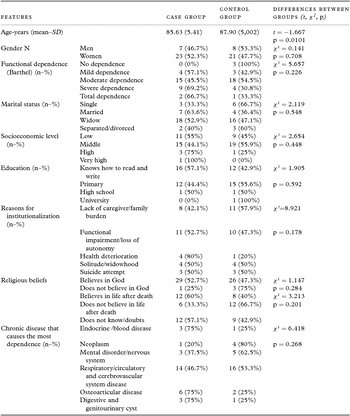
Finally, the sample was composed of 59 subjects (IG = 30 and CG = 29) with an average age of 86.80 years (ranging between 75 and 99 years) and a standard deviation (SD) of 5.19 The IG was composed of 30 subjects, 23 of whom were women and 7 of whom were men. The CG had 29 subjects, 21 of whom were women and 8 of whom were men. As shown in Table 1, there are no differences between the groups related to either sociodemographic variables (age, gender, marital status, socioeconomic level, level of studies, reason for institutionalization, and religious beliefs) or the level of functional dependence or chronic diseases.
Demographic characteristics at the beginning of the study
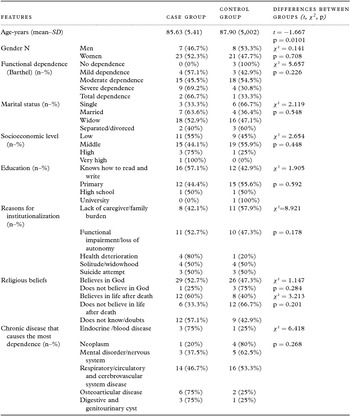
With regard to chronic diseases affecting each participant's dependence, we can highlight the fact that the subjects in the sample have pluripathology, with an average of three chronic diseases that cause some type of functional dependence. Among these diseases, those with the greatest percentage were circulatory system diseases (35.5%), followed by osteoarticular system diseases (12.9%). It is also noteworthy that more than half of the sample (54.3%) declared that the reason for institutionalization was a functional impairment that prevented them from independently performing BADL.
Instruments
Barthel Index (modified version of Granger et al., Reference Granger, Albrecht and Hamilton1979). This instrument makes it possible to assess the level of dependency and classify subjects into five groups: no dependence (100), mild dependence (91–99), moderate dependence (61–90), severe dependence (21–60), and complete dependence (0–20). The intra- and inter-observer reliability scores show κ indexes of 0.99 and 0.58, respectively (Buzzini et al., Reference Buzzini2002).
Short portable mental status questionnaire (SPMSQ) (Pfeiffer, Reference Pfeiffer1975). The Spanish version adapted by González Montalvo et al. (Reference González-Montalvo, Salgado and Alarcón1993) was used. This screening test assesses cognitive functioning. Scores greater than 2 indicate mild, moderate (3 to 7), or severe (8 to 10) cognitive impairment. The data on inter-and intra-observer reliability are 0.73 and 0.93, respectively.
Geriatric Depression Scale (GDS) (Sheikh and Yesevage, Reference Sheikh and Yesevage1986). This tool was designed specifically to detect cases of depression among the elderly. Scores between 0 and 5 indicate the absence of depressive symptomatology; scores between 6 and 10 indicates mild depression; and scores above 10 indicate severe depression. This scale has a sensitivity of 0.81 and a specificity of 0.75 (Wancata et al., Reference Wancata, Alexandrowicz, Marquart, Weiss and Friedrich2006).
Mini-Mental State Examination (MMSE) (Folstein et al., Reference Folstein, Folstein and Mchugh1975). The Spanish version was adapted by Blesa et al. (Reference Blesa2001). It performs a general cognitive-function screening, providing information about the presence of cognitive deficit. This questionnaire has a sensitivity of 0.87 for and a specificity of 0.82 (Contador et al., Reference Contador, Fernández-Calvo, Ramos, Tapias-Merino and Bermejo-Pareja2010).
SF-12 Health Survey. The Spanish version was adapted by Alonso (Reference Alonso2002). This reduced version of the SF-36 Health Survey evaluates physical functioning, physical role, body pain, general health, vitality, social functioning, emotional role, and mental health. The internal consistency, measured with Cronbach's α, is 0.81 for the over-65 population.
The Hamilton Anxiety Rating Scale (HAM-A) (1959). The Spanish version adapted by Carrobles et al. (Reference Carrobles, Costa, Del Ser and Bartolomé1986) was used. It is a hetero-administered scale with two scores that correspond to somatic and psychological anxiety. It presents good internal consistency, with Cronbach's α ranging from 0.79 to 0.86 and test-retest values after one week of 0.96.
Rosenberg Self-esteem Scale (1965), adapted into Spanish by Martín-Albo et al. (Reference Martín-Albo, Núñez, Navarro and Grijalvo2007). This instrument evaluates personal self-esteem, understood as feelings related to personal worth and self-respect. The test-retest reliability is 0.85 and has a Cronbach's α coefficient of 0.92. The Cronbach's α coefficient is 0.85 and the test-retest correlation after two weeks is 0.91.
Mini Nutritional Assessment (MNA) (Guigoz et al., Reference Guigoz, Vellas and Garry1996). This instrument presents two phases: screening and evaluation. The latter assesses nutritional status. It has a sensitivity of 0.96 and a specificity of 0.98.
Self-efficacy scale for aging (Fernández-Ballesteros, Reference Fernández-Ballesteros2008). This instrument examines the perception of self-efficacy in four dimensions: (1) cognitive health; (2) functional skills; (3) physical skills; and (4) socio-emotional skills. The scores are obtained by considering what will occur in the future. The scale shows a reliability of 0.84.
Record of variables related to the intervention related to physical well-being. Measures of systolic and diastolic blood pressure levels, heart rate, body mass index, weight, and height.
Intervention
The intervention program, called “Coexisting with dependence and wellbeing,” consists of two types of activities developed simultaneously: some focus on emotional well-being, whereas other focus on improving participants’ physical condition.
The intervention focused on physical well-being was based on aerobic exercises tailored to the age and functional capacities of participants. Segments of a complete workout were included in each session: warm up (five minutes), flexibility and coordination exercises (20% of the time), exercises for muscle strength (10% of the time), aerobic endurance exercises (70%), and cool down and relaxation (10 minutes). There were two weekly 30-minute sessions for nine weeks.
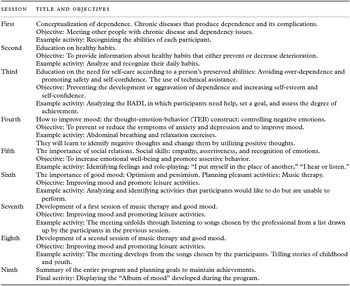
The intervention that focused on emotional well-being occurred during weekly sessions, with an approximate duration of 1 hour and 30 minutes over nine weeks. These sessions were conducted in ten person groups. All of the sessions had the same structure except for the first and the last sessions. The general outline for each session was structured as follows: (a) revision of the assigned task during the previous meeting and resolution of the difficulties related to it; (b) development of the objective of the session (see Table 2); (c) practical exercises; and (d) explanation of the tasks to be undertaken during the following week.
Theoretical content, objectives, and examples of activities in the “Coexisting with dependence and wellbeing” program

The sessions were conducted with simplified oral presentations and were accompanied by audiovisual material (slides) aimed at capturing participants’ attention and ensuring the maximum understanding of the most important concepts developed in the program. These concepts were adapted to the participants’ educational level (primary studies/incomplete primary studies). Additionally, each session was complemented with other resources such as weekly tasks, debates, music, and humor.
Procedure
This pilot study was conducted from April 1, 2014 to July 26, 2014 and is part of a broader research project on functional dependence in the elderly. Before beginning the study, the main researcher met personally with the directors of the centers to ask for authorization and carry out the study in these nursing homes. After confirming the authorization, nurses, psychologists, physiotherapists, and occupational therapists were briefed on the program objectives by the main researcher. These professionals noted the possibility of voluntary participation in this functional and psychological assessment of the elderly and welcomed participants who satisfied the study's inclusion criteria.
Pre-intervention assessments on participants were conducted from April 1 to 15, 2014. Subsequently, and before implementing the intervention program, a simple randomization was conducted to assign the participants to the IG and the CG. From April 17 to June 13, the IG received the treatment provided by the program. The sessions of the intervention program aimed at improving emotional well-being were convened by the main researcher (a registered nurse) once per week for nine weeks. The sessions aimed at improving physical well-being were convened by a physiotherapist and an occupational therapist twice per week for nine weeks. All of the participants in the three IG received the same content in each session to avoid biases between the groups. All of the sessions were convened in the morning, with emotional well-being and physical well-being sessions conducted on different days.
Finally, from June 23 to 30, 2014, the post-intervention assessments of the participants in the IG and CG were conducted. This means that post-intervention assessments were performed ten days after finishing the treatment in the “coexisting with dependence and well-being” program.
Pre- and post-intervention assessments were conducted using the instruments described above. The data from the instruments that measure emotional well-being were collected by the main researcher. These data were analyzed and interpreted by the two psychologists who participated in the design of the intervention program. The data from the instruments that measure functional dependence were collected and interpreted by a nurse and an occupational therapist. The ability to perform physical exercise was assessed by a physiotherapist and a doctor.
A pre-intervention physical assessment, including blood pressure, heart rate, body mass index, height, and weight, was conducted a day before the beginning of the program. After the intervention program, post-intervention physical measures were collected a day after the end of the program. These data were collected by the same nurse in both cases.
Statistical analysis
The data were analyzed with the IBM SPSS program for Windows, version 17.0 Chicago (USA). Descriptive analyses were conducted on the means and standard deviations for the quantitative variables and on the frequencies for the qualitative variables. The differences between the groups were analyzed using the t-test (for independent samples) and the χ 2 test. Linear models for repeated measures (Wilks’ Lambda) were used to assess the effect of the program. In all cases, the assumptions of homogeneity of variances were taken into account (Levene test). The effect size was calculated with Cohen's d. Statistical significance was set at p < 0.05.
Finally, Spearman correlations and simple linear regressions were used to check the relationship between the level of dependence before the intervention and the dependent variables after the intervention (moderator analysis).
Results
We present the results of the comparison between the groups based on the evaluation time for the different variables. A general linear model for repeated measures with a 2 × 2 design was used to perform the analysis. It presented two levels for the inter-group factor, depending on whether the participants had participated in the intervention program (IG and CG), and two levels for the intra-subject factor, corresponding to the two moments of the evaluation (time) (pre-intervention and post-intervention).
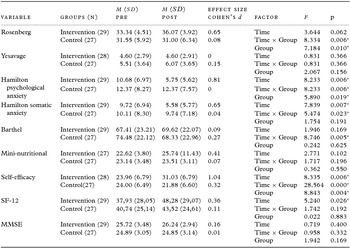
Table 3 presents the averages, standard deviations, effect sizes (Cohen's d), and results obtained from the differences between the groups, the evaluation time, and the interaction of variables. The results for the emotional variables, nutritional status, health perception, and cognitive function are also included. The dependent variables are levels of self-esteem (Rosenberg), depression (Yesavage), anxiety (Hamilton, somatic, and psychic anxiety), dependence (Barthel), nutrition (mini-nutritional), self-efficacy, general health (SF-12), and cognitive functioning (MMSE).
Means (M), standard deviations (SD), effect size (Cohen's d), and analysis of the differences (Wilks’ Lambda), depending on the time of evaluation, interaction, and group for the variables

Notes: * p < 0.05.
Regarding self-esteem (Rosenberg), differences in the time (F = 5.097, p = 0.028) and group (F = 7.160, p = 0.010) factors were found, along with differences in variable interaction (F = 10.447, p = 0.002). These results indicate changes in the second evaluation; these changes were different in the two groups. Specifically, the participants in the intervention group presented higher values at the end of the program, whereas modifications were not observed for the CG. These results are consistent with the size effect found in the intervention group, which is moderately high (d = 0.75).
Similar results were obtained for psychological anxiety symptoms (Hamilton), with differences in the time (F = 8.203, p = 0.006) and group factors (F = 7.309, p = 0.009) and in variable interaction (F = 8.203, p = 0.006). These differences are explained by the significant decrease in psychological anxiety levels during the post-evaluation in the IG; in contrast, there were no changes in the CG. The effect size for the change observed in the IG was moderately high (d = 0.76). In the case of somatic anxiety, the differences centered on the time factor (F = 7.715, p = 0.007) and interaction (F = 5.305, p = 0.025). These differences suggest changes in the second evaluation; moreover, the pattern of these changes is different for both groups. In particular, changes decrease in the IG and are maintained in the CG. The effect size for the IG was moderate (d = 0.63).
For the functional dependence variable (Barthel), we found differences in the interaction (F = 8.922, p = 0.004). These results indicate that the changes in the groups followed different patterns. The participants in the IG had slightly higher scores at the end of the program, whereas the participants in the CG presented lower scores in relation to the initial measurement. This phenomenon explains why the level of functional dependence in BADL increased in the CG. However, the effect sizes were low in both groups.
With regard to self-efficacy, differences were found in the time (F = 6.903, p = 0.011) and group (F = 8.925, p = 0.004) factors and in interaction (F = 25.809, p = 0.000). These results indicate not only that there were significant changes in the two evaluation measures but also that these changes were different in both groups. Specifically, the pattern for the IG showed an increase in self-efficacy in the post-intervention measure, whereas there was a decrease in the CG. The effect size for the intervention group was high (d = 1.04).
Finally, differences were also found for general health (SF-12) in the time factor (F = 6.343, p = 0.015). The implication is that there were changes in the second evaluation, showing an increase in both groups. The effect size was greater for the IG (d = 0.40); nonetheless, the value is low.
No significant differences were found for the remaining variables in any of the factors (depression, nutrition, and MMSE).
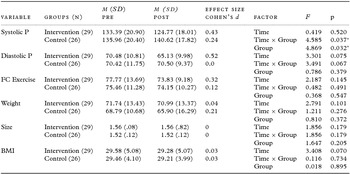
Table 4 shows the results of the differences in the anthropometric and cardiovascular variables, specifically, systolic and diastolic pressure, cardiac frequency, weight, height, and body mass index. There were differences for the systolic pressure in the group (F = 4.869, p = 0.032) and interaction (F = 4.849, p = 0.032) factors. The differences show a decline in this variable for the IG and an increase for the CG. The effect size in both cases was low. In the case of body mass index, significant differences were found for the time factor, showing a slight decline in the post-intervention evaluation. No significant differences were found for the remaining variables.
Means (M), standard deviations (SD), effect size (Cohen's d), and analysis of the differences (Wilks’ Lambda) depending on the time of evaluation, interaction, and group for the variables

Notes: *p < 0.05, **p < 0.01.
With regard to the correlational analysis, results obtained in the GI have shown no significant correlations between the level of dependence prior to intervention and the dependent variables, except in the case of nutritional status, which is measured using both MNA (ρ = 0.432, p < 0.05) and post-Barthel scores (ρ = 0.880, p < 0.01).
Conversely, the models of the simple linear regression analysis conducted on the results of the IG participants in each variable measured, using the pre-intervention level of functional dependence as the independent variable, indicate that this level predicts the level of post-intervention self-esteem F (1, 27) =5.762, p = 0.024, R 2 = 176, β = 0.419, post-intervention self-efficacy F (1, 27) = 5.632, p = 0.025, R 2 = 0.173, β = 0.415, and post-intervention dependence F (1, 27) = 122.103, p = 0.000, R 2 = 0.819, and β = 0.905.
Discussion
This study's general objective was to implement an intervention program to provide resources to attempt to prevent and delay functional dependence in a group of mostly octogenarian and nonagenarian individuals and examine its effects. The factors related in the literature to active aging and various coping strategies to prevent dependence were taken into account in the program design (Kahana and Kahana, Reference Kahana, Kahana and Settersten2003; Fernández-Ballesteros, Reference Fernández-Ballesteros2009). In general, the results indicate that the program both improves the participants’ mood and helps prevent functional dependence, maintaining their preserved capabilities at various levels of functional dependence.
Demographic changes predict a significant increase in the number of people needing assistance to perform their BADL. The data indicate that individuals with at least three chronic diseases have a higher risk of dependence on another person for personal care than individuals without comorbidity. Moreover, those over the age of 75 are at even greater risk (Koller et al., Reference Koller, Schön, Schäfer, Glaeske, van den Bussche and Hansen2014). As a result, within the framework of its strategy for active aging, the World Health Organization (WHO) emphasizes the importance of prevention, defensive actions against diseases that cause functional impairment and when such diseases do appear, preventing them from evolving toward disability and functional dependence. In global terms, active aging policies contribute to economic development and competitiveness among countries. To achieve this objective, however, it is of paramount importance for institutions to favor the implementation of programs that promote healthy physical and mental life habits in these age groups. Projects that promote the active participation of elderly individuals include the Experience Corps project, Isolation to inclusion, Senior Empower, Senior European Volunteers Exchange Network, and Age Friendly Cities (OMS, 2007); in Spain, various programs promoting active participation have been implemented, among which the Living with vitality (Vivir con vitalidad) program (Fernández-Ballesteros, Reference Fernández-Ballesteros2002) is noteworthy. All of these programs develop activities aimed at active participation in terms of recreation, physical activity, and health promotion. Nevertheless, there is little literature that addresses active participation in the elderly population (in their 80s and 90s) almost notably, preferential focuses on functional dependence and functional well-being, as is the case with the program “Coexisting with dependence and wellbeing,” which was the main objective of this work.
The program included three basic ingredients: health education, negative-mood prevention, and increased levels of physical activity. In addition, we wanted to determine whether such programs could be effective in groups of the elderly population that present some degree of functional dependence. The sample can be considered representative of the Spanish population in this age group: mostly women, with mild to moderate dependence, widowed, from a middle-class socioeconomic background, with primary studies, with religious beliefs, and entering a nursing home because of either a lack of caregivers or an increased deterioration in their functional capacity. Spanish women are the longest-lived in the European Union, with a life expectancy at birth of 85.1 years.
The results indicate that the program has been especially effective in improving mood and more specifically, reducing anxiety levels and increasing both self-esteem and the perception of self-efficacy. The results for dependency levels are particularly interesting because we find that the group participating in the program maintained these levels, whereas these levels in the CG decreased. Finally, there is also a reduction in blood pressure values (especially systolic values).
Although it is true that some of these effects have been moderate (dependency level and blood pressure), we understand that they support the suitability of establishing these types of programs, taking into account the population studied. Previous studies have demonstrated the relationship between increases in physical skills and improvements in self-esteem and psychological well-being (Wang et al., Reference Wang, Tzeng and Chung2014). Our results confirm this relationship because the intervention program works simultaneously with physical activity, exercise, emotions, thoughts, and behavior, in addition to interpersonal relationships. In short, the program entails promoting changes in habits that allow participants to live better.
Contrary to expectations, there were no significant changes in depression levels. For example, Saito et al. (Reference Saito2008) have found that an improved capacity to perform daily activities decreases depression symptoms in elderly individuals. This result could be explained by the low presence of depressive symptomatology in our study's participants, which makes it difficult to detect significant changes. With regard to health perception, no significant differences were found; however, there was a trend that was consistent with the initial hypothesis, that is, the group participating in the intervention program perceived an improvement in health by the end of the program that was not present in the CG.
Additionally, it was foreseeable that there would be no changes in participants’ nutritional status or cognitive state. Regarding the former, because these are institutionalized individuals, they maintain a relatively homogeneous diet. Regarding the latter, the program included no cognitive training module.
With regard to weight and body mass index, we must note that the fundamental objective of the physical activity program was to increase flexibility, muscular strength, balance, and mobility, not to treat overweight. The previous literature shows that there is strong evidence for not only the positive effect of physical training on muscular strength and mobility (Rydwik et al., Reference Rydwik, Frändin and Akner2004) but also the beneficial effects of strength training exercises to prevent functional dependence (Rolland et al., Reference Rolland, Dupuy, Abellan van Kan, Gillette and Vellas2011). One fundamental premise that was taken into account in the design of the intervention program is that physical exercise programs in people of advanced age should be customized and adapted to each participant's functional capacities (Fairhall et al., Reference Fairhall2011).
As suggested by the literature, designing interventions to prevent functional deterioration has the potential not only to generate economic savings in health care but also to reduce physical, emotional, social, and financial problems attributable to disability and functional dependence (Gill et al., Reference Gill, Baker, Gottschalk, Peduzzi, Allore and Byers2002). Our results suggest that quality of life can be promoted by enhancing personal development, training to increase the functional capabilities preserved, and facilitating proactive care in octogenarian and non-agenarian individuals. This program provides elderly people with tools and resources to improve their physical and emotional well-being, and it fosters professionals’ awareness of belonging to an enabling environment, not to an environment that aims at substitution. The objective of professionals who care for people with functional dependence must focus on facilitating the performance of BADL, not performing them for the patient (unless the patient's functional capacities are not preserved), to avoid further deterioration in functional levels. Therefore, directing programs toward prevention and proactive care is of paramount importance.
We also wish to highlight that programs such as the program proposed are compatible with the dynamics of nursing homes, can be applied to particularly vulnerable people (in terms of both age and level of dependence), and do not require professionals different from those who are already working in this type of institution. In addition, the program is designed based on one of the most important premises of WHO's Active Aging: A Policy Framework: To prevent and reduce the burden of excess disabilities, chronic disease, and functional decline in aging people (WHO, 2002).
Therefore, we highlight the following program benefits: (a) it can be applied to a population aged 75 and over with various levels of functional dependence; (b) it does not require special resources (clinical, material, and professional) to be implemented beyond those available in institutions; (c) it promotes proactive changes in the physical and emotional dimensions of health; and (d) it generates high degrees of adherence to the intervention.
Nevertheless, future studies should consider including a monitoring phase to verify the program's medium- and long-term effects. It would also be desirable to have a most rigorous CG in terms of age, gender, and level of functional dependence. Similarly, the effectiveness of the various components and the possibility of including new modules focused on preventing dependence should be considered. Applying the program to other samples with different ages or to people who live in the community and are cared for by informal caregivers, that is, those who are not living in an institution that offers specific care related to functional dependence, could have intriguing implications.
In conclusion, we can generally state that based on actual practice, the “Coexisting with dependence and wellbeing” program is innovative in its comprehensive bio-psychosocial care of people aged from 75 to 99 who are institutionalized. Additionally, this program is effective in increasing self-esteem and self-efficacy. These variables positively affect functional capabilities and emotional well-being, reduce anxiety levels, and delay functional dependence. Therefore, this program is a valid intervention in the very elderly and confirms that they can continue to learn.
Conflict of interest
None.
Ethical considerations
A signed written consent was required at the beginning of the study. The fundamental principles of autonomy, beneficence, non-malfeasance, and justice have been respected, and the confidentiality of the subjects has been guaranteed, following the applicable legislation according to the Helsinki Declaration adopted by the 59th General Assembly in Seoul (South Korea).
Description of the authors’ roles
María Teresa Rodríguez-Díaz created the research question, designed the study, collected and analyzed the data, and wrote the manuscript. María Nieves Perez-Marfil helped with the study design, supervised the data collection, performed the statistical analysis, analyzed the data, and wrote the manuscript. Francisco Cruz-Quintana helped with the study design, supervised the data collection, and wrote the manuscript.
Acknowledgments
We offer our thanks to the “Los Balcones” Elder Care Centers, especially the elderly participants.