


Roland Hinterhölzl's ambitious book attempts to derive restructuring constructions from a biclausal, head-initial base. In doing so, it tackles head-on one of the challenges that face antisymmetric approaches, namely how to motivate the multiple movements that must take place. The book can be seen as the culmination of a line of thinking that the author has been progressively developing in his dissertation (Hinterhölzl Reference Hinterhölzl1999) and subsequent papers.
Informally, restructuring refers to the manner in which two putatively independent lexical verbs seem to act as a single verb with respect to a number of phenomena. It has been a contentious topic at least since Rizzi (Reference Rizzi and Samuel1978) proposed a transformational rule which converted or ‘restructured’ two clauses into a single clause in the presence of a verb belonging to a cross-linguistically coherent class of restructuring predicates.
The examples in (1) illustrate the transparency of a restructuring configuration for clitic climbing in Italian.
(1)

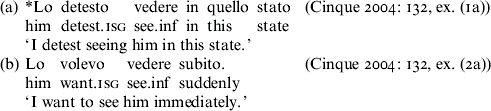
In (1a), there are two independent clauses and the clitic from the embedded clause cannot occur to the left of the matrix verb. In contrast, the clitic in (1b) can occur to the left of the matrix verb, which suggests that the two clauses have been restructured into what Rizzi proposed to be a single-clause structure.
With the widespread adoption of the Linear Correspondence Axiom (Kayne Reference Kayne1994) came a gradual acceptance among syntacticians that derivations that had previously seemed relatively ‘simple’ were in fact derived by a series of leftward movements. In this light, Hinterhölzl's focus on the verb-final languages Dutch and German is significant. In the antisymmetric framework adopted by Hinterhölzl, the effect of head-finality is derived by leftward, licensing movements of all non-verbal material to higher positions in the functional domain. This approach potentially provides a rationale for additional movements in syntax (or at least a theoretical environment in which these movements can be more easily accommodated).
Hinterhölzl's focus on Dutch and German is also significant in light of the fact that both languages have crossing dependencies – as illustrated for Dutch in (2), where the constituents of the infinitival clause are interleaved with the constituents of the finite clause – which constitute a substantial empirical challenge for theories espousing monoclausal accounts of restructuring.
(2)

Crossing dependencies are crucially important to syntax because their existence is among the strongest evidence that syntax is context-sensitive. As far as I can see, no current monoclausal analysis derives these data in a straightforward manner, which lends support to Hinterhölzl's biclausal account of restructuring constructions. In short, both the fact that Dutch and German are verb-final languages, which, given the Linear Correspondence Axiom, must involve large-scale leftward remnant movement, and the fact that they display crossing dependencies make these languages a unique environment in which to test Hinterhölzl's claims about restructuring.
The book begins with an ‘Introduction’, which contains a short overview of restructuring, remnant movement and Hinterhölzl's theoretical assumptions. Chapter 2, ‘Scrambling’, considers scrambling phenomena, mainly in German, and their analysis. The author distinguishes scrambling from topicalisation, differentiating further between A-bar, S(tressed)-scrambling (where the scrambled XP is stressed) on the one hand, and ‘ordinary’ A-movement scrambling on the other, where the scrambled XP does not bear emphatic stress. While German allows both types of scrambling, Dutch allows only S-scrambling.
Chapter 3, ‘Coherent infinitives in Dutch and West Flemish’, explores the empirical nature of verb cluster constructions in Dutch and West Flemish, including verb raising, extraposition and the ‘third construction’. Hinterhölzl argues for an antisymmetric analysis (cf. also Zwart Reference Zwart1994, Reference Zwart1997) and claims that verb raising does not involve head-raising (as in the classic analysis of Evers Reference Evers1975) but is derived by XP base-generation with leftward movement – an issue which is revisited in chapter 4.
Chapters 4 (‘A remnant movement account of restructuring’) and 5 (‘Coherent infinitives in German’) constitute the heart of the book. It is first demonstrated that, given the Linear Correspondence Axiom, arguments and predicates must undergo leftward movement to licensing positions. Importantly, Hinterhölzl argues that sentential complements also undergo licensing movement. Having established licensing movement as an empirical fact, he then seeks to develop it into an analysis of restructuring from a biclausal base.
Akin to his earlier discussion of verb raising in Dutch, Hinterhölzl argues that non-verb material in the Verb Phrase (VP) cannot undergo ‘ordinary’ scrambling. He proposes that it is successive remnant movement operations that derive a restructuring configuration in both verb raising and ‘third construction’ contexts. The two constructions differ only with respect to the amount of material that is ‘evacuated’ from the VP before the VP is moved to the specifier of the Complementiser Phrase (SpecCP). It is worth outlining in detail the movements postulated in the derivation of the verb raising construction in the Dutch example in (2) above, repeated here as (3).
(3)

(4)

One of the immediate advantages of the analysis outlined in (4) is that it derives the crossing dependencies between verbs and adverbs.
Chapter 5 is largely an overview of restructuring in German, giving arguments against the monoclausal approach. It is shown that properties of restructuring verbs that have hitherto been taken as evidence for monoclausality are idiosyncratic, and the author outlines a biclausal approach for the German constructions, which is essentially the same as the one proposed for Dutch.
Chapter 6, ‘Verbal complexes and the syntax of IPP-complements’, draws on Infinitivus Pro Participio (IPP) phenomena to provide a more precise characterisation of the position to which the Aspectual Phrase (AspP) must move. Based on IPP in Frisian, the author shows that IPP-verbs are ambiguous between infinitives (‘Nammefoarms’) and gerunds (‘Doelfoarms’). Variation with respect to the appearance of IPP is related to whether the verb in question is a Nammefoarm or a Doelfoarm.
In chapter 7, the author proceeds to a discussion of ‘Open issues: Extraposition, VP-topicalization, and the status of gerunds’. The book closes with chapter 8, entitled ‘Summary and conclusions’.
Before discussing my general impression of this book, let me state explicitly that, as far as I can see, the movement operations proposed in this volume do indeed derive the empirical facts associated with restructuring, including the all-important crossing dependencies. This is no small feat, and for this reason alone the book constitutes an important contribution to the literature on this topic.
However, Hinterhölzl's book is not an easy read. There are a number of areas where readability might have been improved. First, at a typographical level, the word-for-word glosses of examples should be aligned with the example text. Moreover, not all examples have been glossed, which makes the book less accessible, especially for readers who are not adept at reading German. In addition, it is not always clear which language a particular example represents – again, while this is obvious to readers acquainted with the languages in question, it is less clear to non-specialist readers. Finally, there are a number of small errors, including reference to perception-verb Accusativus Cum Infinitivo (ACI) constructions as Exceptional Case Marking (ECM) constructions.
As noted above, chapter 5 serves as a general introduction to German restructuring. As such, it links up with the general introduction to Dutch and West Flemish coherent infinitives and includes arguments against the monoclausal approach to restructuring. These arguments would have been more effective if they had been placed before the in-depth discussion of the biclausal approach in chapter 4. Moreover, the empirical nature of chapter 5 clashes with the highly theoretical and speculative discussion at the end of chapter 4, whose suggestions concerning a generalised theory of complementation and verb-second would have been more appropriately included in the concluding chapter.
Another shortcoming of this book is that the analysis itself is described differently at different points in the book. Particularly confusing is the question of which projection undergoes movement to where. To name but one inconsistency, in Dutch, it is the embedded AspP that moves to SpecCP of the embedded clause (108), whereas in German, it is the embedded AgrP that moves via SpecCP into SpecAspP of the matrix clause (149).
One obvious challenge to any analysis based on remnant movement is the freezing effect: XPs cannot be extracted from a larger XP which has undergone movement. Hinterhölzl demonstrates that the effect is derivational, not representational, and that extraction may occur from an XP before that XP undergoes remnant movement. However, the analysis proposed by the author specifically requires extraction – presumably by ‘ordinary’ scrambling – of nominal arguments from a remnant-moved AspP.
Another point that needs more discussion is the relationship between movement and feature-checking. Although Hinterhölzl endorses the spirit of the Minimalist program (Chomsky Reference Chomsky1995), he is selective in his commitment. For example, although he assumes the existence of phases, he apparently does not assume the existence of Agree, a fundamental component of the phase-based approach, thereby opening himself up to criticism. Thus, the question arises why features cannot be checked in situ by Agree (Chomsky Reference Chomsky, Roger, David and Juan2000) or, alternatively, on what grounds Agree is to be ignored and why (presumably) all feature-checking needs to be established via movement – which is a very strong claim indeed. The bottom line is that Hinterhölzl must rely on movement for his analysis to work, and while he justifies the postulated feature-checking needs, the reasons as to why these feature relationships need to be checked by movement remain unexamined.
Notwithstanding these criticisms and unanswered questions, the book is an important contribution to the discussion on restructuring, posing a challenge to monoclausal accounts of the phenomenon. What makes Hinterhölzl's analysis particularly attractive is that it can account for crossing dependencies.


