Introduction
People with cognitive problems show increasing degrees of impairment in social skills, behaviour, functioning and activities of daily living (Bediou et al. Reference Bediou, Ryff, Mercier, Milliery, Henaff, D'Amato, Bonnefoy, Vighetto and Krolak-Salmon2009; Dubois et al. Reference Dubois, Feldman, Jacova, Cummings, Dekosky, Barberger-Gateau, Delacourte, Frisoni, Fox, Galasko, Gauthier, Hampel, Jicha, Meguro, O'Brien, Pasquier, Robert, Rossor, Salloway, Sarazin, de Souza, Stern, Visser and Scheltens2010; Wilson et al. Reference Wilson, Krueger, Arnold, Schneider, Kelly, Barnes, Tang and Bennett2007), even in the very early stages of the cognitive decline (Henry et al. Reference Henry, von Hippel, Thompson, Pulford, Sachdev and Brodaty2012). This may affect their ability to relate to others, which thus contributes to reduced social participation (Sorensen, Waldorff and Waldemar Reference Sorensen, Waldorff and Waldemar2008). People with cognitive problems experience increasing difficulties with participating in community activities (Rocha et al. Reference Rocha, Marques, Pinto, Sousa and Figueiredo2013). Social participation continues to decrease as cognitive problems progress (Barberger-Gateau et al. Reference Barberger-Gateau, Fabrigoule, Amieva, Helmer and Dartigues2002; Muo et al. Reference Muo, Schindler, Vernero, Schindler, Ferrario and Frisoni2005). Furthermore, being a family care-giver for someone with cognitive problems causes burden and stress, and may result in social isolation as well (Samuelsson et al. Reference Samuelsson, Annerstedt, Elmstahl, Samuelsson and Grafstrom2001). Therefore, it is important that support for the care-giver also aims at reducing care-giver burden (Adelman et al. Reference Adelman, Tmanova, Delgado, Dion and Lachs2014). It is notable, for instance, that care-givers are relieved when the people they care for participate in activities outside the home (Soderhamn et al. Reference Soderhamn, Landmark, Eriksen and Soderhamn2013).
Being able to participate in social activities is one of the central themes in high-quality psycho-social care for those with dementia in Europe (Vasse et al. Reference Vasse, Moniz-Cook, Rikkert, Cantegreil, Charras, Dorenlot, Fumero, Franco, Woods and Vernooij-Dassen2012). Social participation is an important part of successful and healthy ageing (Guse and Masesar Reference Guse and Masesar1999; Law Reference Law2002; Minagawa and Saito Reference Minagawa and Saito2014). For instance, it independently affects functional decline (Crowe et al. Reference Crowe, Andel, Pedersen, Johansson and Gatz2003; Glei et al. Reference Glei, Landau, Goldman, Chuang, Rodriguez and Weinstein2005; Sorensen, Waldorff and Waldemar Reference Sorensen, Waldorff and Waldemar2008; Zunzunegui et al. Reference Zunzunegui, Alvarado, Del Ser and Otero2003); social activity and social support are significantly associated with higher physical function (Kanamori et al. Reference Kanamori, Kai, Aida, Kondo, Kawachi, Hirai, Shirai, Ishikawa and Suzuki2014; Park and Lee Reference Park and Lee2007). As social participation is a potentially modifiable factor, numerous studies suggest the need for interventions to encourage the elderly to take part in both physical and social activities (Berkman Reference Berkman1995; Levasseur et al. Reference Levasseur, Richard, Gauvin and Raymond2010; Park and Lee Reference Park and Lee2007; Sorensen, Waldorff and Waldemar Reference Sorensen, Waldorff and Waldemar2008; Unger, Johnson and Marks Reference Unger, Johnson and Marks1997). Considering social participation as an element of health and wellbeing, the World Health Organization advocates its improvement among the ageing population as well (Gordon and Bickenbach Reference Gordon and Bickenbach2013).
Participation in social activities is an element of the social health domain in the new definition of health: ‘the ability to adapt and to self-manage’ (Huber et al. Reference Huber, Knottnerus, Green, van der Horst, Jadad, Kromhout, Leonard, Lorig, Loureiro, van der Meer, Schnabel, Smith, van Weel and Smid2011). Social health includes three dimensions: the capacity to fulfil one's potential and obligations, the ability to self-manage despite the disease and participation in social activities (Huber et al. Reference Huber, Knottnerus, Green, van der Horst, Jadad, Kromhout, Leonard, Lorig, Loureiro, van der Meer, Schnabel, Smith, van Weel and Smid2011). Dimensions of social health depend on the person's own capacity and ability, as well as on external factors such as interactions with the social environment. Opportunities and limitations shift during one's lifetime, and interactions with others influence a person's capacity and ability. For instance, the capacities of people with cognitive problems fluctuate and decrease over time, but care-givers and support in the environment can compensate for this decline. The dynamic concept of social health and its dimensions is therefore applicable to people with cognitive problems (Droes et al. Reference Droes, Chattat, Diaz, Gove, Graff, Murphy, Verbeek, Vernooij-Dassen, Clare, Johannessen, Roes, Verhey and Charras2016; Vernooij-Dassen and Jeon Reference Vernooij-Dassen and Jeon2016).
Despite the importance of social participation as part of health, little is known about how people with cognitive problems and their care-givers perceive their participation in social life and what factors are influential (Keating and Gaudet Reference Keating and Gaudet2012). Studies of the effectiveness of person-centred programmes for improving social inclusion and participation in meaningful social activities are scarce (Cohen-Mansfield and Perach Reference Cohen-Mansfield and Perach2015; Pitkala et al. Reference Pitkala, Raivio, Laakkonen, Tilvis, Kautiainen and Strandberg2010), so social participation is one element promoted as a research theme in, for example, dementia care (Moniz-Cook et al. Reference Moniz-Cook, Vernooij-Dassen, Woods and Orrell2011).
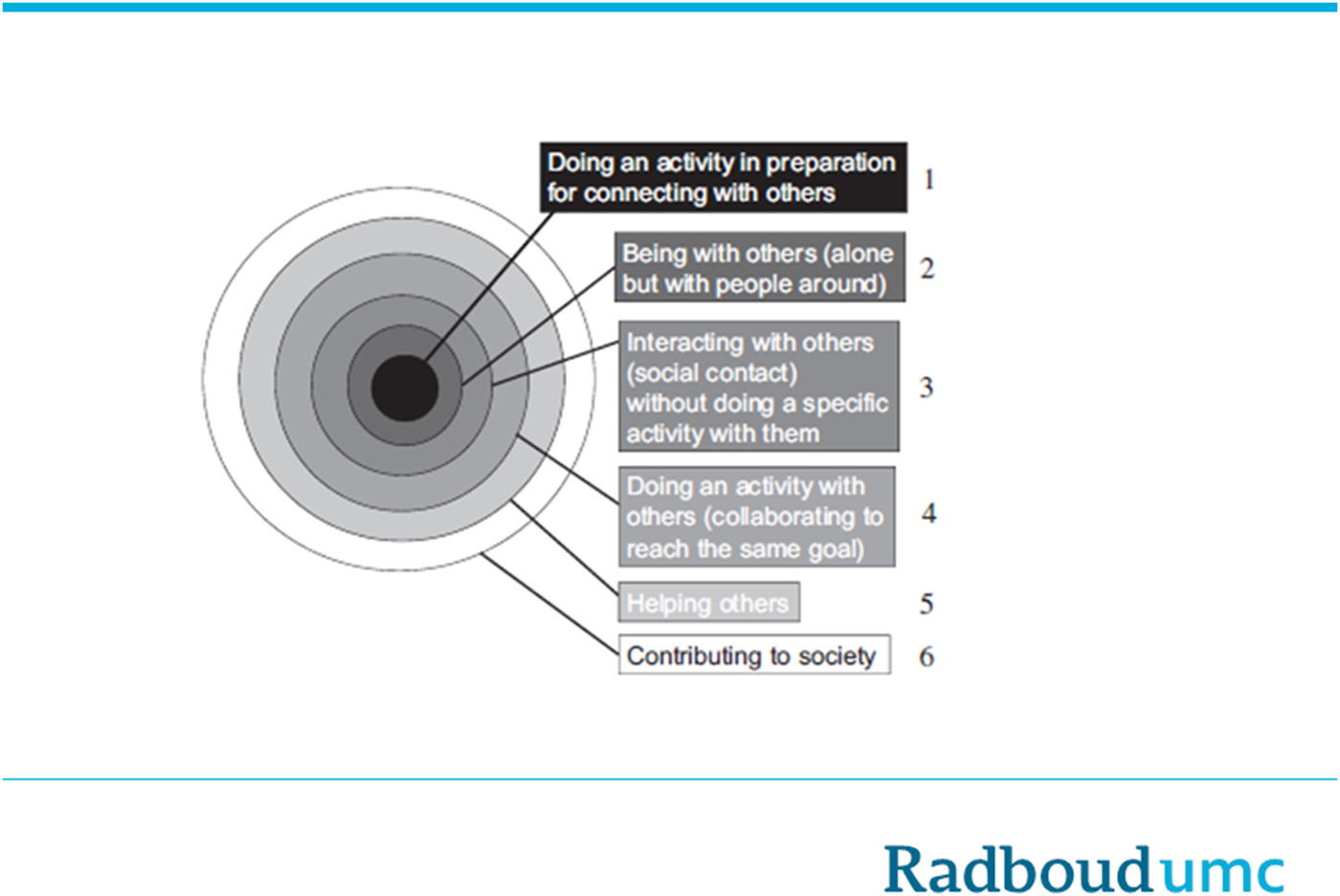
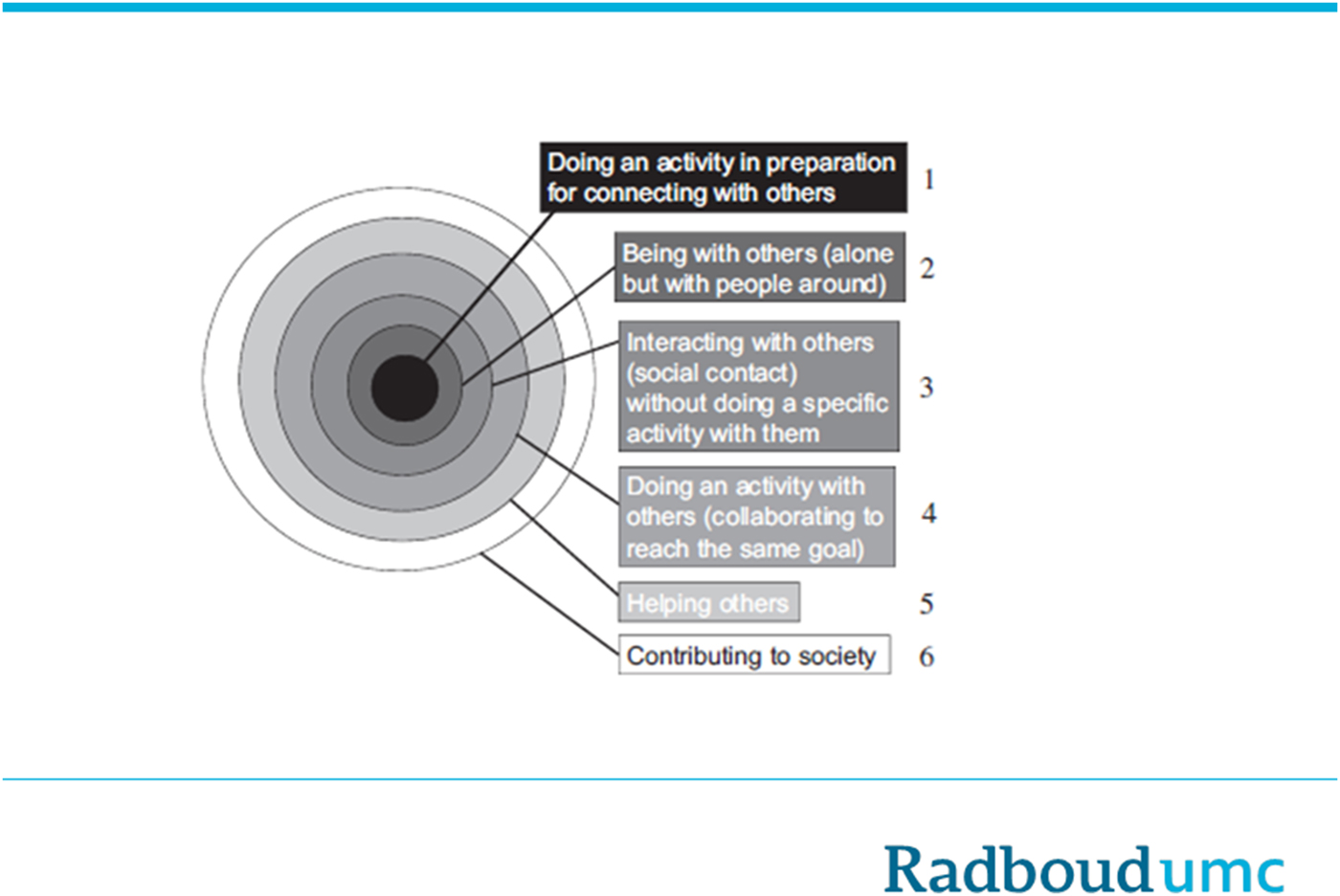
In this paper, social participation refers to the taxonomy of social activities as proposed by Levasseur et al. (Reference Levasseur, Richard, Gauvin and Raymond2010: 2146): ‘the person's involvement in activities that provide interaction with others in society or the community’. These authors suggest grouping activities in six levels, depending on the involvement of the individual with others and the goals of the activity: (1) an activity that prepares for connecting with others, (2) being with others (alone but with people around), (3) interacting with others (social contact) without engaging in a specific activity with the others, (4) engaging in an activity with others (collaborating to reach the same goal), (5) helping others, and (6) contributing to society (Figure 1). Levels 1 and 2 include daily activities such as getting dressed and preparing breakfast, which act as a precondition to the performance of social participation. As cognitive problems result in increasing degrees of impairment in functioning and activities of daily living, social participation is also threatened indirectly by a decline in daily activities, and thus these activities are important in relation to social participation. Furthermore, performing everyday activities contributes to peoples’ sense of self-management and autonomy. Performing daily activities also has a value because it results in feelings of belonging, enjoyment and independence (Satink et al. Reference Satink, Josephsson, Zajec, Cup, de Swart and Nijhuis-van der Sanden2016). Levels 3–6 are regarded as social participation. As there is no agreement on a common definition of social participation and the underlying dimensions (Levasseur et al. Reference Levasseur, Richard, Gauvin and Raymond2010; Piskur et al. Reference Piskur, Daniels, Jongmans, Ketelaar, Smeets, Norton and Beurskens2014), different concepts such as social participation, community involvement and participation are used interchangeably. A lack of consensus resulted in problems around the development and selection of instruments to measure social participation. The taxonomy of social activities used in this study is based on an inventory and content analysis of definitions that allows differentiation between levels of social participation. This classification of activities enables health-care providers to operationalise in goal setting and measurement, and it enables them to identify changes in activities over time. This is highly relevant in the current study, which targets people with cognitive problems whose abilities decrease over time. The possibility of measuring changes in social participation is important for our consecutive intervention pilot study of improvement of social participation. For this reason, we used Levasseur's model for social participation.
Taxonomy of social activities based on levels of involvement of the individual with others and the goals of these activities.
The aim of our study was to explore how community-dwelling older people with cognitive problems and their care-givers perceive their own social participation, how care-givers evaluate the social participation of the people they care for, and what factors they perceive to be influential as barriers and facilitators. This qualitative study is embedded in research related to the development of the Social Fitness Programme (Donkers et al. Reference Donkers, van der Veen, Vernooij-Dassen, Nijhuis-van der Sanden and Graff2017), in which we use the recommendations of the Medical Research Council (MRC) (Craig and Petticrew Reference Craig and Petticrew2013). The MRC proposes a systematic and phased approach for intervention development. As part of the development phase of the MRC framework, we integrated effective interventions with expert opinions from health-care and welfare professionals into a draft intervention. For the next step in the development, our paper focuses on social participation perspectives of a target population of people with cognitive problems and their care-givers who were referred for an intervention. Insight into their needs and questions for help enables us to improve the quality of the intervention and to incorporate this insight during intervention delivery.
Method
Research design and setting
In this qualitative study, we explore the experiences and perspectives on social participation of both the older people with cognitive problems and their care-givers. We performed semi-structured, in-depth interviews with the people who participated in the Social Fitness Programme. We did so by following the consolidated criteria for reporting qualitative research (COREQ; Tong, Sainsbury and Craig Reference Tong, Sainsbury and Craig2007). The local research ethics committee of the Radboud University Medical Center, Nijmegen (CMO number 2012/401), approved this study. The study took place in two districts in the Netherlands.
The Social Fitness Programme consisted of an integration of occupational therapy, physiotherapy and guidance provided by a welfare professional. The intervention took place in the home environment to enable the removal of barriers and to facilitate the execution of activities in the social and physical environment (the context). The professionals used a personalised approach to empower participants to optimise compensatory and environmental strategies and enable clients and care-givers to participate socially in their own context. The intervention addressed needs, preferences and abilities of the person with cognitive problems, the care-giver and their social environment. To achieve this, the occupational therapist started the intervention with a thorough analysis of problems and needs, which led to a shared-goal setting that focused on social activities that were relevant and important to both the person with cognitive problems and the care-giver. The occupational therapists and physiotherapists combined active treatment methods with exercises to improve the strategies, skills, bodily functions and physical activities of the dyads. To do this, they used coaching methods that focus on improving self-confidence and self-management. The welfare professional provided practical support for the participants in achieving their goals, such as active guidance for the activities (Donkers et al. Reference Donkers, van der Veen, Vernooij-Dassen, Nijhuis-van der Sanden and Graff2017).
Study population, procedures and recruitment
Two related participant groups who contacted the Social Fitness Programme were included in the study. The first group consisted of home-dwelling people with cognitive problems (Mini-Mental State Examination, MMSE 10–24; Vertesi et al. Reference Vertesi, Lever, Molloy, Sanderson, Tuttle, Pokoradi and Principi2001). The second group included the primary care-givers who wished to maintain or improve their own social participation or the social participation of the people they cared for.
In this study, health-care and welfare professionals from general practices, memory clinics, home care organisations, social welfare organisations for the elderly, meeting centres for people with dementia and care-givers provided people with cognitive problems and their care-givers with oral and written information about the study. Candidates were included as participants if they were able to formulate at least one need or intervention goal on level 2 (being with others) of the social participation taxonomy. The occupational therapist qualitatively assessed this criterion during the intake. The regional co-ordinating occupational therapists contacted clients and care-givers who were willing to participate. These therapists provided oral and written explanations of the nature of the study to the potential participants and checked whether they met the inclusion criteria. Potential participants who were not able to complete the self-assessment forms as a result of language problems, and those who exhibited behavioural and psychological symptoms of dementia, severe heart conditions or other comorbidity, or were in hospital, were excluded. All 14 dyads who were willing to participate and who met inclusion criteria enrolled in the study after they had signed an informed consent form. Participation in this study was voluntary, and the participants could withdraw from participation at any time.
After their participation in the Social Fitness Programme, the research assistant contacted the participants and asked if they were willing to take part in an interview. If they agreed to be interviewed, the research assistant explained the procedures, answered any questions and made an appointment for an interview.
Data collection
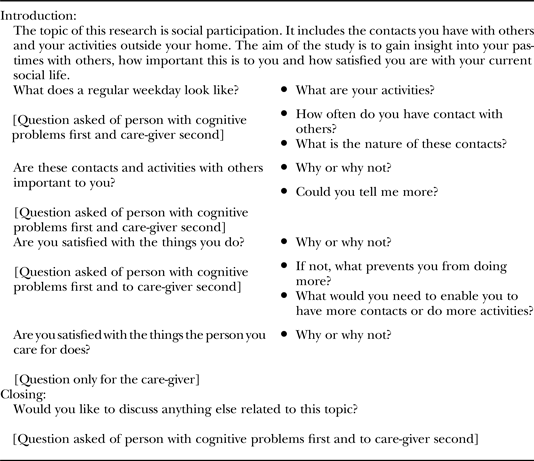
Thirteen semi-structured interviews were conducted in two rounds: six interviews took place in February 2013 and seven interviews took place in August and September 2013. Both the person with cognitive problems and the care-giver participated together in 12 interviews; one care-giver was interviewed alone because the person with cognitive problems was unable to participate. One couple declined because the care-giver felt the burden of participating was too great for her and her husband with cognitive problems. A trained interviewer obtained informed consent from the participants and interviewed them at their homes. The interviewer used an interview guide (Table 1), which was derived from the Canadian Occupational Performance Measurement (COPM; Law et al. Reference Law, Baptiste, McColl, Opzoomer, Polatajko and Pollock1990) and adapted to incorporate social participation as a specific topic of the interview. The COPM is an individualised, standardised, client-centred measure designed to assess problems in meaningful daily activities for use by occupational therapists. It is suitable for all people with perceived problems in daily activities. Because we apply a definition for social participation as part of social health in which daily activities and social participation are closely linked, we believe that the design of the COPM is adequate for evaluating social participation perspectives and topics.
Interview guide

As shown in Table 1, the interviewer began with a question to get insight into the dyads’ daily and social activities and elaborated on the meaningfulness of these activities. Both the person with cognitive problems and the care-giver were invited to respond to questions regarding their self-perceived current performance and satisfaction with these activities. The interviewer asked the person with cognitive problems questions first and the care-giver second, with the exception of the question regarding the care-giver's satisfaction with the social activities of the person with cognitive problems. The interviewer tried to elicit opinions from both participants during the interview and posed additional questions to clarify whether there was agreement or discrepancy in the opinion of the two interviewees. The duration of the interviews was not predefined and depended on the interviewees’ input. The interviews lasted 71 minutes on average, with a range of 36–96 minutes.
Analysis
The trained research assistant transcribed the recorded interviews verbatim, then content analysis was used to analyse the transcripts thematically (Graneheim and Lundman Reference Graneheim and Lundman2004). After repeated study of the transcripts, we used the software program Atlas.ti 7.1.4 to code the text segments. The coding system was based on the content of the data, and there were no predefined coding themes. Two researchers coded the first five transcripts independently. Two researchers reviewed, discussed and refined the initial coding results until they reached consensus for a draft code book. This book formed the basis for coding the rest of the transcripts. DV coded the remaining eight interviews and HD checked the coding. Two researchers discussed and refined all the coded transcripts until they reached consensus for all the codes. Since both the person with cognitive problems and the care-giver were invited to respond to all questions, codes were attributed to either the care-giver or the person with cognitive problems. When there was a difference of opinion between the care-giver and the person with cognitive problems, separate codes were assigned.
In a subsequent meeting of the project team, an affinity diagram was created (Johnson et al. Reference Johnson, Barach, Vernooij-Dassen and Collaborative2012) for mapping barriers to and facilitators of social participation. The project team consisted of the main researcher (HD) and the three senior researchers not involved in data collection or analysis (MV, MN and MG). During the meeting, the team members independently classified codes in categories consisting of codes referring to the same phenomenon. All individual codes were brought together in categories, which were subsequently grouped in overall themes. In this way an affinity diagram was created, which was discussed until consensus was achieved and no new categories or themes were generated. Then the two researchers involved in data collection discussed this final affinity diagram. This did not result in proposed modifications.
Results
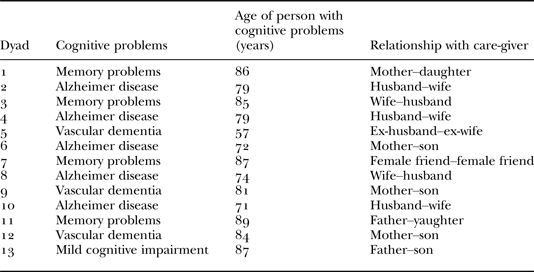
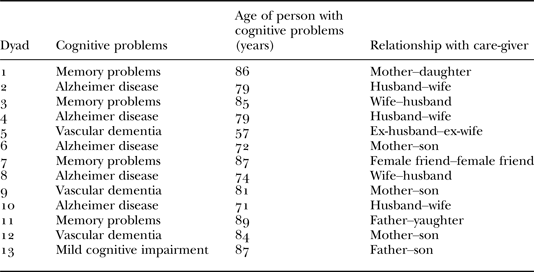
Table 2 presents the characteristics of the interviewees. The mean age of the people with cognitive problems was 80 years, with a range of 57–89 years. Seven care-givers were of the same generation as the people they cared for, and six care-givers were of a younger generation (adult children).
Dyad characteristics
Current social participation
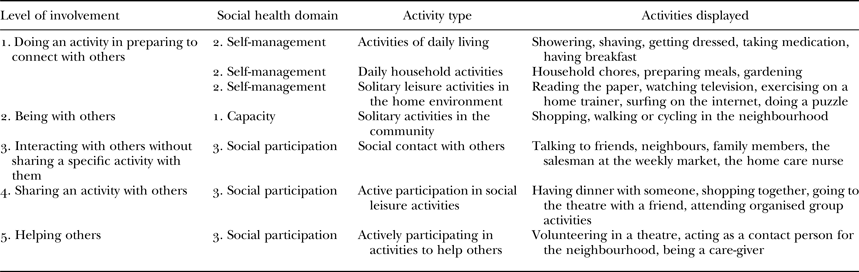
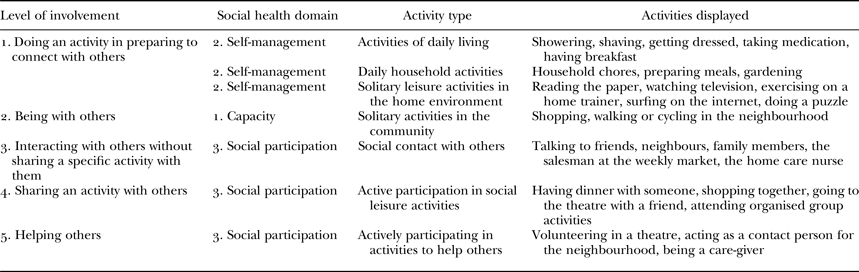
Table 3 shows the current social activities of people with cognitive problems and their care-givers listed by level of involvement in social participation (Levasseur et al. Reference Levasseur, Richard, Gauvin and Raymond2010). The activities most often mentioned were preconditions for connecting with others. No activities in the sixth level of involvement (contributing to society) were mentioned in the interviews. In order to allow contributions to the social health framework, we connected the levels of social participation to the concept of social health (Huber et al. Reference Huber, Knottnerus, Green, van der Horst, Jadad, Kromhout, Leonard, Lorig, Loureiro, van der Meer, Schnabel, Smith, van Weel and Smid2011). Most activities concerned self-care, as well as instrumental and leisure activities in the home environment. These activities took place independently as preconditions for connecting with others (social participation level 1) and were also part of the self-management domain (social health domain 2). Activities performed alone but in the presence of others (e.g. shopping) could be connected to social participation level 2 and linked to the social health domain 1 (capacity to fulfil potential and obligations) because they both concern the ability of a person to function outside the home environment. Activities involved in social participation from level 3 onwards were regarded as active social participation, which connected with social health domain 3 (social participation). Social participation involved meaningful activities and social interactions, such as conversations, group activities and being a care-giver.
Types of social and daily activities displayed by the interviewees
Social participation perspectives
All the people with cognitive problems and their care-givers reported that the frequency of daily and social activities had diminished over time. This was more apparent for the older care-givers than for the younger ones.
He [husband] has difficulties with being alone … which is very difficult for me because I go out for shorter periods of time. (Care-giver 5)
A decrease of different roles was reported as well, for example, roles such as being a professional, babysitter, care-giver and volunteer. This reduction in roles applied to all the people with cognitive problems and to most of the care-givers in the same generation, and to a lesser extent, to the younger care-givers. Although all the people with cognitive problems said that their social participation had diminished, most of them were satisfied with their current level of social participation.
I think the contacts I currently have are pleasant; I can oversee them. I do not want all my days too full anymore. (Person with cognitive problems 1)
Only two of the people with cognitive problems (persons 8 and 12) were dissatisfied with their current level of social participation and they would rather have more contact with others.
Well, unfortunately you meet less people when you are 70 years or older. (Person with cognitive problems 8)
Ten of the 13 care-givers were satisfied with their own activities and contacts and wanted to maintain them.
I have an urge for social contacts, which I have. (Care-giver 1)
However, three older care-givers said they would rather do more. In contrast, four of the older care-givers and four of the younger ones believed the people they cared for should be more socially active.
She [person with cognitive problems] is satisfied. But I do not think it is good for her to sit inside the house all day. (Care-giver 6)
Barriers and facilitators for social participation
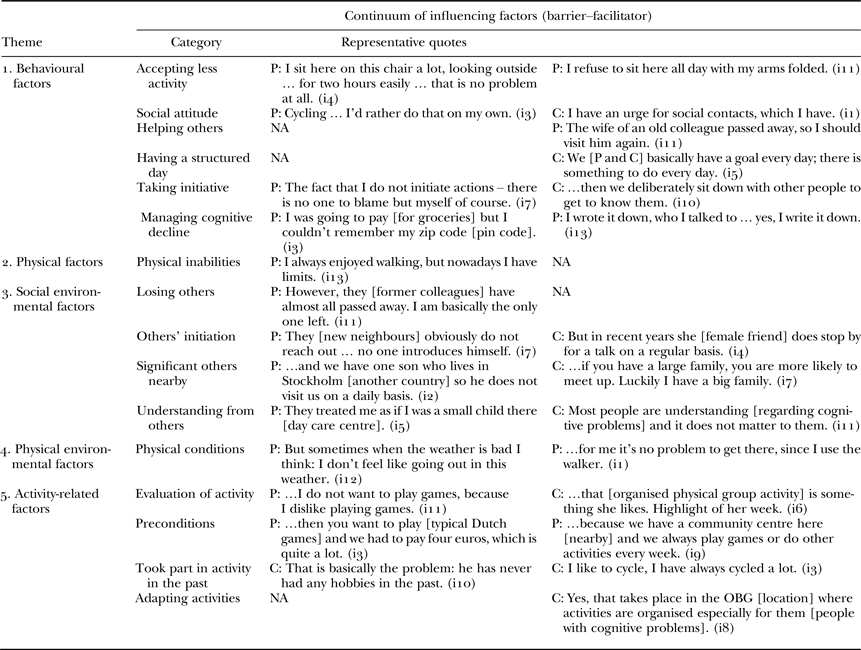
During the interviews, interviewees showed that a variation of factors influence their social participation. The analysis of the interviews provided five themes: behavioural, physical, social environmental, physical environmental and activity-related. A total of 16 categories were distinguished in the five themes; these categories represent a continuum of factors that either hinder or enhance social participation. Table 4 shows an overview, including representative quotes per category.
Themes, categories and quotes related to factors influencing the dyad's social participation
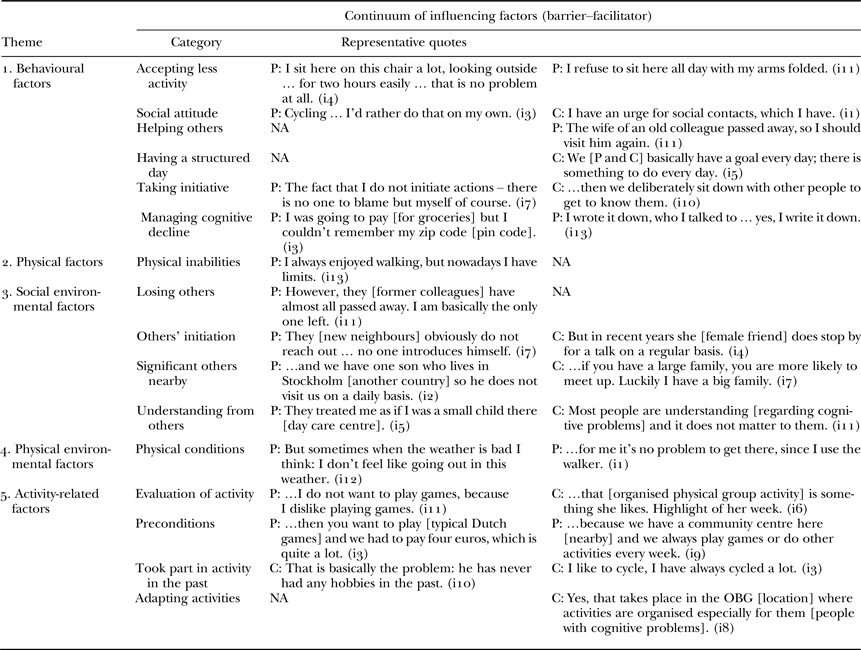
Notes: P: person with cognitive problems. C: care-giver. i: interview. NA: not applicable.
Theme 1: Behavioural factors
The main barrier for social participation was the acceptance of taking part in activities less frequently coupled with a lack of motivation for social participation. At the same time, refusing to accept an activity decrease was the main facilitator for people to remain socially active. People with cognitive problems and some older care-givers stated that they were satisfied with being alone and doing things alone; true internal need and necessity for social participation with others was lacking. They believed that becoming less socially active was normal at older age.
It [social activity level of person with cognitive problems] clearly decreased yes … but of course all older people have that. (Care-giver 7)
It [performing social activities] is getting more difficult … yes, you have to account for getting older. (Person with cognitive problems 10)
To some degree, all the people with cognitive problems and four older spouse care-givers deliberately chose to refrain from social participation. They stated that they did not perceive being with others as having any added value, and some said they would rather be alone or at home instead of somewhere else. Some also stated that they preferred doing activities alone and had never had much social contact with others in the past, so they did not want to start new activities or meet new people.
Cycling … I'd rather do that on my own. (Person with cognitive problems 3)
However, all the people with cognitive problems and six care-givers also showed signs of a positive attitude towards social participation as a valuable part of everyday life. People referred to themselves as being sociable, preferring to be among others and sharing activities, enjoying small talk and conversations. Being a sociable person was also evident in their desire to help others, which led to some people with cognitive problems and some care-givers initiating social participation. Several people preferred doing something nice for others, such as inviting them for dinner, or they wanted to support people in difficult times, such as during illness.
The wife of an old colleague passed away, so I should visit him again. (Person with cognitive problems 11)
Several behavioural factors influencing social participation were related to changes in cognition. All the people with cognitive problems reported that their reduced cognitive abilities hindered their participation in social activities. This sometimes resulted in a deliberate choice to refrain from social participation, to protect themselves from the consequences of their cognitive problems. They said that they often forgot new appointments, things they had done recently, peoples’ names and conversations they had had. They also realised that they could no longer manage some activities of daily living because of their cognitive problems, e.g. withdrawing money from a cash machine. This caused negative feelings of insecurity and shame to some of them, and it influenced their self-confidence and self-efficacy. Their cognitive problems also resulted in the inability to manage changes in daily life, such as finding the way home when part of the street was blocked. Two spouse care-givers mentioned that their inability to manage the cognitive decline of the person they cared for impeded their own social participation, e.g. because the person with cognitive problems preferred their care-giver to be around all the time. A lack of taking their own initiative compounded the decrease in social participation of the people with cognitive problems. Some depended entirely on others to encourage them to take on activities. However, several people with cognitive problems also used strategies such as effective note keeping to compensate for their cognitive decline. They wrote things down so they would remember them, things such as who they had talked to recently and what the conversation was about. Having a structured day with fixed daily routines, recurrent appointments with others and routine obligations in general also helped them stay socially active.
I wrote it down, who I talked to … yes, I write it down. (Person with cognitive problems 13)
Theme 2: Physical factors
All the people with cognitive problems and seven spouse care-givers reported several physical inabilities that acted as barriers to their social participation. People said that their mobility and condition deteriorated. Some of them felt tired and had no energy to do things. Pain and other physical discomforts, such as hearing problems, deterred several persons from being socially active. A feeling that they might fall also hindered some people.
I always enjoyed walking, but nowadays I have limits. (Person with cognitive problems 13)
Theme 3: Social environmental factors
The social environment can hinder or enhance a person's social participation directly or indirectly. When no significant others lived nearby, people with cognitive problems and their care-givers perceived the geographical distance to be a barrier. Most of the people with cognitive problems and spouse care-givers mentioned the death of a spouse, family members or friends who had been close to them. Those were people they lived with, could talk to and share activities with. Losing important others decreased the opportunities to be socially active. Children and grandchildren often had busy lives, so they could not initiate contact more often. Furthermore, some people with cognitive problems were prevented from being socially active because they had no one to go along with them to an activity or to take them somewhere. Another barrier was the exclusion of people in their neighbourhood; neighbours had individual lives of their own and did not initiate contact. The initiating role of the social environment can also be an important facilitator of social participation. Having a big family living nearby acts as an opportunity for social contacts. All the people with cognitive problems and three spouse care-givers reported that there were others who initiated social contact by visiting them and offering help. Sometimes people, especially younger people, encouraged people with cognitive problems and older care-givers to be socially active. For example, one daughter encouraged her mother (who was a care-giver for her husband) to go to yoga classes with her. Moreover, two people with cognitive problems and their spouse care-givers reported that their marriage automatically resulted in sharing activities. Care-givers often said that they encouraged the people they cared for to become more active.
The social network's lack of acceptance of cognitive problems acted as a barrier to social participation. Six people with cognitive problems experienced unpleasant interactions with others, and their care-givers also evaluated these experiences as unpleasant for the person they cared for. This made the people with cognitive problems feel insecure and decreased their self-confidence. As a result, they withdrew from certain contacts or activities. Sometimes others stopped initiating activities, e.g. they no longer returned visits. This also hindered social participation.
They treated me as if I was a small child there [day care centre]. (Person with cognitive problems 5)
In contrast, the way the social network coped with cognitive problems could be a factor that stimulated social participation, e.g. when people displayed understanding and acceptance of cognitive problems. Pleasant contact with others and feeling welcome facilitated seeking contact and sharing activities with others. Knowing each other for a long time ensured having things to talk about, which was highly valued in contacts with others.
Most people are understanding [regarding cognitive problems] and it does not matter to them. (Care-giver 11)
Theme 4: Physical environmental factors
Increasing physical inabilities (the personal physical factors in theme 2) resulted in the experience of barriers from the physical environment. Lack of transport due to the lost ability to drive a car or difficulties using public transport were barriers for eight people with cognitive problems and five spouse care-givers. In contrast, the availability of alternative transport and the use of walking aids were enhancing factors for social participation. Furthermore, cold or rainy weather and outdoor darkness in winter discouraged people from going out, while good and dry weather acted as a facilitator.
But sometimes when the weather is bad I think: I don't feel like going out in this weather. (Person with cognitive problems 12)
Theme 5: Activity factors
People with cognitive problems who had never participated in organised activities in the past had difficulty finding appropriate activities. Sometimes people assumed that certain activities would not be what they wanted. The evaluation of an activity is an important factor for recurrent social participation. Some activities that people with cognitive problems actually participated in were experienced as unpleasant afterwards, sometimes because they were unable to perform the activity as planned. These negative evaluations resulted in their refraining from participating again, while positive evaluations elicited recurrent participation.
I do not want to play games, because I dislike playing games. (Person with cognitive problems 11)
Activities that were adapted to the abilities and preferences of the people with cognitive problems were likely to be continued. Some people with cognitive problems and older care-givers said that they continued activities of the past or that they had again picked up activities they used to do.
Activity factors related to environmental preconditions also influenced peoples’ continuing or discontinuing social participation. This was often related to personal physical factors (theme 2) and physical environmental factors (theme 4). Some people with cognitive problems and some care-givers said that the location of the activity could be a hindrance. This was because of the distance or because of the look and feel of the place. With regard to organised group activities, the starting time, frequency or costs did not suit some people. The location, starting time and frequency of some organised activities appealed to some people, which facilitated their social participation:
…that [organised physical group activity] is something she [person with cognitive problems] likes. Highlight of her week. (Care-giver 6)
Discussion
By elucidating perceptions from two perspectives, this study extends the knowledge of the complexity of social participation and its influencing factors. We showed that the different levels of social participation are connected to all dimensions of social health. This highlights the dynamics of social participation as an interaction between personal factors (the capacity to fulfil one's potential and obligations and the ability to self-manage the disease) and the social and physical environment in which social participation occurs. Social participation is threatened in the context of cognitive decline as one's capacity and ability to self-manage is affected. Social participation can be challenged by the response of the social network. A negative response or fear of a negative response might enhance social disengagement. While a positive response of the social network, which includes the maintenance of dignity and preserving people's autonomy, might enhance social participation. This finding corresponds to the work of Berkman et al. (Reference Berkman, Glass, Brissette and Seeman2000) who developed a conceptual model to understand the influences of how social networks impact health. This model includes a ‘downstream’ causal process on the influence of network structure and function on social and interpersonal behaviour. Four ‘primary pathways’ are expected to influence behaviour: provision of social support, social influence, social engagement, and attachment and access to resources and material goods (Berkman et al. Reference Berkman, Glass, Brissette and Seeman2000: 843).
With regard to social participation perceptions, two new findings imply that social participation has both subjective (feeling) and objective (doing) dimensions. First, most people with cognitive problems were satisfied with their reduced social participation. Second, the care-givers were dissatisfied with the reduced social participation of the people they cared for. This study confirms earlier research findings that social participation diminishes with increasing age (Desrosiers et al. Reference Desrosiers, Robichaud, Demers, Gelinas, Noreau and Durand2009; Turcotte et al. Reference Turcotte, Lariviere, Desrosiers, Voyer, Champoux, Carbonneau, Carrier and Levasseur2015). Social participation is influenced by a continuum of factors that can act as barriers or facilitators. People's social participation is determined to a great extent by their personal attitudes and behaviour, in interaction with factors in the social and physical environment, including activity-related factors
A lack of motivation to be socially active, often assigned to their older age, was an important behavioural barrier for people with cognitive problems. The results suggest that people coped with reduced social participation in one of two ways, similarly to older people who experience loneliness (Goll et al. Reference Goll, Charlesworth, Scior and Stott2015; Schoenmakers, van Tilburg and Fokkema Reference Schoenmakers, van Tilburg and Fokkema2012). While care-givers whose own social participation had diminished (mainly the older spouse care-givers) tried to improve their level of social participation, the people with cognitive problems usually adapted their expectations and accepted the barriers. This acceptance could also result in satisfaction with their own reduced level of social participation. Most influencing factors of social participation are often difficult for the older individual to change, especially when cognitive problems occur. For example, initiating the expansion of a decreased social network can be difficult, as can finding appropriate activities for someone with cognitive problems. The different behavioural reactions on reduced social participation displayed by care-givers and the people they cared for is in line with literature characterising people from the third age and the fourth age (Pirhonen et al. Reference Pirhonen, Ojala, Lumme-Sandt and Pietilä2015). The older care-givers (third age, the active and contributing age) created opportunities to participate socially; while on the other hand, the people with cognitive problems (fourth age, the frail ‘real old age’) were unable to self-manage and initiate social participation. The inability to self-manage causes dependence on their care-givers, which in turn could have threatened their autonomy and dignity (Lloyd et al. Reference Lloyd, Calnan, Cameron, Seymour and Smith2012).
Different subconscious mechanisms seem to be at play in the display of satisfaction with reduced social participation. A social stigma might stop people with cognitive problems from admitting their dissatisfaction with reduced social participation (Rokach Reference Rokach2012). According to Festingers’ theory of cognitive dissonance (Festinger Reference Festinger1962), claiming to be satisfied with reduced social participation can be an illustration of peoples’ effort to reduce dissonance between their actual behaviour and their values and beliefs. When a decline in social participation resulted in discomfort with their beliefs about the importance of being socially active, people with cognitive problems adapted their beliefs to overcome this discomfort. As a result, they claimed to be satisfied with their reduced social participation. The satisfaction with reduced social participation may also be considered as a form of self-compassion, ‘being kind toward oneself when considering weaknesses, remembering that being human means being flawed and imperfect’ (Neff and Vonk Reference Neff and Vonk2009: 26). In this way, psychological functioning is influenced positively. The people with cognitive problems accepted their decreased participation: a decrease in participation and functioning is commonly associated with older age. This in turn positively influenced their emotional functioning by evoking feelings of satisfaction. Although people with cognitive problems experienced a decrease in social participation, they tried to protect themselves and hide associated negative feelings: negative feelings of shame as a result of reduced competencies and negative feelings related to fear of not being accepted. This contributed to their withdrawal and to their decreased social participation. Research into loneliness suggests this as well (Holmen, Ericsson and Winblad Reference Holmen, Ericsson and Winblad2000).
The dissatisfaction of the care-givers with the reduced social participation of the people they cared for resulted in a discrepancy in perspectives on social participation between care-givers and the people they cared for. Disagreement about patient–care-giver needs (van der Roest et al. Reference van der Roest, Meiland, Comijs, Derksen, Jansen, van Hout, Jonker and Droes2009) and less favourable outcomes reported by care-givers in proxy reports are common (Lyons et al. Reference Lyons, Zarit, Sayer and Whitlatch2002). In our study, the care-givers tended to respect the autonomy and wishes of people they cared for, on the one hand, but encouraged them to be more socially active, on the other hand. This represents the tension between what is supposed to be beneficial to people with cognitive problems and their own personal wishes. To enhance individual social participation, it is important to first get insight into the reasons for the decline of peoples’ social participation. Sometimes people withdraw as a consequence of dealing with their cognitive decline and accept these adaptations in their social participation due to changing personal circumstances. Then an intervention is required that is different from the intervention for people who withdraw as a result of a more passive attitude to reduce cognitive dissonance in older age. Most people with cognitive problems displayed both reasons, and most older care-givers showed the acceptance that reduced dissonance. This duality within and between people shows the complexity of social participation perspectives. It also raises the question whether social participation should always be encouraged. Although the definition for positive health includes social participation (Huber et al. Reference Huber, Knottnerus, Green, van der Horst, Jadad, Kromhout, Leonard, Lorig, Loureiro, van der Meer, Schnabel, Smith, van Weel and Smid2011), and social participation leads to health benefits (Moll et al. Reference Moll, Gewurtz, Krupa, Law, Lariviere and Levasseur2015), these aspects of health cannot be considered solely as a rationale for intervening without respecting the individual's autonomy (Vernooij-Dassen, Leatherman and Olde-Rikkert Reference Vernooij-Dassen, Leatherman and Olde-Rikkert2011). Therefore, it is important to consider the individual's true needs and desires and to discuss the social stigma associated with social participation as well as the level of support offered by the social and physical environment.
Social environmental influences are mainly a result of (a) the size of the social network, (b) the way the social network copes with cognitive problems, and (c) the level of initiative presented by the social network. The social environment acts as an adaptive scale. Losing others is a threat to social participation because it results in a decrease of the social network and thus of interactions with others. The feeling of not being accepted as a result of cognitive problems, negative encounters and others who stop initiating contact all lead to feelings of insecurity. As a result, to protect oneself from the consequences of cognitive problems and from negative encounters with others, people sometimes deliberately choose to refrain from social participation. Support from the social environment is therefore important to help keep people with cognitive problems socially active and engaged in activities (Teri et al. Reference Teri, Gibbons, McCurry, Logsdon, Buchner, Barlow, Kukull, LaCroix, McCormick and Larson2003). In our study, the care-givers often wanted to improve the social participation of the people they cared for. The main barrier they encountered was a lack of motivation of the person they cared for to be socially active. Cognitive problems often led to a deterioration of social and behavioural skills and physical functioning. The inability to manage this decline most likely resulted in decreased self-confidence and self-efficacy, which contributed to their lack of motivation, as Sorensen, Waldorff and Waldemar (Reference Sorensen, Waldorff and Waldemar2008) report as well. The feeling of not being accepted because of cognitive problems and negative encounters led to feelings of insecurity. As a result, to protect themselves from the consequences of cognitive problems and negative encounters, people sometimes deliberately chose to refrain from social participation. Physical environmental factors can also hinder social participation, which is a finding consistent with other studies among adults with various diseases (Silva et al. Reference Silva, Sampaio, Ferreira, Camargos and Neves2013; Whiteneck et al. Reference Whiteneck, Harrison-Felix, Mellick, Brooks, Charlifue and Gerhart2004). Furthermore, physical and cognitive inabilities interact with physical environmental conditions and activity-related preconditions, which influences social participation. This finding is also consistent with other studies among adults with various diseases (Silva et al. Reference Silva, Sampaio, Ferreira, Camargos and Neves2013; Whiteneck et al. Reference Whiteneck, Harrison-Felix, Mellick, Brooks, Charlifue and Gerhart2004).
Our study shows that, to improve social participation, not only is encouragement of both the people with cognitive problems and their care-givers necessary, but their social and physical environment should also be adapted to their individual needs to prevent and overcome barriers to social participation. The Social Ecological Model (Krug Reference Krug2002) provides a theory-based framework for promoting social participation within a social system, which addresses barriers at multiple levels and accounts for interactions between individuals and their environment. Promoting social participation requires a multifaceted approach that includes the following elements. It should be individual in addressing attitude and enhancing physical skills and intrapersonal in empowering the social network. It should be community-related in encouraging stigma reduction and include people with dementia by means of age- and dementia-friendly communities. It should be society-related in embracing the social health paradigm (Vernooij-Dassen and Jeon Reference Vernooij-Dassen and Jeon2016).
Although dementia-friendly communities focus on decreasing the physical, cognitive and social barriers for people with dementia in general, this policy is not tailored to individual preferences and needs, which are also essential elements (Van Mierlo et al. Reference Van Mierlo, Van der Roest, Meiland and Droes2010). Because dementia is a progressive disease, the patient's social and functional skills deteriorate so that a greater amount of care-giving becomes necessary. This, in turn, threatens the social participation of the person with cognitive problems and the care-givers (Adelman et al. Reference Adelman, Tmanova, Delgado, Dion and Lachs2014; Moyle et al. Reference Moyle, Venturto, Griffiths, Grimbeek, McAllister, Oxlade and Murfield2011). Therefore, a collaboration of the person with cognitive problems and the care-giver, along with an adapted social (Leung, Orrell and Orgeta Reference Leung, Orrell and Orgeta2015) and physical environment (Malinowsky et al. Reference Malinowsky, Almkvist, Nygard and Kottorp2012), are needed to overcome these barriers for social participation.
Our study has some possible limitations. This research was embedded in research related to the user-oriented development of a new intervention programme with a focus on improving social participation. While participants were interviewed after participation in the intervention, their perceptions on social participation were influenced by this experience, which may have caused bias during the interviews. The satisfaction and acceptance people with cognitive problems showed regarding their decreased social participation might be a result of failure to improve their social participation during the intervention due to cognitive decline. Also, selection bias may have occurred because people were given the opportunity to sign up for the research themselves. Most often, the care-giver initiated study participation because of dissatisfaction with the social participation of the people they cared for. The results of this study are therefore not generalisable to the general population of people with cognitive problems and their care-givers.
Response bias may also have occurred because the interviews involved both the person with cognitive problems and the care-giver at the same time. To avoid this bias, the interviewer tried to gather the individual opinions of both parties by asking follow-up questions and by looking at non-verbal communication signs of agreement and disagreement. As the results show, there was disagreement about the satisfaction with social participation of the persons with cognitive problems. On the whole, people with cognitive problems shared opinions with their care-giver, and vice versa.
Conclusions and implications
Most of the people with cognitive problems said they were satisfied with their reduced social participation, while most care-givers were dissatisfied with it. A discrepancy in perspectives of social participation between care-givers and the people they care for becomes a dilemma, especially for younger care-givers. A key element that might influence this discrepancy is a sometimes deliberate choice of people with cognitive problems to refrain from social participation to protect themselves from the consequences of cognitive problems and from encounters with others. To enhance individual social participation, it is important to first get insight into the reasons for the decline of peoples’ social participation. Analysing the factors influencing social participation resulted in five related themes: behavioural, physical, social environmental, physical environmental and activity-related. These themes represent a continuum of influencing factors that, on the one hand, can act as barriers and, on the other hand, as facilitators. This highlights the dynamics of social participation as an interaction between personal factors (the capacity to fulfil one's potential and obligations and the ability to self-manage the disease) and the social and physical environment in which social participation occurs.
This study extends the knowledge of social participation by providing insight into the perceptions older people with cognitive problems and their carers as well as its influencing mechanisms. Our study also contributes to the emerging theory of social health in relation to social participation. Follow-up research into intervention development aimed at achieving the promotion of social participation would benefit from the incorporation of these findings. We recommend applying knowledge about activity-related factors in practice in order to improve matching the activities with the wishes of people with cognitive problems. Further research is needed to investigate the behavioural adaptations that people with cognitive problems and their care-givers adopt in general as a result of cognitive problems (versus the selected population of our study). More insight into their true evaluations with regard to acceptance and satisfaction or dissatisfaction with these changes is needed. Insight into the mediating role of one's entire social environment could help to improve the social participation of people with cognitive problems, for which additional research is required.
Acknowledgements
We want to thank the people with cognitive problems and their care-givers who participated in this study. The Dutch Alzheimer Association supported this work under grant number WE03.2011-21. The funders had no role in the study design, data collection and analysis, decision to publish or preparation of the manuscript. HD, MV, MN and MG designed the study; DV was instrumental in the data collection; and HD and DV performed the analyses. HD, MV and MG compiled the draft manuscript, and DV and MN commented. All authors read and approved the final manuscript. The research ethics committee of Radboud University Medical Center approved this study (CMO number 2012/401). All ethical guidelines have been met, including adherence to the legal requirements in the Netherlands. Participation in this study was voluntary, and respondents could withdraw from participation at any time. The respondents’ written informed consent was obtained after they had received oral and written explanations of the nature of the study. All authors declare that they have no conflicts of interest with the material in this paper, including financial, consultant, institutional or other relationships that might lead to bias or a conflict of interest.