
 ∞
 ∞
 ∞
 TWr(−)



1. Introduction
The Yoneda embedding is a fundamental tool in category theory. In higher category theory, the
 $(\infty ,1)$
-categorical Yoneda embedding was proved by Lurie [Reference Lurie15, Proposition 5.1.3.1]. There is a fully faithful functor
 $C\to \textrm {Fun}(C^{\textrm {op}},\mathcal{S})$
from an
 $\infty$
-category
 $C$
to the
 $\infty$
-category of presheaves on
 $C$
with values in the
 $\infty$
-category
 $\mathcal{S}$
of spaces. The
 $\infty$
-category
 $\mathcal{S}$
is a full subcategory of the
 $\infty$
-category of (small)
 $(\infty ,1)$
-categories
 $\textrm {Cat}_{(\infty ,1)}$
. In general, it is difficult to work with functors into
 $\mathcal{S}$
or
 $\textrm {Cat}_{(\infty ,1)}$
. The
 $(\infty ,1)$
-categorical Grothendieck construction overcomes this difficulty. Combining [Reference Lurie15, Theorem 2.2.1.2] with [Reference Lurie15, Proposition 4.2.4.4], it gives an equivalence between the
 $\infty$
-category
 $\textrm {Fun}(C^{\textrm {op}},\mathcal{S})$
of presheaves on
 $C$
and the
 $\infty$
-category of right fibrations over
 $C$
. It also gives an equivalence between the
 $\infty$
-category
 $\textrm {Fun}(C^{\textrm {op}},{\textrm {Cat}_{(\infty ,1)}})$
of functors into
 $\textrm {Cat}_{(\infty ,1)}$
and the
 $\infty$
-category of Cartesian fibrations over
 $C$
by combining [Reference Lurie15, Theorem 3.2.0.1] with [Reference Lurie15, Proposition 4.2.4.4]. It is easier to handle right fibrations or Cartesian fibrations than functors into
 $\mathcal{S}$
or
 $\textrm {Cat}_{(\infty ,1)}$
.
The twisted arrow
 $\infty$
-category of an
 $(\infty ,1)$
-category is a right fibration associated with the mapping space functor. For an
 $\infty$
-category
 $C$
, the twisted arrow
 $\infty$
-category
 $\textrm {Tw}^r(C)$
was introduced by Lurie in [Reference Lurie16, §5.2.1]. It comes equipped with a map
 $\textrm {Tw}^r(C)\to C\times C^{\textrm {op}}$
of
 $\infty$
-categories which is a right fibration classified by the mapping space functor
 $\textrm {Map}_{C}(-,-)\,:\, C^{\textrm {op}}\times C\to \mathcal{S}$
.
Twisted arrow
 $\infty$
-categories of
 $(\infty ,1)$
-categories play a fundamental role in higher category theory. They are used to show an existence of a dual equivalence between two
 $(\infty ,1)$
-categories, where a dual equivalence between
 $(\infty ,1)$
-categories
 $C$
and
 $D$
means an equivalence of
 $C$
and
 $D^{\textrm {op}}$
. A pairing of
 $\infty$
-categories between
 $C$
and
 $D$
is a functor
 $C\times D\to \mathcal{S}$
. As mentioned above, it is convenient to identify it with a right fibration over
 $C^{\textrm {op}}\times D^{\textrm {op}}$
. As a matter of fact, in [Reference Lurie16, Definition 5.2.1.5], Lurie has defined a pairing of
 $\infty$
-categories to be a triple
 $(C,D,\lambda )$
, where
 $\lambda \,:\, M\to C\times D$
is a right fibration between
 $\infty$
-categories. A pairing is said to be perfect if it is equivalent to a twisted arrow
 $\infty$
-category as right fibrations under the equivalence between
 $\textrm {Fun}\,(C\times D,\mathcal{S})$
and the
 $\infty$
-category of right fibrations over
 $C^{\textrm {op}}\times D^{\textrm {op}}$
. If a pairing between
 $C$
and
 $D$
is perfect, then it gives a dual equivalence between
 $C$
and
 $D$
. This technique is used to study iterated bar constructions and Koszul duality for
 $\mathbb{E}_k$
-algebras in
 $\mathbb{E}_k$
-monoidal
 $(\infty ,1)$
-categories in [Reference Lurie16, §5.2]. It is also used in [Reference Torii21] to construct a dual equivalence between the
 $(\infty ,1)$
-category of monoidal
 $(\infty ,1)$
-categories and left adjoint oplax monoidal functors and that of monoidal
 $(\infty ,1)$
-categories and right adjoint lax monoidal functors.
Twisted arrow
 $\infty$
-categories are also used for other constructions in the setting of higher category theory. The
 $(\infty ,1)$
-categorical (co)ends [Reference Glasman8] and weighted (co)limits [Reference Gepner, Haugseng and Nikolaus7] are constructed as some (co)limits indexed by twisted arrow
 $\infty$
-categories. For an
 $\infty$
-category
 $C$
, the
 $\infty$
-category of spans in
 $C$
is constructed from some functors from the twisted arrow
 $\infty$
-categories of the ordinary categories
 $[n]$
into
 $C$
. The construction of
 $\infty$
-categories of spans was introduced in [Reference Barwick2]. It is shown that the construction of twisted arrow
 $\infty$
-categories is a left adjoint to the construction of
 $\infty$
-categories of spans in [Reference Haugseng, Hebestreit, Linskens and Nuiten10, Theorem A].
A generalization to the construction of
 $\infty$
-categories of twisted arrows in
 $(\infty ,2)$
-categories was introduced by Abellán García and Stern in [Reference García and Stern1]. For an
 $\infty$
-bicategory
 $Z$
, they constructed an
 $\infty$
-category
 $\textrm {Tw}^r(Z)$
equipped with a map
 $p\,:\, \textrm {Tw}^r(Z)\to u_1Z\times u_1Z^{\textrm {op}}$
of
 $\infty$
-categories which is a Cartesian fibration classified by the restricted mapping
 $\infty$
-category functor
 $\textrm {Map}_{Z}(-,-)\,:\, (u_1Z\times u_1Z^{\textrm {op}})^{\textrm {op}}\simeq u_1Z^{\textrm {op}}\times u_1Z\to {\textrm {Cat}_{(\infty ,1)}}$
, where
 $u_1Z$
is the underlying
 $\infty$
-category of
 $Z$
.
The goal of this paper is to give another simple model for twisted arrow
 $\infty$
-categories of
 $(\infty ,2)$
-categories. We first construct a complete Segal space
 $\mathrm{TW}^r(Z)$
which is a lifting of the
 $\infty$
-category
 $\textrm {Tw}^r(Z)$
with respect to the Quillen equivalence
 $i_1^*\,:\, \textrm {bSet}_{\Delta }^{\textrm {CSS}}\to \textrm {Set}_{\Delta }^{\textrm {Joy}}$
[Reference Joyal and Tierney14] from the category of bisimplicial sets equipped with complete Segal space model structure
 $\textrm {bSet}_{\Delta }^{\textrm {CSS}}$
[Reference Rezk20] to the category of simplicial sets equipped with Joyal model structure
 $\textrm {Set}_{\Delta }^{\textrm {Joy}}$
[Reference Joyal13, Reference Lurie15]. Although it is known that there is a lifting of
 $\textrm {Tw}^r(Z)$
to a complete Segal space by [Reference Haugseng, Hebestreit, Linskens and Nuiten10, Corollary 7.17], we construct
 $\mathrm{TW}^r(Z)$
by making use of combinatorial structure on scaled simplicial sets.
The construction of
 $\textrm {Tw}^r(Z)$
in [Reference García and Stern1] uses a cosimplicial scaled simplicial set
 $Q(\!\bullet\! )$
, where the underlying simplicial set of the
 $n$
th scaled simplicial set
 $Q(n)$
is isomorphic to the
 $(2n+1)$
-dimensional simplex
 $\Delta ^{2n+1}$
. We introduce a cosimplicial scaled simplicial set
 $T(\!\bullet\! )$
, where
 $T(n)$
is a subcomplex of
 $Q(n)$
of dimension
 $(n+1)$
. We construct a bisimplicial set
 $\mathbb{T}\mathrm{W}^r(Z)$
in the same way as
 $\mathrm{TW}^r(Z)$
by using
 $T(\!\bullet\! )$
instead of
 $Q(\!\bullet\! )$
. We show that
 $\mathbb{T}\mathrm{W}^r(Z)$
is a complete Segal space by comparing it with
 $\mathrm{TW}^r(Z)$
. By applying the right Quillen equivalence
 $i_1^*$
to
 $\mathbb{T}\mathrm{W}^r(Z)$
, we obtain an
 $\infty$
-category
 $\mathbb{T}\mathrm{w}^r(Z)$
. As in
 $\textrm {Tw}^r(Z)$
, we show that the
 $\infty$
-category
 $\mathbb{T}\mathrm{w}^r(Z)$
comes equipped with a Cartesian fibration
 $p_{\mathbb{T}}\,:\, \mathbb{T}\mathrm{w}^r(Z)\to u_1Z\times u_1Z^{\textrm {op}}$
.
The following is the main theorem of this paper, which says that the
 $\infty$
-category
 $\mathbb{T}\mathrm{w}^r(Z)$
equipped with the Cartesian fibration
 $p_{\mathbb{T}}$
is equivalent to the twisted arrow
 $\infty$
-category
 $\textrm {Tw}^r(Z)$
with
 $p$
.
Theorem 1.1
(cf. Theorem 5.15). For any
 $\infty$
-bicategory
 $Z$
, there is a natural equivalence of
 $\infty$
-categories
 \begin{equation*} \textrm {Tw}^r(Z)\stackrel {\simeq }{\longrightarrow } \mathbb{T}\mathrm{w}^r(Z) \end{equation*}
which makes the following diagram commute

There are related constructions of twisted arrow
 $\infty$
-categories. In §6, we discuss relationships between them and the twisted arrow
 $\infty$
-category in this paper. In particular, we compare twisted
 $2$
-cell
 $\infty$
-bicategories of [Reference Harpaz, Nuiten and Prasma9] with the twisted arrow
 $\infty$
-categories of
 $(\infty ,2)$
-categories in this paper. A twisted
 $2$
-cell
 $\infty$
-bicategory is constructed from a fibrant marked simplicial category, which is a model of an
 $(\infty ,2)$
-category, and it comes equipped with a scaled coCartesian fibration which is classified by the mapping
 $\infty$
-category functor of the marked simplicial category composed with the twisted arrow construction of marked simplicial sets. Although the construction of twisted arrow
 $\infty$
-category of an
 $(\infty ,2)$
-category in this paper is less general than that of twisted
 $2$
-cell
 $\infty$
-bicategory, it is desirable to have a simple model of twisted arrow
 $\infty$
-category which is directly described in terms of
 $\infty$
-bicategories, not through marked simplicial categories.
We will discuss an application of the result of this paper in [Reference Torii22]. We will introduce a notion of map monoidales in monoidal
 $(\infty ,2)$
-categories, and show that the endomorphism
 $\infty$
-category of a map monoidale admits the structure of a duoidal
 $\infty$
-category. We will use the main theorem in this paper to show that one of the two monoidal structures on the duoidal
 $\infty$
-category is equivalent to convolution product.
The organization of this paper is as follows: In §3, we review the theory of scaled simplicial sets. We recall the notion of scaled anodyne maps and the model structure on the category of scaled simplicial sets. We prove a lemma which gives a sufficient condition for a map of scaled simplicial sets being scaled anodyne for later use. In §4, we study the twisted arrow
 $\infty$
-categories of
 $(\infty ,2)$
-categories. We construct a functor from the category of fibrant scaled simplicial sets to the category of complete Segal spaces, which is a lifting of the construction of twisted arrow
 $\infty$
-categories in [Reference García and Stern1]. In §5, we construct another model of the twisted arrow
 $\infty$
-category of an
 $(\infty ,2)$
-category. First, we introduce the cosimplicial scaled simplicial set
 $T(\!\bullet\! )$
. For a fibrant scaled simplicial set
 $Z$
, we define the bisimplicial set
 $\mathbb{T}\mathrm{W}^r(Z)$
by using
 $T(\!\bullet\! )$
and show that it is a complete Segal space. Next, we construct a Cartesian fibration
 $p_{\mathbb{T}}$
and finally prove the main theorem (Theorem5.15). In §6, we compare the twisted arrow
 $\infty$
-category in this paper with other related constructions. In §7, we construct a right Quillen functor from the model category of scaled simplicial sets to the complete Segal space model category, which is equivalent to the functor
 $\textrm {TW}^r(-)$
when restricted to the full subcategory of
 $\infty$
-bicategories.
Warning 1.2.
Throughout this paper we use the term
 $\infty$
-category for quasi-category.
2. Notation
For a nonempty finite totally ordered set
 $I$
, we denote by
 $\Delta ^I$
the
 $(|I|-1)$
-dimensional simplex with
 $I$
as the set of vertices. For
 $i\in I$
,
 $\Delta ^{I-{\{i\}}}$
is the codimension
 $1$
face of
 $\Delta ^I$
opposite to the vertex
 $i$
. For a subset
 $\emptyset \neq J\varsubsetneqq I$
, we set
 \begin{equation*} \Lambda ^I_J=\bigcup _{i\in I-J}\Delta ^{I-\{i\}}. \end{equation*}
For
 $[r]=\{0\lt 1\lt \cdots \lt r\}$
, we write
 $\Delta ^r$
and
 $\Lambda ^r_i$
for
 $\Delta ^{[r]}$
and
 $\Lambda ^{[r]}_{\{i\}}$
, respectively, as usual. We write
 $x\in X$
for a
 $0$
-simplex
 $x$
of a simplicial set
 $X$
.
We denote by
 $\textrm {Set}_{\Delta }$
the category of simplicial sets. We can consider several model structures on
 $\textrm {Set}_{\Delta }$
and its variants. We denote by
 $\textrm {Set}_{\Delta }^{\textrm {Kan}}$
and
 $\textrm {Set}_{\Delta }^{\textrm {Joy}}$
the category of simplicial sets equipped with the Kan and Joyal model structures, respectively. We denote by
 $\textrm {Set}_{\Delta }^{+}$
the category of marked simplicial sets equipped with the Cartesian model structure [Reference Lurie15, §3.1.3]. We denote by
 $\textrm {Set}_{\Delta }^{\textrm {sc}}$
the category of scaled simplicial sets equipped with the model structure given by [Reference Lurie17, Theorem 4.2.7].
We denote by
 $\textrm {bSet}_{\Delta }$
the category of bisimplicial sets. We write
 $\textrm {bSet}_{\Delta }^{\textrm {Reedy}}$
for the category of bisimplicial sets equipped with the Reedy model structure. We write
 $\textrm {bSet}_{\Delta }^{\textrm {CSS}}$
for the category of bisimplicial sets equipped with the complete Segal space model structure [Reference Rezk20, Theorem 7.2].
For a model category
 $M$
, we denote by
 $M^{\circ }$
the full subcategory of
 $M$
spanned by those objects which are both fibrant and cofibrant. We write
 $M_{\infty }$
for the underlying
 $\infty$
-category of the model category
 $M$
.
3. Scaled simplicial sets and
 $\infty$
-bicategories

In this section, we review scaled simplicial sets and
 $\infty$
-bicategories. In §3.1, we recall the theory of scaled simplicial sets, which is a model of the theory of
 $(\infty ,2)$
-categories. We describe the model structure on the category of scaled simplicial sets introduced in [Reference Lurie17]. In §3.2, we study scaled anodyne maps. We prove a lemma which gives a sufficient condition on maps of scaled simplicial sets to be scaled anodyne.
3.1. Scaled simplicial sets
There are many models for
 $(\infty ,2)$
-categories. A model of scaled simplicial sets is one of them, which was introduced by Lurie in [Reference Lurie17]. In [Reference Barwick and Schommer-Pries4] Barwick and Schommer-Pries introduced a theory of
 $(\infty ,n)$
-categories by axiomatizing expected properties of a model for
 $(\infty ,n)$
-categories and proved a uniqueness of theories of
 $(\infty ,n)$
-categories up to equivalences. Furthermore, they verified that many known models satisfy the axioms and, in particular, showed that almost all models for
 $(\infty ,2)$
-categories are equivalent except for a model of saturated
 $2$
-trivial complicial sets. Finally, Gagna, Harpaz, and Lanari [Reference Gagna, Harpaz and Lanari6] showed that all known models for
 $(\infty ,2)$
-categories are equivalent by constructing a Quillen equivalence between the model category of scaled simplicial sets and that of saturated
 $2$
-trivial complicial sets. Therefore, the underlying homotopy theory of the model category of scaled simplicial sets is equivalent to the theory of
 $(\infty ,2)$
-categories. In this subsection, we recall the model structure on the category of scaled simplicial sets, which was constructed in [Reference Lurie17, Theorem 4.2.7].
First, we recall the definition for scaled simplicial sets. A scaled simplicial set
 $X$
is a pair
 $(\overline {X},T_X)$
of simplicial set
 $\overline {X}$
and a set
 $T_{X}$
of
 $2$
-dimensional simplices of
 $\overline {X}$
that contains all degenerate ones. We say that a
 $2$
-dimensional simplex of
 $\overline {X}$
is thin if it belongs to
 $T_X$
. A map of scaled simplicial sets
 $f\,:\, X\to Y$
is a map of simplicial sets
 $\overline {f}\,:\, \overline {X}\to \overline {Y}$
that satisfies
 $\overline {f}(T_X)\subset T_Y$
. We denote by
 $\textrm {Set}_{\Delta }^{\textrm {sc}}$
the category of scaled simplicial sets.
For a simplicial set
 $S$
, we have two canonical scaled simplicial sets
 $S_{\sharp }$
and
 $S_{\flat }$
. The scaled simplicial set
 $S_{\sharp }$
has the underlying simplicial set
 $S$
equipped with all
 $2$
-dimensional simplices as thin triangles. On the other hand, the scaled simplicial set
 $S_{\flat }$
has the underlying simplicial set
 $S$
equipped with degenerate
 $2$
-dimensional simplices as thin triangles.
Now, we recall scaled anodyne maps of scaled simplicial sets which characterize fibrant objects in
 $\textrm {Set}_{\Delta }^{\textrm {sc}}$
. For a set
 $T$
of
 $2$
-dimensional simplices of a simplicial set
 $\overline {X}$
and a subcomplex
 $\overline {Y}\subset \overline {X}$
, we write
 $T|_{\overline {Y}}$
for the subset
 $T\cap \overline {Y}_2$
of
 $T$
.
Definition 3.1 [Reference Lurie17, Definition 3.1.3]. A collection of scaled anodyne maps is the weakly saturated class of morphisms of scaled simplicial sets generated by the following maps:
-
An1: the inclusion maps
for
\begin{equation*} (\Lambda ^n_i,\{\Delta ^{\{i-1,i,i+1\}}\}|_{\Lambda ^n_i}\cup \{\textrm {degenerate}\}) \to (\Delta ^n,\{\Delta ^{\{i-1,i,i+1\}}\}\cup \{\textrm {degenerate}\}) \end{equation*}
$n\ge 2$
and
$0\lt i\lt n$
,
-
An2: the inclusion map
where
\begin{equation*} (\Delta ^4,T)\to (\Delta ^4,T\cup \{\Delta ^{\{0,3,4\}},\Delta ^{\{0,1,4\}}\}), \end{equation*}
\begin{equation*} T=\{\Delta ^{\{0,2,4\}},\Delta ^{\{1,2,3\}}, \Delta ^{\{0,1,3\}},\Delta ^{\{1,3,4\}}, \Delta ^{\{0,1,2\}}\}\cup \{\textrm {degenerate}\} , \end{equation*}
-
An3: the inclusion maps
for
\begin{equation*} \Big(\Lambda ^n_0\coprod _{\Delta ^{\{0,1\}}}\Delta ^0, T|_{\Lambda ^n_0\coprod _{\Delta ^{\{0,1\}}}\Delta ^0}\Big) \to \Big(\Delta ^n\coprod _{\Delta ^{\{0,1\}}}\Delta ^0, T\Big) \end{equation*}
$n\ge 3$
, where
\begin{equation*} T= \{\Delta ^{\{0,1,n\}}\}|_{\Delta ^n\coprod _{\Delta ^{\{0,1\}}}\Delta ^0} \cup \{\textrm {degenerate}\}.\end{equation*}


Definition 3.2
(cf. [Reference Lurie17, Theorem 4.2.7]). A scaled simplicial set is said to be
 $\infty$
-bicategory if it admits extensions along every scaled anodyne map.
Remark 3.3.
In [
Reference Lurie17, Definition 4.1.1] scaled simplicial sets in Definition 3.2 are referred to as weak
 $\infty$
-bicategories, and the term
 $\infty$
-bicategory was reserved for fibrant objects in
 $\textrm {Set}_{\Delta }^{\textrm {sc}}$
. However, it is shown that these two notions coincide in [
Reference Gagna, Harpaz and Lanari6, Theorem 5.1].
The model structure on the category
 $\textrm {Set}_{\Delta }^{\textrm {sc}}$
of scaled simplicial sets is given as follows:
Definition 3.4
(cf. [Reference Lurie17, Theorem 4.2.7], [Reference Gagna, Harpaz and Lanari6, Theorem 5.1]). There exists a model structure on the category
 $\textrm {Set}_{\Delta }^{\textrm {sc}}$
of scaled simplicial sets whose cofibrations are the monomorphisms and whose fibrant objects are the
 $\infty$
-bicategories. We call a weak equivalence of scaled simplicial sets a bicategorical equivalence. This model structure is left proper and combinatorial.
Now, we study mapping spaces of
 $\textrm {Set}_{\Delta }^{\textrm {sc}}$
. For this purpose, we recall relationships between
 $\textrm {Set}_{\Delta }^{\textrm {sc}}$
and other model categories. We will construct a diagram
 \begin{equation*} \textrm {Set}_{\Delta }^{\textrm {Kan}} \stackrel {(-)^{\sharp }}{\mathrel {\mathop {\rightleftarrows }\limits _{u_0}}} \textrm {Set}_{\Delta }^{+} \stackrel {(-)^{\flat }}{\mathrel {\mathop {\leftrightarrows }\limits _{U}}} \textrm {Set}_{\Delta }^{\textrm {Joy}} \stackrel {(-)_{\sharp }}{\mathrel {\mathop {\rightleftarrows }\limits _{u_1}}} \textrm {Set}_{\Delta }^{\textrm {sc}} \end{equation*}
of Quillen adjunctions between model categories, where the upper arrows are left adjoint and the lower arrows are right adjoint.
First, we consider the pair
 $((-)^{\sharp }, u_0)$
of functors. The functor
 $(-)^{\sharp }\,:\, \textrm {Set}_{\Delta }^{\textrm {Kan}}\to \textrm {Set}_{\Delta }^{+}$
assigns to a simplicial set
 $X$
the marked simplicial set
 $X^{\sharp }=(X,X_1)$
. Its right adjoint
 $u_0\,:\, \textrm {Set}_{\Delta }^{+}\to \textrm {Set}_{\Delta }^{\textrm {Kan}}$
assigns to a marked simplicial set
 $(X,S)$
the subcomplex of
 $X$
spanned by those simplices whose edges are all marked. In particular, when
 $Z$
is a fibrant marked simplicial set,
 $u_0Z$
is a Kan complex. We call
 $u_0Z$
the underlying
 $\infty$
-groupoid of
 $Z$
.
We will show that the pair
 $((-)^{\sharp }, u_0)$
is a Quillen adjunction (cf. [Reference Lurie15, Example A.3.2.22]). It is clear that
 $(-)^{\sharp }$
preserves cofibrations. Let
 $i\,:\, A\to B$
be a trivial cofibration in
 $\textrm {Set}_{\Delta }^{\textrm {Kan}}$
. We shall show that
 $i^{\sharp }\,:\, A^{\sharp }\to B^{\sharp }$
is a trivial cofibration in
 $\textrm {Set}_{\Delta }^{+}$
. For an
 $\infty$
-category
 $Y$
, we denote by
 $Y^{\natural }$
the fibrant marked simplicial set whose underlying simplicial set
 $Y$
equipped with equivalences as marked edges. We recall that
 $\textrm {Set}_{\Delta }^{+}$
is a simplicial model category with mapping object
 $\textrm {Map}_{}^{\sharp }(-,-)$
by [Reference Lurie15, Corollary 3.1.4.4]. By the definition of weak equivalence in
 $\textrm {Set}_{\Delta }^{+}$
, it suffices to show that the induced map on mapping spaces
 $\textrm {Map}_{}^{\sharp }(B^{\sharp },Y^{\natural })\to \textrm {Map}_{}^{\sharp }(A^{\sharp },Y^{\natural })$
is a trivial Kan fibration for any
 $\infty$
-category
 $Y$
. This follows by observing that
 $\textrm {Map}_{}^{\sharp }(C^{\sharp },Y^{\natural })$
is isomorphic to
 $\textrm {Map}_{}(C,Y^{\simeq })$
for a simplicial set
 $C$
, where
 $Y^{\simeq }$
is the underlying Kan complex of
 $Y$
.
Next, we consider the pair
 $((-)^{\flat },U)$
of functors. The functor
 $(-)^{\flat }\,:\,\textrm {Set}_{\Delta }^{\textrm {Joy}}\to \textrm {Set}_{\Delta }^{+}$
assigns to a simplicial set
 $X$
the marked simplicial set
 $X^{\flat }=(X,s_0(X_0))$
. Its right adjoint
 $U$
is the forgetful functor. The pair
 $((-)^{\flat },U)$
is a Quillen equivalence by [Reference Lurie15, Proposition 3.1.5.3].
Finally, we consider the pair
 $((-)_{\sharp },u_1)$
of functors. The functor
 $(-)_{\sharp }\,:\, \textrm {Set}_{\Delta }^{\textrm {Joy}}\to \textrm {Set}_{\Delta }^{\textrm {sc}}$
is given by
 $X\mapsto X_{\sharp }$
. Its right adjoint
 $u_1\,:\, \textrm {Set}_{\Delta }^{\textrm {sc}}\to \textrm {Set}_{\Delta }^{\textrm {Joy}}$
assigns to a scaled simplicial set
 $Y=(\overline {Y},T_Y)$
the subcomplex of
 $\overline {Y}$
spanned by those simplices whose
 $2$
-dimensional faces are all thin. By [Reference Lurie17, Remark 4.1.3],
 $u_1Z$
is an
 $\infty$
-category when
 $Z$
is an
 $\infty$
-bicategory. We call
 $u_1Z$
the underlying
 $\infty$
-category of
 $Z$
.
The model structure on
 $\textrm {Set}_{\Delta }^{\textrm {sc}}$
is Cartesian closed by [Reference Lurie17, Proposition 3.1.8 and Lemma 4.2.6] (see, also, [Reference Gagna, Harpaz and Lanari6, Remark 1.31] or [Reference Gagna, Harpaz and Lanari5, the paragraph before Lemma 1.22]). Thus, we have a function object
 $\textrm {FUN}(A,B)$
in
 $\textrm {Set}_{\Delta }^{\textrm {sc}}$
for scaled simplicial sets
 $A$
and
 $B$
. When
 $Z$
is an
 $\infty$
-bicategory,
 $\textrm {FUN}(A,Z)$
is also an
 $\infty$
-bicategory, and we denote by
 $\textrm {Fun}(A,Z)$
its underlying
 $\infty$
-category
 $u_1\textrm {FUN}(A,Z)$
. In particular,
 $\textrm {Fun}(A,Z)^{\natural }$
is a fibrant marked simplicial set for an
 $\infty$
-bicategory
 $Z$
. By applying the functor
 $u_0$
, we obtain a Kan complex
 \begin{equation*} \textrm {Map}^{\textrm {sc}}(A,Z)=u_0\textrm {Fun}(A,Z)^{\natural }. \end{equation*}
Note that
 $\textrm {Map}^{\textrm {sc}}(A,Z)$
is the underlying
 $\infty$
-groupoid of the
 $\infty$
-category
 $\textrm {Fun}(A,Z)$
since
 $u_0Y^{\natural }=Y^{\simeq }$
for any
 $\infty$
-category
 $Y$
.
We will prove that the pair
 $((-)_{\sharp },u_1)$
is a Quillen adjunction. It is clear that
 $(-)_{\sharp }$
preserves cofibrations. Thus, it suffices to show that
 $(-)_{\sharp }$
preserves trivial cofibrations. Let
 $i\,:\, A\to B$
be a trivial cofibration in
 $\textrm {Set}_{\Delta }^{\textrm {Joy}}$
. We shall show that
 $i_{\sharp }\,:\, A_{\sharp }\to B_{\sharp }$
is a trivial cofibration in
 $\textrm {Set}_{\Delta }^{\textrm {sc}}$
. By [Reference Gagna, Harpaz and Lanari5, Lemma 1.22], it suffices to show that the induced map on mapping spaces
 $\textrm {Map}^{\textrm {sc}}(B_{\sharp },Z)\to \textrm {Map}^{\textrm {sc}}(A_{\sharp },Z)$
is a trivial Kan fibration for any
 $\infty$
-bicategory
 $Z$
. This follows by observing that
 $\textrm {Map}^{\textrm {sc}}(C_{\sharp },Z)$
is isomorphic to
 $\textrm {Map}_{}^{\sharp }(C^{\flat },(u_1Z)^{\natural })$
for any simplicial set
 $C$
.
We need the following proposition in §4.2 below.
Proposition 3.5.
Let
 $X$
be an
 $\infty$
-bicategory and let
 $A\to B$
be a cofibration in
 $\textrm {Set}_{\Delta }^{\textrm {sc}}$
. The induced map
 $\textrm {Map}^{\textrm {sc}}(B,X)\to \textrm {Map}^{\textrm {sc}}(A,X)$
is a Kan fibration of Kan complexes in
 $\textrm {Set}_{\Delta }^{\textrm {Kan}}$
.
In order to prove Proposition 3.5, we need a preliminary lemma. The construction
 $Y\mapsto Y^{\natural }$
determines a functor
 \begin{equation*} (-)^{\natural }\,:\, \big(\textrm {Set}_{\Delta }^{\textrm {Joy}}\big)^{\circ } \longrightarrow \big(\textrm {Set}_{\Delta }^{+}\big)^{\circ }. \end{equation*}
By [Reference Lurie15, Proposition 3.1.3.5], the functor
 $(-)^{\natural }$
preserves and reflects weak equivalences. We show that
 $(-)^{\natural }$
also preserves fibrations.
Lemma 3.6.
For a categorical fibration
 $p\,:\, X\to Y$
of
 $\infty$
-categories, the induced map
 $p^{\natural }\,:\, X^{\natural }\to Y^{\natural }$
is a fibration of fibrant objects in
 $\textrm {Set}_{\Delta }^{+}$
.
Proof.
Let
 $i\,:\, A\to B$
be a trivial cofibration in
 $\textrm {Set}_{\Delta }^{+}$
. We consider a commutative diagram of solid arrows

We need to show that there is a dotted arrow
 $h\,:\, B\to X^{\natural }$
which makes the whole diagram commute.
We have a commutative diagram

of Kan complexes. The vertical arrows are trivial Kan fibrations by [Reference Lurie15, Lemma 3.1.3.6] and the definition of weak equivalences in
 $\textrm {Set}_{\Delta }^{+}$
(cf. [Reference Lurie15, Proposition 3.1.3.3]). Thus, we obtain a homotopy equivalence of Kan complexes
 \begin{equation} (i^*,p^{\natural }_*)\,:\, \textrm {Map}^{\sharp }(B,X^{\natural }) \stackrel {\simeq }{\longrightarrow } \textrm {Map}^{\sharp }(A,X^{\natural }) \times _{\textrm {Map}^{\sharp }(A,Y^{\natural })} \textrm {Map}^{\sharp }(B,Y^{\natural }). \end{equation}
Commutative diagram (3.1) determines a vertex
 $(f,g)$
on the right-hand side of (3.2). By homotopy equivalence (3.2), we can take
 $k\in \textrm {Map}^{\sharp }(B,X^{\natural })$
and a homotopy
 $K=(K_1,K_2)\,:\, \Delta ^1\to \textrm {Map}^{\sharp }(A,X^{\natural }) \times _{\textrm {Map}^{\sharp }(A,Y^{\natural })} \textrm {Map}^{\sharp }(B,Y^{\natural })$
from
 $(f,g)$
to
 $(i^*,p^{\natural }_*)(k)$
. By using
 $k$
and
 $K$
, we obtain a commutative diagram of solid arrows

where
 $M$
is a subobject of
 $B\times (\Delta ^1)^{\sharp }$
given by
 $(A\times (\Delta ^1)^{\sharp })\coprod _{A\times \Delta ^{\{1\}}} (B\times \Delta ^{\{1\}})$
, and
 $\overline {K}_1$
is a morphism whose restrictions are given by
 $\overline {K}_1|_{A\times (\Delta ^1)^{\sharp }}=K_1$
and
 $\overline {K}_1|_{B\times \Delta ^{\{1\}}}=k$
.
Combining [Reference Lurie15, Proposition 3.1.2.3] with the fact that
 $\Delta ^{\{1\}}\to (\Delta ^1)^{\sharp }$
is a marked anodyne morphism by [Reference Lurie15, Definition 3.1.1], the inclusion map
 $M\to B\times (\Delta ^1)^{\sharp }$
is marked anodyne. We can verify that
 $p^{\natural }$
satisfies the conditions in [Reference Lurie15, Proposition 3.1.1.6] by using the fact that
 $p\,:\, X\to Y$
is a categorical fibration of
 $\infty$
-categories, the dual of [Reference Lurie15, Corollary 2.4.6.5], and [Reference Lurie15, Proposition 2.4.1.5]. Hence,
 $p^{\natural }$
has the right lifting property with respect to all marked anodyne morphisms, and we can construct a lifting
 $H\,:\, B\times (\Delta ^1)^{\sharp }\to X^{\natural }$
which makes whole diagram (3.3) commute. Then
 $h=H|_{B\times \Delta ^{\{0\}}}$
gives the desired lifting of commutative diagram (3.1).
Proof of Proposition 3.5. The induced map
 $\textrm {FUN}(B,X)\to \textrm {FUN}(A,X)$
is a fibration of fibrant objects in
 $\textrm {Set}_{\Delta }^{\textrm {sc}}$
since the model category
 $\textrm {Set}_{\Delta }^{\textrm {sc}}$
is Cartesian closed. The fact that
 $u_1$
is a right Quillen functor implies that
 $\textrm {Fun}(B,X)\to \textrm {Fun}(A,X)$
is a fibration of fibrant objects in
 $\textrm {Set}_{\Delta }^{\textrm {Joy}}$
. The lemma follows from Lemma 3.6.
3.2. A lemma on scaled anodyne maps
In this subsection, we prove a lemma which gives a sufficient condition for an inclusion map of scaled simplicial sets into a simplex being scaled anodyne.
First, we recall the notation of simplicial sets. For a nonempty finite totally ordered set
 $I$
, we denote by
 $\Delta ^I$
the
 $(|I|-1)$
-dimensional simplex with
 $I$
as the set of vertices. For
 $i\in I$
,
 $\Delta ^{I-{\{i\}}}$
is the codimension
 $1$
face of
 $\Delta ^I$
opposite to the vertex
 $i$
. For a subset
 $\emptyset \neq J\varsubsetneqq I$
, we set
 \begin{equation*} \Lambda ^I_J=\bigcup _{i\in I-J}\Delta ^{I-\{i\}}. \end{equation*}
For
 $[n]=\{0\lt 1\lt \cdots \lt n\}$
, we write
 $\Delta ^n$
and
 $\Lambda ^n_i$
for
 $\Delta ^{[n]}$
and
 $\Lambda ^{[n]}_{\{i\}}$
, respectively, as usual.
Let
 $\Delta ^n_{\dagger }=(\Delta ^n,T_{\Delta ^n_{\dagger }})$
be a scaled simplicial set whose underlying simplicial set is
 $\Delta ^n$
. For a subcomplex
 $L$
of
 $\Delta ^n$
, we denote by
 $L_{\dagger }$
the scaled simplicial set whose underlying simplicial set is
 $L$
equipped with the induced scaling.
We extensively use the following lemma.
Lemma 3.7 (cf. [Reference García and Stern1, Lemma 1.18]). Let
 $n\ge 3$
and let
 $M$
be a nonempty subset of
 $[n]-\{n\}$
. We assume that there exists an integer
 $s$
with
 $0\le s\lt t$
such that
 $s\not \in M$
and
 $a\in M$
for all
 $s\lt a\le t$
, where
 $t$
is the largest number of
 $M$
. Furthermore, we assume that
 $|M|\le n-2$
and that the triangle
 $\Delta ^{[n]-M}$
is not thin in
 $\Delta ^n_{\dagger }$
when
 $|M|=n-2$
. If triangles
 $\Delta ^{\{b,t,t+1\}}$
are thin in
 $\Delta ^n_{\dagger }$
for all
 $s\le b\lt t$
, then the inclusion map
 $\Lambda ^n_{M,\dagger }\to \Delta ^n_{\dagger }$
is scaled anodyne.
Proof.
We notice that all thin triangles in
 $\Delta ^n_{\dagger }$
are contained in
 $\Lambda ^n_{M,\dagger }$
by the assumption that
 $|M|\le n-2$
and
 $\Delta ^{[n]-M}$
is not thin when
 $|M|=n-2$
. We prove the lemma by induction on the cardinality
 $|M|$
of
 $M$
.
First, we consider the case
 $|M|=1$
. We write
 $M=\{m\}$
with
 $0\lt m\lt n$
. In this case we have
 $0\le s=m-1$
and
 $t=m\lt n$
. By the assumption,
 $\Delta ^{\{m-1,m,m+1\}}$
is thin in
 $\Delta ^n_{\dagger }$
. There is a pushout diagram
 \begin{equation*} \begin{array}{ccc} (\Lambda ^n_m,\{\Delta ^{\{m-1,m,m+1\}}\} \cup \{\textrm {degenerate}\}) & \longrightarrow & (\Delta ^n, \{\Delta ^{\{m-1,m,m+1\}}\} \cup \{\textrm {degenerate}\})\\ \bigg \downarrow & & \bigg \downarrow \\ \Lambda ^n_{m,\dagger } & \longrightarrow & \Delta ^n_{\dagger }\\ \end{array}\end{equation*}
of scaled simplicial sets. Since the top horizontal arrow is a scaled anodyne map, so is the bottom horizontal arrow.
Next, we suppose that
 $|M|\gt 1$
. We let
 $m=\min M$
and set
 $M'=M-\{m\}$
. When we regard
 $M'$
as a subset of
 $[n]-\{n\}$
, we can verify that
 $M'$
satisfies the assumptions on the lemma if
 $M$
does. By the hypothesis of induction,
 $\Lambda ^{[n]}_{M',\dagger }\to \Delta ^{[n]}_{\dagger }$
is scaled anodyne. Thus, it suffices to show that the inclusion map
 $\Lambda ^{[n]}_{M,\dagger }\to \Lambda ^{[n]}_{M',\dagger }$
is scaled anodyne. There is a pushout diagram
 \begin{equation*} \begin{array}{ccc} \Lambda ^{[n]-\{m\}}_{M',\dagger }& \longrightarrow & \Delta ^{[n]-\{m\}}_{\dagger }\\ \bigg \downarrow & & \bigg \downarrow \\[3mm] \Lambda ^{[n]}_{M,\dagger }&\longrightarrow & \Lambda ^{[n]}_{M',\dagger }\\ \end{array}\end{equation*}
of scaled simplicial sets. We have an isomorphism
 $\theta \,:\, [n]-\{m\}\cong [n-1]$
of finite ordered sets. We can verify that the subset
 $\theta (M')\subset [n-1]-\{n-1\}$
satisfies the assumptions on the lemma if
 $M\subset [n]-\{n\}$
does. Thus, the top horizontal arrow is scaled anodyne by the hypothesis of induction, and so is the bottom horizontal arrow.
Remark 3.8.
The dual statement of Lemma 3.7 also holds: Let
 $n\ge 3$
and let
 $M$
be a nonempty subset of
 $[n]-\{0\}$
. We assume that there exists an integer
 $s$
with
 $t\lt s\le n$
such that
 $s\not \in M$
and
 $a\in M$
for all
 $t\le a\lt s$
, where
 $t$
is the least number of
 $M$
. Furthermore, we assume that
 $|M|\le n-2$
and that the triangle
 $\Delta ^{[n]-M}$
is not thin in
 $\Delta ^n_{\dagger }$
when
 $|M|=n-2$
. If triangles
 $\Delta ^{\{t-1,t,b\}}$
are thin in
 $\Delta ^n_{\dagger }$
for all
 $t\lt b\le s$
, then the inclusion map
 $\Lambda ^n_{M,\dagger }\to \Delta ^n_{\dagger }$
is scaled anodyne.
Remark 3.9.
When
 $|M|\lt n-2$
, we notice that Lemma 3.7 is a special case of [
Reference García and Stern1, Lemma 1.18] by setting
 $\mathcal{A}=\{\{a\}|\ a\in [n]-M\}$
with pivot point
 $t=\max {M}$
. In this case
 $\textrm {Bas}(\mathcal{A})=\{Z\}$
with
 $Z=[n]-M$
, and
 $l^Z_{t-1}=s$
and
 $l^Z_{t}=t+1$
.
Example 3.10.
For example, we consider the case in which
 $n=5$
and
 $M=\{1,3,4\} \subset [5]-\{5\}=\{0,1,2,3,4\}$
. In this case we have
 $s=2$
and
 $t=4$
. Suppose that
 $\Delta ^5_{\dagger }$
is a scaled simplicial set such that the
 $2$
-simplex
 $\Delta ^{\{0,2,5\}}$
is not thin. If
 $\Delta ^{\{2,4,5\}}, \Delta ^{\{3,4,5\}}$
are thin in
 $\Delta ^5_{\dagger }$
, then the inclusion map
 $\Lambda ^5_{M,\dagger }\to \Delta ^5_{\dagger }$
is scaled anodyne.
4. Twisted arrow
$\infty$
-categories

In this section, we study the twisted arrow
 $\infty$
-categories for
 $\infty$
-bicategories. In §4.1, we review the construction of twisted arrow
 $\infty$
-category introduced in [Reference García and Stern1]. The construction of twisted arrow
 $\infty$
-categories determines a functor from the category of
 $\infty$
-bicategories to the category of
 $\infty$
-categories. Haugseng-Hebestreit-Linskens-Nuiten [Reference Haugseng, Hebestreit, Linskens and Nuiten10, Corollary 7.17] showed that this functor can be lifted to a functor with values in the category of complete Segal spaces. We give another combinatorial proof of this fact. In §4.2, we construct a functor to the category of Segal spaces. In §4.3, we show that it lands in the category of complete Segal spaces.
4.1. Twisted arrow
$\infty$
-categories

In this subsection, we recall the construction of twisted arrow
 $\infty$
-category introduced in [Reference García and Stern1]. For
 $n\ge 0$
, we consider the ordinary category
 $[n]\star [n]^{\textrm {op}}$
, where
 $(-)\star (-)$
is the join of ordinary categories (cf. [Reference Lurie15, §1.2.8]). By applying the nerve functor to
 $[n]\star [n]^{\textrm {op}}$
, we obtain the simplicial set
 $\Delta ^n\star \Delta ^{n,\textrm {op}}$
, which is isomorphic to
 $\Delta ^{2n+1}$
. We represent it as the following diagram

Definition 4.1.
We recall the scaled simplicial set
 $Q(n) =(\Delta ^n\star \Delta ^{n,\textrm {op}}, T_{Q(n)})$
in [
Reference García and Stern1, Definition 2.2]. The underlying simplicial set of
 $Q(n)$
is
 $\Delta ^n\star \Delta ^{n,\textrm {op}}$
and the set of thin triangles
 $T_{Q(n)}$
is given by
 \begin{equation*} \begin{array}{rcll} T_{Q(n)}&=& & \{\Delta ^{\{ik,ik',ik''\}}|\ i=0,1,\ 0\le k\lt k'\lt k''\le n\} \\ & & \cup & \{\Delta ^{\{0k,0k',1k''\}}|\ 0\le k\lt k'\le k''\le n\}\\ & & \cup & \{\Delta ^{\{1k,1k',0k''\}}|\ 0\le k\lt k'\le k''\le n\} \\ & & \cup & \{\textrm {degenerate}\}.\\ \end{array}\end{equation*}
Notation 4.2.
For a subcomplex
 $K$
of
 $\Delta ^n\star \Delta ^{n,\textrm {op}}$
, we denote by
 $K_{\S }$
the scaled simplicial set whose underlying simplicial set is
 $K$
equipped with the induced scaling from
 $Q(n)$
.
We notice that the collection
 $Q(\!\bullet\! )=\{Q(n)\}_{n\ge n}$
forms a cosimplicial object of scaled simplicial sets. Furthermore, the inclusion maps
 $\Delta ^n_{\sharp }\to Q(n)$
and
 $\Delta ^{n,\textrm {op}}_{\sharp }\to Q(n)$
induce maps of cosimplicial objects
 $\Delta ^{\bullet }_{\sharp }=\{\Delta ^n_{\sharp }\}_{n\ge 0}\to Q(\!\bullet\! )$
and
 $\Delta ^{\bullet ,\textrm {op}}_{\sharp }= \{\Delta ^{n,\textrm {op}}_{\sharp }\}_{n\ge 0}\to Q(\!\bullet\! )$
in scaled simplicial sets.
Now, we recall the construction of twisted arrow
 $\infty$
-categories.
Definition 4.3
[Reference García and Stern1, Definition 2.4]. Let
 $Z=(\overline {Z},T_Z)$
be an
 $\infty$
-bicategory. For
 $n\ge 0$
, we consider the set
 $\textrm {Hom}_{\textrm {Set}_{\Delta }^{\textrm {sc}}}(Q(n),Z)$
of morphisms of scaled simplicial sets from
 $Q(n)$
to
 $Z$
. This determines a simplicial set
 \begin{equation*} \textrm {Tw}^r(Z)=\{\textrm {Hom}_{\textrm {Set}_{\Delta }^{\textrm {sc}}}(Q(n),Z)\}_{n\ge 0}. \end{equation*}
The morphisms
 $\Delta ^{\bullet }_{\sharp }\to Q(\!\bullet\! )$
and
 $\Delta ^{\bullet ,\textrm {op}}_{\sharp }\to Q(\!\bullet\! )$
induce a morphism of simplicial sets
 \begin{equation*} p\,:\, \textrm {Tw}^r(Z)\to u_1Z\times u_1Z^{\textrm {op}}. \end{equation*}
which is a Cartesian fibration by [
Reference García and Stern1, Theorem 0.1]. In particular,
 $\textrm {Tw}^r(Z)$
is an
 $\infty$
-category since
 $u_1Z\times u_1Z^{\textrm {op}}$
is an
 $\infty$
-category. The Cartesian fibration
 $p$
is classified by the restricted mapping category functor
 \begin{equation*} \textrm {Map}_{Z}(-,-)\,:\, u_1Z^{\textrm {op}}\times u_1Z \longrightarrow {\textrm {Cat}_{(\infty ,1)}} \end{equation*}
by [ Reference García and Stern1, Theorem 0.1].
4.2. Liftings to Segal spaces for twisted arrow
$\infty$
-categories

The construction
 $Z\mapsto \textrm {Tw}^r(Z)$
determines a functor
 $\textrm {Tw}^r(-)\,:\,(\textrm {Set}_{\Delta }^{\textrm {sc}})^{\circ }\to (\textrm {Set}_{\Delta }^{\textrm {Joy}})^{\circ }$
. Haugseng-Hebestreit-Linskens-Nuiten [Reference Haugseng, Hebestreit, Linskens and Nuiten10, Corollary 7.17] showed that this functor can be lifted to a functor with values in the category of complete Segal spaces. We give another combinatorial proof of this fact. In this subsection, we show that the functor
 $\textrm {Tw}^r(-)$
lifts to the category of Segal spaces. In the next subsection, we show that it takes values in the category of complete Segal spaces.
Definition 4.4.
Let
 $Z$
be an
 $\infty$
-bicategory. For
 $n\ge 0$
, we set
 \begin{equation*} \mathrm{TW}^r(Z)_n= \textrm {Map}^{\textrm {sc}}(Q(n),Z)\in \textrm {Set}_{\Delta }.\end{equation*}
The collection
 $\{\mathrm{TW}^r(Z)_n\}_{n\ge 0}$
forms a bisimplicial set
 $\mathrm{TW}^r(Z)$
. This construction determines a functor
 \begin{equation*} \mathrm{TW}^r(-)\,:\, (\textrm {Set}_{\Delta }^{\textrm {sc}})^{\circ } \longrightarrow \textrm {bSet}_{\Delta },\end{equation*}
where
 $\textrm {bSet}_{\Delta }$
is the category of bisimplicial sets.
The goal of this subsection is to prove the following proposition.
Proposition 4.5.
The bisimplicial set
 $\mathrm{TW}^r(Z)$
is a Segal space for any
 $\infty$
-bicategory
 $Z$
.
To prove Proposition 4.5, we give some preliminary lemmas. For the model category
 $\textrm {Set}_{\Delta }^{\textrm {sc}}$
of scaled simplicial sets, we can consider the Reedy model structure on the category of cosimplicial objects of
 $\textrm {Set}_{\Delta }^{\textrm {sc}}$
(see, e.g., [Reference Hirschhorn11, Reference Hovey12] for the Reedy model structure). Let
 $A^{\bullet }$
be a cosimplicial object of scaled simplicial sets. We assume that
 $A^{\bullet }$
is cofibrant in the Reedy model structure on the category of cosimplicial objects of
 $\textrm {Set}_{\Delta }^{\textrm {sc}}$
. In other words, the map
 $L_nA^{\bullet }\to A^n$
is a monomorphism for all
 $n\ge 0$
, where
 $L_nA^{\bullet }$
is the
 $n$
th latching object of
 $A^{\bullet }$
. For
 $n\ge 0$
, we recall that the co-Segal map
 \begin{equation} \overbrace {A^1\mathrel {\mathop {\coprod }\limits _{A^0}}\cdots \mathrel {\mathop {\coprod }\limits _{A^0}}A^1}^n \simeq A^{\{0,1\}}\mathrel {\mathop {\coprod }\limits _{A^{\{1\}}}}\cdots \mathrel {\mathop {\coprod }\limits _{A^{\{n-1\}}}}A^{\{n-1,n\}} \to A^{\{0,1,\ldots ,n\}}\simeq A^n \end{equation}
is induced by inert morphisms
 $[i]\to [n]$
for
 $i=0,1$
. We say that
 $A^{\bullet }$
satisfies the co-Segal condition if map (4.1) is a weak equivalence for all
 $n\ge 0$
.
Lemma 4.6.
Let
 $X$
be an
 $\infty$
-bicategory. If
 $A^{\bullet }$
is a Reedy cofibrant cosimplicial object of
 $\textrm {Set}_{\Delta }^{\textrm {sc}}$
, then
 $\textrm {Map}^{\textrm {sc}}(A^{\bullet },X)$
is a Reedy fibrant simplicial object of
 $\textrm {Set}_{\Delta }^{\textrm {Kan}}$
. In addition, if
 $A^{\bullet }$
satisfies the co-Segal condition, then
 $\textrm {Map}^{\textrm {sc}}(A^{\bullet },X)$
is a Segal space.
Proof.
The first part follows by Proposition 3.5. If
 $A^{\bullet }$
satisfies the co-Segal condition, then we see that
 $\textrm {Map}^{\textrm {sc}}(A^{\bullet },X)$
satisfies the Segal condition.
By using Lemma 4.6, we will show that the bisimplicial set
 $\mathrm{TW}^r(Z)$
is Reedy fibrant.
Lemma 4.7.
The cosimplicial object
 $Q(\!\bullet\! )$
of scaled simplicial sets is Reedy cofibrant. Hence, the bisimplicial set
 $\textrm {TW}^r(Z)$
is Reedy fibrant for any
 $\infty$
-bicategory
 $Z$
.
Proof.
The first part follows by observing that the
 $n$
th latching object of
 $Q(\!\bullet\! )$
is isomorphic to the subcomplex
 $\cup _{i=0}^n(\Delta ^{[n]-\{i\}}\star \Delta ^{[n]-\{i\},\textrm {op}})_{\S }$
of
 $Q(n)$
. The second part follows by Lemma 4.6 since
 $\textrm {TW}^r(Z)=\textrm {Map}^{\textrm {sc}}(Q(\!\bullet\! ),Z)$
.
By [Reference Hovey12, Proposition 3.1.5], the cosimplicial object
 $Q(\!\bullet\! )$
induces an adjunction
 \begin{equation*} L_Q\,:\, \textrm {Set}_{\Delta }\rightleftarrows \textrm {Set}_{\Delta }^{\textrm {sc}} \,:\, R_Q, \end{equation*}
where
 $L_Q$
is the left Kan extension of
 $Q(\!\bullet\! )\,:\, \Delta \to \textrm {Set}_{\Delta }^{\textrm {sc}}$
along the Yoneda embedding
 $\Delta \to \textrm {Set}_{\Delta }$
. For notational ease, we write
 $Q(K)$
for the scaled simplicial set
 $L_Q(K)$
. By [Reference Hovey12, Proposition 5.4.1] and Lemma 4.7, the left adjoint
 $L_Q\,:\, \textrm {Set}_{\Delta }\to \textrm {Set}_{\Delta }^{\textrm {sc}}$
preserves cofibrations. Therefore, for a monomorphism
 $A\to B$
of simplicial sets,
 $Q(A)\to Q(B)$
is a monomorphism of scaled simplicial sets. In particular, for a subcomplex
 $K$
of
 $\Delta ^n$
, the scaled simplicial set
 $Q(K)$
is isomorphic to a subcomplex of
 $Q(n)$
given by
 $\cup _{\Delta ^I\subset K} (\Delta ^I\star \Delta ^{I, \textrm {op}})_{\S }$
, where the union ranges over subsets
 $I\subset [n]$
such that
 $\Delta ^I\subset K$
. By this description, we see that
 $Q(K)\times _{Q(n)} Q(L)$
is isomorphic to
 $Q(K\cap L)$
for subcomplexes
 $K$
and
 $L$
of
 $\Delta ^n$
.
By Lemmas 4.6 and 4.7, it suffices to show that
 $Q(\!\bullet\! )$
satisfies the co-Segal condition in order to prove Proposition 4.5.
Lemma 4.8.
The inclusion map
 $Q(\Lambda ^n_i)\to Q(n)$
is scaled anodyne for any
 $0\lt i\lt n$
.
Proof.
Let
 $(K^n_i)_{\S }$
be a subcomplex of
 $Q(n)$
defined in [Reference García and Stern1, Construction 2.7], that is,
 $(K^n_i)_{\S }=Q(\Lambda ^n_i)\cup \Delta ^n_{\sharp } \cup \Delta ^{n,\textrm {op}}_{\sharp }$
. By [Reference García and Stern1, Lemmas 2.10.1 and 2.12.1], the inclusion map
 $(K^n_i)_{\S }\to Q(n)$
is scaled anodyne, and hence, it suffices to show that
 $Q(\Lambda ^n_i)\to (K^n_i)_{\S }$
is scaled anodyne. This follows by observing that
 $Q(\Lambda ^n_i)\cap (\Delta ^n_{\sharp }\cup \Delta ^{n,\textrm {op}}_{\sharp })= \Lambda ^n_{i,\sharp }\cup \Lambda ^{n,\textrm {op}}_{i,\sharp }$
and
 $\Lambda ^n_{i,\sharp }\cup \Lambda ^{n,\textrm {op}}_{i,\sharp } \to \Delta ^n_{\sharp }\cup \Delta ^{n,\textrm {op}}_{\sharp }$
is scaled anodyne by [Reference Lurie17, Remark 3.1.5].
Lemma 4.9.
For
 $0\lt i\lt n$
, the inclusion map
 $Q(\Lambda ^n_{\{1,\ldots , i\}})\to Q(n)$
is scaled anodyne.
Proof.
We prove the lemma by induction on
 $n$
. When
 $n=2$
, the map
 $Q(\Lambda ^2_1)\to Q(2)$
is scaled anodyne by Lemma 4.8. Now, we suppose that
 $n\ge 3$
and assume that the lemma holds for less than
 $n$
. We show that
 $Q(\Lambda ^n_{\{1,\ldots ,i\}})\to Q(n)$
is scaled anodyne by induction of
 $i$
. When
 $i=1$
, it holds by Lemma 4.8. We suppose that
 $2\le i\lt n$
and assume that it holds for less than
 $i$
. Since
 $\Lambda ^{n}_{\{1,\ldots ,i\}}\cap \Delta ^{[n]-\{i\}}= \Lambda ^{[n]-\{i\}}_{\{1,\ldots ,i-1\}}$
, there is a pushout diagram of scaled simplicial sets

By using the isomorphism
 $Q(\Delta ^{[n]-\{i\}})\cong Q(n-1)$
and the hypothesis of induction, the top horizontal arrow is scaled anodyne and hence so is the bottom horizontal arrow. By the hypothesis of induction,
 $Q(\Lambda ^n_{\{1,\ldots ,i-1\}})\to Q(n)$
is scaled anodyne. Thus, the composite
 $Q(\Lambda ^n_{\{1,\ldots ,i\}})\to Q(\Lambda ^n_{\{1,\ldots ,i-1\}})\to Q(n)$
is also scaled anodyne.
Proof of Proposition 4.5. It suffices to show that
 $Q(\!\bullet\! )$
satisfies the co-Segal condition. For
 $0\le i\le j\le n$
, we define a subcomplex
 $\textrm {sp}_{[i,j]}$
of
 $\Delta ^n$
by
 \begin{equation*} \textrm {sp}_{[i,j]}=\Delta ^{\{i,i+1\}} \coprod _{\Delta ^{\{i+1\}}}\cdots \coprod _{\Delta ^{\{j-1\}}} \Delta ^{\{j-1,j\}}. \end{equation*}
We show that the co-Segal map
 $Q(\textrm {sp}_{[0,n]})\to Q(n)$
is scaled anodyne by induction on
 $n$
. When
 $n=0,1$
, it is trivial. We suppose
 $n\ge 2$
and assume that it holds for less than
 $n$
. We define a subcomplex
 $s(i,n)$
of
 $\Delta ^n$
by
 \begin{equation*} s(i,n)=\Delta ^{\{0,\ldots ,n-1\}}\coprod _{\Delta ^{\{i,\ldots ,n-1\}}} \Delta ^{\{i,\ldots ,n\}}\end{equation*}
for
 $0\le i \lt n$
. By setting
 $S(i,n)=Q(s(i,n))$
, we obtain a filtration of scaled simplicial sets
 $Q(\textrm {sp}_{[0,n]})\to S(n-1,n)\to S(n-2,n)\to \cdots \to S(0,n)=Q(n)$
. The inclusion map
 $Q(\textrm {sp}_{[0,n]})\to S(n-1,n)$
is scaled anodyne since it is obtained as a pushout of
 $Q(\textrm {sp}_{[0,n-1]})\to Q(\Delta ^{\{0,\ldots ,n-1\}})$
, which is scaled anodyne by the hypothesis of induction, along the inclusion map
 $Q(\textrm {sp}_{[0,n-1]})\to Q(\textrm {sp}_{[0,n]})$
. Therefore, it suffices to show that
 $S(i+1,n)\to S(i,n)$
is scaled anodyne for
 $0\le i\lt n-1$
. Since
 $s(i+1,n)\cap \Delta ^{\{i,\ldots ,n\}}= \Lambda ^{\{i,\ldots ,n\}}_{\{i+1,\ldots ,n-1\}}$
, there is a pushout diagram

The top horizontal arrow is scaled anodyne by Lemma 4.9, and hence so is the bottom horizontal arrow.
4.3. Completeness of the Segal space
$\mathrm{TW}^r(Z)$

We recall that a Segal space
 $W$
is complete if the map
 $s_0\,:\, W_0\to W_1^{\textrm {eq}}$
is an equivalence, where
 $W^{\textrm {eq}}_1$
is the full subspace of
 $W_1$
spanned by equivalence morphisms. The goal of this subsection is to show that the Segal space
 $\mathrm{TW}^r(Z)$
is complete.
Theorem 4.10.
For any
 $\infty$
-bicategory
 $Z$
, the Segal space
 $\mathrm{TW}^r(Z)$
is complete.
First, we recall relationships between the model categories
 $\textrm {bSet}_{\Delta }^{\textrm {CSS}}$
and
 $\textrm {Set}_{\Delta }^{\textrm {Joy}}$
, where
 $\textrm {bSet}_{\Delta }^{\textrm {CSS}}$
is the category of bisimplicial sets
 $\textrm {bSet}_{\Delta }$
equipped with the complete Segal space model structure. Let
 $\pi _1\,:\, \Delta ^{\textrm {op}}\times \Delta ^{\textrm {op}}\to \Delta ^{\textrm {op}}$
be the first projection, and let
 $i_1\,:\, \Delta ^{\textrm {op}}\cong \{[0]\}\times \Delta ^{\textrm {op}} \to \Delta ^{\textrm {op}}\times \Delta ^{\textrm {op}}$
be the inclusion. These functors induce an adjunction
 $\pi _1^*\,:\, \textrm {Set}_{\Delta }\rightleftarrows \textrm {bSet}_{\Delta }\,:\, i_1^*$
, where
 $(\pi _1^*A)_{m,n}=A_m$
and
 $(i_1^*B)_{n}=B_{n,0}$
for
 $A\in \textrm {Set}_{\Delta }$
and
 $B\in \textrm {bSet}_{\Delta }$
. By [Reference Joyal and Tierney14, Theorem 4.11], the adjunction
 $(\pi _1^*,i_1^*)$
forms a Quillen equivalence
 \begin{equation*} \pi _1^*\,:\, \textrm {Set}_{\Delta }^{\textrm {Joy}}\rightleftarrows \textrm {bSet}_{\Delta }^{\textrm {CSS}}\,:\, i_1^*.\end{equation*}
There is a natural isomorphism of sets
 $\textrm {Map}^{\textrm {sc}}(X,Y)_0\cong \textrm {Hom}_{\textrm {Set}_{\Delta }^{\textrm {sc}}}(X,Y)$
for a scaled simplicial set
 $X$
and an
 $\infty$
-bicategory
 $Y$
. This implies that there is a natural isomorphism of simplicial sets
 \begin{equation*} i_1^*\mathrm{TW}^r(Z)\cong \textrm {Tw}^r(Z) \end{equation*}
for any
 $\infty$
-bicategory
 $Z$
.
We denote by
 $E(n)$
the nerve of the groupoid
 $[n]^{\textrm {gpd}}$
freely generated by the category
 $[n]$
. Let
 $t\,:\, \Delta \times \Delta \to \textrm {Set}_{\Delta }$
be the functor given by
 $t([m],[n]=\Delta ^m\times E(n)$
. By a left Kan extension of
 $t$
along the Yoneda embedding
 $\Delta \times \Delta \to \textrm {bSet}_{\Delta }$
, we obtain a functor
 $t_!\,:\, \textrm {bSet}_{\Delta }\to \textrm {Set}_{\Delta }$
. The functor
 $t_!$
admits a right adjoint
 $t^!\,:\, \textrm {Set}_{\Delta }\to \textrm {bSet}_{\Delta }$
given by
 $t^!(A)_{m,n}=\textrm {Hom}_{\textrm {Set}_{\Delta }} (\Delta ^m\times E(n), A)$
for
 $A\in \textrm {Set}_{\Delta }$
. By [Reference Joyal and Tierney14, Theorem 4.12], the adjunction
 $(t_!,t^!)$
forms another Quillen equivalence
 \begin{equation*} t_!\,:\, \textrm {bSet}_{\Delta }^{\textrm {CSS}}\rightleftarrows \textrm {Set}_{\Delta }^{\textrm {Joy}}\,:\, t^!. \end{equation*}
Next, we will construct a lifting of the functor
 $u_1\,:\, \textrm {Set}_{\Delta }^{\textrm {sc}}\to \textrm {Set}_{\Delta }^{\textrm {Joy}}$
to
 $\textrm {bSet}_{\Delta }^{\textrm {CSS}}$
. We define a functor
 $v_1\,:\, \textrm {Set}_{\Delta }^{\textrm {sc}}\to \textrm {bSet}_{\Delta }^{\textrm {CSS}}$
to be the composite
 $t^!u_1$
. Since
 $t^!$
and
 $u_1$
are right Quillen functors, so is
 $v_1$
. Since there is a natural isomorphism
 $i_1^*t^!A\cong A$
for any simplicial set
 $A$
,
 $v_1$
is a lifting of
 $u_1$
through
 $i_1^*$
in the sense that there is a natural isomorphism of functors
 $i_1^*v_1\cong u_1$
.
For a scaled simplicial set
 $X$
, we define a bisimplicial set
 $v_1^{\textrm {rev}}X$
by
 $v_1^{\textrm {rev}}X= t^! (u_1X^{\textrm {op}})$
. We notice that there is a natural isomorphism of sets
 $(v_1X)_{m,n}\cong \textrm {Map}^{\textrm {sc}}(\Delta ^m_{\sharp },X)_n$
and
 $(v_1^{\textrm {rev}}X)_{m,n}\cong \textrm {Map}^{\textrm {sc}}(\Delta ^{m,\textrm {op}}_{\sharp },X)_n$
for any
 $\infty$
-bicategory
 $X$
.
For an
 $\infty$
-bicategory
 $Z$
, the inclusion maps
 $\Delta ^n_{\sharp }\coprod \Delta ^{n,\textrm {op}}_{\sharp } \to Q(n)$
for
 $n\ge 0$
induce a map of Segal spaces
 \begin{equation*} q\,:\, \mathrm{TW}^r(Z)\longrightarrow v_1Z\times v_1^{\textrm {rev}}Z.\end{equation*}
The map
 $q$
induces a commutative diagram

We notice that the bottom horizontal arrow is an equivalence since the Segal spaces
 $v_1Z$
and
 $v_1^{\textrm {rev}}Z$
are complete. Hence, in order to prove that the top horizontal arrow is an equivalence, it suffices to show that (4.2) is a pullback diagram in the
 $\infty$
-category of
 $\infty$
-groupoids.
We take a
 $0$
-simplex
 $M$
in the Kan complex
 $\mathrm{TW}^r(Z)_1=\textrm {Map}^{\textrm {sc}}(Q(1),Z)$
that is represented by a map
 $M\,:\, Q(1)\to Z$
of scaled simplicial sets. We put
 $N_0=d_1(M)$
and
 $N_1=d_0(M)$
. We would like to have a necessary and sufficient condition for
 $M$
being an equivalence in the Segal space
 $\mathrm{TW}^r(Z)$
.
Proposition 4.11.
A morphism
 $M\in \mathrm{TW}^r(Z)_1$
is an equivalence in the Segal space
 $\mathrm{TW}^r(Z)$
if and only if
 $M$
extends to a map from
 $(\Delta ^1\star \Delta ^{1,\textrm {op}})_{\sharp }$
and the edges
 $M(\Delta ^{\{00,01\}})$
and
 $M(\Delta ^{\{11,10\}})$
are equivalence
 $1$
-morphisms in
 $Z$
.
First, we show the “if” direction of Proposition 4.11.
Lemma 4.12.
If
 $M\in \mathrm{TW}^r(Z)_1$
is an equivalence, then
 $M$
extends to a map from
 $(\Delta ^1\star \Delta ^{1,\textrm {op}})_{\sharp }$
and the edges
 $M(\Delta ^{\{00,01\}})$
and
 $M(\Delta ^{\{11,10\}})$
are equivalence
 $1$
-morphisms in
 $Z$
.
Proof.
Suppose that
 $M\in \mathrm{TW}^r(Z)_1^{\textrm {eq}}$
. By applying
 $q_1^{\textrm {eq}}$
to
 $M$
, we see that
 $M(\Delta ^{\{00,01\}})$
and
 $M(\Delta ^{\{11,10\}})$
are equivalence
 $1$
-morphisms in
 $Z$
.
We shall show that
 $M$
extends to a map from
 $(\Delta ^1\star \Delta ^{1,\textrm {op}})_{\sharp }$
. For this purpose, it suffices to show that
 $M(\Delta ^{\{00,10,11\}})$
is thin by [Reference Lurie17, Remark 3.1.4]. By the assumption, there are
 $L,R\in \mathrm{TW}^r(Z)_2$
such that
 $d_0(L)=M, d_1(L)=s_0(N_1)$
and
 $d_1(R)=s_0(N_0),d_2(R)=M$
. By using Lemma 4.8 for
 $n=3$
and
 $i=2$
, we obtain
 $A\in \mathrm{TW}^r(Z)_3$
such that
 $d_0(A)=R$
,
 $d_3(A)=L$
, which is given by a map
 $A\,:\, Q(3)\to Z$
of scaled simplicial sets. We notice that
 $A(\Delta ^{\{00,10,12\}})$
and
 $A(\Delta ^{\{01,11,13\}})$
are thin triangles since
 $d_1d_3(A)=d_1(L)=s_0(N_1)$
and
 $d_1d_0(A)=d_1(R)=s_0(N_0)$
are degenerate. Furthermore, we see that the edges
 $A(\Delta ^{\{00,01\}})$
and
 $A(\Delta ^{\{10,11\}})$
are equivalences by applying
 $q_3$
to
 $A$
.
We would like to show that
 $M(\Delta ^{\{00,10,11\}})=A(\Delta ^{\{01,11,12\}})$
is thin. We consider the restriction of
 $A$
to the
 $3$
-simplex
 $\Delta ^{\{00,01,11,12\}}$
. In order to show that
 $A(\Delta ^{\{01,11,12\}})$
is thin, it suffices to show that
 $A(\Delta ^{\{00,11,12\}})$
is thin by [Reference Gagna, Harpaz and Lanari6, Proposition 3.4(1)] since the edge
 $A(\Delta ^{\{00,01\}})$
is an equivalence and the triangle
 $A(\Delta ^{\{00,01,11\}})$
is thin.
First, we will show that
 $A(\Delta ^{\{00,11,13\}})$
is thin. We consider the restriction of
 $A$
to the
 $3$
-simplex
 $\Delta ^{\{00,01,11,13\}}$
. Since
 $A(\Delta ^{\{01,11,13\}}), A(\Delta ^{\{00,01,13\}}), A(\Delta ^{\{00,01,11\}})$
are thin, so is
 $A(\Delta ^{\{00,11,13\}})$
by [Reference Lurie17, Remark 3.1.4]. Next, we consider the restriction of
 $A$
to the
 $4$
-simplex
 $\Delta ^{\{00,10,11,12,13\}}$
. We notice that the trivial cofibrations are invariant under taking opposites of simplicial sets since the bicategorical equivalences are invariant (cf. [Reference Gagna, Harpaz and Lanari6, Remark 1.32]). A lifting against the opposite of An2, which is a trivial cofibration, implies that
 $A(\Delta ^{\{00,10,11\}})$
is thin. Finally, we consider the restriction of
 $A$
to the
 $3$
-simplex
 $\Delta ^{\{00,10,11,12\}}$
. Since
 $A(\Delta ^{\{00,10,12\}}), A(\Delta ^{\{00,10,11\}}), A(\Delta ^{\{10,11,12\}})$
are thin and the edge
 $A(\Delta ^{\{10,11\}})$
is an equivalence,
 $A(\Delta ^{\{00,11,12\}})$
is thin by [Reference Gagna, Harpaz and Lanari6, Proposition 3.4(2)].
Next, we show the “only if” direction of Proposition 4.11.
Lemma 4.13.
If
 $M\in \mathrm{TW}^r(Z)_1$
extends to a map from
 $(\Delta ^1\star \Delta ^{1,\textrm {op}})_{\sharp }$
and the edges
 $M(\Delta ^{\{00,01\}})$
and
 $M(\Delta ^{\{11,10\}})$
are equivalence
 $1$
-morphisms in
 $Z$
, then
 $M$
is an equivalence.
Proof.
It suffices to construct
 $L,R\in \mathrm{TW}^r(Z)_2$
such that
 $d_0(L)=M, d_1(L)=s_0(N_1)$
and
 $d_1(R)=s_0(N_0), d_2(R)=M$
. We recall that we have a Cartesian fibration
 $p\,:\, \textrm {Tw}^r(Z)\to u_1Z\times u_1Z^{\textrm {op}}$
of
 $\infty$
-categories by [Reference García and Stern1, Theorem 0.1]. Using the fact that the set of
 $n$
-simplices of
 $\textrm {Tw}^r(Z)$
is
 $\textrm {Hom}_{\textrm {Set}_{\Delta }^{\textrm {sc}}}(Q(n),Z)$
, we regard a
 $0$
-simplex
 $X\in \mathrm{TW}^r(Z)_n=\textrm {Map}^{\textrm {sc}}(Q(n),Z)$
as an
 $n$
-simplex
 $\overline {X}\in \textrm {Tw}^r(Z)_n$
. In particular, we regard
 $M\in \mathrm{TW}^r(Z)_1=\textrm {Map}^{\textrm {sc}}(Q(1),Z)$
as a morphism
 $\overline {M}$
of
 $\textrm {Tw}^r(Z)$
. By [Reference García and Stern1, Theorem 2.6], a morphism in
 $\textrm {Tw}^r(Z)$
is
 $p$
-Cartesian if and only if it extends to a map from
 $(\Delta ^1\star \Delta ^{1,\textrm {op}})_{\sharp }$
. Thus,
 $\overline {M}$
is a
 $p$
-Cartesian morphism of
 $\textrm {Tw}^r(Z)$
. The assumption that
 $M(\Delta ^{\{00,01\}})$
and
 $M(\Delta ^{\{11,10\}})$
are equivalence
 $1$
-morphisms in
 $Z$
implies that
 $\overline {M}$
is an equivalence in
 $\textrm {Tw}^r(Z)$
by [Reference Lurie15, Proposition 2.4.1.5]. Hence there exist
 $\overline {L},\overline {R}\in \textrm {Tw}^r(Z)_2$
such that
 $d_0(\overline {L})=\overline {M}, d_1(\overline {L})=s_0(\overline {N}_1)$
and
 $d_1(\overline {R})=s_0(\overline {N}_0), d_2(\overline {R})=\overline {M}$
. By using the isomorphism of simplicial sets
 $i_1^*\mathrm{TW}^r(Z)\cong \textrm {Tw}^r(Z)$
, we obtain the desired
 $L,R\in \mathrm{TW}^r(Z)_2$
.
Now, we turn to the proof of Theorem4.10. For this purpose, we give some preliminary lemmas. We set
 \begin{equation*} \begin{array}{rcl} P(1)&=&(\Delta ^1\star \Delta ^{1,\textrm {op}})_{\sharp },\\[2mm] \textrm {Sp}_1(P)&=&\Delta ^{\{00,01\}}_{\sharp }\coprod _{\Delta ^{\{01\}}_{\sharp }} \Delta ^{\{01,11\}}_{\sharp }\coprod _{\Delta ^{\{11\}}_{\sharp }} \Delta ^{\{11,10\}}_{\sharp }. \end{array}\end{equation*}
Lemma 4.14.
The inclusion map
 $\textrm {Sp}_1(P)\to P(1)$
is scaled anodyne.
Proof. This follows from the fact that it is obtained by iterated pushouts along scaled anodyne maps of type An1.
We set
 \begin{equation*} \widetilde {P}(1)= \Delta ^0_{\sharp }\coprod _{\Delta ^{\{00,01\}}_{\sharp }} P(1) \coprod _{\Delta ^{\{10,11\}}_{\sharp }}\Delta ^0_{\sharp }.\end{equation*}
The map
 $s^0\,:\, Q(1)\to Q(0)$
extends to a map
 $\widetilde {s}^0\,:\,\widetilde {P}(1)\to Q(0)$
of scaled simplicial sets. We show that it is a bicategorical equivalence.
Lemma 4.15.
The map
 $\widetilde {s}^0\,:\,\widetilde {P}(1)\to Q(0)$
is a bicategorical equivalence.
Proof.
There are canonical maps
 $Q(1)\to P(1)\to \widetilde {P}(1)$
. We denote by
 $\widetilde {d}{}^0\,:\, Q(0)\to \widetilde {P}(1)$
the composite of these maps with
 $d^0\,:\, Q(0)\to Q(1)$
. In order to prove the lemma, it suffices to show that
 $\widetilde {d}^0$
is a trivial cofibration since the composite
 $\widetilde {s}^0\widetilde {d}^0$
is the identity of
 $Q(0)$
.
We set
 \begin{equation*} \textrm {Sp}_1(\widetilde {P})= \Delta ^0_{\sharp }\coprod _{\Delta ^{\{00,01\}}_{\sharp }} \textrm {Sp}_1(P) \coprod _{\Delta ^{\{10,11\}}_{\sharp }}\Delta ^0_{\sharp }.\end{equation*}
By Lemma 4.14, we obtain a scaled anodyne map
 $\textrm {Sp}_1(\widetilde {P})\to \widetilde {P}(1)$
. The desired result follows from the fact that the map
 $d^0$
induces an isomorphism
 $Q(0)\cong \textrm {Sp}_1(\widetilde {P})$
of scaled simplicial sets.
Proof of Theorem 4.10. We would like to show that (4.2) is a pullback diagram in the
 $\infty$
-category of
 $\infty$
-groupoids. First, we note that the map
 $q_n\,:\, \mathrm{TW}^r(Z)_n\to (v_1Z)_n\times (v_1^{\textrm {rev}}Z)_n$
is a Kan fibration between Kan complexes for any
 $n\ge 0$
by Proposition 3.5. By using the fact that
 $W_1^{\textrm {eq}}$
is a full subspace of the Kan complex
 $W_1$
for a Segal space
 $W$
, we see that
 $q_1^{\textrm {eq}}\,:\, \mathrm{TW}^r(Z)_1^{\textrm {eq}}\to (v_1Z)_1^{\textrm {eq}}\times (v_1^{\textrm {rev}}Z)_1^{\textrm {eq}}$
is also a Kan fibration between Kan complexes. Thus, in order to prove that (4.2) is a pullback diagram, it suffices to show that the induced map
 $\mathrm{TW}^r(Z)_{0,(x,y)}\to \mathrm{TW}^r(Z)_{1,(s_0(x),s_0(y))}^{\textrm {eq}}$
on fibers is an equivalence for any
 $(x,y)\in (v_1Z)_0\times (v_1^{\textrm {rev}}Z)_0$
.
The map
 $\widetilde {s}^0\,:\, \widetilde {P}(1)\to Q(0)$
induces a map
 $s_0\,:\, \mathrm{TW}^r(Z)_0\to \textrm {Map}^{\textrm {sc}}(\widetilde {P}(1),Z)$
, which is an equivalence by Lemma 4.15. By composition with the inclusion map
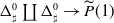 $\Delta ^0_{\sharp }\coprod \Delta ^0_{\sharp } \to \widetilde {P}(1)$
, we obtain a Kan fibration between Kan complexes
 $\widetilde {q}_1\,:\, \textrm {Map}^{\textrm {sc}}(\widetilde {P}(1),Z) \to (v_1Z)_0\times (v_1^{\textrm {rev}}Z)_0$
by Proposition 3.5, which makes the following diagram commute

By taking fibers over
 $(x,y)\in (v_1Z)_0\times (v_1^{\textrm {rev}}Z)_0$
, we obtain the desired equivalence.
5. Another model of twisted arrow
$\infty$
-categories

In this section, we give another simple model of twisted arrow
 $\infty$
-categories for an
 $\infty$
-bicategory. In §5.1, we introduce a cosimplicial scaled simplicial set
 $T(\!\bullet\! )$
, where the scaled simplicial set
 $T(n)$
is a subcomplex of
 $Q(n)$
for all
 $n\ge 0$
. In §5.2, we define a bisimplicial set
 $\mathbb{T}\mathrm{W}^r(Z)$
to be
 $\{\textrm {Map}^{\textrm {sc}}(T(n),Z)\}_{n\ge 0}$
for an
 $\infty$
-bicategory
 $Z$
. We show that the bisimplicial set
 $\mathbb{T}\mathrm{W}^r(Z)$
is a Segal space. In §5.3, we show that the cosimplicial objects
 $T(\!\bullet\! )$
and
 $Q(\!\bullet\! )$
are equivalent in the Reedy model structure on the category of cosimplicial scaled simplicial sets. By using this result, we show that the Segal space
 $\mathbb{T}\mathrm{W}^r(Z)$
is complete. By applying the right Quillen equivalence
 $i_1^*\,:\, \textrm {bSet}_{\Delta }^{\textrm {CSS}}\to \textrm {Set}_{\Delta }^{\textrm {Joy}}$
to
 $\mathbb{T}\mathrm{W}^r(Z)$
, we obtain an
 $\infty$
-category
 $\mathbb{T}\mathrm{w}^r(Z)$
which is equipped with a map
 $p_{\mathbb{T}}\,:\, \mathbb{T}\mathrm{w}^r(Z)\to u_1Z\times u_1Z^{\textrm {op}}$
. In §5.4 we show that
 $p_{\mathbb{T}}$
is a Cartesian fibration equivalent to
 $p\,:\, \textrm {Tw}^r(Z)\to u_1Z\times u_1Z^{\textrm {op}}$
. In particular,
 $p_{\mathbb{T}}$
is classified by the restricted mapping
 $\infty$
-category functor.
5.1. The cosimplicial scaled simplicial set
$T(\!\bullet\! )$

In this subsection, we introduce a cosimplicial object
 $T(\!\bullet\! )$
of scaled simplicial sets.
Definition 5.1.
For
 $n\ge 0$
, we consider the simplicial set
 $\Delta ^n\star \Delta ^{n,\textrm {op}}$
. We recall that we represent it as the following diagram

For a vertex
 $v=(i,r)$
of
 $\Delta ^1\times \Delta ^n$
, we set
 $\hat {v}=ir$
. For a simplex
 $\sigma$
of
 $\Delta ^1\times \Delta ^n$
, we denote by
 $\hat {\sigma }$
the simplex of
 $\Delta ^n\star \Delta ^{n,\textrm {op}}$
spanned by
 $\hat {v}$
for vertices
 $v$
of
 $\sigma$
. For a subcomplex
 $K$
of
 $\Delta ^1\times \Delta ^n$
, we denote by
 $\Omega (K)$
the subcomplex of
 $\Delta ^n\star \Delta ^{n,\textrm {op}}$
spanned by
 $\hat {\sigma }$
for
 $\sigma \in K$
. We write
 $\Omega ^n$
for
 $\Omega (\Delta ^1\times \Delta ^n)$
for simplicity. We notice that
 $\Omega ^n$
is an
 $(n+1)$
-dimensional subcomplex of
 $\Delta ^n\star \Delta ^{n,\textrm {op}}$
. The collection
 $\Omega ^{\bullet }=\{\Omega ^n\}_{n\ge 0}$
forms a cosimplicial object of simplicial sets by restricting the cosimplicial structure on
 $\{\Delta ^n\star \Delta ^{n,\textrm {op}}\}_{n\ge 0}$
.
We define a scaled simplicial set
 $T(n)$
. The underlying simplicial set of
 $T(n)$
is
 $\Omega ^n$
. In other words, it is a full subcomplex of
 $\Delta ^n\star \Delta ^{n,\textrm {op}}$
spanned by
 $(n+1)$
-dimensional simplices
 \begin{equation*} \sigma (r)=\Delta ^{\{00,\ldots ,0r,1r,\ldots ,1n\}} \end{equation*}
for
 $0\le r\le n$
. The scaling of
 $T(n)$
is induced by
 $Q(n)$
. Concretely, the set
 $T_{T(n)}$
of thin triangles is given by
 \begin{equation*} \begin{array}{rccl} T_{T(n)} &=& & \{\Delta ^{\{ik,ik',ik''\}}|\ i=0,1,\ 0\le k\lt k'\lt k'' \le n\}\\[2mm] & & \cup & \{\Delta ^{\{0k,0k',1k''\}}|\ 0\le k\lt k'\le k'' \le n\}\\[2mm] & & \cup & \{\textrm {degenerate}\}. \end{array}\end{equation*}
We note that
 $(\Omega ^n)_2\cap T3=\emptyset$
since
 $\sigma (r)$
does not contain any triangles in
 $T3$
for
 $0\le r\le n$
, where
 $T3=\{\Delta ^{\{1k,1k',0k''\}}|\ 0\le k\lt k'\le k''\le n\}$
is a subset of
 $T_{Q(n)}$
.
We can verify that the collection
 $T(\!\bullet\! )=\{T(n)\}_{n \ge 0}$
forms a cosimplicial object in the category of scaled simplicial sets by restricting the cosimplicial structure on
 $Q(\!\bullet\! )$
.
5.2. The Segal space
$\mathbb{T}\mathrm{W}^r(Z)$

In this subsection, we introduce a bisimplicial set
 $\mathbb{T}\mathrm{W}^r(Z)$
for an
 $\infty$
-bicategory
 $Z$
and show that it is a Segal space. We will show that it is a complete Segal space in §5.3 below.
Definition 5.2.
Let
 $Z$
be an
 $\infty$
-bicategory. We set
 \begin{equation*} \mathbb{T}\mathrm{W}^r(Z)_n=\textrm {Map}^{\textrm {sc}}(T(n),Z). \end{equation*}
The collection
 $\mathbb{T}\mathrm{W}^r(Z)=\{\mathbb{T}\mathrm{W}^r(Z)_n\}_{n\ge 0}$
forms a bisimplicial set by using the cosimplicial structure on
 $T(\!\bullet\! )$
The goal of this subsection is to show the following proposition.
Proposition 5.3.
For any
 $\infty$
-bicategory
 $Z$
, the bisimplicial set
 $\mathbb{T}\mathrm{W}^r(Z)$
is a Segal space.
In order to prove Proposition 5.3, we give some preliminary lemmas. First, we show that
 $T(\!\bullet\! )$
is Reedy cofibrant.
Lemma 5.4.
The cosimplicial object
 $T(\!\bullet\! )$
in
 $\textrm {Set}_{\Delta }^{\textrm {sc}}$
is Reedy cofibrant.
Proof.
This follows by observing that the
 $n$
th latching object is isomorphic to
 $\Omega (\Delta ^1\times \partial \Delta ^n)_{\S }$
.
For
 $0\le i\le n$
, we define subcomplexes
 $\Lambda ^n_iT$
and
 $\overline {\Lambda }{}^n_iT$
of
 $T(n)$
by
 \begin{equation*} \begin{array}{rcl} \Lambda ^n_iT &=& \Omega \big(\Delta ^1\times \Lambda ^n_i\big)_{\S },\\[2mm] \overline {\Lambda }{}^n_iT &=& \Omega \big(\Delta ^1\times \Lambda ^n_i\cup \partial \Delta ^1\times \Delta ^n\big)_{\S }.\\ \end{array}\end{equation*}
Lemma 5.5.
For any
 $0\lt i\lt n$
, the inclusion map
 $\Lambda ^n_iT\to T(n)$
is scaled anodyne.
Proof.
First, we show that the inclusion map
 $\Lambda ^n_iT\to \overline {\Lambda }{}^n_iT$
is scaled anodyne. There is a pushout diagram

of scaled simplicial sets. We note that there is a natural isomorphism of scaled simplicial sets
 $\Omega (\partial \Delta ^1\times K)_{\S }\cong K_{\sharp }\coprod K_{\sharp }^{\textrm {op}}$
for any subcomplex
 $K$
of
 $\Delta ^n$
. Since the top horizontal arrow is scaled anodyne by [Reference Lurie17, Remark 3.1.5], so is the bottom horizontal arrow.
Next, we show that the inclusion map
 $\overline {\Lambda }{}^n_iT \to T(n)$
is scaled anodyne. For
 $0\le r\le n$
, we recall that
 $\sigma (r)$
is the
 $(n+1)$
-dimensional simplex
 $\Delta ^{\{00,\ldots ,0r,1r,\ldots ,1n\}}$
of
 $\Delta ^n\star \Delta ^{n,\textrm {op}}$
. For
 $0\le s\le n$
, we define a scaled simplicial set
 $X(s)$
, which is a subcomplex of
 $\Omega ^n$
equipped with the induced scaling from
 $T(n)$
, by
 \begin{equation*} X(s)= \overline {\Lambda }{}^n_iT \cup \bigcup _{s\le r\le n}\ \sigma (r)_{\S }.\end{equation*}
By definition, we obtain a filtration
 \begin{equation*} \overline {\Lambda }{}^n_iT= X(n+1)\to X(n)\to X(n-1)\to \cdots \to X(0) = T(n)\end{equation*}
of scaled simplicial sets, which consists of subcomplexes of
 $T(n)$
. In order to prove that
 $\overline {\Lambda }{}^n_iT \to T(n)$
is scaled anodyne, it suffices to show that the inclusion map
 $X(s+1)\to X(s)$
is scaled anodyne for any
 $0\le s\le n$
.
We fix
 $s$
with
 $0\le s\le n$
and show that
 $X(s+1)\to X(s)$
is scaled anodyne. We set
 $I(s)=\{00,\ldots ,0s,1s,\ldots ,1n\}$
. Then we have
 $\sigma (s)=\Delta ^{I(s)}$
. The intersection of
 $\sigma (s)$
with the underlying simplicial set of
 $X(s+1)$
has the form
 $\Lambda ^{I(s)}_{M(s)}$
, where
 \begin{equation*} M(s)=\left \{\begin{array}{ll} \{1i\} & (s=0),\\ \{0s,1i\} & (0\lt s\lt i),\\ \{0i\} & (s=i),\\ \{0i,0s\} & (i\lt s\le n).\\ \end{array} \right . \end{equation*}
Hence, there is a pushout diagram

Thus, it suffices to show that the inclusion map
 $\Lambda ^{I(s)}_{M(s),\S } \to \Delta ^{I(s)}_{\S }$
is scaled anodyne. This follows from Lemma 3.7.
Next, we show that
 $T(\!\bullet\! )$
satisfies the co-Segal condition.
Lemma 5.6.
The cosimplicial scaled simplicial set
 $T(\!\bullet\! )$
satisfies the co-Segal condition.
Proof. It suffices to show that the co-Segal map
 \begin{equation*} T(1)\coprod _{T(0)}\cdots \coprod _{T(0)}T(1)\longrightarrow T(n) \end{equation*}
is scaled anodyne for all
 $n\ge 0$
. This follows by induction on
 $n$
together with Lemma 5.5.
Proposition 5.7.
For any
 $\infty$
-bicategory
 $Z$
, the bisimplicial set
 $\mathbb{T}\mathrm{W}^r(Z)$
is a Segal space.
5.3. Completeness of the Segal space
$\mathbb{T}\mathrm{W}^r(Z)$

The goal of this subsection is to show that the Segal space
 $\mathbb{T}\mathrm{W}^r(Z)$
is complete. For this purpose, we prove that
 $T(\!\bullet\! )$
and
 $Q(\!\bullet\! )$
are equivalent in the Reedy model structure on the category of cosimplicial scaled simplicial sets.
Proposition 5.8.
The inclusion map
 $T(\!\bullet\! )\to Q(\!\bullet\! )$
is a weak equivalence in the Reedy model structure on the category of cosimplicial objects in
 $\textrm {Set}_{\Delta }^{\textrm {sc}}$
, that is, it is a levelwise bicategorical equivalence.
Using Proposition 5.8, we can show that the Segal space
 $\mathbb{T}\mathrm{W}^r(Z)$
is complete.
Theorem 5.9.
For any
 $\infty$
-bicategory
 $Z$
,
 $\mathbb{T}\mathrm{W}^r(Z)$
is a complete Segal space.
Proof.
The map
 $T(\!\bullet\! )\to Q(\!\bullet\! )$
of cosimplicial scaled simplicial sets induces a map of Segal spaces
 $\mathrm{TW}^r(Z) \to \mathbb{T}\mathrm{W}^r(Z)$
, which is a levelwise weak equivalence by Proposition 5.8. The theorem follows from the fact that
 $\mathrm{TW}^r(Z)$
is a complete Segal space by Theorem4.10.
Now, we turn to the proof of Proposition 5.8. For
 $0\le k\lt l\le n+1$
, we denote by
 $\tau (k,l)$
the simplex of
 $\Delta ^n\star \Delta ^{n,\textrm {op}}$
given by
 \begin{equation*} \tau (k,l)=\Delta ^{\{00,\ldots , 0k,0l,\ldots ,0n, 1k,\ldots ,1n\}}. \end{equation*}
We understand
 $\tau (k,n+1)= \Delta ^{\{00,\ldots ,0k,1k,\ldots ,1n\}}$
.
Proof of Proposition 5.8. For
 $0\le k\le n$
, we define a scaled simplicial set
 $U(k)$
, which is a subcomplex of
 $\Delta ^n\star \Delta ^{n,\textrm {op}}$
equipped with the induced scaling from
 $Q(n)$
, by
 \begin{equation*} U(k)=T(n)\cup \bigcup _{k\le i\le n} \tau (i,i+1)_{\S }. \end{equation*}
By definition, we obtain a filtration
 $T(n)= U(n)\to \cdots \to U(0)=Q(n)$
of scaled simplicial sets consisting of subcomplexes of
 $Q(n)$
. In order to prove Proposition 5.8, it suffices to show that
 $U(k+1)\to U(k)$
is scaled anodyne for all
 $0\le k\lt n$
.
For this purpose, we introduce a further filtration. For
 $k+1\le l\le n+1$
, we define a scaled simplicial set
 $V(k,l)$
, which is a subcomplex of
 $\Delta ^n\star \Delta ^{n,\textrm {op}}$
equipped with the induced scaling from
 $Q(n)$
, by
 \begin{equation*} V(k,l)=U(k+1)\cup \bigcup _{l\le j\le n+1}\tau (k,j)_{\S }. \end{equation*}
By definition, we obtain a filtration
 $U(k+1)=V(k,n+1)\to \cdots \to V(k,k+1)=U(k)$
of scaled simplicial sets consisting of subcomplexes of
 $U(k)$
. In order to prove that
 $U(k+1)\to U(k)$
is scaled anodyne, it suffices to show that
 $V(k,j+1)\to V(k,j)$
is scaled anodyne for all
 $k+1\le j\le n$
.
We set
 $J(k,j)=\{00,\ldots ,0k,0j,\ldots ,0n,1k,\ldots ,1n\}$
. Then we have
 $\tau (k,j)=\Delta ^{J(k,j)}$
. The intersection of
 $\tau (k,j)$
with the underlying simplicial set of
 $V(k,j+1)$
has the form
 $\Lambda ^{J(k,j)}_{M(k,j)}$
, where
 \begin{equation*} M(k,j)=\left \{\begin{array}{ll} \{00,\ldots ,0k, 1(k+1),\ldots ,1n\}&(j=n),\\\{00,\ldots ,0k, 1(k+1),\ldots ,1n, 0(j+1),\ldots ,0n\}&(k+1\le j\lt n).\\\end{array}\right .\end{equation*}
Hence, there is a pushout diagram of scaled simplicial sets
 \begin{equation*} \begin{array}{ccc} \Lambda ^{J(k,j)}_{M(k,j),\S } & \longrightarrow & \Delta ^{J(k,j)}_{\S }\\ \bigg \downarrow & & \bigg \downarrow \\ V(k,j+1) & \longrightarrow & V(k,j).\\ \end{array}\end{equation*}
Since the top horizontal arrow is scaled anodyne by Lemma 3.7, so is the bottom horizontal arrow.
5.4. A model for twisted arrow
$\infty$
-categories

Let
 $Z$
be an
 $\infty$
-bicategory. By Theorem5.9,
 $\mathbb{T}\mathrm{W}^r(Z)$
is a complete Segal space. The inclusion maps
 $\Delta ^n_{\sharp }\coprod \Delta ^{n,\textrm {op}}_{\sharp } \to T(n)$
for
 $n\ge 0$
induce a map of complete Segal spaces
 $q_{\mathbb{T}}\,:\, \mathbb{T}\mathrm{W}^r(Z)\to v_1Z\times v_1^{\textrm {rev}}Z$
. By applying the right Quillen equivalence
 $i_1^*\,:\, \textrm {bSet}_{\Delta }^{\textrm {CSS}}\to \textrm {Set}_{\Delta }^{\textrm {Joy}}$
, we obtain a map of
 $\infty$
-categories
 \begin{equation*} p_{\mathbb{T}}\,:\, \mathbb{T}\mathrm{w}^r(Z)\longrightarrow u_1Z\times u_1Z^{\textrm {op}},\end{equation*}
where
 $\mathbb{T}\mathrm{w}^r(Z)$
is an
 $\infty$
-category whose set of
 $n$
-simplices is
 $\textrm {Hom}_{\textrm {Set}_{\Delta }^{\textrm {sc}}}(T(n),Z)$
. The goal of this subsection is to show that
 $p_{\mathbb{T}}$
is a Cartesian fibration classified by the restricted mapping
 $\infty$
-category functor, and hence,
 $\mathbb{T}\mathrm{w}^r(Z)$
is a model of twisted arrow
 $\infty$
-category.
First, we will show that
 $p_{\mathbb{T}}$
is a categorical fibration between
 $\infty$
-categories.
Lemma 5.10.
The map
 $p_{\mathbb{T}}\,:\, \mathbb{T}\mathrm{w}^r(Z)\to u_1Z\times u_1Z^{\textrm {op}}$
is a categorical fibration between
 $\infty$
-categories.
Proof.
First, we show that
 $q_{\mathbb{T}}\,:\, \mathbb{T}\mathrm{W}^r(Z)\to v_1Z\times v_1^{\textrm {rev}}Z$
is a fibration between fibrant objects in
 $\textrm {bSet}_{\Delta }^{\textrm {CSS}}$
. Recall that the model category
 $\textrm {bSet}_{\Delta }^{\textrm {CSS}}$
is a left Bousfield localization of the Reedy model structure on
 $\textrm {bSet}_{\Delta }$
. Since
 $\mathbb{T}\mathrm{W}^r(Z)$
and
 $v_1Z\times v_1^{\textrm {rev}}Z$
are complete Segal spaces, in order to show that
 $q_{\mathbb{T}}$
is a fibration in
 $\textrm {bSet}_{\Delta }^{\textrm {CSS}}$
, it suffices to show that
 $q_{\mathbb{T}}$
is a Reedy fibration (cf. [Reference Hirschhorn11, Proposition 3.3.16]).
For a bisimplicial set
 $X$
, we denote by
 $M_nX$
the
 $n$
th matching object. We set
 $V= v_1Z\times v_1^{\textrm {rev}}Z$
for simplicity. We have to show that the map
 $f_n\,:\, \mathbb{T}\mathrm{W}^r(Z)_n\to M_n\mathbb{T}\mathrm{W}^r(Z) \times _{M_nV}V_n$
is a Kan fibration for all
 $n\ge 0$
. We observe that
 $f_n$
is isomorphic to the map
 $\textrm {Map}^{\textrm {sc}}(T(n),Z)\to \textrm {Map}^{\textrm {sc}}(\overline {\partial }T(n),Z)$
induced by the inclusion map
 $\overline {\partial }T(n)\to T(n)$
, where
 $\overline {\partial }T(n)$
is a subcomplex of the scaled simplicial set
 $T(n)$
given by
 \begin{equation*} \overline {\partial }T(n)= \Omega ((\Delta ^1\times \partial \Delta ^n)\cup (\partial \Delta ^1\times \Delta ^n))_{\S }. \end{equation*}
By Proposition 3.5, we see that
 $f_n$
is a Kan fibration.
Thus,
 $q_{\mathbb{T}}$
is a fibration between fibrant objects in
 $\textrm {bSet}_{\Delta }^{\textrm {CSS}}$
. By applying the right Quillen equivalence
 $i_1^*\,:\, \textrm {bSet}_{\Delta }^{\textrm {CSS}}\to \textrm {Set}_{\Delta }^{\textrm {Joy}}$
, we see that
 $p_{\mathbb{T}}$
is a categorical fibration between
 $\infty$
-categories.
Next, we show that
 $p_{\mathbb{T}}$
is a Cartesian fibration.
Proposition 5.11.
The map
 $p_{\mathbb{T}}\,:\, \mathbb{T}\mathrm{w}^r(Z)\to u_1Z\times u_1Z^{\textrm {op}}$
is a Cartesian fibration.
In order to prove Proposition 5.11, we give a characterization of
 $p_{\mathbb{T}}$
-Cartesian edges. We define a scaled simplicial set
 $T(n)_{\textrm {cart}}$
for
 $n\ge 0$
. The underlying simplicial set of
 $T(n)_{\textrm {cart}}$
is
 $\Omega ^n$
and the set
 $T_{T(n)_{\textrm {cart}}}$
of thin triangles is given by
 \begin{equation*} T_{T(n)_{\textrm {cart}}}= T_{T(n)}\cup \{\Delta ^{\{0i,1(n-1),1n\}}|\ 0\le i\lt n\}. \end{equation*}
For a subcomplex
 $K$
of
 $\Omega ^n$
, we denote by
 $K_{\textrm {cart}}$
the scaled simplicial set whose underlying simplicial set is
 $K$
equipped with the induced scaling from
 $T(n)_{\textrm {cart}}$
. We denote by
 $\overline {\Lambda }^n_nT_{\textrm {cart}}$
the subcomplex of
 $T(n)_{\textrm {cart}}$
given by
 $\Omega (\Delta ^1\times \Lambda ^n_n \cup \partial \Delta ^1\times \Delta ^n)_{\textrm {cart}}$
. We show that a morphism
 $T(1)\to Z$
in
 $\mathbb{T}\mathrm{w}^r(Z)$
is a
 $p_{\mathbb{T}}$
-Cartesian edge if it factors through the map
 $T(1)\to T(1)_{\textrm {cart}}$
.
Lemma 5.12.
The map
 $\overline {\Lambda }^n_nT_{\textrm {cart}}\to T(n)_{\textrm {cart}}$
is scaled anodyne for
 $n\ge 1$
.
Proof.
We recall that
 $\sigma (r)=\Delta ^{\{00,\ldots ,0r,1r,\ldots ,1n\}}$
for
 $0\le r\le n$
. For
 $0\le s\le n$
, we define a scaled simplicial set
 $X(s)_{\textrm {cart}}$
, which is a subcomplex of
 $\Omega ^n$
equipped with the induced scaling from
 $T(n)_{\textrm {cart}}$
, by
 \begin{equation*} X(s)_{\textrm {cart}}=\overline {\Lambda }^n_nT_{\textrm {cart}}\cup \bigcup _{s\le r\le n} \sigma (r)_{\textrm {cart}}.\end{equation*}
By definition, we obtain a filtration
 $\overline {\Lambda }^n_nT_{\textrm {cart}} = X(n+1)_{\textrm {cart}} \to \cdots \to X(0)_{\textrm {cart}}=T(n)_{\textrm {cart}}$
of scaled simplicial sets consisting of subcomplexes of
 $T(n)_{\textrm {cart}}$
. In order to prove that
 $\overline {\Lambda }^n_nT_{\textrm {cart}}\to T(n)_{\textrm {cart}}$
is scaled anodyne, it suffices to show that
 $X(s+1)_{\textrm {cart}}\to X(s)_{\textrm {cart}}$
is scaled anodyne for all
 $0\le s\le n$
.
We use the notation in the proof of Lemma 5.5. We recall that
 $I(s)=\{00,\ldots ,0s,1s,\ldots ,1n\}$
for
 $0\le s\le n$
. The intersection of
 $\Delta ^{I(s)}$
with the underlying simplicial set of
 $X(s+1)_{\textrm {cart}}$
has the form
 $\Lambda ^{I(s)}_{N(s)}$
, where
 \begin{equation*} N(s)= \left \{ \begin{array}{ll} \{1n\} & (s=0),\\\{0s,1n\} & (0\lt s\lt n),\\\{0n\}& (s=n).\\ \end{array}\right .\end{equation*}
Hence, there is a pushout diagram of scaled simplicial sets

By using the fact that
 $\Delta ^{\{0(n-1),0n,1n\}}$
and
 $\Delta ^{\{0i,1(n-1),1n\}}$
are thin for
 $0\le i\lt n$
, we see that the top horizontal arrow is scaled anodyne by Lemma 3.7. Hence, so is the bottom horizontal arrow.
We define
 $\overline {\Lambda }^n_nT'$
by
 \begin{equation*} \overline {\Lambda }^n_nT'= \overline {\Lambda }^n_nT \coprod _{\Omega (\Delta ^1\times \Delta ^{\{n-1,n\}})_{\S }} \Omega (\Delta ^1\times \Delta ^{\{n-1,n\}})_{\textrm {cart}}.\end{equation*}
Lemma 5.13.
For
 $n\ge 2$
, the inclusion map
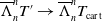 $\overline {\Lambda }^n_nT' \to \overline {\Lambda }^n_nT_{\textrm {cart}}$
is scaled anodyne.
Proof.
When
 $n=2$
, it is the identity map. When
 $n\ge 3$
, the desired result follows by observing that
 $(\Delta ^{\{0i,0(n-1),1(n-1),1n\}},T) \to \Delta ^{\{0i,0(n-1),1(n-1),1n\}}_{\sharp }$
is scaled anodyne for
 $0\le i\lt n-1$
by [Reference Lurie17, Remark 3.1.4], where
 $T$
is the set of all
 $2$
-simplices of
 $\Delta ^{\{0i,0(n-1),1(n-1),1n\}}$
other than
 $\Delta ^{\{0i,1(n-1),1n\}}$
.
Corollary 5.14.
A morphism
 $T(1)\to Z$
in
 $\mathbb{T}\mathrm{w}^r(Z)$
is a
 $p_{\mathbb{T}}$
-Cartesian edge if it factors through the map
 $T(1)\to T(1)_{\textrm {cart}}$
.
Proof.
Let
 $M\in \mathbb{T}\mathrm{w}^r(Z)_1$
be a morphism of the
 $\infty$
-category
 $\mathbb{T}\mathrm{w}^r(Z)$
given by a map
 $\overline {M}\,:\, T(1)\to Z$
of scaled simplicial sets. We consider the following commutative diagram of simplicial sets

for
 $n\ge 2$
. By [Reference Lurie15, Remark 2.4.1.4], if there exists a lifting
 $\Delta ^n\to \mathbb{T}\mathrm{w}^r(Z)$
that makes the diagram commute, then
 $M$
is a
 $p_{\mathbb{T}}$
-Cartesian edge. Unwinding the definitions, we see that this is equivalent to the following lifting problem

in
 $\textrm {Set}_{\Delta }^{\textrm {sc}}$
.
If
 $\overline {M}$
factors through
 $T(1)_{\textrm {cart}}$
, then the map
 $\overline {\Lambda }^n_nT\to Z$
extends to a map
 $\overline {\Lambda }^n_nT'\to Z$
. We obtain the following commutative diagram

By Lemmas 5.12 and 5.13, the middle vertical arrow in (5.1) is scaled anodyne. Since
 $Z$
is a fibrant object in
 $\textrm {Set}_{\Delta }^{\textrm {sc}}$
, the dotted arrow in (5.1) exists that makes the right triangle commute. The desired lifting is obtained as the composite of
 $T(n)_{\textrm {cart}}\to Z$
with the inclusion map
 $T(n)\to T(n)_{\textrm {cart}}$
.
Proof of Proposition 5.11. We consider a lifting problem depicted by the following commutative diagram

in
 $\textrm {Set}_{\Delta }$
. Unwinding the definitions, we see that this is equivalent to the following lifting problem

in
 $\textrm {Set}_{\Delta }^{\textrm {sc}}$
. We would like to have a lifting
 $\overline {M}\,:\, T(1)\to Z$
which factors through
 $T(1)_{\textrm {cart}}$
.
Since the inclusion map
 $\overline {\Lambda }^1_1T\to \overline {\Lambda }^1_1T_{\textrm {cart}}$
is the identity, we can factor the map
 $\overline {\Lambda }^1_1T\to Z$
through
 $\overline {\Lambda }^1_1T_{\textrm {cart}}$
and we obtain the following commutative diagram

The middle vertical arrow in (5.3) is scaled anodyne by Lemma 5.12. Since
 $Z$
is a fibrant object in
 $\textrm {Set}_{\Delta }^{\textrm {sc}}$
, we obtain the dotted arrow
 $T(1)_{\textrm {cart}}\to Z$
in (5.3) that makes the right triangle commute. The composite
 $\overline {M}\,:\, T(1)\to T(1)_{\textrm {cart}}\to Z$
gives a lifting
 $M$
in (5.2). Since
 $\overline {M}$
factors through
 $T(1)_{\textrm {cart}}$
, the morphism
 $M$
is
 $p_{\mathbb{T}}$
-Cartesian by Corollary 5.14.
Next, we show that
 $p_{\mathbb{T}}$
is classified by the restricted mapping
 $\infty$
-category functor. For this, it suffices to show that
 $p_{\mathbb{T}}$
is equivalent to the Cartesian fibration
 $p\,:\, \textrm {Tw}^r(Z)\to u_1Z\times u_1Z^{\textrm {op}}$
.
Theorem 5.15.
There is an equivalence of
 $\infty$
-categories
 $\textrm {Tw}^r(Z)\to \mathbb{T}\mathrm{w}^r(Z)$
which makes the following diagram commute

Proof.
The commutative diagram is obtained from the inclusion maps
 $\Delta ^{\bullet }_{\sharp }\coprod \Delta ^{\bullet ,\textrm {op}}_{\sharp } \to T(\!\bullet\! )\to Q(\!\bullet\! )$
of cosimplicial scaled simplicial sets by applying
 $\textrm {Hom}_{\textrm {Set}_{\Delta }^{\textrm {sc}}}(-,Z)$
. The map
 $T(\!\bullet\! )\to Q(\!\bullet\! )$
induces an equivalence of complete Segal spaces
 $\mathrm{TW}^r(Z)\to \mathbb{T}\mathrm{W}^r(Z)$
by Proposition 5.8. By applying the right Quillen equivalence
 $i_1^*\,:\, \textrm {bSet}_{\Delta }^{\textrm {CSS}}\to \textrm {Set}_{\Delta }^{\textrm {Joy}}$
, we see that
 $\textrm {Tw}^r(Z)\to \mathbb{T}\mathrm{w}^r(Z)$
is an equivalence of
 $\infty$
-categories.
Corollary 5.16.
The Cartesian fibration
 $p_{\mathbb{T}}\,:\, \mathbb{T}\mathrm{w}^r(Z)\to u_1Z\times u_1Z^{\textrm {op}}$
is classified by the restricted mapping
 $\infty$
-category functor
 \begin{equation*} \textrm {Map}_{Z}(-,-)\,:\, u_1Z^{\textrm {op}}\times u_1Z\longrightarrow {\textrm {Cat}_{(\infty ,1)}}.\end{equation*}
Remark 5.17.
There is an isomorphism
 $\overline {(-)}\,:\, (\Delta ^{n}\star \Delta ^{n,\textrm {op}})^{\textrm {op}} \to \Delta ^{n}\star \Delta ^{n,\textrm {op}}$
of simplicial sets given by
 $\overline {0i}= 1i$
and
 $\overline {1i}= 0i$
. For a scaled simplicial set
 $A$
whose underlying simplicial set is a subcomplex of
 $\Delta ^n\star \Delta ^{n,\textrm {op}}$
, we define its conjugate
 $A^{\textrm {conj}}$
to be the scaled simplicial set whose underlying simplicial set is
 $\overline {A^{\textrm {op}}}$
equipped with a set of thin triangle
 $\{\overline {t^{\textrm {op}}}|\ t\in T_A\}$
, where
 $T_A$
is the set of thin triangles of
 $A$
. We notice that
 $Q(n)^{\textrm {conj}}=Q(n)$
for all
 $n\ge 0$
.
In particular, we have a subcomplex
 $T(n)^{\textrm {conj}}$
of
 $Q(n)$
. The underlying simplicial set of
 $T(n)^{\textrm {conj}}$
is spanned by
 $(n+1)$
-dimensional simplices
 \begin{equation*} \Delta ^{\{10,\ldots ,1k,0k,\ldots , 0n\}} \end{equation*}
for
 $0\le k\le n$
. By assembling
 $T(n)^{\textrm {conj}}$
for
 $n\ge 0$
, we obtain a cosimplicial scaled simplicial set
 $T(\!\bullet\! )^{\textrm {conj}}=\{T(n)^{\textrm {conj}}\}_{n\ge 0}$
equipped with a map
 $T(\!\bullet\! )^{\textrm {conj}}\to Q(\!\bullet\! )$
of cosimplicial scaled simplicial sets. For an
 $\infty$
-bicategory
 $Z$
, we define
 $\mathbb{T}\mathrm{W}^r(Z)^{\textrm {conj}}$
to be the bisimplicial set
 $\textrm {Map}^{\textrm {sc}}(T(\!\bullet\! )^{\textrm {conj}},Z)$
.
For a monomorphism
 $A\to B$
of scaled simplicial sets, where the underlying simplicial sets of
 $A$
and
 $B$
are subcomplexes of
 $\Delta ^n\star \Delta ^{n,\textrm {op}}$
, if it is a trivial cofibration of scaled simplicial sets, then its conjugate
 $A^{\textrm {conj}}\to B^{\textrm {conj}}$
is also a trivial cofibration. By using this fact and the functoriality of
 $(-)^{\textrm {conj}}$
, we see that
 $\mathbb{T}\mathrm{W}^r(Z)^{\textrm {conj}}$
is a complete Segal space by the conjugates of Lemma 5.4
, Lemma 5.6
, and Proposition 5.8
.
We define
 $\mathbb{T}\mathrm{w}^r(Z)^{\textrm {conj}}$
to be the
 $\infty$
-category obtained by applying the right Quillen equivalence
 $i_1^*$
to
 $\mathbb{T}\mathrm{W}^r(Z)^{\textrm {conj}}$
. Although
 $(\Delta ^{\{00,\ldots ,0n\}}_{\sharp })^{\textrm {conj}} =\Delta ^{\{10,\ldots ,0n\}}_{\sharp }$
and
 $(\Delta ^{\{10,\ldots ,0n\}}_{\sharp })^{\textrm {conj}} =\Delta ^{\{00,\ldots ,0n\}}_{\sharp }$
, the inclusion map
 $\Delta ^{\{00,\ldots ,0n\}}_{\sharp } \coprod \Delta ^{\{10,\ldots ,1n\}}_{\sharp } \to Q(n)$
is invariant under
 $(-)^{\textrm {conj}}$
, and it factors through
 $T(n)^{\textrm {conj}}$
. The map
 $\Delta ^{\{00,\ldots ,0n\}}_{\sharp } \coprod \Delta ^{\{10,\ldots ,1n\}}_{\sharp } \to T(n)^{\textrm {conj}}$
induces a map
 $p_{\mathbb{T}}^{\textrm {conj}}\,:\, \mathbb{T}\mathrm{w}^r(Z)^{\textrm {conj}}\to u_1Z\times u_1Z^{\textrm {op}}$
of
 $\infty$
-categories. By the functoriality of
 $(-)^{\textrm {conj}}$
, we see that
 $p_{\mathbb{T}}^{\textrm {conj}}$
is a Cartesian fibration by the conjugates of Lemmas 5.12 and 5.13
.
By the conjugate of Proposition 5.8
, we have an equivalence
 $\mathrm{TW}^r(Z)\to \mathbb{T}\mathrm{W}^r(Z)^{\textrm {conj}}$
of complete Segal spaces. This implies an equivalence
 $\textrm {Tw}^r(Z)\to \mathbb{T}\mathrm{w}^r(Z)^{\textrm {conj}}$
of
 $\infty$
-categories. Since we have monomorphisms of scaled simplicial sets
 $\Delta ^{\{00,\ldots ,0n\}}_{\sharp }\coprod \Delta ^{\{10,\ldots ,1n\}}_{\sharp }\to T(n)^{\textrm {conj}}\to Q(n)$
, we see that the equivalence
 $\textrm {Tw}^r(Z)\to \mathbb{T}\mathrm{w}^r(Z)^{\textrm {conj}}$
is compatible with the maps
 $p$
and
 $p_{\mathbb{T}}^{\textrm {conj}}$
to
 $u_1Z\times u_1Z^{\textrm {op}}$
. Hence, we can also regard
 $\mathbb{T}\mathrm{w}^r(Z)^{\textrm {conj}}$
as another model of the twisted arrow
 $\infty$
-category.
6. Comparisons with other constructions of twisted arrow categories
In this section, we compare the twisted arrow
 $\infty$
-category in this paper with other related constructions. In §6.1, we discuss a relationship with the construction of twisted
 $2$
-cell
 $\infty$
-bicategory in [Reference Harpaz, Nuiten and Prasma9]. In §6.2, we compare the twisted arrow
 $\infty$
-category in this paper with the constructions of twisted arrow
 $\infty$
-category of an
 $(\infty ,1)$
-category in [Reference Mukherjee and Rasekh19] and [Reference Martini18].
6.1. Twisted
$2$
-cell
$\infty$
-bicategories


In this subsection, we discuss a relationship between the construction of twisted arrow
 $\infty$
-category in this paper and that of twisted
 $2$
-cell
 $\infty$
-bicategory of [Reference Harpaz, Nuiten and Prasma9].
First, we recall the notion of twisted
 $2$
-cell
 $\infty$
-bicategory introduced in [Reference Harpaz, Nuiten and Prasma9, §3]. We let
 $\textrm {Cat}_{\Delta }^+$
be the category of
 $\textrm {Set}_{\Delta }^{+}$
-enriched categories and
 $\textrm {Set}_{\Delta }^{+}$
-enriched functors. We equip it with the Bergner-Lurie model structure (cf. [Reference Lurie15, A.3.2]). We refer to an object of
 $\textrm {Cat}_{\Delta }^+$
as a marked simplicial category. Let
 $\mathbb{C}$
be a fibrant marked simplicial category. We denote by
 $\textrm {Map}_{\mathbb{C}}\,:\,\mathbb{C}^{\textrm {op}}\times \mathbb{C} \to \textrm {Set}_{\Delta }^{+}$
the mapping marked simplicial set functor. We note that
 $\textrm {Map}_{\mathbb{C}}$
is a
 $\textrm {Set}_{\Delta }^{+}$
-enriched functor.
By [Reference Lurie17, Theorem 4.2.7], there is a Quillen equivalence
 \begin{equation*} \mathfrak{C}^{\textrm {sc}}\,:\, \textrm {Set}_{\Delta }^{\textrm {sc}}\rightleftarrows \textrm {Cat}_{\Delta }^+\,:\, N^{\textrm {sc}}, \end{equation*}
where
 $N^{\textrm {sc}}$
is the scaled nerve functor and
 $\mathfrak{C}^{\textrm {sc}}$
is its left adjoint. We set
 $\mathbb{D}=\mathbb{C}^{\textrm {op}}\times \mathbb{C}$
and
 $D=N^{\textrm {sc}}(\mathbb{D})$
. We denote by
 $\phi \,:\, \mathfrak{C}^{\textrm {sc}}(D) \to \mathbb{D}$
the counit map at
 $\mathbb{D}$
, which is a weak equivalence in
 $\textrm {Cat}_{\Delta }^+$
.
By applying the scaled unstraightening functor
 $\textrm {Un}_{\phi }^{\textrm {sc}}$
(cf. [Reference Lurie15, §3.5] and [Reference Harpaz, Nuiten and Prasma9, §2.2]) to the fibrant
 $\textrm {Set}_{\Delta }^{+}$
-enriched functor
 $\textrm {Map}_{\mathbb{C}}$
, we obtain a scaled coCartesian fibration in the sense of [Reference Harpaz, Nuiten and Prasma9, Definition 2.7]
 \begin{equation*} \textrm {Tw}^{\textrm {sc}}(\mathbb{C})\longrightarrow D.\end{equation*}
By [Reference Harpaz, Nuiten and Prasma9, Lemma 2.9], the scaled simplicial set
 $\textrm {Tw}^{\textrm {sc}}(\mathbb{C})$
is an
 $\infty$
-bicategory.
We have a twisted arrow construction on marked simplicial sets
 $\textrm {Tw}^+\,:\, \textrm {Set}_{\Delta }^{+}\to \textrm {Set}_{\Delta }^{+}$
(cf. [Reference Harpaz, Nuiten and Prasma9, the paragraph after Remark 3.2]), which preserves finite products and fibrant objects. By applying
 $\textrm {Tw}^+$
to the mapping marked simplicial sets of
 $\mathbb{C}$
, we obtain another fibrant marked simplicial category
 $\mathbb{C}_{\textrm {Tw}}$
. The twisted
 $2$
-cell
 $\infty$
-bicategory of
 $\mathbb{C}$
[Reference Harpaz, Nuiten and Prasma9, Definition 3.3] is defined by
 \begin{equation*} \textrm {Tw}_2(\mathbb{C})=\textrm {Tw}^{\textrm {sc}}(\mathbb{C}_{\textrm {Tw}}). \end{equation*}
In order to compare
 $\textrm {Tw}_2(\mathbb{C})$
with the construction of twisted arrow
 $\infty$
-category in this paper, we will construct a functor
 $\textrm {Tw}_2(\mathbb{C})\to \textrm {Tw}^{\textrm {sc}}(\mathbb{C})$
of
 $\infty$
-bicategories. For any fibrant marked simplicial set
 $W$
, we have a marked left fibration
 $\textrm {Tw}^+(W)\to W^{\textrm {op}}\times W$
in the sense of [Reference Harpaz, Nuiten and Prasma9, Definition 2.16]. By composing with the projection
 $W^{\textrm {op}}\times W\to W$
, we obtain a map of marked simplicial sets
 $\textrm {Tw}^{+}(W)\to W$
. By applying this construction to the mapping scaled simplicial sets of
 $\mathbb{C}$
, we obtain a
 $\textrm {Set}_{\Delta }^{+}$
-enriched functor
 $\mathbb{C}_{\textrm {Tw}}\to \mathbb{C}$
. We set
 $\mathbb{D}_{\textrm {Tw}}=\mathbb{C}_{\textrm {Tw}}^{\textrm {op}}\times \mathbb{C}_{\textrm {Tw}}$
and
 $D_{\textrm {Tw}}=N^{\textrm {sc}}(\mathbb{D}_{\textrm {Tw}})$
. The functor
 $\mathbb{C}_{\textrm {Tw}}\to \mathbb{C}$
induces an
 $\textrm {Set}_{\Delta }^{+}$
-enriched functor
 $\psi \,:\, \mathbb{D}_{\textrm {Tw}}\to \mathbb{D}$
, a map of scaled simplicial sets
 $f=\mathfrak{C}^{\textrm {sc}}(\psi )\,:\, D_{\textrm {Tw}}\to D$
, and a natural transformation of
 $\textrm {Set}_{\Delta }^{+}$
-enriched functors
 $\textrm {Map}_{\mathbb{C}_{\textrm {Tw}}}\to \textrm {Map}_{\mathbb{C}}\circ \psi$
. By [Reference Lurie17, Remarks 3.5.16 and 3.5.17], we obtain the following commutative diagram

Although the twisted
 $2$
-cell
 $\infty$
-bicategory
 $\textrm {Tw}_2(\mathbb{C})$
is more general than
 $\textrm {Tw}^{\textrm {sc}}(\mathbb{C})$
, the construction of
 $\textrm {Tw}^{\textrm {sc}}(\mathbb{C})$
is more directly connected to that of twisted arrow
 $\infty$
-category in this paper. We will compare the construction of twisted arrow
 $\infty$
-category for an
 $\infty$
-bicategory in this paper and that of
 $\textrm {Tw}^{\textrm {sc}}(-)$
.
Let
 $Z$
be an
 $\infty$
-bicategory. We take a fibrant replacement
 $\mathfrak{C}^{\textrm {sc}}(Z)\to \mathbb{C}(Z)$
in
 $\textrm {Cat}_{\Delta }^+$
. It induces a fibrant replacement
 $\varphi \,:\, \mathfrak{C}^{\textrm {sc}}(Z^{\textrm {op}}\times Z) \to \mathbb{C}(Z)^{\textrm {op}}\times \mathbb{C}(Z)$
. By applying the unstraightening functor
 $\textrm {Un}_{\varphi }^{\textrm {sc}}$
to the fibrant
 $\textrm {Set}_{\Delta }^{+}$
-enriched functor
 $\textrm {Map}_{\mathbb{C}(Z)}$
, we obtain a scaled coCartesian fibration of
 $\infty$
-bicategories
 $\textrm {Tw}^{\textrm {sc}}(\mathbb{C}(Z))\to Z^{\textrm {op}}\times Z$
. Furthermore, by applying the right Quillen functor
 $u_1\,:\, \textrm {Set}_{\Delta }^{\textrm {sc}}\to \textrm {Set}_{\Delta }^{\textrm {Joy}}$
, we obtain a coCartesian fibration of
 $\infty$
-categories
 \begin{equation*} \textrm {Tw}^l(\mathbb{C}(Z)) \longrightarrow u_1Z^{\textrm {op}}\times u_1Z,\end{equation*}
where
 $\textrm {Tw}^l(\mathbb{C}(Z))= u_1\textrm {Tw}^{\textrm {sc}}(\mathbb{C}(Z))$
is the underlying
 $\infty$
-category of the
 $\infty$
-bicategory
 $\textrm {Tw}^{\textrm {sc}}(\mathbb{C}(Z))$
. By construction, it is classified by the restricted mapping
 $\infty$
-category functor
 $\textrm {Map}_Z\,:\, u_1Z^{\textrm {op}}\times u_1 Z \to {\textrm {Cat}_{(\infty ,1)}}$
.
We say that a Cartesian fibration and a coCartesian fibration of
 $\infty$
-categories are dual to each other if they classify the same functor to
 $\textrm {Cat}_{(\infty ,1)}$
. A model of dual (co)cartesian fibrations was constructed in [Reference Barwick, Glasman and Nardin3]. Since the cartesian fibration
 $\mathbb{T}\mathrm{w}^r(Z)\to u_1Z^{\textrm {op}}\times u_1Z$
of the twisted arrow
 $\infty$
-category for an
 $\infty$
-bicategory
 $Z$
in this paper is classified by the restricted mapping
 $\infty$
-category functor
 $\textrm {Map}_Z\,:\, u_1Z^{\textrm {op}}\times u_1 Z\to {\textrm {Cat}_{(\infty ,1)}}$
, it is a dual to the coCartesian fibration
 $\textrm {Tw}^l(\mathbb{C}(Z))\to u_1Z^{\textrm {op}}\times u_1Z$
.
6.2. Other models of twisted arrow
$\infty$
-categories

In this subsection, we compare other constructions of twisted arrow
 $\infty$
-categories.
We consider relationships between various constructions of twisted arrow
 $\infty$
-categories. First, we compare the construction by Abellán García and Stern with that of Lurie. Abellán García and Stern generalized Lurie’s construction of twisted arrow
 $\infty$
-category of an
 $(\infty ,1)$
-category to that of an
 $(\infty ,2)$
-category. The functor
 $(-)_{\sharp }\,:\, \textrm {Set}_{\Delta }^{\textrm {Joy}}\to \textrm {Set}_{\Delta }^{\textrm {sc}}$
is also right Quillen (cf. [Reference Harpaz, Nuiten and Prasma9, (2.3)]), which induces a functor
 $(-)_{\sharp }\,:\, (\textrm {Set}_{\Delta }^{\textrm {Joy}})^{\circ }\to (\textrm {Set}_{\Delta }^{\textrm {sc}})^{\circ }$
. We have the following commutative diagram

where
 $\textrm {Tw}^{\textrm {Lurie}}$
is Lurie’s twisted arrow construction, and
 $\textrm {Tw}^{\textrm {AGS}}$
is Abellán García and Stern’s.
Next, we compare the functor
 $\mathrm{TW}^r\,:\, (\textrm {Set}_{\Delta }^{\textrm {sc}})^{\circ }\to (\textrm {bSet}_{\Delta }^{\textrm {CSS}})^{\circ }$
constructed in §4 with the functor
 $\textrm {Tw}^{\textrm {AGS}}\,:\, (\textrm {Set}_{\Delta }^{\textrm {sc}})^{\circ }\to (\textrm {Set}_{\Delta }^{\textrm {Joy}})^{\circ }$
. The functor
 $\mathrm{TW}^r$
is a lifting of
 $\textrm {Tw}^{\textrm {AGS}}$
in the sense that we have the following commutative diagram

Now, we compare the construction of twisted arrow
 $\infty$
-category by Mukherjee and Rasekh [Reference Mukherjee and Rasekh19] with
 $\mathrm{TW}^r$
. Let
 $\epsilon \,:\, \Delta \to \Delta$
be a functor given by
 $[n]\mapsto [n]\star [n]^{\textrm {op}}$
. We consider a functor
 $\textrm {Tw}^{\textrm {MR}}\,:\, \textrm {bSet}_{\Delta }\to \textrm {bSet}_{\Delta }$
given by
 $\textrm {Tw}^{\textrm {MR}}(W)=W\circ \epsilon ^{\textrm {op}}$
for
 $W\in \textrm {bSet}_{\Delta }$
, where we regard
 $\textrm {bSet}_{\Delta }$
as
 $\textrm {Fun}(\Delta ^{\textrm {op}},\textrm {Set}_{\Delta })$
. This is a variant of the construction by Mukherjee and Rasekh [Reference Mukherjee and Rasekh19], which is given by
 $W\mapsto W\circ \epsilon '$
with
 $\epsilon '([n])=[n]^{\textrm {op}}\star [n]$
. By using [Reference Mukherjee and Rasekh19, Theorem 3.8], we see that
 $\textrm {Tw}^{\textrm {MR}}$
determines a functor
 $\textrm {Tw}^{\textrm {MR}}\,:\, (\textrm {bSet}_{\Delta }^{\textrm {CSS}})^{\circ } \to (\textrm {bSet}_{\Delta }^{\textrm {CSS}})^{\circ }$
. We can verify that we have the following commutative diagram

Finally, Martini [Reference Martini18] has developed the theory of categories internal to an
 $\infty$
-topos
 $\mathcal{B}$
. He has introduced a notion of
 $\mathcal{B}$
-category. This is a generalization of complete Segal space since the notion of
 $\mathcal{B}$
-category coincides with that of complete Segal space when
 $\mathcal{B}$
is the
 $\infty$
-category of
 $\infty$
-groupoids
 $\mathcal{S}$
. We denote by
 $\textrm {Cat}(\mathcal{B})$
the
 $\infty$
-category of
 $\mathcal{B}$
-categories. Thus, there is an equivalence of
 $\infty$
-categories between
 $\textrm {Cat}(\mathcal{S})$
and the underlying
 $\infty$
-category of
 $\textrm {bSet}_{\Delta }^{\textrm {CSS}}$
. He has also introduced a construction of twisted arrow
 $\infty$
-category for a
 $\mathcal{B}$
-category, which determines a functor
 $\textrm {Tw}^{\textrm {Mar}}_{\mathcal{B}}\,:\, \textrm {Cat}(\mathcal{B})\to \textrm {Cat}(\mathcal{B})$
by [Reference Martini18, Definition 4.2.4 and Proposition 4.2.5].
We compare the functor
 $\textrm {Tw}^{\textrm {Mar}}_{\mathcal{S}}$
with
 $\textrm {Tw}^{\textrm {MR}}$
and
 $\mathrm{TW}^r$
. For this purpose, we introduce some notation. For a model category
 $\mathcal{M}$
, we denote by
 $\mathcal{M}_{\infty }$
the underlying
 $\infty$
-category. Suppose that
 $F\,:\, \mathcal{M}^{\circ }\to \mathcal{N}^{\circ }$
is a functor between full subcategories of model categories
 $\mathcal{M}$
and
 $\mathcal{N}$
spanned by fibrant-cofibrant objects that preserves weak equivalences. We denote by
 $F_{\infty }\,:\, \mathcal{M}_{\infty }\to \mathcal{N}_{\infty }$
the induced functor between the underlying
 $\infty$
-categories.
By the construction of
 $\textrm {Tw}^{\textrm {Mar}}_{\mathcal{S}}$
in [Reference Martini18, Definition 4.2.4], it is equivalent to the functor
 $\textrm {Tw}^{\textrm {MR}}_{\infty }$
of
 $\infty$
-categories induced by
 $\textrm {Tw}^{\textrm {MR}}$
. Therefore, we have the following commutative diagram of
 $\infty$
-categories

7. An extension of
$\textrm {TW}^r(-)$
to a right Quillen functor

In this section, we construct a Quillen adjunction
 \begin{equation*} L_{Q,E}\,:\, \textrm {bSet}_{\Delta }^{\textrm {CSS}}\rightleftarrows \textrm {Set}_{\Delta }^{\textrm {sc}}\,:\, R_{Q,E} \end{equation*}
whose right adjoint is equivalent to the twisted arrow construction
 $\textrm {TW}^r(-)\,:\, (\textrm {Set}_{\Delta }^{\textrm {sc}})^{\circ }\to (\textrm {bSet}_{\Delta }^{\textrm {CSS}})^{\circ }$
when restricted to the full subcategory
 $(\textrm {Set}_{\Delta }^{\textrm {sc}})^{\circ }$
of
 $\infty$
-bicategories.
First, we construct the functor
 $L_{Q,E}\,:\, \textrm {bSet}_{\Delta }\to \textrm {Set}_{\Delta }^{\textrm {sc}}$
. We recall that
 $Q(\!\bullet\! )$
is a cosimplicial scaled simplicial set which is Reedy cofibrant by Lemma 4.7. We also recall that the simplicial set
 $E(n)$
is the nerve of the groupoid
 $[n]^{\textrm {gpd}}$
freely generated by the category
 $[n]$
. The assignment
 $[n]\mapsto E(n)$
determines a cosimplicial simplicial set
 $E(\!\star\! )$
. We will show that
 $E(\!\star\! )_{\sharp }$
is a Reedy cofibrant cosimplicial scaled simplicial set.
Lemma 7.1.
The cosimplicial simplicial set
 $E(\!\star\! )$
is Reedy cofibrant.
Proof.
This follows by observing that the
 $n$
th latching object
 $L_nE(\!\star\! )$
is isomorphic to the subcomplex
 $\cup _{i=0}^n N(([n]-\{i\})^{\textrm {gpd}})$
of
 $E(n)$
.
By [Reference Hovey12, Proposition 3.1.5], the cosimplicial object
 $E(\!\star\! )$
induces an adjunction
 \begin{equation*} L_E\,:\, \textrm {Set}_{\Delta }^{\textrm {Kan}}\rightleftarrows \textrm {Set}_{\Delta }^{\textrm {Joy}} \,:\, R_E, \end{equation*}
where
 $L_E(K)$
is given by the left Kan extension of
 $E(\!\star\! )\,:\, \Delta \to \textrm {Set}_{\Delta }$
along the Yoneda embedding
 $\Delta \to \textrm {Set}_{\Delta }$
. For notational ease, we write
 $E(K)$
for the simplicial set
 $L_E(K)$
. By [Reference Joyal and Tierney14, Theorem 1.19] ([Reference Joyal13, Theorem 6.22]), the adjoint pair
 $(L_E,R_E)$
is a Quillen adjunction.
Since the functor
 $(-)_{\sharp }\,:\, \textrm {Set}_{\Delta }^{\textrm {Joy}}\to \textrm {Set}_{\Delta }^{\textrm {sc}}$
is a left Quillen functor, we obtain the following corollary.
Corollary 7.2.
The cosimplicial scaled simplicial set
 $E(\!\star\! )_{\sharp }$
is Reedy cofibrant.
By the Cartesian product of the cosimplicial scaled simplicial sets
 $Q(\!\bullet\! )$
and
 $E(\!\star\! )_{\sharp }$
, we obtain a functor
 $Q(\!\bullet\! )\times E(\!\star\! )_{\sharp }\,:\, \Delta \times \Delta \to \textrm {Set}_{\Delta }^{\textrm {sc}}$
which assigns to
 $([m],[n]$
the scaled simplicial set
 $Q(m)\times E(n)_{\sharp }$
. We define a functor
 $L_{Q,E}\,:\, \textrm {bSet}_{\Delta }\to \textrm {Set}_{\Delta }^{\textrm {sc}}$
to be the left Kan extension of
 $Q(\!\bullet\! )\times E(\!\star\! )_{\sharp }$
along the Yoneda embedding
 $\Delta \times \Delta \to \textrm {bSet}_{\Delta }$
.
The functor
 $L_{Q,E}$
has a right adjoint
 $R_{Q,E}\,:\, \textrm {Set}_{\Delta }^{\textrm {sc}}\to \textrm {bSet}_{\Delta }$
. Let
 $\pi _i\,:\, \Delta ^{\textrm {op}}\times \Delta ^{\textrm {op}}\to \Delta ^{\textrm {op}}$
be the
 $i$
th projection for
 $i=1,2$
. We define an object
 $F(m,n)$
of
 $\textrm {bSet}_{\Delta }$
to be
 $\pi _1^*(\Delta ^m)\times \pi _2^*(\Delta ^n)$
. We note that there is a natural isomorphism
 $\textrm {Hom}_{\textrm {bSet}_{\Delta }}(F(m,n),A)\cong A_{m,n}$
for any
 $A\in \textrm {bSet}_{\Delta }$
. For any scaled simplicial set
 $X$
, the bisimplicial set
 $R_{Q,E}(X)$
satisfies the following natural bijection
 \begin{equation*} \textrm {Hom}_{\textrm {bSet}_{\Delta }}(F(m,n),R_{Q,E}(X)) \cong \textrm {Hom}_{\textrm {Set}_{\Delta }^{\textrm {sc}}}(Q(m)\times E(n)_{\sharp },X )\end{equation*}
for any
 $m,n\ge 0$
.
Next, we will show that
 $R_{Q,E}(Z)$
is a complete Segal space for any
 $\infty$
-bicategory
 $Z$
.
Lemma 7.3.
For any
 $\infty$
-bicategory
 $Z$
, the bisimplicial set
 $R_{Q,E}(Z)$
is Reedy fibrant.
Proof.
By Lemma 4.7,
 $\textrm {FUN}(Q(\!\bullet\! ), Z)$
is Reedy fibrant in the category of simplicial object of
 $\textrm {Set}_{\Delta }^{\textrm {sc}}$
. By applying the right Quillen functor
 $u_1$
,
 $\textrm {Fun}(Q(\!\bullet\! ), Z)$
is Reedy fibrant in the category of simplicial object of
 $\textrm {Set}_{\Delta }^{\textrm {Joy}}$
. We notice that there is a natural isomorphism of bisimplicial sets
 $R_E\textrm {Fun}(Q(\bullet ,Z))\cong R_{Q,E}(Z)$
. The lemma follows from the fact that
 $R_E\,:\, \textrm {Set}_{\Delta }^{\textrm {Joy}}\to \textrm {Set}_{\Delta }^{\textrm {Kan}}$
is a right Quillen functor by [Reference Joyal and Tierney14, Theorem 1.19] ([Reference Joyal13, Theorem 6.22]).
Lemma 7.4.
For any
 $\infty$
-bicategory
 $Z$
, there is a natural map of bisimplicial sets
 $R_{Q,E}(Z)\to \textrm {TW}^r(Z)$
, which is a levelwise trivial Kan fibration.
Proof.
For a scaled simplicial set
 $Z$
, there is a natural isomorphism of bisimplicial sets
 \begin{equation*} \textrm {Hom}_{\textrm {Set}_{\Delta }^{\textrm {sc}}}(Q(\!\bullet\! )\times E(\!\star\! )_{\sharp }, Z) \cong \textrm {Hom}_{\textrm {Set}_{\Delta }}(E(\!\star\! ), \textrm {Fun}(Q(\!\bullet\! ),Z)).\end{equation*}
When
 $Z$
is an
 $\infty$
-bicategory, we have a natural isomorphism of bisimplicial sets
 \begin{equation*} \textrm {Hom}_{\textrm {Set}_{\Delta }} (\Delta ^{\star },\textrm {Map}^{\textrm {sc}}(Q(\!\bullet\! ),Z))\cong \textrm {Hom}_{\textrm {Set}_{\Delta }^{+}}((\Delta ^{\star })^{\sharp }, \textrm {Fun}(Q(\!\bullet\! ),Z)^{\natural }). \end{equation*}
The proposition follows from the fact that the inclusion map
 $\Delta ^{\star }\to E(\!\star\! )$
induces a natural trivial Kan fibration
 $\textrm {Hom}_{\textrm {Set}_{\Delta }}(E(\!\star\! ),Y) \to \textrm {Hom}_{\textrm {Set}_{\Delta }}(\Delta ^{\star },Y^{\simeq }) \cong \textrm {Hom}_{\textrm {Set}_{\Delta }^{+}}((\Delta ^{\star })^{\sharp },Y^{\natural })$
for any
 $\infty$
-category
 $Y$
by [Reference Joyal and Tierney14, Proposition 1.20] ([Reference Joyal13, Proposition 6.26]).
Corollary 7.5.
For any
 $\infty$
-bicategory
 $Z$
,
 $R_{Q,E}(Z)$
is a complete Segal space.
Proof.
Since
 $\textrm {TW}^r(Z)$
is a complete Segal space by Proposition 4.5 and Theorem4.10, the corollary follows from Lemma 7.4.
By Lemma 7.4, the functor
 $R_{Q,E}$
is equivalent to
 $\textrm {TW}^r(-)$
when restricted to
 $(\textrm {bSet}_{\Delta }^{\textrm {CSS}})^{\circ }$
. Next, we will show that
 $R_{Q,E}$
is a right Quillen functor.
Theorem 7.6.
The adjunction
 $(L_{Q,E},R_{Q,E})$
induces a Quillen adjunction
 \begin{equation*} L_{Q,E}\,:\, \textrm {bSet}_{\Delta }^{\textrm {CSS}}\rightleftarrows \textrm {Set}_{\Delta }^{\textrm {sc}}\,:\, R_{Q,E}. \end{equation*}
In order to prove Theorem7.6, first, we will show that the left adjoint
 $L_{Q,E}$
preserves cofibrations. The complete Segal space model structure on the category of bisimplicial sets is a left Bousfield localization of the Reedy model structure. We denote by
 $\textrm {bSet}_{\Delta }^{\textrm {Reedy}}$
the category of bisimplicial sets equipped with Reedy model structure. The Reedy model structure on
 $\textrm {bSet}_{\Delta }$
is cofibrantly generated. The pushout product of
 $\pi _1^*(\partial \Delta ^m)\to \pi _1^*(\Delta ^m)$
and
 $\pi _2^*(\partial \Delta ^m)\to \pi _2^*(\Delta ^m)$
, we obtain a map of bisimplicial sets
 $\partial F(m,n)\to F(m,n)$
, where
 $\partial F(m,n)= (\pi _1^*(\partial \Delta ^m)\times \pi _2^*(\Delta ^n)) \coprod _{\pi _1^*(\partial \Delta ^m)\times \pi _2^*(\partial \Delta ^n)} (\pi _1^*(\Delta ^m)\times \pi _2^*(\partial \Delta ^n))$
. We can take a generating set of cofibrations of
 $\textrm {bSet}_{\Delta }^{\textrm {Reedy}}$
as
 \begin{equation*} \{\partial F(m,n)\to F(m,n)|\ m,n\ge 0\}\end{equation*}
(cf. [Reference Hirschhorn11, Theorem 15.6.27]).
Lemma 7.7.
The left adjoint
 $L_{Q,E}$
preserves cofibrations.
Proof.
It suffices to show that
 $L_{Q,E}\partial F(m,n)\to L_{Q,E}F(m,n)$
is a monomorphism for any
 $m,n\ge 0$
. We have an isomorphism of scaled simplicial sets
 $L_{Q,E}F(m,n)\cong Q(m)\times E(n)_{\sharp }$
. The lemma follows by observing that the map
 $L_{Q,E}\partial F(m,n)\to F(m,n)$
is isomorphic to the pushout product of monomorphisms
 $Q(\partial \Delta ^m)\to Q(m)$
and
 $E(\partial \Delta ^n)_{\sharp }\to E(n)_{\sharp }$
, which is a monomorphism.
By [Reference Joyal and Tierney14, Proposition 7.15] ([Reference Joyal13, Proposition E.2.14]) and Lemma 7.7, in order to prove that
 $(L_{Q,E},R_{Q,E})$
is a Quillen adjunction, it suffices to show that the right adjoint
 $R_{Q,E}$
preserves fibrations between fibrant objects.
Lemma 7.8.
The right adjoint
 $R_{Q,E}$
preserves fibrations between fibrant objects.
Proof.
We write
 $R(Z)$
for
 $R_{Q,E}(Z)$
for simplicity. Let
 $f\,:\, X\to Y$
be a fibration of scaled simplicial sets between
 $\infty$
-bicategories. By Corollary 7.5,
 $R(X)$
and
 $R(Y)$
are complete Segal spaces, and hence, they are fibrant objects in
 $\textrm {bSet}_{\Delta }^{\textrm {CSS}}$
. Since the model category
 $\textrm {bSet}_{\Delta }^{\textrm {CSS}}$
is a left Bousfield localization of
 $\textrm {bSet}_{\Delta }^{\textrm {Reedy}}$
, it suffices to show that the map
 $R(f)\,:\, R(X)\to R(Y)$
is a Reedy fibration by [Reference Hirschhorn11, Proposition 3.3.16(1)].
The model category
 $\textrm {bSet}_{\Delta }^{\textrm {Reedy}}$
is a simplicial model category (cf. [Reference Hirschhorn11, Theorem 15.3.4(3)]. We denote by
 $\textrm {Map}^{\textrm {bs}}(A,B)$
the mapping simplicial set of
 $A,B\in \textrm {bSet}_{\Delta }$
. We set
 $F(k)=F(k,0)$
and
 $F(\partial \Delta ^k)=\partial F(k,0)$
for simplicity. The inclusion map
 $i\,:\, F(\partial \Delta ^k)\to F(k)$
induces a map
 \begin{equation*} (i,f)^{\textrm {bs}}\,:\, \textrm {Map}^{\textrm {bs}}(F(k), R(X))\to \textrm {Map}^{\textrm {bs}}(F(\partial \Delta ^k),R(X)) \times _{\textrm {Map}^{\textrm {bs}}(F(\partial \Delta ^k),R(Y))} \textrm {Map}^{\textrm {bs}}(F(k),R(Y)) \end{equation*}
of simplicial sets. In order to show that the map
 $R(f)$
is a Reedy fibration, it suffices to show that the map
 $(i,f)^{\textrm {bs}}$
is a Kan fibration by [Reference Hirschhorn11, Proposition 9.4.4(3) and Lemma 9.4.7].
Since
 $\textrm {Set}_{\Delta }^{\textrm {sc}}$
is a cartesian closed model category and
 $\textrm {FUN}(-,-)$
is the mapping object, we have a fibration of
 $\infty$
-bicategories
 \begin{equation*} \textrm {FUN}(i,f)\,:\, \textrm {FUN}(Q(k),X)\to \textrm {FUN}(Q(\partial \Delta ^k),X)\times _{\textrm {FUN}(Q(\partial \Delta ^k),Y)} \textrm {FUN}(Q(k),Y).\end{equation*}
By applying the right Quillen functor
 $u_1\,:\, \textrm {Set}_{\Delta }^{\textrm {sc}}\to \textrm {Set}_{\Delta }^{\textrm {Joy}}$
, we obtain a categorical fibration of
 $\infty$
-categories
 \begin{equation*} \textrm {Fun}(i,f)\,:\, \textrm {Fun}(Q(k),X)\to \textrm {Fun}(Q(\partial \Delta ^k),X)\times _{\textrm {Fun}(Q(\partial \Delta ^k),Y)} \textrm {Fun}(Q(k),Y).\end{equation*}
We notice that there are natural isomorphisms of Kan complexes
 \begin{equation*} \begin{array}{rcl} R_E\textrm {Fun}(Q(k),Z)&\cong & \textrm {Map}^{\textrm {bs}}(F(k),R(Z)),\\ \quad R_E\textrm {Fun}(Q(\partial \Delta ^k),Z) &\cong & \textrm {Map}^{\textrm {bs}}(F(\partial \Delta ^k),R(Z))\\ \end{array}\end{equation*}
for any
 $\infty$
-bicategory
 $Z$
. By applying the right Quillen functor
 $R_E\,:\, \textrm {Set}_{\Delta }^{\textrm {Joy}}\to \textrm {Set}_{\Delta }^{\textrm {Kan}}$
to
 $\textrm {Fun}(i,f)$
, we see that
 $(i,f)^{\textrm {bs}}$
is a Kan fibration between Kan complexes.
Proof of Theorem 7.6. The theorem follows from Lemmas 7.7 and 7.8 by using [Reference Joyal and Tierney14, Proposition 7.15] ([Reference Joyal13, Proposition E.2.14]).
Acknowledgments
The author would like to thank the referee for his/her careful reading, valuable comments, and suggestions. The author was partially supported by JSPS KAKENHI Grant Numbers JP23K03113.



