INTRODUCTION
Intestinal nematodes are amongst the most prevalent infections of humans worldwide, with an estimated 3·5 billion people being affected. These nematodes are also a major cause of lost productivity in farming communities, particularly in developing countries. At present, the most popular means for controlling gastrointestinal (GI) nematodes is by the use of anthelmintic drugs (Albonico et al. 1999). However, among the GI nematodes of livestock, widespread resistance to these anthelmintics has developed, especially in countries of the southern hemisphere, such as Australia, Africa and South America, where triple resistance now occurs in some GI nematodes of sheep and goats (Waller, 1986; Mwamachi et al. 1995; Waller et al. 1996; Gill and Lacey, 1998; Gopal et al. 1999). Resistance is not yet such a problem in the control of GI nematodes of humans, although there are indications that continuous use of a single drug may result in reduced efficacy (Geerts et al. 1997; Albonico et al. 2003). With no new chemotherapeutic drugs likely to be available in the foreseeable future, there is an urgent need for alternative control methods.
Extracts from a wide variety of plants have been used traditionally in the developing countries for the treatment of many medical ailments, including parasitic infections (Giday et al. 2003). Since the early 19th century, extracts from the papaya plant (Carica papaya) and many species of fig (Ficus species) have been used against ascarids, tapeworms, whipworms and hookworms by indigenous people, particularly in tropical countries (Berger and Asenjo, 1940). Recently, there has been a resurgence of interest in using plant extracts as anti-parasitic treatments (Hammond et al. 1997; Tagboto and Townson, 2001; Waller et al. 2001; Githiori et al. 2004; Anthony et al. 2005). Although there are numerous published reports detailing the efficacy of various plant extracts against parasitic nematodes (e.g. Githiori et al. 2003; Hördegen et al. 2003; Hounzangbe-Adote et al. 2005a,b), only a few of these reports have examined and identified the components in the plant extracts that are active against parasitic helminths (e.g. Raj, 1974; Tandon et al. 1997; Beloin et al. 2005).
Early work by Robbins (1930) indicated that the mechanism of action of the latex from the fig plant, Ficus glabrata, was to digest the cuticle, although the active constituent of the latex was not fully determined. The latices of fig (Sgarbieri et al. 1964) and papaya (Dubois et al. 1988; Dekeyser et al. 1994), and the fruit of pineapple (Ananas comosus; Yamada et al. 1976; Rowan et al. 1988; Napper et al. 1994) and kiwi (Actinidia chinensis; McDowall, 1970) are known to contain proteolytic enzymes of the papain family of cysteine proteinases (subfamily C1A in the Merops database (http://merops.sanger.ac.uk/)). Our previous studies examined the in vitro and in vivo effects of the cysteine proteinases from papaya, fig, pineapple and kiwi fruit, against two rodent GI nematodes, Heligmosomoides polygyrus in the small intestine (Stepek et al. 2005) and Trichuris muris in the caecum (Stepek et al. 2006). These studies showed that both the pure and crude enzymes from papaya, fig and pineapple, but not from kiwi fruit, had a rapid detrimental effect on both nematode species in vitro, and that crude papaya latex significantly reduced both the worm burden and faecal egg output of infected mice. The active constituents were found to be the cysteine proteinases, both in vitro (Stepek et al. 2005, 2006) and in vivo (Stepek et al. manuscript in preparation).
The plant enzymes of the papain family have a pH optimum for activity of around 7·0 (Salih et al. 1987), with the pKa values of the active-site cysteine and histidine residues being around 4·0 and 9·0, respectively, indicating that below pH 4·0 and above pH 9·0, the activity of the cysteine proteinases rapidly decreases. To our knowledge, cysteine proteinases from plants have not yet been examined against stomach nematodes of humans or rodents, but attempts to treat the ovine abomasal nematode, Haemonchus contortus, with these enzymes have failed (Satrija et al. 2001). Given their sensitivity to pH (Huet et al. 2006), it is not surprising that plant enzymes of the papain family have lower efficacy against stomach nematodes in situ than against those residing further down the gastrointestinal tract.
In order to extend our earlier studies assessing the efficacy of plant cysteine proteinases against a range of GI nematode species that live throughout the gastrointestinal tract, we examined the in vitro and in vivo effects of the pure and crude enzymes from papaya, pineapple, fig and kiwi fruit against Protospirura muricola, a spirurid stomach nematode of rodents.
MATERIALS AND METHODS
Materials
Crude papaya latex (catalogue number P3250; lot number 124K1004), papain (Merops identifier C01.001; catalogue number P3125), chymopapain (C01.002; catalogue number C8526), ficin from Ficus carica (C01.006; catalogue number F4125), stem bromelain (C01.005; catalogue number B4882), L-trans-epoxysuccinyl-leucylamido(4-guanidino)butane (E-64) (catalogue number E3132) and the antacids, cimetidine (catalogue number C4522) and sodium bicarbonate (NaHCO3) (catalogue number S6297), were purchased from Sigma Chemical Company, UK. L-cysteine (catalogue number 16,814-9) was purchased from Sigma-Aldrich, UK. Latex was obtained from fig plants of the species Ficus carica and Ficus benjamina maintained in the University of Sheffield Experimental Gardens. Fruit bromelain (C01.028) and actinidain (C01.007) were isolated by acetone precipitation of pineapple fruit and kiwi fruit, respectively. The substrates, α-N-benzoyl-D,L-Arg-para-nitroanilide (Bz-D,L-Arg-pNA) (catalogue number L-1140), benzyloxycarbonyl-Phe-Arg-pNA (Z-Phe-Arg-pNA) (catalogue number L-1242) and Z-Arg-Arg-pNA (catalogue number L-1225), were purchased from Bachem.
Animals
Male BKW mice were purchased from B & K, UK at 5 weeks of age, with experiments starting when the mice reached 6 weeks of age, and were used for P. muricola infections because this mouse strain shows the highest susceptibility to infection and worms survive the longest. Male C3H mice, from Charles River Ltd, UK, were purchased at 5 weeks of age, with experiments starting when the mice reached 6 weeks of age, and were used for the determination of enzyme activity in the GI tract; C3H mice were employed for this part of the work because they were the most easily available and had been previously used for the H. polygyrus in vivo experiments (Stepek et al. in preparation). The mice received food and water ad libitum. All animal procedures were performed under Home Office licence numbers 40/2621 and 40/2242, and under the regulations of the Animals (Scientific Procedures) Act, 1986.
Parasites
The stomach nematode of rodents, P. muricola, was originally isolated from spiny mice (Acomys dimidiatus) in Egypt and has been maintained at the University of Nottingham in BKW mice and flour beetles since 1997 (Lowrie et al. 2004). The infective L3 develop in various ground-dwelling insects, but are conveniently maintained for laboratory studies in flour beetles of the genus Tribolium (Quentin, 1969; Campos and Vargas, 1977; Lowrie et al. 2004). The eggs were therefore collected from adult female worms incubated overnight in 10–20 ml of Hanks' Balanced Salt Solution (HBSS) at 37 °C and mixed into a flour mixture (approximately 60 g strong plain bread flour, 70 g wholemeal flour and 5 g Brewer's yeast) so that a dough-like consistency was obtained. This was placed in Petri dishes housing flour beetles (T. confusum), which had been starved for 1–2 weeks, so that each dish received at least 6000 eggs. After 5 days, any of this egg/flour mixture which remained was removed and approximately 2·5 g of fresh flour mixture was added. The beetles were maintained in the dark at approximately 26 °C for at least 30 days for the development of the eggs to the infective L3 stage (the L3 stage encysts and does not develop further until entry into the definitive host). The beetles were dissected, using fine forceps and a dissecting microscope, into HBSS so that the infective L3 cysts were retrieved. BKW mice were infected orally with 10 L3 cysts each and, after 28 days, the L4 stage was present. After 60 days, the worms had fully matured to the adult stage. The mice were killed by an overdose of CO2 and the stomach was removed. Using fine forceps, the stomach was carefully opened in a Petri dish containing pre-warmed (37 °C) HBSS and the worms were removed, washed, separated into males and females and counted.
Enzymes
The enzymes used throughout the in vitro study were the pure enzymes, papain and chymopapain, and the crude latex from papaya (Carica papaya), the pure enzyme, ficin, from fig (Ficus carica) and stem bromelain from the stem of the pineapple plant (Ananas comosus). Fresh latex was also collected from the fig plants F. carica and F. benjamina, and stored at −20 °C. Upon thawing, the latex was mixed with an equivalent volume of 1 mM EDTA to prevent inactivation of the enzymes by reaction with heavy metals. This mixture was centrifuged in a microfuge at maximum speed for 5 min. The supernatant was collected and stored at −20 °C. Fruit bromelain and actinidain were retrieved by acetone precipitation of pineapple fruit (A. comosus) and kiwi fruit (Actinidia chinensis) pulp, respectively (Rowan et al. 1990). All the enzyme preparations were standardized by active-site titration with the cysteine proteinase-specific inhibitor, E-64 (Stepek et al. 2005).
In vitro assessment of anthelmintic efficacy of plant cysteine proteinases
Four L4 or adult male and female worms of P. muricola were incubated in 4-well plates (1 worm/well) with the following active enzyme concentrations (determined by E-64 titration): 25 μM papaya latex, 30 μM papain, 24 μM chymopapain, 16 μM F. carica latex, 15 μM F. benjamina latex, 12 μM ficin, 34 μM stem bromelain, 15 μM fruit bromelain and 30 μM actinidain. Four control worms (1 worm/well) were incubated with either 25 μM (active enzyme) papaya latex+150 μM E-64, 75 μM (active enzyme) stem bromelain+300 μM E-64, Hanks' saline with 16 mM L-cysteine or Hanks' saline alone. The worms were incubated at 37 °C for 2 h, and their motility was recorded every 15 min using a motility scale from 0–5, where 0 is completely immobile and 5 is highly active (Stepek et al. 2005, 2006).
In a separate experiment, adult worms were incubated for 2 h with the same active enzyme concentrations as described above. Worms were removed every 30 min and immediately fixed with 2·5% glutaraldehyde in 0·15 M phosphate buffer, pH 7·2 for 1 h. These worms were then prepared for scanning electron microscopy, as described previously (Stepek et al. 2005).
In vivo assessment of anthelmintic efficacy of plant cysteine proteinases
In earlier studies, we reported significant reductions in parasite egg output and worm burden of H. polygyrus (Stepek et al. manuscript in preparation) and T. muris (Stepek et al. 2006), when infected mice were treated with papaya latex. For consistency, we also tested papaya latex here against P. muricola in vivo to determine whether this representative source of plant-derived cysteine proteinases would show comparable activity against a stomach nematode. On day 0, 6 groups of 8 male BKW mice were infected orally with 8 P. muricola L3 cysts, which were freshly removed from infected beetles as described above. Five grams of papaya latex were mixed with 8 ml of sterile distilled water (dH2O), filtered, and the amount of active enzyme present was measured, by active-site titration, to be 331 nmol. A solution of NaHCO3 was prepared by dissolving 0·5 g NaHCO3 in 5 ml sterile dH2O and a solution of cimetidine was prepared by dissolving 0·4375 g cimetidine in 5 ml of 25% ethanol in 0·9% saline. Mice were treated orally for 7 consecutive days from day 60 to day 66 post-infection, inclusively, coinciding with the first week of patency for this parasite species (Lowrie et al. 2004). Each group of mice received a different treatment: 0·2 ml of papaya latex alone (containing 8 nmol active enzyme), 0·2 ml of papaya latex 15 min after 0·2 ml NaHCO3 or cimetidine, 0·2 ml sterile dH2O alone, or 0·2 ml sterile dH2O 15 min after 0·2 ml NaHCO3 or cimetidine. The experimental design was therefore factorial (3×2), with 3 levels to the antacid treatments (water, cimetidine or NaHCO3) and 2 levels to the papaya latex treatment (papaya latex or water). Autopsies were carried out on day 67 post-infection, 7 days after the onset of egg production (Lowrie et al. 2004), and the number of worms in the stomach was counted. Prior to autopsy, the mice that had received an antacid during the course of the treatment received the same antacid, and 1 mouse/group was killed at 5 min intervals. The pH of the stomach contents was measured with pH paper. The pH of the stomach was also measured for the mice not receiving antacid. After measuring the pH, the stomach and contents were washed in a Petri dish containing pre-warmed (37 °C) HBSS, and the male and female worms were separated, counted and collected in a 20 ml universal tube with HBSS.
Measurement of enzyme activity throughout the murine GI tract
Papaya latex was prepared by mixing 5 g in 8 ml of sterile dH2O and then filtering. Six groups of 3 uninfected C3H male mice were orally administered 0·2 ml of this preparation of papaya latex and then one group was killed, by an overdose of CO2, after the following times: 10, 20, 60, 90, 120 and 180 min. The mice had free access to water, but not food, during this experiment. The entire GI tract, from the stomach to the large intestine, was removed from each mouse, briefly washed in a Petri dish of PBS, and then split into 4 sections: the stomach, the upper half (anterior) of the small intestine, the lower half (posterior) of the small intestine, and the large intestine. These sections were opened longitudinally and washed individually with 1 ml of PBS before the contents were filtered. The amount of enzyme activity present in each section over the 3 h period was determined by performing activity assays using Bz-D,L-Arg-pNA as the substrate, with and without E-64. Briefly, 50 μl sample was added to 250 μl of phosphate buffer, pH 6·85, containing 16 mM L-cysteine, with and without 2 μM E-64 (final volume of 1 ml). The assay was started by the addition of 25 μl of 2·5 mM Bz-D,L-Arg-pNA from a stock in dimethyl sulphoxide. After 15 min, the reaction was stopped by the addition of 1 ml of stopping buffer (100 mM sodium chloroacetate, 200 mM sodium acetate, pH 4·3), and the absorbance at 410 nm was measured on a spectrophotometer. The concentration of product was calculated using a molar extinction coefficient of 8800 M−1cm−1 (Mole and Horton, 1973): 1 Unit of enzyme activity was defined as that which produced 1 nmol min−1 of product under these assay conditions. The presence of E-64 in half of the assays was necessary in order to discriminate between the activities of the plant proteinases and trypsin, which also cleaves Bz-D,L-Arg-pNA.
Statistics
Changes in motility were analysed by repeated measures ANOVA (GLM) in SPSS (vs. 12.0.1) on raw data, with time after introduction of experimental treatments as the within-subject factor, and treatment (papaya latex, Hanks' saline, etc) as the between-subject factor. The data shown in Fig. 1 met the requirements of sphericity (Mauchley's Test of Sphericity, W=0·29, P=0·3), and the Tukey HSD test was used to determine homogenous subsets of treatment. The data in Fig. 2 did not meet the requirements of sphericity and, therefore, we used the Huynh-Feldt adjustment to the degrees of freedom to interpret significance on the side of caution.

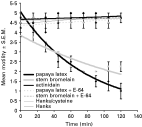
Fig. 1. The motility of Protospirura muricola adult worms exposed to plant cysteine proteinases in vitro (only papaya latex, stem bromelain and actinidain are shown for clarity). Adult worms of P. muricola were incubated with papaya latex (with and without E-64), stem bromelain (with and without E-64), actinidain (all in the presence of cysteine) or Hanks' saline with and without L-cysteine. Motility declined rapidly in the presence of all cysteine proteinases examined, except actinidain, while no change in activity was evident for the worms incubated in Hanks' saline, with and without cysteine, or with cysteine proteinase preincubated with E-64. Error bars represent the standard error of the mean.

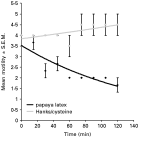
Fig. 2. The motility of Protospirura muricola L4 exposed to papaya latex or Hanks' saline+L-cysteine in vitro. Only the L4 incubated with papaya latex showed a decline in motility; no change in motility was observed for the L4 incubated in the absence of cysteine proteinase. Error bars represent the standard error of the mean.
Worm burdens were analysed by 2-way ANOVA, and whilst we explored models based on raw data with normal or negative binomial error structures, and transformed data with normal error structures, the best fit were models based on the log10 (x+1) transformed data. All parametric models were assessed for goodness of fit by R2, and residuals were checked for normal or negative binomial distribution, as relevant. The final statistical models fitted to the data are explained more comprehensively in the text. In Fig. 4, where log transformation was used to enable statistical analysis, we present data as mean log10 (worms recovered+1)±standard error of the mean (S.E.M.). Back-transformed values for some treatments are also given in the text as geometric means ±95% confidence limits (CL).
RESULTS
Plant cysteine proteinases demonstrate anthelmintic efficacy in vitro against P. muricola
When incubated with any of the plant cysteine proteinase preparations, except actinidain, at the concentrations given in the Materials and Methods section, the motility of P. muricola adult worms rapidly declined.
For example, an experiment was conducted in which 7 treatment groups were compared, comprising papaya latex (with and without E-64), stem bromelain (with and without E-64), actinidain, Hanks'+L-cysteine and Hanks' alone. The only treatments to show activity were papaya latex and stem bromelain (Fig. 1). Analysis of within-subject effects by 1-way rmANOVA gave a significant effect of time, F8,112=9·1, P<0·001, and a significant interaction between time and treatment, F48,112=8·0, P<0·001, indicating that motility changed significantly with time and diverged between treatments. There was also a significant difference between treatments (between-subject analysis: main effect of treatment, F6,14=30·0, P<0·001). The worms in the Hanks' saline, with and without cysteine, showed no change in their motility over time, nor was there any evidence of a significant decline in activity when either papaya latex or stem bromelain were combined with E-64. Post-hoc analysis by the Tukey HSD test showed that treatment with papaya latex and stem bromelain did not differ significantly from each other (P=0·99), but these 2 treatments varied significantly from the remaining 5 treatments (P<0·001).
In these in vitro tests, there was an indication that, overall, the motility of female worms was lower than that of male worms (1-way rmANOVA for main effect of sex, F1,14=4·2, P=0·059) and declined more quickly with time (within-subject analysis: time×sex interaction, F48,112=2·0, P=0·058), although neither effect quite reached significance. The motility of female worms exposed to papaya latex, in particular, was lower than that of male worms 105 and 120 min after exposure (mean motility for males at 105 and 120 min=2·0±0 and 1·5±0·6, and for females, 1·0±1·0 and 0·5±0·5).
The effective enzymes also caused noticeable blistering at points along the surface of the nematode. With time, the internal structures of the parasite burst out from these swollen blisters. This effect on the motility and worm surface was dependent upon the cysteine proteinases because no change in motility or surface appearance occurred when the parasites were incubated with enzyme pre-incubated with the specific inhibitor, E-64 (Fig. 1).
Indistinguishable detrimental effects were observed on the L4 stage of P. muricola in the presence of papaya latex, but were not evident on the control worms. In one such experiment, L4s were exposed to papaya latex or Hanks' saline in the presence of L-cysteine (Fig. 2). Motility declined significantly with time (1-way rmANOVA for within-subject analysis: effect of time, F7,21=5·1, P=0·002) and diverged significantly between the two treatments with time (for time x treatment interaction, F7,21=9·0, P<0·001). There was a significant difference in motility between incubation in Hanks' saline and incubation in papaya latex (main effect of treatment, F1,3=48·2, P=0·006).
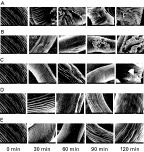
The surface damage observed during the motility experiments was more closely examined using scanning electron microscopy. Fig. 3 shows that the same enzymes which were effective in significantly reducing the motility also caused substantial damage to the cuticle of the worm (Fig. 3A–C). This cuticular damage was progressive, with the initial formation of blisters, which then perforated to release the internal structures of the worm. This was followed by complete digestion of the cuticle by 120 min. As with H. polygyrus (Stepek et al. 2005) and T. muris (Stepek et al. 2006), the adult worms of P. muricola were not affected by the cysteine proteinase from kiwi fruit, actinidain (Fig. 3D). The worms incubated with this enzyme had a similar appearance to the control worms in Hanks' saline with cysteine (Fig. 3E), with intact longitudinal ridges.

Fig. 3. Scanning electron microscopy of Protospirura muricola adult worms incubated with and without plant cysteine proteinases in vitro. The micrographs were taken at equivalent points along the worm surface, near the mid-point. The digestion of the cuticle was evident by 120 min when the worms were incubated with 25 μM (active enzyme) papaya latex (A), 15 μM (active enzyme) Ficus benjamina latex (B) and 15 μM (active enzyme) fruit bromelain (C). Note the perforation of the blisters (arrowhead) formed during incubation with fruit bromelain (C). The longitudinal ridges remained evident, even after 2 h, on incubation of the worms with 30 μM (active enzyme) actinidain (D) and Hanks' saline+16 mM cysteine (E). Scale bar=100 μm.
Plant cysteine proteinases are efficacious against P. muricola in vivo only after antacid pre-treatment
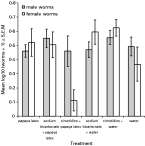
In initial pilot experiments, we found that, despite its efficacy in vitro, papaya latex had no effect on worm burden or on egg output following its oral administration to infected mice (data not shown). We hypothesized that this could be due to the low pH of the stomach, conditions in which these enzymes are known to be poorly active (Salih et al. 1987; Huet et al. 2006). When mice were pre-treated with NaHCO3 or the antacid, cimetidine, to increase the pH of the stomach before papaya latex was administered, a significant reduction in worm burden (61·1%, based on geometric means) was observed only when papaya latex treatment was preceded by cimetidine (Fig. 4; geometric mean=2·3 (±95% CL 0·86–4·94), compared with the group given cimetidine and water, where geometric mean=5·92 (±95% CL 4·38–7·92)). Statistical analysis by 2-way ANOVA on log10 (x+1) transformed total worm counts gave only a significant 2-way interaction between treatment with papaya latex and treatment with antacids [2-way ANOVA with papaya latex treatment at 2 levels (with or without), and antacid treatment (3 levels: cimetidine, NaHCO3 and water); F2,40=4·81, P=0·013; model R2=0·203], indicating that the effect of papaya latex varied between treatments with cimetidine, NaHCO3 and water. The main effect of treatment with and without papaya latex was just outside significance (F1,40=3·5, P=0·07).

Fig. 4. The mean worm burden, shown separately for male and female worms, in mice infected with Protospirura muricola and treated with papaya latex or water, with and without antacid pre-treatment. Only papaya latex preceded by cimetidine resulted in a significant reduction in worm burden, but only of female worms. Error bars represent the standard error of the mean.
When analysis was confined to female worms alone, the 2-way interaction gained significance (F2,40=6·5, P=0·004; model R2=0·25), but did not when the analysis was conducted on male worms (F2,40=0·9, P=0·4). The main effect of treatment with and without papaya latex for female worms was again just outside significance (F1,40=4·0, P=0·052). Hence, the only treatment that resulted in a significant reduction in worm burden, and then only of female worms (90·6% reduction based on geometric means), was papaya latex preceded by cimetidine (geometric mean=0·3 (±95% CL 0–9·94), compared with the group given cimetidine and water, where geometric mean=3·2 (±95% CL 2·06–4·82)); male worms were not affected. No reduction in worm burden occurred when papaya latex was administered alone or following NaHCO3.
The pH of the stomach contents of the mice which only received papaya latex or sterile dH2O was 4, whereas NaHCO3 raised the pH to 9 and cimetidine to 7. The effect of the antacids on the stomach pH lasted for at least 35 min. Therefore, papaya latex is efficacious in vivo against P. muricola adult female worms, but only when preceded by an antacid, such as cimetidine, which neutralizes the stomach pH, maintaining it at approximately 7·0, close to the optimal pH for cysteine proteinase activity (Salih et al. 1987).
Cysteine proteinase activity throughout the GI tract changes with time
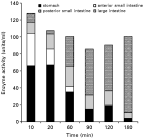
The enzyme activity of papaya latex varies over time as the latex passes through the GI tract of mice. As shown in Fig. 5, the activity was initially highest in the stomach, but rapidly declined here, so that negligible levels remained in the stomach after 90 min. In contrast, whereas the activity levels in the stomach decreased by 90 min, it was from this time that the levels of enzyme activity in the large intestine steadily rose, with the majority of the activity appearing to accumulate at this point of the GI tract by 180 min. Fig. 5 also indicates that papaya latex passed very rapidly through the small intestine, with activity being present in the anterior small intestine for only 20 min. The overall enzyme activity of papaya latex in the GI tract gradually decreased over 90 min and then increased again. The period of increase (90 to 180 min) coincided with the time when the majority of the enzyme activity was in the large intestine, and may be due to an increase here in enzyme concentration following absorption of water in both the lower small intestine and the large intestine (Fig. 5).

Fig. 5. Mean enzyme activity (Units/ml) of papaya latex throughout the GI tract over time. The cysteine proteinase activity was assayed and the unit of activity was defined as that which produced 1 nmol min−1 of product (see Materials and Methods section). Enzyme activity associated with papaya latex declined rapidly in the stomach and small intestine over time, but increased steadily in the large intestine.
DISCUSSION
P. muricola is a robust, relatively large, stomach worm of rodents, with female worms growing to a length of more than 5 cm (Behnke et al. 2000) and living for well over 2 months, often in excess of 7 months (Lowrie et al. 2004). These worms have a thick cuticle and are therefore, presumably, a more challenging target for cysteine proteinases than the other nematode species that have been examined to date. Nevertheless, this study showed that, in vitro, cysteine proteinases from papaya, pineapple and fig, at concentrations shown previously to be effective against H. polygyrus (Stepek et al. 2005) and T. muris (Stepek et al. 2006), were just as effective against this species, causing substantial damage to the cuticle of the nematode, which resulted in its death. This effect was similar to that described previously for 3 other gastrointestinal nematodes, H. polygyrus (Stepek et al. 2005), T. muris (Stepek et al. 2006) and Ascaris suum (Robbins, 1930; Berger and Asenjo, 1939), indicating that plant cysteine proteinases have a broad spectrum of activity against GI nematodes in vitro.
As for H. polygyrus and T. muris, actinidain from the juice of kiwi fruit was without effect on motility and cuticular damage. This is a remarkable finding given the similarity in enzyme structure and activity between actinidain and the other papain-like enzymes (Varughese et al. 1989, 1992). It suggests that the different enzymes show distinct differences in activity against the unknown component(s) of the adult cuticle. It is likely that the target molecules in the cuticle, although undefined, are common components of the adult cuticle of these three species of GI nematode.
We found no in vitro anthelmintic action of the plant cysteine proteinases against the L3 stage of P. muricola (results not shown). Similar observations were also made in the cases of H. polygyrus and T. muris in that only the gut lumen-dwelling L4 and adult post-infective stages were affected detrimentally by the plant enzymes. This suggests that the components of the cuticle that are sensitive to attack are only present during the post-infective (mammal parasitic) late developmental and usually adult stages of nematodes (the L3 of P. muricola are parasitic in insects, whilst those of H. polygyrus are free-living, and the L3 stage of T. muris are mammal parasitic, but are hidden from access because they are within the mucosal tissues), and that damage to the cuticle is the crucial mechanism of action for these enzymes as anthelmintics.
Although the plant cysteine proteinases, with the exception of actinidain, show anthelmintic activity against P. muricola in vitro, and earlier studies have shown significant in vivo efficacy of papaya latex against the adult worms of H. polygyrus (Stepek et al. manuscript in preparation) and T. muris (Stepek et al. 2006), we initially failed to detect efficacy of papaya latex against P. muricola in vivo. However, when the mice were pre-treated with the antacid cimetidine, papaya latex had a significant anthelmintic effect. Because the activity of the cysteine proteinases is pH-sensitive, the enzymes may become temporarily inactive when passing through parts of the gastrointestinal tract, such as the stomach (with a pH as low as 2), but regain their activity on entering the small intestine with a pH of 7–8. Cysteine proteinases of the papain family are stable between pH 4 and 9, with optimal activity at neutral pH, but their activity decreases greatly below pH 4 and above pH 9, due largely to the pKas of the active-site thiolate and imidazolium ions (Salih et al. 1987). This would explain the lack of effect of papaya latex alone (stomach pH<4) or when preceded by NaHCO3 (stomach pH~9). Only cimetidine retained the stomach pH at a value close to the enzymes' optimum (pH~7). Our results regarding the treatment of mice with antacid prior to cysteine proteinase administration have confirmed, and added support to, the recent findings of Hale (2004), who found that when bromelain was administered with antacid, it retained its activity throughout the intestinal tract of mice.
Importantly, Athanasiadou et al. (2001) and Paolini et al. (2003) reported that an extract of condensed tannins from plants reduced worm burdens of nematode species in the small intestine, but not of those in the abomasum, of small ruminants. The parallel to our results is clearly evident, especially as Athanasiadou et al. (2001) suggested that a possible reason for this was the pH of the abomasum and small intestine. These authors stated that condensed tannins are stable between pH 5 and 7, and that infections in sheep of the abomasal nematodes, Haemonchus contortus and Teladorsagia circumcincta, were probably not affected due to the abomasum having a pH of 2·5, in contrast to that of the small intestine (pH of 7–8), explaining why Trichostrongylus colubriformis worm burdens were reduced. Perhaps, in this situation, pre-treatment with an antacid with the capacity to neutralize the pH of the abomasum would facilitate tannin-mediated reduction in worm burden of nematode species found in the abomasum.
P. muricola is unique in that only female adult worms were susceptible in vivo to the action of the proteinases, even though, in vitro, both sexes were affected, although there was an indication that male worms took longer to immobilize (however, this was not unequivocally supported by the statistical analysis). The reason for this is not clear, but it may be due to a successful evasion strategy by the males or to the enzyme concentrations that were tested in the present study. However, male worms of both H. polygyrus (Stepek et al. manuscript in preparation) and T. muris (Stepek et al. 2006) were also less susceptible in vivo than the corresponding female worms (although they were eventually expelled by treatment), suggesting that perhaps further treatments might also remove male worms of P. muricola.
This study has shown that papaya latex, at the concentrations used, had a more potent anthelmintic effect in vitro than in vivo and that, in both assay systems, female worms were more susceptible. A direct comparison of enzyme concentrations in vitro and in vivo is difficult to obtain due to the unknown volume of the enzyme bolus passing through the GI tract, and the variable volume of the GI tract itself. The amount of active enzyme administered in each dose (8 nmol) is based on the successful anthelmintic action of papaya latex on T. muris (Stepek et al. 2006) and H. polygyrus (Stepek et al. manuscript in preparation), and is limited by the practicalities of administering papaya latex to a mouse. Assuming the volume of a mouse stomach to be 1 ml and the enzyme to be present throughout the stomach at equal dilution, the concentration of enzyme would be in the order of 8 μM, which is somewhat lower than the in vitro concentrations. Another possible reason for the greater effect in vitro than in vivo may be because in vitro, the pH was kept buffered at approximately 6–7 but, in vivo, it was only approximately 7 after addition of cimetidine. The length of exposure of the worms to papaya latex may also be a crucial factor because in vitro, the worms were consistently exposed to the latex for the whole of the incubation period lasting up to 2 h, but only for a relatively short time (<1 h) in vivo because of the rapid passage of the contents through the gastrointestinal tract. However, the fact that, in vivo, female worms are particularly susceptible makes this a potentially attractive mechanism for the control of nematode egg production, hence life-cycle and transmission.
We have demonstrated that the enzyme activity of papaya latex varied over time as it passed through the GI tract of mice, with the highest activity in the stomach immediately after administration, and with a build-up of activity in the large intestine from around 90 min post-administration, which lasted for at least a further 90 min. This may be a major factor for the in vivo activity of papaya latex against T. muris, which resides in the large intestine (Stepek et al. 2006), and shows promise for adapting this treatment for use against equine nematodes, where those parasitizing the large intestine are perhaps the most important impediment to health (Uhlinger, 1990; Love, 1992). These data further show that enzyme activity in papaya latex can survive transit through the stomach and that enzyme inactivation in the stomach can be reversed to a useful extent when the latex is returned to a more neutral pH.
In conclusion, plant cysteine proteinases are efficacious in vitro against the stomach nematode of rodents, P. muricola, but only show efficacy against this parasite in vivo following neutralisation of the stomach acid by an antacid such as cimetidine. Consequently, if the cysteine proteinases from plants are to be used as anthelmintics against stomach nematodes, then pre-treatment with an antacid, such as cimetidine, will be required to achieve maximal efficacy. Although synthetic drugs such as cimetidine provide a means for neutralising stomach pH, other classes of medicinal plants may also bring about a similar effect. Therefore, combinations of plants containing naturally-occurring anthelmintics and plants that have naturally-occurring antacid properties may enable these novel treatments for worm infections to be exploited by small-holder livestock owners, without the expense of purchasing commercially-available drugs. Further study on methods of formulation and delivery of these enzymes is essential to obtain maximum efficacy against all GI nematodes before testing in clinical and field trials is undertaken.
This work was funded by a research grant from The Leverhulme Trust held by J.M.B., D.J.B. and I.R.D. We thank Steve Ellin and the late Ken Cartmell (Tapton Experimental Gardens, University of Sheffield) for their help in the maintenance of the fig trees and in the collection of the latex. Finally, we are sincerely grateful to Simon Clifford and Tim Smith for excellent technical assistance in parasite maintenance and electron microscopy.