The story of Hérodiade's creation is a bit of a mystery. Though the opera has fallen out of the modern repertory, it was easily the most sensational musical work of 1885 – not in Paris as might be expected, but rather in Lyon. Despite its immensely successful (and hardly controversial) premiere at the Théâtre Royal de la Monnaie in Brussels four years earlier, Lyonnais audiences were up in arms over the opera's admittedly rather loose adaptation of Gustave Flaubert's Hérodias and reworking of the biblical characters John the Baptist, Salome, Herod and Herodias. The Lyonnais critic Paul Bertray recounted a lively conversation that he supposedly overheard at another musical event:
Spearheaded by a priest (Father de Pubély), the Archbishop of Lyon (Father Louis Caverot) and a layman (Joannès Blanchon), the campaign against Hérodiade by this Lyonnais trio laid the groundwork for a writer in Le progrès, Lyon's most Republican newspaper of the time, to report that the Archdiocese of Lyon would be calling for Massenet's excommunication in order to avenge what it had perceived as an open assault on the Catholic Church.Footnote 2 For the most part, their protests were based on the opera's libretto. Specifically, they took offence at the transformation of Jean-Baptiste from divine prophet to mere lover through his entanglement with Salomé, whose spiritual love for him at the opening of the opera has become entirely physical by the end.
Parisian newspapers quickly picked up the story that was developing in Lyon. The threatened excommunication of one of the country's most famous composers made for good entertainment and even better sales. But Hérodiade had not yet been performed in the capital in French: its only performance in Paris had taken place the previous year, on 1 February 1884, at the Théâtre-Italien – and even that Italian-language performance had been a long time in the making. Work on Hérodiade began as early as 1878, as Massenet was in Italy preparing the Italian version of Le roi de Lahore. Having been given a scenario based on Gustave Flaubert's Hérodias, Massenet enlisted a young writer, Paul Milliet, to translate Angelo Zanardini's Italian text into French. With the assistance of Georges Hartmann (under the pseudonym Henri Grémont), the French translation was completed, and Massenet began work on the piano–vocal score in September 1878. One year later, in December 1879, that score was completed, and by September 1880 Massenet had finished the orchestration.Footnote 3
Having worked towards a premiere at La Scala in Milan, Massenet was disappointed to learn that Giulio Ricordi's interest in the project seemed to have faded. Equally disheartening was the fact that Massenet had previously refused requests to stage the work in London, Lyon and Brussels while awaiting news from Ricordi. After being denied an Italian premiere, Massenet identified the Paris Opéra as an alternative venue. It remains unclear who approached whom regarding the production of Hérodiade, but the Opéra's director, Auguste-Emmanuel Vaucorbeil, ultimately rejected Hérodiade in what has since become a famous exchange.Footnote 4 While Massenet's memoirs recall Vaucorbeil's distaste for the young Milliet's work as the grounds on which the work was rebuffed – the director explained that Milliet's text required a carcassier (butcher) to refashion it – numerous Parisian newspapers reported that Vaucorbeil's rejection was based on the ‘incendiary’ nature of the libretto.Footnote 5
Thus Massenet turned to Oscar Stoumon and Édouard Calabresi, the directors of La Monnaie, who offered to stage the work. Hérodiade had its premiere there on 19 December 1881 to a house packed with the who's who of high society. In addition to the staunchly Catholic Belgian royal family, the audience counted among its ranks Parisian elites and journalists who had taken the train to attend the performance, including Antonin Proust, the Minister of Fine Arts, and even Vaucorbeil himself. Notwithstanding the opera's enormous success in Brussels, neither the Paris Opéra nor the Opéra-Comique would stage the work in the French capital, and its premiere in Paris and in French would come only eleven years later, on 18 October 1893, at the Théâtre de la Gaîté. Herein lies the mystery: an opera whose masterful score and sensationalised libretto virtually guaranteed artistic and financial success was relegated to sporadic performances in Paris's secondary theatres. Hérodiade was, in essence, an operatic outlaw.
There is no question that the opera's unconventional staging of biblical personae was a theatrical risk and constituted, at least to some observers, an overstepping of poetic licence.Footnote 6 But the story itself – and indeed the freedom with which it was treated – was not new in fin-de-siècle French culture. Stéphane Mallarmé wrote his dramatic poem Hérodiade in 1864–9, Gustave Moreau's painting L'apparition, featuring Salome's dance, was completed in 1876, and this vogue for reinterpretation would continue through to Oscar Wilde's famous play twenty years later, in 1891.Footnote 7 Moreover, Massenet's frequent (by the mid-1880s) amalgamation of the sacred with the sensual was well known and all but expected of him: the premieres of his oratorios Marie-Magdeleine in 1873, Ève in 1875 and La Vierge in 1880 had established him firmly within that aesthetic and ideological realm, and his later operas Manon (1884), Esclarmonde (1889) and Thaïs (1894) would continue in the same vein.Footnote 8 Why, then, was a Parisian performance of Hérodiade so difficult to obtain?
The answer lies not so much in the libretto's transformations of biblical characters, nor even in the sexualisation of the New Testament's most famous prophet. Rather, the problem arose in what those transformations represented to the Catholic Church and to the still-nascent French Third Republic. Since its foundation in 1870, the Third Republic had been threatened with instability resulting from the complex – and rather public – manœuvring between the French state and the Catholic Church. Following in the steps of their Revolutionary forbears, Republican leaders asked whether the Church should function as a moral barometer in modern society.Footnote 9 Such issues had already been broached on the parliamentary floor. As early as 1879, for example, Jules Ferry, the Minister of Public Education, had proposed a law that forbade clergy from teaching in public schools. The following year, the Jesuits had been expelled from France, and in 1882, following a surge in anticlericalism, the French government passed the law that rendered public education both compulsory and secular. In the early 1880s, then, notions of reconciling the increasingly fractured relationship between Church and State seemed utopian, if not impossible: while the Republic sought to regain stability after the disastrous Franco-Prussian War, the Church and its supporters grappled for a foothold in a nation that was edging dangerously close to what they perceived as total secularisation.
Public figures, including intellectuals, politicians, clergy, artists and musicians openly engaged with the increasing tension between the Catholic Church and the French state. Many Republicans, though no longer practising Catholics, still depended on the Church and its rituals – indeed its sacraments – to mark important occasions in their lives in the form of marriages, first communions and burials. These conformistes saisonniers were also vocal in their support of ecclesiastical reforms put forward by Gallicanists: French Catholics who, unlike their ultramontane counterparts, proclaimed the French Church's autonomy and looked to the State as the primary authority in the governance of French churches.Footnote 10 Gallican bishops found themselves in a small (if vocal) minority when the doctrine of papal infallibility was passed at the First Vatican Council (1869–70). This act further entrenched the battle lines between Republican politicians and the Church. Whereas many moderate Republicans (and even those who leaned more to the left) had been in favour of Gallicanist-led reforms, the successful vote for papal infallibility rendered ultramontanism and Catholicism virtually synonymous in their minds: the ultramontanists’ failure to acknowledge patriotism towards the French nation kicked Republican anticlericalism into overdrive.
Such debates were not relegated to the parliamentary floor, nor were they confined to any secret, behind-the-scenes dealings of the clergy. Parisian newspapers that ranged in readership from ultramontane Catholics to the most staunchly anticlerical Republicans covered the issues with such fervour that one would be hard-pressed to find a newspaper that did not boast front-page headlines announcing the day's newest squabble between Catholics and Republicans.Footnote 11 The public was thus acutely aware of the Republic's hostility towards the Church – and vice-versa – and it was surely not simply the opera's libretto or score that kept Hérodiade off the most prestigious Parisian stages. Instead, the work held a mirror to contemporary political concerns in ways that were simply too telling for it to appear at the Opéra, whose repertoire had so successfully projected ‘the nation's image’ in earlier decades.Footnote 12
The blacklisting of Hérodiade at the most prestigious Parisian theatres in fact reveals significant and heretofore overlooked connections between musico-dramatic and political structures in fin-de-siècle Paris. Massenet presents the Church, personified by Jean-Baptiste as Christ in both traditional Catholic and modern Republican senses, in relation to the French Republic, personified by the Roman consul Vitellius. Whereas previous readings of Jean-Baptiste have placed the prophet firmly within the realm of traditional Catholicism, I understand the prophet as analogous to the fallen theologian Ernest Renan's contemporary – and controversial – vision of Christ. As I shall argue, the controversies spawned by the opera ran much deeper than the stated conundrums of humanised prophets and ‘indecent’ love duets. By pitting the Church so openly against the Republic, Hérodiade offered an interpretation of the biblical story that was far too close to the current political situation to appear on stages that were still trying to present a cohesive national image to international as well as domestic audiences. In the end, the ‘mystery’ of Hérodiade emerged from the intricate complexities of competing ideologies whose timely coalescence barred the opera from what should have been its natural Parisian home.
From the prophet to the prophesied
In the decade prior to the Brussels premiere of Hérodiade in 1881, the still-nascent Third Republic was governed by Président-Maréchal Patrice de MacMahon (1808–93). Under what has now become known as the ‘Moral Order’, the conservative and devoutly Catholic MacMahon attempted to bring about a religious course-correction that was necessitated, in the minds of many Parisian citizens, following defeat in the Franco-Prussian War (1871). Proponents of MacMahon's Moral Order viewed the devastation of the war as God's punishment for the nation's descent into decadence. Indeed, Rupert Christiansen describes early 1870s Paris as ‘the Sodom that God had destroyed for its wickedness’.Footnote 13 In the early years of the Third Republic, then, a return to the ideals of the Church and to Christ at its head seemed to be inevitable.
Notwithstanding the changes to the biblical story introduced in the libretto, many critics were quick to make comparisons between the character of Jean-Baptiste and Christ himself. Jean-Baptiste's entrance into the public square in Act II scene 7 – accompanied by swaying palm branches and cries of ‘Hosannah! Gloire à celui qui vient au nom du Seigneur!’ (‘Hosanna! Glory to him who comes in the name of the Lord!’) – recalls Christ's entrance into Jerusalem and is perhaps the most obvious conflation of Jean-Baptiste's life with that of Christ. According to Johannès Weber, all that was missing from that scene was a donkey.Footnote 14 The likeness to the Passion narrative was also made clear at the opera's denouement, when angry crowds scream for Jean-Baptiste's death and, in a move that mirrors Pontius Pilate's condemnation of Christ, are granted their wish by Herod. This was, according to Perkéo (the Belgian correspondent for Le figaro), the basis for the ‘impression of religious emotion that hovers over the entire work’.Footnote 15 In his opinion, the opera's authors had set their sights on a ‘different martyr’, one whom ‘respect prohibits from putting on the stage’.
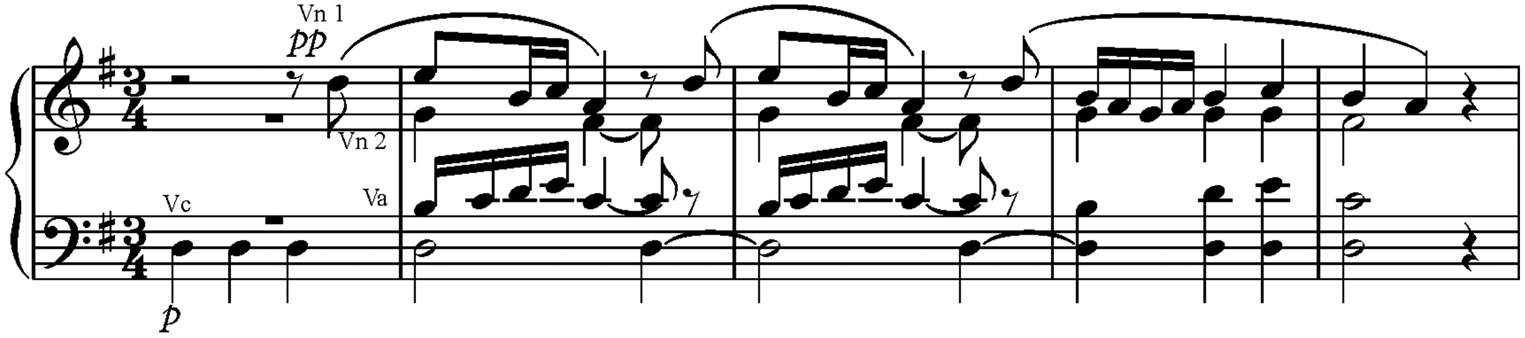
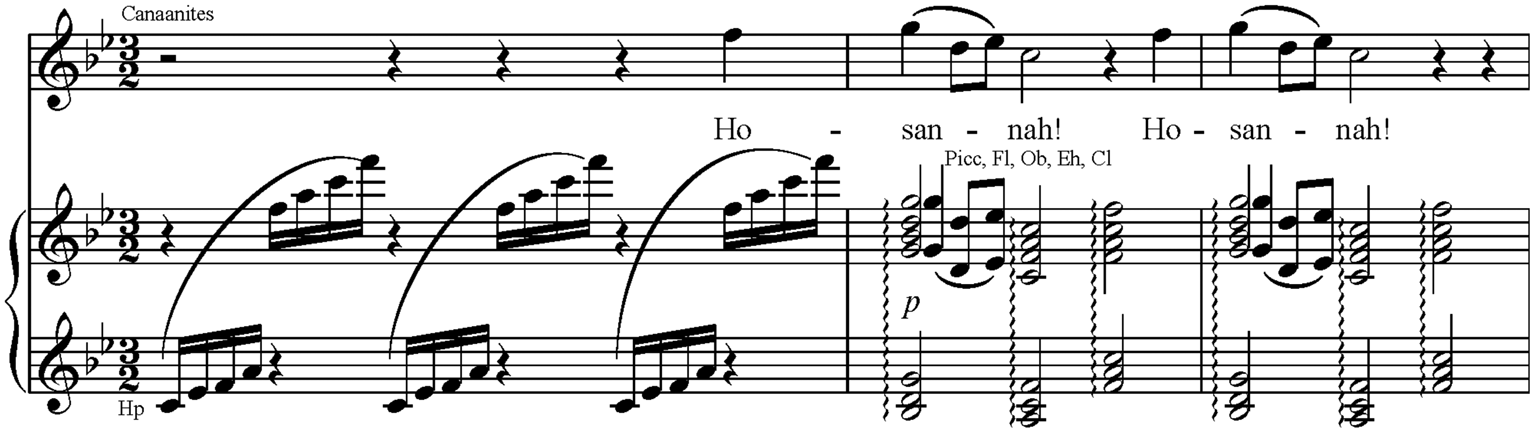
Perkéo's ‘different martyr’ was of course Christ himself. Massenet fused Jean-Baptiste and Christ sonically from the very beginning of the opera. Just as Christ entered Jerusalem accompanied by choruses of ‘Hosannah’ and the waving of palm branches, so too does Jean-Baptiste. As the crowd proclaims the glory of Vitellius and Rome, Jean-Baptiste arrives triumphantly, flanked by Salomé and a devoted band of Canaanite women. This clear conflation of the prophet with the prophesied is foreshadowed musically: the first melodic moments in the ‘Introduction’ present the same tune that will accompany the Canaanite women and Salomé's song of ‘Hosanna’ and Jean-Baptiste's entrance into the square in Act I (Exx. 1a and 1b).Footnote 16
Jules Massenet, Hérodiade, ‘Introduction’.

Jules Massenet, Hérodiade, Entrance of the Canaanite women and Salomé.

In the same way that Christ's entrance into Jerusalem marks the beginning of his journey towards death, Jean-Baptiste's own triumphal entry hastens his execution. Similarly, the operatic prophet recalls Christ's prayer from the Garden of Gethsemane when he submits himself to the Lord's will in the hour of his own demise: ‘Seigneur, ta volonté soit faite, je me repose en toi!’Footnote 17 Like Christ, Jean-Baptiste commends himself to the Lord and accepts his fate, having similarly been condemned by the cries of an angry crowd and its sycophantic leaders. At his execution, Jean-Baptiste's spirit becomes that of Christ through his martyrdom as a ‘symbol of Humanity, the strong and simple soul of the new world, that will be nourished for its part in the blood spilled by his executioners’.Footnote 18
According to the composer Charles Koechlin, the deliberate fashioning of Jean-Baptiste as a Christ-like figure was later confirmed by Massenet who explained to his composition students that ‘Saint Jean-Baptiste is, in my view, not the Precursor of the [biblical] story, but is Christ himself … and Salomé is Mary Magdalene. The entry of Jean into Jerusalem is that of Jesus. Everything is modelled on the life of Christ.’Footnote 19 Though one might rightly question the veracity of Koechlin's recollection (or even of Massenet's statement, for that matter), the similarities are there. As a symbol of Christ, Jean-Baptiste positions himself in stark contrast to the Roman – or French – Republic. But given the increasingly powerful influence that positivist theology held over Republican society, one might also wonder to whose version of Christ Massenet was referring, for the Church and the French Republic held vastly differing opinions on the matter during the second half of the nineteenth century.
‘The gospel according to Renan’, or Massenet's La vie de Jean-Baptiste
At the same time that MacMahon's moral regeneration was gaining currency with Parisians, a brand of theology that was heavily steeped in positivism was becoming equally influential across Europe. Even as early as 1836, the German positivist theologian David Strauss had separated Jesus-as-human from Jesus-as-divine, situated Jesus and the gospel narratives in their historical and geographical contexts, and argued for a ‘historical Jesus’, thereby denying his status as divine and demoting the Gospels from their position as bearers of the words of God to exoticised myth.Footnote 20 Strauss's ideas – along with those of his like-minded German contemporaries – were highly influential throughout Christian Europe, and perhaps no more so than to the Frenchman Ernest Renan, whose immensely popular – and compelling – La vie de Jésus (1863) provoked outrage from Catholic critics and stimulated an equally passionate interest among its Republican supporters, especially since memories of the repressive Catholicism of the Second Empire remained fresh in many Parisian minds, and an increasing portion of bourgeois society began to transform its conception of Jesus as a biblical figure.Footnote 21
Though he had trained as a seminarian, Renan's growing scepticism towards traditional Catholic teachings, fostered largely by his exposure to Strauss's work, led to a crisis of faith that eventually resulted in his abandoning the Catholic Church in 1845. As a professor of Hebrew at the Collège de France (appointed in 1861), Renan travelled to the Middle East and, through his archaeological studies, came to believe that the doctrine of the Church was incompatible with the historical and anthropological evidence that he had gathered. When La vie de Jésus was published in 1863, it was immediately successful – not only because it catered directly to growing anticlerical sentiment in Second Empire Paris, but also because, as Robert D. Priest suggests, it engaged actively in numerous debates that spanned diverse intellectual circles. Though its publication resulted in Renan's immediate suspension from his appointment at the Collège, the book nevertheless popularised secularist criticism of the Bible within France and highlighted the emergence of questions that sought to re-establish Jesus's political and religious significance.Footnote 22 As a result, the characterisation of the life, death and teachings of Christ came to depend on an individual's perception of the nature of the doctrinal praxis of the Church itself and rested heavily on one's support of, or distancing from, the clergy. The life of Christ was either defined by scriptural narrative or recast so as to fit within Republican reconfigurations of religious belief and practice. Whereas post-Revolutionary Church doctrine had focused on fear, retribution and, as Ralph Gibson calls it, ‘hellfire and damnation’, Republicans shifted the emphasis towards a religion compatible with positivist values: hell became a metaphorical state, and depictions of God as loving, forgiving and socially conscious emerged instead.Footnote 23
Renan's position fitted perfectly into the emergent Republican conception of Jesus as loving human. His central claim was that Jesus should, above all, be stripped of his divinity, treated as a human figure, and the New Testament – and especially the Gospels – serve as a historical source rather than as a ‘divinely inspired and harmonious narrative’.Footnote 24 He castigated Catholicism as a misinterpretation of Jesus's teachings; his reconfiguration of Christ was a direct reaction to the doctrinal teachings of the Catholic Church that, in turn, had served as catalysts for the anticlerical movement in France. His stance went against the claim for the necessity of Christ-like suffering, the denial of economic, social and physical pleasure, and subordination to the clergy through confession.Footnote 25 For Renan's Jesus ‘the idea of being all-powerful by suffering and resignation, and of triumphing over force by purity of heart, was indeed an idea peculiar [i.e., unique] to him’.Footnote 26 Christ, as Renan moulded him, was the ultimate Republican priest:
Never has there been any one less a priest than Jesus, never a greater enemy to forms, which stifle religion under the pretext of protecting it. In this we are all his disciples and his successors; by this he laid the eternal foundation-stone of true religion; and, if religion be essential to mankind, by this he has merited the divine rank which the world has accorded him. An absolutely new idea, the conception of a worship founded on purity of heart, and on the brotherhood of humanity, through him entered into the world an idea so lofty that the Christian Church had necessarily to fall short of it, an idea which, in our days, only a few minds are capable of following.Footnote 27
For Renan, a study of Jesus as a historical figure proved that the nurturing of purity of the heart and love through human fraternity – rather than the clerically forced adherence to domineering social and moral interdicts – was the foundation of the Church. To worship Renan's Jesus called for a transformation of Catholic dogma: ‘Jesus despised all religion that was not of the heart. The vain ceremonial of devotees, the outward display of strictness which trusted to punctiliousness for salvation, had in him a mortal enemy … Love of God, charity, and mutual forgiveness in these consisted the whole law. Nothing could be less sacerdotal.’Footnote 28
Massenet was no stranger to Renan's work: his contemporary, the critic Hugues Imbert, claimed that the composer was, in effect, a frequent guest at Renan's salon.Footnote 29 Members of the press had already noticed the influence of Renan's theology in his oratorios, especially Marie-Magdeleine (1873) and Ève (1875).Footnote 30 And associations between Renan's philosophies and Massenet's music, though not always positive, continued to the end of the nineteenth century. In his description of the composer's final oratorio, La terre promise, the ultra-conservative critic Camille Bellaigue described Massenet as having departed from his former persona as the ‘Renan of the oratorio, the feminist and delightful musician of piety without faith’; and in her 1891 biography of Charles Gounod, Marie Anne de Bovet exalted Gounod's musical expression of faith above Massenet's fanciful interpretations of biblical episodes.Footnote 31 She rejoiced that Gounod, unlike Massenet, was not ‘the Renan of Music’.Footnote 32
Love of God and charity were defining characteristics of Renan's Jesus as much as Hérodiade's Jean-Baptiste. As Clair Rowden has shown, Jean-Baptiste was informed by Renan's portrayal of the prophet as a lesser figure who lacked ‘inspirational, forward-looking dogma’ and ‘never expounds on the teachings of Jesus’.Footnote 33 Although in Renan's writings Jesus and John the Baptist shared certain similarities, the prophet was cast as inferior, rendered ineffective by his inability to generate a great religion. In Hérodiade, however, Jean-Baptiste is anything but. His proclamation of a new religion based at once on love, fraternity and forgiveness stands in opposition to the limited but benign portrait painted by Renan in La vie de Jésus. Indeed, Jean-Baptiste takes on a double persona in the opera, mirroring not only Christ at the head of the Catholic Church, but also Renan's humanised – and staunchly Republican – Jesus.
Jean-Baptiste becomes conflated with Renan's Jesus almost immediately following the opening of Act I as the Pharisees and the Sadducees begin quarrelling over religion and religious practice. The astrologer Phanuel is quick to point out their ignorance of ‘la voix immortelle qui leur répète: “Amour! Pardon! Vie éternelle!”’ (‘the immortal voice which calls to them: “Love! Pardon! Eternal life!”’).Footnote 34 The ‘immortal voice’ to which he refers is that of Jean-Baptiste, yet the message is that of the Renanian Jesus. Phanuel speaks of a voice that preaches love and does not attempt to instil morality through fear; rather he portrays Jean-Baptiste as a figure whose creed stands in contrast to that of the most traditional nineteenth-century French clergy. Phanuel continues by declaring that the prophet has come ‘de pays lointains où les actes suivront de très près les paroles, bientôt tout changera, les lois et les symboles!’ (‘from distant parts where deeds will very soon follow words, and soon all will change, laws and creeds!’). This ideological shift is reflected musically. When Phanuel enters amidst the religious quarrelling, his music is marked by a sense of unease: accompanied by chromatic harmonies, his words are severe and declaimed syllabically on descending chromatic pitches (Example 2a). It is only when he speaks of the immortal voice of Jean-Baptiste preaching love, pardon and eternal life that the music becomes warm, lyrical and melodic as unsteady chromaticism gives way to clear diatonicism. Before Jean-Baptiste has even appeared on stage, Phanuel has characterised him as the change that was longed for in 1880s France: Jean is the personification of a repositioning of faith away from domineering moral creeds and laws towards love and brotherhood (Example 2b).
Jules Massenet, Hérodiade, ‘Encore une dispute!’ (Phanuel).

Jules Massenet, Hérodiade, ‘Ce que je veux’ (Jean-Baptiste).

Throughout the opera, however, Jean-Baptiste questions his identity as the ‘immortal voice’ of God. According to Renan, Jesus often doubted his existence as the Messiah and was, in fact, unaware of it until the Messianic image was created for him by his followers – much like Jean-Baptiste's identity is shaped by Phanuel and Salomé. As the time of his death draws near, Jean directly questions the Lord as to his lineage, asking
Phanuel, however, is well aware of the message that Jean is preaching; at times, he seems to be the only one who is.
Salomé, too, is convinced of Jean-Baptiste's serene nature, coupled with his devotion to love and charity – character traits that automatically identify him as Renan's humanised Jesus. She sings to him, declaring ‘C'est Dieu que l'on te nomme, car il n'est pas un homme qui garde ta sérénité! / Toi, dont la vie entière ne fut qu'une prière à l'amour, à la charité!’ (‘you must be called God, for no man could retain such serenity! You, whose entire life has been but a prayer to love and to charity!’)Footnote 36 Salomé sings of Jean's good nature, his soft voice and his tender heart throughout the opera, but she also praises his tender words for their ability to banish sorrow and suffering – key tenets of faithfulness that had been touted by Renan – in her famous aria ‘Il est doux, il est bon’:
This ‘prophet’ of whom Salomé sings, like Renan's Jesus, served to lighten the clergy's emphasis on Christ-minded suffering familiar to French audiences. Although her affectionate characterisation of Jean might be viewed as a product of her infatuation with him, her insistence on his tender nature is a further indication of Renan's process of humanising the figure of Jesus. Renan also noted the serenely sensitive nature of Christ's temperament:
Thus, as often happens in very lofty natures, tenderness of heart was in him transformed into an infinite sweetness, a vague poetry, a universal charm. His relations, free and intimate but of an entirely moral kind, with women of dubious character, are also to be explained by the passion which attached him to the glory of his Father and made him jealously anxious for all beautiful creatures who could contribute to it.Footnote 38
Renan, unlike his Catholic critics, does not rebuke Jesus's relationships with women of ‘dubious character’. Instead, he affirms that ‘Jesus’ extremely delicate feeling towards women which we remark in him was not inconsistent with the exclusive devotion which he had for his ideal’.Footnote 39
Jean-Baptiste enters the stage not preaching love and brotherhood, however, but rather spewing harsh invective against Hérodiade: a Jezebel whom he claims no one would be able to pity.Footnote 40 Instead of confirming the later parallels with Renan's Christ, Jean initially resists them by reinforcing the clerical model of a dogmatic priest.Footnote 41 For Jean, Hérodiade's sins are too grave to be forgiven, even after confession. Indeed, her status as a divorced woman, her incestuous marriage to Hérode, and the abandonment of her own child together serve as the antithesis to strict Catholic and, indeed, Republican moral codes for females.Footnote 42 But when Salomé enters and begins to tell Jean-Baptiste that she loves him, his disposition changes, and he speaks to her in the tender and serene voice that she has already introduced to the audience. Even though her confession might easily be regarded as blasphemy, Jean does not send her away angrily. Instead, he urges her not to renounce her youth; Salomé is living in a ‘season to love’ during which the ‘rashest desires invite kisses on hungry lips’.Footnote 43 He sings to her in the same manner in which she sings to him, and in doing so, he begins to act more like Renan's Jesus than a member of the clergy. Jean, however, recognises that his own destiny is different, and his declaration is underscored musically by an abrupt change of key from E major to C major – the key that, representing purity and godliness in Massenet's œuvre, confirms Jean's heavenly destiny and distinguishes it from Salomé's earthly life (Ex. 3).
Jules Massenet, Hérodiade, ‘Ce que je veux’ (Jean-Baptiste).

In his initial response to her continued outpouring of love, Jean-Baptiste implores Salomé to transform her worldly love for him into a spiritual one. Her love is ‘d'un sentiment profane’ that nonetheless has the potential to grant Salomé religious faith and eternal life. At the same time, Salomé continues to confess her love for him. The first act ends with Jean and Salomé singing their own respective texts in musical unison. Their desires at this point are different, but their musical linkage blurs the spiritual distinction between sacred and erotic love, thus exhibiting the ‘extremely delicate feeling towards women’ that Renan's Jesus was said to have felt. The point is emphasised by Massenet's casting of the prophet as a tenor alongside Salomé's soprano – the voice parts evoking the convention of the archetypal operatic love duet. It will only be in the moments directly preceding Jean-Baptiste's execution that they sing in perfect unison – musically and textually. Yet then, too, they still sing of the ‘mystery of immortality’ and the radiance of their love in Heaven. Even after Jean-Baptiste has reconciled his earthly love for Salomé with the spiritual, they remain insistent that their physical love for each other does not negate their religious faith. Indeed, it is God himself who ordained it through the granting of ‘the voice to say Your name, Lord, and the soul to harbour love!’. At the end of his earthly life, Jean continues to share Renan's view that physical love is not necessarily antithetical to the mission of the Catholic Church; indeed, as Jean says, ‘these words are not a blasphemy!’Footnote 44
For a Renanian Christ, these words constitute the foundation of an idealised Christian – and entirely Republicanised – religion. Clair Rowden's observation that Jean-Baptiste's religious message becomes virtually inseparable from his humanised and sensual one only confirms the likenesses between the two: his desire that Salomé transform her carnal love into a divine love eventually gives way to the opposite as he cedes to his physical desire for his disciple – contrary to the teachings of the Catholic Church, these events were not mutually exclusive.Footnote 45 At the same time that Massenet portrays his prophet as a Christ-like figure in the most traditional sense, he deploys Jean-Baptiste as a mouthpiece for a wholly contemporary theology, one that was loathed by the Church and heralded by the Republic as a corrective to the Church's enormous influence on Parisian society.
Hérodiade and the French Republic
Jean-Baptiste's Christ-like personification – in both a traditional and a modernised, Republican sense – stands in stark contrast to the Republican state as it is personified by Vitellius and the Romans. Rowden has already noted the numerous ways that Vitellius embodies French Republican values in the opera: the Romans’ evocation of a strong sense of patrie through their cry of ‘Romans! We are Romans!’ and Vitellius's proclamation that he represents both Caesar and justice align closely with the modern Republic's ideals.Footnote 46 As the head of Roman (civic) Republican authority, Vitellius stands primed to portray the French Republic in opposition to Jean-Baptiste's personification of Catholicism: at the moment that Vitellius claims that he is the true arbiter of justice as Caesar's representative, Jean launches into a counterattack, declaring that ‘all justice comes from Heaven’. In an obvious reference to the conflicts that were raging between the Church and the State, Jean hotly exclaims that manmade power ‘will break at the feet of the Eternal like a clay vessel’.Footnote 47
Contemporary critics were quick to draw their readers’ attention to the similarities between Hérodiade and the French state's current political situation. When the composer and critic Armand Gouzien noted Vitellius's appearance on the stage, he followed his observation with the request that a certain Henri Maret be assured that ‘he [Vitellius] does not resemble Gambetta at all’.Footnote 48 Here Gouzien was referencing influential figures in French politics: Henri Maret (1837–1917), a radical left-wing deputé, and Léon Gambetta (1838–82), the newly elected prime minister. Though Gambetta had been in office for only one month at the time of Hérodiade's premiere, he was a well-known figure in French politics, having already served as President of the Chamber of Deputies and the Minster of the Interior. As the founder and editor-in-chief of the newspaper Le radical – an aptly named soapbox for radical leftist ideology – Maret had also established quite the reputation among Parisians. Gouzien's remark, however, was not a generalised comparison between the Roman republic and the French state. Instead, it was a pointed reference to a heated debate on electoral procedures between Maret and Gambetta that had taken place only days before, on 14 December, on the parliamentary floor. When another deputy attempted to speak on the matter, Gambetta reminded him that he was not allowed a second response. Maret then compared Gambetta's rigid control to that of Caesar, arguably in an effort to accuse the latter of corruption; when Gambetta became visibly agitated, Maret questioned whether he would rather have been compared to Vitellius, another Roman emperor whom one French commentator described as weak, cowardly and gluttonous.Footnote 49 The same writer, however, referenced another (unnamed) Vitellius-type figure who, according to his description, lived in the fourteenth century, was a Polish diplomat whose character was charming and opportunistic and who was, perhaps most importantly, a bishop. The critic's comparison between Gambetta and a bishop might not have been unfounded, though Gambetta himself was virulently anticlerical; part of his political platform was the secularisation of French education that was being spearheaded by Jules Ferry. In fact, Gambetta was in talks with another (coincidentally named) Mgr Henri Maret (1805–84) who was the dean of the theology faculty at the Sorbonne and seeking to prevent its dissolution. Mgr Maret's opposition to Ferry's policies of laïcité was driven by a belief that he could find a middle ground between ultramontane Catholics and anticlerical Republicans and ultimately accommodate some of the aspirations put forward by both Catholics and Republicans.Footnote 50 Gambetta's willingness to negotiate with a cleric in order to further the lay cause would presumably have seemed too opportunistic for the radical and anticlerical deputé Henri Maret.
Maret's likening of Gambetta to Vitellius was not entirely off the mark, given that the Roman consul was not in negotiations with the Church. Nor would the reference have been lost on contemporary audiences, given that multiple Parisian newspapers reported on the parliamentary confrontation only three days prior to Hérodiade's premiere in Brussels.Footnote 51 Here, Gouzien's implication that another Vitellius-like figure's opportunistic manœuvring bore a resemblance to that of the real-life Gambetta, along with the concomitant comparison between Vitellius in Hérodiade and the French prime minister would have been striking for French audiences in the 1880s, for the issue of control was at the heart of anticlerical debates: either the Church or the Republic would be charged with educating and leading French citizens, whether through Mgr Maret's educational reforms or Henri Maret's electoral strategising. In Hérodiade, the same desire for control of a subjected people manifested itself in the confrontation between Vitellius (the Republic) and Jean (the Church). But whereas the Roman empire eventually fell, in Hérodiade it proves victorious by way of Jean's beheading; at least in this sense, the Republic – which does not negotiate – stood strong amidst the Church's threats.
An operatic outlaw
Given the work's clear Republican credentials, the Parisian directors’ lack of interest in Hérodiade is particularly odd, especially in the face of the overwhelming artistic and financial success of Massenet's previous opera, Le roi de Lahore, at the Opéra in 1877. More intriguing is the paradox presented by Jean-Christophe Branger's assertion that religiously themed operas gained in popularity during the fin de siècle, regardless of their continually embattled reception within the Church. In a society that ‘favoured the emergence of struggles against religious doctrine’, religiously inspired works of art – especially opera – were equally valued by Parisian audiences.Footnote 52
Because of production problems at the Opéra, there would have been an opening in its line-up for Massenet's ready-made opera during the 1881–2 season. As many contemporary critics pointed out, Vaucorbeil had already committed to staging Gounod's Le tribut de Zamora and Ambroise Thomas's Françoise de Rimini and therefore had no room for Massenet's new work. Yet announcements to stage these two operas had appeared two years earlier, in 1879, when Vaucorbeil succeeded Olivier Halanzier as the new director of the Paris Opéra: Gounod's opera was to open in January 1880, and Thomas's later that year in November. By the end of 1880, however, neither opera had appeared. When Gounod requested an additional six months to revise his score, Vaucorbeil planned to fill the vacancy with Françoise de Rimini. But like Gounod, Thomas was not ready; David Grayson notes that the composer's desired singers were either unavailable or had not yet been found, and Thomas asked that his opera not be scheduled so late in the season.Footnote 53 In the end, Le tribut de Zamora did not play until April 1881, and Françoise de Rimini until April 1882. Though Vaucorbeil had also planned to premiere three new ballets in addition to Gounod's and Thomas's operas in 1880, only Charles-Marie Widor's La korrigane was produced that year, which arguably left more than enough space (and ostensibly enough financial reserves) to programme Hérodiade in 1881 or soon after.Footnote 54
That Massenet was denied the stage of the Opéra thus comes as a surprise. The premiere of Le roi de Lahore was, according to Katharine Ellis, Halanzier's crowning achievement, and Vaucorbeil was still riding the coattails of that success: the celebrations of its fiftieth performance coincided with the transfer of power from Halanzier to Vaucorbeil.Footnote 55 Massenet was, by many accounts, a ‘safe’ composer. By 1878, he was already a state-sanctioned artist, having been appointed to a professorship at the Conservatoire (the position left vacant by Thomas's new appointment as its director) and elected to the Institut de France (Académie des Beaux-Arts) that same year.Footnote 56 Nor was the score likely to pose a threat to an institution that was grappling with Wagner's enormous influence. Critics were quick to distance both Massenet and Hérodiade from Wagner's shadow. Victor Wilder, a staunch Wagnerian, simultaneously praised Massenet's compositional style and separated Hérodiade from Wagnerian music:
As for Mr. Massenet's score, it is surely worthy of the author of Marie-Magdeleine and Le roi de Lahore. The young master is now at the peak of his talent, and from the point of view of his dexterity, he possesses the last secrets of the craft, those that the muse reveals to the initiates only … Some have spoken of Mr. Massenet's tendencies, suggesting that this prudent man has ventured into the virgin forests where Richard Wagner is boldly trying to pave the way for the art of the future. That is saying too much! In Hérodiade, there is a visible preoccupation with renewing the hallowed forms of opera, or rejuvenating them.Footnote 57
Although Massenet had, according to Wilder, ventured occasionally into Wagnerian territory, in Ernest Reyer's opinion he had not come close in Hérodiade:
The score of Hérodiade is divided by scenes, following the precepts of the new school, others having already done as M. Massenet did; others will do so after him. But do not infer from these that the composer abused song and what they call ‘continuous melody’. I think that I have reassured you in that respect: the old mould was not broken.Footnote 58
But for one critic writing in Le figaro, Massenet's Wagnerian tendencies showed themselves in the design of the opera's musical numbers. Cavatinas, trios, duets and finales were not to be found. Instead, they had been replaced by ‘scenes of one, two, three, five, [or] one hundred characters, scenes that follow one another to form the unity of the musical discourse’.Footnote 59 Notwithstanding the similarities to the concept of a total artwork, Massenet and Hérodiade were not linked with the troublesome Wagner: according to ‘two chatty spectators’, Massenet was not of the Wagnerian school. As one viewer allegedly put it, ‘he goes to Mass, but he does not take communion!’Footnote 60
Musically speaking, then, Hérodiade would have posed no threat to an institution that had, by 1880, become an ‘operatic museum’: the work was, as Steven Huebner claims, a meeting of gospel and grand opéra.Footnote 61 By the time that Vaucorbeil took the helm at the Opéra, Halanzier's legacy of effecting a ‘profound institutional transformation’, wherein public subsidies for premieres of new works had been overtaken by subsidies for new productions of older works (or foreign works in translation), had been firmly cemented.Footnote 62 This ‘repertorial stagnation’, as Christophe Charle and Jennifer Boittin cast it, resulted in a theatre that took few risks.Footnote 63 Though the money made from productions of old standards provided at least some financial backing for the staging of new works by young French composers, threats to new works came from all directions, from performers who were unwilling or simply unavailable to perform new roles, and from directors such as Halanzier and Vaucorbeil who were more comfortable producing operas by older, more established composers whose works had been proven successful with both audiences and the box office. The Opéra was, according to Huebner, ‘as inhospitable to risk-taking as it was conducive to orthodoxy’.Footnote 64 For the Opéra, Hérodiade, would have been neither a risk nor unorthodox, however.
Hérodiade might have fared even better at the Opéra-Comique. This institution was required by contract to produce more new works per year than the Opéra, a stipulation for its operation that was emphasised to the then-director Léon Carvalho by the Commission des Beaux-Arts when it reminded him that the main purpose of his theatre's government subsidy was to promote new works by young French composers.Footnote 65 Indeed, the Opéra-Comique would become known for its progressive repertoire during the 1880s, at least in comparison with that of the Opéra; Carvalho's restaging of Carmen in April 1883 – albeit in an edited version with a shortened duel scene and a less provocative Carmen – along with productions of later Massenet operas such as Manon (1884) and Esclarmonde (1889) helped secure its reputation as the more adventurous theatre.Footnote 66 As Huebner notes, at the same time that the politics of the Republic skewed left, the repertory at the Opéra-Comique moved with it, which suggests that the blatantly Republican Hérodiade might have indeed found a welcoming home there. But a marginal note on the autograph score suggests that Hérodiade received the same rejection at the Opéra-Comique. Here Massenet suggests that he visited Carvalho on 27 August 1880 and that the director liked the score; on another folio, Massenet claimed to be waiting for a decision from both the Opéra and the Opéra-Comique.Footnote 67 Yet if Massenet truly wanted the Opéra-Comique to stage the opera as his annotations suggest, he would have had to make considerable revisions to a score that was, as many critics suggested, written as a grand opéra with its numerous marches, ballets and grand scène religieuse. Other aspects of the opera mark it as grand opéra as well: its use of recitative instead of spoken dialogue and its historical subject matter.Footnote 68 Though by the 1880s, the generic boundaries between grand opéra and opéra comique were rarely rigid, there was still a strong relationship between institution and genre, the implications of which suggested that Hérodiade was, in strictly musical terms, inappropriate for the Opéra-Comique.Footnote 69 Indeed, the opera has, to date, never appeared on its stage.
Like the Opéra, the Opéra-Comique was, to a certain extent, still under state control and therefore dependent on government subsidies for its operations: the Opéra received 800,000 francs per year, and 300,000 francs per year went to the Opéra-Comique.Footnote 70 Both houses were run by entrepreneurs who, after putting up significant amounts of their own capital, had to be approved by the state and were subject to the conditions of their respective cahiers des charges. The State therefore exerted significant control over what could and could not appear on national stages – and the stakes were high. While Wagner and Wagnerism posed a major threat to the last vestiges of the national image at the Opéra, the Opéra-Comique was promoted by musicians, directors and journalists as an ‘eminently national’ stage, one that had, by the 1880s, also acquired a reputation as a theatre favoured by the bourgeoisie. In his study of Parisian opera audiences between 1830 and 1870, Huebner has noted that the Opéra sought to attract ‘more elegant’ audiences than those at the Opéra-Comique.Footnote 71 Whereas aristocrats and high-society elites frequented the boxes in full evening dress at the Opéra, bourgeois Parisians who constituted much of the city's white-collar workers filled the seats at the Opéra-Comique, where black-tie dress was required only on official State occasions.Footnote 72 The bourgeois nature of the Opéra-Comique's audiences extended beyond fashion, however. By the time that Hérodiade was set to appear, the theatre's foyer had become a popular site for bourgeois wedding interviews and, as parliamentary debates over the reconstruction of the Opéra-Comique intensified during the late 1880s, one deputé cited his nostalgia for his own wedding interview as support for his argument that the theatre should be rebuilt on the same site.Footnote 73
Although there is no extant information regarding the process by which Hérodiade was rejected by Carvalho, one could easily infer that the opera's libretto was deemed unsuitable for his predominantly bourgeois audiences, regardless of their penchant for more progressive musical tastes. At the Opéra, Vaucorbeil was known for his conservatism, a conservatism that was mandated in part by the State: his 1879 cahier des charges decreed that the Opéra ‘was not a theatre for experimentation’.Footnote 74 Yet if, as Mark Everist has written, institutions were responsible for the preservation of repertory, either through the personal inclinations of directors or by State mandate, audience tastes did not necessarily match those of the director at any given theatre.Footnote 75 Whereas the more aristocratic audiences at the Opéra may have been, like Vaucorbeil, more conservative about issues of genre and musical form in their appreciation of, and advocacy for, the continued significance of operatic classics, they were perhaps less so regarding operatic subjects. Conversely, bourgeois audiences at the more progressive Opéra-Comique were more concerned with matters of plot – Georges Bizet's Carmen (1875) is a case in point – than they were with continuing the canonisation of already aging operas: Hérodiade fell between the proverbial cracks.
Given that the Paris Opéra functioned as an arm of a State that was consistently working towards its separation from the Church, the openly anticlerical stance of Hérodiade, with its representation of a prophet who succumbed to the temptations of the flesh, should have been Vaucorbeil's crowning glory as the theatre's director. Yet change at the Opéra came slowly. As André Michael Spies has shown, the Opéra and Opéra-Comique reacted to political shifts at different speeds. He argues that between the years 1879 and 1883, the libretti of works produced at the Opéra-Comique overwhelmingly concerned characters who devoted themselves to the state – and that state was generally a republic. According to Spies, these librettos frequently reflected the audiences’ allegiances.Footnote 76 Similarly themed librettos did not appear at the Opéra until 1883 at the earliest, however. Thus in 1881, as Massenet searched for a stage on which Hérodiade might find its premiere, audiences at the Opéra – where it would probably have met with the greatest success – still comprised aristocrats and political conservatives whose sensibilities would most likely have been offended by the opera's obvious portrayal of the contemporary clash between Church and Republic.
Had Hérodiade premiered in Paris in 1881, however, its combination of biblical narrative and scandalous seduction would not have been new to either the Opéra or the Opéra-Comique. Following its overwhelmingly successful premiere at Édouard Colonne's Concerts Nationales on 11 April 1873 (Good Friday), Massenet's oratorio Marie-Magdeleine enjoyed six performances at the Opéra-Comique the following year. The oratorio, widely considered to be Massenet's first masterpiece, featured an erotically charged love duet between the biblical prostitute and Jesus that had ‘touched the purely human side of Jesus's life’.Footnote 77 Vaucorbeil himself had facilitated the premiere of Massenet's third oratorio, La vierge, at the newly inaugurated Concerts Historiques de l'Opéra on 22 May 1880. Unlike Marie-Magdeleine, however, La vierge was a spectacular failure. Though the failure of La vierge might account for Vaucorbeil's unwillingness to mount another of Massenet's biblical love stories, reviews noted that it was the lack of sensual allure that caused its downfall: Victor Wilder observed that ‘with La vierge, Massenet has ventured into the clouds of dogma. I think that because this new score loses itself in this vague sense of the supernatural, it is less thrilling than the two earlier [oratorios] with which it forms a sort of sacred trilogy’.Footnote 78 Had this description of La vierge influenced Vaucorbeil's decision not to accept Hérodiade, however, Vaucorbeil would have recognised that the two librettos (and, indeed, the scores themselves) were vastly different after his initial hearing of the opera in early 1881.Footnote 79
Though performances of earlier oratorios were unstaged and were thus fundamentally different from an operatic production, Hérodiade's ‘incendiary’ libretto was nonetheless nothing new: judging from the earlier failure of La vierge, critics and audiences had become used to – and wanted more of – Massenet's specific brand of religiously themed dramatic music. Thus the unwillingness on the part of Parisian directors to stage the premiere of Hérodiade was likely motivated not by a libretto that was imbued with a distinct blend of religion and sex, but rather by a conservatism brought on by a desire to downplay the all-too-real discord between the Church and the State on government-sponsored national stages. Indeed, Vaucorbeil's willingness to include La vierge in a concert series, coupled with his unabashed refusal to mount Hérodiade, indicates the extent to which opera remained the guardian of a carefully crafted French musical image.Footnote 80
The refusal to mount the opera in Paris is especially paradoxical given that the Republic's official position towards the arts was relatively lax during the early 1880s. Antonin Proust, the Minister of Fine Arts, wanted to replace the outmoded standards at the Opéra with those of more contemporary artists; and according to Jann Pasler, Jules Ferry was known for his ‘aesthetic tolerance’ and ‘ministerial laissez-faire’ regarding productions on state-subsidised stages.Footnote 81 Both Proust and Ferry were acknowledged for their advocacy of a secular society. Ferry, who was adamantly opposed to MacMahon's Moral Order – or, more specifically, to the Church's public encroachment on Parisians’ private lives – also declared that the State would not intervene in the professional affairs of its artists. Artists would not, according to Ferry, be subject to any sort of official doctrine or aesthetic; rather, his goal was to facilitate a free, independent artistic environment in which diverse aesthetics and ideologies could prosper.Footnote 82 Finding a stage for Hérodiade in the milieu of Ferry's and Proust's tolerant artistic policies should have been much easier than it was, at least in theory. The libretto was a worthy model for their battle against conservative academicism in the arts, and its ‘safe’ score – modern yet not Wagnerian – provided a balance that would have likely catered to even more conservative musical tastes. Given the amount of ministerial anticlericalism promoted by both Ferry and Proust, the opera's portrayal of the Church ought, in theory, to have fitted perfectly into their secularising agenda.
In this context, the controversy surrounding Hérodiade went deeper than the juxtaposition of the religious with the erotic. As the separation of Church and State became a more visible part of the Republican agenda, it fell to the Théâtre Royal de la Monnaie in Brussels to carry the risk that Parisian directors were unwilling to take in staging Hérodiade, even though those same stages had hosted performances with equally vulnerable biblical men. Indeed, the danger in Hérodiade was not, as many have previously argued, the sensual retelling of a gospel narrative. Rather, the danger lay in the opera's symbolic representation of a simultaneously Catholic and Republic Christ (in the role of Jean-Baptiste) and State (in the representation of Vitellius and the Romans). The battle between Church and State that raged in Hérodiade was far too close to the current political situation in France to appear on stages that were still trying to portray a conservative nation's image to an international audience.