Introduction
Airway compromise is the second leading cause of potentially survivable battlefield injuries. Reference Eastridge, Mabry and Seguin1,Reference Mazuchowski, Kotwal and Janak2 Airway difficulties are typically caused by gross damage to the airway, traumatic shock, brain injuries, or impairment of other airway reflexes. Reference Jain, Akhter, Schoppe, Hood and De Lorenzo3 Compromised airways and/or head trauma often require the employment of airway management strategies, which typically include endotracheal intubation, cricothyroidotomy, supraglottic airways, and tracheostomy. Reference Keller, Han, Galarneau and Brigger4,Reference Mabry and Frankfurt5 Blackburn, et al reported that prehospital endotracheal intubation was performed in 68% of patients that received an airway intervention in the prehospital combat setting, with nearly 25% having a combat medic as the highest level of provider recorded in the patient record. Reference Blackburn, April and Brown6
Clearing the airway is vital to airway management, as battlefield injuries can leave the airway clogged with blood, vomit, mucus, foreign bodies, and debris. Reference De Lorenzo, Hood, Jain, Pescador, Lasch and Feng7 Airway suction, the act of using negative pressure in a patient’s upper airway, removes debris that can prevent respiration, decreases possible aspiration risks, and allows clearer viewing of the airway for intubation. Reference Jain, Akhter, Schoppe, Hood and De Lorenzo3 A small mouthful of vomit can cause serious obstructions, and aspirating as little as 25mL of vomit can cause severe pulmonary aspiration injury. Reference Jain, Akhter, Schoppe, Hood and De Lorenzo3 In addition to aspiration risks, vomit and blood in the airway complicate interventions, creating the clinical situation of a “difficult airway.” Reference DuCanto, Serrano and Thompson8,Reference Gaither, Spaite, Stolz, Ennis, Mosier and Sakles9 This is also seen with other common battlefield injury pattens such as facial or airway trauma. Reference Gaither, Spaite, Stolz, Ennis, Mosier and Sakles9 It is estimated that six to ten percent of airway obstruction deaths could have been prevented with proper airway management. Reference Jain, Akhter, Schoppe, Hood and De Lorenzo3,Reference Sebesta10
Most military guidelines recommend suctioning, if available and appropriate, with little to no guidance on proper procedures. 11–13 While it is highly recommended, only approximately one-half of the advanced airways placed use suction in the civilian prehospital setting. Reference Jain, Akhter, Schoppe, Hood and De Lorenzo3 This is likely due to suction devices only being carried by approximately 25% of prehospital providers. Reference Jain, Akhter, Schoppe, Hood and De Lorenzo3 The situation on the battlefield is likely much worse, as only 15% of combat medics carry any form of suction device. Reference Schauer, Naylor, Uhaa, April and De Lorenzo14
The prehospital environment presents many challenges for the use of suction devices, specifically fitting all functions needed into a small, lightweight package. “Portable” suction devices exist, but many are heavy, bulky, require a wall outlet, or otherwise complicate transport on the battlefield. There are very limited data on the usage of suction devices in the field. Military experience suggests that data available would reflect purchases made but not where and when the devices were used. Reference De Lorenzo, Hood, Jain, Pescador, Lasch and Feng7
A survey of medical personnel relevant to combat medicine found that the three most important characteristics of a portable airway suction device are: portability, strong suction, and ease of use. Reference De Lorenzo, Hood, Jain, Pescador, Lasch and Feng7 To improve portability of the airway suction devices, the device must be easy to carry, light, small, and perform for an extended period, so information was collected on product weight, dimensions, and canister capacity. Reference Jain, Akhter, Schoppe, Hood and De Lorenzo3 Information was collected on vacuum pressure, suction tube diameter, and airflow rate to discover which airway suction devices have strong suction. To allow ease of use in the forward combat zones with limited access to power, information was collected on battery type, battery life, and length of charging time. To assess detectability of deployment in a combat zone, information on maximum noise level was collected. As continuous suction can cause complications, it was determined if devices had intermittent suction capabilities. Information on customer ratings and year of market entry for various available suction system was also collected.
Study Objective
In this study, 31 commercial, off-the-shelf suction devices were assessed for prehospital military use. The search included specific characteristics that would increase the likelihood that the devices would be suitable for battlefield use. Reference Jain, Akhter, Schoppe, Hood and De Lorenzo3,Reference De Lorenzo, Hood, Jain, Pescador, Lasch and Feng7 This included weight, size, battery life, noise emission, canister size, tubing, and catheter.
Methods
Ethics
No human or animal subjects were involved in this market review. Therefore, this review did not require institutional regulatory oversight per institutional policy.
Search Methods
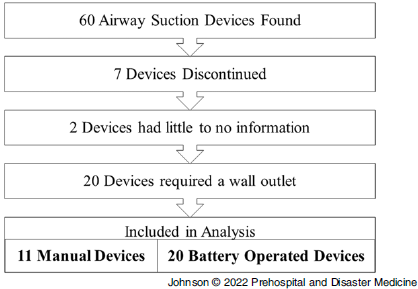
A market review was conducted seeking available suction technology using readily-available sources for public purchasing. Multiple sources were examined for available technology until redundancy was reached and no further discovery of new devices or technology. The reviewed included available suction devices identifiable within academic papers, military publications, Google searches (Google Inc.; Mountain View, California USA), and Amazon searches (Seattle, Washington USA). Google Search finds results by crawling the web for sites, indexing the content of the sites, and then ranking the sites based on relevance to the keywords searched, previous searcher interactions with the site, and how quickly they load. 15 Amazon is an online market in which sellers have posted their products and give Amazon a commission back. Reference Re and Maio16 Amazon’s search engine optimization is based on the keywords searched for and previous transactions of the products, so products that are sold more often are the top results. Google and Amazon web search terms included “portable airway suction,” “prehospital airway suction,” and “portable suction.” Sixty airway suction devices were identified. Suction devices were excluded if they were discontinued (seven devices), if there was little to no information on product specifications (two devices), or if they required a 120-voltage alternating current (VAC) wall outlet (20 devices; Supplemental Table 1, available online only).
Information provided by manufacturers was compiled. Information was collected from product descriptions, product specifications, manuals, and emails to the manufacturers. Information was compiled on product description, weight (kg), dimensions (cm), canister capacity (mL), vacuum pressure (mmHg), battery type, battery life, charge time, maximum noise level, suction tube diameter, type of suction tip, whether intermittent suction was available, year the product entered the market, and customer ratings and reviews. When available, the devices were cross-referenced with US Food and Drug Administration (FDA; Silver Spring, Maryland USA) documentation, however, since most of these are Class I devices, the FDA clearance process is substantially limited compared to other device technology. Devices were then categorized into manual devices and battery-operated devices.
Results
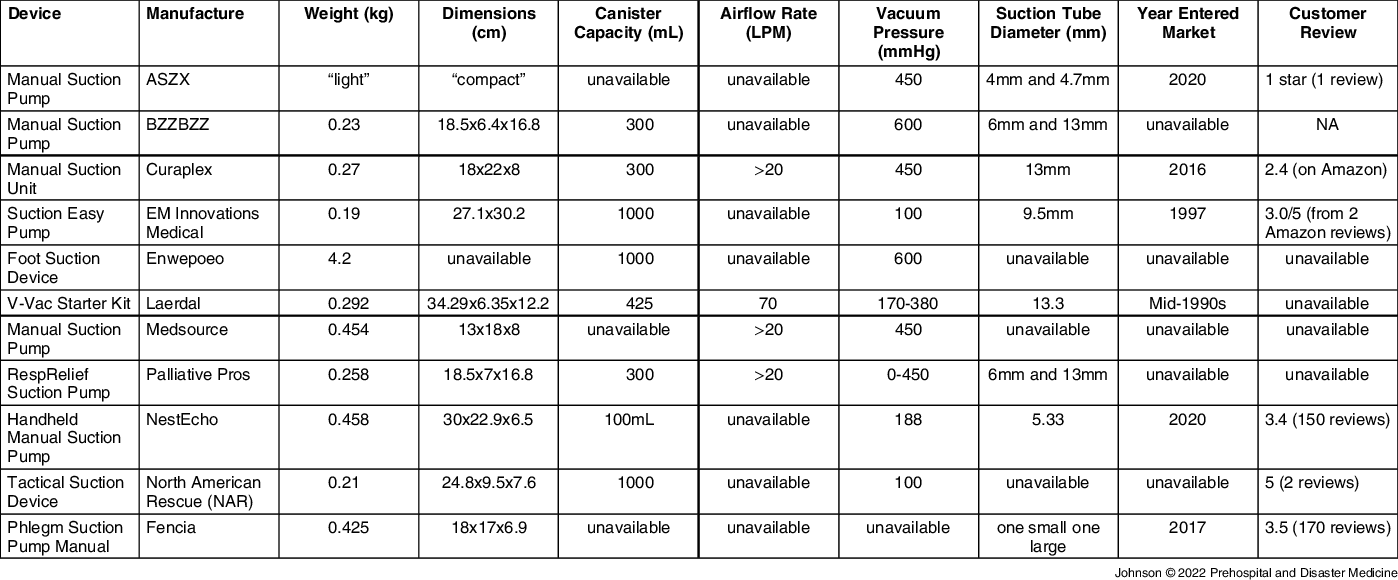
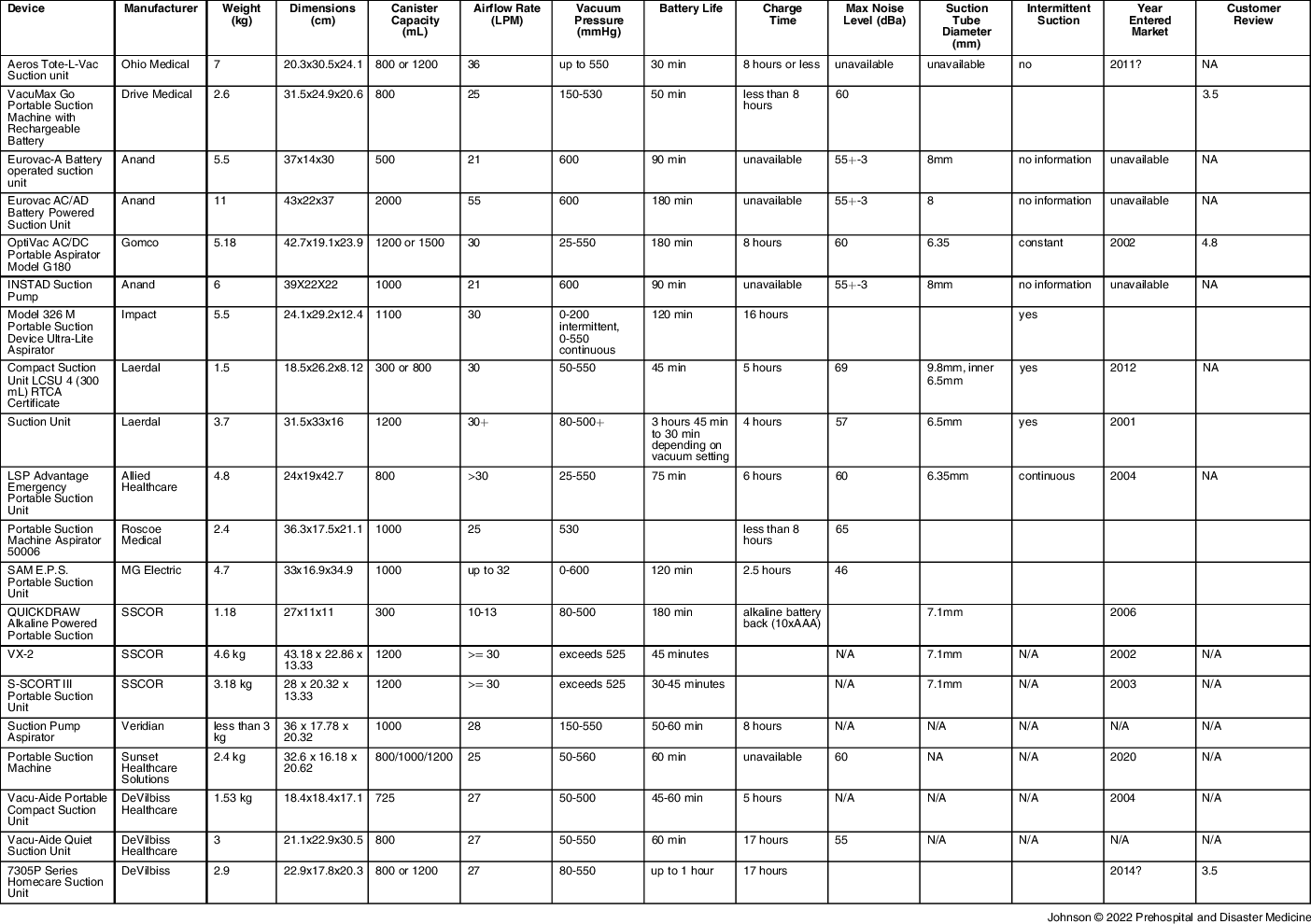
The internet search yielded 60 airway suction devices, 31 of which met inclusion criteria for comparison (Figure 1; Supplemental Table 1, available online only). The devices were then sorted according to their power supply. Eleven manually operated suction devices were found (Table 1). Twenty battery-operated airway suction devices were compared (Table 2).
Flow Diagram of Devices Included.

Manual Suction Units

Battery-Powered Suction Units

Discussion
One of the first steps of airway management is clearing the airway of any debris. Reference Jain, Akhter, Schoppe, Hood and De Lorenzo3,Reference Gerhardt, Mabry, De Lorenzo and Butler17,Reference Shannon and Goldsmith18 Patient positioning, manually clearing the airway with a finger, or medical suction are commonly recommended ways to clear the airway. Reference Jain, Akhter, Schoppe, Hood and De Lorenzo3,11 While adjusting the patient’s position can help drain and open the airway, it does not actually clear fluids and materials. Reference Morrow19 Manually clearing the airway is recommended as a last resort due to the threat of infection and digital injury to the medic if the patient clenches their jaw. Reference Jain, Akhter, Schoppe, Hood and De Lorenzo3 The effectiveness of the manual method is not established, and the risk of oropharyngeal injury and aspiration is apparent. Reference Couper, Abu Hassan and Ohri20
While many suction devices exist, no single device is widely used for all military forces. An airway suction device that is compact, lightweight, but able to perform all necessary functions is needed. Specifications are not fully established, but De Lorenzo, et al recommended several capabilities for a prehospital suction device that could be carried by medical personnel: Reference De Lorenzo, Hood, Jain, Pescador, Lasch and Feng7
-
Weight: <1kg, or <0.5kg for man-pack version;
-
Dimensions (including canister): 30 x 10 x 10cm;
-
Canister Capacity: 1000mL, or 500mL for man-pack version;
-
Flowrate (of vomit): 3L/minute;
-
Vacuum Pressure Range (measured at catheter tip): 0-550mmHg;
-
Device Operation Time (under no load): 5 minutes;
-
Device Operation Time (under maximum load): 3 minutes;
-
External Alternating Current/Direct Current (AC/DC) Input Power Range: 120 VAC/12-24 voltage direct current (VDC) nominal;
-
Battery Type: rechargeable or disposable;
-
Max Noise Level: ≤ 69dBA; and
-
Suction Tube Diameter: 1.27-1.91cm.
In Table 1, 11 manual suction devices are presented for comparison. In general, these devices are smaller and lighter than the battery-powered counterparts, but they offer fewer features. When using these devices, the medic must use both hands: one to provide power and one to direct the suction tube, reducing the efficiency of the medic.
The recommended weight for the suction device used in the field is <1kg, or <0.5kg for a version designed for use in the combat medic pack. Reference De Lorenzo, Hood, Jain, Pescador, Lasch and Feng7 This is very difficult to create in battery-powered suction devices, which averaged around 4kg. On the other hand, the manually powered devices all weighed under 0.5kg, other than the Enwepoeo Foot Suction Devices. Some of the devices even had weights as low as 0.19kg. If medics are simply looking for a lightweight device that can perform basic suction, manually powered devices may suffice.
In exchange for the lighter weight, many manual devices have lower airflow rates and vacuum pressures. For example, three of the devices have reported maximum vacuum pressures under 200mmHg (EM Innovations Medical’s Suction Easy Pump, NestEcho’s Handheld Manual Suction Pump, and North American Rescue’s Tactical Suction device). Laerdal’s V-Vac Starter Kit states it is capable of a peak airflow rate of 70L/minute and the other devices with information on flowrate specify a flow rate of >20L/minute. Unfortunately, air flow rate is not a relevant standard, as it does not consistently correlate to performance in removing viscous fluids and debris. Reference Jain, Akhter, Schoppe, Hood and De Lorenzo3,Reference De Lorenzo, Hood, Jain, Pescador, Lasch and Feng7 In addition, the flow rate and vacuum pressures are also dependent on the ability of the medic working the device. Thus, all the manually powered devices suffer from a lack of realistic performance specifications.
EM Innovations Medical’s Suction Easy Pump and North American Rescue’s Tactical Suction Device have a similar design: a bag with a suction bulb. While this design offers a lightweight, compact device with large canister capacity (1000mL), both only produce vacuum pressures of 100mmHg, which is much lower than De Lorenzo’s recommended capability of 550mmHg. Reference De Lorenzo, Hood, Jain, Pescador, Lasch and Feng7 Neither specify the flowrate for their device. Though these devices are small enough to keep in a pack, they have highly limited capabilities.
ASZX’s Manual Suction Pump, BZZBZZ’s Manual Suction Pump, Curaplex’s Manual Suction Unit, Laerdal’s V-Vac Starter Kit, Medsource’s Manual Suction Pump, Palliative Pros’ RespRelief Suction Pump, NestEcho’s Handheld Manual Suction Pump, and Fencia’s Phlegm Suction Pump Manual include a trigger-like design which is pulled back to create suction with a firm collection canister. While these are reported to be slightly heavier than the previous design, they range from 0.23kg to 0.458 kg, light enough for the military recommendations. They also report higher vacuum pressures than the suction bulb design with maximum vacuum pressure ranging from 188mmHg to 600 mmHg. The devices with information on canister capacity state the capacity between 100-425mL, which is smaller than the recommended 500mL capacity. Overall, these devices weigh slightly more than the suction bulb design, have smaller canister capacities, but have higher suction capabilities.
Due to manual devices producing lower suction capabilities requiring efficiency-reducing two-handed use, De Lorenzo, et al preferentially recommended battery-operated portable suction devices. Reference De Lorenzo, Hood, Jain, Pescador, Lasch and Feng7 With the use of a battery, additional specifications must be considered such as battery life, charging time, and maximum noise level.
The addition of a battery and motor adds weight to the design. The weight of these devices ranges from 1.18kg to 11.0kg. All these devices are heavier than the recommended 1.0kg maximum or the 0.5kg maximum for the man-pack version. Reference De Lorenzo, Hood, Jain, Pescador, Lasch and Feng7 Many of these devices are too heavy to realistically be carried in the pack of a medic, which already typically weighs over 36kg. Reference De Lorenzo, Hood, Jain, Pescador, Lasch and Feng7 The lightest battery-powered device is SSCOR’s Quickdraw Alkaline Powered Portable Suction unit, which uses ten single-use AAA batteries in place of the more typical rechargeable lithium-ion batteries. Laerdal’s Compact Suction Unit 4 (LCSU 4) and DeVilbiss HealthCare’s Vacu-Aide Portable Compact Suction Unit are the next lightest, both weighing approximately 1.5kg. Six out of the twenty battery powered devices analyzed weighed 2-3kg, and eleven of the devices weighed over 3kg.
In addition, the battery-powered devices were larger in size than the manual devices. With these increased dimensions, the canisters had larger capacities. All except SSCOR’s Quickdraw Alkaline Powered Portable Suction unit had an option for a canister that was 500mL or larger. Thirteen of the devices had options for a canister capacity of 1000mL or larger.
With the use of battery power, these devices have greater reported suction capabilities. All the devices report a maximum vacuum pressure of 500mmHg or greater, with 13 reaching the recommended vacuum pressure of 550mmHg. Reference De Lorenzo, Hood, Jain, Pescador, Lasch and Feng7 In addition, most of the battery-powered devices have reported airflow rates greater than 20L/minute (except for SSCOR’s Quickdraw Alkaline Powered Portable Suction unit which has a flowrate of 10-13L/minute). Seven have flowrates greater than 30L/minute. However, as with manually powered devices, air flow rate is not the relevant standard, as it does not consistently correlate to performance in removing viscous fluids and debris. Reference Jain, Akhter, Schoppe, Hood and De Lorenzo3,11 While a 3L/minute flowrate for vomit is recommended, the companies offer no information on the flowrate of fluids other than air. Therefore, literature review cannot determine which devices are capable of evacuating vomit at 3L/minute, nor can it be determined which devices are most effective at suctioning up liquids and debris commonly found in the airway.
Future research should work to develop a light and compact battery-operated unit with high suction performance. The heavy weight of currently available battery-operated devices indicates that future efforts to develop a battery-operated military prehospital suction device must investigate ways to reduce weight to be carried in a medic’s pack. In addition, research should be conducted to determine the flow rate of the airway suction devices in terms of bodily liquids, debris, vomit, and other substances commonly found in the airway other than air. Seeing as the mean average year that the devices entered the market was 2008, recent technology needs to be utilized to develop the most efficient suction device available. The mean year that the devices reviewed entered the market was 2008, indicating that there has been little disruptive innovation within the market.
Efforts by Ahkter, et al to produce an airway suction device designed for use in the combat theater yielded a 1.73kg device capable of producing an airflow rate of 11L/minute. Reference Akhter, Schoppe and Navarro21 These devices also suggested several tests for common situations encountered in airway injuries in theater. Some modifications to testing include using stimulated particles such as 3D-printed tooth geometries to test suction capability, more realistic vomitus solution, and standardized testing for airflow and vacuum pressure assessment. Overall, they found several important characteristics to improve airway suction in the battlefield, such as larger suction tubes, filters offering less hydraulic resistance, and improved pump designs. They concluded more research is needed to lighten, debulk, and improve suction features of airway suction devices.
In United States’ conflicts prior to the 2000s, airway injuries had been the third leading cause of potentially preventable battlefield death after hemorrhage and tension pneumothorax. Reference Kelly, Ritenour and McLaughlin22–Reference Kotwal, Montgomery and Kotwal24 Recent improvements in body armor and medical treatments have changed the battle injury profiles and now airway is a leading contributor to overall mortality. Reference Mazuchowski, Kotwal and Janak2 For example, tourniquets were first implemented in a limited fashion in 2005 and nearly universally by 2007 after demonstrating a substantial decrease in mortality due to compressible extremity hemorrhage. Reference Eastridge, Mabry and Seguin1,Reference Jain, Akhter, Schoppe, Hood and De Lorenzo3 Improved torso protection has lowered the number of injuries overall, but has caused a relative percentage increase (27%) in primary injuries to the head, neck, and airway. Reference Jain, Akhter, Schoppe, Hood and De Lorenzo3,Reference Adams, Cuniowski, Muck and De Lorenzo25,Reference Le, Gurney and Nnamani26 The net result is a re-orientation of medical priorities with airway compromise, breathing problems, and noncompressible hemorrhage often inseparable as causes of mortality. Reference Mazuchowski, Kotwal and Janak2,Reference Kotwal, Mazuchowski and Janak27 Because of this, future improvements to combat casualty survival will require a comprehensive approach to damage control resuscitation that includes attention to airway, breathing, and noncompressible hemorrhage problems. Ensuring the availability of an appropriately portable and powerful suction device at the point of injury will help address a major gap in airway management. Future research should focus on the relative contribution of airway compromise to battlefield mortality in general, and the mitigating effects of adequate portable suction.
Limitations
This review has several limitations. The main limitation was reliance on manufacturers’ and distributors’ reports and other information obtained during the search. While such information is useful, it is not typically verified by independent third-parties. Devices that are near-market-ready may not be included due to not being found via internet search. After-market modifications were not considered, such as adding an after-market battery or using alternative suction tubing. Some devices, such as those sold on Amazon, may not be FDA-cleared and therefore cannot be used. Moreover, the FDA clearance pathway for these devices is limited compared to other device technology. Thus, available data from the FDA were limited, if any were readily available. Finally, some of the manufacturers did not provide sufficient detailed information about the products, and adequate third-party information was not available.
Conclusion
This review of 31 commercially available, off-the-shelf airway suction devices focused on potential use in the prehospital combat zones. Manual suction devices offered compact, light-weight design with limited suction ability. Battery-operated devices had higher suction power but weighed significantly more. Future research should work to develop a light and compact battery-operated unit with high suction performance.
Conflicts of interest/funding
The authors declare none. The views expressed in this article are those of the authors and do not reflect the official policy or position of the US Army Medical Department, Department of the Army, Department of Defense, or the US Government.
Supplementary Materials
To view supplementary material for this article, please visit https://doi.org/10.1017/S1049023X22000437