


Many theoretical and conceptual models of human development presume that experiences early in life shape development later in life (e.g., attachment theory, social-learning theory, and life-course sociology). For the most part, these frameworks emphasize the mechanisms of development or how development operates, whether focusing on mediating processes involving affective-cognitive functioning (e.g., attachment theory's “internal working model”), physiological processes (e.g., cortisol reactivity), and/or social-relational ones (e.g., parenting). Rarely, however, do these widely referenced approaches to investigating effects of developmental experiences and environmental exposures on human development consider, at least explicitly, why development operates the way it does. The latter focus directs attention to ultimate rather than proximate explanations, ones that emphasize the evolutionary function and fitness consequences of a trait or developmental process. Perhaps one reason such a concern remains relatively neglected in human developmental science is because scholars rarely consider, again at least explicitly, the logical alternative of early experience models, namely, that future functioning is not tied to early life experience, but regulated either by later life ones (e.g., Lewis, Reference Lewis1997) or not at all by experience.
Two evolutionary–developmental (evo-devo) models are explicitly and directly informed by ultimate accounts of why there should be the kind of developmental “programming” implicit in any framework embracing early experience effects, each of which is delineated below. Whereas one of these emphasizes the contextual conditions to which the child is exposed while growing up, the other highlights internal-state conditions (i.e., within the body) when it comes to accounting for why early life experience and/or condition should forecast future development. Although these two frameworks differentially emphasize external and internal factors and, thereby, different levels of analysis, they are by no means mutually exclusive, a proposition we address empirically herein by evaluating whether internal-state indicators of physical health have an indirect effect on developmental context early in life and diverse aspects of adolescent development.
External-Prediction Model
Even if many models of early experience effects do not explicitly address why there should be early life regulation of later life development, it would be mistaken to imply that such concerns are entirely absent from contemporary developmental thinking. This is because “preparation” for the future is no doubt the implicit, even if rarely stipulated, reason for why so many developmental scholars presume that early life experiences should shape later life development. Most developmental perspectives that presume early experience effects are in some sense, then, learning theories. After all, they presume that organisms “learn” something from their exposures early in life that prepare them for the demands of later life.
Evo-devo thinkers conceptualize such early life effects in terms of predictive–adaptive–response (PAR). However, for evolutionary-minded scholars “adaptive” refers not only, as in most contemporary developmental thinking, to some idealized notion of health and well-being, including success in achieving the goals of family (e.g., attachment security), school (e.g., good grades), or society (e.g., marriage and employment), but also to reproductive success, that is, the passing of genes on to future generations. Belsky, Steinberg, and Draper's (Reference Belsky, Steinberg and Draper1991) evolutionary theory of socialization (also known as “psychosocial acceleration theory”) was the first modern developmental framework to formally embrace PAR thinking, situating psychological and behavioral development and the effects of early life experience in an evolutionary context. Thus, the theory stipulates that the central goal of life is to pass genes on to future generations (as opposed to being healthy or happy); that human development has evolved in the service of this fundamental goal of all living things; that childhood has thus evolved to adjust development in response to contextual conditions early in life because these will tolerably forecast future life conditions; and that developing in such a manner consistent with anticipated, later life conditions will promote reproductive fitness.
It is for these reasons that psychosocial acceleration theory stipulates that children who experience problematic family relationships that convey that others cannot be trusted, that the future is uncertain, and that development to reproductive age is precarious, should develop in certain ways and that others who experience contrasting and supportive conditions should develop in quite different ways. Thus, whereas the former should accelerate pubertal maturation, initiate sex earlier in life, establish unstable pair bonds, and bear many children but provide care of limited quality, the latter should develop in the opposite manner. It would seem notable, then, that there is now, at least in the case of females, extensive empirical support for these propositions, most notably, perhaps, the theory-distinguishing pubertal-timing one (Belsky, Reference Belsky2012).
It is because of its explicit focus on reproductive success that Belsky et al.’s (Reference Belsky, Steinberg and Draper1991) thinking diverges from virtually all modern developmental frameworks. Rather than regarding certain problematical patterns of development as nonoptimal, dysregulated, and/or dysfunctional, it views them simply as alternative means of, or “strategies” for, getting the job of life done (i.e., dispersion of genes). This is because so-called nonoptimal phenotypes are no different than supposedly optimal ones, in that they fit the organism to the context anticipated by early life experiences and, in so doing, promote reproductive fitness (or at least once did). From this evolutionary perspective, then, there is no optimal development, as what is optimal, when it comes to dispersing genes in future generations, varies according to the context of development.
Internal-Prediction Model
Despite the theoretical foundations of psychosocial acceleration theory and evidence documenting contextual regulation of female pubertal development, the PAR thinking central to this framework has not gone unchallenged. Rickard, Frankenhuis, and Nettle (Reference Rickard, Frankenhuis and Nettle2014) and Nettle, Frankenhuis, and Rickard (2014) recently critiqued PAR theorizing, questioning the foundational assumption that natural selection shaped individuals to regulate development in response to external-environmental cues (e.g., family chaos) early in life; this was because of the potential inaccuracy of such cues in forecasting adult-life conditions (see also Nederhof & Schmidt, Reference Nederhof and Schmidt2012). To their way of thinking, the potential for mismatch between early and later life contextual conditions was likely to have been too great, even within a generation (i.e., from childhood to adulthood), over the course of human history for natural selection to have crafted our species to calibrate reproductive development in response to early life contextual “cues” early.
These evo-devo scholars proposed, instead, that what the organism monitors when it comes to regulating its development in the service of fitness goals is its own “internal state” (e.g., physical health; body mass index, telomere length, and inflammation). This is because internal-state cues or biomarkers would be more accurate than external cues in forecasting future morbidity and mortality, and thus the reproductive strategy that should be implemented. Research has found that chronic childhood illness predicts earlier age of first reproduction (Wayforth, 2012).
As Rickard et al. (Reference Rickard, Frankenhuis and Nettle2014) make clear, however, it would be a mistake to regard the “privileging” of internal-state cues rather than the external ones central to psychosocial acceleration theory as implying that external cues are not influential. This is because their internal-state model presumes that many, though not all, internal cues are themselves affected by and thus reflective of external conditions to which the developing child has been exposed. Thus, the two models are somewhat similar, in that Belsky et al. (Reference Belsky, Steinberg and Draper1991) made clear that it was via some to-be-discovered physiological processes that contextual conditions become, in current terminology, “biologically embedded” so as to shape pubertal timing and reproductive strategy more generally. This is exactly why Rickard et al. (Reference Rickard, Frankenhuis and Nettle2014) regarded their effort as an extension of psychosocial acceleration theory rather than a fundamental alternative to or replacement of it.
Certainly consistent with the claim that the model privileging external conditions and the one emphasizing internal cues have much in common is Nettle, Frankenhuis, and Rickard's (Reference Nettle, Frankenhuis and Rickard2013) mathematical modeling of the evolutionary process shaping development. It revealed that one model that included both internal and external predictors performed better than one that included external only. In line with such a multilevel, integrated model are empirical findings that the effect of early contextual conditions on later development is mediated by internal cues. Consider in this regard the work of Ellis and Essex (Reference Ellis and Essex2007) showing that higher levels of marital conflict and depression predicted greater body mass index (BMI), which in turn forecast accelerated pubertal development in girls. Drawing on the same Wisconsin Longitudinal Study data base, Belsky, Ruttle, Boyce, Armstrong, and Essex (Reference Belsky, Ruttle, Boyce, Armstrong and Essex2015) further established such internal-cue mediation of external-environmental effects upon testing and finding support for the hypothesis that greater maternal depression during infancy would lead to elevated basal cortisol levels in childhood, which would themselves predict earlier age of menarche and, thereby, poorer mental and physical health.
The Current Study
The purpose of the work reported herein is to build on the theoretical developments and empirical findings already discussed and, in so doing, evaluate the utility of working at multiple levels of analysis. The research reported herein thus sought to test the indirect effects of internal-health cue on early life environmental effects and adolescent development, drawing on data from the NICHD Study of Early Child Care and Youth Development (SECCYD). Multiple investigations have previously utilized this data set and found external-cue effects on later reproductive strategy, including maternal harshness predicting earlier puberty (Belsky, Steinberg, Houts, & Halpern-Felsher, Reference Belsky, Steinberg, Houts and Halpern-Felsher2010) and lower maternal sensitivity and greater environmental unpredictability predicting more sex partners by age 15 (Belsky, Schlomer, & Ellis, Reference Belsky, Schlomer and Ellis2012). Thus, in the current effort, we employed similar measures of parental quality (i.e., maternal harshness and sensitivity), as well as more general indictors of the overall family environment (i.e., unpredictability and income harshness) collected during the first 5 years of life to serve as early life external cues. For internal-state variables, we included health measures (i.e., general health and BMI) that were assessed multiple times through early and middle childhood, allowing us to capture change over time. Finally, we selected a diverse set of dependent variables at adolescence, including ones directly reflective of reproductive strategy, that is, age of menarche (girls only), risk taking (e.g., nonsexual risk taking), and sexual behavior (e.g., number of sex partners), as well as others widely studied by scholars concerned with whether and how early developmental experiences generally shape adolescent development (e.g., future orientation, social skills, loneliness, depressive symptoms, and behavior problems).
Method
Participants
The NICHD SECCYD recruited 1,364 families through hospital visits shortly after the birth of a child in 1991 at 10 US locations (for detailed description of recruitment procedures and sample characteristics, see NICHD Early Child Care Research Network, 2001; information about this public data set can be found at http://www.icpsr.umich.edu). During selected 24-hr intervals, all women giving birth (N = 8,986) were screened for eligibility. From that group, a total of 1,364 families were recruited and completed a home interview when the infant was 1 month old, becoming study participants (for details of the sampling plan, see NICHD Early Child Care Research Network, 2005). In terms of demographic characteristics, 26% of the mothers in the recruited sample had no more than a high school education at recruitment; 21% had incomes no greater than 200% of the poverty level; and 22% were minority (i.e., not non-Hispanic European American). To utilize the full sample of 1,364 adolescents, full information maximum likelihood method was used to handle missing data (see details in Data Analysis Plan section).
Measures
We used multiple measurements available in the NICHD SECCYD data set to measure internal and external cues. In order to establish the temporal order for the pathway analyses, all external cues selected were measured before and up to child age of 5, whereas internal cues were measured from birth to Grade 6 (i.e., age 12). Outcome variables, with the exception of age of menarche, were assessed at age 15.
External predictors
Four sets of measurements served as external cues/predictors.
Maternal sensitivity
Measures of parenting quality were collected when children were in 6, 15, 24, 36, and 54 months. Mother–child interactions were videotaped during 15-min semistructured tasks (NICHD Early Child Care Research Network, 2003). A number of scales were used to rate the mothers’ behavior from these videotapes. More specifically, at 6 months, mothers and children were instructed to play together, first with toys available in the home (or none at all) and then with a standard set of toys. At 15, 24, 36, and 54 months, mothers were asked to show their children age-appropriate sets of toys in three containers in a set of order. As in prior studies of this sample (e.g., NICHD Early Child Care Research Network, 2001), observations of maternal sensitivity from the first 4.5 years of life (i.e., 6, 15, 24, 36, and 54 months) were standardized and averaged to create a composite of the observed maternal sensitivity measure. Note that at 6, 15, and 24 months, the a priori maternal sensitivity composites were constructed by summing ratings for sensitivity to nondistress, positive regard, and intrusiveness (reversed). At 36 and 54 months, the supportive presence, respect for autonomy, and hostility (reversed) scales were composited. Internal consistency of composites was 0.75, 0.70, 0.79, 0.78, and 0.84 for the 6-, 15-, 24-, 36-, and 54-month composites, respectively, and intercoder reliabilities were on scales greater than 0.80.
Maternal harshness
Maternal harshness was assessed when children were 4.5 years of age. Mothers completed a questionnaire assessing parenting strategies from which a 10-item measure of maternal harshness was derived (α = 0.67; Shumow, Vandell, & Posner, Reference Shumow, Vandell and Posner1998). Mothers who scored high on harsh control spanked their child for doing something wrong, expected their child to obey without asking questions, expected the child to be quiet and respectful when adults were around, regarded respect for authority as the most important thing for the child to learn, believed praise spoiled the child, and did not give lots of hugs and kisses.
Unpredictability
Three measures were used to assess levels of unpredictability in and around the family during the first 5 years of each target child's life, each of which is explained in detail in Belsky et al. (Reference Belsky, Schlomer and Ellis2012). Paternal transitions, the number of changes in the male parental figure within the home (i.e., male partners moving in or out), was based on interviews with mothers about household composition when their children were 1, 3, 6, 9, 12, 15, 18, 21, 24, 30, 33, 36, 42, 46, 50, 54, and 60 months of age. The number of paternal transitions from each time point was standardized and averaged together if there were at least six data points. Household moves was the number of changes in residences based on documentation of when families relocated during the child's first 5 years of life. Parental employment transitions, the number of changes in the mother's and father's employment during the child's first 5 years, was based on reports from mothers at approximately 3-month intervals. Scores from each of these three measures were standardized and averaged to create an unpredictability composite, as used in Belsky et al. (Reference Belsky, Schlomer and Ellis2012).
Income harshness
We derived an index of income harshness using a repeatedly measured income to needs ratio. At children's age 1, 6, 15, 24, 36, and 54 months, mothers reported detailed information about family finances. The income to needs ratio was created as an index of a family's income as a proportion of the official federal poverty line for a family of the same size. A higher income to needs ratio indicated greater financial resources per person in the household after adjusting for family size. More specifically, family income was divided by the federal poverty threshold of the same family size; hence, a ratio of 1 indicates the family income equals the federal poverty threshold for a family of that size. The poverty threshold (income to needs ratio = 1) for a family of four was an annual income of $13,812 in 1991, the year when participating children were born. Mean level of income to needs appeared relatively stable, yet also fluctuated across the 1, 6, 15, 24, 36, and 54 time points: 2.86 (SD = 2.61), 3.66 (SD = 3.10), 3.70 (SD = 3.21), 3.72 (SD = 3.04), 3.61 (SD = 3.05), and 3.59 (SD = 3.17), respectively. The income to needs ratio was averaged across the six measurement occasions and reverse coded to reflect the extent of income harshness, with higher score indicating greater income harshness.
Internal variables
Two indicators of internal cues were created.
General health
Mothers reported on their child's general health when the child was 1, 3, 6, 9, 12, 15, 18, 21, 24, 27, 30, 33, 36, 42, 46, 50, 54, and 60 months of age, and at Grade 1 (i.e., age 7), Grade 3 (i.e., age 9), and Grade 6 (i.e., age 12). Mothers were asked about the “health of her baby since the child has been at home,” with responses rated on a 4-point Likert scale ranging from 1 (poor health) to 4 (excellent health). Subsequently, a series of multilevel growth curve models were fitted to the general health scores, and the random intercepts serve as the indicators of general physical health over time (see details in Data Analysis Plan section).
BMI
BMI was calculated using children's height and weight measurements made using a standard weight scale and measuring stick at 15, 24, 36, and 54 months of age, and at Grade 1 (i.e., age 7), Grade 3 (i.e., age 9), and Grade 6 (i.e., age 12). BMI was calculated by dividing the weight (kg) by the squared height (m) at each measurement occasion. Similar to the health indicator, we fitted a series of multilevel growth curve models to the repeated-measured BMI and selected the random slopes as the indicator of BMI from 15 months to Grade 6 (see details in Data Analysis Plan section).
Adolescent outcomes
Eight outcomes were selected for analysis, all obtained from children themselves when they were 15 years of age, with the exception of age of menarche in females.
Age of menarche
Age of menarche was assessed by asking the girls annually between the ages of 9.5 and 15 years whether they had begun menstruating and, if so, their age at their first menstrual period (in years and months). Mothers were also asked to report on their daughter's first menstrual period, and these data were used if information from the girls was missing. In addition, mothers reported on their own age of menarche, in years and months, which was used to create the dependent variable: a residual score of girl's age of menarche when controlling for maternal age of menarche in an effort to discount at least some of the genetic variance in girls’ age of menarche.
Number of oral and sexual intercourse partners
Sexual behavior was assessed by asking adolescents two questions: (a) “How many different partners have you had oral sex with in your entire life?” and (b) “How many different partners have you had sexual intercourse with in your entire life?” The response scale for these items ranged from 0 to 5. Mean number of oral sex partners was 0.33 (SD = 0.92); mean number of sexual intercourse partners was 0.28 (SD = 0.89). Given that most of the adolescents reported having no sexual partners (i.e., number of oral-sex partners: N (partner number=0) = 801; number of sex-intercourse partners: N (partner number=0) = 826), these two variables were recoded as binary measurements, reflecting the presence (coded as 1) versus the absence (coded as 0) of sexual activity for purposes of the analyses presented herein.
Nonsexual risk-taking behavior
Thirty-six risk-taking items were drawn from instruments used in prior studies of adolescents (Halpern-Felsher, Biehl, Kropp, & Rubinstein, Reference Halpern-Felsher, Biehl, Kropp and Rubinstein2004). Adolescents reported the extent to which, over the past year, they used alcohol, tobacco, or other drugs; behaved in ways that threatened their own safety (e.g., rode in a vehicle without the use of seatbelts); used or threatened to use a weapon; stole something; or harmed property. Responses to each item were made on a 3-point scale (0 = never, 1 = once or twice, 2 = more than twice). Ratings were summed across items, with higher scores indicating more risk-taking behavior (α = 0.89).
Externalizing behavior
The Youth Self-Report (Achenbach & Rescorla, Reference Achenbach and Rescorla2001), which consists of 119 items that reflect a broad range of behavioral/emotional problems as well as 16 socially desirable items, was used to assess externalizing behavior. Externalizing behavior was assessed using the 30-item subscale (α = 0.86).
Impulse control
Seven of eight items included in the impulse-control subscale of the Weinberger Adjustment Inventory (Weinberger, & Schwartz, Reference Weinberger and Schwartz1990) were administered. Adolescents reported on a 5-point scale (1 = false to 5 = true) the extent to which their behavior matched a series of statements (e.g., “I stop and think things through before I act”), with higher score indicating greater impulse control (α = 0.82).
Depressive symptoms
The 10-item scale short form of the Children's Depression Inventory (Kovacs, Reference Kovacs1992) was administered to measure depressive symptoms over the past 2 weeks. Possible score ranges from 0 to 20 (α = 0.81).
Social skills
The Social Skills Rating System was used to assess adolescent social competence. The scale consists of 39 items with responses made on a 3-point scale (0 = never, 1 = sometimes, and 2 = very often). Standard scores ranged from 59 to 130, with higher scores indicating a greater likelihood of engaging in socially acceptable behaviors (e.g., “I make friends easily” and “I ask before using other people's things”; α = 0.88).
Loneliness
Loneliness was measured using a 25-item questionnaire, based on the Loneliness and Social Dissatisfaction Questionnaire (Asher, Hymel, & Renshaw, Reference Asher, Hymel and Renshaw1984), which assessed the adolescent's feelings of loneliness and social dissatisfaction (e.g., “I have nobody to talk to”). Items were summed, and scores ranged from 16 to 75, with higher scores indicating greater loneliness (α = 0.91).
Data analysis plan
Data analyses proceeded in two stages, each discussed in greater detail below: a preliminary and a primary stage. The preliminary stage involved deriving random intercepts and/or slopes from the repeatedly measured internal predictors by fitting a series of multilevel growth curve models; this was followed by data-reduction oriented factor analyses for the external predictors and adolescence outcomes in order to reduce the number of analyses undertaken and thus the risk of chance findings. The primary stage consisted of pathway analyses to evaluate the indirect effect of internal-health indicators between early exposure to external adversities and adolescents’ behavior and girls’ age of menarche.
Preliminary stage
In the first step of the preliminary stage, we fit a series of nested multilevel growth curve models separately to the repeatedly measured indices of general health and child BMI (i.e., internal-state variables). Because external predictors were all measured up to child's age of 60 months, we set Grade 1 (i.e., 7 years/84 months) as the midpoint (i.e., time = zero) for the health variables and treated month as the unit of time to establish the temporal order of the pathway analyses. Four models were fitted: (a) a null model (i.e., fixed and random intercept only), (b) a fixed-effect of time model (i.e., fixed linear time effect with random intercept), (c) a linear model of change (i.e., fixed and random intercept and linear time effect), and (d) a (fixed) quadratic model of change (i.e., fixed linear and quadratic time effect with random intercept and random linear slope).
These four models were fitted to the data in order and we adopted a data-driven approach to identify the best fitting models, relying on the significance of parameter estimates (e.g., linear time effect), the variance of the random terms (i.e., variance of the random intercept and linear slope), and model fit indices (i.e., –2 log likelihood, Akaike information criterion, and Bayesian information criterion). If and when the random slope proved nonsignificant in Model c (e.g., the variance of the random linear slope was too small), an alternative model was tested to determine whether the higher order fixed effect (i.e., the fixed quadratic time effect) should be included despite the insignificant random linear slope (i.e., in addition to Model b, Model b.1 is also be tested while including fixed linear and quadratic time effects, plus the random intercepts).
In summary, for both internal-state variables, general health and BMI, significant (fixed) linear increases (βgeneral health = 0.002, p < .01; βBMI = 0.04, p < .01) and quadratic trends (βgeneral health = 0.00003, p < .01; (βBMI = 0.0006, p < .01) emerged. For BMI, it was the quadratic model of change (i.e., fixed linear and quadratic time effect with random intercept and random linear time effect) that fit the data best, whereas for general health, the alternative model (Model b.1, fixed linear and quadratic time effect with only the random intercept) fit best (i.e., yielding the lowest –2 log likelihood, Akaike information criterion, and Bayesian information criterion values). As a result, the random intercept for general health, and the random intercept and random linear slopes for BMI were saved for further analyses (see Table 1), after accounting for the fixed (linear and quadratic) time effect. We decided to only include BMI slope for the subsequent pathway analyses because (a) BMI intercept and BMI slope proved to be extremely highly correlated (β = 0.92. p < .01) and (b) BMI slope was judged to reflect a more dynamic index of development in comparison to the intercept.
Bivariate relationship for the internal and external predictors

Note: The total numbers for bivariate correlations ranged from 1,047 to 1,364. BMI, body mass index.
a BMI intercept was not included in the pathway analyses.
*p < .05. **p < .01.
The second step of the preliminary stage of analysis focused on data reduction of the external predictors by exploratory factor analysis and separate measures of child functioning at age 15. In the external predictors, all four indicators loaded on a single factor (eigenvalue = 1.38, 90.6% variance explained, factor loading ranging from 0.49 to 0.69), leading us to create a single composite variable by summing standardized scores of maternal harshness, unpredictability, income harshness and the maternal sensitivity (reversed).
In the adolescent functioning, two rather clear factors emerged, which resulted in the creation for two composite measures, one of “risky behavior” and one of “problematic functioning.” Eigenvalues for both factors were >1. The risky-behavior factor explained 60.2% and the problematic-functioning factor explained 27.5% of the variance. Factor loadings of the variables used to create the risky-behavior composite score ranged from 0.70 to 0.80, with those used to create the problematic-functioning composite ranging from 0.42 to 0.77. There were no cross-loaded items within these ranges for either factor. Thus, risky behavior reflected the sum of scores for oral-sex partner and sex-intercourse partner, and the standardized score for nonsexual risk taking. The problematic functioning score was created by summing the standardized score of externalizing behavior, depressive symptoms, loneliness, impulse control and social skills (reversed).
Primary stage
After creating the composited scores of external adversity and adolescent functioning, we performed pathway analyses to evaluate the hypotheses that early-life exposure to external adversities will forecast poorer general health condition, and faster growth in the BMI, which will in turn predict compromised behavioral functioning and, in a separate analysis of girls only, earlier age of menarche. These pathway analyses were performed in Mplus 7 (Muthén & Muthén, Reference Muthén and Muthén1998–2011) using the maximum likelihood estimation with robust standard errors. Missing data were treated according to the full information maximum likelihood procedures. According to Hu and Bentler (Reference Hu and Bentler1999), good fitted models have the values of the comparative fit indices (CFI) and Tucker–Lewis index (TLI) close to 0.95, and values of the root mean square error of approximation (RMSEA) and the standardized root mean square residual (SRMR) of less than 0.06 and 0.08, respectively.
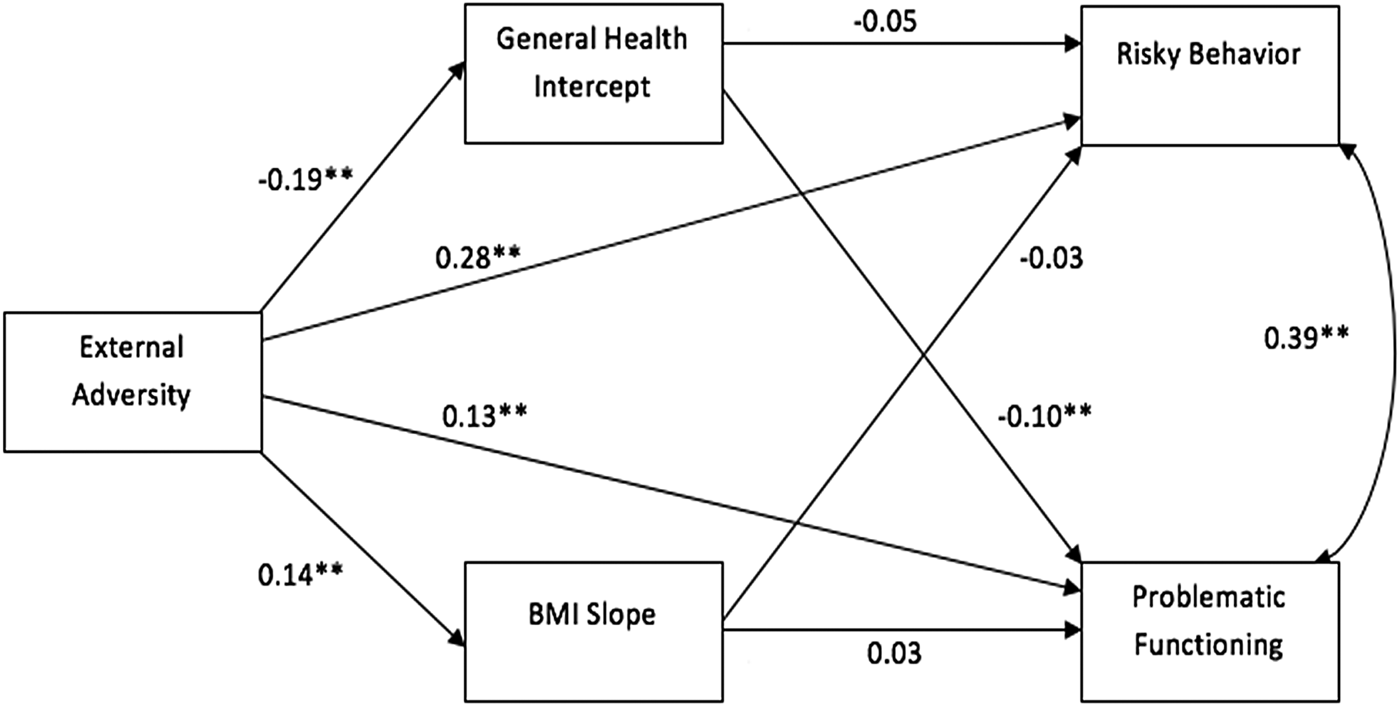
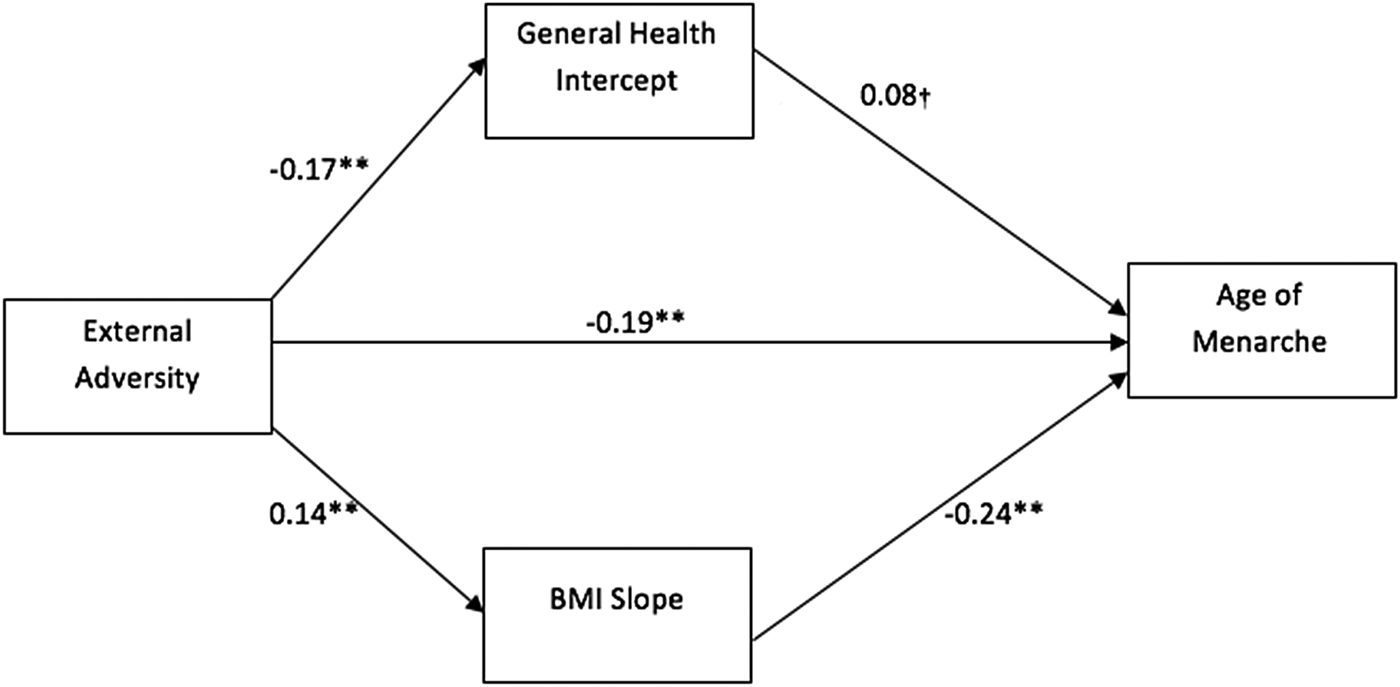
In the pathway models already mentioned, one forecasting adolescents’ behavioral functioning (Model 1, N = 1,364) and the other girls’ age of menarche (Model 2, N = 659), external adversities were included as the predictors of the internal-health variables (i.e., general health intercept, BMI slope) and directly the adolescent outcomes (i.e., Model 1: risky behavior and problematic functioning; Model 2: age of menarche). In addition, both health variables were used to forecast the adolescent outcome(s) in each model. Finally, the two adolescent outcomes in Model 1 were allowed to covary. Note that although Baron and Kenny's (Reference Baron and Kenny1986) rule for testing mediation requires the direct path from predictor to outcome to become insignificant after accounting for mediator(s), other researchers suggested the less conservative criteria such that incomplete mediation (i.e., the direct path remains significant after inserting the mediator[s] into the model) should also be regarded as mediation (e.g., MacKinnon & Fairchild, Reference MacKinnon and Fairchild2009). However, for the sake of the current work, we have chosen to use the more conservative terminology by referring to incomplete mediation as indirect effects although some may consider it as simply mediation.
Results
Highlighted first is the model forecasting adolescent functioning fitted to the entire sample (i.e., Model 1), followed by the model predicting age of menarche in the female subsample (i.e., Model 2). For each model, we first discuss the direct effects, followed by the indirect effects in which external adversities affect internal health indicators, which then predict adolescent outcomes.
Predicting adolescent functioning
After fitting the pathway model to the entire sample, Model 1 (i.e., forecasting adolescent behavioral functioning) yielded good overall fit: χ2 (1, N = 1,364) = 2.57, p = .11, CFI = 0.995, TLI = 0.946, RMSEA = 0.034, SRMR = 0.010.
Direct effects
As shown in Figure 1 (also see Table 2 for the detailed path coefficient estimates), greater external adversities significantly predicted poorer general health, faster growth in BMI, and compromised adolescent functioning, that is, more risky behavior and problematic functioning. In addition, poorer general health forecast more problematic functioning, with all other paths directly linking health indicators to adolescent functioning proving insignificant.
The pathway model forecasting adolescence behavioral functioning (N = 1,364). **p < .01.
Path coefficient estimates predicting adolescents behavior (N = 1364)

Note: BMI, body mass index.
Indirect effects
One of four indirect paths tested proved significant (see Table 3): greater external adversity predicted poorer general health and thereby more problematic functioning. Notable as well is that the total indirect effect from external adversity toward problematic functioning was also significant, indicating significant overall indirect pathway via internal state (i.e., health and BMI).
The indirect effects predicting adolescents behavior (N = 1,364)

Note: BMI, body mass index.
Predicting age of menarche
The full model predicting age of menarche yielded a good model fit: χ2 (1, N = 659), p = .70, CFI = 1.00, TLI = 1.00, RMSEA = 0.00, SRMR = 0.004. Inspection of Figure 2 indicates that greater external adversity forecast poorer general health, faster increase in BMI, and earlier age of menarche (see Table 4 for detailed pathway coefficient estimates). Furthermore, when indirect effects were tested (see Table 5 for details), greater contextual adversity predicted girls’ earlier age of menarche via faster increase in BMI and, marginally, compromised general health. Collectively, the indirect effects from external adversities towards (earlier) age of menarche were significant.
The pathway model forecasting girls’ age of menarche (N = 659). † p < .1, **p < .01.
Path coefficient estimates predicting girls’ age of menarche (N = 659)

Note: BMI, body mass index.
The indirect effects predicting girls’ age of menarche (N = 659)

Note: BMI, body mass index.
Discussion
The purpose of the multiple levels of analysis research reported herein was to examine the role of two sets of early-life predictors reflecting external-environmental conditions and internal-health state in forecasting adolescent functioning. Directly informed by the external-prediction and internal-prediction evo-devo models outlined in the introductory section, we thus evaluated whether effects of external-environment cues on adolescent development were indirect via internal measures of physical health. Evidence revealed this to be the case, at least to some extent.
Consistent with the external-prediction model, early-life adversity predicted greater adolescent risk-taking behavior, problematic functioning, and earlier age of menarche (for girls). Thus, these findings add to the already extensive evidence that environmental cues experienced early in life (appear to) regulate sexual maturation and later reproductive strategy (e.g., Belsky et al., Reference Belsky, Schlomer and Ellis2012). Note that these external effects were significant even with internal-health measurements included in the model, thereby indicating a direct effect of the quality of the environment on adolescent development regardless of quality of health, at least given the health measurements included in this inquiry.
As for internal-health variables, we found evidence for indirect effects when it came to predicting problematic functioning and age of menarche, but not risky behavior. Specifically, early adversity predicted decreased general health that forecast greater problematic functioning. In addition, the overall, indirect paths of early adversity to problematic functioning via internal-health indicators were significant. Similarly, there was a significant indirect effect via BMI slope on the relation between early-life adversity and girls’ age of menarche. More specifically, greater adversity predicted greater increases in BMI that then led to earlier age of menarche. The latter finding is highly consistent with those of Ellis and Essex's (Reference Ellis and Essex2007) work showing an indirect effect of BMI on marital conflict/depression effects and pubertal development.
As already noted, no evidence emerged of an indirect effect of early adversity on risky adolescent behavior via internal-health indicators. This could be due to the major limitation of this report, namely, the limited internal-state indicators available within the NICHD Study data set. One could imagine, for example, that evidence of an indirect effect of internal state might have emerged had other relevant indicators or biomarkers been available (e.g., telomere length/erosion, inflammation, oxidative stress, cortisol reactivity). It will be important for future research to investigate such possibilities.
On reflection, however, it occurred to us that evidence of indirect effects on risky behavior via internal-state factors might emerge if we conceptualized age of menarche in such terms, rather than as we did originally, as an outcome to be explained. After all, prior work with data from the NICHD Study indicates that age of girls’ first menstruation was involved in linking early rearing experience with risk taking (Belsky et al., Reference Belsky, Steinberg, Houts and Halpern-Felsher2010). When we carried out a secondary pathway analysis treating age of menarche as a third internal-state marker and risk taking as the outcome, not only did the model fit the data well, but it also revealed a significant indirect effect of adversity on risk taking via age of menarche. As inspection of Figure 3 and Table 6 indicates two indirect pathways proved significant: (a) greater adversity predicted earlier age of menarche and thereby greater risk taking; and (b) greater adversity forecast greater growth of BMI and thereby earlier age of menarche and thereby greater risk taking.
Path model predicting risky behavior via girls’ age of menarche (N = 659). † p < .1, **p < .01.

Path coefficient estimates and indirect effects predicting risky behavior via girls’ age of menarche (N = 659)

Note: The model yielded an overall good fit: χ2 (3, N = 659) = 5.07, p = .17, comparative fit index = 0.98, Tucker–Lewis index = 0.94, root mean square error of approximation = 0.03, standardized root mean square residual = 0.02. BMI, body mass index.
Even given these findings from our secondary analysis, it remains important to consider the possibility that individuals may vary in their responsiveness to the environment, both internal and external (Rickard et al., Reference Rickard, Frankenhuis and Nettle2014). Differential susceptibility theory, for which there is now extensive empirical support, posits that not all children are equally sensitive to developmental experiences and environmental exposures (Belsky & Pluess, Reference Belsky and Pluess2009, Reference Belsky and Pluess2013; Ellis, Boyce, Belsky, Bakerman-Kranenburg & van IJzendoorn, Reference Ellis, Boyce, Belsky, Bakermans-Kranenburg and van IJzendoorn2011). Thus, the external-environment and internal-health effects we discerned may be stronger for some but weaker, or nonexistent, for others. Although this view has mostly informed inquiry focused on effects of the external environment, it would be interesting to investigate individual differences in susceptibility to the supposed developmental “guidance” of internal-state cues central to Rickard et al.’s (Reference Rickard, Frankenhuis and Nettle2014) internal-prediction model. Thus, an important future direction would involve evaluating whether individuals are more or less responsive to either or both internal or external cues.
In the main, the effects of early-life environmental exposures and health have been separately considered when it comes to investigating their power to predict future development (e.g., early environment: Pettit, Laird, Dodge, Bates, & Criss, Reference Pettit, Laird, Dodge, Bates and Criss2001; early health: Case, Fertig, & Paxson, Reference Case, Fertig and Paxson2005). One of the important contributions of the evo-devo models that informed the current study is that they underscore the potential theoretical and empirical utility of integrating these approaches. Not to be missed in this regard is that such a contribution stems from thinking conceptually at multiple levels of analysis: about why as well as how development operates the way it does.
Furthermore, through a better understanding of the developmental pathways through which early experience shapes later behavior, we can more precisely tailor intervention efforts to prevent future dysfunction. Our study adds to the extensive literature that highlights the importance of the quality of the early rearing environment as a key point in time to intervene in order to prevent a developmental cascade of later problematic functioning. In addition, our work has revealed childhood health to play an important role in linking the early life rearing environment to adolescent development in a way that illuminates a potential target for prevention efforts. For example, efforts to improve childhood health, especially perhaps in the case of children growing up under adverse conditions, may prevent some of the negative consequences associated with such developmental experiences and environmental exposures. This suggests that interventions now conceptualized as principally or exclusively psychosocial in nature may be more likely to realize their longer term developmental goals by adding a health focus to them.



